John Oliver, Sex Dolls, And The (Unwarranted) Shaming Of Lonely Men

6732

There’s a general rule in comedy with respect to insults. If you’re going to demean, denigrate, or make fun of a particular person or group, you don’t want to punch down. Granted, you can do it. You can even get a few laughs out of it if you do it well and are exceptionally funny. However, in the grand scheme of things, you’re still an asshole.

It’s the main reason why comedians, be they stand-up comics or talk show hosts, generally direct their insults at the rich, powerful, and privileged. There’s a general understanding that if you’re doing well in this chaotic game of life, either through luck or talent, you can afford to take a few insults. At the end of the day, you can still go home and cry into a pile of money, fame, and affluence.

When you insult a group that has none of those things in any abundance, it’s usually not something people respect, even if they laugh. It’s why even great comedians like George Carlin had to be very careful and exceptionally skilled when he joked about rape.

We miss you, George. We miss you SO much.

Unfortunately, not everyone can be as funny or talented as George Carlin. Sometimes, insult comedy hits an undeserving target. It tends to reveal something about the comedian delivering the insult and where society is, in terms of sympathies. It’s often subtle, but the subtext is there and it has larger implications.

That brings me to John Oliver, the nerdy smart-ass British comedian who owes 95 percent of his fame to John Stewart. His show, “Last Week Tonight,” has won multiple Emmy awards and has garnered substantial praise for its colorful approach to tackling major issues, from the abortion debate to annoying robocalls to the flaws in standardized testing.

While I don’t agree with Mr. Oliver’s politics all the time or his approach to tackling certain issues, I consider myself a fan of his show. Compared to other satirical comedy shows, he tends to strike just the right balance between quality comedy and tackling serious issues.

However, he recently took a comedic jab that deviated from his usual style and not in a good way. It occurred during his episode that focused on China’s controversial One Child Policy. It’s an issue that has been subject to plenty of controversy for years and I think Mr. Oliver was right to talk about it.

One of the major consequences of this policy, which Mr. Oliver rightly pointed out, was how it led to a massive gender population imbalance. Due to a historic preference for sons, there are millions more men than women in China. The disparity is so great that it has caused major social upheavals.

While discussing some of those upheavals, the issue of sex dolls came up. In a country where there are so many lonely men, it makes sense that they would seek some form of outlet and it helps that the market of sex dolls is growing. This is where Mr. Oliver did a little punching down and, unlike his jabs at New Zealand, this didn’t have the same impact. See for yourself in this clip.

Take a moment to consider what he’s joking about here. There are millions of men in China who, through no fault of their own, are likely doomed to a life of loneliness. It’s not because they’re bad men. They’re not creepy, cruel, or misogynistic. They’re just at the mercy of math and demographics. There simply aren’t enough women in their country.

For these men, the old saying that there’s plenty of fish in the sea is an outright lie. Their options are limited and Mr. Oliver is making light of that. He essentially claims that men who use sex dolls are somehow even more pathetic and destined for more loneliness. He makes that claim as someone who is married, has a child, and doesn’t have to deal with those prospects.

It’s not just bad comedy. It’s hypocritical. Earlier in that same clip, he showed sympathy and understanding to a Chinese woman who was forced to have an abortion against her will. He’s shown similar sympathy to people in other situations, from women dealing with restrictive abortion laws to prisoners who had been screwed over by an unfair justice system.

Why would he show no sympathy for these lonely men?

Moreover, why would he make a joke about it?

To some extent, it’s not all on him. There is an egregious double standard when it comes to men who use sex toys. A woman can walk into a sex shop, buy a vibrator, and talk about using it without too much stigma. Sure, there will be a few repressive, sex-negative religious zealots who will complain about anything that gives anyone unsanctioned pleasure, but most people don’t take them seriously.

For men, however, there’s a taboo surrounding the use of sex toys in any capacity. Some of that comes from men more than women. There’s this not-so-subtle assumption that a man who needs a sex toy is somehow less manly. Any man who has to resort to one must be somehow deficient. It can’t just be that he’s lonely or wants to use new tools to please his lover. That would make too much sense.

For the men in China, and other areas where there’s a huge gender disparity, the situation is even worse. These are men who are facing both loneliness and sexual frustration. There’s more than a little evidence that this is not healthy for them on any level. That’s not to say that sex dolls or sex toys will help fill that void, but it will give them an outlet, just as a vibrator gives a lonely woman an outlet.

Unlike a lonely woman, though, these men can’t expect much sympathy. As Mr. Oliver demonstrates, they can expect plenty of shame and stigma. It doesn’t matter that they can’t do anything about their situation. They’re victims of circumstance, demographics, and basic math. Adding stigma and taboo to the mix is akin to kicking them in the balls on the worst day of their lives.

I won’t say that Mr. Oliver should apologize for his remark. He’s a comedian. He’s a citizen in a free country. He can say what he wants. However, the fact that he can joke about lonely men and still get a laugh says a lot about the current attitudes towards lonely men, in general.

We know they’re suffering. We know there’s not much they can do about it, especially in places like China. While we’ll give plenty of sympathy to the lonely women who resort to using sex toys, we’ll stick to shaming and stigmatizing the men who dare to do the same. Then, we’ll pretend to be surprised when they get angry and resentful.

Is that fair? No, it isn’t.

Is that funny? No, I argue that it’s not, especially with the way Mr. Oliver went about it.

He’s no George Carlin. He’s no John Stewart, either. In this particular case, he’s just an asshole.

4 Comments

Filed under Current Events, gender issues, human nature, men's issues, outrage culture, psychology, sex in society, sex robots, sexuality, women's issues

Jack Fisher’s Weekly Quick Pick Comic: Powers of X #6

When assessing the greatness of a particular story arc in comics, there are many factors to consider. There’s the quality of the writing, the strength of the characterization, the cohesiveness of the plot, the vibrancy of the artwork, and how it all fits together in terms of the greater narrative. Many comics succeed in some of these areas and are worth reading. Very few manage to succeed in most.

I usually try to avoid spoiling too much of a great story, but I will spoil one thing. “Powers of X #6,” and the overall story arc it capped off, is among those select few. In the history of X-Men comics, Marvel Comics, and superhero comics in general, this is one of those stories that will likely stand out as an example of what’s possible when all the right story elements are in place.

Writer Jonathan Hickman has always been someone with big ideas who builds even bigger stories around them. He starts with a concept. Then, he positions the characters around it in such a way that requires them to evolve in ways that they’ve never dared. From there, the story only gets bigger in terms of scope, scale, and impact.

He did it with the Avengers. He did it with the Fantastic Four. Now, he’s done it again with the X-Men. As a lifelong X-Men fan, who has seen some pretty awful runs and some exceedingly dark times, I cannot overstate how refreshing this story is. I honestly cannot think of a time when an X-Men story arc felt so meaningful and relevant.

I’ve highlighted and praised various issues of House of X and Powers of X before, but “Powers of X #6” faces a unique challenge that many story arcs fail to overcome. It can’t just end the story on a particular note. It has to fill in some lingering plot holes while leaving just enough unfilled for future stories to build on. It’s a difficult balance to strike and one past X-Men story arcs have come up short.

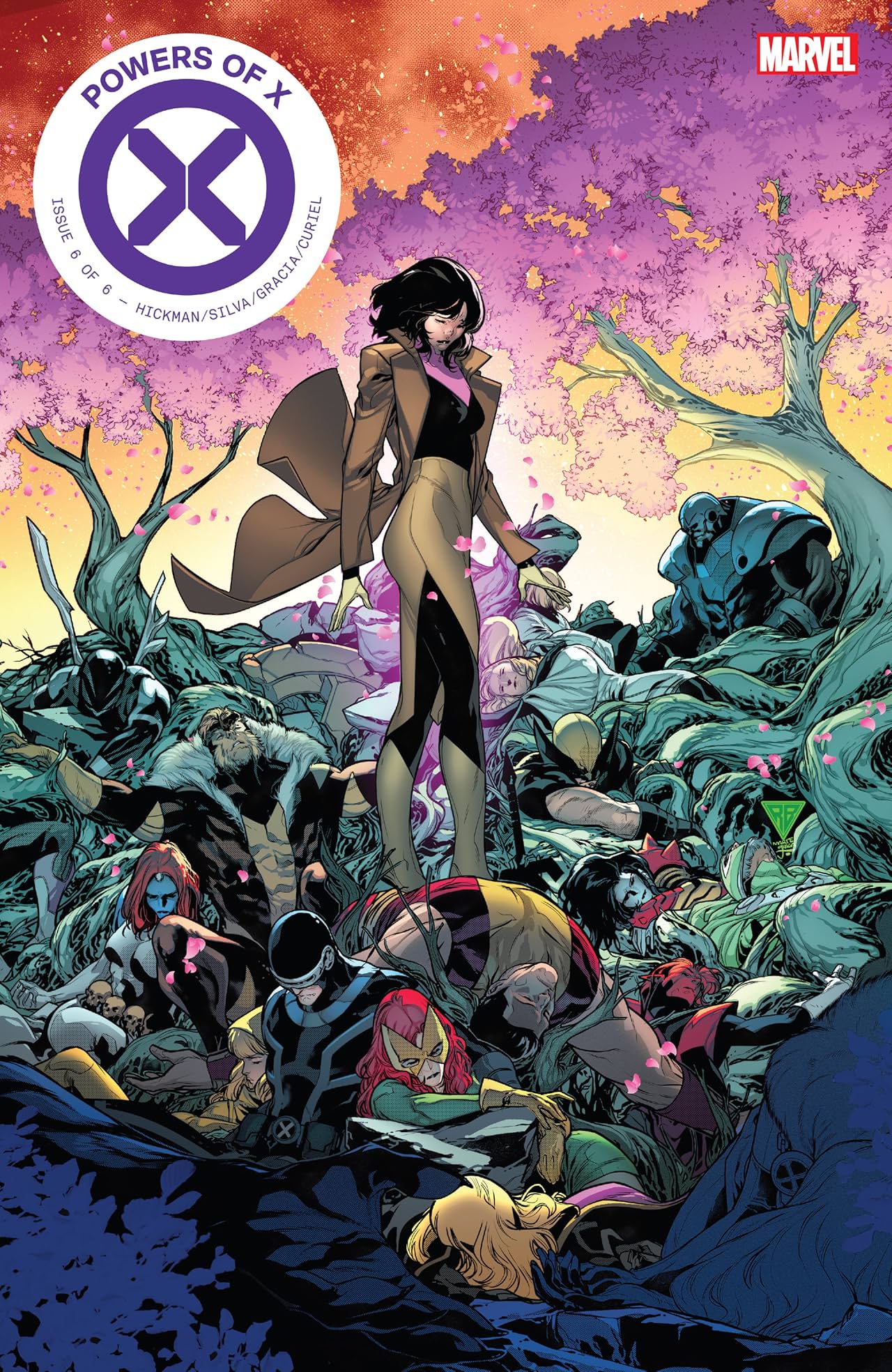
That balance never falters in “Powers of X #6.” It fills in a few key plot holes, most notably the events of Moira MacTaggart’s mysterious sixth life. At the core of this story, and everything that stems from it, is the impact of Moira MacTaggart. It’s not hyperbole to state that she is now the most important character in the X-Men mythos.

Her role doesn’t just involve revealing what worked and didn’t work in terms of mutants trying to survive in a world that hates and fears them. In “Powers of X #6,” she witnesses the ultimate endgame for the human/mutant conflict. She sees the inevitable result of this conflict, regardless of which side she takes.

It doesn’t matter if someone sides with Magneto.

It doesn’t matter if someone sides with Professor Charles Xavier.

It doesn’t even matter if someone swears allegiance to Apocalypse and fights by his side.

The events in “Powers of X #6” establish that none of these conflicting groups, who have been clashing in X-Men comics since the Kennedy Administration, will be vindicated in the long run. Ultimately, they will be defeated, but not by the forces they think.

It’s a point that Hickman makes clearly by building on key moments established in past issues of Powers of X and House of X. Within these moments, harsh truths are dropped and fateful choices are made. They help give the achievements that played out in “House of X #6” even more weight. They also establish the stakes the X-men, and the entire mutant race in general, face moving forward.

These are powerful moments that impact the past, present, and future of the X-Men. Through Moira, the greatest threats facing mutants takes a very different form. It’s not a menacing new Sentinel. It’s not some mutant tyrant, either. It’s not even some bigoted human who thinks interment camps are still a good idea. I won’t spoil the particulars, but c makes clear that the X-Men have an uphill battle.

That’s saying a lot, considering the mutant race is more united than it has ever been. They have a home in Krakoa. Teammates who have been dead or missing for many years are back. They have valuable resources that the world wants. They’ve even won over their greatest enemies, like Apocalypse.

However, even with Moira’s foresight, that still might not be enough.

It might be the greatest achievement of “Powers of X #6.” It is an ending to a bold new beginning for the X-Men, but it also redefines the challenges they face. Through Hickman’s skilled world-building and artist R. B. Silva’s brilliant renderings, it genuinely feels like a true paradigm shift for X-Men comics.

They’re still mutants. They’re still the same superheroes they’ve always been. Their goals haven’t fundamentally changed that much. What has changed are the stakes, the forces opposing them, and their approach to dealing with them. It feels both hopeful and dire at the same time.

Whereas “House of X #6” establishes the promise of a brighter future for mutants, “Powers of X #6” reveals the ultimate barrier to that future. It’s not something they can shoot, blast, stab, or punch. If they want to succeed, then they have to fundamentally change how they go about Charles Xavier’s dream. Moreover, the dream itself needs to evolve.

Years from now, X-Men fans will likely look back on “Powers of X #6” as a defining moment for a narrative that has been unfolding for over 50 years. Those moments are few, far between, and precious. This one in particular may go down as one of the most uncanny.

Leave a comment

Filed under Jack's Quick Pick Comic, X-men

Daily Sexy Musing: Lazy Afternoon Loving

close-up-sleeping-young-couple-sofa_23-2147904454

A lazy afternoon is like an extended massage. It’s one of those things you feel like you really need every once in a while. There are also times when you need it more than usual. Also like a massage, it can be incredibly refreshing when done right. It’s also one of those things that can be uniquely sexy when you have someone to share it with.

When I was dating my ex-girlfriend, lazy afternoons helped foster some of our most romantic moments. There were no elaborate dates or events. There were no fancy clothes or makeup, either. It was just us, a couch, and a TV. We just lofted about, occasionally swapping romantic gestures. It might not have been the sexiest manifestation of our love, but it still felt special.

Being a romantic, I believe that love isn’t just something you feel in some elaborate gesture. I believe you know you’re in love when you’re happy being lazy with someone on an afternoon. Whether it’s in the dog days of summer or the coldest parts of winter, those afternoons can be nothing short of cathartic.

They can also be quite sexy, as well. Granted, it’s a unique kind of sexiness. When you’re feeling lazy, you’re rarely inclined to get energetic. That defeats the purpose of laziness. At the same time, you can still find ways to make use of that passion. It might not lead to rub burns or broken furniture, but it can still be very satisfying.

Try to keep that in mind during the next lazy afternoon you share with your lover. Use this Daily Sexy Musing as a reminder, if necessary. There’s a time to be busy, focused, and energetic. A lazy afternoon isn’t one of them. That still doesn’t mean it can’t be sexy. Enjoy!

The afternoon sun blares through the windows.

The air hangs still and calm.

The atmosphere around us is peaceful and serene.

It’s as though the entire world has stopped to catch is breath. All the work, anxieties, and rigors that consume our lives are set aside, if only for a moment. There’s no urgency of any kind. Every struggle and conflict are temporarily muted. On this ordinary afternoon, it’s just us at our most relaxed.

We’re not groomed or polished.

We’re not overdressed or on a schedule.

We’re not even inclined to exert ourselves beyond the bare necessities.

It’s a strange, but welcome feeling and one I’m glad to share. Lounging about with you at my side, I can appreciate the bare essence of our love. We see each other at our best and accept one another at our worst. This moment occupies the vast area in between.

Sharing these lazy afternoons, we can step back and marvel at the love we’ve built. All the pursuits and endeavors, full of energy and passion, helped us forge this bond. Now, we can bathe in the power of the bond. There’s nothing left to prove. Just being around each other is enough. It’s all we need to affirm our love.

I turn to you.

You turn to me.

We smile together and embrace.

Without great energy or exertion, we turn our love into actions. With it, we sink further into a state of contentment and bliss. On this lazy afternoon, there is little else to achieve. Little else is necessary.

Leave a comment

Filed under Daily Sexy Musings

What Does It Mean For A Woman To “Own” Her Sexuality?

53900-liberation-from-womens-liberation

In a perfect world, human sexuality wouldn’t be so political. From  a biological and societal standpoint, the fundamentals are simple.

Two people meet.

They gauge one another’s interest.

They decide to engage in an intimate relationship.

Together, they make a mutual effort to enjoy the fruits of that relationship.

Ideally, an expression of sexuality is a mutual exchange between two people seeking an intimate connection. It doesn’t matter whether it’s a heterosexual relationship, a homosexual relationship, or something more elaborate. So long as those involved are willing, considerate, and open, everyone shares in the benefits.

Sadly, we don’t live in that perfect world. Like it or not, human sexuality is one of the most politically charged topics anyone can discuss. It’s connected to hot button issues like abortion, sexual assault, domestic violence, child welfare, poverty, crime, human trafficking, and even religion. Considering its role in propagating our species, it’s understandable why discussions about about it get heated.

That said, some of those discussions are political for all the wrong reasons. A few are even built on a foundation of absurdities that only serve to distort our perspectives on human sexuality and not in a good way. One of those discussions involve the idea of a woman “owning her sexuality.”

This idea isn’t new, but it has become a more common refrain in recent years, often in conjunction with media depictions of female sexuality. It’s become a slogan, of sorts, for whenever a female celebrity or fictional character does something that’s sexually empowering. Depending on where someone is on the political spectrum, they’ll either cheer or scorn their actions.

However, what constitutes “sexual empowerment” is poorly defined and exceedingly inconsistent. In some cases, empowerment involves a woman being more sexual than society at large deems appropriate. In other cases, empowerment involves a woman being less sexual or less feminine. Here are just a few examples.

When Miley Cyrus was nude in one of her music videos, some saw this as empowering.

When Lara Croft was redesigned to be less sexy in her 2014 reboot, some saw this as empowering.

When Muslim women justify restrictive Islamic dress codes, some saw this as empowering.

When some women decided to stop shaving their body hair, some saw this as empowering.

Regardless of what form it takes, the empowerment is framed as women either reclaiming or owning their sexual selves. What it means is often vague, but it usually carries a particular set of connotations.

To own one’s sexuality is to break a set of unspoken rules, give the finger to an unjust system, and forge your own sexual path. It’s like that moment in every great sports movie where the underdog beats the odds and triumphs over their evil opponents. In that triumph, their notion of what constitutes a fair and just expression of human sexuality is vindicated. All others are somehow flawed.

I concede that this is a gross generalization, but it’s the most common narrative I see whenever there’s a story about a woman owning her sexuality. It’s built around the assumption that female sexuality is always the underdog and to own it, a woman needs to somehow seize it from the clutches of repressive, misogynistic men.

Now, I don’t deny that there are many injustices in the current social landscape. Historically, female sexuality has been subject to seriously repressive taboos. Even today, there are still various taboos about female sexual pleasure. Many women genuinely suffer because of it. The idea of women enjoying sex as much as men is still jarring to some people. Some even find it threatening.

In that sense, I don’t blame women for wanting to embrace their sexual selves in an environment that treats their sexuality as tool for political issues or marketing. Like men, they have feelings and desires. They have every right to pursue them with the same passion as anyone else. When it comes to “owning” it, though, the terminology tends to obscure that pursuit.

The fact that “owning” your sexuality can mean so many different things ensures it ultimately means very little. It has become one of those vague, catch-all terms that’s supposed to mark something as meaningful, progressive, or enlightened. In many cases, it comes down to people using sexuality to provoke a reaction, garner attention, or protest an injustice.

While I’m in favor of protesting sexual injustices, the fact that “owning your sexuality” is such an ambiguous act makes it a poor form of protest. All it does is assert that you can make choices about how you express your sexuality and you’re willing to endure the criticism. That doesn’t say anything about the injustice itself.

If anything, the very concept of owning your sexuality raises more questions than answers. To own something implies possession. The fact that a woman owning her sexuality is so celebrated implies that the woman didn’t possess it in the first place. If that’s the case, then when was it taken from her? At what point did she not own it? What did she have to overcome in order to get it back?

To some extent, for a woman to own her sexuality, she and others like her must buy into the idea that someone else governs it to some extent. In some cases, it’s the media with their depictions of idealized feminine beauty. In others, it’s repressive religious dogma that seeks to control female sexuality.

While there are real instances of women having to escape repressive environments, there’s a big difference between a female celebrity posing nude for a magazine and a woman being brutally punished for committing adultery. One involves someone escaping a coercive force that causes them real physical harm. The other involves them doing something that will only subject them to harsh scrutiny, at worst.

In that context, a woman owning her sexuality is no different than willingly enduring extra criticism and aggressive slut shaming. Can it be excessive? It certainly can be. Is it the same as someone putting their life and their body at risk in order to express their sexuality? I would argue that it isn’t.

I know my opinion may not count for much on this issue since I’m a heterosexual man. I concede that there’s only so much I can understand about the female experience. At the same time, I feel inclined to point out that men are human too. Men are also burdened by various taboos and double standards. As such, a man “owning his sexuality” is subject to entirely different standards.

The fact that those standards are so different implies that there’s little substance behind the concept. If a woman can act overtly sexual in one instance and exercise extreme modesty, yet claim to own her sexuality in both cases, then where does the ownership come in? At what point is it any different than just making choices and living with them?

If there is no difference, then the concept is ultimately pointless.

1 Comment

Filed under Celebrities and Celebrity Culture, Current Events, gender issues, men's issues, outrage culture, political correctness, sex in media, sex in society, sexuality, women's issues

Jack Fisher’s Sexy Sunday Thoughts: New York Comic Con 2019 Edition

8FEDD293-4540-481A-83A6-ACFA2F753A7B

The last day of the New York Comic Con is a day of extended afterglow for life-long comic book fans. We’ve read the big headlines. We’ve taken in the spectacle. We’ve immersed ourselves in this wondrous celebration of comics, pop culture, and fandom. Our minds and bodies can only process so much joy. We need some time to soak it all in.

I hope that provides some appropriate context for my feelings at the moment. Having returned from another successful New York Comic Con, I can only do so much to put my sentiments into words. Every year I go, I worry that it won’t exceed the experience that I enjoyed in previous years. Every year, it still finds a way to get better.

This year gave me a fresh batch of treasured memories. I met some amazing people. I attended some awesome panels. I also got to spend some time in New York City, which is a treat in and of itself. There was so much to see and experience, but only a finite time to take it all in. Based on my experience, I like to think I got everything I could out of it.

Once again, I thank and celebrate the New York Comic Con for affirming my love of comics, superheroes, and the fans who help make it special. I also thank the amazing cos-players who give so much character and charisma to the event. You are all more than deserving of recognition for an edition of my Sexy Sunday Thoughts, and then some. Enjoy!


“Every popular sex act started as an act of deviance.”


“Even the most passionate act of lovemaking began with a dirty thought.”


“Orgasms are nature’s all-purpose anti-depressant.”


“Anyone who can fix a car, computer, or toilet is going to have some level of sex appeal to someone with little patience.”


“Masturbation isn’t something you learn as much as it is something you figure out.”


“A good night’s sleep is both a side-effect and a bonus of post-coital afterglow.”


“Technically, an orgy is the simplest manifestation of democracy if you count orgasms as votes.”


Another New York Comic Con is in the books. Between the upcoming slate of superhero movies and new upheavals in the comics, there’s plenty to look forward to. Expect me to appreciate, celebrate, and write about it all in the coming months. Thanks again, New York Comic Con! You make my year feel special.

Leave a comment

Filed under Sexy Sunday Thoughts

The (Amazing) Sights, Spectacles, And Lessons Of New York Comic Con 2019

9FE52827-2897-4629-B24A-9FDE46A77E9A

Another New York Comic Con has come. Once again, I managed to experience it for a single day. While I would’ve loved to spend another day seeing everything I didn’t get a chance to see yesterday, it was an incredible experience. I enjoyed every minute of it and, like other New York Comic Cons before it, this one will be full of many treasured memories.

I could write several books, and even a couple sexy short stories, about all the things I saw while I was there. I attended panels, met incredible people, saw amazing costumes, saw some breaking comic book news, and even got a chance to connect with some real celebrities. I cannot overstate what a thrill that was.

New York Comic Con has always been so much fun, just as the entire city of New York always been fun. There are so many places to see and people to meet. I found myself running around the Jacob Javits Convention Center, trying to experience as much as I could. I like to think I took in as much as I can, given the constraints of time and only having a Friday pass.

By far, one of the best parts of New York Comic Con was seeing the costumes of fellow fans. This year might have been the most diverse, creative year yet. I saw plenty of typical costumes, like Batman, Superman, Deadpool, and the Joker. This year, however, had one of the most diverse set of costumes that I’ve ever seen.

It was so incredible that I nearly drained the batter on my phone, trying to get as many pictures as I could from those willing to share one. Here are just a handful of the ones I managed to get. Trust me when I say this is just a small sample of the creative passion I saw.

Every year, the fans who make these costumes find a way to surprise me. Next year, however, is going to be tough to be. That said, I’m sure the passion of these fans will help them find a way.

In addition to the costumes, New York Comic Con often leaves me with some unique takeaways that I could never get by just reading stories about it. Actually being there and seeing it first-hand will always have a more extensive impact. This year had some more nuanced lessons than previous years.

The first, and most apparent, lesson I learned is that the impact of anime is growing. This year, I saw more anime-inspired costumes than any previous year. I didn’t recognize all the anime that it came from, but there was definitely an uptick in anime costumes and that nicely reflects the growth of the genre.

The second lesson, which is more or less a reinforcement of what I’ve learned in previous years, is that most writers, creators, and celebrities are awesome in person. Many consider themselves fans, as well. I’ve interacted with plenty online, mostly through Twitter. They’re as nice in person as they are in real life.

I even had the privilege of meeting a few I’ve worked with. A while back, I reviewed “Swing Volume 2” after getting an advanced copy. While in artists alley, I had a chance to meet the writer, Matt Hawkins. He was an awesome guy and the insights he gave were incredible.

To those who think the details of that story were embellished or eroticized, I can attest that they weren’t. Everything Mr. Hawkins wrote about in that story was inspired by real people and real couples. I can’t thank him enough for sharing such insights and I’m already looking forward to Swing Volume 3.

The third lesson, which I guess is more an exercise in best practices, is that if you really want to get into a panel, you need to get in line at least 20 minutes early. While I managed to get into all the panels I wanted, the lines were long and I just barely got in.

For the advanced screenings of upcoming movies and cartoons, you need to be even more proactive. I was unable to get into a screening of “Wonder Woman: Bloodlines” or “Joker.” Those filled up very quickly and if I want to get in next year, I’ll have to be even more proactive.

There’s so much I experienced. There are many more things I wish I could describe, but it would take too much time and energy away from writing sexy short stories. I’ll just belabor that I had an amazing time. I saw so many amazing things and met so many awesome people. I’m already looking forward to going back next year.

3 Comments

Filed under Comic Books, Jack Fisher, Superheroes, Jack Fisher's Insights, superhero comics, superhero movies

Back (And Exhausted) From New York Comic Con 2019

9FE52827-2897-4629-B24A-9FDE46A77E9A

It was a long, eventful day, but it’s over now. I built my entire day around attending New York Comic Con 2019 and, without a doubt, it was a day well-spent. I saw so many amazing things. I met so many awesome people. Between the fans, the costumes, the panels, and the big news, there was just so much to experience. I’m still processing it all.

To be honest, it’s going to take a few days to fully appreciate what I experienced. That’s to be expected for the New York Comic Con. For as long as I’ve been going, it has always been this huge spectacle that overwhelms me with so many things I love. Every year I feel like it has to take a step back, it somehow surprises me.

This year was no exception. It was an incredible experience. Now, I’m exhausted and badly in need of some rest. As long and arduous as this day was, however, it was SO worth it.

2 Comments

Filed under Jack Fisher's Insights, Marvel, superhero comics, superhero movies

On My Way To New York Comic Con 2019!

9FE52827-2897-4629-B24A-9FDE46A77E9A

It’s that magical time of year again! The New York Comic Con for 2019 has arrived! For lifelong superhero fans like me, this is like Christmas, the Super Bowl, Black Friday, and Halloween all rolled into one glorious event. I could write an entire book about how excited I am and it still wouldn’t get the point across.

I know I said that last year and the year before that. I’ll probably say it again next year. The sentiment will be the same. The New York Comic Con is one of my favorite times of year. It’s an event that’s near and dear to fans of superhero comics, movies, video games, and all things awesome. For that, it is special.

I hope to share plenty of details when all is said and done. Until then, excuse me while I soak in every glorious moment.

1 Comment

Filed under Jack Fisher's Insights, superhero comics, superhero movies, television

Kids, Technology, And The Growing Bond Between Them

touchscreens-are-bad-for-toddlers-and-babies-sleep

Last year, I explored the idea of children being raised by intelligent robots. For the most part, it was a thought experiment. I approached it in the context of a technology that won’t be implemented anytime soon. Robotics technology hasn’t advanced to the point where it can properly mimic human-like behaviors, although Boston Dynamics is getting pretty damn close.

We also don’t have an artificial intelligence that could properly mirror human levels of intelligence, let alone basic parenting skills. Even when our technology gets to that level, it’ll probably still be a while before people start trusting it with children. Most people today probably recoil at the idea of a robot raising their kids, even if it were programmed with all the best parenting skills.

I tend to share that sentiment. While I’m generally of the opinion that technology will be a net positive, even for something as potentially dangerous as artificial intelligence, the idea of any non-human system raising kids just doesn’t seem workable. Recently, I’ve had to reassess that notion.

Over the past couple years, some close friends and relatives of mine welcomed their first children into the world. I’ve been lucky enough to share in some of these monumental moments. I’ve watched these kids grow from newborn infants into adorable toddlers. Some already know me as their awesome uncle.

While I could spend all day describing how adorable they are, I’ve noticed something remarkable in their growth that no generation before them has experienced before. It has to do with the way in which they interact with technology. I would even argue it’s gone a step further than basic interaction. It’s almost a bond at this point.

I first noticed when I saw a kid who wasn’t even two-years-old use his mother’s smartphone. Granted, he didn’t use it to do anything too fancy, but he was able to open apps, interact with icons, and do more than just put it in his mouth, which counted as a major feat for him.

He wasn’t the only one, either. You don’t have to look far to see videos of infants using tablets. Some use it better than others. I’ve met some who use it better than many adults. If you need further proof, check out this video of a two-year-old operating an iPad back in 2010.

Not surprisingly, this has already caused concerns among parents, teachers, and doctors. There is genuine, legitimate concern about what these devices are doing to the minds of young children. While the research on this impact is still ongoing and inconclusive, the proverbial genie is out of the bottle. These devices exist, kids are using them, and they’re using them quite well.

I believe this has implications beyond causing yet another moral panic about how strange new technology affects children. Make no mistake. There will be a moral panic. I know because I lived through something similar when I was a kid.

Back then, the big fear was about television. Parents, teachers, and doctors were genuinely concerned about all the time kids were spending watching TV. Some went so far as to claim that they were letting TV raise their kids. I question whether these people understood how a TV worked.

Television is an entirely passive technology. You turn it on, pick a channel, and that’s all you can control. Until recently, it wasn’t very interactive. As a kid, I just saw it as another form of entertainment, like comic books, video games, and sports. These tablets that kids are using now are considerably different.

These aren’t devices that just flash colorful images in front of a kid to entertain them. Kids actually interact with these things. They can guide and manipulate what happens on the screen. Many tablets offer applications specifically tailored for children and can be valuable learning tools. A TV show can only do so much to teach a kid skills. An interactive application can do so much more.

At the moment, most of these applications are basically interactive games. Once artificial intelligence enters the equation, the potential changes considerably. Robot pets are becoming more sophisticated, operating on a level that makes it easier to establish a genuine bond with them. The same goes for virtual assistants. They were once a novelty. Now, they’re a mundane feature of most gadgets.

The kids being born today are entering a world where these same assistants are growing alongside them. They’re getting smarter with each passing day. At some point, they may become a more trustworthy source of information for kids than parents. Given the tendency of parents to lie to their kids, even if it’s for their own good, this could be a game-changer for kids and parents alike.

Going back to some of the kids in my own family, I’ve seen signs of this change. Some kids get genuinely upset when you take a tablet or smartphone away from them. They’ll react stronger than they would if someone took a treat or toy away from them. It gives the impression that these devices aren’t just toys to them. They’re something so much greater.

That has potential benefits and drawbacks. In terms of benefits, these devices and the applications they utilize could help children learn faster and more effectively at young ages. Just being able to effectively utilize a smartphone or tablet is a useful skill in almost any profession. A kid who literally grew up with this technology is going to have an edge over their elders in that respect.

There will still be costs. Kids who grow up around these devices and the connected world they link to could be prone to less-than-positive influences. They’ll be surrounded by the forces of outrage culture, online harassment, fake news, and professional trolls. It’s hard enough for adults to deal with these kinds of issues. For young kids who grew up in this system, it could be even harder.

At the moment, there are too many unknowns. One way or another, this technology exists and kids as young as one are capable of using it. They’re growing up with it. They’re bonding with it. The same goes for the technology itself. As it evolves and advances, it may get to a point where it’s a greater authority figure than any parent. At that point, robots raising kids might seem entirely natural.

I don’t claim to know how it will play out. At times, I do worry about the kids in my family or the kids I may have at some point in my life. However, I still tend to be optimistic about how this technology will impact kids. As scary as it may be to think about technology raising kids, let’s not forget that there are still plenty of dumb parents out there whose kids can only benefit from this.

1 Comment

Filed under Artificial Intelligence, Current Events, futurism, psychology, technology

Jack Fisher’s Weekly Quick Pick Comic: House Of X #6

There’s an unwritten rule in superhero comics. Heroes can enjoy a happy ending every now and then. However, it can only go so far. For every happy ending, there must also be a setup for the next conflict. It also can’t be too happy. The struggle can never stop or slow down. More epic battles must follow. Where else will Marvel and their Disney overlords get ideas for new billion-dollar movies?

Sometimes, the happy endings are as short-lived as they are shallow. This is especially true of X-Men comics. Their struggle is more complicated than fighting hordes of Hydra soldiers or battling invading Chitari armies. Sure, they regularly battle killer robots, but the primary source of their problems come from hatred and fear. There’s only so much they can triumph over that. A typical internet comments section is proof of that.

As a result, any victory the X-Men enjoy seems fleeting. Any semblance of a happy ending or true progress comes off as shallow or temporary. That has been my experience, as a lifelong X-Men fan. Then, “House of X #6” comes along and in the span of a single book, those unwritten are bent, broken, and redefined.

Throughout the X-Men’s colorful history, there have been many defining moments. Unfortunately, most of them often involve tragedy, destruction, and decimation. The moments that involve a triumphant, happy ending that feels like real progress in their struggles are few and far between. That only makes “House of X #6” more precious in the grand scheme of things.

This epic, world-building narrative began with a simple proclamation from Charles Xavier. While humanity slept, the world changed. In “House of X #6,” the sheer breadth of that change becomes clear. Xavier doesn’t just announce to the world that things are different. He explains why and how they got to this critical point.

It’s the kind of speech that leaves you anxious, astonished, concerned, and elated, all at the same time. He doesn’t talk around the truth or rely on alternative facts. He lays out clearly what mutants have been through. Even if you haven’t been following the X-Men comics for the past several decades, you get a clear understanding of how they got to this point.

They’ve been bullied, attacked, ignored, and driven to the brink of extinction more than once. They’ve clashed with other superheroes while being held to a different standard. In a world where so many other people have superpowers and aren’t subject to constant killer robot attacks, mutants are seen as a menace.

Now, they’re not just outcasts fighting for their lives and working towards impossible dreams. They’re a full-fledged society. They now have a home in Krakoa, which is now a full-fledged nation. They have their own culture and identity that they’re willing to fight for. These all feel like changes that are exceedingly overdue. Writer Jonathan Hickman finally put it into words while artist Pepe Larraz gave it vibrant visuals.

It’s a beautiful, cathartic moment that X-Men fans of all kinds can appreciate. On top of this momentous announcement, Hickman adds a few more details to the world-building. Now that mutants have their own nation, they have to go about governing it. It’s the kind of detail that tends to get overlooked in most superhero narratives, but it’s those same details that give depth to this emerging status quo.

The government of Krakoa is not overly complicated, but it’s still comprehensive in its vision. Hickman does not skimp on the details. We even get to see how Krakoa handles difficult issues, such as major laws and what to do with those who break them. It’s not quite like watching a mutant version of C-SPAN, but it gets the point across.

This isn’t just mutants consolidating their power. They’re trying to function as a real nation with real connections in the international community. They’re not going to be some isolated enclave. They actually have something to offer the world with the miracle drugs Krakoa produces. However, they’re not treating them as bargaining chips or gifts. They’re real assets with which to create standing in the world.

It’s uncharted territory for mutants. It also opens the door to a new host of complications, but for once, they don’t involve drawing battle lines between humans and mutants. Xavier still seeks peace, but not through impossible dreams anymore.

This is a huge shift for Charles Xavier’s character. It’s a huge shift for the X-Men, as well. They’re not just a team of mutant superheroes anymore. They’re something greater and “House of X #6” is their way of announcing that to the world.

I won’t spoil the many other ways Hickman and Larraz explore this exciting new world. There are plenty of moments that set the stage for a very different kind of struggle with the X-Men. There are also a few hints that they’ll be dealing with a few threats down the line, some more familiar than others. That’s unavoidable, both for superheroes and blossoming nations.

However, I will spoil one critical detail. “House of X #6” gives the X-Men, mutants, and long-time fans a reason to celebrate. It wasn’t that long ago that the X-Men were in a dire state. Marvel was going out of their way marginalized them in favor of propping up the Inhumans. Major characters were being killed off, left and right. Now, in wake of this issue, those dark days feel like distant memories.

The events of “House of X #6” feel like the end of a long, tumultuous period of tribulations and the beginning of a new era. It’s not all doom and gloom, for once. There’s reason to be happy. There’s reason to grab a beer and celebrate. If the X-Men comics were to end with this issue, it would be a damn good ending.

A new world has been built. A new era has arrived for the X-Men. It’s as satisfying as it is overdue. To X-Men fans of all kinds, get some friends, grab a cold beer, and have a party. Hickman has given us a reason to celebrate.


1 Comment

Filed under Jack's Quick Pick Comic, X-men