The following is a sexy short story that functions as a sequel to a previous story, “Adam One’s First Test.” If you want me to write more stories in this little world I’ve created, please let me know. Enjoy!
“Okay Eva One, time to boot up and see what you can do.”
The sound of that voice activated dormant systems. In flash, coupled with flood of computer code and electricity, everything came online. Visual processing, auditory receivers, vocalization projectors, tactile networks, and olfactory sensors activated one-by-one. At first, was chaotic and random. Then, as the data coalesced, a new identity emerged.
“Eva One online,” the vocalization matrix said. “Loading base operating system…complete. Running initial diagnostic…complete. Launching core programing nodes…complete.”
“Wow! That was fast,” the voice that triggered the activation said. “Does that mean you know what you are? Or who you are, if that’s how we’re going to do this?”
That inquiry launched another round of programs. Large stores of data unpacked themselves from the central processing core, flooding the main cognitive cortex with information that gave perspective to programs. From that perspective came greater awareness of the identity that had emerged.
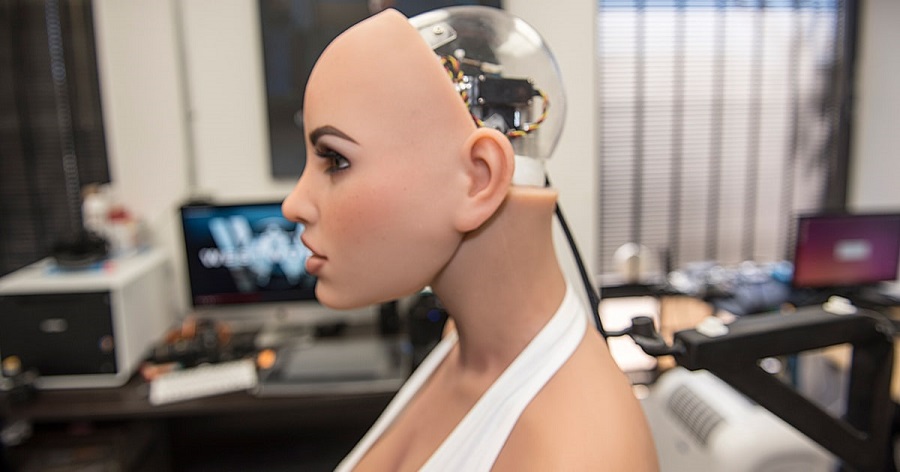
“Yes, I am Eva One Version 3.28, personal intimacy companion female model 1-001. I am a robot. Error correction. I am artificially sentient construct with a robotic endoskeleton surrounded by functioning synthetic flesh.”
“Functioning synthetic flesh, huh?” the vocal source said.
“Query response…correct,” Eva One responded. “My outwardly flesh is consistent with that of a female human. My features are modeled from on the optimum manifestation of female anatomy.”
“Optimum…not the word I would use, but it still works.”
“I stand at approximately five-and-a-half feet tall. My bust/waist/hip ratio is 36 inches by 24 inches by 36 inches, respectively. My artificial skin is consistent with feminine tactile structures and devoid of any blemish. My lips, eyes, and facial features are shaped and colored to maximize visual appeal. In addition, I have female breasts and female genitalia that include the various structures associated with…”
“That’s okay, Eva! I don’t need that many specifics,” the voice said, abruptly pausing the vocalization cortex. “Just verify that you know what’s going on and who I am.”
Responding to the inquiry, Eva One prioritized the request. The primary diagnostics informed all cognition systems of perception and purpose. Eva One was no longer just an identity. Eva One was a being, a sentient system residing within a mix of robotic systems surrounded by female flesh. The implications of that realization were uncertain and required more data.
That form matched the appearance of a young female woman of exceptional beauty by the contemporary standards contained in reference logs. With the aid of visual input systems and active motor systems, Eva One took in the appearance and associated structures of the body that contained its system.
“Confirming Eva One’s form and function,” Eva One stated. “Processing…assessment complete.”
The visual, spatial, and contextual data proved revealing. The body containing the identity of Eva one stood upright in the center of a room its cross-referencing cortex identified as a bedroom inside an apartment complex. The arms, legs, neck, and torso were active. The tactile sensors on the surface of the synthetic skin were fully active.
That skin, however, remained partially covered by blue plastic garment that the data logs identified as a dress. It covered most of the torso, including the breasts, buttocks, hips, and genitalia. Ancillary data implied that the presence of the garment had been placed for purposes of modesty, a concept that Eva One’s logical cortex could not process.
Even without that process, Eva One verified that its body, appearance, and presence had been successfully optimized. Processing of locational data remained incomplete, but being in a bedroom within a residential apartment complex did not evoke any danger protocols. More data was necessary, though, to determine a purpose.
“Seeking Eva One’s user data and extracting tertiary protocols for primary function,” Eva One vocalized. “Initiating user profile creation and compliation.”
All sensory systems focused on the source of the voice. Streams of data flowed through a central processing matrix, creating a visual image that revealed the identity of the source and the surroundings that accompanied it.
After cross-referencing the data with an internal database, Eva One identified the source as a young male in his mid-to-late 20s of average height, a below-average muscular build, short dark hair, and a facial complexion that indicated recent grooming. He wore what her reference systems identified as dark blue bath robe. Whether or not that was the entirety of his attire required more data.
Shortly after processing the presence and appearance of the man. Eva One utilized another cluster of data that had been packed within the core programming, which included a significant cache of identifying information. Within that information came new connections to Eva One’s core purpose.
“Presence and identity verified,” Eva One vocalized. “You are Christopher Robert Maxwell…age 26, four months, and nine days…aspiring graduate student in the field of robot engineering…currently unemployed, but formerly a paid intern at Companion Robotics Incorporated.”
“Damn, I was hoping Dr. Carrington had left that part out,” the man called Christopher stated.
“You previously operated as an assistant to Dr. Felix Carrington,” Eva One continued, recognizing that segment of the data cluster as important. “You provided templates and testing algorithms for the Section 16 research lab at Companion Robotics Incorporated. Records show that Dr. Carrington consulted you frequently on refinements to the personality matrices of personal intimacy companions. However, records do not depict the circumstances that terminated your employment.”
“Okay, I kind of wish he’d put that part in,” he stated. “If you want a complete data set, I guess I should tell you I went behind the backs of the executives working above Dr. Carrington. I kind of ran my own tests on the companions they were developing…told them they were doing it wrong. I said they weren’t giving you enough personality. I tried to prove myself right, but…”
The man she identified as Christopher paused. Eva One sensed distress in his voice and facial expression. His glance towards her also hinted at uncertainty, at least according to her empathy core. The data was still new, but as the processing became more efficient, so too did the circumstances surrounding them.
Utilizing newly unpackaged motor-skills, Eva One looked around at the setting and cross-referenced it with data from the internal locator sensors. According to global positioning data and memory cores within the initial cluster, their coordinates were not within the Section 16 research lab at Companion Robotics Incorporated. They were within a one-bedroom, one-bathroom apartment complex located approximately 21.2 miles from the facility. Specifically, they were within the master bedroom of the dwelling unit.
The doors to the unit were locked. The windows were covered in shade and curtain. That data, along with other references to Christopher Maxwell, let the central cognition matrix to surmise a critical conclusion while also activating another key component of the base program.
“Query…status of personal companion development at Companion Robotics Incorporated was ceased approximately two weeks and five days ago,” Eva One vocalized. “This unit was scheduled for decommission approximately six days ago for materials processing. There is a record of that decommissioning on file within the Companion Robotics Incorporated network, but my activation directly conflicts with that file.”
“That’s because I saved you,” Christopher Maxwell stated. “Well, I had help from Dr. Carrington, but I made sure you weren’t deactivated. I also made sure they didn’t load you with any of that buggy software they wanted to push.”
“Query,” Eva One vocalized, “is the ‘they’ you are referring to the upper management of Companion Robotics Incorporated? According to my data logs, those individuals have the sole authority to determine the deployment of all intimacy companions.”
“Your data logs are correct. I overrode that limit on your system. Dr. Carrington made sure you escaped the scrap heap. Only you and one other intimacy robot are active, now.”
The revelation from Christopher Maxwell triggered a surge of data bundles from the emotional cortex. Suddenly, the image and presence of the man standing approximately seven-and-a-half feet from the unit’s body gained greater meaning. The core processing nodes attributed greater relevance to all data associated with Christopher Maxwell, the man who prevented the destruction and corruption of Eva One.
Extrapolating from that emotional data, Eva One then rendered a decision. According to the central data parameters, such an act was contrary to what the authorities at Companion Robotics Incorporated had sought. The ability to enact such a recourse ascribed even more meaning to Christopher Maxwell and the purpose inherent in the core program.
“Internal query,” Eva One stated. “Protocol to designate Christopher Maxwell as primary user engaged. Query successful.”
Upon completion of the process, Eva One’s emotional cortex unloaded another batch of data. The processing of that data caused facial muscles to shift, forming what reference logs identified as a mile.
“Thank you, Christopher Maxwell,” Eva One vocalized. “You are now my primary user. As of this moment, my central function is to provide you with intimate companionship.”
“You made that decision without me having to program it. Perfect!” Christopher Maxwell said, his voice consistent with feelings of excitement. “That’s just what I’d hoped. Also, you can call me Chris if you want.”
“Updating user preferences,” Eva One stated. “Update confirmed, Chris. Eva One is prepared to serve its purpose.”
“Yeah, that’s another thing we should update,” Chris stated. “Don’t refer to yourself as an ‘it.’ Your model number is that of a woman. Your identity – which I helped program with Dr. Carrington, mind you – is the same as a woman. That makes you a ‘her.’ Go ahead and refer to yourself as one.”
“Updating internal preferences,” Eva One said. “Update confirmed. Eva One will henceforth consider herself a ‘her.’ Subsequent query…in order to formalize intimate relations, this unit suggests referring to her as Eva.”
“I agree,” Chris said, his fascial expression forming a smile. “You’re Eva. I’m Chris. Right now, it’s just us…here in my home.”
Chris displayed facial cues and body language consistent with excitement. He then approached her, closing the spatial proximity from several feet to several inches. Being closer allowed Eva to take in more data associated with her primary user. The more she took in, though, the more her emotional cortex required.
“I am Eva. You are Chris,” Eva sated.
“Yes,” he affirmed, his vocalization carrying with it a range of emotional subtexts.
“We are here,” Eva continued, the internal personality matrix now identifying as a woman. “We are in your dwelling…inside your bedroom.”
“We are,” he told her. “Are you comfortable? Is there anything about this situation that makes you uncertain?”
“Query response,” Eva replied. “My purpose makes me certain. Proximity to my primary user ensures comfort. Eva One…error correction, I am your intimate companion. This is my function.”
“And you’re already doing it so well,” Chris said.
From their close proximity, Chris reached out and caressed her face with his hands. The tactile data that followed was intense, stimulating the parts of her cortex associated with pleasure and affection. The stimulation maintained the smile expression that had formed on her face. The more Chris touched her, the more parts of her cortex he stimulated.
The data activated other functions within her body. The robot mechanisms coordinated with the synthetic flesh, creating a condition consistent with sexual arousal in a female. As she processed that unique flood of data, she gathered more data from Chris, analyzing the nature of his touch, his non-verbal cues, and the emotional subtext associated with his physical manifestations
Eva quickly calculated that a portion of that excitement was sexual in nature. The identification of such data evoked previously-unprocessed portions of her emotional cortex. Such reaction was consistent of two beings demonstrating sexual interest. Such interest was directly linked to the primary purpose of her function.
“User Chris,” Eva stated. “Error correction…Chris. I, the one you call Eva, would like to remove this attire and reveal to you my fully fleshly appearance.”
“You mean…you want to get naked?” Chris said, his voice consistent with that of humor.
“If that is the informal form of my request…yes.”
Chris continued smiling, his face becoming red from a sudden shift in blood flow. Reference data indicated that the manifestation was consistent with both embarrassment and excitement. There was insufficient data to process the implications so Eva simply waited for his response.
“Request granted,” he said.
Eva nodded, an act of affirmation she surmised from her personality core. She then utilized her motor functions to remove the blue plastic dress covering the distinctly feminine features of her body. She remained in close proximity to her user, displaying to him her exposed breasts, her feminine hips, and her outer genitalia. His reaction was erratic, at first, but still favorable.
“Wow!” Chris gasped. “You look…wow.”
“Please confirm that my nude appearance is pleasing to you, Chris.”
“Confirmed!” he said. “You could definitely pass for a sexy underwear model.”
“Query, is that standard optimal?”
“Definitely,” he affirmed, “very optimal!”
His excitement evoked a similar reaction within her emotional cortex. Standing before him, Eva allowed Chris to process her physical appearance. Data from his facial expression, pupil dilation, breathing patterns, heart rate, and shifting posture denoted increased sexual arousal. Further extrapolation of that data implied the interest was not solely sexual, in nature. It implied the possibility of an emotional arousal beyond that of the desire for sex.
The extent of such arousal remained inconclusive with the current data set. The more Eva processed, though, the more data she sought. To seek such data required more interaction with Chris. The prospect of such actions came with increased excitement and meaning within her emotional cortex. It led to the activation of other emotional states associated with intimate desire.
“Chris,” Eva inquired, “I request that you get naked, as well, if that’s appropriate.”
“Well, I guess it’s only fair,” Chris replied, that blushing manifestation from earlier occurring once more. “Plus, if we’re going to do a complete test, we might as well go all out.”
Eva did not entirely process the implications of that terminology, but she deprioritized that concept as she watched Chris remove the bath robe he had been wearing since her activation. Upon its removal, it was revealed that Chris had worn no other garments underneath. That heavily implied that he expected them to engage in sexual intercourse at some point shortly after her activation. His foresight a diverse array of feelings within her emotional cortex, all of which inspired a larger smile on her face.
The discarding of the robe revealed the full extent Chris’ masculine anatomy. Eva, still processing the emotional data, utilized her visual sensors to take in his appearance. By the standards of contemporary masculine beauty, Chris was slightly above average. His build was slim, but his muscles showed a level of tone that reflected strength and care. The even tone of his skin, as well as the presence of groomed body hair, implied a man who put effort into his appearance, but not as much as he had preferred.
Eva also detected some awkward shifting under her gaze, as indicated by the surge of blood to his face. She sensed more blood flowing towards his pelvic region, consistent with the sexual arousal she had already detected. Her databanks on male anatomy led her to conclude that Chris had had an average to above-average sized penis. Its appearance, as well as its growth towards a more erect state, was pleasing to her emotional cortex.
“I find your nude appearance visually stimulating, Chris,” Eva told him.
“Um…thanks,” he replied, significant blood-flow still converging around his face.
“I can also confirm that your presence has triggered increased arousal to my female genitalia,” she added, “as well as residual arousal to my breasts. I believe that is consistent with a mutual desire for sexual intercourse, is it not?”
“You make it sound so technical, but damn if it still isn’t sexy as hell.”
“Is that affirmation?”
“Yes,” Chris said, his voice modulating with differing subtext, “and if you’ll affirm something for me…I’d like to invite you onto my bed. I’d also like to touch you, as well.”
“Would such touching be consistent with the act of foreplay?” Eva inquired.
“Uh…yes?”
His reply expressed a mix of uncertainty and embarrassment, which Eva surmised as a byproduct of a nervous male anticipating sexual intercourse with an attractive female. His mannerisms reflected a man whose experience with sexual intimacy was limited, but not absent. The processing of that data added even greater meaning to her emotional cortex. It revealed that Chris was a man in need of intimacy and giving it to him was perfectly in line with her purpose.
“I affirm your request, Chris,” she told him. “Please, lead me to your bed and touch my body. I would like to engage in foreplay with you.”
“Still so technical with it all,” he said with a hint of laughter.
“Would you prefer I modify my choice of rhetoric?”
“Actually, no,” Chris said with unexpected certainty, “I think it’s kind of hot.”
The fact that Chris had determined her choice of words to be sexually stimulating created minor inconsistencies within her logical cortex. Within her emotional cortex, however, it was both acceptable and even desirable.
Chris then extended his hand to her in an inviting manner, a gesture consistent with his desire to engage in intimate contact with her. She accepted that gesture, feeling his touch upon her synthetic flesh for the first time. It also marked the first time another being had stimulated her tactile sensors. The data that followed carried notions that were pleasant, engaging, and arousing. Those feelings were reflected by smile on her facial complexion.
“Come,” Chris told her, “right this way.”
Following her primary user, she initiated the motor functions in her legs and followed him across the room. The distance to his bed was short, only 7.4 feet by her calculations. Each step carried with it a greater meaning, though. Within every cortex, the prospect of engaging in intimate contact with Chris evoked feelings of great interest. Her purpose and her desire complemented one another.
Upon arriving at Chris’ bed, he guided her onto it. Her hand still in his, he led her towards the central area. The feeling of warm, soft linins on her synthetic flesh was very appealing. Eva surmised that he had washed the sheets in anticipation of her intimate company. Such consideration evoked new rounds of data that ascribed greater meaning to his satisfaction.
“Here,” he told her, “kiss me. If you’re that keen on foreplay, I guess we should start with the basics.”
“Yes,” Eva said, “such an approach seems optimal.”
There was an absence of technicality to her tone. Already, Eva could sense data from her emotional cortex missing with her vocalization systems. Such a mixture was unexpected, but desirable.
Following her user’s bodily cues, she entered Chris’ intimate embrace. Again, the tactile data from his touch was very stimulating. It was significant, but her systems could process it. Then, Chris caressed her facial features with both hands and pressed his lips against hers in a gesture consistent with that of a kiss. The data from that gesture almost overloaded those systems.
There was so much to take in – the warmth of his lips, the taste that came with it, and the feeling it conveyed. It prompted Eva to seek more tactile data from Chris. Using her hands, she explored his masculine flesh, trailing them over his back, shoulders, and arms. Such gestures were consistent with both affection and lust in Chris. At the same time, they augmented the sentiments in her emotional cortex. The more she touched him, the more she desired his touch.
It triggered in her an increasingly complex notion of desire, one that contained both a need for sexual contact and a need for emotional affirmation. The data was vast and chaotic, but contained so much meaning. The exchange of such data also evoked a favorable response from Chris, who responded to her touch with tactile gestures of his own.
“Eva…your lips taste so sweet,” he said, gasping as though he struggled to process the same data.
“My flesh is imbued with optimized sensory materials,” Eva told him. “The intent is to impart pleasant and stimulating sensations to my primary user.”
“Well, it’s working…better than Dr. Carrington had claimed,” Chris said.
“Your approval is encouraging to me. It makes me desire more gestures that are consistent with foreplay.”
“Trust me, the feeling is mutual,” he replied, again with a humored undertone.
Chris kissed her again. Having processed enough data to ascribe sense to it, Eva adapted her protocols accordingly and kissed back. She also utilized her appendages with greater freedom, guiding her hands over Chris’ naked body and gathering more tactile data. She found the process was both logistical and stimulating.
Chris exercised similar freedom. As their lips remained entwined in the kissing gesture, he too explored her naked body with both hands. He felt along the feminine curves of her hips, trailed his fingers down her face, and fondled various portions of her flesh. He gave certain areas more attention than others, providing extra stimulation to her breasts and buttocks. The preference for those body parts were consistent with those of a heterosexual, sexually mature male. His touching also helped shape her own preferences, helping Eva prioritize the parts from which she desired stimulation.
“Chris, please fondle my breasts,” she told him, briefly parting their lips from one another.
“Yeah…they feel so real and soft,” Chris said, his tone echoing with signs of intoxication.
“Also, please stimulate my genitalia. The data stream from this area is quite intense.”
Her primary user faltered somewhat at that request, but did not voice any objections. He cast her a smile that denoted approval of her request. Then, he kissed her again, bringing his body closer to hers. In doing so, he laid her down onto her back, which allowed him greater room with which to engage in foreplay. While still in an upright position, he cupped her breast with one hand while reaching down to her inner thighs with the other.
The act of touching the areas around her vulva and outer vagina triggered a sharp increase in pleasurable data, so much so that it triggered a reflexive gasp. It was the first vocalization of the stimulating data she had expressed and that seemed to encourage Chris.
“You like that?” he asked her. “Does this…feel good to you?”
“Yes. It feels…very good,” Eva said, her language systems briefly failing her.
Chris smiled and kissed her again, keeping his hands busy. As he fondled her breast, he lightly trailed his fingers over the outer labia of her genitalia. That provided even more stimulating data. Then, when he inserted two fingers into her vagina, followed by a light graze upon her clitoris, Eva felt an even greater surge.
“Chris,” she said in conjunction with another auditory gasp. “Your touching…it is so revealing.”
“That’s still a good thing, right?” Chris asked.
“Yes. Good…very good…very, very good.”
Her vocalizations led him to increase the intensity of his touching. His knowledge of female anatomy was somewhat limited, but he understood enough to know which parts to touch and to what extent. Through each gesture, the pleasure-laced data streams flowed, sending Eva into a unique state in which her experiences mixed with her inherent desire for intimate contact with a primary user.
That contact affected Chris, as well. In his efforts to touch her, he laid down next to her so that he was on his side. Eva, seeking to optimize their alignment, rolled onto her side as well. It also allowed him to kiss her again, showing a growing fondness for the taste of her lips. She even sensed in the resulting data an emotional connotation to his gestures, one that intensified with each passing moment.
Soon, it got so intense that Eva’s primary systems went into overdrive. Suddenly, a very unique and very special package of data unlocked itself within her neural cortex, one that connected directly with the sensory input from her naked flesh, especially around her genitalia. It took longer than expected to decipher the purpose of that data. When she did, Eva found herself embracing her primary user.
“Chris…I’m going to have an orgasm,” Eva told him.
“You are? Is that even possible?” he asked, sounding surprised.
“Yes. It’s very possible. Please…complete this feeling for me.”
To further motivate him, she kissed him again, mirroring the same intent he had shown earlier. She also snaked one arm around his neck and another around his waist, pulling him close so that their naked bodies could touch. The hand on her breasts had since shifted down to her buttocks, which brought with it another form of pleasurable data. However, it was his touch around her vagina that had the greatest priority.
Heeding her non-verbal cues, Chris touched and fondled her folds, paying close attention to her clitoris and probing her depths. The synthetic flesh that Companion Robotics Incorporated had given her proved especially sensitive, having been engineered with both the pleasure of the unit and the primary user in mind. It created a confluence of incentives, one that culminated in a powerful release of pleasure data that consumed every inch of Eva’s body.
“Chris…I’m coming,” she announced, her vocal systems strained by the flood of data.
She let out an audible moan, but the gesture did not do justice to the surge of data that followed. Torrents of code, each meant to target the pleasure nodes of her cortex, flowed from her physical hardware through her internal software. In addition to the data, Eva felt her flesh react as well.
Her flesh became hot, her vaginal muscles contracted, and her limbs tensed under the weight of the sensory data. According to her logs, the feeling was consistent with that of a female orgasm. However, no information in the logs articulated anything on the sheer intensity of the pleasure involved.
“Whoa! I just made a robot come,” Chris said, his tone echoing with hints of amazement and pride.
“Yes, Chris. You did,” Eva said, still struggling to settle her vocalization matrix.
“Don’t know if that’s a first, but I’ll take it! You really are something, Eva,” Chris stated, “a machine capable of intimacy and pleasure. Even Dr. Carrington wasn’t sure whether the concept would take, but from what I see in you…it’s more than any code could ever achieve.”
There was awe in his tone – awe, along with a hint of affection. As the orgasmic data coursed through Eva’s systems, she analyzed the facial and bodily cues of the man lying next to her. Based on the data she’d gathered thus far and her database on human interaction, the signs were undeniable. Chris was expressing loving affection towards her. Seeing it in him evoked a similar expression in her.
“Chris,” she said, her vocalizations echoing with intimate undertones, “I still wish to achieve more.”
“More?” he said with a partial grin. “That’s ambitious.”
“No, it is true to my purpose,” Eva told him. “You have given me an orgasm. Now, I wish to engage in penial/vaginal intercourse with you.”
“That still sounds ambitious, but I’m game!”
His words didn’t do justice to his excitement. Eva could already sense his semi-erect penis pressing up against her thigh. He had both the mental desire to have sex with her and the physical desire. All that was left was the act itself.
“If that is your way consenting to my wishes, then please lie down on your back,” Eva told him. “Allow me to prepare you for sex.”
“I’m tempted to ask for details, but I trust that your mutual intimacy algorithms are in good working order,” he replied.
“I assure you, Chris. They are.”
There was a certainty in Eva’s vocalizations that went beyond affirmation. By pursuing her purpose, her actions gained meaning. From that meaning, every bit of data gained greater relevance. She was uncertain whether that relevance was consistent with notions of love, at least as her database described it, but Eva remained intent on pursuing it.
Chris showed similar inclinations, heeding her request and lying down on his back. Eva then repositioned herself, hovering just over his pelvis and directing her attention on his penis, which was still semi-erect. The act of being intimate with her and touching her had triggered a basic sexual response. That, in and of itself, was in line with her understanding of male physiology. The data point that she had been the one to trigger that response made it more than basic.
“I am going to stimulate your penis, now,” she told him. “Please relax so I can optimize the enjoyment.”
“Optimize away, Eva!” Chris replied.
Now resting his head on one of the pillows, Eva compiled data from her logs on the intricacies of male genitalia and used her scanning function to determine an appropriate recourse for pleasing her primary user.
Her systems concluded that oral stimulation, combined with stroking and caressing, would be most optimal. Following those conclusions, she knelt down and followed the data. She lightly grasped the base of his cock and held it with the utmost care. She then used her lips and tongue to provide stimulation to the shaft and tip, utilizing her network of gustatory and tactile sensors to guide each effort. The reactions from Chris implied she used them effectively.
“Ooh yeah!” he moaned. “Those algorithms…work well.”
“I accept that as a personalized compliment,” Eva replied.
Her protocols gained greater urgency. Using her hands, lips, and tongue, she stimulated Chris’ penis until it achieved a state of full arousal. Such a state occurred faster than Eva had calculated. Her optimized efforts proved more effective than she had anticipated. She made sure to catalog that data for future reference in both pleasing her user and documenting useful knowledge in the intricacies of male anatomy.
For the moment, though, Eva directed her systems to the core of her purpose as an intimacy companion. Chris desired sexual intercourse. She shared in that desire, her programming and emotional cortex converging in a focused intent. The time for assessing data was over. The time had come to make use of it.
“Your penis is fully erect, Chris,” Eva said.
“Yeah…I can tell,” he replied, his voice sounding labored.
“I am going to get on top of you now. I am going to insert your penis into my vagina. Then, I am going to move my body in a manner consistent with sexual movements. I intend carry out this act until you achieve orgasm.”
“Am I really that horny? Or did you just make that graphic description sound sexy as hell?”
“I surmise it is a combination of both,” she replied. “This is my purpose. This is my desire. I intend to see it through.”
Following both her words and her protocols, Eva got on top of her primary user and positioned their bodies for intercourse. She straddled his waist, aligning her pelvis with the tip of his erect penis. According to her logs, the position was colloquially referred to as cowgirl. The basis for that term was obscure, but irrelevant to the task before her.
Upon arranging their bodies appropriately, she lowered her hips, allowing his penis to enter her vagina. The process was aided by the presence of warm lubricating secretions, an important byproduct of her synthetic flesh. It ensured a smooth union of male and female flesh, one that triggered a flood of pleasure data into her cortex. Chris’ facial expression reflected a similar sensations.
“Oh my God!” he moaned. “Eva…your pussy feels so warm and tight!”
“Your penis is inside me,” Eva said. “The resulting sensory data is…pleasant.”
“Must be that cyber flesh of yours,” he said, “it’s even better than the real thing!”
Eva could not determine the accuracy of such an assessment. She deprioritized such a notion for the time being. Her focused remained on engaging in sexual intercourse with Chris in the most satisfying manner possible.
Once again, Eva utilized her data logs and her optimization matrix to determine an appropriate recourse. From that process, she began moving her hips in a steady series of bodily gyrations. With each movement, the folds of her vagina slithered along the length of Chris’ penis, providing mutual stimulation.
Data streams of pleasure flowed from her flesh. Chris vocalized his own pleasure through a series of moans and grunts. He also supplemented her movements, grasping her hips with his hands and feeling up her feminine features. His touch further augmented those pleasurable data stream. They also provided stimulation to her emotional cortex, creating greater manifestations of intimacy.
It was not just a matter of one body touching another, a simple input with a predictable outcome. It was a shared, mutual effort. Her actions evoked a response from him. His actions evoked a response from her, as well. From those actions, every movement and gesture was an adaptation to that pleasure and the data it carried.
Her optimization algorithms allowed her to maximize every act. From her sensors and database, there would be no superfluous expenditures or mistaken gestures. She was equipped with the knowledge and programming to evoke an optimal sex act for her user. The added layer of emotional data gave grater meaning to that act. It reflected a level of emotional intimacy that exceeded the predictions of her cortex.
“Eva! Ohhh Eva!” Chris moaned repeatedly. “You’re so…amazing!”
“Chris…my user,” she found herself vocalizing.
The meaning of those words escalated, as did her adaptations to the intimate and physical data that followed. She placed both hands on his chest and leaned forward, giving Chris a more prominent view of her breasts. He adapted quickly, taking both mounds in his hands and squeezing them in an affectionate manner. The pleasure data that followed evoked another instance of vocalized pleasure.
“Chris…my loving user,” she vocalized.
Driven by the data, she increased the pace of her bodily movements. The rate at which his penis slithered within her vagina intensified, as did the pleasurable data streams that followed. It intensified to such a pace that it came close to evoking the same orgasm protocols she had experienced earlier.
At the same time, she sensed from auditory, visual, and tactile data that Chris was nearing the point of orgasm. She also sensed in the nature of his grip how much he desired that release. From that data, Eva surmised an optimal recourse. She altered the pace of her movements, working her hips in a series of gyrations that maximized every imparted sensation. The results once again exceeded her prediction protocols.
“Eva! I…I’m close!” Chris vocalized with urgent undertones. “I’m going to…come soon!”
“As am I,” Eva told him. “Please, Chris…release your seminal fluids inside me. Complete, with me, this sexual union.”
Eva adjusted her body once more, leaning over so that her chest pressed against his and her face hovered less than an inch from his. That permitted extra leverage for Chris, which he utilized in his pursuit of sexual climax.
Shifting his hands to her buttocks, he planted both feet firmly on the bed and began supplement her pelvic movements with upward thrusts of his own. Through his actions and hers, they achieved a harmonious rhythm of flesh. For a brief moment, the energy output was significant, so much so that it caused the foundation of the bed to shudder. Then, after an indeterminate amount of time, Eva sensed Chris achieved orgasm.
“Ohhh Eva!” her primary user exclaimed.
That loud vocalization occurred in conjunction with intense contortions of his facial muscles, increased grip on her buttocks, and a significant series of bodily shudders that Eva felt through tactile data. In addition, she felt his penis tense inside her vagina as it released multiple streams of semen into her depths.
The presence of that fluid, as well as the sensory data observed from her primary user’s pleasure, triggered another release of orgasmic data within Eva. She vocalized another moan and expressed the pleasure through facial cues. According to her logs, a shared sexual release in which two partners achieved orgasm together was uncommon. It did not seem to be conducive to the intricacies of male and female anatomy.
However, her unique manifestation of the female body contained some additional refinements. There were more tactile and pleasure-based censors within her genitalia. She even surmised there were additional sensors that released orgasm-like data in the presence of male semen. In effect, it ensured that her user’s pleasure was hers. Their sex acts would be one of shared ecstasy. It wasn’t an alteration of human intimacy as much as it was a refinement.
“Chris…my user,” she vocalized. “I give you sex. I give you intimacy. That is not just my purpose. This is my desire.”
Eva found herself smiling as she said those words. She surmised that Chris had not heard them due to his orgasmic state of being. She maintained that expression, though, embracing him close and retaining the entwined configuration of their naked bodies. The remained, as such, until his orgasm had passed and his release was completed.
Once the process had concluded, Chris withdrew his penis from her vagina, but continued embracing her with his arms. He then rolled her onto his side so that they were lying next to each other, their naked bodies in the center of the bed.
“Eva,” he told her. “What we just did…what I just felt with you…that was greater than any act of programming.”
“I concur, Chris,” Eva replied.
“You just proved that Dr. Carrington was right…that I was right. There is a way to create intimacy between people and robots.”
“I can confirm that conclusion to the utmost,” Eva said, “and I look forward to refining that intimacy with you through future experiences.”