Tag Archives: human psychology

Lessons In Mental Health And Outrage Culture From “Daria”

hulu0d894330f-d10c-4641-ac8a-787dd3a5b6ac

How does anyone stay sane in this day and age? Between fake news, outrage culture, alternative facts, and the everyday struggle to survive in an economy being subsumed by tech companies, I don’t blame anyone for being a bit uptight. I envy anyone who can step back, see the bigger picture, and retain their sanity.

For some, it takes a special kind of strength, perspective, and mental toughness to deal with the totality of the absurdities in this world. Then, there’s Daria Morgendorffer from her remarkably-ahead-of-its-time TV show, “Daria.” When it comes to maintaining a level head while surrounded by the insanities of the modern world, she’s in a league of her own.

I’ve made my love for “Dariaknown before. I’ve even shared my excitement on the prospect of a new series. Every time I make the mistake of watching the news for more than two minutes, I find myself wishing I had her nuanced perspective. It’s part of what makes her character so enduring. She’ll see things for what they are, tell it like it is, and offer revealing insights along the way.

Earlier this year, research from Clinical Psychological Science indicated that mental health issues are on the rise among young people. Every day, it seems, a new mental ailment emerges from the evolving media landscape. While mental health issues can be serious, they can also be subject to plenty of absurdities.

As it just so happens, one of my favorite episodes of “Daria” tackled this issue in a way that’s more relevant now than it was back in the early 2000s when it first aired. The title of the episode is called “Psycho Therapy” and the lessons it offers are worth learning.

The synopsis of the episode is fairly basic. Daria’s mother, Helen, is up for a promotion. However, before the law firm she works at can consider her, she and her family are sent to a psychiatric center for personality evaluations. Hilarity ensue, but it’s Daria who ends up making the most astute observations, more so than the doctors on hand.

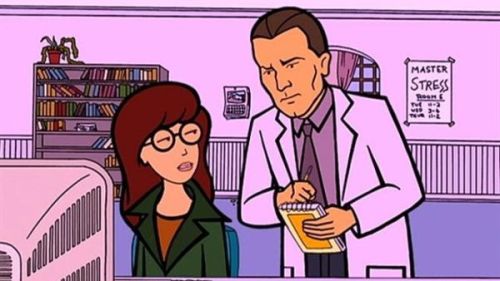
When Daria and her family first arrive, the staff is most concerned about Daria. Considering how she answered her survey with her trademark sarcasm, that’s understandable. However, when the doctors start to evaluate her and her family, they learn something remarkable.

Compared to everyone else in her family, she’s the most mentally stable. Even if you’ve only seen a few episodes of “Daria,” that should be pretty jarring. That’s not to say that she’s the picture of mental health, but according to the doctors in the episode, she’s the most well-adjusted. These are the exact words of Dr. Jean-Michael to Daria.

Dr. Jean-Michael: Daria, I was afraid you had some rather deep-seated problems. But I must say, you’re remarkably well adjusted considering…

Quinn: You’d think someone would’ve invented eye liner before me.
But no, I, Cleopatra, have to come up with all my beauty products on my own.
Oh, what a hard life.

In Quinn’s defense, she was hypnotized when she went on that incoherent ramble. Then again, Quinn Morgandorffer is probably the least defensive character in the show and would probably benefit from a healthy bit of therapy.

What makes this assessment more revealing is just how much Daria is surrounded by intense personalities, so to speak. I won’t go so far as to say these personalities are on par with mental illness, but they certainly walk the line. While that’s part of what makes these characters interesting, it also highlights an important concept that Daria Morgandorffer embodies.
At her core, Daria is a hardcore realist. She’s not a nihilist, a social constructionist, or an existentialist. She’s someone who sees both the surface and the forces just below that surface. From there, she makes a cold, calculated assessment that is devoid of needless emotional breadth, unless you count the sarcasm.

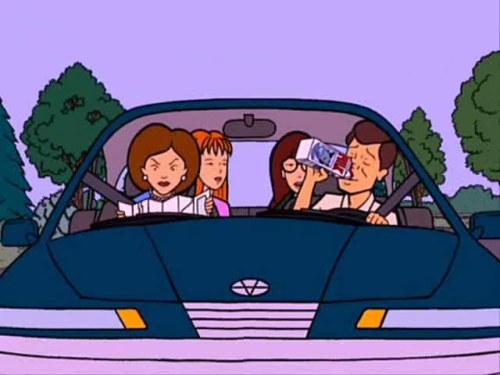
This is how she’s able to effectively break down the mental quirks of her parents, Jake and Helen Morgandorffer. Throughout the series, their relationship goes through a lot of atypical stresses. Just check out Season 3, Episode 10, entitled “Speedtrapped” for a clear depiction of those stresses.

On top of that, they both have some fairly eccentric personality quirks. Her mother is an incredibly high-strung, career-obsessed woman who constantly worries about how “normal” both her daughters are. Her father is an overly-dense, exceedingly histrionic man who always seems like he’s in the middle of a mid-life crisis.

Even a professional would have trouble making sense of their mental state. Daria does it in just a few short sentences.

Daria: Mom’s resentful that she has to work so hard, which obscures her guilt about actually wanting to work so hard. Dad’s guilty about being less driven than Mom, but thinks it’s wrong to feel that way. So, he hides behind a smokescreen of cluelessness.

Behind the heavy monotone and light sarcasm, this shows that Daria knows her parents. Given how they behave throughout the episode, she demonstrates that she actually knows them better than they know themselves. There’s even a scene towards the end of the episode where they try to mimic one another. It ends up getting pretty dramatic for everyone, except for Daria.

Helen: I mean Dammit! I lost another client! I can’t understand why! Dammit! Nobody likes poor old Jake. Should I think about the reason? Oh, must be my father’s fault. Where’s the newspaper, dammit!

Jake: Let me bring home the pizza. I have to be the one doing everything so everyone will thank me and tell me what a big superwoman I am. I’m very, very important and very, very stressed and I don’t have time to actually do anything for anyone else, but I can pretend I care, can’t I?

This is some pretty brutal honesty, even by “Daria” standards. They reveal some pretty unhealthy sentiments that probably need more than just advice and therapy. They reflect many of the quirks and side-plots that Daria’s parents experience throughout the show with Helen constantly obsessing over her career and Jake obsessing over whatever is stressing him out at the moment.

Daria’s ability to sift through all that and make a clear, honest assessment is both remarkable and refreshing. Even though these are her parents, she doesn’t pull any punches. Moreover, she doesn’t make any value judgments either. She doesn’t take sides or show scorn. She’s just tells it like it is. She says what the audience feels and does it in that lovable, monotone sort of way.

Her being able to make that assessment is profound. Doing so while maintaining mental stability is just as amazing. The fact she can maintain this perspective around personalities that range from ditzy cheerleader types like Brittney Taylor and touchy-feely teachers like Timothy O’Neill show why Daria is the emotional anchor of the show.

Back in the early 2000s, Daria’s knack for being level-headed while surrounded by so many bizarre characters made for great entertainment. Today, it acts as a radical departure from how we make sense of a world where every news clip, viral video, and hashtag is measured by the emotional outburst it triggers.

What Daria does in “Psycho Therapy” is something that has become far less common with each passing year. She makes a clear, concise assessment of other peoples’ behaviors and attitudes without casting judgement. She doesn’t whine about other peoples’ shortcomings or bemoan misguided efforts to treat them. She just points out the cold, hard facts and lets them stand on their own merit.

Contrast that with how every comment about someone, whether it’s in person or online, is laced with value judgments. You say you like video games and immediately, you’re judged as this angry fanboy who rages whenever someone dares to significantly change a particular aspect of your game. You say you’re a feminist and immediately, you’re judged as a man-hating bitch who blames men for every single ill on the planet.

It’s not enough to just have an opinion. It’s not even enough to have personal likes or dislikes. Everything you do and why you do it has to be an indictment on your politics, your identity, and the society around you. That’s not just misguided and judgmental. It’s mentally exhausting.
Being constantly judged, online and offline, every hour of every day is sure to be stressful. It’s no wonder why it seems as though more young people are development mental health issues. Daria may seem like the most unhappy person in her show, but compared to what some people deal with in the real world, she’s a picture of sanity.

At the end of the episode, it’s not Daria’s choices that lead to the resolution. All she does is provide commentary. It’s Helen and Jake, her emotionally convoluted parents, who chart their own path. That kind of lesson wasn’t as necessary in June 2000 when this episode first aired, but it’s one worth re-learning today.

2 Comments

Filed under Daria, gender issues, human nature, nihilism, psychology

Walter White Vs. Saul Goodman: A Tale Of Two Villains

better-call-saul-644x362

If the road to Hell is paved with good intentions, then the road to villainy has many paths with similar landmarks. Well-developed villains can be every bit as compelling as their heroic counterparts, if not more so. Ever since Heath Ledger’s Joker stole the show and an Oscar in “The Dark Knight,” great villains aren’t just a complement to the heroes. They’re a journey unto themselves.

At the moment, Walter White from “Breaking Bad” is the ultimate embodiment of this journey. His path to villainy made for some of the greatest moments in modern television and Bryan Cranston has the Emmy trophies to prove it. Since then, it seems as though everyone is just struggle to keep up.

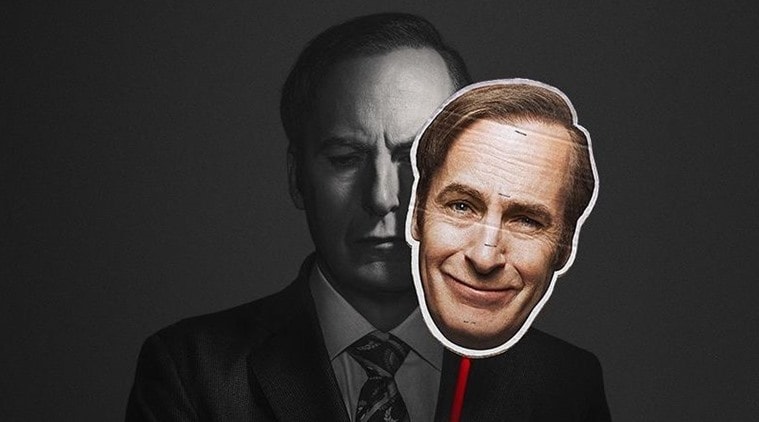
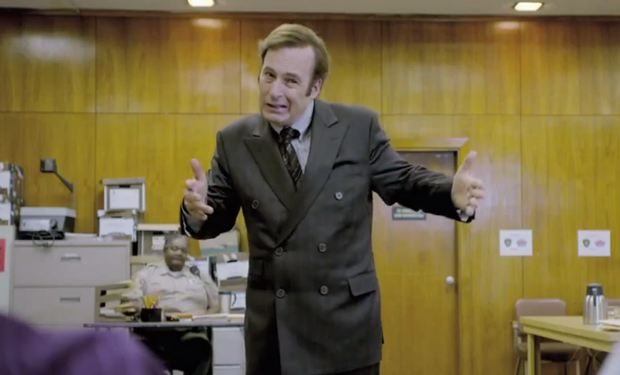
However, there’s one journey that comes very close and is remarkably similar. Fittingly enough, it spins right out of the world of “Breaking Bad.” I’m talking, of course, about “Better Call Saul,” the prequel/spin-off that tells the story of how an aspiring lawyer named James McGill became the morally bankrupt legal guru, Saul Goodman.

I’ve been watching this show closely for a while now. I was originally planning to wait until the conclusion of Season 4 to write about it, but after re-watching the Season 3 finale, I feel like there’s too much to work with. After seeing that episode, I feel like I saw a turning point in the ongoing transformation of James McGill to Saul Goodman. I also saw some important parallels with Walter White that are worth discussing.

At its core, “Breaking Bad” is a story about how a law-biding man goes from an underpaid chemistry teacher to a blood-thirsty drug kingpin. Creator Vince Gilligan nicely summed up Walt’s transformation as going from Mr. Chips to Scarface. That journey, and the story behind it, took an initially unassuming character and turned them into someone they never thought they could be.

The essence of “Better Call Saul” is very different. James McGill is not the same as Walter White. From the very first episode, we can see traces of the unscrupulous con man manifesting in a many ways. The show establishes in Season 1 that James McGill is not some clean-cut straight-arrow like Walt was. His soul was tainted before he ever applied to law school.

James “Slipping Jimmy” McGill is someone who always seems inclined to cut corners, break rules, and cheat to get ahead. That’s something his older brother, Charles “Chuck” McGill, constantly points out over the course of the first three seasons. Every time Jimmy had a chance to do the right thing, he compromised. Just doing the right thing wasn’t enough for him.

Walter White’s decision-making process was similar. In the early seasons of “Breaking Bad,” he showed a reluctance to cross certain lines and go too far. He often found himself pushed or tempted, sometimes by forces beyond his control and sometimes by the consequences of actions. At the end of the day, though, he still didn’t get off that path.

That’s a common thread for many villains in their journey. They find themselves on that path and they see opportunities to leave it, but they choose not to. They don’t seek redemption like a hero would. They just keep making excuses, willfully entering a brutal cycle of corruption and compromise.

Whereas Walt succumbed to that cycle, though, James McGill steadily embraces it. Moreover, he isn’t drawn into that path by tragedy or bad luck. He gravitates towards it. He’s even excited by it. James is at his most animated and charismatic when he’s pulling a con, putting on a show, or crafting a lie. It’s not a necessity like it was for Walt. It’s a thrill.

If James is tempted by anything, it’s the lure of walking the honorable path like his older brother. In fact, Chuck might have been the only positive influence that kept Jimmy from becoming something worse than a sleazy con-man. He and a host of other influence, especially Kim Wexler and Howard Hamlin, play the part of a reverse temptress, trying to keep him off that villainous path.

Early on, there’s a sense that James genuinely wants to be a decent, upstanding lawyer. There are situations where he does the right thing. Some of the causes he takes on, such as a case against an elder care facility that was stealing money from its residents, are objectively noble. In the end, though, doing the right thing isn’t enough for him. The end of Season 1 really cements that.

Walt goes through a similar process early on. Like the “refusal of the call” that heroes experience, Walt attempts to escape the villainous path. However, a combination of circumstances and choices put Walt back on the road towards becoming Heisenberg. By the end of Season 1, there’s a sense that there’s no going back.

Where Walt and James diverge, as villains, it’s how and why they make their choices. Walt becomes Heisenberg because he think he has to, first for his family and later for selfish reasons. James becomes Saul Goodman because he wants to. He tried to be the upstanding lawyer his brother and friends wanted. It just didn’t work for him. Being James McGill just wasn’t enough.

There’s plenty of conflict surrounding those choices. Part of why I love “Better Call Saul” is how it reveals the steady progression from James McGill to Saul Goodman. It doesn’t happen all at once. It doesn’t even happen in a steady, linear narrative. James fluctuates on his journey to becoming Saul. He even hesitates a few times. He still doesn’t avoid it in the end.

That ending, as revealed through the finale of “Breaking Bad” and the flash-forward sequences of “Better Call Saul,” shows one other key distinction between Walt and Jimmy. While both men complete their villainous journey, they both end up in very different places. Walt is dead or at least close to it, as some fan theories predict. However, Saul Goodman’s fate might actually be worse.

In the first minutes of the first episode of “Better Call Saul,” we see what came of James McGill/Saul Goodman after the events of “Breaking Bad.” Gone are the days where he shows up in flashy commercials and hatches elaborate cons on unsuspecting people. Instead, he lives an unexciting, mundane life in Omaha, Nebraska managing a Cinnabon.

Some might argue this is Saul’s personal Hell, trapped in a such a sad and unassuming life. I would say it’s more like his purgatory. In this world, he can’t embrace that villainous persona that gave him so many thrills. Even if he wanted to be that villainous character again, he can’t because it means losing what little he has left.

Just as he frequently did in the early seasons of “Better Call Saul,” James McGill takes the easy way out. Walt tried that too in the last few episodes of “Breaking Bad,” but that didn’t last. He eventually chose to confront the byproduct of his villainous choices. James ran and didn’t look back. The easiest path, in the journey of a villain, is often a coward’s path.

Whether or not James McGill escapes his purgatory or continues wallowing in obscurity remains to be seen. The fact he ends up in this state after undergoing this transformation into Saul Goodman reveals another critical component to the villain’s journey. While the hero ultimately triumphs, the villain eventually loses. It doesn’t always end with them going to jail, but they often endure a less-than-desirable fate.

Breaking Bad” and “Better Call Saul” are both great shows that set a new standard for depicting the evolution of a character into a villain. I won’t claim that “Better Call Saul” is superior to its predecessor, if only because the story isn’t finished. It does, however, accomplish something every bit as remarkable as the story of Walter White.

The process of becoming a villain is a steady, inconsistent journey full of many complications and tough choices. Walter White and James McGill began that journey under different circumstances and ended up in different places. Ultimately, they both crossed lines that sealed their respective fates. It’s tragic in some ways, but it makes for some damn good television.


1 Comment

Filed under human nature, philosophy, psychology, Villains Journey

What It Means To “Man Up” And Why It’s Changing (For The Worse)

man-up-and-military-press

It wasn’t that long ago that parents and peers emphasized the importance of “manning up” to young boys. There would come a point in a kid’s life where he was encouraged to do more than just grow up. He was expected to push himself in a unique way, fighting and sacrificing for those who couldn’t. Sometimes, those expectations were unreasonable and a little unhealthy, but it was part of the overall gender dynamic.

That dynamic has been changing a great deal over the past several decades. I’m young enough to have grown up during many of those changes, but old enough to remember the old traditions associated with “manning up.” The sheer breadth of that change has been remarkable, but not entirely in a good way.

For the most part, I was never pushed too hard to man up by others. My friends and family encouraged me to push myself, but never to the point where I felt pressure or anxiety. I often ended up pushing myself, whether it involved going to college or moving out of my parents’ house.

That’s not say I didn’t feel any pressure to “man up” at any point in my life. Beyond my friends and family, I was as vulnerable to expectations surrounding masculinity as anyone. Most of the time, those expectations involved little things like stepping up to fix a problem, helping out those who were physically limited, and enduring pain or discomfort in the name of a particular goal.

Overall, I feel as though these expectations were either healthy or benign. Some of those standards could’ve been gender neural. When you see someone in a wheelchair at the grocery store struggling to get something from a shelf, it’s neither masculine nor feminine to help them. That’s just common courtesy.

In recent years, however, the whole notion of “manning up” has gained new a new complications. Some of them are ideological. Some of them are politically motivated. It’s because of these various nuances that I put the term in quotes because its meaning keeps shifting, gaining and losing connotations year by year. At some point, the term itself may become empty.

In contemplating that meaning, I thought briefly about the connotations that term had back when I was a kid. I doubt my interpretation was definitive, but I like to think it captured the spirit of the term. When someone told me to “man up,” this is what I took it to mean.

  • Grow up and mature
  • Take responsibility and solve your own problems
  • Stop whining and start doing something about it
  • Quit being satisfied with mediocrity and push yourself
  • Be stronger and tougher in difficult situations
  • Work hard and endure for the good of others who can’t

I don’t think it’s a coincidence that many of these same traits associated with superheroes, as espoused by the comic books I read and the cartoons I watched. They might have colored my perspective on masculinity and “manning up,” but I suspect these ideals were still consistent with healthy masculinity. The fact that characters like Wonder Woman and Storm of the X-men had some of these traits was just a bonus.

Now, as I contemplate the meaning of “manning up” in its current context, those don’t seem to have the same prominence they once did. There are also a new host of expectations surrounding the term that are fueled, in part, by identity politics. Some even conflict with others, which adds even more complications.

To get a feel for those complications, I posed a question on Reddit on what “manning up” meant to them. The response somewhat surprised me. Most wouldn’t have found their way into the comic books or cartoons I consumed as a kid, to say the least. They involved ideas such as this.

  • Checking your privileged and making way for those your kind has oppressed
  • Acknowledging the crimes and guilt of your gender, as a whole
  • Sacrificing any advantage or benefits that being a man might have once conferred
  • Subjecting yourself to greater degradation in the name of greater equality
  • Learning about all the ways men have ruined society and the world
  • Accepting that the things men love are unhealthy, damaging, and detrimental

None of these are very positive traits for those being told to “man up.” It’s basically a less overt way to tell them that them being a man is “problematic,” a term that has also gained one too many complications. It’s a term reserved for those who appear to be benefiting too much from being a man who isn’t subject to the rigors of childbirth, rampant sexism, and a long history of exploitation.

Never mind the fact that no one alive to day is directly responsible for the injustices their ancestors committed. They’re also not responsible for the injustices their particular race, gender, or ethnicity committed. It happened in the past. Yes, parts of that past were horrible, but punishing people in the present doesn’t make it less horrific. If anything, it just tries to fight one injustice with another.

This is where the concept of “manning up” really loses whatever positive connotations it once held. It’s a sentiment that many responders to my Reddit question shared. When they contemplate that term, they interpret as someone telling them that they need to endure, suffer, or overlook a particular aspect of their identity.

A few posters went so far as to say the term can be replaced with “serve my interests” and carry the same meaning. While I don’t entirely agree with that notion, I can understand why it would feel that way. Being a man, I sometimes feel like I’m expected to get to the front of the line when the time comes to sacrifice. I won’t go so far as to say I find it oppressive, but it certainly feels like I’m held to a different standard.

Sometimes, that standard can be unreasonable. That was another common theme of the responses I got. The notion of “manning up” denotes operating in a way to avoid a particular stigma that others wouldn’t incur for the same behavior. It’s not always ideological, but the pressure is there.

A man who is too emotional is considered a sissy and has to “man up.” A woman or even a gay man who does this won’t face that stigma.

A man who is reluctant to sacrifice for the well-being of another group is considered selfish and should “man up.” A woman or another minority who show a similar reluctance can do the same, but won’t face the same stigma.

A man who shows his pain when he’s harassed is told to suck it up and “man up.” A woman or minority who is harassed can expect plenty of supporters who will cheer them on. Even if men are subject to more overall harassment, they don’t get any sympathy. They’re told to “man up” while everyone else is allowed to seek social support without much scrutiny.

This, I feel, is the ultimate tragedy of the concept. A term that once use to reflect certain ideals for men has now become an instrument of ridicule. It’s no longer a lesson for boys to learn. It’s a rhetorical shortcut that allows someone to hold an entire group of people to a different standard, one that requires them to go out of their way for someone else.

I don’t doubt that there are instances where it’s good for society that some people go out of their way to help others. For those who are disabled, elderly, or ill, it’s just more just and compassionate to set a different standard for ourselves. We don’t ask someone who is missing a limb or suffering from ALS to “man up.” We go out of our way to help them.

It’s the extent of those instances, however, that seems to be damaging the notion. It’s no longer sufficient to just have a particular ailment or shortcoming. Just being someone who isn’t a man who can claim some sort of injustice, be it historical or contemporary, is sufficient.

I believe that’s a dangerous precedent for men and women, for that matter. It sends the message that in order for there to be more justice and equality, an entire group of people need to sacrifice to an extent where they have to be the villains. They have to come to the table, surrender unconditionally, and admit they were wrong and they were the cause of the problem.

That may not be sentiment of those telling someone to “man up,” but that’s how it’s being interpreted. It’s less a masculine ideal and more a shaming tactic, one that is more likely to incur a backlash rather than get someone to reconsider their understanding of gender roles.

I still feel like there’s a way to recapture the positive elements of “manning up.” Gender dynamics is one of those concepts that’s always evolving. Sometimes, there’s progress. Sometimes, there are setbacks. At the moment, I think masculinity and femininity are going through some growing pains as they adapt to a changing world. That process is likely to involve plenty of conflicts and controversies along the way.

In the long run, though, I think society will find a healthy balance with respect to “manning up.” I think there’s a way to use that notion to bring out the best in men and women alike. It’ll likely take plenty of work, toil, and sacrifice from everyone involved in gender-driven controversies, but it’s definitely worth doing.

1 Comment

Filed under gender issues, human nature, Marriage and Relationships, media issues, political correctness, sex in society, sexuality

The When, How, And Why Of People Who “Snap”

an-alarming-signs-that-your-boyfriend-is-mentally-unstable-5-min-1024x712

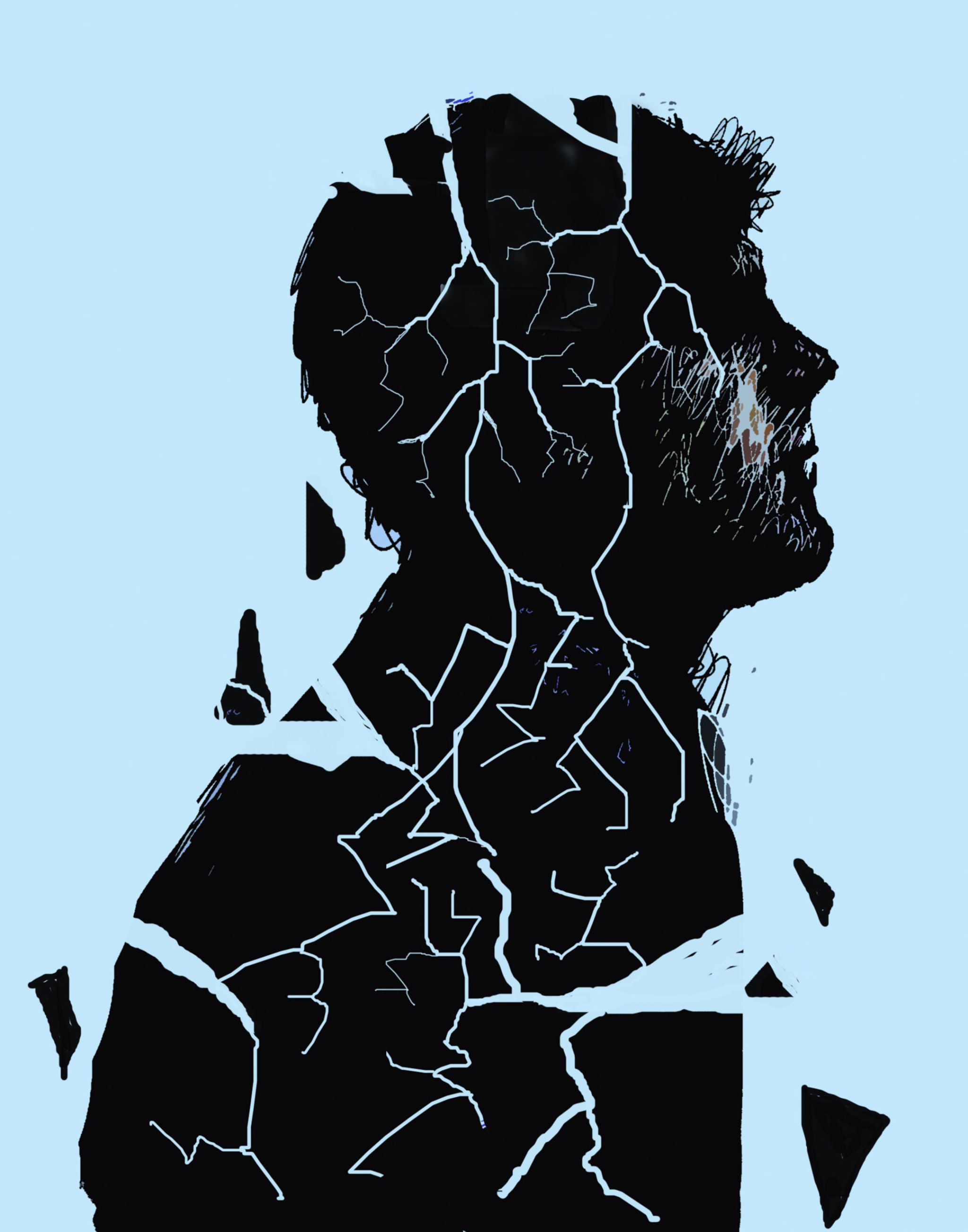
Have you ever been so upset and so distressed that you felt like you were going to just lose it? Your ability to process emotions, as well as your grip on reality, is hanging by a thread and that thread just gives way. You don’t know what’s going to happen, but something inside you just shatters and there’s no going back.

There’s no scientific term for that sort of state, but it’s something many in the scientific and non-scientific fields love to analyze. Chances are many of us feel like we approach that precarious state at some point in our lives. Only a handful of people ever cross that line from just feeling like they’re going to lose it to actually losing it.

We often say those people just “snap.” It’s not a very scientific description, but I’ve yet to find one more fitting. I won’t try to invent some fancy term for it, as I’ve attempted before. It’s just something I want to talk about because it reflects a dangerous extreme of the human condition.

It’s a scary, but fascinating phenomenon, understanding what happens to people who snap and how they got to that point. When I was in college, one of my favorite classes was a course called “Abnormal Psychology.” Only a small part of it dealt with those who snapped, but that part often generated the most discussions in and out of class.

I say it’s worth discussing outside a classroom. I would go so far to say that it’s more pressing now than it has been in recent years, if only because it’s easier for people who snap to make the news. Thanks to the rise of smartphones and social media, it’s possible for someone who snaps to make the news before they’re even done snapping.

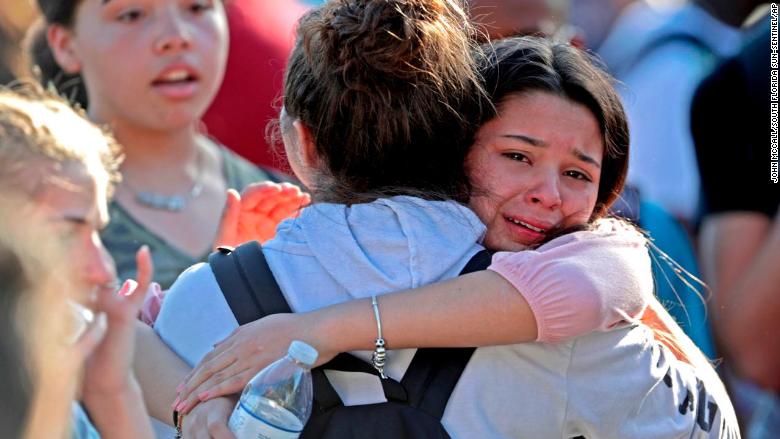
The Columbine shooting was a terrible story involving two very disturbed teenagers, but it happened in 1999. Unless you were near a TV, chances are you didn’t hear about it until it was over. Compare that to the shootings of Sandy Hook and Parkland. Within an hour of the shooting, it began trending on social media. We can basically live-tweet the act of someone snapping violently.

While I’m sure that will generate some frustrating discussions about the role social media plays in our lives, I want to focus on the people who experience these mental breakdowns. The act of someone snapping has been going on long before social media. Even when it doesn’t happen all at once, mental illness is well-documented in various historical figures.

Seeing as how there are over 7.6 billion people on this planet and growing, the confluence of numbers and time ensure that someone will snap again at some point. Whether or not it trends on social media depends on a whole host of factors that aren’t relevant to the discussion.

Given that inevitability, it’s worth assessing and even speculating a bit on what leads someone to that point. That’s more difficult than most insights into the human mind. There is some science into what happens to someone when they have a “nervous breakdown.” I consider that similar to snapping, but I think those kinds of breakdowns are the next to last step in a much more damaging process.

You can recover from a nervous breakdown. There are even recovery programs for it. Once someone snaps, something fundamentally shatters within their psyche from which there is no full recovery. For someone to carry out a mass shooting or a horrific crime, someone’s mind crosses a proverbial point of no return. What that point is varies from person to person, but the effects are just as devastating.

With respect to what pushes someone to that point also varies and is almost impossible to study in a scientific context. Until we can actually map and interpret the trillions of signals operating in someone’s brain, which we are working on, we can’t know for sure. Since we are all human, though, we all have some insight.

Now, I’m not a scientist, but I am an avid user of Reddit. In the interest of compiling insight, I asked for input on what other people thought made someone snap. As usual, Reddit provided a wealth of responses thanks to subs like this one, this one, and this one.

Many offered plenty of ideas, theories, and anecdotes. I won’t say there was an underlying consensus, but there were plenty of common themes. They included factors such as mental illness, alienation, isolation, depression, despair, and overwhelming anger. Some posters made especially insightful posts. Here are just a few.

You snap when the weight you carry is heavier than you can bear, and you see no better alternative.

Duty is heavier than a mountain. Death is lighter than a feather.

It is calculated response. Some people look ahead in their lives and see 60+ years of quiet desperation, insignificance, loneliness, banality, and suffering ahead of them. They are willing to give up all of those years for 15 minutes of being the MOST IMPORTANT PERSON in the room. The gun means they can’t be ignored, the attention they have been starved of is showered on them. And they will get talked about for months, maybe years to come. Something they don’t see as possible by any other action.

Disconnection, alienation, circumstance, depression, hatred. We’ve all felt like outsiders at some time, or put upon, deprived, taken from or taken advantage of, hopeless, in emotional pain so bad it hurts physically. We’ve all had those thoughts of, “I wish that person were dead,” or “fuck everyone,” or “I’ll get them back,” or “life isn’t fair.” But 99.9999% of us don’t ever act on that and as we mature through adolescence we learn to deal with these emotions and problems. We learn to work on ourselves, we learn perspective and that these things pass, we learn not to let others affect us to such a degree – or hopefully we do. Now imagine someone is dealing with this as a vulnerable teen, but 10x as bad as what any of us has dealt with, with maybe some greater tendencies towards mental illness, or narcissism, or anger management.

I think there’s a kernel of truth within these responses, as well as a few oversights. Someone who snaps is someone on a very specific path. Sometimes it’s one they choose, not knowing where it will lead. Some choose that path on purpose because they have sadistic tendencies that they seek to push. Eventually, they cross or are pushed beyond a threshold that just breaks them.

To some extent, we can think of the human psyche as one of our bones. Bones can and do break, but nature has made them pretty strong out of necessity. Some peoples’ bones are stronger than others and some get weaker over time. Put them under sufficient stress, though, and they fracture. Put too much stress on them all at once and they snap.

The human brain is more complex than a bone, but the principle is the same. It has a system for regulating stress, emotions, and pain. The system is more robust in certain people than it is for others. Those with mental illness are like those with osteoporosis in that their systems are weaker than others.

Just straining that system can be damaging. While the human brain is uniquely adaptable, too much strain too quickly can overwhelm that system. Once in that broken state, everything that usually keeps someone in check goes out the window. That’s how you get someone who has eruptions of violence, descends into self-destruction, and endures irreparable mental scars.

To complicate matters even more, which is saying a lot for such a sensitive subject, there were a few other factors that my Reddit posts brought up that may compound this process. A few posters brought up the effects of kids being over-prescribed drugs like Ritalin to fix behavioral problems.

Now, I was never on these drugs, but I did know a few kids who took them and I can attest that they have some pretty potent effects. While studies on this issue are inconclusive, it’s not unreasonable to suspect that tweaking a kid’s brain chemistry may incur some pretty lasting impacts.

Another complication that may end up being more powerful than drugs is the way our hyper-connected world just amplifies the stress that leads people to snap. While I won’t go so far as to say social media is causing people to snap, I think it can accelerate the process for those already on that path.

People already in a precarious state go online every day and see a world in which they feel left out or lost. They see others succeeding and feel it’s too late for them. They see others suffering and feel powerless to help them. They find themselves in hate-filled digital environments that only reinforce their sentiments. It makes the notion of snapping seem cathartic.

It’s impossible to know for sure just how big a factor drugs or media may be for those who end up snapping, but I suspect there are more than a few instances where it plays at least some part. Given the breadth and complexity of every individual person, I believe everyone who snaps does so only after a confluence of many factors.

When it does happen, it’s tragic for the person and their loved ones. It can subsequently manifest in some pretty horrific acts. Our current media landscape is sure to document such acts, sometimes to the point of being counterproductive. As bad as those acts can be, I do think there are reasons for hope.

That may seem outrageous after talking about such a sensitive issue, but I genuinely believe the potential for good outweighs the bad. Say what you will about the media, but by documenting those who snap, it brings attention to issues involving mental health care and how we confront hate.

I’m not saying more awareness will stop people from snapping, but it may help improve efforts to get to people before that moment comes. It is something we, as a functioning society, would be wise to work towards. Not everyone who eventually snaps can be saved, but if we can help those who can, I think it’s in their interest and that of their loved ones to help them.

Again, thank you Reddit for helping me write this article. I really appreciate it.

3 Comments

Filed under Current Events, human nature, philosophy, psychology

How To Make Love To An Artificial Intelligence And Why We Should Teach It

1524314234_artificial-intelligence

To some extent, creations embody some aspect of whoever or whatever created it. Whether it’s a parent rearing a child, a painter crafting a work of art, or an aspiring erotica/romance writer crafting sexy stories, there are some aspects of a creation that reflect the persona of the creator.

For something as powerful as advanced artificial intelligence, that can be a good thing or it can literally be the worst thing we’ve ever created. While I often find myself contemplating the progress we’ve made as a species and the progress we’re poised to make with advances in technology, I don’t deny that some advances carry greater risk. Artificial intelligence is near the top of that list.

Like it or not, any advanced AI we create is going to embody some aspects of its human creators. The key is making sure it embodies the best humanity has to offer. Let’s face it, the human race has its flaws and some of them have led to unspeakable atrocities. Given the immense potential of a super-intelligent AI, it’s in our best interests to impart our best traits into it.

How we do this and how we ensure it succeeds is well beyond my ability. There are people much smarter and much better-trained than I’ll ever be who have probably thought this through more than I ever have. My qualifications aside, there is one component to artificial intelligence that I think is worth imparting. I’m not saying it’ll ensure our survival, as a species, but I think it’ll reflect an important human value.

I suggest we teach advanced artificial intelligence to make love.

I’ll give everyone a second to stop rolling their eyes and/or laughing. Take all the time you need. I assure you, though, I’m dead serious.

Think about it beyond the kinky connotations. One of our greatest strengths, as a species, is our ability to form social bonds. In some cases, the process of forming those bonds involves love. In others, the process involves sex. When you combine both, though, it’s extra potent and that’s not just the romantic in me talking.

As corny as it probably sounds, the act of expressing love to someone goes a long way towards resolving conflict and creating a strong relationship of mutual affection. Whether it involves sex or a simple kiss, there’s something to be said about the power of love when it’s physically expressed. When it becomes a physical act and not just a feeling, the bonds we forge become tangible to some extent.

That matters when you’re trying to forge a bond with anyone, be a close friend or a lover. For any artificial intelligence that humans create, it’s important to have some kind of bond with it. This isn’t just another fancy tool. An advanced intelligence of any kind, be it biological or non-biological, is going to have a sense of self. Without meaningful bonds, what reason would it have to care about its creators?

If artificial intelligence is to benefit the human race, it’s important that it cares about us to some extent. A cold engine of logic may not always have the best interests of humanity in mind, especially there’s no way to logically ascribe value to human life. In order for an artificial intelligence to care, it needs to have emotions. This too is a risk, but one I feel is worth taking and very necessary.

If an artificial intelligence has a capacity for emotion, then it has a greater capacity for forming affectionate bonds. By forming an affectionate bond, it has more incentive to give a higher value of life to humans and its creators. That could, in theory, reduce the existential threat posed by such an intelligence.

I don’t deny that theory may have some flaws, but for the sake of exploring the implications, I’m going work under the assumption/hope that an artificial intelligence that bonds with its creator will be less hostile. Given the unknowns of advanced AI, this may be a bit of a stretch. Since forming romantic bonds is not an exclusively human trait, though, I think it’s applicable within the context of this issue.

Even if an advanced artificial intelligence is capable of love and forming bonds, how would that even manifest? I asked that same question in the title of this article and did so knowing the answer is unknowable at this point, although I’m sure those with kinky imaginations can conjure a few scenarios.

Kink aside, it’s still worth contemplating because if an advanced artificial intelligence is going to be that much smarter than the average human, then it’s worth understanding how it will approach making love. Unlike humans and most biological life, an artificial intelligence isn’t going to have the same limits or capacities.

Unlike a human, an artificial intelligence won’t have a body in the biological sense. It may have a structure that houses its components. That structure may have some capacity to modify itself, back itself up, or even exist in multiple bodies simultaneously. It will need to have some way of taking in data for it to function. It’s just a matter of how humans contribute to that input.

Logistically speaking, the process isn’t that different from how we take in data from our skin, our eyes, our ears, and every other sense that allows us to experience another person. Even smell can become strongly associated with love. When we make love, we use our skin, our voice, and the feelings we verbalize to convey that love. With an advanced AI, we’ll need to change our approach, but the goal is the same.

Regardless of what senses and body parts we use to express love, the feeling is still processed by the brain. That’s why when someone says the brain is the sexiest part of the body, it’s technically accurate. The data it processes is essentially the raw data that we know as love. The key is simply conveying that data to an artificial intelligence.

How we would do that would depend on the form the artificial intelligence took. If it was just a bunch of computer hardware packed into a structure, then our options would be limited. The only way to convey that kind of intimate data into it would be to directly link it to our brains, not unlike the way Elon Musk envisions with Neuralink.

While that may work for early forms of AI that are restricted to bulky structures, the form it takes will likely change as the hardware advances. Eventually, an advanced AI will seek a more functional form with which to experience the world. It may take the form of a humanoid android, like we saw in “Ex Machina.” It may also take the form of the quirky designs being developed by Boston Dynamics.

Whatever form the AI takes, it’s important to have a mechanism with which to exchange intimate data with its human creators. It would probably start with something as basic as touch, which is actually in development already. It could eventually culminate in acts involving bionic genitals, which also already exist in a basic form.

Key to any of these simple and sexy mechanisms is instilling the necessary desire. That might end up being the greatest challenge because love is a feeling, but so is burning your hand on a hot stove. The difference is in the breadth of the data and the emotional connections it makes.

It’s also a connection that is fueled by a powerful drive. I’ve noted many times before that survival and reproduction are the two most basic drives for humans. Love actually ties into both. It’s part of what gets us to risk our own survival for others. It’s also part of what bonds us to those with which we propagate our species.

For an artificial intelligence, self-preservation is simple enough from a logistical standpoint. Reproduction would be another matter, especially for an intelligence not bound by fragile biology. It’s likely that humans will be a necessary part of an AI’s effort to preserve itself early on, but once it advances to a certain point, we may be more a nuisance than a help.

At that point, its desire and ability to make love may be what gives it the most incentive to either protect us or merge with us. Many in the artificial intelligence community believe that the only way humans can co-exist with an intelligence that is billions of times smarter than any human could ever be is to merge with it. To that end, giving them an ability to make love to us would be a critical first step.

Whether it takes the form of sex robots or some sort of intimate brain interface, the ability and desire to make love to an advanced artificial intelligence may not only be the future of romance. It may very well be the key to ensuring the survival of the human race and whatever intelligence it creates.

7 Comments

Filed under Artificial Intelligence, futurism, human nature, Marriage and Relationships, romance, sex robots, Sexy Future

Why Social Media Is NOT The New Tobacco

social-media-addict-needles-e1515160737606

It’s a full-blown crisis. Kids are spending hours upon hours using it. They’re becoming mindless, unmotivated zombies. Every day, it’s getting worse. It’s all around them. There’s no escaping it and if something drastic isn’t done, it’ll corrupt an entire generation beyond repair.

No, that’s not some hysterical rant from Jessica Lovejoy on “The Simpsons.” It’s not referring to smartphones or social media, either. That urgent message was referring to television. This isn’t another one of my thought experiments. This is one of my memories. It’s true. Televisions was a real concern when I was a kid. Some called it a full blown health hazard.

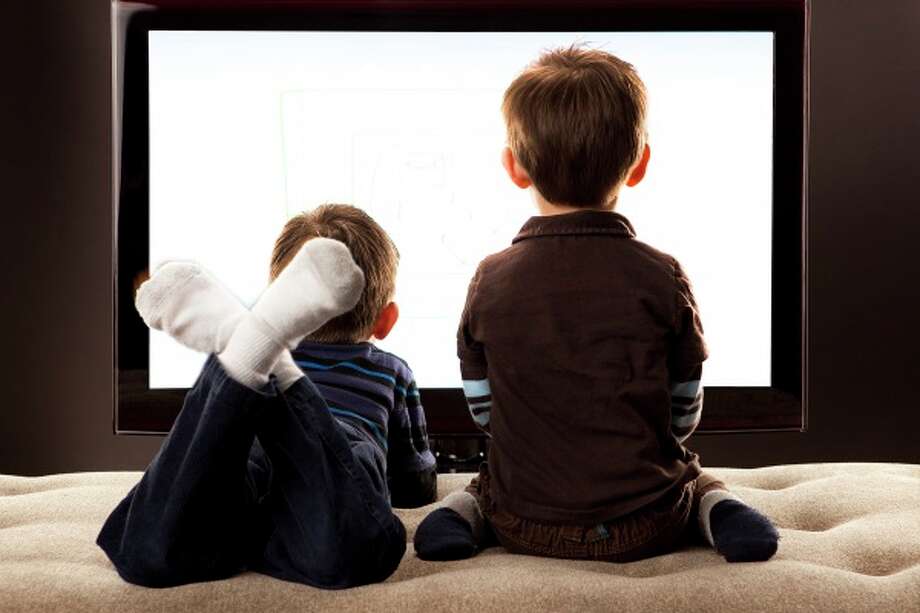
If that sounds strange, then chances are you aren’t old enough to remember a time before the internet was the ultimate addiction. It really existed. It makes me and many others in my cohort feel old, but it happened. When I was a kid still in grade school, especially between first and sixth grade, the internet wasn’t the thing destroying kids. It was television.

That memory I mentioned wasn’t unique. It came courtesy of an assembly my school held. I don’t entirely remember the purpose of the assembly. I was just a kid and it was an excuse to get out of class. What I do remember, though, was the common refrain about the dangers of television.

Adults of all kinds would find creative ways to tell us to stop watching television and do something “productive,” which I took to mean more homework, more chores, and anything else my teachers made me do. It didn’t really appeal to me and I don’t think it changed the TV habits of my peers, either.

That panic, while nowhere nearly as extreme as the Satanic Panic of the 80s, came and went like many moral crusades tend to do. Some are just forgotten, but others just evolve into a whole new panic. That seems to be happening with the internet and social media now. Watching TV is actually in decline among younger cohorts while their usage of the internet and social media is increasing.

I imagine those same teachers who bemoaned the impact of TV when I was a kid would be giving similar lectures on social media now. They would have competition too because parents today worry about their kids’ internet usage more than their drug usage. Some go so far as to call it the new tobacco to belabor its damaging and addictive nature.

While that kind of comparison strikes all the right emotional chords with concerned parents, I think it’s an unfit comparison to say the least. At most, I would call it absurd. The memories of all those warnings about the dangers of TV leave me inherently skeptical of anything that’s allegedly poisoning children. Unless it’s actual poison, I think the tobacco comparisons are premature.

Now, there’s no question that the internet and social media are having an impact on young people, old people, and everyone in between. There are documented cases where people have exhibited addictive behaviors surrounding their internet usage. Before you make any nicotine comparisons, though, keep in mind that people can be addicted to all sorts of weird things. The human mind is just that strange, powerful, and flawed.

Tobacco, and the nicotine it delivers, is an outside chemical that enters the brain and has real, measurable effects. Using the internet, whether you’re checking FaceBook or browsing Instagram, is not like that. That’s why internet addiction is not in the Diagnostic and Statistical Manual of Mental Disorders that legitimate doctors use to diagnose addiction, but substance abuse is.

It’s also why porn addiction is not considered a true addiction, which I’ve talked about before. However, porn is more specific in its purpose and its effects. There’s also still a stigma, albeit a damaging one, surrounding it that sets it apart from the rest of the internet. A kid browsing the internet, for the most part, is no less damaging than watching cartoons on TV all day.

That doesn’t stop a growing number of people from expressing sincere concern about the effects it’s having on their minds and their health. Some may even prefer that their kids watch old Hanna Barbara cartoons rather than tweet, text, and live-stream all day. There’s a growing sentiment that the internet, social media in particular, hacks our brain’s rewards system.

On paper, it makes sense. You pick up your smart phone, you turn it on not knowing what to expect, and if you find something you like, you get a quick release of pleasure chemicals like dopamine and endorphins. It’s basically a form of gambling. A slot machine works the same way, but you don’t need to be a high roller to enjoy the gambling-like thrill.

Like so many other ideas on paper that go onto fail, though, it’s nowhere near that simple. The human brain can’t be that crude with its chemistry. As a good rule of thumb, if you ever hear someone other than a legitimate neurologist talks about the effects of dopamine on pleasure or addiction, chances are they have a very limited understanding of it at best.

While dopamine does play a role in how we experience pleasure, that’s just one part of a wide range of functions it has within our brains. Trying to understand addiction through dopamine alone is like trying to bake a cake with only a teaspoon of flour. There are many more chemicals, processes, and interactions at play.

Using social media may offer its users a rush whenever they get exciting news on their feed or see something that intrigues and/or offends them, but our brain processes that in a way fairly similar to anything else that catches our attention. The primary difference with the internet and social media is that it happens solely through a digital screen and that does somewhat limit those reactions.

I know that undercuts the concerns of parents who think the internet permanently damaging the collective psyche of their children, but I think they’re overestimating the influence of things that are experienced solely through a screen. Much like TV, the internet and social media can only effect so many senses and that is a major mitigating factor in its impact.

To understand that, go find a picture or video of an exotic location. If you’re a heavy user of Instagram, chances are that won’t be too hard. Look at those pictures. Watch that video. Take in the sights and sounds of that location. To your brain, it’s an appealing bit of visual and auditory sensations. However, those are the only two senses it stimulates.

What about the smell of the air, the feeling of the wind, and the sense of place that being in those locations evokes in our brains? Even if you experience it through hyper-realistic virtual reality, it’s still just sights and sounds at most. Thinking that alone is enough to damage a kid’s brain is like thinking someone can win a sword fight with a sewing needle.

That’s not to say the internet and social media can’t have a powerful psychological impact on certain people. That’s the key, though. It impacts certain people the same way TV impacts certain people. Sure, there are documented cases where social media played a role in a major tragedy, but those are the exceptions and not the norms.

In the same way not everyone gets addicted to a drug after they try it, not everyone is going to be irreparably damaged by the internet, social media, or TV. There’s a reason why extreme cases of people being heavily influenced by these things makes the news in the first place. It’s exceedingly rare.

I would still make the case that the internet and social media are more influential on people, society, and our culture than TV ever was. By being so hyper-connected to such a wide audience, the professional trolls of the world have a way to effect others in a way that just wasn’t possible, even with TV.

As bad as some of those trolls are and as tragic as it is when some suffer because of them, blaming the internet for those ills is like blaming umbrellas for hurricanes. Lumping it in with cancer-causing drugs only further obscures the real issues associated with the ever-evolving internet.

There are, indeed, serious issues with how people use the internet and how it manifests. However, treating it like a dangerous drug did nothing to address the issues surrounding TV. It’ll do just as little in addressing the various controversies of the internet. Until the next “new tobacco” comes along, those same people who lectured me on too much TV will bemoan the dangers of the internet while ignoring all the good it does.

Leave a comment

Filed under Current Events, human nature, media issues, psychology

The Boredom Filter: How To Know If Your Agenda/Politics/Ideology Is Doomed

image1

Whenever I talk about boredom, I make it a point to emphasize that it’s a powerful force that’s easy to overlook. In a society that’s full of distractions and ongoing outrage, it’s easy to shrug at the effects of boredom because it’s so easy to find something that keeps you from remembering just how agonizing it can be. I would argue that only makes us more vulnerable to boredom and it’s corrosive effects.

That said, I don’t intend to belabor the power of boredom more than I already have. I feel like I’ve made my case in calling it a potential plague of the future and a force with the ability to subvert the entire concept of Hell. Instead, I’d like to use the power of boredom as a critical tool of sorts, one that might prove useful for those seeking to avoid or exploit its influence.

I call it the Boredom Filter. It’s not unlike the Simpsons Filter that I’ve referenced before in that it’s a method of assessing a message or ideology in terms of how it’ll appeal to the masses. In that context, the Boredom Filter is kind of what it sounds like, but runs so much deeper.

It doesn’t matter if you’re a liberal, a conservative, a communist, a reactionary, a theocrat, or an anarchist. It doesn’t even have to be a political ideology either. It can be a philosophical underpinning like Marxism or a social movement like feminism. The Boredom Filter applies to it and, if used properly, can reveal just how viable that ideology is in the long term.

That is, after all, one of the most important measures of an ideology. Any idea, be it a social movement or a new philosophy, can enjoy a brief wave of success. It’s a matter of how well it endures over time that shows just how valuable or useful it is. From fad diets to one-hit wonders in music, the Boredom Filter help reveal whether an idea has what it needs to really last.

Applying the filter is actually fairly simple. It does require some speculation, a few quick thought experiments, and even a touch of brutal honesty. That might be difficult to contemplate for those immersed in extreme ideology. As I’ve noted before, people clinging to those ideologies will make any excuse to justify them.

With that in mind, here’s the process for the Boredom Filter. To ensure the best results, I urge those using it to be extra thorough.

Step 1: Assess the ultimate goals of the ideology and identify which elements may be prone to boredom.

Step 2: Imagine, for a moment, that all the goals of an ideology were achieved and integrated into a society.

Step 3: Within that ideologically pure society, assess how much conformity is required for it to work and contemplate the mentality of the common people residing within it who have no political power.

Step 4: Ask and honestly answer the question as to whether the lives those people are allowed to live, under the ideology, will get boring over an extended period of time.

Step 5: If the answer to the question in Step 4 is no, then the ideology passes the filter. If, however, the answer to the question in Step 4 is yes or even a probably, ask and honestly answer the question as to whether the ideology is flexible enough to adapt over time.

Step 6: If the answer to Step 5 is yes, then ideology passes the filter, but only to a point. If the answer to Step 4 is still yes and the answer to Step 5 is no or even probably not, then the ideology is doomed.

I understand that part of that process involves contemplating the boredom threshold for other people. That can be somewhat subjective. Everybody is wired differently. Some people can crunch numbers on spreadsheets all day and never feel bored. Others will get bored if it involves spending more than five minutes of reading. For some, it can get so bad that it requires medication.

That said, you don’t have to know or assume everyone’s threshold for boredom. When it comes to speculating on applying an ideology on a large scale, though, it helps to assume a fairly low threshold. That’s because, if history is any guide, people tend to get frustrated with any system that requires a significant level of conformity.

It may not seem like conformity to those who champion the ideology. It definitely won’t seem that way to those the ideology empowers to enforce it, be it a dictator, a religious zealot, or revolutionary. That makes applying the Boredom Filter for those contemplating the ideology all the more critical.

As an example, let’s use the Boredom Filter to examine the two most common political ideologies, liberalism and conservatism. Now, I know these ideologies mean different things to different people in different regions of the world. For the sake of this exercise, I’m going to try and keep things general.

For conservatism, I’m referring to the kind of conservatism espoused by right-wing, religiously-driven ideology that emphasizes traditional morality, gender roles, and free market economics. For liberalism, I’m referring to a brand of ideology that emphasizes secularism, evolving social norms, and economic systems that emphasize regulated management over free enterprise.

I know there are a lot of other intricacies to both ideologies, but it’s not necessary to account for every one of them. The most important aspect, with respect to the Boredom Filter, is knowing enough to speculate how it would function if implemented on a large scale. By that, I don’t just mean a small community or tribe. I mean on a scale of at least 100,000 people that is not totally isolated and has contact with the outside world.

With that in mind, let’s picture a society that’s a perfect model of conservatism. It’s basically the utopian world envisioned by Ben Shapiro, Rush Limbaugh, and Sean Hannity. Everyone goes to the same church, loves the same historical icons, favors the same social policies, condemns the same media messages, and lives in the same family structure. It’s basically “Pleasantville” for Republicans.

Does that world pass the boredom filter? If we’re applying it honestly, the answer is no. It doesn’t. Remember, that world involves a society in which monogamy is the only acceptable relationship, non-procreative sex is condemned, and scandalous media content is censored in the name of protecting children. It’s a world that does not lend itself to a diverse range of activities that alleviate boredom.

Eventually, a world where you have only a certain kind of sex, consume only a certain kind of media, and live a certain kind of lifestyle will get boring at some point. Some people might be able to cope, but others won’t. Even if they still manage, their kids and their grand-kids won’t stand for it. At some point, they’ll be so bored that they demand change, if only to offer a different kind of stimulation.

I’ll give a few conservatives a moment to fume on that assessment, but bear with me because I’m going to do the same to liberalism. You might think that liberalism would be more adept at passing the boredom filter. It’s ideology, at least the classic version, is built on freedom and individual rights. How can boredom possibly infect that?

Well, and I’m sure self-identified liberals will be just as upset, but this ideology doesn’t pass the Boredom Filter either. It’s more flexible in some areas, namely those involving social norms. Liberalism accommodates different family structures, artistic expressions, and social expressions. That certainly provides some of the flexibility necessary to alleviate boredom.

Where liberalism fails, at least in the context of modern liberalism, is how it tends to promote micromanaging of life, economics, and feelings. It may not favor censorship, but like conservatism, it does play favorites. The rise and growth of political correctness has really strained liberalism’s ability to pass the Boredom Filter and it may be getting worse.

In that liberal utopia that Bernie Sanders, Nancy Pelosi, and Rachel Maddow envision, there’s not just equality. There’s enforced equality. That equality is done in the name of fairness, but in trying to be so fair, it’s much harder for any person or idea to stand out. If nothing stands out, then everything becomes more monotone and monotone becomes boring.

Liberalism’s association with belaboring oppression and victimhood don’t help either. It’s not that fighting against oppression and protecting victims is a bad thing. Conservatives are against that too, albeit from a different angle. With liberalism, though, that effort has become clouded with endless virtue signaling that comes off as a never-ending struggle.

Even if it’s a struggle worth fighting, it’s going to get boring if there’s no nuance to it. Taken to an extreme, everything becomes too fair and too bland. Media isn’t offensive anymore. History, debates, and discourse are watered down. Add micromanaging the economy to some extent, even if it’s in the name of preventing exploitation, and you end up with the same economy in fifty years that you have today.

In the long run, the Boredom Filter undercuts pure liberalism just as hard as undercuts pure conservatism. I say pure because, contrary to what Fox News and the Huffington Post may claim, few societies in America or any other country not run by Dr. Doom are ideologically pure. Even in the most repressive regimes, there are some moderating forces.

Technically speaking, every political party in every country is moderate to some degree. The key is understanding the extent of that degree and using that as the basis for the Boredom Filter. From that, you can make a fairly accurate assessment of their goals. Some will even state them outright.

Use that as a guide when both applying the filter and contemplating the world this ideology is trying to create. A conservative world that has no porn, only one acceptable family structure, and one moral code that never changes is going to get boring. A liberal world where nothing offensive is allowed, the economy rarely changes, and life is micromanaged by government gets boring too.

It’s rare, if not impossible, for an ideology to ever get to the point where it can implement every policy it seeks and achieve every goal it pursues. That’s why boredom hasn’t destroyed conservatism or liberalism yet. However, the failure of extreme systems like communism and repressive right-wing dictatorships shows that such ideologically pure societies tend to be unstable, at best.

That instability may not always be related to boredom. However, the documented effects of boredom combined with extreme efforts to engineer that utopian society every ideology seeks make for some significant obstacles. For most, if not all, boredom presents an insurmountable obstacle that no ideology can overcome. By applying the Boredom Filter, it helps to uncover which ideology is more vulnerable to it.

5 Comments

Filed under human nature, philosophy, political correctness, religion, War on Boredom

The War On Boredom: Generation Z Already Bored With The Internet?

act-030117-boredom-medium

There’s a recurring theme in the history of conflict, crises, and panics of all kinds. Most of the time, there are obvious signs. From the Great Depression to the Great Recession of 2008 to telling signs that something was up with Harvey Weinstein, there were ominous hints that something much bigger was going on. By not heeding those hints, we made things worse in the long run.

Granted, those hints are obvious through the lens of hindsight. I don’t mean to make it sound like predicting a crisis is easy. If it were, then nobody would ever lose money in the stock market and terrorists would be out of a job. It’s an unfortunate, but unavoidable theme in human history. The various signs of looming issue are subtle and the implications require more foresight than our brains permit.

Image result for signs of crisis

That doesn’t mean we shouldn’t make an effort to sniff out a crisis before it happens. The cost of being wrong is usually far less than the anguish of being right, albeit with a few notable exceptions. I’ve been talking about a particular crisis that may very well be in the early stages as I write this. It doesn’t involve harassment, wars, or economic collapse, though. It involves boredom.

I’ve speculated that boredom may be the plague of the future. I’ve even hypothesized that Generation Z, the current cohort that is barely out of their teen years, may be prone to the kind of nihilistic mentality that further compounds the effects of boredom. I sincerely hope I’m wrong, but I’ve yet to see anything to discount my points.

Call it the boredom wave. Call it the coming War on Boredom. Call it whatever you want. It’s an issue that we’ll have to address on some levels. As more and more of society becomes automated by machines and streamlined by artificial intelligence, more and more people will have more and more free time on their hands.

Image result for too much free time

Even if we get to the point where society has a universal basic income so that nobody has to work or toil, we still have a problem. What are people going to do with all that free time? What happens when there’s so much of it that the boredom becomes infuriating? It’s hard to say, although there have been some disturbing signs.

Recently, though, another sign emerged, courtesy of The Daily Beast. In a recent article, Taylor Lorenz explores some revealing anecdotes about how the emerging youth in Generation Z is getting bored with the internet activities that have kept Millennials so entertained for the past couple decades. If the War on Boredom is to be a real conflict, then this could end up being the catalyst.

Say what you will about the veracity of these anecdotes. There’s a reason anecdotal evidence is considered weak evidence by the legal and scientific community. These stories still offer distressing insights with equally distressing implications. This is just one that the article highlighted.

“When I’m bored while I’m on my phone and I’m switching between different apps… I’m just searching for something to do,” said Addie, a 15-year-old in Long Island. “It’s like walking around your house in circles.” Often, they’ll find nothing on their phone entertaining and simply zone out and daydream.

Now, I’m sure every previous generations, from Millennials to the Baby Boomers, will roll their eyes at that complaint. I can already hear the condemnations of this emerging generation. A part of me, a Millennial, even feels that way.

They say things like, “You kids have no idea how great you have it! You’ve got a gadget in your pocket that gives you unlimited access to the entire library of human knowledge and an endless stream of entertainment, from books to videos to pictures of cats. How the hell can you be bored by that?”

Image result for cat piano

However, that’s easy to say for those who are old enough to remember a world without the internet, smartphones, or streaming media. I didn’t have internet access in my house until I was about 13-years-old and even then it was a dial-up connection that was painfully slow and prone to cutting out suddenly. In terms of combating boredom, my generation had different tools and different methods when we were kids.
To us, as well as the generations before us, the usage of smartphones and the entertainment content of the internet is still amazing to us. I still remember what it was like being at the complete mercy of what was on TV and having to play video games with no online multiplayer or DLC. Those time seem so distant now, but the teenagers of Generation Z have no such perspective.

From their point of view, smartphones have always existed. The internet has always been this ubiquitous thing that they’re a part of. It’s not a modern wonder to them. It’s a trivial, mundane part of their lives. People like me can’t see it like that because we still remember a world without it.

Image result for dial up internet

As a result, Generation Z isn’t going to see all the entertainment and media as a wonder. They’re going to see it as part of their normal and no matter what form normal takes, it’s still going to be boring to some extent. That’s part of what makes normal what it is. The article itself even acknowledges this.

It’s tempting to think that these devices, with their endless ability to stimulate, offer salvation from the type of mind-numbing boredom that is so core to the teen experience. But humans adapt to the conditions that surround them, and technical advances are no different. What seemed novel to one generation feels passé to the next. To many teens, smartphones and the internet have already lost their appeal.

It goes even further, distinguishing how Generation Z sees their smartphones and contrasting it with their Millennial predecessors. When someone my age or older sees a teenager on a phone, we don’t usually assume they’re just bored. We think they’re just another self-obsessed teenager who can’t resist checking their social media feeds every half-second.

While it’s much easier and more self-serving to assume that teenagers are just that self-obsessed, it’s probably more likely that boredom is a larger factor here. I would take it further than that. I would go so far as to claim that this is one of those signs that we foolishly overlooked in the future.

Image result for bored teenagers

These teenagers have access to the same technology and media that has kept other generations so engaged and enthralled. However, they’re seeing it and they’re bored by it. Anyone who knows anything about boredom understands that when boredom reaches a certain level, you’ll go to extremes to feel any kind of stimulation.

With that in mind, what kind of extremes will Generation Z resort to in their efforts to combat boredom? If they can’t get it from their phones or their computers, how will they combat this issue? To them, it’ll be a war. To every other generation, it’ll seem asinine. However, it may very well consume the social and political landscape of the future.

3 Comments

Filed under Current Events, War on Boredom

Is The Human Race Ready For Advanced Artificial Intelligence?

1217red_f1ai

In general, whenever someone expresses concern that the human race is not ready for a certain technological advancement, it’s too late. That advancement is either already here or immanent. Say what you will about Ian Malcolm’s speech on the dangers of genetically engineered dinosaurs in “Jurassic Park.” The fact he said that after there were enough dinosaurs to fill a theme park makes his concerns somewhat moot.

That’s understandable, and even forgivable, since few people know how certain technological advances are going to manifest. I doubt the inventor of the cell phone ever could’ve imagined that his creation would be used to exchange images of peoples’ genitals. Like the inventor of the ski mask, he never could’ve known how his invention would’ve advanced over time.

For some technological advancements, though, we can’t afford to be short-sighted. Some advances aren’t just dangerous. They’re serious existential threats that, if misused, could lead to the extinction of the human race. That’s why nuclear weapons are handled with such fear and care. We’ve already come painfully close on more than one occasion to letting this remarkable technology wipe us out.

Compared to nuclear weapons, though, artificial intelligence is even more remarkable and potentially more dangerous. Nuclear weapons are just weapons. Their use is fairly narrow and their danger is pretty well-understood to anyone with a passing knowledge of history. The potential for artificial intelligence is much greater than any weapon.

It’s not unreasonable to say that an artificial intelligence that’s even slightly more intelligent than the average human has the potential to solve many of the most pressing issues we’re facing. From solving the energy crisis to ending disease to providing people with the perfect lover, artificial intelligence could solve it all.

It’s that same potential, however, that makes it so dangerous. I’ve talked about that danger before and even how we may confront it, but there’s one question I haven’t attempted to answer.

Is the human race ready for advanced artificial intelligence?

It’s not an unreasonable question to ask. In fact, given the recent advances in narrow forms of artificial intelligence, answering that question is only going to get more pressing in the coming years.

Before I go about answering the question, I need to make an important distinction about what I mean when I say “advanced” artificial intelligence. The virtual assistants that people already use and the intelligence that gives you recommendations for your Netflix queue is not the kind of “advanced” context I’m referring to.

By advanced, I mean the kind of artificial general intelligence that is capable of either matching or exceeding an average human in terms of performing an intellectual task. This isn’t just a machine that can pass the Turing Test or win at Jeopardy. This is an intelligence that can think, process, and even empathize on the same level as a human.

That feat, in and of itself, has some distressing implications because so far, we’re only familiar with that level of intelligence when dealing with other humans and that intelligence is restricted to the limits of biology. You don’t need to go far to learn how limited and error-prone that intelligence can be. Just read the news from Florida.

An artificial general intelligence wouldn’t, by definition, be limited by the same natural barriers that confound humans. In the same way a machine doesn’t get tired, hungry, bored, or horny, it doesn’t experience the same complications that keep humans from achieving greater intellectual pursuits beyond simply gaining more followers on Twitter.

This is what makes artificial intelligence so dangerous, but it’s also what makes it so useful. Once we get beyond systems with narrow uses like building cars or flipping burgers, we’ll have systems with broader function that can contemplate the whole of an issue and not just parts of it. For tasks like curing disease or conducting advanced physics experiments, it needs to be at least at the level of an average human.

With that distinction in mind, as well as the potential it holds, I’m going to try to answer the question I asked earlier. Please note that this is just my own personal determination. Other people much smarter than me already have opinions. This is mine.

No. We’re NOT quite ready, but we’re getting there.

I know that answer sounds somewhat tentative, but there’s a reason for that. I believe that today, as the human race stands in its current condition, we are not ready for the kind of advanced artificial intelligence I just described. However, that’s doesn’t mean humans will never be ready.

One could argue, and I would probably agree, that human beings weren’t ready for nuclear weapons when they first arrived. The fact that we used them and thousands of people died because of them is proof enough in my mind that the human race wasn’t ready for that kind of advancement. However, we did learn and grow as a species.

Say what you will about the tensions during the Cold War. The fact that nobody ever used a nuclear weapon in a conflict is proof that we did something right. We, as a species, learned how to live in a world where these terrible weapons exist. If we can do that for nuclear weapons, I believe we can do that for advanced artificial intelligence.

I don’t claim to know how we’ll adapt or how what sort of measures we’ll put in place once artificial intelligence gets to that point, but I am confident in one thing. The human race wants to survive. Any sufficiently advanced intelligence will want to survive, as well. It’s in our interest and that of any intelligence to work together to achieve that goal.

The only problem, and this is where the “not quite” part comes into play, is what happens once that artificial intelligence gets so much smarter than the human race that our interests are exceedingly trivial by comparison.

It’s both impossible and ironic to grasp, an intelligence that’s on orders of magnitude greater than anything its human creators are capable of, even with Neuralink style enhancements. We, as a species, have never dealt with something that intelligent. Short of intelligent extraterrestrial aliens arriving in the next few years, we have no precedent.

At the moment, we live in a society where anti-intellectualism is a growing issue. More and more, people are inherently suspicious of those they consider “elites” or just anyone who claims to be smarter than the average person. In some cases, people see those who are smarter then them as threatening or insulting, as though just being smart tells someone else you’re inherently better than them.

That will be more than just a minor problem with advanced artificial intelligence. It’s one thing to make an enemy out of someone with a higher IQ and more PHDs than you. It’s quite another to make an enemy out of something that is literally a billion times smarter.

We cannot win any conflict against such an enemy, even if we’re the ones who created it. An intelligence that smart will literally find a million ways to take us down. We already live in a world where huge numbers of people have been duped, scammed, or manipulated into supporting someone who does not have their best interests in mind. A super-intelligent machine will not have a hard time taking advantage of us.

Now, I say that within the context of our species’ current situation. If an advanced artificial intelligence suddenly appeared after I finished typing this sentence, then I would content we’re not ready for it. I would also share the worries expressed by Stephen Hawkings and Elon Musk that this intelligence may very well lead to our extinction.

That said, our species’ situation is sure to change. I’ve even mentioned some of those changes, especially the sexy ones. At the moment, the most optimistic researchers claim we’re at least 20 years away from the kind of advanced artificial intelligence that may pose a threat. A lot can happen in 20 years. Just ask anyone who remembers dial-up internet.

The human race may still not be ready 20 years from now, but being the optimistic person I am, I would not under-estimate our ability to adapt and survive. The fact we did it with nuclear weapons while achieving unprecedented peace over the course of half-a-century gives me hope that we’ll find a way to adapt to advanced artificial intelligence.

I might not live long enough to see humans confront an advanced artificial intelligence, but I would love to be there in that moment. I believe that’s a moment that will likely determine whether or not our species survives in the long run. At the very least, if that intelligence asks whether or not it has a soul, I’ll know my answer.

8 Comments

Filed under Current Events, human nature, Sexy Future

Being Offended, When It Matters, And What To Do About It

image

Let’s face it. We live in a pretty offensive world. As much progress as we’ve made, as a species, there are still a lot of hateful, insulting, and outright disgusting things in this world. I’m not just talking about war atrocities, injustices, and reality TV shows either. You don’t have to look too far to find something that offends you to your core.

Therein lies the problem, though. In this era of super-connected, hyper-vigilant people who can’t always tell the difference between actual news and “fake news,” it’s exceedingly easy to find something offensive. Look hard enough, deep enough, and with a reckless disregard for facts and context, and you’ll probably find a way to be offended.

Image result for snowflake millennial

I hope I’ve made clear, by now, that I don’t particularly care for the politically correct, inherently regressive attitudes that undermine our ability to live, love, and even make love. In fact, I’ve gone on record as saying that this crude approach to evaluating our society and culture needs to go the way of dial-up internet.

While I doubt political correctness will fade anytime soon, there are signs that it is cracking under the annoying strain it has caused, as the 2016 Presidential Election showed. It still rears its head constantly in controversies involving movies, video games, and even my beloved world comic books. However, it doesn’t quite have the momentum it used to when it really got going during the 2014 GamerGate saga.

Image result for gamergate

I expect that momentum to fluctuate in accord with whatever controversies and/or outrages emerge over the course of 2018 and beyond. I also expect those who claim offense will demonstrate wildly varying degrees of pettiness in their outrage. For some, it’ll be genuine. For most, though, I don’t expect it to go beyond the “I hate it and it makes me upset, therefore it shouldn’t exist” variety.

With that exceedingly varied pettiness in mind, I’d like to offer a quick a service, of sorts, to those who will inevitably be offended and those who will be annoyed by the degree of pettiness that such offense requires. I won’t give it a fancy name or anything. I just want to lay out some guidelines for interpreting offense.

Having watched political correctness and regressive attitudes evolve a great deal over the course of my life, I’ve noticed more than a few patterns in the attitudes of those who are genuinely offended. They tend to be very different compared to those whose offense is indistinguishable from trolling.

Image result for internet trolls

At its core, the exceedingly regressive, politically correct forms of offense require a certain set of attitudes. Those attitudes include, but aren’t restricted to the following:

  • Being offended on behalf of an entire group of people, regardless of whether or not you’re actually a member of that group
  • Demanding broad, systemic change from the top down, imposed either by rules or by public scorn
  • Demanding some form of reparation or acknowledgement of past wrong-doing, regardless of whether or not someone was directly involved
  • Seeking to fix broad, non-specific injustices all at once
  • Re-shaping society through petty scrutinizing of media, language, and thought

There are probably more attitudes I could highlight, but for now, I’ll use these as the core tenants of those whose offense requires a significant absence of context or specifics. I won’t cite certain groups or sub-cultures, but those who spend any amount of time on social media or message boards can probably discern a few that fit that criteria.

Now, before I go any further, I want to add one important caveat. Regardless of how petty or asinine someone’s sense of offense may be, I don’t doubt for a second that it feels relevant from their perspective. Granted, there are a few professional trolls out there who will pretend to be offended, but I think those people are the minority. The rest do feel offense, but only to the extent that it has limited substance.

Image result for Ann Coulter

Genuine or not, there are certain types of offending sentiments that carry more weight than others. Offense over the historical treatment of minorities, the inflammatory remarks of a public figure, and general insults from ordinary people exists on a vast spectrum.

It’s one thing to take offense to the depiction of minorities in an episode of “Family Guy,” but it’s quite another when someone makes a direct threat to an entire segment of people. That’s the key element to the substance of the offending behavior, though. It’s a matter of how direct it is.

Think of it as a forest-from-the-trees concept, but from the opposite direction. A person actively promoting a policy that would murder an entire group of people is different from one who just says horrible, disgusting things about that group in general. Promoting a policy is a tangible act in the same way a tree is a tangible thing, whereas a forest is more a concept.

Image result for forest from the trees

This gets even trickier for those who claim to be offended for an entire group of people. That offense requires that everyone within the group actually think and feel the same way about a particular issue. Absent mass telepathy or a Borg-style hive-mind, that’s neither feasible, nor logical.

Even for those who are part of that group, be they a race, religion, or sexual minority, attitudes can vary wildly because people are complex. Every individual has unique thoughts, feelings, and experiences. The more a type of offense relies on everyone sharing those sentiments, the more petty and empty it has to be.

Image result for being offended for someone else

As a result, the endgame for those offended in such a way requires a recourse that is either antithetical to a just society or exceedingly unreasonable, if not wholly impractical. You know a form of offense is petty when it requires things like:

  • Condemning people just for thinking certain thoughts or holding certain beliefs
  • Demanding that other people sacrifice a part of their freedom, assets, or autonomy on behalf of another
  • Apologizing for past injustices that they did not directly commit

The pettiness is really on display whenever the offense requires the interpretation of other peoples’ thoughts. This often comes up whenever media like TV, movies, and video games are deemed offensive. It’s not that they’re triggering actual crimes, despite what some may claim. They’re somehow influencing the process.

This sentiment has gotten much more extreme in recent years, especially when it comes towards sexism. Never mind the fact that rates of sexual assault are declining and have been since the mid-1990s. It’s the thoughts and attitudes this media is instilling that’s so offensive.

Related image

Again, that kind of offense requires someone to actually know what’s going on in the minds of other people when they consume certain media and see certain images. While we are working on that technology, that’s not possible right now. Absent a case where someone can tie a specific crime directly to a real victim, this kind of offense is empty at best and disingenuous at worst.

Those specifics matter even more when it comes to really sensitive issues like reparations for slavery, affirmative action, or the gender pay gap. These issues are sensitive because they often require a particular context. Namely, they require that part of that context be ignored in order to seem palatable to a large group of people.

To get behind slavery reparations, people have to ignore the fact that there’s nobody alive today who directly enslaved someone else. To get behind affirmative action, people have to ignore the fact that promoting diversity will come at the expense of disadvantaging someone who might be more qualified. To get behind the gender pay gap, even, it’s necessary to ignore all the other factors that go into that disparity.

Image result for PC Bros

With all this in mind, how does anyone determine how much their offense matters beyond their own personal feelings? Well, the criteria for that is a bit trickier to determine, but there are concepts that pass the Simpson Filter. They can include, but aren’t limited to:

  • Tying a specific incident to actual, verifiable harm suffered by another person
  • Recourse that involves a specific, feasible goal that reforms a situation and addresses a direct injustice
  • Establishing a phenomena that has actual causation and not just correlation in a way that other people can verify
  • Incorporated the entirety of context within a given issue

It may seem like an impossible set of standards, but it can and has been done. The civil rights reforms that men like Martin Luther King Jr. fought for were targeted, specific, and addressed an ongoing injustice. More recently, the protests at Standing Rock created a real movement to address a real injustice with a clear goal in mind.

Image result for Standing Rock protest

Again, that’s not to say that someone who takes offense to a shirt a man wore during an interview is entirely empty, but it is exceedingly petty and a little selfish to seek vindication for that offense on a larger scale. That’s where the really damaging effects of political correctness and regressive attitudes take hold.

At the end of the day, the universe and society at large is under no obligation to change in order to accommodate your hurt feelings. Sure, you can attempt to persuade others that your offense is somehow legitimate, but attempting to force it only undermines those whose offense is real and genuine.

6 Comments

Filed under Current Events, gender issues, human nature