Category Archives: political correctness

Why The Republic Of Gilead Would Fail (Spectacularly) In The Real World

w3yn9m9s-1490826576-991x470

In recent years, there has been a great deal of dread among feminists, libertarians, and supporters of secular values in the United States. The country seems to be going down an authoritarian path. Traditions of liberty and personal freedom are under threat by a government that seems more inclined to micromanage peoples’ lives for their own benefit.

One path in particular is becoming a lot more prominent. That is the one that could lead the United States to a government like that of the Republic of Gilead, the repressive theocratic regime from Margaret Atwood’s novel, “The Handmaid’s Tale.” In that system, gender politics are pushed to the utmost extreme. The freedom, equality, sex, and love that contemporary society enjoys doesn’t exist.

The reasons for these fears are many. The current state of gender politics has become heated with the rise of the anti-harassment movement and ongoing legal battles surrounding abortion access. During the protests surrounding upheavals on the Supreme Court, it was common to see female protesters dressed in the distinct garb from the “The Handmaid’s Tale.” Such protest has even spread to other countries.

The message is clear. People are worried that our society is inching closer to a world similar to the repressive gender politics of Gilead. I can certainly understand those concerns. While I’ve often criticized certain aspects of gender politics, I don’t deny the worry that many women feel about the current state of affairs.

That said, I believe the idea that the United States, or any western country for that matter, could descend into a state of gender apartheid like Gilead is absurd. While we should be concerned about the influence of religious extremism, even in the west, the chances of it ever gaining power on the level depicted in “The Handmaid’s Tale” is precisely zero.

Even if a regime like it came to power, it wouldn’t just fail quickly. It would collapse so spectacularly that it would be a joke on par with the Emu War. Gilead is not this all-encompassing, overwhelming power on par with Big Brother in George Orwell’s “1984.” Atwood even implied at the end of “The Handmaid’s Tale” that the regime was set to fall.

We’ve yet to hear that part of the story, but Atwood did announce that she’s working on a sequel. One way or another, Gilead’s days are numbered, even in the fanciful world that she created. Before then, I’d like to break down why the Republic of Gilead would be doomed if it ever attempted to set up shop in the real world.

If nothing else, I’d like to offer some perspective to those who fear that the state of gender politics is regressing. To those people, I share your concerns. However, I’m an optimist. I believe both feminists and men’s rights activists can and will find plenty of common ground on these issues in due time.

Even if they don’t, they can take comfort in knowing that Gilead, as both a philosophy and a system, is so flawed that dreading it is an exercise in hyperbole. There are still plenty of lessons to be learned from “The Handmaid’s Tale,” but in terms of setting up a competent theocratic regime, it’s a perfect check-list on what not to do.


Reason #1: Establishing Gilead Would Collapse The Economy

One of the first things the Sons of Jacob did when they established Gilead was fire every woman from their job and effectively eliminate their legal rights. On top of it being an exercise in brutal oppression, it removed half the labor force from the economy. In 2010, there were approximately 123 million women in the workforce. Firing every one of them wouldn’t just cause a huge recession. It would destroy the economy at every level.

Even the most ardent anti-feminist would be badly hurt by a world where half the GDP just disappeared. Suddenly, the industries that everybody relies on just cease functioning. Baking, health care, technology, and basic services essentially collapse as both the labor pool and the consumer base disappears.

That means from the very beginning, Gilead would have to navigate the worst economic collapse in history. More often than not, governments that cause collapses or fail to recover from them don’t last very long. Even if the Sons of Jacob found a way to blame it on minorities, feminists, or other religions, they would still be on the hook for fixing things and doing so with half the labor force will be difficult, to say the least.

Beyond the logistics, destroying an entire economy as part of a religious crusade is going to piss off some very powerful people who were thriving in the current system. America, alone, has over 500 billionaires whose massive wealth would be threatened by such a collapse. People with those kinds of resources aren’t going to let Gilead succeed, even if they manage to seize power.


Reason #2: Micromanaging Peoples’ Lives Is Impossible (In The Long Run)

I’ve noted before that fascist systems have many fundamental flaws. There’s a reason why some of the most brutal, authoritarian regimes in history still ended up collapsing. In the long run, they find out the hard way that it’s just impossible to effectively manage the lives their citizens.

The Republic of Gilead is a lot like Big Brother in that it takes micromanaging to a ridiculous extreme. It doesn’t just have its own secret police to enforce a rigid caste system. Much of its governing philosophy relies on ensuring people stick to their roles and never deviate. Women do what the state requires them to do without question. Men do the same, right down to how they structure their families.

That system only works if human beings are like machines who never get bored doing the same thing over and over again for their entire lives. Since human beings are not like that, there’s no way that kind of society can remain functional in the long run. The fact that the boredom of solitary confinement drives people crazy is proof enough of that.

It still gets worse than that. In every revolution, there’s often a period of heavy solidarity when the people rally behind the new regime as the beginning of a new Utopian vision. This happened in the Russian Revolution and during the Cultural Revolution in Communist China. Unfortunately for Gilead, it came to power by brute, terrorizing force.

That means this government coming to power isn’t the will of the people. It’s just plain bullying and people tend to resent that sort of thing. Even the Iran Revolution had the good sense to rally the people. The Republic of Gilead didn’t bother with that. It’s hard to imagine that collapsing the economy and subjugating half the population at gunpoint will make them many friends.


Reason #3: Theocracies Are The Least Stable Forms Of Autocracies
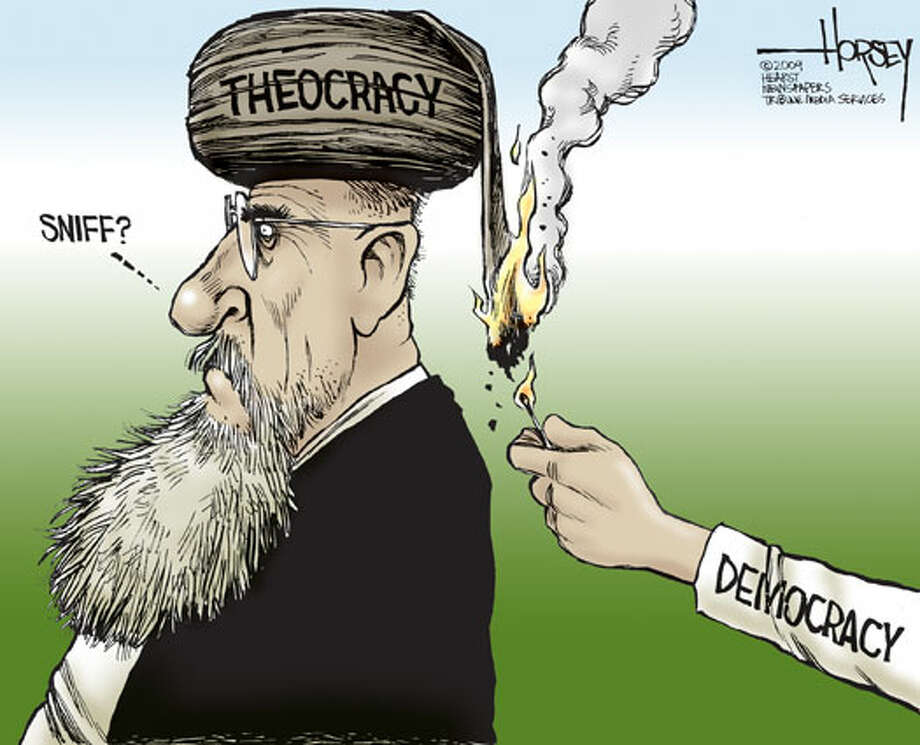
Remember when a purely theocratic state managed to prosper without being located atop an ocean of valuable oil? I don’t either and there’s a good reason for that. When it comes to repressive authoritarian states, theocracies are the worst possible choice. That’s because by entwining government with religion, it’s also entwining itself with the various flaws of religion.

Big Brother didn’t bother with religion in “1984.” It didn’t have to because religion, for all intents and purposes, was obsolete. The authority of the state and the authority of a deity was the same thing. The Republic of Gilead doesn’t have that luxury. Their politics and theology is based on an extremely conservative form of Christianity.

While that may seem fine to the Pat Robertson’s of the world, it adds a whole host of complications to the mix. The Sons of Jacob justify their repressive actions by appealing to Christianity and the bible. That’s okay if every single person in the entire republic agrees on one single interpretation of a religion and its holy text. Unfortunately, that has never occurred in the history of humanity.

There are dozens upon dozens of denominations in Christianity. There are also fringe cults, radical sects, and even schisms within those groups. At most, Gilead could have a unified theology at the beginning, but as new generations come along, that unity will collapse.

People will inevitably disagree. Every side will claim God is with them and everyone else are heretics. This sort of thing has been happening with religion for centuries. It won’t stop in Gilead. At some point, someone is going to think they heard God tell them something else and no one will be able to convince them otherwise. When that happens, conflict will ensue.

That sort of conflict can be managed in a more secular dictatorship. When government and religion are entwined, though, it’s much harder to work around. Even if Gilead could survive an economic collapse and the logistics of micromanaging peoples’ lives, it’s very unlikely it’ll survive the never-ending onslaught of religious debates.


Reason #4: Gilead Would Be An Easy Target For Invasion

Whether you’ve read the book or only watched the TV show, it’s hard to tell what sort of geopolitics the Republic of Gilead deals with. There are a few hints that there are other countries who did not descend into theocratic repression. There are even some cases of refugees in neighboring areas where women still have their rights.

The existence of those neighbors is yet another complication that ensures Gilead won’t last long, no matter how much its leaders pray. It already created a huge refugee crisis when it took over a sovereign government by force. At the same time, it handicapped itself by collapsing its economy and relegating half its population to serve as baby factories. It’s not just a source of chaos. It’s an easy target.

Neither the book nor the show reveals much about Gilead’s military capabilities. Even if we assume they get their hands on nuclear weapons, they’re still vulnerable because other countries have them too. More importantly, they know how to operate and maintain them. Religious zealots are good at a lot of things, but science isn’t one of them.

In the same way creationists aren’t likely to understand quantum mechanics, an entire government run by religious extremists aren’t likely to manage advanced weaponry. As time goes on, their emphasis of religion over reality will undermine their ability to develop such weapons. Their secular neighbors will have no such qualms.

Letting Gilead endure with its religious extremism and gender oppression means establishing a precedent that most other countries don’t want. Seeing one country fall to such a violent overthrow would be jarring enough. The first reaction to every nearby country would be to take steps to ensure it doesn’t happen to them. One of those steps could be overthrowing Gilead before one woman has to wear those goofy outfits.


Regardless of how you feel about “The Handmaid’s Tale” or where you stand in terms of gender politics, the book offers a powerful message. Like “1984,” it shows how bad things can get when extremism takes hold. Whether you’re a man, woman, or transgender, we have a lot more incentive to get along rather than fight one another. At the end of the day, that will ensure that Gilead remains nothing more than a flawed, fictional country.

Leave a comment

Filed under Current Events, gender issues, human nature, Marriage and Relationships, men's issues, outrage culture, political correctness, psychology, religion, sex in society, sexuality, television, women's issues

Legalizing Vs. Decriminalizing Prostitution: Knowing The Difference And Why It Matters

5a3a8d764aa6b51d008b62e2-960-720

Anyone who has dealt with lawyers for more than five minutes will likely tell you that the words you use in legal issues really matter. In fact, even punctuation matters. There has been more than one case in which the placement of a comma has made a difference measured in millions of dollars. When it comes to issues like prostitution, the stakes are even higher with respect to word choice.

For better or for worse, but mostly for worse, the debate surrounding prostitution has been derailed by poor word choice. That’s because when most people discuss prostitution these days, it gets caught up in rhetoric surrounding human trafficking, sexual slavery, and exploitation. No matter where you are on the political spectrum, there’s no way to get around such ugly verbiage.

That’s a big problem too because, as I’ve noted before, sex work and human trafficking aren’t the same thing. That’s not just me saying that. This is what actual data says. According to research conducted by the International Labour Organization, only 22 percent of human trafficking victims are forced into sex work. The vast majority of victims end up in other forms of forced labor.

Despite this, it hasn’t stopped anti-prostitution advocates from citing human trafficking as a reason for keeping prostitution illegal. However, as a few notable cases have revealed, broad scale prohibition of prostitution doesn’t work. That’s why a number of western countries have attempted other legal models to deal with the issue, the most popular being the Nordic Model.

Under this model, sex work isn’t entirely legalized. It’s legal to sell sexual services, but it isn’t legal to buy it. It’s basically akin to legalizing hot dog stands, but not the consumption of hot dogs. It may sound absurd, but the intention is to attack the demand surrounding prostitution, punishing the people who patronize an exploitative industry.

While that sounds noble on paper, the results don’t line up with the goals. There’s no evidence that this model makes people less inclined to want sex from a prostitute. There’s also no evidence that it has improved the lives of sex workers. Even so, whenever prostitution comes up, any discussion of legalization is bound to draw ire from anyone who isn’t an ardent libertarian.

Liberals see prostitution as exploitation of women, minorities, and the poor.

Conservatives see prostitution as immoral, dirty, and sinful.

Feminists see prostitution as a product of oppressive, patriarchal traditions.

With such powerful opposition in mind, it might help to take a step back and understand the actual substance surrounding legal sex work. When most people think about legalized prostitution, they probably imagine scenes like the legal brothels that operate in Nevada or the Red Light Districts that operate in parts of Europe. However, that’s only a small part of a much larger story.

That’s because legalized prostitution is not the same as decriminalized prostitution. Make no mistake. The difference is subtle, but has huge implications and you don’t have to be a sex worker, a police officer, or a lawyer to appreciate them.

By and large, the presence of red light districts are a byproduct of legalization. That’s because under a legalization model, the government and local authorities regulate the practice. This is how it works in countries like Germany and the Netherlands. Like the Nordic Model, the intentions are good and it even sounds good on paper.

The government license sex workers, thus providing them with a legal paper-trail. They can also include things like mandatory health screenings, adherence to specific labor laws, and access to public services and benefits. Again, that sounds good and it has plenty of benefits, especially when compared to the inherent dangers of street prostitution.

The drawback is that government regulation of prostitution has the same issues associated with government regulation, in general. It effectively requires that the lives of sex workers be micromanaged to a degree that those who work in fast food or coal mines don’t experience. Those who don’t abide by those regulations are as worse off as they were under illegal prostitution.

In essence, legal prostitution improves things for sex workers who are able to comply with the various regulations. Given how many sex workers come from poor or marginalized backgrounds, this ensures that not everyone enjoys the benefits of legal protections. It essentially creates two tiers of prostitution in which one is still very vulnerable to exploitation and the government gets to decide who is in that tier.

Regardless of how much you trust the government to decide who in the sex trade to protect, the legal shortcomings are inherent. This is where decriminalized prostitution sets itself apart. In this model, the government doesn’t exactly legalize prostitution as much as it removes the criminal penalties associated with its activities.

It’s a small, but critical distinction in that the government and the authorities don’t play favorites with who they prosecute and who they ignore. They still have to enforce laws surrounding violence and coercion. That means human trafficking is still illegal. You can’t force someone to become a sex worker any more than you can force them to work in a copper mine. Essentially, it treats sex work as actual work.

While I’m sure that offends the sensibilities of many people on various parts of the political spectrum, it does frame sex work in an important context. In almost every form of labor, there’s room for exploitation. Workers can be underpaid and subject to deplorable conditions. Shady business practices can ensure that only a select few see the benefits. Decriminalization makes no special exceptions for sex work.

The same laws that attempt to combat those practices in other businesses are simply applied to sex work. Even in the United States, if prostitution were decriminalized tomorrow, human trafficking and forced labor would still be illegal. It would just be treated the same as those who employ trafficked labor to work in agriculture or factories.

To some extent, this makes sex work less taboo from a legal standpoint. When you make special classifications for specific behaviors, it sends the message that there’s something that sets it apart from other similar activities. In societies where sexual activity is subject to all sorts of taboos outside prostitution, it can effectively reinforce many of those taboos.

It’s for that reason, among many others, that more human rights organizations now favor decriminalizing prostitution over legalization or the Nordic Model. Among those organizations include the likes of Amnesty International, who issued their official position back in 2016 wherein they stated the following:

It recommends the decriminalization of consensual sex work, including those laws that prohibit associated activities – such as bans on buying, solicitation and general organization of sex work. This is based on evidence that these laws often make sex workers less safe and provide impunity for abusers with sex workers often too scared of being penalized to report crime to the police. Laws on sex work should focus on protecting people from exploitation and abuse, rather than trying to ban all sex work and penalize sex workers.

At the moment, the only country that has embraced decriminalization is New Zealand. While it’s not perfect, the research on the effectiveness of policies show promise. It’s also the policy that many sex workers themselves advocate.

It’s still not a perfect policy, but that makes it all the more important to understand the differences between what’s being done now and what could be done in the future. Prostitution is called the world’s oldest profession for a reason. Human beings are sexual creatures. They are wired to seek sex. There will always be those who seek it and those willing to provide it for a price.

Laws can change, but no amount of legal distinctions and enforcement are going to change human nature. The emergence of sex robots and sex doll brothels promise to further complicate the issue. There’s no one perfect way to handle an issue as sensitive as prostitution, but there are plenty of ways to make it worse.

6 Comments

Filed under gender issues, political correctness, prostitution, sex in society, sexuality

Fun, Happiness, And Why People Wage War On Them

people-having-fun

There’s a famous quote attributed to American journalist, H. L. Mencken, on Puritanism. It goes like this:

“Puritanism. The haunting fear that someone, somewhere, may be happy.”

I’ve always found that sentiment humorous and more than a little revealing. It’s one I often notice with people who have extreme views on politics, religion, or some other arbitrary social construct. I see it those who are overly liberal or exceedingly conservative. I see it in organized religion among adherents who are exceedingly-strict with their dogma. I even see it among ardent comic fans to some extent.

Wherever you find a subject in which people can hold extreme positions, you’ll find people who are aghast at the idea that someone else within their domain is happy or having fun. Some take it as a direct insult, as if anyone who isn’t as passionate about their opinion is an affront to their very being.

Some Christians and Muslims are genuinely appalled when they see someone getting drunk and fooling around.

Some Hindus are just as appalled when they see someone enjoying a big hunk of beef for dinner.

Some feminists are outraged when they see men acting extra-masculine or even women acting traditionally feminine.

Even some anti-feminists are outraged when they see women exercising some degree of freedom, be it sexual or legal.

What’s going on here? I get why people get upset when they see a gross injustice in the world, be it a natural disaster that claims many lives or some atrocity committed by a violent psychopath. Human beings are naturally empathetic creatures. It makes sense for us to get worked up about those horrible situations. Why would we get just as worked up about people having fun or being happy?

I found myself asking that question a lot after a non-scandal broke out involving Alexandria Ocasio-Cortez, the youngest woman ever elected to the United States Congress. Being young, female, beautiful, and an unabashed liberal, she’s bound to attract criticism from her rivals and she certainly has since her election.

I understand there’s always going to be some mud-slinging in politics. However, an attack involving an old video of her from college took the discourse to a new domain of absurdity. What was that old video that a conservative rival used in an attempt to discredit her? Did she go on a racist rant, joke about sexual assault, or give unsolicited opinions about Israel?

It was none of that. It was just a video of her dancing in video that mirrored a classic scene from “The Breakfast Club.” Seriously, that’s it. She’s just dancing, smiling, and having a great time. Remember, this was intended to attack her.

Much to the chagrin of her rivals, it backfired. Most of the people who saw it thought it was adorable. I thought it was great. She and her friends are smiling, having fun, and enjoying themselves. What’s wrong about that? Why is fun and happiness a political weapon?

These are serious questions that are hard to take seriously when an issue involves happiness and fun. After all, who could possibly be against that other than those misery-loving Puritans that H. L. Mencken joked about? Well, there is twisted logic to it and it’s distressing in its implications.

This actually isn’t the first time a video of young people dancing and being happy caused a political scandal. Back in 2014, six youths in Iran were arrested and punished for having the audacity to dance together in a video to the Pharrell Williams song, “Happy.” This being Iran, a country ruled by a radical theocratic regime, they just couldn’t tolerate that.

The face of a man bent on killing fun.

The reasons for that intolerance weren’t the same was those behind the attack on Ms. Ocasio-Cortez, but the twisted logic was the same. These people were doing something other than working for the advancement of a particular movement, specifically Iran’s theocratic regime. Moreover, they were having fun in the process. From the perspective of the ruling state or radical ideologues, that’s just untenable.

I’m not being coy in making that point. People having fun and being happy is a legitimate problem for any religious, social, or political movement. That’s because, much to the horror of adherents, people who are content generally don’t want to get worked up about anything . They’re enjoying themselves. Why should they want to change anything about their current situation?

Happiness and fun are essentially kryptonite to anyone who wants to rally supporters to overthrow a government, the patriarchy, or angry “Star Wars” fans. They’re not just the ultimate distraction. They send the message that the current state of affairs is good and doesn’t need a radical upheaval. For those who want that upheaval, it’s a huge obstacle.

To some extent, the success of any movement requires that people never be happy or have fun. It’s how you keep the revolutionary fervor going. It’s how supporters of a movement stay energized. If they’re angry, upset, and distressed, then they’ll stay motivated. They’ll keep working and sacrificing to alleviate this troubled state.

Even in the absence of a powerful moment, fun and happiness can be a problem for an established order. Whether it’s a Western-style democracy or an old-school autocracy, people who have too much fun can become a liability. Too much fun and happiness could negatively impact their ability to work in the interests of that order. Even when times are good, there’s a tendency to attack anything that’s too fun.

Think back to the outrageous moral panics of the class, such as those involving comic books, dungeons and dragons, and various forms of music. In fact, you don’t even have to venture into the past. Just look at the current panics surrounding video games, porn consumption, and illicit drugs. There are all things that people have fun with, but they’re a not-so-subtle threat in the eyes of the established system.

From the perspective of those fueling the panic, all this fun won’t just keep people content and distracted. It’ll bring down the whole of society. That’s not just hyperbole. In their minds, they envision a world where everyone is having fun reading comics, doing drugs, and listening to heavy metal music. While they’re having that fun, though, the world around them is suffering.

Nobody is going to work and sacrificing for the community. Nobody is pairing up with an appropriate partner and having children that go onto be productive, tax-paying workers/consumers/adherents. For the rulers, politicians, and religious figures who benefit from that system, this vision is nothing short of apocalyptic.

This gets especially touchy whenever sex gets involved. If you want to understand why sexual promiscuity and the LGBT community have faced so much condemnation over the years, look no further than the constant refrain that they will ruin civilization. It’s not just that they don’t produce families/children/workers/taxpayers/adherents. There’s too much room for personal fulfillment.

Granted, their concerns are unfounded. The idea that everyone in a society would suddenly be distracted indefinitely by something that’s just that much fun underscores just how easily people get bored or distracted. People are chaotic and diverse in how they live their lives. They can’t even agree on the color of a dress or whether this picture of Bill Murry or Tom Hanks.

It’s still a crippling fear for every ideology or existing society. Too much happiness and fun will just cause it to collapse entirely. Even individual people who have too much fun are somehow flawed because they’re not passionately and angrily pursuing some sort of larger goal.

People NOT protesting. The horror.

Think back to the attack on Ms. Ocasio-Cortez and her fun-loving dance. From the perspective of her attacker, they thought they were showing that this woman was incapable of pursuing the goals she promised in her campaign. They thought it would undermine her credibility, as a politician and a potential threat to the opposing party.

However, those same attackers made the same mistake that everyone in a moral panic tends to make. People, in general, like having fun and being happy. They even appreciate those who can achieve it in their own unique way. It’s a losing battle, waging war on fun and happiness. It’s also a battle that those seeking to preserve power or pursue radical change can’t avoid.

Happy people having fun aren’t going to care about whatever angry rhetoric they’re trying to sell. Why would they? They’re too busy enjoying themselves.

Leave a comment

Filed under human nature, media issues, outrage culture, philosophy, political correctness, psychology, religion, sex in society, War on Boredom

Why The Outrage Over Brie Larson And “Captain Marvel” Is Misguided (And Counterproductive)

captain_marvel_comics_nick-fury_avengers

Celebrities sometimes say dumb things. I doubt most people would contest that. Sometimes, celebrities say things that aren’t dumb, but badly taken out of context. I imagine most people would agree with that too. However, in an era where outrage is a national pastime and social media makes it way too easy to blow things out of proportion, it’s easy for a celebrity to cause controversy for all the wrong reasons.

Brie Larson, whose star is set to rise considerably with the release of “Captain Marvel,” is learning this the hard way and a large consortium of angry people on the internet are intent on making it harder. What should’ve been a culmination of a young woman’s career and a female hero’s ascension to the superhero A-list is now mired in the ugliest kind of gender politics.

The origin of that controversy actually had nothing to do with Ms. Larson’s role on “Captain Marvel.” Back in June 2018, she made some overly political comments while accepting the Crystal Award for Excellence in Film. While celebrities making political statements is nothing new, Ms. Larson’s statement was hardly extreme.

It wasn’t some radical feminist tirade.

It wasn’t some angry rant about the outcome of 2016 Presidential Election.

It wasn’t even some act of elaborate virtue signaling by some smug celebrity.

All Ms. Larson did was advocate for greater diversity among film critics. She didn’t just make such a statement on a whim, either. She did so in response to a study published by the USC Annenberg School for Communication and Journalism that revealed a significant lack of representation in the industry of film criticism.

That’s not an unreasonable concern. The western world is becoming more diverse and the success of movies like “Black Panther” and “Crazy Rich Asians” shows that there’s a market for such diverse tastes. Advocating for greater representation in the field of film criticism makes a lot of sense.

Unfortunately, that’s not the message that some people gleamed from Ms. Larson’s comments. All they heard was that she doesn’t want to hear from white men anymore. They somehow got the impression that Brie Larson resents white men and her movies, including “Captain Marvel,” aren’t made for them. They’re not even welcome in the conversation.

Who these people are and the politics they represent is difficult to discern. I don’t think it’s accurate to call them conservative, liberal, feminist, anti-feminist, leftist, or any other political label. Outrage culture rarely gets that specific, but given the heated politics surrounding movies like “Ghostbusters” and “Star Wars: The Last Jedi,” it’s a frustratingly familiar narrative.

While I can understand some of the outrage surrounding “Ghostbusters” and “Star Wars: The Last Jedi,” in this case I don’t think it’s justified. That’s not just because I’m a big fan of Marvel Comics, superhero movies, and all things Captain Marvel. It’s because the actual substance of Ms. Larson’s words don’t warrant the controversy she has generated.

For specific reference, here’s what she actually said during her speech in June 2018. Read it very slowly and try to understand the context of her statement.

“I don’t want to hear what a white man has to say about ‘A Wrinkle in Time.’ I want to hear what a woman of color, a biracial woman has to say about the film. I want to hear what teenagers think about the film. If you make a movie that is a love letter to women of color, there is a chance that a woman of color does not have access to review and critique your film. Do not say the talent is not there, because it is.”

Remember, she said these words after learning how little diversity there was among movie critics. Unlike most people, she was actually in a position to do something about it. Being an Oscar winning actress who was poised to join the Marvel Cinematic Universe, her words carry more weight than most.

Even so, those words were construed as racist and sexist, two exceedingly loaded terms that bring out the worst in people, especially on the internet. Never mind the fact that she made clear in her original speech that she did not hate white men. Never mind the fact that she has since clarified her words. She is still being attacked as some angry radical feminist who hates men, especially those who are white.

It would be one thing if she had said outright that white men should be banned from criticizing certain movies. Many celebrities, including a few still relevant today, have said far worse. However, that’s not what Ms. Larson said. She never, at any point, advocated disparaging white men. She didn’t even say that people who hate her movies are racist and sexist, something the “Star Wars” crowd is painfully familiar with.

Again, all Ms. Larson spoke out against was a lack of diversity among film critics. That part is worth emphasizing because it renders the outrage surrounding her statement as utterly absurd. It also makes the targeted attack on the fan reviews for “Captain Marvel” both asinine and misguided.

Even though the movie isn’t out yet, the movie is being targeted with negative comments on Rotten Tomatoes. Since it has only screened for a handful of audiences, it’s unlikely that any of these people actually saw the movie or were inclined to see it in the first place. Some are even claiming that this has already impacted the projected box office for the movie.

Whether that impact manifests remains to be seen, but it’s worth noting that when “Black Panther” was targeted with similar attacks, it failed miserably. At the moment, early reactions to “Captain Marvelhave been glowing so the chances of these attacks hurting the box office are probably minor at best. If the pre-ticket sales are any indication, the movie will likely turn a hefty profit for Marvel and their Disney overlords.

Even if there were an impact, it would be for all the wrong reasons. It would send the message that there’s a large contingent of people who are willing to work together to tank a movie because of comments a celebrity said that had nothing to do with that movie and weren’t the least bit controversial, when taken in context.

In this case, it was simply twisting someone’s comments to make them sseem like they said things that they never said or even implied. Then, those who bought into that narrative simply use that as an excuse to disparage a movie that they haven’t seen. That’s not just absurd, even by the skewed standards of outrage culture. It sends the worst possible message from those who think they’re protecting their favorite movie genre.

It tells the world that they don’t care what a celebrity actually says. They actively look for an excuse to hate someone who doesn’t completely buy into their preferred status quo. It would be one thing if that status quo was just and reasonable, but that’s not the case here.

All Ms. Larson did was advocate for more diversity among film critics. If that is somehow too extreme, then the problem isn’t with her or celebrities like her. It’s with those determined to hate her. There are a lot of issues in the world of celebrities and movies that warrant outrage, but advocating for more diversity in film criticism isn’t one of them.

I can already hear some people typing angry comments stating that if she had said those same words, but changed the demographic to something other than white men, then it would be an issue. However, the fact remains that this isn’t what she said.

It also doesn’t help that Brie Larson identifies as a feminist and that term has become incredibly loaded in recent years. However, she has never embraced the kind of radical rhetoric that other, less likable celebrities have espoused. Until she does, those determined to identify her and “Captain Marvel” as racist, sexist propaganda are only doing themselves and their politics a disservice.

16 Comments

Filed under Celebrities and Celebrity Culture, extremism, gender issues, Marvel, media issues, men's issues, movies, outrage culture, political correctness, superhero movies

Why More Men Are Confiding In Sex Workers

australia_prostitution

Where do you turn to when you need to confide in someone? Who can you trust to listen to your problems, not judge you, and show you basic human decency? Some people are lucky enough to have one or more person they can turn to during difficult times.

For me, it’s my parents. Both my mother and my father have always been there for me, no matter what I’m going through. I can tell them anything and I know they’ll listen. They won’t judge me. They won’t tell me to just suck it up. They’ve helped me through some pretty difficult times and I love them deeply for that.

Some people aren’t as lucky. They don’t have close friends or family members they feel they can turn to. This is especially true for those with poor social skills or severe social anxieties. These issues affect everyone, regardless of race, gender, or sexual orientation. However, in recent years, the impact on men has been more pronounced.

As a result, some of those men have been turning to an unexpected source when they need to confide in someone. It’s not friends, family members, or licensed therapists. It’s sex workers. While there are plenty of ugly politics surrounding sex work, some of which I’ve discussed, this unusual phenomenon makes sense, albeit for tragic reasons.

Rather than speculate on those reasons, I’ll let Nicole Emma share the distressing details from her recent Ted Talk. While I strongly recommend everyone to listen to the full lecture, this one anecdote she shared nicely sums up the issue.

“Yesterday, a miracle happened. Since my wife passed, I’ve been very lonely. I haven’t so much as been hugged in over two years. I’m not handsome. I’m not rich. I don’t know how to talk to women, but you held me. You rubbed my back. You listened to me vent about my grief. This might just be a job for you, but today you saved my life.”

Think about this aside from the fact that a man hired a sex worker. This man was lonely, having lost his wife and not experienced much physical intimacy since then. He’s not some charismatic character from a beer commercial. He’s just an ordinary man with the same basic needs as everyone else. He felt like he couldn’t meet those needs so he turned to a sex worker.

Why he felt this way is difficult to surmise, but as a man, I can make a few educated guesses. Like it or not, there’s a stigma associated with men who share their insecurities. I learned that first-hand last year when I dealt with the death of someone very close to me. Even though I was comfortable confiding in my parents, I still felt inclined to hold back.

I know I’m not the only man who has felt this and there are people far smarter than me who have studied this. There are many factors behind this taboo. Some will blame “toxic masculinity,” a flawed concept at best. Others will attribute it to certain expectations about men that we simply don’t scrutinize as much as we should.

Regardless of the cause, the issue comes back to having few outlets for their feelings. Not everyone can afford a therapist and some are even reluctant to share these sentiments online. Given the prevalence of trolling these days, I can’t say I blame them. In that context, a sex worker is in a perfect position to help these men.

Yes, I’m aware that may be a poor choice of words.

Logistically, it provides them with something clear and transparent. The man knows what the woman wants. The woman knows what the man wants. The price is clear and predetermined. There’s no uncertainty or mixed messages.

Beyond the logistics, the exchange fulfills some of basic of needs. There’s actual, physical intimacy. There’s no screen between the man and the sex worker. There’s real human contact and that, in and of itself, provides significant health benefits. Add the inherent health benefits of orgasms and the impact of a sex worker can be more therapeutic than any therapist.

Even without the sex, a sex worker offers the man something that’s difficult to find, even in today’s hyper-connected world. For once, they’re with someone who will listen to them in a way that’s objective, unbiased, and free of judgment. A sex worker may see them as a client, but part of their work involves providing intimacy. Oftentimes, the line between physical and emotional intimacy isn’t clear.

Ms. Emma, having been a sex worker for years, understood that and, based on her personal testimony, she did her job very well. That man she referenced benefited from having that kind of intimacy. Unlike a therapist or a counselor, she didn’t treat him as someone who was sick or in need of medication. She just treated him as a lonely man who needed some intimacy.

I think many men can empathize with that situation. I doubt don’t that women can empathize with it as well. Sometimes, you don’t want therapy and you don’t want the complexities of other social interactions. You just want someone who provides a service that allows you to feel some basic level of emotional and physical intimacy.

Regardless of how you feel about the legality of prostitution or the men who hire sex workers, there’s no denying that this sort of intimacy is a fundamental need. We’ve seen what happens when people don’t get it. In recent years, we’ve seen it get downright ugly and hateful.

People need emotional and physical outlets, regardless of gender. The fact that sex workers are the primary outlet for some men is emblematic of a much larger problem. Beyond the taboos, stigmas, and misguided gender politics, we’re still human. We all still seek intimate connections. Without it, people will suffer and ignoring that suffering will only make it worse.

3 Comments

Filed under Current Events, gender issues, human nature, men's issues, political correctness, prostitution, psychology, romance, sex in society, sexuality, women's issues

Scrutinizing (And Questioning) The Gender Wage Gap

wage_gap_photo_

There are some assumed truths that we, as a society, don’t question as much as we should. In the era of fake news, alternative facts, and conspiracy theorists who act like living internet memes, it’s hard to know what’s true anymore. Even when things are proven definitively false, people still cling to them. Why else would creationism still exist?

However, there are a few over-arching assumptions that I feel deserve more than just skepticism. There are some common talking points that have significant flaws solely because of their implications. You don’t even need to compile statistics or conduct extensive research. Just asking questions that build directly from the logic are sufficient to expose underlying flaws.

One talking point that keeps coming up in the world of gender politics is the gender wage gap. It’s been an issue for years, but keeps coming up in everywhere from Hollywood to tech companies. Even though I’ve talked about gender politics many times before, I’ve avoided this particular issue because everyone can find numbers to throw at it to support their position. As a result, there’s not much to write about.

That’s why I’m not going to try and debate it with economic studies or statistics. There are plenty of other people far smarter and more qualified to do that sort of thing. Instead, I want to scrutinize this common and contentious issue in a few simple ways that I hope demonstrate why it’s such a flawed issue to begin with. I believe this can be accomplished by asking just a few simple questions.


If Women Are Always Paid Less, Then Why Would A Company Hire Men?

I’m not an economist, a financial specialist, or a business expert, but I understand logistics as well as most people. Last I checked, a good business seeks to maximize profits and minimize costs. That’s the hard of nearly every challenge for every business, whether they’re selling widgets or time shares.

With that in mind, why would any business hire men if they can save money by hiring women? If women are every bit as capable, as many in the halls of gender politics argue, then there’s no reason for them to favor men. If the gender wage gap is true, then any business that hires men is intentionally throwing money away.

I get that the economics of wages, combined with the complexities of gender dynamics, create all sorts of confounding factors. That doesn’t change the math or the incentives surrounding profit. The basics of the wage gap imply that there’s a system in place that allows companies to pay women less for the same work, but they’re not taking advantage of it.

That just doesn’t make sense and I rarely hear those who bemoan the pay gap address this. I feel like since most people don’t understand business or economics, it’s easy to ignore and people just take the path of least resistance.


What Exactly Constitutes Equal Work?

This might be entirely subjective in most cases, but the idea of “equal pay for equal work” is becoming a bigger and bigger part of this issue. I hear politicians, pundits, and protesters using this phrase in any number of speeches in debates. However, they never go into detail.

Equal pay is one thing, but equal work is something else entirely. Human beings are not machines. Even if two people have the exact same skill level, they’re not always going to produce the same product with their work. That’s just not physically possible for non-cyborg humans.

I don’t doubt that a woman can be just as good as a man in many tasks, from typing up reports to carving furniture out of wood like Ron Swanson. Most of these skills are not physically impossible for able-bodied people, regardless of their genital configuration. Even if they’re capable, though, how do you decide that their work is equal?

Is it determined by how much time they put in? Is it determined by the volume of the work or the amount of money it generates? Most businesses use a mix of workers that have a wide variety of talents, skills, and abilities. Given those constraints, the whole idea of equal work seems to break down.

I’m not saying there aren’t cases where a woman is paid less for doing the same work as a male counterpart. That probably has happened before and will happen again. I just don’t see how that can be address beyond a case-by-case basis.


How Do You Enforce Perfectly Equitable Pay?

Beyond just determining what equal work is, there’s the whole concept of enforcing that equality. Passing laws is the most obvious possibility, but implementing those laws can be tricky. In the state of Georgia, there’s a weird law that prohibits people from living on a boat for more than 30 days. How do the authorities go about enforcing something like that?

Like I said before, businesses have all sorts of complex machinations. People have a variety of skills, roles, and duties. Not everyone works the same hours and not everyone will work with the same efficiency. Do they all still get paid the same? How would you even go about determining what constitutes fair pay in every instance?

It’s not just unfeasible. It’s physically impossible. There are so many subjective forces at work and everyone will argue that their work contributed more value than everyone else’s. They all can’t be right, but they all can be wrong and if everyone is wrong, then how can you know the truth? Even if the idea of equal pay seems good and just, it still breaks down when you try to apply logistics.


What Else Can People (Reasonably) Do?

In 1963, the Equal Pay Act was passed and signed into law by President Kennedy. This law stated outright that no employer could utilize sexist discriminatory practices when determining the wages of its employees. That law has been on the books ever since. It’s a federal law so it applies to every state and territory. It can be enforced by legal resources at every level of government.

Paying someone less because they’re a woman is already illegal and has been for decades. What else can people do? Like I said, enforcing a law is difficult, but the law is still there. However, in the same way that drug laws didn’t make illicit drugs go away, laws concerning equal pay don’t make the gaps go away.

Laws can only provide rules. They can only do so much to change society as it is. The pay gap has significantly narrowed, but it’s not perfect. Nothing ever is. Beyond abolishing wages for everyone, which may actually happen one day, what else can be done? I get that many favor hiring more women and minorities, but is that really reasonable for every business in every sector of the economy?


Again, I see the merit and the passion behind the idea. Someone getting paid less for their work just because of their gender is a gross injustice, but righting that wrong in such a complex world just isn’t that easy. Nothing ever is. I know these questions can’t be fully answered, but I hope that simply asking them offers a more complete perspective of the issue.

1 Comment

Filed under gender issues, men's issues, outrage culture, political correctness, sex in society, sexuality, women's issues

Five Comic Books I Would Recommend To Bill Maher

image2

I love comic books.

I love superhero movies.

I love geek culture and actively participate in it.

I also understand that there are people who don’t share those passions. Some may even see them as childish and foolish. That’s perfectly fine. It doesn’t make them a bad person, by default. It doesn’t even mean I can’t get along with them or agree with them on other issues.

The fact I have to make that disclaimer only makes the current state of affairs more frustrating. I feel it’s more necessary now because I’m about to address a topic has evoked all the wrong emotions for all the wrong reasons. Normally, my first instinct is to avoid such controversy, but since it involves superhero comics, I feel inclined to respond.

It started late last year with a blog post by Bill Maher, a late night talk show host for the long-running HBO series, “Real Time With Bill Maher.” That blog post came shortly after the death of Stan Lee and, without going too heavily into details, attacked the culture behind comic books and superhero media.

Many took that post as an insult to the legacy of Stan Lee. Having read that post multiple times, I really didn’t get that sense. I won’t deny that I took some offense to it, but I’ve read far more offensive things in the comments section of YouTube videos. The fact that it got such a visceral reaction only skewed the conversation even more.

Then, this past week on his show, Mr. Maher finally addressed the issue again in the closing commentary on his show. If you haven’t seen it, here it is.

The long and short of it is his commentary had less to do with Stan Lee and more to do with people who think comic books warrant serious cultural weight. He goes onto bemoan how people cling to the things they loved as kids as a way of avoiding the adult world. It’s less an indictment on people who like comics and more a criticism of people who whine about adulting, in general.

To some extent, I understand his criticism. There are people in this world who try to avoid adult responsibilities at every turn. They don’t want to deal with the harshness of the real world and cling to fantasies about having superpowers that render those problems moot. Even as someone who loves superhero comics and movies, I think that’s an issue for some people.

For most people though, it’s just fun. Mr. Maher seems to completely overlook that. I don’t care how old you get. Having fun is fun. Comics are a lot of fun to read, follow, and enjoy. The more “serious” pieces of literature that he recommends in his commentary probably have plenty of merit, but they’re not nearly as fun.

The idea that he finds superhero media as childish is understandable. Bill Maher is over 60 years old. For most of his life, comic books and superheroes have been for children. It’s only within the last 30 years that they’ve matured to a point where they appeal to all ages, so much so that they’ve raked in over $20 billion at the box office. You don’t make that much money on childish things.

In addition to box office billions, some comics have gained serious acclaim. A select few have even been recognized as some of the greatest literary works in the past 100 years. I doubt Mr. Maher is aware of this because most of these amazing works happened after he became an adult. I imagine that if you were to ask most people his age, they would agree that comics shouldn’t be considered serious literature.

I respectfully disagree with that notion and I know many others disagree as well. That said, I doubt anyone will ever convince Mr. Maher that he’s wrong. He has made his politics very clear on many occasions and I don’t doubt he’ll say other offensive things in the future.

At the very least, I can offer Mr. Maher some perspective. I believe that, if he were to give comics a chance, he would see their literary value. He may still think they’re childish, but I think he would have a greater appreciation for the medium, if only because he sees how it has evolved since he was a kid.

What follows are five comics that I would personally recommend to Mr. Maher. I feel these books would help show just how salient comics can be in terms of society, politics, and art. While I doubt he’ll give them a chance, I hope others who share his sentiments take a moment to see why comic books and superhero media have become such an integral part of our culture.


Watchmen

This is an easy choice and not just because Watchmen routinely ranks near the top as on of the greatest comic books of all time. This seminal work by Alan Moore and David Gibbons actually speaks to the same criticisms that Mr. Maher levied against superheroes. Watchmen is, at its heart, the ultimate deconstruction of the entire concept of superheroes.

This story isn’t just about heroes fighting villains or heroes fighting other heroes. Watchmen is a story with deep, philosophical overtones about what it means to wield power and make peace in a chaotic world. It casts a harsh light on the dangers of relying on superheroes or super-powered beings to solve big problems on the global stage. It’s a sentiment that Mr. Maher himself has made on more than one occasion.

Being a political person, I believe Mr. Maher would find a lot to enjoy about the world of Watchmen. Beyond the art and the complexities of the story, it has a message that goes beyond good guys fighting bad guys.

In many respects, Watchmen was the comic that broke all the rules and ushered the medium into a new era. It proved that a comic could make serious contributions to the world of literature. Between its unique place in the history of comics and the awards it received, I think Watchmen can prove to Mr. Maher that comics can be great works of art that tell relevant messages for the real world.


Sandman

This is another series that routinely gets mentioned in discussions surrounding the greatest comics of all time. Like Watchmen, Sandman pushed the limits on what a comic book could be. It’s not a standard superhero comic. It’s not about heroes searching for some ominous glowing object, which is something Mr. Maher pointed out in his criticism. Sandman is deeper than that.

The writer of Sandman, Neil Gaiman, dared to craft a more mature fantasy. This is a world where mythological figures like Morpheus, Lucifer, and even characters from the bible interact with one another in a complex narrative that provides insight into spirituality, religion, and philosophy.

I believe that insight would appeal to Mr. Maher more than most and not just because he’s a self-admitted stoner. Say what you will about him, but he’s a very intelligent man who went to an Ivy League school. He also majored in English, which I think would make Sandman that much more appealing to him.

The story in Sandman is not something most children will understand or appreciate. Even most adults may struggle to make sense of the various themes that Gaiman explores throughout the book. It’s a powerful story, but one that works best in the medium of comics. I think if Mr. Maher gave Sandman a chance, he would see that.


X-men: God Loves, Man Kills

Even though Mr. Maher singled out superheroes as the most childish element of comics, I believe there are still a select few that would still appeal to him, if only because of his political leanings. Mr. Maher has always identified as a liberal and routinely espouses the value of liberal principles. He grew up watching the civil rights movement unfold and it has clearly had an impact on him.

That’s exactly why a comic like X-men: God Loves, Man Kills would resonate with him. Even though it follows many common superhero themes, this classic X-men story by legendary X-men writer, Chris Claremont, goes much further in linking the struggle of the X-men with that of civil rights.

This story is less about the X-men fighting killer robots and more about confronting the depths of human bigotry. In addition to providing the inspiration for “X2,” it explores a kind of bigotry that feels like it was ripped from the real world. It even throws religion into the mix with the introduction of Reverend William Stryker, a man who has drawn more than a few comparisons with Vice President Mike Pence.

Mr. Maher will probably notice those parallels more than most. He has made no secret of his disdain for organized religion and the people who use it to justify their bigotry. X-men: God Loves, Man Kills tells a story of just how dangerous that kind of religiously-motivated bigotry can get. Even though it’s still a superhero story, it doesn’t hide from the real-world parallels.

Good literature, whether it’s a comic book or a novel, often reflects the controversies of its time. The X-men were created right at the onset of the Civil Rights Movement. Stan Lee has gone on record as saying that elements of the X-men were inspired by real life heroes of the Civil Rights Movement. As both a proud liberal and a critic of religion, Mr. Maher will find plenty to like about this classic X-men story.


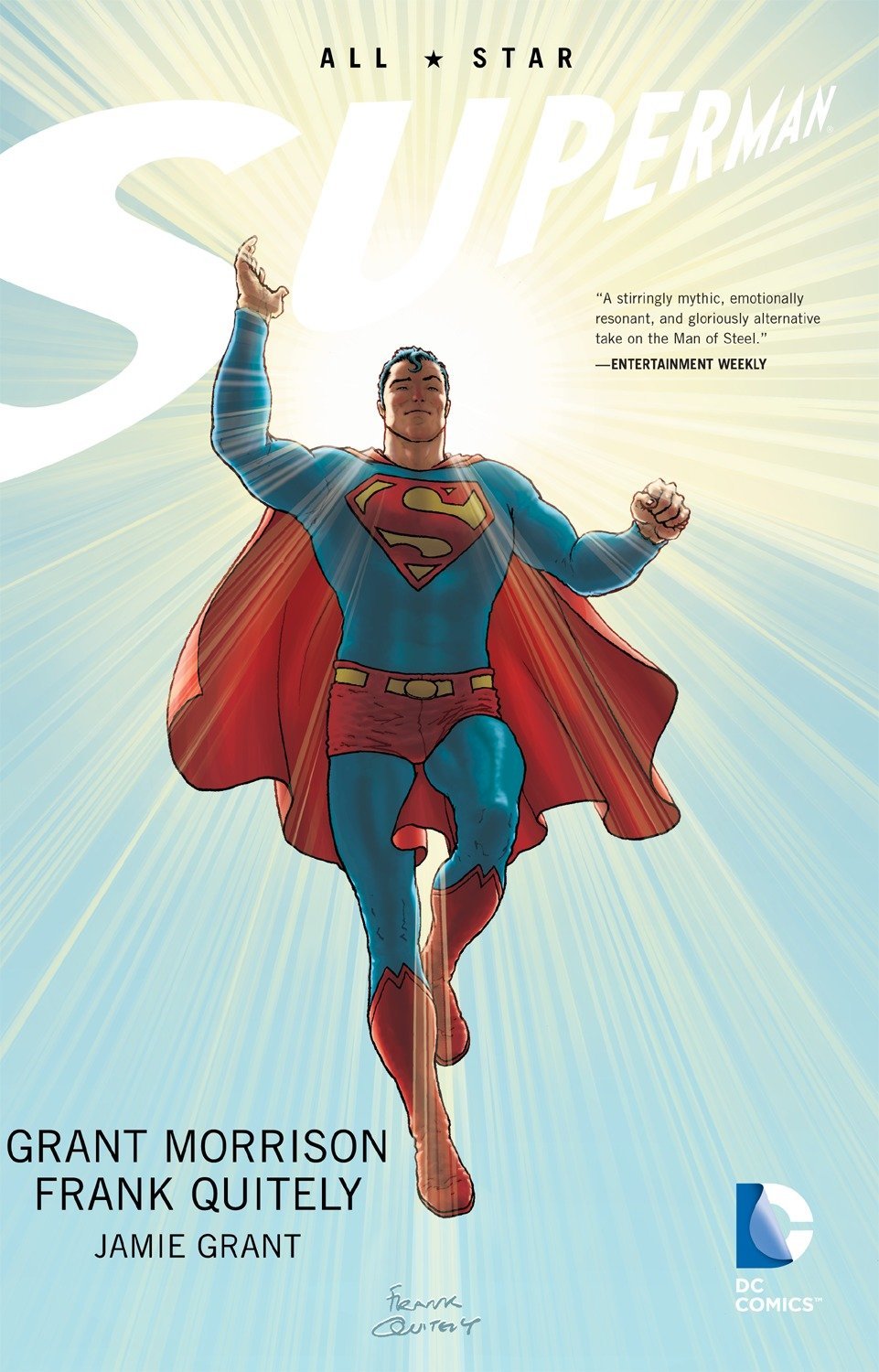
All-Star Superman

This story might be the toughest sell for Mr. Maher. However, I think if any comic can demonstrate the value of superheroes, it’s All-Star Superman. This love letter to Superman and all the fanciful themes surrounding him is a celebration of the ultimate hero. Even if Mr. Maher thinks idolizing heroes is dangerous, I think even he’ll appreciate why Superman is such an icon after 80 years.

What makes All-Star Superman special isn’t in how it depicts the Man of Steel at his best. It’s not just about him saving the day, defeating Lex Luthor, and winning the love of Lois Lane. More than anything else, the story that Grant Morrison and Frank Quietly tell demonstrates just how much Superman inspires those around him.

Throughout the series, there are many great moments that are full of heart, hope, and compassion. Some of it is cartoonishly over-the-top, but it never feels corny. There’s never a point where Superman takes a moment to tell a bunch of kids to eat their vegetables and stay in school. It doesn’t try to make Superman someone he’s not. He’s the ultimate paragon of virtue and this series just runs with that.

To further raise the stakes, this version of Superman is living on borrowed time. As powerful as he is, he has saved the day one time too many. He basically has to do what he can with what little time he has left to make the world a better place. It’s an endeavor that even Mr. Maher can appreciate.

More than once, Mr. Maher has tried to inspire others to be better. Even if his efforts are politically motivated, the will to inspire is something he’s always shown, going back to his days on “Politically Incorrect.” Even if he thinks Superman comics are for kids, he can still appreciate Superman’s efforts to inspire the good in others.


Y: The Last Man

This is another acclaimed comic series that doesn’t rely on superheroes, fancy costumes, or superpowers. At a time when gender politics are such a hot topic, a series like Y: The Last Man is more relevant than ever. This beloved comic by Brian K. Vaughan and Pia Guerra takes issues surrounding gender to an apocalyptic extreme.

As someone who has routinely criticized how the debate surrounding feminism and gender has evolved, I believe Mr. Maher will find a lot to like about Y: The Last Man. This is a story that puts men and women in the ultimate bind. One day, without warning, every creature on Earth with a Y chromosome just keels over and dies. Only one man, Yorick Brown, and his pet monkey, Ampersand, survive.

The story the follows is both a fight for survival and a critical insight into what happens when gender dynamics operate in extremes. The world that Vaughan and Guerra show just how much men and women rely on one another without realizing it. When one is completely removed from the equation, it pushes people beyond the brink.

At the same time, it shows just how resilient people can be in terrible situations. The will to survive knows no gender. It can bring out the best and the worst in someone, but the best is what usually keeps driving us. Mr. Maher has often spoken urgently about issues like climate change. The apocalyptic setting of Y: The Last Man shows why that urgency is necessary.


Again, I don’t expect Mr. Maher to change his mind on much. He has made it abundantly clear in the past that he is very set in his ways. However, if he is genuinely open to seeing the merits of comic books, these titles should help. Comic books may have been for kids when he was a kid. They have since become so much more and their legacy, like that of Stan Lee’s, will continue for generations to come.

Leave a comment

Filed under Celebrities and Celebrity Culture, Current Events, media issues, political correctness, religion, superhero comics, superhero movies, television

On Martin Luther King Jr. Day And Escaping Hate

martin-luther-king-washington-march-1963

To everyone out there who values peace, justice, and equality, I wish you a happy Martin Luther King Jr. Day. To some, this is just a day where kids get an extra day off school. To others, it’s a reminder of just how far we’ve come in the struggle against racism, injustice, and bigotry. Even though it seems like we’re stagnating at times, we’re still world’s better than we were in the days of Dr. King.

It’s hard to for young people today to understand just how entrenched racial attitudes were 60 years ago. For generations, inequality and bigotry wasn’t an aberration. It was the norm. Fighting that was like fighting the tides for a lot of people, but unlike the tides, hearts and minds can change.

That’s something Martin Luther King Jr. believed in. He dedicated his life to confronting hate and pursuing justice for everyone, regardless of race. His legacy lives on today for minorities of all kinds, from the LGBT community to immigrants. It may seem like an uphill battle at times and even after Dr. King’s death, there are still plenty of bigoted attitudes in the world today. Some people cling to those attitudes more than most.

However, it is possible for someone to let go of their hatred. It’s not easy, but it does happen. In the spirit of this day that I’m sure brings out a lot of conflicting passions in today’s society, I’d like to share one of my favorite Ted Talks.

This one is from Christian Picciolini, a former Neo-Nazi and white supremacist who managed to leave his hateful past behind. His story is one that’s especially relevant on a day like today because it doesn’t just reveal how people end up in hate groups. It shows just how difficult it is to get out. It can be done, though, and Mr. Picciolini’s story is one worth telling.

Whatever your politics, prejudices, and attitudes, we are all still human. We all inhabit this planet together. We all want a better future for ourselves and our loved ones. Ultimately, we can achieve much more by working together than by hating one another. That’s what Dr. King fought for and his legacy is worth celebrating, now more than ever.

Leave a comment

Filed under extremism, human nature, media issues, men's issues, outrage culture, political correctness, psychology

Why “F Is For Family” Is The Perfect Satire Of The American Dream

netflix-f-is-for-family-bill-burr-e1498677110849

What would you say about a man who constantly yells, curses like a sailor on crack, and constantly threatens to put his kids through a wall? On the surface, it sounds like this guy has some serious anger issues. You would probably suspect there’s something wrong with him and that he needs help from a competent therapist.

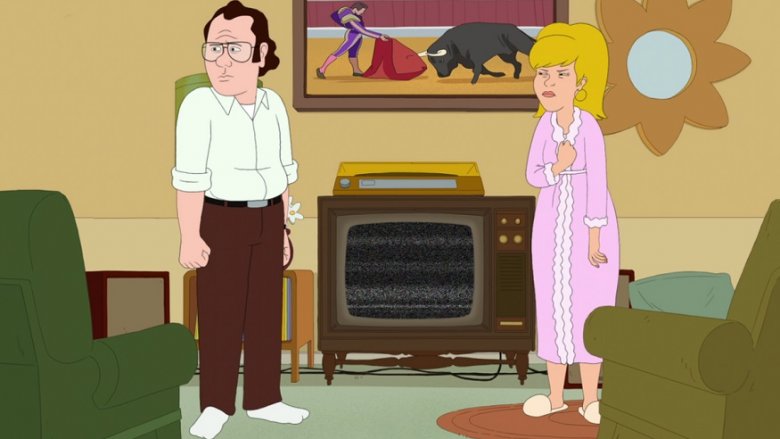
Then, after you find out that man’s name is Frank Murphy from the animated show, “F is for Family,” you quickly realize that even the best therapist in the world couldn’t do squat for this man. His anger, cursing, and threats of intentional property damage are entirely understandable. In fact, he would need a therapist if he didn’t exhibit some level of anger.

That’s because Frank Murphy, along with every other major theme in “F is for Family,” is the personification of the disillusion of the American Dream. Take everything you think you know about what it means to work hard, get ahead, and achieve your goals in life. Then, kick it in the gut, spit on it, and throw it through a brick wall. That’s Frank Murphy’s life. That’s what “F is for Family” is all about.

I only recently discovered this show while browsing Netflix and I’m glad I did. “F is for Family” is one of those shows that takes an overdone concept, like a dysfunctional cartoon family, and injects it with some overdue nuance. This isn’t a show about a bumbling dad, a nagging mom, or mischievous kids. The issues and themes in “F is for Family” feel genuinely relevant to the current state of the world.

For a show that takes place in the 1970s, that’s quite an accomplishment. At the same time, it makes sense for this show to take place during that particular time period in America because that’s when the hopes, dreams, and optimism of the post-World War II economic boom began to falter. They just faltered a lot faster for Frank Murphy and his family.

In many respects, Frank’s short-tempered persona is a byproduct of that decline. Throughout the show, it’s clear that Frank underwent a significant transformation. He wasn’t always this rage-filled working stiff who jumps at any chance to cuss out anyone in close proximity. He was once an upbeat, optimistic man who reflected the spirit of his time and his country. This is even reflected in the show’s opening theme.

He starts off as an idealistic youth. Born in 1931, he enters adulthood just as his country returns victorious from World War II. Like others before him, he serves his country after getting drafted in the Korean War. He returns home somewhat scarred, but still optimistic about his future. In 1958, he has dreams of flying airplanes and marrying Sue, a young woman in college at the time.

By all accounts, Frank plays by the rules. He works hard and carries out his duty as well as anyone can expect. He’s not some thick-headed dope like Homer Simpson or Peter Griffin. He’s also not some misanthropic underachiever like Al Bundy. He can speak in complete sentences, form coherent thoughts, and demonstrate an average level of competence.

He is, for the most part, an appropriate representation of a working class man trying to provide for his family. The problem, and the frequent source of his anger, is that his efforts often go unrewarded and unappreciated. In some cases, he gets completely screwed over, both by forces beyond his control and by unexpected consequences from his behavior.

In the first season, he works hard and sucks up to his asshole boss, Lance Dunbarton, to get a promotion at the airport he works at as a baggage handler. He even manages to avert a strike on Christmas Eve. Rather than get rewarded for this effort, he gets fired.

In the second season, he gets a chance to return to work, but the way he confronts his former supervisor, Bob Pogo, ends up making his situation worse.

Along the way, Frank also attempts to deal with the constant dysfunction of his family, which includes a rebellious teenage son, a wimpy pre-teen son who gets bullied at every turn, and a young daughter who refuses to conform to traditional gender norms. On top of all that, his wife is dissatisfied with just being a housewife and her efforts to achieve her own dreams cause plenty of marital strife.

At every level, Frank Murphy’s life is not the at all consistent with what the American dream had promised. Instead of the white picket fence with a content wife and well-behaved kids, his life is a constantly-devolving mess. No matter how hard he works or how much he plays by the rules, nothing seems to improve. Things only ever get more frustrating. After only a few episodes, it’s easy to understand why Frank is so angry.

To some extent, Frank Murphy is a fitting personification of Murphy’s Law. That’s not to say that everything goes wrong for him all the time, but through three eventful seasons, his attempts to improve his lot in life never works out. For every step forward he takes, he suffers a major setback.

He finally gets his job back at the airport where he hopes to pursue his dream as a pilot. Then, he gets his wife pregnant and they have to put their dreams on hold again.

He tries to improve things with Sue by taking his wife out for a romantic evening on their anniversary, but ends up getting into a major fight that makes everything worse.

Even his family isn’t immune to this regressive trap. While Frank struggles to find a stable job, Sue attempts to enter the working world, only to have her dreams crushed when the company she works for steals her invention. On top of that, she works in an office where she’s constantly belittled, harassed, and demeaned by co-workers whose conduct makes Don Draper look like a hippie.

His rebellious son also has dreams of becoming a rock star, but ends up getting kicked out of his band after a breakdown involving his drug-loving neighbor’s busty girlfriend. In season 3, he tries to reinvent himself and he tries to find a sense of belonging with a new group of friends. The end result is him getting arrested and spending a night in jail.

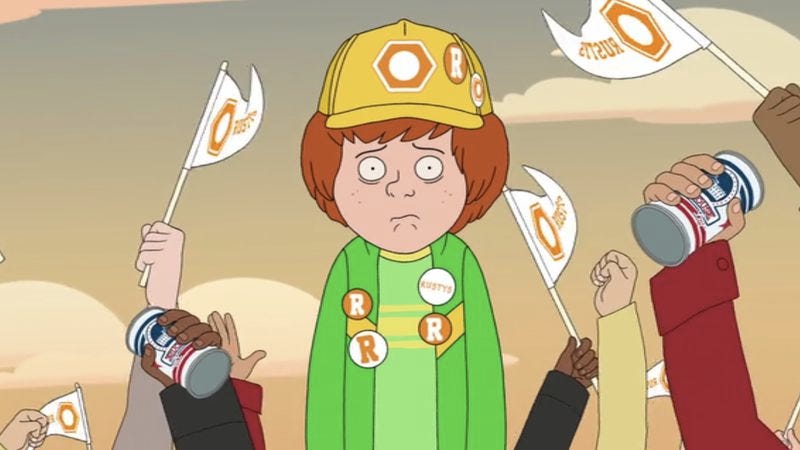
His youngest son, Bill Murphy, learns these harsh lessons even earlier than his father. He also tries to work hard and play by the rules. He tries to stand up for himself and confront the bully who torments him. Like his father, though, he ends up making things worse. I won’t get too deep into spoilers, but I will note that there’s some heavy arson and awkward boners involved.

Even his brainy daughter, Maureen, isn’t immune from it. Being a young girl in the early 1970s, her dreams are limited. Even when she aims low, like winning a ring toss contest on kids show, it still fails and through no fault of her own. Like her parents and brothers, the world seems determined to deny her any semblance of success.

If the essence of satire is to offer scathing criticism of a particular social construct, as those who edit Wikipedia imply, then “F is for Family” is a direct attack on the ideals and assumptions we associate with the American Dream. It never gets overly-nihilistic like “Rick and Morty” or “Bojack Horseman.” With every episode and sub-plot, it chips away at the foundation on which that dream is built.

It’s established throughout the show Frank and Sue were both in a position to achieve that dream. They were on a promising path with Sue being in college and Frank wanting to become a pilot. Even when they faced a major obstacle, namely Sue getting pregnant, they tried to do the right thing. They sacrificed for each other and their family.

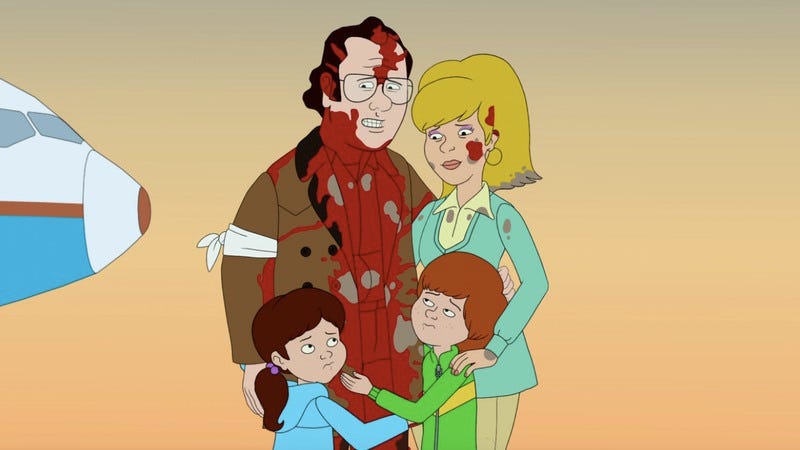
That’s NOT red paint.

In any other narrative, their responsible behavior would be rewarded. By the standards of the American Dream, they did the right thing. They got married and tried to provide for their family. However, despite those sacrifices, they’re repeatedly denied their dreams. At the end of the day, doing the right thing and playing by the rules just doesn’t cut it.

Frank watches as his obese, slob of a boss screws him over on Christmas Eve. Sue watches as the company that made her so miserable steals her idea and profits from it. Their kids watch as the world around them rewards and punishes those who don’t deserve it. The only ones who ever seem to benefit are those strong enough to skirt the rules or well-connected enough to bend them.

In that context, it’s fitting that “F is for Family” takes place in the 1970s. That marked the end of the post-World War II economic boom and the beginning of major economic decline from which working class people never recovered. The well-paying, blue-collar jobs that once allowed a man like Frank Murphy to support his family are long gone thanks to the rise of automation and globalization.

While the show never dives too deep into the complexities of this decline, it provides a great deal of crude tongue-in-cheek humor that reveals just how flawed the American Dream had become at that point. There are not-too-subtle jokes about women, minorities, family life, politics, and the media that highlight just how flawed the system is. Frank Murphy is just the guy who gets screwed more than most.

In the end, though, that’s what makes “F is for Family” the ultimate satire for the idealized narrative we associate with the American Dream. It shows that this notion that a hard-working, self-sacrificing working man who plays by the rules will achieve his dream is nothing more than a bad fairy tale. Frank does everything society expects a working class man to do and rewards him with jack squat.

Given everything he endures, from abandoning his dreams of becoming a pilot so he could provide for a family that rarely shows him any gratitude, I’ll rephrase the question I asked earlier. What would you say about a man like Frank Murphy, who played by the rules and bought into the American Dream, only to see it screw him over at every turn? Can you really blame him for being so angry?

4 Comments

Filed under gender issues, human nature, Marriage and Relationships, men's issues, political correctness, psychology, sex in media, television

Cheating, Sex Robots, And Why It’s About To Change

man-kissing-robot

What constitutes cheating in a relationship? It’s a simple question with not-so-simple answers. It often varies from couple to couple. For some, a simple kiss counts as cheating. For others, nothing beyond full sexual intercourse counts as cheating. For a few, even sex doesn’t count, provided there’s no deeper emotions involved.

It’s a difficult issue, but one in which the factors are clear. You have two people in a relationship. Ideally, they want that relationship to work and part of that involves being faithful. Cheating undermines that. Regardless of whether you think humans are inherently monogamous, it’s generally a good idea to understand the merits of fidelity.

Now, take every complication that surrounds cheating and throw sex robots into the mix. It doesn’t just require that we reevaluate what counts as cheating. It changes many of the fundamental factors behind it.

I know that has been a common refrain whenever I’ve mentioned sex robots. Beyond changing how we’ll interact with advanced artificial intelligence, this technology will trigger an unprecedented upheaval in how we look at intimacy. It has already caused controversy in some areas and chances are, it’ll inspire many others.

What inspired this particular issue was a study conducted by the University of Helsinki that evaluated attitudes on cheating, prostitutes, and sex robots. The methodology was fairly straightforward. It surveyed participants’ reactions to a particular scenario involving a 30-year-old individual whose gender varied from that of those responding.

The scenario was that, while on a business trip, the individual visited either a prostitute or a sex robot. Sometimes the individual was married. Sometimes they were single. For the most part, respondents didn’t condemn the person for using either if they were single, although the one using the sex robot wasn’t subject to too much scorn.

Relatively speaking.

However, it was when the person was in a committed relationship where the data really diverged. Whether the person visited a sex robot or a prostitute, they were still guilty of cheating in the eyes of the respondents. Those who used the service of the sex robot, though, weren’t as harshly condemned. In other words, using a sex robot isn’t the same as soliciting a prostitute.

This insight is pretty striking, in and of itself. It has major implications for the prostitution industry, which has been subject to some major upheavals in recent years. If this research is any indication, the market is about to get very ripe for sex robots. As prostitution becomes increasingly taboo, sex robots may emerge as a more palatable alternative.

That said, the study did make clear that the participants saw using sex robots as a form of cheating. Even if it wasn’t cheating on the same level, it still constituted cheating to some extent. This is revealing in the context of sex robots because, unlike living prostitutes, it ascribes an emotional connection.

These aren’t vibrators, dildos, or flesh lights. These are robots that look, feel, and act like living people. A woman bringing herself to orgasm with a vibrator or a man doing the same with the aid of internet porn is seen as an individual act. The function is the same, though. These devices are created with the intent of giving the user a sexual experience.

It creates a situation in which this unspoken standard emerges in the context of cheating. People in a relationship may not always like that their significant other gets a sexual release without them, but generally won’t consider them using toys or porn an issue, although that does become an issue for certain people.

In the context of this study, sex robots hint that those in a relationship own their significant other’s sexuality to some extent. If they’re not getting their release from them, then that counts as cheating. It’s easier to overlook with sex toys because they don’t have faces or a measure of intelligence. Once it becomes human-like, though, it becomes an issue.

This aspect of cheating, establishing that how someone goes about pursuing individual sexual experiences, will require people in relationships to start asking some uncomfortable questions.

Do those in a relationship have a say in how their partner goes about pursuing a sexual release on their own?

Just how much should sex be a factor in determining what constitutes cheating?

What is the fundamental difference between a sex robot and a sex toy?

Does using a sex robot constitute a unique sexual experience beyond cheating?

I don’t claim to know the answer to these questions. I’ve written stories about sex robots, but that doesn’t qualify me to answer them. The rapid development of sex robot technology and the emergence of brothels that utilize sex dolls ensure that this will be an issue, regardless of how we feel about cheating.

There is one component, however, of this study and this issue that I feel is worth highlighting. Unfortunately, it involves gender politics and I know how heated that can get. I have a feeling that just pointing this out is going to trigger all sorts of heated discourse, but it’s still worth noting.

In the same University of Helsinki study, there was one bit of data that’s sure to complicate future discussions of cheating. Regardless of whether prostitutes or sex robots were involved, there was a gender difference in terms of condemnation. Specifically, women gave stronger condemnation to users of both prostitutes and sex robots. This is the exact quote from the study.

“There was a consistent difference in how female subjects showed slightly stronger condemnation than male subjects.”

The keyword in there is “slight,” but in research, those differences matter. Some of that difference could be cultural. This research was conducted among young college students in Scandinavia. The demographics and sample size is worth taking into account.

That said, such a difference does seem to reflect the extent to which gender matters with respect to cheating. The women, in this study, had a broader definition of what constituted cheating. A sex robot and a prostitute aren’t that different. Both warrant condemnation. Both can be used as a means of judgment and scorn.

As sex robot technology becomes more advanced, this difference is likely going to become more apparent. As a result, it’s likely to trigger even more gender-driven conflicts than we have now, which is saying something given the topics that trigger such conflicts. Changing concepts of cheating will likely intensify those conflicts.

Again, and this is a necessary disclaimer for research of any kind, this study is not definitive. It’s still worth studying, though. It provides a telling clue at where the line is right now with respect to cheating. It also hints at just how much it’s going to change in the coming years as sex robots become more advanced.

2 Comments

Filed under futurism, gender issues, Marriage and Relationships, political correctness, prostitution, psychology, romance, Second Sexual Revolution, sex in society, sex robots, sexuality, Sexy Future, technology