Category Archives: Marriage and Relationships

Why Men Should Also Be Concerned About The Future Of Roe v. Wade

108294094

These are tenuous times for abortion rights. Regardless of your gender, there’s no getting around the news. The overall trend in abortion access is not on the path of greater accessibility. If anything, it’s going in the opposite direction.

Regardless of which side you’re on in this exceedingly divisive issue, there’s no denying the legal reality. For the past 25 years, a woman’s ability to get an abortion has steadily eroded, thanks largely to the spread of TRAP Laws. These laws may not explicitly outlaw abortion, but they make getting one inconvenient at best and impossible at worst.

As I say in every piece I write about abortion, I don’t particularly enjoy talking about abortion. This is an issue that I feel I’m woefully unqualified to talk about because I’m not a woman and will never know what it’s like to be in such a difficult situation.

That said, there is an aspect about this topic that I feel needs to be addressed and it’s a part of the issue that impacts men. It takes two to make a baby, last I checked. Even though it’s objectively true that abortion affects women more directly, men do have a role and I feel that role will expand as abortion rights trend in a less-than-liberal direction.

As I write this, the United States Supreme Court is in the midst of a huge shake-up. After the retirement of Justice Anthony Kennedy, the justice system is poised to shift heavily to the right. That has caused plenty of concerns among those who worry about the status of Roe v. Wade, the Supreme Court case that legalized abortion nationwide in 1973.

At the moment, it still seems like a long-shot for this decision to be overturned. However, Supreme Court decisions have been overturned in the past. It happened with racial segregation. It happened with anti-sodomy laws. Legally speaking, there’s no reason why it couldn’t happen with abortion.

Now, that process is fraught with a long list of political, legal, and ethical complications, the least of which would be the long-term alienation of whatever political party favors it. However, I don’t want to harp too much on the politics here. Instead, I want to focus on the social component because that’s where the effects will be most directly felt.

Women, by far, will be the most directly impacted. There are still women alive today who can recount what life was like before Roe v. Wade. Their stories are becoming more relevant. For men, however, I don’t think those stories are as well-known and for good reason. Women had to endure bearing those unwanted children. At worst, men just found themselves on the wrong end of a shotgun wedding.

If Roe v. Wade were overturned, however, that wouldn’t be the only predicament most men faced. Beyond the abortion issue, 1973 was a very different place. In that world, it was possible for a man to just skip town, run out on a pregnant woman, and never interact with her again. While that man would have to be a callous, irresponsible asshole, it was possible and it did happen.

That sort of thing isn’t as easy to do today. Anyone who has seen a single episode of Maury Povich knows that. Between social media, improvements in paternity tests, and tougher child support laws, most of which came after 1973, it’s a lot harder for a man to escape parental obligations. It’s not impossible, but it’s not as easy as just skipping town.

In a world where women cannot easily end an unwanted pregnancy, there will be greater incentive to find these reckless men and hold them responsible. Where there’s an incentive, especially one that has the potential to become a lucrative legal racket, there will be people and businesses that emerge to fill that need.
How that manifests is hard to determine, but desperate people will find a way and you won’t find many more desperate than a woman dealing with a child she can neither afford nor care for. I know a sizable contingent of people, many of which are probably men, will blame the woman for being promiscuous. That still doesn’t change the basic equation of human reproduction.

Two people are involved. Those people, in a world where decisions about a pregnancy are pre-made by the law, are going to be in a tough situation. Regardless of whether a pregnancy was the result of an accident, a crime, or an extortion plot, there will be serious ramifications and not just in terms of legal fees.

The story of women enduring the rigors and hardship of an unwanted pregnancy are many. However, the story of men living in a world without Roe v. Wade and modern child support laws haven’t been told yet because the circumstances haven’t been in place. On the day Roe v. Wade gets overturned, those stories will begin and those are stories men don’t want told.

They’re not very sexy stories, to say the least. They have sexy moments, but extremely unsexy outcomes. Picture, if you can, the following scenario that may play out in a world without Roe v. Wade.

A young man with plenty of dreams has a one-night stand with a woman in a lone act of recklessness. The woman ends up pregnant. Since they live in a state where abortion is illegal, she has to have the child. The man has no idea for months until the woman tracks him down through the courts, forces him to take a paternity test, and confirms that he’s the father.

With no say in the matter, he’s legally liable for child support for the next 18 years. The woman, without any of his input, decides to keep the child instead of putting it up for adoption. The man resents the woman for making this decision without him, but begrudgingly goes along with it, if only to avoid the stigma.

Years go by and his life becomes more of a struggle. He can barely afford to support himself due to the child support payments. He and the mother of his child are constantly at each other’s throats, going through legal battles over how much support is needed and how much access he should have to his child.

Between the legal and financial struggles, both end up in poverty. Their child ends up in poverty too, growing up in a broken home. In a world where there are few choices for women and fewer choices for men, there are plenty others.

Does that sound like an appealing, functional society? Does it sound like one that benefits men, women, and children in any capacity? You don’t need to be a liberal, conservative, or a Supreme Court Justice to understand why such a society is undesirable.

Some of this isn’t even speculation. There have been societies that have outlawed abortion completely. Those societies didn’t prosper. They didn’t benefit men, women, or children. However, the lessons from those societies will probably not faze the anti-abortion crowd. I doubt they’ll give any judges or legislators pause as they push for more restrictions.

The impact of these laws will be felt first by the women. They still bear the children. They’ll still suffer the most negative effects at first. Those effects will quickly find their way to the men, as well. Unlike the men prior to 1973, they won’t be able to escape it.

As a man, there’s only so much I can bring to the table in the abortion debate. However, given the current laws surrounding child support, child rearing, and parental rights, there are more than a few issues that should give men cause for concern. Even if you’re a man and you consider yourself anti-abortion, there’s one inescapable truth. A world without Roe v. Wade is going to impact everyone.

4 Comments

Filed under gender issues, human nature, Marriage and Relationships, media issues, men's issues, outrage culture, political correctness, sex in media, sex in society, women's issues

The Pathetic Life Of Alan Harper: A Prelude/Warning To Men?

maxresdefault

Sometimes, popular culture is uncanny at predicting the future. “Star Trek” famously predicted cell phones. “2001: A Space Odyssey” predicted tablet computers. Then, there’s “The Simpsons,” which has predicted so many things that it’s creepy. Some predictions, however, fly under the radar. Some aren’t even predictions as much as they are worst case scenarios.

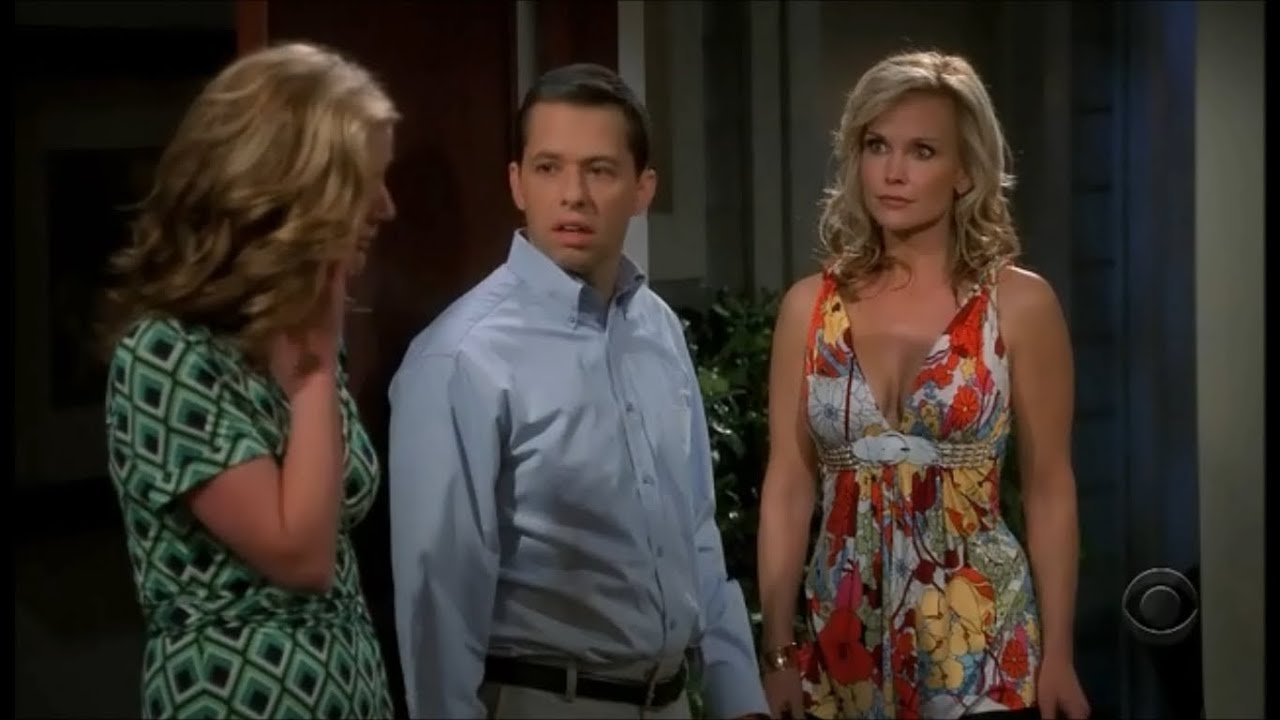
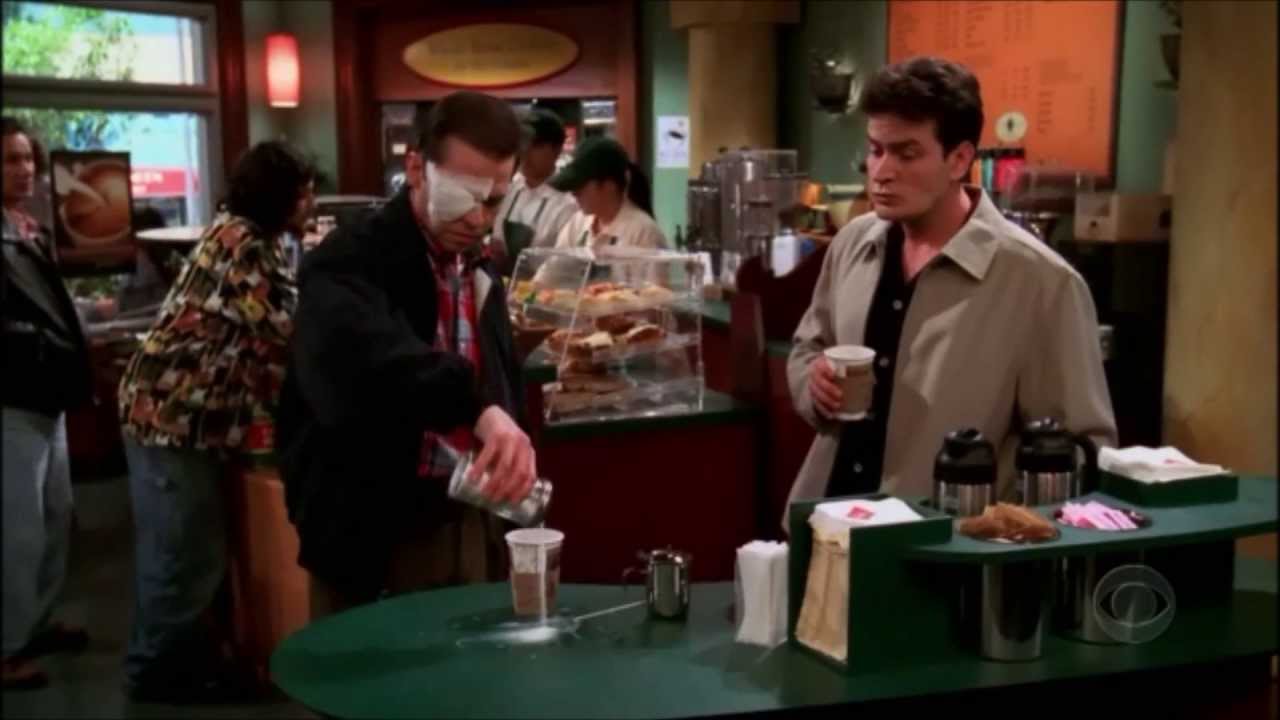
One such scenario played out in “Two and a Half Men,” a show more famous for its off-screen drama than its on-screen antics. Granted, those antics were fairly crude. Most episodes revolved around dirty jokes, sexual innuendo, and glorified hedonism. In today’s social climate, this show would trigger mass protests with every episode.

That didn’t stop it from being funny. I consider myself a fan of the show. However, this is one of those shows that could never be made today, even with an emotionally-stable Charlie Sheen. Its brand of comedy just wouldn’t work in an era where sexy Halloween costumes are considered controversial.

However, the message “Two and a Half Men” conveyed goes beyond its brand of humor and the actors who made it controversial. It’s a message that probably wasn’t intended when the show first aired, but one that manifested with time. That message centers around the only male character to make it through every season alive and unaltered, Alan Harper.

As a character, Alan is the catalyst for the whole show. It begins with him getting kicked out of his house by his wife, forcing him to live with his brother, Charlie. It serves as the foundation for the antics that follow. However, in light of recent trends in feminism, Alan Harper has become more of a concept than a character.

Simply put, Alan Harper is the perfect embodiment of a defeated, emasculated man. He’s a step below the stereotypical beta male. He’s the masculine equivalent of rock bottom. Even the entire cast of “The Big Bang Theory” or Al Bundy from “Married With Children” would feel sorry for him.

You don’t need to watch every episode of every season to see how this plays out. The show rarely goes more than a few minutes without highlighting how pathetic Alan is. The denigration goes beyond his ex-wife kicking him out of his house, divorcing him, and hitting him with egregious alimony payments.

Alan Harper, at his core, is a man dependent on everyone around him for affirmation, but is incapable or unwilling to earn it. His womanizing brother, Charlie Harper, often describes him as a parasitic leech who feeds on the pity of others to survive. In terms if how he conducts himself throughout the show, that’s pretty accurate.

Everything Alan does, from trying to make a living to pursuing romance, is done from a position of dependence. He depends on his brother for a place to live. He depends on his ex-wife to see his son, Jake. He depends on all the women he encounters for love, sex, and affection. He never has any leverage, always working from a position of weakness.

This earns him sympathy, but he’s no lovable loser. In addition to being dependent and weak, he’s also neurotic, selfish, and lazy. He rarely puts much effort into improving his lot in life. He never stands up for himself, rarely accepts responsibility for his mistakes, and endures failure without ever learning from it.

This is especially true in the later seasons of the show after Charlie Sheen was fired. Instead of having to leech off his brother, Alan managed to leech off a total stranger in Walden Schmidt. He makes every possible excuse to keep living in his brother’s house, never pay for anything, and avoid any semblance of personal growth.

Even if you pity Alan Harper, there’s little reason to respect him. Whenever he has a chance to make choices that can change that, he either makes the wrong decision or avoids it entirely. He’s not just a perpetual victim of a vindictive ex-wife, a hedonistic brother, and an idiot son. He actually clings to his victimhood, as though it were part of his identity.

It was fodder for comedy when “Two and a Half Men” was still on the air. Now, it’s a serious issue that affects men and women alike. That’s because leveraging victimhood has become less a comedy trope and more an ideological tactic.

The current discourse, especially when it comes to gender, is often built around who victimizes who. A big part of the anti-harassment movement is driven by the idea that women have been victims for years, suffering in silence under the thumb of misogynistic men. There are more than a few situations like that in “Two and a Half Men.”

Men are just as guilty of using that tactic too, albeit not to the extent of Alan Harper. Men have cited the lack of attention people give Terry Crews or Corey Feldman whenever they talk about issues like sexual abuse. They’ll point out the ways in which women get preferential treatment in our society, some of which actually plays out in “Two and a Half Men.”

There’s no question that harassment and inequality are problems, but just being a victim can’t be the end of the conversation. Alan Harper is, in essence, the personification of what happens when we don’t attempt to further that conversation. It impacts everybody, but it’s especially relevant for men.

Alan reflects a worst-case-scenario. In the overall gender dynamic, he draws every bad card and makes every wrong move. He marries a woman who hates him and exerts immense control over his life. He has a callous, egocentric mother who gives him no affection, guidance, or support. The entire world takes advantage of him and he does nothing to stop it.

To make matters worse, there’s very little Alan can do to stop it. Even if he stands up for himself, he has no support because he’s so dependent on other people. If he gets kicked out of the house, he has nowhere to go. If he makes any money, someone else ends up getting it, often his ex-wife or an ex-girlfriend. He’s not just pathetic in how he handles it. He’s utterly trapped.

This is the kind of nightmare scenario that men genuinely worry about. Many women may laugh it off, but men aren’t blind to the bigger picture. If Alan Harper were gay or transsexual, then he would have organizations that support him. There are many groups that work hard to help disadvantaged members in the LGBT community.

There are also plenty of organizations that help women as well. If Alan were a woman who had been kicked out of his house by a vindictive husband, then there’s no way that the comedy in “Two and a Half Men” would’ve worked. It’s not funny to see a poor woman get thrown out on the streets and denied custody of her child. When it happens to a man like Alan, though, it’s hilarious.

That’s where the humor in “Two and a Half Men” becomes distressingly serious. A character like Alan Harper lends himself to ridicule, but his situation is no laughing matter. He’s the pinnacle of a defeated man. Society does nothing to help him and everything to mock him. If he weren’t a man, it would be a tragedy. Instead, it’s a comedy.

For men, that’s a scary thought. On top of that, his situation can manifest in the real world, minus the laugh track. It is possible for a man to lose his home, his kid, and his money thanks to a vindictive wife. It is possible for a man to be so utterly helpless that he has to depend on everyone’s pity to survive.

The fact that it’s possible, but still funny in the context of a sitcom, gives men more pause today than it did when “Two and a Half Men” was still on the air. Men’s lives are being ruined by a society that does not give them the benefit of the doubt. Any debate that tries to take the side of men tends to get labeled as misogynistic.

We can either take those concerns seriously or create a society where men may end up like Alan Harper, laughably pathetic and utterly destitute. “Two and a Half Men” was still a funny show. However, the core of its comedy has serious implications and that are worth taking seriously, now more than ever.

12 Comments

Filed under gender issues, human nature, Marriage and Relationships, political correctness, psychology, romance, sex in media, sex in society, sexuality, women's issues

Jack Fisher’s Top Five Romance Comics

tumblr_m9f6wpy3tu1qjzyxso1_1280

I love comics. I love romance, too. When you put them together, it’s like putting bacon on pizza. It takes two inherently wonderful concepts and combines them, thereby compounding everything that makes them awesome.

I talk a lot about comics and romance. I’ve cited certain relationships that stand out in the current romantic landscape and praise certain comics that raise the bar for romance between superheroes. I think I’ve made the extent of my fondness for both fairly clear. Now, I’d like to offer some specifics.

For a while now, I’ve gotten comments and emails from people asking for recommendations of good romantic comics. I feel like I’ve contemplated this enough to craft a list of the comics I feel have the most to offer in terms of romance. While there are plenty of comics that cater specifically to romance, I’ve left those out in favor of those that offer a broader story that general comics fans can also appreciate.

What follows are my top five picks for the best romance comics. Please note that this is a personal list. I don’t wish to imply that this ranking is definitive. These are just my hand-picked comics that I feel offer the perfect blend of love and comic book level awesome.


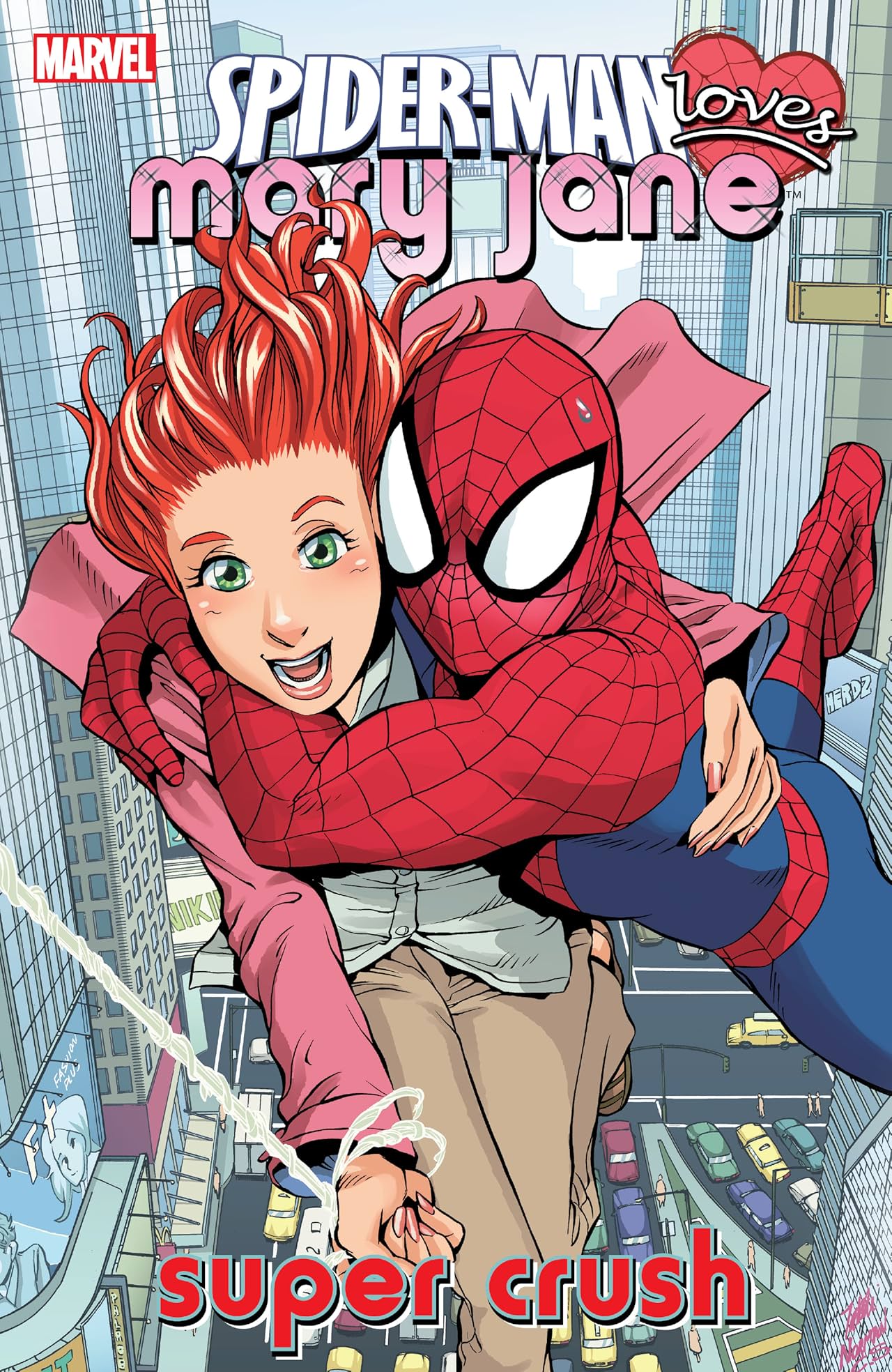
Number 5: Spider-Man Loves Mary Jane

This sweet, fun little series from the mid-2000s is one of Marvel’s more underrated gems. There’s a lot of drama, angst, and frustration surrounding the romance between Spider-Man and Mary Jane Watson. I’ve cited some of the “complications” these two have endured on more than one occasion.

This series basically avoids all of that and doesn’t rely on elaborate retcons to do it. The story is less about Spider-Man and more about Mary Jane Watson. Specifically, it’s about a young, pre-supermodel Mary Jane Watson who hasn’t quite become the gold standard for sex redheaded comic book characters. That’s critical to what makes this series so great in terms of story and romance.

For once, Peter Parker being Spider-Man is secondary. That story is unfolding behind the scene, but the real drama comes directly from Mary Jane. She’s at an age where she’s blossoming into a beautiful young woman, but still figuring herself out. She’s not sure of what she wants, how to love, or where she fits into this crazy world. On every level, she’s far more relatable than any superhero.

As she navigates that world, she makes touch choices and even a few mistakes. More than anything else, though, this series shows how and why Mary Jane came to love Peter Parker so much. It doesn’t rely on overt sex appeal or excessive heroics. The story focuses entirely on chemistry and growth.

On paper, it sounds like something that shouldn’t work in a superhero comic, but it totally does. It’s a romance story that’s balanced and well-developed. It also isn’t too mature. Anyone from age 8 to 80 can appreciate the romance here. On top of that, Takeshi Miyazawa’s artwork is gorgeous, bringing light and heart to a romance that badly needs it.


Number 4: Rogue and Gambit

This is a very recent entry on my list, but one that did more than enough to justify its position. Over the course of five issues, “Rogue and Gambit” accomplished something extraordinary. It took a well-known romance that had been deconstructed, denigrated, and mishandled for years and effectively rebuilt it into something truly uncanny.

Kelly Thompson, one of Marvel’s rising stars, took the baggage surrounding the Rogue/Gambit relationship and channeled it in a way that felt both rewarding and sincere. It starts as an undercover mission, but evolves into some overdue couple’s therapy. Thompson doesn’t ignore all the factors that kept them apart. She even lets them argue and agonize over them.

In doing so, this series presents this romance as one you won’t find in any fairy tale. This isn’t a case of star-crossed lovers destined to be together. It’s a romance in which the two people involved have to really work at it. They have to confront their flaws, their failures, and all the excuses they’ve made to avoid their feelings. It gets ugly, but beautiful at the same time.

I would go so far as to cite this series a template for how a modern superhero romance can work, even without an iconic legacy. The Rogue/Gambit romance isn’t ideal, but that’s exactly what makes it so enjoyable and endearing. These are flawed characters who have both found themselves playing villainous roles at some point in their history. Them coming together despite all that just feels so right.

The only reason this series isn’t higher on my list is because it’s so recent. It’s also still evolving through a companion series, “Mr. and Mrs. X.” I’ve reviewed and praised that series too, but it wouldn’t be possible without this series. Whatever complications the Rogue/Gambit relationship faces in the future, this series will remain one of its most defining moments.


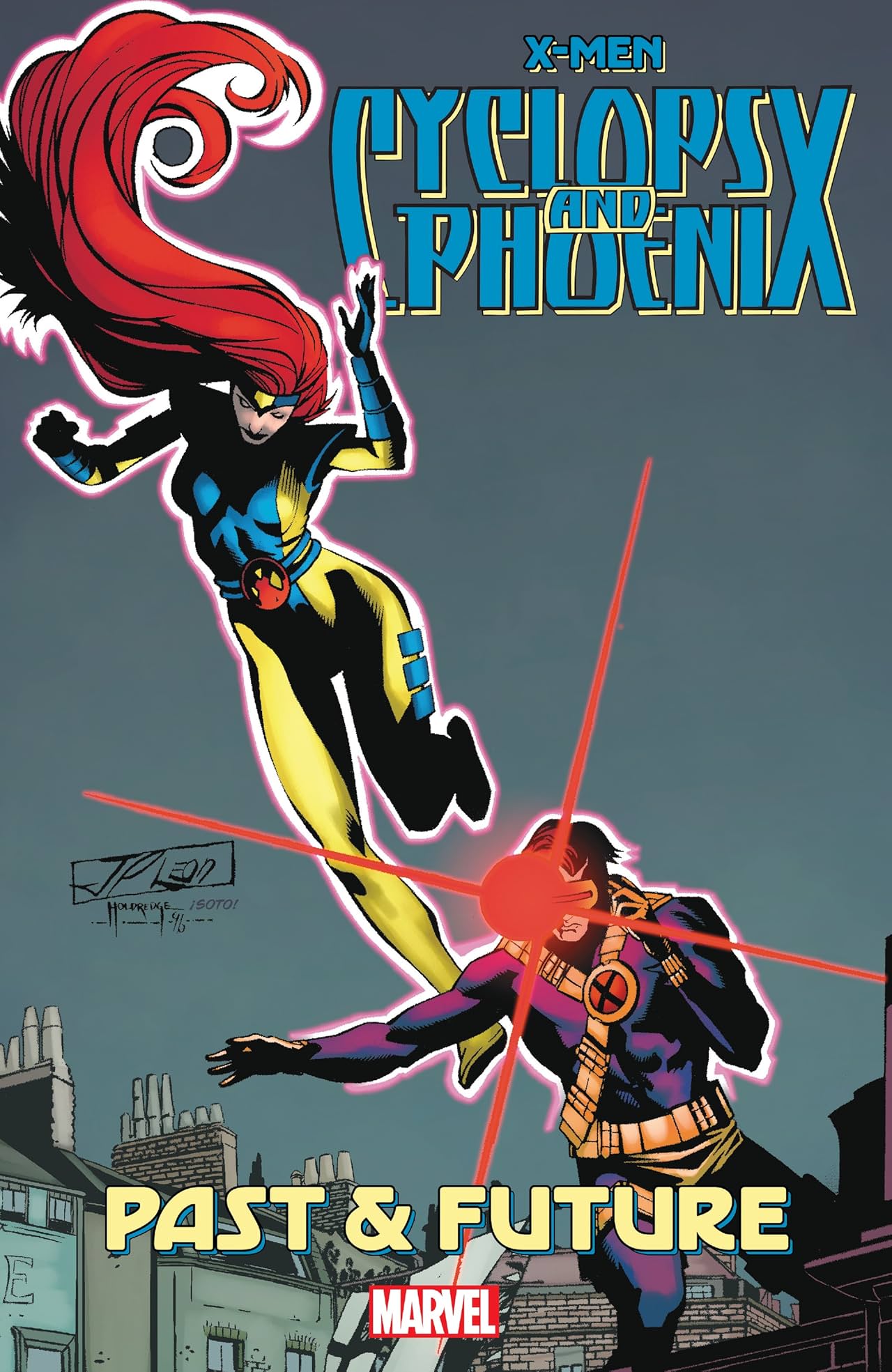
Number 3: The Adventures of Cyclops and Phoenix

I’ve made no secret of how much I love the romance between Cyclops and Jean Grey. I’ve cited them as one of those uniquely special relationships that is both iconic and balanced, a rare combination for a romance that has been unfolding for over 50 years now. While they’ve endured plenty of tribulations, complications, and retcons along the way, they remain iconic for a reason.

This series from the late 1990s is a testament to just how strong their romance can be when retcons, cosmic forces, and terrible love triangles are set aside. At their core, Cyclops and Jean Grey are two people don’t just want to love each other. They want to create a better world for their friends, their family, and their future children. They get to do all of that and then some here.

Much of the story takes place in one of the many dystopian futures that plague the X-men, namely one ruled by Apocalypse. It puts Cyclops and Jean in a position where they can’t fall back on their fellow X-men or the support of other superheroes. They have to navigate this wasteland of a world with only each other to fall back on. It’s a true testament to the strength of their relationship.

As the title implies, though, the story emphasizes the adventure more than the romance. While there are plenty of sweet moments between Cyclops and Jean, their relationship is not the primary focus. It’s certainly a factor driving them forward, but the meat of the story is how it drives them through the conflict. If you enjoy adventure with your romance, then this is definitely the series for you.


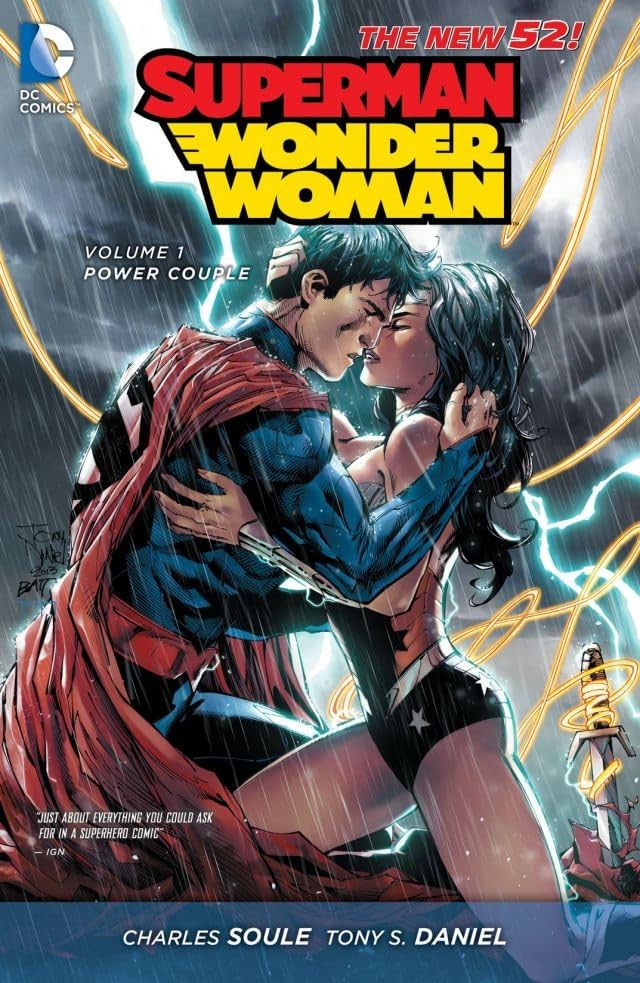
Number 2: Superman and Wonder Woman Volumes 1 and 2

Yes, I know Superman and Lois Lane are still considered the most iconic superhero couple of all time.

Yes, I know there’s an extremely vocal contingent of Superman fans that believe there’s something missing whenever he’s not with Lois.

No, I do not care. That’s because the run on this series by Charles Soule and Tony Daniel really raised the bar for just how great a romance can be for these two iconic characters.

There’s a lot I can say about the romantic potential between Superman and Wonder Woman. It would probably take me multiple blog posts and several essays to adequately describe what sets it apart from Superman’s relationship with Lois and why it works so beautifully. Thanks to this series, though, I don’t need to do that.

This particular series takes place during the controversial, but endearing New 52 era of DC Comics. During this strange, but amazing period of DC Comics, Superman and Lois aren’t married. They know each other, but they aren’t romantically involved. That opens the door for Superman to explore a relationship with Wonder Woman. However, this series makes clear that this romance is no gimmick.

They’re not forced together, nor is it presented as a gimmick. From the very beginning, as well as the events that led up to it, there’s a distinct sense that Superman and Wonder Woman find one another during tenuous times in their lives. They’re two powerful characters making their way through a world in which they feel isolated. When they’re together, though, they’re at their best.

This story brands them as a power couple and they do plenty to earn it. Together, they face threats from alien tyrants and renegade Greek gods. Their worlds collide, but they guide each other through. They make each other stronger. They make each other better. They fight as individuals and as equals. If that’s not the definition of a power couple, I don’t know what is.

Again, if you’re a die-hard supporter of Superman and Lois, that’s fine. This series does nothing to undercut that. However, it does plenty to prove that Superman and Wonder Woman can share a powerful romance, literally and figuratively. Even after DC has undergone extensive retcons and reboots, this series still captures the power of that romance in the best possible way.


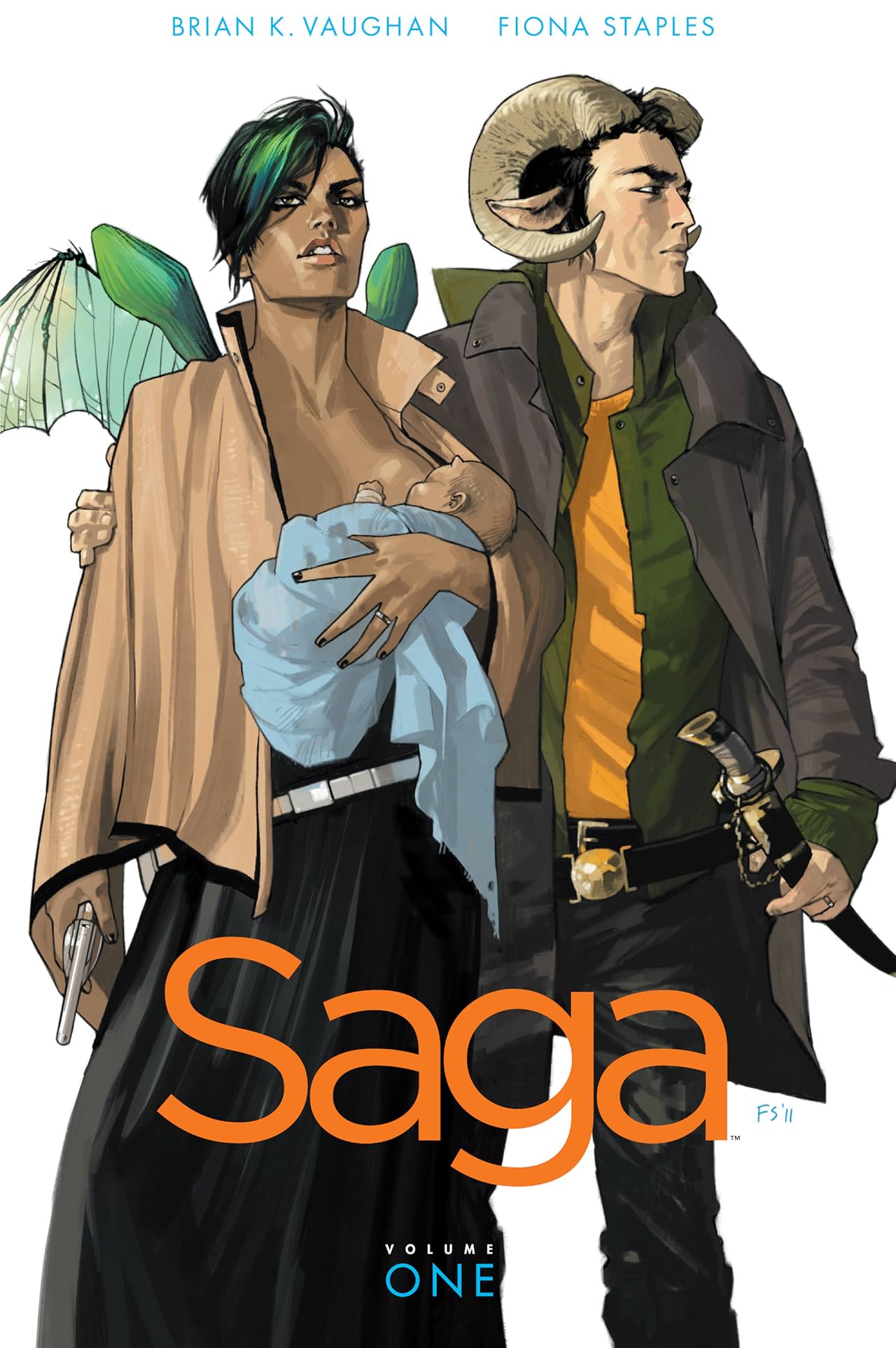
Number 1: Saga

This is probably a controversial selection for those who aren’t familiar with this series. It doesn’t involve superheroes. It’s not a product of Marvel or DC Comics. It’s an entirely different world full of bizarre creatures that include talking cats, a humanoid seal, and an entire race of beings with TVs for heads. I swear I’m not making any of that up.

However, at the heart of this amazing series by Brian K. Vaughan and Fiona Staples is an amazing love story between two characters from warring worlds. That love is very much the driving force between all the conflict and the characters that get caught up in it. It’s one of those romances that has every conceivable force working against it, but it still happens and it’s downright beautiful

Alana and Marko aren’t Superman and Lois Lane. They’re not even Rogue and Gambit. They’re not exactly heroes trying to live up to an ideal. They’re soldiers in a war between two worlds, but they somehow find each other, fall in love, and create a family together.

It’s not a fairy tale romance, though. Their romance involves more than a few explicit sex scenes, as well as a scene where Alana gives birth to their daughter. Nothing is filtered or polished. The sexy and unsexy parts of their relationship is laid bare within a world that is full of fanciful characters and locales.

It’s a genuinely epic journey, but one that all comes back to the romance between Alana and Marko. No matter what kind of romantic you are, these two find a way to check the right boxes. There are many moments of passion, sorrow, and loss. There are also plenty of moments that are funny, cute, and endearing. It has everything a great romance needs and then some.

I should offer a fair warning, though. You will get attached to these characters. You will feel it during certain moments. As a self-professed romantic, I can safely say that it’s worth the risk.

There you have it! These are my top five selections for romance comics. I’m sure some will disagree with my selections. The list may even change as other great romance comics emerge in the coming years. That’s perfectly fine and I welcome any debates on my list.


Romance is in every medium and comics are no exception. I would even argue that the romance in comics is under-appreciated and under-valued. As the genre continues to evolve, I have a feeling that’ll change and I hope to be part of that change.

5 Comments

Filed under Comic Books, Jack Fisher, Superheroes, Marriage and Relationships, romance, sex in media, superhero comics, X-men

Why Men Remain Single: The Science, Lies, And Logistics

9a67b9b6-9c66-11e8-8838-278d266b5e3b

There’s an emerging crisis. To most, it’s just another distressing trend among the many we have in this chaotic world. More men are staying single. Some do it by choice. Some just do it because they’ve given up and decided to take themselves out of the dating pool. Whatever their reason, the results are the same.

Men aren’t seeking love, getting married, or having children. According to both Gallup and data from the United Kingdom, the number of single adults is increasing, especially among the younger generations. Even the number of couples cohabitating aren’t increasing. In the United States alone, 64 percent of young adults report being single. That’s nearly two-thirds of the youth population.

Naturally, the abundance of single men is causing more concern than single women. To governments, demographers, religious leaders, conservatives, and women looking for romance, that’s a major issue with enormous ramifications. They see perpetually single men as a danger that threatens to undercut the current social fabric. Some societies are already having to deal with it, albeit for different reasons.

There are plenty of theories as to why these men are opting to remain single. Conservatives claim they’ve lost touch with tradition. Feminists blame lingering misogyny. They’ll often cite the emerging incel phenomenon as proof that these men are toxic burdens who will hold everyone back.

To all those various groups and their theories, I respectfully disagree. Speaking as a man who is currently single, but very open to finding love, I like to think I have more insight than most on single male mentality. I can’t claim to speak for all men, single or otherwise. However, I can offer my personal take while also citing some actual research.

In August 2018, the Journal of Evolutionary Psychological Science published a study that surveyed approximately 13,400 men on this issue. The methods weren’t exactly sophisticated. They used Reddit as a source of data. As a regular user of Reddit, I can attest that there are some meaningful insights from commenters. I can also attest that there’s a lot of trolling and misinformation.

That said, the study still provides some insights into this phenomenon that has so many people worried. I won’t say it’s definitive. No study is. The author of the paper freely admits that. However, there’s still some truth to be gleaned from the data, as well as a few lies.

To appreciate both, here are the top five reasons that men in the study gave for being single.

1: Poor Looks

2: Low Self-Esteem/Confidence

3: Not Putting Much Effort Into Seeking Relationships

4: Not Being Interested In A Relationship

5: Poor Social Skills With Women

There were a total of 43 other categories of reasons/excuses that men gave, but these were the most common. I feel they’re worth highlighting because they identify some of the inherent complications men deal with in today’s relationship scene.

Of those five stated reasons, three of them reflect traits that a person can actually control to some extent. Looks, confidence, and social skills can all be improved through work and effort. I, myself, am a testament to that. It’s not easy, but it is possible. It’s the other two reasons, though, namely the third and fourth most common response, that are the most telling.

In those cases, being single is a choice. The men don’t want to seek out companionship. They want to stay single. That notion seems off-putting to a lot of people, implying that there’s something wrong with them. How could men not be miserable staying single? That concept just feels flawed in the context of our current culture.

It’s a concept that doesn’t apply equally to women. The idea of a single woman isn’t seen as a societal problem. It’s even glorified in the media. There are popular songs about it. The entire “Sex in the City” franchise is built around it. That’s understandable, to some extent. Historically, women have had very few opportunities for independence. I don’t think anyone should be surprised that some are celebrating it.

With men, though, there’s a disconnect between those who have certain assumptions about masculinity and the mentality of those who don’t abide by those assumptions. This is where some of the lies surrounding the study show. It isn’t explicitly stated in the data, but it is implied.

It all comes back to incentives. If you look at the current structure of relationships, as reflected in popular culture and social norms, men don’t necessarily have much incentive to pursue a relationship. To understand why, just consider the expectations men face in those relationships.

Men are expected to set aside their interests, hobbies, and passions for their partner. They need to stop playing video games, hanging out with friends, and watching sports all day so they can tend to their lover’s needs. They’re expected to support their partner emotionally and financially at every turn. In return, they get love, intimacy, sex, and family. To many men, that reward just isn’t sufficient.

What I just described is not an accurate description of how most relationships play out in the real world. It assumes a lot about how much women want to control their partners. Granted, there are some very controlling women out there. I’ve known a few, but they’re not nearly as common as 80s teen movies would indicate.

How common they are doesn’t matter, though. That is the perception men have of relationships. On top of that, many young people are currently swimming in student loan debt, unable to get a high-paying job, and withholding their rage every time older generations blame them for ruining things. From a logistical standpoint, it makes sense for men to protect their independence.

It certainly doesn’t help that young men are one of the easiest demographics to denigrate. They commit most of the crime. They’re the ones spreading hate, misogyny, and outrage throughout our hyper-connected culture. Even if they’re more likely to be victimized in violent crime and less likely to garner sympathy, you’re not going to face much stigma for hating them.

That doesn’t even factor in the serious inequities in marriage laws, which I’ve talked about before. A man entering a relationship is taking a chance, but unlike the woman, he’s risking more than just heartbreak. If ever that relationship gets to that stage and binding contracts become involved, he stands to lose more than just a partner.

Again, and I feel it’s worth belaboring, some of the reasons these men give for wanting to remain single are based on flawed assumptions about relationships. However, when it comes to issues surrounding our emotions and the hyper-connected media that evokes them, perception matters more than any data from a study.

The men who participated in this particular study are probably not an accurate reflection of all men. They do provide some important insight, though, on the current state of relationships, gender, and everything in between.

Regardless of the study’s conclusion, though, the romance-lover in me genuinely believes that there’s room for improvement. Whether or not we pursue that improvement depends largely on the choices men make and the incentives they have to make them.

11 Comments

Filed under gender issues, human nature, Marriage and Relationships, men's issues, psychology, sex in society, sexuality, Wonder Woman

Attending My First Beach Wedding!

image1

I just want to make a quick, but notable announcement. I know most people don’t come here to hear about my day-to-day activities that don’t result in sexy novels or sexy short stories, but this is one activity that I feel is worth sharing.

As I write this, I’m preparing to attend my first beach wedding ever!

It’s true. I, a self-professed romantic, have never been to a beach wedding. I’ve been to multiple weddings before. I’ve even been to weddings at unique locations, including wineries and museums. However, I’ve never been to a beach wedding and something about that just feels off for a lover of love like me.

If that weren’t unique enough, the wedding I’m about to attend is a lesbian wedding. One of my oldest friends, who I’ve known since I was a kid, is getting married to a woman she has been with for many years now. They’re very excited and very eager to celebrate their love before friends and family.

It promises to be a beautiful moment in a beautiful setting. I look forward to sharing it with them and all the friends and family that will be attending. Being a romantic, I might get a little emotional and I don’t care in the slightest. It’s a wedding. It’s the one event where we can all channel our inner romantic.

1 Comment

Filed under Jack Fisher's Insights, Marriage and Relationships, romance, Uncategorized

Abortion, Prostitution, And The Indirect (But Powerful) Link Between Them

Pic

When it comes to conflict between genders, there are many factors driving it. Chief among them is the unavoidable ignorance that comes with men not knowing what it’s like to be a woman and women not knowing what it’s like to be a man. Add those who identify as transgender into the mix and there’s a massive disparity in understanding.

While I consider that limited understanding to be the primary driving force behind gender-driven conflicts, there’s another force that is a close second. It has less to do with how people relate to one another and more to do with who determines the accessibility and availability of sex.

As an aspiring erotica/romance writer, this issue is more relevant to me than others. However, after a few notable news stories, one involving prostitution and another involving abortion, the issue is now relevant to everyone and that’s why I feel it’s worth talking about.

The concept of sex being this tangible commodity that certain people control is already bound to cause plenty of consternation among people from every part of the political spectrum, but for logistical purposes, this is how we treat sex in a modern context. It’s no longer something we do for survival or for the passing on of property.

Like food, sex has developed a more diverse role in the modern world. We treat it as a tangible asset that we must manage. Like any asset, though, there are logistics to it and those who do the managing wield a great deal of power. Why else would pimps be so glorified in popular culture?

Who actually wields that power, though, depends on the political affiliation of who you talk to. If you ask someone who is liberal, feminist, or left-leaning, they will claim that the power is held primarily by rich old men who try to manage sex by punishing those who do it in ways they don’t like.

Ask someone who is conservative, traditional, and right-leaning, and they’ll probably say the power is held by radical feminists and their submissive male allies who wield the power of sexual management. They’re just as convinced as those opposing them that they’re right. It’s difficult to convince them otherwise and I’m not going to try. That’s not the purpose of this article.

My goal here is to point out a connection from which the conflict has evolved. Given recent events in the political world, that evolution is likely to continue and not in a direction that benefits either side in the long run. To understand that connection, I need to dig a little deeper into the unspoken, but powerful link between abortion and prostitution.

I know that just talking about one of these issues is abound to send peoples’ passions into overdrive. I’ve discussed abortion before. I’ve discussed prostitution as well. I haven’t really touched on the link between them because they’re tied up in different political domains, but have enough similarities affect one another.

Prostitution is commonly known as the world’s oldest profession and for good reason. It only ever makes the news when there’s a scandal or a legal upheaval. For once, there has been an uptick in the latter rather than the former. It began with new laws that made it more difficult for prostitutes to operate online. In some respects, these efforts are the byproduct of a trend that has been going on since the early 2000s.

Most industrialized countries in the world accept, to some degree, that it’s impossible to stamp out prostitution completely. As a result, there have been more elaborate efforts to reduce it that don’t rely entirely on blanket prohibition. Currently, the most popular approach is known as the Swedish model.

In this setup, it’s legal for someone to sell sex, but it remains illegal to buy it. It’s akin to making it legal to set up a lemonade stand, but illegal to buy lemonade. While that sounds absurd on paper, the intent of the law is somewhat clever. It’s a means to criminalize the buyer of sex to give the seller more leverage. Since the seller is often assumed to be an exploited woman, it’s viewed as an equalizer of sorts.

Granted, the assumption that those selling sex are always exploited women is flawed, as an estimated 20 percent of prostitutes are men. There are people in the world who enter the business willingly, just as there are people who willingly work in coal mines.

There’s also plenty of data that indicates that the Swedish model doesn’t have the desired effect. There’s also no evidence that it has reduced human trafficking, either. That hasn’t stopped it from spreading to other countries. In the process, it has had another effect that goes beyond the issue of prostitution.

Essentially, this approach to combating prostitution places more power in the hands of women with respect to managing sexuality. Since they make up the majority of the prostitutes in the world and men are the primary clients, this dynamic ensures they have more leverage. They can, under this model, decide whether or not their client becomes a criminal. That’s a lot of leverage and not the kinky kind.

This is where the link to abortion comes into play. It’s an indirect link, but it utilizes the same dynamics. In countries where abortion is legal, the women wield a significant amount of power in terms of sexual decision-making. In the context of abortion, they can decide how the consequences of sex play out.

Women can, in this dynamic, decide whether or not to have a child if she becomes pregnant. Whether or not the father wants to child is irrelevant. The woman can abort the child against the father’s wishes. She can even have the child against his wishes, in which case he would be on the hook for child support for 18 years.

Again, that’s a lot of power for one gender to wield. That’s not to say it isn’t understandable. Women are the ones who bear children. They’re the one whose bodies undergo the 9-month rigor that is pregnancy. It’s totally logical that women would have more leverage in this situation because they’re putting themselves at greater risk.

However, and I know this is where I’ll upset a few people, there comes a point where that leverage can become excessive. There are cases where men lose their money and their freedom because of what a woman chooses. There’s no way for them to opt out of their parental responsibilities. That hasn’t stopped some from attempting to create a legal mechanism for that choice, but to date those efforts have not been successful.

Within this context, it shouldn’t be that surprising that abortion rights are steadily eroding. In the United States, it’s looking more likely with recent upheavals in the Supreme Court that this erosion will accelerate. Some are already claiming that we’re on our way to becoming the kind of oppressive society depicted in “The Handmaid’s Tale.”

While most of those concerns are overly apocalyptic, I think part of that effort is tied directly to who wields the power in the sexual landscape. Women are poised to gain more of that power as prostitution laws in the mold of the Swedish model spread. They’ve also gained even more leverage socially through the anti-harassment movement.

From the perspective of men, who cannot turn off their sex drives, women already wield so much authority in matters of sex. They’re the ones more likely to get paid to do it. They get to decide when and where it happens. They get to decide whether or not a sex act was consensual. They don’t even face the same stigma or consequences when sex crimes does occur and are granted greater protections by the law.

That perspective is not going to sway most women, though. The same women arguing for abortion rights are just as likely to argue for the Swedish model in combating prostitution. It’s a common thread among certain brands sex-negative feminism that see prostitution as an inherently oppressive force for women in every circumstance.

This is where the paths converge and where the fuel for the conflict gets a boost. Whether intentionally or by accident, both prostitution and abortion eventually link back to who wields authority in sexual matters. Both sides can claim some form of oppression. Both sides can even be right to a limited extent. By fighting to secure the most leverage though, they inevitably invite more backlash.

I don’t claim to know what the endgame is. I have a feeling that once sex robots enter the picture, and they have to some extent, there will be a major upheaval in the whole sexual landscape that neither side will be able to confront. Until then, though, the conflict over sexual leverage will continue. In the end, though, it’s unlikely that anyone will ever be truly satisfied.

1 Comment

Filed under gender issues, human nature, Marriage and Relationships, political correctness, prostitution, psychology, sex in society, sexuality

Sex Robots, 3D Printing, And The Future Of The Porn Industry

feature

Most people with a passing knowledge about the history of media know that the porn industry played a significant role in deciding the competition between VHS and Betamax back in the 1970s. Decades later, porn played a similar role in the growth of the internet. It’s not unreasonable to say that the growth of the internet was fueled by porn.

Love it or hate it, the adult entertainment industry is a powerful economic driving force. Every effort to combat or avoid it has failed. Protests and outrage has done little to undercut the billions in revenue it generates every year. Culture, tastes, and media technology keeps changing and porn finds a way to adapt to it.

Lately, though, it has had a harder time adapting than usual. While the internet helped grow the adult industry, that same medium is undermining it by facilitating piracy and limiting distribution channels. Unlike Netflix or other streaming services, most major media companies don’t allow adult content on their platforms. Some have even gotten rid of their softcore content.

These limitations and setbacks are likely temporary, though. For as long as there is a market for sexy content and a collective libido that remains unsatisfied, the adult industry will find a way to adapt and make profits. It’s very likely that 20 years from now, the porn industry will look nothing like it does today.

Whatever form it takes will likely astonish some and terrify others. It’s hard to know for sure how the economics of porn will evolve, but there are already signs that the future of the adult industry is taking shape. As we saw with the VHS/Betamax issue, the technology is already in place. It’s just a matter of maturation and refinement.

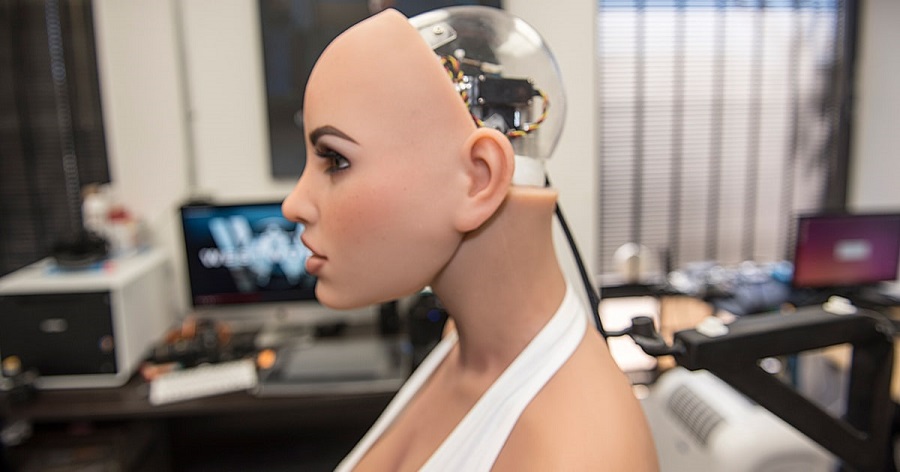
As I write this, the development of sex robots is well underway. There’s also already an established market for life-like sex dolls that can’t interact with users, but can still provide an intimate experience that you can’t get through a computer screen. This current situation has already been subject to controversy, but further refinements ensure there will be many more to come.

That’s not just me speculating, though, as I’ve done before with sex robots and sex dolls. I’m writing this because a critical, but under-reported refinement in the sex doll/sex robot industry took place recently in China from a company called DS Doll Robotics. Their plans, if they come to fruition, may do for sex dolls what McDonald’s did for cheeseburgers.

Those plans involve addressing one of the key limitations of sex dolls at the moment, which also will plague sex robots if it isn’t addressed. As it stands, just making a sex doll is expensive, labor-intensive, and difficult to mass produce. That’s why most high-quality sex dolls will set you back at least several thousand dollars. It’s actually comparable to the cost of cell phones in the early 1980s.

DS Doll Robotics is looking to change that. In July 2018, they launched plans to utilize 3D printing to help streamline the manufacturing process. What the assembly line did for cars, this company hopes to do for sex dolls and, eventually, sex robots that incorporate artificial intelligence.

It may sound mundane on paper since 3D printing has been an emerging technology in the manufacturing sector. It’s still has room to mature in the same way the early internet had to mature, but it’s one of those technologies that’s uniquely equipped to help the adult industry. In fact, it’s not unreasonable to say that it’ll completely reinvent it.

That’s because DS Doll Robotics isn’t just using 3D printing to streamline the manufacturing process. They’re also using new scanning techniques to scan the bodies of real humans as a baseline, of sorts. This is an exact quote from the July 2018 article that reported on the company’s plans.

“It is also connected to a 3D scanner which can be used to scan in the body of a full person as well as prototype parts for replication. This type of technology is excellent for creating new doll bodies and faces as they can be developed from a real human.”

That bold text is my doing because that’s the part of the story, I feel, that has far greater implications. Just making sex dolls cheaper and easier to produce isn’t going to change the adult industry too much. It may expand an existing market that had been cost-restrictive before, but it won’t provide a radically different experience compared to the one that exists today.

The part where sex doll manufacturers scan the bodies of real people, though, is something that will significantly impact the entire landscape of the adult entertainment industry. It won’t just change the economics of sex dolls. It’ll change the way the adult industry operates.

To understand how, it’s necessary to know how adult entertainers make money in the current economy. Most people in the adult industry, be they performers, directors, or producers, get paid a certain amount for each scene they perform. In the past, they could also depend on residuals from DVD sales, but those have declined sharply due to piracy and tube sides.

As a result, it’s becoming increasingly common for porn stars to do escorting on the side. Being a porn star makes it more lucrative than regular escorting, but that still comes with risks, especially in wake of recent legal issues attacking sex work. With sex dolls and 3D printing, though, these entertainers suddenly have a new way to monetize their sex appeal.

From a business standpoint, porn stars and beautiful celebrities in general are in the best possible position to franchise their bodies. Say there’s a moderately-successful porn star, male or female, who has some level of notoriety. If they do their job well, they create a fan base. Chances are there’s a significant portion of that fan base that wants to have sex with them.

Thanks to DS Doll Robotics, they can get that or at least something close to that without having to resort to escorting. Some porn stars already licence parts of their bodies as sex toys, but with 3D printing technology, they can do it all. With further refinements to the flesh and molding of the body, it wouldn’t just feel like plastic. It would feel real.

Some of this is already being done to a limited extent. Some porn stars have licensed their bodies to create life-like sex dolls. However, they’re still very expensive and labor intensive. Refinements of 3D printing will bring that cost down and that will grow the market, but it won’t stop there.

It’ll only be when sex robots and artificial intelligence enter the mix that the true future of the adult entertainment industry will take hold. Once those same licensed bodies develop an ability to interact with their users, then they’re not just over-sized masturbation aids. They deliver a full-on sexual experience.

Like brands of clothing or food, each adult entertainer could create a particular brand. One star might have a really cute, friendly personality. Another might have a very domineering, controlling personality. By incorporating them into a sex robot, they create a product that cannot be experienced through a computer screen, let alone pirated.

For the adult stars themselves, it’s easy money. They wouldn’t actually have to do anything, sexual or otherwise. They would just have to license their likeness to a company and collect a portion of the residuals like any merchandising company. If they prove really popular, then they could conceivably create a life-long income that continues well past their stint in the business.

That’s something that’s difficult to do in any entertainment industry, pornographic or otherwise. The use of 3D printing and more realistic materials will make that both possible and lucrative. If it becomes cheap enough, then the opportunities even go beyond direct sales.

There are already sex doll brothels operating in certain parts of the world. In areas where prostitution is legal, there’s even an app for people to order a prostitute the same way they would an Uber. In the future, if someone doesn’t want to buy, store, and maintain a sex robot, they may just rent one for a while. Between discretion and safety concerns, there would certainly be a market for that.

I’m sure that sort of business would attract a great deal of controversy and outrage. Sex dolls are already controversial and sex robots already have their opponents. However, if history is any guide, the prospect of making money and satisfying peoples’ burning libidos will win out. It’s just a matter of how quick the technology can progress and how quickly the ever-evolving adult industry adapts.

10 Comments

Filed under futurism, Marriage and Relationships, sex in media, sex in society, sex robots, sexuality, Sexy Future

My Top Six Non-Canon Comic Cook Romances Of All Time

deadpool-harley-quinn-kiss-unique-drawing

This has been a rough summer for fans of superhero comics, romance, and weddings. For a fan like me, this summer couldn’t have been rougher without adding a broken air conditioner to the mix. Between the depressing outcome in X-men Gold #30 and the disappointment in Batman #50, this summer has been a one-two punch to the heart.

While it’s pretty disheartening, I’m not totally discouraged. Being the admitted romantic I am, I believe love will eventually win out. I know that sounds corny and ripped right out of a Disney movie, but wouldn’t put so much energy into so many sexy love stories if that belief weren’t sincere.

Even so, I feel as though the current mood surrounding romance and superhero comics has a lot of room for improvement. Mr. and Mrs. X #1 was a good start, but only to a point. There’s only so much that I can do as a fan, aside from buying comics that depict quality romances with great sex appeal. Beyond that, my influence is limited.

As such, I’m going to take a moment from complaining about the current state of love in superhero comics and try a little exercise in romantic imagination. By that, I mean I’m going to contemplate the romantic potential of superheroes that will probably never cross paths, due to rights issues and belonging to different publishers.

It’s a sad fact of life and copyright laws that Marvel characters cannot interact with DC characters. However, that doesn’t mean certain characters don’t have romantic potential. In fact, I believe some have more potential than they do with anyone in their current continuity.

What follows is my personal list of the top six non-canon superhero couples. Not every couple on this list is a Marvel and DC character paired together, but given how many iconic characters those two companies control, it’s somewhat unavoidable. Also, please keep in mind that this is just my list. It is by no means definitive. This is just something meant to inject a little romance into a summer that badly needs it.


Number 6: Black Panther and Vixen

BPVix

When it comes to healthy romance, it helps when two people share the same quirks. Whether that’s wine tasting or underwater basket weaving, having similar distinctions go a long way towards helping a couple thrive. It’s for that reason that I believe Black Panther and Vixen have the quirks/kinks to make a romance that’s both functional and sexy.

Black Panther’s star has risen quickly thanks to a billion-dollar movie, but his romantic history has been somewhat stagnant. His brief, but bland marriage to Storm of the X-men came off as a gimmick rather than a relationship. While he has chemistry with Nakia, it’s only the very general kind.

That’s where Mari “Vixen” MaCabe sets herself apart. Her powers, abilities, and personality is largely driven by her connection to animal spirits. It’s very similar to the connection that Black Panther has with Wakanda’s native deity, Bast. Being connected to animal spirits and having a fondness for jungle-themed costumes gives these two a unique connection that they haven’t had with their in-universe love interests.

I believe these two would complement each other in unique ways. Vixen is cunning and charismatic. Black Panther is strong and diplomatic. Alone, they’re both pretty strong. Together, they’re even stronger and much sexier.


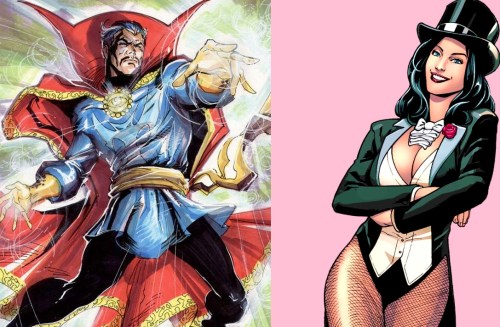
 Number 5: Dr. Strange and Zatanna

StrangeZat

This is another instance of two people having shared interests, but with Dr. Strange and Zatanna, it goes deeper than that. These two are some of the most recognizable mystical characters in their respective worlds. Dr. Strange is the Sorcerer Supreme in Marvel and Zatanna is one of the most skilled magicians in the DC Universe. Together, their magic can be pretty potent, literally and figuratively.

However, it’s not just because of their mystical skills that I believe they would be good together. In their respective universes, both characters struggle to maintain even a semi-functional relationship. Zatanna often finds herself on the outside looking in with love interests like Batman and John Constantine. Dr. Strange has never had much of a love life outside Clea, who is almost always relegated to a supporting role.

Zatanna is not the kind of woman who is content with a supporting role. She’s someone who fights alongside Batman and the Justice League. She can handle the crazy mystical threats that Dr. Strange deals with on a regular basis.

For Dr. Strange, he finally has someone who can deal with his attitude and arrogance, which is a tough barrier for any potential love interest. Again, Zatanna dealt with Batman. Any woman who can deal with Batman has an edge. The fact she isn’t afraid to show her legs off and be a bit more playful with her magic also helps.

More than anything else, Zatanna is someone who could make a man like Dr. Strange smile while he works. That, in and of itself, is a kind of magic that helps any relationship.


Number 4: Batman and Sara Pezzini (Witchblade)

BatWitch

This one kind of breaks the mold because it doesn’t pair a Marvel character with a DC character. Sara Pezzini, also known as the bearer of the Witchblade, is not a Marvel character. She’s a product of Top Cow Productions. She comes from a very different world compared to Batman, but that world makes her uniquely equipped to handle being Batman’s lover.

Batman requires that a romance be complicated and prone to tragedy. Few women can handle that. While Catwoman came very close to making it official, it’s a testament to just how tortured Batman is in his love life, among other things.

For Sara Pezzini, that’s exactly the kind of man who brings out the best in her. Unlike Catwoman, Sara was never a thief. She’s a cop and a very dedicated cop. Throughout her long-running series, she defines herself as the kind of hard-nosed, tough-as-nails person who doesn’t hesitate to run into the crossfire of a gang war or a demon army.

Beyond just being a cop, Sara deals with far larger problems that come with being the bearer of the Witchblade, an ancient weapon that tends to attract insane threats, even by NYPD standards. Batman already deals with homicidal clowns and thugs who are half-crocodile. They can handle the craziness in each other’s lives.

More importantly, though, Sara can do something that so few women have ever done for Batman. She can complement him as both Bruce Wayne and Batman. As a cop, she can actually help Batman’s efforts to fight crime in Gotham. He can, in turn, help her deal with the supernatural horror shows that tend to follow her, as only Batman can.

On nearly every level, Batman and Sara Pezzini make each other better. They’re the kind of couple that can work together and be together. That kind of romantic combination is potent. Plus, Sara Pezzini’s hardened attitude might actually help Batman crack a smile every once in a while.


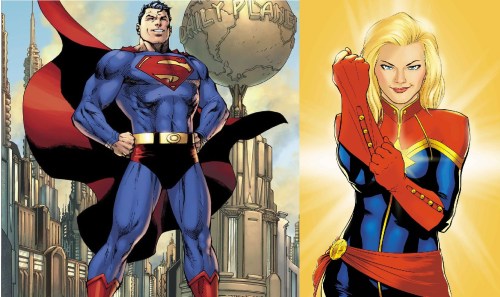
Number 3: Superman and Captain Marvel (Carol Danvers)

SuperCarol

This is probably the most controversial pairing on this list because Superman has one of the most iconic romances of all time with Lois Lane. Carol “Captain Marvel” Danvers, on the other hand, has no relationships that even come close, even if you take into account her affair with alcohol.

The reason I believe these two would forge a powerful romance is because Carol Danvers embodies the best traits of both Lois Lane and Wonder Woman. She’s a skilled fighter like Wonder Woman, having trained in the military and fought in interstellar wars. She’s also uncompromising in her pursuit of truth, much like Lois Lane.

Beyond just having the best traits of two iconic women, Carol brings something else to the table. Unlike Superman, she wasn’t born with her powers. She got them in an accident that merged her DNA with that of an alien. At the heart of her story, she’s a human who becomes an alien. Superman, by contrast, is an alien who becomes human.

That unique dynamic, the struggle between being alien and human, is something that Superman has never been able to share with either Lois or Wonder Woman. Someone like Carol could both help him through that journey and fight by his side. She’s tough enough to go up against anything, be it a mad Titan or an evil super-genius billionaire.

Superman is, at heart, an ideal. He’s an icon because he sets an impossible standard for others to aspire. Carol Danvers defines herself by doing the impossible and fighting for it every step of the way. That shared struggle can create the kind of love that empowers two already powerful characters.


Number 2: Captain America and Wonder Woman

This one is probably the most logical pairing on this list. In fact, Captain America and Wonder Woman are probably the one instance where their potential is greater than that of any in-canon romance and it’s not just because their movies were so similar.

Captain America and Wonder Woman are ideal love interests because they both represent the best of their respective worlds. Captain America is the embodiment of the American spirit of freedom and justice, reality-warping retcons aside. Wonder Woman is the personification of womanhood, compassion, and a warrior’s spirit. They both set high standards and pride themselves on achieving them at every turn.

It’s a standard that Steve Trevor never achieves, despite being Wonder Woman’s primary love interest. With all due respect to him and Chris Pine, he’s not on Captain America’s level. In fact, Captain America is the kind of guy Steve Trevor aspires to be, but never achieves. That elevates him in terms of how he relates with Wonder Woman.

Beyond just showing Wonder Woman the best a man can be, Captain America can hold his own better in a drawn out battle. He may not have Wonder Woman’s level of powers, but he’s also a man who regularly fights alongside the likes of Thor and Hulk. He’s not just capable of working with demigods. He actually leads them. It’s easy to see why Wonder Woman would fall in love with a man like that.

On Wonder Woman’s side, she can do more than just punch the Red Skull harder than most women. She’s the kind of woman whose compassion and love of justice is second to none. Even though she’s not American, she embodies many of the American principles that Captain America champions. She may very well be the only woman he can love as much as his country.


Number 1: Deadpool and Harley Quinn

This one was a no-brainer. In terms of sheer sex appeal and romantic compatibility, Deadpool and Harley Quinn are in another league on top of being from different comic book worlds.

I don’t think I need to say much about Deadpool’s eccentric tastes in romance. Between his overtly raunchy movie and the fact he married a succubus in the comics, the man isn’t just attracted to crazy. It’s practically an omega-level fetish for him. In terms of crazy, sexy, and all the weird fetishes that go with it, Harley Quinn checks every box.

Beyond her fondness for clown makeup and obscenely short pants, Harley has always been defined by her love with madness. Love is what drove her into a world of villainy when she crosses paths with the Joker. While that relationship has many quirks, plenty of which are quite unhealthy, it shows that Harley loves men who aren’t bound by sanity.

Deadpool wouldn’t just fill her crazy quota and then some. He would offer her the healthy kind of crazy. He’s the kind of guy who reserves gratuitous violence to those who deserve it and that has been a major struggle for Harley for much of her history. He wouldn’t just be able to carry her through that struggle. He’d make her laugh just as much as the Joker and with only half the property damage.

Unlike the Joker or a succubus, Harley and Deadpool are also the kind of relationship that would have a level of sex appeal that is literally crazy. Beyond Harley’s love of skin-tight clothes and Deadpool’s “super penis,” these two would know how to have fun and blow things up, in and out of the bedroom. With these two, you never have to worry about things getting boring.


There you have it. That’s my list for the best non-canon comic book couples. I imagine this list will cause some disagreements. That’s okay and I welcome further debate on the issue. If you think there are other couples I should add to the list, please let me know. This is a rich and sexy topic that’s ripe for discussion.

2 Comments

Filed under Comic Books, Jack Fisher, Superheroes, Jack Fisher's Insights, Marriage and Relationships, romance, Wonder Woman

Lessons In Love According To Rick Sanchez

mv5botexyzyxodytogrimi00mzbmltkwnzmty2q5zdu2zjdmogzmxkeyxkfqcgdeqxvyntkymje3ndu-_v1_

What is love? Can we ask that question without referencing to a one-hit wonder R&B song from 1993? I think it’s a question worth asking and one people have been asking since the dawn of our species. Many men who are way smarter than I’ll ever be have tried to answer this question. Some have offered revealing insights. Others just use it as an excuse to whine about a cheating spouse.

Then, there’s Rick Sanchez. I know that by saying that name, I’ve completely altered the tone of this topic. I could’ve easily spent the next several paragraphs breaking down how the smartest men in history view love and how that understanding reveals itself in our modern concept of romance. For now, I’d rather scrutinize love from the perspective of a hard-drinking, brutally honest, nihilistic cartoon character from Adult Swim.

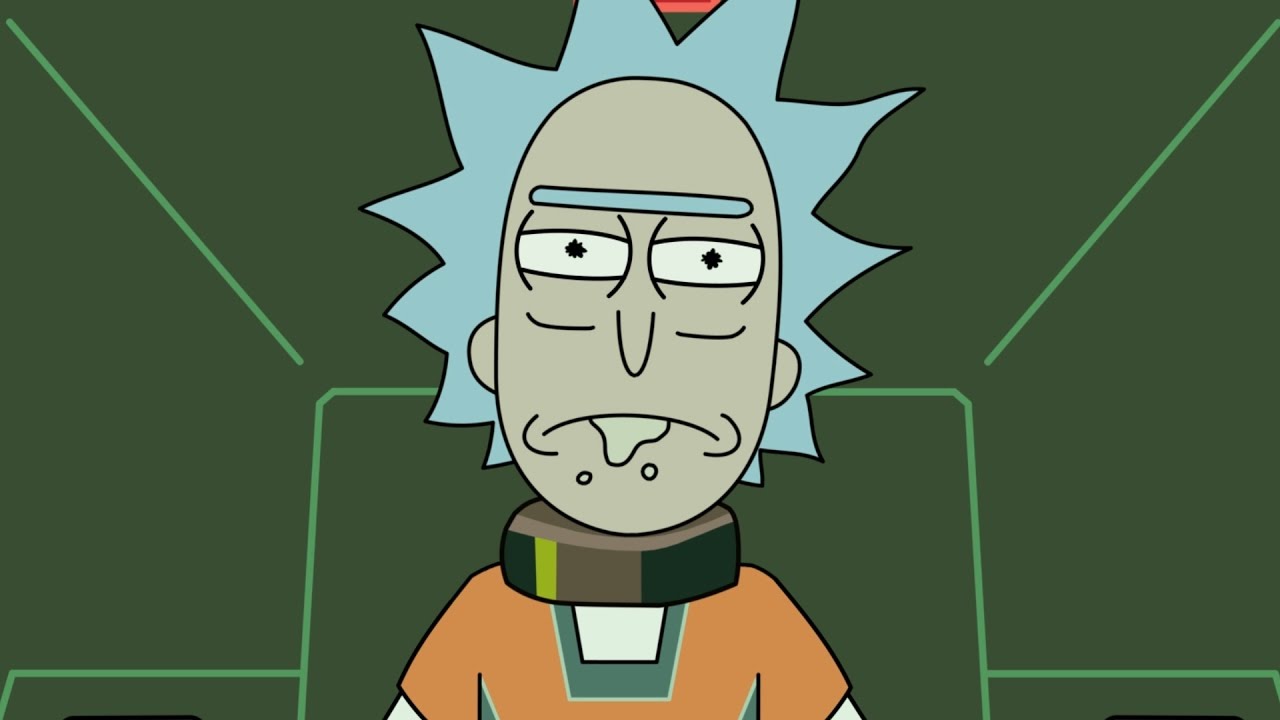
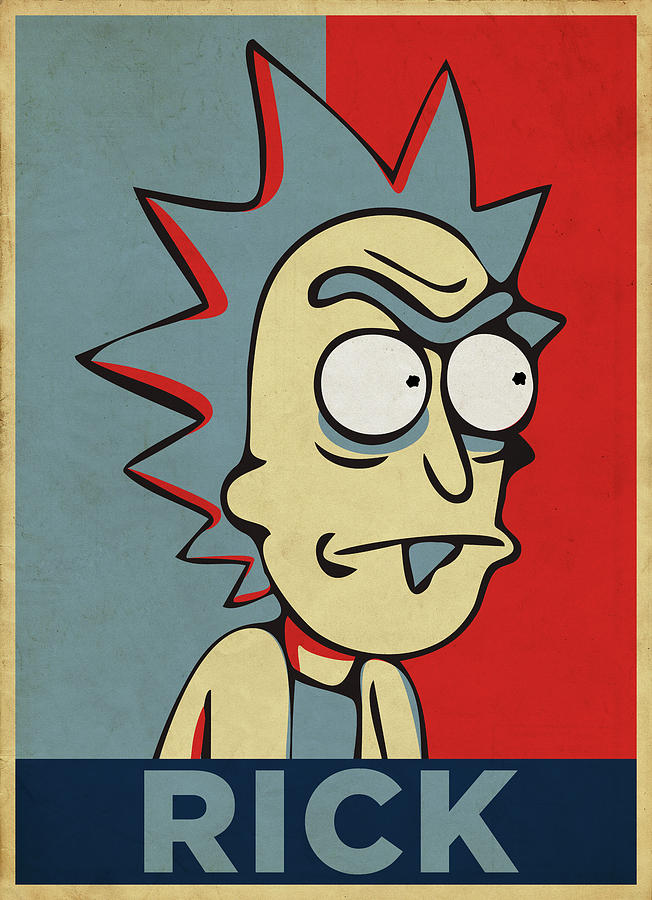
Yep, I’m referring to this guy again.

Make no mistake. I’m not just using this as another excuse to talk about “Rick and Morty,” although I wouldn’t blame anyone for thinking that. I really do think characters like Rick Sanchez have something to teach us on the topic of love. Being an admitted romantic and aspiring erotica/romance writer, I believe those lessons are worth heeding.

On paper, Rick Sanchez is the last person most would go to for insights into love. From the first scene in the first episode, he establishes himself as an overly-cynical, high-functioning alcoholic who may or may not be okay with blowing up the world for the sake of a fresh start. To say he’s not the romantic type would be like saying Jerry needs help with his golf game.

However, Rick does demonstrate throughout the show that he has a capacity for love. He has even had a few moments where he has shown genuine heart. There’s an odd mix of eccentricity and complexity to Rick’s behavior. That’s part of what makes him such an endearing character and why he resonates so much with an emerging generation.

From all that chaos, though, there are insights worth noting. “Rick and Morty” may go heavy with nihilism and moments of existential crisis, but it doesn’t avoid the impact of love. Whether it’s Morty constantly trying to get with Jessica or the constant upheavals in Beth and Jerry’s marriage, love is an underlying factor throughout the show.

This is despite the fact that Rick is pretty overt about his feelings on love. In “Rick Potion #9,” the sixth episode of the first season, he gives his clearest, most quote-worthy opinion on love.

“Listen, Morty, I hate to break it to you but what people call ‘love’ is just a chemical reaction that compels animals to breed. It hits hard, Morty, then it slowly fades, leaving you stranded in a failing marriage. I did it. Your parents are gonna do it. Break the cycle, Morty. Rise above. Focus on science.”

That sounds pretty jaded, to say the least. It’s perfectly fitting with Rick’s misanthropic mentality. However, there is a context here and one that’s fairly subtle, as things tend to be in the world of “Rick and Morty.”

Part of that context is Rick’s family situation. Beyond being a drunk and an eccentric mad scientist, he also has a family. It’s not just his daughter and two grandkids, either. He mentions in his cynical musings that he’d fallen in love and gotten married at one point.

That, alone, has some pretty profound implications. It shows that even the smartest, most capable man in the multiverse cannot avoid the impact of love. Keep in mind, this is a man who travels the multiverse on a whim, defeats Thanos-level super-villains while drunk, and understands how meaningless everything is in the grand scheme of things.

Despite all that, Rick Sanchez still fell in love. He still got married. That, in and of itself, shows the power of love better than any Huey Lewis song. While the show hasn’t revealed much about his former wife, Diane, it does establish an important fact. Rick is capable of love, even when he sees it as just a confluence of brain chemicals.

The show goes onto to reveal that Rick is still influenced by love, despite this reductionist understanding of it. The most comprehensive example comes in Season 2, Episode 3, “Auto Erotic Assimilation.” In many ways, this episode helps convey the most meaningful lesson in love that any animated series has ever attempted.

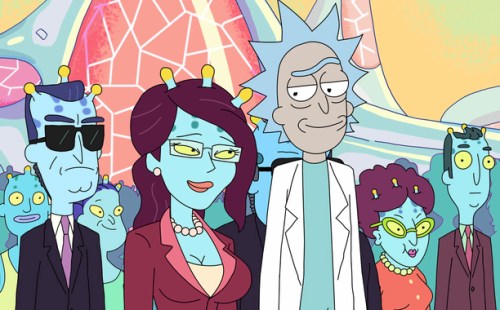
In the episode, Rick catches up with an old girlfriend, who happens to be an alien hive mind named Unity. If that sounds weird, even by “Rick and Morty” standards, trust me when I say it doesn’t crack the top ten. The fact that Unity is a hive mind is part of why the insights are so unique and impactful.

Throughout the episode, we learn about the particulars of Rick and Unity’s relationship. Unity establishes herself as one of the few beings in the multiverse who can keep up with Rick’s eccentricities. If anything, she has to be a hive mind in order to do so, as evidenced by Rick’s elaborately kinky requests.

In this context, Unity is the ultimate manifestation of supportive lover. She can literally do anything and be anywhere because she has the collective resources of an entire planet at her disposal. She’s more capable than a shape-shifter like Mystique or even an advanced sex robot.

If she wants to make love as a beautiful, buxom blond right out of a Playboy centerfold, she can do that. If she wants to do it as a greasy-haired, middle-aged man with a hairy back and bad breath, she can do that too. She can be two people, ten people, or as many people as she wants to be to love Rick and express that love however they want.

This breaks down, however, when Unity’s efforts to pursue that romance with Rick ends up straining her ability to maintain her hive mind. It gets so strenuous, at one point, that it leads to a nipple-driven race war on the planet. Again, this is pretty standard in terms of weirdness for “Rick and Morty.”

The implications of this breakdown are serious and I’m not referring to the nipple-driven race war. Logistically speaking, Rick and Unity had everything they needed to make their relationship work. They had unlimited resources and unlimited opportunities for intimacy, decadence, and everything in between. In exercising that, though, their relationship devolved into an ongoing spiral of self-destruction.

There was clear, unambiguous love between Rick and Unity. However, the act of being together proved toxic to both of them. Unity couldn’t be with Rick without losing herself, literally and figuratively. Rick couldn’t be with Unity without descending into a spiral of debauchery. Even if the love is there, embracing it leads to both of them getting hurt.

This made for one of the most dramatic and emotional moments of the show, one that reveals just how much Rick loved Unity. After she leaves him, it really hits him on an emotional level, so much so that he nearly kills himself. Remember, this is a man who said love is nothing more than a chemical reaction in the brain.

The pain in that moment, though, belabors a much larger point about love and being with someone. Just loving someone is easy. As Rick says, it’s just a chemical reaction in your brain. It’s something that can happen to anyone, even the smartest man in the multiverse.

However, being with someone and expressing the full spectrum of love involves much more than convergent brain chemistry. For some people, love can be downright destructive. If pursuing love means undermining your sense of being, as happened with Unity, then that’s a sign that the relationship isn’t tenable.

It’s tragic, but unavoidable. You can love someone with all your heart, but not be capable of having a functional relationship. It’s a harsh reality, one that’s perfectly in line with the nihilistic subtext in “Rick and Morty.” At the same time, though, there’s a less dire lesson to be learned.

Even if love is just a brain function that helps propogate the species, it has the power to affect us in the best and worst of ways. It can lead us to the greatest of joys, as Rick and Unity experienced for a brief time. It can also lead us to the worst of sorrows. Few other brain functions can make that claim.

That wide range of experiences are a powerful mechanism for finding meaning in a meaningless universe. Rick Sanchez doesn’t avoid the pain in those experiences and he doesn’t hesitate to pursue the joys, often to a reckless degree. Finding meaning in this universe is hard enough, but love can do plenty to carry us forward. You don’t have to be a Rick-level genius to appreciate that, although that’s probably a good thing.

7 Comments

Filed under gender issues, Marriage and Relationships, philosophy, Rick and Morty, romance

The Other Orgasm Gap (Involving Men) And Why We Should Confront It

basic-secrets-male-orgasm

There are many disagreements about gender these days, but when it comes to orgasms, most reasonable people are on the same page. In general, regardless of politics or genital configuration, we’re in favor of them. We support efforts to experience more for ourselves and for our partners. In matters of sex, it’s one of the few unifying issues.

Even if most people agree that orgasms are awesome, there are still some sources of tension. I’ve already touched on the current status of the orgasm gap, as it pertains to women. That is still an unresolved issue and the current status of gender relations can only improve if that gap is reduced or eliminated.

However, there is another orgasm gap that is rarely touched on, but inescapably linked to the current pleasure parity. This one pertains to men and, unlike the female orgasm gap, is shackled by hard biological limits. Any man, myself included, knows those limits all too well.

It’s no secret, but it might as well be one because it’s rarely talked about. Without getting too graphic, I’ll just say that the female orgasm is a symphony whereas the male orgasm is like a kazoo. It’s a one-note instrument that is simple, basic, and blunt. You can still make music with it, but the range is limited.

That’s because men have something called a refractory period. It’s basically the cool-down period that men experience after orgasm. From a biological standpoint, it’s the part of sex where the brain and genitals tell one another that the job is done and it’s time to rest. That process involves releasing all sorts of hormones and chemicals that are responsible for men getting sleepy after sex.

It’s the reason why men have a difficult time getting aroused again after sex, both physically and mentally. Once a man reaches that peak, it takes a while to get to that level again. It can take as little as 15 minutes to almost an entire day. During that time, though, a man’s ability and desire are significantly hindered.

This inescapable process is also the source of many jokes about premature ejaculation and men who can’t last long in bed. I don’t doubt it’s a factor in the orgasm gap. Whereas it takes a man only two to three minutes to achieve orgasm, it takes a woman an average of 12 minutes to do the same. That is not a trivial gap.

Conversely, women aren’t hindered by a refractory period. Even though it takes women longer to climax, they’re capable of having more orgasms in rapid succession. To give you an idea of just how many more women are capable of, the record for most female orgasms in an hour is 134 whereas the most a man has ever had is 16. Again, that is not a trivial gap.

While men don’t have to look far for tips and tricks that allow men to have multiple orgasms, many of these so-called techniques are just gimmicks. They’re methods for improving stamina and control, which is a great thing to have with any partner. However, it doesn’t change the fundamental biology of refractory periods.

That’s not to say this particular gap is impossible to close. That’s also not to say that there aren’t documented cases of men achieving multiple orgasms. They do exist, but there’s not a lot of research on the topic, especially compared to the amount of research on the female orgasm.

If we’re to close the orgasm gap for everybody, though, this is something that’s worth studying. I would even argue that we can’t solve the orgasm gap with women without confronting this lesser-known gap with men. In essence, that refractory period is the greatest hindrance to true orgasm parity.

Just talking about it only goes so far, though. Unlike the female orgasm gap, the refractory period is rooted in biology rather than psychology. From an evolution standpoint, it makes sense. By achieving orgasm quickly, a man can spend less time impregnating a woman and more time surviving. It was a necessary trait for managing the survival/reproduction dynamic of the human species.

Like many other traits from our pre-modern ancestors, though, these traits are less necessary in the modern era. In fact, they can be a liability. In a world of low infant and maternal mortality, we have more incentive to seek quality over quantity in our lovers. The refractory period, much like our body’s tendency to get fat, is a real hindrance to that effort.

Addressing it is probably not going to be as simple as telling men to do kegel exercises. Men being able to achieve multiple orgasms may require an effort similar to that of developing the female birth control pill. In the same way modern medicine has given women control over their fertility, it may end up doing the same for male orgasms.

How modern medicine would go about that is well-beyond my expertise. However, we already do have some clues as to what goes into reducing the refractory period. Studies has shown that a chemical called prolactin may play a major role.

Specifically, when a man climaxes and goes through a refractory period, levels of prolactin in the body spike. In rare cases of multi-orgasmic men, though, it doesn’t rise in conjunction with an orgasm. Now, that could be only be part of a much more complex process, as is often the case in medicine, but it’s a start.

In the same way some people are already hacking their biology for reasons relating to health and beauty, it may be possible to tweak certain bodily processes to enable men to have the same orgasmic potential as women. It doesn’t even have to extend to modifying genetics. It can just involve tweaking chemical and hormonal processes, something we’ve been doing in medicine for years.

Unfortunately, research on this phenomenon is scant at best. However, given how much money pharmaceutical companies have made treating sexual dysfunction, I believe the incentives are there. It may take a long time, but given the progress medicine has made on male contraception lately, I think the infrastructure is in place and so is the market.

It’s hard to predict what form modern medicine will take in treating any condition, be it the limits of the male orgasm or the current orgasm gap with women. However, I am confident in saying that any advance that puts everyone on the same level of orgasmic potential will be a game-changer of the sexiest kind.

Leave a comment

Filed under gender issues, Marriage and Relationships, sex in media, sex in society, sexuality