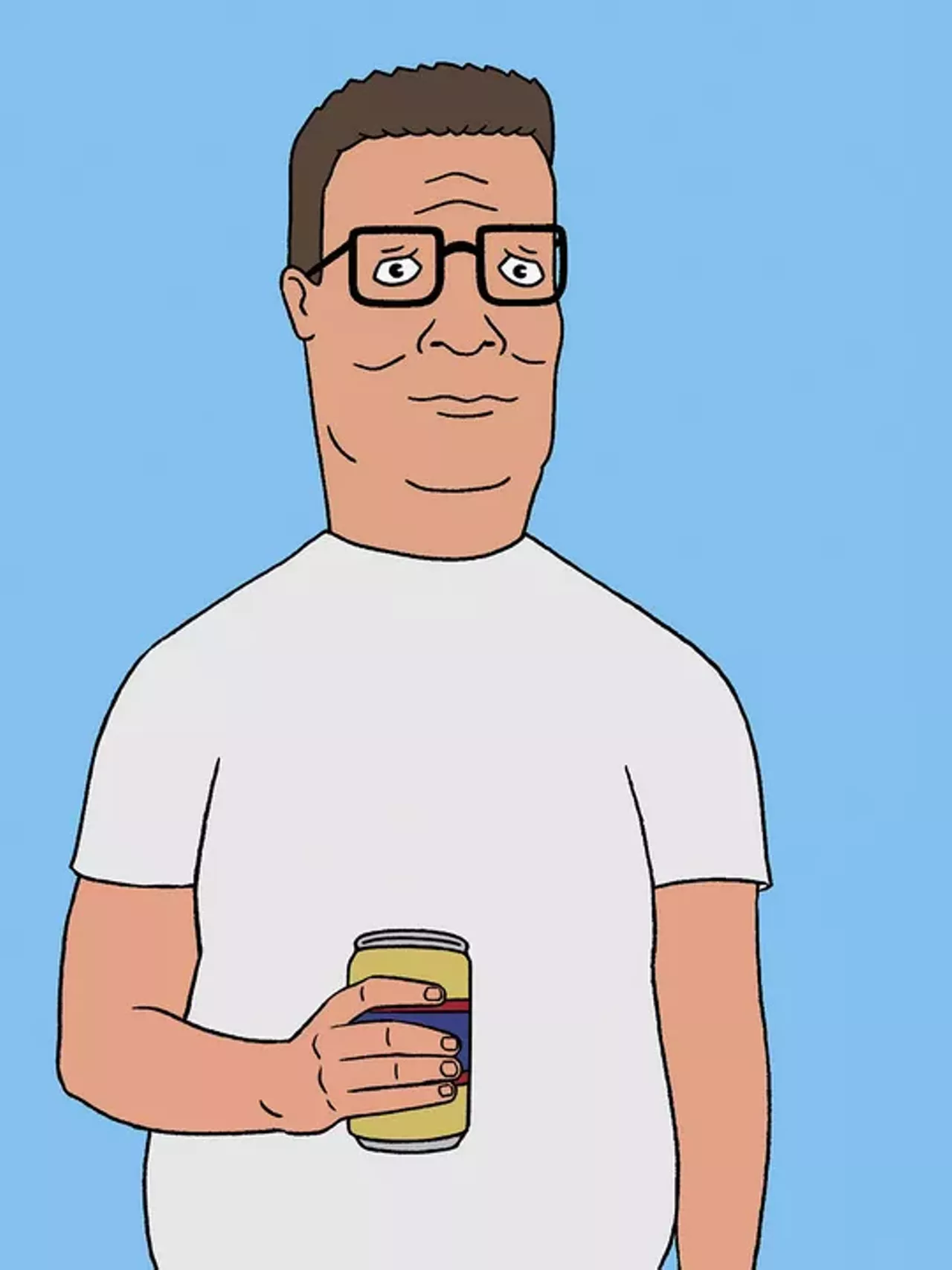
Profiles In Noble Masculinity: Hank Hill

nol3t

When it comes to paragons of masculinity, the standards tend to skew towards characters who crank the testosterone levels up to the maximum and even go a little bit beyond. From mythical figures like Hercules to modern icons like James Bond, it often seems as though that a truly masculine man has to exceed some lofty standards.

While there’s certainly a place for that kind of masculinity, I don’t think that has to be the only criteria. I believe there’s room for a more subtle, yet equally strong manifestation of manliness. They don’t have to be the kind of men who sweat raw testosterone and shave with shards of broken glass. They can be their own man and still embody respectable masculinity.

I chose Joel from “The Last Of Us” for my first profile in noble masculinity primarily because his example was not very subtle. He embodied the masculine values of strength, survival, fatherhood, and compassion in ways that are easy to highlight within a larger narrative. It didn’t take much work to make my case for Joel’s noble traits.

For my next profile, though, I’ve chosen a character who presents a tougher challenge. He comes from a narrative that’s very different from Joel’s. Instead of a post-apocalyptic world where everything comes back to survival, his is a more contemporary story from the far less dire setting of suburban Texas.

His name is Hank Hill. He sells propane and propane accessories. He’s a proud American, a hard worker, a die-hard football fan, and the star of “King of the Hill.” In the pantheon of modern-era animation, it’s a show that doesn’t usually rank near the top for most people, but the fact it lasted 13 years proves it did something right and Hank his is one of those things.

I consider him another example of noble masculinity. He’s one that differs considerably from Joel in “The Last Of Us,” but I consider him an example none-the-less. Over the course of 258 episodes and 13 seasons, Hank establishes himself as one of those rare characters who manages to be compelling and respectable without being too flawed.

He’s not a bumbling dad, nor is he self-absorbed narcissist always looking to get ahead. Hank Hill, at is core, is blue collar family man who loves his job, loves his wife, and tries to make the most of his situation. He’s not a whiner. When he sees a problem, he tries to fix it. When he makes a mistake, he owns up to it, even if he stumbles along the way.

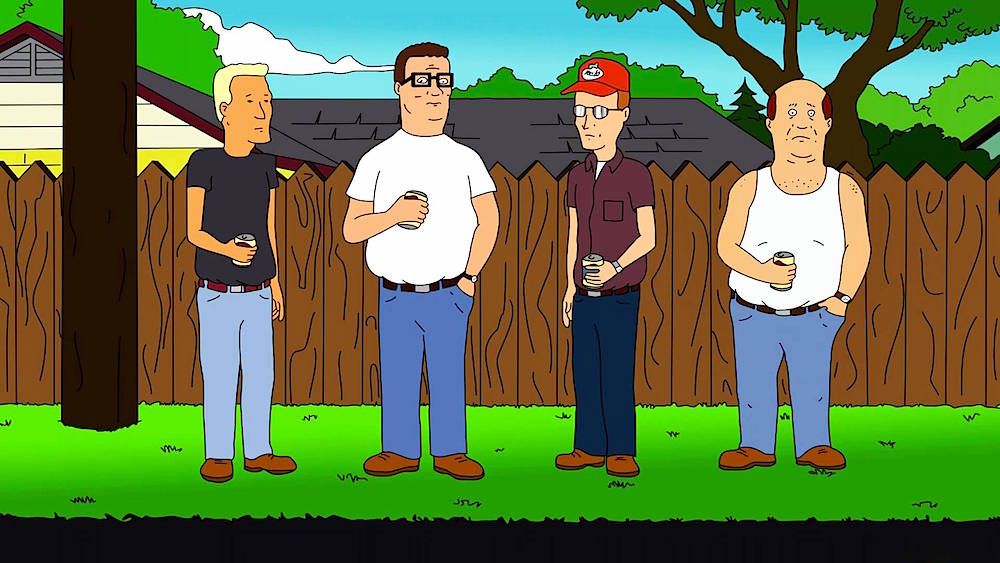
He tries to do all of this while surrounded by characters who have a wide range of issues, flaws, and eccentricities. One of his neighbors is a self-loathing loser obsessed with his wife. Another is a chain-smoking paranoid idiot who doesn’t know his wife cheats on him. The other is Boomhaur. Actually, Boomhaur is awesome.

Beyond his idiot friends, Hank also deals with a know-it-all wife with an inflated ego, a lazy son who goes out of his way to under-achieve, a bimbo niece who attracts all the wrong people, and an eccentric, misogynistic father who hates his guts. The fact that Hank manages to maintain such a calm, collected demeanor most of the time is a testament to his strength.

That strength, however, isn’t exactly obvious if you just look at his persona on paper. In fact, if you just skim the basics, Hank doesn’t come off as a very interesting character, let alone one who fits the criteria for noble masculinity. He’s conservative, he’s frugal, he doesn’t exude charisma, and he’s a staunch defender of law, order, and the status quo.

Hank isn’t the kind of man who willingly goes on adventures, acts on an impulse, or seeks to radically change the world around him. He actually likes his world, for the most part, and actively defends it from those who try to upset it. This has led to more than a few conflicts throughout the show, but Hank’s ability to resolve those conflicts reveals that there’s much more to his character.

It’s in those efforts where Hank’s nobility, as both a man and a character, really shows. While he is a staunch traditionalist who goes to church, votes Republican, and is extremely uncomfortable with sex, he’s also remarkably tolerant of those who don’t share his views.

Throughout the show, he encounters people who are overtly promiscuous, exceedingly liberal, and don’t care much for football. At no point, though, does he try to change those people or convince them that they’re flawed. Sure, he’ll threaten to kick an ass every now and then, but he usually reserves that recourse for those who most deserve it.

When he’s not kicking asses that deserve to be kicked, Hank is also demonstrates an ability to reserve judgment and not make anything too personal. Throughout the show, he’s encountered crazy right-wing religious types, flamboyant homosexuals, and unapologetic womanizers. By nearly every measure, he deals with them in a way that’s respectable and fair for the most part.

For the most part, indeed.

Hank doesn’t condone or condemn their behavior. He’s more concerned with the consequences they have on others. In his view as a freedom-loving American, what people choose to do is their business, provided they understand and accept responsibility for the consequences.

Throughout the course of the show, he’ll point out or remind others of those consequences. He’ll even help some confront it. However, he doesn’t make it personal. He doesn’t whine about it. He doesn’t try to get everyone to embrace his way of doing things. Hank basically lets other people be free and live their lives.

It’s not the same as slaying giant monsters or rescuing princesses from towers, but it’s noble in its own right. In the context of masculinity, Hank Hill’s ability to remain strong, stern, and confident in the face of so much chaos from so many characters, each with plenty of quirks and eccentricities, is a testament to the kind of man he is.

He’s a man who takes pride in his work, leads by example, and tries to be the voice of reason in a world full of unreasonable people. He’s willing to be brave and bold when he has to be. He’s also willing to take responsibility when others won’t or refuse to. As a man, he’s someone who earns the respect of others and does plenty to maintain it.

That’s not to say that Hank is without his flaws. Sometimes, he is traditional to the point of being petty. In one episode, the entire plot was driven by his dismay at another family sitting in his non-assigned seat at church. He can also be controlling, especially with how he raises his son, Bobby.

On more than one occasion, he’s been an obstacle for Bobby’s endeavors. His famous refrain, “That boy ain’t right,” is often said in the context of him wanting to guide Bobby down a certain path. Most of the time, though, he does so in a way that’s appropriate for a caring father. Other times, though, he gives the impression that he wants Bobby to be just like him.

Even with these flaws, Hank Hill still commands and earns respect. As a man, a father, and an American, he checks most of the boxes in terms of noble masculinity. He’s strong, responsible, hard-working, and accepting of other peoples’ strengths and flaws. He’s a man worthy of admiration and the fact he knows propane is a nice bonus.

4 Comments

Filed under gender issues, media issues, noble masculinity, political correctness

Boredom: How It Can Shape (And Subvert) Religion

Praying hands

Whenever I talk about boredom, whether in the context of the present or a future where it’s a full-blown plague, I often belabor how it’s effects and impacts are understated. That’s somewhat unavoidable. Boredom, by definition, requires an environment of limited, monotonous drudgery. Most people see their lives as inherently hectic so the boredom seems like a distant concern.

Hectic or not, everyone is still vulnerable to boredom’s corrosive effects. Those effects are well-documented and it’s part of why solitary confinement is considered torture. Those same effects can shape heroes, villains, and eccentric mad scientists, alike. It can also be a factor in determining the long-term viability of an ideology.

That last detail is something I attempted to explore in an earlier article where I introduced the concept of the Boredom Filter. Simply put, by contemplating an ideology taken to its ultimate end, the Boredom Filter can reveal whether that ideology can survive in a world where humans despise boredom and will do anything, including horrific crimes, to alleviate it.

While researching that article, I originally intended to apply the filter to religion as well. I knew that was sure to enter some extremely sensitive areas. Talking about identity politics and sexual taboos is tricky enough. Adding religion to the mix is like adding a bit of nitroglycerine to a burning pile of napalm.

On top of that, I think religion in its general form is somewhat distinct from ideologies like liberalism, conservatism, feminism, and even libertarianism. Those ideologies are philosophical or logistical tools that present themselves as guides or interpretations of social phenomenon. Religion also does that to some extent, but has a broader scope.

Religion doesn’t just cover methods for making sense of society and the universe, as a whole. Unlike an ideology that can be taught, learned, or studied, religion is a lot more subjective and dependent on personal and shared experiences. Even though religious affiliation is in decline, it’s still an influencing force on society.

Whether or not that influence grows or wanes is not the point. My focus, in this case, is to show how religion is shaped by boredom. I also intend to use it show how boredom can subvert the core tenants of a religion, if it’s followed strictly.

Before I go any further, I want to make clear that I’m not out to condemn or demean any particular religion or its adherents. I’m making a concerted effort not to play favorites here. If it sounds like I’m being unfair or too harsh to a particular religion or faith, I apologize. We all have our biases. I’m not particularly religious so I’ll try to remain objective as possible.

With that out of the way, I feel it’s important to establish one particular aspect of religion that sets it apart from political or philosophical ideologies, in terms of how boredom effects it. Religion, and religious experiences, are extremely subjective. You could argue that they’re entirely subjective.

One individual can go to a church on Sunday, listen to a sermon, and be incredibly moved on a personal level. To them, it could be one of the most intense experiences they could have. Another person who is as healthy and sane as the other can sit through that same sermon and be bored out of their mind.

It’s that subjective disparity that makes it difficult to apply the Boredom Filter. However, even with that disparity, boredom is still an influencing factor. A religion that evokes more of those intense experiences in a large number of people will likely be successful and pass the Boredom Filter. One that only evokes those experiences in a small group will only have limited appeal.

That’s why repressive cults usually only appeal to a handful of people. If you’re in a tight-knit group that’s full of solidarity and intense tribalism, it’s possible to get around boredom, if only because members are too scared or too brainwashed to escape. For larger religious organizations, boredom is a bigger issue because appealing to a lot of people means ensuring they don’t get bored.

When assessing an ideology with the Boredom Filter, it’s relatively easy to speculate on what their idealized society is because most ideologies clearly state those goals. Communists want a communist utopia. Liberals want a liberal utopia. Libertarians want a libertarian utopia. With religion, there’s not a clear endgame for the most part.

Sure, some religions like Christianity and Islam preach spreading the faith, if not converting the entire world’s population. Others either don’t emphasize it in their theology or only use it to the extent that it has to market itself in a modern economy. When applying the Boredom Filter, though, it’s important to be targeted.

By that, I mean it can’t just apply to what a holy book says or what sort of ethics certain religious icons preach. It has to apply to how it’s actually practiced. There are so many varying sects and denominations within a particular religion. Not all of them practice the same way or take their holy texts quite as literally.

That, more than anything, is the key to determining whether the Boredom Filter will impact a particular form of religious expression. Even if it passes, though, it can also reveal how that form of expression is shaped. It’s rarely overt, but the fact major religions have endured longer than most ideologies shows that a religion is more willing to adapt than it claims.

For a simple example, let’s apply the filter to the most common form of evangelical Christianity, as practiced by the religious right in America and espoused by religious leaders like James Dobson from the Family Research Council. They favor a brand of Christianity that favors a very strict form of religious morality.

It doesn’t take much speculation to see that this form of Christianity doesn’t pass the Boredom Filter. This brand of Christianity seeks one particular manifestation of family, one manifestation of gender, and one manifestation of personal conduct. That includes no promiscuity, no cursing, no porn, and no unholy behavior.

Even if that one manifestation of society is a particularly good one, it’s not hard to imagine people getting bored with that. At some point, they’re not going to be as moved when they go to church. They’re not going to be as excited about consuming the same Christian-friendly media or having sex with the same person for the same reasons again and again. Boredom will set in for many people. It’s unavoidable.

The same issue occurs when you apply the filter to fundamentalist Islam, especially the kind espoused by modern extremist groups. They may use a different holy book and employ different religious practices, but the manifestations are the same. It promotes a society of strict, rigid conformity for large numbers of people, regardless of their diverse personalities, passions, and proclivities.

Even when these standards are brutally enforced by state-sanctioned religious police, there’s no escaping the boredom. People may still conform out of fear for their lives, which is usually a stronger motivator. However, it only goes so far in terms of creating loyal, passionate adherents. In general, people who conform out of fear can only be so sincere.

In a sense, the fact that some of these religious ethics have to be enforced with fear and violence, be it from the police or threats of eternal damnation, is a tacit acknowledgement that those ideals are not tenable to a large group of people. Without that fear, the boredom alone will make them seek other experiences and no religion can survive like that.

That still begs the question as to why some religions manage to survive, even the repressive ones. On paper, the Catholic Church has pretty strict moral tenants. The Vatican opposes premarital sex, masturbation, divorce, homosexuality, abortion, contraception, and free expression that denigrates or defames the church.

However, the difference between the Catholic Church and the extreme forms of Islam and Christianity is that they can’t do much to enforce that morality. They could in previous centuries, but these days the Vatican’s moral proclamations are largely symbolic. They preach against immoral behavior, but don’t directly combat it.

To some extent, that might have helped the Catholic Church endure. By losing it’s authoritarian muscle, it had no choice but to adapt its theology to accommodate less-than-pure adherents. It’s not quite as flexible as some would prefer, but it has shown a willingness to revisit old traditions in the name of evolving with the times.

Other religions have done a much better job of that. Denominations like Reformed Judaism and Unitarian Christianity have been much more receptive to adapting their theology to the changing times. While this may upset some traditionalists, so much so that they won’t even consider those denominations as true adherents, they do win in one aspect. Adapting their theology keeps it from getting boring.

Sure, church on Sundays may still feel like a chore, but at least you won’t have to listen to the same fire and brimstone rhetoric every week. That counts for something when applying the Boredom Filter. Any sect or denomination that doesn’t do that, though, will only ever have limited appeal, at most.

In that sense, Islam is more vulnerable to the Boredom Filter. Traditional Islam is basically in the same domain where Catholicism was several hundred years ago. It still enforces strict adherence of its traditional method in many Islamic countries. Like the Vatican, however, the enforcement isn’t always on par with the Spanish Inquisition.

Within these countries, those traditions and the state-sanctioned enforcement of them are often challenged or overlooked. To some extent, the Boredom Filter is already having an impact because shifting demographics and generational clashes are leading some within Islam to become disillusioned with those rigid traditions. I’m not saying boredom is the sole cause of it, but like Christianity, it is a likely factor.

Islam’s ability to adapt to these trends will determine whether or not it will continue to endure like Catholicism. There are some making a genuine effort, much to the detriment of their safety. Whether or not these adaptations are sufficient will have depend heavily on its ability to pass the Boredom Filter.

I don’t want to speculate too much on the future of Islam, Christianity, or other faiths. I also don’t want to give the impression that the Boredom Filter is definitive, especially for something like religion. I present it as simply another tool to help make sense of, and possibly speculate on, the impact of religion.

That impact will continue to incur other impacts on society, even as religion continues to decline. It will always have a certain appeal to certain people. If it’s going to have appeal to more people in a future where people are more informed and possibly enhanced, it would be both wise and necessary for it to pass the Boredom Filter.

1 Comment

Filed under human nature, philosophy, religion, sex in society, War on Boredom

“Lessons In Lovemaking” A Sexy Short Story

4197r-57057

The following is a short story entitled “Lessons In Lovemaking.” It’s a story inspired, in part, by some recent events surrounding the state of sex education in this country. You’ll see what I mean by the end of the story. Enjoy!

“Are you ready for this, Evelyn?” asked a nervous, but excited Aaron Jay Patterson.

“I think so,” replied his girlfriend, Evelyn Marsh.

“It’s not too late. We can stop right now and forget the whole thing. I’ll even take you to that burger place you love.”

“No, it’s okay, babe,” she said with more certainty. “I am ready. I just…want to do this right.”

“So do I,” he said, casting her a smile, “which is exactly why we’re here.”

The beautiful, radiant woman by his side smiled back. The same woman who’d once laughed at the idea of falling in love with a guy she met at her younger brother’s birthday looked at him with an intensity that made him weak in the knees for all the right reasons. Holding her hand, conveying his love with his touch, he’d been preparing for this moment since their first kiss. It was a moment that just had to be perfect.

That was why, on a hot summer day in June, they took a day off from work and college classes to make an appointment with Dr. Sharon Braddock. It was just past noon when they arrived at the office complex located a couple miles of his apartment. Time slowed to a crawl as they sat together in the room, watching other eager couples come and go.

Those that left often did so with beaming smiles. That was a promising sign in Aaron’s book. He wanted him and Evelyn to be one of those couples. Based on Dr. Braddock’s glowing online reviews, her expertise could only help. She was supposed to be one of the best in the area.

Just making the appointment showed how much his relationship with Evelyn had progressed. He’d had other girlfriends. She freely admitted that she’d had other boyfriends as well. However, neither of them had been in a relationship that made it to this far. It wasn’t unreasonable to say that the outcome of this appointment would determine whether their love and their relationship was serious.

Aaron tried not to think about that as he and Evelyn nervously waited their turn. The waiting room had a TV and good Wi-Fi, but there was only so much he could do to distract himself. He was eager to take this next step with Evelyn.

“Mr. Patterson and Ms. Marsh?” the assistant from behind the secretary’s counter said.

“Yes?” said Aaron, sounding childishly eager.

“Dr. Braddock is ready for you now.”

He and Evelyn exchanged glances again. She was still smiling, but he could tell by her touch that she was as nervous as him. From what his older brother told him about these appointments, it was a normal feeling. He also told him it faded really fast once things got started.

“Let’s go!” Evelyn said, brimming with energy.

“Lead the way, my love,” Aaron said.

Together, they got up and walked through the main door, which lead into a narrow hall. With growing anticipation, they made their way towards a large set of double doors. Upon arriving, the doors automatically opened and entered into Dr. Braddock’s staging area, as it was called. There, they were greeted by a tall, middle-aged woman with an athletic frame, a professional demeanor, and a dead serious look in her eyes.

“Welcome,” the woman said. “I’m Dr. Braddock. Thank you for choosing me as your provider today.”

“Thank you for seeing us,” said Aaron as he and Evelyn took turns shaking her hand.

“We’ve heard a lot of great things about you,” said Evelyn. “My Aunt Helen said her second marriage succeeded because of you.”

“I like to think my results speak for themselves. As such, let’s get started.”

The older woman led them into the area and closed the door behind her. It looked pretty much like Aaron expected. It was fairly spacious, about the same size as the master bedroom at his parents’ house. The windows had been blacked out, the lights had been dimmed, and the décor on the walls was very appropriate, so to speak.

There wasn’t much furniture, aside from a queen-sized bed in the center of the room, a desk in the corner, and a couple of mahogany dressers alongside the walls. It probably wasn’t the best staging area in town, but Aaron didn’t need anything too fancy. He just needed Dr. Braddock to deliver.

“I’ve gone over your respective profiles and determined an appropriate recourse,” she said as she looked over a tablet computer. “I need only your affirmative consent to proceed.”

“You’ve got it,” said Evelyn without hesitation.

“Same here,” said Aaron, matching his girlfriend’s confidence.

“Very well,” said Dr. Braddock. “Then, come this way, please. Get into position while I make the appropriate arrangements.”

Knowing what that meant, Aaron exchanged one last nervous look with Evelyn. He hoped it would be the last. From this point forward, he approached the procedure with the assumption that it would vindicate his and Evelyn’s love.

Confident in his mindset, he and Evelyn walked over to the side of the bed and stood in front of one another. He faced her and she faced him, awaiting the doctor’s instructions and trying to contain his desire for the woman before him.

“According to your file, you two have been romantically involved for six months and nine days,” Dr. Braddock said, now standing in front of her desk.

“That’s correct,” said Aaron.

“It says you both have been involved in previous relationships,” she said. “Am I correct in stating that at least one of those relationships included sexual intercourse?”

“That’s correct too,” said Aaron. “I’ve had sex with one other woman. It was during high school and it was only three times.”

“Same here,” Evelyn said. “It was just after high school and twice with two different men.”

“Would you consider any of those encounters explicitly romantic?”

“Nope,” Aaron said simply.

“No, definitely not,” said Evelyn.

“Would you say they were pleasurable, even if they weren’t particularly satisfying?” Dr. Braddock asked.

“Yeah, I’d say that’s accurate,” said Evelyn.

“Same here,” said Aaron. “I don’t remember them being that special. Guess that’s why we’re here.”

“Indeed,” said Dr. Braddock, typing notes into her laptop with a stern professional demeanor.

The older woman entered something into the computer on her desk. Then, she downloaded it into her tablet. Aaron kept facing Evelyn. They were standing so close that he could feel the warmth radiating from her body. He fought the urge to just throw his arms around her and vent his passions on the spot.

Aaron took a deep breath and restrained himself, though. He reminded himself why he and Evelyn were doing this. It was an important step for every couple. He saw it as one of the most serious efforts he’d taken on in his adult life. He and Evelyn had worked hard on their love. He had every intention of working harder for this.

After going over more data on her tablet, Dr. Braddock walked over from her desk so that she stood at the head of the bed. Then, with a professional demeanor that would’ve made his old gym teacher proud, she addressed him and Evelyn.

“I’ve compiled your data. The procedure is ready,” Dr. Braddock said. “Do you wish to begin?”

“Yes,” said Aaron intently.

“Hell yes!” said Evelyn, her tone brimming with energy.

“Very well,” the older woman said. “First step in the process…take off each other’s clothes. Do not remove anything on your body. Rely exclusively on your lover. Is that understood?”

“Yes, Doctor,” he and Evelyn said simultaneously.

Aaron and his love did as instructed. Evelyn undid the buttons on his shirt and pulled it off over his head with ease. He undid her tight-fitting denim pants and pushed them down her shapely legs, giving her room to wiggle out of them. She was even a little playful with it, but only to a point. She understood as well as him that this was serious and they had to treat it as such.

Piece by piece, he and Evelyn took turns stripping one another. He took off her shirt. She took off his pants. They even alternated when taking off their shoes and socks. That might have been a bit too formal, but under Dr. Braddock’s critical eye, it couldn’t hurt to be extra thorough.

Once down to their underwear, though, Aaron let himself get a little affectionate. He slipped in closer to her warmth as he reached around to undo her bra, grinning affectionately at her as their naked skin touched. She smiled back, giggling a little as she pushed his boxers down to his ankles. That smile only widened when he did the same with her panties, pulling them down those shapely legs of hers and exposing his love in all her glory.

It might have been the most mundane part of the procedure. He’d seen a naked woman before. He and Evelyn had even seen each other naked on multiple occasions. He made no secret of how much he enjoyed the sight of her exposed breasts, her heart-shaped butt, and her womanly curves. She was just as vocal about her fondness for his slim, yet muscular build.

“Remain close to one another,” Dr. Braddock said, her voice very official. “Take a moment to admire one another’s bodies. Complement each other on the parts you enjoy.”

Aaron laughed to himself. That wasn’t going to be too hard. Evelyn had so many features he admired, physical and otherwise.

“You have great breasts, Evelyn,” he told her. “They’re so nice and round.”

“You have a great butt, Aaron,” she told him. “It’s so strong and compact.”

“You’ve got a great butt too. I admire it a lot when you’re not looking.”

“I do the same. Why else do you think I love wearing tight jeans?”

She snickered like a couple of giddy school children, but remained as focused as him. Aaron’s eyes drifted up and down her body, scrutinizing her nude figure from head to toe. It made him want so badly to reach out, touch her, and feel her hot flesh. For all he knew, that might have even been the point.

“Now, go ahead and embrace each other,” Dr. Braddock instructed. “Do not kiss. Simply touch. Give special focus to the breasts, buttocks, and genitals. You are lovers now. That means opening yourselves and being open to one another.”

The way she said it made it sound so official, as though they had just graduated from a casual romance to something more serious. That made the experience of touching his lover’s body that much more meaningful, not to mention arousing.

Like gravity pulling them together, Aaron snaked his arms around Evelyn’s waist while she pawed his chest. With growing desire in his eyes, he affectionately grasped her butt while she traced her finger down the sinews of his upper body. She soon made her way down to his torso, eventually reaching his penis, which she lovingly took in both hands. He let out a slight gasp under her touch, which encouraged her to grasp it harder. That, in turn, got him to squeeze her butt, evoking a soft purr from her lover.

He could already feel the lust escalating between them. Every touch felt so hot. Aaron felt his heart rate jump, half the blood in his body rushing downward, causing his penis to become erect. Within that escalating feeling, their naked bodies pressed up against one another like the opposite poles of two magnets coming together. Not kissing her made it somewhat strange, but that might have been a good thing because it gave them a chance to really admire one another’s beauty.

“Aaron…please,” Evelyn whispered, “touch me here.”

Not waiting for him to react, she lightly grasped his wrist and guided his hand between her legs. It marked the first time he touched his love’s private areas. He knew as much about female anatomy as any man with an internet connection, but the feeling of touching the one that belonged to his girlfriend carried extra meaning to it.

“You’re hot already,” Aaron commented, trying hard not to react too strongly.

“And you’re hard,” she said, giving his member a lightly squeeze.

“Don’t be too overt,” Dr. Braddock told them. “It’s good to vocalize some arousal, but let the touching do the talking. Use that to get each other sufficiently aroused.”

He and Evelyn fell silent, but continued sharing affectionate moans as they explored each other’s bodies. They weren’t quite as casual as they’d been when taking each other’s clothes off. He found himself being more careful, as though his lover’s body was a precious relic that required the utmost care. She treated his the same, but Evelyn was a bit more enthusiastic.

Like an athlete getting their second wind, she became bolder with her touching. While still fondling his cock with one hand, she trailed the other all over his body, feeling around his arms, shoulders, back, and butt. Aaron knew Evelyn was an affectionate persona, but he had no idea she could convey so much with touch alone.

He tried to return the favor, lightly stroking the tender flesh between her thighs and feeling up the curves of her body. With each new bit of skin he felt, Aaron’s passion for her grew. It was like seeking the warmth of a fire on a cold winter day, wanting so much to embrace that warmth, but not able to get close enough. That too might have been intentional.

“For effective, pleasurable lovemaking,” Dr. Braddock said, “trust must come before desire and desire must come before intimacy. Your respective passions, as well as your personalities, are uniquely adept at complementing one another. Channeling that feeling will ensure maximum intimacy.”

The woman’s expertise showed. Aaron could already sense his passion for Evelyn intensify to new levels. The way she looked at him was unlike any look he’d ever gotten from a woman. Just being horny and aroused wasn’t enough. He sought more from his love.

“With that in mind, get onto the bed and proceed with your foreplay,” Dr. Braddock told them. “This time, incorporate kissing into your gestures. Convey both your passions and your desire for intimacy.”

Her instructions were so simple, yet seemed so daunting. That didn’t make Aaron any less determined to see it through, though. If anything, it encouraged him and his lover.

His legs already weak from arousal, he and Evelyn climbed onto the bed together. They remained in a partial embrace, not wanting to part from her loving warmth. Whether by accident or instinct, he found himself sitting in the center of the mattress with her, their arms and legs entwined in somewhat messy convergence of flesh. It was like they didn’t know what to do with all their passion and desire.

“You heard the doctor, Aaron. Kiss me,” Evelyn said.

That was just the reminder he needed. Before they fully settled into the bed, he captured her lips with his in a powerful kiss. It wasn’t the most desperate kiss they’d ever shared, but it conveyed the right emotions and incurred the right impact.

As soon as their lips tongued and their tongues twirled, a more thorough round of foreplay unfolded. Aaron more freely explored his lover’s body, fondling her breasts and trailing his fingers over the ticklish parts of her skin. Evelyn did the same, showing a bit more urgency. The way her nails raked over his neck and shoulders, he could literally feel how much she wanted him.

“You’re doing well,” Dr. Braddock said. “You’re building both anticipation while communicating affection. That, in turn, gives meaning to the pleasure you’re about to give one another.”

Encouraged by her words – the idea of sharing such feelings with his lover and making it feel good – Aaron stepped up the pace of his foreplay as well. It was getting pretty heated. He didn’t just feel Evelyn’s desire in her kiss. He felt the extent of her arousal, the passionate energy radiating from her body and the moist heat from between her legs. His arousal was pretty obvious too, as if there was any way to hide a full-fledged erection.

As heated as their passions had grown, though, Aaron still listened intently to Dr. Braddock’s instructions. He hadn’t forgotten why they came here or why he and Evelyn decided to do this.

“The next step will set the tone for that pleasure,” she said. “Mr. Patterson, lie down on your back. Ms. Marsh, got on top of them. From there, give each other mutual oral sex.”

“Isn’t the official term for that a 69?” joked Aaron.

“I don’t go by what’s official. I go by what’s necessary,” she said, still as serious as ever. “Proceed with your oral sex. Please, for the time being, refrain from climaxing.”

“Yes, Doctor,” said Evelyn, not sounding nearly as serious.

Their lips having parted, they shared a playful grin before repositioning themselves accordingly. As instructed, Aaron got on his back and Evelyn got on top of her. That left him face-to-face with her pussy and her with a perfect view of his cock. Still approaching the procedure as important as any other, Aaron went to work eating his lover out.

“Mmm…my love,” she purred as she took his manhood in both hands.

“That’s it,” Dr. Braddock said. “Be gentle, but focused. Get a feel for your lover’s anatomy. Make an effort to memories those intricacies. You’ll need them for later.”

Now more motivated than ever, Aaron channeled his love for Evelyn and his moderate understanding of the female body to give her the pleasure he wanted. He was very careful at first, not wanting to hurt or overwhelm his lover. He quickly found out that she wasn’t as sensitive as he thought. She responded quite favorably to targeted, fervent stimulation.

As he got a feel for how his lover liked to be teased, Evelyn did her part as well. With both hands gripping his shaft, she began suckling along the length of his cock. Like him, she started slowly, emphasizing quality over quantity. She quickly learned that he enjoyed a little energy with his sex. When she sucked him harder, he returned the favor with some extra thorough oral teasing.

Soon, the staging area echoed with muffled moans of bliss. It was like a perfect cycle of sorts, a circle pleasure that complemented their passions. It helped satiate some desires while intensifying others, adding a new layer of intimacy to their act.

As the cycle continued, hot sensations compounding every intimate feeling, Dr. Braddock kept taking notes. She watched the scene before them like an impartial observer. Aaron had no idea what she was writing. He just knew he had to memorize every intricate kink that made his lover moan with delight.

Aaron wasn’t sure how long Dr. Braddock would have them go at it. For all he knew, he was racing against the clock, needing to get his lover to a level of arousal before a certain point. Evelyn had already worked him to a state of peak arousal, forcing him to restrain himself from climaxing too quickly. He had to work quickly, touching and teasing her pussy with every ounce of effort to get her to that special place.

“For maximum intimacy, you must guide your bodies into a similar state of being,” Dr. Braddock told them. “That way, you can share the breadth of the feeling.”

The older woman stopped writing down notes. With his face still buried in his lover’s pussy and his cock still deep in her mouth, Aaron never lost focus, waiting for that moment when his body and Evelyn’s would be in sync. It was hard to tell, but that was why they had a professional present.

“You’re both doing very well, thus far,” the older woman said. “It’s time for the last and most important step. Mr. Patterson and Ms. Marsh, cease your oral sex and reposition yourselves as follows – Ms. Marsh, lie down on your back and spread your legs while Mr. Patterson gets on top of you.”

“Yes, Doctor!” they both said, intense desire having long since replaced playful spirit.

Now fully intoxicated by his passion and lust for this woman, Aaron coordinated his body with Evelyn’s at an efficiency that would’ve made his drill sergeant uncle proud. Evelyn couldn’t get on her back fast enough, lying down in the center of the bed and spreading her legs as wide as her old gymnastic skills would allow. Aaron then got on top of her, his face hovering just inches over hers as he caressed her hands in his.

“Now, Mr. Patterson, enter your partner,” Dr. Braddock said. “Use your hands to hold her legs apart. Ms. Marsh, hold onto your partner’s shoulders to provide leverage.”

Like an order from a higher power, Aaron shifted his grip to his love’s thighs and guided his manhood towards her wet entrance. Then, with a steady thrust of the hips, his manly flesh filled her womanly depths. The hot sensations that followed were a feeling like no other.

“Oh Evelyn!” he gasped.

“Aaron!” Evelyn moaned.

As they took in that powerful moment, Dr. Braddock wrote down something else. Then, her gaze narrowed on him as though she were about to give him the most important message of his life.

“Your bodies are entwined. Start moving together,” she said. “Work your penis within her vagina. Use the knowledge you gained earlier to stimulate your partner’s depths. Do it with the intent of giving her an orgasm.”

“Yes…Doctor,” said Aaron.

Overwhelmed with energy and desires, he began making love to the beautiful woman under him. He dug his knees and feet into the soft mattress, clinging firmly to her thighs as he worked his body against hers in a fervent sexual rhythm. With every movement came a rush of blissful sensations. With those sensations came heightened passions. At that moment, Aaron felt more connected to this woman than he had with anyone else before.

As gasps and grunts filled the room, her loving gaze locked onto his. She clung hard to his shoulders, providing just the right amount of leverage for every motion. In between the passionate moans, they shared affectionate kisses. For such an intimate feeling, it was like icing on top of an already delicious cake.

“Keep the pace of your sex steady,” Dr. Braddock said. “Don’t be afraid to go a little faster, either. Extra stimulation is often necessary for greater pleasure, particularly to those within your personal profile.”

Aaron still took that suggestion as a command. He dug his feet into the bed harder and increased the tempo of their sex. He didn’t do it too hard, but it was still hard enough to rock the bed. If Evelyn’s louder moans were any indication, he was doing something right.

“Aaron…my love! Like that! Just…just like that!” she moaned.

“You hear that, Mr. Patterson? I believe you’ve found her preferred tempo,” Dr. Braddock said. “Now, with that in mind, make sure you stimulate her clit to facilitate orgasm. Most women do not climax from penetration alone. Ms. Marsh is one of them.”

Always one to be thorough, especially when it came to the woman he loved, Aaron followed Dr. Braddock’s instructions. He released his grip on one of her thighs and used his fingers to rub Evelyn’s clitoris with the same rhythmic intensity as their sex. The impact of those efforts was almost immediate.

“Oohhh Aaron!” Evelyn exclaimed. “You’re going to make me come! You’re going to…make me…come!”

Hearing those beautiful words in that beautiful voice made Aaron feel like a star athlete about to win the race. With grit and determination, he intensified their love-making, being more thorough with every thrust of his hips. He watched in awe as his love’s expression tensed and contorted to the oncoming pleasure. He was close too, but he badly wanted to see her go first.

“Your partner is about to orgasm, Mr. Patterson,” Dr. Braddock said. “You can stop withholding yours, if you haven’t already. Try to time your release with hers. It doesn’t have to be simultaneous. It just has to be close.”

Aaron hadn’t realized how close he was to his own release. Getting the go-ahead from Dr. Braddock seemed to remind him. He was almost ready, but he refused to cross that threshold before his lover.

With greater focus, Aaron pumped his manhood into Evenly’s pussy harder, applying more pressure to her clit. Being so in tuned with her – physically, emotionally, and sexually – he could practically feel her peak approaching. When it finally arrived, he watched with utmost pride as his love closed her eyes, threw her head back, and cried out to the heavens in ecstasy.

“Ohhh Aaron!”

It was nothing short of angelic, the look on her face when she came. Her lower back arched, her toes curled, and nails dug into his shoulders, as though he were her lifeboat in an ocean of ecstasy. In addition to the visual spectacle, he felt the hard contractions of her inner muscles around his dick. With just a few more thrusts, that gave him the push he needed to achieve his peak as well.

“Evelyn…I’m coming!” he moaned.

At that moment, time stopped and so did his world. His body tensed and shuddered as an eruption of hot pleasure surged through him. Aaron had experienced plenty of orgasms before, but this one felt extra special. All the anticipation, the effort, and the exertion paid off. His love for Evelyn took a real, tangible form and it felt amazing.

Together, he and his love writhed in the pleasure, their bodies reverberating together in an intimate heat. It felt like a true culmination of their relationship, literally and figuratively. They’d come to Dr. Braddock to make sure they did it right. Who knew doing something so right could feel so good?

“Congratulations,” Dr. Braddock said, finally cracking a smile. “You two have successfully made love to each other.”

“Thank you, Doctor,” said Aaron breathlessly.

“You…are a true expert,” said Evelyn, still in an orgasmic daze.

“I simply evaluate, inform, and instruct, as any competent sex doctor does,” she said as she wrote down a few more notes. “With the completion of your first lesson, I can prescribe a recommended regiment for lovemaking. Given what I’ve observed, I suggest you two make love at least three times a week. Also, start sleeping naked if you haven’t already.”

“We haven’t,” said Aaron, “but I’m looking forward to it now.”

“Me too!” said Evelyn playfully. “Doctor’s orders, after all.”

They shared a playful laugh, already settling into their post-lovemaking afterglow. As Aaron withdrew his flesh from his lover, he kissed her passionately to cap off a successful and critical experience.

As they shared that moment, their naked bodies entwined on the bed of a sex doctor’s office, Aaron took a moment to appreciate the time in which he lived. He and Evelyn resided in a world where couples didn’t have to fumble around on their own in learning how to make love. There were experienced professionals to help them skip all that awkwardness. How his parents and everyone before them managed sex without such resources was beyond him.


2 Comments

Filed under Sexy Short Story

The following is a review I wrote for PopMatters for “Hunt For Wolverine: Mystery In Madripoor #1.” Enjoy!

Friends Matter in ‘Hunt for Wolverine: Mystery In Madripoor #1’

Leave a comment

May 29, 2018 · 10:07 pm

How Much Are We Willing To Hurt The Innocent To Punish The Guilty?

symbol-of-justice

There are certain questions that nobody likes to ask, but still need to be answered. Questions concerning crime, justice, and punishment are usually at the top of that list. Lately, answering those questions has becom more urgent. If current cultural trends continue, that urgency will only increase.

That’s not because people are becoming more keen on justice. It’s more a byproduct of injustice being so much more visible in the age of the internet and social media. Crimes don’t just make the news these days. They can trigger full-blown social movements, destroy careers, and bring down powerful people.

To some extent, this is a good thing. We, as a social species, have an innate sense of justice hardwired into us. When we see something unjust, be it a kid stealing a cookie or a gruesome murder, most sane people want to see some level of justice enacted. When it isn’t, that bothers us. That’s where our sense of empathy comes from.

That said, it is possible for that innate desire for justice to go too far. Nature is a blunt instrument, largely out of necessity. Our desire for justice is no different and in the same way egregious injustices are harder to hide, gross misapplications of justice are becoming more visible as well.

As of this writing, the Innocence Project, a non-profit legal organization that works to exonerate those who’ve been wrongly convicted of a crime, have freed 350 people, some of whom were on death row. Those are the lucky ones, though. In a 2014 study, the National Academy of Sciences estimated that approximately 4 percent of those sentenced to death row may be innocent.

Think about that, for a moment, as a simple math problem. For every 100 people who are executed by the state for their crimes, 4 of them are completely innocent. Whether you’re liberal, conservative, libertarian, or communist, the murder of an innocent person offends our humanity to the core. Only a sociopath would be comfortable with that math.

That murder of some innocent people for the sake of punishing the guilty is an extreme example, but one that nicely highlights the potential pitfalls of our reckless crusade against injustice. I don’t bring it up to start a debate on the death penalty, which is very much a dead-weight issue within politics these days. I’m using it to provide context for misapplications of justice that aren’t as clear cut.

Thanks to social media and global connectivity, it’s a lot easier attack injustice without the rigid bureaucracy of legal justice system. It’s largely because of this emerging technology that the ongoing anti-harassment movement and the push for greater diversity have become more vocal. Instances of injustice that might have been ignored in the past are now much easier to confront.

Instead of hiring a lawyer, getting the cops involved, or going door-to-door to raise awareness, these perceived injustices can be attacked online, which can subsequently lead to offline consequences. While that can be an effective recourse for those who wield great power and have an army of lawyers, it does come at a cost and innocent people have felt that cost.

While there are plenty of cases that don’t become mainstream news, some of the most notable include the Duke Lacrosse incident or the UVA rape case. These are both cases that struck the right and wrong chords at the right and wrong time, evoking in people their inherent aversion to injustice in the utmost. It got people upset and emotional, so much so that they didn’t stop to wonder whether those involved were really guilty.

The alleged crimes were undeniably heinous. There’s no question about that. Anyone guilty of such crimes deserves to be punished. However, in wanting to punish such crimes, innocent people suffered. Some had their reputations temporarily ruined and others have been irreparably destroyed.

There are other lesser known cases of innocent people suffering because of an accusation that later turned out to be false. There are likely more in which the innocent person never gets justice. It’s impossible to know how common they are. Most will point out how rare those instances and in terms of raw numbers, that’s true.

However, that still implies that we have to accept the price that some innocent people will suffer in our pursuit of justice. It also highlights how important it is to have a functioning justice system that includes traditions such as due process and the presumption of innocence.

It’s a tradition worth belaboring too.

It’s an imperfect process, admittedly. There have been notable cases where someone likely got away with a crime because the standards for a conviction are so high. The principle behind that system is that, in the name of not condemning the innocent, we accept the price that some of the guilty may escape justice.

For some people, that’s more untenable than the condemnation of an innocent person. That has become a much more prominent theme in recent years, due to the anti-harassment movement. That’s somewhat understandable, given how long men like Harvey Weinstein got away with their deplorable behavior.

In the effort to prevent or punish such deplorable behavior, though, those critical tenants of our justice system that are supposed to protect the innocent are being cast aside. There are some within the anti-harassment movement who emphasize the importance of believing the victim’s accusations in lieu of the presumption of innocence.

Other, more radical, voices in the movement have favored changing the standards of evidence for rape cases so that they would no longer be subject to reasonable doubt. Granted, these are somewhat extreme measures that probably won’t upend our justice system anytime soon. Others far smarter than me have already pointed out the dangers and debunked many of the assumptions.

None of this is to say that the anti-harassment movement or the effort to hold people accountable for their behavior is entirely misguided. I’m in favor of exposing crimes and having the guilty pay for those crimes, provided they really are guilty. I support efforts to reduce harassment, sexual or otherwise. I support efforts to reduce sexual assault on women and men. Most decent human beings share that sentiment.

What I don’t support is the idea that it’s okay for more innocent people to suffer for the sake of capturing even more guilty people. As I mentioned before with the Innocence Project, our flawed justice system already condemns innocent people. A willingness to let more innocent suffer is the wrong direction to go in fighting injustice.

I know that’s easy for someone like me to say because I’ve never been the victim of a serious crime. I’ve had some stuff stolen before, I’ve been cheated out of some money, and I have been roughed up before, but I’ve never been seriously injured or assaulted. I can’t imagine how someone who has been seriously victimized feels about what happened to them.

Their suffering matters. The suffering of innocent people matters too. It’s why the question surrounding hurting the innocent to punish the guilty needs to be asked, even if the answers make us uncomfortable. The fact those answers make us uncomfortable reflects the flaws of our justice system and how imperfect our world really is.

At the same time, it also reminds us why seeking justice and combating injustice matters. We, as a society and a species, cannot function if there isn’t some semblance of justice. For victims and innocent alike, we need those institutions so that we can prosper and grow as a civilization.

From the anti-harassment movement to crusading prosecutors to overt bias in the court system, there comes a point in the pursuit of justice where compromising the innocent is a price that some are willing to pay. Once that line is crossed, though, it sets a dangerous precedent that relies on dangerous assumptions.

To be willing to compromise the innocent, it’s necessary to believe that people who fit a certain profile are guilty by default. If their gender, race, ethnic group, religion, or nationality checks enough boxes, then innocence becomes an afterthought. It becomes another numbers game in assessing potential guilt over actual guilt.

That’s a precedent that can easily devolve into a panic and, as history has shown, panics tend to harm the innocent far more than the guilty. It also undercuts the suffering of actual victims because if actual guilt becomes an afterthought, then so too does actual victimization.

That, in many ways, is the greatest price that comes with compromising innocence. Punishing a guilty criminal simply rights a wrong. Punishing an innocent person has impacts that go beyond simply making an undeserving individual suffer. It has a ripple effect on the entire concept of justice, much of which cannot be qualified.

That’s why, even if it is as rare as some claim, the punishment of one innocent person should offend our sense of justice more than a guilty person escaping. A guilty person is still going to be guilty, no matter what their high-priced lawyers say. An innocent person who is punished for a crime they didn’t commit often lose so much more than just their innocence and that’s an injustice no one should tolerate.

1 Comment

Filed under Current Events, gender issues, human nature, philosophy, political correctness

Happy Memorial Day 2018!

us-soldiers

Today is a special, but bittersweet day for many. For most people, Memorial Day is just the day you recognize as when all the pools open and everyone starts planning a trip to the beach. I admit that’s how I saw it as a kid. As we grow and learn about the hardships of this world, we come to appreciate it’s more profound meaning.

Memorial Day is, as declared in the act that made it a federal holiday in 1968, a date for remembering those who lost their lives in the wars that helped shape the history and character of a country. While I know it is trendy among certain crowds to criticize and even bemoan the character of a country that once owned slaves, that doesn’t make the sacrifice of these brave soldiers any less honorable.

Say what you will about those who craft the policy or agenda of a country, but those who choose to serve it are worthy of our respect and admiration. It takes a special something to be willing to lay your your body, your life, and your principles on the line for your country. That takes a strength that not everybody has.

I’m lucky enough to know some of that strength personally. I have close family members, both alive and deceased, who served in the United States Military in various forms. I have family who served back in World War II in the Pacific. I have family who served in the army. I even have one who served in Vietnam as a marine.

I see in these people who I love and cherish as embodiments of the strength it takes to serve. Just growing up with them, learning from them, and sometimes getting lectured by them have helped forge my character and that of my family. They help teach me what it means to be honorable, strong, and selfless.

Even those who didn’t serve directly in the armed forces still found ways to contribute. One of my female relatives worked in a torpedo factory during World War II. She did that when other relatives tried to discourage her out of concern for her safety, but she did it anyways. She was just that kind of strong.

Female Soldier

Even with this strength, though, there were losses. These same relatives who show such strength and honor for their service also show the price that comes with that service. Some of the people they served with never came home. There were also plenty that did who did not come back in one piece, physically and mentally.

These days, that price is easy to overlook in an era of political upheaval and evolving agendas. My family understands that more than most, but not as much as some have suffered. On a day like this, it’s important to remember and reflect on those who suffered fron their sacrifice. Their losses have helped ensure that we have a society and civilization in which we can thrive.

Even though war, as a whole, has been in decline over the past century, such progress was only possible through the sacrifice of these soldiers. Some of them never got to live to see the world they helped create. Some may never know just how much their toil helped shape the world. That makes days like this that much more important.

Memorial Day Parade

Beyond the parades and barbecues, it’s just as critical to honor the spirit that every active soldier and experienced veteran embodies. Whether it’s within your own family or in those close to you, today is a day to celebrate the ideals they pursued and the burdens they bore.

It’s also a great time to contribute to any veteran-related charities. Some include The Wounded Warrior Project and Home For Our Troops. Whether it’s contributing money or just spending time with those close to you who served, every little act helps to honor their sacrifice.

Once more, to all who serve now and to all who have served before, especially those who are no longer with us, I thank you for your strength and your sacrifice. Happy Memorial Day and please continue to honor the ideals that make this country and others worth defending.

Leave a comment

Filed under Jack Fisher's Insights

Sexy Sunday Thoughts: Memorial Day 2018 Edition

us-marines-by-dvidshub-creative-commons

It’s the last weekend of May and you know what that means. Tomorrow is Memorial Day. For most people, especially kids who have been stuck in school for the last nine months, it’s the day when all the pools finally open. It’s the first holiday of the summer and a good excuse to spend the day at the beach.

While I appreciate any sentiment that involves summer, the beach, and lounging by a pool, Memorial Day has a more serious connotation that warrants a far greater celebration. It’s a day in which we honor the sacrifices of our veterans. I come from a family who has multiple veterans, going back to World War II. We understand the value of that sacrifice more than most.

The brave individuals who put their lives on the line for their country deserve to be honored. Whether it’s through a parade or a backyard barbecue, their story is one that helps make freedom possible. In a chaotic, unjust world, they are the ones that help carve law, order, and civilization from the chaos. That’s the kind of strength that’s worth honoring.

As such, I’m proud to dedicate this week’s edition of my Sexy Sunday Thoughts to all the veterans out there who have so bravely served their country. It’s because of you that we can live in a world where we can appreciate the sexy things. For that reason, we are in your debt and we thank you.


“A good day for a prostitute has a lot in common with a bad day for a plumber.”


“It’s distressing to wonder just how many lurid sex acts have been covered up by good laundry habits.”


“A comfortable couch has much more sexual potential than a typical bed.”


“People rarely need an excuse to be horny, but they’ll make as many as they have to in order to justify it.”


“Nobody ever fell in love with someone because they gave lackluster oral sex.”


“Are men who have sex with their pregnant wives just trying to earn extra credit on future paternity tests?”


“A man who begs for nudes is tacitly admitting that he’s bored with internet porn.”


I hope that helped get everyone feeling patriotic about their country and compassionate for its veterans, among other things. Make no mistake. Veterans are worthy of our love, admiration, and sex appeal. They put themselves in the line of fire and make tremendous sacrifices so we can live in the freest, sexist society possible. For that, we are forever in their debt. Happy Memorial Day!

Leave a comment

Filed under Sexy Sunday Thoughts

Overpopulation, The Black Death, And Why Thanos Is WRONG

thanos-best-moments-1104213-1280x0

We’re living in a golden age, of sorts. If you’re fan of comic books, superhero movies, and complex villains, you’ve got a lot to appreciate. Between the emergence of complex villains like Walter White and the dominance of superhero movies at the box office, “Black Panther” and “Avengers: Infinity War” being the latest, these are amazing times indeed.

It wasn’t that long ago that villains were barely distinguishable from a well-designed speed bump. Sure, there were memorable villains, but unless they came from the mind of George Lucas or Francis Ford Coppola, they weren’t that memorable. They only ever existed to make the hero more heroic.

That all changed when Health Ledger raised the bar as the Joker in “The Dark Knight.” That Oscar-winning performance, more than anything, proved that villains could be both compelling and have motivations that go beyond pissing off the hero. More recently, Thanos in “Avengers: Infinity War” has set a new standard that would make the Joker’s grin even wider.

As wonderful a time this is for fans of heroes and villains, alike, that added complexity comes with a few uncomfortable side-effects. In order for a villain to be compelling, they have to have some kind of motivation beyond just wanting to kill the hero. They have to have a goal or desire that ordinary, non-villainous people can understand and empathize with.

Heath Ledger’s Joker was an agent of death and chaos, but he found a way to make that seem right in the twisted, crime-ridden world of Batman. Thanos did the same with “Avengers: Infinity War.” What he did was on a much bigger scale than the Joker, but why he did it is actually part of what made him so menacing.

He didn’t want to wipe out half of all life in the universe out of sadism, hatred, or vengeance either. He didn’t even do it for the same reason he did it in the comics, which involved him falling in love with the female personification of death. I swear I’m not making that up. It’s one of those rare occasions that it’s good that the movie didn’t follow the comics too closely.

As the action-packed spectacle plays out in “Avengers: Infinity War,” Thanos goes out of his way to justify what he’s doing. It’s monstrous, brutal, and outright genocidal. At the same time, however, he really thinks he’s doing the right thing. He genuinely believes that the universe will benefit more than it loses by killing half of all life.

The way he goes about justifying such an atrocity is part of what makes “Avengers: Infinity War” such an incredible movie, as I made abundantly clear in my review. His motivations are presented so well that it’s hard not to ask the disturbing, yet pertinent question. Is Thanos right? Even if it’s only in part, is there some twisted merit to culling an entire population at that scale?

They’re deplorable questions with even more deplorable answers. Nobody who isn’t openly pro-genocide can condone Thanos’ methods. Even so, it’s a question that’s hard to leave unanswered. Even if that question itself disgusts us, it’s still one worth asking.

With that in mind, I’m going to make a concerted effort to answer it. Moreover, I’m going to try and answer in a way that doesn’t skew too heavily towards heroic or villainous biases. I’m just going to try and assess the merits of Thanos’ idea that culling life on a massive scale is necessary to save it in the long run.

The answer for such a daunting question is not simple, but it’s not as complex as those posed by other villains like the Joker, Baron Zemo, or Erik Killmonger. There’s a short and a long answer. To start, here’s the short answer to that daunting question.

Thanos is wrong, even if his intentions are right.

I think most sane people would agree with that. “Avengers: Infinity War” did an excellent job of giving context to Thanos’ action. He believed overpopulation on his home world, Titan, would destroy it. He turned out to be right. He saw, with his own eyes, his entire world destroy itself. In terms of raw numbers, he’s not wrong. Half a world is still better than no world.

There’s even some real-world parallels. Granted, they rely on immense amounts of suffering, but the implications are hard to ignore. It didn’t happen with the aid of infinity gems or talking raccoons though. It happened through an aptly named period called the Black Death, a period in history that I’m sure would fill Thanos with glee.

Most people with a passing familiarity of history know what happened during the Black Death. A wave of disease, mostly in the form of Bubonic Plague, ravaged Eurasia. It was so devastating that it’s estimated to have killed between 50 and 200 million people. In some cities, more than half the population died over a five-year span. Even by Thanos standards, that’s pretty brutal.

At the same time, though, the consequences of the Black Death had a few silver linings. Those lucky enough to survive inherited a world in which the flaws of the previous order had been shattered. Thanks to the Black Death, the old feudal order ended. A new middle class emerged. Old traditions and dogmas that helped spread the disease collapsed. From the ashes of that destruction, a stronger, healthier society emerged.

Thanos himself pointed that out in “Avengers: Infinity War” at one point. A massive onslaught of random, chaotic death has a way of getting society to reorganize itself. That kind of devastation makes it much harder to cling to the old order, especially if it relies on a mass of disease-prone peasants to do hard-labor for subsistence resources at best.

That’s the benefit Thanos sees. That’s also the danger that influential scholars like Thomas Malthus saw when he noted the dangers of overpopulation. Unlike Thanos, though, Malthus didn’t favor unleashing waves of death. He simply favored encouraging people to restrain themselves from having too many children that they couldn’t sustain. There was no need for an Infinity Gauntlet.

Both Thanos and Malthus saw overpopulation and strained resources as a problem, one that has to be solved by either restraint or mass death. However, the crux of their philosophy still relies on a series of key assumptions that are inherently flawed. This leads directly to the longer answer to that distressing question I posed earlier.

Thanos is wrong because his sample size is too small and justifying his actions requires assumptions that are demonstrably false.

I don’t think the answer needs to be that long, but it’s worth further elaboration. Not long ago, I cited a man named Dr. Norman Borlaug, a man who is basically the anti-Thanos. Rather than using death to fight hunger, he channeled the power of science, compassion, and good old grit to create new tools to improve food production, thereby feeding a growing population.

It’s worth noting that while Dr. Borlaug was hard at work, there were a lot of doomsayers out there like Thanos, warning that a growing population would lead to war, starvation, and conflict. Paul R. Ehrlich was probably the most famous with his book, “The Population Bomb,” which might as well have been written by Thanos.

Unlike Thanos, though, Dr. Borlaug and men like him helped prove that idea dead wrong. Ehrlich, Malthus, and Thanos all worked under the same flawed assumption. The carrying capacity of the world was finite. Once life approached that finite limit, it would lead to conflict that included starvation and war.

In the case of a species that could make weapons, like humans, that conflict could potentially destroy the entire world. That’s what happened to Thanos’ world. It almost happened to humanity on more than one occasion. However, there’s a fundamental flaw in that assumption. It’s the idea that humanity, or some other advanced species, is incapable of finding ways to transcending natural limits.

Part of what sets humans apart from other animals, who are very much at the mercy of a land’s carrying capacity, is their ability to make tools and modify the environment to improve survival and enhance resource management. As flawed as humans are, that’s still one of humanity’s greatest strengths. It’s part of what has helped us become the dominant species on this planet.

The human race, especially with the rise of modern civilization, has created amazing new tools that have helped us transcend the limits that once ravaged our species. Old limits like famine, disease, and even large-scale war have either been eliminated or mitigated. Even as our population increases, thereby straining our resources, we keep creating new tools that help us progress.

For Thanos to be right, humans and other alien species have to be incapable of making such tools. To some extent, Dr. Norman Borlaug proved Thanos wrong before Thanos was even created by Jim Starlin in 1973 . By then, Dr. Borlaug had already received a Nobel Prize for his work in helping to increase food production in places vulnerable to famine.

Maybe Thanos’ people never had a Dr. Borlaug to help improve their ability to prosper. From his perspective, someone like that is impossible. He goes onto assume that if it’s impossible on his world, then it’s impossible on every other world in the universe. It’s a flawed assumption, a sample size fallacy mixed with a faulty generalization fallacy.

Like a true villain, though, Thanos also works under the assumption that his world, Titan, is somehow representative of all worlds. It’s inherently egotistical, something that a lot of villains deal with. From Thanos’ perspective, though, he’s still doing what he thinks is right. He can’t possibly imagine that any other world could escape the fate of his.

There’s one more element he and other doomsayers like him have to assume that’s impossible to know. It’s also an element that undercuts many of the benefits that devastating events like The Black Death might foster. Even if killing half a population results in short-term benefits, those benefits are only justified if those killed weren’t going to aid in the progress of a society.

Think back to all those who died in The Black Death. Think back to those who’ve died in other terrible atrocities. How many of those dead might have gone onto become a Leonardo Di Vinci, a Martin Luthor King Jr., or a Nikola Tesla? Sure, there might have been a few nasty personalities mixed in, but they’re far less common than those with ideas, ambitions, and dreams.

It’s another significant assumption, believing that some of those lost in the atrocity might have gone onto solve the problems that Thanos foresaw. However, the fact that it’s every bit as possible as the contrary is further proof that Thanos’ logic, and that of other population doomsayers, is inherently flawed.

While I doubt these arguments would convince Thanos he’s wrong, seeing how he is still a villain and has a reputation for being mad, they’re still worth scrutinizing. Even if it’s possible to understand and even sympathize with Thanos to some extent, it’s refreshing to remind ourselves how flawed his assumptions are and how wrong he is in the grand scheme of things.

If nothing else, it reminds us why we should keep cheering the Avengers on when they take on Thanos again in “Avengers 4.” It’ll make that moment when they finally triumph that much more satisfying.

1 Comment

Filed under Comic Books, Jack Fisher, Superheroes, human nature, philosophy, superhero movies

Using Nihilism To Make Sense Of Politics

nihilist_lives_dont_matter_462x385

I don’t consider myself that huge philosophy buff, but in general, I’m a fan of anything that helps me make sense of mind-bending complexities of the universe. In an era where mass media and the internet have made it easier than ever to see the breadth of that complexity, I think such tools are more valuable than ever.

Lately, I’ve found myself more frustrated than usual with the news media, the politics surrounding it, and the never-ending crisis/outrage cycle that it seems to perpetuate. I’ve written articles before where I’ve mused over the absurdities surrounding the media and outrage culture in general, but I’ve tried to be apolitical about it.

It hasn’t been easy, to say the least.

Well, given the ongoing trends of politically-driven divides in recent years, I don’t think that approach is entirely tenable in the long run. At some point, I’m going to have to get somewhat political on certain issues, more so than I already have. For that reason, I want to take a certain kind of philosophy and use it to cut through the layers of political bullshit that are sure to obscure any issue, present and future alike.

That philosophy is nihilism, which should come to no surprise of those who regularly follows this site. Whether it involves the tendencies of future generations or my favorite cartoon show, I’ve made my fondness of nihilism fairly clear. I also think that, as a philosophy, it’s a more useful tool than most with respect to filtering hyper-partisan politics.

In my experience, Nihilism is useful because its premise and principles are relatively simple. There’s nothing too convoluted or esoteric about it. As a baseline philosophy, nihilism posits that life, the universe, and everything in it has no inherent meaning. Human life isn’t special. Life, in general, isn’t special. The entire universe isn’t special. It’s just random clumps of matter floating around aimlessly.

It’s simple, albeit depressing. There’s a good reason why it’s popular among goths, punk music, and Rick Sanchez from “Rick and Morty.” It makes no promises and guarantees nothing. It acknowledges that all the meaning we ascribe to our lives and our world, be it through religion, ideology, or our favorite football teams, is entirely arbitrary.

Naturally, this does not sit well with those whose religion preaches faith in a higher power or whose ideology requires adherents to accept some greater, intangible meaning to it all. The basic implications of nihilism can leave many feeling uneasy. The idea that our universe is so purposeless can trigger an existential crisis, especially among those who’ve been led to believe there’s something special about them.

However, it’s that same cold, callous element to nihilism that makes it so useful. It immediately casts doubt on anything that someone or a group of people deem meaningful. It forces both observers and participants to take a step back and ask some metaphysical questions about why they deem something so meaningful.

To illustrate, here’s a painfully recent example. There have been two school shootings in 2018, thus far, that have garnered major media attention, followed significant political upheaval. One occurred in Parkland and the other occurred at Sante Fe High School in Texas. In both cases, the political upheaval involved gun control. One even led to a major, nationwide protest.

For one side of the political spectrum, these incidents motivate politically minded individuals to fight for stricter gun control. That’s the common position of liberal politics. For the other side of the political spectrum, such incidents motivate other politically minded individuals to protect the rights of gun ownership against government intrusion. That’s the common position of conservative politics.

Which side is right? Which side is wrong? Which side’s policies are more supported by verifiable scientific research? Which side’s position is statistically shown to result in less suffering?

These are all questions that both sides of the political spectrum argue about endlessly and to the point of absurdity. They’re questions that are impossible to answer. However, when you apply a little nihilism to the debate, the context suddenly changes. Instead of asking all these specific, unanswerable questions. Nihilism asks only one major question.

Why does it even matter?

More specifically, why does it matter what the liberals say? What does it matter what the conservatives say? Why does all the outrage and protest surrounding gun control, abortion rights, or convoluted campaign finance laws matter at all?

It’s not a question meant to trigger or troll an audience. The purpose, in this instance, is to get people to take a step back and understand that the meaning behind the current debate requires that the meaning behind this current point in time be exceedingly inflated.

With gun control, the primary catalyst for the debate that rages today began with the Columbine shooting in 1999. Many of the passions surrounding gun control began with that event. I’m old enough to remember how big a deal it was when it first happened. My school underwent a great deal of melodrama during that time.

As horrific as that event was, why is it any more meaningful than the deadly shooting that occurred in 1966 at the University of Texas in Austin? Going back even further than that, what about the deadly massacre that occurred without guns at Enoch Brown that occurred in 1764 and left 10 people dead, 9 of which were children?

Most people don’t even remember or know of those atrocities. Do they matter any less? Sure, there aren’t as many people alive today who are affected by them. In fact, for most atrocities committed before the 20th century, nobody is alive to ascribe meaning to those events.

That makes sense through the lens of nihilism because, given enough time and entropy, nothing matters in the long run. The outrage of those events and all those effected passed as soon as the people involved passed. When they died, they took the meaning with them. Even though the records of those events still exist to anyone willing to look them up, they are devoid of meaning.

Now, with that in mind, think about how meaningful the recent school shootings will be 200 years from now. It’s a given that they won’t be nearly as relevant, but will they carry the same meaning? Will anything that happened as a result really matter in the long run? Will all those political debates mean anything in the grand scheme of things?

If history is any indication, and history itself is subject to arbitrary meaning with nihilism, then chances are it won’t. There’s a high possibility that the current uproar surrounding gun control, as well as the uproar surrounding every political issue we deem important today, will eventually be rendered pointless.

That’s not to say they become pointless in an instant. Time has a way of skewing and twisting hot-button issues that don’t always make much sense in the decades that followed. Before the 1980s, abortion was largely considered a Catholic issue and didn’t become really touchy until the rise of the religious right.

The same thing happened with issues of censorship. Back in the mid-1960s, campuses like UC Berkeley were the central hub of the free speech movement that championed the right of people to say controversial things. These days, those same campuses have promoted censorship of controversial speakers, sometimes to the point of violence.

To most, that comes off as an act of hypocrisy. In a nihilistic context, though, it makes sense because both positions are similarly flawed. They were deemed meaningful during a particular time, but once that time passes, that meaning faded once the people who gave it that meaning moved on.

That, more than anything, is the ultimate message nihilism conveys to political discourse. What people consider politically charged is only relevant because the people currently alive are making it so. When those people die, move on, or get bored, the political upheaval fades and loses meaning.

The fact that such a heated issue can lose meaning further implies that the meaning ascribed to it in the first place was entirely arbitrary. It only meant something because people subjectively believed it. There was no larger force at work in the grand scheme of things. It’s just individuals in a certain time at a particular place collectively deciding that this is worth their emotional energy.

It may seem callous. It may even seem to undercut suffering and injustice. However, I would argue that nihilism actually helps by putting an issue into a proper context. Whether it’s gun control, abortion, or the right of a person to marry a squirrel, the meaning of both the issue and the passions behind it is contingent on those experiencing it. There’s nothing else beyond that and pretending there is only obscures the situation.

Nihilism, and its propensity to strip away inflated meaning, reduces every issue back to temporary, finite beings concerned with their current condition in a fleeting, uncaring, unguided universe. It doesn’t matter if life is ultimately meaningless in the long run. It doesn’t matter that life in the past has been rendered pointless or that life in the future will eventually be pointless. What matters is what we’re experiencing now.

Anything beyond that context within a political issue is just false meaning. Anything that attributes more meaning to the events in the past and future is just as arbitrary. Ultimately, the individuals alive today are responsible for ascribing meaning to an issue, whatever it may be.

I believe that harsh truth actually puts every political issue in a proper perspective, one that shows just how responsible we are as a society for giving meaning to an issue. It doesn’t mean we should all just give up and lament at the meaninglessness of our lives. It means we should be mindful of the things to which we ascribe meaning because, in a nihilistic universe, nothing else will do it for us.

Leave a comment

Filed under Current Events, nihilism, philosophy

How Might Aliens Make Love?

maxresdefault

There was a brief time in my life when I was really into UFOs, extraterrestrials, and alien conspiracies. I would watch movies like “Independence Day” and “Men In Black” as though they were secret documentaries attempting to send secret messages to those who would listen.

Needless to say, I quickly outgrew the notion that aliens were real and the government was covering them up. As soon as I learned about the well-documented history of government ineptitude and the inherent flaws in most conspiracy theories, I realized that if aliens really existed and were really on this planet, then the government would be too incompetent to keep it a secret.

While I still believe it’s very likely that there’s intelligent life in the universe, if only because of the math is so overwhelming, I don’t think they’ve visited Earth. I don’t think they’re abducting people and probing them. Anything involving abduction and probing is more likely to involve a college prank gone horribly wrong.

Even if aliens aren’t visiting or abducting this planet, I still find myself fascinated by the concept. It’s probably a byproduct of loving comic books and Star Wars as a kid and an adult. As I’ve gotten older, though, I’ve been more fascinated by the possibilities that may come with alien life.

It’s not just that aliens may look and behave radically different. Their entire notion of thought, identity, and being may be completely unlike anything humans can conceive of. We are, after all, limited by the perceptions of being a specific sub-species of primates that evolved only a few hundred thousand years ago. The fact that the universe is around 13.8 billion years old leaves plenty of time for alien life to evolve.

There are any number of courses that alien life could take, from simple bacteria to intelligent beings. Many people much smarter than I’ll ever be have imagined the possible forms life can take. I’m not going to try and speculate on the aesthetics. What does interest me, though, is how those same aliens might make love.

By that, I don’t just mean how they’ll reproduce. If any kind of life, alien or otherwise, is to survive in this universe, it has to reproduce somehow. Whether by sex, spores, or cloning, reproduction is a necessary constant. Being an aspiring erotica/romance writer, I’m much more intrigued by the intricacies behind it.

Yes, humans use sex to reproduce, but it has other non-procreative functions. Humans aren’t the only ones who do it either. Like any product of nature, a trait or behavior has to be flexible in order to be viable. Logically, that should apply to aliens as much as it does to life on Earth.

Granted, that’s an assumption on the part of one human with an admitted love of romance. It’s still one that has a basis in logic, given what we understand about the biology of emotions. Those emotions help social animals like humans coordinate, adapt, survive, and thrive to the point where they can build space ships and contemplate life on other worlds.

If intelligent life does exist, then it’s entirely possible that alien life might follow a similar path. It might not be on the level of convergent evolution, but there’s a great deal of adaptive potential in a species’ ability to coordinate and connect with one another. Love might very well be the key, at least for certain alien species.

I’m not saying it’s impossible for an intelligent alien species to evolve without an emotional connection analogous to love, but I think it’s more likely that it would, if only because it has such strong adaptive potential. In order to realize that potential, though, an alien would have to have some way of expressing it, both physically and emotionally.

It’s that kind of alien passion that I find both interesting and alluring to some extent. Comic books, movies, and TV shows do plenty to show us how terrifying and sexy aliens can be. However, they rarely get into the intricacies of alien passion. If they do, it’s usually overly humanized or overly gruesome.

I suspect that if aliens do indeed feel some kind of love, they’re not going to express it in a way that’ll make for a sexy scene with Captain Kirk. Their idea of love may be so alien that it warrants a very alien way of expressing it. It may or may not have anything to do with reproduction, but it would likely be a key component of their social structure.

There are some examples of it in popular culture. I think “Avatar” did a good job of exploring alien love, using a kinky trick involving ponytails to express an intimate bond. It’s not the same as using genitals, but the intent is the same. It’s to forge an intimate, loving bond.

Another interesting manifestation of alien love comes from the pages of Spider-Man comics. I’ve mentioned the parasitic symbiotes before when discussing human enhancement, but there’s another interesting detail to their species that often gets overlooked. When a symbiote bonds with a host, like the Venom symbiote did with Spider-Man, it actually loves them in a strange, alien sort of way.

It’s not a love that’s entirely connected to sex or reproduction. From the perspective of the alien symbiote, the bonding process itself can produce a kind of love. Granted, it can be a very abusive love at times, but that nicely reflects the greater complexities of love. It’s not just that thing we see too much of in old John Hughes movies. It can be creative, destructive, and everything in between.

Where alien love gets really interesting, however, is when we start to imagine what happens to a species once it reaches a certain level of advancement. Specifically, what happens to a species when their technology becomes so advanced that they merge with it, transcending their biology and integrating with machinery? That sort of change is bound to affect a lot of things about a species, including how they express love.

We’re already seeing hints of that advancement with the human race. We’ve already developed a very close relationship with our technology, some more so than others. That relationship will likely grow closer as hacking our genetics mixes with internal implants like the kind Elon Musk wants to develop.

At some point, it’ll be necessary for an advanced species to adapt themselves to the harsh environments of space. There are just too many resources in space and too much room to explore. There are some in the field of searching for alien life who believe that if we do find another intelligent species, it’s likely they’ll be partially or entirely machine.

It may very well be the case that almost every advanced species goes through a process in which they merge with machines and transcend their biological limits. When that happens, and some believe it will happen to humans, what will happen to love? Will we or intelligent aliens still feel or express it?

I think it will, but it’ll be radically different than the love we know. That’s because simply being a cold, calculating machine has limits in the same way that being an irrationally emotional mess has limits too. A truly advanced species won’t sacrifice one for the other. They would find a way to perfect both.

A species that advanced may not even have bodies with which to express love. They may become some collection of nanobots that shape-shift into whatever form is necessary for a given situation. Famed futurist, Ray Kurzweil, called it the human body 3.0. In a body like that, expressing love may involve more than just kissing or touching. It may simply involve the exchange of emotional data.

To some extent, that’s what love really is at its core. It’s an exchange of emotion between two or more individuals. The nature of that exchange is limited to how an individual expresses themselves. If their cognition is vastly enhanced by artificial intelligence and their bodies are infinitely malleable thanks to nanotechnology, then in theory, there are ways of expressing love that we humans literally cannot imagine.

Even if we can’t wrap our primate brains around it, it’s still an interesting/sexy idea to entertain. I believe that if humans ever discover advanced alien life, it will likely involve a species that has merged with its technology. There’s still a chance we may encounter aliens with biological forms like ours so there’s still hope for those with an alien fetish.

Whatever form aliens take, and regardless of whether or not they have sex appeal to us, I think it’s likely they’ll have some form of love that they express among one another. Whether or not they’ll express it with humans or other advanced species is hard to tell. One day, we may find out and if we can find a way to share in that love, then that bodes well for the universe, as a whole.

2 Comments

Filed under Aliens, human nature, philosophy, sex in society, sexuality