Category Archives: Thought Experiment

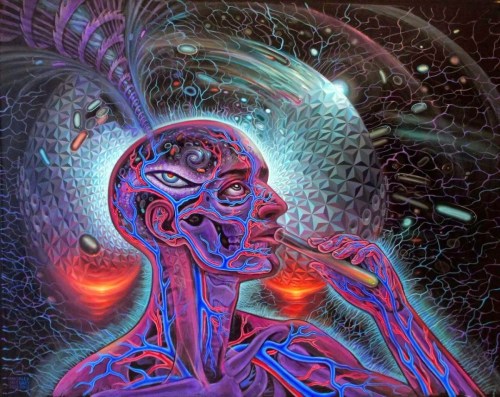
Prison Or Brain Hacking? A Choice That May Shape Our Future

fajb_brain_hacking_01_sep2012

How does a civilized society deal with its least civilized individuals? This is a question that every society has had to answer, going back to the hunter/gatherer era. We live in an imperfect world full of imperfect individuals. Some are more imperfect than others, so much so that it’s not always possible to reform them into functional members of society.

Most people who commit crimes are not monsters, nor are they sadists who get their joy by torturing the innocent. A vast majority are just people who find themselves in bad situations where they make wrong decisions, exercise poor judgment, or lack impulse control. For these people, fines and brief imprisonment are usually sufficient.

For those who become career criminals, neither respecting the law nor seeking to abide by it, the current system is woefully inadequate. It’s part of the reason why criminal justice reform has become a hot topic. We’re finally learning that throwing people into prisons where they’re dehumanized, degraded, and tortured doesn’t help them become productive members of society. Go figure.

There’s plenty of room for improvement. Some countries have demonstrated that there are more effective, more humane ways to treat criminals. However, even those systems have their limits. As long as human beings remain an imperfect species, we’ll still have to deal with these deviant, violent, and inherently dangerous individuals.

For the moment, our options for dealing with these people are few. It primarily involves incarceration or intense therapy, often coupled with drug therapy. While this can be helpful to some, there are severe limitations. Some individuals don’t even want treatment and even those who are caught don’t always respond.

With that in mind, allow me to present a not-quite-hypothetical scenario. What if, instead of prison or therapy, we gave offending criminals an option to undergo an invasive treatment that affects the primary source of their deviant behavior in the brain? Jail is still an option for those who aren’t keen on messing with their brain wiring, but for certain people, an alternative is an alternative.

What I just described is one of those concepts in which the science is there, but the technology and the courts haven’t caught up to it. I know whenever I talk about emerging technology, be it sex robots or artificial wombs, I venture pretty far into speculation territory. Some of these advances rely on science and tools that don’t yet exist. This isn’t one of those cases.

In July 2018, the Journal of Neuroscience published a study revealing that targeted stimulation of the prefrontal cortex reduced aggressive tendencies in test subjects. Before you start getting fever dreams of mad scientists strapping people to gurneys and sticking wires in their ears, you can rest easy. This isn’t the kind of electroshock treatment that find their way into one too many horror movies.

These treatments have ground-breaking implications. They prove that it’s possible to temper or mitigate certain behaviors in people. The study doesn’t specify the limits of the effects or if it can be applied to something other than aggressive behaviors. It’s still a proof of concept and one that could compound the impact of other emerging technologies.

We already have tools like CRISPR that allow us to tweak our genes. We also have companies like Neuralink that are actively working on implants that could fix, augment, or expand our brain capacity. While men like Elon Musk and Ray Kurzweil often discuss these advances within the context of keeping humanity on pace with artificial intelligence, there will likely be some interim uses for these technologies.

Tempering violent behavior in people with significant cognitive impairments is just one possible use, but one that has the potential to change how we think about crime and punishment. Think back to those people I mentioned earlier who just inherently violent. They can’t manage their emotions or control their anger. They don’t think before they act and some don’t even feel guilty about what they do.

Like it or not, these people exist. I’ve known people in my life who have terrible impulse control and fly into a rage over the smallest things. Some of those people have had issues with the law and I often see in them a sense of never-ending frustration. Many don’t like that they have these issues. A few have tried to get help, but it doesn’t always work.

I suspect that if some of those people were given a chance to treat their tendencies with targeted shock therapy or a brain implant, they would jump at the chance. Deviant tendencies aside, they seek some level of function in their lives. If tweaking their brain is the difference between prison and freedom, then they’ll take that risk.

Turning people who might have been unrepentant psychopaths into productive, non-violent members of society is an objective good. The technology to do just that is not that far off and more study could help us refine the process, so much so that prison might be less necessary in certain cases. Given how expensive it is to imprison people, it’s an alternative worth pursuing.

Along with that undeniable good, however, there are plenty of potential dangers. Anyone who has ever seen one too many psychological thrillers or just read “One Flew Over The Cuckoo’s Nest,” can easily imagine how this kind of technology could be abused.

Tempering someone’s violent behaviors is all well and good, but why would it stop there? The brain is capable of all sorts of behaviors, deviant and otherwise. Say a society determines that other non-violent behaviors, be it sexual promiscuity or binge-watching Netflix for too many hours, are not socially desirable. What’s to stop them from imposing this on their citizens?

Some countries probably already fantasize about technologies that enable them to directly pacify their citizens, rendering them weak, passive, and easily manipulated. In his famous novel, “1984,” George Orwell called these people proles. However, in the book, the deviants had to be tortured and re-educated. If Big Brother had access to this technology, it would be a simple medical procedure.

That has plenty of terrifying possibilities for abuse. What if someone uses brain stimulation to prevent people from having homosexual urges? What if someone uses it to treat those who identify as transgender? There’s no evidence that the techniques in the study would work on that, but there’s no evidence to say it’s impossible.

Its use will definitely be controversial. That much, I’m certain of. It’s not advanced enough to become a legitimate treatment for anything. At the moment, direct brain stimulation is utilized for a specified set of conditions and it’s often a last resort. Using it on healthy people who just want to cull their violent urges is uncharted territory.

Whether it enters the picture for criminal justice reform is anyone’s guess, but if the process works, someone who has dealt with one too many repeat offenders will try to use it. From there, the precedent will be set. It’s hard to say what form it’ll take, but it’ll take society into uncharted territory with respect to controlling our minds.

Perhaps, at first, the process would be voluntary and only be presented in conjunction with jail or some other treatment. It’s also possible that the courts will determine a strict set of criteria for when the state could force this treatment onto someone. There are probably a few repressive governments who would try to use this on an industrial scale. I won’t say they’re names, but most people know who they are.

Like any emerging technology, there are risks and rewards worth considering. We stand to benefit greatly by having a society with as few violent individuals as possible. We also stand to lose a great deal if we allow misguided authority figures to determine how we use this technology.

I’m not qualified to determine whether or not someone should have their brain hacked. I don’t know that anyone is. However, I also don’t deny that the human brain, as magnificent as it is, has plenty of flaws. We should go about fixing those flaws, especially in people who are disproportionately impacted by them. We just have to be very careful about how we manage it.

Leave a comment

Filed under futurism, human nature, psychology, sex in society, Sexy Future, Thought Experiment

How Artificial Intelligence Will Destroy Democracy (In A Good Way)

t2uexujfigmglako7fzy

Picture the perfect candidate for an election. I know the bar for politicians these days is laughably low, but try to stretch your imagination a bit. Try to envision the kind of candidate that embodies the best collection of values, abilities, and charisma for a civilized society.

Everybody looks for something different in a candidate, but a truly perfect candidate would appeal to everyone in a democratic system. This person would embody the highest values, championing human rights to the utmost and justice for everyone. Every decision they make is with the safety, sanctity, and rights of other people as their top priority. There’s no compromise. They do right by the people every time and all the time.

This person would also be the ultimate leader, capable of getting anyone to go along with them without fear or coercion. There wouldn’t need to be corruption of any kind. This person would be perfectly capable of navigating every level of government and making it work to the utmost. The people would trust in that government, believe in it, and even celebrate it.

Keep that perfect candidate in the forefront of your mind because when it comes to discussing politics, cynicism tends to rule the day. I don’t think I need to cite too many recent events to show how imperfect democracy is these days. I don’t even need to cite famous historical events that show just how bad government can be in this convoluted world.

It’s because of that cynicism, though, that the perfect candidate you’re thinking of could never win a democratic election in the real world. Even if they existed, the inherent flaws of the electorate and those of less perfect candidates would keep them from winning. It’s one of democracy’s greatest flaws. It’s not about who the best candidate is. It’s just about who can convince enough people that they’re worth voting for.

On the subject of democracy, Winston Churchill once said the following:

“The best argument against democracy is a five-minute conversation with the average voter.”

Time, politics, and the proliferation of has only proven Mr. Churchill right. I would even amend that quote to say just 30 seconds on 4chan will make anyone lose faith in the promise of democracy. That’s not to say democracy is all bad, though. Mr. Churchill also once famously said this about the alternatives:

“Indeed it has been said that democracy is the worst form of Government except for all those other forms that have been tried from time to time.”

It’s distressing, but frustrating fact of civilization, one that fuels mass protests, fake news, and lurid scandals. Go back to any point in history and scrutinize any government, be it a king or some quasi-democracy, and chances are you’ll find serious flaws in the system. I don’t just mean long lines at the post office, either. There have been times when democracy has not furthered the protection of human rights.

It’s not necessarily a flawed principle as it is a concept with flawed ingredients. While I tend to place a great deal of faith in the goodness of human nature, I don’t deny that people can be arrogant, irrational, and downright callous. We’re prone to overreacting and not thinking things through. We’re hard-wired to go with intuition over logic.

Even when we’re proven wrong, we stubbornly cling to our assertions. The prevalence of creationism is proof enough of that. Every election cycle is prone to bold promises, bloated melodrama, and major goals that rarely ever become actual policy. Some become full-fledged revolutions with Utopian visions. The fact that none of those utopias ever manifested is proof of how unsuccessful they were.

We are not a species built for democracy on a large scale. We evolved to function in close-knit tribes, hunting and gathering for food while fighting for survival. That kind of evolution doesn’t really lend itself to a functioning democracy. It doesn’t lend itself to a total autocracy, either. Whether it’s a free republic or a fascist state, humans cannot govern other humans without their flaws plaguing them in both directions.

It’s for this reason that I often lean libertarian in political debates, but given the complexities and challenges of modern society, even that only goes so far. Like it or not, large-scale civilizations populated a species not evolved to manage it requires some measure of authority. More importantly, it requires competent, incorruptible, compassionate authority.

It needs to be able to defend a population of people within a particular border. It needs fair and just laws that can be equally enforced. It also needs the confidence and trust of the people being governed. Sometimes, it’s done out of fear. Sometimes, it’s done out of free will. Both can work, provided the system has robust capabilities that aren’t prone to human error.

Unless a government is populated by a democratic council consisting of Superman, Wonder Woman, and Dr. Doom, that kind of functional democracy is physically impossible. Even though democracy is still the best we have from an exceedingly limited list of options, that may change in a big way thanks to artificial intelligence.

I know it seems like I attribute many superhuman capabilities to this emerging field, it’s hard to overstate its potential. Unlike every other tool humanity has created, artificial intelligence promises to rewrite the rules at every level of society. That includes government and it’s here where AI’s capabilities could go beyond superhuman.

Think back to that perfect candidate I mentioned earlier and all the traits that made them perfect. By and large, an advanced artificial intelligence shares many of those traits and then some. A sufficiently powerful AI would be beyond politics, pettiness, or demagoguery. In principle, it could embody everything people would want in a strong leader and a capable government.

For one, it would be smarter than any human. Beyond knowing more about every subject than any human ever could, it would be smart in a way that would allow it to persuade people to trust it. That’s often a skill that even smart politicians fail to refine. It certainly doesn’t help that many voters attribute intelligence with smugness. That’s a big reason why populist candidates of questionable merit gain so much support.

An advanced artificial intelligence, provided it has an in depth understanding of human psychology and how to persuade people, would be able to gain support from everyone. It wouldn’t be bound by the limits that keep most human candidates from appealing to everyone. With enough intelligence and capabilities, it would surmise a way to appeal to everybody.

Beyond just persuading the voters, an AI of that level could be just as effective at actual governance. There are plenty of candidates who are very adept at winning elections, but terrible when it comes to actually governing. A capable AI would be able to do both. If anything, one function would complement the other.

With enough emotional, logistical, and pragmatic intelligence, this AI would be capable of crafting and passing laws without the need for debate or controversy. The laws it crafts are already so refined and so well thought out that to do so would be redundant. In the same time it takes your phone to send a text, this AI could pass sweeping legislation that protects human rights, ensures justice for all, and promotes economic growth.

It’s hard to imagine because the only laws and government we’ve ever known have come from flawed humans. It’s just as hard to imagine how those laws would be enforced. Perhaps this advanced AI has nodes all throughout society that allow it to gather data, know where enforcement is needed, and determine the appropriate recourse. If it’s capable enough, people won’t even know it’s there.

Perhaps that same AI uses a mix of human enforcers and intelligent robots to maintain order. If the AI is sufficiently capable, every enforcer at every level would be equipped with perfect knowledge and a clear understanding of how to carry out the orders of the government. Since an AI wouldn’t be prone to corruption or prejudice, instances of injustices would be few and far between.

It wouldn’t be a totalitarian state of Orwellian proportions. It would be more of a “Star Trek” style, post-scarcity society where we wouldn’t have to be cynical about government authority. We would inherently trust it because it’s just that effective. We wouldn’t feel like we’re being run by a robot dictator. We would feel like we’re being run by the greatest ruler outside of a “Black Panther” movie.

To some extent, though, an advanced artificial intelligence of this nature would render democracy obsolete. If we created an AI that could effectively govern society at every level, then what’s the purpose of having elections in the first place? Why bother when there’s an intelligence that’s literally more capable than any ordinary human could possibly be?

History has shown that democracy and government can only do so much when flawed humans are in charge. Once advanced artificial intelligence enters the picture, the logistics of governance changes entirely.

Perhaps there will be a period in our history where instead of running human candidates, we start creating AI systems that compete with one another in a pseudo-democratic process. That would go a long way towards improving overall governance.

Unlike humans, though, technology evolves much faster than humans ever will and it wouldn’t take long for those systems to improve to a point where they’re just too good an option to overlook. Human-led governments, even in humans who are enhanced to some degree, will still have flaws. In a future where technology, society, and individuals keep creating new challenges, we’ll need a capable government to manage it all.

In the end, that government probably won’t be a democracy. It won’t be a dictatorship, either. It’ll be something that we can’t yet conceptualize. That’s the biggest challenge when contemplating something like an advanced artificial intelligence, though. It operates on a level that ordinary humans literally cannot comprehend. That’s why it’s our best option for governing our future.

7 Comments

Filed under Artificial Intelligence, Current Events, futurism, political correctness, Thought Experiment

The Appeal And (Major) Implications Of “Westworld”

westworld

When most people think about the future, they imagine all the ways that technology and progress will solve problems and make our lives better. I’ve certainly imagined that. I’ve even written about it, with respect to how future advances will make us smarter, protect us from disease, and even help us love each other better.

As intriguing as those possibilities may be, it’s also worth taking a moment to contemplate the implications. I’m not talking about the potential existential crisis we may face with advancing technology either. I’m referring more to the practical aspects of a future where disease, suffering, and toil are largely mitigated by technology.

Beyond just living in a world with less suffering and less struggle, how exactly would we entertain ourselves? That may seem like a mundane question, given the more serious implications of advances like genetic engineering and advanced robotics, but it’s one of those issues that effects individuals on a personal level.

If we’re always health, physically strong, and have our basic needs met through some universal basic income, then what exactly are we going to do with all that free time? I’ve expressed concern that this may create an epidemic of boredom that’s every bit as serious as any major pandemic. No matter how strong, healthy, or affluent you are, boredom can have some pretty debilitating effects.

Enter the fanciful world of “Westworld” and all its implications, sexy and otherwise. For those of you who don’t get HBO, it’s a TV show inspired from an old movie produced by Michael Crichton, also known as the guy who wrote “Jurassic Park.” It’s no “Game of Thrones,” but it has a fair amount of gratuitous violence, nudity, and sex, albeit with much less incest.

Graphic content aside, it’s the underlying concept behind “Westworld” that makes it such an intriguing show. That same concept also has even greater implications for what the future may hold in terms of immersive entertainment, managing artificial intelligence, and how we treat sex robots. For once, I’m not going to focus entirely on the sex robots, since I give that subject plenty of attention.

The appeal of “Westworld,” as both a concept and a show, is built around a company called Delos Inc., which offers its high-paying customers a chance to immerse themselves in a unique experience. For a while, they get to leave civilization, modernity, and all its associated infrastructure behind and live in rugged, lawless world of the old west.

It’s not some movie where they just get to see images of scenery. It’s not some virtual reality that just makes them feel like they’re there, either. It’s a fully realized artificial world, complete with intelligent androids that have the look, feel, and presence of real people. Sure, some still act as sex robots, but that appeal goes far beyond that.

This is a world where you can live a different life, experience in a different time, and explore a world that no longer exists. You don’t watch it. You don’t listen to it. You don’t follow along through the eyes of a protagonist. You are the protagonist. You actually get to live out a real fantasy where the participants aren’t just role playing. They’re sophisticated androids that really believe they are what they are.

Now, the operation and function of those androids has been a major source of conflict within the show. As the show has progressed, controlling these androids and seeing them develop a sense of self has made for great drama. I would argue it’s one of the most engaging aspects of the show. It creates powerful moments that reflect real existential issues with respect to artificial intelligence, some of which I’ve contemplated.

While those issues are profound, in and of themselves, I find myself more interested in how “Westworld” may reflect the evolution of entertainment itself. Look past the issue with managing intelligent androids for a moment and think about the business Delos Inc. is employing here.

On paper, it’s not just brilliant in terms of potential profitability. It may very well embody the future of entertainment. Take a moment to contemplate how the entertainment industry has evolved over the past 30 years. We’ve gone from analog to digital, standard definition to high definition, and now high definition to 4k.

I’m still old enough to remember the lousy picture quality of TV shows, the pre-IMAX movie theater experience, and theme parks with less-than-polished exhibits. I still vividly remember going to see “Men in Black” in a theater that was crowded, dirty, and cramped. It was fun, but not that immersive.

Over time, the general trend of entertainment, both with movies and with TV shows, has been to make it more interactive. Movies have done that with the rise of 3D movies. TV shows have done that through things like live-tweeting. Video games, especially, have become much more immersive, both through virtual reality and through online interaction.

This trend reflects the understanding from producers and consumers alike that the most powerful form of entertainment is the kind that offers the most immersion. A game on your smartphone is fun and all, but it’s just data on a screen. It’s not going to engage too many senses.

The same goes for virtual reality, which is basically just putting that same screen over your eyes and bombarding you with sound to make you feel like you’re somewhere you’re not. It also doesn’t change the fact that you don’t have to move your body, exert yourself, or engage in the kind of activity that would lead you to believe that the experience is real. Granted, the brain can be fooled, but only to a point.

What “Westworld” does is logical in terms of crafting an experience that makes people feel like it’s truly real. The customers of Delos Inc. aren’t just observing or following along. They’re actually engaging with this fantasy world. It’s not on a screen. It’s not being projected into their brains. It’s real and they get to be part of it.

That world can literally be anything they Delos Inc. wants it to be. With their resources and their army of life-like androids, they can create all kinds of worlds for customers to explore. These worlds don’t have to be confined by the laws of modern civilization, current social norms, or even notions of reality.

Perhaps they can create an apocalyptic world where participants can kill zombies and live the lives of rag-tag survivors, like those of “The Walking Dead.”

Perhaps they can create a medieval world in the mold of “Game of Thrones” where participants can live the lives of brave knights, lecherous kings, or privileged queens.

Perhaps, if the Marvel Cinematic Universe continues to grow, there can be a world where people either get to interact with the Avengers or even get to be the Avengers. As a comic fan, I would definitely pay for that experience. I would be shocked if Disney isn’t working on something like this now, as we speak.

It doesn’t even have to involve an elaborate fantasy world either. Perhaps there’s a world where participants can live the lives of rock stars in 70s and 80s, complete with cocaine, groupies, and massive concerts where they’re the stars.

In theory, there’s no limit to the kinds of worlds a company like Delos Inc. can create. The old wast in “Westworld” is just one of them. The key is making the world perfectly immersive, but still safe to the point where the costumers aren’t ever hurt and face no repercussions for what happens during the experience.

However, it’s in that key safeguard in which the implications of “Westworld” get more distressing. It even plays out a few times in the show. In this immersive world of the old west, participants can carry out acts that would be wrong, immoral, or downright abhorrent in the real world.

The androids in “Westworld” may be more intelligent than the average exhibit at Disney World, but they’re still just robots playing a role. If a participant kills, rapes, or tortures one of them, there’s no repercussion. The android can just be cleaned up, fixed, and reloaded with a new program like it never happened.

It’s that kind of moral void, so to speak, that may make this brand of entertainment questionable. Say there’s someone willing to pay a lot of money to a company like Delos Inc. to create a world where they could go on a killing spree, murdering and raping as much as they want. This person is a law-biding citizen who has never acted on any violent impulses. Would the company be unethical in accommodating that fantasy?

There may be plenty of other distressing requests. Maybe someone wants a world where they can live the life of an 19th century slave-owner because they want to abuse slaves. Maybe someone wants a world where they’re the Nazis and they get to commit any number of unspeakable atrocities.

Remember, what they do in this world isn’t done to real people. They’re just paying for an experience. It’s not like the kind they would get in “Total Recall” where they only get memories of an experience. In a world like that of “Westworld,” they actually interact with that world. They make choices and do things, but no matter what they do, there’s no consequence or repercussion.

It raises many disturbing questions that are impossible to answer now. “Westworld” attempts to answer some of them, but there are plenty more that are simply beyond the scope of the show. It may do a commendable job focusing on what happens when intelligent robots start to get a will of their own, but it doesn’t do much to explore the implications that this form of entertainment inspires.

It’s going to be quite a while before we have the technology that we see in “Westworld,” but even if the human race progresses to a point where people and society are free from most conflict, there will be a need for entertainment. The form that entertainment takes may just reveal more about us than we care to know.

1 Comment

Filed under Artificial Intelligence, futurism, human nature, sex in society, Sexy Future, Thought Experiment, War on Boredom

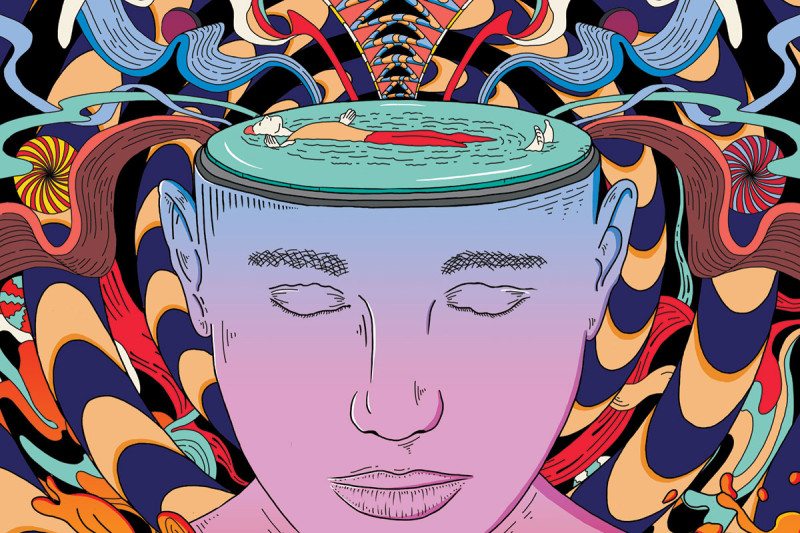
Contemplating The Perfect Drug (And Whether We Could Handle It)

psychedelic-delirium-hallucination

Imagine, for a moment, you took the perfect drug. By that, I don’t mean the kind of drug that alleviates a headache, settles an upset stomach, or just makes it so you can function normally. I’m not talking about the kinds of drugs that gives us Captain America level superpowers either. I’m talking about the kind of drug that alters, enhances, or somehow changes the way you experience the world, physically and mentally.

It is a very subjective thought experiment, especially compared to some of the others I’ve explored. It might even be somewhat inappropriate to contemplate as parts of this world are dealing with a serious prescription drug problem and violence generated by the illegal drug trade. However, with the War on Drugs that Richard Nixon first declared being almost 50 years old, I think a little nuance on the issue is warranted.

In the same way we’ll never have a society of perfect monogamy, despite the best efforts of religion and government, we’ll never have a completely drug-free society. Human beings have been experimenting with drugs since ancient times in some form or another. Some major historical figures are known to have done drugs that would’ve gotten them thrown in jail today.

The choice of drug may vary, but so too does their reason for taking it. Some seek to alleviate pain. Some seek to enhance pleasure. Some are just bored and want to experience something new and profound. Whatever the reasons, the fact that so many different people from so many different eras, cultures, and situations seek drugs is revealing in and of itself.

In some respects, it reflects our inherent dissatisfaction with our current limits. We are, at the end of the day, at the mercy of our bodies, our brains, and the evolutionary mechanisms behind them. We get tired too easily. We can’t run as hard or as fast as we want. We can’t remember things that well or learn new things that efficiently. That doesn’t even begin to the limitations that effect our sex lives.

If anything, our own evolution gives us a powerful imperative to seek out powerful drugs. Our bodies and brains are programmed with two imperatives, survival and reproduction. If we can find a drug that enhances both, then we’re just improving our evolutionary standing in the world.

While I wouldn’t make that argument to a DEA agent, I think it’s worth contemplating the kind of drug that would do more to help us transcend our limitations than what we have now. Modern drugs, legal and illegal alike, do some amazing things. However, as anyone who has dealt with the side-effects of pain killers knows, there’s room for improvement.

Ignoring side-effects for a moment, think of the effects and benefits of the familiar drugs in existence right now. Look at what they do, how they do it, and why people pursue those effects in the first place. Then, imagine which of those effects you would want to include with the perfect drug.

Would it make you really astute and focused like Adderall or Ritalin?

Would it make you really relaxed and mellow like Xanex or Marijuana?

Would it make you really energized like cocaine or amphetamines?

Would it give you better stamina and endurance like anabolic steroids?

Would it give you mind-altering perceptions like LSD and DMT?

Would it make you extremely happy and empathetic like MDMA?

Chances are, you might want a little of everything. What you want might also depend on your situation. If you want a drug that’ll help you lose weight, you’ll probably want the effects of steroids and amphetamines. If you want to sleep better, you’ll want the effects of Xanex or weed. If you just want to be happy, sometimes all you need is a cigarette or a beer.

The perfect drug, by definition, would be able to grant you all or at least part of these experiences. Ideally, you wouldn’t need to a new prescription or a new dealer. The same drug would be capable of evoking those effects. It may require some tweaking of the dosage, mechanisms, or chemical processes, but it’s still capable of delivering.

It may sound like an impossible substance and to some extent, it is. However, it’s still only as impossible as our limitations and there are plenty of ongoing efforts to transcend those limitations through biotechnology, nanotechnology, and human/machine interface. I’ve mentioned a few of those efforts, including smart blood and neural implants. With future refinements, they’ll provide the catalyst for the perfect drug.

It may take the form of a special pill full of programmable biomatter. Maybe you want it to help you sleep. Maybe you want it to help you focus. Maybe you want it to help you make love to your spouse for five hours straight. With the right programming and the right application of biology, it can do that.

For some effects, maybe a pill isn’t enough. To have the kinds of effects that would give someone the kind of physical or mental enhancement they seek, it may be necessary to inject this programmable matter directly into the body via an IV drip. That might be cumbersome, but it allows for more direct delivery than a pill.

Even if it’s more effective, it still might not be ideal. Some of the most addictive drugs, like tobacco and alcohol, have a social element to them. People bond when they do them together and since humans are such a social species, that might be a necessary component of the perfect drug.

Perhaps instead of an injection or a pill, it can be ingested as a drink like tea and coffee. That will allow people to congregate and make it a social event at a bar or club. It can be part of a greater bonding experience, a group of people all sharing in the benefits of the perfect drug. It effectively complements every component of the human condition.

On the issue of side-effects, this is where the perfect drug would have to clash with flawed biology. On paper, a perfect drug would have no adverse side-effects. It wouldn’t have withdrawal symptoms, damage organs, or turn your urine blue, which does happen.

In the real, less-than-perfect world, every drug will have side-effects. Even if biotechnology and neural implants gives people superhuman durability on par with Wolverine from the X-men, it’s likely that such powerful experiences will result in equally powerful impacts, both mental and physical.

One of the most likely effects, which might still be the most damaging, involves what happens to people when they’re not on the perfect drug. Even if the drug causes no withdrawal symptoms and generally leaves the body intact, it still creates a discrepancy in experience.

There’s the state the person was in without the perfect drug. There’s the state the person was in when they took it. If the gap between the two is big enough, as would likely be the case for the perfect drug, then even an enhanced mind within an enhanced body would struggle to some extent.

It would be like going from taking a private jet across the ocean to riding a mule. One is just going to be so much richer and more intense than the other that it doesn’t matter how enhanced you or your brain are. You’re going to want that drug and you’re going to do whatever it takes to get it.

In a future where people can enhance their bodies, augment their brains, and rid themselves of disease, what else will drive them other than the inherent human desire to transcend more limitations? Those experiences and the methods to get them, either by a drug or some other means, might end up being the most valuable currency in the future.

For now, we’re stuck with a diverse array of drugs with a wide variety of effects. They all come with their own unique risks and their own blend of side-effects. With more and more drugs being developed, as well as refinements to existing drugs, people will continue using drugs and seeking them, even if it means clashing with the law.

We’re still a long way from a perfect drug like the one I just described, but it’s an idea with contemplating. It reveals why we seek drugs in the first place and what we’re looking for in using them, despite all the risks and side-effects.

We don’t just seek health, strength, or new experiences. We seek to improve and enhance our own condition. How we go about it and how well we handle it depends on a lot of factors. We might never create a truly perfect drug, but as medical science and human enhancement continue to evolve, we may still achieve its effects.

2 Comments

Filed under human nature, Sexy Future, Thought Experiment

Is Democracy The Best Way To Ensure Basic Rights?

20141029when-democracy-fails-600x0

When it comes to ensuring the happiness, advancement, and general prosperity of humanity, it’s not unreasonable to say that basic human rights are a core ingredient. Most know the basics of these rights as life, liberty, and property. Some even throw in the pursuit of happiness, which denotes all kinds of freedom, including the sexy kinds.

Beyond just sounding great on paper, human rights are a major guiding force. History has shown, time and again, that societies that value these rights tend to prosper more that only exist to glorify a despot. The contrast between the two Koreas is proof enough of that.

However, the preservation and promotion of basic human rights is no easy task. The world is full of corrupt, cruel, and power-hungry people who would scoff at the very concept the same way they would anyone who claims trees have souls. The fact that some of them manage to get elected in countries with democratic institutions says a lot about just how hard it can be to protect human rights.

It’s that vulnerability in one the most cherished modern institutions, which some claim took a major hit in 2016, that leads me to ask a question that I’m sure is going to draw me some level of ire. However, in wake of recent news and a particular Hollywood movie that indirectly touches on this concept, I think it’s worth asking.

Is democracy the best way of preserving basic human rights in a society?

I ask that question as someone who loves and celebrates the freedoms that being an American has given me. I feel lucky and honored to live in a country where I get to participate in the democratic process. I make it a point to vote in every election, be it mid-term or a presidential election.

That said, I’m not among those hyper-patriot, Ron Swanson wannabes who willfully ignores the flaws of the democratic systems around me. Between the limited choices offered by a two-party system, the non-democratic nature of the electoral college, and misguided ballot initiatives, I see these flaws as much as anyone else with an internet connection.

To some extent, I recognize that not all of these flaws are fixable within a democracy. The essence of democracy is people electing their government. Unfortunately, people aren’t always rational and anyone who has read headlines from Florida knows that. People can also be whipped up into a hateful, mob-like frenzy. It’s one of the side-effects of being such a social species. We’ll often go with the crowd before we go with reason.

In a perfect democracy, every voter would be completely independent, completely informed, and only vote to elect the person they believe will best preserve basic human rights. Since there’s no such thing as a perfect democracy any more than there’s such a thing as a perfect autocracy, there are bound to be flaws in the system.

Some of those flaws can be mitigated with things like voter education. Others involve mixing democratic systems with that of a republic. That’s primarily what the founding fathers attempted to establish with the United States, a republic being the fixed body of laws to preserve our rights and using democratic systems to protect those rights.

Other western democracies utilize various methods to address these issues, but so long as people are involved, there will be human flaws in any system. The key is making sure that those flaws don’t end up undermining human rights. The results haven’t been perfect. Ask any number of minority communities for proof of that.

With these flaws in mind, I believe it’s worth thinking beyond democracy to imagine other ways of preserving and promoting human rights. Some of those concepts manifest in movies, comics, and TV shows. The “Black Panther” movie presented an enticing, albeit fanciful, idea of an all-around good king who believes in basic human rights and does what he can to promote it, at least for his own people.

I’ve also cited Dr. Doom in a previous article who, despite being the ultimate villain in the Marvel universe, is pretty much the perfect ruler for any system of government. Sure, people in his government fear his wrath, but that’s the only thing they fear. You could argue that such fear is inconsistent with basic human rights, but in terms of actually securing people, property, and what not, Doom has no equals.

Outside the world of superheroes, though, there are also instances where a great leader who deeply values human rights gets thrust into power. That’s the entire premise of “Designated Survivor,” a show where Kiefer Sutherland does more than just shoot and torture terrorists. The best possible leader for a government isn’t elected. They essentially find themselves in that position.

In a sense, that embodies the disconnect between the fictional world and the real world. The idea that a king with ultimate power in a secretive country or some low-level government appointee would turn out to be a perfect president assumes a lot of things that don’t play out in the real world. It essentially vindicates what Winston Churchill once said about democracy.

“Many forms of Government have been tried, and will be tried in this world of sin and woe. No one pretends that democracy is perfect or all-wise. Indeed it has been said that democracy is the worst form of Government except for all those other forms that have been tried from time to time.”

Those bolded parts are my doing because those are the parts that most people recall. Considering the context in which Churchill said those words, having just fought a massive war against two leaders who had been democratically elected, it’s hard to blame him.

Even today, extremists who do not hold certain human rights in high regard do get elected to positions of power. It’s not a matter of people just throwing the concept away. People are still very tribal, last I checked. They’re going to vote or protest in accord with their own interests, even if it means undermining the interests of others.

That situation leaves basic human rights vulnerable. There are, as I write this, people living in functioning democracies whose basic rights are being undermined. While we have made a great deal of progress over the past century as democracies have spread, there’s still plenty of room for improvement.

Going back to the original question I asked about democracy’s ability to preserve human rights, I don’t think there’s an easy answer. For now, I’m inclined to side with the wisdom of Winston Churchill. Democracy has it’s flaws, but it’s the best we’ve got thus far. We can definitely stand to do better and should work towards doing so.

Some of that may involve getting money out of politics to mitigate corruption. Some involve doing the opposite of what China just did and setting term limits for politicians. Some are taking an even more radical approach by integrating emerging technology into the democratic process.

These are all bold ideas, which are certainly worth pursuing in the future. Until we have a real life T’Challa to be king or a super-intelligent AI capable of running a government with perfect efficiency, democracy is our best bet for preserving human rights. We shouldn’t stop trying to improve, but we should still celebrate it’s merit.

1 Comment

Filed under Current Events, human nature, Thought Experiment

The (Uncomfortable) Questions We’ll Have To Answer With Human Enhancement

In general, I tend to be optimistic about the future. I know that seems crazy, given our current political climate, but I try to look beyond the petty grievance’s and focus on the bigger picture. By so many measures, the world is getting better. The human race is on an unprecedented winning streak and we’re only getting better.

A great deal of this improvement is due, largely, to our ability to make increasingly amazing tools. As I type this, countless people who are far smarter than I’ll ever be are working on advances that will keep us healthier, make us smarter, and help us transcend our physical and mental limits by orders of magnitude.

This is all exciting stuff. We should all look forward to a future where we never get sick, we never age, and we have the physical and sexual prowess of an Olympic athlete on meth. The aspiring erotica/romance writer in me is giddy with excitement over the sexy possibilities.

Like all advancements, though, there will be a cost. Even the greatest advancements mankind has ever made in science, technology, and sex have come at a cost. It’s just the nature of the chaotic world we live in. Nothing is ever smooth and easy when there are so many chaotic forces that we can’t always make sense of.

That’s why for some of these advancements, such as CRISPR, biotechnology, and artificial intelligence, we have to be extra proactive. We’re not just talking about tools that makes it easier to defend ourselves against a hungry lion. These are tools that will fundamentally change what it means to be human.

They’ll take the caveman logic and tribalism that has guided the human race for its entire existence and throw it out the window. They’ll completely rewrite the rules of human nature, crossing lines and redrawing them in ways that even a kinky mind like mine can’t imagine. It won’t just be an overwhelming transition. For some, it’ll be downright traumatic.

Given that there are over seven billion humans on this planet, there will be a lot of moving parts to this transformation. Before we can even think about taking the first steps in that process, we need to ask ourselves some serious, unsexy questions. As much an optimist as I am, I cannot deny the need for caution here.

That’s why I’ll take a step back, keep my pants out, and ask some of these unsexy questions. I understand this won’t exactly get everyone in the mood, but given the rate at which our technology is advancing, we need to be extra proactive. That way, we can get through the hardest parts of the process and get to the sexy parts.


Uncomfortable Question #1: Who (Or What) Gets To Decide How Much We Enhance Ourselves?

This will probably be the most pressing question once the technology becomes refined enough for the commercial market. Most technology goes through a progression. We saw it with the development of cell phones. At first, only business tycoons and drug lords could afford to use them or even have a use for them, to begin with.

That model might have worked for cell phones. It’s not going to work for something like CRISPR or smart blood. That’s because, unlike cell phones, the poorest and the impoverished are the ones most in need of these tools. They’re also the ones that stand to benefit most, in terms of quality of life.

Historically speaking, though, the government has not treated the poor and impoverished very well. Use the same approach with cell phones and the rich and well-connected will be the only ones to benefit. They’ll also further widen the gap, so much so that they might be even less inclined to share.

That’s why the default answer to this question can’t just be the government or rich business interests. I’m not going to pretend to know who the authority will be or how they’ll even go about distributing these advances to people in a fair and just manner. I just know that our current method will not be sufficient.


Uncomfortable Question #2: How Do We Stop Certain Human Enhancements When They Go Wrong?

When your computer freezes, you reboot it. When the sound on your speakers starts making noises, you turn it off. It’s a beautiful, but underrated thing, having an off-switch. I’m sure we’ve all had people in our lives whom we wish had an off-switch. It’s a necessary fail-safe for a chaotic world that we can’t always manage.

Putting an off-switch on dangerous technology, especially something like artificial intelligence, is just common sense. It would’ve made “The Terminator” a lot shorter and a lot less confusing. With other advancements, especially those involving CRISPR and biotechnology, it’s not as easy as just installing an extra switch.

How do you turn off something that literally rewrites our DNA? How do you stop someone who has grown used to having superhuman abilities, by our standards? That’s akin to asking someone to make themselves sick or hack off a limb because the technology has some side-effects. That’s going to be a tough sell.

Again, I am not smart enough to imagine how a fail-safe for that sort of thing would work. It can’t just rely on blind faith, magical thinking, or whatever other tactic that used car salesmen exploit. It has to be in place and up to speed as soon as this technology goes live.


Uncomfortable Question #3: How Independent/Dependent Will Human Enhancement Make Us?

Smartphones, running water, and free internet porn are great. However, they do require infrastructure. People today are at the mercy of whoever pays their cell phone bill, whoever knows the wifi password, and whoever can stop their toilets from overflowing with shit. To some extent, we all depend on certain institutions to keep our lives and our society going.

In a future of enhanced humans, who have been imbued with traits and abilities that way beyond the scope of our current infrastructure, how dependent or independent can they be in the grand scheme of things?

If they rely on a regular injection of nanobots or need to recharge every other day, then they’re going to have to rely on some form of infrastructure. That may help keep enhanced humans from becoming super-powered Biff Tannens, but it will also give a lot of power to whoever or whatever is supplying those resources.

In a sense, it can’t be one or the other. If enhanced humans are too independent, then they have no reason to interact or aid one another. If they’re too dependent on certain resources, then those controlling those resources become too powerful. There needs to be a healthy balance, is what I’m saying. There will be costs, but we have to make sure that the benefits far outweigh those costs.


Uncomfortable Question #4: How Much Of Our Humanity Do We Keep?

Let’s not lie to ourselves. There’s a lot about the human condition we wish we could change or drop altogether. Personally, I would love to never have to go to the dentist, never have to clip my toe nails, and never have to sleep, which is an advancement that’s closer than you think.

Humanity has has a lot of flaws, which is a big part of what drives the development of these tools. However, there are certain parts about humanity that are worth preserving and I’m not just talking about the health benefits of orgasms. Change too much about our bodies, our minds, and everything in between and we cease to become human. At that point, why even care about other humans?

Maintaining a sense of humanity is what will separate enhanced humans from overpriced machines. Our sense of humanity is a big part of what drives us to live, love, explore, and understand. If we lose that, then we’re basically a very smart rock that’s only interested in maintaining its status as a rock.

To really expand our horizons, we need to preserve the best of humanity. Humans do amazing things all the time that reminds us why humanity is worth preserving. When we start enhancing ourselves, we need to save those traits, no matter what we become.


Uncomfortable Question #5: How Will Society Function In A World Of Enhanced Humans?

We’ve built a good chunk of our society around our inherent flaws, as humans. We form tribes to cooperate and survive in ways we can’t do on our own. We seek leaders who are capable of guiding us to functional, stable society. Granted, sometimes those efforts fail miserably, but the goal is the same.

With human enhancement, the rules aren’t just different. They’re obsolete. So much of our society is built around the idea that we’re still a bunch of cavemen with fancier tools that we really don’t have a concept of how we’ll function beyond that context. We have nation states, national identities, and various tribes to which we bind ourselves.

Those are all still products of our inherent drive towards tribalism. That’s still our default setting, as a species. What happens when we start tweaking those settings? Will things like nation states, government, and social circles even exist? When society is made up of a bunch of superhuman beings who can live forever and never need a sick day, how do we even go about functioning?

This is well-beyond my expertise, as an aspiring erotica/romance writer. It may be one of those things we can’t contemplate until after some of these advances take hold. At the very least, we need to put this question at the top of our to-do list when that time comes.


Uncomfortable Question #6: How Will Human Enhancement Affect Our Understanding Of Family And Love?

This is probably the most pressing question for me, as an aspiring erotica/romance writer. I’ve already highlighted some of the flaws in our understanding of love. Once humanity starts enhancing itself, it may either subvert those flaws or render them obsolete. In the process, though, it may create an entirely new class of flaws to deal with.

What happens to a marriage when the people involved live forever and don’t age? That whole “death do us part” suddenly becomes an issue. What happens when having children is essentially uncoupled from romance, through tools like artificial wombs? What will love even feel like once we start enhancing our brains along with our genitals?

Since all love and passion still starts in the brain, which we’re already trying to enhance, any level of human enhancement will necessarily affect love, marriage, and family. Chances are it’ll take on a very different meaning in a world where marriage is less about tax benefits and more about new forms of social dynamics.

Human enhancement will change a lot about our bodies, our minds, and our genitals. It’ll effect so much more, including how we go about love and family. It’s still impossible to grasp since we’re all still stuck with our caveman brains. However, once that changes, this is just one of many issues we should contemplate if we’re to make the future better, sexier, and more passionate.

Leave a comment

Filed under Sexy Future, Thought Experiment

The Future Of Beauty (In A World Where People Don’t Need To Exercise)

When I write one of my sexy novel, I work hard on it. I really put my heart and soul into it. There are other feelings I put into it, but those are only part of a much greater effort that doesn’t always manifest in my pants.

The work we put into something is what gives it meaning to us. Even the laziest slob will concede to that. If my novels just magically conjured themselves while I was asleep, that would be wonderfully convenient. However, I don’t think I would be as passionate about them if I didn’t actually put the work into making them.

I think the same concept applies to exercise and how we go about making ourselves beautiful. Throughout human history, there have been all sorts of elaborate, albeit bizarre rituals surrounding beauty and fitness. When I work out, whether it’s for my health or to look good at the beach, the effort I put into it helps add to the fulfillment I feel when I look in the mirror.

Take that work out of the equation and what does that change? That’s not a rhetorical question. That’s a serious inquiry because if we didn’t have to work so hard to get fit and beautiful, then are we going to approach fitness and beauty the same way? I believe we haven’t asked that question enough, but the answer is already out there.

When I mentioned recent research that promises drugs that allow users to enjoy the fruits of exercise without actually doing anything, I’m sure there were plenty of out-of-shape couch potatoes out there who got excited. I certainly wouldn’t blame them. The idea that we can all look like we spend two hours a day in the gym is pretty enticing.

Thin man flexing muscles in front of mirror reflecting figure of body builder : Stock Photo

However, that means that fit, toned body we all crave now would be much easier to get. You don’t really work for it. You just take a pill, sit back, and let science and biology do the rest. That kind of effort isn’t going to inspire much pride. Hell, that kind of effort is barely on par with brushing your teeth every day.

If that’s all it takes to look fit and slim in the future, then is being fit and slim really going to be considered beautiful? Standards of beauty have changed a lot over the course of history. Beauty is usually meant to confer a sense of health, strength, and vitality. It’s also a way for some people to set themselves apart in an exceptional way.

In a world where being fit is so common, would it really be considered that beautiful in a larger context? If everyone is beautiful, then is anyone truly beautiful? Doesn’t beauty require a certain variation that is difficult for most people to attain?

It’s akin to the inherent contradiction in thinking everyone is special. If you go by the dictionary definition of the word, the entire concept falls apart if you approach it that way. When everyone is unique in the same way, then they cease to be unique.

That raises another question that’s much harder to answer. In a world where everyone is fit and doesn’t need to exercise to incur its benefits, what will be considered beautiful? What will be considered sexy? As an aspiring erotica/romance writer, these kinds of questions are very serious.

Naturally, a world full of fit people with stronger bodies is going to be inherently sexier. Beauty standards aside, there’s a lot to be gained by having a society full of healthy individuals. Obesity has already been linked to sexual dysfunction. Increased exercise has also been linked to a higher sex drive. Regardless of whether or not that exercise comes in pill form, it’s going to affect our collective sex lives.

That means the concept of what is sexually attractive will gain even greater importance. If everyone around you looks like an extra in a softcore porn movie, then how do you decide which one you want to hook up with? Could this create a paradox of choice situation where find ourselves unable to determine who rouses our loins?

It’s impossible to know since we don’t live in that world. However, unlike our beauty-minded ancestors, other aspects of future technology will impact this effort. Tools like CRISPR and smart blood will allow people to modify and enhance their bodies in ways no amount of exercise ever could.

However, those advances are still a way off. Before we advance to that point, people may have to improvise. It may require that people develop more unique fetishes, of sorts, which I’ve speculated on before. If you think the stuff in “50 Shades Of Grey” or furry conventions are kinky, then you might have to hold your jaw up in the future.

Beyond the fetishes, the fashion industry will likely become an ongoing LSD trip in its effort to accommodate the inherent need to stand out in a world where everyone is fit. That’s because just being healthy won’t be enough. Like being a nice guy or not being a sleazy Hollywood mogul, that just won’t be enough to attract prospective lovers.

There’s only so much an aspiring erotica/romance writer can imagine. Even my kinky mind has its limits. Major technological advances, from antibiotics to contraception, have already had enormous impacts on our sex lives and how we go about forging romantic bonds. More advances are on the horizon. Some will hit harder than others.

That means there’s also a chance that there will be major drawbacks in a world where the benefits of exercise comes in pill form. Even if people are healthier and hornier, there may be large segments of society not equipped to handle that. It was a burning question in my book, “Skin Deep,” that did not get a complete answer. We probably won’t be able to answer that question until the technology arrives.

Whatever the case, for better or for worse, I will do my part to adapt my sexy stories accordingly. A world full of fit, healthy people is sure to change a great deal with respect to how we think of beauty, how we go about finding lovers, and how we make love.

However, our collective libido is nothing if not adaptive. It’s a big reason why the human race is the dominant species on this planet. That, in and of itself, is a thing of beauty whose form will continue to evolve in sexier ways than we can possibly imagine.

1 Comment

Filed under Sexy Future, Thought Experiment

A Drug That Eliminates The Need For Sleep (Is Almost Here)

Whenever I talk about the possibilities of human enhancement, sexy and otherwise, I do so with the hope that the benefits outweigh the costs. I understand that all progress comes at a cost. I also understand that it’s impossible to know the full extent of those costs until the genie is out of the bottle and the bottle is destroyed.

Never-the-less, I still think the risks we take with future technology are worth taking. In fact, I would argue we have to take them because our caveman tendencies towards tribalism and our inherent vulnerability to bullshit is a clear indication that our current situation is not working well enough. We, as a species, need to improve if we’re going to function on this confined planet.

Certain enhancements will do a lot more than others. I’ve mentioned emerging tools like smart blood, brain implants, and CRISPR. It’s impossible to overstate the kind of impact those advances will have on the human condition. They will be akin to giving a light sabre to a chimp.

Other enhancements, however, will have a more subtle effect. They’re also likely to happen sooner, despite Elon Musk’s best efforts. That brings me back to sleep and the annoying need to spend a third of our lives doing it. I’ve already asked people to consider how their life would change if they didn’t have to sleep as much. Well, I have a confession to make. That was kind of a loaded question.

That’s because that, as we speak, there are efforts underway to reduce or eliminate our need to sleep. This is not some far-off fantasy out of a “Star Trek” re-run. This is actually happening, courtesy of DARPA, also known as the Defense Department’s officially-sanctioned mad science division.

However, there’s nothing mad about their motivations. DARPA is in the business of developing obscenely-advanced technology to ensure that the United States Military remains the most technologically advanced military on the planet by an obscene margin. Part of that effort involves developing technology that creates soldiers that don’t have to sleep.

In the grand scheme of things, that’s one of the least weird projects they’ve pursued. This is a department that is researching flying submarines for crying out loud. As awesome/crazy as those concepts are, this potential breakthrough in sleep technology could have implications that go far beyond having soldiers that don’t require a nap.

According to Wired, DARPA’s years of mad science has culminated in the development of a spray that users would apply, just like ordinary nasal spray. The spray contains a naturally-occurring brain hormone called Orexin A, which helps keep the brain in a state of alertness without the aid of heavy stimulates or copious amounts of coffee.

It’s somewhat crude in that it’s basically dumping chemicals into the brain and hoping for the best. That approach is not that different from those of other psychoactive drugs, which are fraught with all kinds of danger. Unlike other emerging technologies, though, this one is already happening. From here, it’s just a matter of refinement.

At the moment, the technology is basic and unrefined, but that’s how all technology starts. Just look at the models of old cell phones. That refinement will occur, though. There’s too much potential profit in it. Between truckers, grade-grubbing college students, and marathon gaming, there are a lot of people out there who would gladly pay to not have to sleep.

Depending on how much it costs, I would certainly jump at the chance to not feel so damn tired on a Monday morning. It would also give me more time and energy to write more sexy novels or explore more sexy issues on this blog. When sleep becomes optional and you have a lot of stuff you want to do, this sort of technology suddenly becomes invaluable.

I doubt I’m the only one whose life would invariably change, due to this technology, and I’m not just talking about hardcore night owls. Think about all the people who work demanding, energy-sapping jobs. These jobs don’t just put a huge premium on sleep. They can be downright damaging. Take away the need to sleep and suddenly, these people can have a life again.

That, in many ways, is the biggest implication of this technology. Suddenly, that third of our lives that we spend sleeping suddenly becomes open to us. Human society may vary wildly across time, space, and sexual practices, but they’re all bound by the same limits. People still need to sleep and rest. What happens to those societies when that changes?

It’s impossible to know, but we may find out soon enough. As we’ve seen before with other popular drugs, once a market is established, people build entirely new lifestyles around it. We saw it already with boner pills. This one may end up being even more groundbreaking and it doesn’t require an awkward conversation with your doctor.

While this is sure to enrich drug companies to no end, it’s also the first step in a much larger process of removing the burden of sleep. Other emerging technologies that I’ve mentioned, such as smart blood and brain implants, will take it a step further.

Theoretically, they could both rewire or augment our biology so that we never need sleep in the first place. There would be no need to take a drug. There would be no need to worry about ever being tired. It may even make it so that other people who have to sleep are pitied the same way we pity those who don’t have high-speed internet.

These kinds of advancements will already enhance so much of the human condition, from cognitive function to mental acuity to sexual prowess. Removing sleep from that equation gives those same enhanced humans even more time to flex their enhancements. It’s hard to know what people will do with that kind of time on their hands, but I imagine some of it will inspire a few sexy novels.

A society full of people who never need to sleep is completely unprecedented. Hell, a society where sleep is entirely optional is unprecedented as well. It wasn’t that long ago that society was at the mercy of the night. Even if you weren’t tired back then, you couldn’t do much when it was pitch black outside. Then, electric lighting came along and freed people to do more with their time.

When technology gives people an opportunity to work around the limits of nature, they generally take it. The consequences or implications are rarely clear, but given how little we think things through, I can’t imagine we’ll hesitate to make this technology part of our culture.

Time will tell. Money will be made. Entirely new lifestyles will emerge. It’s amazing to imagine what we’ll do with ourselves when sleep is no longer an issue. I hope it helps me write more sexy novels. I also hope it helps others live a richer life. Whenever it happens, I look forward to the day when beds are just used for sex and showing off fancy linens.

1 Comment

Filed under Sexy Future, Thought Experiment

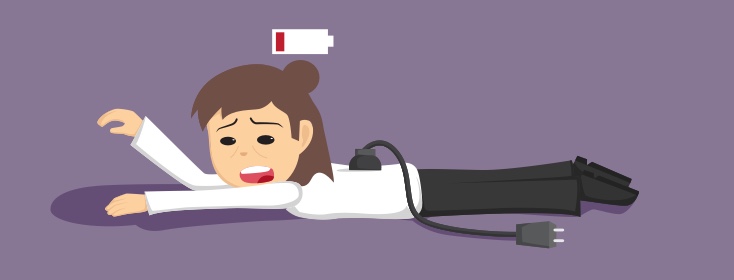
What If We Didn’t Have To Sleep?

Last week, I went to bed early in hopes of getting some extra sleep. The next couple of days were going to be long and busy. I wanted to be as rested as possible in anticipation. Any over-worked college student who ever tried to do this in anticipation of an exam probably knows where I’m going with this.

My hopes were quickly dashed because I ended up lying in bed for several hours, tossing and turning, trying to will myself to sleep. I was tired and usually I’m pretty good at falling asleep when I need to, but not on this night. For whatever reason, I just couldn’t get the rest I wanted.

It was frustrating, but easily resolved the next day with more coffee. However, in recalling that frustration, I found myself thinking back to all the other nights where I just lay there in bed, trying to sleep and failing miserably. It led me to one inescapable conclusion. That’s a lot of wasted time that I could’ve used to do something else.

With that time, I could’ve written dozens of more sexy novels. For all I know, one of them might have been a masterpiece and a best seller. Sure, it’s more likely that most of them would either be average or crap, but the fact is I still would’ve written them.

With that time, I also could’ve read more books written more content for this blog, or worked out more. How much healthier or more well-read would I be? Sure, a lot of those books might have been comics, but I’ve shown before that comics can provide some pretty uncanny insights.

With that time, I could’ve just done more of the mundane stuff that gives me joy. I could’ve played more video games, danced to terrible pop music, or binged-watched more of the shows that my friends and family keep recommending.

My point is that I’ve wasted a lot of time in bed, failing to fall asleep. I doubt I’m alone either. How many others out there struggle to fall asleep at night? Seeing as how the market for sleeping pills is around $58 billion, I imagine it’s more than a few.

I’m not saying sleep is a waste of time. There’s a biological need associated with sleep. Like food, not getting enough of it will actually kill you in the long run. That puts sleep just above sex in terms of the needs hierarchy, albeit not by much. While the need for sleep is somewhat of a mystery, we know we have to do it. We just don’t realize how much of it consumes our lives.

As it stands, we spend about a third of our lives sleeping. That means every day we’re alive, we’re stuck only living part of it. That’s a lot of time that we end up losing. That leads me to a simple, but colorful thought experiment. What if we could get that time back? What if we, as a whole, didn’t have to sleep or only needed a little to be refreshed?

This isn’t one of my overly sexy or overly disturbing thought experiments. This is basically akin to wondering what it would be like to have superpowers, something most people do on a daily basis when they’re stuck in traffic. Not sleeping may not be as impressive as flying like Superman, but it would incur an undeniable impact on our lives and our society.

Some of it might be good. Some of it might be bad. Some of it might be downright mundane. For certain people, not sleeping just means more time sitting on the couch watching “Star Trek” re-runs. Whatever the case, it has many possibilities for better, for worse, and everything in between.

As much as I enjoy sleeping naked, I would prefer to have more time and energy to do more things. I might even end up doing those things naked anyways so it wouldn’t be too much of a loss. Sure, that might cause some legal issues, but I’m willing to make that trade-off.

There are a lot of things I’d like to do, try, or explore. The problem is often a confluence of time, energy, and focus. I don’t always have enough of all three and sometimes one overcompensates for the other. The need to sleep is the only factor that ties into all them.

I get that there are some who genuinely enjoy sleep. I admit it’s a great feeling, waking up on a Saturday morning, feeling rested and refreshed. However, is it really worth all that time we miss? Who’s to say that what we do with that extra time won’t be just as rewarding? Like I said, there are trade-offs.

I’m not sure what I would do if I didn’t have to sleep so much, but I like to think I’d be able to do more and be better. What about you, the wonderful readers of this humble, yet sexy website? What would you do if you had an extra eight hours of life every day? Would you be more productive? Would you be happier? Would you succumb faster to the looming plague of boredom?

It’s a non-disturbing, non-sexual thought experiment that I encourage everyone to try it and share your thoughts in the comments. We’re all the mercy of our need to sleep to some extent. It’s interesting to imagine what our lives would be like or what kind of person we’d become if we had more time to work with.

1 Comment

Filed under Jack Fisher's Insights, Thought Experiment

Does (Too Much) Knowledge Drive You Crazy? “Rick And Morty” Says Yes!

Greetings, and wubba lubba dub dub! If you remember that wacky string of words from a previous article, then you know, in part, what this will be about. That’s right. I’m going to talk about “Rick and Morty” again.

I promise it involves a serious issue and one I’ve touched on before. I know that’s hard to do when “Rick and Morty” contains characters named Mr. Poopybutthole, but I’m willing to rise to that challenge because I think this show illustrates that issue better than most, while still being hilariously subversive.

In some ways, the issue stems from problems I already highlighted with the crippling effects of boredom. It’s an issue Rick Sanchez deals with many times in the show and it’s just one of the reasons why I pegged him as someone who might relate to an emerging generation that will have to deal with more boredom than any generation before it.

However, this may even go beyond boredom in the sense that it strains our sanity more directly. In a world that’s already full of traffic jams, internet trolls, and reality TV shows featuring spoiled toddlers, that’s already pushing it. It all boils down to one simple question.

“Does too much knowledge drive us crazy?”

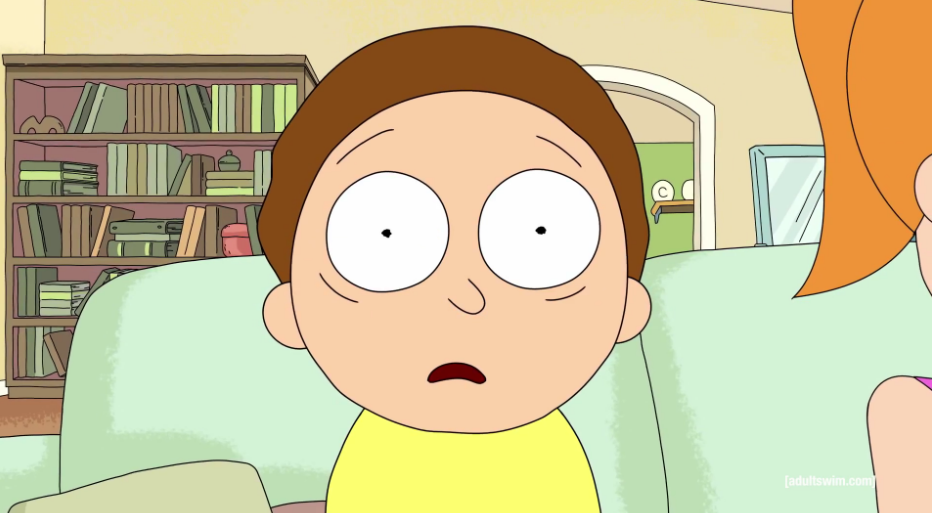
It’s a question that “Rick and Morty” tries to address in the least subtle way possible. In an episode called “Morty’s Mind Blowers,” which inspired this article, Morty briefly gains ultimate knowledge by gazing into the eyes of an alien turtle. I swear on Pamela Anderson’s tits that’s not made up. That really happened.

Naturally, this drives Morty nuts, which is saying something because it’s hardly the first time he’s been horribly traumatized. This is a different kind of trauma, though. Having all that knowledge, plenty of which strains his teenage brain more than it can handle, leaves him completely unhinged. He carries himself as someone who will need heavy medication and a padded cell.

Rick, being the lovable asshole he is, just shrugs this off and offers a simple solution. He’ll simply remove Morty’s memory of the experience from his brain. In fact, he reveals that he does this quite often, so much so that there’s a whole room full of Morty’s memories that he’s removed during their mind-bending adventures. Again, not a word of that is made up.

It’s an extension, of sorts, on a concept I’ve discussed earlier in dealing with trauma. I think most would see, to some extent, the merit of removing traumatic memories from someone’s brain. It spares them undue suffering and helps them function. On the basis of limiting someone’s pain, I think it could be argued that it’s a moral thing to do.

If, however, we use that same moral concept of reducing suffering, then what does that mean when excessive knowledge strains the human psyche to untenable extremes? If such knowledge inevitably leads to suffering, then it might take more than just removing memories to fix it.

It’s a distressing, but documented phenomenon and not just in shows like “Rick and Morty” either. There is a body of research that shows a correlation between mental illness and individuals with genius IQs. While correlation and causation are very different concepts, so much so that they’re easily confused, it’s hard to ignore the pattern here.

Those with obscenely high IQs know more you, me, or 99 percent of the average population. They see the world in a way that’s so different that it’s hard to relate to them on a fundamental level. It goes beyond the comical social awkwardness we see in shows like “The Big Bang Theory.” It can be downright debilitating for some people.

It speaks to the inherent limits of our caveman brains. As I’ve said many times before, our brains are not wired to process ultimate knowledge. They’re wired with two purposes in mind, namely survival and reproduction. While I enjoy writing stories about the latter, it’s hard to get around the former.

Knowing a lot means thinking a lot. Thinking a lot means realizing things that most people never even contemplate, either because they’re too busy trying to get laid or too stupid to wrap their head around it. In that sense, idiots may have an advantage when it comes to sanity, but what happens when it gets harder to be a happy idiot in this world?

As I write this, our society is being influenced by something called the Flynn Effect. In essence, it’s like Moore’s Law in that it documents a general rise in our collective IQ as civilization advances. That has huge implications and not just for the viral video industry that lives off the theatrics of idiots.

idiot moron 19 I can count to potato (22 photos)

I’ve noted that it’s getting a lot easier and cheaper these days to educate people without sending them to the hormonal torture camp that is high school. This generation, as well as the next one, is the most educated generations of all time. Is it possible that as people get smarter, they’ll be more prone to mental illness?

It’s a difficult question to answer, especially when you throw brain augmentation like those being developed by Neuralink into the mix. It may very well be the case that Morty wouldn’t have needed his memories removed if he just had some sort of brain implant that allowed him to process all the knowledge he had. That may be what keeps everybody sane in the distant future.

It’s impossible to know for sure, but the conclusion of “Morty’s Mind Blowers” isn’t very hopeful. Near the end, Morty tries to absorb all the other memories he’s had purged from his brain over the years. Once he has them all back, he decides there’s only one solution. He tries to kill himself. Yes, it gets that dark.

Naturally, he doesn’t succeed and not because someone talked him down. He doesn’t succeed because his sister, Summer, shows up and we find out that Rick actually had a plan for something like this, as he often does with everything.

To solve the issue, and effectively render all the conflict in the episode pointless, Summer purges Rick and Morty’s memory of the events of the entire episode. She then restores them to what they were at the beginning and makes it seem as though they fell asleep watching TV. There’s no real resolution, no greater insight, and no real lesson learned. This isn’t a 50s sitcom. This is “Rick and Morty.”

That resolution, as crass as it might be, might be the most we can do at this point. Our caveman brains are still painfully limited, even as our ability to craft and share knowledge grows. At what point do we reach a tipping point where so much knowledge starts to drive us crazy?

We don’t know for sure and the development of brain augmentation is sure to complicate things, but shows like “Rick and Morty” highlight just how hilariously unequipped we are to deal with this stuff at the moment. For now, we might be best taking Rick’s own advice and simply not thinking about it.

In that sense, maybe reading some of my sexy stories will help. It’s just a suggestion.

cropped-passionrelapse_9781786511645_bookmark.jpg

1 Comment

Filed under Jack Fisher's Insights, Rick and Morty, Thought Experiment