Category Archives: media issues

Five Things I Want From The “Daria” Reboot

96d03d53-c9a4-43ef-a0a2-f99b14256637

Last year, I wrote an article about how the classic 90s MTV show, “Daria,” is more relevant today than it was back when it debuted in 1997. That special brand of misanthropic monotone conveyed a harsh, uncompromising honesty of the world in a way that felt both genuine and endearing.

Well, it appears I’m not the only one who felt that way because according to The Hollywood Reporter, the newly-minted MTV Studios is looking to reboot the show as part of a push to reinvigorate the MTV brand that seemed to fade along with the appeal of boy bands. While I’m skeptical that MTV can ever become relevant again, I couldn’t be more thrilled at the prospect of Daria returning to TV.

I think I speak for many who watched that show back in the late 90s when I say that this world needs her. Specifically, it needs her critical insights into a world awash in fake news, alternative facts, and political correctness. There’s an entire generation emerging whose reality is shaped by their news feed on social media. It feels as though no one is even capable of seeking the truth anymore.

Daria doesn’t just tell the truth like she sees it. She says it in a way that is apolitical, unbiased, and relatable. She doesn’t criticize. She doesn’t have an agenda, either. She sees something she thinks is a farce and she points it out. At a time when every character needs to be an icon for something or someone, that’s nothing short of refreshing. For a character from the late 90s, that says a lot about our current state of affairs.

There’s a lot more I could say about “Daria,” both as a character and as a TV show. For now, I want to create a wish list, of sorts, for what I’d like to see in a “Daria” reboot. I know that’s a bit premature since MTV Studios is in the very early stages of making this happen, but I think the prospect of more “Daria” at this particular point in our history is exciting.

I know excitement is the last trait anyone would associate with Daria Morgendorffer, but I’m willing channel my inner Quinn to entertain the possibilities. What follows are five things I want from a new “Daria” show. I know any rebooted show is subject to reinvention, sometimes for the worse, but I believe if the new “Daria” delivers on these critical elements, it’ll be a success. It might even get Daria herself to crack a smile.


Wish #1: Build Daria’s Agenda Around Exposing Other Agendas

Let’s face it. Today, everyone seems to have an agenda and social media has given people a platform to pursue that agenda, even when they’re dangerous, damaging, and downright hurtful. In the late 90s, media outlets like MTV got a lot of flak for pushing bloated consumerism around bubblegum pop music and reality shows. Today, social media has created countless outlets for countless agendas of varying absurdity.

Daria Morgendorffer can set herself apart in this chaotic landscape by building her agenda around exposing other agendas. She could see right-wing talking points as just excuses to pay fewer taxes and be a dick to poor people. She could see left-wing talking points as utopian fantasies mixed with a pathological need to be outraged over something. With Daria, no agenda is safe.

In any show that would have her take part in the current climate, it needs to give her opportunities to see all this social masquerading for what it really is. As I’ve noted before, people have a frustrating tendency to believe they’re the hero of their own story. In Daria’s world, there are no heroes. There are no villains. There are just people.

That’s a harsh reality, but one Daria refuses to ignore. Her reminding people of that reality in any show would be both refreshing and cathartic, especially to anyone who is sick of people building their agendas around professional trolling.


Wish #2: Continue Daria’s (Unique) Growth From The Show

Throughout five memorable seasons and two made-for-TV movies, Daria’s character remained remarkably consistent. However, she did undergo her share of growth during that time. It was subtle, much more so than that of characters like Jane, Quinn, Helen, and Tom. However, that’s exactly what made it meaningful.

At the beginning of the show, Daria is already her anti-social, misanthropic self. She’s a teenager and a high school student, though. Teenagers go through changes. Even Daria isn’t immune to that. She developed her first crush, had her first serious boyfriend, and even improved her relationship with Quinn, a character who might have been the least likable person on the show.

The show ended with Daria graduating high school and going to college, culminating in one of the most memorable graduation speeches ever made. However, college is rarely the endpoint for anyone who survived high school, even someone as jaded as Daria. Any new show that expands her story should also follow that evolution.

Whether it takes place in college or shortly after, Daria always expressed a desire to get out of Lawndale and do something with her life that she wouldn’t hate. That’s a process a lot of people go through, but few could endure it with the same attitude or crass as Daria. That’s exactly why that story is worth telling.


Wish #3: Keep Her Apolitical And Unbiased

No matter how much she grew over the course of the show or what she encountered, Daria Morgendorffer may very well be the only character in the show, or in real life, who can call themselves truly unbiased. She doesn’t have a political affiliation. She doesn’t identify with one group or the other. She’s just Daria. Her opinions and leanings are her own.

That’s an important facet to preserve in any new “Daria” show. That may prove challenging, though. If you go by current stereotypes, Daria’s age and education levels put her in line with the kind of left-leaning archetypes that Fox News whines about every half-second. However, in terms of her overall worldview, Daria would be just as cynical about the MSNBC crowd.

The core of Daria’s politics is that all politics are stupid. Politics is just one big exercise in people gathering around others who think like they do so that they can rely on someone else to do the thinking for them. That is not Daria’s style. She believes in thinking for herself. Anything beyond that is a waste of time.

Moreover, her worldview is as simple as it is plain. The real world doesn’t care about your beliefs, your principles, or how hard you fight for them. The real world is harsh and whining about it doesn’t change anything. That would put her at odds with liberals, conservatives, and everyone in between. The idea of her getting into debates with some of the politically-minded trolls in the world would certainly be worth watching.


Wish #4: Give Her Supporting Cast A Chance To Support Her

Like any great character, animated or otherwise, a big part of what made “Daria” such a great show was its diverse cast of colorful characters. From her annoying younger sister to her uptight mother to her charismatic classmates, Daria was surrounded by a lot of memorable individuals who helped highlight just what a unique persona she was.

Daria’s closest relationships were with her friend, Jane Lane, and her family that could never understand her. To maximize the strength of her persona, those relationships should definitely be part of a new show. There can also be room for new relationships that put her in entirely new situations.

That may already be in the works. Within the announcement surrounding the possible reboot of the show, there’s a mention of giving Jodie Landon a significant role in the show. That has a lot of potential because Jodie was a great character who didn’t get a chance to develop until the last two seasons of the show. A new show could give both her and Daria new opportunities in a world full of new controversies.

Within the existing cast, there’s also potential for Daria to forge connections with characters other than Jane. There’s also potential to form new romantic entanglements. She does have the capacity for affection, despite what her demeanor may imply. In an age where romantic entanglements are fraught with complications, that could bring out the best in her and the worst in everyone else.


Wish #5: Put Her In The Middle Of Controversial Issues (And Let Her Work Her Magic)

The original “Daria” was a great show in that it didn’t take sides in a controversy or preach to the audience. In fact, those kinds of public service announcements would’ve been antithetical to Daria’s persona. She doesn’t think that it’s the job of other people, be they animated or otherwise, to tell you how to feel about an issue. That’s something you’re supposed to figure out for yourself.

At the same time, however, I felt as though “Daria” avoided too many major issues that could’ve helped make the show even more relevant. While it lightly touched on issues of teen sex and out-of-control consumerism, it didn’t get too deep into the kinds of topics that inspire hashtags and hate mail.

I think that worked well for “Daria” in the late 90s. I don’t think it’ll work as well in today’s hyper-political climate where a new outrage is just a click away. A new “Daria” show won’t succeed if it avoids hot-button issues like the anti-harassment movement, gender inequality, and an emerging generation that may end up being the most nihilistic of all time.

I’m not saying the show has to be built around those kinds of serious topics every other episode. Shows like “South Park” already do that. The biggest appeal to this show would be Daria offering her misanthropic take on those issues to help expose them for what they are.

I believe that there’s definitely a market for that kind of nuance in our current political climate. I also think there’s a growing need for a voice who can sift through the endless shit storms that get kicked up every day for one reason or another. Whether it’s something the President tweets or some dumb comment a celebrity makes, we all need a harsh, but sincere voice to speak the honest truth.


Daria can be that voice. I would still argue we need that voice now more than we did in the late 90s and early 2000s. I hope that this show, assuming it gets made, provides that voice. “Daria” was ahead of its time, as a how and as a character. It’s time we finally catch up with one another.

Daria” was a great show in that it didn’t take sides in a controversy or preach to the audience. In fact, those kinds of public service announcements would’ve been antithetical to Daria’s persona. She doesn’t think that it’s the job of other people, be they animated or otherwise, to tell you how to feel about an issue. That’s something you’re supposed to figure out for yourself.

At the same time, however, I felt as though

1 Comment

Filed under Current Events, gender issues, media issues, political correctness

Why Social Media Is NOT The New Tobacco

social-media-addict-needles-e1515160737606

It’s a full-blown crisis. Kids are spending hours upon hours using it. They’re becoming mindless, unmotivated zombies. Every day, it’s getting worse. It’s all around them. There’s no escaping it and if something drastic isn’t done, it’ll corrupt an entire generation beyond repair.

No, that’s not some hysterical rant from Jessica Lovejoy on “The Simpsons.” It’s not referring to smartphones or social media, either. That urgent message was referring to television. This isn’t another one of my thought experiments. This is one of my memories. It’s true. Televisions was a real concern when I was a kid. Some called it a full blown health hazard.

If that sounds strange, then chances are you aren’t old enough to remember a time before the internet was the ultimate addiction. It really existed. It makes me and many others in my cohort feel old, but it happened. When I was a kid still in grade school, especially between first and sixth grade, the internet wasn’t the thing destroying kids. It was television.

That memory I mentioned wasn’t unique. It came courtesy of an assembly my school held. I don’t entirely remember the purpose of the assembly. I was just a kid and it was an excuse to get out of class. What I do remember, though, was the common refrain about the dangers of television.

Adults of all kinds would find creative ways to tell us to stop watching television and do something “productive,” which I took to mean more homework, more chores, and anything else my teachers made me do. It didn’t really appeal to me and I don’t think it changed the TV habits of my peers, either.

That panic, while nowhere nearly as extreme as the Satanic Panic of the 80s, came and went like many moral crusades tend to do. Some are just forgotten, but others just evolve into a whole new panic. That seems to be happening with the internet and social media now. Watching TV is actually in decline among younger cohorts while their usage of the internet and social media is increasing.

I imagine those same teachers who bemoaned the impact of TV when I was a kid would be giving similar lectures on social media now. They would have competition too because parents today worry about their kids’ internet usage more than their drug usage. Some go so far as to call it the new tobacco to belabor its damaging and addictive nature.

While that kind of comparison strikes all the right emotional chords with concerned parents, I think it’s an unfit comparison to say the least. At most, I would call it absurd. The memories of all those warnings about the dangers of TV leave me inherently skeptical of anything that’s allegedly poisoning children. Unless it’s actual poison, I think the tobacco comparisons are premature.

Now, there’s no question that the internet and social media are having an impact on young people, old people, and everyone in between. There are documented cases where people have exhibited addictive behaviors surrounding their internet usage. Before you make any nicotine comparisons, though, keep in mind that people can be addicted to all sorts of weird things. The human mind is just that strange, powerful, and flawed.

Tobacco, and the nicotine it delivers, is an outside chemical that enters the brain and has real, measurable effects. Using the internet, whether you’re checking FaceBook or browsing Instagram, is not like that. That’s why internet addiction is not in the Diagnostic and Statistical Manual of Mental Disorders that legitimate doctors use to diagnose addiction, but substance abuse is.

It’s also why porn addiction is not considered a true addiction, which I’ve talked about before. However, porn is more specific in its purpose and its effects. There’s also still a stigma, albeit a damaging one, surrounding it that sets it apart from the rest of the internet. A kid browsing the internet, for the most part, is no less damaging than watching cartoons on TV all day.

That doesn’t stop a growing number of people from expressing sincere concern about the effects it’s having on their minds and their health. Some may even prefer that their kids watch old Hanna Barbara cartoons rather than tweet, text, and live-stream all day. There’s a growing sentiment that the internet, social media in particular, hacks our brain’s rewards system.

On paper, it makes sense. You pick up your smart phone, you turn it on not knowing what to expect, and if you find something you like, you get a quick release of pleasure chemicals like dopamine and endorphins. It’s basically a form of gambling. A slot machine works the same way, but you don’t need to be a high roller to enjoy the gambling-like thrill.

Like so many other ideas on paper that go onto fail, though, it’s nowhere near that simple. The human brain can’t be that crude with its chemistry. As a good rule of thumb, if you ever hear someone other than a legitimate neurologist talks about the effects of dopamine on pleasure or addiction, chances are they have a very limited understanding of it at best.

While dopamine does play a role in how we experience pleasure, that’s just one part of a wide range of functions it has within our brains. Trying to understand addiction through dopamine alone is like trying to bake a cake with only a teaspoon of flour. There are many more chemicals, processes, and interactions at play.

Using social media may offer its users a rush whenever they get exciting news on their feed or see something that intrigues and/or offends them, but our brain processes that in a way fairly similar to anything else that catches our attention. The primary difference with the internet and social media is that it happens solely through a digital screen and that does somewhat limit those reactions.

I know that undercuts the concerns of parents who think the internet permanently damaging the collective psyche of their children, but I think they’re overestimating the influence of things that are experienced solely through a screen. Much like TV, the internet and social media can only effect so many senses and that is a major mitigating factor in its impact.

To understand that, go find a picture or video of an exotic location. If you’re a heavy user of Instagram, chances are that won’t be too hard. Look at those pictures. Watch that video. Take in the sights and sounds of that location. To your brain, it’s an appealing bit of visual and auditory sensations. However, those are the only two senses it stimulates.

What about the smell of the air, the feeling of the wind, and the sense of place that being in those locations evokes in our brains? Even if you experience it through hyper-realistic virtual reality, it’s still just sights and sounds at most. Thinking that alone is enough to damage a kid’s brain is like thinking someone can win a sword fight with a sewing needle.

That’s not to say the internet and social media can’t have a powerful psychological impact on certain people. That’s the key, though. It impacts certain people the same way TV impacts certain people. Sure, there are documented cases where social media played a role in a major tragedy, but those are the exceptions and not the norms.

In the same way not everyone gets addicted to a drug after they try it, not everyone is going to be irreparably damaged by the internet, social media, or TV. There’s a reason why extreme cases of people being heavily influenced by these things makes the news in the first place. It’s exceedingly rare.

I would still make the case that the internet and social media are more influential on people, society, and our culture than TV ever was. By being so hyper-connected to such a wide audience, the professional trolls of the world have a way to effect others in a way that just wasn’t possible, even with TV.

As bad as some of those trolls are and as tragic as it is when some suffer because of them, blaming the internet for those ills is like blaming umbrellas for hurricanes. Lumping it in with cancer-causing drugs only further obscures the real issues associated with the ever-evolving internet.

There are, indeed, serious issues with how people use the internet and how it manifests. However, treating it like a dangerous drug did nothing to address the issues surrounding TV. It’ll do just as little in addressing the various controversies of the internet. Until the next “new tobacco” comes along, those same people who lectured me on too much TV will bemoan the dangers of the internet while ignoring all the good it does.

Leave a comment

Filed under Current Events, human nature, media issues, psychology

How Negative Expectations May Ruin “X-men: Dark Phoenix” (For The Wrong Reasons)

SophieJean1

There’s an important, but understated difference between negative expectations and a self-fulfilling prophecy. Expectations are like reflexes. They’re somewhat involuntary, reflecting our assumptions and understanding of a situation. A self-fulfilling prophecy involves actual effort. Whether intentional or not, it guides our perceptions in a particular direction, one often associated with a particular bias.

To some extent, a self-fulfilling prophecy is akin to self-hypnosis. We convince ourselves so thoroughly of a particular outcome that to consider otherwise would be downright shocking, if not distressing. That’s why it’s so difficult, at times, to escape a particular expectation, especially if it’s negative.

I bring up expectations and self-fulfilling prophecies because they do plenty to shape our reactions and attitudes, especially in the media we consume. For better or for worse, often varying from person to person, we tend to determine how much we enjoy something before we even experience it.

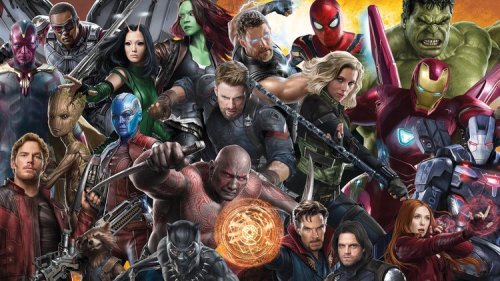
Sometimes, it works to the benefit of a particular movie, video game, or TV show. The powerful brand of the Marvel Cinematic Universe is built heavily on the expectations that a long list of quality, well-received movies have established. Conversely, the DCEU struggles with negative expectations, thanks largely to a catalog of movies that have failed to consistently deliver.

Then, there’s “X-men: Dark Phoenix.” It’s a movie for which I’ve made my passion and my excitement very clear over the past year. It’s also a movie that is in the midst of an emerging crisis. It’s not the kind that involves negative press, actors melting down on set, or sordid sex scandals, for once. Instead, it’s an issue that involves negative expectations that may very well become a self-fulfilling prophecy.

As big an X-men fan as I am, I don’t deny that the X-men franchise is not on the same level it was in the early 2000s when it dominated the box office alongside Spider-Man. Even though I loved “X-men: Apocalypse,” I can’t deny it under-performed and underwhelmed.

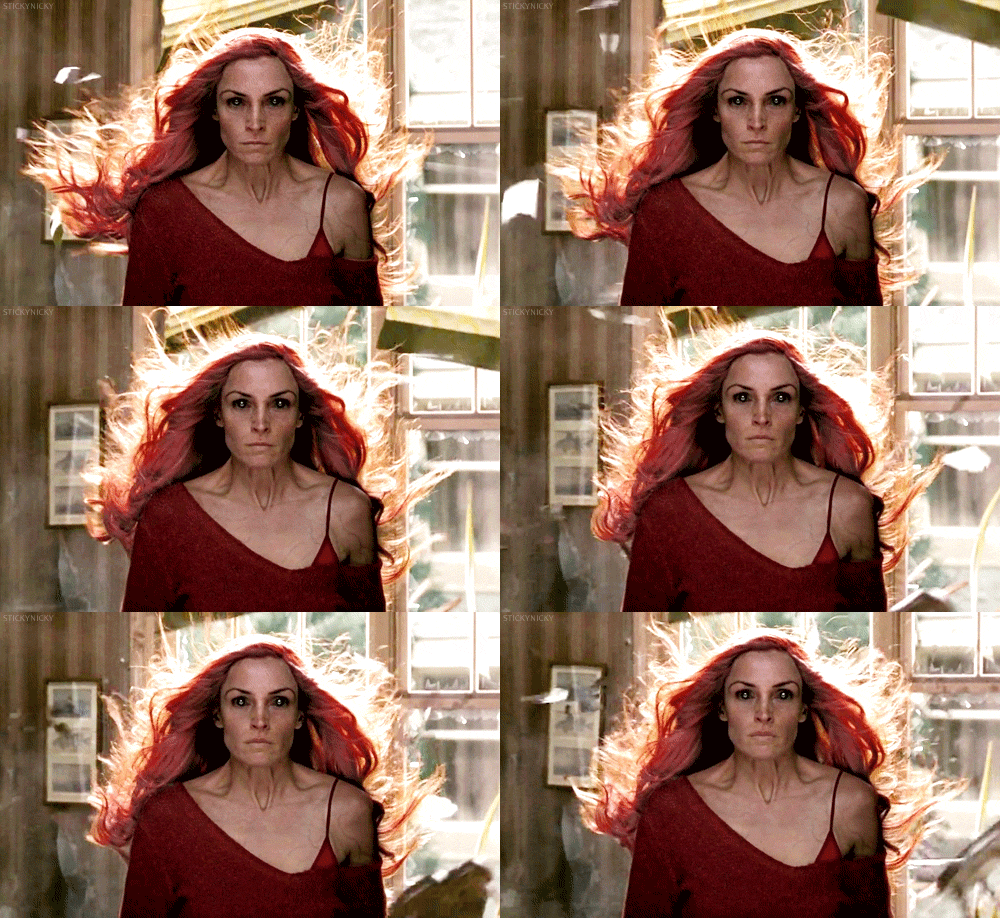
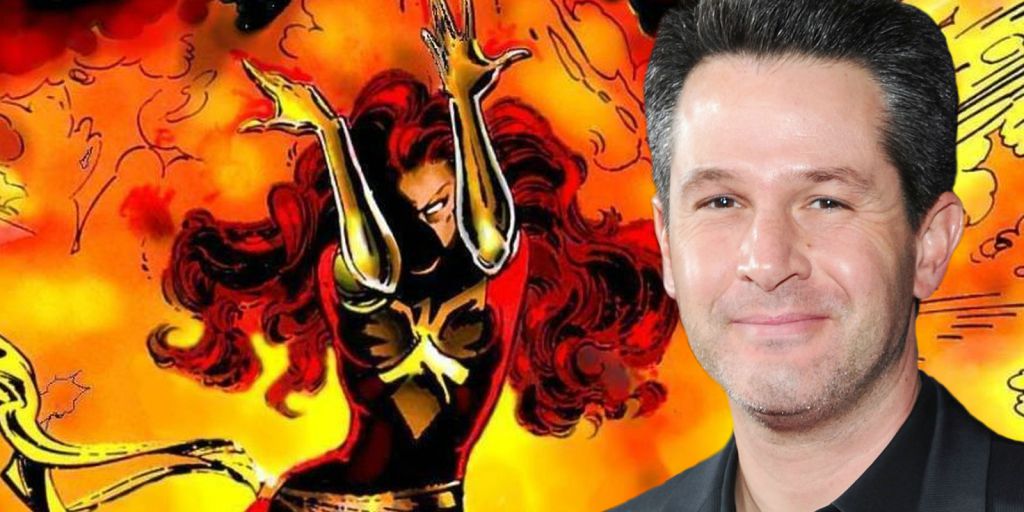
Despite that, “X-men: Dark Phoenix” has more going for it. It’s attempting to tell the Dark Phoenix Saga, the most iconic X-men story ever told. Moreover, it’s attempting to tell that story after it botched it horribly in “X-men: The Last Stand.” Even the director, Simon Kinberg, has gone on record as saying that he wants to “X-men: Dark Phoenix” to succeed where the last one failed.

Given how rare that kind of humility is in Hollywood these days, X-men fans and fans of superhero movies in general have every reason to expect better things from this movie. Given how low the bar is after “X-men: The Last Stand,” I’m more optimistic than I dare to be when it comes to comic book movies.

Unfortunately, that sense of optimism seems to beg getting less and less prevalent. Whether due to the underwhelming performance of “X-men: Apocalypse” or a growing impatience to see the X-men join the MCU after the Disney/Fox merger is complete, there’s a general sentiment that this movie is going to be bad.

I see it on popular YouTube channels. I see in the many comic book message boards I frequent. The overall consensus is that this is a Marvel movie that isn’t part of the MCU. Therefore, it’s going to be terrible. That is, by every measure, a terrible excuse to dismiss a movie, especially when we haven’t even seen a trailer.

To make matters worse, a recent string of leaks from an alleged test screening revealed details that have only fueled those negative expectations. For reasons that I’ll make clear in a moment, I won’t list the details of those links. I will, however, offer a direct quote that aptly sums up the prevailing attitude for this movie.

“I do believe some things won’t change. What can’t change is the movie being really underwhelming. Really lower your expectations because this one is not good.”

This news, if accurate, is not encouraging to anyone hoping to see a well-done Dark Phoenix Saga on the big screen. To make matters worse, those who already had negative expectations about this movie have even more excuses to resent it.

As I’ve noted before, people tend to cling to excuses that justify their preconceived notions. It doesn’t even matter if the excuse is true. Once they have it, they cling to it. It’s usually not done out of malice. It’s just a lot easier to keep thinking what you’ve already thought rather than adjust your expectations.

In this case those, the story surrounding the leaks has already confirmed to be untrue. That leak came from a Reddit post, of all things, which is akin to getting your news from 4chan. On top of that, and this is a testament to Reddit’s users, the mods have stated outright that the user was not credible. This is an exact quote.

Apparently test screen guy is Atlanta Filming, created an account and sent fake spoilers/leaks. Trying to discredit other bloggers because he wants to be “the only legit source”.

If that weren’t telling enough, it was already announced back in March that the movie was going to undergo reshoots in August. Now thanks to “Justice League,” reshoots have gotten a bad name, but they’re a fairly common practice. Even the heavily-hyped, positively-perceived “Avengers 4” is scheduled for reshoots.

Even if those leaks were accurate, chances are the cut of the movie shown at test screenings isn’t the final cut. Kinberg himself has said that the reshoots are intended to shore up the final product, as one would expect of any piece of art. It sounds so reasonable and logical.

That still doesn’t matter, though. It doesn’t change the expectations. This movie still isn’t meeting the impossible set of criteria that fans spoiled by the MCU have so unreasonably set. It’s not in the MCU, nor is it being guided by Kevin Feige. Therefore, it must be terrible.

It’s unfair, unreasonable, and just plain asinine to judge “X-men: Dark Phoenix” by those standards, especially with reshoots to come and no official trailer. At this point, the negative expectations are so heavy that they’re starting to sound more and more like a self-fulfilling prophecy.

With that being the case, I feel like I can predict the reactions from people once the trailer drops. Sure, there will be some like me who are eager to give this movie a chance after what happened with “X-men: The Last Stand,” but I think there will be more comments like this.

“It’s not the MCU. I’ll pass.”

“X-men Apocalypse sucked! I’m not even giving this one a chance.”

“To hell with this movie! Just let Marvel have the rights back already! Fox can’t do anything right!”

Now, far be it from me to defend Fox, the same company that gave us “Wolverine: Origins,” but these are all intensely petty reasons to judge a movie. I say that as someone who is guilty of setting low expectations for movies, cartoons, comics, and TV shows. Hindsight has done plenty to reveal which of those were the result of self-fulfilling prophecies. That still doesn’t make the expectations any less absurd.

Even for those who aren’t just ardently opposed to any superhero movie that isn’t a product of the MCU, I think I can predict the criticisms they’ll probably levy against this movie even after it comes out. Chances are, they’ll be every bit as petty and include comments like this.

“It’s too dark and not cosmic enough!”

“It’s too cosmic and not grounded enough!’

“It’s too much like the comics!”

“It’s not enough like the comics!”

“It doesn’t have enough [Insert Favorite Character Here]!”

“It has too much [Insert Intensely Hated Character Here]!”

There will probably be plenty more excuses for hating this movie, far more than I can list. It doesn’t even matter how subjective they are or how empty they may be. People who are determined to hate something will find an excuse that satisfies their psyche and vindicates their feelings. Anything else would require that someone actually re-evaluate their expectations and that’s just untenable.

It’s frustrating and tragic that a movie or any piece of media would be subject to this kind of debasement before it’s even completed. It’s one thing for a movie to face skepticism because of production troubles, “Solo: A Star Wars Story” being the most recent example. For a movie whose primary crime is not being in the MCU, that’s just plain absurd.

In terms of the bigger picture, it’s good for superhero movies, as a whole, if “X-men: Dark Phoenix” succeeds. It’s unhealthy for the genre if the MCU is the only acceptable avenue for quality superhero movies. We’ve seen with “Wonder Woman” that it is possible for a superhero movie to succeed in a world that doesn’t have Robert Downy Jr. or Chris Pratt.

X-men: Dark Phoenix” deserves the same chance. That’s why I intend to keep my expectations high, but cautious for this movie. Even if it turns out to be good, though, I worry that it’ll be undercut by too many people who are too eager to hate it. It would be both a tragedy for the movie and all those involved, as well as a bad omen for the genre as a whole.

5 Comments

Filed under Comic Books, Jack Fisher, Superheroes, media issues, movies, X-men

Free Speech And The Long-Term Fallout Of The “Rosanne” Cancellation

rosanne

When it comes to free speech and freedom of expression, I consider myself somewhat of an extremist. If I were in charge of setting the standards, I would permit un-bleeped profanity, unfiltered hate speech, unblurred nudity, and anything else that One Million Moms finds offensive. That’s how much I believe in free speech.

It’s probably for that reason that I would be woefully unqualified to establish a legal framework for what constitutes free speech and how it would be enforced. I’m not a lawyer, a legal expert, or some colorful TV personality who pretends to be one. Despite my qualifications, though, I do feel like I have something worth contributing to an ongoing debate surrounding free speech.

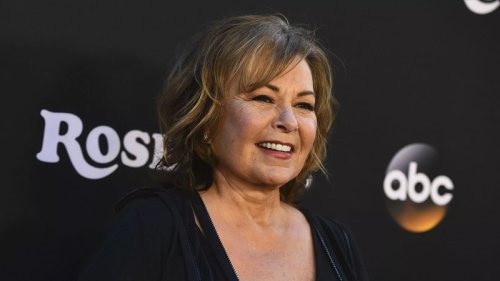
If you’ve been anywhere near the internet or a TV over the past few weeks, you’ve probably heard about the scandal surrounding Roseanne Barr. Simply put, Rosanne Barr made some offensive tweets that she blamed on sleeping pills. The tweets triggered a major outrage across social media. As a result, ABC canceled her hit show, which had been generating strong ratings since its return.

On some levels, I can understand this reaction. ABC is owned by Disney, a company that has one of the strongest brands in the world. They are not the government. They are a publicly traded company and as such, public perceptions affect their profits and their image. If you think that doesn’t matter, just ask the NFL what happens when a brand gets undermined.

On every other level, though, I see this reaction as one of those short-term solutions that could create many other problems in the long run. Whether you agree with Roseanne Barr’s politics or hate her guts, she was still just voicing her opinion. Yes, it was in bad taste and had some racial overtones, but she did apologize for it. The sincerity of that apology is hard to gauge, but the effort still counts for something in my opinion.

Even without that apology, the potential precedent and backlash are already in place. We, as a society, have established a process for punishing speech that we don’t like or find offensive. The process has nothing to do with an authoritarian government cracking down on its people. It doesn’t even involve the kind of mass censorship that other countries routinely practice. We’re doing this all on our own.

Essentially, we’re doing Big Brother’s job for him. We’re just not calling it censorship or a crackdown. Instead, we’re creating our own category of speech that a significant number of people believe ought not to be expressed or shared. There are no lawyers or police enforcing those standards. We’re doing that through a type of speech-based vigilante justice.

Me being a die-hard fan of superhero comics, many of which are built around vigilante justice, I’m somewhat sympathetic to those who want to right the wrongs that our imperfect justice system leaves unfinished. In this case, however, I don’t see the kind of justice that Batman would pursue, nor do I see the kind of villainy that the Joker would carry out.

I see an emerging system where a huge population of well-connected, well-informed, and generally well-meaning people want to confront people and ideas that they feel our damaging to others, themselves, and society as a whole. I don’t doubt their sincerity or their idealism. However, I seriously doubt they understand the implications of what they’re doing.

I don’t agree with Roseanne Barr’s comments. I didn’t find them funny, but I didn’t find them that offensive either. I see far more offensive comments on message boards and Reddit at least twice a day. That sentiment is out there. It exists. Even if the internet disappeared tomorrow, people would still have these thoughts and opinions.

That’s exactly why the outrage, protests, and subsequent consequences don’t necessarily achieve much beyond removing a few offensive comments from an immense network that’s full of so much worse. It does nothing to actually change the sentiments of those expressing the speech. If anything, it just makes them regret getting punished.

It’s akin to the inherent conflict we feel in accepting a criminal’s apology. We can’t know for sure whether they’re genuinely sorry for doing what they did or whether they’re just sorry they got caught. One is very different from the other. Without reading Roseanne Barr’s mind directly, we don’t know if her show getting cancelled has changed her political persuasions or just made them worse.

Moreover, her losing her show, her job, and her credibility reveals to a hyper-connected world that this is how you combat speech you find offensive. You don’t try to change someone’s mind. You don’t grow thicker skin and deal with it. You just get enough people to voice enough outrage and eventually, you can both remove the speech and punish the person who spoke it.

For those who didn’t like Roseanne’s comments or were genuinely offended by them, I doubt that seems like a bad thing. They are, after all, simply voicing their own free speech and using that to effect change from a non-government, publicly-traded company. They probably see themselves as the heroes in this story.

What happens, though, when the script is flipped? It’s not unlike the distressing thought experiment I pitched a while back that involved swapping the genders of famous movie or TV scenes. Reverse the roles and suddenly, the situation takes on a very different context.

You don’t even need any imagination to contemplate this because it already happened with Colin Kaepernick. Like Roseanne, he expressed himself in a very public way that triggered a very public backlash. He ended up losing his job and any prospects of getting another.

The same people celebrating Roseanne Barr’s cancellation likely protested how Kaepernick was treated. Some of them even protested on his behalf in a very public way to apply pressure not unlike the kind ABC faced. While the two situations are not exactly the same, the general premise is clear.

If someone expresses a political opinion that you don’t agree with, you and those like you can protest as well to silence that opinion and publish the one who expressed it. Conservatives can do it to liberal figures. Liberals can do it to conservative figures. The end result is the same. The speech is silenced and the speaker is punished, but the underlying attitudes remain untouched.

It’s those untouched attitudes that may end up having the biggest long-term impact of both the Roseanne Barr situation and that of Colin Kaepernick. Being public figures, these two made themselves targets with their controversial expressions. However, the way others confronted it is potentially damaging to the very concept of free speech.

Thanks to the internet, social media, and outrage culture, both situations make clear to those of any political persuasion that you don’t have to confront the actual substance of someone else’s speech. You don’t have to thicken your skin, evolve your thinking, or learn how to process offense. You can just protest the speech and punish the speaker, all without getting the government involved.

That’s the kind of approach that does not foster a free, open exchange of ideas. If anything, it ensures that people internalize their feelings and sentiments that others may find offensive. In doing so, that makes it even harder to confront them and potentially change their minds. Roseanne losing her show isn’t going to convince her that her critics are right. If anything, it’s going to make her hate her critics even more.

The end result of this kind of self-censorship is downright dystopian. Imagine a world where everything online, on TV, and in movies is so filtered, so watered down, and so overly polished that nobody even has an opportunity to voice anything offensive. The government doesn’t enforce it. We do.

In that world, hate and bigotry still exists. It’s just hidden and we have no way of knowing about it. History and human nature makes clear that internalizing these feelings can be very damaging. Now, we’ve just given Roseanne Barr and everyone who shares her views to be angrier and more hateful. We’ve also given them a tool with which to fight back against those they disagree with.

It’s a dangerous situation with damaging implications for the future of free speech. We could argue whether or not ABC was right to cancel Roseanne’s show or whether a company like Disney has the right to fire people who damage their brand. At the end of the day, though, the source of the outrage and conflict still comes from us. If offense is all it takes to censor speech, then speech is no longer free.

4 Comments

Filed under Current Events, gender issues, human nature, media issues, political correctness

Profiles In Noble Masculinity: Hank Hill

nol3t

When it comes to paragons of masculinity, the standards tend to skew towards characters who crank the testosterone levels up to the maximum and even go a little bit beyond. From mythical figures like Hercules to modern icons like James Bond, it often seems as though that a truly masculine man has to exceed some lofty standards.

While there’s certainly a place for that kind of masculinity, I don’t think that has to be the only criteria. I believe there’s room for a more subtle, yet equally strong manifestation of manliness. They don’t have to be the kind of men who sweat raw testosterone and shave with shards of broken glass. They can be their own man and still embody respectable masculinity.

I chose Joel from “The Last Of Us” for my first profile in noble masculinity primarily because his example was not very subtle. He embodied the masculine values of strength, survival, fatherhood, and compassion in ways that are easy to highlight within a larger narrative. It didn’t take much work to make my case for Joel’s noble traits.

For my next profile, though, I’ve chosen a character who presents a tougher challenge. He comes from a narrative that’s very different from Joel’s. Instead of a post-apocalyptic world where everything comes back to survival, his is a more contemporary story from the far less dire setting of suburban Texas.

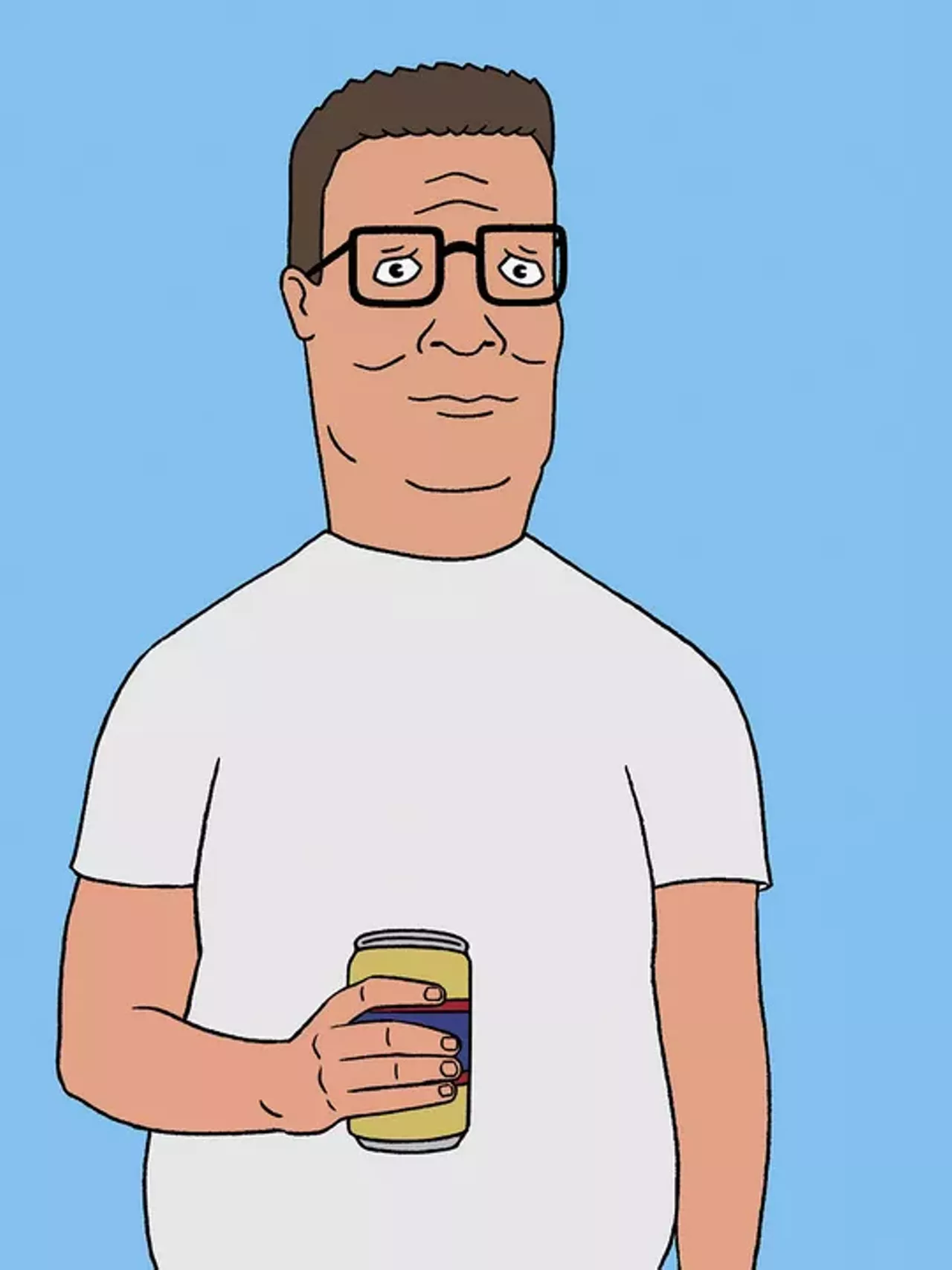
His name is Hank Hill. He sells propane and propane accessories. He’s a proud American, a hard worker, a die-hard football fan, and the star of “King of the Hill.” In the pantheon of modern-era animation, it’s a show that doesn’t usually rank near the top for most people, but the fact it lasted 13 years proves it did something right and Hank his is one of those things.

I consider him another example of noble masculinity. He’s one that differs considerably from Joel in “The Last Of Us,” but I consider him an example none-the-less. Over the course of 258 episodes and 13 seasons, Hank establishes himself as one of those rare characters who manages to be compelling and respectable without being too flawed.

He’s not a bumbling dad, nor is he self-absorbed narcissist always looking to get ahead. Hank Hill, at is core, is blue collar family man who loves his job, loves his wife, and tries to make the most of his situation. He’s not a whiner. When he sees a problem, he tries to fix it. When he makes a mistake, he owns up to it, even if he stumbles along the way.

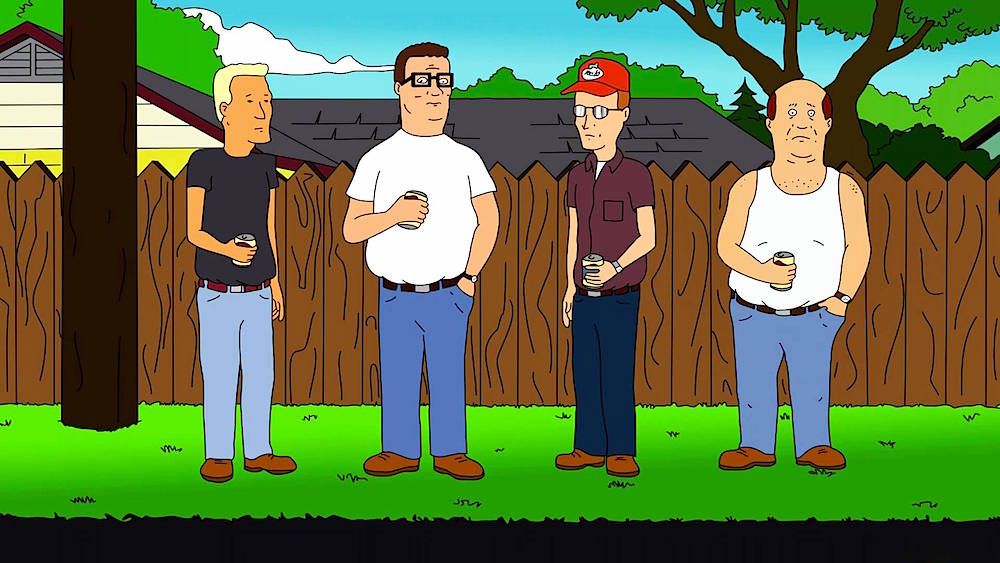
He tries to do all of this while surrounded by characters who have a wide range of issues, flaws, and eccentricities. One of his neighbors is a self-loathing loser obsessed with his wife. Another is a chain-smoking paranoid idiot who doesn’t know his wife cheats on him. The other is Boomhaur. Actually, Boomhaur is awesome.

Beyond his idiot friends, Hank also deals with a know-it-all wife with an inflated ego, a lazy son who goes out of his way to under-achieve, a bimbo niece who attracts all the wrong people, and an eccentric, misogynistic father who hates his guts. The fact that Hank manages to maintain such a calm, collected demeanor most of the time is a testament to his strength.

That strength, however, isn’t exactly obvious if you just look at his persona on paper. In fact, if you just skim the basics, Hank doesn’t come off as a very interesting character, let alone one who fits the criteria for noble masculinity. He’s conservative, he’s frugal, he doesn’t exude charisma, and he’s a staunch defender of law, order, and the status quo.

Hank isn’t the kind of man who willingly goes on adventures, acts on an impulse, or seeks to radically change the world around him. He actually likes his world, for the most part, and actively defends it from those who try to upset it. This has led to more than a few conflicts throughout the show, but Hank’s ability to resolve those conflicts reveals that there’s much more to his character.

It’s in those efforts where Hank’s nobility, as both a man and a character, really shows. While he is a staunch traditionalist who goes to church, votes Republican, and is extremely uncomfortable with sex, he’s also remarkably tolerant of those who don’t share his views.

Throughout the show, he encounters people who are overtly promiscuous, exceedingly liberal, and don’t care much for football. At no point, though, does he try to change those people or convince them that they’re flawed. Sure, he’ll threaten to kick an ass every now and then, but he usually reserves that recourse for those who most deserve it.

When he’s not kicking asses that deserve to be kicked, Hank is also demonstrates an ability to reserve judgment and not make anything too personal. Throughout the show, he’s encountered crazy right-wing religious types, flamboyant homosexuals, and unapologetic womanizers. By nearly every measure, he deals with them in a way that’s respectable and fair for the most part.

For the most part, indeed.

Hank doesn’t condone or condemn their behavior. He’s more concerned with the consequences they have on others. In his view as a freedom-loving American, what people choose to do is their business, provided they understand and accept responsibility for the consequences.

Throughout the course of the show, he’ll point out or remind others of those consequences. He’ll even help some confront it. However, he doesn’t make it personal. He doesn’t whine about it. He doesn’t try to get everyone to embrace his way of doing things. Hank basically lets other people be free and live their lives.

It’s not the same as slaying giant monsters or rescuing princesses from towers, but it’s noble in its own right. In the context of masculinity, Hank Hill’s ability to remain strong, stern, and confident in the face of so much chaos from so many characters, each with plenty of quirks and eccentricities, is a testament to the kind of man he is.

He’s a man who takes pride in his work, leads by example, and tries to be the voice of reason in a world full of unreasonable people. He’s willing to be brave and bold when he has to be. He’s also willing to take responsibility when others won’t or refuse to. As a man, he’s someone who earns the respect of others and does plenty to maintain it.

That’s not to say that Hank is without his flaws. Sometimes, he is traditional to the point of being petty. In one episode, the entire plot was driven by his dismay at another family sitting in his non-assigned seat at church. He can also be controlling, especially with how he raises his son, Bobby.

On more than one occasion, he’s been an obstacle for Bobby’s endeavors. His famous refrain, “That boy ain’t right,” is often said in the context of him wanting to guide Bobby down a certain path. Most of the time, though, he does so in a way that’s appropriate for a caring father. Other times, though, he gives the impression that he wants Bobby to be just like him.

Even with these flaws, Hank Hill still commands and earns respect. As a man, a father, and an American, he checks most of the boxes in terms of noble masculinity. He’s strong, responsible, hard-working, and accepting of other peoples’ strengths and flaws. He’s a man worthy of admiration and the fact he knows propane is a nice bonus.

4 Comments

Filed under gender issues, media issues, noble masculinity, political correctness

My Frustrations And Fondness With Bumbling Dad Tropes

ventilador-griffin-750x500-750x500

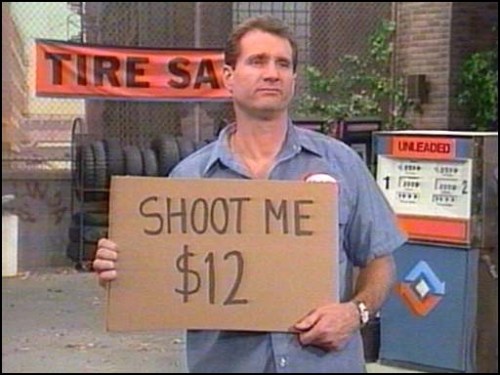
We know them, love them, laugh at them, and cringe at them every now and then. They entertain us. They educate us. They amuse us in any number of ways, both with real-life antics and those only possible through animation. They are the clumsy, bumbling, oafish father figures of popular culture. Compared to many other tropes, they make up a sizable chunk of the overall comedy footprint in our media landscape.

Don’t get the wrong idea. I don’t write that with disdain or dismay. In fact, I’m quite fond of the bumbling father figures that make up a sizable chunk of sitcoms, animated shows, and movies. I grew up on a steady diet of “The Simpson,” “Family Guy,” and “Married With Children.” Characters like Homer Simpson, Peter Griffin, and Al Bundy have had a profound impact on my world and not just in terms of laughter.

As I get older, though, I find myself scrutinizing the dynamics of these faltering father figures more and more. I also find myself paying more attention to the context and circumstances surrounding them, especially as our media and culture evolves in accord with changing trends, some less positive than others.

Maybe it’s because I’m an adult now. Maybe it’s because, as both an adult and a man, I have too much experience with the larger complexities of the world. I can still laugh every time Homer does something foolish or Peter does something stupid. However, a part of me can’t help but contemplate the larger implications of bumbling dads.

Some of it has to do with double standards, which I’ve talked about many times before. Some of it deals with the struggles/inexperience in developing complex fatherly characters who aren’t blatant rip-offs of Superman, John McClane, Jack Baur, or Ward Cleaver. Most of it simply reflects a sentiment that I find frustrating at times.

Think, for a moment, about the dumbest, most hilariously idiotic antics in a show featuring bumbling dads. “The Simpson,” alone, should give plenty of content to draw from. With those antics in mind, contemplate what those antics say about the bumbling dad as a character and what it says about male characters, as a whole.

Whether he’s Homer Simpson, Peter Griffin, or a guy you know in real life who once threw up in a kiddie pool after doing shots of habenero sauce on a dare, the themes are fairly consistent. At the heart of every conflict in the story is a selfish, moronic, thick-headed guy who, if he didn’t have his wife and kids, would’ve been dead by now.

The bumbling dad isn’t just the catalyst for most of the conflicts in the show. He basically embodies the inherent ineptitude of men, as a whole. Whereas strong, independent women are celebrated as a trope of their own, the bumbling dad acts as a case study as to why men can’t function on their own. Unless they have a woman and a family to restrain them, they’ll collapse under the weight of their own stupidity.

It doesn’t just reflect poorly on male characters. It sends a pretty frustrating message to female characters as well, saying that women basically have to act as referees on top of being spouses and mothers. Their role, in the context of the bumbling dad trope, is to either clean up the mess or reign the man in before he does some serious damage.

In a sense, the bumbling dad is the catalyst for the nagging woman, a character not nearly as hilarious that can be every bit as frustrating. One causes all the chaos and problems in a story. The other whines about it and tries to limit the damage, often while failing to teach the bumbling dad any meaningful lessons that’ll help him be less bumbling.

Granted, there are some exceptions to that dynamic. Compared to Marge Simpson and Lois Griffin, Peggy Bundy from “Married With Childrencompletely subverts this trope. Then again, that whole show went out of its way to undermine every standard sitcom trope that ever existed. As I noted before, it’s the kind of show that could never be made today.

Those exceptions aside, the bumbling dad represents another point of frustration that has more to do with the implications of character development, as a whole. It’s a frustration that even plays out in other forms of media that don’t involve idiot married men who only still have their limbs because their wives won’t let them near fireworks.

When you take a step back and look at the kinds of roles bumbling dads have in so many narratives, you notice a number of recurring themes that don’t just reflect poorly on them as men and fathers. They also help enable a lot of the themes that reflect poorly on certain female characters as well.

Essentially, the bumbling dad is allowed to be an idiot with flaws, ineptitude, and shortcomings of all kinds. It’s okay that he make a fool of himself, getting hurt and causing all sorts of damage with his antics. When Al Bundy and his idiot male friends keep falling off a roof, it’s funny and entertaining. If a female character did that, though, that just wouldn’t have the same impact.

Even in shows like “Married With Children,” the female characters were never allowed to fall off a roof, get hurt, or get into fights of any kind. Even when they’re not nagging or trying to be the voice of reason, the female characters are treated as more fragile, needing to fill a more specific role rather than explore the vast array of buffoonery that their male counterparts get to experience.

A female character can’t be bumbling, idiotic, or self-destructive. That would imply she has too many flaws. Even in the days before the recent push for more female representation, that was considered taboo.

A female character can’t be the catalyst for a problem either, unless it involves the moral crusades of Lisa Simpson. The idea of a female character causing anywhere near the problems as a man would just trigger too much outrage for daring to hint that women can be as flawed as men. That last sentence was sarcasm, by the way.

This, essentially, is the driving force behind the frustration. The bumbling dad trope basically gives the impression that men are the only ones who can be foolish, self-destructive, unreasonable, and unlikable. Women can occasionally do those things, but never to the point of the bumbling dad.

In terms of character development, that’s limiting to characters of any gender. It means all the conflict, plot twists, and memorable story elements have to come from the male characters. All the female characters ever do is react, recover, or rebuild from the male character’s antics.

The bumbling dad basically sets up the expectations alongside the comedy. We expect them to do something stupid. We expect them to make a fool of themselves, get hurt, and not think things through. We also expect the women to basically bring them back in line again because without them, they just couldn’t function.

Beyond the expectations, the bumbling dad is basically the crash test dummy for all the chaos within a plot. They’re the ones that get hurt. They bear the brunt end of the physical comedy, be it a slap in the face or constantly falling down a cliff. The idea of women getting hurt just as much, even in an era where the push for tough female characters has never been greater, still doesn’t sit right with audiences.

That says as much about lingering gender norms as it does about bumbling dads, as a whole. Beyond just relegating the comedy and the personal journey to a particular male character, it gives the impression that women aren’t capable of doing foolish things. Anyone with a stable internet connection knows that’s just not true.

Again, this is not to say the bumbling dad trope is inherently “toxic.” I’ve already made clear how much I despise that terminology. There will always be a place for bumbling dads and the comedy they inspire. There’s also plenty of room for non-male, non-dad characters to be foolish as well. When it comes to gender, age, race, and sexual orientation, stupidity is the ultimate egalitarian.

1 Comment

Filed under gender issues, human nature, media issues, sex in society, sexuality

Are Cheerleaders An Endangered Profession?

cheerlader

There are certain professions that go extinct and for perfectly valid reasons. Occupations like elevator operator, switchboard operators, and milkmen are all jobs that just don’t have a place in the economy or society anymore. Technology and trends have rendered them unnecessary or obsolete.

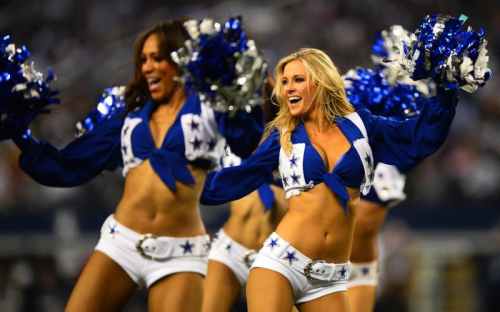
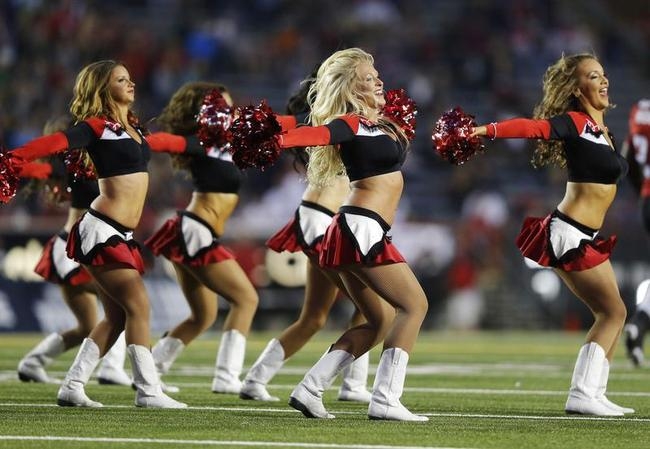
For a small, but vocal contingent of regressive individuals with a low threshold for outrage, there’s a particular occupation that they’d like to add to that list. That is the profession/hobby of cheerleading, specifically the kind that involves parading beautiful women in sexy attire so they can dance, shake pom-poms, and get a crowd excited. Hell, it’s not like there’s anything inherently appealing about that.

That last sentence was sarcasm, by the way. I want to make clear that, as both a man and an avid sports fan, I love cheerleaders. They embody so many wonderful concepts about the world. They combine sports, sex appeal, dancing, and excitement. They bring happiness, excitement, and spirit to an event. There is literally no downside.

Unfortunately, that regressive crowd who insist on seeing sexism, misogyny, and oppression at every corner sees none of that. They only see beautiful women being paraded around in sexy attire for horny men to gawk at. It doesn’t matter if those women choose to do so or are paid to do. Beautiful women attracting the attention of horny men is seen as inherently oppressive to all women everywhere.


That was sarcasm too. I’m sorry if I’m using more than usual, but I find it’s the best way to highlight the sheer absurdity of this attitude. However, it’s an absurdity with serious implications because it reflects a growing trend. Now, in an era where it’s suddenly scandalous to depict the female body in any sexual context, cheerleading is a growing target.

It’s a target that has already taken a few hits. Earlier this year, Formula One Racing announced that it would no longer utilize grid girls, who are basically cheerleaders for racing. This act was cheered by the radical anti-sex feminist crowd. It was probably secretly cheered by priests, mullahs, and monks, as well. While it did inspire somewhat of a backlash, it hasn’t stopped that same crowd from aiming at other targets.

More recently, NFL cheerleaders are in the spotlight. In terms of cheerleading, as a profession, this is basically going for the very top of the hierarchy. The NFL is for cheerleaders what the Pro Bowl is for NFL players. It’s seen as the very pinnacle of the profession and it may be in danger.

It hasn’t helped that there have been some distressing scandals involving how some NFL cheerleaders are treated. The recent scandal involving the Washington Redskins cheerleading squad has only added more fuel to the outrage. Never mind that the facts of these scandals are limited and anecdotal, in some cases. It gives the regressive crowd everything they need to cry sexism and misogyny.

Now, none of this is to downplay some of the real issues surrounding cheerleading, as a profession. There are certainly issues with respect to how much cheerleaders are paid and how their lives are micromanaged. Those issues should be addressed and reformed. However, that’s not the conversation anyone wants to have.

Instead, cheerleading is getting lumped into other outdated traditions like arranged marriages, virginity tests, and being forced to cover their ankles in public. It’s not a profession or a passion that needs to be reformed and improved. It’s something that needs to be outright purged from society.

That’s not just an extreme reaction to a job that isn’t even the most dangerous or the most prone to sex scandals. It’s an attack on the very idea that beautiful, sexy women can and should be used to promote anything, be it a sports team or a fast food meal. The problem isn’t how the job is unfairly managed. It’s the job itself.

From the perspective of cheerleading’s opponents, it objectifies the female body and commodifies female sexuality for the consumption of men. In an era where sexually harassing a woman is seen as the ultimate evil, whereas sexually abusing a man isn’t nearly as outrageous, that’s just unacceptable.

The attitudes of the women who seek this profession don’t matter. The attitudes of the men who enjoy the sexiness and excitement that cheerleaders inspire especially don’t matter. All that matters is that cheerleaders are too sexually stimulating to the masses and that’s feeding a culture of misogyny and sexism. I wish that were sarcasm, but that’s what these regressive people genuinely believe.

For them, undermining the freedom and agency of those who want to pursue cheerleading and those who want to admire cheerleaders is a price they’re willing to pay. While some, like the Grid Girls, try to fight back, they’re facing an uphill battle and it’s one that cheerleaders might end up losing.

That’s because these are exceedingly sensitive times. Just trying to inject reason and criticism into the movement against sexism is subject to irrational outrage. Matt Damon found that out the hard way. More and more, people are just avoiding the conversation altogether because it just keeps fueling more outrage.

The current dynamic is as simple as it is unfair. If you stand up for cheerleaders, then the regressive crowd can just claim you’re a sexiest who wants to gawk at beautiful women. Even if you’re a woman speaking on behalf of cheerleaders, your criticism can be cast aside because you’re just brainwashed by the patriarchy and you’re for the objectification of women.

Never mind the fact that the very concept of objectification is fundamentally flawed. Never mind the fact that that flawed concept is also prone to some pretty disturbing double standards. The protests against cheerleading is framed as a protest against sexism, misogyny, and patriarchal oppression. It doesn’t matter how wrong or misguided that notion is. That’s the perception and there’s just no way to win that argument.

These days, being called a sexist is bad for business and for your profession. I believe the regressive crowd knows that, to some extent. They understand that the NFL is a business and one that has already been ravaged by negative press. Their success and their profits are dependent on their brand. If they see something as potentially damaging to their brand, then they’re going to either get rid of it or downplay it.

I’m not good at predicting the future, but depending on how these recent cheerleading scandals play out, I suspect that the NFL might just slowly phase out cheerleaders, altogether. It’s the path of least resistance. Keeping them around means keeping the outrage around. That’s just more risk and frustration than it’s worth.

It would be another major loss, one far bigger than the loss of the Grid Girls. However, as much as I love cheerleaders and the sex appeal they bring, I can totally understand why a major organization like the NFL would resort to such an extreme. By just removing cheerleaders, altogether, the crowd of regressive outrage will move onto their next crusade and, hopefully, leave them alone.

It’s a scenario that nobody wins. If the NFL ends up eliminating cheerleaders, it won’t be because they’ve seen the error of their ways and are now champions of women’s empowerment. They’re just protecting their brand. They’re trying to stop the whining, an approach that only offers the illusion of progress and not actual progress.

Personally, I hope the NFL resists the outrage. The more ground we give to regressive attitudes, the more regressive our society becomes. This is a crowd that won’t stop until everything that might potentially evoke sexual feelings or portray women in a sexy way is either eliminated or stigmatized.

As both a fan of all things sexy and an aspiring erotica/romance writer, that’s not a world I want to live in. That’s not a world that even other women want to live in, as the Grid Girls have shown. It’s a boring, unsexy, downright dystopian world that’s worth resisting and I hope there are plenty of cheerleaders, male and female alike, who will cheer on that effort.

Leave a comment

Filed under Current Events, gender issues, media issues, political correctness, sex in society, sexuality, sports

How And Why It Became Trendy To Hate “The Big Bang Theory”

1488462637_058409_1488464865_noticia_normal

There was once a time in the mid-90s when Hootie and the Blowfish was the hottest band in the world. They’re music was everywhere. You couldn’t listen to the radio for more than five minutes without hearing one of their songs. I didn’t consider myself a huge fan, but I found plenty of their songs catchy and fun. I still have “Hold My Hand” on my phone.

Then, for reasons I still don’t quite understand, it became cool to hate them. Suddenly, admitting that you enjoyed your music was akin to admitting that you did shots of paint thinner to win a five-dollar bet. It got to the point when even “The Simpsonsmade a joke about them in an episode.

The same thing happened to Nickelback in the 2000s. They went through an early period of intense success. Their fourth album, “The Long Road,” sold over five million copies. That’s success that most artists only ever dream of. I even admit I have that album and I love it. Their song, “Feelin’ Way Too Damn Good,” is on my workout playlist.

Then, for reasons that I’d rather not speculate on, it became cool to hate them too. While that hasn’t stopped them from selling over 50 million albums and becoming one of the most successful acts of a decade, it’s still trendy to despise them as everything wrong with music. It doesn’t seem to matter how successful they are. For some strange, esoteric reason, they embody everything wrong with the world.

If I would write that with more sarcasm, I would. However, this piece isn’t about Hootie and the Blowfish or Nickelback. I reference them because they’ve already gone through what’s happening to “The Big Bang Theory” seems to be enduring right now. They’ve risen to the top, defying the odds to achieve a level of success that most can only dream of. Then, it becomes cool to hate them for any number of reasons.

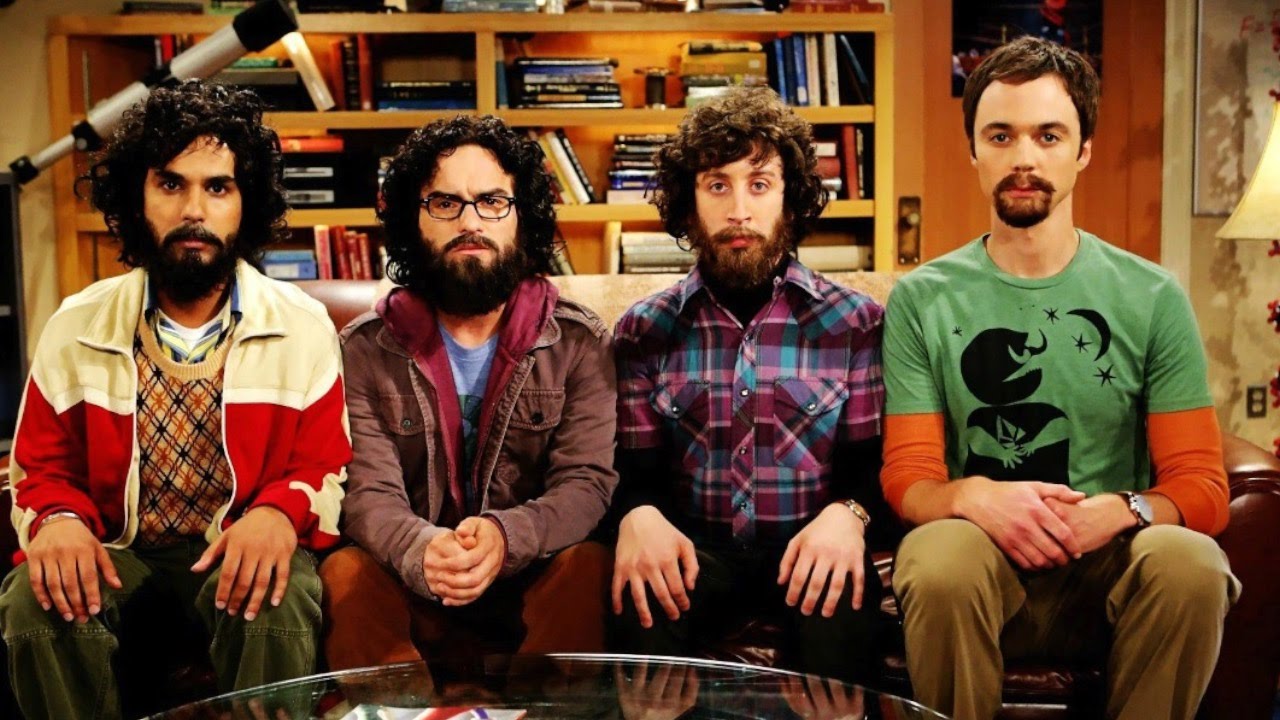
Now, I know I’ve criticized “The Big Bang Theory” before. I’ve cited it as the show that contains one of the worst romances in all of fiction. I don’t deny that it’s brand of humor and reliance on nerdy, socially inept men can be dry at times. That said, I do consider myself a fan of the show.

I watch it regularly. I even laugh at it. It has flaws, but I think the things it does well do plenty to overshadow those flaws. Sheldon is eccentric, but funny. Amy is quirky, but endearing. Howard, while creepy in the early seasons, has really grown up in all the right ways over the years. I would even go so far as to say that the show is worth watching just for Raj Koothrappali.

It’s not the best show on television, but like Nickelback and Hootie and the Blowfish, there’s no denying its success. It’s been syndicated and regularly ranks as one of the highest rated prime-time shows. Then, somewhere along the way, it became cool to hate the show as much as Nickelback.

You don’t have to look far to find articles of people whining about the show. Even Cracked, a site I often reference, once wrote a scathing article that flat out insulted anyone who dared enjoy the show. This is a direct quote.

Who are you people? The people watching The Big Bang Theory, I mean. Show yourselves. The world demands explanation. I mean that, too. In every way, shape, and form, this is the Justin Bieber of television shows.

I know the internet is full of this kind of trolling, but we’re not talking about snuff films and public crucifixion here. It’s a goddamn TV sitcom. It tries to be funny and entertaining. It doesn’t always work for everyone, but it still works for some. Are those people, which I guess includes me, somehow damaged just for liking this show?

I could probably ask the same of those who enjoy music from Nickelback and Hootie and the Blowfish. I could even offer a partial answer if I only use the basis of personal taste. That is, after all, what the consumption of all media is, be it music, movies, or TV. You tend to consume what you like. It’s that simple.

However, for an issue like this, there are added complications when something becomes cool to hate. Suddenly, it’s no longer a matter of just liking something different. It’s a matter of having some inherent personal flaw for liking something that has a vocal contingent of critics.

Call those critics whatever you want. Call them hipsters, trolls, or any number of other names that would warrant fines from the FCC. They’re still driven by the same focused outrage that dominates politics, religious disputes, and Overwatch tournaments. The only real question is why a show like “The Big Bang Theory” gets singled out.

It’s a hard question to answer and I’m not qualified to answer it completely. However, I do think something strange happens to movie, TV show, or band when they get so successful and so acclaimed that those who don’t like the show just can’t stop at not watching it.

It’s rare for any show to achieve the kind of success “The Big Bang Theory” has garnered. Success makes a show a bigger target. If shows like “South Park” or “The Simpsons” weren’t so successful, nobody would care how bad some of their jokes were or how controversial a certain character might be.

Some of that might be out of envy. There’s only so much success to go around. The fact “The Big Bang Theory” is so successful means, in the eyes of those who hate it, that it’s robbing success from shows that might be funnier or more worthy of it. Never mind the fact that the humor and worthiness of a show is completely subjective. Fans of that show will see “The Big Bang Theory” as a thief and a fraud.

Like it or not, envy can be a pretty powerful source of emotion. It’s underrated compared to outrage and hate, but still potent in its own right. However, I don’t think that’s the sole reason why “The Big Bang Theory” gets more hate than most prime-time shows that don’t involve CSI spin-offs.

I suspect there’s a deeper reason driving the hatred towards “The Big Bang Theory” that even Nickelback doesn’t have to deal with. I think part of that reason has to do with the archetypes the show uses. I don’t think it’s a coincidence that the combination of nerdy, socially awkward young men and a cute ditzy blonde conjures some heated emotional reactions, to say the least.

There’s no doubt that combination is contrived and relies heavily on old stereotypes. Then again, you could say that about a lot of other shows. The fact this one uses nerds and cute blondes, though, just makes it seem more overt. It makes every joke, every plot, and every gag seem cheap or forced.

It makes some of the resentment to the show understandable, but I think that resentment is even more compounded by trends in political correctness. Chief among those trends is a growing aversion to stereotypes. Characters and archetypes once considered inoffensive are now controversial. Jokes that were once just in poor taste are now the source of intense outrage.

Since its inception, “The Big Bang Theory” has relied a lot on stereotypes for its characters and its humor. Like all shows, it exaggerates certain personas. Sheldon Cooper, alone, is a testament to a character whose quirks are taken to a ridiculous extreme.

By relying on these stereotypes, though, it makes itself an even bigger target. Laughing at the show, in the eyes of some, means accepting some of these stereotypes and having the audacity to find them funny. That appears to be the undertone of the Cracked article I cited earlier. It seems to be the undertone of a lot of the hatred the show gets.

Now, I don’t deny that “The Big Bang Theory” can go overboard with cliches and stereotypes. There are a number of episodes in “The Big Bang Theory” that even I find bland. However, for the most part, I still laugh. I still find myself enjoying the story. Even when I can apply some of those stereotypes to myself, I still laugh.

At the end of the day, “The Big Bang Theory” is still just a TV show in the same way Nickelback is just a band. Nobody forces anyone to watch it. It’s easy to just change the channel and watch something else. However, when a show becomes so successful while relying on a premise that is getting more politically incorrect with each passing year, it’s bound to attract criticism and not just from the hipster crowd.

I still enjoy the show and I intend to keep watching it. I also intend to keep all the songs by Nickelback and Hootie and the Blowfish on my phone for the foreseeable future. If that makes me uncool in the eyes of some, then so be it. To me, it doesn’t matter if something is cool to hate. Petty hate is still petty hate.

I also expect to see plenty more hatred directed at the show for how it treats nerds, women, minorities, and humor. It’s just too successful and too big a target to avoid that kind of scrutiny. In that situation though, as with Nickelback and Hootie and the Blowfish, sometimes the best you can do is just laugh and enjoy it on your own terms. Bazinga!

2 Comments

Filed under human nature, media issues

Why Most Complaints About Hollywood Are Empty

hollywood-sign-mulholland-highway

There are a many annoying trends in the media these days and I’m not just talking about “fake news” or “alternative facts.” Those are trends that only bring out the worst in people whenever they’re discussed. While still annoying, there’s at least some legitimate substance behind those discussions. The trends I’m referring to are as empty as the whining they inspire.

It involves a new online cottage industry. It utilizes criticism wrapped in an agenda that’s disguised as meaningful social justice. It usually takes the forms of articles with click-bait heavy titles that give the impression that this is an official statement on behalf of all those who consume media. In reality, it’s just empty rhetoric that hides more whining.

You’ve probably seen these articles before. They’re often made by sites like BuzzFeed or Cracked, a site I’ve been reading for years and even reference frequently. They usually contain heavy-handed titles like this.

5 Things Action Movies Need To Stop Doing

8 Things Hollywood Needs To Stop Doing With Female Characters

7 Recurring Gags That Movies Need To Stop Using

14 Things TV Shows Need To Stop Doing With Minority Characters

15 Ways Hollywood Is Still Racist

37 Ways Movies And TV Are Still Offensive To Women And Minorities

9 Common Hollywood Practices That Need To Stop

None of these titles are to real articles, but you don’t have to look far to find articles like them. If there’s a legitimate and/or petty way to complain about the way Hollywood does business, then chances are there’s an article about it. Some pretend to express real concern about real issues. Most just whine about it, though.

I get that Hollywood is easy to criticize. It is, after all, a very shallow and cut-throat world with a history of scandals and less-than-ethical business practices. However, discussing those issues and trying to reform them is hard. Just whining about some of the content Hollywood puts out is easier and allows certain people to virtue signal. It’s not that hard to understand why people do it.

Even so, it doesn’t change a few inescapable facts that render all these click-bait articles utterly devoid of substance. Most of those fact come back to the simple truth that Hollywood is, and always has been, a business. It does have an agenda, but that agenda begins and ends with making money. Everything else is an afterthought.

It’s not very glamorous or sexy, but you could say that about almost every business venture. The only difference with Hollywood and the media is that pursuing that goal requires them to present a fantasy that sometimes requires that the goal be less obvious. That’s how you can get movies that protest corporate greed, but are still produced by corporations driven by greed.

It’s that same desire to make money and turn a profit that often leads to the kinds of practices that these wannabe media critics complain about. In general, people want to see beautiful women and attractive men following the kind of tried-and-true that has entertained people for centuries, long before movies and TV even existed.

From a pure business perspective, it’s easy to understand why Hollywood and media companies use these tropes. Like it or not, they work. People still aren’t tired of seeing male action stars like Tom Cruise run from explosions. People still aren’t tired of seeing beautiful women like Jennifer Lawrence or Scarlet Johannsen run around in skin-tight outfits either.

If the masses want it, then those in Hollywood would be lousy business people if they didn’t try to give it to us. There’s a demand for something. They supply it. That’s economics at its most basic. What these articles are basically asking for, to some extent, is that Hollywood stop doing what has historically made them money and do something completely different that may not work at all.

Think about that for a moment and try to appreciate the implications. You’ve got a job. It’s a good job that pays well. It involves doing something you know how to do and have seen, time and again, how well it works. Then, some person comes along who has never done your job and yells at you for how you do it.

On top of that, they claim that doing your job the way you do it contributes to all the horrible things in the world. Somehow, your job is what fosters all the racism, sexism, and bigotry that makes the world such an awful place and it’s your obligation to change everything about your job, risking your own money and livelihood in the process.

How would you feel about that person? Would you be all that inclined to listen to them? Would you even take them seriously? Chances are you wouldn’t and it’s not that surprising that Hollywood rarely responds directly to these complaints. The only reason Hollywood ever changes its approach to entertainment in any capacity is to make more money. That’s all there is to it.

It’s the biggest flaw in complaints about things like whitewashing, the Bechdel Test, and every damsel in distress trope. People can complain all they want. As long as movies, TV shows, and video games keep turning a profit, they’ll keep getting made. Hollywood and the media would be irresponsible, as a business, not to do just that.

That’s not to say Hollywood is doomed to remain stagnant. Hollywood, like any business, tries to follow market trends. That’s how we get things like a half-dozen superhero movies in a year and a glut of “Die Hard” rip-offs. When you find a winning formula, you stick with it. Those that don’t usually don’t stay in business for very long. The fickle and unpredictable nature of markets sees to that.

However, those who complain about Hollywood are basically demanding that they adopt this inherently risky method for producing media. They’re demanding that they ignore market trends and go out of their way to produce content that’s new, unproven, and politically correct to cultural and social sensibilities. They demand all this, regardless of how much it costs or how much profit it turns.

In general, when people make such unreasonable demands, they doom themselves to disappointment. For the professional whiners of the world, that basically creates a self-reinforcing cycle. They demand the impossible or the impractical. Then, when it doesn’t happen, they get upset and blame those who didn’t go out of their way for them.

It’s petty and annoying, but it’s the nature of the current media landscape. Thanks to the internet and social media, every has a platform and a voice. They have a mechanism for making demands that their media cater to certain groups and agendas, despite having no understanding of the business or economic forces behind the things they consume.

On top of all this, the process of making movies is getting more expensive with each passing year. That means producers have less room for error. If they make a movie that bombs, the losses are a lot bigger. It also means that even if a movie does well, the amount of profit it generates isn’t quite as great. That’s why the most profitable movies tend to be low-budget films that are unexpectedly successful.

It’s that unexpected part, though, that’s so frustrating to Hollywood. Nobody truly knows if a movie will be a hit, even if it’s from an established franchise. Sure, we can question how George Lucas thought Jar Jar Binks was a good idea for a character, but most every competent movie maker creates their products with the expectation and hope that they’ll be successful.

Now, none of that is to say that some themes aren’t overplayed. In recent years, Hollywood has made a concerted effort to improve how women are depicted in film and TV. The recent success of “Black Panther” has shown that there is money to be made in crafting products with a more diverse appeal.

However, these efforts weren’t the results of people complaining about a lack of diversity. They were the results of a business following market trends. The world is getting more diverse and so its consumer base. Naturally, a business will want to appeal to the most people possible. A successful business doesn’t care about the gender, race, religion, or sexual orientation of the consumer. The money is just as valuable.

For some people, though, that’s not happening fast enough and it doesn’t make up for past transgressions. Never mind the fact that history can’t be changed and doesn’t give a damn about how people feel about it. The fact that something once existed or doesn’t exist yet still offends some people.

At the end of the day, whining about the prevalence tropes, jokes, or themes that pervade Hollywood is no different than whining about how too many people like something that you hate. It’s selfish, petty, and asinine on every level. If it keeps making money, then it’ll keep happening. Until capitalism and economics radically changes, then those who keep whining about these trends will just have to deal with it.

Leave a comment

Filed under Celebrities and Celebrity Culture, media issues, movies

Stereotypes, The Simpsons, And The (Empty) Complaints About Apu

season_25_icon

For nearly three decades, our society has had an unspoken, but clear understanding. For something to become culturally relevant, it has to be mentioned “The Simpsons.” Whether it’s a major plot on something like boy bands or a subtle joke about a classic novel, it’s not truly a mainstream idea until it shows up on “The Simpsons.”

I happen to be among the demographic who have always lived in a world where the “The Simpsons” existed. I honestly cannot remember a time when this show wasn’t on the air or relevant in some ways. For a show that has been on the air for nearly 30 years, it’s remarkable just how much impact it has had, despite so many changes in trends, culture, technology, media, and tastes.

There have been controversial moments, though. I still remember how controversial it was when John Waters voiced a gay character on the show. That was considered controversial in 1997. Looking back on it, I can see why. The more recent controversies, however, are a bit harder to understand.

That brings me to Apu Nahasapeemapetilon, Springfield’s lovable Indian owner of the Kwik-E-Mart. I say he’s lovable because, for the most part, he’s one of the show’s most colorful side-characters and for the right reasons. He’s smart, he’s got a unique personality, and he’s undergone plenty of growth over the years.

However, according to a documentary by Indian comedian Hari Kondabolu called “The Problem With Apu,” this established character on an iconic TV show is contributing to a serious social ill in the world. The fact that Apu exists is a factor in the many causes of social injustice, racism, and bigotry. He’s almost as bad as video game characters being too sexy. If I could write that with more sarcasm, I would.

With all due respect to Mr. Kondabolu, who lives a minority in a country that has a spotty history with race to say the least,  I sincerely question his method for picking certain battles. There are many serious issues surrounding race relations in America and throughout the world. Those issues have all sorts of complexities and nuances to them.

Instead of scrutinizing those, however, he singles out a popular cartoon character to make his point. Even That doesn’t just undermine the serious issues he discusses in that movie. It ensures that his point will get lost in the collective groans of those who bemoan political correctness.

I know that whining about political correctness has become a source of whining in and of itself, but there is a continuum of sorts that separates serious issues about representation in the media from outright trolling. The separation isn’t always clear, but in the case of Apu and Mr. Kondabolu, it’s too petty to be subtle.

The idea that Apu is now problematic, a word that has gained a lot of frustrating connotations in recent years, sends an indirect message that I don’t think Mr. Kondabolu wanted to send. It’s not that racism and bigotry aren’t important issues. It’s the idea that anyone who enjoys “The Simpsons” and appreciates characters like Apu are somehow on the same level as old school, George Wallace level racists.

For most reasonable people, that notion is both insulting and absurd. Again, I doubt that’s the direct message Mr. Kondabolu was saying, but that’s the subtext of the message he sent with that documentary. “The Simpsons” and the people who enjoy it are somehow bad people and contributing to a problem.

Understandably, both fans and the creators of the show aren’t going to respond with homemade chocolates and hugs. Even though the creators promised to address it, the way they did so did not involve an extended apology about how the show has depicted Apu and paying massive reparations for all the hurt feelings it has caused.

Instead, they worked it into a side-plot in the episode, “No Good Read Goes Unpunished,” wherein Marge tries to rewrite her favorite book so that it’s free of anything that might be considered offensive in 2018. As many in Hollywood and the media are finding out the hard way these days, that’s next to impossible.

It all culminated in a moment where Marge and Lisa partially broke the fourth wall, Deadpool style, and indirectly confronted the controversy by basically saying that there’s not much you can do when old characters who weren’t offensive at first become offensive years later. Those characters exist, as do their stories. Lisa flat out asks to the camera, “What can you do?”

It’s a very relevant question that Mr. Kondabolu isn’t able to answer. In fact, I don’t think the question has an answer. At the very least, the scene didn’t mock him directly or discount his feelings. It was surprisingly even-handed for a show that regularly mocks popular trends. This is how the scene that played out.

Needless to say, that response rubbed plenty of people the wrong way, included Mr. Kondabolu. According to Entertainment Weekly, this was his response.

“Wow. ‘Politically Incorrect?’ That’s the takeaway from my movie & the discussion it sparked?” wrote Kondabolu. “Man, I really loved this show. This is sad.” In another tweet, he said, “In ‘The Problem with Apu,’ I used Apu & The Simpsons as an entry point into a larger conversation about the representation of marginalized groups & why this is important. The Simpsons response tonight is not a jab at me, but at what many of us consider progress.”

I want to be sympathetic to Mr. Kondabolu’s feelings. I really do. However, the problem with his response is that he didn’t even try to answer the question that Lisa asked. She asked what can you do. He just whined that this response wasn’t the one he wanted from the show. On top of that, he didn’t even try to explain what he’d hoped to hear.

This why I find his protest of Apu so empty. It’s also why I find a lot of complaints about offensive characters or stereotypes so asinine. It’s not enough that someone is offended. They basically set it up so that there’s no way for them not to be offended. They present a problem with no solution. If they offer one, it’s vague and easy to move the goalposts when someone doesn’t respond to their satisfaction.

For Mr. Kondabolu, he doesn’t just move the goalposts, though. He essentially tries to play an entirely different game on an entirely different field and expects everyone else to know the score. Even by scrutinizing the content of his own documentary, Mr. Kondabolu reveals just how misguided his arguments are. In another article by Entertainment Weekly, this was his justification for singling out Apu.

As Kondabolu made clear in his film, the problem with Apu extends beyond a brown character voiced by a white actor; the problem was not just with The Simpsons, but with its viewers, the drunk idiots on the street who call any South-Asian person “Apu” and who repeated “Thank you, come again,” as a mocking refrain.

I highlighted those bold parts because they’re the most revealing part of Mr. Kondabolu’s argument, as well as the greatest flaw. He links the depiction of Apu to the “drunk idiots” who harass people like him of South-Asian descent. From his perspective, the problem isn’t the drunk idiots doing the harassing. It’s the cartoon character.

In that context, it’s understandable why even a bleeding heart liberal like Lisa Simpson, a notable lover of cartoons, wouldn’t take up Mr. Kondabolu’s cause like she has so many others. It’s not just empty. It completely overlooks the actual source of the problem, namely the drunk idiots.

Are they drunk idiots because they watched “The Simpsons?” Are they drunk idiots towards people of South-Asian descent because of Apu and the stereotype he represents? Well, if that’s the argument Mr. Kondabolu is going to make, then he’s got a much bigger problem. “The Simpsons” are full of so many other stereotypes that to single just one out as “problematic” isn’t just asinine. It’s petty.

Homer Simpson is a stereotype of a dimwitted, drunk middle class working stiff.

Lisa Simpson is a stereotype of a whiny, bleeding heart liberal social justice lover.

Marge Simpson is a stereotype of a nagging housewife.

Groundskeeper Willie is a stereotype of an angry Scotsman.

Barney Gumble is a stereotype of a fat, drunk alcoholic slob.

Cletus Spuckler is a stereotype of a white trash hillbilly.

Luigi Risotto is a stereotype of an Italian chef.

Fat Tony is a stereotype of an Italian mobster.

I could go on, but with nearly 30 years of characters, “The Simpsons” has such a huge cast of characters that there’s no way I could list every character and the stereotype they represent. In fact, it’s because “The Simpsons” has so many characters and so much history that it’s possible to find a character that embodies an offensive stereotype of some type. The only requirement is that you have to be really petty.

That’s what Mr. Kondabolu had to do. He had to get really petty to single out Apu, which also required he ignore the real, non-animated people who were harassing minorities. Again, none of this is to say that racism and harassment aren’t problems. They are. However, when highlighting this issue requires a level of pettiness that involves singling out cartoon characters, then there’s something wrong with that approach.

1 Comment

Filed under Current Events, media issues, political correctness