Tag Archives: gender issues

Why The First Male Birth Control Pill Won’t Be Successful (And Why That’s Still Progress)

male-pill-900x450

When it comes to our health, certain treatments or trends occur faster than others. Fad diets and health crazes can gain favor, fall out of favor, and be forgotten all within the same year. For more serious aspects of our health, the wide acceptance of certain treatments and trends can take longer, even if they work as advertised. When it comes to our sex lives, though, it can be even more challenging.

It’s one thing to be worried about your waistline and your ability to fit into an old pair of pants. It’s quite another to worry about whether certain intimate parts of your body are functioning properly. Naturally, we tend to worry a lot more about the sexy parts. Why else would boob jobs be so popular?

This gets even more touchy when issues surrounding contraception come up. Even when there’s a major breakthrough that has the potential to revolutionize our sex lives and our fertility, it takes time for it to permeate throughout society. It’s also a lot more prone to taboo and political protests than boob jobs.

Just look at the documented history of the female birth control pill. The actual pill itself was invented in 1951. Human testing didn’t begin until 1954 and the FDA didn’t approve it until 1957, but it was only approved to use for severe menstrual disorders. It’s only in 1960 when it’s approved for use as a contraceptive, but it still takes years before it becomes both widely used and socially accepted.

Overall, it took at least a decade before the female birth control pill really established itself as part of modern medicine and as part of our sexual culture. I cite that history because men are close to forging a similar history with contraception. It wouldn’t be unreasonable to say that men are on the brink of the biggest upheaval in their sex lives since the invention of condoms.

I’ve written about the promise and potential social impact of male contraceptives, referencing developments in products like Vasalgel. However, that method is still in the testing phases and probably won’t get regulatory approval within the next few years. Given that it is also requires a targeted injection, that testing will be subject to a lot more scrutiny, as would be expected of things that involve needles near genitals.

It’s far more likely that a pill will get approval before something like Vasalgel, if only because people are more comfortable taking pills than getting a shot. In fact, as I write this, the University of Washington is conducting a large-scale human test on an oral contraceptive for men called dimethandrolone undecanoate, or DMAU for those who would rather not learn that level of science jargon.

While DMAU doesn’t offer quite as much promise as Vasalgel, it does offer a similar product to the one women have been using for half-a-century now. It’s a one-a-day pill that men can take with their morning coffee. Also like its female counterpart, it uses hormones that effectively block the production of sperm. For men already used to taking pills every day for other issues, it wouldn’t be that hard of an adjustment.

That said, though, this first step towards equalizing male contraceptive methods will face a lot more obstacles than the female birth control pill did when it first came out. In fact, I’d go so far as to predict that if DMAU were approved by the FDA tomorrow, it probably wouldn’t be that successful.

I say that as someone who freely admits he’s not good with predictions, as my Super Bowl picks last year prove. However, being a man who follows these kinds of sex-related issues, I feel like I have more insight than most when it comes to gauging the potential of a major advancement for our collective sex lives.

Like it or not, and I’m sure those versed in identity politics will cringe at this, men are wired differently than women, especially when it comes to their sexual health. There was a very different set of motivating factors behind the female birth control pill, so much so that getting women to adopt it wasn’t too challenging, even if it took years. With men, though, it’s a different story.

Men are already far less likely to go to the doctor than women. They’re also far less likely to ingest something that might impact their hormones and, by default, their sex lives. Since DMAU utilizes hormones in inhibiting sperm production, it’s going to have the potential for side-effects. Even the doctors in the study admit that.

Of the test subjects who completed the study and were taking 400 milligrams (mg) of DMAU – the highest dose tested – few reported symptoms consistent with testosterone deficiency.

The subjects who were given the pill did have weight gains of between 1 and 3 pounds on average, according to Page.

“The weight gain and a small decrease in good cholesterol levels, HDL, are things we’re going to look at more closely in future studies,” Page says.

This is where I have to denigrate my own gender, but when it comes to tolerating side-effects, I think women have men beat in that arena. The many side-effects women endure with contraception is proof enough of that. Men, as tough as we can be, are somewhat dense when it comes to accepting certain side-effects.

It’s for that reason why I think DMAU is going to have limited success at most and will likely fall out of favor quickly once more promising alternatives like Vasalgel enter the market. Even without those alternatives, though, I suspect DMAU will not gain widespread acceptance among men, even for those who have been clamoring for more contraceptive options.

Now, and this is where I’m going to make another prediction, I think that limited success or outright failure will actually mark a huge turning point in the history of male contraception and a positive one at that. To some extent, failure is part of the process when it comes to making progress in our health. Again, anyone who knows anything about fad diets can attest to that, some being worse failures than others.

To some extent, the first male contraceptive pill will be like the first cell phone. It’ll be clunky, crude, and not nearly as efficient as consumers wish it were. It’ll also likely be pretty pricy as well, as only the Gordon Gekko’s of the world could afford those early cell phones. However, that doesn’t mean the product itself was a waste or a loss.

Keep in mind, the first cell phone was probably considered strange and unnecessary in a market that was used to making calls from LAN lines. Why would anyone even want a cell phone that was bulky, expensive, and offered only spotty coverage when you could accomplish the same thing with a phone booth and a quarter?

Over time, though, and as the technology improved, cell phones made their way into the market. I suspect that the first male birth control pill will do the same. At first, it’s going to be seen as strange. It may even seem unnecessary to men who can get the same effect from a box of condoms at a gas station for less than five bucks.

The value, however, isn’t in how men initially react to the first male birth control pill. The true value is just putting the idea out there that men now have this option. Even if only a handful of men take advantage of it, that’s still enough to establish a consumer base.

That small consumer base will eventually grow as the idea of a male birth control pill stops being a novelty like the first cell phone and becomes a legitimate consumer product. There will be plenty of room for improvement. There may even be some unpleasant stories about men struggling with the side-effects.

In the long run, that’s a good thing because once a consumer base is in place, they’re going to demand improvements to the product. More improvements will create a better product. It has helped create a wealth of options for women. Eventually, like the cell phone, male birth control will undergo a similar process until it ends up with the contraceptive equivalent of the iPhone.

That process will take time and there will be missteps along the way, just as there were with female contraceptives. The most important part of that process is just establishing the idea this is an option for men who want more choice and control of their fertility. It’s a level of choice and control they haven’t had before, one that women have enjoyed for decades.

Beyond just giving men more options and choices with respect to their fertility, products like DMAU could start the process of narrowing a lingering gender disparity that has been fodder for plenty of gender-driven conflict. The more we can do to alleviate that disparity, the better.

It’s going to take a while for that idea to sink in. In many ways, the first male birth control pill is going to start behind the curve, but that’s okay. The day will eventually come when both men and women can finally say they have equal control over their fertility. It’s still a first step and given how far the technology has to go to catch up to women, it’s a step that needs to happen in the name of true gender equality.

 

2 Comments

Filed under gender issues, Second Sexual Revolution, sex in society, sexuality

On Gender Double Standards And Male Strippers

mc-gp-chippendales-bethlehem-sands-20150121

When I was 21-years-old, I took my first trip to Las Vegas. It was truly a magical experience. Even though I was young and socially awkward at the time, I had a lot of fun there. It was the first time I had been somewhere that really treated sex like a spectacle. That spectacle can bring out a very different side of people.

One incident, in particular, really exemplified this during that first fateful trip. It occurred when I was walking down Fremont Street, also known as the old part of Las Vegas. This is the area that gets glorified in gangster movies like “Casino.” Today, it’s largely full of street performers, tacky vendors, and Elvis impersonators.

Image result for old las vegas

However, the one spectacle that stood out most occurred when I passed by an unusual crowd near the Golden Nugget. The crowd was unusual because it consistent mostly of women and they were making noises that I had never heard women make to that point in my life.

When I moved in closer, I saw that the source of the spectacle were a few male strippers, specifically the big, muscular types that worked at places like Chippendales. Despite being straight and shy at the time, even I found these guys to be attractive. However, it was the behavior of the women that really stood out.

They were all over these guys. They were cheering and laughing as though they had just won the lottery. They were taking turns hugging them, kissing them, and feeling around their perfectly chiseled muscles. Some women had this look on their face that resembled a kid looking at a giant chocolate cake. It was quite a sight.

Image result for women with male strippers

Keep in mind, these weren’t Las Vegas showgirls. Most of these women looked like soccer moms who could’ve easily been friends with my parents. At that moment, though, they were utterly uninhibited. The things they said to those strippers, and on a public street no less, would’ve made an experienced porn star blush.

At the time, it was just an amazing sight that I hadn’t seen before in my youth. As the years have gone by, though, that experience has taken on a very different context. That context has gained even greater meaning as trends in feminism, popular culture, and social justice have really changed the conversations we have about gender.

The particulars of that conversation really stand out when you focus on strippers. Specifically, the double standards within those conversations become a lot more apparent. I know I talk about double standards a lot, but some are more egregious than others. I would even go so far as to say that those involving strippers are most revealing, if that’s not too loaded a term.

Related image

For any man who has gone to a strip club featuring female strippers, most quickly learn that there’s a lengthy set of guidelines to follow. I freely admit to going to multiple strip clubs so I’m pretty familiar with all of them. They usually involve these kinds of  rules.

  • Do NOT touch or grope the strippers while on stage or during a lap dance
  • Do NOT try to solicit sex or sexual services from the strippers
  • Do NOT yell at or disrupt the stripper while they’re on stage
  • Do NOT invite a stripper back to your hotel room or to a private residence
  • Do NOT address the strippers in a vulgar manner

There are usually other rules, but these are the most basic. Every strip club is different and some are better about enforcing those rules than others. For the most part though, these are the expectations and failure to meet them often means getting thrown out or arrested.

The rules and expectations for male strip clubs, however, are very different. It’s not just that it tends to be louder and more intimate, so to speak. There are things women do at male strip clubs that would get most men thrown out of female strip clubs, if not arrested.

Image result for men thrown out of strip club

A couple years ago, Vice compiled testimony from male strippers about some of the behavior they encountered during their work. Their experiences included, but weren’t limited to being puked on by drunk women, women getting up on the stage to dance with them, and being flat out groped.

It’s also both common and expected that women will hook up with male strippers. Sometimes they’ll offer money. Sometimes they won’t. In either case, it’s exceedingly rare for them to face scrutiny or arrest for that sort of behavior. In fact, some even see it as empowering.

Never mind the fact that such empowerment requires such an apparent double standard. Women being sexually uninhibited and free to pursue whatever decadence they want is seen as liberating. However, men doing the same is seen as oppressive. The principles and mechanics are the same. The social stigma is not.

Image result for man thrown out of strip club

That stigma also effects women in more indirect ways. There are more than a few stories about women being fired from their jobs after someone found out they worked as a stripper or porn star. Men who work as strippers, though, don’t usually have this issue. Former stripper Amber Rose pointed that out, noting how men like Channing Tatum get praised for his portrayal of a stripper while she still faces stigma for her past.

In both instances, the stigma is damaging. The double standards are asinine. Sure, you could argue that patriarchal traditions have helped forge these standards, making overly sexualized women taboo while overly sexualized men are prized. However, as with most double standards, they still require one too many assumptions and just as many taboos.

In both cases, the double standard is built around the idea that women should be sexually limited in most aspects of her life. There are even those who claim that women being sexually uninhibited undermines civilization. Nobody should take those claims seriously. Chances are those same people have unhealthy, regressive views about sexuality in general.

Related image

That same standard also asserts that men are unthinking, unfeeling beasts. They want to be objectified by women. They’re expected to be dispassionate brutes who exist only to lure women into their bed the same way a rancher would herd cattle. Never mind the fact that some male strippers do indeed feel objectified. Their feelings don’t matter as much as their female peers.

However, while female objectification is decried, male objectification is celebrated at male strip clubs and movies about them. At the same time, women who dare to be sexual, either as strippers or just in general, are subject to stigma and scorn. Both are a byproduct of sexual repression and both are equally wrong.

Therein lies the most revealing implications about this double standard. It essentially exposes the script that men and women are expected to follow with sexuality. In that sense, I honestly can’t blame the women I saw that day in Las Vegas for going so nuts around those male strippers. They’re scorned for doing that in every other aspect of their lives. When they finally get a chance to break free, they go all out.

Related image

Conversely, men still have to follow the script. They still have to jump through all the hoops and layers that tell them their desire for sex is inherently damaging. Their desire to just indulge in one of the most basic acts of intimacy in nature is an oppressive force, one that must be mitigated by the strict rules and guidelines prescribed by strip clubs.

In the end, strip clubs are a microcosm of the different sexual expectations for men and women. One form of sexuality is damaging, oppressive, and needs to be managed. The other is liberating, empowering, and forcibly contained by taboos and stigma. The fact that strip clubs even exist in the first place are a hint that those expectations are not entirely healthy for either gender.


8 Comments

Filed under gender issues, human nature, sex in society, sexuality

Five Reasons Why Legal Prostitution Will Improve Gender Relations

Red Light District

When it comes to improving relations between genders these days, I believe all options should be on the table. Granted, some are crazier and less feasible than others, but I believe there’s a growing urgency to improve the situation. In times of crisis, we can’t be picky.

Between the anti-harassment movement that’s making it increasingly difficult for men to interact with women and the associated counter-movements by bitter men, I think there’s a strong need for some sort of mitigating force. What we’re doing right now is clearly not enough. Anyone who spends too much time on Tumblr or reads the comments section on alt-right articles can see that.

Being the foolish optimist I am, I believe there are multiple ways to improve relations between men and women. Some are large. Some are small. I have enough faith in humanity to believe that we’ll eventually do enough to make it so the genders of this world can genuinely get along.

Image result for men and women arguing

In an effort to help this process, I’d like to put forth one possible mechanism for improving gender relations that I believe will go farther than most. It’s something that might seem politically untenable now, but like same-sex marriage before it, that may change quicker than we think. I’m talk about, of course, legalized prostitution.

I’ve talked about prostitution before, both in term of its legal standing and how it impacts sex in society as a whole. I suspect it’ll come up again on any number of topics, but for this discussion, I want to keep the focus on improving gender relations. There are already many people much smarter than me who have argued for the legality of prostitution on a much broader scope.

For that reason, I’m not going to focus on the legal or logistical reasons for legalizing prostitution. Also, for the purposes of this discussion, I’m going to define “legal prostitution” as the kind favored by Amnesty International, who put forth their position on prostitution in 2016. Specifically, this is their favored policy on prostitution.

The policy makes several calls on governments including for them to ensure protection from harm, exploitation and coercion; the participation of sex workers in the development of laws that affect their lives and safety; an end to discrimination and access to education and employment options for all.

It recommends the decriminalization of consensual sex work, including those laws that prohibit associated activities—such as bans on buying, solicitation and general organization of sex work. This is based on evidence that these laws often make sex workers less safe and provide impunity for abusers with sex workers often too scared of being penalized to report crime to the police. Laws on sex work should focus on protecting people from exploitation and abuse, rather than trying to ban all sex work and penalize sex workers.

With that in mind, I’m going to set aside the other issue surrounding prostitution and focus on how legalizing it will improve gender relations. Keep in mind, though, this is simply my sentiment as someone who writes a lot about sex and gender relations. What I say is not meant to be a prediction. It’s just me contemplating how a world of legal prostitution would be a world of better gender relations.


Reason #1: It Would Help Separate Pursing Sex From Pursuing Love

Image result for finding love

This might just be the romance lover in me, but I stand by my admittedly-sappy position that there’s a big difference between having sex and making love. Human beings are emotional, passionate creatures. They’re also horny and playful. When the two mix, it tends to cause problems, to say the least.

There are times when someone just wants to have sex and not get love involved. Conversely, there are times when someone wants love and doesn’t care much for sex. When prostitution is illegal, it’s more difficult to pursue sex, especially if you’re not rich and/or well-connected. Instead, you have to constantly pretend you’re not looking for it, which makes us uncertain whether someone really loves us or just parts of us.

There’s a time for sex. There’s a time for love. There’s a time for both. With legal prostitution, there’s a way to take care of the basic sexual needs. That, in and of itself, has plenty of health benefits for everybody, regardless of gender. Those benefits, combined with the ability of people to make their intentions clearer, ensures that pursue of love and pursuit of sex is less likely to conflict.

I believe a lot of hostility between men and women stems from resentment for those who thought someone loved them, but just wanted sex. There’s plenty more conflict from those who thought they were just seeking sex, only to find that someone else wanted more. Resolving this disconnect, I believe, will go a long way towards helping genders communicate better.


Reason #2: It Would Provide A Sexual Outlet For Those Who Wouldn’t Otherwise Have One

Related image

Let’s face it. If you’re a beautiful woman or an attractive man, you don’t have to worry too much about getting sex. More often than not, it comes to you and most people in that position exploit it to some degree. While others may resent them, can you honestly blame them?

As I noted before, rich and powerful people rarely need to worry about getting arrested for sex. It’s the not-so-rich, not-so-powerful people who struggle. Both prostitutes and clients alike are vulnerable, leaving the sexual marketplace reserved only for those who can afford the legal risks and associated legal bills.

With legalized prostitution, the market doesn’t just expand. It gives those who may not be rich, but have just enough resources to hire a prostitute every now and then. They may not be attractive or endowed, but in a legal, regulated environment, they can pursue sex in a way they wouldn’t be able to get otherwise.

Having that kind of sexual outlet can go a long way for some people and I’m not just referring to mental health. Those who resent women for their lack of sex suddenly don’t have as many reasons to resent. Whether they’re unattractive or disabled in some way, they have a way of enjoying some basic intimacy.

Beyond just improving the mood of those who had once been sexually deprived, it makes the sexual marketplace in general more egalitarian. Rather than be reserved for the rich and the beautiful, people of many different means can pursue a level of sexual satisfaction with greater ease. If you don’t think that’ll have much benefit, then you haven’t spent enough time around sexually satisfied people.


Reason #3: The Stigmas And Taboos Surrounding Sexuality Would Diminish

Related image

One of the biggest catalysts for conflict in sexuality involves stigmas and taboos. I’ve talked about taboos before and make no mistake. They have a powerful impact on both society and how individuals within that society interact. It’s also a taboo that affects women and men in the sex industry in unique ways.

As it stands, people working in the sex industry are either labeled as criminals or as pariahs, due to stigma. Even those who work in legal areas of the sex industry, like porn, are subject to a level of stigma that undermines their ability to function in society. People see what they did as deviant and dirty. Adding illegality to the mix only makes it worse.

By making prostitution legal, available, and well-regulated, there are fewer factors in place that could fuel taboos and stigmas. By keeping prostitution illegal, it just reinforces the notion that sex that isn’t line with what priests, mullahs, rabbis, and monks claim is moral is deserving of the stigma.

With a legal, robust marketplace in which people other than the rich and the beautiful can enjoy sex safely, the strength of that stigma isn’t as great. The fact that it’s becoming more possible for former porn stars to build a successful life after their careers gives me hope that the stigma and taboos are already in decline. Legalizing prostitution may just accelerate that process.


Reason #4: Individuals Would Be Better Able To Explore Their Sexuality

Image result for sex teacher

This is especially important for those who may struggle with their sexuality at times. Even for those who know for certain they’re heterosexual, homosexual, or transgender will struggle to actually experience those feelings in an intimate way. By not being able to explore, people are essentially doomed to stumble around in the dark.

This leads to more than a few conflicts among genders and sexual orientations. There are serious psychological effects to sexual repression, especially for those whose sexuality offends the Vatican. That inner conflict only further fuels the animosity, discord, and outright hatred that often manifests among genders.

When people don’t understand us, we tend to get upset. However, how can we expect others to understand us when we don’t fully understand our own sexual preferences? It’s not always easy to do that in our personal lives. We often run the risk of pursuing the wrong sex with the wrong kind of person, which can be awkward to say the least.

Legalized prostitution, specifically the kind that is mature and diverse enough for various proclivities, provides people with a means of exploring their sexuality. They may think they’re one kind of sexual creature, but find out they’re something else entirely. Having that kind of certainty and self-awareness goes a long way towards being healthier as both an individual as a member of a larger community.


Reason #5: The Overall Attitude Towards Sex Would Improve

Image result for healthy sex

This is probably the most important, most far-reaching reason for legalizing prostitution in the name of improving gender relations. The fact that paying for sex is illegal basically codifies the notion that sex is somehow deviant, dangerous, and needs government regulation. Even if you’re not a hardcore libertarian, that should still bother you.

There are a lot of unhealthy attitudes with respect to sex, both from uptight religious zealots and repressive moral crusaders. The idea that there has to be all these taboos, stigmas, and concerns about sex only ensure that people will treat it as a mine-field rather than a critical component of life.

As a result, people have more reasons to put distance between themselves and others rather than actually pursue intimacy. Some communities go to great length to separate the genders. The ongoing anti-harassment movement is giving men too many reasons to avoid women entirely. If we want healthier attitudes toward sex and intimacy, this is not the way to do it.

By making prostitution legal, pursuing intimacy isn’t just legal. It provides people with an opportunity to directly confront aspects of sexuality that they would otherwise relegate to prejudice and taboo. If people have a chance to actually confront these attitudes, then they have a chance to realize how right or wrong they are.


Now, none of this is to say that there wouldn’t be costs or drawbacks to legalizing prostitution. There are costs and drawbacks to everything in this world. However, given the current climate between men and women, I think the benefits of legalizing prostitution vastly outweigh the costs.

1 Comment

Filed under gender issues, human nature, sex in society, sexuality

Why We Should Be Excited (And Worried) About A “Y: The Last Man” TV Show
y-the-last-man

There are certain announcements that certain kinds of comic book fans have been waiting to hear for years. Most people who don’t have boxes and bookshelves full of comics probably won’t appreciate the importance of those announcements when they finally arrive. Ideally, everyone eventually comes to acknowledge how important it is in the long run.

Just recently, one of those announcements hit the entertainment wire and comic book fans like myself are still trying to catch their breath from the excitement. It has to do with a series called “Y: The Last Man,” one of the most critically acclaimed comic book series of the past 20 years. According to The Hollywood Reporter, FX has officially ordered a pilot for a TV series based on this comic.

I know that may not sound like ground-breaking news in an era when TV shows based on comic books account for a sizable chunk of programming. There are shows featuring famous superheroes like “The Flash,” “Supergirl,” and “Daredevil.” There are also shows based on non-superhero comics like “Preacher” and “The Walking Dead.” Why is adding yet another show to that list such a big deal?

Well, as someone who has thoroughly read and deeply enjoyed Y: The Last Man, I can attest that this is one of those comics that is special for all the right reasons. It’s compelling, dramatic, mysterious, and emotional on so many levels. It doesn’t just tell a great story. It builds an entirely new world around a truly catastrophic event.

The premise of Y: The Last Man is simple in concept, but grandiose in implications. One day, all the men in the world just die. They don’t get sick first. There’s no mass pandemic. They all just start bleeding from their mouth and eyes before they keel over and die. It’s not just human men either. Everything with a Y-chromosome just dies.

It happens so suddenly and so quickly. It’s not the flashiest apocalypse, but it’s every bit as brutal and traumatic as it sounds. In the midst of this massive gendercide, only one man survives for mysterious reasons. His name is Yorick Brown, an amateur escape artist who also happens to have a male pet monkey, who also survives.

The story about how he survives in this post-apocalyptic world, while also trying to uncover the mysteries of the plague that killed all the men, is full of intrigue, sorrow, hope, and drama. The fact that it manages to achieve all this without zombies or superheroes makes it all the more remarkable.

Add on top quality writing from by acclaimed comic writer Brian K. Vaughan and top-notch art from Pia Guerra and it’s easy to see why this series received multiple awards, including the coveted Eisner Award back in 2008. The fact that Y: The Last Man wasn’t made into a movie or TV show earlier is both shocking and outrageous.

To be fair, there have been multiple attempts to make a movie based on the series, all of which failed for a wide variety of reasons. Given the scope and nature of the story, though, a TV series is probably more suited and there has been interest in making one since 2010.

Now that there’s finally a pilot in the works on FX, a network that is less inclined to water down the harsher elements of the series, there’s are plenty of reasons for comic fans and fans of apocalyptic dramas to be excited. At the same time, however, there are also a plenty of reasons to worry.

Had this been announced five years ago, I don’t think those worries would’ve been major. Then, gender politics began getting exceedingly heated. From scandals born from video games to new concerns about female representation in movies to the anti-harassment movement, things have gotten a lot more hostile between genders.

This is an era where every action between men and women are subject to greater scrutiny. It’s an era where attempts at rational discussion are overshadowed by ever-present outrage. Buzzwords like mansplaining, social justice warrior, soy boy, and toxic masculinity are now part of our lexicon. I’ve expressed my dismay over such terms and why they’re empty in meaning, but I don’t expect them to disappear anytime soon.

It’s because of these ongoing trends in gender politics that I’m concerned about what form Y: The Last Man will take in this era. I don’t expect a perfect, panel-for-panel recreation of the 60-issue comic series. That’s not always necessary, as the success of “The Walking Dead” has proven.

However, I do worry that the greater meaning and dramatic impacts of the story will get lost, somehow, under the weight of ongoing gender politics. Some of those concerns are even articulated in the Hollywood Report’s announcement. Mr. Vaughan is even quoted as saying this when he met with potential show-runner, Michael Green.

“When [Green] first pitched his take on it to Nina Jacobson and me a long time ago, he came in saying he wanted to do something about toxic masculinity. It felt very relevant, and unfortunately, I think it’s only become more relevant with each passing day. His take on it was really brave and very different, but exciting as well. I really admire how audacious he’s been with his translation.”

It’s the bolded part that really has me worried. I’m not entirely surprised that producers of the show would want to tap into ongoing debates about toxic masculinity, no matter how asinine a term that might be. Like it or not, it is a relevant issue and for a premise that involves killing nearly all the men on the planet, it’s going to influence the story.

It’s just a matter of how different those involved want to make the narrative in Y: The Last Man. What matters most, however, is keeping with the overall theme of the story. Y: The Last Man is not just about an apocalypse involving gendercide. It’s part of a much larger world full of colorful and, at times, eccentric characters.

What happens to these characters is downright traumatic, as is to be expected in the face of a global apocalypse. The world, as they know it, is shattered. Their sons, fathers, husbands, and brothers are all dead. The pain, the loss, the sorrow, and the anger surrounding that trauma is what helps drive the story.

That’s especially true of the lone male survivor, Yorick Brown. In the comic, he’s not a superhero or even a multi-talented super-genius. In fact, he’s painfully human and downright inept at times, especially compared to some of his supporting cast. However, he never comes off as a whiny beta male or a brutish meathead. He’s the kind of character we see in real men throughout the real world.

Any effort to subvert that by turning him into some sort of superhero or some beta male weakling will remove a core aspect of Yorick’s appeal, not to mention the appeal of the overall story. It’s not just Yorick’s story either. The female characters in this story are every bit as rich and diverse, but as we saw with the female characters in “Star Wars: The Last Jedi,” that can be badly mishandled.

There are no Mary Sues in Y: The Last Man. There are no Lara Crofts or Wonder Womans either. These characters, especially Yorick’s sister, Hero Brown, and his bodyguard and traveling companion, Agent 355, are all as human as he is. They fight, struggle, fail, and suffer like real people navigating a traumatic apocalypse.

That’s not to say there aren’t some elements of gender politics in Y: The Last Man. There are aspects of the story that lend plenty of fodder to the radical feminist part of the political spectrum. There are a few characters who go so far as to celebrate the death of all men. The fact that some women in the real world have advocated killing all men shows that this sentiment is very present.

At the same time, there are parts of Y: The Last Man that will appeal to the men’s rights crowd, as well. The way society collapses with the death of all the men will give plenty of credence to those seeking to highlight men’s role in society. As with the radical feminists, though, it might be tempting to take it too far.

The story is not defined exclusively by toxic masculinity or radical feminism. It’s a story that puts men, women, and society in an extreme situation that brings out the best and worst in them. That would be the ultimate failure for a show like this and an egregious insult for a series as celebrated as Y: The Last Man. If it becomes driven by gender politics and not the spirit of the actual story, then that’s tragedy for all genders.


Leave a comment

Filed under Comic Books, Jack Fisher, Superheroes, gender issues, sex in society, sexuality

When Regressive Gender Politics Inspire Deviant Sexual Taboos

christian-grey-anastasia-steele-jamie-dornan-dakota-johnson

Take a moment to think about the many non-criminal, but still deviant behaviors that  society considers taboo. From not tipping the pizza guy to not asking for permission when you borrow your roommate’s toothbrush, there are plenty of behaviors that may not be illegal, but still make us recoil to some extent because they subvert social norms.

Now, consider for a moment that there was a point in time when these behaviors weren’t taboo. For some, you don’t have to go back too far. For others, you may need to go back a century or several, but the point is these taboos didn’t just arise randomly. There were factors that inspired it.

I’ve talked about the origins of taboos before, as well as ways to break them. When it comes to sexual taboos, though, it gets even more complicated, not to mention kinky. It’s one thing for an inane social norm to take on a life of its own. Add a powerful, instinctual drive to the mix and that taboo may gain a few extra lives in the process.

Image result for BDSM

Few things inspire more elaborate taboos than sex. Anyone familiar with a particular area’s porn consumption understands that to some extent. Sex is such an integral part of life, love, and passion that it’s bound to inspire more than a few taboos. We don’t usually think about where those taboos come from, but there’s usually a catalyst of sorts that inspires them.

I bring all this up because we live in sensitive times where it doesn’t take much to inspire a controversy, especially when it involves a sex scandal. It’s a world where everyone seems downright eager to get outraged about something, be it a sex scandal or something a celebrity wore.

Some of that outrage is built on a foundation of good intentions. Say what you will about the extent of the anti-harassment movement, but the goal is commendable. A world with less harassment, sexual or otherwise, is an objectively better world.

Image result for anti-harassment

However, problems arise when that movement becomes a moral panic and few things bring out our collective eccentricities than those. Just ask everyone still worried about Satanic cults operating day care centers. Those same panics can also inspire taboos. They can even turn something that wasn’t a taboo before into something far less mundane.

As I type this, there may be a new taboo forming before our eyes in wake of the anti-harassment movement. I’m not saying it’s official or anything, but the factors are in place and since it involves sex, it’s sure to evoke a wide range of feelings. To illustrate the extent of this emerging taboo, consider the following scenario.

There’s a woman in a room, casually lofting about. A man enters. He’s big, strong, and aggressive. He storms over to the woman, passion and desire in his eyes, and pins her up against the wall. Then, without asking, he kisses her and starts caressing her body. The woman is shocked and overwhelmed, but finds herself kissing back.

Then, after overpowering her with his strength and lust, he strips her naked and has sex with her right then and there. He doesn’t ask for permission. He just does it. He’s aggressive, but passionate. He’s not out to hurt her. He’s just there to take her. When he finishes, he wraps his powerful arms around her and holds her close so she cannot escape and kisses her again in a final act of domination.

This brief, but steamy scenario is a fairly familiar scene. It plays out in countless pornographic narratives, from the most hardcore content you can find on the internet to the erotica/romance novels that I like to write. It was even a big part of a best selling BDSM novel called “50 Shades Of Grey” that I’m sure everyone has heard of by now.

Image result for 50 shades of grey scene

In the recent past, that might have made a certain crowd a bit uncomfortable, but it wouldn’t have been taboo. Now, many would see this scenario as outright sexual assault and demand that the man be thrown in jail. It wouldn’t even matter if the woman in the scenario said she liked it. In the context of a moral panic, the man is an abuser.

I understand, to some extent, why certain people would feel that way. From an outside perspective, not knowing the thoughts and desires of those involved, it seems pretty distressing. In the past, such concerns would be addressed privately or by police. In the post-privacy world of social media, hash-tags, and professional trolls, it’s much easier for these sorts of matters to gain public scrutiny.

Image result for internet outrage

I know there are still those who say the anti-harassment movement isn’t at the level of a moral panic just yet, but it doesn’t have to be at the same level of the Satanic Panic to inspire taboos. That scenario I described above may not have checked all the necessary boxes before, but it sure does now and that’s going to complicate certain sexual attitudes.

The idea that such a scenario could become taboo didn’t cross my mind until someone on Reddit brought it up. They cited an article from the New York Times where a woman expressed outright dread that she was betraying the anti-harassment movement because she’d enjoyed those kinds of dominating experiences in the past.

In the article, a sex and intimacy therapist and psychologist named Michaela Boehm says that woman’s feelings aren’t deviant. She even goes onto make a statement that probably wouldn’t have been controversial a decade ago, but would certainly spark outrage now.

Many women like to be dominated in bed. “Not in their lifestyle, not in their career, but in the bedroom, many women would like to surrender,” Dr. Boehm said. This may explain why, on Amazon’s list of best-selling erotica — a medium that, unlike pornography, is mostly produced and enjoyed by women — themes of male dominance tend to, well, dominate.

Chances are if a man had said those words, he would be scorned as a modern day monster. Even though a licensed psychologist says there’s nothing wrong or unhealthy about women enjoying those kinds of experiences, the sentiment is there. As such, the roots of the taboo are already in place.

Now, the reasons why a woman may enjoy submissive sexual experiences are many and there is some research behind it, but I won’t go too deep into that issue. I want to focus on what happens when taboo is thrown into the mix. Even if there were no biological factors behind the appeal of that kind of sex, a taboo does plenty to complicate things.

Related image

Think back to that same scenario again. Now, add a few other forces to the mix. It’s not just erotic. It’s dangerous. The man could get into a lot of trouble if word got out and the woman could get into trouble if she admits she enjoys it. If you don’t think that doesn’t add appeal to an experience, then you’ll have a hard time explaining the appeal of skydiving.

Call it the forbidden fruit effect. Call it misattribution of arousal, a real phenomenon where your brain may not know the difference between being in danger and being horny. Whatever biological factors might be behind it, taboo only adds more fuel to the proverbial fire.

Suddenly, this simple manifestation of sex takes on a form of kink that it didn’t have before. Kink, much like skydiving, has appeal because there’s a thrill to it, both in terms of danger and the fact that it’s considered deviant. Add the basic pleasures that come with sex and suddenly, a mundane experience becomes a night with James Bond.

Image result for James Bond

I doubt that’s what those in the anti-harassment movement intended. It may very well be fine print in the law of proportional backlash that tends to affect major social movements. However, unintended consequences are often the pre-cursor to taboos and it may already be too late for this one.

Sexual attitudes are always evolving and at the moment, they’re evolving in a climate of fear and uncertainty. People are more vigilant with their sex lives and how they interact with women. That’s where practices like the Mike Pence rules comes in. There’s a risk that the way we publicly go about sex is making it difficult for anyone to know what’s acceptable anymore.

Conversely, taboos embrace the danger, the risk, and the utter abnormality of an act. They take something you didn’t once think was a big deal and make it seem like a trill ride at Disneyland. Given the ambiguity surrounding consent and inherent power of the human sex drive, this is one taboo that may be more potent than most.

Image result for women love bad boys

Now, that’s not to say that submissive sex is destined to exceed the Satanic Panic in terms of taboo, but the potential is there. History shows that efforts to re-shape attitudes is a messy process. Sometimes, it works beautifully. Sometimes, it fails spectacularly. There are many ways to combat a certain social ill, but making it taboo may end up doing more harm than good.

If you’re still not convinced, go to the nearest theme park and ride a few roller coasters. That should remind you of the kind of forces you’re working with here.

1 Comment

Filed under Current Events, gender issues, sex in society, sexuality

Closing The Orgasm Gap With Lingerie

i-one-brandand8217s-quest-to-help-women-say-yes-to-receiving-oral-sex-lorals-product-5

There are a lot of things that divide men and women these days. There’s the anti-harassment movement, representation in media, and people who get too much of their romantic advice from Hugh Grant movies. I’ve written about a few of these issues and even I admit, there are times when it feels like there’s no way to bridge the divide between genders.

While there is no magic wand we can wave that’ll create perfect gender equality, there are a few small things we can do to alleviate the hostility between men and women. They won’t solve problems like female representation in the tech industry or male pay disparities in the porn industry, but they will help us get along just a little bit easier.

On simple, but critical effort that both genders can do to help the situation involves the orgasm gap. Yes, this is going to be another article about orgasms, but in a serious way. The orgasm gap is a very serious issue, as I’ve highlighted before. How can the genders possibly get along when one side is taking more trips to O-Town than the other?

Image result for orgasm gap

The factors behind the orgasm gap are many, including forces such as cultural attitudes, poor understandings of anatomy, and lackluster effort. However, I don’t want to bemoan the extent of problem. Instead, I want to focus on the solutions. That usually gets people more excited about this very serious issue, among other things.

There are, indeed, small things that men and women can do on a personal level to close that orgasm gap. However, where those things fall short, technology and sexy innovations can help fill the void. Sex toys are an obvious possible solution and I’ve even singled a few out for praise.

Unfortunately, not everyone is comfortable using a sex toy or even talking about sex toys, in general. I understand and respect that. Some of these issues are not easy to talk about, to say the least. That’s why those serious about closing the orgasm gap have to get a bit more subtle.

Image result for orgasm gap

That’s where companies like Lorals come in, which hope to do for women receiving oral sex what Michael Jordan did for sneakers. Much like the Ta-Ta towels, they hope to take something simple that most people are already comfortable with and use it to facilitate an intimate act that could help close that gap that hinders the shared joy of both genders.

I’m singling Lorals out because their approach is unique, as well as subtle. Rather than use sex toys, which often have to be ordered discretely and sometimes require a quick clearing of one’s browser history, this company is reinventing lingerie in the name of closing the orgasm gap. I’ll give everyone a moment to wipe the tears of joy from their eyes.

This is brilliant on Lorals part because lingerie operates in a rare gray area, in terms of sexual accessories. Yes, it’s sexy, but it’s the kind of sexy you can buy on Amazon or at Walmart without much concern for scrutiny. People may look at you oddly if you walk out of a store with bag of dildos, but if you have a bag of sexy lingerie, they’ll probably smile because they know someone’s having a good night.

Image result for shopping for female lingerie

Melanie Cristol, the founder of the company, is using that unique comfort we have with lingerie and tweaking the design so that it doesn’t just look sexy. It makes the act of stimulating a woman’s lady parts, whether by touch or tongue, a lot easier and enjoyable. As an aspiring erotica/romance writer who favors all form of sexy stimulation, I wholly support such an effort.

How it does this is simple, but deceptively cunning. Instead of the traditional fabric used in lingerie, Lorals uses thinner materials like latex to allow for easier stimulation. It’s like a condom, but disguised like lingerie. James Bond himself would be impressed and a little turned on by such cunning.

In an interview with Fast Company, Ms. Cristol offered some insight into the product and the purpose behind it.

The new product she’s invented–called Lorals–is lingerie made from thin latex similar to the material used in condoms.

It is designed to feel luxurious against the skin, but is so thin and stretchy that it allows for oral and finger penetration.

Even if you’re not that impressed by something that emphasizes a woman receiving oral sex, there’s another reason why she and Lorals took this approach. It may seem like just having special lingerie wouldn’t do much to improve our sex lives, but if you know the specifics of the orgasm gap, you’ll understand why she’s attacking it this way.

Ms. Cristol is aware of those specifics more than most. Rather than belabor studies or providing impromptu anatomy lessons on female physiology, I’ll let her explain why lingerie that facilitates oral sex is a key tool in battling the orgasm gap.

One study conducted by the author of the The Sex Diaries found that 81% of women orgasm during oral sex, which is about three times more often than during intercourse. But in a survey Cristol conducted, she discovered that 80% of women turn down oral sex when they wanted to say yes. “Women turn down oral sex for many different reasons,” she says. “They might be concerned that they haven’t showered yet, have just come back from the gym, or are on the tail end of their period. They might be worried about how their sexual partner feels about tastes and scents.”

Men, on the other hand, appear to be less inhibited. They are two times as likely to receive oral sex as women, according to the Canadian Journal of Human Sexuality
With Lorals, Cristol wanted to create a product that would help women overcome some of their self-consciousness. Lorals are black and designed to look like any other sexy lingerie, but they are disposable.
The idea would be for a woman to have the undies on hand, and be able to put them on right before the act of oral sex. Of course, this means adding another step to the process of sexual activity, but Cristol believes it should be fairly easy to introduce this new behavior into the process.

After reading that, I hope others will join me in applauding Ms. Cristol’s efforts. She wants to expand the script that men and women use in approaching sex. There is, indeed, an imbalance when it comes to technique and tendencies with sexual activity. There’s an understandable eagerness when it comes to men receiving oral sex, but a frustrating hesitation with women receiving it from men.

Image result for orgasm gap

Some of that comes back to our sexual attitudes, which are always evolving. However, rather than simply wait for those attitudes to mature to the point where the joys of oral sex are perfectly equal, this unique brand of lingerie should help accelerate the process.

I don’t doubt that, like the Ta-Ta Towels,  Lorals has a long road ahead of it in order to carve a place for itself within our collective sex lives. Condoms, vibrators, dildos, and traditional lingerie have all had go to through a maturation process before they became an acceptable addition to our sexual arsenal.

With this new brand of lingerie, though, the incentives are definitely there because they can directly contribute to our effort at closing the orgasm gap. If this product gains sufficient popularity, then lovers will be more inclined to equitably share in the range of sex acts that get them to O-Town and back.

Image result for orgasm gap

This new brand of lingerie won’t entirely close the orgasm gap, but it does have the potential to make a dent. When it comes to narrowing that gap, every bit counts. There are all sorts of gender-driven conflicts in this world, but if we can at least make it so no gender need worry about who is getting more orgasm than the other, then I believe we’ll all find it easier to get along with one another.


1 Comment

Filed under gender issues, sex in society, sexuality

Dangerous Double Standards And The Distressing Stories They Tell

father-main1

When it comes to conveying complex ideas in an understandable way, I don’t consider myself exceptionally skilled. When it comes to telling a story, though, that’s a skill I know I have and not just because I aced every essay question in college.

Sometimes, a story is the best way to convey an idea and the emotional weight it carries. Anyone can list the details of complex issues like gun control, abortion rights, or net neutrality. Some, like John Oliver, can even make it funny or entertaining. However, explaining what an issue is doesn’t necessarily convey why it matters.

Whenever I talk about gender double standards, be it uncomfortable thought experiments or imbalances in our sexual attitudes, I try to do so in a way that highlights the larger implications. Those implications, I believe, are part of the reason why there’s so much hostility on issues like the anti-harassment movement, representation in popular culture, and fair treatment under the law.

I don’t want to belabor the points I’ve made on that topic in the past. Instead, I want to tell a quick story that I thought about turning into a short novel. Then, something happened in the process that struck me on a personal level. Read the following story and see if you can tell where the process broke down.

An average man, single and living alone, is walking down the street on a Saturday evening. It’s cold and rainy. Not many people are out in these conditions.

Then, as he passes by the dumpster near his home, he sees a girl who can’t be older than 10-years-old huddling under some dirty boxes. She’s wearing dirty clothes, she’s shivering, and is clearly in a bad situation.

The man feels sorrow and concern for the girl. He asks her where her parents are. He learns that the girl has run away. Her mother was abusive, even showing him some scars she had from when her mother cut her with a fork. Horrified, the man offers to help the girl. She eagerly accepts.

The man takes the girl home, gives her some badly-needed food, lets her take a hot bath, and lets her sleep in his bed while he sleeps on the couch. The next morning, he calls social services and finds out the girl’s mother is nowhere to be found. Overwhelmed and under-staffed, they are unable to find any relatives to take care of her.

Having grown fond of her company, he offers to look after her. The girl eagerly accepts. The man spends the next several weeks caring for her, getting her new clothes and introducing her to his family. At first, his parents and siblings are uncertain about him taking care of a kid. When they meet her and see how much she loves him, their worries quickly fade.

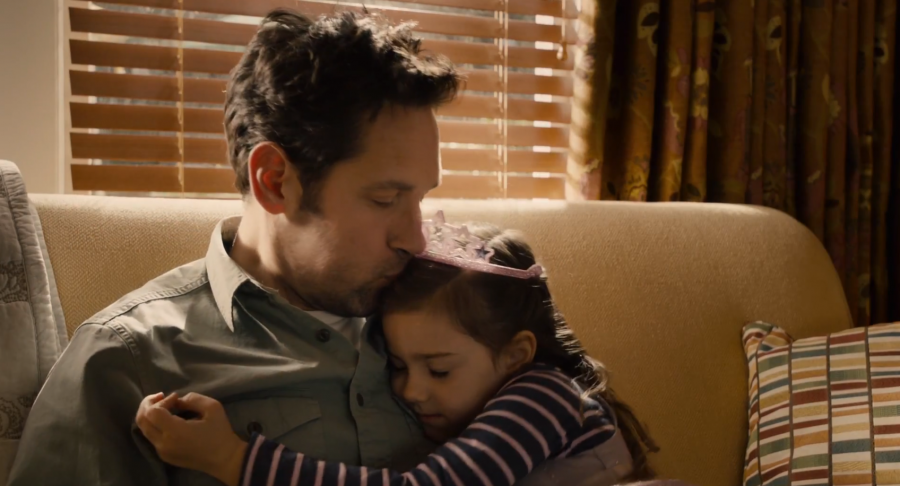
As time goes on, the girl comes to love the man as a father. She starts calling him daddy. At first, he keeps reminding her that he’s not her real father. Soon, he stops and just smiles. The girl enriches his life in ways he never imagined. He wants to be a father to this girl who isn’t his. He wants to love her in the way she deserves.

Then, one day, a woman arrives at his door. She’s angry, disheveled, and badly dressed. She claims to be the girl’s mother. When the girl sees her, she’s terrified and hides behind the man in fear. The man demands that she leave, but she refuses to leave without her daughter. He threatens to call the police, but she threatens to do the same.

She then takes a step closer, revealing bad teeth, foul breath, and loveless eyes, and presents him with an ultimatum. If he doesn’t hand over the girl, she’ll call social services, the police, and the local news crew and tell him that he’s a sick pervert who took a girl off the streets just so he could groom her to be his personal slave.

It doesn’t stop there. She points out that he’s single, unmarried, and living by himself. Conversely, she’s just a poor woman who got taken advantage of by the girl’s biological father, fled out of fear for their safety, and got tragically separated in the process. All she wants to do is get her daughter back and away from a sadistic pervert. She even says she’ll claim he gave her all the girl’s scars.

In that story, he won’t be the man who took a poor little girl under his care and loved her like a father. He’ll become a disgusting pervert, his reputation destroyed and his life ruined. The fact the girls loves him will just be proof of how much he’s groomed her to be his slave.

The man is horrified. The girl says her mother is a liar and a monster. The woman just laughs before asking one more time for the man to hand over the girl. The man, seeing the terrified look in the girl’s eyes, doesn’t want to see her suffer. He then gets up in her face and tells her this.

“You stay the hell away from her! She belongs with me! Lie all you want. I know the truth and so does she.”

The woman just shakes her head and laughs again.

“It doesn’t matter what the truth is. Everyone will believe me at my worst before they believe you at your best.”

This is as far as I could take the story. At this point, the creative process broke down for me. For someone like me who loves telling stories, sexy or otherwise, that’s akin to tripping over my own feet in the middle of a race. It usually takes a lot for me to throw my hands up and give up on a story. This was one of them.

Image result for man in defeat

That’s because when I imagined that final confrontation, I could not come up with a way to see it through. I can easily see the man fighting the woman’s accusations and winning out in the end. I can also see the woman winning out and the man having his life ruined, all because he showed compassion for a little girl.

The fact that I can see both outcomes as equally possible really bothers me and not just because I found myself unable to finish the story. In telling that story, I touched on a disturbing implication of double standards and the assumptions we have about men, women, and how they treat one another.

The story was partially inspired by an incident in the UK where a man, who happens to be a widower, took his teenage daughter on a vacation. When they checked into a motel, though, the staff got suspicious that an older man was traveling with a teenage girl. They called the police on him, suspecting that he might be a pedophile.

 The dad and daughter were staying over for trip to Thorpe Park together

By most measures, it’s a simple, albeit egregious misunderstanding. It deeply disturbed the girl and put the father in a terrible position. He was able to show the staff pictures and IDs to prove that he was the girl’s father and not some pervert. The damage was done, though.

When I read that story, I found myself wondering what would’ve happened if the man hadn’t had those family pictures. Then, I wondered what would’ve happened if the man wasn’t a blood relative of the girl. Then, and this is where the impact got especially heavy, I wondered what would’ve happened if the man had just tried to help a girl who had run away and had nowhere to go.

If he had been a woman helping a 14-year-old girl in her time of need, I doubt anyone would’ve batted an eye. However, because this involves a man and expectations about parenting is different for men, the situation takes on a much darker undertone.

Image result for man with daughter

That undertone highlights why these gender double standards can be so damaging. It’s one thing for those standards to inspire overplayed tropes about men in sitcoms. When they create a real incentive for people to not do the compassionate thing, that’s not just a problem. That creates real, tangible harm in the world.

Men are capable of kindness and compassion. Most decent people believe this. However, when there’s a situation in which assuming the best for one gender requires that you assume the worst for another, that reflects the kind of double standard that needs to be confronted.

We’re already seeing men show more reluctance in being alone with women. Any level of reluctance requires a certain level of fear. When it gets to a point that just being alone with another human being scares us, then that’s a sign that something is very wrong with our attitudes.

7 Comments

Filed under gender issues, sex in society, sexuality

A (Non-Preachy) Lesson In Tolerance In Supergirl #19

635764-_sx1280_ql80_ttd_

Growing up, every TV show that aired between 3:00 p.m. and 6:00 p.m. seemed air some sort of pro-tolerance, anti-bigotry message. These shows assumed, rightly in my case, that a lot of kids who’d just gotten home from school would plop themselves in front of the TV and rather than doing their homework. In terms of targeting a market, it was pretty brilliant.

Having been fed those messages for over two decades now, I think they’ve been belabored to the point where most kids and young adults have gotten the message. Some are even annoyed by it. Even I admit there’s only so many times I can hear some poorly-rendered cartoon character say that tolerance is good and bigotry is bad.

Image result for care bears 90s

In recent years, especially with the rise of certain regressive elements within popular media, these pro-diversity, anti-bigotry messages have gone to distressing extremes. It’s no longer enough to just send the message. It has to be angrily protested by media critics, internet mobs, and hyper-sensitive crowds that push political correctness way past its previous extremes.

I could spend fill several blog posts of instances of people whining about a lack of diversity or complaining that political correctness has gone too far. I can understand the frustration of both sides to some extent. Both see a problem with the way tolerance is being promoted within society and they want to fix it. They both want to make society better and that’s entirely commendable.

Instead of focusing on the frustrations, though, I want to highlight an example of a pro-tolerance, anti-bigotry message done right. By that, I mean it sends a message in a way that doesn’t sound preachy, heavy-handed, or denigrating to another group. As it just so happens, it unfolds in a comic book, a medium that has provided me with many deeper messages in the past.

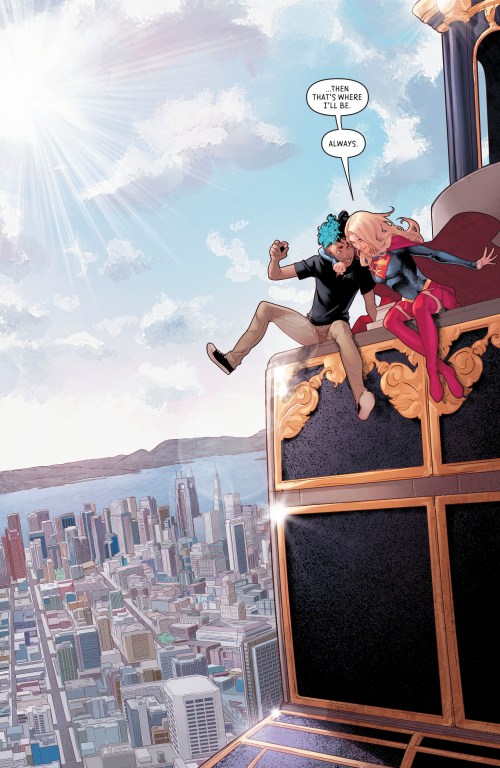
In this instance, the comic is Supergirl #19 by Steve Orlando and Vita Ayala. Being a fan of the “Supergirl” TV show and of beautiful, lovable female heroes in general, I’ve been following this comic since it relaunched in 2016. It’s a series that deals with heroic conflicts typical of DC Comics and anyone remotely associated with Superman. This issue, however, takes a moment to get personal.

Image result for Supergirl Rebirth

The story itself is a brief, self-contained narrative often referred to as a one-shot. You don’t have to know the full story of the character or even the events of the past several issues to understand what’s going on. You don’t even have to know the first thing about Supergirl to appreciate the message that this issue conveys.

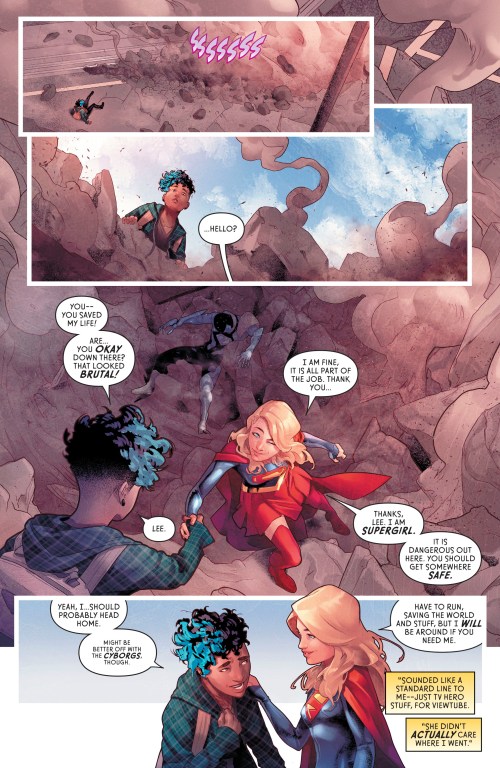
It’s built around a personal story told by a character named Lee Serano, a character whose life Supergirl recently saved. That, in and of itself, isn’t too remarkable. Supergirl, Superman, and pretty much every major DC hero saves the life of a random character in almost every issue. However, it’s Lee’s struggles beyond being in the wrong place at the wrong time that make her note-worthy.

Supergirl (2016-) 019-009

Lee identifies as genderqueer or non-binary, a concept that tends to make headlines for all the wrong reasons. More often than not, stories about people who identify with this label are only identified as a way to point out how far political correctness has gone. It’s often a classification that certain people cite when making fun of those who think there need to be over 58 genders.

Whatever your attitudes towards gender, it’s still generally a dick move to ridicule and degrade someone for identifying that way. Throughout Supergirl #19, Lee doesn’t come off as someone who is just craving attention by identifying as some extreme minority. She comes off as someone who is genuinely conflicted with her gender and is afraid how it’ll affect her.

That’s where Supergirl comes in and this is where the anti-bigotry message gains some unexpected, but welcome dimensions. Like any good hero, Supergirl goes out of her way to help Lee beyond saving her life. She offers her both consolation and sincere affection, as any decent person would to someone who is in distress. The fact she has superpowers is basically an afterthought.

Supergirl (2016-) 019-017

It’s here where Lee stands up for Supergirl in a way that might catch even the anti-PC crowd by surprise. She acknowledges that there are those who look at Supergirl and only see this blond-haired, blue-eyed, traditionally beautiful, able-bodied, cis-gendered woman with superpowers. Her very presence is seen as part of the problem.

The fact she acknowledges this has an important context. This issue takes place at a time when Supergirl is trying to regain the trust of the public. Unlike her more famous cousin, she hasn’t been around long enough to earn everybody’s implicit trust when she makes a mistake. The extent of that mistake is covered in previous issues, but you don’t need to know them to get the message here.

In one of the most revealing scenes, Lee confronts the argument that certain regressive types would use against Supergirl if she ever tried to get involved with gender minorities, social justice, and everything in between. She makes this important comment that sets the tone for the entire story.

“People are out there talking, saying Supergirl’s dangerous, that she can’t be trusted. Saying that her hiding her dad – trying to help him get better – is wrong. I heard the talk. Believed it for a while, even. I mean, she’s the “All-American Ideal – blonde, white, pretty – and she can fly. She MUST think she’s better than us – above us,” and, “There’s no way she could understand,” right? But that’s not the truth.”

This statement is critical in that it highlights the most frustrating part of discussing these issues with the overly-regressive crowd. Their politics and attitudes are so skewed in one direction that they see anyone who doesn’t line up with their particular group, however eccentric it might be, as somehow unworthy of being part of the conversation.

It often happens in discussions involving race, gender, religion, and most other minority issues. For certain people in those discussions, often the angrier, more radical wings, just associating with the majority is seen as fraternizing with the enemy. It doesn’t just limit the conversation. It dehumanizes the opposing side.

Image result for dehumanizing the other side

Supergirl #19 takes the opposite approach in that both Supergirl and Lee are humanized to the upmost. Lee isn’t some confused, attention-seeking teenager. Supergirl isn’t some arrogant, stereotypical stand-in for majority. They’re just two individuals, connecting like mature individuals do to help one another in a time of need. It’s basically a template for simple human decency.

Contrast that with those who claim white people shouldn’t contribute to conversations about race. Contrast that with those who claim beautiful people shouldn’t contribute to issues surrounding body shaming. Contrast that with those who claim men should shut up when discussing women’s issues, scorning anyone who dares to follow Matt Damon’s example.

These instances don’t just take the anti-bigotry, pro-tolerance message to an unhealthy extreme. It angers and alienates those on the other side of the argument. It gives them no reason to listen to what someone who considers themselves gender non-binary has to say, relying instead on prejudices and assumptions.

Image result for prejudice

Neither side benefits from that approach. Nobody helps anyone when two sides of an issue harbor so much animosity that the very presence of another is seen as an insult. Yes, Supergirl does check most of the boxes for someone who faces far fewer issues than a non-white, gender non-binary individual in the United States. That doesn’t mean she’s part of the problem.

I don’t want to spoil the rest of Supergirl #19. Like other comics I’ve singled out in the past, I’d rather people take the time to read it in order to experience the breadth of the story. It’s a story worth heeding during these contentious times. I would argue it offers something far more important than those old after-school PSAs.

More than anything else, it emphasizes treating people as individuals and not lumping them into a particular group with a particular agenda. Lee points out that people just assume Supergirl thinks and feels a certain way because of how she looks and acts. That’s a flawed assumption that dehumanizes and denigrates her.

Image result for Supergirl hugs

It doesn’t matter if Supergirl, or anyone else who gets involved in contentious social issues, looks a certain way or doesn’t check the right boxes. She’s still a human being, albeit one with alien origins. Unless you can actually read her thoughts and feelings, as some DC characters can, then making those assumptions is just a different form of bigotry hiding behind the guise of anti-bigotry.

Supergirl #19 is a solid story with an important message. I would argue it’s more important now than it would’ve been in the days of after-school specials. It’s a good thing to promote tolerance, but not to the point that it inspires intolerable attitudes. Supergirl’s compassion helped Lee in her time of need. Her life and Supergirl’s are better because of it.

The fact that Supergirl didn’t even need to use her powers that much to help Lee is a testament to her character, as well as an inspiration. If she can help a total stranger that much, just by being decent and compassionate, then what’s our excuse?

Image result for Supergirl comics

2 Comments

Filed under Comic Books, Jack Fisher, Superheroes, Current Events, gender issues, human nature

Why Wolverine Of The X-men Is The Perfect Counter To Toxic Masculinity

During a debate, the biggest challenge is making a point that strikes the right chords, evokes the right emotions, and has some semblance of logic. Anyone who has ever engaged in a meaningful debate, be it a formal contest or an argument on a message board, understands the extent of that challenge.

Sometimes, you have to get creative to make those points. Thankfully, getting creative for an aspiring erotica/romance writer and die-hard comic book fan is easier than it is for most people. Every now and then, your mind makes unexpected connections that perfectly encompasses the message you’ve been trying to convey.

This brings me back to “toxic masculinity,” a term I still believe should be retired from the English language, and every other language for that matter. I’ve dedicated multiple posts to deconstructing this concept. Now, I want to take it a step further.

I want to re-frame my stance on this concept by offering a different kind of argument. I’ve already argued that context and social situations are the primary driving force of the traits often ascribed to toxic masculinity.

I still think the point I made about context and social situation is difficult to grasp, even with the references to the rat park experiments. Most people outside of psychology buffs aren’t familiar with those experiments. Instead, I want to make my point by referencing a character that the vast majority of people have heard of to some extent.

Some know him as Logan, James Howlett, Weapon X, or that snarling guy with the claws who helped make Hugh Jackman famous. Most simply know him as Wolverine.

Yes, I’m going to bring Wolverine, one of the most famous male superheroes of all time, into a discussion about toxic masculinity, but not in the way you think. Being an ardent X-men fan who has used superheroes to make points in the past, I feel uniquely qualified to link this iconic character to this concept that so many resent.

On the surface, that sounds like a losing battle. Bear with me, though. When you take a step back and look at Wolverine in the context of masculinity, as a whole, you’ll find that he’s the perfect embodiment of a man who guts the idea of toxic masculinity with his claws and spits on its corpse.

That may seem counter-initiative because anyone who is even somewhat familiar with Wolverine might see him as a man who embodies all the negative traits associated with masculinity. He’s brutish, crude, ill-mannered, ill-tempered, impulsive, violent, and irresponsible. He has all those traits on top of a tendency to go after married women.

However, before anyone starts attributing those traits to toxic masculinity, it’s important to understand the complexities of Wolverine’s story. There’s a reason why he’s often ranked as one of the most compelling characters in the history of comics. His life, persona, and story are full of all sorts of twists and turns. More than anything else, though, Wolverine’s story is one built on dehumanization.

Whether it’s the comics, movies, are cartoons, this is the primary driving force of Wolverine’s story. From his earliest origins to his most defining moments, Wolverine is a man who has been subjected to extreme forms of dehumanization. Some of them, especially those involved in the Weapon X program that made him, have no real-world parallel outside the mind of a North Korean mad scientist.

He’s had his memories erased, his mind warped, his body tortured, and even his soul stolen by a demon. Even by comic book standards, Wolverine has been roughed up more than most. Many people of exceedingly villainous tendencies have tried to strip him of his humanity and turn him into a living, breathing weapon. Needless to say, most of those people died horribly.

As a result, Wolverine is one of the most violent and unpredictable characters in all of comics. He’s also one of the most dangerous, having killed every major hero in the Marvel universe at one point and survived death itself on more than one occasion.

The most remarkable feat though, which also happens to strike directly at the very foundation of toxic masculinity, is his continued desire to cling to his humanity and be the iconic hero that so many X-men fans love.

It’s that drive, and the endearing persona that emerges from it, that makes Wolverine the perfect counter-punch to toxic masculinity. Despite all these dehumanizing forces, he still clings to his humanity. That effort, which has played out in many comics, movies, and cartoons over the years, reflects one important concept.

In essence, Wolverine reflects the idea that it’s really hard to make a man behave in such a toxic way. In order for him to be the kind of man that most people attribute to toxic masculinity, it’s necessary to torture him endlessly, strip him of all identity, and undercut his humanity in the worst way possible. If that kind of force is required, then how can anyone claim that masculinity is inherently toxic?

If those sorts of traits were inherent in men, then someone like Wolverine wouldn’t need that kind of conditioning. He wouldn’t need to be tortured or coerced into being the brutish, blood-thirsty monster that Weapon X wants him to be. If toxic masculinity were valid, someone would just have to give him some metal claws, send him out into the world, and let the magic of testosterone do the rest.

That’s not how men work, though, even in the fictional world. In X-men comics, as well as real life, ideas of masculinity guide men in different ways. For Wolverine, those ways led him to becoming an X-men, an Avenger, and an iconic hero who helped make Hugh Jackman famous. It shows in more than just his heroism.

Throughout his history in the X-men comics, Wolverine has shown that when he’s not being coerced or tortured, he makes an effort to live an honorable life. He seeks love, having even married a couple of a times. He seeks friendships and relationships, some of which have helped make characters like Kitty Pryde and Jubilee famous in their own right. He basically tries to be his own man.

Even though he’s still an asshole at times, he’s an asshole in a way that’s gender neutral. The things Wolverine does that make him an ass are the same things that apply to women. Whether it’s going after someone else’s spouse, undercutting someone’s authority, or randomly running off to do his own thing, there’s nothing Wolverine does that a woman couldn’t also do.

That leads directly to what might be an even more compelling argument for Wolverine being the antithesis of toxic masculinity. That’s because there is a female character who shares many of Wolverine’s experiences and exemplifies the same traits. Those who saw the “Logan” movie last year already know where I’m going with this.

It’s his clone/daughter, Laura “X-23” Kinney. In a sense, she doubles down on the idea that these “toxic” traits are not inherently masculine because she endured dehumanization to a similar extent. In fact, her dehumanization was even worse because she wasn’t given a name, only a number.

Like Wolverine, being subjected to such dehumanization rendered Laura violent, impulsive, and callous. If she were male, then it would be easy for advocates of toxic masculinity to slap her with that label, just like Wolverine. However, her being female undercuts that argument from its very foundation.

Together, the character and story surrounding Wolverine and X-23 undercuts toxic masculinity by establishing that the toxic effects of dehumanization don’t apply to just one gender. Strip away someone’s identity, social support, and humanity and they’ll demonstrate more than a few toxic traits.

What this means in terms of the bigger picture is that those traits attributed to toxic masculinity have a larger context that goes beyond gender. These traits that are tied to certain male behaviors are correlated to one thing, but not necessarily tied to the actual cause. Being a man doesn’t make Wolverine who he is. Being a man who was subject to dehumanizing treatment did that.

Now, apply that to a world where the very idea of masculinity is being subject to all sorts of scrutiny. Joss Whedon went so far as to call certain masculine tendencies a disease when making excuses for his infidelity. By linking everything bad in the world to masculinity, it dehumanizes men by making them seem inherently flawed.

That’s the most insidious implication of toxic masculinity. It’s very much akin to the forces behind Weapon X in that it attempts to deconstruct a core part of someone’s identity, reducing them to a hunk of flesh to be molded for someone else.

Most men don’t want that. Most people, in general, don’t want that. It’s yet another reason why the idea of toxic masculinity needs to be gutted with adamantium claws, locked in an adamantium case, and thrown into the deepest, darkest pits of the real and fictional world.

5 Comments

Filed under gender issues, sex in media, sex in society, sexuality

In Defense Of Hook-Up Culture (To A Point)

635915974671817180628327593_the-crucial-guide-to-surviving-the-hook-up-culture

There are certain cultural phenomena that are difficult to defend. Things like big businesses, the NFL, or the current president come to mind. However, some of those things are attacked, denigrated, or hated for misguided reasons. It’s not always the case that they should be defended, but there are times when a little balance is needed.

When it comes to a topic that’s easy to criticize, hook-up culture has a bigger target than most and that target has only grown in recent years. It’s one of those issues that has fronts for both the unceasing war on horny women and the escalating war on horny men. To defend it means fighting a two-front war, which has historically been a bad idea.

I’m still going to try, though, and not because I think hook-up culture in its current state deserves to be defended. There are certain aspects about that state that I find flawed, some of which I’ve discussed before. Even so, I do believe some aspects of hook-up culture should be defended. I still intend to pick my battles very carefully, though.

At the moment, hook-up culture has been getting attacked on multiple fronts. It used to be that only cantankerous old people whined about young people having more sex than what priests, mullahs, rabbis, and monks deem appropriate. These people saw hook-up culture as antithetical to the idealized nuclear family model that was glorified in every 50s sitcom.

Most people, these days, don’t take that kind of whining seriously. However, a new attack on hook-up culture is actually coming from other young people and otherwise educated people that are smart enough to recognize why those idealized 50s sitcoms were pure fantasy. Instead, they’re attacking hook-up culture as some inherently toxic manifestation that’s destroying men and women alike.

Make no mistake. This attack isn’t restricted to extreme conservatives who see hook-up culture as an affront to traditional values or liberals who see it as a tool of oppression that’s inherently objectifying. It’s not even restricted to man-hating feminists who think cat-calling constitutes assault or women-hating men who see every woman is a gold-digger who wants to ruin his life.

The attack runs deeper than that. Taken all together, these attacks reflects a sentiment that isn’t always hostile to sex, but treats it the same way most people treat a phobia. Regardless of political or agenda affiliation, sex from the attackers is almost always in a context of anxiety, fear, and hyper-vigilance. That phobia manifests in different ways.

If you’re a conservative traditionalist, hook-up culture evokes a fear that anything other than the nuclear family will destroy society and hurt those who participate.

If you’re a liberal progressive, hook-up culture evokes the fear that men will exploit women, using them for their own selfish reasons and subsequently contributing to their continued oppression.

To some extent, I can understand those fears. However, like most phobias that don’t involve spiders, those fear are not justified. They also reflect some very unhealthy attitudes about sex, intimacy, and romance in general.

Some of those attitudes play out in the sensationalized headlines surrounding hook-up culture. In these stories, it’s often portrayed as callous, bland, and overtly hedonistic. People aren’t getting together to fall in love, get married, and make babies. They’re just having sex the same way they would scratch an itch.

For some people, that’s unnerving, especially if they have children above the age of consent. There may even be a twinge of jealousy in that these young people are enjoying the kind of fun that older people didn’t get to experience when they were that age. While I suspect that’s a factor, I don’t think it’s the root cause.

Beyond the cause, though, the attitudes feed the sex-phobic sentiments whenever there’s news that hook-up culture may be harmful. There has been research on the topic and while the American Psychological Association does not draw any sweeping conclusions, it does take the position that hook-up culture is often prone to complications.

Chief among those complications, which also provokes the sentiments of the liberal progressive crowd, are the instances in which people regret hooking up. This is especially sensitive for women. In one study, over 75 percent of the women who’d hooked up with someone regretted it.

For some, it was just an unsatisfying experience. For others, it was somewhat traumatizing. This has become especially taboo since the recent scandal with Aziz Ansari in which the line between regret and misconduct is difficult to see. If you have an agenda, though, confirmation bias will allow you to see these situations as either misogynistic assault or man-hating extortion.

That’s what I find particularly dangerous/revealing about these attacks on hook-up culture. It’s so easy to find instances where people have a bad experience with it or are negatively affected by it. By singling these instances out, whether it’s mental health issues or part of a major celebrity scandal, every side can point to hook-up culture to justify their various sexual anxieties.

It probably doesn’t help that these anxieties may very well contribute to the ongoing orgasm gap between men and women. It also doesn’t help that trends in social media have made hook-up culture even easier to pursue than ever before. By nearly every measure, hook-up culture has little way of defending itself.

This is where I come in and I’m already bracing myself for the criticism.

armor knight man art warrior wallpaper

When I take a step back and look at the intent of hook-up culture instead of the anecdotes surrounding it, I do see something that’s worth defending. I’m not going to discount the negative impact it might have on some people, but I think the sentiment behind hook-up culture deserves more merit.

To highlight that merit, I need only ask a few questions. I doubt I’ll get honest answers from everyone, but at least consider them when contemplating hook-up culture.

Is it possible that hook-up culture reflects some of the inherent flaws with our traditional approaches towards seeking love and sex?

Is it possible that those engaged in hook-up culture are actually looking for some casual intimacy and NOT just hedonistic indulgence?

Is it possible that men prefer hook-up culture because they don’t want to jump through all the hoops of a relationship to get the intimacy and sexual release they desire?

Is it possible that women prefer hook-up culture because they just want to enjoy the toe-curling pleasure that comes with basic sexual intimacy?

Is it possible that some people just want to explore their sexuality without committing too much of their time, energy, and life to a relationship?

None of the questions above are rhetorical or factious in any way. They’re serious, honest questions that I think need to be asked when assessing the issues surrounding hook-up culture.

Regardless of whether or not hook-up culture exists, people are going to get horny. People are going to want to express their sexual desires. There’s no way to stop that. Religion, government, and culture has tried desperately over the years, some going to more extremes than others. All have failed.

This is what I think it hook-up culture’s best defense. It reflects and acknowledges the inherent need of people to express and explore their sexual desires without navigating the myriad of legal, social, and cultural rituals associated with it. In some respects, that reveals the inherent shortcomings in those rituals themselves.

I don’t doubt there are risks associated with hook-up culture. Disease and unwanted pregnancy are at the top of that list, along with instances of exploitation and assault. Focusing on those outcomes is like calling Eddie Murphy’s entire career a failure just because he stared in “Pluto Nash.”

There is a larger context to consider. Remember that study about people regretting their hook-ups? Well, science is rarely that definitive when it comes to matters of human psychology and sexuality. Later studies reveal that the extent of that regret isn’t very strong. It turns out that, like paying to see “Pluto Nash,” we tend to get over it. Most functioning human beings do.

Those same studies also make clear that the quality of the hook-up matters. If someone hooks up with someone for sex, but the sex isn’t satisfying, then of course there’s going to be some regret and anxiety later on. That’s what happens whenever our expectations aren’t met. Just ask anyone who got excited about the Jacksonville Jaguars’ failed Super Bowl guarantee.

This is where the extent of my defense of hook-up culture ends. While I think the various criticisms and anxieties about it are unwarranted, it does carry some baggage that makes all those unpleasant anecdotes so common.

Hook-up culture, in its current form, has all sorts of heavy expectations surrounding it. Whether it’s people actively engaged in it or those observing it from the outside, there’s this sense that hook-up culture is this non-stop party where everyone is enjoying the Caligula-style orgy and nobody leaves unsatisfied. That’s just not how human sexuality works.

Human beings are a passionate, social species. When hook-up culture becomes too dispassionate, which can happen, then it ceases to be a healthy expression of human sexuality. In that context, it’s basically glorified masturbation. As a romance fan and an aspiring erotica/romance writer, I can’t get behind that sort of callousness.

However, I think the attacks on hook-up culture are more misguided than hook-up culture itself. Men are seeing it as an agenda that beautiful women are exploiting. Women are seeing it as an agenda that misogynistic men are exploiting. Liberals and conservatives are seeing it as an affront to everything they deem good and moral. In attacking it, though, they all reveal their own sexual anxieties.

If our collective sexual attitudes are to improve, along with our overall satisfaction, we need to confront these anxieties. Hook-up culture isn’t going away because people wanting to enjoy sex with fewer strings is not going away. We can either learn from it or fight it, with the understanding that fighting it rarely ends well for either side.

Leave a comment

Filed under gender issues, sex in media, sex in society, sexuality