Tag Archives: feminism

A Better Male Feminist: Ron Swanson

When it comes to icons and heroes, it says a lot about society when most these days are fictional characters. We’ve become a very cynical bunch, never putting too much stock into real people. It’s often only a matter of time before they tweet something stupid or are discovered to be card-carrying asshole.

In some ways, it’s a sign of the times. We are an exceedingly jaded bunch, born from a generation of burned-out hippies. We also live in a world where we have no concept of privacy and no ability to give anyone who holds problematic opinions a pass. For anyone who becomes an icon, it’s usually only a matter of time before they say or do something to ruin their iconic status.

Recently, Joss Whedon added his name to that bloated list of fallen icons. Up until a few weeks ago, he wasn’t just a successful director and alpha dog of geek culture. He was held up, by many, as a feminist icon. He was the gold standard that feminists referred to when asked to reference how a male feminist should conduct themselves.

Now, like so many other icons whose hypocrisy was exposed, Joss Whedon’s once impeccable feminist credentials have been shattered. While I’ve argued that his hypocrisy isn’t quite on the same level as other less reputable celebrities, it’s still a mortal blow, of sorts, to his status as an icon. He may still be a celebrity and a successful director, but he cannot be a feminist icon anymore.

I think that’s more than tragic. As an unapologetic fan of superhero comics, I know the value of having an iconic hero who embodies the values of a particular idea. While I’ve taken issue with certain brands of feminism, I do think there are still important women’s issues that deserve attention. Those kinds of struggles need icons and heroes.

So, in lieu of Joss Whedon’s shortcomings in this area, I’d like to offer an alternative to those seeking a new feminist hero who can raise the bar for everyone in terms of true gender equality. That hero is already an icon to many and one whose feminist credentials are a lot more pragmatic than Whedon’s ever were.

He’s a man, but he’s a man who earns the respect of men, women, and everything in between. He’s also a fictional character, but one who managed to carve a special place in popular culture for all the right reasons. Ladies, gentlemen, and those of unspecified gender, I give you the ultimate feminist hero, Ron Swanson.
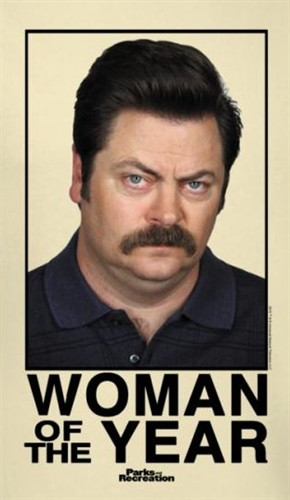
To those who haven’t watched every episode of “Parks and Recreation,” bear with me. I have a feeling that those already familiar with the unstoppable force of American manliness that is Ron Swanson don’t need much convincing. They already know damn well why this man deserves to be an icon to men and woman alike.

For the sake of those who haven’t seen the show, and I weep for those people, allow me to explain. Ron Swanson isn’t just a man of many talents, from wood-working to cutting wasteful government spending. He’s a man of principle. Throughout every season of the show, he makes those principles clear and doesn’t give a wet fart about whose feelings or faces are hurt in the process.

Those are ideals that plenty of men can respect. However, it’s how he conducts himself around women that sets him apart even more. The fact he can do so with a perfectly groomed mustache is just an awesome bonus.

One of Ron Swanson’s most defining traits is that he deals with everyone the same way and sees them on a similar level, as individuals. Specifically, he sees most people as morons who annoy him and are too lazy/stupid/weak to solve their own problems. Yes, that’s a somewhat cynical view of people in general, but that’s just it. It’s how he views people.

Ron Swanson is nothing if not even-handed in dealing with men and women alike. Throughout the show, he holds both genders to the same standard. If you annoy him, as most people do, he won’t give you special treatment on the basis of what body parts you may or may not have. Annoyance is annoyance, no matter where it comes from.

That is, in essence, what traditional feminism has been about, treating both genders fairly and holding them to a similar standard. Ron Swanson does that better than anyone. Moreover, he doesn’t need to be constantly reminded. That’s just how he rolls. He doesn’t need any rigorous feminist training.

He also trusts women to be as capable as men in whatever tasks he gives them. While he’s the director of the Pawnee Park’s Department, he delegates most of the tasks to his deputy, Leslie Knope. However, he doesn’t do that because he has to. He does it because he trusts her to do the job and because Leslie wants that job.

His relationship with Leslie Knope shows that Ron is capable of working with women, trusting them, and acknowledging their value in a professional, non-romantic sort of way.

He has a similar relationship with his assistant, the crass and crude April Ludgate. Again, Ron doesn’t give her the job because she’s a woman. He gives her the job because he knows she’ll do it effectively. He also doesn’t try to make her conform to any particular standard for an assistant, gender or otherwise. He lets her be herself. Can you think of fairer, more pro-feminist way to deal with a female employee? I think not.

Beyond his working relationships, Ron shows he’s also capable of having deeper relationships with other women. Not all of them are healthy, though. He’s been divorced twice, both to women named Tammy. However, it’s these unhealthy relationships that really help solidify Ron’s status as a true feminist hero for men and women alike.

In a sense, Ron’s ex-wives are the very antithesis of feminism. In fact, they’re perfect feminist villains. Tammy One, as Ron calls her, is a joyless, ball-busting tyrant who has the warmth and comfort of a venomous snake. She exists to control everyone around her, especially Ron. She doesn’t accept anyone for who they are. She tries to mold them into whoever she wants them to be. Men and women alike are right to fear her.

On top of that, she works for the IRS. I honestly can’t think of a way to make anyone, man or woman, more terrifying. The fact that Ron survived a marriage with her should immediately give him credibility with any feminist looking to avoid the label of a man-hater.
Then, there’s Tammy Two, as Ron calls her, and while not quite as terrifying, she’s every bit as devious. What she lacks in Tammy One’s callousness, she more than makes up for with weaponized sex appeal. I’m not talking about the cute, lovable kind of sex appeal either. I’m talking about the kind that attempts to strangle a man with brute vaginal strength.

Like Tammy One, Tammy Two attempts to use sex to bend men and everyone around her to her will. Throughout the show, she makes multiple attempts to seduce Ron back into her grasp and almost succeeds a number of times. Despite her supernatural ability to manipulate men with her vagina, Ron is able to resist and break her hold.

On one level, that’s a perfect demonstration of a woman who uses sexuality for manipulation, something feminists and men’s rights activists alike complain about. On another, it also demonstrates that some men cannot be bought with sex, no matter how wild and amazing it might be. Ron is one of those men and he’s a better man because of it.

Despite his experiences with his ex-wives, Ron Swanson still treats women fairly. He’s even a romantic, of sorts, and not just towards bacon. In the later seasons of the show, he meets a woman named Diane Lewis and she’s everything the Tammys aren’t.

She accepts him for who he is, doesn’t want him to change, and eventually marries him. Ron treats her the same. Theirs is a true relationship of equals, a kind that feminists can respect and admire alongside that of Cyclops and Jean Grey. For a man to have endured two failed marriages to two monstrous women, yet still love a better woman for all the right reasons, is as heroic a story as any, especially within a feminist context.

Between the way Ron works with women, the way he loves them, and the way he deals with them, he demonstrates a far more refined approach to feminism than Joss Whedon ever did. He didn’t need to create female heroes. He didn’t need to make multi-billion dollar movies or iconic TV shows. He just had to show that it’s possible to deal with women in a fair, equal, and respectful way.

The fact that Ron does all of that without being the kind of whiney beta-male that makes every male feminist sound like they have a deflated scrotum. Ron is, by every measure, as alpha as it gets when it comes to men. He’s strong, he’s tough, he’s stern, and he has one of the manliest mustaches of all time. No one in their right mind would doubt this man’s masculine credentials.

On top of that, he’s not the kind overly-muscled, John Rambo kind of alpha male with woefully impractical muscles and ridiculous skills that nobody without Arnold Schwarzenegger’s body-building routine can hope to match. Ron Swanson has the build and physique of an actual man. He does set the bar too high or inspire body image issues, except when it comes to manly facial hair.

By nearly every measure, Ron Swanson is the kind of man that should earn him a place in the feminist hall of fame. He is everything men respect and women admire. He should be the icon and hero that feminists refer to.

I’m not saying he’s without flaws. I’m not saying there aren’t other men, real and fictional, who deserve a similar status. I’m just saying that Ron Swanson is the kind if icon that feminists can rally around. Granted, Ron doesn’t care much for rallies, icons, heroes, or annoying people in general, but that’s what makes him Ron fucking Swanson.

3 Comments

Filed under Celebrities and Celebrity Culture, Current Events, gender issues

Joss Whedon: Feminist Hypocrite Or All Too Human?

Happier times: Architect and producer Cole claims that Whedon cheated on her multiple times through their 16 year marriage in her piece for The Wrap; (pictured 2010)

If you’ve been following this blog in any capacity, or even the past few months, you’ve probably picked up on a number of themes. If you’re new and just stumbled across this blog because you noticed how much it talks about boobs, sex robots, and Deadpool, then here’s a quick rundown of those themes.

  • Every human being is at the mercy of their brain wiring to a large extent
  • Our brain wiring still assumes that we’re a bunch of cavemen hunting and foraging in the savanna
  • Our brains and body structure have two primary purposes, survival and reproduction
  • Any function other than survival and reproduction is secondary
  • Our overall biology is a blunt instrument that is nearly incapable of being precise, specific, or consistent
  • People will make endless excuses to justify actions they think were more logical than they actually are
  • Sex robots are awesome and cannot come soon enough

For this post, which highlights a major story that broke recently, it’ll cover almost all of those themes, minus the sex robots. It’s also a story that’s still developing so, in all likelihood, the details are bound to change at some point.


That tends to happen a lot when the story involves divorce, celebrities, and potential hypocrisy on a level that even our celebrity-loving culture can’t tolerate. I’ve made an issue of that kind of hypocrisy before when sex icon and walking male fantasy Pamela Anderson came out against porn, despite having become rich and famous from it. This, however, involves a different kind of hypocrisy.

This brings me Joss Whedon, whose life seems to have taken a few tumbles since it peaked while directing “The Avengers.” It’s not just that he never got “Firefly” un-cancelled or did not do a good job of handling the less-than-flattering controversy surrounding “Avengers: Age of Ultron.” His personal life is also suffering.

Lately, Whedon has been going through a long, tedious divorce with his wife, Kai Cole. Divorce is always rough, even when you’re as celebrated and successful as Joss Whedon. Celebrity couples endure it with distressing frequency, as Chris Pratt and Anna Faris recently learned. However, Whedon’s divorce has incurred another story with even larger implications.

Granted, it doesn’t take much to make divorce even more painful, especially when you have the resources of a celebrity. This might be one case where the pain goes beyond the relationship, revealing something about ourselves that’s as impactful as any billion-dollar movie.

That pain came in the form of a letter that Kai Cole penned about her husband for The Wrap. This is not just an angry rant from a bitter ex-wife, although that’s definitely a part of it. This letter potentially reveals a level of hypocrisy that may undermine our ability to trust any male celebrity who claims to be an ardent feminist.

While I’ve articulated my doubts about those kinds of figures before, Ms. Cole’s article is basically a perfect storm, of sorts. That’s because, until this letter, Joss Whedon had a reputation as being the quintessential male feminist in Hollywood geek culture.

He did plenty to earn that reputation too by creating shows like “Buffy the Vampire Slayer,” “Dollhouse,” and the aforementioned “Firefly.” He even wrote comics like Astonishing X-men. The man had a long list of accomplishments. The fact he did so much under the feminist label says a lot about him.

Then, this letter comes along that basically says Whedon’s feminist credentials are built on a lie. It’s a major revelation that may not have surprised some, but it’s still pretty jarring for those who held Whedon as the gold standard for male feminism.

For some context, here are some of the things his ex-wife said about those lies. I’ll give die-hard Buffy fans a moment to brace themselves.

There were times in our relationship that I was uncomfortable with the attention Joss paid other women. He always had a lot of female friends, but he told me it was because his mother raised him as a feminist, so he just liked women better. He said he admired and respected females, he didn’t lust after them. I believed him and trusted him. On the set of “Buffy,” Joss decided to have his first secret affair.

Fifteen years later, when he was done with our marriage and finally ready to tell the truth, he wrote me, “When I was running ‘Buffy,’ I was surrounded by beautiful, needy, aggressive young women. It felt like I had a disease, like something from a Greek myth. Suddenly I am a powerful producer and the world is laid out at my feet and I can’t touch it.” But he did touch it. He said he understood, “I would have to lie — or conceal some part of the truth — for the rest of my life,” but he did it anyway, hoping that first affair, “would be ENOUGH, that THEN we could move on and outlast it.”

Joss admitted that for the next decade and a half, he hid multiple affairs and a number of inappropriate emotional ones that he had with his actresses, co-workers, fans and friends, while he stayed married to me. He wrote me a letter when our marriage was falling apart, but I still didn’t know the whole truth, and said, “I’ve never loved anyone or wanted to be with anyone in any real or long-term way except for you ever. And I love our life. I love how you are, how we are, who you are and what we’ve done both separately and together, how much fun we have…” He wanted it all; he didn’t want to choose, so he accepted the duality as a part of his life.

Now before I say anything else about this issue or Ms. Cole’s letter, I need to make one thing clear. This letter is just one side of the story. As of this post, Joss Whedon and his people have not commented on this letter. That could change between now and the second after I publish this post.

Also, keep in mind that the person who wrote this letter is an ex-wife who probably isn’t feeling too happy with her former husband. She has reason and incentive, due to his wealth and status, to undermine his reputation. That’s usually all anyone needs to shrug off details, context, and facts.

For that reason, and others I don’t have time to get into, it’s unreasonable to assume that every word of Ms. Cole’s letter is completely true. It’s also just as unreasonable to assume that every word is false. Even if she is bitter, there may very well be elements of truth behind her claims. We’ve seen how hard it is to expose the hard truth of celebrities.

For the sake of exploring the implications, here, let’s assume that at least part of Ms. Cole’s letter is true. Since they are divorcing, it’s entirely plausible that Whedon was not entirely faithful during their marriage.

He’s a big name Hollywood director, armed with obscene amounts of money and influence. If you think for a second that beautiful women aren’t going to throw themselves at someone like that, then I suggest you watch some old Motley Crue music videos. Feminist or not, people are attracted to wealth and power. How else do you explain Mick Jagger having kids with women more than half his age?

I think it’s a near certainty that, at some point in his career, a beautiful young woman has offered herself to Joss Whedon in ways that would make Anastasia Steele blush. I wouldn’t be surprised at all if some just showed up naked at his trailer and offered a guided tour of their vaginas. The only uncertainty is the extent to which Mr. Whedon accepted these offers.

Even if he accepted just one and never did it again, that would still be a major blow to his feminist credentials. Think of it from the perspective of the feminist characters that Mr. Whedon usually champions. What he did would be the antithesis of the narratives he tried to forge with shows like “Buffy the Vampire Slayer.” Instead, it would basically be the same narrative of at least half of every porno ever made.

In that story, he’s anything but the feminist he claims to be. He’s a powerful man who uses his power and wealth to get sex from the kinds of eager young women who would fail the Bechtal Test on every level. It doesn’t matter that these women willingly offered sex. It still gives the impression that he’s a powerful man who’s using his position to get the kind of sex usually reserved for the villains in a “Mad Max” movie.

According to the letter, Ms. Cole was not an absent force in his life so it wasn’t like she was never around. She makes clear that she helped him with his career. She even contributed in some ways. However, those contributions didn’t stop Whedon from taking advantages of the sexy opportunities that presented themselves, often quite literally.

Whatever the extent of Whedon’s infidelity, if true, it still begs one important question. Does what he did make him a hypocrite in the eyes of feminism? Well, I would argue that it does, but to a very limited extent.

What he did was not very feminist. In fact, it was about as progressive as the setting of “Mad Men.” He plays directly into the narratives he claims to resent. However, he didn’t actively seek that narrative. It sought him. He’s a man. Feminist or not, when beautiful women throw themselves at you, that caveman brain of yours is going to take notice.

In Ms. Cole’s letter, she quoted Mr. Whedon offering an excuse for his behavior. Given what I’ve said about excuses, certain details should be fairly obvious.

When I was running ‘Buffy,’ I was surrounded by beautiful, needy, aggressive young women. It felt like I had a disease, like something from a Greek myth. Suddenly I am a powerful producer and the world is laid out at my feet and I can’t touch it.

That bold portion was my doing. Read it over a few times and think about what he’s saying. Mr. Whedon is implying that the concept of being surrounded by beautiful women wanting to throw themselves at you and feeling inclined to accept their eager offers isn’t just antithetical to feminism. It’s a disease.

That creates a couple of problems, both for his feminist narrative and his depleted excuse bank. One, it implies that, by being a disease, there’s some outside force responsible for his behavior and he’s somehow not responsible. Two, it also implies that a man wanting to enjoy the sexual opportunities that come his way is somehow inherently wrong.

Both of those problems fail miserably within the context of caveman logic and simple human nature. In fact, it even fails within the context of the natural biology of life that prioritizes survival and reproduction. Mr. Whedon did more than enough to acquire abundant resources for survival. Then, opportunities to reproduce follow and nearly every law of nature makes him inclined to use those opportunities.

In that sense, Mr. Whedon is not a hypocrite, but he is misguided in his understanding of sexual dynamics. I don’t deny that he sees himself as a pro-feminist person. However, I think that’s such a huge part of his identity that he’s willing to make more excuses than most to protect it. It’s really no different than what happened with Ted Haggard.

If Joss Whedon weren’t so closely associated with feminism, then the revelation that he might have cheated on his wife probably wouldn’t be news. He would just be another powerful man in Hollywood who enjoyed the fruits of being rich and famous. However, it’s his excuses, as Ms. Cole describes them, that are most telling.

It also reflects the distressing flaws in the kinds of sex-negative feminism that pervade certain parts of Hollywood and mass media. It paints certain sexual dynamics between gender, which are entirely logical within the context of biology, and paints them as flawed.

Now, I don’t deny that the human body has its flaws. Any man who has been kicked in the balls will attest to that. However, attempting to subvert those flaws never ends well. Just ask anyone who has survived gay conversion therapy. Any man or women who thought Mr. Whedon could subvert those same forces in the name of feminism is living in a fantasy world every bit as flawed as “Dollhouse.”

So while I don’t think it’s right to call Mr. Whedon a total hypocrite, I do think his actions, if true, reflect poorly on the principles he’s preached. It also reflects poorly on the brand of feminism that insists that certain male inclinations are inherently wrong. Mr. Whedon may be a great director and a less-than-perfect husband, but he’s still a man at the end of the day. If we acknowledge that, then we don’t need as many excuses.

6 Comments

Filed under Celebrities and Celebrity Culture, Current Events, Reasons and Excuses

What Makes A Woman An Asshole?

These days, discussing any inherent differences between men and women is an easy way to turn a casual conversation to a blood feud between radical feminists and angry men’s right’s activities. It doesn’t matter if there’s substance, logic, or legitimate issues involved. It only takes one poorly-worded remark to turn a simple discussion into an all-out gender war.

In general, I try not to take sides in that war or give either side any ammunition. I’ve learned, often the hard way, that no good can ever come from angry debates on the internet about any relevant subject. Eating sand and rubbing my ass on my computer screen would be just as productive.

While this hasn’t stopped me from commenting on certain issues regarding feminism and various gender issues, I’ve generally tried to limit the amount of time and energy I spend on these topics. If I can’t apply it to something sexy or something relating to my efforts to be an erotica/romance writer, I generally don’t bother.

Well, when I did my article on the factors of what makes men assholes, I knew I would do something similar for women at some point. For one, it’s only fair that I give both genders equal weight on this topic because being an asshole is one of the few issues that’s truly gender neutral. No matter what genitals we may or may not have, we still have assholes and we’re just as capable as being one.

However, and this is where I’m sure I’ll get in trouble with the more radical elements of gender issues, women deal with very different dynamics, compared to men. Some are biological. Some are societal. Some are just basic variations we see from person to person. Regardless of how convinced you are of one gender’s superiority/inferiority, it’s impossible to deny that both genders breed assholes.

As with the men, understanding those factors is important to creating characters in a story. Not all of the female characters involved will be paragons of virtue with the chastity of a devout nun. Some are just going to be assholes who just happen to be female.

Skin Deep” had more than a few female characters who fit that description. In fact, you could argue that Mary Williams, the second protagonist and primary love interest to Ben Prescott, started off the story as a selfish asshole who didn’t realize she was just exploiting her looks to be popular. While she underwent a dramatic change, others like her friend, Melissa Miller, did not.

It’s debatable just how much an asshole Melissa was in the context of the story. She was definitely no Regina George or Quinn Morgendorffer, but she definitely walked a fine line between just being selfish and being an outright asshole of the bitchiest variety.

As with men, we’ve all probably dealt with female assholes at some point in our lives. The main difference with women is that they’re not as overt about it, compared to men. Yes, I realize there are some women who will match and exceed men in certain instances, but in general, the female genders have an style of asshole that’s all their own.

So, just as I did with the men, I’m going craft another list of basic factors to explore the unique elements associated with female assholes. Some might also call these the factors of a bitch, but I prefer the asshole label and not just because it’s more gender neutral. A bitch can just be a state of mind. An asshole is a way of life.

Again, I realize that this list will be somewhat limited than the one for men because I’m a man. However, I’m also human and women are human, last I checked. I don’t deny that my gender does influence the way I interpret the world and that has shown on this blog before. So please keep that in mind before you start another gender war on this blog.

It’s also because I’m a man and my perspective is limited, I encourage the female portion of my audience to comment and, if necessary, correct my list. I think it’s important that we all know the factors influencing male and female assholes, alike. If we’re going to have to deal with these people in life, then we might as well be proactive.


Asshole Factor #1: Completely (And Willfully) Lacking In Self-Awareness

It’s one thing for a girl just to be ditzy and clueless. There are women, and even plenty of men, who just haven’t made enough sense of the world to really understand why some of the things they do come off as annoying. These people aren’t assholes. They’re just ignorant or misguided.

What crosses the line between ignorant and asshole is akin to a suspension of belief that just being a girl is somehow a substitute for actually doing something. This is most comment with cute, naturally beautiful women who think people are nice to them just because they’re inherently awesome.

They think this, despite wearing skin-tight jeans and push-up bras. It would be one thing if they just flaunted their beauty with the full understanding that it gave them an edge. Those kinds of women aren’t assholes. They’re just honest. The dishonest ones, namely the Quinn Morgendorffers of the world, don’t even make the effort.

Beyond the laziness, that willful lack of self-awareness ensures they always have a flawed view of the world. They think they’re more special than they actually are and don’t make an effort to do anything other than exploit their looks or their gender. The extent to which they’ll avoid any meaningful depth is what makes them a unique brand of asshole.


Asshole Factor #2: Getting Others To (Unknowingly) Fight Their Battles For Them

This is something I find that women do better than men in almost every case. It would actually be strategic and cunning if it weren’t such a common tactic for assholes. Whereas a male asshole would just brutishly charge into battle, swinging his fists and not caring if his fly was unzipped, a female asshole will get others to do the hard work for them so she can sit back, sip martinis, and laugh her ass off from a distance.

Sometimes it takes the form of lurid gossip that turns into full-blown rumors. Sometimes it takes the form of using social status to effectively outsource direct acts of assholery. Back in college, I knew a girl who gave her ex-boyfriend’s roommate a blowjob in exchange for installing malware on his laptop. Yes, it was an asshole move, but you can’t argue with results.

This is also what makes asshole women every bit as dangerous as men, if not more so in some instances. Just ask Cersei Lannister. They don’t even have to go so far as to offer a blowjob or a nude picture to get others to do stuff for them. Sometimes, they just create the impression that doing their bidding will win them favors that may involve nudity. Sure, it’s working smarter and not harder, but it still makes her an asshole.


Asshole Factor #3: Treating Every Friend And/Or Lover As Disposable

This is probably the most overt manifestation of the female asshole. That’s not to say men don’t do it too. They most certainly do. There are men who treat women and other men with the same care as a used candy wrapper. What sets women apart, though, is the breadth and spectacle of their actions.

It’s one of those traits that’s easy to spot in spoiled rich girls who see everyone as an employee who is legally required to do what they say. However, it also shows up in the non-spoiled brat crowd just as often. Whether a girl is just pretty or well-connected, she actively avoids any deeper connection with others. People are just a means to an end for her.

Whereas asshole men will often employ that approach when it comes to getting sex, women use it to get everything, including sex. The line between their friends, colleagues, and lovers is distressingly thin, if not invisible. The second she’s done with someone, or senses they serve no further purpose to her, she jumps at the first opportunity to abandon them like a used tissue.


Asshole Factor #4: Making Everything An Agenda For Or Against Them

People blaming other people for their failings is nothing new. Everybody of every gender has done it at some point in their lives to some extent. It’s part of the mechanism that our brains use to protect our overly fragile ego. It doesn’t always make someone an asshole, but it certainly can when taken to an extreme.

In my experience, women are more eager to go to that extreme then men. It often shows up at radical feminist rallies or internet shouting matches about who’s the bigger victim. Whatever the setting or the ideology, the intent is the same. The female asshole goes out of her way to not just blame everyone for their problems, but make it seem as though everyone is actively plotting against her.

This is conspiracy thinking on the level of Alex Jones, assuming he’s not faking it. It’s what female assholes use to either derail or end an argument. It doesn’t always have to involve debates on feminism too. A simple debate with a friend, spouse, or co-worker can turn everyone into a Lex Luthor level villain who deserves every asshole thing done to them.

Such asshole tactics, when employed effectively, can make it both convenient and easy for someone to be the kind of asshole they want to be. While male assholes may occasionally explore these tactics, female assholes have mastered them.


Asshole Factor #5: An Eagerness To Weaponize Whining/Annoyance

This factor goes all the way back to childhood for certain asshole women. They learned early on that whining incessantly can help get them what they want and they never unlearned that tactic when they got older. When they were little, it made them a brat. As an adult, it makes them an asshole.

In my experience, women channel their ability to whine and annoy better than any man. It’s not enough for them to just be loud. They’re very tactical with their whining, striking just the right emotional chords to get someone to react in just the way they want. They’ll still be the asshole, but they’ll make it so everyone around them is an even bigger asshole by not heeding her whining.

On some levels, asshole women seem to know that people in general have a low capacity for annoyance. If they exceed that capacity to any reasonable extent, they can get others to either concede their point, even when they’re wrong, or make any meaningful exchange impossible. It’s basically the social equivalent of cheating at a video game and cheaters tend to be assholes.


Asshole Factor #6: Always Talking Down To Everyone (And Never Justifying It)

In general, we expect assholes to talk down to us. At the same time, however, we celebrate and cheer leaders who do the same. What’s the difference? Why do we love one and hate the other?

With respect to assholes, it has to do with merit. A good leader earns the right to talk down to others. Assholes don’t even bother. Male assholes might be loud and annoying, but at least they’ll yell directly into your face. A female asshole has to take it a step further. She has to elevate herself or bring someone else down before she can start yelling.

This is where asshole women maximize their excuse bank, doing anything and everything to put them in a position to yell at others in a way where they can’t respond. We see it lousy teachers, bad parents, and women who just think they deserve a greater say because they have a vagina.

The tactics may be more subtle, but the themes are the same. An asshole will not give two licks of a squirrels nut sack about substance, effort, or reason. They would rather just skip those steps and get to the part where they can just be an asshole and get away with it.


Once again, please refrain from turning the comments section of my blog into Round 1,039,280,860,896,077 of angry feminists versus whiny men’s rights activities. I understand my blog doesn’t get the kind of traffic to warrant that level of discourse just yet, but I would still prefer to leave those kinds of discussions to 4chan and Reddit.

As with the men’s list, though, I encourage others to leave comments and suggest other factors to add to either list. The struggle against assholes, male and female alike, is real for all of us. The more we know, the better-equipped we’ll be in the long run.

7 Comments

Filed under Jack Fisher's Insights, Marriage and Relationships, Reasons and Excuses

Comics, Milkshakes, And (Failing To Fight) Internet Trolls

Before I say anything, I need to make one thing clear. I am extremely reluctant to talk about an issue that’s still fresh, so to speak. In general, I prefer to wait until he uproar has died down and/or the angry masses of the internet have tired themselves out over an issue. I usually find it easier to sift through the rubble after the storm has passed.

This may very well be the most hesitant I’ve ever been to talk about a particular issue. Think about that for a moment. I’m someone who has talked about sex robots, awkward boners, and his own circumcision. If I’m reluctant to talk about a topic, then it must be pretty nasty.

Well, don’t adjust your gag reflex just yet because it’s not that kind of topic. This isn’t something that just sparks revulsion or passionate disagreement. This is the kind of stuff that just brings out the worst in everybody. It’s like licking the shit stains on a toilet before they’ve dried. It just makes a bad topic that much worse.

However, I’m willing to suck in my gut, brace myself, and ignore my reluctance because I feel like this is something that needs to be said while certain people are still listening. Plus, it involves comics and the comic book industry. Other than the erotica/romance industry, few are quite so near and dear to me.

Even those who don’t follow the industry probably noticed an unusual hashtag trending in the news recently. It involved an incident with some of Marvel’s editorial staff. When I first saw it, I had no idea it was a controversy. I thought it was some new promotional effort. Marvel, and most comic companies, do that all the time.

For once, I’m sad to say that this had nothing to do with an ad gimmick. The hashtag in question was #MakeMineMilkshake and it was inspired by this innocent-looking tweet from Heather Antos, who happens to be an editor at Marvel.

I actually saw this on my Twitter feed. I thought it was a nice moment. It put a smile on my face. It involved milkshakes, comics, and cute girls in the comic book industry. I honestly can’t think of something more appealing to me without adding pizza, the beach, or free tickets to a football game.

Then, some asshole internet trolls, of which there are many, had to look at this happy little moment and mess it up for everyone. They did this by replying to the Tweet with a bunch of crude, vulgar comments. I won’t get into the substance of those comments because they’re not worth spreading. I won’t even make an assessment over how bad they were. I’ve been to the many toilets of the internet. I know how bad it can get.

However bad it was, it created a hashtag that has spread like a wildfire and burned away any faith you might have had in humanity, comics, or peoples’ ability to discuss an issue rationally. Like other hashtags before it, #MakeMineMarvel has become a catalyst for two sides of a pointless debate to whine and moan endlessly about how right they are. It’s a debate that nobody can ever win.

The hashtag, which I doubt Ms. Antos intended to start, has created this rage-filled rant on toxic sub-cultures like comics. On one side, you have those claiming that it’s full of angry young men who don’t want to see women screwing up their favorite toys. On the other, you have those who feel like they’re being demonized for comments that just a few idiot trolls made. Again, nobody wins that debate.

It was frustrating to me because, being a man, it made me feel like I’m being lumped in with the same group of assholes and I want no part of that. I didn’t respond to Ms. Antos’ tweet. I didn’t respond to anyone who asked me to respond. This was just a hornet’s nest that I didn’t want to poke.

An abandoned hornet's nest my dad found in his shed that he hadn't been in for a couple years. The head is apart of a wooden statue it fused with.

Then, the hashtag kept trending and people at Marvel and DC, two rival companies mind you, began responding to it. They even made milkshakes into counter-protest, of sorts, using it to fight against internet trolls and toxic subcultures. Considering some of the other protests we’ve seen this past year, I think that’s a fairly innocuous method.

However, the mere fact that this is even a thing speaks to a much larger issue. It’s one of those things where neither side, be it Ms. Antos or those who now despise her, can see the forest from the trees. After it started trending, Ms. Antos posted this tweet and understandably so. There are just certain parts of the internet and certain people who use it that completely warrant that sentiment.

Now, here’s where I start saying things that I know will rub certain people the wrong way. I’m going to try and be very careful with my words here.

I don’t want to start a new hashtag or anything. I also don’t want to get blocked because I follow people like Heather Antos on social media. I’ve said enough dumb things in the past and I’m trying to limit that, especially in these sensitive times we live in. I’ll do my best to be polite about it, but I’m not going to shy away from the truth. I’m just going to add what I hope is meaningful context.

With that in mind, I’d like to send Ms. Antos an important message that I doubt she’ll never read. That same message should apply to others who supported her since #MakeMineMilkshake started trending. Here it is and excuse me while I brace myself with an adamantium shield.

“The trolls have already won. You’re letting them win with every word you say about this issue. PLEASE change the way you fight them.”

I’m going to keep that adamantium shield up just in case, but I know this will probably take some uncomfortable explanations. I’ve talked about dealing with internet trolls before. I’ve also talked about professional trolls who go out of their way to start digital shit storms like this for their own benefit. What I’ve seen with #MakeMineMilkshake is basically a case-study in how not to respond to trolls.

Now, that’s not to say that Ms. Antos’ intentions are misguided. I don’t doubt for a second that she responded to the comments she got in the best way she thought possible. Maybe she didn’t intend for it to start trending. Nobody can really know whether or not something will become a thing, especially if it doesn’t involve cute animals.

Even if #MakeMineMilkshake didn’t start trending, though, Ms. Antos’ response would’ve already ceded some form of victory to the trolls. Like punting on third down in a football game, she didn’t adapt her game plan. Given how quickly this unfolded, I doubt she thought she even needed one.

The problem with turning her response into a hashtag, albeit indirectly, is that doing so gave the trolls exactly what they wanted. With every retweet, response, and cute quip, they get even more. That’s because trolls don’t deal in the traditional currencies of shame, sorrow, and basic human decency. They only understand one form of coin and that’s attention.

It may very well be the most important currency of the digital age. It may even be more than just a currency. It could very well be the life force with which trolls need to sustain themselves. Like Galactus, devourer of worlds, the hunger is never sated. Lacking heralds or The Power Cosmic, these trolls must resort to the lowest lows of the internet to feed their hunger.

With #MakeMineMilkshake, they basically got a free buffet and a complementary desert. I guarantee that once this hashtag started trending, they didn’t cower with fear, dread, or remorse. They’re probably still grinning and twirling their fake mustache. If they could make a collective statement towards Ms. Antos and everyone who came to her defense, this is what they would probably say.

“Ha! I did it! I got under her skin. I made this person who is more successful than I’ll ever be cry out for help, play the victim, and seek validation. They can call me a racist, bigoted, sexist pig all they want. It doesn’t matter. They just proved they’re a bunch of thin-skinned, hyper-sensitive snowflakes. Now, thanks to the hashtag, the world knows it! They know it and it’s all because of me! Mwhahahahahahaha!”

I concede that the evil laughter might be an exaggeration, but since this involves comics, I think it’s appropriate. Internet trolls are the closest thing most of us have to villains. Other than former child stars and the IRS, it’s hard to think of anyone more devious.

It pains me to say it, but the trolls won this round. Ms. Antos, whatever her intentions might have been, gave them what they wanted. She gave them attention and they’re using it. They’re already turning this misguided hashtag into Round 1,283,285,206,809 of the angry alt-right versus the bossy progressive left. It’s a fight that never has any winners.

Again, I know Ms. Antos is never going to read this post. I’m not successful enough or smart enough to have that kind of audience just yet. I’m working on it, but Ms. Antos is so far ahead of me that I can totally understand her not responding to every aspiring writer who tries to add his thoughts to an overly-complex issue. She’s an editor at Marvel. She has far more awesome things to do with her time.

If I could send her a message, though, I would offer her a simple bit of advice. When dealing with trolls, you have countless ways to lose and only a few with which to win. Anything that gives them the slightest bit of attention, no matter how negative, counts as a victory for them and a defeat for you.

To defeat the trolls, the best thing you can do is ignore them. Don’t just instinctively block them, though. Let them whine, yell, and complain with the worst digital drivel they can come up with. Either they’ll get bored or they’ll make an ass of themselves. In either case, you’ll save yourself the frustration and not embolden those who would frustrate you.

If ignoring them isn’t possible, then the second best thing you can do is fight them with kindness. I know that sounds cheesy. I know that sounds like something Superman, Captain America, or Spider-Man would say in an after school special. It still has merit, though. Your capacity for kindness, even to those who insult you, shines a brighter light on the kind of person you are while also exposing the kind of person the troll is.

The worst thing you could do is take what these trolls say and turn them into a rallying cry, of sorts. That doesn’t just give the trolls even more attention. It gives them a larger target to hit. It’s the digital equivalent of Newton’s Third Law. For every action, there is an equal an opposite reaction. With respect to trolls, poking them just makes them poke back harder.

If Ms. Antos is still with me at this point, I thank her. I know there are some who have already decided to block me at this point. I’m hoping I can still reach those willing to listen so here’s my final thought.

Trolls, in whatever form they take, should never be used as a basis to judge larger swaths of a population. Using these trolls to condemn all men, comic book fans, and Twitter users is a huge mistake. It’s basically a bonus to the trolls on top of the attention because it means more will identify with the trolls than their victims. That’s the last thing you want and the last thing the internet needs.

I don’t doubt for a second that there will be other misguided hashtags like #MakeMineMilkshake. I suspect there will be far worse trolling down the line. That’s because people are always going to say stupid shit, both online and in real life. It’s just part of the package that is the human condition. It’s how you react to it that determines whether you’ve saved the day or aided a Skrull agent.


Update: Well, I wrote this post under the assumption that Ms. Antos, or anyone else who is many times more successful than me, would ever read it. I was wrong and I’m more than relieved to say that. Ms. Antos did actually read this post. As a result, there’s something I need to clear up. Several hours after I posted this, Ms. Antos issued the following tweet.

I sincerely thank her for her response and I apologize for the impression that my post had given. In reading it over again, I realize I had implied that she was the one who started the #MakeMineMilkshake hashtag. She did not. I never thought she did, but I implied otherwise. For that, I sincerely apologize. Apparently, I was not careful enough with my words. I’ll try to be mindful of that in the future.

5 Comments

Filed under Comic Books, Jack Fisher, Superheroes

Why Fascists Want To (And Need To) Control Your Sex Life

Whenever I bring up a topic on this blog, be it advances in biotechnology or news on the “Wonder Woman” movie, it’s only a matter of time before I explore the sexy side of that topic. Sometimes that also involves the kinky side, but sometimes sexy and kinky aren’t mutually exclusive issues in certain topics.

Now, when it comes to issues of fascism and totalitarian governments, it’s hard to make that too sexy. However, it’s hard to discuss these issues without also discussing the implications on our sex lives. Even the most repressive governments still need people having sex o they can make babies that will eventually become works, soldiers, etc.

Throughout history, the government has always had some interest or policy in our sex lives. From state-sanctioned fertility festivals in Ancient Rome to rigid traditions in Ancient China, there’s always been some amount of government between the sheets. So those yelling for government to get out of their bedrooms probably don’t realize just how long it has been there.

For the most part, a government’s only real interest in your sex life extended to whether or not you were producing children that would become soldiers, workers, and tax payers. Beyond that, it could care less what you do with your genitals and how you do it. Those governments usually lacked the power, resources, and will to micromanage.

There were some exceptions, primarily with the sex lives of rulers and aristocrats. Since preserving the royal lineage was of the most vital importance, often leading to massive upheaval in a kingdom, they had to micromanage to some extent. If they weren’t producing heirs to the throne or to inherit the family land, then that was a problem. The entire premise of “Game of Thrones” is proof of that.

However, the world has changed a great deal since the days of kings, feudalism, and fertility rituals. Industrialization, modernization, and a better understanding of how our sexy anatomy works has changed how the people and the government approaches matters of sexuality. Sure, some people in government still have a poor understanding of certain lady parts, but our knowledge is more comprehensive for the most part.

It’s because of that knowledge, though, that a fascist or overly authoritarian regime has an even greater interest in controlling your sex life. At least the kings and emperors of the ancient world lost interest at the part where your sex life made the babies that would become soldiers and workers. Modern rulers with a keen interest in controlling a population know to go much further than that.

The best example of this is how Nazi Germany and Fascist Italy approached its citizens’ sex lives. For these governments, it wasn’t enough for people to make babies that would become soldiers and workers. They had to make perfect, super-babies and a lot of them. That whole “master race” ideology wasn’t just about subverting minorities. At some point, they need to have the race they prefer to propagate.

Sometimes, they did this through incentives. Giving birth to a healthy, racially pure baby in Nazi Germany came with all sorts of benefits. However, those benefits sometimes hid the heavy hand of the state. Women in this society were not expected to work. Their sole focus was supposed to be on producing more racially pure babies.

It wasn’t much different or better for women in Fascist Italy. While it didn’t rely heavily on concepts of genetic purity or racial supremacy, there was this ideal espoused by the state. The perfect woman, in their eyes, was supposed to be poor, subservient, and doing everything she could to give birth to as many babies as possible.

Beyond simply controlling the population, these fascist states also sought to control the nuts and bolts of family life. There was only one ideal family structure and one form of acceptable sexual activity. Any citizen that deviated from it in any way, be it homosexuality or watching certain types of porn, was prohibited.

Again, it goes several steps further than the prudish policies we sometimes get in non-fascist states. In America, we had policies like the Comstock Laws that effectively made talking about sexual issues a crime. Even today, issues surrounding sex education, which are prescribed by the government, are subject to plenty of controversy.

However, it’s that very presence of a controversy that highlights just how different a fascist state approaches sexuality compared to a non-fascist one. Say what you will about America and western governments. At least it’s possible to have a debate about sexual issues. It’s not always productive, but having that debate won’t get you killed.

The same can’t be said in a fascist state because controlling sexuality isn’t just necessary for population control. It’s a primary component of maintaining its overall power. A fascist state, by definition, needs to exercise a lot of control over its people. In general, people don’t like to be controlled. History shows it’s hard to control people. Even organized religion is finding this out.

For any fascist state to maintain control, it needs to be able to control the two most important drives in human beings, namely survival and reproduction. It needs to make sure that the citizens are completely dependent on the state to fulfill those drives.

It’s somewhat easier to confiscate food and use hunger to keep people in line. If someone is hungry, they’ll say or do anything to get a good meal, especially if a government dangles it in front of them as incentive.

The same applies to sex. Through policy, policing, and public shaming, it can dissuade people from exercising their sexuality in ways that the fascist state does not sanction. Like hunger, those who are horny will do anything they can to fulfill that basic drive. Some religions have already weaponized this drive. A fascist state would make it part of a larger system.

It’s because of that systemic approach to sexuality that it’s hard to claim that modern conservatives or liberals are seeking to control sexuality on the same levels as a fascist state. I know I make a lot of jokes about Rick Santorum’s views on sexuality, but he’s never favored creating an entire bureau of government to ensure that people have only the kind of sex that he approves of.

I also make a lot of jokes about how sex-negative radical feminism is making us more sexually uptight. While those on the more extreme liberal side of the spectrum may protest and shame those who dare exercise a form of sex they don’t like, they don’t actively ask the government the manage the sex lives of others.

That’s not to say both sides don’t have ridiculous, harmful, and often detrimental views of sexuality. They’re just not even in the same hemisphere as a fascist state, which would use human sexuality as a method of controlling its population.

It’s not just that a fascist state tends to be inherently prudish and tradition. It has to control things like sexuality because it has to control the people to achieve its goals, be it stability or some sort of racial agenda. So if and when the day comes when you need government approval to have an orgasm, you’ll know you’re living in a fascist state.

4 Comments

Filed under Jack Fisher's Insights

The Galbrush Paradox And The Challenge Of Female Characters

rey1

Anyone who’s written anything longer than a haiku will tell you that one of the biggest challenges is coming up with great characters. Stan Lee may make it look easy, but it’s most definitely not. Without great characters, your story might as well be a sandwich without bread. It just can’t function.

I can certainly attest to the challenge of creating great characters. In the eight novels I’ve written, I’ve tried to put as much energy and nuance as possible. Whether it’s Ben Prescott in “Skin Deep” or Mary Ann Scott in “Passion Relapse,” I make a concerted effort to help them stand out for all the right reasons.

In doing so, I have noticed something that’s both distinct and frustrating. It’s something I think every writer, including the Stan Lees and J.K. Rowlings of the world, have noticed at some point. When it comes to creating great characters, there’s a lot of flexibility when it comes to male characters. With female characters, though, there are too many unwritten rules to keep track of.

It’s only gotten more frustrating in recent years because the demand for strong female characters has never been greater. The success of movies like “Wonder Woman” and “Mad Max: Fury Road,” as well as novels like “Harry Potter” and “Twilight,” have raised the bar. Make no mistake. There are a lot of incentives to create these characters.

I’ve talked about why characters like Wonder Woman matter now more than ever. However, there’s one caveat that I didn’t mention and for good reason. I think it’s an issue that the William Marstons and Stephanie Meyers of the world understood, albeit indirectly. When it comes to creating female characters, the margin for error is painfully small.

By that, I mean there are a lot of things you can do with a male character that you just can’t do with a female character. Even male minority characters have a lot more flexibility, in terms of what you can put them through. Every character that Samuel L. Jackson has ever played is proof of that.

With female characters, it’s a lot trickier. If you don’t believe me, think back to that disturbing thought experiment I pitched a while back that reversed the genders of certain famous scenes, thereby creating a much more disturbing result. With that in mind, try to craft a story about a flawed, vulnerable character that has the potential to be interesting.

Maybe the character is a former cop who suffered a terrible injury at the hands of a deranged criminal.

Maybe the character is someone who made a huge mistake with a former lover and is haunted by it.

Maybe the character is someone who found themselves in a vulnerable state, had a few too many drinks, and had a messy one-night stand with a total stranger.

These are all fairly standard setups for typical characters. Think about those characters for a second. Chances are the character that comes to mind is a man. That’s not too surprising. That doesn’t make you a terrible sexist who deserves to lick the mud off the shoes of every radical feminist form now until the end of time. By and large, most of the iconic characters in popular culture are male.

Now, try to imagine that same character as a female. Chances are your reaction will be different. Even if it isn’t, there’s a good chance you’ll be more reluctant to develop this character because you know the kind of responses you’ll get from certain people.

Remember that cop who suffered a terrible injury? Well, if that cop is a female, then you’re a horrible misogynistic monster because you subjected that woman to violence and we can’t tolerate that.

Remember that character who made a huge mistake with a former lover? Well, if that character is a female, you’re also a horrible, misogynistic monster because you utterly failed the Bechdal Test by defining her through a relationship with a man.

Remember that character who was vulnerable and had a one-night stand? Well, guess what? You’re also a horrible, misogynistic monster because you overtly sexualized the female character in a way that propagates the idea that women are sexual objects to be used by men.

Are you seeing the pattern here? Are you getting that twinge of pain in your palms while you grind your teeth? Don’t worry. You’re not having a stroke. That’s normal. It also gives you a taste of just how hard/frustrating it is to create good female characters without making it an agenda.

That agenda didn’t used to be that big a deal. Then, in recent years, with the rise of third-wave feminism and social media scandals that have made people hyper-sensitive to sexism, the challenge got that much harder.

That’s not to say there isn’t some merit behind the sentiment. There are only so many Disney Princesses and horny vixens in “James Bond” movies before the narrative gets old, predictable, and outright insulting. Even I think Super Mario has had to rescue Princess Peach way too many times.

The problem is that when people try to create characters that aren’t princesses or Joss Whedon characters, they run into a wall, of sorts. They quickly find that creating those characters is a minefield, one where a single misstep can get you labeled a racist, misogynist, homophobe at a time when a single misworded tweet can ruin your life.

It’s such a frustrating challenge that someone gave it a name. It’s called the Galbrush Paradox and it emerged during the infamous GamerGate scandal in 2014. I won’t get into the particulars of that shit storm, if only because every discussion about that topic tends to lower people’s IQ by at least a dozen points. I’ll just focus on what the Galbrush Paradox is, as defined by its creators.

Do you know why there’s so many white male characters in video games? Especially leads? Because no one cares about them. A white male can be a lecherous drunk. A woman can’t or it’s sexist. Sexualizing women and what all. A white male can be a mentally disturbed soldier who’s mind is unraveling as he walks through the hell of the modern battlefield. A woman can’t or you’re victimizing women and saying they’re all crazy.

Consider Guybrush Threepwood, start of the Monkey Island series. He’s weak, socially awkward, cowardly, kind of a nerd and generally the last person you’d think of to even cabin boy on a pirate ship, let alone captain one. He is abused, verbally and physically, mistreated, shunned, hated and generally made to feel unwanted.

Now let’s say Guybrush was a girl. We’ll call her Galbrush. Galbrush is weak, socially awkward, cowardly, kind of a nerd and generally the last person you’d think of to even cabin boy on a pirate ship, let alone captain one. She is abused, verbally and physically, mistreated, shunned, hated and generally made to feel unwanted.

Now, you might notice that I’ve given the exact same description to both of these characters. But here’s where things deviate. While no one cares if Guybrush takes a pounding for being, for lack of a better term, less than ideal pirate, Galbrush will be presumed to be discriminated against because of her gender. In fact, every hardship she will endure, though exactly the same as the hardships Guybrush endured, will be considered misogyny, rather than someone being ill suited to their desired calling.

And that ending. She goes through ALL that trouble to help, let’s call him Eli Marley, escape the evil clutches of the ghost piratess Le Chuck, it turns out he didn’t even need her help and she even screwed up his plan to thwart Le Chuck. Why, it’d be a slap in the face to every woman who’s ever picked up a controller. Not only is the protagonist inept, but apparently women make lousy villains too!

And that’s why Guybrush exists and Galbrush doesn’t. Men can be comically inept halfwits. Women can’t. Men can be flawed, tragic human beings. Women can’t. And why? Because every single female character reflects all women everywhere.

It’s a fairly new concept, but a relevant one. We’ve already seen it play out in a number of ways in recent years. The best example is probably Rey from “Star Wars: The Force Awakens.”

If you’ve done any digging whatsoever into “Star Wars” beyond seeing the movie and listening to arguments about whether Han shot first, then you’ve probably seen some of the criticisms about her. She’s what some call a “Mary Sue.”

A Mary Sue is a byproduct of the Galbrush Paradox in that she’s a character who’s too perfect. While this character can be a man, it most often takes the shape of a female character who’s so skilled, so beautiful, so perfect that it’s hard to make her interesting.

Rey faced this issue, and for good reason. Throughout “Star Wars: The Force Awakens,” she was perfect at everything she did. She flew the Millennium Falcon, wielded a light sabre, and used the Force as though she’d been doing it all her life. Everything that happened to her just happened so easily. She was never allowed to struggle, suffer, or slip up too much like Finn or Poe Dameron.

I can even understand why. If she had been tortured like Poe or lied like Finn, there would be mass protests and hashtags. A very vocal contingent of fans and professional whiners with nothing better to do would’ve condemned Rey as an affront to women everywhere. Her flaws would’ve been taken as huge insults against an entire gender. If she were a man, though, nobody would’ve batted an eye.

It’s tragic, in a sense, because it shackles characters and stories. It creates self-imposed limits that don’t need to be there. It’s true that there is real sexism in the world. There’s even plenty in movies, especially slasher movies. However, nitpicking every little detail of a female character to ensure sufficient purity, so to speak, is counterproductive. All it does is discourage people from even trying to create these characters in the first place.

That’s not good for either gender because it is possible to create great female characters. From Furiosa in “Mad Max: Fury Road” to Sarah Conner in “Terminator” to Ripley in “Alien,” there are plenty of great female characters that go onto become iconic in their own right. That’s why it’s so important to avoid the pitfalls of the Galbrush Paradox, otherwise we’ll be doomed to a future of Mary Sues.

20 Comments

Filed under Jack Fisher's Insights

Why Wonder Woman Matters Now More Than Ever

Image result for Wonder Woman movie

Today’s the big day. For comic book fans, superhero movies, and those who appreciate seeing beautiful women kick ass, it has been a long time coming. It shouldn’t have taken so long, but there were a few setbacks along the way. Well, we can forget about those now because the wait is over. The “Wonder Woman” movie has arrived.

I can safely say as a self-proclaimed comic book fan and a fan of sexy female superheros, I’ve been looking forward to this movie more than any other in a decade. I’ve said it before as I’ve tracked this movie’s approach, but I believe that “Wonder Woman” is the most important superhero movie since the original “X-men” movie made us forget about Joel Shumacher.

It’s not just that Wonder Woman is the most iconic female superhero of the past century. It’s not just that Wonder Woman can give female superhero movies some badly-needed credibility, especially after debacles like “Catwoman” and “Elektra.” The ideals and themes of Wonder Woman, as a character and an icon, are more important now than they’ve ever been. For once, though, it has nothing to do with her BDSM origins.

Image result for Wonder Woman Earth One

At the moment, we live in some very volatile times. I won’t get into the breadth and scope of that volatility. Pretty much anyone who has watched the news for more than five minutes understands what I mean. While I have argued that the world is getting better by most objective measures, there’s no denying that there’s still plenty of conflict.

Whether it’s wars in the middle east or uproars over comic book covers, there are so many things dividing us, as a species. We get into fights, both online and the real world, over both serious and trivial issues. We can never be too content as a society. We always have to be fighting a battle somewhere. We always have to be playing the hero to someone.

This manifests in everything from clashes over identity politics to gender-based double standards to real-world wars that take a horrific human toll. Improvements and context aside, the world is still a scary place and we’re still a bunch of scared children looking for anything or anyone to comfort us.

Image result for Wonder Woman saving children

That’s where Wonder Woman comes in. Like Superman or Captain America, she represents an ideal. Hers, however, is a unique ideal, one that embodies the greatest aspects of female strength. She stands for all that is good about women. Regardless of culture or creed, she represents the love and strength that brings out the best in women.

Regardless of whether you’re a man, woman, or something in between, Wonder Woman stands for a unique set of values that make her both a hero and an icon. She is someone every gender can look up to, but one that uniquely resonates with women. It’s not just that she can fight, fly, and wield power on the same level as Superman. She embodies a different kind of strength, one that sets her apart from other male heroes.

It’s this strength that her creator, William Marston, focused on when he created Wonder Woman. Beyond the BDSM themes, Marston was very ahead of his time in crafting Wonder Woman’s ideals. It wasn’t just about putting women in power. It was about rethinking the very concept that power should rule in the first place.

Image result for Wonder Woman

Wonder Woman, at her core, does not seek domination or destruction. She is, at her core, a voice for peace and love between innocents. She is also a warrior, but one who reserves her skills for those who would dare destroy such innocents. She will fight those who would harm innocent lives, but she won’t just use her fists.

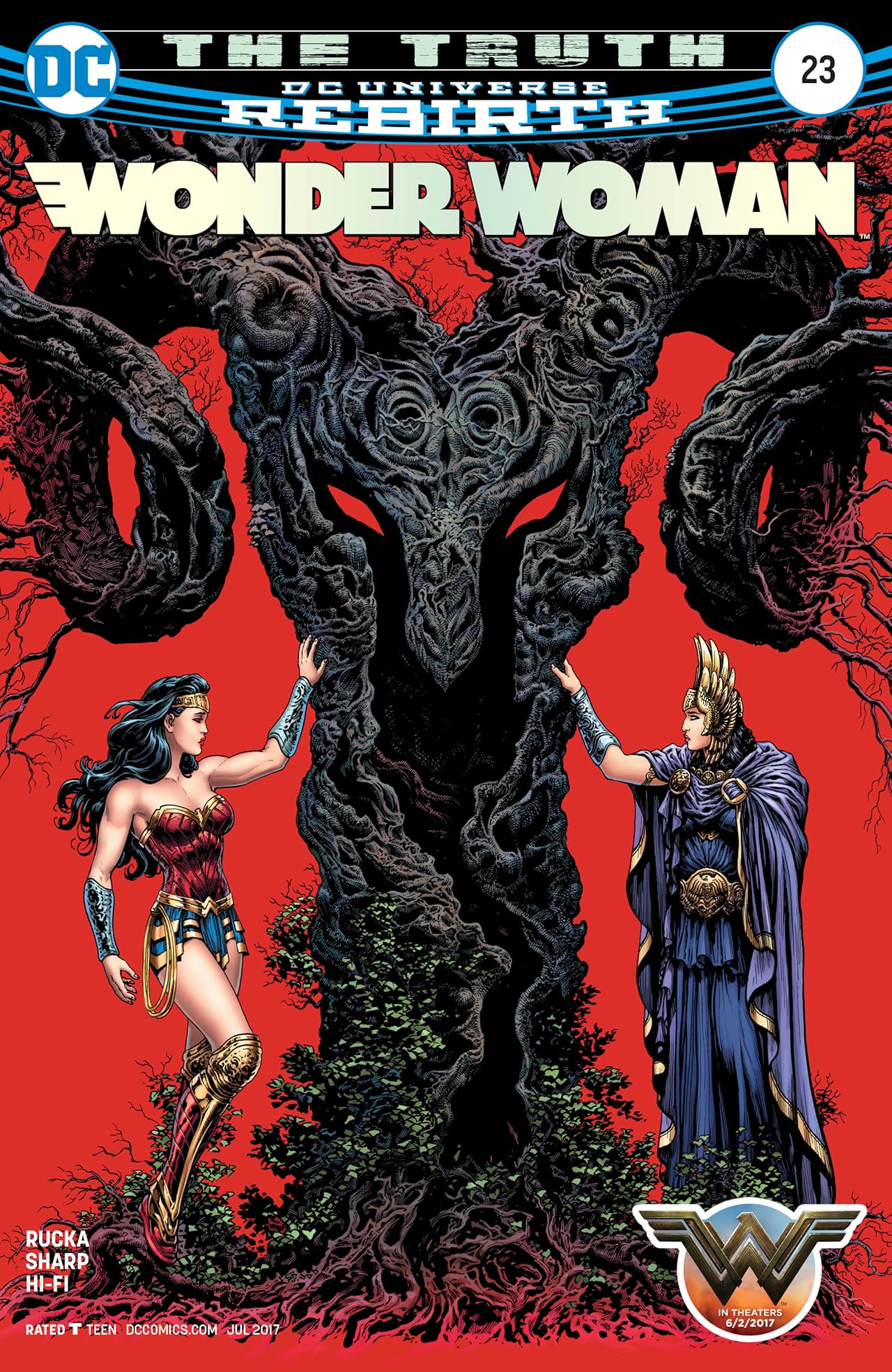
In a very timely move by DC Comics, a recent issue of Wonder Woman’s ongoing comic series demonstrated that. In Wonder Woman #23, by Greg Rucka and Liam Sharp, Wonder Woman goes up against Phobos and Deimos, the devious sons of Ares, the God of War. They try to provoke Wonder Woman into freeing their imprisoned father. It’s a situation where Superman or Batman would’ve tried to fight their way out of.

Wonder Woman (2016-) #23

However, that’s not what Wonder Woman does. She doesn’t defeat Phobos and Deimos through violence. She understands that such power with more power is bound to cause destruction, pain, and loss. Instead, she fights them in a different, wholly unique way. She fights them with love.

It’s not nearly as corny as it sounds. It’s a culmination of many conflicts that had been building over the course of a dozen issues, which included more than a few major clashes along the way. In the end, though, fighting power with more power wasn’t the answer. Wonder Woman understood this and chose a different path. It worked too. Phobos and Deimos were defeated and no innocents had to suffer.

Wonder Woman #23 is a perfect demonstration of what sets Wonder Woman apart from other heroes and why she’s such a strong female icon. Sure, the uptight asshats at the United Nations may think she’s too sexy to be an icon, but they’re dead wrong. Wonder Woman’s beauty is a reflection of her heart. That heart, and her ability to use it as well as her fists, is what makes her message more important than ever.

Image result for Wonder Woman

We currently live in an era where everything from feminism to beauty standards is becoming more and more tribal. It’s not enough to just fight for equality and understanding. Everyone has to form their tribe and help it dominate in some way, either by having it play the victim or resort to excessive virtue signaling.

That’s exactly the kind of endless power struggle that Marston criticized when he created Wonder Woman. It’s also the kind of struggle that Wonder Woman rises above. She may be a feminist icon, but she does not carry herself as one who favors one gender dominating the other.

She champions love and understanding for all. She seeks not domination of one idea over the other, but loving submission to the idea that none need dominate. It is possible for everyone, male and female, to humble themselves and open their hearts. We don’t need power over others to achieve peace.

Image result for Wonder Woman

Her message is one that should resonate now more than ever. With her movie finally released, that message has a chance to spread. Sure, there will be controversy. People make up controversies all the time. There was a controversy over Wonder Woman’s armpit hair, for crying out loud. That’s all the more reason to heed her ideals of fighting conflict with love.

It’s been a long, arduous journey for Wonder Woman to get to this point. I’m not equipped to document the sheer breadth of that journey, but the fine folks at Midnight’s Edge have already done the work for me. They recently released a chronicle, of sorts, on how Wonder Woman got to this point and why her movie is so vital to the future of DC and superhero movies in general.

However you feel about Wonder Woman or superhero movies, today is still an important day in our culture. There are still so many issues that plague men and women alike. Now, more than ever, we need heroes like Wonder Woman to show that there’s a better way for us to forge our future.

7 Comments

Filed under Comic Books, Jack Fisher, Superheroes

Will Sex Robots Make Us Better People?

https://i0.wp.com/mojidelano.com/wp-content/uploads/2016/10/15-58-55-special-report-sex-robots-a-psychological-perspective-sfw-jpeg-209057.png

I’m going to do it again. That’s right. I’m going to talk about sex robots. Do I have your attention now? I know it’s not the first time I’ve brought up this inherently kinky, but sexy topic. I doubt it’ll be the last. Honestly, there’s so much potential in this topic, sexy and otherwise, that I’m surprised I don’t talk about it more often.

There’s no way around it. Sex robots are coming, literally and figuratively. There’s already a brothel in Spain that employs sex dolls for customers. Companies like RealDoll are actively working on developing them. Given that sex still sells and there’s a lot of horny people in the world, the economic and personal incentives are just too huge.

Like any early technology, though, it’s going through some growing paints. It’s still a ways away from being refined, effective, and cheap. Like early cell phones and TVs, sex robots are going through that clunky phase where they seem more like a novelty than a practical reality.

https://i0.wp.com/dynamicmedia.zuza.com/zz/m/resized_gallery/0/f/0f055e1c-6678-4ec1-9bdf-0f3dcbebbc2f/01_realdolls3___Gallery.jpg

Eventually, we’ll work out the kinks, so to speak. I’m confident that everyone under the age of 30 will live to see a day where sex robots are almost indistinguishable from real partners. They won’t just look, feel, and sound real. They’ll be every bit as customizable and versatile as modern smartphones.

You want a meek, submissive partner who only lives to serve you? There will be a sex robot for that. You want a tough, dominant bondage enthusiast who makes you their personal bitch? There will be a sex robot for that too. The only limit is your own perverse imagination.

This leads to one vital question, which I’m sure hasn’t slipped the minds of those who still make weird faces when the topic of sex robots comes up. I imagine these same people used to think Twitter was a waste as well. Today, I imagine they’re still kicking themselves for not buying stock in it. It’s still a wholly relevant question, though.

How will sex robots affect society?

I’ve been dancing around this question for a while because I’m still not sure how to address it. Believe me, though, I’m working on it. I do want to keep talking about sex robots. I’ve noticed it gets my target audience uniquely excited.

However, there are others who think about this topic as well, sometimes more intently than even an aspiring erotica/romance writer would dare. The cast from ThinkTank, a fun and sometimes kinky YouTube channel that I’ve cited before, actually chose to ask that question in a different way.

How will sex robots make us better people?

On the surface, that does seem like a loaded question, if that’s not too inappropriate a term. It seems inherently bias that sex robots will only make people better. That’s like pretending ski masks are only used for skiing or that guns are only used for hunting.

Loaded or not, they do highlight an important dynamic of sex robots. It’s one that tends to get overlooked and underplayed, but one that has the potential to change society in a way that’s very positive by most measures. It has less to do with how we interact with sex robots and more to do with how they’ll interact with us.

Here’s the video that explores this discussion. I’ll give those who own fleshlights and vibrators a minute to collect their thoughts and steady their hearts. Take all the time you need.

At the core of the issue here is how the artificial intelligence within these sex robots is configured. There will be some that just obey orders. Like any appliance or gadget, you push a button and you get the effect you want. There will be a market for those sex robots, just as there’s still a market for old flip phones.

However, that’s not going to be enough for some people. I know this because those with vibrators and fleshlights still seek love and companionship. That’s because, in addition to being extremely horny, we’re a very emotional species as well. We are biologically wired to seek intimate connections with others. Incorporating that function into a sex robot just seems logical.

A sex robot with that kind of ability would do more than just provide the experience of sharing an intimate connection with a user. It’ll help people explore and develop their ability to seek such connections with others. It could be a teacher or a mentor of sorts. This is just one you have sex with and looks as sexy as you want it to be. There’s literally nothing unappealing about that concept.

https://i0.wp.com/www.collegemagazine.com/wp-content/uploads/2012/07/ef410b39aaacff80684620e12daf9175_b.jpg

Beyond the teenage fantasy, though, there’s another aspect to that idea that ThinkTank didn’t touch on. It has to do with our collective struggles to explore and deal with sexual issues. Given the erratic nature of our sexual attitudes, it’s an issue that’s bound to come up.

Think back to the heath classes or sex ed you got in high school, assuming you didn’t go to school in Texas. Those classes told you what sex was, how it worked, and the body parts involved. Some may have even touched on the dynamics of sexual relationships. Again, if you got your education in a state like Texas, your experience may vary.

Just knowing about sex isn’t enough, though. Most of those students are still horny teenagers who don’t know how to deal with their horniness just yet. They don’t have many outlets to explore that feeling. Other than internet porn and each other, their options are limited.

https://i0.wp.com/mydeepinside.info/wp-content/uploads/2015/05/neschastnaya-lyubov.jpg

Now, imagine getting that same information from health and sex ed. Then, imagine getting your own sex robot to help you explore your sexuality. Whether you’re a man or woman, gay or straight, you have something that will actually guide you through the intricacies of having sex and forging relationships.

It may sound like a bad scene from a porno, but throw an intelligent sex robot into the mix and suddenly, it’s not just pornographic. It’s wholly pragmatic.

As the clip said, sex robots with AI could be programmed to help teach users to interact and understand one another. It could teach men and women to better form genuine, intimate connections. Compared to the lessons that movies, video games, and fairy tales teach, which makes it seem like everyone needs to be a prince or princess, sex robots would be invaluable towards molding healthy minds and genitals.

https://i0.wp.com/www.dogubayazithalkinsesi.com/resimler/2/40794.jpg

So much of our struggles to get along, be they unequal gender dynamics or a poor understanding of what constitutes consent, stem from our limited ability to form relationships. They also may be a product of not getting laid often enough.

I know I’ve said this before, but it’s worth saying again. There are a lot of health benefits to regular sex. When someone has a rich, satisfying sex life, they’re generally happier and nicer to be around. A society full of sexually satisfied men and women who actually know how to forge intimate relationships can only be a good one.

https://i0.wp.com/consciouslifenews.com/wp-content/uploads/2013/05/image12.jpg

It’s still impossible to know just how sex robots will affect society. There may very well be other negative consequences that I either haven’t explored or thought of yet. Whatever they may be, expect me to talk about them or write about them in my novels at some point. It’s just too sexy a topic to ignore. In time, nobody will be able to ignore it.

13 Comments

Filed under Sexy Future

A (Distressing) Thought Experiment On Gender Double Standards

http://vignette1.wikia.nocookie.net/diehard/images/e/ea/DH3_-_John_McClane.jpg/revision/latest?cb=20130411165945

Whenever I pose one of my thought experiments, I do so with the hope of inspiring novel, entertaining ideas that get people thinking for all the right reasons. Ideally, these ideas are fun and enlightening. If they make people horny in the process, then that’s just a bonus.

Every now and then, however, it’s not enough for an idea to be enlightening or sexy. Sometimes, for a thought experiment to work, it needs to make people feel uncomfortable. It needs to create some sort of mental distress.

I know that’s something most people avoid. I’ve even pointed out how our brains are wired to do anything and everything to avoid mental distress, even if it leads to outright hypocrisy.

Well, as uncomfortable as it is, mental distress has a purpose. It forces us to contemplate an idea that highlights a major problem in the world. It’s often one of those problems we know is there on some level, but avoid thinking about because it’s too daunting. For this particular thought experiment, it’s not so much that the idea is overwhelming. It’s more that it reveals something about our attitudes that we don’t often scrutinize.

So with that in mind, here’s the experiment. Think back to any action scene in any major action movie of the past couple decades. Given the glut of superhero movies and “Die Hard” rip-offs out there, that shouldn’t be too difficult. Specifically, think of a scene where a female character was kicking ass. Given the rise of strong female characters, that shouldn’t be too difficult either.

A good example comes from the memorable Black Widow fight scene in “Iron Man 2.” By any measure, it’s a wonderfully entertaining scene. It has Scarlett Johanssen kicking ass in a skin-tight outfit. What’s not to love about it? Most people who watch this scene, especially comic book fans and people who find Scarlett Johanssen sexy, would be rightly entertained.

Here’s where the thought experiment comes in. This is where it gets really uncomfortable. Watch the scene above once as you usually would. You don’t need to know the context too much. This is just Black Widow beating up the hired goons of Justin Hammer, the primary antagonist of the movie. Use that first reaction as a baseline of sorts.

Now, watch the scene again. This time, though, reverse all the genders of the characters involved. Make Black Widow a man. Make Justin Hammer’s goons women. Let it play out in your mind, this lone male character beating up all these women. Does the scene evoke the same reaction? For most people not named Chris Brown, it probably makes you sick to your stomach.

This goes beyond the typical double standards between men and women, which I’ve talked about before. It even goes beyond strong female characters, which I’ve also touched on in various ways. This is one of those dynamics that has always been there right in front of us. We just don’t take the time to scrutinize it.

Image result for stressed out man

We can watch scenes of James Bond beating the crap out of a bunch of SPECTRE henchmen and be entertained. We can also watch scenes of Black Widow, Sarah Conner, and Furiosa do the same and be entertained. Swap the genders, though, and it becomes extremely distressing. We don’t see powerful characters kicking ass anymore. We just see a man beating up multiple women.

Find a scene like the one above from “Iron Man 2” and do the same thought experiment. Look for a scene where a woman beats up a much of male thugs. Then, swap the genders. Chances are, the feelings it evokes are just as distressing.

Image result for Furiosa fighting

For a greater sense of context, I came up with this thought experiment after reading an article on Cracked.com about the way Hollywood treats men. I’ve cited Cracked before because and while I don’t always agree with them, they’re good at tackling serious topics in a humorous way, even sexy topics. This one, however, had a hard time being funny.

6 Backwards Ideas Hollywood Still Has About Men

Some parts of the article were more inane than others, like pointing out how every leading man has to be at least a half-foot taller than the average guy or how tortured men are somehow compelling. Some of those details are just quirks, blatant examples of style over substance.

Beyond the quirks, though, there are some genuinely disturbing dynamics at work. We find such entertainment in women beating the crap out of men. We also find entertainment in men beating the crap out of men. However, when it’s men beating the crap out of women, context doesn’t matter. It always makes us feel disgusted and repulsed.

The thought experiment I just posed highlights that. However, it goes beyond violence as well. Rape is one of those super-sensitive issues that’s impossible to make funny or sexy. However, if you put it in the context of prison rape where men rape men, then that somehow changes things, so much so that jokes about rape will even find their way into an episode of SpongeBob SquarePants.

Image result for Spongebob Soap

Then, there are the cases where women rape men. Yes, that does happen in real life. Women are capable of domestic violence against men. However, it’s still okay to joke about. Christopher Titus has even worked it into his standup. It even finds its way into cartoons that air on prime-time.

The best example of this is the “Futurama” episode, “Death By Snu Snu.” In that episode, the cast encounters a planet populated by big, hulking, hostile Amazonian women, albeit not of the Wonder Woman variety. Through a series of hilarious antics that are entirely appropriate for a show that has a hard-drinking, sociopath robot, the male characters end up captured.

This is where the line between hilarity and distress blurs if you dare do the same thought experiment. Once captured, the Amazonian women decide to “torment” their prisoners with “snu snu,” which is their alien verbiage for sex. The reaction of Fry and Zap Branigan is a mix of horror and intrigue.

Related image

Granted, it’s presented in a funny way, but that doesn’t change the actual substance of what happens. The women rape these men. They rape them and it’s portrayed as humorous. I’m not going to lie. I did laugh somewhat at how the episode played out. Most people with a healthy sense of humor would.

However, if you do the same thought experiment with the Black Widow scene in “Iron Man 2,” it takes on a very different context. Watch the episode again, but turn the hulking Amazons into men. Then, turn Fry and Zap into women. Suddenly, that scene takes on a much darker undertone.

It would push the line even for the most hardcore porn. Think about how that would play out, a group of warrior men taking a couple of women who just stumbled upon their world and deciding to rape them to death. It wouldn’t just be rated NC-17. It would be outright banned and subject to protest from every women’s group in the world.

What does it say about our attitudes, our culture, and our standards when we’re okay with one gender dynamic and not the other? Now, there are inherent differences in those dynamics. Human beings are a sexually dimorphic species. That means there are inherently different traits within the genders that are impossible to overlook completely.

However, the sheer breadth of the disparity here is cause for concern. If flipping the genders of a story or scene evokes such a different reaction, then that’s a serious disconnect that’s worth scrutinizing.

That’s not to say that the scenes in “Iron Man 2” or “Futurama” are wrong or not entertaining. There’s just something inherently revealing about ourselves when we flip the gender dynamics and react to the same scene. We may not like what that reveals, but it’s not something that can or should be ignored.

21 Comments

Filed under Thought Experiment

Wonder Woman, Gal Gadot, And A Positive Feminist Message

It’s hard to believe it’s almost here. In less than one month, the “Wonder Woman” movie starring Chris Pine and Gal Gadot will finally be released. It’s been a long time coming. For comic book and superhero fans of every age, race, and gender, this is a movie we’ve been waiting for with baited breath and wet panties.

I’ve already made my love of Wonder Woman quite clear on this blog. She is, beyond dispute, the most iconic female hero of the last 100 years. She isn’t just a symbol for female power that spans generations. She represents a unique heart, spirit, and passion that appeals just as much to 1950s housewives as it does to latte-loving millennials in 2017.

Of all the many superhero movies I’m excited for, “Wonder Woman” is at the top of a very long list. She already made her presence felt in last year’s “Batman v. Superman: Dawn of Justice.” While that movie was critically panned to no end for all the wrong reasons, there was one sentiment than most agreed on. Wonder Woman was one of the best parts of that movie.

Gal Gadot, who also happens to be a former Israeli soldier in addition to being drop-dead gorgeous, proved that she is worthy of this iconic role. She can be Wonder Woman and kick an insane amount of ass while doing it. She can do all of this while having a level of sex appeal that Lynda Carter herself would be proud of.

https://i0.wp.com/i.imgur.com/Z8BQ2kT.jpg

This is all wonderful news for fans of comics, superheroes, and beautiful kick-ass women. This is also usually where I turn the tables in a post and bring up an issue that tends to bring down your spirits faster than a dead kitten in a graveyard for orphans.

Well, if you’re looking for me to put another dent in your soul, I’m going to have to disappoint you this time. Instead, I wanted to bring up Wonder Woman, Gal Gadot, and all the wonders that come with her for a genuinely good reason that should put a smile on your face and fill your heart with a cradle of baby puppies.

That’s because, as the marketing machine ramps up for Wonder Woman, Gal Gadot and the director, Patty Jenkins, are hitting the media circuit. Naturally, that’s going to lead to a few fake controversies and out-of-context quotes. Just look at any interview ever done with Ben Affleck. It’s as inevitable as a child star needing therapy.

https://i0.wp.com/cinepremiere.impresionesaerea.netdna-cdn.com/noticias/2016/05-mayo/SadBenaffleck.jpg

It’s a dangerous game, throwing yourself out there in a world where the internet will crucify you for using the wrong pronouns. If anyone can do it and be sexy as hell, though, it’s Gal Gadot. She ended up proving herself in a way that any Amazon warrior would be proud of.

She did so by addressing an issue that tends to infuriate the internet, people, and the very forces of nature if it’s ever mentioned above a whisper. That’s right, Gal Gadot talked about feminism. I’ll give everyone a moment to stop gasping, but don’t head for your safe space just yet. This one actually has a happy ending.

I’ve made multiple posts on how hard it is to talk about this issue, especially when there are so many frustrating double standards. Gal Gadot didn’t attempt to address everything. Even Wonder Woman has her limits. However, she did address one issue that seems to divide feminists, conservative Christians, and men who have a hard time hiding their boners. Specifically, she talked about her attire.

https://i0.wp.com/www.cosmicbooknews.com/sites/default/files/galww.jpg

Usually, when people talk about women’s attire, it turns into a pay-per-view caliber whining fight where one side argues it’s too sexy and the other side argues it’s too repressive. Wear too little and you’re being too slutty. Wear too much and you’re propagating the grand patriarchal conspiracy to relegate all women to making sandwiches. You just can’t win.

Gal Gadot, being the wonderful woman she is, proved that wrong. In an interview with the New York Times, she addressed the issue of Wonder Woman’s attire and did so in a way that every self-proclaimed feminist should learn from. Here’s what she said.

“I think as a feminist, you should be able to wear whatever you like!” Ms. Gadot said. “In any case, there is such a misunderstanding of the concept. Feminism is about equality and choice and freedom. And the writers, Patty and myself all figured that the best way to show that is to show Diana as having no awareness of social roles. She has no gender boundaries. To her, everyone is equal.”

It almost makes too much sense. It’s almost too logical. If you’re for feminism, you should be for wearing whatever the fuck you want. If you want to wear a G-string and a tube top made out of duct tape, then wear it. If you want to wear a burka or a bear costume, then wear it. That is the perfect feminist message, one that men, women, and those of unspecified gender can get behind.

It’s wonderfully refreshing because feminism, be it radical or otherwise, has been somewhat schizophrenic when it comes to women’s attire. On one hand, you’ll have feminists protesting their right to sunbathe topless. On the other, you’ll have feminists whining about video game characters dressing too sexy.

It’s a painfully asinine conflict, one that reduces feminism to glorified virtue signaling coupled with excessive excuse banking. It’s the main reason why feminism has become such a toxic buzzword that’s less associated with equality and more associated with mean-spirited bitchiness.

https://i0.wp.com/media.breitbart.com/media/2015/12/maxresdefault.jpg

What Gal Gadot says helps put things in perspective. It’s also the perfect response to the bullshit decision the United Nations made earlier this year to rescind her status as an ambassador to girls because she was too sexy. She’s able to frame feminism in a context where only genuinely uptight, misogynistic, patriarchal asshats can disagree. By every measure, that’s a win for Wonder Woman and feminism.

I’m sure Gal Gadot and Wonder Woman will still have her detractors from feminists, men, and even other comic book fans. That’s just the nature of a world full of diverse, erratic, and often misguided opinions. That’s why it’s so refreshing for someone like Gal Gadot to use your position to make a positive contribution.

There will still be those who complain that Wonder Woman’s attire is too sexy. There will also be those who complain that she’s not sexy enough and that she’s not a good role model. However, those same people would complain about the sky being too blue if they had nothing else so their opinions deserve less credibility than their farts.

Gal Gadot didn’t need to say what she said. She didn’t need to prove to anyone that she deserves the role of Wonder Woman. She still did it and for that, on behalf of Wonder Woman fans and fans of those who say things that actually make sense, I thank her.

4 Comments

Filed under Comic Books, Jack Fisher, Superheroes