Tag Archives: Superheroes

What “The Gifted” Reveals (And Warns Us) About Ourselves

Every now and then, a TV show comes along at just the right time. Like bikinis in the summer, hot chocolate in the winter, or beer at a football game, it just makes the right connections for all the right reasons.

You could argue that shows like “Married With Children” or “South Park” were shows that just happened to come along at a time when audiences were eager for something different, but didn’t know it. Some, especially “Married With Children,” couldn’t be made today because of changing standards. The fat jokes alone would’ve triggered endless whining on social media that would’ve gone on for years.

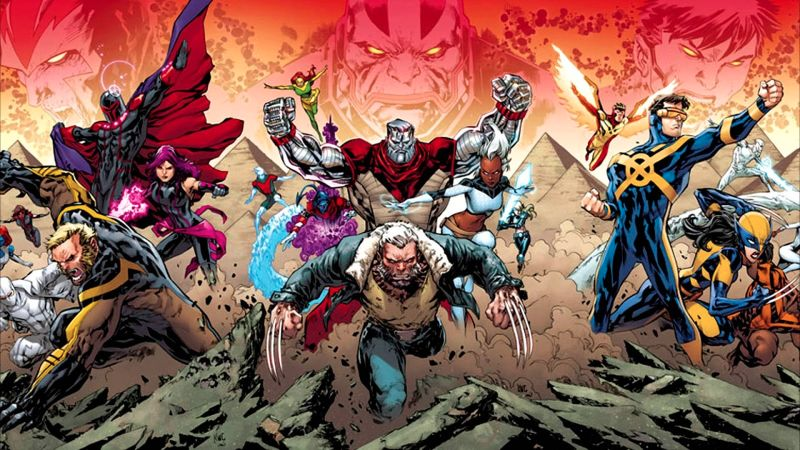
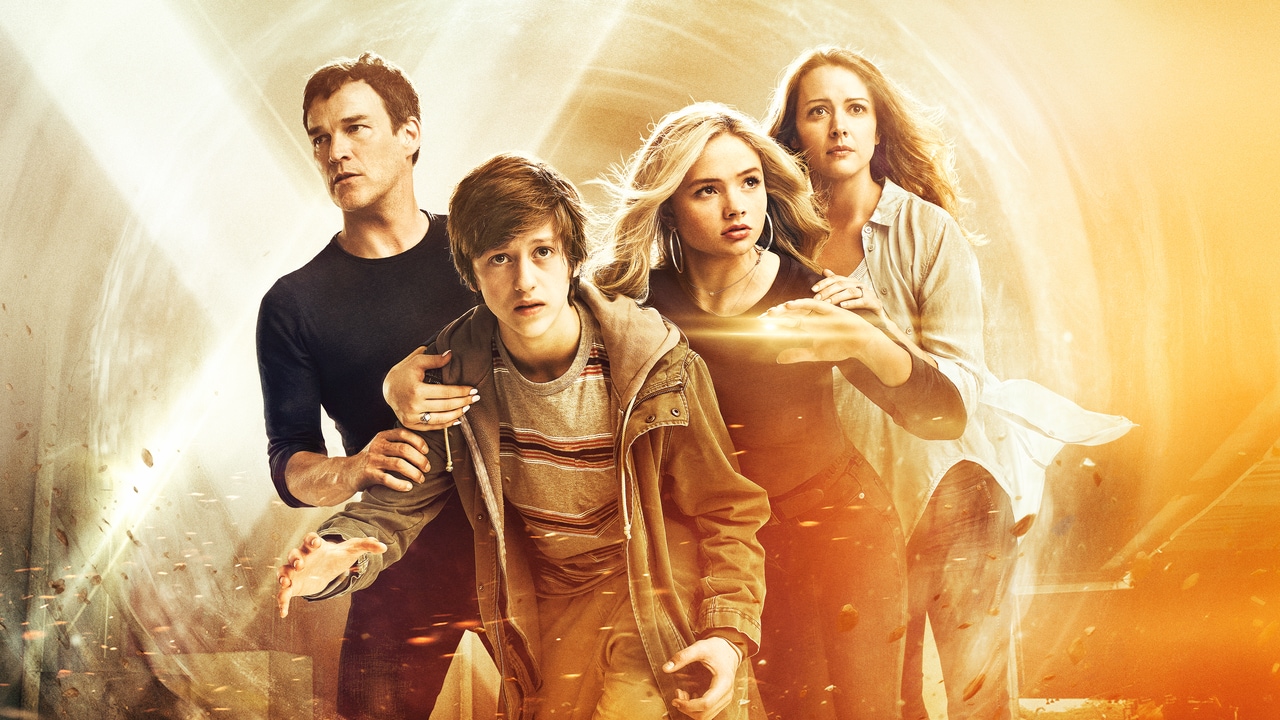
That brings me to “The Gifted,” Fox’s latest effort to squeeze every cent of profit from the X-men franchise. Yes, this is going to be another one of those posts. As I’ve done before, I’m going to tie real-world issues to one of my favorite superheroes. Unlike other posts, though, those ties go beyond getting romance tips from Deadpool.

While I’m usually skeptical about efforts to shamelessly exploit the glut of superhero shows on TV, I gladly make an exception for “The Gifted” and for a good reason. Compared to superhero melodrama on the CW or the gritty violence of the superheroes on Netflix, it’s a very different kind of show with a very different kind of struggle. Unlike aliens, blind lawyers, and secret armies of ninjas, this struggle is more relevant.

That’s because “The Gifted” doesn’t focus on heroes. Sure, it takes place in the same world as the X-men, but they aren’t the focus. Instead, the show builds its story around the Von Strucker family. They don’t live in a mansion. They don’t have their own personal hypersonic jet. They don’t even have their own personal high-tech training room.
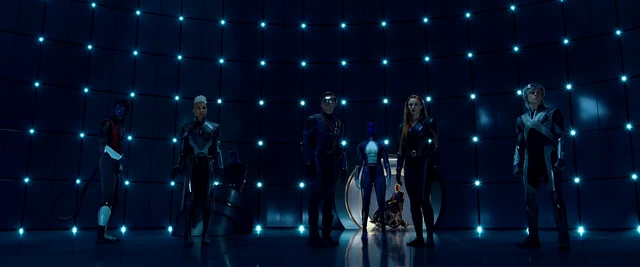
The Von Struckers, unlike their comic counterparts, are an ordinary middle class family. They aren’t concerned with superheroes, super-villains, and insane love triangles between heroes. They’re concerned with work, school, taxes, and taking out the garbage. In a sense, they are a reflection of real people in a world with unreal challenges.

That’s a perspective that rarely manifests in the X-men movies. In fact, other than a memorable scene in “X2: X-men United,” the impact that mutants have on ordinary people is rarely touched on. Sure, they’ll show humans running in terror from a Sentinel or a pissed-off Magneto. That doesn’t give us much insight into the lives these people live.

The Gifted” builds an entire narrative around a family that lives in this world and during exceedingly tense times, no less. This is not a world where seeing the X-men take down a Sentinel is the sort of thing that happens every other Tuesday. This is a world where both the X-men and the Brotherhood have disappeared in an event that has only been referred to as “The July 15th Incident.”

That incident, much like 9/11 or a major assassination, created a dramatic/traumatic shift in society. Suddenly, mutants aren’t just another minority issue. They’re an existential threat, like nuclear weapons or mass pandemics. Mutants aren’t just a distant threat anymore. They’re a real threat.

From the perspective of the Von Struckers, at least in the first episode, the danger of mutants is like the threat of terrorism. They know it’s there. They accept the systems and precautions that society has put in place to deal with it. They’ve learned not to think much of it. They’re too busy just being an ordinary family in a world that happens to have individuals who have the mutant ability to turn into ice cream.

In a sense, we’ve done the same thing in the real world. We accept that we live in a world where the NSA reads all our emails, the CIA tries to assassinate world leaders, and gross injustices happen every day. We know, to some extent, that it’s manifesting all around us. We just shut it out and try to live our lives.

What happens, though, when that injustice hits you or someone you love? That’s what happens to the Von Struckers in the very first episode of “The Gifted.” Their blissfully oblivious lives are shattered when Reed and Kate Strucker find out their children are both mutants. Not only that, one of them ends up trashing the school gymnasium when his powers first manifest.

Their happy, middle class lives aren’t just disrupted. They’re shattered, spit on, and covered in fresh whale shit. To make matters worse, Reed Strucker, played by Stephen Moyer, was a prosecutor who made his living sending mutants to prison. Short of beating mutant children with a baseball bat for a living, he couldn’t have had a worse job.

The mutants he sent to prison weren’t always guilty of crimes. Sometimes, it was just a matter of being in the wrong place when their biology decided to act up. It would be like a teenage boy being arrested for an awkward boner, something we can’t always control. Granted, mutant powers tend to be more destructive, but they can be just as unpredictable.
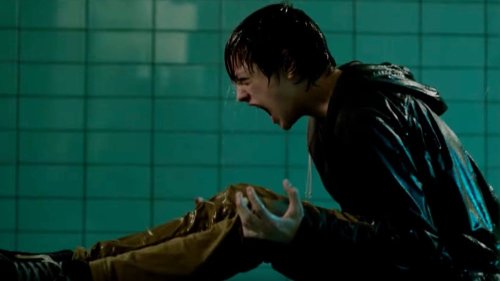
It’s this revelation, as well as the events that unfold in the episodes that follow, that really highlight the impact that “The Gifted” leaves. It’s an impact more relevant than most X-men stories, including the ones that involve jealous ex-lovers. In a sense, it’s one that many minorities already understand all too well.

From the beginning of the show, there’s never a sense that Reed Strucker believed that he was hurting anyone. He never came off as the kind of guy who hates mutants and longs for the days where men like him can throw mutants into internment camps. He’s just doing his job, which he believes is making the public safer.

It’s really no different from those who genuinely believe that homosexuality is inherently harmful or that gun control will only lead to more violence. Most of the people who believe these things, the Pat Robertsons and Richard Spencers of the world notwithstanding, are decent people who want to live in a world where they’re families are safe.

Then, something traumatic comes along that shatters this worldview. They find out they have a gay son or they find themselves in the crossfire of a mass shooting. Suddenly, they can’t ignore these injustices anymore. They can’t go about their happy lives as though the system isn’t victimizing someone. It’s one of those rare situations where no amount of excuse banking can change the truth.

In a sense, the Von Strucker family are reflections of the families in the real world that find themselves on the wrong end of injustice. Whether it’s a Muslim family victimized by racial profiling or being on the wrong side of a sexual harassment claim, it’s not possible to avoid or ignore it anymore. These injustices are hurting you and the people you love. It’s soul-shattering, but that’s what makes “The Gifted” so compelling.

In the fourth episode, this message really hits hard. Reed finds himself in a jail cell right next to Polaris, a mutant who he prosecuted in the first episode, who also happens to be Magneto’s daughter. In these bleak conditions, she basically lays out all the hard truths that he and others like him avoid.

Yes, there was an incident where a group of mutants, which you could substitute for any minority, did something terrible. That was a terrible incident, but efforts to prevent other incidents like that are just hurting real people who don’t want to be superheroes fighting killer robots. Polaris is just one of them. Reed’s children are two more.

That harsh message is one that carries over in the real world, often in tragic ways. Back in 2007, a documentary called “For The Bible Tells Me So” highlighted deeply religious families who had been vehemently anti-gay, only to have one of their children turn out to be gay. Sometimes, it changed their perspective. In some instances, though, it ended tragically.

It’s a harsh, but necessary truth. We can’t control our circumstances. Much like Reed Strucker, we sometimes find ourselves in the worst situations at the worst possible times. The world is chaotic, full of strange people who do terrible things. The fact we can’t control or prevent those things is agonizing, at times. We, as a society, will do as much as we can to mitigate that danger.

In the process, though, we’ll try to fight injustice with more injustice. We’ll obsess less over what is real and more about what is potentially real. It leads us to do extreme things like throw innocent people into internment camps or create killer robots to protect people.

The Gifted” reveals the cost of those measures. It goes beyond the eccentricities surrounding superheroes and focus on the real impact that real minorities feel. Most who are lucky enough to not be part of that group remain content to ignore it. Then, when it finally affects them, they realize just how unjust it is.

At a time when injustices are harder to hide and minorities are a growing part of society, these are important messages. The X-men have been exploring these themes for years, often with colorful adventures involving cosmic birds. “The Gifted” goes even deeper and during these troubled times, these are messages worth heeding.

2 Comments

Filed under Current Events, gender issues, X-men

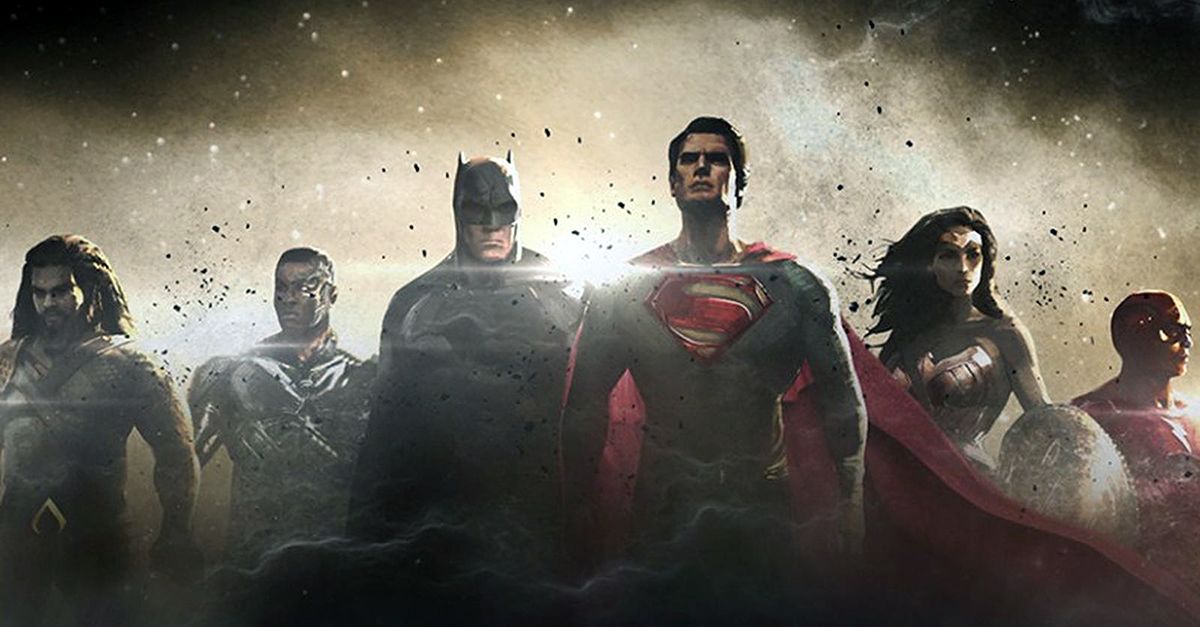
My Justice League Review (And Why The Criticisms Are Unwarranted)

When I did my review for the “Wonder Woman” movie earlier this year, I did so under fairly favorable circumstances. The movie was already getting a lot of positive buzz from critics and general word-of-mouth. I was excited to see it in any case, but that buzz certainly set a positive tone when assessing the merits of that movie.

With “Justice League,” I face the polar opposite of those circumstances. While I generally try not to give much weight to critics or Rotten Tomatoes scores, it was hard to avoid this time. Unlike “Wonder Woman,” the buzz for this movie was entirely negative and it showed in the box office returns, also known as the only real measure that studios care about.

For a movie that was set to be a major milestone, finally putting DC’s most iconic heroes into one movie, it has since become an outright scandal. How can a movie with so much superhero star power do this poorly? That’s a question I am not equipped to answer, especially since people much smarter and more well-connected than me already have.

Instead, I’m going to walk right into this ongoing firestorm of whining and anger to give my spoiler-free review of this movie. I wanted to do it sooner, but I decided to let that firestorm die down just a bit before I offered my take. That might have been a mistake on my part. There’s a lot of noise surrounding “Justice League,” but not much insight.

With that in mind, I’m going to keep my review simple. I’m not going to try and extrapolate a bigger picture, like I did with “Wonder Woman.” I’m just going to focus my review on one simple question.

Is “Justice League” a good movie?

Before I go into detail and try to talk over all the noise, I want to answer this question with my honest and sincere sentiment. Given how much I’ve talked about comic books, superheroes, and superhero movies, including the sexy parts, I like to think my answer has at least some weight. However much stock you put into my opinion, here’s my ultimate conclusion on “Justice League.”

It is a good movie.

Yes, I realize that sentiment doesn’t reflect its Tomatometer score. Keep in mind, though, that score reflects the opinions of critics who are paid to see and/or overthink movies. It doesn’t reflect how actual fans feel about it, which actually shows in the response for this movie.

Even critics can’t deny that this movie went out of its way to please fans, especially those who were dissatisfied with “Batman v. Superman: Dawn Of Justice.” It directly dealt with the aftermath of that movie, as well as the characters’ reaction to it. It even dealt with the aftermath of “Wonder Woman,” building upon a foundation and creating connections, exactly like a real movie universe should.

Those connections weren’t too critical to appreciate the movie as a whole. It also works very well on its own, creating a simple, concise plot that really ramps up the scale. Again, it’s entirely consistent with the effort to make a large, inter-connected movie universe, just as Marvel has done with so much acclaim.

However, that’s not my primary reason for me saying that “Justice League” is a good movie. In simplest terms, this movie is good because it sticks to the basics and does them very well. It doesn’t try to be overly elaborate. It doesn’t attempt to reinvent the characters to an excessive degree. Yes, those characters have some variations, compared to their comic counterparts, but it’s nothing that warrants confusion or outrage.

Superman is still Superman. Wonder Woman is still Wonder Woman. Batman is still Batman, even if it is through the brooding demeanor of Ben Affleck. Getting those three right is critical to the success of any “Justice League” movie and this one makes it a point to do that early on.

It doesn’t stop there, though. It puts time and energy into developing the rest of the league, namely Flash, Aquaman, and Cyborg. These three characters had only brief cameos in “Batman v. Superman: Dawn Of Justice,” but they achieved much greater depth here.

These supporting members weren’t just there to fill out the ranks. They each had their own personal story to follow. Through that story, Flash, Aquaman, and Cyborg gain a personal stake in “Justice League.” It’s not just about saving the world for them. They’re struggling for something greater and, through the story, they achieve it.

At times, there are a lot of plots unfolding simultaneously. The personal stories of all those involved tend to mix. While it does get somewhat messy, it never gets chaotic. The story never goes off-track and it never becomes too confusing, which was a common criticism levied against “Batman v. Superman: Dawn Of Justice.”

A major reason why the story remained so concise was because of the main villain, Steppenwolf. While he’s not as iconic a villain as Lex Luthor, Loki, or Darkseid, who is mentioned multiple times, he does plenty to establish himself as a powerful threat and a highly motivated villain.

Like the other members of the league, his role in the plot has a personal component. He doesn’t just show up, wanting to destroy the world for shits and giggles. There’s an actual reason behind his actions and those reasons never become excuses, something that should carry weight for any character.

On top of those reasons, Steppenwolf’s story helps build the bigger picture of the DC Extended Universe. Through it, we learn that there are much larger conflicts in this universe that go beyond the Justice League. It helps establish a larger role for the Amazons, who showed their strength in “Wonder Woman.” It also establishes the Atlanteans and Green Lantern Corp, who are set to show theirs in future movies.

If the secondary goal of “Justice League” was to build a world and expand the possibilities, it certainly succeeded. If its primary goal was to bring each hero together in a way that was entertaining, flashy, and dramatic, then it succeeded as well.

There were plenty of powerful moments. There were plenty of dramatic moments. There were even some funny moments, most of which involved Ezra Miller’s Flash. Few of the moments felt forced or contrived. None felt empty either. There was purpose in every moment, decision, and action. By those most basic of standards, “Justice League” works.

I would even argue that this movie works better than a lot of Marvel movies. I would certainly put it above titles like “Avengers: Age Of Ultron” and “Iron Man 3,” movies that I think get more praise than they deserve. “Justice League” even makes the effort to improve on the mistakes of its predecessor, something few franchises even try, as “Amazing Spider-Man” can attest.

None of this is to say that “Justice League” is without flaws. It certainly has a few. The effects aren’t as flashy or colorful as other movies. Even “Man Of Steel” had better effects, by comparison. It’s also worth belaboring that Ben Affleck is no Christian Bale and Steppenwolf is no Darkseid. It really did feel as though the movie held back, at times.

If that’s the biggest shortcoming of “Justice League,” though, then I still say it qualifies as a good movie. It tells a story. It fleshes out characters. It tells a big, flashy story, full of big battles and satisfying conclusions. There’s a sense of emotional catharsis at the end that is much more uplifting than what we got in “Batman v. Superman: Dawn Of Justice.” When put in the context of the greater DCEU, it acts like frosting on the cake.

Why, then, does it receive such hate and scorn from critics? If this movie does have a major crime, it’s that it isn’t crafted in the same mold as Marvel with their cinematic universe. I don’t deny that Marvel sets a very high bar. However, this movie cannot and should not operate by those same standards. If it did, then those same critics would just whine that it’s ripping off Marvel too much.

There are other criticisms of “Justice League,” but when so many of them revolve around Henry Cavill’s digitally-removed mustache, those criticisms are downright petty. It is possible to hate and criticize this movie by focusing on those petty issues, but that’s hardly a fair way to judge the actual substance of the movie.

In terms of actual substance, “Justice League” has it and plenty more. It Superman being Superman, Batman being Batman, and Wonder Woman being Wonder Woman, just in case her movie didn’t give you enough of that. For that reason, “Justice League” deserves far more praise than it has gotten and far less petty criticism.

In the end, it still gives us a satisfying, live-action Justice League movie. That, in and of itself, makes it inherently awesome

4 Comments

Filed under Comic Books, Jack Fisher, Superheroes, Movie Reviews, Wonder Woman

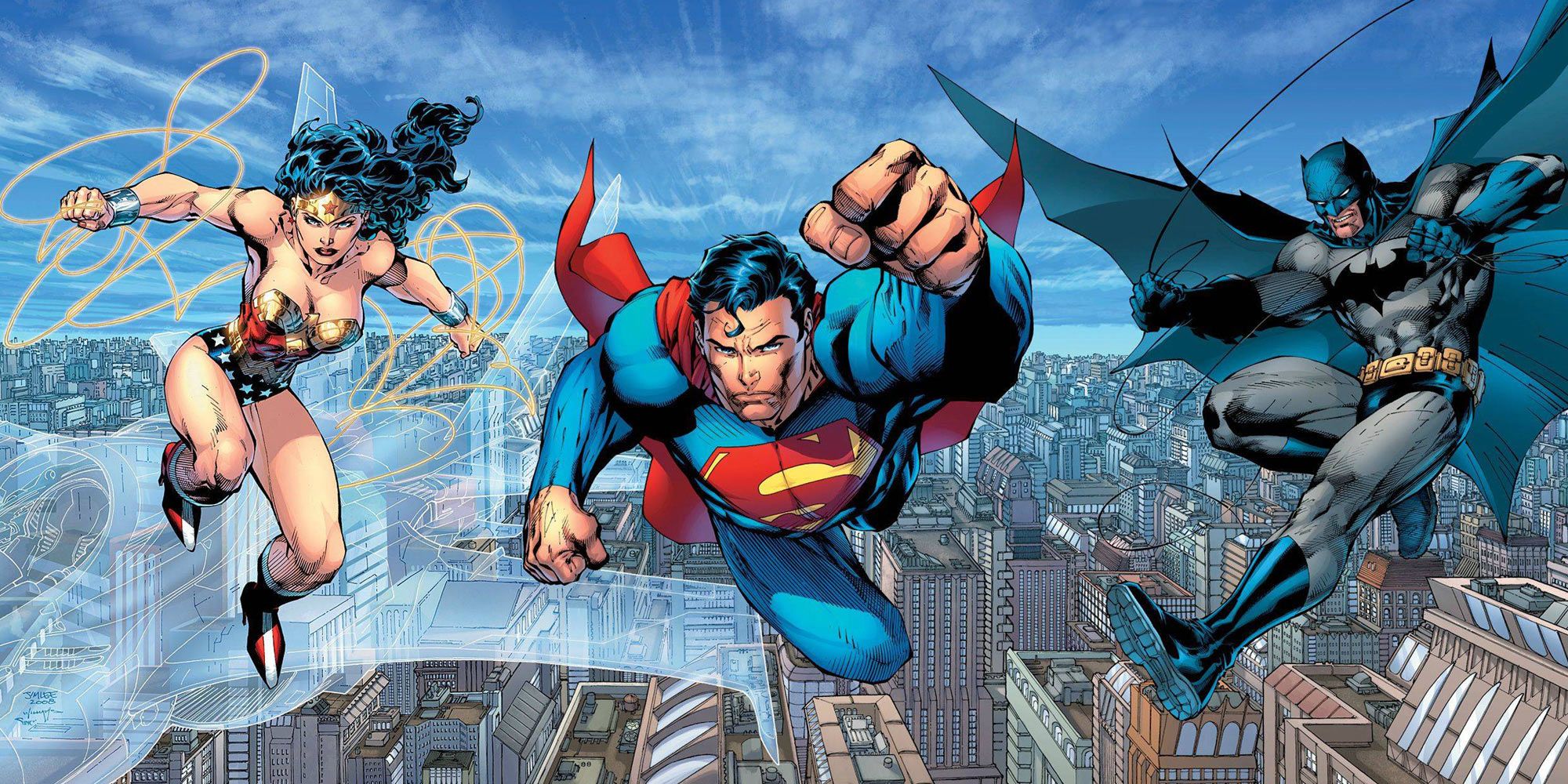
Why Wonder Woman Is The Most Important Member Of The Justice League

There’s a lot that can be said about the “Justice League” movie. Granted, not a lot of it has been good lately. The horrendous critical reception, despite the solid audience reception, has effectively muted the sheer accomplishment of creating this movie in the first place.

It is a hell of an accomplishment, creating a live-action “Justice League” movie just two decades after “Batman and Robin” nearly ruined the genre completely. While the success of movies like “The Avengers” has undermined the novelty of the concept, it still means something to those like me who grew up loving these characters in comics and cartoons.

I could spend multiple blog posts discussing and dissecting the issues with the “Justice League” movie, but I’ll save them for another time. For now, I want to take a moment to highlight an important point that the “Justice League” made, despite all the controversies and shortcomings that hounded it. That point is this.

Wonder Woman is THE most important member of the Justice League.

I know that sounds like something a hopeless fanboy would say, particularly those who enjoy talking about the kinkier elements of Wonder Woman’s history. It’s probably something most Wonder Woman fans would agree with and not give much thought to. However, I’d like to take a moment to make my point, even to those die-hard fans of Superman, Batman, and even Plastic Man. You know who you are.

Even among those die-hard fans, there’s no denying that Wonder Woman is part of DC’s superhero trinity. For decades, Superman, Wonder Woman, and Batman have been the anchor of DC’s entire superhero universe, both in terms of popularity and importance. That superhero foundation is unlikely to change anytime soon.

Most of the time, though, Superman or Batman wield the most influence. Between Batman’s cast of iconic villains and Superman’s iconic status, they have a lot going for them, in terms of influence and depth. I don’t deny the strength of their status, nor do I think Wonder Woman trumps them on every level.

However, I still contend that Wonder Woman is the most important member of DC’s superhero pantheon in terms of impact, theme, and narrative. She may never get as many movies as Batman. Considering she has the same number of movies as Catwoman, though, I don’t think that’s a fair measure of Wonder Woman’s importance.

The reason I believe she is that important has less to do with her role within the world of DC and more to do with how she goes about being a hero and an icon. Her situation is very different from that of Batman, Superman, or any other hero in the DC universe, male or female.

Wonder Woman didn’t enter a flawed world that needs heroes by accident or tragedy. In fact, she had every possible reason to not join that world. Her situation before becoming a hero was as ideal as it gets without ripping off a Disney movie.

She was a princess on Themyscira, a literal island paradise. As the daughter of Hippolyta, she wanted for nothing. She was surrounded by love, support, and luxury of every kind. Who would ever be inclined to leave such a place to begin with? Those who saw the “Wonder Woman” movie remember that her mother did not want Diana to leave and did what she could to dissuade her.

Despite this, Diana still left her paradise home. She chose to enter a world full of gender inequality, oppression, and bad reality TV. She chose to confront all those flaws and fight them, both with her fists and her heart. She didn’t need to lose someone or be forced by tragedy. That alone makes her a greater hero than most can hope to be.

Contrast that with Batman or Superman. Batman became who he is because of tragedy. Crime took his parents so he built his entire heroic persona out of a response to that tragedy. It helped drive him to become the hero he is. It also led to some pretty insane feats, even by comic book standards.

Superman’s heroic persona wasn’t built on quite as much tragedy, but like Batman, he was somewhat guided into the heroic role. From the time he was an infant, these ideals were in stilled in him. Those who saw the classic 1978 “Superman” movie remember the message his father gave him, through the famous voice of Marlon Brando.

Live as one of them, Kal-El, to discover where your strength and your power are needed. Always hold in your heart the pride of your special heritage. They can be a great people, Kal-El; they wish to be. They only lack the light to show the way. For this reason above all, their capacity for good, I have sent them you…my only son.

Whether by accident or luck, Superman ended up with perfect loving parents who helped nourish those ideals in him. Between those ideals and his immense powers, him not being a hero was never really an option.

With Wonder Woman, she didn’t need circumstances or guidance. She chose the path that led her to becoming a hero. She even chose that path when there were obstacles in her way, namely her mother. Beyond that choice, though, Wonder Woman’s heroism takes on an even greater context when you look at how she goes about it.

Superman may be the ideal when it comes to heroic values. Batman may be the ideal when it comes to seeking justice. However, Wonder Woman’s ideals are even greater in the sense that they’re concepts that ordinary people can relate to. Despite all her power, her approach is something that is wonderfully unifying, if that’s not too fitting a term.

She doesn’t just provide a standard with which to measure heroism. She goes out of her way to confront the good, the bad, and the frustrating of the modern world and not always with her firsts.

In the “Wonder Woman” movie, she doesn’t just criticize the attitudes of early 20th century England, which weren’t very progressive to say the least. She smiled and cheered when she saw a woman with her baby. She also went from fighting alongside men on a bloody battlefield to celebrating with them afterwards.

Along the way, she always wore her heart and her emotions on her sleeve. However, they weren’t a weakness, as they’ve been with Superman. They weren’t her primary motivation either, as is often the case with Batman. She channels her emotions and her passions to win over the hearts of men, women, children, and everyone in between. That’s a power that far exceeds anything form Superman’s strength or Batman’s gadgets.

That ability to embrace a flawed world, confronting its ugliness and its beauty, is something that everyone can do and not just Wonder Woman. She just does it better than most and inspires others to join her. She certainly inspired Steve Trevor in the “Wonder Woman” movie. The fact it got Chris Pine naked was just a nice bonus.

It’s an approach she utilizes in every other medium, from comics to cartoons. For those who enjoyed seeing Wonder Woman’s capacity for heart and strength, I urge you to check out the “Justice League Unlimited” cartoon from the early 2000s. There’s no naked Chris Pine, but Wonder Woman still shines in so many meaningful ways.

Every one of those ways comes back to her heart and her willingness to embrace a flawed world with love and compassion. It’s not just about what is right and wrong, just and unjust, or masculine or feminine. It’s about tempering hate and oppression with love and compassion. Those are powerful principles that work just as well in the real world as they do the fictional one.

While those principles might not help the critical reception of “Justice League,” those who’ve seen the movie have likely seen all the ways Wonder Woman uses her heart and her skills to the utmost. It may not convince everyone that she’s the most important member of the Justice League, but I hope it makes a powerful case.

It’s a concept that will likely carry over into future movies in the DC Extended Universe, but has already shown itself to be true throughout the comics, especially in recent years. Superman and Batman have their place and their status among the world of superheroes. However, Wonder Woman’s impact extends far beyond any comic book or movie. It’s an impact that we would all be wise to learn from.

2 Comments

Filed under Celebrities and Celebrity Culture, Comic Books, Jack Fisher, Superheroes, gender issues

Why Stupid Love Is Honest Love (According To Batman)

Whenever someone says love is stupid, they’re usually getting over having their heart broken or upset that other people aren’t lining up to fuck them. It’s a cynical, jaded position on one of the most fundamental and powerful emotions there is in the human experience. As an aspiring erotica/romance writer, I’m often reminded of its power.

Sometimes, though, you need other kinds of reminders to appreciate the breadth of love. In a sense, it is stupid, but not in the way ex-lovers, recent divorcees, and Evanescence fans often claim. It is an inherently irrational, exceedingly overwhelming emotion that drives us to do some pretty crazy things. However, that’s exactly what makes it beautiful.

That beauty isn’t easy to see. Sometimes, it manifests in subtle ways. Other times, though, it’s front and center in a Batman comic. No, that’s not some colorful aside. I’m dead serious. The stupidity of love has actually manifested itself in a Batman comic and it’s beautiful to a level that only Batman can achieve.

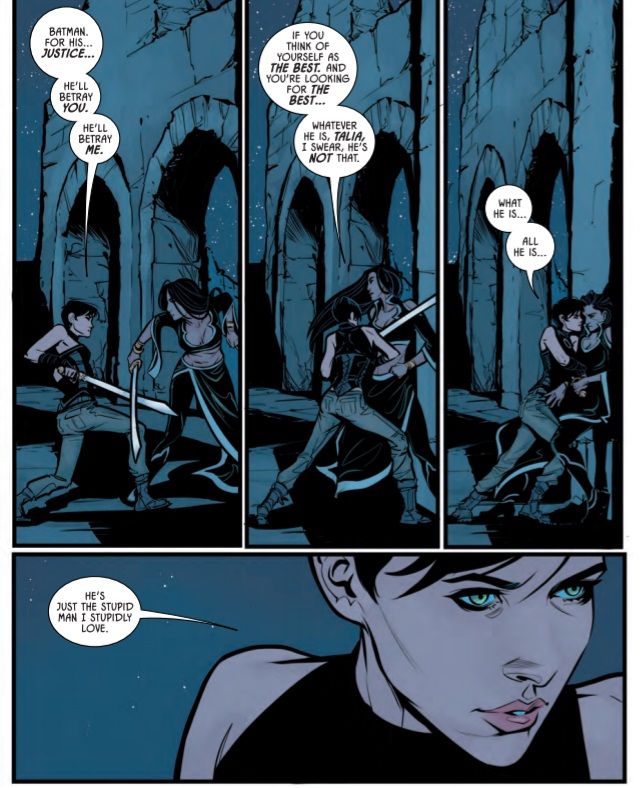
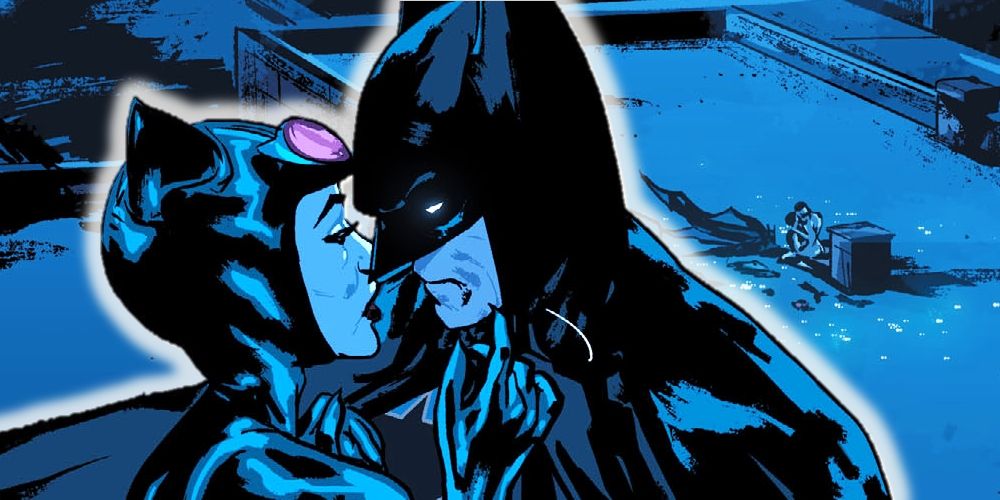
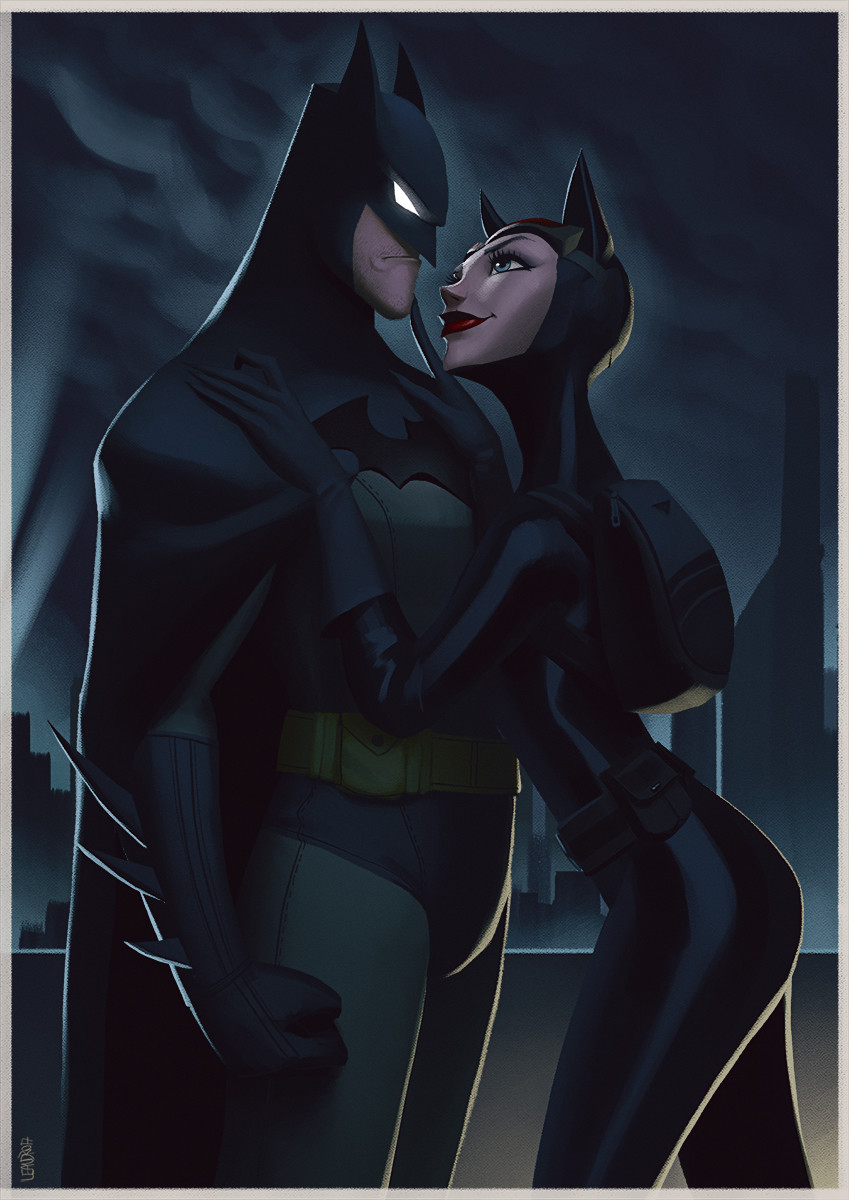
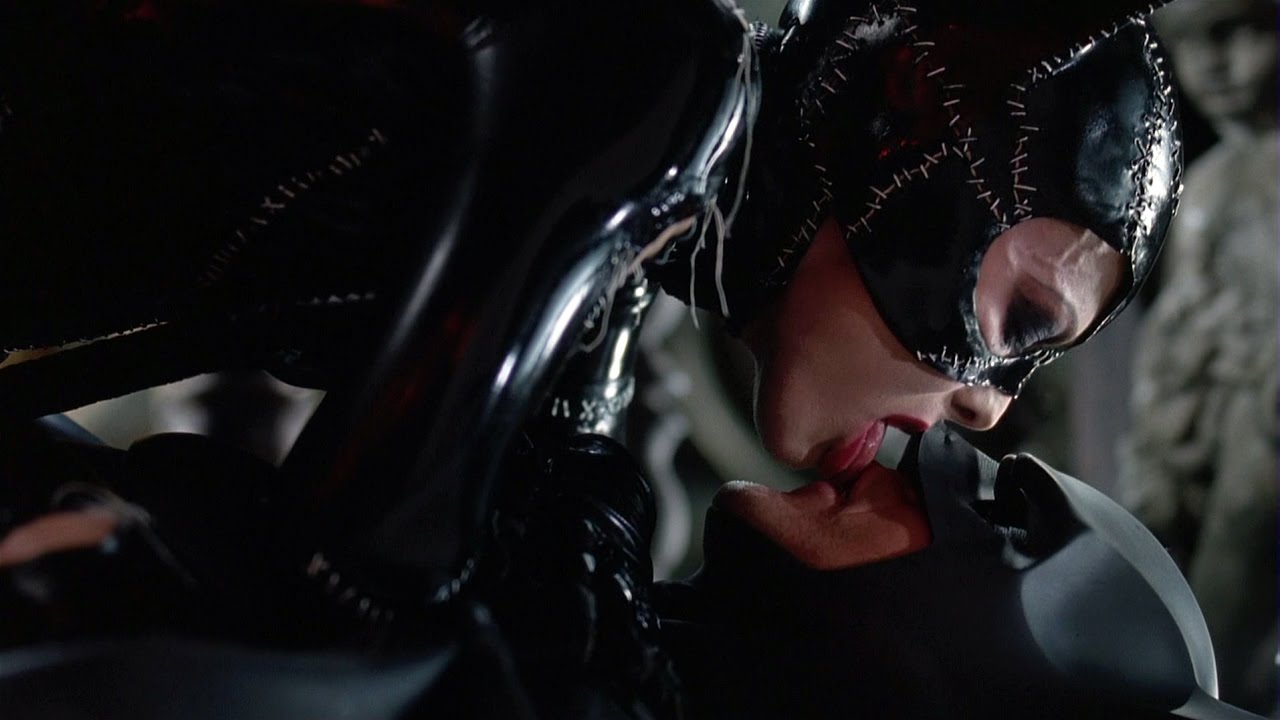
This beauty was on full display in Batman #35, which picks right up from the huge development that occurred a few issues back when Catwoman accepted Batman’s marriage proposal. It has little to do with wedding plans, overpriced engagement rings, or how good Catwoman looks in skin-tight outfits. It actually goes out of the way to highlight the stupidity of love and all its uncanny beauty.

The context of the issue is secondary. If you really want to know the particulars, I highly recommend you read Batman #35 to get the full context of the situation. With respect to the topic at hand, namely the stupidity of love, all you need to know is that Catwoman has a chance to confront one of Batman’s other famous flames, Talia Al Ghul.

That’s a big deal for anyone who dares to get involved with Batman’s personal life. Talia Al Ghul isn’t just someone that both Batman and Bruce Wayne were fond of seeing naked. She’s also the mother of Damien Wayne, but not in the classic sense. He wasn’t conceived in the classic, fun sort of way.

The creation of Damien Wayne, much like Baman’s relationship with Talia, was largely a byproduct of a cold, unfeeling agenda. It had a specific purpose, a defined goal, and very little passion involved. It’s even less sexy than it sounds. It’s basically the antithesis of the stupidity of love.

That’s very much who Talia Al Ghul is. Sure, she looks almost as good as Catwoman in skin-tight outfits, but she’s not much of a romantic. She’s a cold, calculating bitch who sees love as an asset at best and an inconvenience at worst. She’s also the one Catwoman has to deal with in Batman #35 and not just because she’s marrying her baby daddy.

The clash between these two women may not be as sexy as nude oil wrestling at the Playboy mansion. It may not even be as epic as a battle between Superman and Doomsday. However, the way this fight plays out perfectly highlights both the stupidity and the beauty of love. Catwoman herself articulates it perfectly.

It’s not just that loving Batman carries with it a lot of baggage. It’s not just that being involved with the goddamn Batman is overwhelming and not just because he tends to attract homicidal clowns. To love someone like Batman is not to ignore the sheer stupidity of being involved with him in the first place. It’s to embrace it.

It’s a message that fans of romance and aspiring erotica/romance writer alike can get behind. Instead of scrutinizing or overthinking why someone loves another person, you just focus on the love itself. Sure, it’s stupid in the sense that it ignores the logistics. Sometimes, though, that’s the key to making love work.

When you’re in love with a complex person with loads of baggage, like Batman, there’s a lot to think about and scrutinize. It’s one of the many reasons that Batman has had such a colorful history with women. Between being a costumed crime fighter and a billionaire playboy, he’s a complicated man with a lot of moving parts.

It’s because of those complications that many of those women who may genuinely love him find plenty of reasons to walk away. Talia Al Ghul is a perfect example of this because she approaches her love with Batman in a way that’s cold and calculated.

To love him, in her mind, isn’t to embrace his baggage. It’s to re-shape and re-mold it into something she sees as greater. What she tries to do with Batman is very similar to what many people try to do with their lovers in the sense that they try to change and mold them into the person they want them to be, even if it means undermining the person they are.

That’s not just a losing battle that only leads to greater heartache. It goes against the very principles of love. You don’t love someone for who you want them to be. You love them for who they are.

Talia Al Ghul wants Batman to be a certain way for her. She feels she knows what’s best for him, their future, and their family. She’s also willing to lie, cheat, and manipulate him into achieving those goals. She may leave his balls intact, but she’ll make sure his soul is hers to guide. Even Regina George isn’t quite that ambitious.

Catwoman does the exact opposite. She doesn’t try to change Batman into some ideal version of a man that she has in her head. She loves him for who he is and doesn’t want to mold him into something else. On paper, that’s still kind of stupid in the sense that it basically permits him to keep doing the crazy things he does. However, it’s probably the most sincere and honest love anyone can offer.

That does more than contrast Catwoman’s love for Batman from that of Talia Al Ghul. It shows how genuine love compares to the shallow brand of love that comes with caveats. Some people build their relationships around an agenda, much like Talia Al Ghul. They see it as a means to an end. Love, in that context, is indistinguishable from a mortgage application.

Loving someone honestly means loving their flaws as much as their strengths. Catwoman doesn’t overlook or deny those flaws in Batman. Batman himself doesn’t try to hide them either. That honesty, making themselves so vulnerable to one another, is stupid from a purely logistical point of view.

However, that’s exactly what makes their love so sincere. Even if you’re not a comic book fan or a fan of beautiful women in skin-tight outfits, it’s still a love that’s worth celebrating.


2 Comments

Filed under Comic Books, Jack Fisher, Superheroes, Marriage and Relationships

My Fan Theory: The (True) Origins Of Mutants And The X-men

Fans of anything, be it a TV show, a comic book, or extra spicy buffalo wings, like to believe their passion makes them an expert. They believe, either by arrogance or sincere belief, that they understand it better than most people. They may even believe that they can do it better. That’s the entire basis of fan fiction, in as such that fans feel they have something to contribute.

More often than not, those efforts are forgetful at best. I say that as someone who has written his share of fan fiction before he began writing sexy novels. Anyone who has followed my Twitter feed knows that. I’ve never assumed that my work was that good. If it were, then Marvel would’ve paid me to do it so they can make more money. There’s a reason their writers get to do what they do for a living.

That still won’t stop me from making a concerted effort. Since I can’t call myself a successful writer just yet, although I am making progress, I still write with the assumption that it’s average at best. I understand that have a long way to go before I can call my writing objectively good.

That’s why I’m always looking for opportunities to improve. That brings me to this particular opportunity that spun out of my article about fan theories. In case you didn’t read that article, all you need to know is that I’ve become a big fan of them in recent years, especially since they’ve exploded in popularity on sites like Reddit.

Being such a fan, I think the time is right for me to take a shot to see if I can contribute to the phenomenon in some meaningful way. That’s why, channeling the same spirit that inspires fan fiction, I want to add to the overall zeitgeist by creating my own fan theory.

Since fan theories often stem from those who follow something with particular passion, it’s only fitting that this one involves X-men. I’ve made my passion for X-men very apparent on this blog. It’s something I follow closely, often using it as inspiration for various articles on this blog. If any fan is qualified to craft a fan theory, I’m confident I check all the right boxes.

With that in mind, here’s Jack Fisher’s first official fan theory about the X-men. It’s not just mindless speculation. Like the famous no-dinosaurs in Jurassic Park theory, it helps make sense of something that isn’t readily obvious from reading X-men comics Marvel comics in general.

I’m not going to claim it’s secret canon, but I think it adds a new, richer context to X-men as a whole. It all boils down to one simple concept.


Mutants in the Marvel Universe are a direct evolutionary response to the existence of aliens, gods, and magic.

To understand what I mean by this, and why the implications are so serious, I need to point something out that most everyone who passed high school biology probably already knows. The mutation we see in X-men comics is nothing like the mutations we see in the real world.

Sure, there are documented cases where certain genetic mutations confer certain direct benefits, but those mutations never come close to the kinds of powers we see in the X-men. Abilities like shooting lasers from your eyes, summoning hurricanes, or vomiting acid, which I swear is an actual mutant power in the X-men, are physically impossible in our world.

However, in the world of Marvel, the concept of impossible is exceedingly opaque. In that world, it’s possible to devour worlds and create talking raccoons. In that world, gods exist. Magic exists. Advanced aliens exist. Cosmic forces that defy our understanding of reality occur every day, often in the labs of Dr. Doom.

The common existence of such forces doesn’t just make mutation, and all the crazy abilities it conjures, possible within the context of the Marvel Universe. Under this theory, it makes them necessary in that humans must evolve these kinds of abilities in order to survive. Like our universe, evolution is about survival and in a world where giant space gods exist, that requires more than just making better tools.

That’s where the X-gene comes in. According to Marvel’s own wiki on mutant biology, it works in a way similar to how we understand actual genetics in the real world.

This gene leads (via transcription and translation) to an exotic protein. This protein produces chemical signals inducing mutations on other genes, ending up with mutant organisms, variously empowered.

This mechanism is key to this theory because in the real world, there is evidence that a more stressful environment affects how a species mutates. In the Marvel Universe, those stresses aren’t exactly subtle.

In fact, it manifested in a very real way in a recent comic called Marvel Legacy #1. In this comic, it is revealed that powerful forces that include the gods of Asgard, the Phoenix Force, and mystical beings like Agamotto, were present on Earth in 1,000,000 B.C., a time when humans were still evolving from other primates. Their presence, which included a battle with one of those space gods I mentioned, certainly created plenty of stress.

That stress, combined with the thousands of generations that followed, led to the manifestation of the X-gene. It’s basically the human race’s way of adapting to a universe where beings can use magic hammers to trigger thunderstorms on a whim.

However, even without the events of Marvel Legacy #1, there’s another recognized phenomenon in the Marvel Universe that lends credence to this theory. It happened in an event from 2012 called “Avengers vs. X-men,” which is exactly what it sounds like.

In that event, which was a culmination of events that nearly brought mutants to extinction, Tony Stark surmises that there are cosmic forces that will not accept mutants going extinct.

In this case, it’s the Phoenix Force again, which has a tendency to cause big problems in the Marvel universe. Once it sensed mutants were going extinct, it reacted like a rubber band snapping in the other direction. It determined that mutants need to exist. While it doesn’t specifically state why, the fact that someone as smart as Tony Stark came to this conclusion makes it more than mere speculation.

If he’s right, and Tony Stark is usually right in things that don’t involve his love life, then that means this theory has a basis in the biology and physics of the Marvel universe. It means that if mutants vanished from the human populous, then they would be inherently vulnerable to the many powerful forces that threaten it.

In a sense, it’s not just about there being no mutants or X-men to aid the Avengers in a battle against Thanos. It’s about giving the human gene pool the biological tools it needs to survive a universe where beings like Thanos exist. Without it, the human race is the biological equivalent of a dodo bird.

There are a number of other events throughout the history of X-men and the Marvel universe that I could cite, from “X-men: First To Last” to a good chunk of Louis Simonson’s run on “X-Factor.” I won’t get too deep into specifics, but the themes are the same. Humans need to evolve into mutants in order to survive in the Marvel universe.

In the context of this theory, the existence of mutants mutants and their abilities takes on a more defined purpose. The X-gene doesn’t just happen. It’s an evolutionary response to all the craziness that exists within the Marvel universe.

It also raises the stakes for the X-men’s efforts for peace and understanding. Evolution, being an imperfect and messy process in any universe, is bound to cause plenty of tension within a species. The need to coexist doesn’t just pertain to mutants. It applies to both. Without each other, their chances of survival are greatly diminished.


Now, I don’t expect this fan theory to be vindicated or even acknowledged by Marvel in any capacity. Like all fan theories, this is just me interpreting a story and extrapolating a larger theory to add a sense of nuance. It also takes other major events from Marvel’s canon and provides greater connections, which I believe helps any narrative.

It is, and it’s worth belaboring, my first effort at a serious fan theory. I don’t expect it to shake X-men fans or comic fans to their core. I just hope it gets people thinking and discussing. If you think my theory works or think I’m full of crap, I’d love to hear from you. The best part about fan theories is the discussions they inspire. Sure, some of those discussions can get pretty profane, but I’m willing to take that chance.

3 Comments

Filed under Comic Books, Jack Fisher, Superheroes, X-men

Five Reasons Why “X-men: The Animated Series” Was More Progressive Than You Think

DNcLvqLVQAAI1iI

This past Halloween was extra sweet for a certain group of comic book fans, one that I just happen to be part of. Even if you’re not a comic book fan and were just a kid of the 90s, growing up on a steady diet of Saturday morning cartoons, this year marked a special milestone for one of the best shows of that era.

Yes, it involves superheroes. Yes, it involves X-men, which I often go out of my way to discuss. Yes, it involves this iconic theme music that has since become my ring tone.

That insanely catchy guitar rift that got stuck in the heads of millions of fans is from “X-men: The Animated Series.” On October 31st, 1992, this series debuted on Fox Kids and countless childhoods were forged from that day forward, including my own.

That was 25 years ago and while that thought makes me feel way older than I care to feel, it still brings back fond memories. One of my favorite parts of the day, as a kid, was rushing home from school, turning on the TV, and watching my favorite shows. “X-men: The Animated Series,” along with shows like “Spider-Man” and “Power Rangers,” were a big part of my carton diet.

I largely credit this show and “Spider-Man” for getting me into comic books, superheroes, and everything that came with it. I also credit those shows with giving me an early understanding of character development, romance, and storytelling, which would go onto help me write my sexy novels.

For that reason, and many others, “X-men: The Animated Series” has a special place in my heart. I imagine many X-men fans feel the same way because it was this show that helped the X-men really peak in the 90s. What the Avengers are today, the X-men were in the 90s. They were very much the alpha and omega of all things involving superheroes.

While this 25th anniversary gives me time to reflect fondly over how much this show enriched my childhood, my life as an adult has only further expanded my perspective. When I look back on “X-men: The Animated Series,” I’m somewhat amazed by how relevant it still is in terms of theme, drama, and story.

It’s easy to forget that this series came out at a time when most cartoons followed a simple, predictable formula, regardless of whether or not superheroes were involved. There was evil. The heroes found out about said evil. They fought it. Then, the credits roll. “X-men: The Animated Seriesdared to think bigger.

While the animation and voice acting might be somewhat dated, this show dared to speak up about social issues. It dared to explore ideas of hate, bigotry, and discrimination. At a time when parents were still fighting mortal crusades over rock music, this show tried to be relevant in a new way.

Now, as I look back on this series that lasted for five years and 76 glorious episodes, I realize just how progressive and insightful this show truly was for its time. As more and more forms of media, including comics, push for greater diversity, “X-men: The Animated Series” found a way to pull that off 25 years ahead of schedule.

In a sense, the X-men have always been about progressive themes like inclusion, diversity, and justice. Even though some of those words have become toxic today, they embodied the best of it, going back to its earliest days of drawing parallels with the Civil Rights movement. This show just captured it at a time when it a new form of progressive concepts were taking hold.

So, in honor of the 25th anniversary of this show,  I’d like to highlight five reasons why “X-men: The Animated Series” was even more progressive than you remember. Even if you’re not a fan of X-men or comics, it’s amazing to think that a show from 25 years ago achieved so much of what others are trying to accomplish today.


“Genuine bigotry and hatred was depicted in ordinary people.”

To X-men fans, it seems obvious. Bigotry and hatred are very much a part of the X-men’s DNA, going all the way back to their early days in the 60s. However, for a kids cartoon, this was akin to Miley Cyrus flashing her tits on an episode of “Hannah Montana.”

X-men: The Animated Series” did not water down the themes of blind hatred and bigotry espoused in the comics. If anything, they took it a step further by giving a voice, putting that blind hatred on display through characters like Graydon Creed.

This especially played out in the second season where hate groups like the Friends of Humanity formed. They’re the anti-mutant equivalent of the KKK. Their hate was so blind and deep that when one character, Jubilee, asked them why they hated her so much, Creed said simply, “You were born!”

That kind of hatred is harsh in real life, let alone a kids show. The fact that this show gave the X-men more than just monsters, tyrants, and aliens to fight showed an uncanny, if that’s not too fitting a term, willingness to scrutinize these painfully real issues.

As a kid, I barely understood it. As an adult, I’ve come to appreciate it even more. I like to think that exposing that kind of hate in a cartoon showed an entire generation of kids what true assholes look and sound like. Given the amount of assholes in this world, those lessons were invaluable. Plus, it was way more entertaining than “Sesame Street.”


“The characters were diverse and had vastly different personalities.”

Here’s a quick question that should trigger some unpleasant conversations on message boards, as if there are any others. Look at the cast of the Avengers movie. Aside from talking raccoons and androids, what do you notice? They’re mostly men, they’re mostly white, and they mostly have the same avenging personality.

Now, look at the X-men. You’ve got an uptight white guy, a burly Canadian, a sexy southern woman, an African goddess, a smooth-talking Cajun, a giddy teenage girl, and a guy in a wheelchair. Even by today’s absurd diversity standards, the X-men check a lot of boxes. They’ve been checking those boxes since long before diversity was even an annoying buzzword.

It’s not just that the cast of “X-men: The Animated Series” was diverse on the surface. It’s not just that they disagreed with each other, as the Avengers frequently do. They had such wildly different personalities that didn’t always mesh. Cyclops and Wolverine alone had all sorts of clashes and not just over wanting to sleep with the same redhead.

That kind of diversity of thought and personality is something modern cartoons, TV shows, and movies still struggle to achieve. “X-men: The Animated Series” managed to achieve that at a time when Hillary Clinton was still likable. It was a big accomplishment at the time and one that only gets more impressive as the years go by and people still fight about diversity in media.


“The show did feminism and strong female characters RIGHT.”

x-ladies

I’ve said it before and I’ll keep saying it in future posts. Talking about feminism is dangerous, divisive, and frustrating, especially in wake of recent scandals. Nobody seems to know how to even handle feminism or strong female characters who aren’t Wonder Woman. Long before the “Wonder Woman” movie raised the bar, though, “X-men: The Animated Series” made sure it set that bar pretty damn high.

Even by modern standards, “X-men: The Animated Series” found a way to do feminism right. Unlike other cartoons, the female characters weren’t part of the supporting cast or relegated to roles of a love interest. They actually participated on the same level as the male characters.

They didn’t have to create new female characters or force a female character into a male role. “X-men: The Animated Series” simply took characters like Storm, Rogue, Jubilee, and Jean Grey and maximized their strengths. They gave them personalities, power, and individual stories. They didn’t have to show up their male teammates. They could stand on their own and thrive as women.

In terms of feminism, “X-men: The Animated Series” was at omega-level standards long before it became a priority. At a time when we’re still struggling to make solid female characters, it’s remarkable and refreshing to see how well it was done.


“The show didn’t shy away from harsh, dramatic moments.”

People used to make a big deal about cartoon violence. The big worry was that kids would see a cartoon duck fighting with a cartoon rabbit and think that playing with double-barreled shotguns were toys. It was a very different, very strange time, to say the least.

X-men: The Animated Series” basically gave a big, adamantium finger to this debate, at least to the extent that they could get around the network censors. This show did not shy away from the harsh, dramatic moments that had played out in the comics. In fact, in the second episode of the series, one of the characters dies.

Keep in mind, this is a kids show where characters are not allowed to curse or show blood. The fact that this show killed a character in an early episode, and referenced death on more than one occasions, showed a remarkable willingness to portray real struggles with real stakes. Sure, it probably upset a few parents, but it sent a powerful message about the real world.

X-men: The Animated Series” dealt with real issues of bigotry, hatred, and intolerance. As such, it couldn’t water down the harshness and the pain it incurred. These are issues that people are still reluctant to talk about today and this show brought it up during the Clinton Administration. That shows both guts and foresight.


“The villains, heroes, and themes had layers of complexity.”

Watch any cartoon made before 1992 and chances are the characters you see will be pretty basic. You have your evil, mustache-twirling villains. You have your generic good guy/hero types. You have exaggerated violence and shameless toy promotions. There’s not a whole lot of depth there.

X-men: The Animated Series” once again dared to do more. It dared to let its characters grow and evolve over the course of five seasons. It’s an approach that worked so well that others, like the “Spider-Man” cartoon that debuted two years later, went onto adopt it. These characters had all sorts of layers and depth in the comics. The show chose not to simplify it for a young audience and embrace that complexity.

Sure, characters like Magneto, Sinister, and Apocalypse came off as generic bad guys at first, but they developed more and more depth as the series went on. There were even times when Magneto came off as genuinely sympathetic. For a kids show, these moments were pretty heavy and something you just wouldn’t get with the Ninja Turtles.

Today, everyone is trying to give their characters that Walter White style of complexity. Everyone is trying to create a series with a sense of progression. Well, “X-men: The Animated Series” were already doing that in the days of dial-up internet.


The fact this show succeeded to the extent that it did, while being as progressive as it was, even by modern standards, is nothing short of uncanny. After 25 years, the show still has a special place in the hearts of X-men fans. Sure, the animation and dialogue may be dated, but those progressive themes have never been more relevant.

10 Comments

Filed under Comic Books, Jack Fisher, Superheroes, X-men

What Jean Grey Of The X-men Can Teach Us About Life, Love, And Growing Up

These days, when most people read comics or watch movies, they do with an emphasis on escapism, spectacle, and an ability to talk/whine about it on message boards. Most people would rather not consume media with the idea that it has a bigger lesson to teach. We got plenty of those lessons in grade school and most of us got sick of that crap before we hit puberty.

However, there are occasions when a comic, movie, or TV show reveals something deeper about ourselves and our world that’s worth noting. I’m not talking about the kinds of crazy fan theories that claim Jack in “Titanic” never existed. It is possible for the media we consume to give us real, meaningful insights about ourselves.
That brings me back to comic books and X-men. Yes, this is going to be another one of those posts. After talking so much about the horrors of millennial life and the potential horrors of their children, I’m in need of a less serious topic. I think I’ve made clear that I love comics, I love X-men, and I’ll keep finding reasons to talk about them on this blog.

As it just so happens, a comic came out that conveys just such a lesson. It involves Jean Grey again. Other than Wonder Woman, she’s one of the most frequent topics of discussion on this blog. Considering she has a movie coming out next year, that’s likely to continue.

However, this comic has little to do with her movie and more to do with the themes of Jean Grey’s struggle. Some of them are relevant in the sense that they’re common to many major superheroes. Others are more subtle in that they have a bigger message to convey, one that applies to those who don’t have superpowers.

I doubt that the message that Marvel, a company owned by Disney, no less, intends to convey directly. Most of that message is indirect, but it can still function as a lesson, of sorts, that even aspiring erotica/romance writers like myself can appreciate.

The comic, in question, is Jean Grey #6. It’s the latest in a series that began earlier this year and focuses on the exploits of a teenage Jean Grey, who was plucked from the past several years ago in an event that has too many complications to go over without inducing migraines.

You don’t need to know too many of the particulars. You only need to know that she has a good reason for not liking her future. A lot of her adult life, as has played out in the X-men comics over the years, involves death, rebirth, and more dying at the hands of overwhelming power, often at the hands of the Phoenix Force.

Her teenage self is understandably frustrated with how that life played out. For the past several years, she’s gone to considerable lengths to change her fate, going so far as to ditch the X-men and try to be a normal teenage girl. As is often the case with superheroes, and teenagers in general, that doesn’t work. She still finds herself dragged back into the world of X-men and superheroes.

To her credit, she has handled herself fairly well. She’s managed to endure a space adventure with the Guardians of the Galaxy, go on trial for her future crimes that she’s yet to commit, and take part in a superhero civil war. It’s worth remembering, though, that she’s a teenager. She’s doing all this while also being one of the most powerful mutants in all of Marvel comics.

Her solo series, as written by a very talented writer named Dennis Hopeless, takes Jean Grey out of those roles with the X-men and sends her on a more personal journey. As I said before, her adult life is plagued by many complications that end up killing her. Chief among them, though, is the Phoenix Force. Pretty much all her frustrations begin and end with Phoenix Force.

She’s spent most of her time in the future just actively avoiding it or not thinking about it. In the very first issue of her solo series, though, she gets a message that makes clear she can’t ignore it anymore. Eventually, she has to prepare to confront the all-powerful Phoenix Force and all the problems/heartache it’ll cause her.

As part of that effort, she’s been seeking guidance from various sources throughout the Marvel universe. In a universe full of gods, aliens, and talking raccoons, there’s a lot to go around. Jean Grey #6 has her touch base with Dr. Strange. Those who saw Benedict Cumberbatch bring the charming sorcerer supreme to life last year shouldn’t be too surprised.

It actually starts off fairly similar to her previous efforts to seek guidance from more experienced Marvel heroes. Dr. Strange agrees to help her, which involves a little mystical mojo that should offend One Million Moms and amuse card-carrying Satanists. It’s here, though, where the journey and the lesson play out.

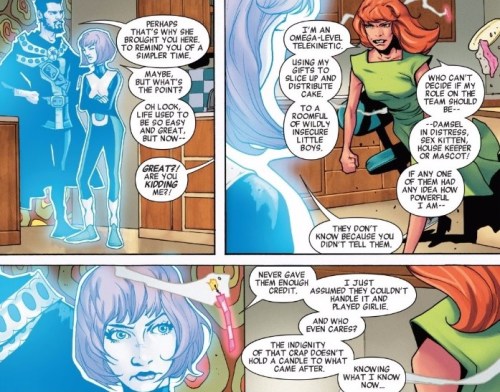
It’s a spirit quest, of sorts, one that takes the teenage Jean Grey through the life she seems doomed to live. It spans multiple eras of X-men comics, from the Stan Lee/Jack Kirby days of Uncanny X-men to her latest death in the early 2000s. What makes this journey a bit rockier, though, is that she’s not just a spectator.

These visions of her future self aren’t just there to remind her why her future sucks. They’re basically drills sergeants trying to hammer some hard lessons into her head that Jean, and teenagers in general, refuse to learn.

Jean4

It’s here where Jean starts to get a harsh lecture on having one persona that you have for all those around you while also having a very different, much less pleasant persona just under the surface. Like celebrities that are assholes when the camera isn’t rolling, some people have to pretend to be something they’re not.

With Jean Grey, one of the most powerful mutants on the planet, it’s even more difficult. Jean’s vision basically tells her what she refuses to admit. She makes herself out to be this quiet, upstanding young woman on a team of teenage boys. However, under the surface, she knows she’s more powerful than everyone else on her team and most other teams.

Her maintaining that facade is like trying to play chess with a brain-damaged monkey and trying to give the monkey a fair chance. As is the nature with mutant powers, she can’t turn them off. She can’t ever not be so powerful and frustrated. It’s a lesson that is hard for a teenage girl to wrap her head around, but easy for most adults who can’t stop being adults.

By now, it should be somewhat easier to see the real-life parallels here. We’re talking about overwhelming feelings that we can’t turn off, which tend to affect us greatly later in life. As teenagers, we don’t know how to deal with them or even how to make sense of them. They still affect us, though. We can try to ignore them all we want, but that doesn’t make them go away.

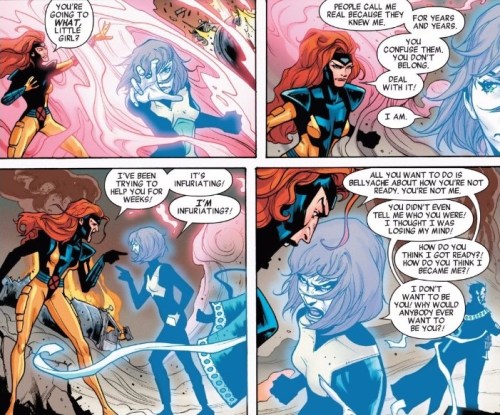
I’ll give the less kinky readers a moment to fill in the blanks. In the meantime, the life lessons in Jean Grey #6 get a lot harsher. As Dr. Strange guides her towards other moments in her life, she encounters a later version of herself that fans of the 90s X-men cartoon should recognize.

This is a version of Jean Grey who has put in the time, effort, and passion to endear herself to a lot of people. This is the woman that many of the other X-men see, or want to see, when they look at teenage Jean Grey. There’s a reason why Jean ranks among the most popular X-men characters of all time. The woman she becomes, which also happens to be a woman teen Jean resents, is just that endearing.

It’s a lot for anyone to live up to. Being a teenage girl, though, Jean isn’t going to just accept that this is the person she becomes. She knows that person still ends up dying. She knows that person still succumbs to the demons she can’t control, namely the Phoenix Force.

Jean3

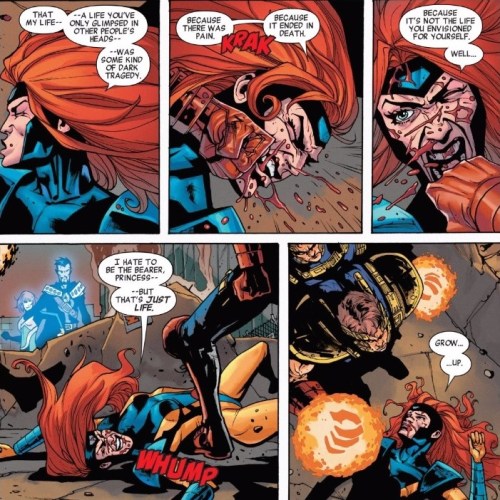
It gets even harsher, though. As with every teenager, Jean Grey’s perspective is very limited. She hasn’t experienced enough of the world to understand what actually shapes someone into a functioning adult.

She, like many other teen heroes, have this idealized version of who they want to be and what life is like. It’s tragic, but inevitable that such idealism will eventually be shattered. That’s just the nature of life, in general. Ideals are for a perfect world and nobody, not even superheroes, live in a perfect world.

This is where the message becomes bigger than Jean Grey. It’s a message that can resonate with all teenagers. Her older self basically lays it out for her in a way so simple that even a teenage mind can process it. The life she thinks is doomed to tragedy and pain isn’t just a matter of rotten luck and crushing disappointment. It’s just life.

Jean5

It’s one of those messages that can apply to much more than superheroes and mutant powers. It can apply almost every teenager to some extent at some point in their lives. They’re just starting to learn what the world is like without the rose-colored glasses of childhood. They’re just starting to feel things that are strange, powerful, and make their pants feel tighter than they want. It’s not a tragedy. It’s just life.

It’s a lesson almost every teenager learns the hard way, regardless of whether or not they have mutant powers. I certainly did. I challenge anyone reading this comic, my novels, or this blog to say otherwise. The transition between childhood and adulthood is hard and it has to be hard because it’s such a harsh world.

On top of that, we have to enter that world with all these powerful feelings and emotions that kids just can’t process. This is where the Phoenix Force, the utter bane of Jean Grey’s life and many deaths, enters the picture.

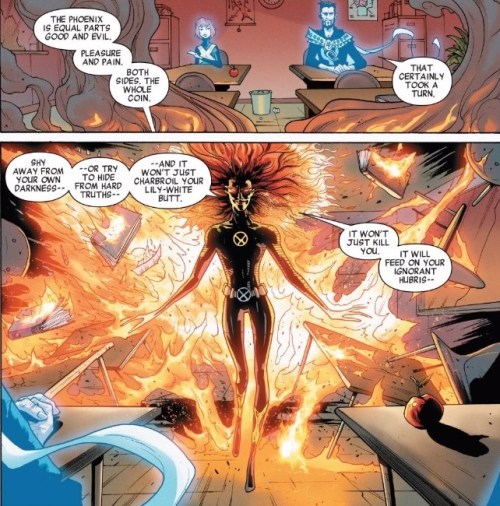
In a sense, this cosmic space bird is a manifestation of the greatest extremes that we experience. In the comics, it’s a force that pushes Jean Grey’s powers over the edge and beyond. In life, it’s basically every overwhelming experience we’ve ever had, amplified to infinity.

When you’re a teenager, you’re full of all sorts of overwhelming feelings. As an adult, they’re still overwhelming, but you gain a sense of perspective. From our ability to love to our desire to make love, it’s a powerful force that shapes how we live and how we die. Being immature teenagers, and even immature adults, we often try to suppress it. Not only does that fail, but it can make everything worse.

Jean Grey, being a teenager, can’t wrap her head around those extremes, be they the Phoenix Force or just being a functional adult. Again, the visions of her older self basically have to belabor it, to the point of frustration.

In her vision, she starts to gain a better perspective of what these feelings are. She comes to see the Phoenix Force as more than just that big cosmic fire bird that ends up killing her twice. It’s not just a force for death. It’s also a force for life. Being a teenager, she can’t help but focus on the death. In doing so, she only ever obsesses over one extreme.

That’s understandable for a teenager who hasn’t lived enough of a life to make sense of it. It’s also the exact mentality that gets her killed. It’s why people who obsess over death tend to live in a state of near-constant distress. It affects them and those around them. By only focusing on one extreme, they basically doom themselves.

Jean Grey is in that exact position. She’s focused entirely on the end, but not on everything else around it. Teenagers, with their limited experiences, are like that and through no fault of their own. That’s why they’ll make such poor decisions, both in their adult lives and in their personal lives.

Jean2

This is where Jean Grey has her most defining moment of the comic, if not the past five years of X-men comics. Despite the benefit of foresight afforded to her by time travel and psychic abilities, she still refuses to confront the extremes of the Phoenix Force. She refuses to accept the person she becomes.

Finally, after all the belaboring and mystical-induced spirit quests, she does it. She finally takes a step back from the doom and gloom of her impending death. She finally looks at the bigger picture. She admits that who she is now and who she’s afraid of becoming are the same person. Those feelings that overwhelm her that she’s been trying to suppress are there and they’re not going away.

As an X-men fan and a fan of personal insight, it was one of the most satisfying moments I’ve reading an X-men comic that didn’t involve Emma Frost’s costume. It was one of those moments that felt much bigger than the character. It’s a powerful message that people without mutant powers can appreciate.

Jean1

Jean Grey’s struggles are very much akin to the struggles everyone faces when they have overwhelming experiences of any kind. Those experience don’t always have to have a sexual or personal connotation, but those are the ones that tend to stick out.

They’re also the experiences that teenagers, and even many adults, are likely to suppress. They’ll see certain experiences and desires as this powerful, dark force that will consume and destroy them, much like the Phoenix Force. However, it doesn’t have to be that way.

Just acknowledging that those feelings exist is an important step, especially for a teenager. There are people out there right now in societies and cultures that pressure them to repress desires that cannot be repressed. Like Jean and the Phoenix Force, those feelings eventually find us in the long run. If we refuse to confront them, then they can destroy us.

It’s a powerful lesson, especially for young people still making sense of their experiences. They may not have Jean Grey’s psychic abilities or the insight provided by time travel, but their future still seems every bit as daunting. It only becomes less daunting when you step back and realize that the overwhelming feelings we dread are just part of life, in general. We can’t always suppress them. Sometimes, we just have to embrace them.

12 Comments

Filed under Comic Books, Jack Fisher, Superheroes, Jack Fisher's Insights, Marriage and Relationships

Lessons In Fate, Power, And Passion (From An X-men Comic)

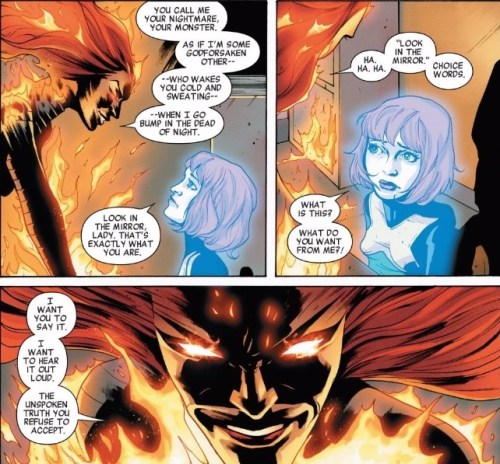
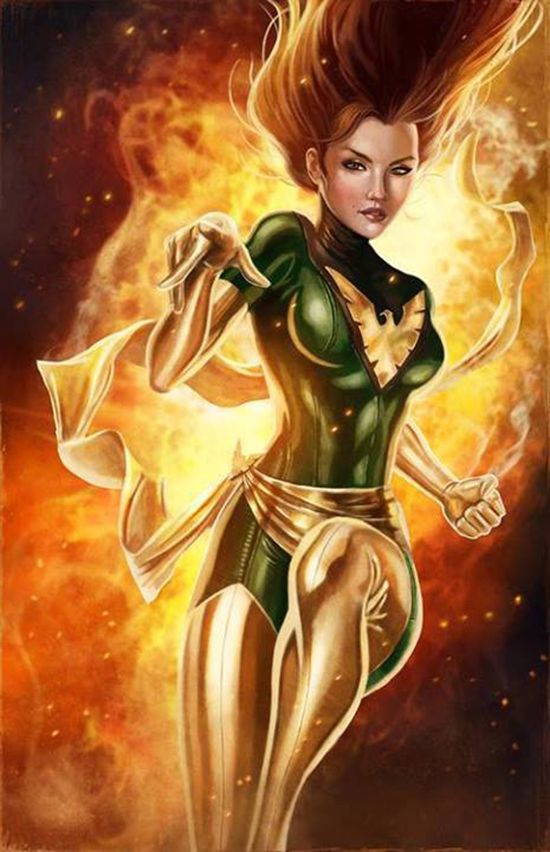
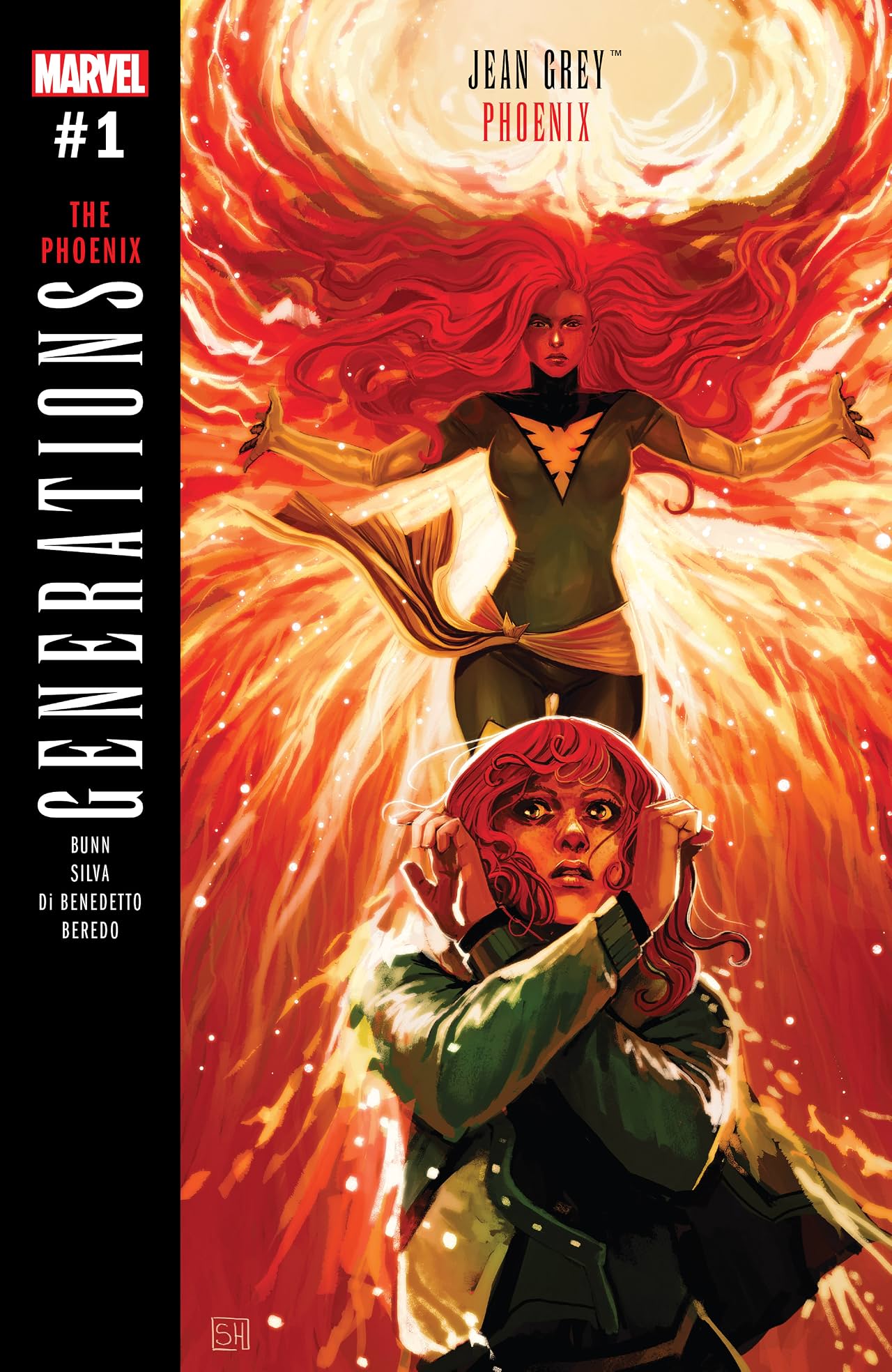
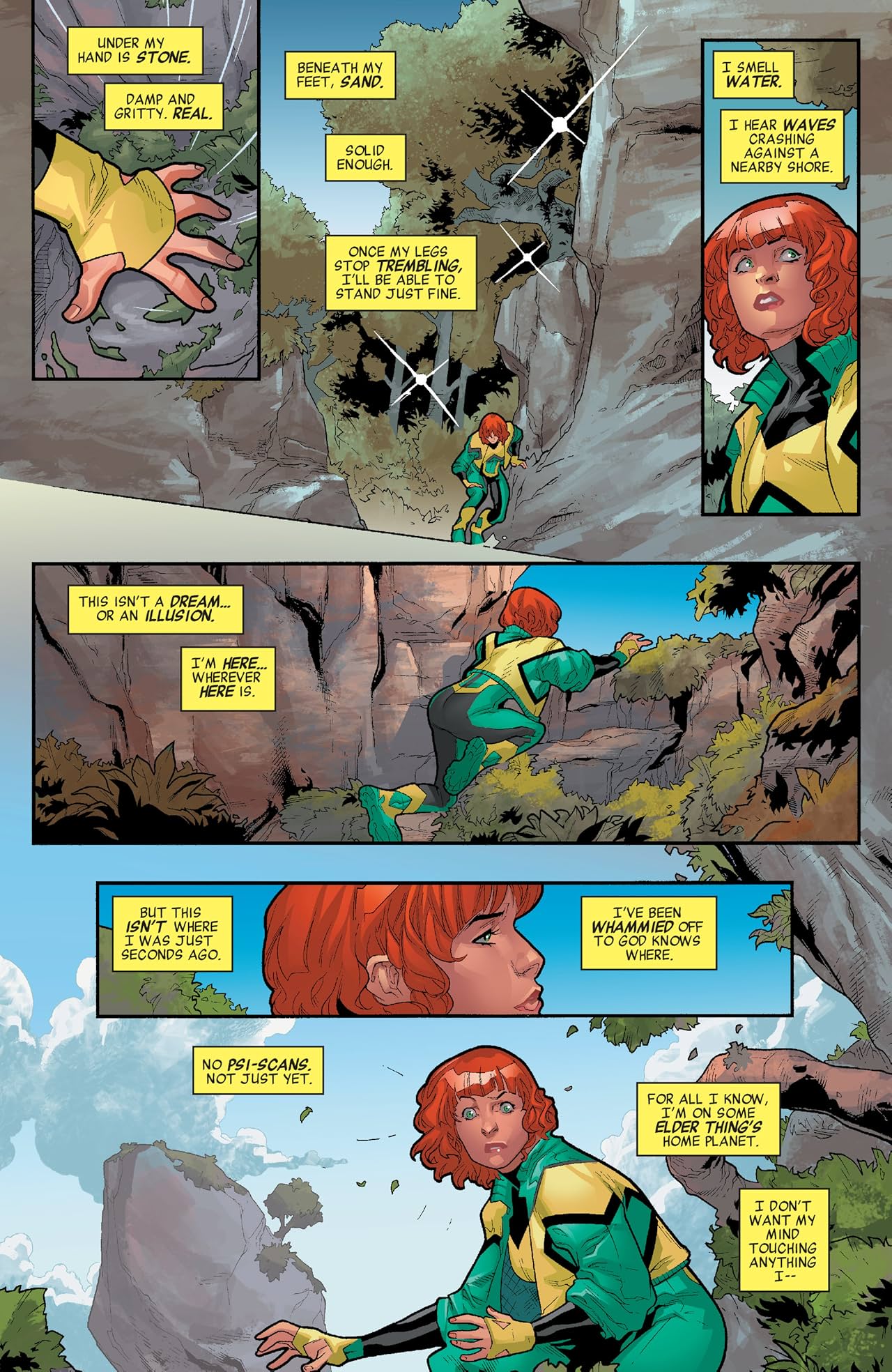
Generations: Phoenix & Jean Grey (2017) #1

As kids, it seems as though everyone is trying to teach us morality lessons that’ll help us grow into functioning adults. Those lessons aren’t always effective, though. Just ask the potheads who sat through the DARE program in school.

As adults, we tend to pay less attention to those kinds of lessons because we arrogantly believe we’ve figured it out. We think we know enough about the human experience to determine what is right and what is wrong. People who think that way tend to be the arrogant assholes who refuse to admit that Dr. Oz is a quack and a fraud.

Truly functional people, be they kids, adults, or adults who still act like kids, never stop learning important life lessons. Life is a constantly changing, obstacle-filled struggle where you never see the finish line and are guaranteed to fall flat on your face at least once a week. That’s why lessons that really deliver a powerful message in a compelling way is a special, precious thing in this chaotic world we live in.

That brings me to comic books, superheroes, and the X-men. Yes, this is going to be another one of those posts. Yes, that means I’m about to extrapolate a major philosophical insight into the human condition from an X-men comic, most likely in a way that applies to love, sex, and everything in between. You’re welcome.

It’s not the first time I’ve gleaned such lessons from an X-men comic. A year ago, I singled out X-men 92 #5 as a testament to just how powerful a romance between equals can be. Chances are, I’ll single out more comics in the future and there’s a high possibility that they’ll involve the X-men, Deadpool, or Wonder Woman.

The comic in question today is Marvel Generations: Phoenix & Jean Grey #1. It’s actually not part of any ongoing X-men series. It’s a single, self-contained story that’s part of an major promotional effort by Marvel called Marvel Generations.

The goal is as simple. Marvel seeks to bridge the gap between its older incarnations of iconic characters with the newer versions. While some of those newer versions have already caused controversy, the goal is always the same. Marvel hopes to appeal to their long-time fans while appealing to newer fans who are just getting into the world of Marvel.

Comic companies do this fairly often, trying to please old fans while creating new ones. Having followed comics for a good chunk of my life, I’ve seen more than my share of efforts. DC Comics, Marvel’s chief rival, did it last year with their DC Rebirth initiative. By most accounts, it was a success. Now, Marvel is attempting to achieve similar success.

There are many challenges to that effort, but for Jean Grey of the X-men, those challenges are more daunting than most. I’m not talking about the kind of daunting that involves dragons, killer robots, and Brett Ratner movies. I’m talking about convoluted complications involving time travel, evil clones, and cosmic forces. Trust me, it’s way more complicated than it sounds.

For this particular issue, though, you don’t need to know the fine print of those complications. You only need to know that Jean Grey’s story, after 50 years of X-men comics, got so crazy that one of her teammates, Beast, traveled back and time and brought her and the rest of the original five X-men to the future.

Now, since 2012, Jean Grey has basically been Marty McFly from “Back To The Future,” minus the incest sub-plot. She knows that her future sucks in that she ends up dead, and multiple times, no less. On top of that, she finds out she’s destined to become corrupted by a cosmic power known as the Phoenix Force, which will go onto cause all sorts of headaches, heartbreaks, and overall frustration.

That destiny is a huge part of the X-men mythos. That’s the part that “X-men: Dark Phoenix,” a movie I’ve talked about extensively, is going to try and capture. In this comic, Jean Grey has already read the spoilers to that story. She knows it doesn’t turn out well.

In fact, she has an ongoing solo series where the primary theme involves her preparing herself to face the Phoenix Force so that she doesn’t become that cute redheaded mutant who constantly dies and ends up on the wrong side of a bad love triangle. That’s entirely understandable and Marvel Generations: Phoenix & Jean Grey #1 gives her the best opportunity she’s had to date to change her fate.

This is where the lesson that Marty McFly learned the hard way comes in. Through elaborate space-time machinations that would give Doc Brown a migraine, Jean Grey is transported to a critical moment in the history of her character. It’s a moment that puts her in a position to change a lot more than just her fate.

That’s because she’s plopped in the middle of the iconic Phoenix Saga, also known by fans as the greatest X-men story ever told. It’s after her older self gains the cosmic power of the Phoenix force, but before it corrupts her in a way that destroys an entire star system and dooms her to a life of death and resurrection. There’s no part of that last sentence that’s exaggerated.

It’s an understandably confusing situation, but it’s one that puts Jean Grey in a position that even Marty McFly never dealt with. She doesn’t just have a chance to change her fate or learn more about her older self, who she’s only really known through the memories of other X-men. She has a chance to learn more about the cosmic power that she knows will doom her.

It makes for a series of colorful interactions between her and her older self that will bring tears of joy to the eyes of X-men fans of any generation. It’s hopeful, sincere, dramatic, and impactful. It fits perfectly within the narrative of Jean’s ongoing story in other X-men comics, as well as the story of her past self.

There’s so much to love about this comic, but I’m not going to spoil the entire thing here. I’d much rather have people go out and buy the issue. It’s money well-spent. Even if you don’t know much about comics or only know the X-men through the movies, this comic will appeal to you.

Beyond that appeal, though, I want to highlight an important theme within this comic. It’s a theme that applies to stories beyond comics and is relevant to life, in general. It especially applies to matters of love, passion, and intimate connections, which are major topic of this blog and the novels I write.

Generations: Phoenix & Jean Grey (2017) #1

At the heart of Jean Grey’s struggle in Marvel Generations: Phoenix & Jean Grey #1 is a difficult decision that everybody who isn’t a psychotic dictator faces at some point in their lives. It has to do with having the power to effect a situation and choosing whether or not to exercise it.

In the comic, Jean Grey has a chance to tell her older self everything she knows about her fate. She could, in principle, warn her about how the events of the Phoenix Saga play out for her. As a result, she could ensure it turns out differently, preferably in a way that doesn’t leave her dead and subsequently cloned.

On the surface, it seems easy. We saw what Marty McFly chose. We saw what the entire cast of “Hot Tub Time Machine” chose. They chose the easiest, most obvious path. They understandably wanted to improve their situation. In doing so, they created a lot more problems that they had to solve. The stakes for Jean’s problems, though, are much higher.

The problems she could create by changing her fate might be far worse than simply ending up dead. She’s not dealing with incestuous infatuations here. She’s dealing with a cosmic force that eats entire stars just for the fun of it.

She already knows the consequences of not changing anything. That has been hard enough to deal with. However, she has no idea whether she’ll fix anything by choosing otherwise. Given the Phoenix Force’s mixed track record, the odds are not in her favor.

I won’t spoil the choice she makes or what goes into. Again, I’d rather people read this comic to appreciate the full weight of its message. I’ll just say that the decision Jean makes is one that we all indirectly make when we have any kind of power over someone and can affect the course of their life.

Whether you’re a parent, a spouse, or an authority figure of any kind, you have an ability to make choices that affect other peoples’ fate. This is especially true when you’re in a relationship with someone. Your love for them and their love for you effectively links your fate. That makes your ability to make the right choices for the right reasons so critical.

It happens all too often, people using their position of power over others to abuse them. We see it when police harass minorities. We see it in crimes of passion. We see it in cases of spousal abuse and child abuse. When someone else trusts us with authority, we impact their lives in so many ways, often in ways we can’t see.

It can bring out the best and the worst in people, as the Phoenix Saga famously demonstrated. Real life demonstrates it too. Power does corrupt people. Sometimes the hardest choice to make is to not exercise that power to avert the potential consequences it might incur. It’s a choice that a lot of crazy dictators fail to make.

It’s a choice ordinary people fail to make as well. Parents find this out the hard way when they try to make decisions for their children. Sure, it seems like the right thing to do at the time. They may see it as them just protecting their child, as every parent should. However, they don’t realize until it’s too late how much damage that can do.

When you’re in an intimate relationship with someone, it can be just as powerful. If someone loves you implicitly and is willing to trust you so completely, you have the power to guide their lives in profound ways. That guidance, though, can be detrimental to the both of you.

When you have the power to influence a person or a situation, it’s easy and tempting to bend it to what you think will be more beneficial. The problem is that, without the benefit of hindsight, it’s impossible to know whether you’ll actually make things better or much worse.

The hardest decision in that situation is to acknowledge the problems as you understand them, bear the burden of solving them, and focus on the future rather than agonizing over the past. It’s rarely a preferable decision because it means accepting a situation and your role in it. It may feel like a missed opportunity, but it can just as easily be an averted crisis. Hindsight may be painfully clear, but possibilities are painfully vague.

Jean Grey, who is a teenager, mind you, in the story that plays out in Marvel Generations: Phoenix & Jean Grey #1, has to make this decision in the face of impossibly high stakes. What she does is a testament to the kind of character she is and the values we cherish in our heroes.

It’s a short, but powerful story that teaches an important lesson to children, adults, comic fans, and non-comic fans alike. Whether you’re a comic book character, a celebrity, an authority figure, or just someone with the slightest bit of leverage over someone, it’s a lesson worth learning.

4 Comments

Filed under Comic Books, Jack Fisher, Superheroes, Jack Fisher's Insights

Comics, Milkshakes, And (Failing To Fight) Internet Trolls

Before I say anything, I need to make one thing clear. I am extremely reluctant to talk about an issue that’s still fresh, so to speak. In general, I prefer to wait until he uproar has died down and/or the angry masses of the internet have tired themselves out over an issue. I usually find it easier to sift through the rubble after the storm has passed.

This may very well be the most hesitant I’ve ever been to talk about a particular issue. Think about that for a moment. I’m someone who has talked about sex robots, awkward boners, and his own circumcision. If I’m reluctant to talk about a topic, then it must be pretty nasty.

Well, don’t adjust your gag reflex just yet because it’s not that kind of topic. This isn’t something that just sparks revulsion or passionate disagreement. This is the kind of stuff that just brings out the worst in everybody. It’s like licking the shit stains on a toilet before they’ve dried. It just makes a bad topic that much worse.

However, I’m willing to suck in my gut, brace myself, and ignore my reluctance because I feel like this is something that needs to be said while certain people are still listening. Plus, it involves comics and the comic book industry. Other than the erotica/romance industry, few are quite so near and dear to me.

Even those who don’t follow the industry probably noticed an unusual hashtag trending in the news recently. It involved an incident with some of Marvel’s editorial staff. When I first saw it, I had no idea it was a controversy. I thought it was some new promotional effort. Marvel, and most comic companies, do that all the time.

For once, I’m sad to say that this had nothing to do with an ad gimmick. The hashtag in question was #MakeMineMilkshake and it was inspired by this innocent-looking tweet from Heather Antos, who happens to be an editor at Marvel.

I actually saw this on my Twitter feed. I thought it was a nice moment. It put a smile on my face. It involved milkshakes, comics, and cute girls in the comic book industry. I honestly can’t think of something more appealing to me without adding pizza, the beach, or free tickets to a football game.

Then, some asshole internet trolls, of which there are many, had to look at this happy little moment and mess it up for everyone. They did this by replying to the Tweet with a bunch of crude, vulgar comments. I won’t get into the substance of those comments because they’re not worth spreading. I won’t even make an assessment over how bad they were. I’ve been to the many toilets of the internet. I know how bad it can get.

However bad it was, it created a hashtag that has spread like a wildfire and burned away any faith you might have had in humanity, comics, or peoples’ ability to discuss an issue rationally. Like other hashtags before it, #MakeMineMarvel has become a catalyst for two sides of a pointless debate to whine and moan endlessly about how right they are. It’s a debate that nobody can ever win.

The hashtag, which I doubt Ms. Antos intended to start, has created this rage-filled rant on toxic sub-cultures like comics. On one side, you have those claiming that it’s full of angry young men who don’t want to see women screwing up their favorite toys. On the other, you have those who feel like they’re being demonized for comments that just a few idiot trolls made. Again, nobody wins that debate.

It was frustrating to me because, being a man, it made me feel like I’m being lumped in with the same group of assholes and I want no part of that. I didn’t respond to Ms. Antos’ tweet. I didn’t respond to anyone who asked me to respond. This was just a hornet’s nest that I didn’t want to poke.

An abandoned hornet's nest my dad found in his shed that he hadn't been in for a couple years. The head is apart of a wooden statue it fused with.

Then, the hashtag kept trending and people at Marvel and DC, two rival companies mind you, began responding to it. They even made milkshakes into counter-protest, of sorts, using it to fight against internet trolls and toxic subcultures. Considering some of the other protests we’ve seen this past year, I think that’s a fairly innocuous method.

However, the mere fact that this is even a thing speaks to a much larger issue. It’s one of those things where neither side, be it Ms. Antos or those who now despise her, can see the forest from the trees. After it started trending, Ms. Antos posted this tweet and understandably so. There are just certain parts of the internet and certain people who use it that completely warrant that sentiment.

Now, here’s where I start saying things that I know will rub certain people the wrong way. I’m going to try and be very careful with my words here.

I don’t want to start a new hashtag or anything. I also don’t want to get blocked because I follow people like Heather Antos on social media. I’ve said enough dumb things in the past and I’m trying to limit that, especially in these sensitive times we live in. I’ll do my best to be polite about it, but I’m not going to shy away from the truth. I’m just going to add what I hope is meaningful context.

With that in mind, I’d like to send Ms. Antos an important message that I doubt she’ll never read. That same message should apply to others who supported her since #MakeMineMilkshake started trending. Here it is and excuse me while I brace myself with an adamantium shield.

“The trolls have already won. You’re letting them win with every word you say about this issue. PLEASE change the way you fight them.”

I’m going to keep that adamantium shield up just in case, but I know this will probably take some uncomfortable explanations. I’ve talked about dealing with internet trolls before. I’ve also talked about professional trolls who go out of their way to start digital shit storms like this for their own benefit. What I’ve seen with #MakeMineMilkshake is basically a case-study in how not to respond to trolls.

Now, that’s not to say that Ms. Antos’ intentions are misguided. I don’t doubt for a second that she responded to the comments she got in the best way she thought possible. Maybe she didn’t intend for it to start trending. Nobody can really know whether or not something will become a thing, especially if it doesn’t involve cute animals.

Even if #MakeMineMilkshake didn’t start trending, though, Ms. Antos’ response would’ve already ceded some form of victory to the trolls. Like punting on third down in a football game, she didn’t adapt her game plan. Given how quickly this unfolded, I doubt she thought she even needed one.

The problem with turning her response into a hashtag, albeit indirectly, is that doing so gave the trolls exactly what they wanted. With every retweet, response, and cute quip, they get even more. That’s because trolls don’t deal in the traditional currencies of shame, sorrow, and basic human decency. They only understand one form of coin and that’s attention.

It may very well be the most important currency of the digital age. It may even be more than just a currency. It could very well be the life force with which trolls need to sustain themselves. Like Galactus, devourer of worlds, the hunger is never sated. Lacking heralds or The Power Cosmic, these trolls must resort to the lowest lows of the internet to feed their hunger.

With #MakeMineMilkshake, they basically got a free buffet and a complementary desert. I guarantee that once this hashtag started trending, they didn’t cower with fear, dread, or remorse. They’re probably still grinning and twirling their fake mustache. If they could make a collective statement towards Ms. Antos and everyone who came to her defense, this is what they would probably say.

“Ha! I did it! I got under her skin. I made this person who is more successful than I’ll ever be cry out for help, play the victim, and seek validation. They can call me a racist, bigoted, sexist pig all they want. It doesn’t matter. They just proved they’re a bunch of thin-skinned, hyper-sensitive snowflakes. Now, thanks to the hashtag, the world knows it! They know it and it’s all because of me! Mwhahahahahahaha!”

I concede that the evil laughter might be an exaggeration, but since this involves comics, I think it’s appropriate. Internet trolls are the closest thing most of us have to villains. Other than former child stars and the IRS, it’s hard to think of anyone more devious.

It pains me to say it, but the trolls won this round. Ms. Antos, whatever her intentions might have been, gave them what they wanted. She gave them attention and they’re using it. They’re already turning this misguided hashtag into Round 1,283,285,206,809 of the angry alt-right versus the bossy progressive left. It’s a fight that never has any winners.

Again, I know Ms. Antos is never going to read this post. I’m not successful enough or smart enough to have that kind of audience just yet. I’m working on it, but Ms. Antos is so far ahead of me that I can totally understand her not responding to every aspiring writer who tries to add his thoughts to an overly-complex issue. She’s an editor at Marvel. She has far more awesome things to do with her time.

If I could send her a message, though, I would offer her a simple bit of advice. When dealing with trolls, you have countless ways to lose and only a few with which to win. Anything that gives them the slightest bit of attention, no matter how negative, counts as a victory for them and a defeat for you.

To defeat the trolls, the best thing you can do is ignore them. Don’t just instinctively block them, though. Let them whine, yell, and complain with the worst digital drivel they can come up with. Either they’ll get bored or they’ll make an ass of themselves. In either case, you’ll save yourself the frustration and not embolden those who would frustrate you.

If ignoring them isn’t possible, then the second best thing you can do is fight them with kindness. I know that sounds cheesy. I know that sounds like something Superman, Captain America, or Spider-Man would say in an after school special. It still has merit, though. Your capacity for kindness, even to those who insult you, shines a brighter light on the kind of person you are while also exposing the kind of person the troll is.

The worst thing you could do is take what these trolls say and turn them into a rallying cry, of sorts. That doesn’t just give the trolls even more attention. It gives them a larger target to hit. It’s the digital equivalent of Newton’s Third Law. For every action, there is an equal an opposite reaction. With respect to trolls, poking them just makes them poke back harder.

If Ms. Antos is still with me at this point, I thank her. I know there are some who have already decided to block me at this point. I’m hoping I can still reach those willing to listen so here’s my final thought.

Trolls, in whatever form they take, should never be used as a basis to judge larger swaths of a population. Using these trolls to condemn all men, comic book fans, and Twitter users is a huge mistake. It’s basically a bonus to the trolls on top of the attention because it means more will identify with the trolls than their victims. That’s the last thing you want and the last thing the internet needs.

I don’t doubt for a second that there will be other misguided hashtags like #MakeMineMilkshake. I suspect there will be far worse trolling down the line. That’s because people are always going to say stupid shit, both online and in real life. It’s just part of the package that is the human condition. It’s how you react to it that determines whether you’ve saved the day or aided a Skrull agent.


Update: Well, I wrote this post under the assumption that Ms. Antos, or anyone else who is many times more successful than me, would ever read it. I was wrong and I’m more than relieved to say that. Ms. Antos did actually read this post. As a result, there’s something I need to clear up. Several hours after I posted this, Ms. Antos issued the following tweet.

I sincerely thank her for her response and I apologize for the impression that my post had given. In reading it over again, I realize I had implied that she was the one who started the #MakeMineMilkshake hashtag. She did not. I never thought she did, but I implied otherwise. For that, I sincerely apologize. Apparently, I was not careful enough with my words. I’ll try to be mindful of that in the future.

5 Comments

Filed under Comic Books, Jack Fisher, Superheroes

How To NOT Screw Up The Captain Marvel Movie

It’s a sad fact of life in an overly flawed world. You hope for the best, but it’s rare that it ever actually happens. Even when it does, it’s not always as much fun as you hope. Ask anyone who lost their virginity during a dare or stood in line for hours to see the Star Wars prequels.

In my experience, it’s rarely feasible to build your anticipation around something for what it can be if everything goes flawlessly. In the real world, there’s no such thing as flawless. People make mistakes. Parties go horribly wrong. Hearts get broken. Michael Bay is given too much money, cocaine, and high explosives.

When it comes to superhero movies, though, it’s not possible to hit a home run at every turn. You can’t expect them to blow your mind and give you the kind of mental orgasm that takes a week to recover from. At best, you can just hope that it doesn’t suck. I love those kinds of orgasms as much as the next guy, but let’s face it. They’re rare and awesome for a reason.

Some movies come close to achieving that kind of cinematic bliss, though. “Wonder Woman” sure did, but as I pointed out in my review, it did have its shortcomings. They were still very minor and by nearly every measure, it is the most successful female superhero movie to date.

More importantly, “Wonder Woman” proved that female superhero movies can be successful. They don’t all have to be box office bombs like “Catwoman.” That opens the door for other female heroes to follow in Wonder Woman’s footsteps. At the moment, though, the only female solo movie besides the Wonder Woman sequel is “Captain Marvel.”

Marvel may have DC beat in almost every other aspect of its movie universe, but now there’s one area where it can’t say it dominates. Sure, it has a lot of strong female characters like Black Widow, Gamora, and the Scarlet Witch. However, they’ve largely been in supporting roles. They’ve never had a chance to shine like Wonder Woman did in her movie.

Captain Marvel will get that chance. She’s the closest hero Marvel has to Wonder Woman, thanks largely to the efforts of writers like Kelly Sue DeConnick. As much as Marvel has dominated DC at the box office, it now has a sub-perfect record. Given the amount of ego and cocaine in Hollywood, there’s no way that Marvel Studios will let that stand.

I don’t doubt that Kevin Feige and the powers that be at Marvel Studio will make every effort to ensure that “Captain Marvel” matches and exceeds “Wonder Woman.” They’ve already cast the beautiful and talented Brie Larson as Carol Danvers. They also announced some major details about the movie at the San Diego Comic Con.

On paper, it looks like this movie has what it takes to match “Wonder Woman.” Then again, on paper I’m sure “Batman and Robin” seemed like a good idea. While I have high hopes for this movie, just as I did with “Wonder Woman,” I’m not going to set my expectations too high. Between the two “Matrix” sequels and “Wolverine Origins,” I’ve been burned too many times.

With that in mind, I intend to do for “Captain Marvel” what I did for “X-men: Dark Phoenix.” I’m going to provide some tips that I’m sure Kevin Feige will never see on how to avoid screwing up the “Captain Marvel” movie.

Wonder Woman” set the bar pretty damn high and looked dead sexy while doing it. It’s unreasonable to expect “Captain Marvel” to exceed it on every level. However, there are a few simple tips to ensure it doesn’t end up enduring the same infamy with “Catwoman.”


Tip #1: Let Carol Fly High (And Take The Audience With Her)

This is the most important tip, right up there with the Marvel Studios logo and Samuel L. Jackson dropping F-bombs, as only he can. Carol Danvers has a few defining traits beyond just looking awesome and kicking ass on a cosmic level. One of those traits is what makes her feel both distinctly human and someone we want to cheer for.

Throughout her history, Carol Danvers has been ambitious in a very particular way. Everybody, male or female, will look up at the stars at night and admire their beauty. Carol, however, doesn’t just want to admire. She wants to actually go there. She doesn’t want to shackle herself to this tiny little mud ball full of killer clowns, spiders, and the Kardashian family.

That’s why she joined the Air Force and fought to outperform everyone in her path. The fact she did that without a penis was secondary. Even before she got her powers, she aspired to go to the stars. Once she got those powers, she was determined to fly higher and go farther than anyone had ever dared, regardless of whether or not they had a penis.

Therein lies the key. Carol dares to venture out into the unknown and kick the ass of anyone or anything that tries to hold her back. That’s the kind of ambition people can get behind. That’s the kind of drive that people admire and want to follow.

It’s part of what makes Wonder Woman so endearing as a character to men and women alike. She has bold ambitions, but she isn’t an asshole about it. She doesn’t just seek to prove herself. She seeks to inspire others. That’s what Captain Marvel needs to do with her desire to go to go to the stars and carry the audience along for the ride.


Tip #2: Tie Carol’s Story Into That Of Mar-Vell’s

I get that there are times when it’s not possible to incorporate certain elements from the comics into a movie. That’s why we didn’t see any not-so-subtle BDSM themes in the “Wonder Woman” movie. However, the movie still made a concerted effort to capture some of the core details of Wonder Woman’s mythos, such as her iconic outfit and her relationship with Steve Trevor.

In the same way Wonder Woman needs her lasso and a desire to have sex with men who look like Chris Pine, there are some core elements to Carol Danvers’ story as a superhero that cannot and should not be glossed over. One of the most important elements involves her connection with Mar-Vell, the original Captain Marvel whose title Carol took on after his death.

Theirs is an unique connection, one with very different dynamics compared to Wonder Woman and Steve Trevor. While there were some romantic overtones early on, their connection was more of a partnership rather than a romance. You can’t tell Carol’s story or get a feel for how she becomes a hero without telling Mar-Vell’s story as well.

That story doesn’t need to take up half the movie, but it does need to feel relevant. Mar-Vell’s story isn’t exactly boring either. He was an alien spy posing as a human on Earth on behalf of the Kree, a race that made it’s presence felt in “Guardians of the Galaxy.” There’s already some connections to build on. This movie just has to do it without a talking raccoon.

The key here is to use Mar-Vell’s story as an alien spy who grows fond of a beautiful Earth woman to supplement Carol’s story. That story is part of how Carol becomes Captain Marvel. That’s why when Kelly Sue DeConnick had Carol take on that title, it had a lot dramatic weight to it. That kind of drama is key for any successful movie, regardless of whether or not it has a talking raccoon.


Tip #3: Give Carol An Attitude (And Make It One To Rally Around)

One of Wonder Woman’s most defining traits, on top of being a beautiful warrior princess, is her capacity for love and empathy. Sure, she’ll fight with all her heart against demons, monsters, aliens, gods, and whatever asshole decided that “Ant Man” should get a movie before her. It’s that heart that makes her personality so endearing.

I point that out because Carol Danvers is not like that. Carol has an attitude and it’s not Wonder Woman. Just because Wonder Woman made a successful movie doesn’t mean Carol has to be too much like her because, in nearly every part of her 40-year history, she’s not like that.

Carol Danvers is a tough, hard-nosed woman who always pushes herself a little farther than anyone dares. That’s to be expected because she’s no princess. She’s a pilot in the United States Air Force. You need to have some attitude to make it there. There are real women who have succeeded in that effort. Let those women be the template.

The key is to do it in a way that doesn’t make her an arrogant bitch. I don’t doubt that’s going to be a challenge because the line between assertive and bitch is exceedingly blurred, more so for women than men. It’s an unfair double standards that people love to whine about, but never do anything to fix. Some argue it can’t be fixed.

That’s not an issue that “Captain Marvel” can hope to resolve over the course of a single movie. As such, it’s important that she walk that fine line in crafting her attitude. Again, Kelly Sue DeConnick struck the perfect balance when she took over Carol’s story in 2012.

She gave her a personality that was tough, but welcoming. She made her someone you want to hug, but don’t want to fuck with. Carol Danvers is ambitious and tough, but also has a strong sense of duty. Being a soldier, a pilot, and a hero, she sees that as part of her mission. It’s what makes her so likable as both a character and a hero.

She can have an edge, but she doesn’t have to be an asshole about it. Being an asshole is one of those traits that knows no gender. Brie Larson is a great actress who has proven that she can play tough, balanced roles. Let her do that and look sexy as hell in the process. That’ll help any movie.


Tip #4: Acknowledge Carol’s Faults And Let Her Bear Burdens

In addition to her attitude, Carol Danvers does has faults. Again, and it’s worth repeating, she is not Wonder Woman. She’s not some demigod princess whose beauty and strength were forged by gods. She’s an ordinary American woman who got her powers because she ended up working with an alien spy. She a fallible, mortal human being with tangible flaws. Any movie about her shouldn’t hide those flaws.

Some of those flaws are more obvious than others and I’m not just talking about the unpleasantness surrounding the plot with Marcus Immortus. Despite being ambitious and determined, Carol tends to be a bit of an adrenaline junkie and is prone to take stupid risks. This has gotten her into trouble before and quite recently in the comics.

With that in mind, it shouldn’t be too surprising that she’s also an alcoholic. However, it’s not the kind of alcoholism that we see with Iron Man. His brand of alcoholism is largely a product of irresponsibility and poor coping skills. Carol’s alcoholism is more about escaping her problems.

In the context of her character, that makes sense. She grew up looking at the stars and wanting to actually go there. She’s always pushing herself to fly a little higher and faster. When she’s unable to do that, she looks for an escape.

For her, accepting limitations is not easy. That’s how her alcoholism got so destructive in the comics, so much so that even Iron Man noticed it. When Iron Man says you have a drinking problem, you can skip the intervention.

That doesn’t mean that Carol has to be a total drunk in the movie. It doesn’t even have to be overtly stated. The reason why Carol drinks is more important than her actually drinking. Accepting limits is difficult for her. It’s a key part of her story and her personality. Let her endure those burdens. Let her confront those flaws. She doesn’t have to be Wonder Woman. Let her be human, with or without her powers.


Tip #5: Make The Kree/Skull War As Epic As Possible

This is somewhat indirect of Carol’s story, but one that’s vital if “Captain Marvel” is to be a fitting addition to the Marvel Cinematic Universe. Beyond just being one of Marvel’s most powerful female characters, her movie also has to expand the overall mythos of the MCU. “Wonder Woman” did that too with DC, albeit on a very limited scale.

In this case, though, that scale needs to be turned up to eleven and given an unlimited supply of crack. That’s because it was announced at the San Diego Comic Con that the “Captain Marvel” movie would introduce the world to the Kree/Skrull war. Talk to any long-time Marvel Comics fan, like yours truly, and they’ll tell you two things. One, She-Hulk is uncomfortably sexy. Two, the Kree/Skrull war is insanely epic.

We like to think we humans are pretty damn good at war. We’ve fought so many of them over our history. Compared to the Kree/Skrull war in the comics, though, we might as well be a bunch of two-year olds playing with melted action figures.

This war is beyond anything Stephen Spielberg or Christopher Nolan could ever capture. For one, this war is on a galactic scale. It’s not just about warring tribes who don’t agree on how many goats to sacrifice during the summer solstice. These are two very different species with very different visions for the galaxy. As big as the galaxy is, it’s just not big enough for them to co-exist.

This massive war has influenced many areas of the Marvel Universe within the comics. It’s usually inevitable that the Avengers, X-men, or any major superhero team from Earth gets caught up in it whenever they dare to leave the planet for more than five minutes. It’s a huge part of the cosmic elements to Marvel, which “Guardians of the Galaxy” just started exploring.

Given the success of those movies, “Captain Marvel” has plenty to build on. Carol Danvers is a soldier. Putting her in the middle of an epic war the likes of which few humans can even fathom will help bring out the best in that soldier. That’s why the Kree/Skrull war has to be as epic as a galactic-level war deserves to be. It’ll bring out the best and worst in all those involved.


There are a lot more tips I can give, but these are the big ones. Unlike “Wonder Woman,” Captain Marvel doesn’t have the burden of proving that female superheroes can hold their own. That has already been proven, so much so that even Ryan Reynolds from “Deadpool” acknowledged it.

More than anything else, “Captain Marvel” must show that Carol Danvers is someone who deserves to be in the same league as Wonder Woman. She’s not the same icon that Wonder Woman is, but she has the potential to be. This movie could finally help realize that potential. It could also be a “Catwoman” level screw-up and no character, male or female, deserves that.

6 Comments

Filed under Comic Books, Jack Fisher, Superheroes