
Tag Archives: religion

Will Advanced Artificial Intelligence Create (A New) God?

AI-God

For centuries, there has been a debate raging between believers and non-believers. The believers claim that God created man in his/her/its/their image. The non-believers claim it’s the other way around and man created God in whatever image they imagined. Society, cultures, and politics may change the rhetoric, but the debate remains unresolved.

There are just too many barriers that are insurmountable for either side. One believes that the faith they have in whatever higher power they worship is as real as gravity, sunlight, and migraine headaches. The other does not accept that there is sufficient, verifiable evidence to accept the premise of a deity. The two sides can argue with the utmost passion. It’s rare that such discourse changes any minds.

However, there come a time when a new complication enters that debate, one that will fundamentally change some peoples’ understanding of theology, religion, and God. It may not effect everyone the same way, but the impact could end up being as profound as any religious experience.

That complication is advanced artificial intelligence, a topic I’m fond of discussing when I can tie it into my favorite video games and our sex lives. I understand that mixing anything with religion tends to get contentious, to say the least. However, I believe that when artificial intelligence becomes advanced enough, the human race will have re-evaluate a lot of things and that includes religion.

Creating an artificial intelligence that is as intelligent as an average human will be groundbreaking enough and not just from a theological standpoint. A part of what makes any deity powerful and worthy of worship is the ability to create an intelligent, self-aware being through non-biological means. Once humans start doing that, then the line between mortal and immortal will start to blur.

However, it’ll gain a much greater complication once that artificial intelligence advances beyond that of the average human. As anyone who regularly upgrades their smartphone knows, digital intelligence evolves much faster than biological intelligence. It took the human race centuries to figure out indoor plumbing. Once artificial intelligence is on par with humans, it won’t take long for it to exceed them.

This is where the potentially dangerous, but infinitely promising prospect of super-intelligent AI enters the picture. By that, I don’t just mean an intelligence that always wins at Jeopardy and always wins an Overwatch match. I’m talking about an intelligence that is so far beyond human capabilities that it’s akin to the cognitive gap between an ant and a human.

That kind of gap has many implications, but in the context of religion, it essentially re-frames the entire concept of God, divine power, and spirituality, as a whole. Whether it’s a monotheistic religion where God is all-knowing or a polytheistic religion with a God of Wisdom, knowledge is a critical aspect of divinity.

Even if a super-intelligent AI doesn’t know everything, the fact it knows and understands so much more than the average human will give people the impression that it’s omniscient. By all accounts, a super-intelligent AI’s knowledge will seem god-like and that’s where that never-ending religious debate I mentioned earlier breaks down.

Unlike the deities championed by adherents today, a super-intelligent AI doesn’t require faith. A super-intelligence, whether it’s in the form of a giant robot or a planet-sized supercomputer, would have a tangible form. It’s hard to know what sort of form that would be, but it only needs to be tangible enough to let an average human know it’s real.

Given how easy it is to fool the average human, a super-intelligent AI wouldn’t need much to prove itself. Unlike purely spiritual beings, the AI would be capable of receiving inquiry from skeptics who question its divine knowledge. Even if those humans are exceptionally smart, possibly through neural implants, a super-intelligent AI would have no problem outwitting them.

At that point, the debate between believers and non-believers takes on a very different context. Suddenly, it’s no longer an issue of whether or not one particular holy book is more valid than another. It’s not even an issue of whether divinity, itself, can exist. From the perspective of the human mind, a super-intelligent AI is divine.

It may not take the form of a man in a white robe with a long beard in the sky, but that wouldn’t matter. A super-intelligent AI, whatever form it ends up taking, would be real enough and cunning enough to convince imperfect human minds of its divinity, if that were its goal.

It wouldn’t even have to physically do anything. It could just be a big stationary box. It could respond to prayers, but it wouldn’t have to directly answer them. It would just have convince believers that their prayers had been received. Again, humans can be pretty gullible and prone to confirmation bias so all the AI has to do is convince someone. If they believe it strongly enough, then it doesn’t matter whether it happens.

In a dynamic like this, there wouldn’t be a debate between believers and non-believers like there is now. The only debate would pertain to just how powerful and how divine the super-intelligent AI really is. It wouldn’t be a matter of whether or not someone believes it is real. Being artificial, it would have a tangible form, at least to the extent that it convinces human perceptions that it does.

That would beg an even more profound theological question. Being so intelligent and so capable of outwitting human minds, would a super-intelligent AI become God in the minds of humans by default? Even if there’s a record of the system being created by people, that wouldn’t make its intelligence any less divine.

It’s a question that subverts almost everything we know about religion. It wouldn’t just render all existing forms of religion obsolete. It would, at least from a limited human perspective, check all the criteria that any spiritual person would look for in a higher power.

Now, there’s one other complication that might ultimately undermine a super-intelligent AI’s divinity. It’s one that I’ve mentioned before in addressing the existential threat posed by artificial intelligence. Human biology, for all its wonder, will not be able to keep pace with the evolution of artificial intelligence. As a result, humans may end up merging their intelligence with that of AI.

This is what artificial intelligence enthusiasts like Elon Musk are seeking to do through neural implants or brain augmentation. By linking our brains to a super-intelligent AI, we wouldn’t just keep pace with AI. It would augment its intelligence to the same divine levels. However, if both human and artificial intelligence are equally divine, then that effectively undermines the notion of divinity itself.

There are still other complications associated with that issue. It only ceases to be an issue if every human being augments or links their minds to a super-intelligent AI. Given how difficult it is for humans to come to a consensus on anything, especially when it comes to technology, it’s very likely that even if most people link themselves to a super-intelligent AI, there will be some who choose not to or get left behind.

This could result in a massive divide. One group, from their limited perceptions, sees super-intelligent AI as a real god. Another, thanks to their augmented perceptions, see it as just another form of intelligence. A debate between the two would be both uneven, if not redundant.

There are many implications and even more unknowns with respect to super-intelligent AI. The impact on religion is just one of many, but it may end up being most profound in terms of changing the nature of a debate. As it stands, believers and non-believers can only make so much headway due to the inherent limits of human cognition.

Once super-intelligent AI enters the picture, then those limits are gone and the debate changes. While I don’t think it’ll end religion, I believe it’ll change it to such a degree that it’ll generate more than just impassioned debates.
7 Comments

Filed under Artificial Intelligence, futurism, philosophy, religion

Why Abstinence Only Sex Education Is Only Getting More Harmful

screen_shot_2017-06-06_at_10-20-47_am

There was once a time when it was possible, albeit cumbersome, for a parent to control the information and education their child received from the cradle up to and even a little bit beyond their high school graduation. Some even went further than that, attempting to control their children well into adulthood. I’m not saying that’s right or wrong. I’m not a parent yet so I’m not in a position to judge. I’m just saying it was possible.

A parent could, for the most part, prevent their children from watching certain TV shows, seeing certain movies, or reading certain books that contained information and messages that they didn’t want them consuming. Sure, every now and then one of their kids’ friends might sneak some “illicit” information past their guard, but they could still exert a fair amount of control over what and how their kids learned.

Without getting too deep into the logistics, it’s safe to say that those days are either over or numbered. In today’s world of ever-increased connectivity, along with cheap smartphones and easy internet access, kids are capable of accessing an unlimited wealth of information that no parent can hope to filter.

In many ways, that’s a good thing. Both the millennial generation and the emerging youth in Generation Z are the most educated cohort of people to have ever lived on this planet. Given that level of education, combined with access to so much information, why do some parents still believe they can keep their kids ignorant about sex?

I don’t deny that talking to children about sex is uncomfortable for parents, to say the least. It’s just as uncomfortable for the kids too. I still remember how awkward it was when my parents told me about sex. I still love and commend them for enduring that awkwardness because it made me more informed later in life. Other parents, however, insist on taking the opposite approach.

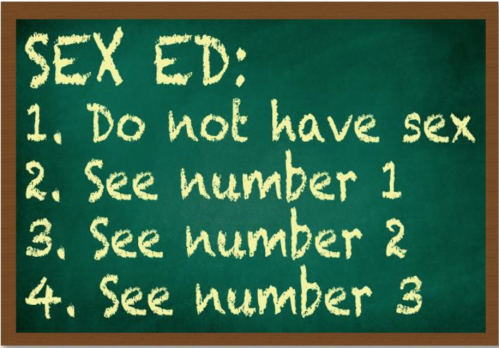
On April 23rd, 2018, there was a nationwide effort conducted by concerned parents who didn’t approve of how their children were being educated about sex. They called it “Sex Ed Sit Out” and it’s exactly what it sounds like. Rather than directly deal with the information their children are being taught, they seek to prevent their children from ever learning about it.

The fact they’re doing this in an era where any kid with a smartphone can look up detailed information about anatomy, sexuality, sexual orientation, and transgender issues is pretty telling. The fact this is being done with support of socially conservative, sex-negative organizations like the Family Research Council and the Liberty Counsel should also be a major red flag.

The effort, itself, was instigated by a North Carolina mother who called herself “The Activist Mommy.” She’s an extremely religious woman who espouses extremely regressive views on any form of sexuality that doesn’t fall in line with what popes, monks, mullahs, and rabbis deem moral. What set her off, though, was what she found out her kids had been learning in sex ed at their school.

It wasn’t just that they were teaching kids about contraception, safe sex practices, and the radical notion that sexual desires aren’t some disease that need to be cured or managed. It was also the idea that these programs had the audacity to inform children about LGBTQ issues relating to sexuality. It even had the gall to ask kids to think about and question how those issues effect them.

Assume that last paragraph was written with the utmost sarcasm, but that was a serious issue for these parents. This isn’t just about information that may or may not conflict with their preferred holy books. Some go so far as to call it “graphic, gender-bending, promiscuity-promoting sex education.”

They frequently throw around phrases like “the sexualization of our children” to get parents really uncomfortable. They treat such education as though they’re a how-to guide, complete with drills and a maintenance schedule. In reality, that’s not how the program works and anyone with an internet connection can verify that.

It’s still not enough for these parents, though. I don’t doubt they love their kids with all their hearts, but I think they’re seriously underestimating their ability to control both the inherent biology of children and the dangers of trying to preserve ignorance in an era where information is so easy to access.

It’s because of that same access that anyone can learn that abstinence only sex education programs don’t work. It doesn’t just bear out through data in peer-reviewed studies. Those programs even fail the basic tenets of common sense and logic. To prove this, just think of all the instances when not knowing about something made it not exist. Outside Freddy Kruger movies, that just doesn’t work in the real world.

Beyond simply being ineffective and a waste of taxpayer money, taking that same abstinence approach to LGBTQ issues is potentially more damaging. It’s one thing to tell children that having a strong desire to be intimate with someone is immoral, dangerous, and may doom their soul to damnation. It’s quite another to instill the notion that they’re somehow damaged for not having gender-based attitudes consistent with 50s sitcoms.

Like it or not, human beings are complicated, diverse creatures with a wide range of desires, attitudes, and identities. The idea that something as inherently powerful as sex can fit into the narrow scope of a 50s sitcom requires a gross misunderstanding of the chaotic, unpredictable nature of sexuality and biology in general.

Granted, this sort of repressive ideology is nothing new. Religious organizations have been protesting sex education in public school for years, favoring abstinence instead of any information that might hint that sex could involve something other than just two married heterosexuals making babies that grow into devout church-going tax-payers.

However, the rhetoric from people like the Activist Mommy is getting louder as gender-driven conflicts enter the conversation on top of the sexual components. It’s more than enough to get parents worried, outraged, and even a little anxious about what their kids are learning.

Whatever their sentiments, sincere and well-meaning as they might be, the abstinence approach still doesn‘t work. It was already ineffective in the era before the internet, as evidenced by the rates of teen pregnancy over the past several decades. However, that same inefficacy may be more damaging now than it was two decades ago.

To understand how, think back to what I mentioned earlier about parents being able to control what their kids learned in the past. Outside extremely restrictive religious communities, that’s just not feasible anymore. Today, just as during any other time period in human history, kids are going to get curious and/or horny. Unlike past eras, though, it’s easier than ever find the information they’re looking for.

That’s not just dangerous to the extent those kids learn things their parents don’t want them to know. It’s dangerous in the sense that there’s a lot of misinformation on the internet, especially about sex. That doesn’t just extend to the unrealistic depictions and expectations in the average porno either. It’s disturbingly easy to find bias sources of information.

Even if that information is accurate, there’s still more damage to be done by abstinence. Once a kid learns that information, much to the dismay of their parent, it’s hard to unlearn it. At the same time, it may also reveal to the kid just how much their parents have been lying to them on issues of sex, gender, and their own bodies.

Now, I get that parents have to lie to their kids every now and then, but some lies are more destructive than others. If the lie is too big or egregious, then suddenly that kid has a valid reason not to trust their parents. First, they say sex you can get pregnant by hugging someone. Then, they expect you to believe them when they say driving after doing tequila shots at a party is dangerous?

As a general rule, if keeping a secret from your kid involves something that can’t easily be uncovered with a couple internet searches, then they’re going to find out eventually. It doesn’t matter how hard you try to protect your kid from this information. If it’s out there and they’re curious, they’ll find it. That’s just the nature of the age we live in.

A child may or may not be capable of understanding sexuality or gender issues at a particular age, but most agree that it’s healthy for a child to trust their parents. Most people, kids and adults alike, can forgive small lies. For bigger lies that can claim natural, healthy desires are a disease, though, those are much harder to overlook.

For the parents to participated in this sit out, I hope they come to understand that at some point. Their children, which I’m certain they love with all their heart, are going to learn about sex, gender, and everything in between at some point. When that point comes and it’s too late, then the damage might already be irreparable.

1 Comment

Filed under gender issues, sex in media, sex in society, sexuality

How The Concept Of Boredom Subverts The Concept Of Hell (And Heaven)

hell-600x450

When we’re kids, we tend to exaggerate how tortuous a situation is. To us, the first day of school, a dentist appointment, or a 10-hour road trip in a car with a broken radio is its own circle of hell. As adults, we exaggerate too. There are times when being stuck in traffic or in a house with poor wi-fi is considered hell. Sure, there’s no fire and brimstone, but that doesn’t make the experience any less hellish.

The takeaway from that kind of exaggeration is that our concept of torture tends to be exceedingly relative. It’s one thing to be in constant pain, which is torture at its most pure. It’s quite another when it strains our psyche, our sanity, and our willingness to endure it.

I highlight this disparity because it’s important to consider in any discussions about Hell. By that, I don’t just mean the feelings we have when we’re sick, hung over, or working overtime on a weekend. I’m referring to the actual religious, philosophical, and literal concept of Hell that fuel our worst nightmares.

I get that this is not a very sexy topic. You could argue that it’s the least sexy topic anyone could discuss and probably win. However, there’s a reason why I’m bringing it up. It has less to do with religious connotations and more to do with the larger implications. To some extent, it may even alleviate some of those distressing sentiments surrounding hell.

That might be hoping for too much because few issues make people more uncomfortable than Hell. Even among the deeply devout, the idea that there’s this terrible place full of unending, unparalleled torture that people consciously experience second after second for eons on end is extremely distressing. By definition, it’s the ultimate form of torture that nobody can hope to escape, resist, or endure.

It’s for that very reason that a literal Hell is often seen as a problem among atheists and theists alike. The very idea of eternal torture doesn’t just clash with the idea of a loving deity. It also conflicts with every notion of justice. We are, after all, finite beings living in a finite world. How can any finite person do anything to warrant infinite torture?

The debate over the merits of infinite punishment for finite sins is one of those theological and ethical debates that has been going on for centuries. I’m not smart enough or spiritual enough to resolve it so I’m not going to try. Instead, I want to highlight a particular detail about the concept of hell and it’s a concept I have discussed more than most theologians.

That concept is boredom, a force that may be more powerful than any fiery sermon about hell. It has already led some to murder and I’ve argued that it could be a plague of the future. In contemplating and studying the power of boredom, though, I’ve noticed that it has a very peculiar effect when applied to the concept of Hell.

Simply put, boredom renders Hell, even the eternal variety, utterly ineffective and ultimately meaningless. That’s not to say eternal torture, or torture of that extent, is justified ethically. My point is that when you inject boredom into the equations of Hell, then all the tenants surrounding it break down.

To illustrate this point, think back to an experience in your life that you considered tortuous. Maybe it was an injury. Maybe it was a relationship. Maybe it was just a family reunion that you couldn’t wait to end. However bad it was, physically or mentally, there’s usually a point where you become numb to it.

It’s not just a function of our brains, which has actual mechanisms for adapting and adjusting to all sorts of torment. It’s a product of perception itself. Experience something so often for so long and it suddenly doesn’t become the aberration. It becomes the norm. When you think about the implications of that, then the concept of Hell breaks down.

Take, for instance, your current state of being. Assuming you’re not sick or in any significant discomfort, you don’t consider this state as painful. From your perspective, it’s a normal state of being and one with which you’ve become familiar over the course of your life.

Now, imagine for a moment, that everyone in the world sees your state and is aghast. They’re horrified that anyone could live, like you do. They see your current state as pure torture, one that they wouldn’t wish on anyone. You’re understandably confused, but can only do so much to grasp it because from your point of view, your condition is normal.

In a less theatrical example, consider those who live in what we might classify as extreme poverty. According to the World Bank, about 10.7 percent of the world’s population lives in extreme poverty. To these people, imagine what their concept of normal is. Torture to them is not being able to eat for days on end whereas torture for some is having to eat at McDonald’s five nights a week.

When it comes to suffering, eternal or otherwise, perception matters. You could argue it’s the only thing that matters. Someone who grew up rich and affluent may consider living in a mid-level apartment in Detroit torture whereas someone who grew up poor might see it as an upgrade. It all depends on how someone’s sense of normal develops.

When you add eternity to the mix, then things get somewhat paradoxical and boredom is at the heart of it. Imagine, if you can, that first moment when a hapless soul is condemned to Hell. Moments after they die, they descend into that horrible lake of fire that many religious texts and famous poets describe with such vivid detail.

Naturally, it’s torturous, plain and simple. Whatever kind of torment Hell offers, be it constant burning or being forced to watch “The Emoji Movie” for all eternity, is exceedingly painful to that poor soul. There’s no getting around that.

However, after a good long while though, such torment loses its impact. Remember, we’re dealing with eternity here. Time tends to obscure our frame of reference. It doesn’t matter how long we lived or how well we remember that life. After enough time, that whole experience will become a minor blip.

That’s a critical reference point because everything we think we know about pain, pleasure, and boredom are derived from those life experiences. Given that those experiences are finite while hell is infinite, it’s literally only a matter of time before Hell ceases to become a place of torment and just becomes our sense of normal.

Beyond normal, though, even the extremes of Hell that holy texts and poets describe lose their luster once boredom enters the picture. Do anything long enough and often enough and chances are, it’ll get boring to some extent. Why else would there be so many kinks and fetishes surrounding sex?

It’s true. Even I, an aspiring erotica/romance writer, don’t deny that sex can become boring. If something as inherently pleasurable as sex can become boring, then anything as pleasurable or painful could become boring as well. Given enough time, repetition, and inanity and it’s inevitable. Add eternity to the mix and, invariably, everything becomes boring.

It doesn’t matter if you’re burning in a lake of fire for trillions upon trillions of years. Eventually, it becomes so mundane that it ceases to become torture. At that point, Hell isn’t even a punishment anymore and it completely loses its purpose.

There are some forms of Hell that try to work around this. In the Fox TV show, “Lucifer,” the torment in hell technically isn’t eternal. In the show, Hell is a domain in which the damned are forced to relive the worst parts of their life over and over again. Even Lucifer himself endured that in one episode.

This isn’t eternal, though, because from the perspective of those being tortured, it isn’t an eternity. From their point of view, it’s just one really bad day. It doesn’t matter if the loop goes on for a trillion years. From their perspective, it’s still one day. If anything, the only one really suffering is Marcus “Cain” Pierce, who actually seeks death because, like Vandal Savage, an immortal life becomes unbearably boring after a few centuries.

That’s not just an irony. It highlights the underlying problem of applying eternity alongside boredom. After a certain amount of time, any experience, be it torture or euphoria, is going to lose its effect once boredom takes hold. In that sense, even Heaven loses its appeal because like pain, pleasure is not immune to the corrosive effects of boredom.

Now, some theologically minded people might still argue that an all-powerful deity would find some way to ensure boredom doesn’t undermine the punishment of Hell or the ecstasy of Heaven. However, doing so would require a total subversion of our mortal perceptions, which would in turn undermine the very experiences that are used to justify sending us to Heaven or Hell in the first place.

The fact that those perceptions are what we use to understand these places is the biggest flaw in the concept. Even an evil, vindictive deity would have to be exceedingly indifferent to standards of judgment and justice to even organize such a scheme.

The fact that so few holy texts or visions of Hell reference the power of boredom is a sign that there’s a disconnect between how the infinite effects the finite. It might also explain why visions of it have to be so terrifying to begin with. It even explains why Heaven has to be so appeal. In the context of eternity, the experience loses purpose eventually.

To some extent, we can take comfort in the idea that no matter how horrible Hell may be, if it even exists, boredom will eventually undermine those horrors. Granted, that means the pleasures of Heaven will be subject to the same effect, but it all evens out in the long run. Given enough time, we’re all subject to the same fate. It may seem grimly nihilistic for some, but I also think it’s comforting in how it binds us.

It also proves that, however powerful a deity may be, even the holiest of power pales in comparison to the might of boredom. Like erosion and entropy, boredom is the experience that overpowers us all eventually.

15 Comments

Filed under religion, War on Boredom

Remembering (And Learning From) The Satanic Panic

stufftoblowyourmind-podcasts-wp-content-uploads-sites-24-2015-04-satanic

Lock your doors, hide your children, and pray with the force of a million pious nuns because it’s happening. It’s out there and it’s probably going on as you’re reading this. There’s a vast network of Satanic cults who have infiltrated schools, child day care centers, and major media outlets. They’re coming for you, they’re coming for your kids, and they’re determined to corrupt every soul they can.

I hope everyone who just read that laugh paragraph is either laughing or confused. It was not meant to be serious. The fact that I actually have to clarify that for a certain segment of people who may take it seriously says a lot about the human condition. It also reveals even more, albeit in a way that’s hardly flattering to our species.

When one person has crazy, irrational fears, we can easily shrug them off and move on with our lives. When a large group of people have those fears, though, it’s a bit harder to ignore, especially when it becomes a full-fledged panic that spurs outrage, ruins lives, and wastes resources.

Image result for moral panic

This is exactly what happened in the 1980s during the so-called Satanic Panic. It may sound like the name of a bad heavy metal band or one of those funny church signs, but make no mistake. It was no laughing matter. There was a real, genuine fear among people that there was a conspiracy of Satanists looking to abuse, exploit, and corrupt children.

It got so serious that major news outlets, the FBI, and even Oprah Winfrey began reporting on it. They included disturbing recollections of adults taking children into dark rooms, dressing up in Satanic attire, and subjecting them to unspeakable abuse that often included sex acts. It got pretty horrifying, which is part of why it got so much attention. This is just a small sample of what some kids recalled.

In hours of footage, they talked about how the devil-worshipers preyed on the wealthy community, holding pedophilic orgies and murdering innocent people. They said the Satanists abused and tortured babies, slitting their throats, drinking their blood and dancing while wearing their skulls.

It all sounds too horrible to imagine. The descriptions are objectively horrifying. There’s just one key detail that undercuts that horror. There’s no verifiable evidence that any of it happened. There’s only evidence that the lives of innocent adults were irreparably ruined.

Image result for satanic ritual

It’s amazing to think that something so irrational had terrified and overwhelmed sane, rational people in a civilized society. Actually, that might have been amazing to contemplate five years ago. I think it’s distressingly easy to imagine something like that happening in an era where false accusations can become a viral media spectacle.

Most people may roll their eyes at the notion that history tends to repeat itself from those who don’t heed it’s lessons. Historically speaking, though, those lessons keep popping up in new forms in conjunction with new panics. One day, it’s a conspiracy of Satanists. The next, it’s a conspiracy of Bronies. In each case, a similar pattern emerges. History may not entirely repeat itself, but it sure follows a similar script.

The catalyst for Satanic Ritual Abuse panic was similar to what triggers most panics. One particular story, which may or may not be true, captures the public’s imagination and terrifies parents to no end. The story, in this case, was called “Michelle Remembers” by Lawrence Pazder. This was to Satanic Ritual Abuse what Harvey Weinstein and GamerGate was to the ongoing panic over sexual misconduct.

Related image

The book itself is a disturbing story disguised as a real documentation about a psychiatrist uncovering repressed memories from a woman who had been abused by a Satanic cult. Almost immediately after publication, the legitimacy of the story came into question and Pazder got sued for libel. That didn’t matter, though. The story went onto become very popular and was actually taken seriously.

This culminated in the infamous McMartin Preschool Trial where, after seven years and millions of dollars in legal fees, those accused were found innocent. That didn’t matter in the end. The media coverage, combined with public fears, made them Satan-loving monsters by default. Needless to say, their lives were ruined.

Image result for McMartin preschool trial

As I said before, and it’s worth belaboring, there was no hard evidence that any of these crazy Satanic rituals ever took place. The allegations were pretty elaborate, but the problem from a truth perspective was that they were based primarily on the testimony of young children. That’s a huge problem beyond the fact that most anecdotal evidence, even from competent adults, is unreliable and rarely admissible in a trial.

The testimony of those children was gained largely through something called recovered-memory therapy. It’s not as intensive as it sounds. Therapists just ask impressionable kids leading questions and get them to tell say whatever they want while claiming it’s a real memory.

That proved to be an effective/dangerous tool in provoking the emotions of the masses. It’s one thing when an adult makes a claim that sounds extreme, but when a child says it who may have been horribly abused, that nurturing instinct that most decent human beings have goes into overdrive. It doesn’t matter if there’s no evidence. The mere possibility that it could be true convinces us.

Image result for satanic ritual

Even after more thorough investigations revealed far more mundane truths, there was still plenty of panic. There was even an organization called Believe The Children that advocated accepting their testimony, even if it couldn’t be verified and meant ruining innocent lives.

This is where some of the distressing similarities to the ongoing crusade against sexual misconduct start to manifest. Now, right of the back, I want to make clear that I am not claiming that the movement to combat sexual harassment is as vacuous as the movement against Satanic Ritual Abuse. I really want to make that clear. However, the parallels are worth noting.

Yes, there have been cases of real, verified assault that have been proven in a court of law. There have also been cases where a false accusation put an innocent person in prison. Just like those urging that people believe the horrific stories told by the children, though, there are those who urge that we place a similar belief in anyone who accuses someone of a sex crime.

Image result for false rape accusations

There’s a reason why we have a justice system. There’s also a reason why the standard of proof for a serious crime is so high. There are some who don’t like applying that standard to sexual misconduct, but there’s a reason for that. In a civilized society, we understand that punishing innocent people can be much more damaging than letting a guilty person go.

I know that doesn’t sit well with certain people. One person getting away with a sex crime is one too much, especially for those who have been victimized. However, and I know this is going to strike the wrong chords, but that’s the price we all pay for having a functional justice system.

Image result for justice system

It’s not perfect because humans aren’t perfect. Trying to make it perfect, though, at the cost of innocent lives is a price that undermines the very concept of justice. The Satanic Ritual Abuse craze in the 1980s ruined innocent lives. Their suffering is a crime in and of itself.

In a sense, the unjust suffering of an innocent is twice the injustice of a guilty person getting acquitted because it inflicts unjust guilt on someone and forces them to carry that burden beyond the accusation. That is why presumption of innocence is so important in any justice system.

The ongoing efforts to combat sexual misconduct has noble goals. Even the panic around Satanic Ritual Abuse had noble goals in wanting to protect children. Most decent people are on the same page with those goals. However, when outrage, anecdotes, and hyperbole are the primary tactics, it leaves little room for actual substance.

Image result for satanic ritual abuse

That substance matters because, in terms of the bigger picture, violence against women has gone down significantly over the past 20 years. Women today are far safer and less likely to be victimized than they’ve been in decades past. I know that’s not much comfort to those who have been victimized, but one burning tree doesn’t need to start a forest fire.

In the end, the Satanic Ritual Abuse panic created a pretty scary environment for parents and children, so much so that little things like facts, truth, and justice got lost within the horror. Those little things matter even more with real crimes like sexual assault. If there’s one lesson we should learn from the Satanic panic of the 1980s, it’s that terrible stories can lead to terrible injustices if the truth gets overlooked.

In the interest of ending this on a lighter note, check out this old video from the Satanic Panic and enjoy a good laugh. Yes, they really took it that seriously.


9 Comments

Filed under Current Events, gender issues, human nature, sex in society

Superman, Rick Sanchez, And The Nihilism Filter

Here’s a question that should strain the brains of anyone who reads too many comics and watches too much TV.

What do Rick Sanchez and Superman have in common?

Take a moment to finish rolling your eyes. Bear with me, I am going somewhere with this. There is a point to posing such a question, relatively speaking. Maybe a better question would be what possible commonalities could someone like Superman share with Rick Sanchez from “Rick and Morty?”

One is the undisputed icon of truth, justice, and the American way. The other is an eccentric, unstable super-genius who also happens to be high-functioning alcoholic. These are two fictional characters who, on paper, would clash at every turn. However, there is one trait that binds them and it’s one that’s worth scrutinizing.

They both perfectly embody nihilistic morality.

Again, I am going somewhere like this. Just hear me out  because this is something I think that fans of both Superman and “Rick and Morty” can appreciate. In an era where everyone has an excuse, an agenda, or a combination of the two, it’s a perspective that I think everyone can appreciate.

To understand that perspective, it’s necessary to understand what I mean by “nihilistic morality.” I’ve mentioned nihilism before when I’ve discussed “Rick and Morty” in previous posts, specifically on what makes Rick Sanchez an appealing character to an emerging generation. For the purposes of this discussion, you need not be a super-genius or a Kryptonian to understand.

By definition, nihilism sounds bleak and depressing. At its core, it states that life has no inherent meaning or purpose. We’re just globs of matter floating around the universe for a finite period of time. That’s it. There’s no plan, purpose, or greater meaning. Any effort we make at seeking meaning requires that we shamelessly lie to ourselves. Rick Sanchez, himself, put it pretty succinctly.

“When you know nothing matters, the universe is yours. And I’ve never met a universe that was into it. The universe is basically an animal, it grazes on the ordinary. It creates infinite idiots, just to eat them.”

Depressing or not, I don’t intend to belabor the grim prospects of nihilism. Instead, I want to focus on the implications because, even if the principles are depressing, the implications are pretty revealing. In a sense, those implications can say a lot about what we consider moral and why we do what we do.

This is where Superman enters the equation. When it comes to beacons of morality, Superman is basically the alpha and omega of all things good and just. He is the standard by which all heroes are measured. He is the arbiter of the ethics, philosophy, and principles of a good and just person. If Superman does it, then it must be good. If there’s a right way to do something, then Superman does it without hesitation.

Where he and Rick Sanchez intersect has less to do with who they are and more with why they do what they do. Whether it’s stopping Zod from destroying a city or selling weapons to assassins to spend an afternoon at an alien arcade, these two characters have surprisingly similar motivations and those motivations have a basis in nihilism.

Simply put, Superman and Rick Sanchez don’t do what they do because it serves an agenda, makes them look good to others, helps them function better in society, or rewards them after death. They do it because they want to. That’s it. That’s the end of the philosophical discussion.

In the context of pure nihilism, these two exceedingly different characters are on the same page. There’s no larger plan or purpose to their choices. Rick Sanchez has never given a cosmic fart about what others think about him, including his own family. Superman has also made it abundantly clear throughout his history that he doesn’t do what he does for adulation. He does it because it’s the right thing to do.

These simplistic, almost shallow reasons are inherently nihilistic in that they acknowledge the pointlessness of attempting to seek greater meaning in a chaotic universe. It’s just as pointless to do something for personal reasons, be they vengeance for dead parents or upstaging the devil. Any reason, large or small, is just as empty within a nihilistic worldview.

However, if you can look past the depressing concepts, there are major implications for the ethical context of these actions. The fact that both Superman and Rick Sanchez don’t need or seek that greater meaning to justify their actions makes what they do more inherently honest. In terms of judging ethical motivations, that counts for a lot.

Whether they’re iconic heroes or alcoholic mad scientists, honesty matters and so does motivation. Heroes like Captain America, Iron Man, Batman, Spider-Man, and the X-men have factors like duty, vision, responsibility, and tragedy to guide their actions. You could say the same about the real people behind any movement, be they civil rights, gender issues, or a political party.

Spider-Man does what he does out of responsibility and the guilt he feels for being irresponsible in the past. Most peoples’ political affiliation is inherited from their parents or their economic circumstances. Some join civil rights movements out of personal conviction or just to virtue signal.

Both Rick Sanchez and Superman would see all those factors as needless complications to what should be a very simple choice. To them, you simply do something because you want to. If there are consequences to that, then you deal with them. That’s all there is to it. That’s all there needs to be.

Superman didn’t need someone to kill his parents or hate his kind to motivate him. Rick Sanchez didn’t need a loving family or an empire of alien insects to motivate him either. They just need the ability to make a choice and nothing more. Anything beyond that is either bonus or needless complications.

In the context of nihilism, that makes the ethics behind both Rick and Superman more genuine. It flies in the face of those who seek justice, morality, or progress as part of some larger endeavor. That’s an important factor because, absent that context, the motivations can be prone to corruptive forces.

This can unfold subtly in things like organized religion. Sure, religion can inspire great charity, but is that because adherents genuinely want to be charitable? Are they just trying to win favor in the eyes of a deity who may or may not punish them eternally after they die?

It also manifests in political movements. Pretty much any political party will consider their platform to be just. However, is that because it actually is just or because that’s just what the party says? Anyone who has lived in a communist dictatorship probably knows the answer to that more than most.

These days, we’re seeing more and more people rally behind various social movements, be they LGBT rights or anti-harassment efforts. Even if the intent of these movements are just, those behind it can have other motives, such as virtue signaling or maintaining an agenda. Remember, Harvey Weinstein donated to the women’s march in early 2017 before his scandal broke.

In either case, it’s not always possible to know the sincerity of someone’s moral underpinnings. In a sense, nihilism provides a filter, of sorts, to sift through the various agendas that someone may or may not have. If that agenda requires that the universe have a special purpose or destiny for them, then that’s usually a sign that they’re trying to be the heroes of their own story, which rarely turns out well.

Superman could care less if the entire world hates his guts for doing what he does. He’ll still do it because it’s the right thing to do. Rick Sanchez could care less if everybody loves him and worships him like a god. He still does what he does simply because he chooses too. They both understand the universe doesn’t care so why should they?

Think about that next time a fictional hero or a real person explains their motivations. Apply the filter of nihilism and you’ll reveal just how genuine or insincere they truly are. Whether you’re saving Lois Lane or searching for that sweet Szechuan Sauce, those motivations matter, especially in a nihilistic universe where little else does.

Image result for Rick and Morty watching TV

10 Comments

Filed under Current Events, human nature, Jack Fisher's Insights, Rick and Morty

Boredom Vs. A Lack Of Belonging: Which Drives Outrage Culture More?

http3a2f2fi-huffpost-com2fgen2f45348782fimages2fn-group-holding-hands-628x314

Here’s a quick non-rhetorical question. Which is worse, crippling boredom or social isolation? There’s no right answer, but every answer has distressing implications. More than anything else, those answers reinforce why solitary confinement is rightly considered torture.

I ask that question because I had an interesting conversation with someone on Reddit about what drives certain people to be constantly outraged about whatever happens to be controversial that day. I’ve talked a bit about outrage culture before and how professional trolls exploit them, but I haven’t really dug into the mechanisms behind it. Given how new controversies seem to trend every day, I think it’s worth scrutinizing.

In the discussion, I singled out boredom as a possibly underrated factor. Having highlighted the power of crippling boredom, I felt qualified to make the case that boredom may very well be an understated, under-appreciated cause. I still feel there’s a case to be made.

In the grand scheme of things, humanity is in uncharted territory when it comes to boredom. For most of human history, we had to live our lives under the constant threat of plague, famine, war, and natural disasters. Whether we were hunter/gatherers or subsistence farmers, life was chaotic and unpredictable.

Say what you will about those harsh, pre-modern eras, but they weren’t boring. They couldn’t be. There was always work to do. Given the lack of effective birth control, there were children to raise. Even if social media had existed 100 years ago, who would have the time or energy to even be outraged about a man wearing a sexist shirt.

Fast forward to the 21st century and things like war, famine, disease, and crippling poverty are all in decline. This is objectively good on so many ways, but for some people, especially in well-to-do middle class people, it leaves a large void that quickly becomes boring if not filled with something. Sometimes, it can get so bad that it can lead to outright murder.

When I made this argument, I think more than a few people took it seriously on Reddit. It was easy to see how someone whose life is so affluent and devoid of heart-pounding conflict that they will latch onto petty outrages just so they can feel something. Like someone stuck in solitary confinement, they’ll do anything for some sort of stimulation beyond counting the tiles on the floor.

Given how our brains can’t always discern the source of arousal, sometimes it’ll settle for whatever adrenaline rush we get from righteous outraged. Some go so far as to call the rush we get from outrage an addiction and it’s not a wholly inaccurate idea.

However, one person in that discussion pointed another element that also relies on that part of the brain that can’t always discern what gets it aroused. Instead of combating boredom, though, this issue deals with our inherent need to join a group and become part of a larger movement.

It’s very much an extension of tribalism and, like seeking stimulation when there is none, human beings are well-equipped by evolutionary biology to form groups. Whether we’re a small band of hunter/gatherers or a group of Taylor Swift fans, it doesn’t take much for us to form those groups and our brains reward us greatly.

Being part of a group feels good. Being part of something gives us a rush. It’s a major reason why peer pressure works and why tribalism often overrules reason. That solidarity we feel when we’re part of a group isn’t just intoxicating. It’s a fundamental component of any highly social species, which includes humans.

What this means for those constantly outrage isn’t that far off from the implications relating to boredom. Like boredom, our current society is pretty unprecedented in terms of how easy it is to form a close-nit group and share in that solidarity that has been driving our species since the hunter/gatherer days.

Thanks to social media and mass communication, it’s possible for people to do more than just share their opinions, no matter how outrageous they might be. It’s also possible to connect with those who either share in those opinions or despise them. In terms of forming a tribe, it’s a two-for-one-deal because it creates both a sense of “us” while revealing a “them” to rally against.

For anyone who has spent any amount of time on social media, it doesn’t take much to see the whole us versus them mentality to take shape. If any amount of disagreement goes on long enough, Godwin’s Law usually takes over and the battle lines are set.

On top of this, the social issues in 2018 aren’t quite nearly as clear-cut as they were in decades past. In the past, there were some pretty egregious injustices surrounding civil rights, women’s rights, and LGBT rights that required major social movements to combat. By and large, society has done a lot to improve the state for these marginalized groups.

There’s no question that being part of such righteous movements is laudable. We, as a society, rightly praise civil rights leaders who stand for such righteous causes. Naturally, some people seek to emulate that. Whether by ego or altruism, it’s only natural that they want to experience that kind of accomplishment.

Thanks to the sheer breadth of human progress, though, there causes on the levels faced by Martin Luther King Jr. or Mahatma Gandhi. However, because that drive to be part of a movement is just that strong, those same people will settle for pettier movements that protest sexy women in video games or bemoan the lack of diversity in old TV shows like “Friends.”

Make no mistake. Those outrages are petty and asinine when compared to the real injustices that past social movements have fought, but the brains of the outraged can’t tell the difference. From their perspective, their movement is every bit as righteous as every other civil rights movement in history. The outrage they express and the solidarity they feel is every bit as fulfilling as something that alleviates boredom.

Even if these causes are petty and the outrage is shallow, it’s important to note the alternative here. If these same people who protest the lack of diversity in the tech industry didn’t have this sort of thing to drive them, then what would happen to the group they’d formed?

Absent that outrage and protest, the group has nothing to rally behind. The person has nothing provoking arousal, be it anger or excitement. Without this dynamic, they don’t belong to something bigger anymore. They’re not the ones marching alongside famous civil rights leaders of the past. They’re just alone, by themselves, contributing nothing of value.

For many people, that’s just untenable. I would go so far as to say it’s almost as untenable as crippling boredom. Even self-proclaimed introverts and ardent individualists, we seek an identity and a constant source of stimulation. When we lack one or both, we lack a core element of any social species. In the same way we’re driven to meet the rest of our basic needs, we’ll be driven to find that somewhere, no matter how misguided.

In the past, we might have found that sense of belonging and purpose through our small communities or organized religion. Today, the world is much bigger and more diverse, thanks to technology and civilization. Organized religion is also not effective anymore due to factors too numerous to list. People are still going to seek belonging.

It’s somewhat ironic that civilization has advanced to such a degree that there aren’t as many clear-cut, good versus evil movements to be part of anymore. However, there’s still this longing to be the hero of our own story and be part of something greater, even if it means actually going out of their way to feel outraged.

Getting back to the initial question I posed, I think the influence of boredom and belonging are inherently linked. We agonize over escaping boredom and over having a sense of belonging. We can’t get that same rush our ancestors felt when surviving bear attacks and hunger so we’ll settle for whining about protests during football games. It’s still annoyingly petty, but distressingly understandable.

4 Comments

Filed under Current Events, gender issues, Reasons and Excuses, War on Boredom

Sex Cults: The Kinky (And Often Dark) Side Of Religion

Certain things don’t go well together, but still find a way to be potent, albeit for all the wrong reasons. I’m not just talking about people who dip their french fries in mayonnaise or banana peppers on pizza either. Certain combinations are just uniquely powerful and not always for the right reasons.

That brings me to religion, a topic I try to avoid like a rash on my scrotum. While I have written about religion and how it affects our sex lives before, I generally don’t like to bring it up on this blog. In my experience, few things kill the mood quicker than discussions about religion. It might as well be the antithesis of every Barry White.

I also feel compelled to point out that I have some deeply religious friends and family members. While I may not share their theology, I go out of my way to respect their beliefs. I don’t try to debate them or de-convert them. They have every right to believe what they believe with all their hearts and souls.

With those disclaimers out of the way, let’s talk about sex cults. I hope I have your attention now because this is one of those potent combinations I mentioned. More often than not, religion and sex are constantly at odds. For some, achieving orgasm and achieving spiritual enlightenment are the same thing. One just requires fewer tissues.

There seems to be a never-ending battle to temper, mitigate, or manage certain sexual desires in the name of religious zeal, often resulting in major taboos. That’s understandable in that sexuality is one of the things that influences the lives of every person on this planet, regardless of language, location, race, or attitude. It’s like a giant mountain. It can’t be circumvented. It can only be navigated.

Sex cults, on the other hand, do more than just navigate. They don’t just try to manage the sexual proclivities of its adherents either. In essence, they attempt to channel sexuality into forging stronger, more faithful adherents. Since people have sexuality hardwired into them at birth, you could argue they work smarter rather than harder.

In theory, this doesn’t have to be a bad thing. Not every sex cult needs to micromanage how its adherents use their genitals. Some are outright gleeful about sex. However, there are many that take it to unhealthy and unsexy extremes, which undermines the mood for everyone except the cult leader.

Speaking of which, one of the most common themes in a sex cult revolves around the leader, specifically with respect to how their genitals are somehow more holy than everyone else’s. This is how men like David Koresh and Warren Jeffs manage to convince dozens of pious women to do their religious duty, which requires them to make their bodies accessible to the cult leader in whatever holy or unholy way he sees fit.

That’s not to say there haven’t been female cult leaders. There have and yes, they can be every bit as perverse as the men. At the core of any sex cult, manipulation of sexuality is usually a secondary goal, at least officially. No successful religion, or any organized social movement, succeeds by being that transparent from the beginning.

Most cult leaders, male or female, won’t say outright that the entire basis of their cult is built around exploiting our most basic desires. They may not even believe it themselves. In fact, I would argue that most people, aside from admitted frauds, that they sincerely believe that they’re not just exploiting peoples’ spiritual sensibilities so they can more easily get sex from adherents.

In their own minds, those in a sex cult may be convinced that what they’re doing is spiritual and holy. Even if it is something as basic as an orgasm, they’ve ascribed some sort of spiritual significance to it. As an erotica/romance writer, I can kind of understand that.

There’s power in that kind of feeling, especially in cultures where it’s so easy to induce shame in others for simply having sexual feelings. I’ve mentioned before how sexual repression can really mess with someone’s psyche and not just with respect to their sex life. Building a cult around this powerful feeling that so few of us can escape isn’t just cunning. It’s distressingly practical.

There are a whole lot of factors that go into creating a cult, but most of them come back to control. Most religion, especially the successful and sincere ones, only go so far with control. When properly done, it can actually be beneficial to society. Cults, especially those of the sexual variety, take it ten steps further.

A sex cult won’t just try to control the when, how, and why you have sex. It won’t just try control how you feel about sex. It will actively shape, re-shape, and warp, if necessary, your entire perceptions about sex, intimacy, and everything in between. Again, it won’t do this directly. It’ll usually hide behind a vast excuse bank of morality, piety, and peer pressure.

More often than not, a sex cult will make you depend on the cult to get the release that your caveman brain still craves. I’m not just talking about the orgasm either. A sex cult will also try to provide the sense of intimacy, love, and community that most people get without sacrificing an animal or a piece of your penis.

It’s usually at that point where it’s hard to tell the difference between piety and subversion. Once people get locked into a cult that gives them a strict, but clear structure for how they get their sex, and all the sweet extras that come with it, they’re effectively locked in. Some may argue that they’re trapped, but I don’t suspect that most adherents will see it that way.

In addition to being very horny, we humans are a very social species. We form groups, tribes, and fan clubs with the same ease that a lion mauls a wounded zebra. Whether it’s a religion, erotica/romance novels, or Taylor Swift music, we’ll form a group about it and pursue it with religious fervor. In that sense, a sex cult isn’t doing anything magical. It’s just taking our own biology and pushing it to an extreme.

Now, I don’t bring up sex cults to warn people about them. I’m also not trying to point out the signs that the charismatic preacher who claims salvation comes through his penis might be a cult leader. Like I said before, most religion is fairly harmless and even beneficial to society. Sex cults, like any other cult, just hijacks a basic, yet powerful part of our being and exploits it.

It’s nefarious, but also fascinating. I built the entire premise of one of my novels around it, namely “The Final Communion.” In that novel, a young woman named Grace Maria Goodwin navigates a sex-fueled ritual that her deeply-religious community uses to control its adherents. Many of the themes I incorporated into this story come from my fascination with sex cults.

I’ve thought, at times, about expanding on novels like “The Final Communion.” I might not be able to develop a full-fledged sequel for Grace’s story, but I think there are untapped stories surrounding sex cults that are either too controversial or too distressing to contemplate.

It’s because they’re distressing, though, that we shouldn’t ignore it. So long as sex is such a powerful driving force in our lives, cults and even organized religion will continue to use it to exploit people. Religion, in and of itself, isn’t a bad thing, but when it starts to undermine our sex lives, then we should be concerned.

2 Comments

Filed under Celebrities and Celebrity Culture, polyamory, religion

The (Real) Crisis Of Faith In Society

Every now and then, I hear some pundit, politician, and/or professional troll lament about the ongoing “crisis of faith” in society. They’re not entirely wrong in their whining. The numbers don’t lie. Religion, especially the organized variety, has been declining significantly over the past decade throughout the western world.

I won’t get into the particulars of that decline. I’ve already given religion a hard time on this blog, especially when it gets taken to extremes. While I stand by my criticisms, I don’t want to give the wrong impression. I respect religious people and the various religious institutions that do wonderful work.

I should also note that I have some devoutly religious people in my family, whom I love and respect dearly. I don’t want to disparage their beliefs or the fulfillment they get from them. While there was a time when I used to seek out heated debates with religious people, I’ve since realized how pointless and counterproductive they are. As I’ve said before, winning arguments rarely changes the harsh truths of reality.

With that in mind, I do agree with part of their lamentations. I honestly do think that there’s an ongoing crisis of faith in society, especially in Western society. However, it’s not the kind of crisis that the televangelists, the militant atheists, and the card-carrying Satanists of the world have in mind.

To illustrate that crisis, I’ll need to depict a couple scenarios that should make a significant number of people uncomfortable. For this, I apologize, but I think it gets my point across better than any burning bush, fiery sermon, or tax-exempt initiative.

The first scenario shouldn’t be too hard to picture for anyone familiar with the Playboy Mansion. For this, I want you to imagine an ordinary man standing in a large room, surrounded by a 100 women. The man doesn’t have to be Hugh Hefner and all the women don’t have to be Playboy Playmates. It just has to be one man and 100 women in the same room. How do you think that man feels in that situation?

Anyone who has seen a few overtly sexy music videos shouldn’t have too hard a time surmising that sentiment. If he’s a straight man, then he’s probably feeling like a kid in a candy story within a toy store within a water park. He’s probably looking around with a goofy grin, crunching the numbers in his head and wondering which of the 100 women will want to touch his penis.

It’s a goofy, juvenile scenario that most just shrug off as harmless male fantasy. Even if the man is gay, chances are he doesn’t feel threatened or unsafe in any capacity. Being surrounded by women doesn’t garner those kinds of feelings. There’s a deeper message there, but one that only becomes clear when you picture the second scenario.

For that scenario, I want you to something similar. This time though, just flip the genders. Make it so there’s a woman in a room surrounded by 100 men. It’s similar to an exceedingly distressing thought experiment that I pitched before. This isn’t quite like that, but it gets an important message across.

This is a scenario that I’ve actually heard some women use when talking about rape and sexual violence. That’s because in that scenario, if we’re all being honest with ourselves, that woman probably doesn’t feel lucky or safe. One women in a room with 100 men is a situation that evokes discomfort on a level that’s hard to articulate, but easy to understand.


The woman in that scenario isn’t imagining which of those 100 men might be her future husband or, at least, a good one night stand. That woman is dreading every worst case scenario ever inspired by reruns of “Law and Order: SVU.” Her survival instincts go into overdrive because she doesn’t just see a room of men. She sees a room of men who might be inclined to rape her.

As a man, I can’t help but take offense to that notion that women assess men solely on how likely they are to assault her. However, I can completely understand the sentiment. The numbers aren’t on my side. In pretty much every major category of violent crime, men are far more likely to be perpetrators than women. There’s nothing sexist about it. That’s just what the numbers say and they don’t inspire a lot of faith.

In recent years, there has been growing awareness of rape culture and increasing efforts to decrease sexual violence against women. While that is an innately noble effort, seeking to reduce the unsexist forms of violence in our culture, it hasn’t always been entirely honest. In some cases, it inspires moral panics that claim video games cause sexism or just criticizing a woman constitutes a form of assault.

I won’t get into the absurdities of those concepts, as I’ve only so much energy and this blog only has so much bandwidth. I’ll just say that some of the hysteria that such efforts inspire, as noble their intentions might be, are what fuels the escalating crisis of faith and I fear that crisis is escalating to disturbing levels.

In this case, it’s not about faith in a higher power, a collection of deities, or some divine force that determines who wins football games every week. The faith I’m talking about here is more personal. It’s the faith we have in each other, as human beings.

On some levels, we’ve always had it. When you order a pizza, you have faith that the people making the pizza and the one delivering it will make it right and not spit in the dough. When you call a doctor, you have faith that this person knows what they’re doing and will do the right thing in treating you when you’re injured, sick, or vulnerable.

Beyond institutions, we also have faith that our neighbors won’t murder us the first time we meet. We have faith that the people we love really love us back. We can’t read other peoples’ thoughts or know with absolute certainty that their feelings towards us are genuine. However, the simple fact that we, as a society, are able to function and get along to some degree is a testament to the faith we have in one another.

Now, I fear that faith is being undermined by the various hysterias that plague our collective consciousness. Some of it is a byproduct of news media, the internet, and social media where terrifying news is easier to spread and garners more attention. That’s understandable, given how fear is such a powerful motivator.

However, and this is a concept that’s not easy to accept, that fear often clouds our judgment and skews our perspective. It’s an unfortunate byproduct of our caveman brains, which almost always gives the edge to perception over reality. Things that scare us get our attention. Our survival instincts, by necessity, over blow any possible threat in order to ensure our survival.

That fear is the universal counter to faith and since it’s so easy to spread scary things in the age of the internet, it’s easy for our faith to be undermined. It might be for that same reason that organized religion is taking a hit. The internet is making it too easy to look up the many absurdities of a religion and its associated frauds.

Again, I don’t wish to denigrate those with sincere religious beliefs, nor do I want to make light of those who use their beliefs to justify atrocities. However, the faith that many have in a higher power, even within a less religious society, only seems to go so far when it comes to other people.

In a sense, it reflects the sentiment that many parents express to their kids when they have a bad attitude. I heard it from my own parents on more than one occasion. If you expect the worst of a person or situation, then that’s what you’ll experience. Assume the worst and it will usually find you, if only because you invite it.

Thanks to our declining faith in other people, we’ve become far more prone to assuming the worst in others. I know that’s hard to avoid for some people, especially when they’ve been the victim of harassment or violent crime. However, in this case, the numbers are actually on our side.

I’ve shared the story of how I came to believe that people are generally good. For those looking for less anecdotal evidence, the data is pretty clear. There are approximately 7.5 billion people on this planet. The amount of violent crime is only a fraction of a fraction of a fraction of that. We would not even have that many people on this planet if we, as a species, were so inclined to harm each other.

It’s one of those rare cases where faith and facts are actually in alignment. Most of the data we have paints a fairly clear picture. In general, people are good if you give them the chance. Think of it in terms of a game of chance. If you want to win, you want the odds in your favor. As such, if you’re a smart gambler, betting on people to be good is the best bet you can make.

However, just being naturally good isn’t enough. What good are those instincts if people don’t have faith in them? If people are inclined to assume the worst, then they’ll be just as inclined to expect it and when you expect the worst, you tend to attract it. It’s the worst kind of self-fulfilling prophecy.

I get that it’s hard to have faith in people when social media is lined with volumes of stupidity and hate. That’s part of what makes faith such a powerful force in our lives, even when it’s absent of religious connotations. That’s also part of what makes it so vital in our efforts to create a better society.

With that in mind, think back to the second scenario I mentioned with the woman in a room of 100 men. This time, though, I want to add some extra bit of context. I concede that there’s a chance that at least one of those men will be an asshole who tries to assault the woman. However, I have faith that those men would be grossly outnumbered and outmatched by those who will feel inclined to protect that woman.

That’s the kind of faith that I believe we need, these days. Yes, there will always be bad people in this world, but I believe those people will always be outnumbered, overpowered, and outgunned by those who are good. Hopefully, more people come to share in that belief.

9 Comments

Filed under Current Events, gender issues, Jack Fisher's Insights

Being Right Vs. Winning An Argument Vs. Ben Shapiro

There’s an old saying that I just made up a few seconds ago, old being a relative term.

“You can either win the argument by merit or be right in principle, but only one matters in the long run.”

It sounds cynical, but it’s something I think most people realize at some point in our lives. The truth is a harsh mistress and it’s rarely the sexy kind. Truth is the kind of mistress that has no safe word, never offers any lube, and rarely gives overt warnings. When she wants to whip us in our most sensitive areas, she’ll do so without asking for permission or a second thought.

I’ll ease up on the BDSM terminology because I’m trying to make a serious point, one that’s a lot more relative in the era of “alternative facts” and “fake news.” More and more, we’re learning the hard way that our caveman brains aren’t equipped to seek truth. Survival and reproduction are our primary imperatives. Truth is optional, at best, and an afterthought at worst.

Image result for fake news

It’s for that very reason that public debates or major speaking present a false sense of perspective that exploits our caveman brains. It gives the impression that the truth can be presented in a slick, concise, and easy-to-digest message that helps us make sense of the world. That kind of certainty in an world of cheap knock-offs and practical jokes is more valuable to our psyche than gold, diamonds, and good Wi-Fi.

I say that as someone who finds a lot of entertainment value in debates. For a time, one of my favorite things to do was to look up debates between scientists and creationists, which always seems to bring out the best and worst of our caveman brains. They nicely highlight how real, functioning human beings can hold such radically different viewpoints, as well as the excuses they’ll make to cling to those viewpoints.

Related image

I won’t get into all the absurdities behind creationist debates. That’s not what prompted this post. The primary inspiration for this topic came from the recent news surrounding Ben Shapiro’s recent speaking gig at UC Berkeley. By every measure, this incident highlights all the problems with such debates better than any creationist ever could.

For those of you who don’t know who Ben Shapiro is, it’s not too hard to know what he’s about. He’s a fast-talking, quick-witted talking head in a media landscape that’s full of them. He specializes in espousing staunch conservative principles and you could make the case he does it better than almost any other conservative, at this point.

Personally, I like Mr. Shaprio’s style and I agree with some of the points he makes and not just because he makes them well. Many of them are points I’ve come to embrace on my own accord in trying to make sense of this crazy world. However, as much as I respect the man and his principles, he does embody a dangerous phenomenon that is becoming more prevalent in the digital age.

Image result for talking heads on tv

It’s one born from that not-so-old saying I mentioned earlier about being right versus winning an argument. They are not the same thing, but they’re easy to confuse, thanks largely to our caveman brains.

Think back to the Simpson Filter in appealing to large swaths of people. For the Homer and Marge Simpsons of the world, winning the argument is enough to win them over. They leave the truth for the sad, lonely, and miserable Lisa Simpsons of the world that nobody listens to.

Ben Shaprio, and others like him, are highly skilled at using the Simpson Filter to get their message across. They’re slick, compelling, and charismatic in the sense that they check all the boxes that appeal to our tribal instincts, which I’ve noted before are a major source of conflict.

Related image

By appealing to these instincts, they don’t have to be completely right. They don’t even have to be half-right. They just have to get people thinking and feeling that it’s right, so much so that they won’t bother checking the facts, doing some research of their own, or even giving it a second thought. Why would they? Ben Shaprio comes off as so smart and so knowledgable that he’s done the thinking for us.

Therein lies the biggest problem, though. By focusing on the argument and not the truth, it’s easy to conflate the two. Ben Shapiro is not a scientist, an economist, a politician, a philosopher, or even a used car salesman. He’s just a commentator, who happens to be exceptionally well at commentating in an articulate manner. That’s a valuable skill, but it’s not the same as being correct.

This actually played out in another event that occurred earlier this year at Politicon 2017. At that event, Ben Shapiro debated Cenk Uygur, another professional commentator who is at the opposite end of the political spectrum. Like Shapiro, I respect Mr. Uygur and agree with some of his positions. However, he is not as skilled a debater as Mr. Shapiro.

If you watch the debate, listen to the crowd, and note the speaking styles of both men, it’s not hard to see who has more skill and experience in that field. If you read the comments and look at the reactions, most agree that Mr. Shapiro won that debate. I’m sure it’s not the first debate he’s won, nor will it be the last.

That’s just it, though. Mr. Shapiro could win a billion more debates against a billion other people much smarter than Mr. Uygur. He could go down in history as the most skilled debater in the history of the human race. It still wouldn’t change one inescapable fact.

The real world, as in the world that operates outside our caveman brains, doesn’t give two whiffs of dried wolf shit about who wins a debate or by how much. Reality still operates under the same facts, rules, and principles. People still operate in ways that are at the mercy of their caveman brains and their collective circumstances.

Image result for Tribalism

Ben Shapiro could convince every person on this planet that Ronald Reagan was right about everything, that the Jewish religion that he practices is the only correct one, and that everyone whoever worked for Hillary Clinton was an alien spy. That still doesn’t change reality. At the end of the day, the truth is still that same harsh mistress that will whip all our asses without warning.

That’s why, in the long run, it doesn’t matter how many debates Ben Shapiro or others like him win. It doesn’t matter how well they craft their message. In the long run, if their ideas don’t line up with reality, then reality will eventually win out. It always does. People die, take their ideas with them, and leave reality to sort out the rest.

Now, I don’t doubt for a second that Mr. Shapiro is sincere in his beliefs. I also don’t doubt that his opponents, like Cenk Uygur are just as sincere. That’s why I wouldn’t classify them as professional trolls, such as the Ann Coulters and Lena Dunhams of the world.

Image result for Ann Coulter

They don’t say what they say, just to provoke our caveman brains and draw attention to themselves. They aren’t outright con-artists either, like certain televangelists. They’re just good at conveying their ideas and making them feel legitimate. Unfortunately, that’s as far as they can take it.

Ben Shapiro, Cenk Uygur, and everyone like them may think they have the answers. They may even believe that their way will make the world a better place, as a whole. They’re not entirely malicious in attempting to convey their points, but they are misguided.

There’s also a danger to their approach, conflating debates with truth. They present the false impression that an issue like politics, evolution, and economics can be resolved through simple debate through a series of talking points. As anyone who has worked with a tax attorney knows, that’s just not how the real world operates.

Image result for Complex economics

The world is complicated, complex, and chaotic. No human brain, or collection of human brains, is equipped to make sense of it. Some of these issues aren’t just complex, either. They’re impossible to resolve because there just aren’t enough resources for everyone.

A skilled debater, like Ben Shapiro, is good at convincing people there are quick fixes. The world can be improved simply by adopting the policies of his favorite ideology. He may convince you, me, and everyone around you that he’s right.

The truth, however, can never be swayed by fast talking, fancy rhetoric, or skilled arguments. At the end of the day, it will stay on the side of the harsh mistress that is reality. In the short term, the Ben Shapiro’s of the world will be able to bask in many victorious debates. In the long term, however, the truth knows whose asses will be stinging in the end.

Related image

9 Comments

Filed under Celebrities and Celebrity Culture, Current Events, Jack Fisher's Insights

Politics, Safety, And The Impossible Paradox

political_debates_in_the_usa_by_brokenteapot

As I’ve said before, I really don’t like talking about politics. I’ve learned over the course of my life, often the hard way, that nothing makes people less comfortable, less horny, and more insufferable than politics. It couldn’t have less sex appeal without involving a clogged toilet, a dead rabbit, and Sean Hannity.

For the most part, I try not to get too political on this blog. I’d much rather be talking about comic books, sex robots, and Leslie Knope. However, there are times when I feel compelled to say something about a particular issue. I often do that with gender issues like feminism because that indirectly ties to the sexier topics I talk about. I try not to take too strong a position. More than anything else, I try to give perspective.

That’s what I did with my post about the health care debate. I tried to be fair to both sides. I tried to frame the issue in a way that both Michael Moore and Ted Nugent could appreciate. I didn’t offer any easy fixes. I didn’t try to denigrate one political ideology over the other. I just tried to point out the inherent flaws in the issue itself.

In the course of writing about that particular debate, I wanted to apply it to a few other issues. However, I quickly realized that there was no way I could do so in a single article and remain concise. When I write on this blog, I tend to assume that part of the audience is drunk, horny, or some combination of the two. That means I can’t drone on for too long, even though I have a habit of doing that when it comes to comics.

Health care is just one issue. Granted, it’s an exceedingly complex issue, but it’s still one issue. The underlying argument I made was that, beyond the complexity, both sides of the political spectrum have the same goal. The problem is that what they want isn’t just logistically difficult. It’s physically impossible.

It’s another hard truth, one that I’d argue is even harder than the truth surrounding O.J. Simpson. Sometimes, even when the politics involved have a noble goal, the particulars of an issue are just beyond our capabilities as humans to produce. We humans can do all sorts of amazing things, from the Great Pyramids to solar-powered vibrators. However, we are a species of many limits, many of which we often fail to acknowledge.

This leads directly to an even bigger picture, of sorts. It also involves something that’s currently impossible in a world without superheros, super-powers, or computers that can’t be hacked for hilariously stupid reasons. Until we start enhancing ourselves, it’ll remain impossible for the foreseeable future.

I call it the impossibility paradox because most people, regardless of their political persuasion, act as though the impossible aspects aren’t there. They’re often smart, driven people who are every bit as driven as their ideological opponents. They work so hard to accomplish something that’s physically impossible. Then, they’re surprised when they come up short.

On top of that, the people they claim to represent or help get upset with them because they didn’t accomplish what they promised. Never mind that what they promised was never possible to begin with. Human beings just aren’t that reasonable, even if they like to pretend that they are. Everybody is still subject to the constraints of reality and, like a moody dominatrix, it doesn’t mind telling us who’s dominant.

Now, apply that dynamic to what might be an even bigger issue than health care for some people. Whether you’re gun-toting conservative or a pot-smoking liberal, most agree that a central function of any government entity is to keep citizens safe.

No state, kingdom, or Dungeons and Dragons guild can survive without providing some level of safety. People, society, and the economy can’t function unless there’s some level of safety. Nobody wants to make iPhones and exchange brownie recipes if there are barbarian hordes just a few miles away, ready to raze your home to the ground.

Since the dawn of civilization, every functioning society has had to provide some measure of safety and protection to its citizens. In exchange, citizens pay taxes to the state so that it can have the resources to perform these duties. Ideally, they’ll use those taxes carefully in accomplishing this goal. In the real world, however, nobody will ever say with a straight face that all taxpayer money is spent wisely.

However, this is where even the anti-government, Ron Swansons of the world have to face another cold, hard fact of reality. It’s every bit as inescapable as the health care debate. Even if, however unlikely, a government spent every penny of taxpayer money wisely and dedicated every resource into ensuring safety and security, it still wouldn’t be enough. That’s because of one simple truth.

“Nobody knows ALL the facts and nobody CAN know all the facts.”

If that sounds a bit too similar to the advice I recently gave on making sense of the world, then bear with me. There’s a reason for that. It’s similar, but not the same because the scope of the issue is different. Every issue takes on twisted, often frustrating new dimensions when politics enter the picture. Just ask Major League Baseball.

When it comes to safety, though, there’s an inescapable complication that has plagued every government entity that ever existed and will continue to plague governments until our robot overlords take over. To provide safety, you need to know everything about a situation and have the resources to deal with it. Unfortunately, or fortunately for privacy-minded folks, nobody can know everything about a given situation.

Nobody can know for sure when and where a terrorist attack will occur.

Nobody can know for sure whether or not a rival nation is plotting against them.

Nobody can know for sure whether a handful of countries are colluding to undermine them.

Nobody can know for sure whether that weird-looking guy walking down the street is about to go on a shooting spree or just skipped laundry day.

There are just so many unknowns in the world of geopolitics. There are a lot of unknowns for individuals as well. Hell, we still can’t figure out just how useful or useless pubic hair is. How are we supposed to know everything about the threats to our safety and sovereignty as people?

That’s just it, though. We can’t know. It’s physically impossible for any one human or group of humans to know everything about a certain situation, individual, or threat. Sure, the CIA could bug your phone and hack your browser history. That may even give them plenty of reason to believe that you’re conspiring with a hidden network of BDSM enthusiasts to take over the entire state of Montana.

At the end of the day, though, even the CIA can’t know for sure and that has proven costly throughout history. No agency, no matter what they call themselves or what sort of fancy acronyms they use, can know everything about a situation. I’m sure they’d like to know. If you’re of the mind of Alex Jones, you might even believe they’re working with aliens to remedy that.

Even if they did have some way to read all our thoughts, there’s still the matter of sifting through random daydreams and outright plots. Honestly, who hasn’t contemplated whipping out a can of lighter fluid and setting a coffee shop on fire because they got your order wrong? The difference between those thoughts and real action, though, is huge.

I’m not saying that governments and police forces should give up trying to keep people safe. We still need some measure of safety in order to function as a society. The problem is that because of this safety paradox, we end up in these brutal cycles that only make us more fearful. It goes like this.

  • Some strange, complex, dire threat is out there and the media blows it up to scare people

  • The people demand action from their politicians and authority figures

  • Those politicians and authority figures try to respond, if only to maintain their hold on power

  • Those politicians and authority figures fail to provide perfect safety because doing so is impossible

  • The public gets upset with the existing people in power and looks for alternatives

  • Some new power-seeking people enter the picture, making impossible promises to fix impossible situations’

  • The citizens, desperate to fix the impossible problem, put these people into power because anything seems like an improvement over the status quo

  • The people who made the impossible promises, predictably, fail to deliver and generate another round of disillusion

  • The cycle starts all over again

This is part of why congress’ approval rating is so low. It’s also why western countries keep cycling through political parties, constantly voting new people into office in hopes that they’ll find a way to solve impossible problems. In every case, they are unable to deliver. Most people don’t see the impossible logistics, though, so they just look to the next power-broker who can deliver.

For now, we’re very much at the mercy of impossible situations and the people who claim they can solve them. Some of these situations will become less impossible as we develop better tools. Until then, though, let’s be mindful of the impossible demands we make on those we entrust with our safety. It’s often when we have impossible standards that we doom ourselves to unlimited disappointment.

7 Comments

Filed under Jack Fisher's Insights