Tag Archives: X-men

Why I’m More Excited For “X-men: Dark Phoenix” Than “Avengers: Infinity War”

Not long ago, the internet stopped for a brief moment and had a shared orgasm over the “Avengers: Infinity War” trailer. I’m not going to lie. I enjoyed my share of the collective ecstasy. I had a smile on my face for the rest of the day. Sure, I had a hard time hiding my comic book loving boner, but compared to other awkward boners I’ve dealt with, I was more than happy to wear loose pants for the rest of the day.

I honestly didn’t think I could be more excited about the impressive slate of superhero movies set for release in 2018. Then, Entertainment Weekly had to come along and offer a first glimpse into “X-men: Dark Phoenix,” a movie I’ve talked about before with the same anxious excitement as Wonder Woman. Honestly, I don’t think anyone not named MC Hammer makes pants loose enough.

I don’t know if the timing was on purpose. I just know that my erection can only get so hard when it comes to superhero movies. Me being an unapologetic X-men fan, which I’ve belabored more than once on this site, I’m inherently more excited about this movie than I am “Avengers: Infinity War.”

I get it. Marvel Studios and Kevin Feige are on a win-streak that would make an entire team of Michael Jordan’s envious. To date, the Marvel Cinematic Universe has raked in over $13 billion and “Avengers: Infinity War” is guaranteed to add to it and at a time when even highly-touted X-men movies can’t rake in more than $800 million.

Why, then, should anyone who isn’t an unapologetic X-men fan be more excited about “X-men: Dark Phoenix?” There are many reasons, more so than most who aren’t X-men fans probably realize. Some are more obvious than other. The first, and most notable, can best be summed up by two words: Sophie Turner.

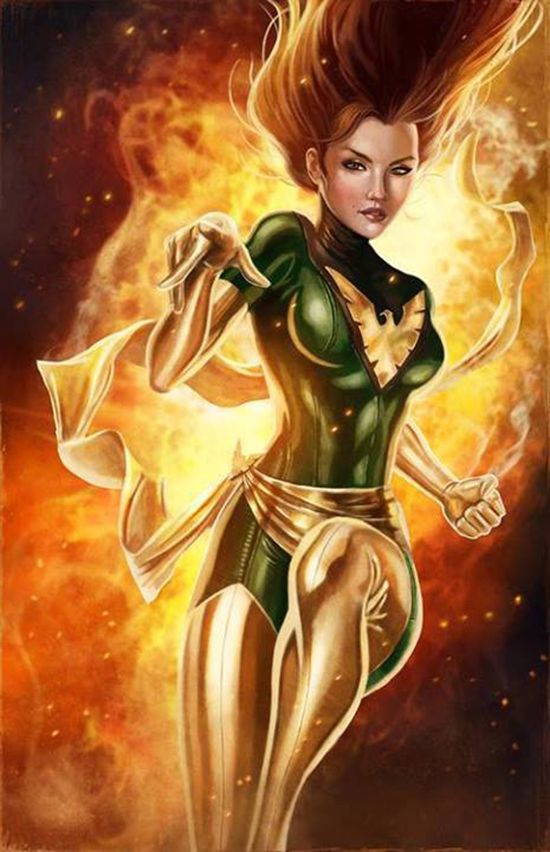
In case anyone needs a reminder why she’s such a big deal, take a look at these first glimpses of Ms. Turner in all her Jean Grey/Dark Phoenix glory. Be sure you have loose pants and clean underwear handy. Don’t say I didn’t warn you.

SophieJean1

I’ll give everyone a moment for their heart to settle and their pants to untighten. Take all the time you need. Believe me, it took me longer than I expected.

That one picture, in addition literally burning with Ms. Turner’s sex appeal, checks the most important box I listed in my article about how to not screw up a Dark Phoenix movie. It unleashes the fiery passion of the Phoenix and uses Sophie Turner’s sex appeal to do it.

While I doubt that director Simon Kinberg read that post, it’s a big deal that he’s emphasized this aspect of “X-men: Dark Phoenix.” That’s primarily because that critical element that makes the Phoenix Saga one of the greatest X-men stories of all time was omitted from the last attempt to do a Dark Phoenix movie, “X-men: The Last Stand.” The less said about that craptactular failure, the better.

Beyond capturing the necessary elements for a decent Dark Phoenix story, it also reflects a fundamental difference between this movie and “Avengers: Infinity War.” At its core, the Phoenix Saga is about a beloved friend and hero becoming corrupted. It involves high drama, heart-breaking sacrifices, and beautiful redheaded women kicking ass.

The core of “Avengers: Infinity War” is decidedly not that, especially after Black Widow died her hair. This movie is banking less on high drama and more on over-the-top battles involving the most powerful heroes of the Marvel Cinematic Universe against Thanos, one of Marvel’s most overpowered villains with a disturbingly extreme death fetish.

Now, there’s nothing inherently wrong with that approach. In fact, it’s probably the best possible approach for a movie that has been built up over the course of over a dozen big-budget films. Nobody can ever claim that Kevin Feige hasn’t been thorough in establishing the scale for this movie.

The problem, if you can call it that, is because of that scale, it’s difficult for a movie like “Avengers: Infinity War” to be anything other than what you expect it to be. It’s going to be an intense, over-the-top battle that will triple down on the themes that made the first Avenger’s movie so successful. At this point, that’s all it can do.

X-men: Dark Phoenix” offers something more than that. Like “Avengers: Infinity War,” it’s expanding the scope and scale of the movie to a level that no previous X-men movie has ever attempted. Whereas the first X-men trilogy tried way too hard to stay grounded, this one is letting the X-men push the boundaries like they do every other week in the comics.

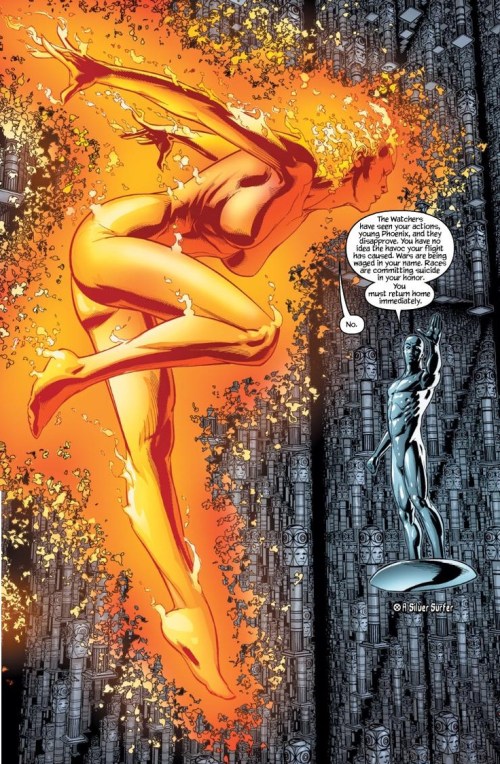
X-men: Dark Phoenix” will let the X-men go into space. It’ll let Jean Grey get overwhelmed and surrounded by cosmic fire, something “X-men: The Last Stand” barely even attempted. It’ll even let Sophie Turner get naked. That alone is worth the bloated ticket price.

Those elements, both the cosmic fire and the nudity, don’t even have to be forced. They’re actually in line with the canon X-men comics. Jean Grey has been known to fly around in the cosmic buff every now and then. I won’t say it’s a critical element to Phoenix Saga movie, but as someone who values nudity more than most, I can safely say it’s a hell of a bonus.
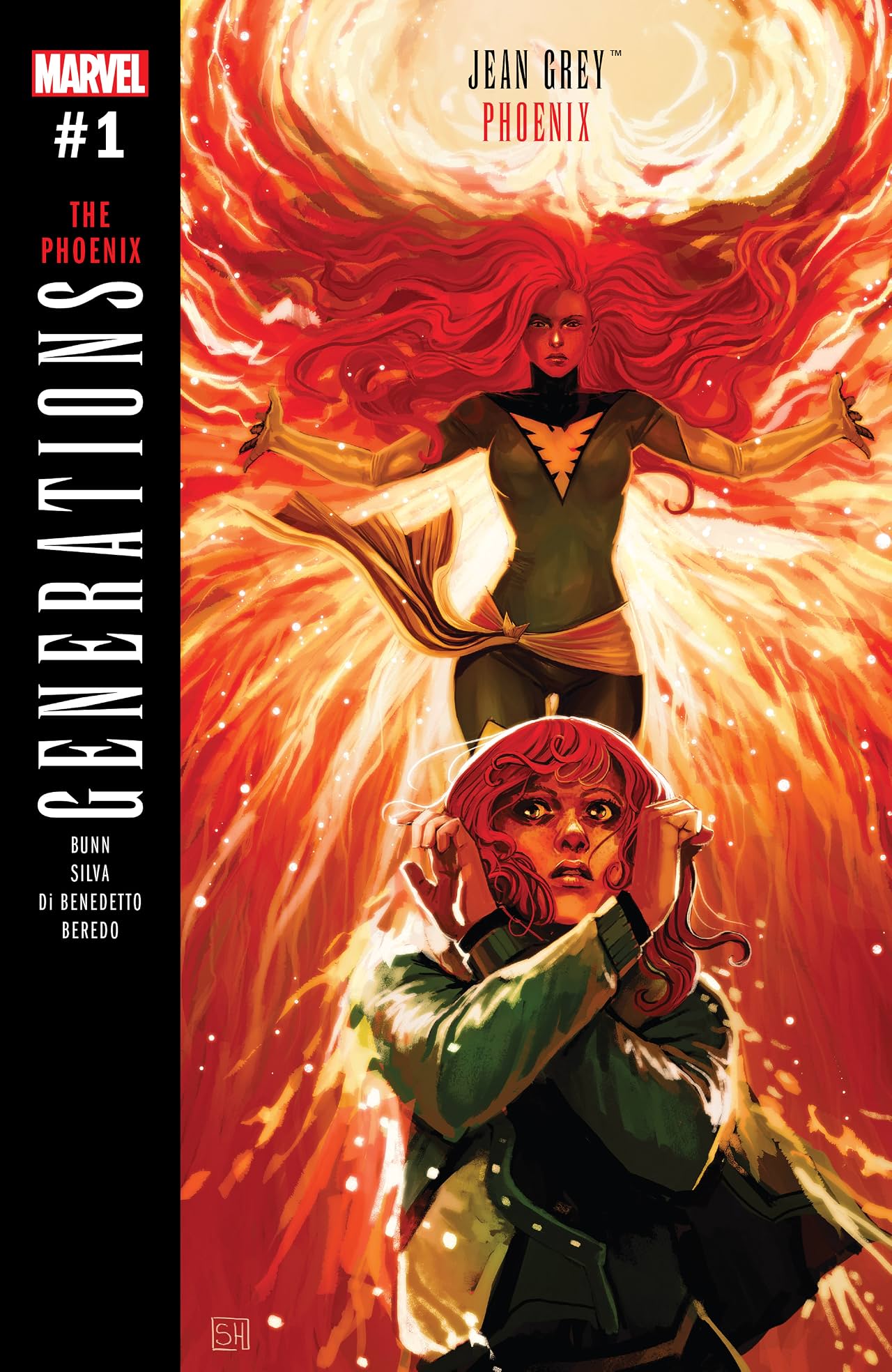
b0eecc16ca5ed57fd3b9cb5d6c5d65ea--jean-grey-phoenix-dark-phoenix

While I doubt anyone will pay extra to see Thanos get naked in “Avengers: Infinity War,” there’s one more element that helps sell me on “X-men: Dark Phoenix.” It has less to do with spectacle or nudity and more to do with underlying theme.

In a sense, “X-men: Dark Phoenix” is an opportunity to go beyond superhero movies. Like “Logan” and “Deadpool” before it, this movie has elements that can help it go beyond superhero movies, just as the original Phoenix Saga dared to go beyond stories about super-powered people in spandex costumes defeating villains.

There are all sorts of genres that “X-men: Dark Phoenix” can encompass. It can be a tragedy. It can be a sci-fi adventure. It can be a romance, which I’ve touched on before. It can be so many things, all within a single narrative. The ability for one movie to encompass all those elements, be it a superhero movie or a Disney musical, is a rare and special thing.

Avengers: Infinity War” has its place and chances are, it’s going to make more money than “X-men: Dark Phoenix.” It may end up making more money than any movie in history that doesn’t involve exploding death stars or blue aliens.

For me, someone who isn’t one of Fox or Disney’s accountants, you can’t put a price on the breadth of experiences offered by “X-men: Dark Phoenix.” Given the early fan responses to these new teasers, it’s safe to say I’m not a alone in this sentiment. Hopefully, those sentiments only grow once the first trailer drops.

If Fox, Simon Kinberg, and Sophie Turner can get it right in all the ways X-men: The Last Stand” failed and/or didn’t attempt, then it promises to be a truly special cinematic experience.

Also, and it’s worth repeating, the prospect of Sophie Turner getting naked outside a disturbing scene in “Game of Thrones” should appeal to everyone. Besides, why should Jennifer Lawrence’s nudity-loving Mystique have all the fun?
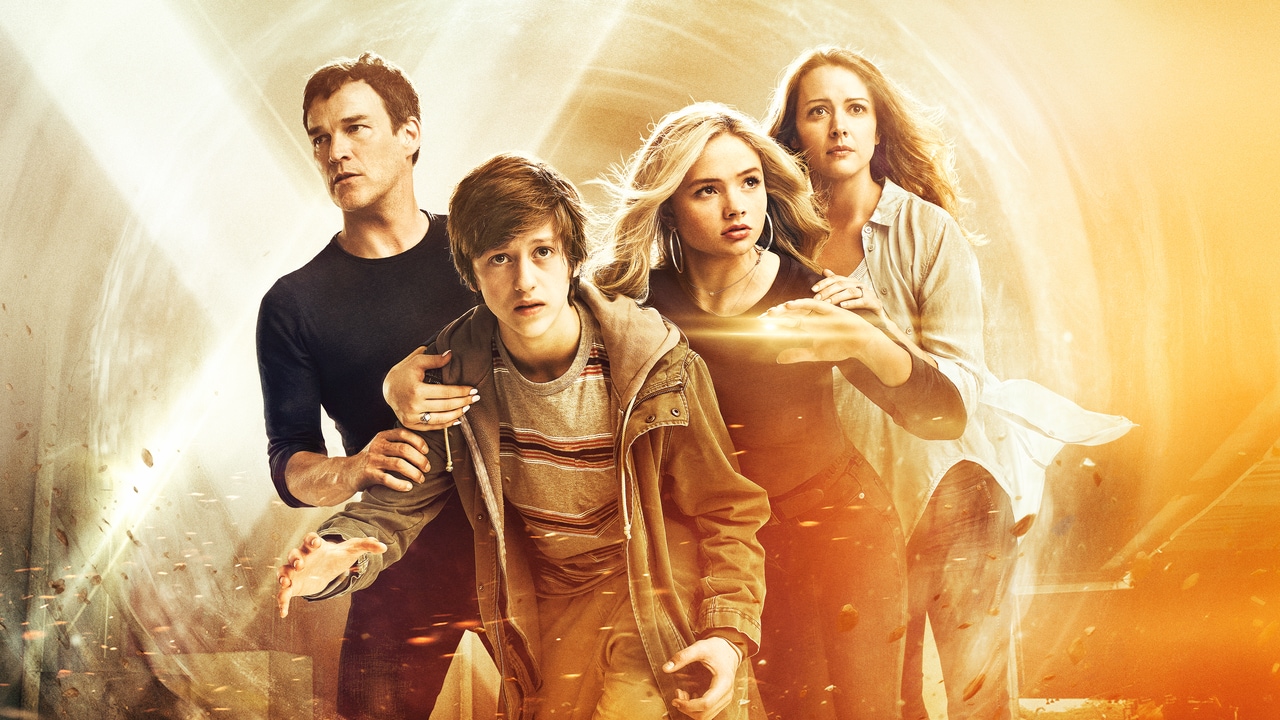
 

11 Comments

Filed under Comic Books, Jack Fisher, Superheroes, X-men

What “The Gifted” Reveals (And Warns Us) About Ourselves

Every now and then, a TV show comes along at just the right time. Like bikinis in the summer, hot chocolate in the winter, or beer at a football game, it just makes the right connections for all the right reasons.

You could argue that shows like “Married With Children” or “South Park” were shows that just happened to come along at a time when audiences were eager for something different, but didn’t know it. Some, especially “Married With Children,” couldn’t be made today because of changing standards. The fat jokes alone would’ve triggered endless whining on social media that would’ve gone on for years.

That brings me to “The Gifted,” Fox’s latest effort to squeeze every cent of profit from the X-men franchise. Yes, this is going to be another one of those posts. As I’ve done before, I’m going to tie real-world issues to one of my favorite superheroes. Unlike other posts, though, those ties go beyond getting romance tips from Deadpool.

While I’m usually skeptical about efforts to shamelessly exploit the glut of superhero shows on TV, I gladly make an exception for “The Gifted” and for a good reason. Compared to superhero melodrama on the CW or the gritty violence of the superheroes on Netflix, it’s a very different kind of show with a very different kind of struggle. Unlike aliens, blind lawyers, and secret armies of ninjas, this struggle is more relevant.

That’s because “The Gifted” doesn’t focus on heroes. Sure, it takes place in the same world as the X-men, but they aren’t the focus. Instead, the show builds its story around the Von Strucker family. They don’t live in a mansion. They don’t have their own personal hypersonic jet. They don’t even have their own personal high-tech training room.

The Von Struckers, unlike their comic counterparts, are an ordinary middle class family. They aren’t concerned with superheroes, super-villains, and insane love triangles between heroes. They’re concerned with work, school, taxes, and taking out the garbage. In a sense, they are a reflection of real people in a world with unreal challenges.

That’s a perspective that rarely manifests in the X-men movies. In fact, other than a memorable scene in “X2: X-men United,” the impact that mutants have on ordinary people is rarely touched on. Sure, they’ll show humans running in terror from a Sentinel or a pissed-off Magneto. That doesn’t give us much insight into the lives these people live.

The Gifted” builds an entire narrative around a family that lives in this world and during exceedingly tense times, no less. This is not a world where seeing the X-men take down a Sentinel is the sort of thing that happens every other Tuesday. This is a world where both the X-men and the Brotherhood have disappeared in an event that has only been referred to as “The July 15th Incident.”

That incident, much like 9/11 or a major assassination, created a dramatic/traumatic shift in society. Suddenly, mutants aren’t just another minority issue. They’re an existential threat, like nuclear weapons or mass pandemics. Mutants aren’t just a distant threat anymore. They’re a real threat.

From the perspective of the Von Struckers, at least in the first episode, the danger of mutants is like the threat of terrorism. They know it’s there. They accept the systems and precautions that society has put in place to deal with it. They’ve learned not to think much of it. They’re too busy just being an ordinary family in a world that happens to have individuals who have the mutant ability to turn into ice cream.

In a sense, we’ve done the same thing in the real world. We accept that we live in a world where the NSA reads all our emails, the CIA tries to assassinate world leaders, and gross injustices happen every day. We know, to some extent, that it’s manifesting all around us. We just shut it out and try to live our lives.

What happens, though, when that injustice hits you or someone you love? That’s what happens to the Von Struckers in the very first episode of “The Gifted.” Their blissfully oblivious lives are shattered when Reed and Kate Strucker find out their children are both mutants. Not only that, one of them ends up trashing the school gymnasium when his powers first manifest.

Their happy, middle class lives aren’t just disrupted. They’re shattered, spit on, and covered in fresh whale shit. To make matters worse, Reed Strucker, played by Stephen Moyer, was a prosecutor who made his living sending mutants to prison. Short of beating mutant children with a baseball bat for a living, he couldn’t have had a worse job.

The mutants he sent to prison weren’t always guilty of crimes. Sometimes, it was just a matter of being in the wrong place when their biology decided to act up. It would be like a teenage boy being arrested for an awkward boner, something we can’t always control. Granted, mutant powers tend to be more destructive, but they can be just as unpredictable.

It’s this revelation, as well as the events that unfold in the episodes that follow, that really highlight the impact that “The Gifted” leaves. It’s an impact more relevant than most X-men stories, including the ones that involve jealous ex-lovers. In a sense, it’s one that many minorities already understand all too well.

From the beginning of the show, there’s never a sense that Reed Strucker believed that he was hurting anyone. He never came off as the kind of guy who hates mutants and longs for the days where men like him can throw mutants into internment camps. He’s just doing his job, which he believes is making the public safer.

It’s really no different from those who genuinely believe that homosexuality is inherently harmful or that gun control will only lead to more violence. Most of the people who believe these things, the Pat Robertsons and Richard Spencers of the world notwithstanding, are decent people who want to live in a world where they’re families are safe.

Then, something traumatic comes along that shatters this worldview. They find out they have a gay son or they find themselves in the crossfire of a mass shooting. Suddenly, they can’t ignore these injustices anymore. They can’t go about their happy lives as though the system isn’t victimizing someone. It’s one of those rare situations where no amount of excuse banking can change the truth.

In a sense, the Von Strucker family are reflections of the families in the real world that find themselves on the wrong end of injustice. Whether it’s a Muslim family victimized by racial profiling or being on the wrong side of a sexual harassment claim, it’s not possible to avoid or ignore it anymore. These injustices are hurting you and the people you love. It’s soul-shattering, but that’s what makes “The Gifted” so compelling.

In the fourth episode, this message really hits hard. Reed finds himself in a jail cell right next to Polaris, a mutant who he prosecuted in the first episode, who also happens to be Magneto’s daughter. In these bleak conditions, she basically lays out all the hard truths that he and others like him avoid.

Yes, there was an incident where a group of mutants, which you could substitute for any minority, did something terrible. That was a terrible incident, but efforts to prevent other incidents like that are just hurting real people who don’t want to be superheroes fighting killer robots. Polaris is just one of them. Reed’s children are two more.

That harsh message is one that carries over in the real world, often in tragic ways. Back in 2007, a documentary called “For The Bible Tells Me So” highlighted deeply religious families who had been vehemently anti-gay, only to have one of their children turn out to be gay. Sometimes, it changed their perspective. In some instances, though, it ended tragically.

It’s a harsh, but necessary truth. We can’t control our circumstances. Much like Reed Strucker, we sometimes find ourselves in the worst situations at the worst possible times. The world is chaotic, full of strange people who do terrible things. The fact we can’t control or prevent those things is agonizing, at times. We, as a society, will do as much as we can to mitigate that danger.

In the process, though, we’ll try to fight injustice with more injustice. We’ll obsess less over what is real and more about what is potentially real. It leads us to do extreme things like throw innocent people into internment camps or create killer robots to protect people.

The Gifted” reveals the cost of those measures. It goes beyond the eccentricities surrounding superheroes and focus on the real impact that real minorities feel. Most who are lucky enough to not be part of that group remain content to ignore it. Then, when it finally affects them, they realize just how unjust it is.

At a time when injustices are harder to hide and minorities are a growing part of society, these are important messages. The X-men have been exploring these themes for years, often with colorful adventures involving cosmic birds. “The Gifted” goes even deeper and during these troubled times, these are messages worth heeding.

2 Comments

Filed under Current Events, gender issues, X-men

My Fan Theory: The (True) Origins Of Mutants And The X-men

Fans of anything, be it a TV show, a comic book, or extra spicy buffalo wings, like to believe their passion makes them an expert. They believe, either by arrogance or sincere belief, that they understand it better than most people. They may even believe that they can do it better. That’s the entire basis of fan fiction, in as such that fans feel they have something to contribute.

More often than not, those efforts are forgetful at best. I say that as someone who has written his share of fan fiction before he began writing sexy novels. Anyone who has followed my Twitter feed knows that. I’ve never assumed that my work was that good. If it were, then Marvel would’ve paid me to do it so they can make more money. There’s a reason their writers get to do what they do for a living.

That still won’t stop me from making a concerted effort. Since I can’t call myself a successful writer just yet, although I am making progress, I still write with the assumption that it’s average at best. I understand that have a long way to go before I can call my writing objectively good.

That’s why I’m always looking for opportunities to improve. That brings me to this particular opportunity that spun out of my article about fan theories. In case you didn’t read that article, all you need to know is that I’ve become a big fan of them in recent years, especially since they’ve exploded in popularity on sites like Reddit.

Being such a fan, I think the time is right for me to take a shot to see if I can contribute to the phenomenon in some meaningful way. That’s why, channeling the same spirit that inspires fan fiction, I want to add to the overall zeitgeist by creating my own fan theory.

Since fan theories often stem from those who follow something with particular passion, it’s only fitting that this one involves X-men. I’ve made my passion for X-men very apparent on this blog. It’s something I follow closely, often using it as inspiration for various articles on this blog. If any fan is qualified to craft a fan theory, I’m confident I check all the right boxes.

With that in mind, here’s Jack Fisher’s first official fan theory about the X-men. It’s not just mindless speculation. Like the famous no-dinosaurs in Jurassic Park theory, it helps make sense of something that isn’t readily obvious from reading X-men comics Marvel comics in general.

I’m not going to claim it’s secret canon, but I think it adds a new, richer context to X-men as a whole. It all boils down to one simple concept.


Mutants in the Marvel Universe are a direct evolutionary response to the existence of aliens, gods, and magic.

To understand what I mean by this, and why the implications are so serious, I need to point something out that most everyone who passed high school biology probably already knows. The mutation we see in X-men comics is nothing like the mutations we see in the real world.

Sure, there are documented cases where certain genetic mutations confer certain direct benefits, but those mutations never come close to the kinds of powers we see in the X-men. Abilities like shooting lasers from your eyes, summoning hurricanes, or vomiting acid, which I swear is an actual mutant power in the X-men, are physically impossible in our world.

However, in the world of Marvel, the concept of impossible is exceedingly opaque. In that world, it’s possible to devour worlds and create talking raccoons. In that world, gods exist. Magic exists. Advanced aliens exist. Cosmic forces that defy our understanding of reality occur every day, often in the labs of Dr. Doom.

The common existence of such forces doesn’t just make mutation, and all the crazy abilities it conjures, possible within the context of the Marvel Universe. Under this theory, it makes them necessary in that humans must evolve these kinds of abilities in order to survive. Like our universe, evolution is about survival and in a world where giant space gods exist, that requires more than just making better tools.

That’s where the X-gene comes in. According to Marvel’s own wiki on mutant biology, it works in a way similar to how we understand actual genetics in the real world.

This gene leads (via transcription and translation) to an exotic protein. This protein produces chemical signals inducing mutations on other genes, ending up with mutant organisms, variously empowered.

This mechanism is key to this theory because in the real world, there is evidence that a more stressful environment affects how a species mutates. In the Marvel Universe, those stresses aren’t exactly subtle.

In fact, it manifested in a very real way in a recent comic called Marvel Legacy #1. In this comic, it is revealed that powerful forces that include the gods of Asgard, the Phoenix Force, and mystical beings like Agamotto, were present on Earth in 1,000,000 B.C., a time when humans were still evolving from other primates. Their presence, which included a battle with one of those space gods I mentioned, certainly created plenty of stress.

That stress, combined with the thousands of generations that followed, led to the manifestation of the X-gene. It’s basically the human race’s way of adapting to a universe where beings can use magic hammers to trigger thunderstorms on a whim.

However, even without the events of Marvel Legacy #1, there’s another recognized phenomenon in the Marvel Universe that lends credence to this theory. It happened in an event from 2012 called “Avengers vs. X-men,” which is exactly what it sounds like.

In that event, which was a culmination of events that nearly brought mutants to extinction, Tony Stark surmises that there are cosmic forces that will not accept mutants going extinct.

In this case, it’s the Phoenix Force again, which has a tendency to cause big problems in the Marvel universe. Once it sensed mutants were going extinct, it reacted like a rubber band snapping in the other direction. It determined that mutants need to exist. While it doesn’t specifically state why, the fact that someone as smart as Tony Stark came to this conclusion makes it more than mere speculation.

If he’s right, and Tony Stark is usually right in things that don’t involve his love life, then that means this theory has a basis in the biology and physics of the Marvel universe. It means that if mutants vanished from the human populous, then they would be inherently vulnerable to the many powerful forces that threaten it.

In a sense, it’s not just about there being no mutants or X-men to aid the Avengers in a battle against Thanos. It’s about giving the human gene pool the biological tools it needs to survive a universe where beings like Thanos exist. Without it, the human race is the biological equivalent of a dodo bird.

There are a number of other events throughout the history of X-men and the Marvel universe that I could cite, from “X-men: First To Last” to a good chunk of Louis Simonson’s run on “X-Factor.” I won’t get too deep into specifics, but the themes are the same. Humans need to evolve into mutants in order to survive in the Marvel universe.

In the context of this theory, the existence of mutants mutants and their abilities takes on a more defined purpose. The X-gene doesn’t just happen. It’s an evolutionary response to all the craziness that exists within the Marvel universe.

It also raises the stakes for the X-men’s efforts for peace and understanding. Evolution, being an imperfect and messy process in any universe, is bound to cause plenty of tension within a species. The need to coexist doesn’t just pertain to mutants. It applies to both. Without each other, their chances of survival are greatly diminished.


Now, I don’t expect this fan theory to be vindicated or even acknowledged by Marvel in any capacity. Like all fan theories, this is just me interpreting a story and extrapolating a larger theory to add a sense of nuance. It also takes other major events from Marvel’s canon and provides greater connections, which I believe helps any narrative.

It is, and it’s worth belaboring, my first effort at a serious fan theory. I don’t expect it to shake X-men fans or comic fans to their core. I just hope it gets people thinking and discussing. If you think my theory works or think I’m full of crap, I’d love to hear from you. The best part about fan theories is the discussions they inspire. Sure, some of those discussions can get pretty profane, but I’m willing to take that chance.

3 Comments

Filed under Comic Books, Jack Fisher, Superheroes, X-men

HUGE Boost In Traffic (Thanks To Reddit)

Rising-Market-Prices

I just wanted to make a quick post acknowledging something unexpected, but amazing. A few days ago, I decided to step up my efforts to promote my blog by creating my own Reddit page. I’ve only recently begun exploring more of Reddit and it has been a great experience. I figured that maybe it can help me increase traffic to my blog.

Boy, was that an understatement. I do what I can to promote this blog, but never has my effort paid off this much. So far, I’ve only posted a handful of my articles on Reddit. Then, earlier today, I posted my article on the 25th anniversary of “X-men: The Animated Series.” Apparently, that article went over very well with the X-men board.

As I write this, that article has received over 500 visitors. That may not sound like much, especially by PewDiePie standards, but for this humble blog operation, that is orders of magnitude bigger. Before today, my most popular articles going all the way back to last year barely exceeded 300. Today, one article beat that in less than 24 hours.

As a whole, this blog has gotten more traffic in the past day than it has at any point in its brief history. It’s a huge milestone and I couldn’t be more excited. Now, this may just be an anomaly. It might just be that my X-men article happened to come along at the right time and get just the right attention from Reddit. It’s fairly likely that this spike will taper off, at least for a while.

For now, though, I’m beyond thrilled. Today, the traffic on this site increased by a factor of 10. It has raised the bar for www.JackFisherBooks.com. For that, I sincerely thank everyone who has supported this site. I hope to continue making this site fun, sexy, and everything in between.

4 Comments

Filed under Uncategorized

Five Reasons Why “X-men: The Animated Series” Was More Progressive Than You Think

DNcLvqLVQAAI1iI

This past Halloween was extra sweet for a certain group of comic book fans, one that I just happen to be part of. Even if you’re not a comic book fan and were just a kid of the 90s, growing up on a steady diet of Saturday morning cartoons, this year marked a special milestone for one of the best shows of that era.

Yes, it involves superheroes. Yes, it involves X-men, which I often go out of my way to discuss. Yes, it involves this iconic theme music that has since become my ring tone.

That insanely catchy guitar rift that got stuck in the heads of millions of fans is from “X-men: The Animated Series.” On October 31st, 1992, this series debuted on Fox Kids and countless childhoods were forged from that day forward, including my own.

That was 25 years ago and while that thought makes me feel way older than I care to feel, it still brings back fond memories. One of my favorite parts of the day, as a kid, was rushing home from school, turning on the TV, and watching my favorite shows. “X-men: The Animated Series,” along with shows like “Spider-Man” and “Power Rangers,” were a big part of my carton diet.

I largely credit this show and “Spider-Man” for getting me into comic books, superheroes, and everything that came with it. I also credit those shows with giving me an early understanding of character development, romance, and storytelling, which would go onto help me write my sexy novels.

For that reason, and many others, “X-men: The Animated Series” has a special place in my heart. I imagine many X-men fans feel the same way because it was this show that helped the X-men really peak in the 90s. What the Avengers are today, the X-men were in the 90s. They were very much the alpha and omega of all things involving superheroes.

While this 25th anniversary gives me time to reflect fondly over how much this show enriched my childhood, my life as an adult has only further expanded my perspective. When I look back on “X-men: The Animated Series,” I’m somewhat amazed by how relevant it still is in terms of theme, drama, and story.

It’s easy to forget that this series came out at a time when most cartoons followed a simple, predictable formula, regardless of whether or not superheroes were involved. There was evil. The heroes found out about said evil. They fought it. Then, the credits roll. “X-men: The Animated Seriesdared to think bigger.

While the animation and voice acting might be somewhat dated, this show dared to speak up about social issues. It dared to explore ideas of hate, bigotry, and discrimination. At a time when parents were still fighting mortal crusades over rock music, this show tried to be relevant in a new way.

Now, as I look back on this series that lasted for five years and 76 glorious episodes, I realize just how progressive and insightful this show truly was for its time. As more and more forms of media, including comics, push for greater diversity, “X-men: The Animated Series” found a way to pull that off 25 years ahead of schedule.

In a sense, the X-men have always been about progressive themes like inclusion, diversity, and justice. Even though some of those words have become toxic today, they embodied the best of it, going back to its earliest days of drawing parallels with the Civil Rights movement. This show just captured it at a time when it a new form of progressive concepts were taking hold.

So, in honor of the 25th anniversary of this show,  I’d like to highlight five reasons why “X-men: The Animated Series” was even more progressive than you remember. Even if you’re not a fan of X-men or comics, it’s amazing to think that a show from 25 years ago achieved so much of what others are trying to accomplish today.


“Genuine bigotry and hatred was depicted in ordinary people.”

To X-men fans, it seems obvious. Bigotry and hatred are very much a part of the X-men’s DNA, going all the way back to their early days in the 60s. However, for a kids cartoon, this was akin to Miley Cyrus flashing her tits on an episode of “Hannah Montana.”

X-men: The Animated Series” did not water down the themes of blind hatred and bigotry espoused in the comics. If anything, they took it a step further by giving a voice, putting that blind hatred on display through characters like Graydon Creed.

This especially played out in the second season where hate groups like the Friends of Humanity formed. They’re the anti-mutant equivalent of the KKK. Their hate was so blind and deep that when one character, Jubilee, asked them why they hated her so much, Creed said simply, “You were born!”

That kind of hatred is harsh in real life, let alone a kids show. The fact that this show gave the X-men more than just monsters, tyrants, and aliens to fight showed an uncanny, if that’s not too fitting a term, willingness to scrutinize these painfully real issues.

As a kid, I barely understood it. As an adult, I’ve come to appreciate it even more. I like to think that exposing that kind of hate in a cartoon showed an entire generation of kids what true assholes look and sound like. Given the amount of assholes in this world, those lessons were invaluable. Plus, it was way more entertaining than “Sesame Street.”


“The characters were diverse and had vastly different personalities.”

Here’s a quick question that should trigger some unpleasant conversations on message boards, as if there are any others. Look at the cast of the Avengers movie. Aside from talking raccoons and androids, what do you notice? They’re mostly men, they’re mostly white, and they mostly have the same avenging personality.

Now, look at the X-men. You’ve got an uptight white guy, a burly Canadian, a sexy southern woman, an African goddess, a smooth-talking Cajun, a giddy teenage girl, and a guy in a wheelchair. Even by today’s absurd diversity standards, the X-men check a lot of boxes. They’ve been checking those boxes since long before diversity was even an annoying buzzword.

It’s not just that the cast of “X-men: The Animated Series” was diverse on the surface. It’s not just that they disagreed with each other, as the Avengers frequently do. They had such wildly different personalities that didn’t always mesh. Cyclops and Wolverine alone had all sorts of clashes and not just over wanting to sleep with the same redhead.

That kind of diversity of thought and personality is something modern cartoons, TV shows, and movies still struggle to achieve. “X-men: The Animated Series” managed to achieve that at a time when Hillary Clinton was still likable. It was a big accomplishment at the time and one that only gets more impressive as the years go by and people still fight about diversity in media.


“The show did feminism and strong female characters RIGHT.”

x-ladies

I’ve said it before and I’ll keep saying it in future posts. Talking about feminism is dangerous, divisive, and frustrating, especially in wake of recent scandals. Nobody seems to know how to even handle feminism or strong female characters who aren’t Wonder Woman. Long before the “Wonder Woman” movie raised the bar, though, “X-men: The Animated Series” made sure it set that bar pretty damn high.

Even by modern standards, “X-men: The Animated Series” found a way to do feminism right. Unlike other cartoons, the female characters weren’t part of the supporting cast or relegated to roles of a love interest. They actually participated on the same level as the male characters.

They didn’t have to create new female characters or force a female character into a male role. “X-men: The Animated Series” simply took characters like Storm, Rogue, Jubilee, and Jean Grey and maximized their strengths. They gave them personalities, power, and individual stories. They didn’t have to show up their male teammates. They could stand on their own and thrive as women.

In terms of feminism, “X-men: The Animated Series” was at omega-level standards long before it became a priority. At a time when we’re still struggling to make solid female characters, it’s remarkable and refreshing to see how well it was done.


“The show didn’t shy away from harsh, dramatic moments.”

People used to make a big deal about cartoon violence. The big worry was that kids would see a cartoon duck fighting with a cartoon rabbit and think that playing with double-barreled shotguns were toys. It was a very different, very strange time, to say the least.

X-men: The Animated Series” basically gave a big, adamantium finger to this debate, at least to the extent that they could get around the network censors. This show did not shy away from the harsh, dramatic moments that had played out in the comics. In fact, in the second episode of the series, one of the characters dies.

Keep in mind, this is a kids show where characters are not allowed to curse or show blood. The fact that this show killed a character in an early episode, and referenced death on more than one occasions, showed a remarkable willingness to portray real struggles with real stakes. Sure, it probably upset a few parents, but it sent a powerful message about the real world.

X-men: The Animated Series” dealt with real issues of bigotry, hatred, and intolerance. As such, it couldn’t water down the harshness and the pain it incurred. These are issues that people are still reluctant to talk about today and this show brought it up during the Clinton Administration. That shows both guts and foresight.


“The villains, heroes, and themes had layers of complexity.”

Watch any cartoon made before 1992 and chances are the characters you see will be pretty basic. You have your evil, mustache-twirling villains. You have your generic good guy/hero types. You have exaggerated violence and shameless toy promotions. There’s not a whole lot of depth there.

X-men: The Animated Series” once again dared to do more. It dared to let its characters grow and evolve over the course of five seasons. It’s an approach that worked so well that others, like the “Spider-Man” cartoon that debuted two years later, went onto adopt it. These characters had all sorts of layers and depth in the comics. The show chose not to simplify it for a young audience and embrace that complexity.

Sure, characters like Magneto, Sinister, and Apocalypse came off as generic bad guys at first, but they developed more and more depth as the series went on. There were even times when Magneto came off as genuinely sympathetic. For a kids show, these moments were pretty heavy and something you just wouldn’t get with the Ninja Turtles.

Today, everyone is trying to give their characters that Walter White style of complexity. Everyone is trying to create a series with a sense of progression. Well, “X-men: The Animated Series” were already doing that in the days of dial-up internet.


The fact this show succeeded to the extent that it did, while being as progressive as it was, even by modern standards, is nothing short of uncanny. After 25 years, the show still has a special place in the hearts of X-men fans. Sure, the animation and dialogue may be dated, but those progressive themes have never been more relevant.

10 Comments

Filed under Comic Books, Jack Fisher, Superheroes, X-men

A (Potential) Solution To The Worst Love Triangle Of All Time

There are some romantic sub-plots that cannot and will not work, no matter how well they’re written. You could resurrect Shakespeare, Tolken, and Faulkner, merge their brains, and still never salvage those plots. More often than not, most of those un-salvageable sub-plots involve love triangles and I’ve made it abundantly clear how much I despise love triangles.

In a sense, love triangles are a symptom of a much larger problem with romance. They’re basically a reverse cheat code in that they’re supposed to be an easy way to inject drama into a romance, but only ends up making things harder in the long run. While it’s not impossible for a love triangle to work, as fans of “Buffy the Vampire Slayer” might argue, it’s exceedingly rare.

That brings me back to what I’ve identified as the worst love triangle of all time, namely the one involving Cyclops, Jean Grey, and Wolverine of the X-men. I could talk for days as to why it’s so awful. However, I don’t want to re-hash those old arguments. I want this article to be more productive in that it offers solutions instead of whining.

In general, this is an aspect of comics I don’t enjoy talking about and avoid at every turn. I probably would’ve kept avoiding it and talked more about my sexy college experiences, but a few recent announcements by Marvel Comics has me and many X-men fans contemplating this god-awful love tingle once again.

It started a couple weeks ago when Marvel announced that Jean Grey, the one that isn’t a time traveler, is returning from the dead after 14 years. Needless to say, this sparked a firestorm of cheers and squees from X-men fans who have been longing for her return for years. I’m not going to lie. I did my share of squeeing.

Then, less than a week later, Marvel dropped another bomb in the pages of Marvel Legacy #1, their latest blockbuster event comic meant to bump sales and soak the panties of collectors. Wolverine, who has been dead since 2014 and was subsequently replaced by multiple characters, is alive again.

That surprised nobody so there wasn’t as much squeeing. Wolverine has survived a nuclear explosion, getting his flesh blown off, and being run over by a steamroller. It was only ever a matter of when and not if he would return. However, him returning at the same time as Jean Grey is one of those coincidences that no self-respecting X-men fan believes to be a coincidence.

If there was any silver lining to Jean Grey being dead for so long, it was that it kept anyone from dragging that god-awful love triangle back into the forefront. With Jean dead, Wolverine could move on and pursue other relationships, like he did with Storm. Cyclops pursued a brief, but passionate relationship with Emma Frost. Both characters seemed to move on from that horrible affront to romance.

Now, with Jean Grey and Wolverine back in the picture and a time-traveling Cyclops still running around, these three are finally in the same universe again. That means there will be the temptation to revisit this malignant tumor of a love triangle. As someone who loves all three of those characters dearly, I am not looking forward to that.

It’s too early to say how the story will play out. Marvel hasn’t revealed anything about how Wolverine came back from the dead. There also isn’t much information on the particulars of Jean Grey’s resurrection. We only know the outcome in that they’re both alive again and that’s usually all anyone needs to re-visit that infuriating love triangle.

Given the circumstances of how it played out, which I’ve noted before, it’s hard to twist this love triangle in a way where anyone comes out looking good. No matter what happens, someone gets screwed over.

If Jean Grey chooses to be with Cyclops, then it screws Wolverine over by reducing him to an obsessive, whiny stalker instead of the ultimate loner.

If Jean Grey chooses to be with Wolverine, then it screws Cyclops over by reducing him to nothing more than an obstacle for Wolverine.

In both cases, Jean Grey comes off as either a prize to be won or a heartless bitch who plays with the heart of any man who dares to fall in love with her. In the end, nobody wins in a love triangle, especially one that was so horribly contrived to begin with.

All that said, I don’t deny that the love triangle is hard to ignore. While it’s not an integral part for each character, it is one of those unresolved issues that has never truly been laid to rest. It’s like a dangling plot hole that can never be totally ignored.

Even so, the love triangle is so toxic to all three characters involved. It only ever brings out the worst in them at every turn. So if it’s only a matter of time before the love triangle re-surfaces again in the X-men comics, then what’s the ultimate endgame? Is there a solution to this omega-level migraine of a plot?

I’m not a writer at Marvel, nor do I have a sliver of influence with them. However, I am a passionate X-men fan, as well as an unapologetic romantic who writes sexy love stories. Given that passion and experience, I have a solution that I doubt Marvel will ever take seriously, but one that essentially fixes the worst love triangle in the history of romance. The solution is as simple as it is sexy.

Make Cyclops/Jean Grey/Wolverine the first polyamorous relationship in comics.

I’ll give comic fans a moment to stop rolling their eyes and/or laughing. I’ll give the ardent proponents of the Cyclops/Jean and Wolverine/Jean relationship a moment to stop shaking their heads as well. This may be the only time both sets of fans are on the same page. I assure you, though, it’s no joke. I’m as serious as an attack by Thanos.

Just think about it from a purely pragmatic point of view. Jean Grey’s love for Cyclops is beyond dispute, being the oldest and most serious relationship in the history of X-men. Her attraction to Wolverine is also beyond dispute, which has made for more than a few sexy moments in the history of X-men.

On top of that, both Cyclops and Wolverine have a history of wanting to hook up with more than one woman. I’ve gone over the long list of romance/hook-ups that Wolverine has gone through. This is a guy who hooked up with Squirrel Girl, for crying out loud. That should be proof that this man cannot handle monogamy.

Cyclops, despite his reputation as a boy scout, also has a history with wanting to hook up with other women. Granted, he’s not even in the same time zone as Wolverine, but the sentiment is there. Unlike other heroes, such as Superman or Mr. Fantastic, he can’t seem to shake it off.

That makes him, Wolverine, and Jean ideal candidates for a polyamorous relationship. They exist in the real world. There is even some evidence that polyamory can be beneficial to certain couples because they require a great deal of communication and understanding, two key requirements to any successful relationship.

Given that Jean Grey is a powerful psychic and Cyclops has a history of attracting psychics, they’re better equipped than any other couple in the real world or the fictional world the create a functioning polyamorous relationship. When real psychics are involved, the obstacles associated with communication become an instant strength.

It works great for Wolverine too because it means he can still be Wolverine. He can still strike out on his own every now and then, stab some monsters, and hook up with a few crazy women. He wouldn’t be tied down by Jean Grey and unable to be what makes him awesome. He can still live, love, and fight like Wolverine.

It may very well be the only way that the nauseatingly overplayed melodrama that is the Cyclops/Jean Grey/Wolverine love triangle gets resolved. With a polyamorous relationship, all three characters get to share in the emotional fulfillment. They all get to feel loved and nobody gets left out in the cold. It may even bring them all closer together.

That might be impossible for some to imagine with Cyclops and Wolverine, two characters who have been at odds since the moment they met. However, they have shown throughout their history that they can get along. They can work together and bond over a shared goal, especially when that goal involves Jean Grey.

On paper, a polyamorous relationship between Cyclops, Jean Grey, and Wolverine would solve so many problems. Everyone involved could have their cake and eat it too. That might be the primary reason why Marvel would never do it, though. It makes too much sense.

I don’t think that a polyamorous relationship would be too taboo for Marvel. In recent years, Marvel has shown a willingness to explore non-traditional relationships. Back in 2012, they celebrated their first same-sex wedding in the pages of Astonishing X-men. They have a fairly lengthy list of LGBT characters as well. Even Daken, Wolverine’s son, has a history of eccentric sexual preferences.

The timing would even be right because polyamorous relationships are on the rise and monogamy is on the decline, especially among young people. While there will always be a place for strong, monogamous couples in comics, why not mix things up a relationship that everyone at Marvel seems eager to strain?

A polygamous relationship isn’t necessarily taboo these days, but it’s something nobody has really tried. It seems like the only way comics, TV, or movies can ever inject drama into a romance is to throw in a love triangle. On behalf of all hopeless romantics, I’d like to go on record as saying that tactic is old, not to mention detrimental.

Cyclops, Jean Grey, and Wolverine are in a perfect position to try something different, creating a new kind of romance that we haven’t seen in comics, TV, or anything that didn’t used to air late night on Cinemax. It would be challenging, but that’s exactly what would make it so appealing.

That may also be why Marvel would never try it. It’s so different and there’s no successful formula to follow. Sure, William Marston, the kink-loving creator of Wonder Woman, did it to great effect, but it would require all sorts of dynamics that take a great deal of effort. That effort might just be more than Marvel, or any comic company, is willing to put in at the moment.

Maybe a time will come when polyamorous relationships find their way into comics, just like same-sex relationships. It may not happen with Cyclops, Jean Grey, and Wolverine, but they are the ones that stand to benefit the most from it. Compared to another exceedingly toxic triangle, it would be a welcome change to the world of superhero romance.

9 Comments

Filed under Comic Books, Jack Fisher, Superheroes, Marriage and Relationships, X-men

Another Lesson From The X-men: Does Power OR Stress Corrupt?

We’ve all heard it before, a saying so common and overplayed that our first reflex is to roll our eyes and think briefly whether those leftovers in the refrigerator are still edible. It manifests in many forms and is the theme of 98.7 percent of every movie featuring evil empires and overly rich assholes. We use many words, but most of us know the basics.

“Power corrupts. Absolute power corrupts absolutely.”

I’ll give everyone a moment to finish yawning. I don’t blame you. As someone who has spent three quarters of his life reading superhero comics and seen nearly every movie that tried to rip off “Star Wars,” I’ve neither the energy nor the bandwidth to list all the stories that play with this theme so I’m not going to try.

Instead, I’m going to be a little bold and challenge that overplayed, overused theme that has been more belabored than a puke bucket at a bulimics convenstion. I’m also going to do it while citing X-men comics again, specifically another one featuring Jean Grey. Yes, I’m aware I’ve done that multiple times already. Yes, I’m going to keep doing that. No, I’m not going to apologize for it.

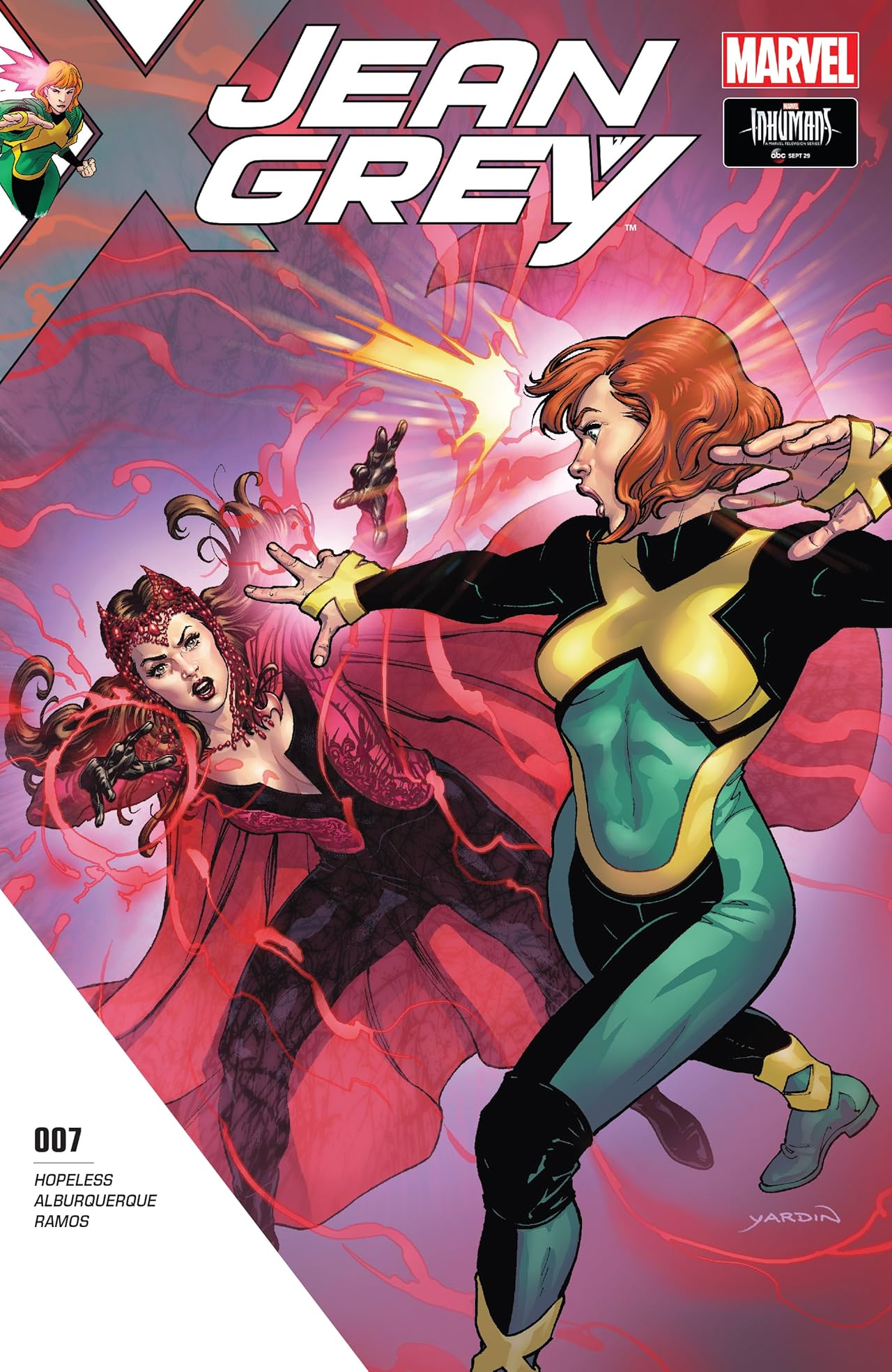
However, I’m not just going to focus on the events of a particular comic. While this post was inspired by Jean Grey #7, a comic written by Dennis Hopeless and drawn by Alberto Jimenez Alburquerque, it’s the bigger picture the story highlights that I want to focus on. I still encourage everyone to read the comic, but you don’t have to in order to appreciate its theme. It’s almost subversive in the larger message it implies.

Think back to that overplayed saying about power corrupting and try, if you can, to do it without yawning. Now, ask this follow-up question and try to do it with a straight face.

“Is it really power that corrupts? Is it possible that the stress that comes along with power is the true danger?”

I hope nobody’s yawning after that because that’s not a question that gets asked very often, but it’s one that Jean Grey ends up answering in Jean Grey #7, albeit indirectly. Given that it’s a question so few ask in the first place, it’s easy to overlook, but it’s worth thinking about.

Think, for a moment, about the impact that stress has on your life. That’s much easier than thinking/fantasizing about what it would be like to have absolute power. Unlike absolute power, there is some actual science behind the effects of stress. According to the Mayo Clinic, the impact of stress is basically the grand slam of negative health effects. Those effects include, but certainly aren’t limited to, nasty stuff like:

  • Headache
  • Muscle tension or pain
  • Chest pain
  • Fatigue
  • Stomach upset
  • Sleep problems
  • Anxiety
  • Restlessness
  • Lack of motivation or focus
  • Feeling overwhelmed
  • Irritability or anger
  • Sadness or depression
  • Overeating or undereating
  • Angry outbursts
  • Social withdrawal

These are all issues that negatively impact your personal life, your work life, your sex life, and pretty much every other life you hope to have as a functional human being. We all endure stress on some levels, but having too much of it is kind of like being really horny. You know when it happens and it’s hard to ignore.

With those effects in mind, imagine just how stressful it is wielding great power. It doesn’t even have to be like the cosmic power Jean Grey is destined to wield in Jean Grey #7. It could be a powerful political position. It could be a powerful business leader. Hell, it could just be the power that comes with being the head of a household.

It’s somewhat paradoxical in that it seems unavoidable. Gaining more power means dealing with more stress. However, we seek power, to some extent, in order to achieve our goals. More often than not, those goals involve alleviating certain stresses on our lives, be they poverty, strife, or simple inconvenience. In a sense, we exchange one form of stress for another and hope the other is easier to deal with.

Sometimes, those hopes don’t pan out. Sometimes, the stress that comes with whatever role that power brings us is more than we expect. In that state of mind, is it really that surprising that people become corrupt?

When I talked about powerful fascist states, I noted the extent to which they have to control the personal lives of others and how that can often be used against them. Those efforts, if you ignore the egregious abuses they entail, require some pretty stressful efforts that anyone not named Dr. Doom isn’t equipped to manage.

It creates, sort of, a chicken-and-egg scenario for the corruption that often follows. Was it the power in and of itself that led that corruption or was it the stress it entailed? While I doubt every situation has the same answer, the one in Jean Grey #7 has some intriguing possibilities.

In the context of this story, the same out-of-time Jean Grey that I’ve covered in previous posts is still dealing with the prospect of a cosmic power known as the Phoenix Force coming after her. She knows it’s destined to kill her. She knows how much it corrupts her, so much so that Fox is making a movie about it. It’s a stressful situation, to say the least.

However, Jean Grey isn’t the only overly powerful character in the diverse menagerie that is the Marvel Universe. Hell, overpowered characters in Marvel probably have their own lobbying group. One of their most notable members is Wanda “the Scarlet Witch” Maximoff. Like Jean Grey, she also wields exceedingly immense power that has driven her insane on more than one occasion.

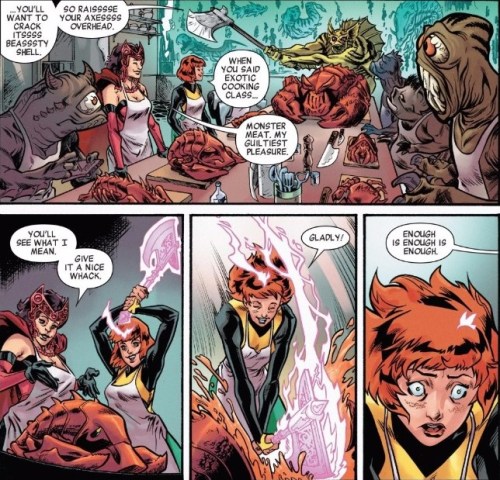
Like a friend staging an intervention for someone they care about, Wanda seeks Jean out and basically has a girl’s day with her. She shows her that obsessing over the power they wield, or are destined to wield, will drive her just as crazy as the power itself. She dares to help Jean do normal, healthy things that don’t involve stressing out over that power.

Some of those things involve stuff actual people do, like going to a beach or running on a hot sunny day. Others are a bit more exotic, like a cooking class that involves monster meat. I swear on Jennifer Lawrence’s ass that I’m not making that up.

MonsterCooking

The events of Jean Grey #7 make a compelling case about the impact of stress over power. The fact that there are other powerful characters throughout the Marvel universe that manage to function on a day-to-day basis without going insane proves, to some extent, that power and corruption need not be the same thing.

Eventually, circumstances within Jean Grey #7 that are beyond Jean’s control derail her efforts to better manage her stress. In a sense, that’s another part of wielding power and the corruption that comes with it. No matter how much power anyone has, be they a comic book character or a warlord in a third-world country, they are still at the mercy of various circumstances beyond their control.

Jean Grey, and most other superheroes, often learn that the hard way. People in real life who wield great power deal with that as well, sometimes in a very public way. Whether you’re Jean Grey or Emporer Palpatine, it’s impossible to deal with every conceivable circumstance that may undermine your power or stress you out. For some people, that just compounds the stress.

In the end, Jean Grey #7 leaves the question surrounding power, corruption, and stress unanswered. However, the fact it dares to ask that question in the first place and make a concerted effort is what really sets it apart. The original Phoenix Saga never asked that question directly, but its indirect implications reveal a lot about how we think of power, corruption, and beautiful female superheroes played by Sophie Turner.

Related image

5 Comments

Filed under Comic Books, Jack Fisher, Superheroes, Jack Fisher's Insights, Reasons and Excuses

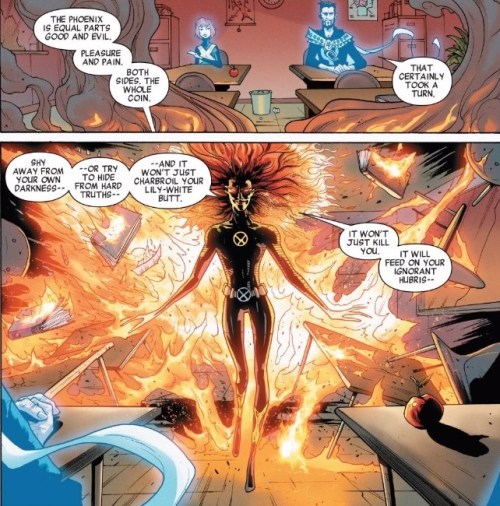
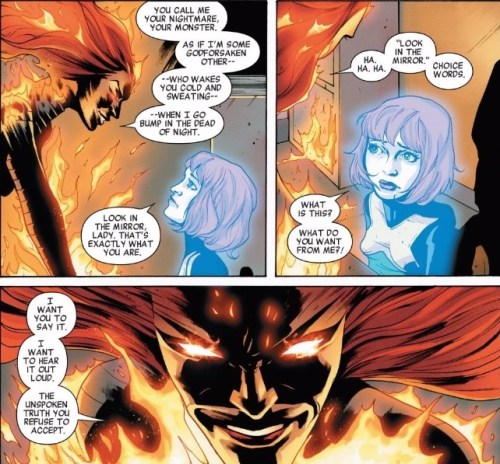
What Jean Grey Of The X-men Can Teach Us About Life, Love, And Growing Up

These days, when most people read comics or watch movies, they do with an emphasis on escapism, spectacle, and an ability to talk/whine about it on message boards. Most people would rather not consume media with the idea that it has a bigger lesson to teach. We got plenty of those lessons in grade school and most of us got sick of that crap before we hit puberty.

However, there are occasions when a comic, movie, or TV show reveals something deeper about ourselves and our world that’s worth noting. I’m not talking about the kinds of crazy fan theories that claim Jack in “Titanic” never existed. It is possible for the media we consume to give us real, meaningful insights about ourselves.

That brings me back to comic books and X-men. Yes, this is going to be another one of those posts. After talking so much about the horrors of millennial life and the potential horrors of their children, I’m in need of a less serious topic. I think I’ve made clear that I love comics, I love X-men, and I’ll keep finding reasons to talk about them on this blog.

As it just so happens, a comic came out that conveys just such a lesson. It involves Jean Grey again. Other than Wonder Woman, she’s one of the most frequent topics of discussion on this blog. Considering she has a movie coming out next year, that’s likely to continue.

However, this comic has little to do with her movie and more to do with the themes of Jean Grey’s struggle. Some of them are relevant in the sense that they’re common to many major superheroes. Others are more subtle in that they have a bigger message to convey, one that applies to those who don’t have superpowers.

I doubt that the message that Marvel, a company owned by Disney, no less, intends to convey directly. Most of that message is indirect, but it can still function as a lesson, of sorts, that even aspiring erotica/romance writers like myself can appreciate.

The comic, in question, is Jean Grey #6. It’s the latest in a series that began earlier this year and focuses on the exploits of a teenage Jean Grey, who was plucked from the past several years ago in an event that has too many complications to go over without inducing migraines.

You don’t need to know too many of the particulars. You only need to know that she has a good reason for not liking her future. A lot of her adult life, as has played out in the X-men comics over the years, involves death, rebirth, and more dying at the hands of overwhelming power, often at the hands of the Phoenix Force.

Her teenage self is understandably frustrated with how that life played out. For the past several years, she’s gone to considerable lengths to change her fate, going so far as to ditch the X-men and try to be a normal teenage girl. As is often the case with superheroes, and teenagers in general, that doesn’t work. She still finds herself dragged back into the world of X-men and superheroes.

To her credit, she has handled herself fairly well. She’s managed to endure a space adventure with the Guardians of the Galaxy, go on trial for her future crimes that she’s yet to commit, and take part in a superhero civil war. It’s worth remembering, though, that she’s a teenager. She’s doing all this while also being one of the most powerful mutants in all of Marvel comics.

Her solo series, as written by a very talented writer named Dennis Hopeless, takes Jean Grey out of those roles with the X-men and sends her on a more personal journey. As I said before, her adult life is plagued by many complications that end up killing her. Chief among them, though, is the Phoenix Force. Pretty much all her frustrations begin and end with Phoenix Force.

She’s spent most of her time in the future just actively avoiding it or not thinking about it. In the very first issue of her solo series, though, she gets a message that makes clear she can’t ignore it anymore. Eventually, she has to prepare to confront the all-powerful Phoenix Force and all the problems/heartache it’ll cause her.

As part of that effort, she’s been seeking guidance from various sources throughout the Marvel universe. In a universe full of gods, aliens, and talking raccoons, there’s a lot to go around. Jean Grey #6 has her touch base with Dr. Strange. Those who saw Benedict Cumberbatch bring the charming sorcerer supreme to life last year shouldn’t be too surprised.

It actually starts off fairly similar to her previous efforts to seek guidance from more experienced Marvel heroes. Dr. Strange agrees to help her, which involves a little mystical mojo that should offend One Million Moms and amuse card-carrying Satanists. It’s here, though, where the journey and the lesson play out.

It’s a spirit quest, of sorts, one that takes the teenage Jean Grey through the life she seems doomed to live. It spans multiple eras of X-men comics, from the Stan Lee/Jack Kirby days of Uncanny X-men to her latest death in the early 2000s. What makes this journey a bit rockier, though, is that she’s not just a spectator.

These visions of her future self aren’t just there to remind her why her future sucks. They’re basically drills sergeants trying to hammer some hard lessons into her head that Jean, and teenagers in general, refuse to learn.

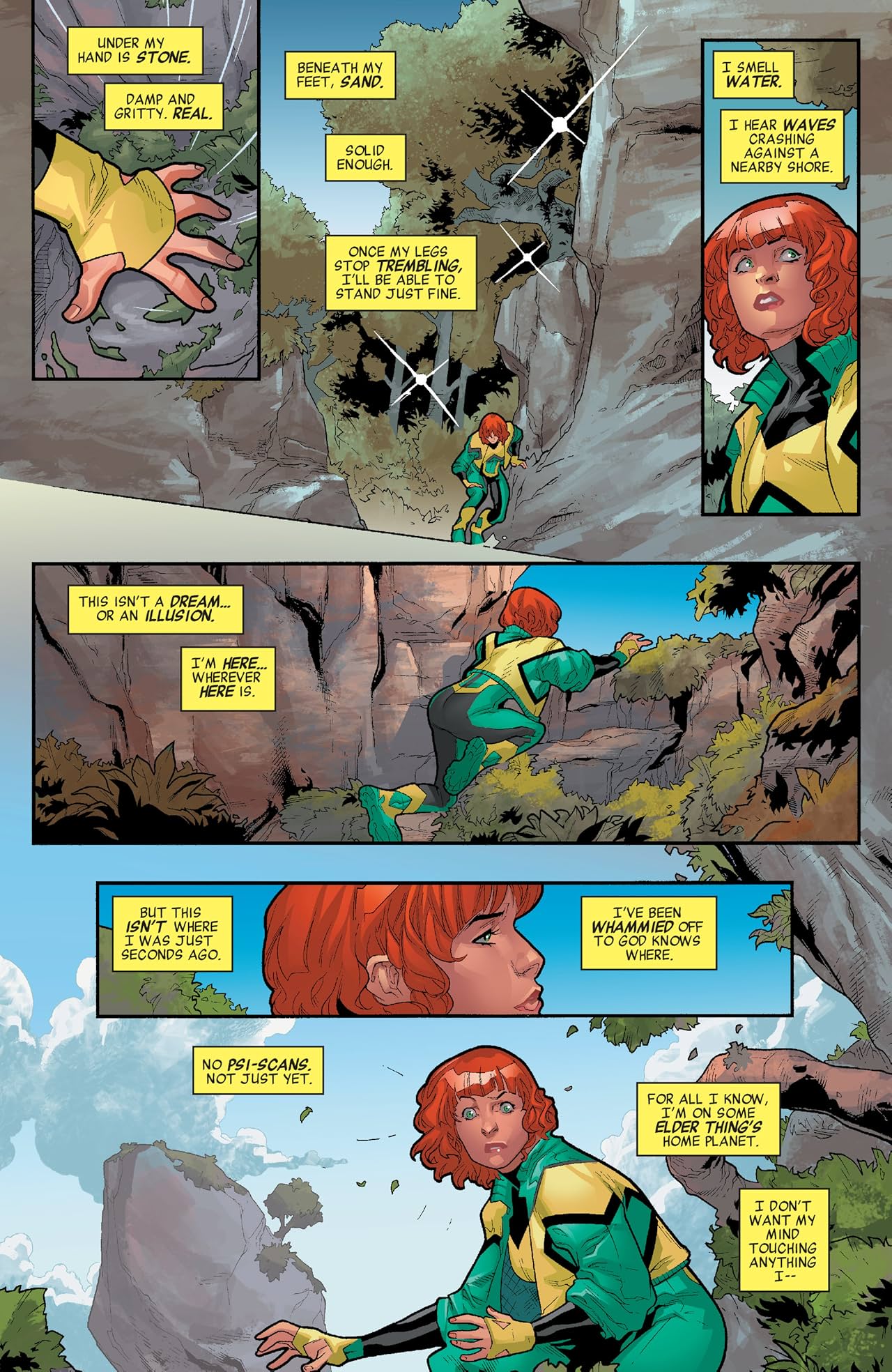
Jean4

It’s here where Jean starts to get a harsh lecture on having one persona that you have for all those around you while also having a very different, much less pleasant persona just under the surface. Like celebrities that are assholes when the camera isn’t rolling, some people have to pretend to be something they’re not.

With Jean Grey, one of the most powerful mutants on the planet, it’s even more difficult. Jean’s vision basically tells her what she refuses to admit. She makes herself out to be this quiet, upstanding young woman on a team of teenage boys. However, under the surface, she knows she’s more powerful than everyone else on her team and most other teams.

Her maintaining that facade is like trying to play chess with a brain-damaged monkey and trying to give the monkey a fair chance. As is the nature with mutant powers, she can’t turn them off. She can’t ever not be so powerful and frustrated. It’s a lesson that is hard for a teenage girl to wrap her head around, but easy for most adults who can’t stop being adults.

By now, it should be somewhat easier to see the real-life parallels here. We’re talking about overwhelming feelings that we can’t turn off, which tend to affect us greatly later in life. As teenagers, we don’t know how to deal with them or even how to make sense of them. They still affect us, though. We can try to ignore them all we want, but that doesn’t make them go away.

I’ll give the less kinky readers a moment to fill in the blanks. In the meantime, the life lessons in Jean Grey #6 get a lot harsher. As Dr. Strange guides her towards other moments in her life, she encounters a later version of herself that fans of the 90s X-men cartoon should recognize.

This is a version of Jean Grey who has put in the time, effort, and passion to endear herself to a lot of people. This is the woman that many of the other X-men see, or want to see, when they look at teenage Jean Grey. There’s a reason why Jean ranks among the most popular X-men characters of all time. The woman she becomes, which also happens to be a woman teen Jean resents, is just that endearing.

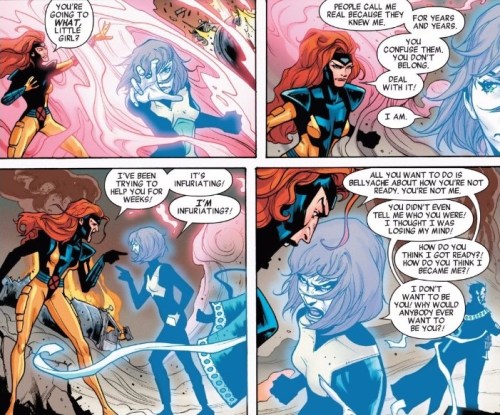
It’s a lot for anyone to live up to. Being a teenage girl, though, Jean isn’t going to just accept that this is the person she becomes. She knows that person still ends up dying. She knows that person still succumbs to the demons she can’t control, namely the Phoenix Force.

Jean3

It gets even harsher, though. As with every teenager, Jean Grey’s perspective is very limited. She hasn’t experienced enough of the world to understand what actually shapes someone into a functioning adult.

She, like many other teen heroes, have this idealized version of who they want to be and what life is like. It’s tragic, but inevitable that such idealism will eventually be shattered. That’s just the nature of life, in general. Ideals are for a perfect world and nobody, not even superheroes, live in a perfect world.

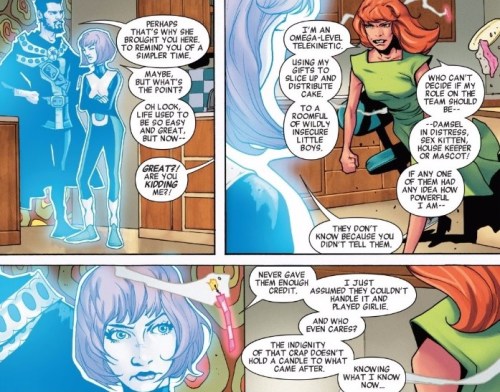
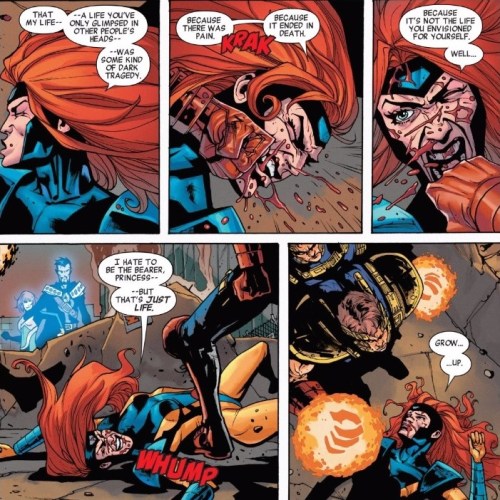
This is where the message becomes bigger than Jean Grey. It’s a message that can resonate with all teenagers. Her older self basically lays it out for her in a way so simple that even a teenage mind can process it. The life she thinks is doomed to tragedy and pain isn’t just a matter of rotten luck and crushing disappointment. It’s just life.

Jean5

It’s one of those messages that can apply to much more than superheroes and mutant powers. It can apply almost every teenager to some extent at some point in their lives. They’re just starting to learn what the world is like without the rose-colored glasses of childhood. They’re just starting to feel things that are strange, powerful, and make their pants feel tighter than they want. It’s not a tragedy. It’s just life.

It’s a lesson almost every teenager learns the hard way, regardless of whether or not they have mutant powers. I certainly did. I challenge anyone reading this comic, my novels, or this blog to say otherwise. The transition between childhood and adulthood is hard and it has to be hard because it’s such a harsh world.

On top of that, we have to enter that world with all these powerful feelings and emotions that kids just can’t process. This is where the Phoenix Force, the utter bane of Jean Grey’s life and many deaths, enters the picture.

In a sense, this cosmic space bird is a manifestation of the greatest extremes that we experience. In the comics, it’s a force that pushes Jean Grey’s powers over the edge and beyond. In life, it’s basically every overwhelming experience we’ve ever had, amplified to infinity.

When you’re a teenager, you’re full of all sorts of overwhelming feelings. As an adult, they’re still overwhelming, but you gain a sense of perspective. From our ability to love to our desire to make love, it’s a powerful force that shapes how we live and how we die. Being immature teenagers, and even immature adults, we often try to suppress it. Not only does that fail, but it can make everything worse.

Jean Grey, being a teenager, can’t wrap her head around those extremes, be they the Phoenix Force or just being a functional adult. Again, the visions of her older self basically have to belabor it, to the point of frustration.

In her vision, she starts to gain a better perspective of what these feelings are. She comes to see the Phoenix Force as more than just that big cosmic fire bird that ends up killing her twice. It’s not just a force for death. It’s also a force for life. Being a teenager, she can’t help but focus on the death. In doing so, she only ever obsesses over one extreme.

That’s understandable for a teenager who hasn’t lived enough of a life to make sense of it. It’s also the exact mentality that gets her killed. It’s why people who obsess over death tend to live in a state of near-constant distress. It affects them and those around them. By only focusing on one extreme, they basically doom themselves.

Jean Grey is in that exact position. She’s focused entirely on the end, but not on everything else around it. Teenagers, with their limited experiences, are like that and through no fault of their own. That’s why they’ll make such poor decisions, both in their adult lives and in their personal lives.

Jean2

This is where Jean Grey has her most defining moment of the comic, if not the past five years of X-men comics. Despite the benefit of foresight afforded to her by time travel and psychic abilities, she still refuses to confront the extremes of the Phoenix Force. She refuses to accept the person she becomes.

Finally, after all the belaboring and mystical-induced spirit quests, she does it. She finally takes a step back from the doom and gloom of her impending death. She finally looks at the bigger picture. She admits that who she is now and who she’s afraid of becoming are the same person. Those feelings that overwhelm her that she’s been trying to suppress are there and they’re not going away.

As an X-men fan and a fan of personal insight, it was one of the most satisfying moments I’ve reading an X-men comic that didn’t involve Emma Frost’s costume. It was one of those moments that felt much bigger than the character. It’s a powerful message that people without mutant powers can appreciate.

Jean1

Jean Grey’s struggles are very much akin to the struggles everyone faces when they have overwhelming experiences of any kind. Those experience don’t always have to have a sexual or personal connotation, but those are the ones that tend to stick out.

They’re also the experiences that teenagers, and even many adults, are likely to suppress. They’ll see certain experiences and desires as this powerful, dark force that will consume and destroy them, much like the Phoenix Force. However, it doesn’t have to be that way.

Just acknowledging that those feelings exist is an important step, especially for a teenager. There are people out there right now in societies and cultures that pressure them to repress desires that cannot be repressed. Like Jean and the Phoenix Force, those feelings eventually find us in the long run. If we refuse to confront them, then they can destroy us.

It’s a powerful lesson, especially for young people still making sense of their experiences. They may not have Jean Grey’s psychic abilities or the insight provided by time travel, but their future still seems every bit as daunting. It only becomes less daunting when you step back and realize that the overwhelming feelings we dread are just part of life, in general. We can’t always suppress them. Sometimes, we just have to embrace them.

12 Comments

Filed under Comic Books, Jack Fisher, Superheroes, Jack Fisher's Insights, Marriage and Relationships

Lessons In Misguided (And Sincere) Love From An X-men Comic

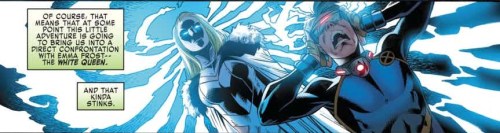
Emma Frost

In general, I don’t always write these posts with a sense of timing in mind. My brain just doesn’t work that way. Usually, I get an idea, either through inspiration or just something that comes to me in the shower, and I just go with it. I find that to be the most effective means of exploring sexy and non-sexy issues alike on this blog.

Every now and then, I get lucky and fall ass-backwards into a perfectly timed topic. Sometimes, I even get obscenely lucky because that topic can relate to comics, which I love tying into sexy topics on this blog every chance I get. Well, whether by luck or outright fluke, I have a chance to link an issue I’ve been discussing lately directly to a comic book.

Trust me, I didn’t plan it. I didn’t expect it. I’m just going to run with it because it’s so relevant to the recent issues I’ve been exploring. It also involves X-men, which I go out of my way to talk about every chance I get, and a very particular character that I’ve mentioned before named Emma Frost. In case you need a reminder, this is Emma Frost.

I’m assuming I have your attention now, especially if you’re a heterosexual man or a homosexual woman with functioning genitals. I swear that pic isn’t some juvenile fan art, like the ones that drew big tits on Flintstones characters. That’s how Emma Frost actually dresses in the X-men comics. Can you now see why I’m so fond of them?

Sadly, I’m not writing this to talk about Emma Frost’s overtly sexy costumes. I’m writing this because recent events in the X-men comics tie directly into what I’ve been discussing with respect to conditioning our brains for love. While it’s an issue we’ll probably have to address once we start hacking our brain’s wiring, it’s something that comic book characters deal with regularly.

I’ve already mentioned how Carol “Captain Marvel” Danvers dealt with it during her early history. I’ve also cited past stories involving mind control, including one infamous story in Action Comics where Superman was brainwashed into making a porno tape with Big Barda. It’s one of those odd, but disturbing kinks that’s unique to worlds filled with psychics, aliens, and talking raccoons with machine guns.

However, this is one instance where a story about the mental manipulation of emotions and/or horniness isn’t quite as disturbing. If anything, it’s tragic in that reveals a lot about what some people are willing to do in the name of love.

To understand that tragedy, it’s necessary to understand the comic in question and the context behind it. The story unfolds in the pages of “X-men Blue #9” by Cullen Bunn, which is one of several ongoing X-men titles. This one focuses on the exploits of the time-displaced original five X-men, who are currently stuck in the future due to some time travel shenanigans that began back in 2012.

I’ll skip the part where I make a bunch of “Back To The Future” jokes and make clear that X-men Blue has much higher stakes compared to other X-men comics. That’s because what happens to these five time-displaced X-men, who also happen to be teenagers, could potentially affect the entire history of the X-men, which has already been subject to the kinds of time travel upheavals that would make Doc Brown’s head explode.

That’s where Emma Frost comes in. She knows, as well as any X-men regular who has encountered time travelers, that influencing these time-displaced teenagers could alter how things play out in their future. That’s important to her because she has a good, albeit tragic, reason to want to change that outcome.

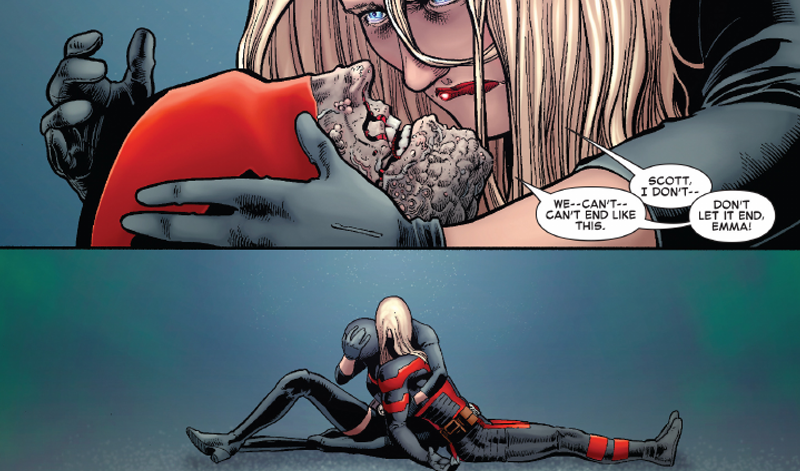
Shortly before the events of this issue, Emma Frost endured a terrible loss. In an ominously-named event called “Death of X,” her former lover, Cyclops, died in her arms. To make matters even worse, it was one of those rare situations where there was nothing she could’ve done to stop it.

This isn’t akin to Spider-Man not stopping the Green Goblin in time or Superman not being able to save Lois Lane. This is basically someone being in the wrong place at the wrong time for the right reasons. In a sense, it’s a lot more realistic than the deaths most superheroes endure. It comes out of nowhere and there’s nothing anyone can do to stop it.

However, Emma Frost isn’t the kind of person to just accept that kind of tragedy and move on. This is a woman who once watched an entire classroom of her students die in an outright mutant genocide. When tragedy hits her, she hits back and looks damn sexy while doing it.

Granted, she does tend hit harder than she needs to or ought to. It has made her a lot of enemies, even alienating some of her former allies. However, Emma Frost isn’t one of those characters who does what she does out of malice. She’s not the Red Skull, Thanos, or even Dr. Doom.

She does see herself as a hero. She carries herself as a hero and has been on the front lines of some major Marvel conflicts. She’s also not a sociopath. She is capable of great love, both for her students and for lovers like Cyclops. So when Cyclops died, it hit her very hard.

When hit with a loss that hard, who wouldn’t jump at the chance to undo it? Even if it means crossing certain lines and hurting others, isn’t that worth getting back the person you love?

That’s a question that a lot of heroes and non-hero’s alike might debate in a philosophy class or a message board. However, there’s no debate for Emma Frost. She sees an opportunity to get her lover back and she takes it. Specifically, she sets her sights on the time-displaced, teenage Cyclops who has yet to grow into the man she fell in love with.

Finally, in X-men Blue #9, she’s in a position to get what she wants. As part of an ongoing event called “Secret Empire,” an event that’s hitting every major Marvel series, she abducts the time-displaced X-men and singles Cyclops out for some special treatment. Trust me, it’s nowhere near as sexy as it sounds.

XMBLUE-3

Emma basically does exactly what I described in my post about managing the future of brain hacking. She tires to twist and contort young Cyclops’ mind into being the man she once loved. She knows it may ruin the timeline. I’m sure Doc Brown would scream at the top of his lungs to get her to stop. It would still do no good.

That’s because Emma wants her lover back. She wants the man who has helped save the mutant race on more than one occasion. She’s willing to risk a time paradox and undermining the free will of someone who made clear in the issue that he doesn’t care for her. She’s just that desperate to get the man she loves back.

I won’t spoil how the book ends. I’d much rather people go out and read X-men Blue #9 because it’s a great comic that’s worth supporting. I’ll just say that the tragedy surrounding Emma Frost and her misguided efforts to subvert that tragedy really strike a chord.

It’s a tragic, but potentially prophetic story that may become more relevant over time. There’s no doubt that Emma Frost’s love for Cyclops in X-men Blue #9 is sincere. It’s not part of an agenda or some elaborate trick. It’s real, honest love that got destroyed through forces nobody could’ve foreseen.

Who’s to say that someone wouldn’t do something similar if they were in her position? I’ve said before in other posts that love is a powerful drug. It’s medically proven that love affects our brains like a drug. Compared to love, crack is watered-down diet soda.

Emma Frost is a powerful telepath, one of the most powerful in the Marvel universe, in fact. That means she can manipulate minds, twist thoughts, and conjure emotions in others. It does have limits, but it’s not that different from the kind of brain hacking that is in development as we speak.

What happens in the future when someone loses a loved one and refuses to accept it? What happens when someone just can’t stand the idea that someone they once loved no longer loves them? If there exists technology that could conjure or recapture that feeling, who wouldn’t be tempted to exploit it?

Our desire to love and be loved is a core, emotional need that every non-sociopath human feels. We don’t have the technology of Neuralink or the telepathy of Emma Frost to force it when we can’t have it. However, once it becomes possible, how long will it be before someone tries it?

Emma Frost didn’t need much temptation in X-men Blue #9. She just needed an opportunity and a plan. Again, it’s wrong to call it an evil plan. She was just trying to get back the man she loved and was willing to cross lines to do it. Love makes us do a lot of crazy, stupid things. What Emma Frost does in this comic is as much a lesson as it is a warning, albeit the sexy kind.

5 Comments

Filed under Comic Books, Jack Fisher, Superheroes, Marriage and Relationships

Lessons In Fate, Power, And Passion (From An X-men Comic)

Generations: Phoenix & Jean Grey (2017) #1

As kids, it seems as though everyone is trying to teach us morality lessons that’ll help us grow into functioning adults. Those lessons aren’t always effective, though. Just ask the potheads who sat through the DARE program in school.

As adults, we tend to pay less attention to those kinds of lessons because we arrogantly believe we’ve figured it out. We think we know enough about the human experience to determine what is right and what is wrong. People who think that way tend to be the arrogant assholes who refuse to admit that Dr. Oz is a quack and a fraud.

Truly functional people, be they kids, adults, or adults who still act like kids, never stop learning important life lessons. Life is a constantly changing, obstacle-filled struggle where you never see the finish line and are guaranteed to fall flat on your face at least once a week. That’s why lessons that really deliver a powerful message in a compelling way is a special, precious thing in this chaotic world we live in.

That brings me to comic books, superheroes, and the X-men. Yes, this is going to be another one of those posts. Yes, that means I’m about to extrapolate a major philosophical insight into the human condition from an X-men comic, most likely in a way that applies to love, sex, and everything in between. You’re welcome.

It’s not the first time I’ve gleaned such lessons from an X-men comic. A year ago, I singled out X-men 92 #5 as a testament to just how powerful a romance between equals can be. Chances are, I’ll single out more comics in the future and there’s a high possibility that they’ll involve the X-men, Deadpool, or Wonder Woman.

The comic in question today is Marvel Generations: Phoenix & Jean Grey #1. It’s actually not part of any ongoing X-men series. It’s a single, self-contained story that’s part of an major promotional effort by Marvel called Marvel Generations.

The goal is as simple. Marvel seeks to bridge the gap between its older incarnations of iconic characters with the newer versions. While some of those newer versions have already caused controversy, the goal is always the same. Marvel hopes to appeal to their long-time fans while appealing to newer fans who are just getting into the world of Marvel.

Comic companies do this fairly often, trying to please old fans while creating new ones. Having followed comics for a good chunk of my life, I’ve seen more than my share of efforts. DC Comics, Marvel’s chief rival, did it last year with their DC Rebirth initiative. By most accounts, it was a success. Now, Marvel is attempting to achieve similar success.

There are many challenges to that effort, but for Jean Grey of the X-men, those challenges are more daunting than most. I’m not talking about the kind of daunting that involves dragons, killer robots, and Brett Ratner movies. I’m talking about convoluted complications involving time travel, evil clones, and cosmic forces. Trust me, it’s way more complicated than it sounds.

For this particular issue, though, you don’t need to know the fine print of those complications. You only need to know that Jean Grey’s story, after 50 years of X-men comics, got so crazy that one of her teammates, Beast, traveled back and time and brought her and the rest of the original five X-men to the future.

Now, since 2012, Jean Grey has basically been Marty McFly from “Back To The Future,” minus the incest sub-plot. She knows that her future sucks in that she ends up dead, and multiple times, no less. On top of that, she finds out she’s destined to become corrupted by a cosmic power known as the Phoenix Force, which will go onto cause all sorts of headaches, heartbreaks, and overall frustration.

That destiny is a huge part of the X-men mythos. That’s the part that “X-men: Dark Phoenix,” a movie I’ve talked about extensively, is going to try and capture. In this comic, Jean Grey has already read the spoilers to that story. She knows it doesn’t turn out well.

In fact, she has an ongoing solo series where the primary theme involves her preparing herself to face the Phoenix Force so that she doesn’t become that cute redheaded mutant who constantly dies and ends up on the wrong side of a bad love triangle. That’s entirely understandable and Marvel Generations: Phoenix & Jean Grey #1 gives her the best opportunity she’s had to date to change her fate.

This is where the lesson that Marty McFly learned the hard way comes in. Through elaborate space-time machinations that would give Doc Brown a migraine, Jean Grey is transported to a critical moment in the history of her character. It’s a moment that puts her in a position to change a lot more than just her fate.

That’s because she’s plopped in the middle of the iconic Phoenix Saga, also known by fans as the greatest X-men story ever told. It’s after her older self gains the cosmic power of the Phoenix force, but before it corrupts her in a way that destroys an entire star system and dooms her to a life of death and resurrection. There’s no part of that last sentence that’s exaggerated.

It’s an understandably confusing situation, but it’s one that puts Jean Grey in a position that even Marty McFly never dealt with. She doesn’t just have a chance to change her fate or learn more about her older self, who she’s only really known through the memories of other X-men. She has a chance to learn more about the cosmic power that she knows will doom her.

It makes for a series of colorful interactions between her and her older self that will bring tears of joy to the eyes of X-men fans of any generation. It’s hopeful, sincere, dramatic, and impactful. It fits perfectly within the narrative of Jean’s ongoing story in other X-men comics, as well as the story of her past self.

There’s so much to love about this comic, but I’m not going to spoil the entire thing here. I’d much rather have people go out and buy the issue. It’s money well-spent. Even if you don’t know much about comics or only know the X-men through the movies, this comic will appeal to you.

Beyond that appeal, though, I want to highlight an important theme within this comic. It’s a theme that applies to stories beyond comics and is relevant to life, in general. It especially applies to matters of love, passion, and intimate connections, which are major topic of this blog and the novels I write.

Generations: Phoenix & Jean Grey (2017) #1

At the heart of Jean Grey’s struggle in Marvel Generations: Phoenix & Jean Grey #1 is a difficult decision that everybody who isn’t a psychotic dictator faces at some point in their lives. It has to do with having the power to effect a situation and choosing whether or not to exercise it.

In the comic, Jean Grey has a chance to tell her older self everything she knows about her fate. She could, in principle, warn her about how the events of the Phoenix Saga play out for her. As a result, she could ensure it turns out differently, preferably in a way that doesn’t leave her dead and subsequently cloned.

On the surface, it seems easy. We saw what Marty McFly chose. We saw what the entire cast of “Hot Tub Time Machine” chose. They chose the easiest, most obvious path. They understandably wanted to improve their situation. In doing so, they created a lot more problems that they had to solve. The stakes for Jean’s problems, though, are much higher.

The problems she could create by changing her fate might be far worse than simply ending up dead. She’s not dealing with incestuous infatuations here. She’s dealing with a cosmic force that eats entire stars just for the fun of it.

She already knows the consequences of not changing anything. That has been hard enough to deal with. However, she has no idea whether she’ll fix anything by choosing otherwise. Given the Phoenix Force’s mixed track record, the odds are not in her favor.

I won’t spoil the choice she makes or what goes into. Again, I’d rather people read this comic to appreciate the full weight of its message. I’ll just say that the decision Jean makes is one that we all indirectly make when we have any kind of power over someone and can affect the course of their life.

Whether you’re a parent, a spouse, or an authority figure of any kind, you have an ability to make choices that affect other peoples’ fate. This is especially true when you’re in a relationship with someone. Your love for them and their love for you effectively links your fate. That makes your ability to make the right choices for the right reasons so critical.

It happens all too often, people using their position of power over others to abuse them. We see it when police harass minorities. We see it in crimes of passion. We see it in cases of spousal abuse and child abuse. When someone else trusts us with authority, we impact their lives in so many ways, often in ways we can’t see.

It can bring out the best and the worst in people, as the Phoenix Saga famously demonstrated. Real life demonstrates it too. Power does corrupt people. Sometimes the hardest choice to make is to not exercise that power to avert the potential consequences it might incur. It’s a choice that a lot of crazy dictators fail to make.

It’s a choice ordinary people fail to make as well. Parents find this out the hard way when they try to make decisions for their children. Sure, it seems like the right thing to do at the time. They may see it as them just protecting their child, as every parent should. However, they don’t realize until it’s too late how much damage that can do.

When you’re in an intimate relationship with someone, it can be just as powerful. If someone loves you implicitly and is willing to trust you so completely, you have the power to guide their lives in profound ways. That guidance, though, can be detrimental to the both of you.

When you have the power to influence a person or a situation, it’s easy and tempting to bend it to what you think will be more beneficial. The problem is that, without the benefit of hindsight, it’s impossible to know whether you’ll actually make things better or much worse.

The hardest decision in that situation is to acknowledge the problems as you understand them, bear the burden of solving them, and focus on the future rather than agonizing over the past. It’s rarely a preferable decision because it means accepting a situation and your role in it. It may feel like a missed opportunity, but it can just as easily be an averted crisis. Hindsight may be painfully clear, but possibilities are painfully vague.

Jean Grey, who is a teenager, mind you, in the story that plays out in Marvel Generations: Phoenix & Jean Grey #1, has to make this decision in the face of impossibly high stakes. What she does is a testament to the kind of character she is and the values we cherish in our heroes.

It’s a short, but powerful story that teaches an important lesson to children, adults, comic fans, and non-comic fans alike. Whether you’re a comic book character, a celebrity, an authority figure, or just someone with the slightest bit of leverage over someone, it’s a lesson worth learning.

4 Comments

Filed under Comic Books, Jack Fisher, Superheroes, Jack Fisher's Insights