
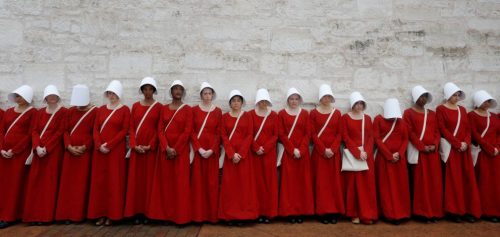
In recent years, there has been a great deal of dread among feminists, libertarians, and supporters of secular values in the United States. The country seems to be going down an authoritarian path. Traditions of liberty and personal freedom are under threat by a government that seems more inclined to micromanage peoples’ lives for their own benefit.
One path in particular is becoming a lot more prominent. That is the one that could lead the United States to a government like that of the Republic of Gilead, the repressive theocratic regime from Margaret Atwood’s novel, “The Handmaid’s Tale.” In that system, gender politics are pushed to the utmost extreme. The freedom, equality, sex, and love that contemporary society enjoys doesn’t exist.
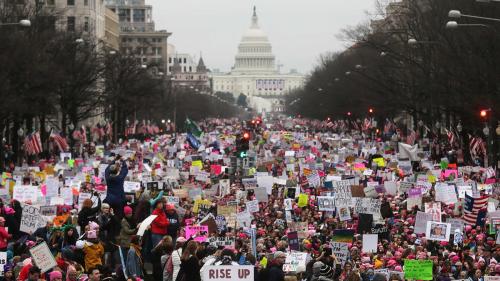
The reasons for these fears are many. The current state of gender politics has become heated with the rise of the anti-harassment movement and ongoing legal battles surrounding abortion access. During the protests surrounding upheavals on the Supreme Court, it was common to see female protesters dressed in the distinct garb from the “The Handmaid’s Tale.” Such protest has even spread to other countries.

The message is clear. People are worried that our society is inching closer to a world similar to the repressive gender politics of Gilead. I can certainly understand those concerns. While I’ve often criticized certain aspects of gender politics, I don’t deny the worry that many women feel about the current state of affairs.
That said, I believe the idea that the United States, or any western country for that matter, could descend into a state of gender apartheid like Gilead is absurd. While we should be concerned about the influence of religious extremism, even in the west, the chances of it ever gaining power on the level depicted in “The Handmaid’s Tale” is precisely zero.
Even if a regime like it came to power, it wouldn’t just fail quickly. It would collapse so spectacularly that it would be a joke on par with the Emu War. Gilead is not this all-encompassing, overwhelming power on par with Big Brother in George Orwell’s “1984.” Atwood even implied at the end of “The Handmaid’s Tale” that the regime was set to fall.

We’ve yet to hear that part of the story, but Atwood did announce that she’s working on a sequel. One way or another, Gilead’s days are numbered, even in the fanciful world that she created. Before then, I’d like to break down why the Republic of Gilead would be doomed if it ever attempted to set up shop in the real world.
If nothing else, I’d like to offer some perspective to those who fear that the state of gender politics is regressing. To those people, I share your concerns. However, I’m an optimist. I believe both feminists and men’s rights activists can and will find plenty of common ground on these issues in due time.
Even if they don’t, they can take comfort in knowing that Gilead, as both a philosophy and a system, is so flawed that dreading it is an exercise in hyperbole. There are still plenty of lessons to be learned from “The Handmaid’s Tale,” but in terms of setting up a competent theocratic regime, it’s a perfect check-list on what not to do.
Reason #1: Establishing Gilead Would Collapse The Economy

One of the first things the Sons of Jacob did when they established Gilead was fire every woman from their job and effectively eliminate their legal rights. On top of it being an exercise in brutal oppression, it removed half the labor force from the economy. In 2010, there were approximately 123 million women in the workforce. Firing every one of them wouldn’t just cause a huge recession. It would destroy the economy at every level.
Even the most ardent anti-feminist would be badly hurt by a world where half the GDP just disappeared. Suddenly, the industries that everybody relies on just cease functioning. Baking, health care, technology, and basic services essentially collapse as both the labor pool and the consumer base disappears.
That means from the very beginning, Gilead would have to navigate the worst economic collapse in history. More often than not, governments that cause collapses or fail to recover from them don’t last very long. Even if the Sons of Jacob found a way to blame it on minorities, feminists, or other religions, they would still be on the hook for fixing things and doing so with half the labor force will be difficult, to say the least.
Beyond the logistics, destroying an entire economy as part of a religious crusade is going to piss off some very powerful people who were thriving in the current system. America, alone, has over 500 billionaires whose massive wealth would be threatened by such a collapse. People with those kinds of resources aren’t going to let Gilead succeed, even if they manage to seize power.
Reason #2: Micromanaging Peoples’ Lives Is Impossible (In The Long Run)
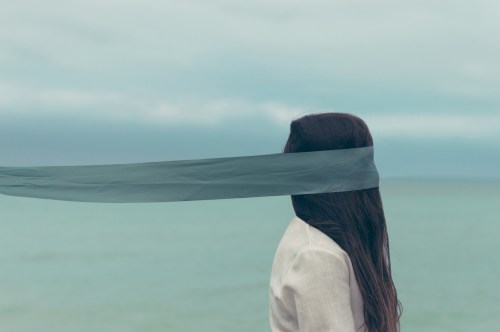
I’ve noted before that fascist systems have many fundamental flaws. There’s a reason why some of the most brutal, authoritarian regimes in history still ended up collapsing. In the long run, they find out the hard way that it’s just impossible to effectively manage the lives their citizens.
The Republic of Gilead is a lot like Big Brother in that it takes micromanaging to a ridiculous extreme. It doesn’t just have its own secret police to enforce a rigid caste system. Much of its governing philosophy relies on ensuring people stick to their roles and never deviate. Women do what the state requires them to do without question. Men do the same, right down to how they structure their families.
That system only works if human beings are like machines who never get bored doing the same thing over and over again for their entire lives. Since human beings are not like that, there’s no way that kind of society can remain functional in the long run. The fact that the boredom of solitary confinement drives people crazy is proof enough of that.
It still gets worse than that. In every revolution, there’s often a period of heavy solidarity when the people rally behind the new regime as the beginning of a new Utopian vision. This happened in the Russian Revolution and during the Cultural Revolution in Communist China. Unfortunately for Gilead, it came to power by brute, terrorizing force.
That means this government coming to power isn’t the will of the people. It’s just plain bullying and people tend to resent that sort of thing. Even the Iran Revolution had the good sense to rally the people. The Republic of Gilead didn’t bother with that. It’s hard to imagine that collapsing the economy and subjugating half the population at gunpoint will make them many friends.
Reason #3: Theocracies Are The Least Stable Forms Of Autocracies
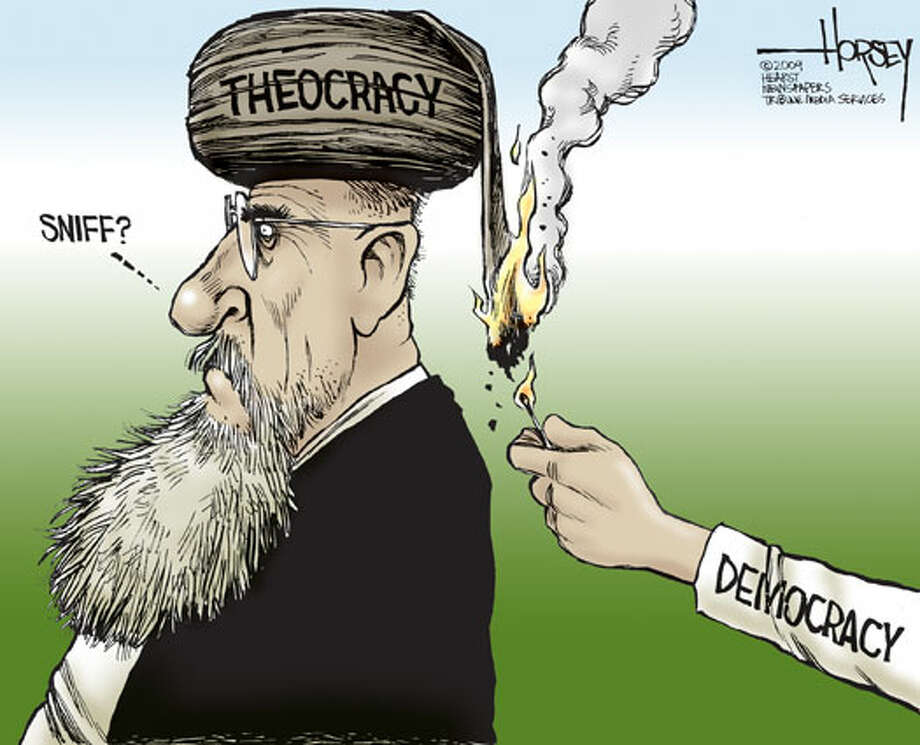
Remember when a purely theocratic state managed to prosper without being located atop an ocean of valuable oil? I don’t either and there’s a good reason for that. When it comes to repressive authoritarian states, theocracies are the worst possible choice. That’s because by entwining government with religion, it’s also entwining itself with the various flaws of religion.
Big Brother didn’t bother with religion in “1984.” It didn’t have to because religion, for all intents and purposes, was obsolete. The authority of the state and the authority of a deity was the same thing. The Republic of Gilead doesn’t have that luxury. Their politics and theology is based on an extremely conservative form of Christianity.
While that may seem fine to the Pat Robertson’s of the world, it adds a whole host of complications to the mix. The Sons of Jacob justify their repressive actions by appealing to Christianity and the bible. That’s okay if every single person in the entire republic agrees on one single interpretation of a religion and its holy text. Unfortunately, that has never occurred in the history of humanity.
There are dozens upon dozens of denominations in Christianity. There are also fringe cults, radical sects, and even schisms within those groups. At most, Gilead could have a unified theology at the beginning, but as new generations come along, that unity will collapse.
People will inevitably disagree. Every side will claim God is with them and everyone else are heretics. This sort of thing has been happening with religion for centuries. It won’t stop in Gilead. At some point, someone is going to think they heard God tell them something else and no one will be able to convince them otherwise. When that happens, conflict will ensue.
That sort of conflict can be managed in a more secular dictatorship. When government and religion are entwined, though, it’s much harder to work around. Even if Gilead could survive an economic collapse and the logistics of micromanaging peoples’ lives, it’s very unlikely it’ll survive the never-ending onslaught of religious debates.
Reason #4: Gilead Would Be An Easy Target For Invasion

Whether you’ve read the book or only watched the TV show, it’s hard to tell what sort of geopolitics the Republic of Gilead deals with. There are a few hints that there are other countries who did not descend into theocratic repression. There are even some cases of refugees in neighboring areas where women still have their rights.
The existence of those neighbors is yet another complication that ensures Gilead won’t last long, no matter how much its leaders pray. It already created a huge refugee crisis when it took over a sovereign government by force. At the same time, it handicapped itself by collapsing its economy and relegating half its population to serve as baby factories. It’s not just a source of chaos. It’s an easy target.
Neither the book nor the show reveals much about Gilead’s military capabilities. Even if we assume they get their hands on nuclear weapons, they’re still vulnerable because other countries have them too. More importantly, they know how to operate and maintain them. Religious zealots are good at a lot of things, but science isn’t one of them.
In the same way creationists aren’t likely to understand quantum mechanics, an entire government run by religious extremists aren’t likely to manage advanced weaponry. As time goes on, their emphasis of religion over reality will undermine their ability to develop such weapons. Their secular neighbors will have no such qualms.
Letting Gilead endure with its religious extremism and gender oppression means establishing a precedent that most other countries don’t want. Seeing one country fall to such a violent overthrow would be jarring enough. The first reaction to every nearby country would be to take steps to ensure it doesn’t happen to them. One of those steps could be overthrowing Gilead before one woman has to wear those goofy outfits.
Regardless of how you feel about “The Handmaid’s Tale” or where you stand in terms of gender politics, the book offers a powerful message. Like “1984,” it shows how bad things can get when extremism takes hold. Whether you’re a man, woman, or transgender, we have a lot more incentive to get along rather than fight one another. At the end of the day, that will ensure that Gilead remains nothing more than a flawed, fictional country.





























 Jack Fisher's Official Publishing Blog
Why The Outrage Over Brie Larson And “Captain Marvel” Is Misguided (And Counterproductive)
Celebrities sometimes say dumb things. I doubt most people would contest that. Sometimes, celebrities say things that aren’t dumb, but badly taken out of context. I imagine most people would agree with that too. However, in an era where outrage is a national pastime and social media makes it way too easy to blow things out of proportion, it’s easy for a celebrity to cause controversy for all the wrong reasons.
Brie Larson, whose star is set to rise considerably with the release of “Captain Marvel,” is learning this the hard way and a large consortium of angry people on the internet are intent on making it harder. What should’ve been a culmination of a young woman’s career and a female hero’s ascension to the superhero A-list is now mired in the ugliest kind of gender politics.
The origin of that controversy actually had nothing to do with Ms. Larson’s role on “Captain Marvel.” Back in June 2018, she made some overly political comments while accepting the Crystal Award for Excellence in Film. While celebrities making political statements is nothing new, Ms. Larson’s statement was hardly extreme.
It wasn’t some radical feminist tirade.
It wasn’t some angry rant about the outcome of 2016 Presidential Election.
It wasn’t even some act of elaborate virtue signaling by some smug celebrity.
All Ms. Larson did was advocate for greater diversity among film critics. She didn’t just make such a statement on a whim, either. She did so in response to a study published by the USC Annenberg School for Communication and Journalism that revealed a significant lack of representation in the industry of film criticism.
That’s not an unreasonable concern. The western world is becoming more diverse and the success of movies like “Black Panther” and “Crazy Rich Asians” shows that there’s a market for such diverse tastes. Advocating for greater representation in the field of film criticism makes a lot of sense.
Unfortunately, that’s not the message that some people gleamed from Ms. Larson’s comments. All they heard was that she doesn’t want to hear from white men anymore. They somehow got the impression that Brie Larson resents white men and her movies, including “Captain Marvel,” aren’t made for them. They’re not even welcome in the conversation.
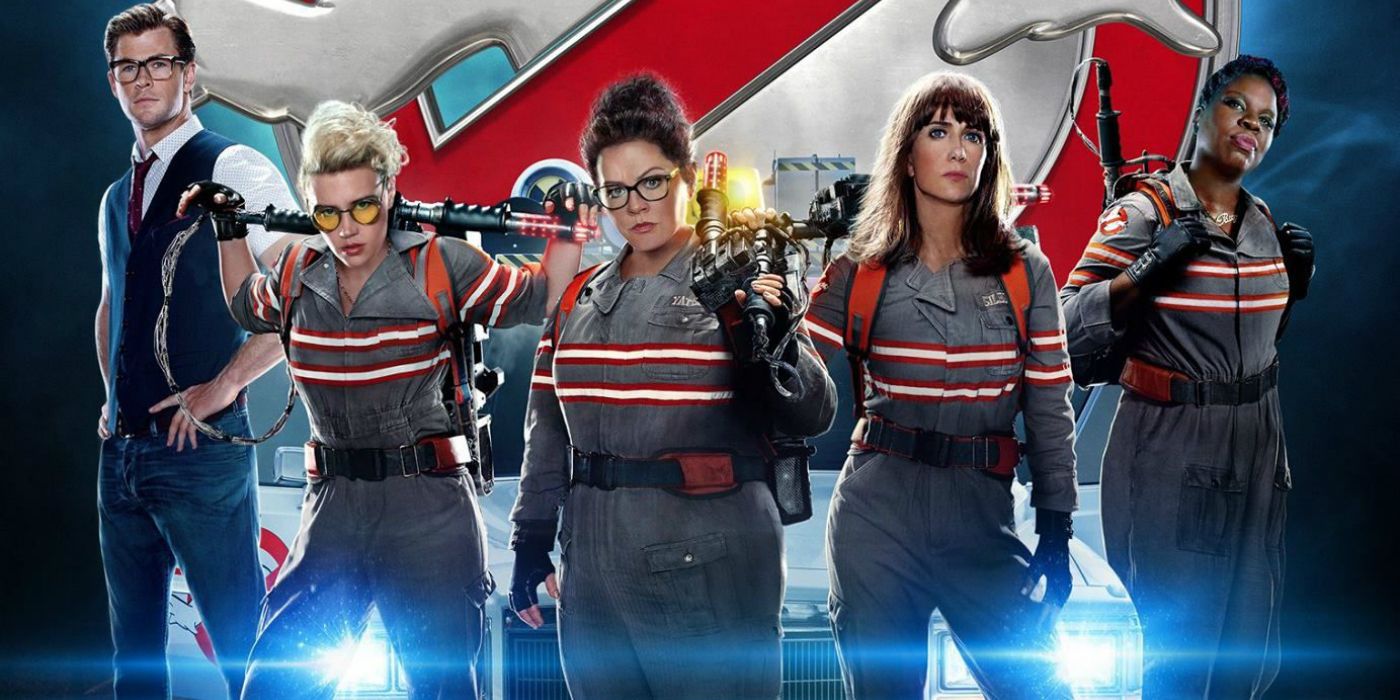
Who these people are and the politics they represent is difficult to discern. I don’t think it’s accurate to call them conservative, liberal, feminist, anti-feminist, leftist, or any other political label. Outrage culture rarely gets that specific, but given the heated politics surrounding movies like “Ghostbusters” and “Star Wars: The Last Jedi,” it’s a frustratingly familiar narrative.
While I can understand some of the outrage surrounding “Ghostbusters” and “Star Wars: The Last Jedi,” in this case I don’t think it’s justified. That’s not just because I’m a big fan of Marvel Comics, superhero movies, and all things Captain Marvel. It’s because the actual substance of Ms. Larson’s words don’t warrant the controversy she has generated.
For specific reference, here’s what she actually said during her speech in June 2018. Read it very slowly and try to understand the context of her statement.
Remember, she said these words after learning how little diversity there was among movie critics. Unlike most people, she was actually in a position to do something about it. Being an Oscar winning actress who was poised to join the Marvel Cinematic Universe, her words carry more weight than most.
Even so, those words were construed as racist and sexist, two exceedingly loaded terms that bring out the worst in people, especially on the internet. Never mind the fact that she made clear in her original speech that she did not hate white men. Never mind the fact that she has since clarified her words. She is still being attacked as some angry radical feminist who hates men, especially those who are white.
It would be one thing if she had said outright that white men should be banned from criticizing certain movies. Many celebrities, including a few still relevant today, have said far worse. However, that’s not what Ms. Larson said. She never, at any point, advocated disparaging white men. She didn’t even say that people who hate her movies are racist and sexist, something the “Star Wars” crowd is painfully familiar with.
Again, all Ms. Larson spoke out against was a lack of diversity among film critics. That part is worth emphasizing because it renders the outrage surrounding her statement as utterly absurd. It also makes the targeted attack on the fan reviews for “Captain Marvel” both asinine and misguided.
Even though the movie isn’t out yet, the movie is being targeted with negative comments on Rotten Tomatoes. Since it has only screened for a handful of audiences, it’s unlikely that any of these people actually saw the movie or were inclined to see it in the first place. Some are even claiming that this has already impacted the projected box office for the movie.
Whether that impact manifests remains to be seen, but it’s worth noting that when “Black Panther” was targeted with similar attacks, it failed miserably. At the moment, early reactions to “Captain Marvel” have been glowing so the chances of these attacks hurting the box office are probably minor at best. If the pre-ticket sales are any indication, the movie will likely turn a hefty profit for Marvel and their Disney overlords.
Even if there were an impact, it would be for all the wrong reasons. It would send the message that there’s a large contingent of people who are willing to work together to tank a movie because of comments a celebrity said that had nothing to do with that movie and weren’t the least bit controversial, when taken in context.
In this case, it was simply twisting someone’s comments to make them sseem like they said things that they never said or even implied. Then, those who bought into that narrative simply use that as an excuse to disparage a movie that they haven’t seen. That’s not just absurd, even by the skewed standards of outrage culture. It sends the worst possible message from those who think they’re protecting their favorite movie genre.
It tells the world that they don’t care what a celebrity actually says. They actively look for an excuse to hate someone who doesn’t completely buy into their preferred status quo. It would be one thing if that status quo was just and reasonable, but that’s not the case here.
All Ms. Larson did was advocate for more diversity among film critics. If that is somehow too extreme, then the problem isn’t with her or celebrities like her. It’s with those determined to hate her. There are a lot of issues in the world of celebrities and movies that warrant outrage, but advocating for more diversity in film criticism isn’t one of them.
I can already hear some people typing angry comments stating that if she had said those same words, but changed the demographic to something other than white men, then it would be an issue. However, the fact remains that this isn’t what she said.
It also doesn’t help that Brie Larson identifies as a feminist and that term has become incredibly loaded in recent years. However, she has never embraced the kind of radical rhetoric that other, less likable celebrities have espoused. Until she does, those determined to identify her and “Captain Marvel” as racist, sexist propaganda are only doing themselves and their politics a disservice.
16 Comments
Filed under Celebrities and Celebrity Culture, extremism, gender issues, Marvel, media issues, men's issues, movies, outrage culture, political correctness, superhero movies
Tagged as anti-feminism, Brie Larson, Brie Larson comments, Captain Marvel, Carol Danvers, celebrities, celebrity controversy, celebrity culture, celebrity scandals, ComicsGate, female superheroes, feminism, gender, gender disparity, gender inequality, gender politics, internet outrage, internet trolls, Marvel, Marvel Cinematic Universe, Marvel Comics, Men's Rights Activists, movie criticism, movie critics, movies, MRA, outrage, outrage culture, political correctness, politics, Racism, Rotten Tomatoes, Superheroes, trolls