Every week, a new collection of comics enters this world and makes it a just little more bearable. In these times of internet trolls, political divide, and terrible movie remakes, few things are as relaxing and rewarding as enjoying a good comic on a Wednesday morning. Once again, I’m here to single out one particular comic that helps make a good morning turn into a great day.
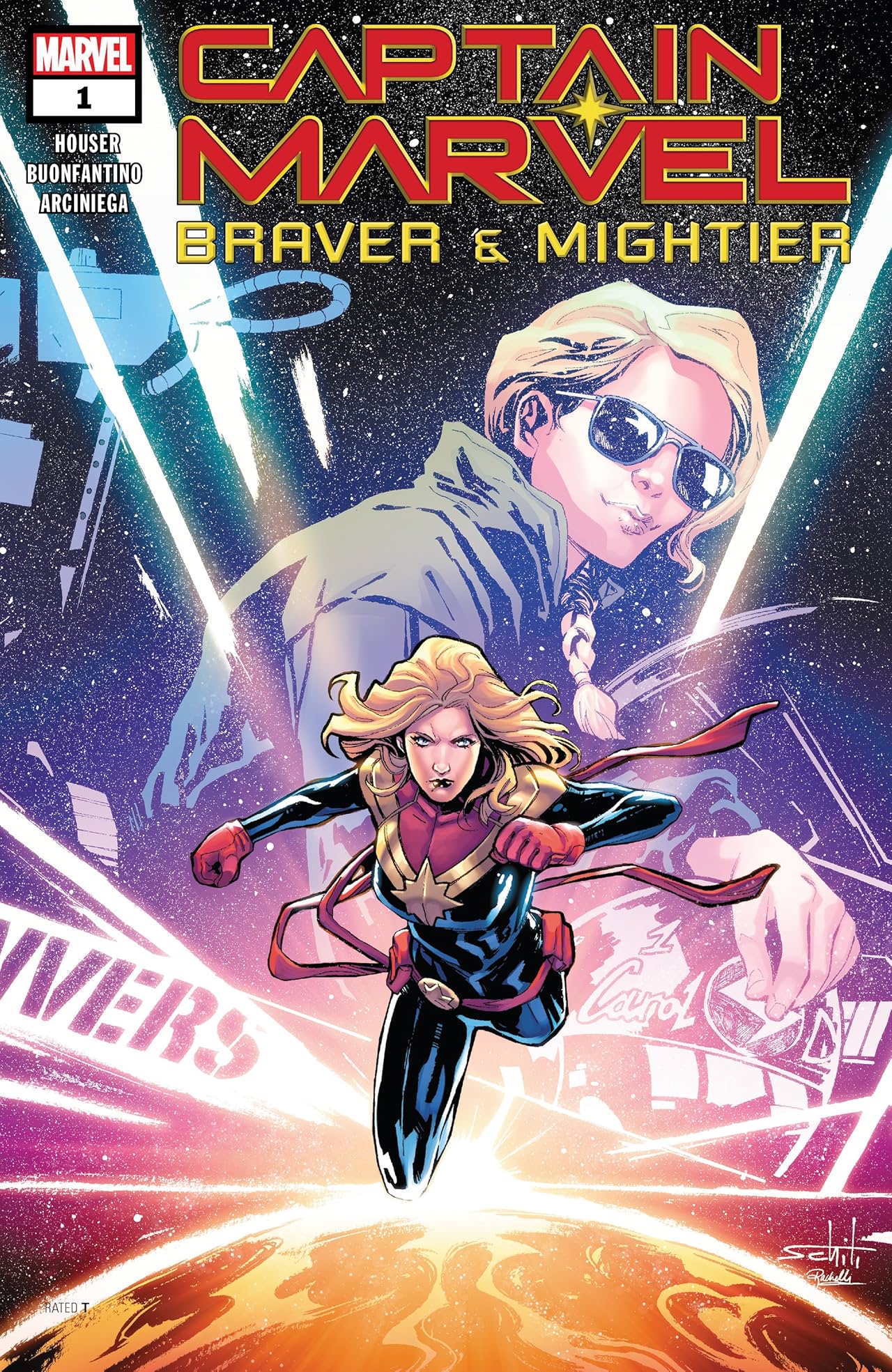
This week, along with a sizable chunk of 2019 thus far, is another great week to be a fan of all things Carol “Captain Marvel” Danvers. With her big debut movie coming out in just over a week, she’s about to achieve a rare status among comic book superheroes. That makes a comic like “Captain Marvel: Braver and Mightier #1” that much more special.
This comic isn’t actually part of Captain Marvel’s other ongoing series by Kelly Thompson, which I also highly recommend. This comic is a simple one-shot with a simple story that, in 23 short pages, highlights why Captain Marvel is a character deserving of the superhero A-list.
If you’re looking for a plot with some big, elaborate twist, you’re looking for too much here and you’re looking in the wrong place. If you’re just looking for a nice, simple summation of who Carol Danvers is and why she’s such a great hero, you’ll get everything you need and then some.
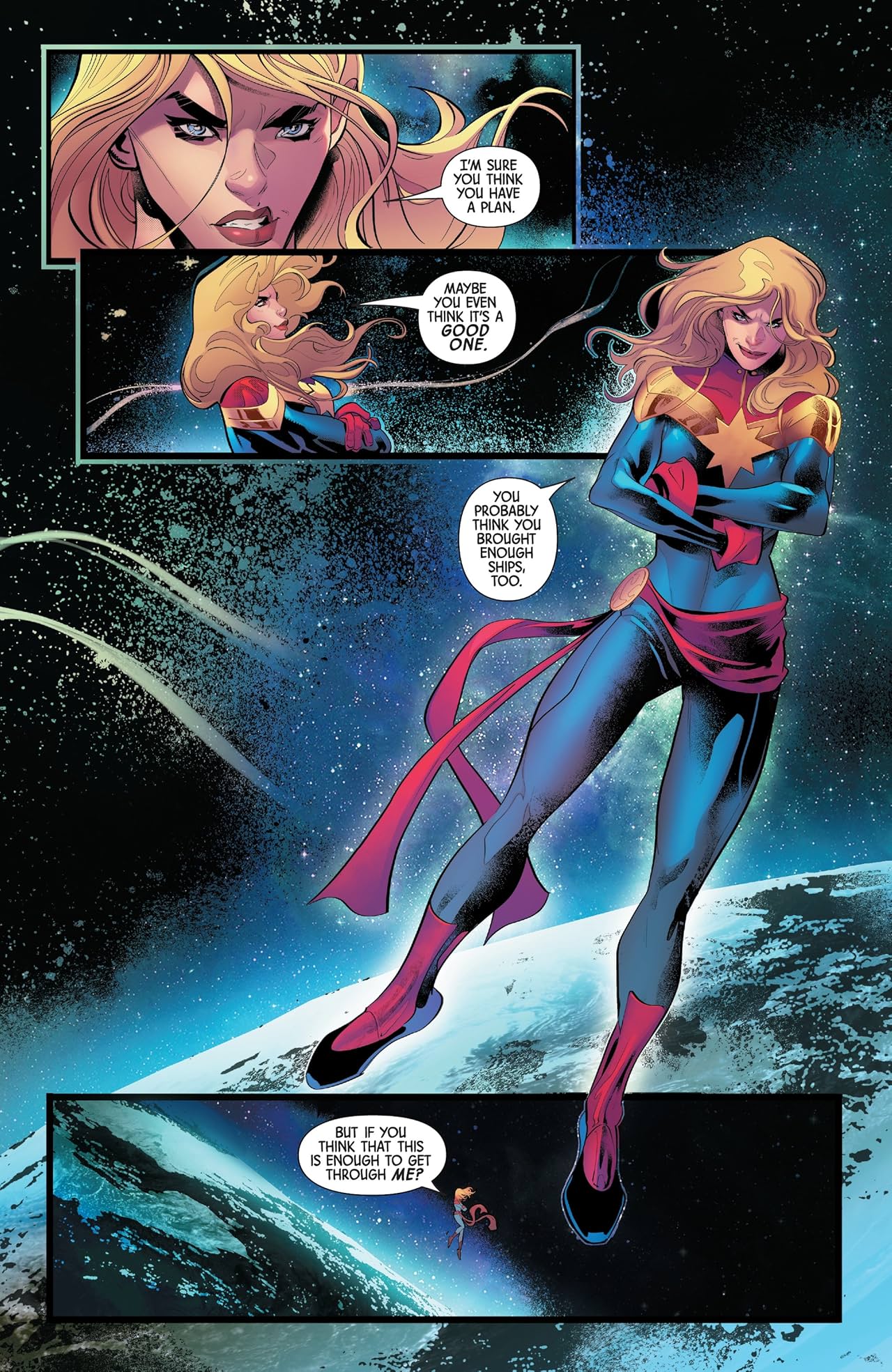
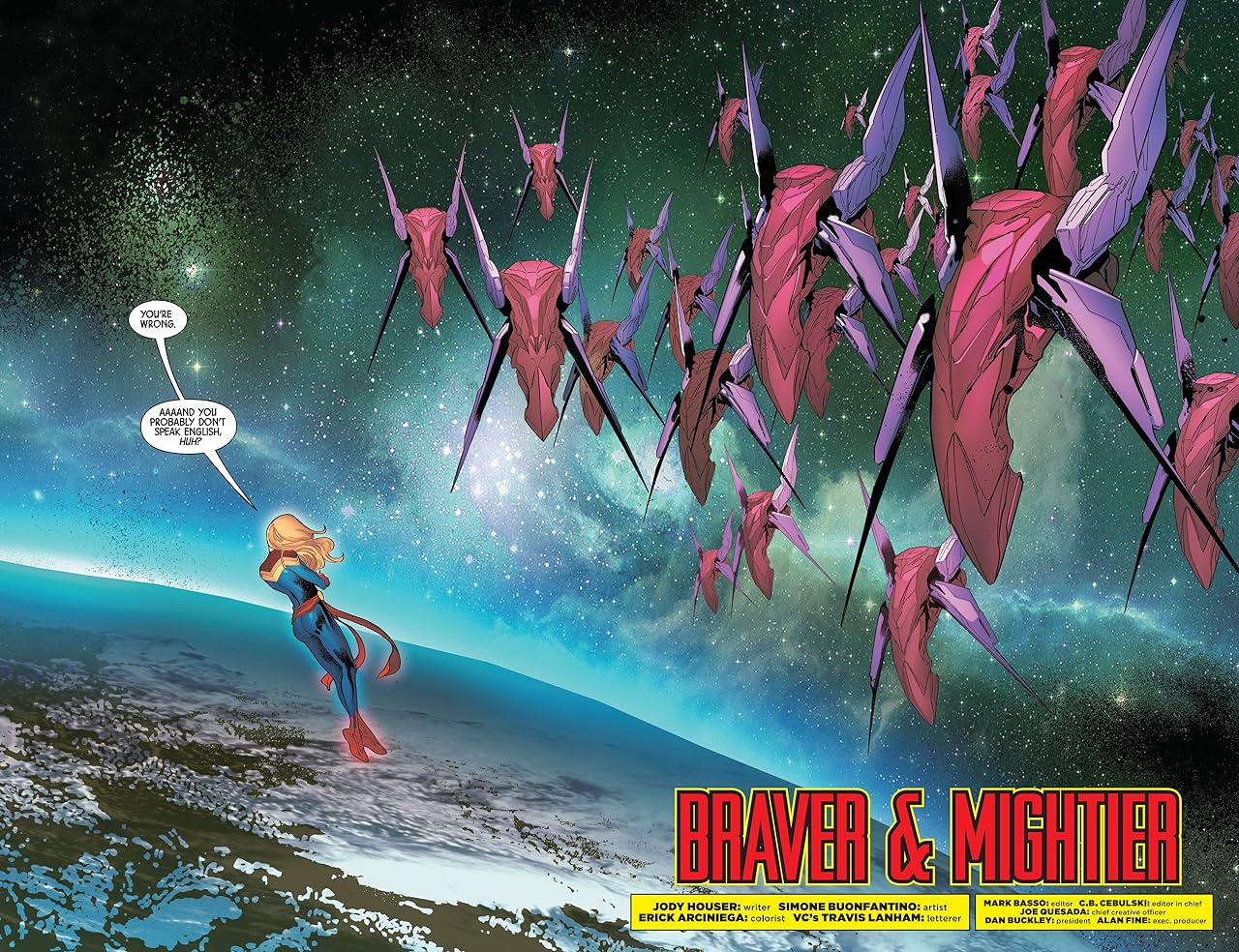
Writer, Jody Houser, puts Carol in a fairly simple setting. A fleet of mysterious aliens are threatening to invade Earth. It’s the sort of thing that happens at least once a week in the Marvel universe. It happens so often that it really doesn’t warrant assembling the Avengers. This sort of thing is right up Carol’s alley.
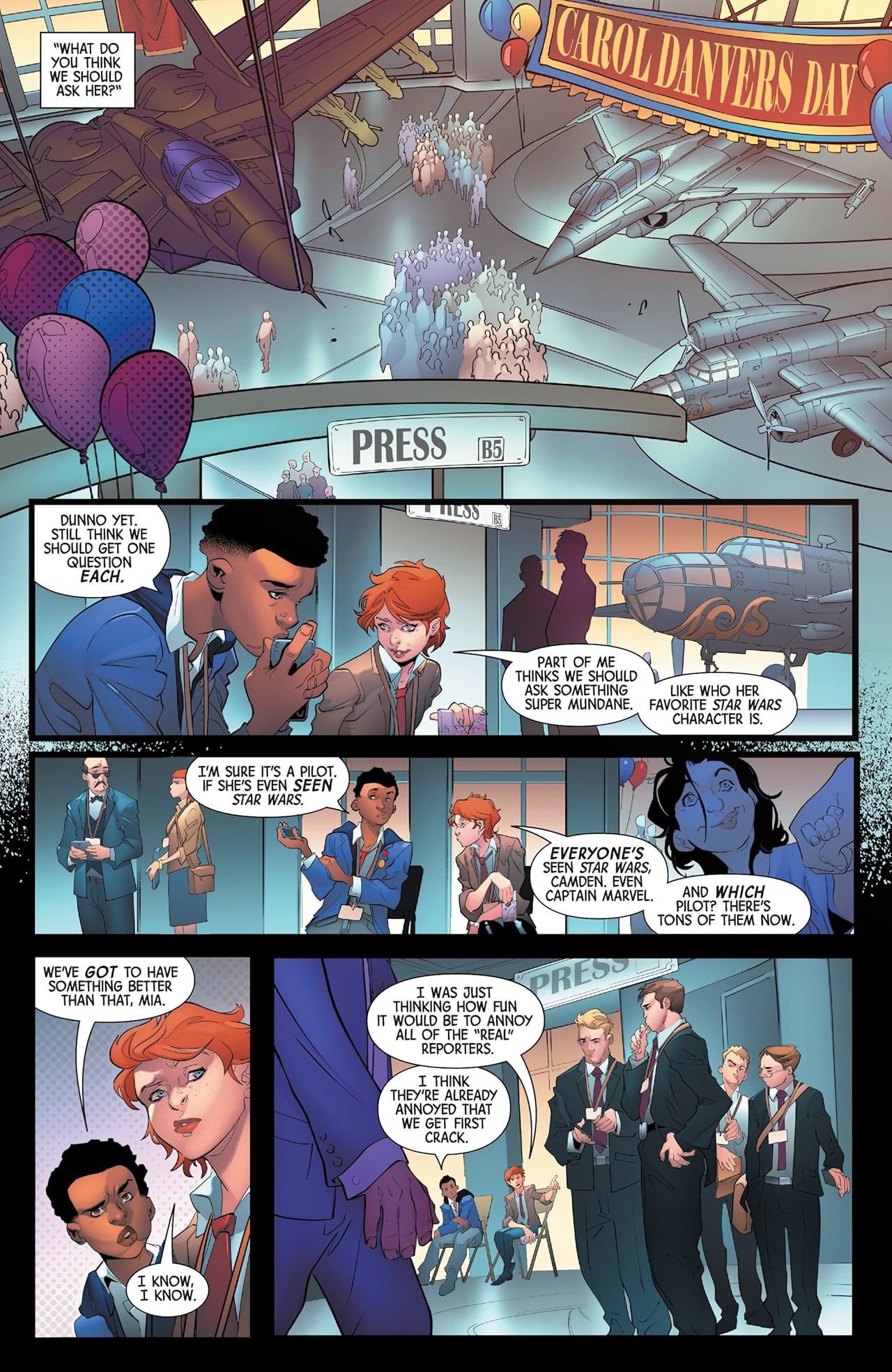
While this is going on, another smaller story unfolds back on Earth. At the Air and Space Museum back on the ground, Carol is being honored with her own little day of celebration. Having come from the United States Air Force and from NASA, it makes perfect sense that they would single her out as their preferred hero. Captain America already has the 4th of July and Tony Stark has a big enough ego.
As part of this celebration, some people in the press are looking for a chance to interview her. Among that press pool are a couple of local high school students who only got to attend because they’re local. They’re not exactly professional reports. They even admit that. However, they still have a chance to talk to Captain Marvel and they want to make the most of it.
They won’t get to ask her many questions. In fact, they need to figure out just one. All the while, they find out along with the rest of the world that Captain Marvel is fighting aliens on the same day when she’s supposed to be celebrated. It feels exactly like the sort of thing she would do, but these two plots complement each other in a way that really works in the end.
Without spoiling too much, Ms. Houser uses “Captain Marvel: Braver and Mightier #1” to demonstrate an issue that affects Captain Marvel more than most superheroes. As someone who is part human and part alien, she is often torn between worlds. Her desire to fly higher, further, and faster isn’t just about ambition. It reflects how her alien side often clashes with her human side.
Throughout her history, especially since she took the title of Captain Marvel in 2012, she often finds herself divided between confronting alien threats in Marvel’s vast cosmic landscape and defending the Earth with her fellow Avengers. As a result, it’s sometimes hard for her to relate to the people on Earth, as well as the aliens not trying to kill her.
Being able to relate to the people they’re saving is an important component for any hero, regardless of their origins or heritage. Superman is an alien and Wonder Woman is a demigod, but they still have strong connections to the world they protect. “Captain Marvel: Braver and Mightier #1” helps remind Carol of that connection.
In the end, Ms. Houser’s story and Simone Buonfantino’s artwork work together perfectly to demonstrate how far Carol Danvers has come and how much further she is poised to soar. It acknowledges the challenges she faced in the past and even noted some of her failures. However, Carol takes the good with the bad. That’s not just the mindset of a good superhero. That’s the mentality of a mature, understanding person.
The simplicity and humanity of “Captain Marvel: Braver and Mightier #1” makes it an excellent entry point for those curious about Captain Marvel beyond her upcoming movie. Again, it’s not too dense in terms of plot, but doesn’t need to be in order to work. It’s a good time to be a fan of all things Carol Danvers and this comic can only make those good times even greater.
Celebrities sometimes say dumb things. I doubt most people would contest that. Sometimes, celebrities say things that aren’t dumb, but badly taken out of context. I imagine most people would agree with that too. However, in an era where outrage is a national pastime and social media makes it way too easy to blow things out of proportion, it’s easy for a celebrity to cause controversy for all the wrong reasons.
Brie Larson, whose star is set to rise considerably with the release of “Captain Marvel,” is learning this the hard way and a large consortium of angry people on the internet are intent on making it harder. What should’ve been a culmination of a young woman’s career and a female hero’s ascension to the superhero A-list is now mired in the ugliest kind of gender politics.
The origin of that controversy actually had nothing to do with Ms. Larson’s role on “Captain Marvel.” Back in June 2018, she made some overly political comments while accepting the Crystal Award for Excellence in Film. While celebrities making political statements is nothing new, Ms. Larson’s statement was hardly extreme.
It wasn’t even some act of elaborate virtue signaling by some smug celebrity.
All Ms. Larson did was advocate for greater diversity among film critics. She didn’t just make such a statement on a whim, either. She did so in response to a study published by the USC Annenberg School for Communication and Journalism that revealed a significant lack of representation in the industry of film criticism.
That’s not an unreasonable concern. The western world is becoming more diverse and the success of movies like “Black Panther” and “Crazy Rich Asians” shows that there’s a market for such diverse tastes. Advocating for greater representation in the field of film criticism makes a lot of sense.
Unfortunately, that’s not the message that some people gleamed from Ms. Larson’s comments. All they heard was that she doesn’t want to hear from white men anymore. They somehow got the impression that Brie Larson resents white men and her movies, including “Captain Marvel,” aren’t made for them. They’re not even welcome in the conversation.
Who these people are and the politics they represent is difficult to discern. I don’t think it’s accurate to call them conservative, liberal, feminist, anti-feminist, leftist, or any other political label. Outrage culture rarely gets that specific, but given the heated politics surrounding movies like “Ghostbusters” and “Star Wars: The Last Jedi,” it’s a frustratingly familiar narrative.
While I can understand some of the outrage surrounding “Ghostbusters” and “Star Wars: The Last Jedi,” in this case I don’t think it’s justified. That’s not just because I’m a big fan of Marvel Comics, superhero movies, and all things Captain Marvel. It’s because the actual substance of Ms. Larson’s words don’t warrant the controversy she has generated.
For specific reference, here’s what she actually said during her speech in June 2018. Read it very slowly and try to understand the context of her statement.
“I don’t want to hear what a white man has to say about ‘A Wrinkle in Time.’ I want to hear what a woman of color, a biracial woman has to say about the film. I want to hear what teenagers think about the film. If you make a movie that is a love letter to women of color, there is a chance that a woman of color does not have access to review and critique your film. Do not say the talent is not there, because it is.”
Remember, she said these words after learning how little diversity there was among movie critics. Unlike most people, she was actually in a position to do something about it. Being an Oscar winning actress who was poised to join the Marvel Cinematic Universe, her words carry more weight than most.
Even so, those words were construed as racist and sexist, two exceedingly loaded terms that bring out the worst in people, especially on the internet. Never mind the fact that she made clear in her original speech that she did not hate white men. Never mind the fact that she has since clarified her words. She is still being attacked as some angry radical feminist who hates men, especially those who are white.
It would be one thing if she had said outright that white men should be banned from criticizing certain movies. Many celebrities, including a few still relevant today, have said far worse. However, that’s not what Ms. Larson said. She never, at any point, advocated disparaging white men. She didn’t even say that people who hate her movies are racist and sexist, something the “Star Wars” crowd is painfully familiar with.
Again, all Ms. Larson spoke out against was a lack of diversity among film critics. That part is worth emphasizing because it renders the outrage surrounding her statement as utterly absurd. It also makes the targeted attack on the fan reviews for “Captain Marvel” both asinine and misguided.
Whether that impact manifests remains to be seen, but it’s worth noting that when “Black Panther” was targeted with similar attacks, it failed miserably. At the moment, early reactions to “Captain Marvel” have been glowing so the chances of these attacks hurting the box office are probably minor at best. If the pre-ticket sales are any indication, the movie will likely turn a hefty profit for Marvel and their Disney overlords.
Even if there were an impact, it would be for all the wrong reasons. It would send the message that there’s a large contingent of people who are willing to work together to tank a movie because of comments a celebrity said that had nothing to do with that movie and weren’t the least bit controversial, when taken in context.
In this case, it was simply twisting someone’s comments to make them sseem like they said things that they never said or even implied. Then, those who bought into that narrative simply use that as an excuse to disparage a movie that they haven’t seen. That’s not just absurd, even by the skewed standards of outrage culture. It sends the worst possible message from those who think they’re protecting their favorite movie genre.
It tells the world that they don’t care what a celebrity actually says. They actively look for an excuse to hate someone who doesn’t completely buy into their preferred status quo. It would be one thing if that status quo was just and reasonable, but that’s not the case here.
All Ms. Larson did was advocate for more diversity among film critics. If that is somehow too extreme, then the problem isn’t with her or celebrities like her. It’s with those determined to hate her. There are a lot of issues in the world of celebrities and movies that warrant outrage, but advocating for more diversity in film criticism isn’t one of them.
I can already hear some people typing angry comments stating that if she had said those same words, but changed the demographic to something other than white men, then it would be an issue. However, the fact remains that this isn’t what she said.
It also doesn’t help that Brie Larson identifies as a feminist and that term has become incredibly loaded in recent years. However, she has never embraced the kind of radical rhetoric that other, less likable celebrities have espoused. Until she does, those determined to identify her and “Captain Marvel” as racist, sexist propaganda are only doing themselves and their politics a disservice.
Every Wednesday brings comic book fans a set of new, colorful adventures in a gloriously literal way. Whether you’re a fan of superheroes, fairy tales, zombie apocalypses, or beautiful warrior women in chain mail bikinis, there’s something for everyone. Within that diverse collection of awesome, some books stand out more than others.
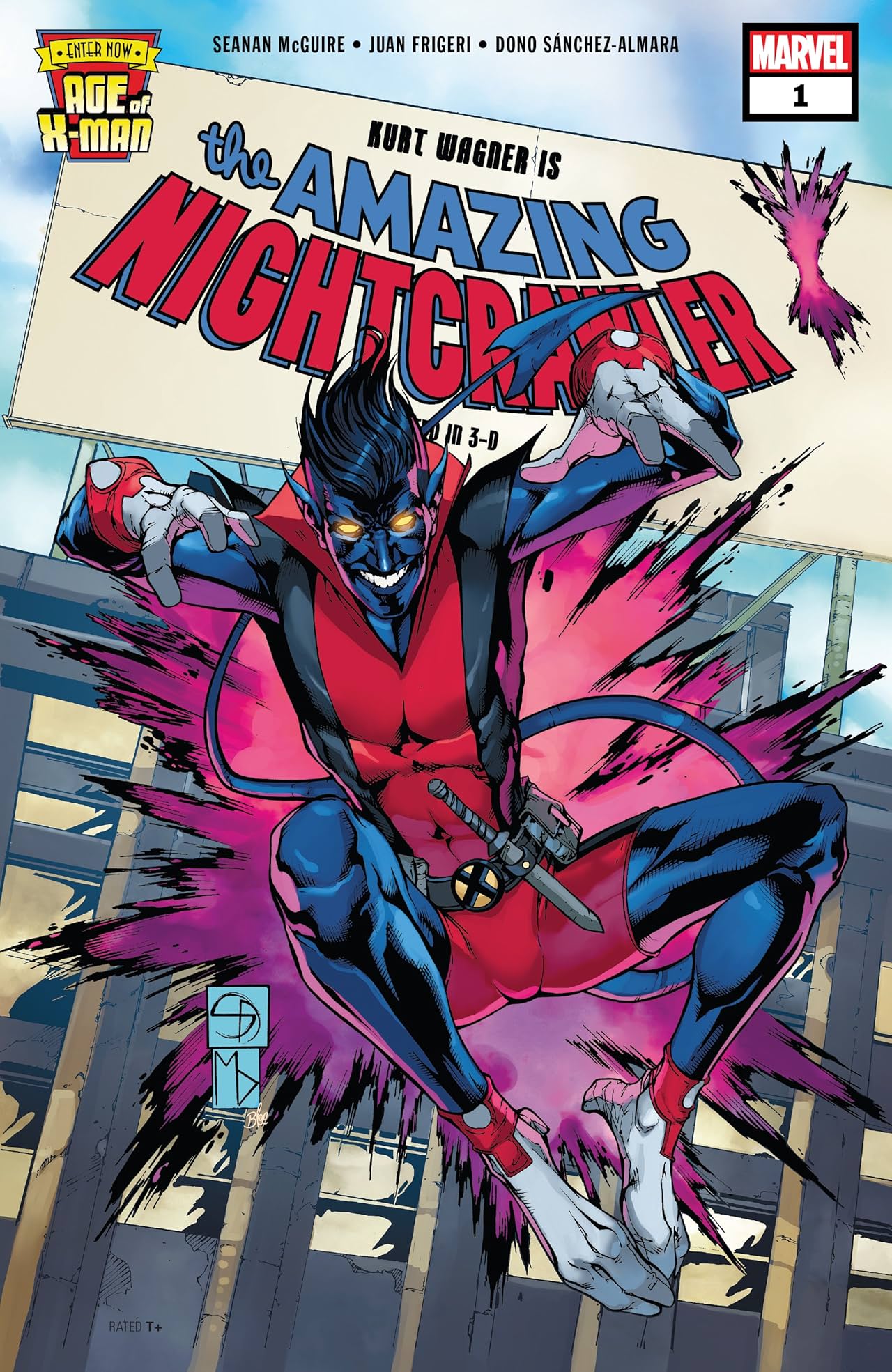
This week, it was genuinely difficult to single one comic out for my weekly quick pick. Every comic tries to stand out these days in some form or another. However, in that noble effort, the one comic I feel succeeded most was “Age of X-Man: Amazing Nightcrawler #1.”
It’s somewhat tricky picking a book that’s just a mini-series that’s meant to tie into a larger ongoing event, namely “Age of X-Man.” Anyone who follows comics, especially superhero comics that seem to have major event books every other month, knows that tie-in comics are often hit-or-miss. Most are misses, but “Age of X-Man: Amazing Nightcrawler #1” is definitely one of those rare hits.
You don’t have to know everything about what’s going on with “Age of X-Man” and why the mutants of the Marvel universe are living in a world where giant robots aren’t trying to kill them. All you need to know is that the X-men now live in an alternate universe where mutants are celebrated, idolized, and respected. Thanks to the reality-warping power of Nate Grey, Charles Xavier’s dream isn’t necessary anymore.
Within that Utopian world, don’t just live in peace. They’ll full-fledged celebrities. Among the celebrities of that world, Kurt “Nightcrawler” Wagner is at the top. He’s basically this world’s Leonardo DiCaprio, Chris Pratt, and Hugh Jackman, all rolled into one. Considering how often his story revolves around people being afraid of his appearance, it’s a huge shift.
This isn’t a Nightcrawler who constantly runs from angry protesters who think he’s a demon in need of an exorcist. He’s an A-list celebrity, complete with managers, directors, fans, and a slight detachment from reality. I say slight because the story that transpires in “Age of X-Man: Amazing Nightcrawler #1” feels like something only a celebrity can experience.
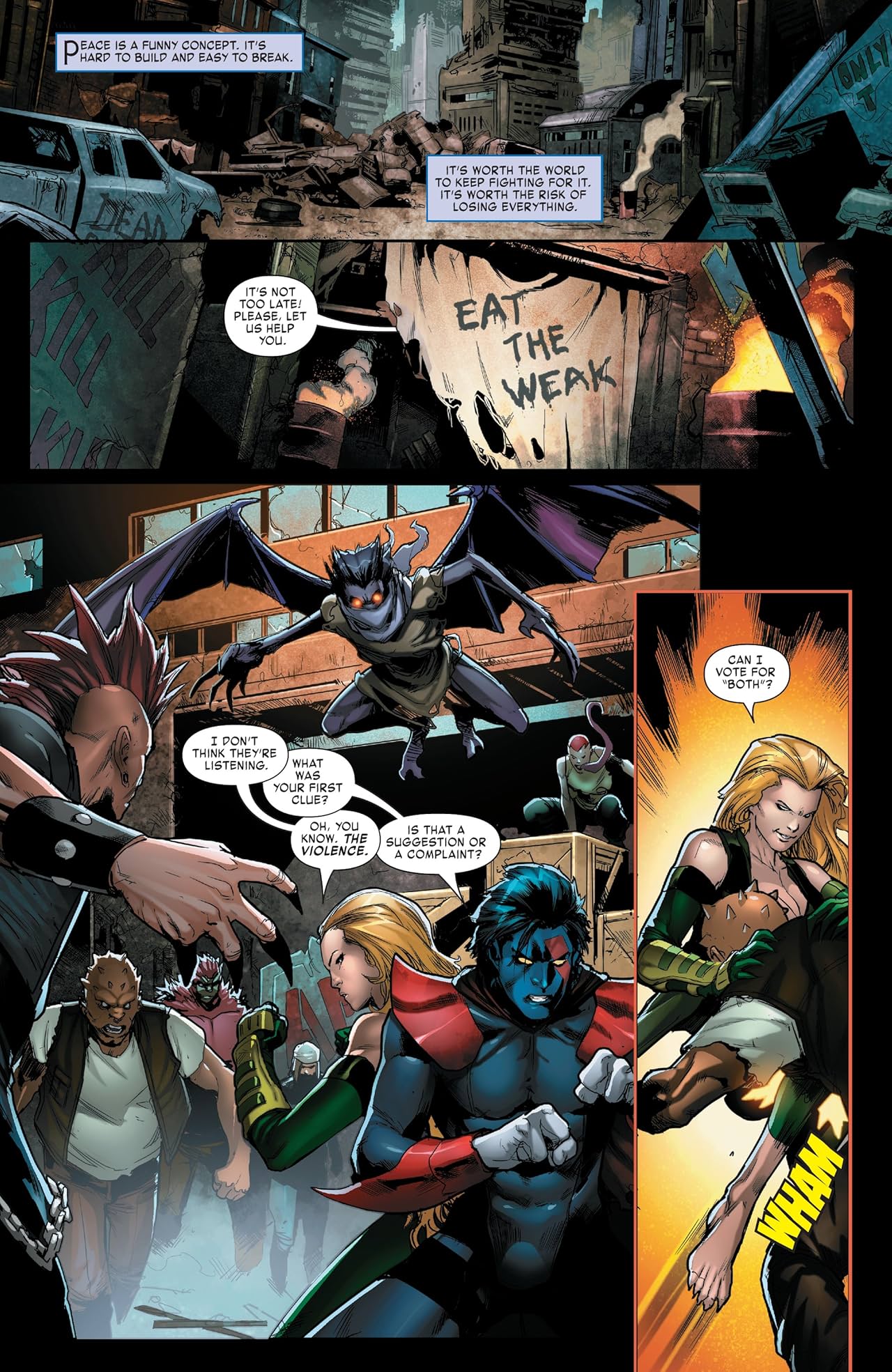
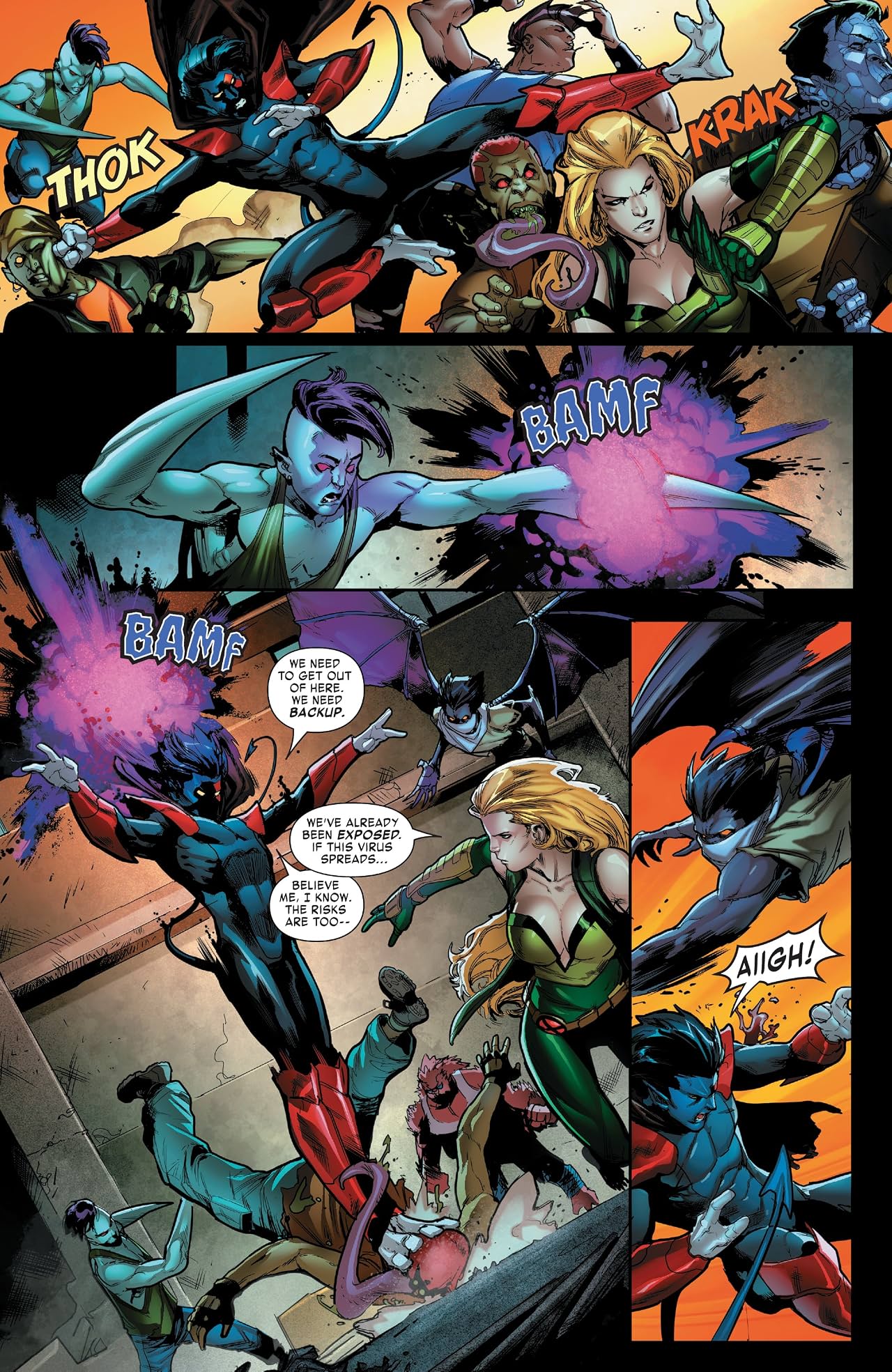
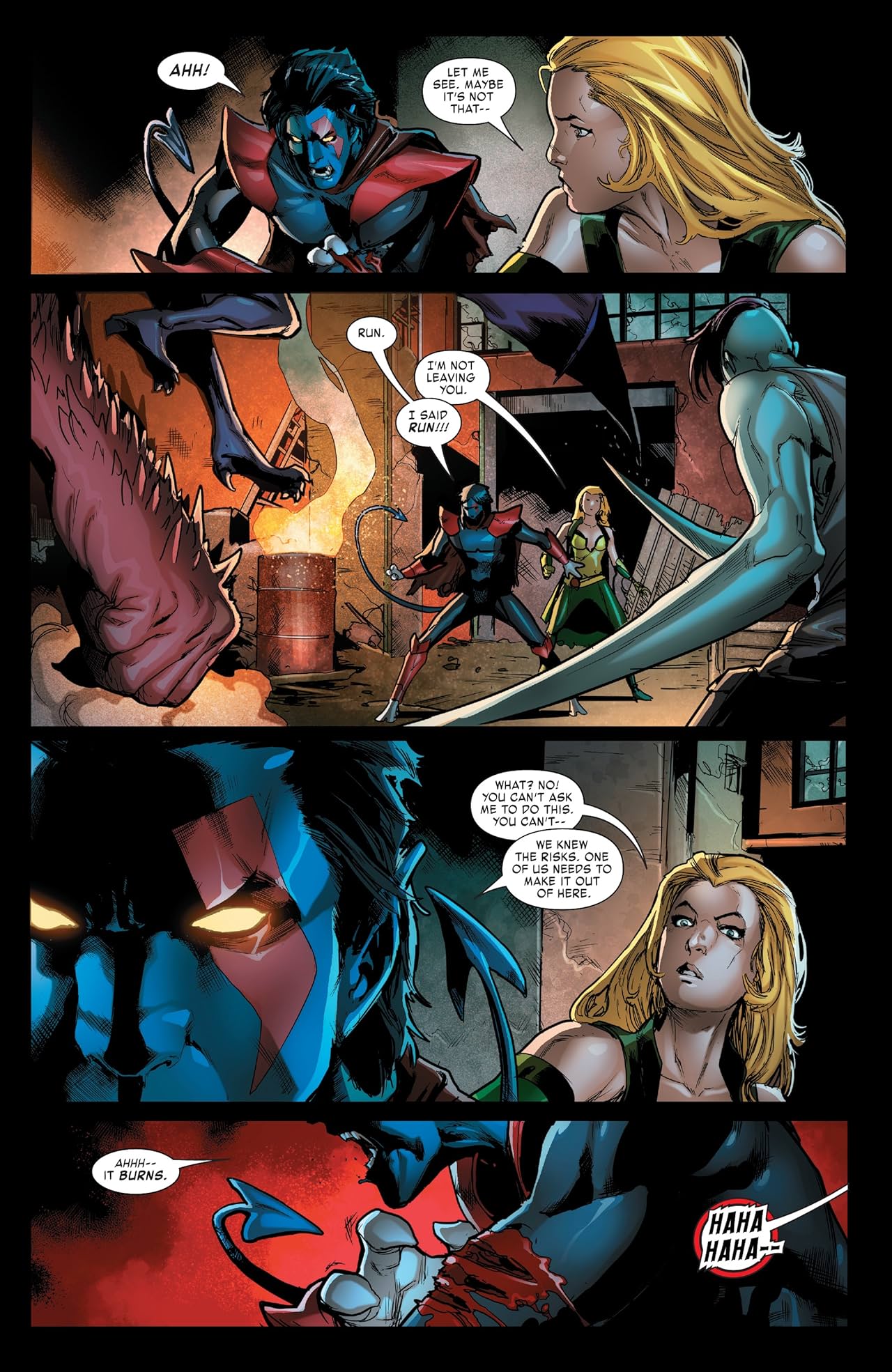
Writer, Seanan McGuire, is both coy and cunning in how she explores Nightcrawler’s life in this world. She even borrows from some of the dystopian imagery of the famous Age of Apocalypse story-line that was so iconic for the 90s era X-men. In this world, those dystopian fears aren’t an ever-present concern for the X-men. They’re just fodder for a movie.
In that world, Nightcrawler isn’t overly concerned about mutants being hunted and oppressed. For him, it’s a huge change of pace because in many of the X-men’s struggles, he finds himself on the front line of those conflicts. Look no further than stories like God Loves, Man Kills to see why he’s often the face of those conflicts.
In a sense, Nightcrawler is one of those mutants who has nothing to lose by fighting alongside the X-men. Even if mutants were outlawed and hunted, some of the more normal-looking mutants could escape easily and hide their status. He can’t do that because of his appearance. While that hasn’t stopped plenty of women from finding him sexy, it does define a big part of his character.
In “Age of X-Man: Amazing Nightcrawler #1,” the script is completely flipped. Now, Nightcrawler has everything to lose. He’s a beloved celebrity. Throughout the story, we see that he handles celebrity better than most. He’s not quite on the same level as Tom Hanks, but he’s close.
By every measure, Nightcrawler has everything going for him in this world. However, McGuire drops plenty of subtle hints that there’s something missing from his charmed life. Both his actions and his inner monologues send the distinct message that there’s something missing from his life and it can’t be filled with a prescription.
It’s the kind of struggle that many celebrities deal with. They can have everything, but still feel empty inside. It’s part of what leads them to engage in self-destructive behavior. While Nightcrwaler is no Bojack Horseman, what he ends up doing could cost him dearly. Those who read “Age of X-Man” understand those stakes.
For once, he’s in a position where he can make mistakes and lose more than just his place on a superhero team. He’s one of those characters who, through a mix of charisma and faith, always seems to do the right thing on instinct. Now, here he is, in a position to make big mistakes that cost him dearly.
It’s an intriguing story that puts a beloved character in an unfamiliar situation. If you’re a Nightcrawler fan, a casual X-men fan, or just think blue fur is sexy, “Age of X-Man: Amazing Nightcrawler #1” checks all the right boxes. Even if you’re just curious about what happens to superheroes in a non-dystopian world, this comic has a lot going for it.
While it’s unlikely that this utopian world will last indefinitely, it’s still interesting to see how certain characters handle themselves in such a world. So much of what defines them is a result of them always having to struggle. By living in a world where all is good, we find out who they really are. Nightcrawler is still lovable, but in the world of Age of X-Man, he’s got way more to lose than most.
Fridays may be everyone else’s favorite non-weekend day of the week, but ask most comic book fans and they’ll say Wednesday holds a special place in their hearts. It’s that magical day when a new batch of comics enters the world and our souls are nourished by their awesome. I don’t care what kind of a week I’m having. When new comics come out on Wednesday, I find a reason to smile.
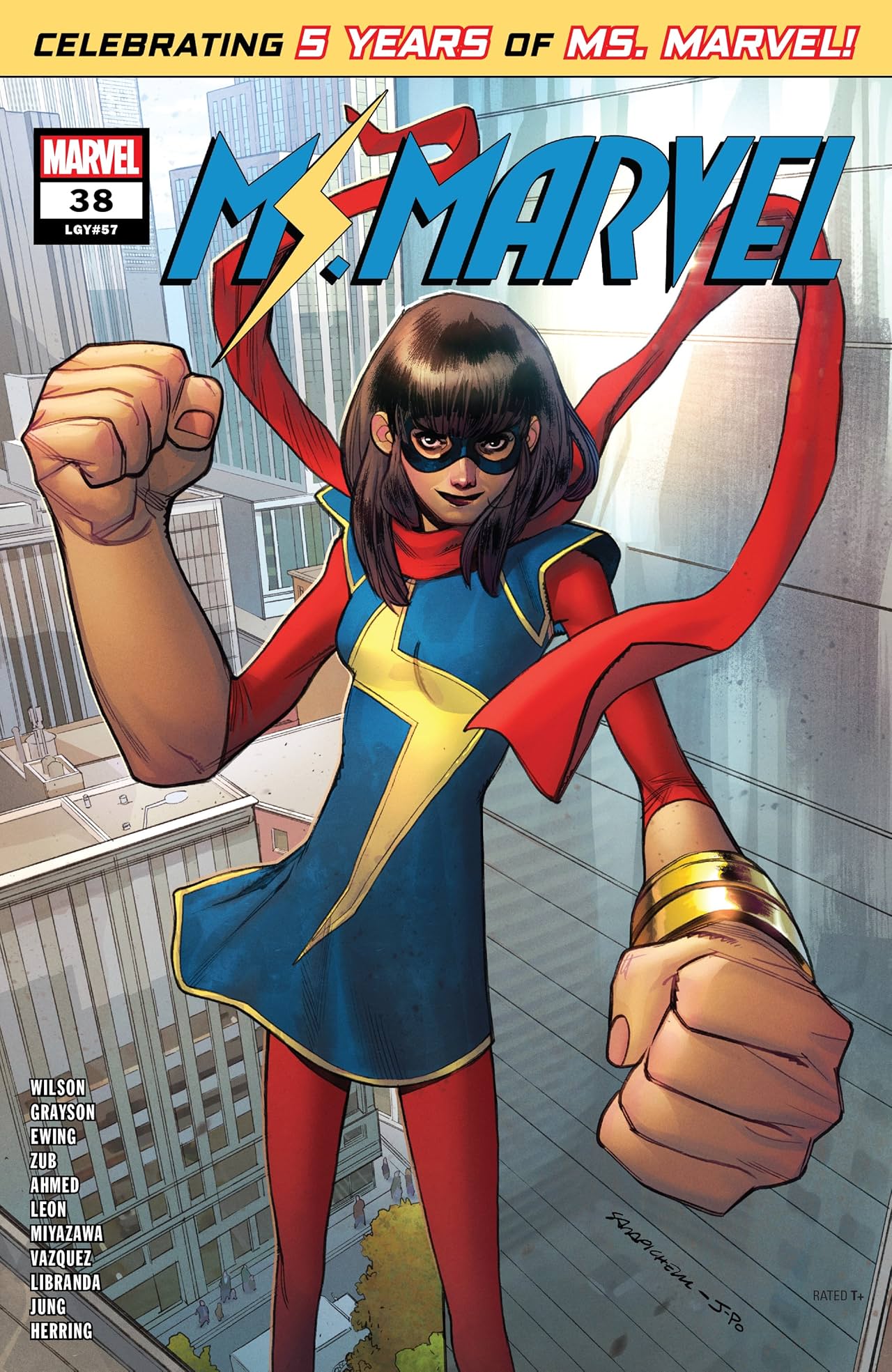
This week, with Valentine’s Day coming up and me being single, I needed more reasons than usual. Thankfully, this week brought us Ms. Marvel #38 and I’m already feeling the love. It also happens to be the five-year anniversary since her landmark debut. Given all the awards and accolades she received in that time, this definitely qualifies as a milestone worth celebrating.
I’ve gone out of my way to praise Kamala Khan before, citing her as a prime example of how to do female superheroes right in this crazy era. She’s young, lovable, determined, and idealistic. She’s also relatable, dealing with the same problems that most stressed out teenagers from Jersey City often deal with. If the past five years of comics haven’t convinced you of that, then Ms. Marvel #38 should help make that point.
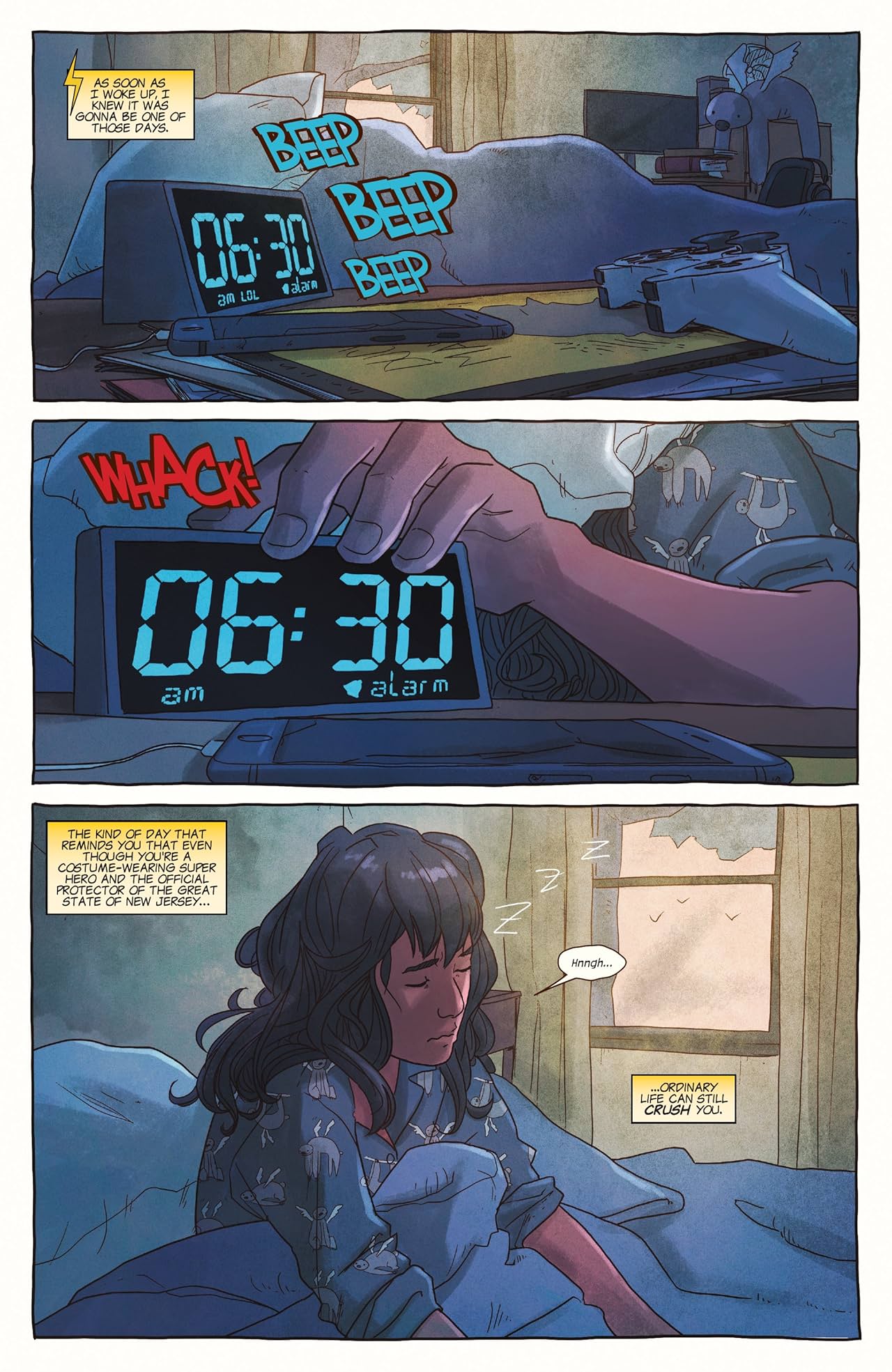
This milestone issue is a one-shot, self-contained story that starts off with Kamala being in a miserable mood. Then, after a brief, but colorful adventure with her friends, she remembers that being pissed off all day is a waste of a perfectly good day. It’s simple. Writer G. Willow Wilson doesn’t try to reinvent Kamala here. She just affirms why she has come as far as she has in five years.
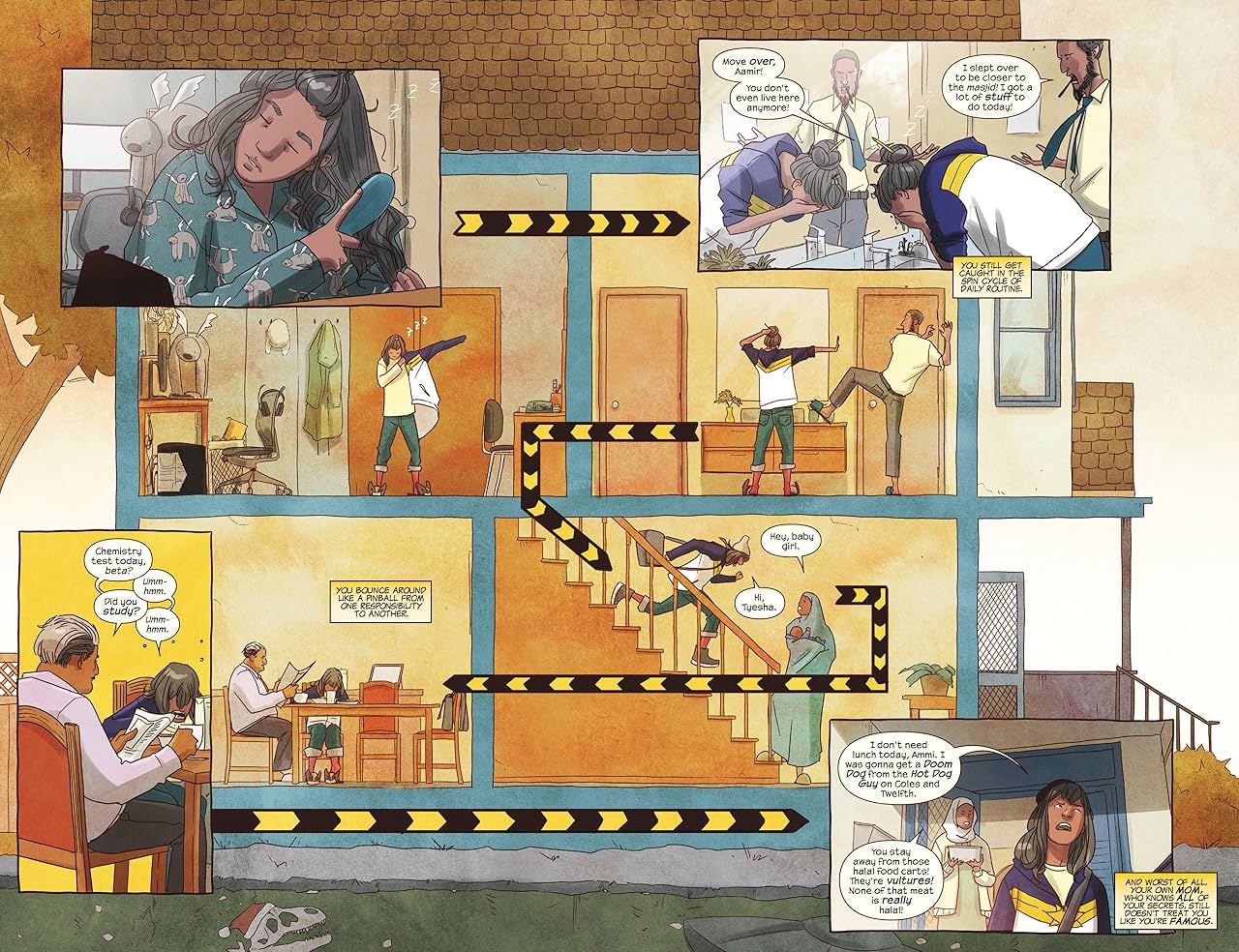
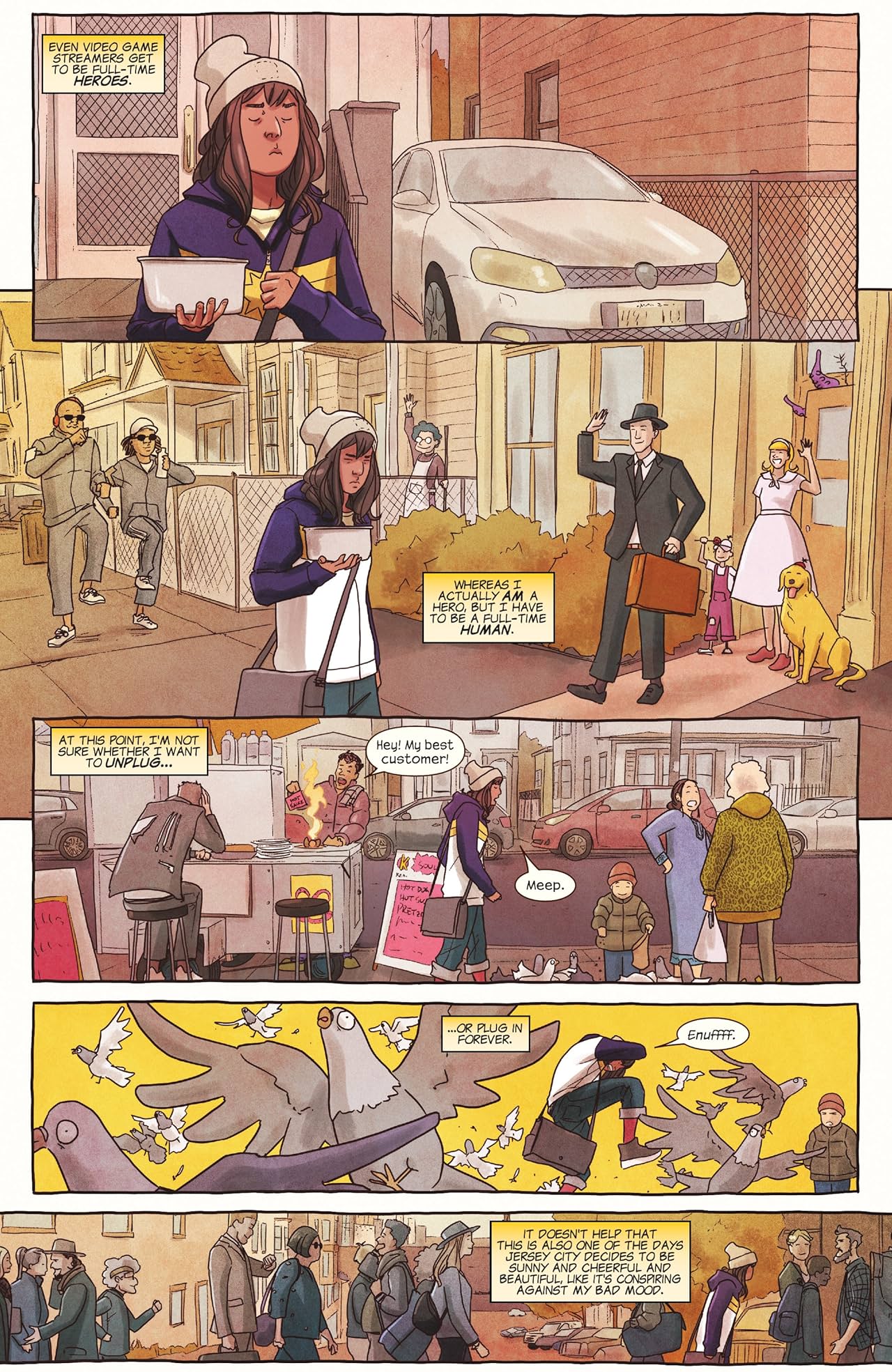
A big part of that process involves highlighting the parts of Kamala’s life that don’t involve costumed villains, superpowers, and dealing with Deadpool’s dirty jokes. Wilson takes the time to show Kamala dealing with parents, siblings, and just getting to school on a day when she feels like crap. It may seem mundane, but Wilson uses it to humanize Kamala at every turn.
In the same tradition of Peter Parker’s Spider-Man, Kamala Khan’s Ms. Marvel is a teenage girl first and a superhero on the side. She doesn’t have the luxury of mixing her personal life with that of her superhero life. Both affect the other and rarely in a good way. She wants to be a superhero, but she doesn’t want to stop being Kamala Khan. That’s not just a challenge. It’s overwhelming.
The stress really gets to her in this Ms. Marvel #38. Even without some major villain attacking, she’s doubting herself and her ability to manage everything. Then, she finds herself plucked into a strange new dimension where the most cheesy tropes of old RPG games come to life. If it sounds random, that’s because it is, but that’s exactly why it works.
Like a double shot of espresso and a slap upside the head, Kamala has to stop moping and be Ms. Marvel. At the same time, she has to help her friends who get sucked into this world as well. Nakia, Zoe, and Bruno do not have superpowers. However, they still end up helping Kamala every bit as much as her powers.
It’s one of the most common, but powerful themes of Ms. Marvel comics. Whereas supporting characters often end up being complications and liabilities for many heroes, Kamala’s supporting cast often supplement her heroics rather than hinder them. Sure, they still have to be rescued every now and then, but it never feels like anyone is a damsel.
There’s also more to this little dive into the world of overdone video game themes than just giving Kamala an adventure to go on. In between the colorful visuals that artist Nico Leon provides every step of the way, there are a few powerful moments in which Kamala and her friends realize how much they’ve grown and how much they haven’t.
It’s a fitting testament to how far Kamala Khan has come in the past five years. On some levels, she’s the same insecure girl she was before she got her powers. On others, she’s grown a lot since then. Having watched her grow since her debut issue, I found Ms. Marvel #38 to be a satisfying testament to the kind of hero she has become.
For that reason and plenty others, Ms. Marvel #38 is an easy choice for my weekly quick pick. Even if you haven’t been following Kamala Khan’s story too closely at this point, this wonderfully-crafted, self-contained story will help reveal why she has become such a big deal in comics in the past five years. Hopefully, the next five years are just as enjoyable, especially if she ever finds her way into the MCU.
Beyond being a teenager, a girl, and a fan of superheroes and video games, Kamala Khan’s journey is one that’s easy to follow and even easier to root for. She starts off having a bad day and you can’t help but want to see her turn it around. We’ve all had bad days. Some are so bad that even superpowers can’t cheer us up. However, Ms. Marvel finds a way because she’s just that special.
Every week, a fresh crop of new comics comes out and the world is a little bit more awesome because of it. As a lifelong fan of comics, superheroes, and many other things that the Bill Maher’s of the world despise, I take it upon myself to single out one comic from that week that makes this most special of days for superhero fans that much more memorable.
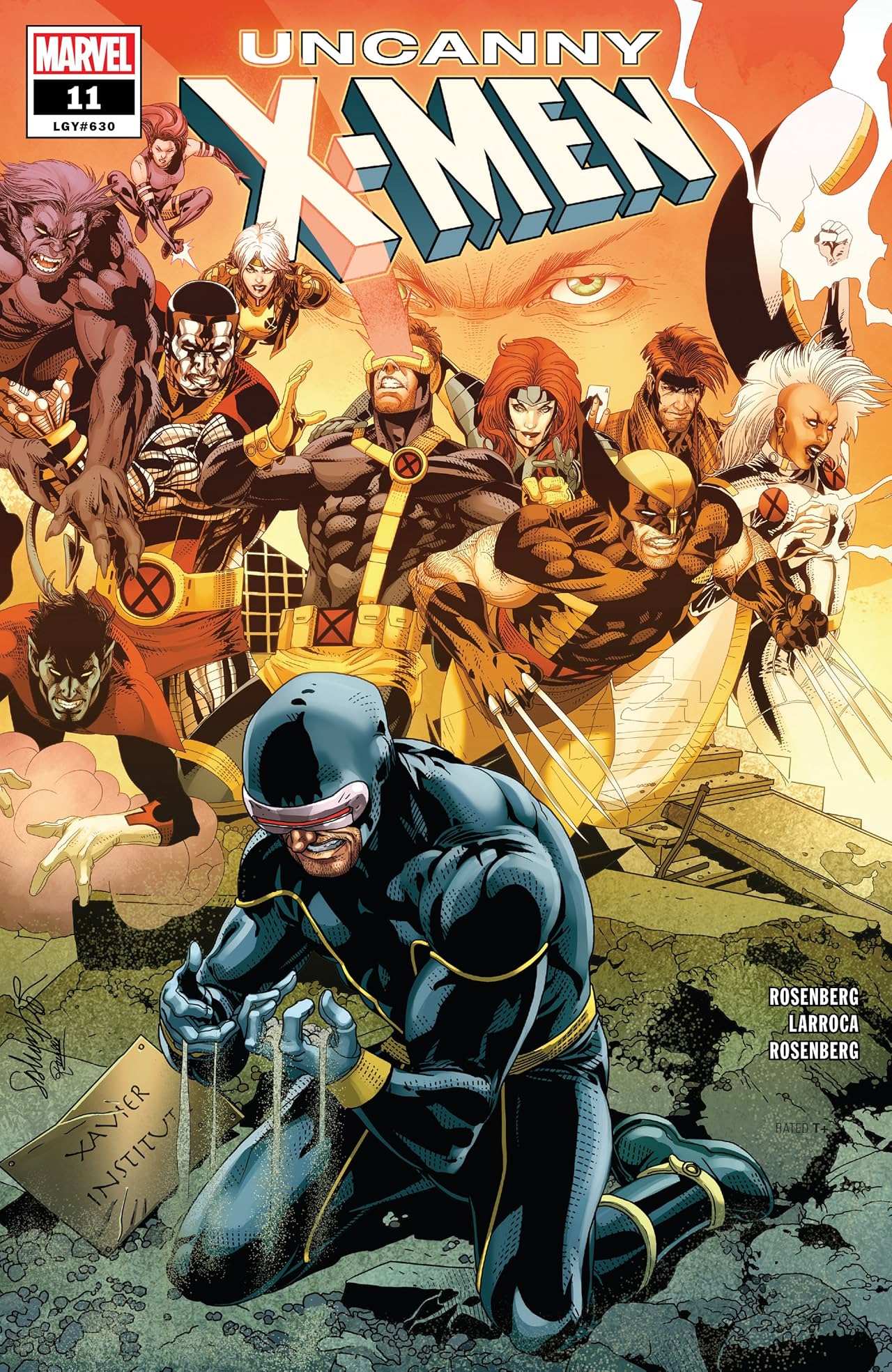
This week was a busy week with big events brewing with DC’s Heroes In Crisis story and Marvel’s ongoing Age of X-Man event. Being a lifelong X-men fan, I know I’m somewhat bias towards the X-men side of things. This week, however, I didn’t need that bias to single out Uncanny X-Men #11 as my top pick of the week.
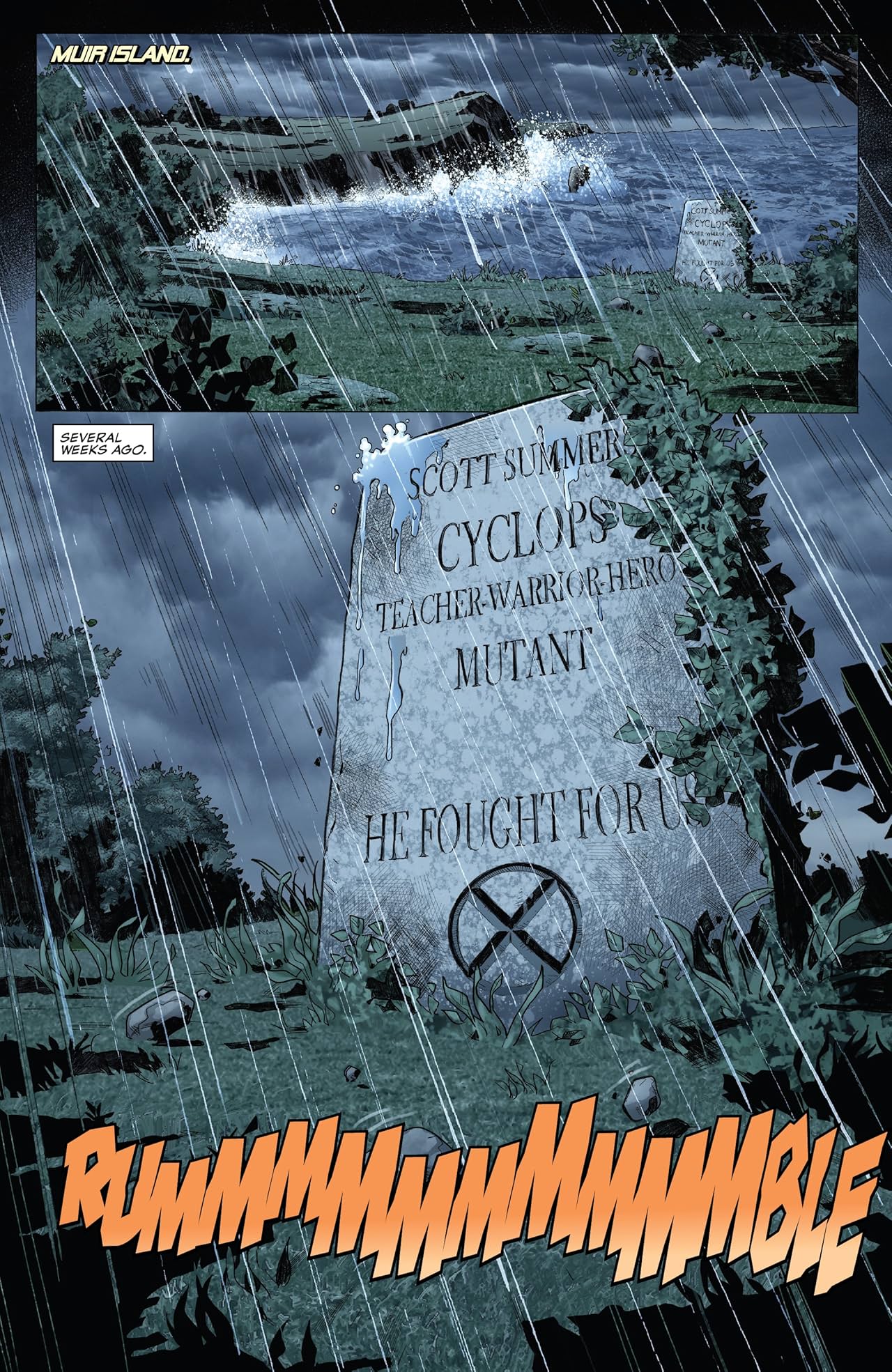
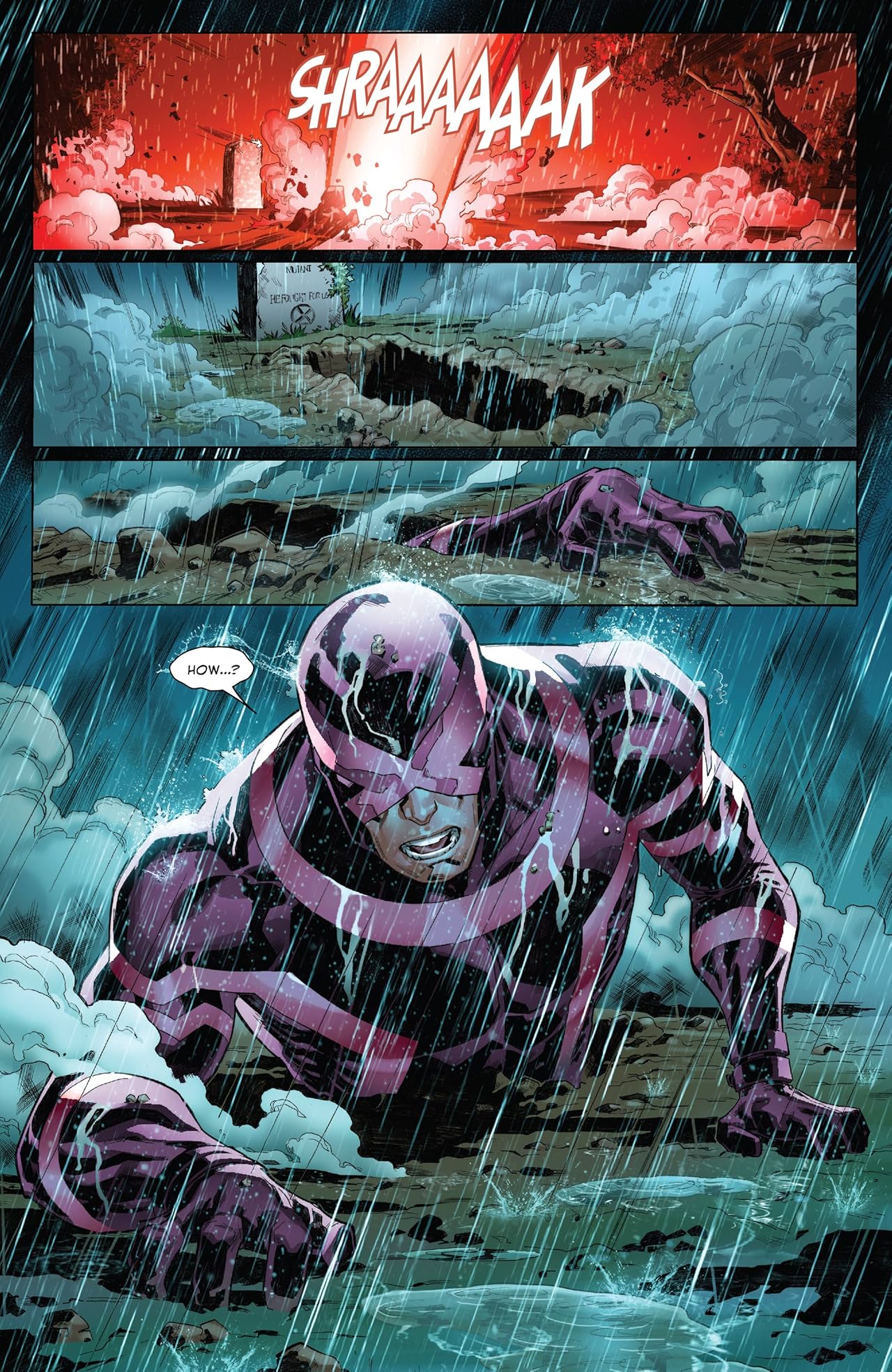
It’s not just because this book comes on the heels of Cyclops’ latest return from the dead, which occurred in Uncanny X-Men Annual #1 a couple weeks ago. It’s not just because he’s returning to a world where most of the X-Men have disappeared and been presumed dead after their battle with Nate Grey in Uncanny X-Men #10, either. What makes this comic my top pick is something far greater.
In every superhero comic, you learn the most about a character when they’re at their worst. It’s easy for any hero to shine when things are going well. When the world loves them, when super-villains despise them, and when they’re not stuck on the wrong end of a love triangle, it’s easy to seem heroic. It’s when everything is terrible and their world is on the brink that you learn who they truly are.
Uncanny X-Men #11 lets everyone know who Scott “Cyclops” Summers is. In this story, he has no X-men to lead. He has no beautiful wife by his side or buxom blonde lusting after him. His mentor is gone. His home is gone. Everything he ever fought to defend is gone. What does a man like that do in a situation like that?
He can either cower and whine or he can step up and fight. Cyclops, having gone to war with the Avengersandthe Inhumans, has never been one to cower. The story that Matthew Rosenberg and Salvador Larroca tell here shows why he’s the leader of the X-men in the first place. It shows why beautiful telepaths are attracted to him. When things are at their worst for the entire mutant race, this is the man you want leading you.
If you’re a Cyclops fan in any capacity, Uncanny X-Men #11 is a must-have. However, what makes this book even more valuable is that it’s giant-sized. That means it costs a little more than the typical two to three dollar price, but you get a lot more for those few extra bucks.
In addition to Cyclops kicking ass, Wolverine has his own story that unfolds in the background. He too recently came back from the dead and has been dealing with the many complications associated with resurrection in his own series, Return of Wolverine. Having sufficiently stabbed those complications, he’s ready to return to the X-Men and he’s just in time to help Cyclops, a guy who’s wife he kept trying to sleep with.
It’s a beautiful thing, these two coming together once more in the X-Men’s darkest hour. The way it happens and the action it inspires is too great for words. That’s why I’m not going to spoil it. I’ll just say that if you’re a Cyclops fan, a Wolverine fan, or an X-Men fan in general, this comic feels like one of those books that will one day be critical in the history of the greater Marvel universe.
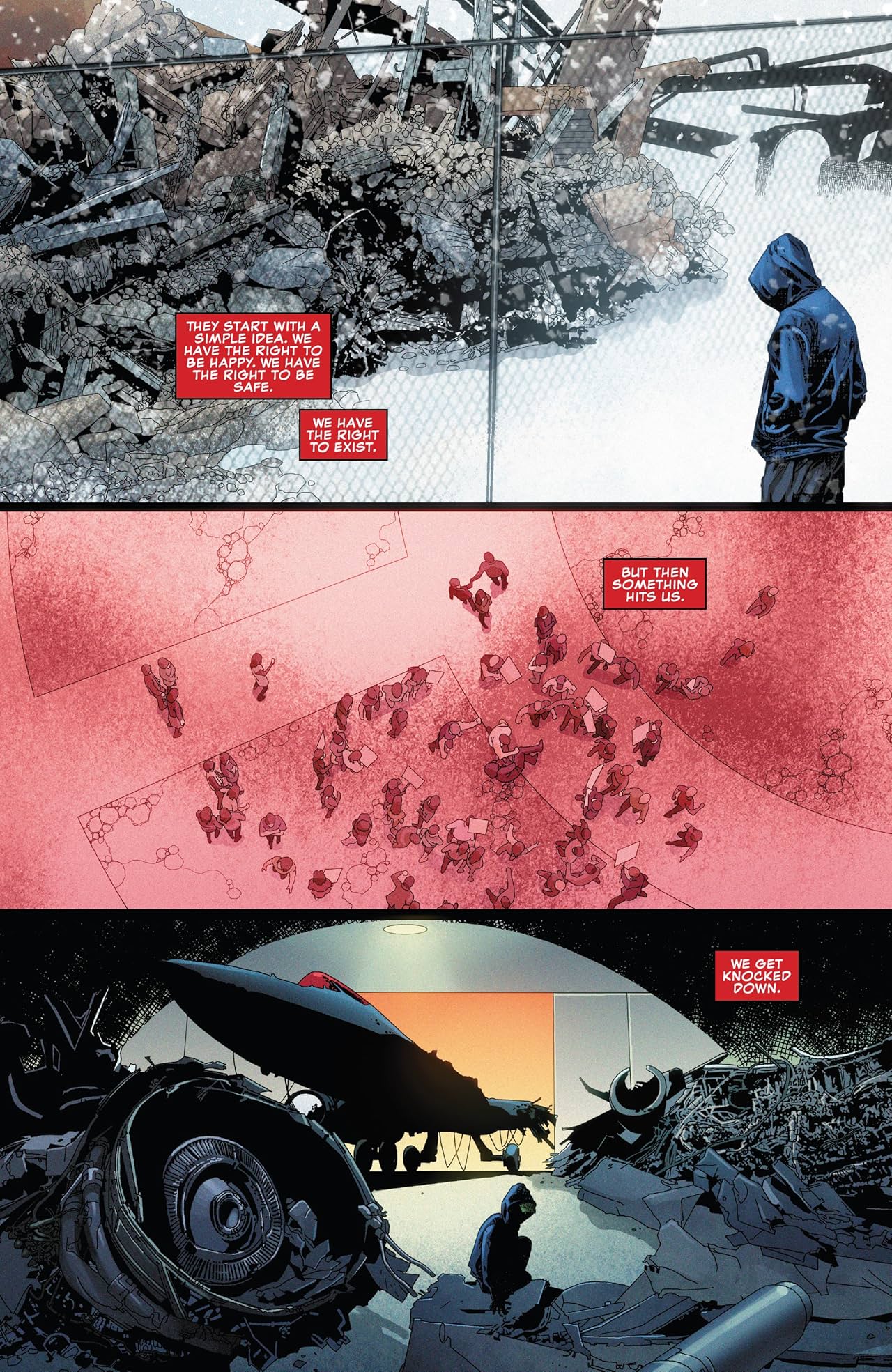
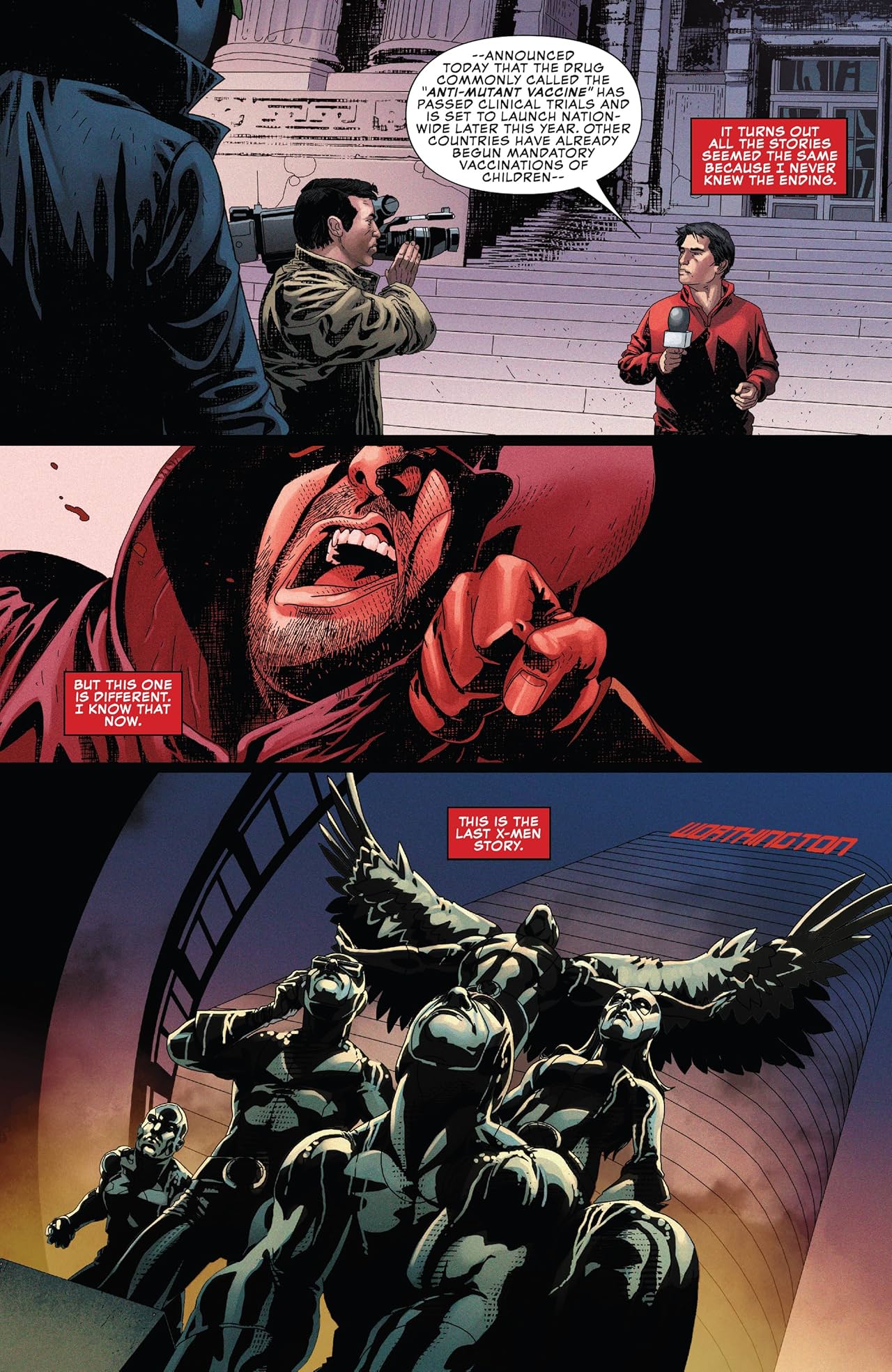
As it stands, the X-Men are gone and the mutant race is fading into obscurity. Rather than genocide, they’re facing a future where people simply treat mutation like a flu shot. The vaccine that was introduced in Uncanny X-Men #1 works. Parents can now keep their children from becoming mutants. While it greatly limits their chances of becoming superheroes, it ensures they can lead a “normal” life.
What does this mean for the future of the X-Men? What does it mean for mutants? These are unanswered questions that will probably linger for many issues to come, but Uncanny X-Men #11 effectively fires the first shot in a new struggle. Cyclops, Wolverine, and the rest of the mutant race aren’t content to just whither away. That’s not their style and this issue demonstrates why in so many uncanny ways.
If the measure of a true hero is determined by how they handle their darkest hour, then Uncanny X-Men #11 reaffirms why the X-Men are in a league all their own. The world may always love the Avengers, but the X-men will always command their respect.
At this point, hoping for more is just being greedy. With a sequel to “Venom” in the works and other spin-off projects in the pipeline, it almost feels wrong to hope for something specific. Marvel, Sony, and Disney are already giving us so much. What more can they possibly offer?
Well, I’d like to make the case that there is one particular branch of the evolving Spider-Man universe that warrants greater attention. It’s something that was already hinted at within “Into The Spider-Verse” and I feel she could have a greater than any other Spidy-centric media. The timing is right. The market is ripe for her ascension. It’s just a matter of building on foundation that is already rich with potential.
I’m referring to Spider-Woman, also known as Gwen Stacy, but best known as Spider-Gwen. In the mythos of Spider-Man, she’s a fairly recent development. However, her rise to prominence has been nothing short of spectacular and I believe she has done plenty to warrant her own place in the franchise.
Most Spider-Man fans know the name, Gwen Stacy. She has had a prominent place in the Spider-Man comics for decades. However, like Miles Morales, Spider-Gwen emerged in an alternate universe where known characters are different and events unfold differently. Her sequence in “Into The Spider-Verse” offered a brief overview of who she was, but her story is far richer than that.
That story still contains many of the iconic themes associated with Spider-Man. Issues like power, responsibility, and dealing with J. Jonah Jameson are a huge part of Spider-Gwen’s story. However, there are a few distinct variations that help set her apart and it’s because of those traits that I believe she can carry her own movie.
What follows are just a few reasons for why I feel that way. There are probably plenty more that other Spider-Gwen fans will resent me for skipping. I understand and accept that responsibility. Since these are such great times for Spider-Man fans, I like to think we don’t need that many reasons to give someone like Spider-Gwen her own movie.
Reason #1: She Sets Herself Apart From Peter Parker (Aside From Being A Woman)
If the success of “Into The Spider-Verse” taught us anything, other than the inherent appeal of cartoon pigs, it’s that you don’t have to be Peter Parker in order to embody the themes of Spider-Man. Miles Morales did a lot to set himself apart in terms of personality, circumstances, and abilities. Spider-Gwen does plenty of that too, but she takes it even further.
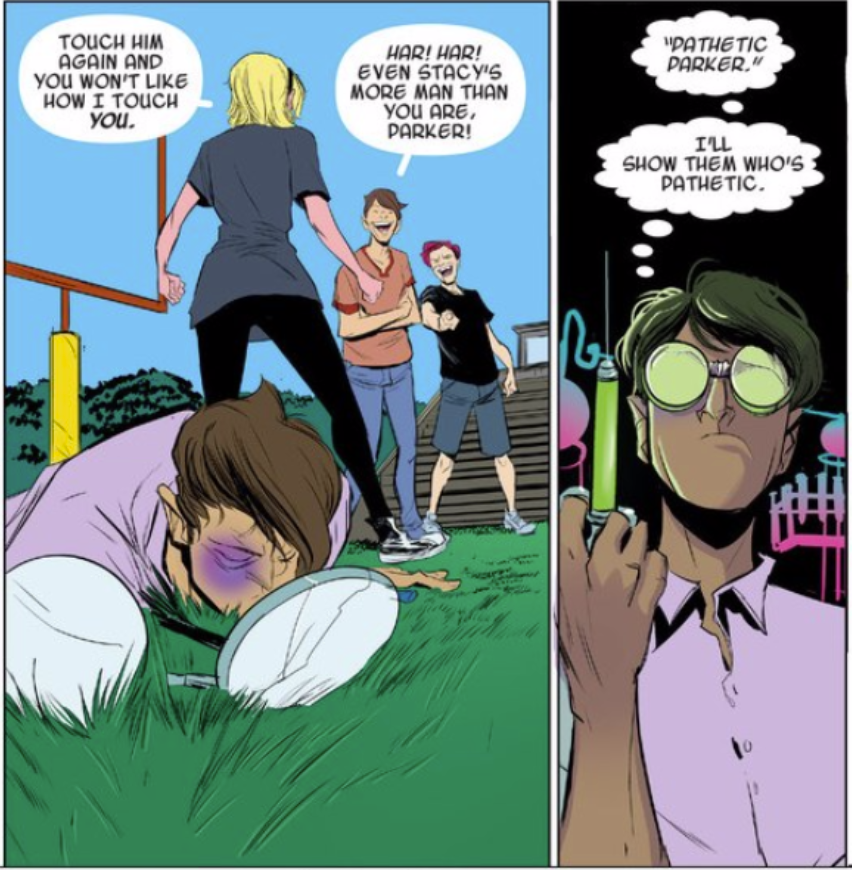
In the world of Spider-Gwen, the story of Gwen Stacy unfolds very differently. She’s not a nerd like Peter. She’s not a biracial teen trying to fit in at a new school. She’s the same sweet girl that Spider-Man fans know from classic stories. That all changes when she gets bit by that radioactive spider instead of Peter.
The Gwen Stacy that emerged after is still Gwen, but she goes about utilizing her powers very differently compared to Peter. They change the way she carries herself. She doesn’t approach them the same way as Peter or other Spider-Man characters. She follows her own path, complete with her own sense of power and responsibility.
Her approach is not radically different from that of Peter Parker, but it still feels distinct. How Gwen becomes Spider-Woman and how this affects her, as a character, is not a story that can be told with Peter Parker, Miles Morales, or any other character, for that matter. The fact she’s a woman at a time when female superheroes have been subject to greater scrutiny is just a nice bonus.
Moreover, the story of Peter Parker has been told and retold many times, already. There have been three distinct timelines with threedifferentactors taking on the role. There’s only so much more that can be done at this point. Gwen Stacy is a different story, but one that’s familiar enough to fit into the greater Spider-Man mythos.
Reason #2: Her Story Brings A Unique Set Of Challenges (Aside From Being A Woman)
Being a masked vigilante is hard. Five decades of Spider-Man comics and three movie franchises have done plenty to establish that. However, Peter Parker never had to deal with being a vigilante while having a cop for a parent. He also never had to be the prime suspect in the death of a friend that he tried desperately to protect.
Those are just some of the challenges Gwen faces throughout her story in the comics. Unlike Peter, she’s not just another high school student trying to balance her personal life with her superhero life. She faces far greater challenges than not having a date to the prom or showing up late to class.
One of her biggest challenges, throughout her story, revolves around being a vigilante while her father, George Stacy, is a cop with the NYPD. On top of that, he’s initially tasked with arresting Spider-Woman because she’s implicated in the death of Peter Parker. Learning that his daughter is Spider-Woman only compounds that challenge.
There’s a lot of drama in that dynamic. If you want to see how it plays out, I strongly recommend checking out the comic series written by Jason Latour. These challenges are things that you won’t find in a Spider-Man story with Peter Parker. Like her counterparts, Gwen bears many burdens and responsibilities, but having a cop for a father only makes it harder.
At a time when the conduct of the police is under more scrutiny than ever, I think a Spider-Gwen movie could explore those conflicts better than most. Beyond giving Gwen different obstacles, it offers a different perspective on what it means to be a hero and how difficult it is to manage when family affairs get involved.
Reason #3: The (Fitting) Tragedy Of Peter Parker In Her World
It’s impossible to tell the story of Spider-Gwen without telling the story of Peter Parker in her world. Her version of Peter is very different in that not getting bit by that radioactive spider sent him down a darker path. His story is one of tragedy, but it’s the kind of tragedy that complements Gwen’s story and fits perfectly with the themes of Spider-Man.
In many respects, Peter fills the role of Uncle Ben in the world of Spider-Gwen, but not in the same way. It’s not a classic case of failing to stop him from getting hurt by a random accident. Gwen actually went out of her way to protect Peter. Getting superpowers actually made that easier for her. She sees him as her friend and wants to help him.
However, in doing so, Peter makes some fateful decisions that result in his death. It’s not just tragic. It’s gut-wrenching for Gwen. She has to watch this boy she cares about die because he wanted to be more like her. She’s very much responsible for what happened to him. On top of that, Spider-Woman is blamed for his death, thanks to shoddy reporting by J. Jonah Jameson.
This version of Peter is powerful in how it twists the classic Spider-Man narrative without warping it entirely. By helping Peter like she did, Gwen ultimately failed him. That’s a different, but effective way to learn the importance of power and responsibility.
Reason #4: She’s Likable In Many Ways (More So Than Peter)
Even in stories where she doesn’t have powers, Gwen Stacy is a genuinely likable character. She’s sweet, fun-loving, and genuine. She’s the kind of girl you can be friends with and/or fall in love with. She’s honest and blunt in how she deals with people. She’s also compassionate and understanding. Getting superpowers only enhances these traits.
What we saw in “Into The Spider-Verse” was just a small sample of a much richer persona. Her attitude, as well as her ability to connect with others in awkward situations, is plenty endearing. In the comics, we see this manifest in many other ways. From the way she deals with her father to how she interacts with her band-mates in their all-female band, the Mary Janes, is likable on so many levels.
I would go so far as to argue that she’s a lot more likable than Peter Parker, if only because she’s less prone to brooding and whining. Throughout the comics, she ends up in some pretty rough situations, which include being actively hunted by the NYPD and unable to go home to her father after he learns of her identity. It’s rough, but at no point does she just whine about it.
As sweet as Gwen is, she also has grit. She knows how to endure a lousy situation and when the going gets tough, she finds a way to get stronger. She still messes up along the way. In fact, she messes up a lot in the comics, but she learns from her mistakes and she grows along the way.
I’m not saying Peter Parker hasn’t grown over the years, but even after five decades of comics, cartoons, and movies, his growth tends to regularly stagnate. Every time he seems to move forward with his life, he takes a step back, whether it’s undoing a marriage or losing his billion-dollar company.
Spider-Gwen may not have had as much time to grow and regress, but her story has been allowed to evolve in many ways since her debut. That development is full of opportunities. Even though she has only been web-swinging since 2014, she has plenty of material for a great movie.
Reason #5: Her Story Is Not Bogged Down By Continuity
This is more a logistical issue than anything else. Peter Parker has been around since the Kennedy Administration. His story has years upon years of continuity that effectively shackle him from radical change. I’ve mentioned before how all superheroes are subject to these constraints. I’ve even argued that Spider-Man is more inept than most at dealing with them.
With Spider-Gwen, however, there are far fewer constraints and many potential avenues for growth. Her story, and that of her distinct alternate universe, is in its infancy, relative to other superheroes. She hasn’t been around long enough for complications and retcons to accumulate. She can follow many different paths, both in the comics and in the movies.
One of the common complaints that comic fans will levy against a movie is how closely it follows the source material. Since Peter Parker is such an icon, there’s not a lot of wiggle room. With Spider-Gwen, there isn’t much source material from which to deviate. “Into The Spider-Verse” already captured the basics. A full-fledged Spider-Gwen movie will have plenty of flexibility.
There are plenty of other reasons I could list to justify Spider-Gwen getting her own movie. She’s a great character who embodies unique aspects of the greater Spider-Man mythos. Given the current state of the superhero genre, especially with respect to box office returns, I don’t think Sony, Marvel, and Disney need many to make Spider-Gwen their next success story.
I also understand that there are people who don’t share those passions. Some may even see them as childish and foolish. That’s perfectly fine. It doesn’t make them a bad person, by default. It doesn’t even mean I can’t get along with them or agree with them on other issues.
The fact I have to make that disclaimer only makes the current state of affairs more frustrating. I feel it’s more necessary now because I’m about to address a topic has evoked all the wrong emotions for all the wrong reasons. Normally, my first instinct is to avoid such controversy, but since it involves superhero comics, I feel inclined to respond.
It started late last year with a blog post by Bill Maher, a late night talk show host for the long-running HBO series, “Real Time With Bill Maher.” That blog post came shortly after the death of Stan Lee and, without going too heavily into details, attacked the culture behind comic books and superhero media.
Many took that post as an insult to the legacy of Stan Lee. Having read that post multiple times, I really didn’t get that sense. I won’t deny that I took some offense to it, but I’ve read far more offensive things in the comments section of YouTube videos. The fact that it got such a visceral reaction only skewed the conversation even more.
Then, this past week on his show, Mr. Maher finally addressed the issue again in the closing commentary on his show. If you haven’t seen it, here it is.
The long and short of it is his commentary had less to do with Stan Lee and more to do with people who think comic books warrant serious cultural weight. He goes onto bemoan how people cling to the things they loved as kids as a way of avoiding the adult world. It’s less an indictment on people who like comics and more a criticism of people who whine about adulting, in general.
To some extent, I understand his criticism. There are people in this world who try to avoid adult responsibilities at every turn. They don’t want to deal with the harshness of the real world and cling to fantasies about having superpowers that render those problems moot. Even as someone who loves superhero comics and movies, I think that’s an issue for some people.
For most people though, it’s just fun. Mr. Maher seems to completely overlook that. I don’t care how old you get. Having fun is fun. Comics are a lot of fun to read, follow, and enjoy. The more “serious” pieces of literature that he recommends in his commentary probably have plenty of merit, but they’re not nearly as fun.
The idea that he finds superhero media as childish is understandable. Bill Maher is over 60 years old. For most of his life, comic books and superheroes have been for children. It’s only within the last 30 years that they’ve matured to a point where they appeal to all ages, so much so that they’ve raked in over $20 billion at the box office. You don’t make that much money on childish things.
In addition to box office billions, some comics have gained serious acclaim. A select few have even been recognized as some of the greatest literary works in the past 100 years. I doubt Mr. Maher is aware of this because most of these amazing works happened after he became an adult. I imagine that if you were to ask most people his age, they would agree that comics shouldn’t be considered serious literature.
I respectfully disagree with that notion and I know many others disagree as well. That said, I doubt anyone will ever convince Mr. Maher that he’s wrong. He has made his politics very clear on many occasions and I don’t doubt he’ll say other offensive things in the future.
At the very least, I can offer Mr. Maher some perspective. I believe that, if he were to give comics a chance, he would see their literary value. He may still think they’re childish, but I think he would have a greater appreciation for the medium, if only because he sees how it has evolved since he was a kid.
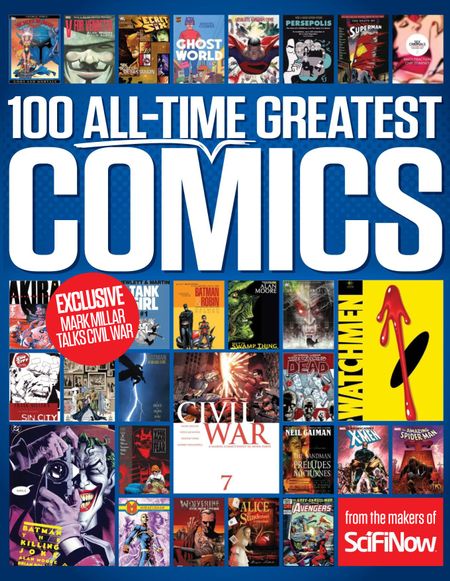
What follows are five comics that I would personally recommend to Mr. Maher. I feel these books would help show just how salient comics can be in terms of society, politics, and art. While I doubt he’ll give them a chance, I hope others who share his sentiments take a moment to see why comic books and superhero media have become such an integral part of our culture.
Watchmen
This is an easy choice and not just because Watchmen routinely ranks near the top as on of the greatest comic books of all time. This seminal work by Alan Moore and David Gibbons actually speaks to the same criticisms that Mr. Maher levied against superheroes. Watchmen is, at its heart, the ultimate deconstruction of the entire concept of superheroes.
This story isn’t just about heroes fighting villains or heroes fighting other heroes. Watchmen is a story with deep, philosophical overtones about what it means to wield power and make peace in a chaotic world. It casts a harsh light on the dangers of relying on superheroes or super-powered beings to solve big problems on the global stage. It’s a sentiment that Mr. Maher himself has made on more than one occasion.
Being a political person, I believe Mr. Maher would find a lot to enjoy about the world of Watchmen. Beyond the art and the complexities of the story, it has a message that goes beyond good guys fighting bad guys.
In many respects, Watchmen was the comic that broke all the rules and ushered the medium into a new era. It proved that a comic could make serious contributions to the world of literature. Between its unique place in the history of comics and the awards it received, I think Watchmen can prove to Mr. Maher that comics can be great works of art that tell relevant messages for the real world.
Sandman
This is another series that routinely gets mentioned in discussions surrounding the greatest comics of all time. Like Watchmen, Sandman pushed the limits on what a comic book could be. It’s not a standard superhero comic. It’s not about heroes searching for some ominous glowing object, which is something Mr. Maher pointed out in his criticism. Sandman is deeper than that.
The writer of Sandman, Neil Gaiman, dared to craft a more mature fantasy. This is a world where mythological figures like Morpheus, Lucifer, and even characters from the bible interact with one another in a complex narrative that provides insight into spirituality, religion, and philosophy.
I believe that insight would appeal to Mr. Maher more than most and not just because he’s a self-admitted stoner. Say what you will about him, but he’s a very intelligent man who went to an Ivy League school. He also majored in English, which I think would make Sandman that much more appealing to him.
The story in Sandman is not something most children will understand or appreciate. Even most adults may struggle to make sense of the various themes that Gaiman explores throughout the book. It’s a powerful story, but one that works best in the medium of comics. I think if Mr. Maher gave Sandman a chance, he would see that.
X-men: God Loves, Man Kills
Even though Mr. Maher singled out superheroes as the most childish element of comics, I believe there are still a select few that would still appeal to him, if only because of his political leanings. Mr. Maher has always identified as a liberal and routinely espouses the value of liberal principles. He grew up watching the civil rights movement unfold and it has clearly had an impact on him.
That’s exactly why a comic like X-men: God Loves, Man Kills would resonate with him. Even though it follows many common superhero themes, this classic X-men story by legendary X-men writer, Chris Claremont, goes much further in linking the struggle of the X-men with that of civil rights.
This story is less about the X-men fighting killer robots and more about confronting the depths of human bigotry. In addition to providing the inspiration for “X2,” it explores a kind of bigotry that feels like it was ripped from the real world. It even throws religion into the mix with the introduction of Reverend William Stryker, a man who has drawn more than a few comparisons with Vice President Mike Pence.
Mr. Maher will probably notice those parallels more than most. He has made no secret of his disdain for organized religion and the people who use it to justify their bigotry. X-men: God Loves, Man Kills tells a story of just how dangerous that kind of religiously-motivated bigotry can get. Even though it’s still a superhero story, it doesn’t hide from the real-world parallels.
Good literature, whether it’s a comic book or a novel, often reflects the controversies of its time. The X-men were created right at the onset of the Civil Rights Movement. Stan Lee has gone on record as saying that elements of the X-men were inspired by real life heroes of the Civil Rights Movement. As both a proud liberal and a critic of religion, Mr. Maher will find plenty to like about this classic X-men story.
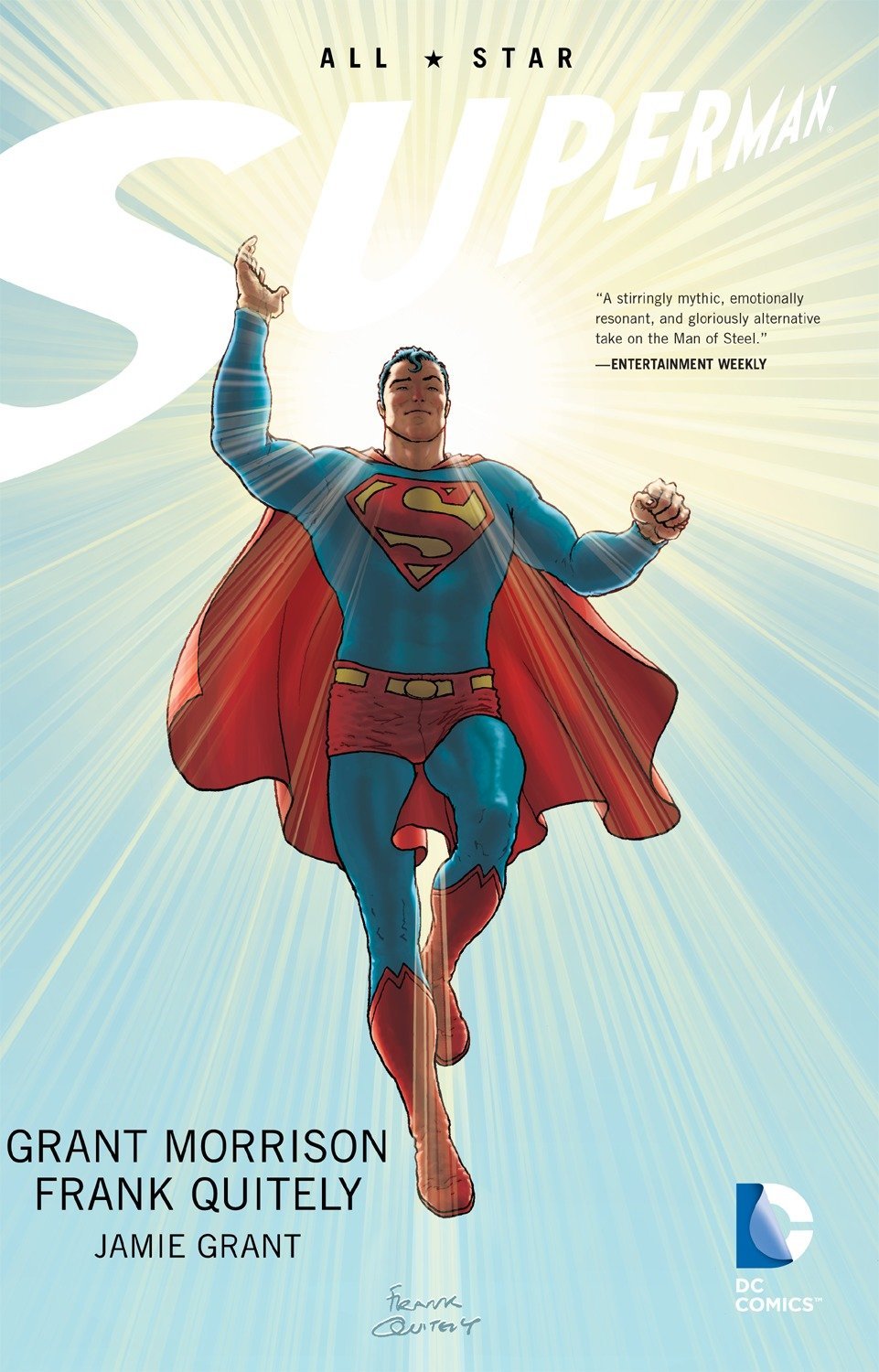
All-Star Superman
This story might be the toughest sell for Mr. Maher. However, I think if any comic can demonstrate the value of superheroes, it’s All-Star Superman. This love letter to Superman and all the fanciful themes surrounding him is a celebration of the ultimate hero. Even if Mr. Maher thinks idolizing heroes is dangerous, I think even he’ll appreciate why Superman is such an icon after 80 years.
What makes All-Star Superman special isn’t in how it depicts the Man of Steel at his best. It’s not just about him saving the day, defeating Lex Luthor, and winning the love of Lois Lane. More than anything else, the story that Grant Morrison and Frank Quietly tell demonstrates just how much Superman inspires those around him.
Throughout the series, there are many great moments that are full of heart, hope, and compassion. Some of it is cartoonishly over-the-top, but it never feels corny. There’s never a point where Superman takes a moment to tell a bunch of kids to eat their vegetables and stay in school. It doesn’t try to make Superman someone he’s not. He’s the ultimate paragon of virtue and this series just runs with that.
To further raise the stakes, this version of Superman is living on borrowed time. As powerful as he is, he has saved the day one time too many. He basically has to do what he can with what little time he has left to make the world a better place. It’s an endeavor that even Mr. Maher can appreciate.
More than once, Mr. Maher has tried to inspire others to be better. Even if his efforts are politically motivated, the will to inspire is something he’s always shown, going back to his days on “Politically Incorrect.” Even if he thinks Superman comics are for kids, he can still appreciate Superman’s efforts to inspire the good in others.
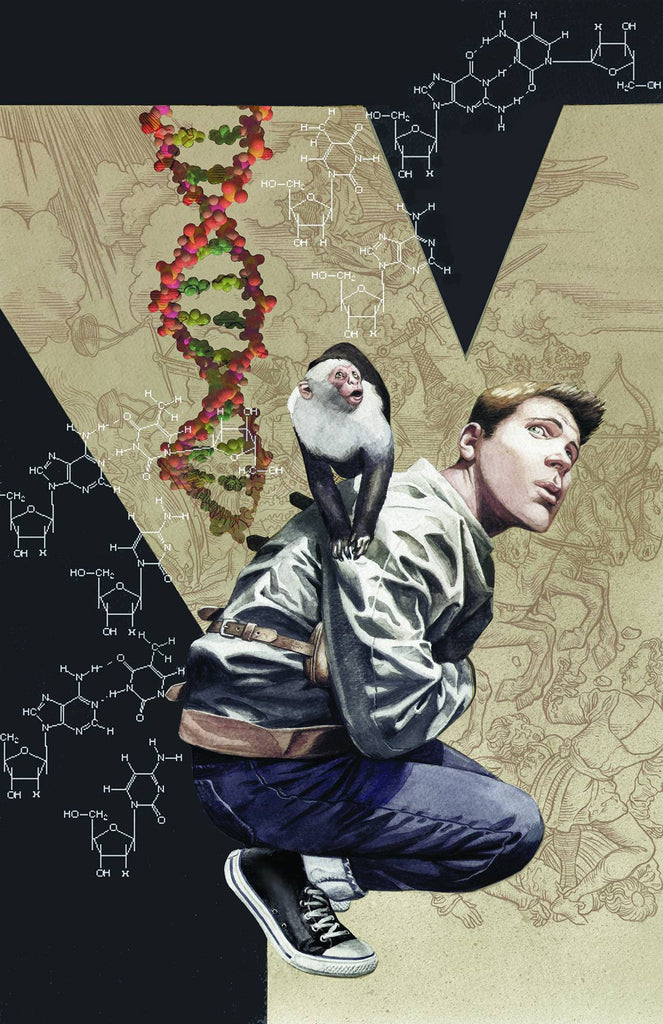
Y: The Last Man
This is another acclaimed comic series that doesn’t rely on superheroes, fancy costumes, or superpowers. At a time when gender politics are such a hot topic, a series like Y: The Last Man is more relevant than ever. This beloved comic by Brian K. Vaughan and Pia Guerra takes issues surrounding gender to an apocalyptic extreme.
As someone who has routinely criticized how the debate surrounding feminism and gender has evolved, I believe Mr. Maher will find a lot to like about Y: The Last Man. This is a story that puts men and women in the ultimate bind. One day, without warning, every creature on Earth with a Y chromosome just keels over and dies. Only one man, Yorick Brown, and his pet monkey, Ampersand, survive.
The story the follows is both a fight for survival and a critical insight into what happens when gender dynamics operate in extremes. The world that Vaughan and Guerra show just how much men and women rely on one another without realizing it. When one is completely removed from the equation, it pushes people beyond the brink.
At the same time, it shows just how resilient people can be in terrible situations. The will to survive knows no gender. It can bring out the best and the worst in someone, but the best is what usually keeps driving us. Mr. Maher has often spoken urgently about issues like climate change. The apocalyptic setting of Y: The Last Man shows why that urgency is necessary.
Again, I don’t expect Mr. Maher to change his mind on much. He has made it abundantly clear in the past that he is very set in his ways. However, if he is genuinely open to seeing the merits of comic books, these titles should help. Comic books may have been for kids when he was a kid. They have since become so much more and their legacy, like that of Stan Lee’s, will continue for generations to come.
Every Wednesday, a new crop of comics enters this world and makes it just a little more awesome. Being a lover of comics in addition to a lover of love, I try to select one comic from this fresh batch that I feel offers the most awesome for just a few bucks. At a time when the economy is always on a verge of tanking, it’s hard to find a better value.
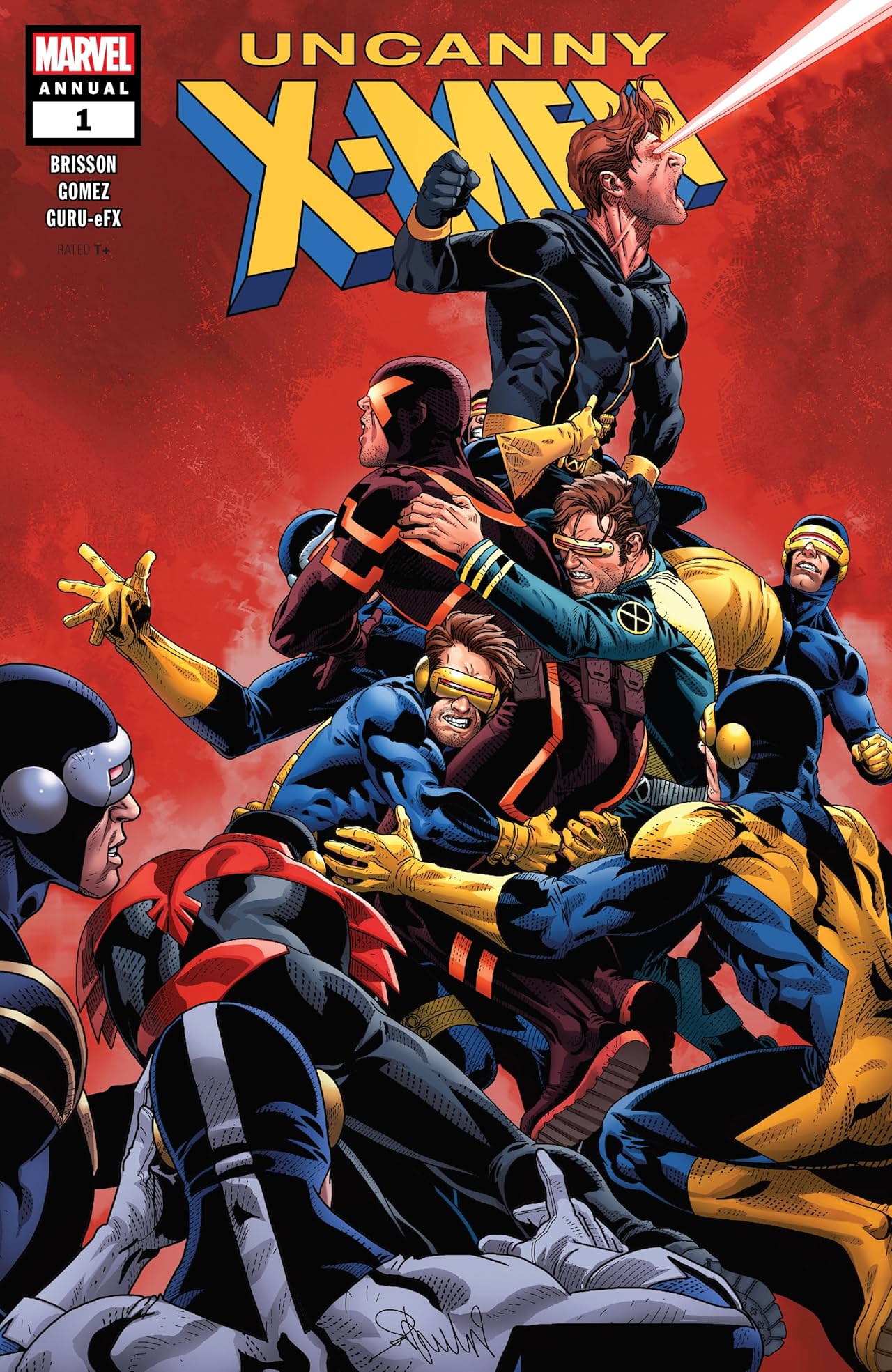
This week’s pick was an easy one with “Uncanny X-men Annual #1” and not just because I’m hopelessly bias towards the X-men, in general. This issue marks a critical development in the overall landscape of the X-men and the Marvel Universe, as a whole. As the beautiful cover art by Salvador Larroca indicates, it’s all about Cyclops.
That may not seem like a big deal for those who don’t regularly follow the X-men comics, but trust me when I say that this is a huge development. That’s because for the past three years, Cyclops has been dead in the X-men comics. In an event aptly called “Death of X,” Scott Summers met an inglorious end at the hands of the Terrigen Mists, the alien gas cloud that gives the Inhumans their powers.
His death had a major impact on the overall landscape of the X-men and very little of it was good. In the same way that the Avengers aren’t the same without Captain America and the Justice League isn’t the same without Superman, the X-men just aren’t the X-men without Cyclops. He’s literally been with the X-men since the beginning and there’s just something missing when he’s not there.
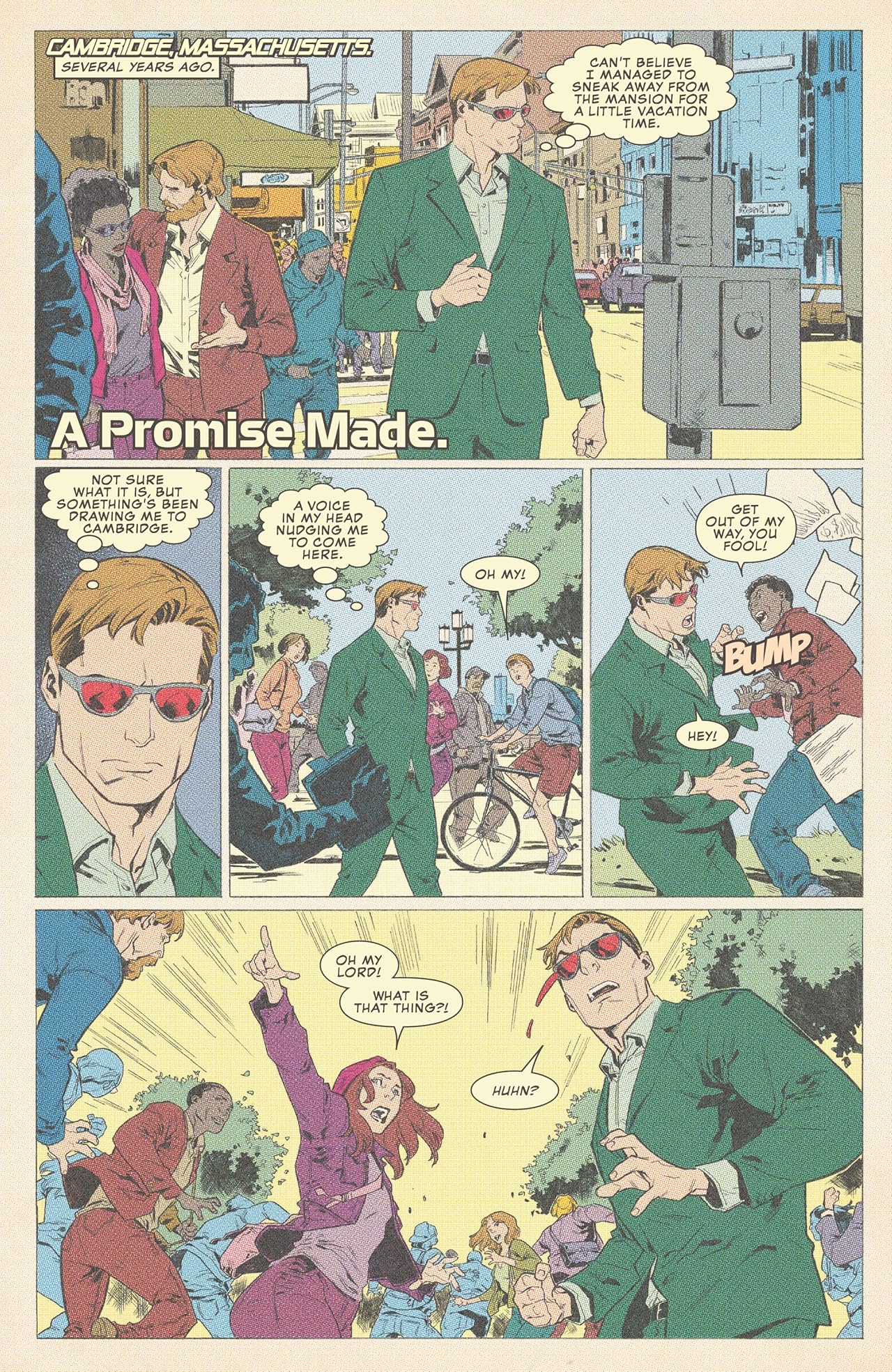
Writer, Ed Brisson, makes it a point to highlight this throughout the issue. Aside from just telling the story of how Cyclops came back from the dead, he takes some time to demonstrate why he’s the leader of the X-men. He even puts him in a position to show why he’s a hero and why other heroes follow him.
Without spoiling too much, the story builds beautifully off the events of both “Death of X” and “Extermination,” which is another brilliant X-men story by Mr. Brisson that I highly recommend. It even references moments from “Phoenix Resurrection,” another story I’ve given high praise. The connections and details in this comic fit beautifully. It shows that there was a lot of effort and thought put into this story.
As someone who has read more comics than most will ever admit to reading, I can safely say I know when a writer isn’t trying very hard. For the past couple years, a new crop of writers that include the likes of Mr. Brisson show that there’s a new round of passion surrounding the X-books and it clearly shows in “Uncanny X-men Annual #1.”
Beyond making appropriate connections to recent continuity, the story checks all the right boxes in terms of telling a quality X-men story. It even checks some extra boxes in terms of showing a character at his best when they sorely need it.
Cyclops is one of those characters who always seems to generate heated debates among X-men fans. He’s also someone a long list of talented Marvel writers have mishandled over the years. The fact he’s part of the worst love triangle of all time is proof of that. This issue cuts through those complications and just gets to the core of what makes Cyclops great.
This issue is one of those comics that will definitely have a ripple effect for future X-men comics. Any time a major character comes back from the dead, which happens a lot in X-men comics, it’s a big deal. It often marks a turning point for the course of the story and lays the groundwork for the future of the series.
By the time you finish “Uncanny X-men Annual #1,” you really feel as though you’ve just witnessed one of those turning points. On top of that, there’s a sense that this character who has been so maligned over the years for all the wrong reasons is back to his old self. If that doesn’t get your inner X-men fan excited, then you’re just being difficult.
For Cyclops fans, X-men fans, and Marvel fans in general, “Uncanny X-men Annual #1” is one of those rare books that actually gets you excited about the future. At a time when you can’t go more than a day without something terrible trending on social media, that’s worth the price of a comic book.
Every Wednesday, fans of comic books and superheroes are blessed with fresh batch of comics. It’s like Christmas every week and you don’t have to suck up to some jolly fat guy who lives at the North Pole. You just have to have a few extra bucks and a Comixology account.
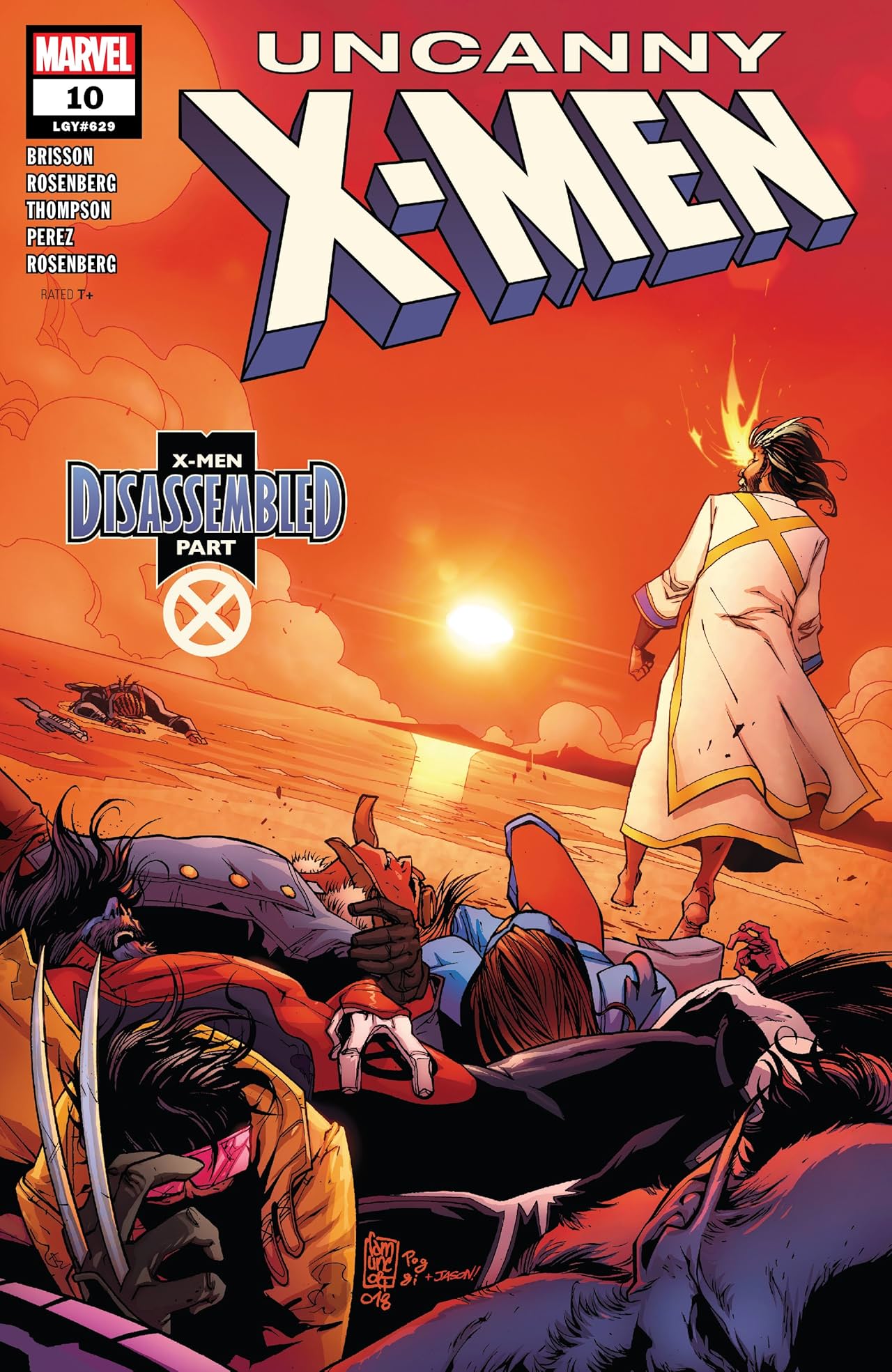
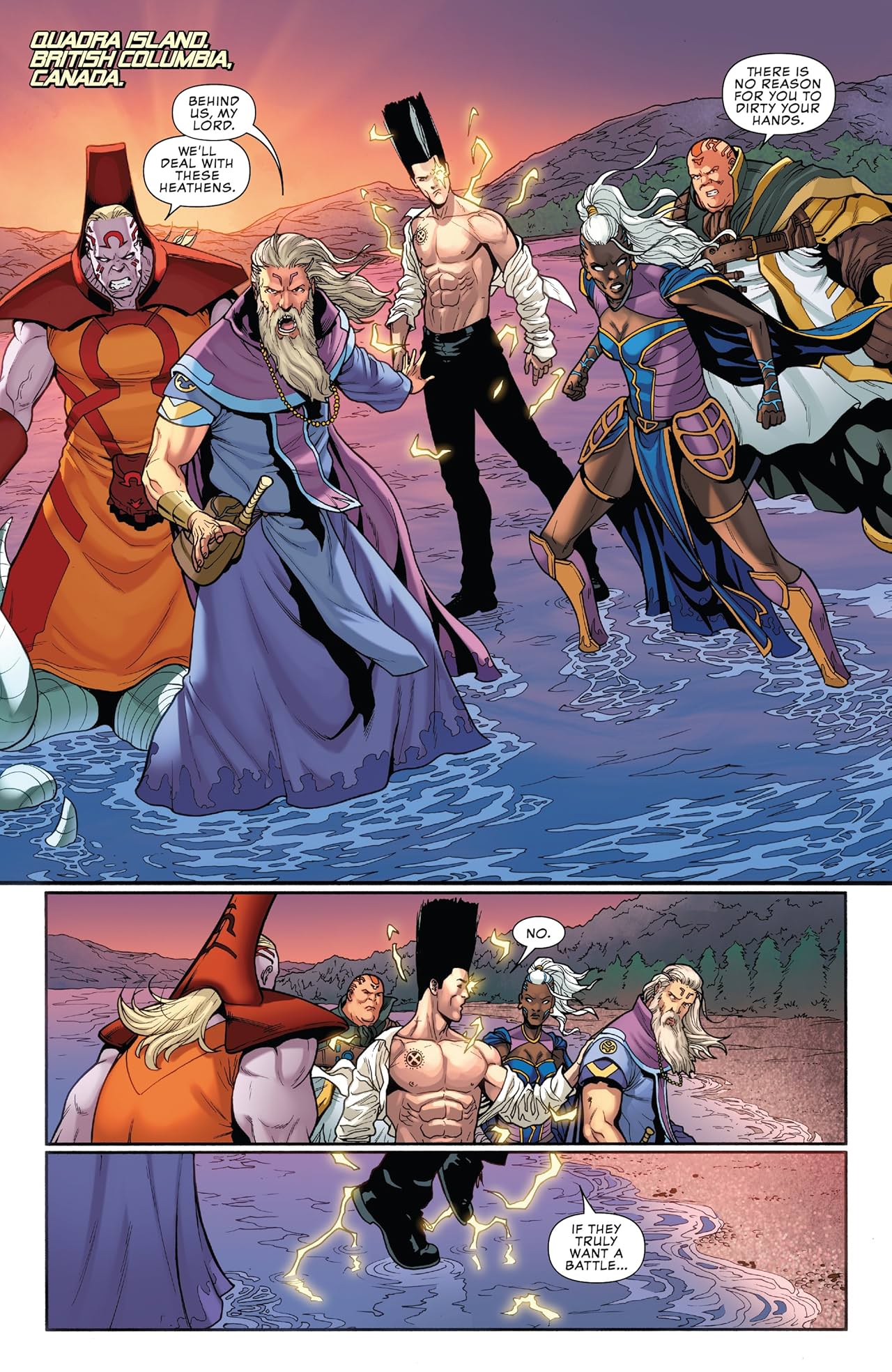
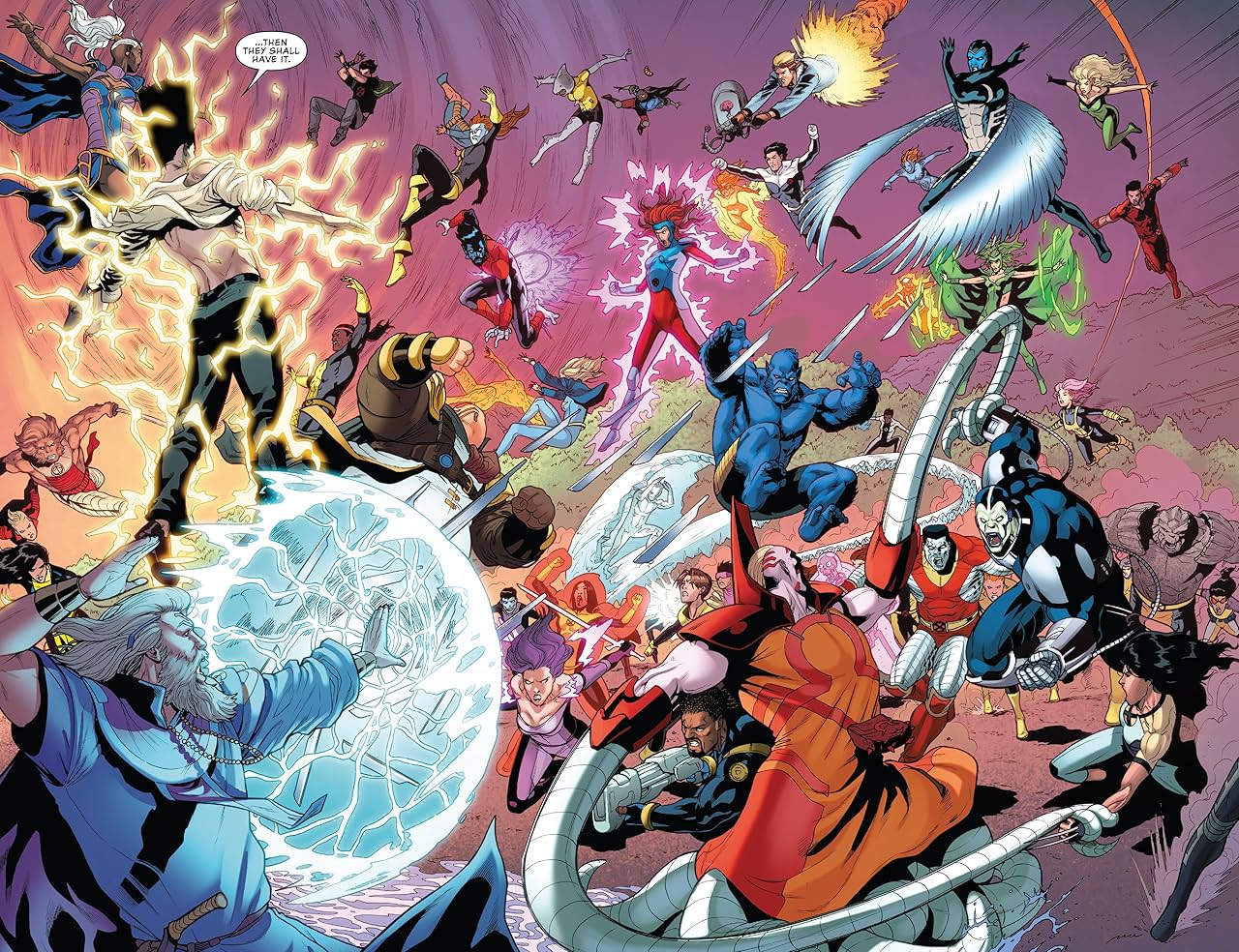
This week, however, those extra bucks go a lot further than usual for X-men fans. That’s because “Uncanny X-men #10,” the final issue in a story arc that assembled almost every notable character associated with X-men has come out. Some weeks are harder than others when it comes to picking the most worthy comic from the bunch. This was not one of those weeks.
Make no mistake. “Uncanny X-men #10” is both a game-changer and a major upheaval for the X-men. It acts as a culmination of a battle that began with the return of Nate “X-man” Grey, but in a powerful new form. He’s not just another displaced character from a dystopian timeline, of which there are many in comics. His agenda is different and his personal connections to the X-men make him a daunting foe.
He’s not Apocalypse. He’s not Magneto. He’s not even some uneasy ally who was once an enemy and the X-men have had plenty of those. Nate Grey is out the save the world, but not by protesting injustice or signing an online petition. He literally wants to destroy it and remake it. Given the insane breadth of his power, that’s entirely possible.
For the past nine issues, he’s gone about his plan with the subtly of a hurricane. He’s abducted senators, mind-controlled powerful mutants, and waged war on anyone who might stand between him and a better world. The X-men, who have a strict policy against over-powered mutants destroying the world to remake it, oppose him at every turn.
“Uncanny X-men #10” is just the final showdown and it’s a battle for the ages. The writing talents of Matthew Rosenberg, Ed Brisson, and Kelly Thompson team up with the artistic talents of Pere Perez to craft a mutant-powered spectacle that never slows down. It’s the most powerful mutants in the Marvel universe against a threat who wasn’t just a close friend. To characters like Jean Grey, he’s family.
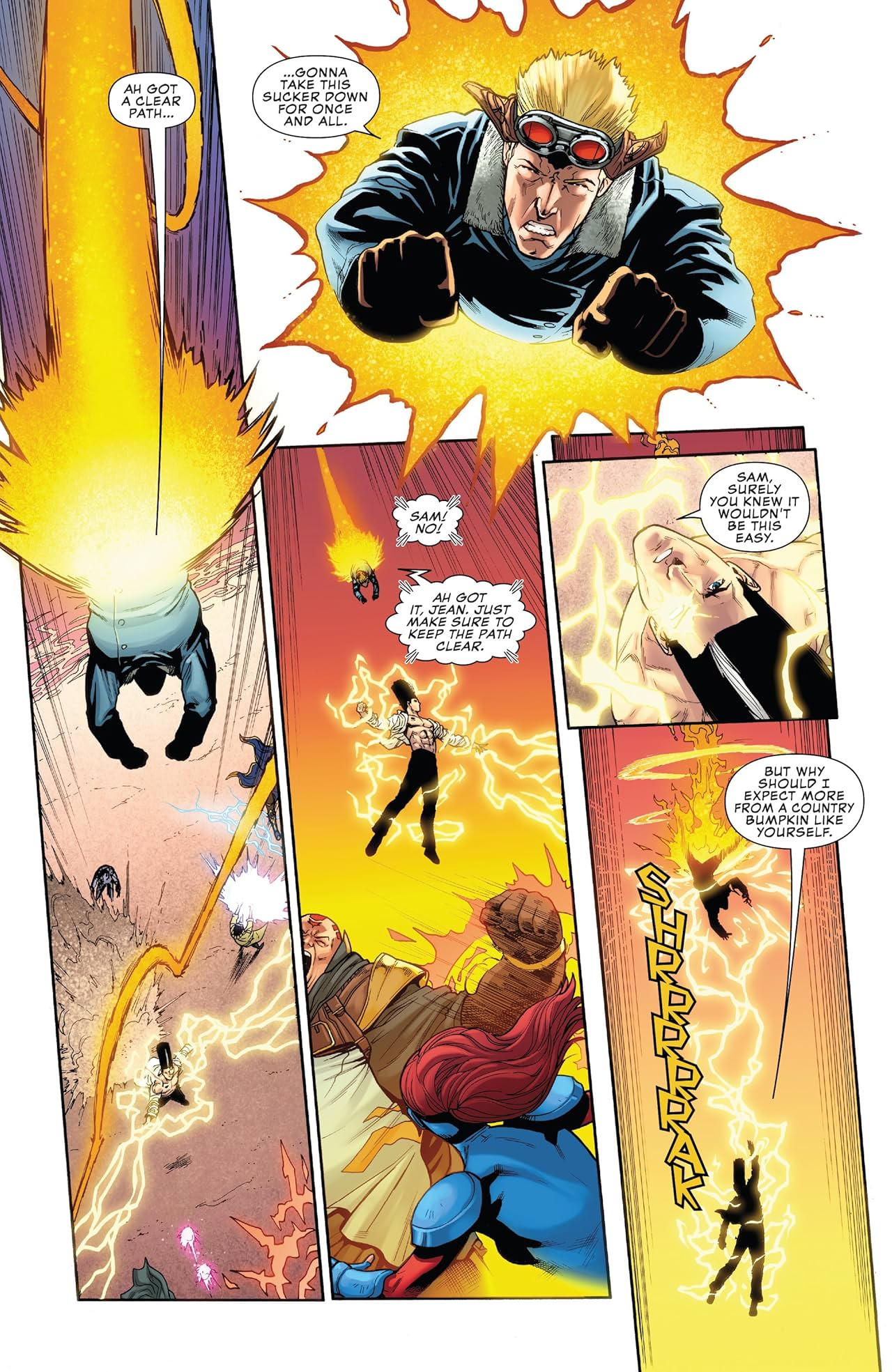
This is where “Uncanny X-men #10” shines in a special way. While a good chunk of the comic is dedicated to epic mutant battles, there’s never a point where the action is mindless and impersonal. In between all the fighting, there are major personal stakes for Nate and his alternate universe mother, Jean Grey.
Their interactions is what really gives dramatic weight to the spectacle. I won’t spoil the details of their exchange. I’ll just say that it’s beautifully done. It’s genuinely heart-wrenching to see Jean having to battle her own son. Even if he’s from an alternate universe, she sees him as family and that makes fighting him all the more difficult.
That kind of heavy drama is what brings out the best in the X-men. It’s what makes for the best moments in superhero comics, as a whole. However, what really makes “Uncanny X-men #10” worth getting is how it sets up the future of the series.
Again, I won’t spoil it. I’ll just say that the aftermath of the battle creates a very different world for mutants, humans, the X-men, and everyone in between. It’s a world where all the hopes and dreams of the X-men are effectively moot. What does that mean for them and those they protect? There are some telling hints, but there’s definitely an impact when all is said and done.
I’m sure there will be plenty of X-men fans who feel both excitement and dread after reading “Uncanny X-men #10.” If you’ve been following X-men comics in any capacity for the past several decades, then you know that’s not unusual. However, this feels like one of those issues that people will be referring to for years to come. Whether they love it or hate it, this comic marks a major turning point for the X-men.
Most X-men fans knew that 2019 was going to be a major year for the Children of the Atom. Between two movies, the pending Disney/Fox merger, and the return of multiplemajor characters, there’s a lot get hyped about. “Uncanny X-men #10” is just the latest catalyst that can only help the X-men’s prospects in 2019.
It’s Wednesday and if you’re a lifelong comic book fan like me, you know that’s the most magical day of the week. Screw sleeping in on Saturday or going out to party on Fridays. Wednesday is new comic day, that magical day when a fresh batch of comics enter the world and make it more awesome. In celebration of this day, I offer my pick of a single comic that I feel makes new comic day that much more awesome.
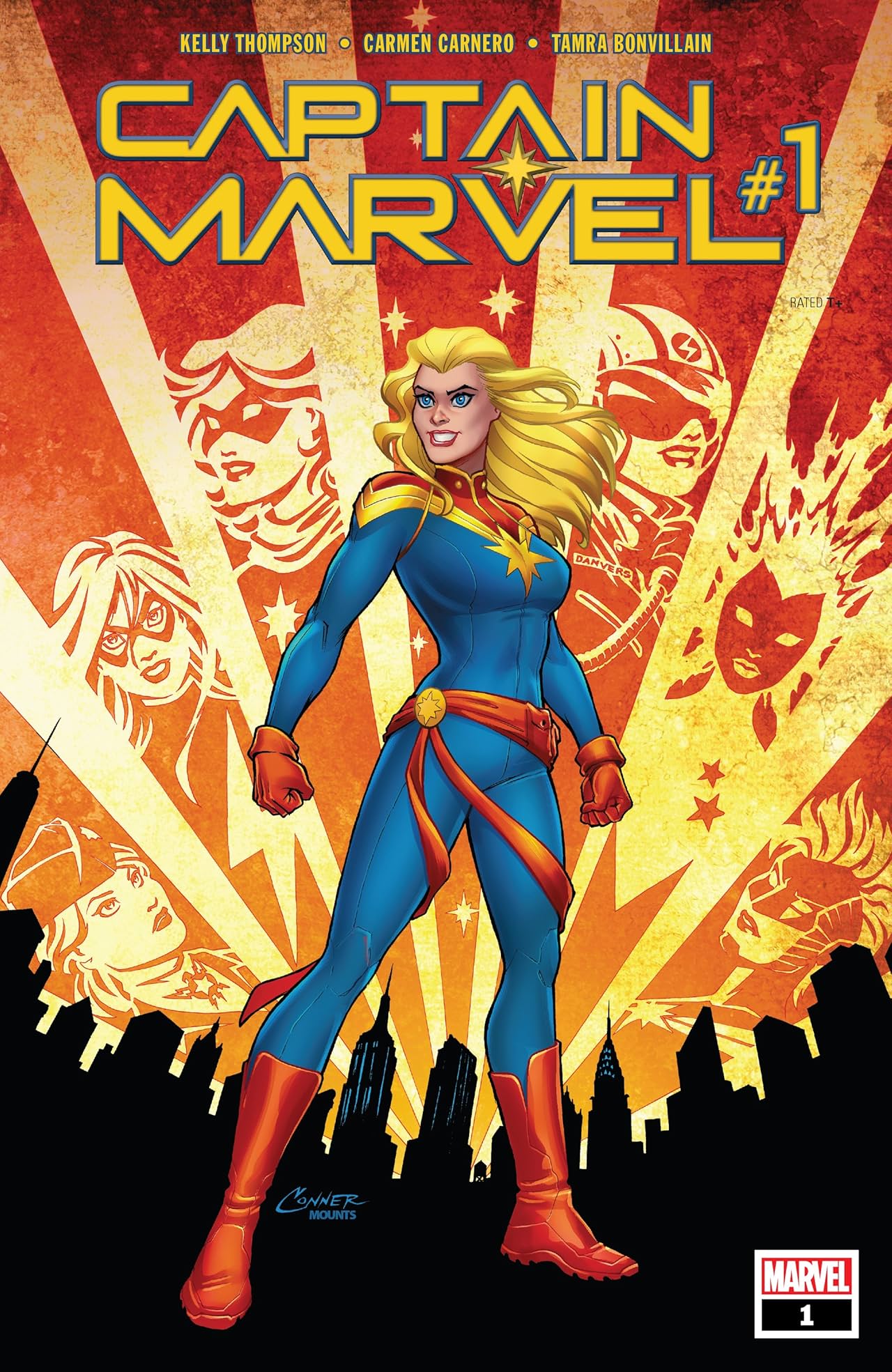
This week was easier than most. If you were up late watching the College Football Championship Game, you saw the latest trailer for the upcoming “Captain Marvel” movie. This year is already shaping up to be an awesome year for Captain Marvel, Carol Danvers, Brie Larson, and everyone affiliated with this marvelous character. Writer, Kelly Thompson, helps do her part with “Captain Marvel #1.”
Even if you’ve never read a Captain Marvel comic and only know the bare minimum about Carol Danvers, this comic is for you. It’s the latest relaunch of the series and after recent upheavals in her life, the timing is perfect. I know a lot of comic fans whine about the number of relaunches that occur these days, but sometimes it’s appropriate when a character undergoes a major transition.
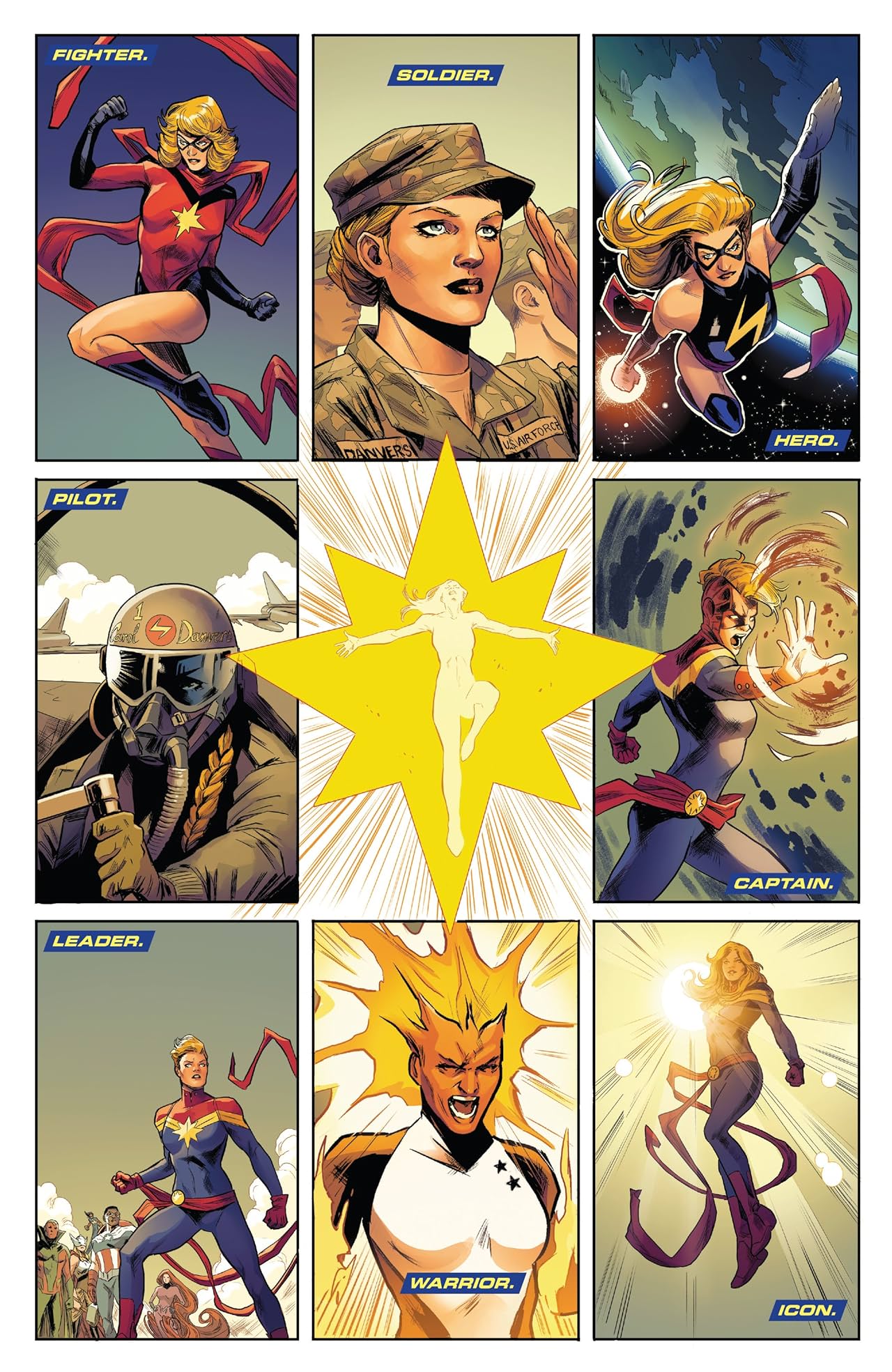
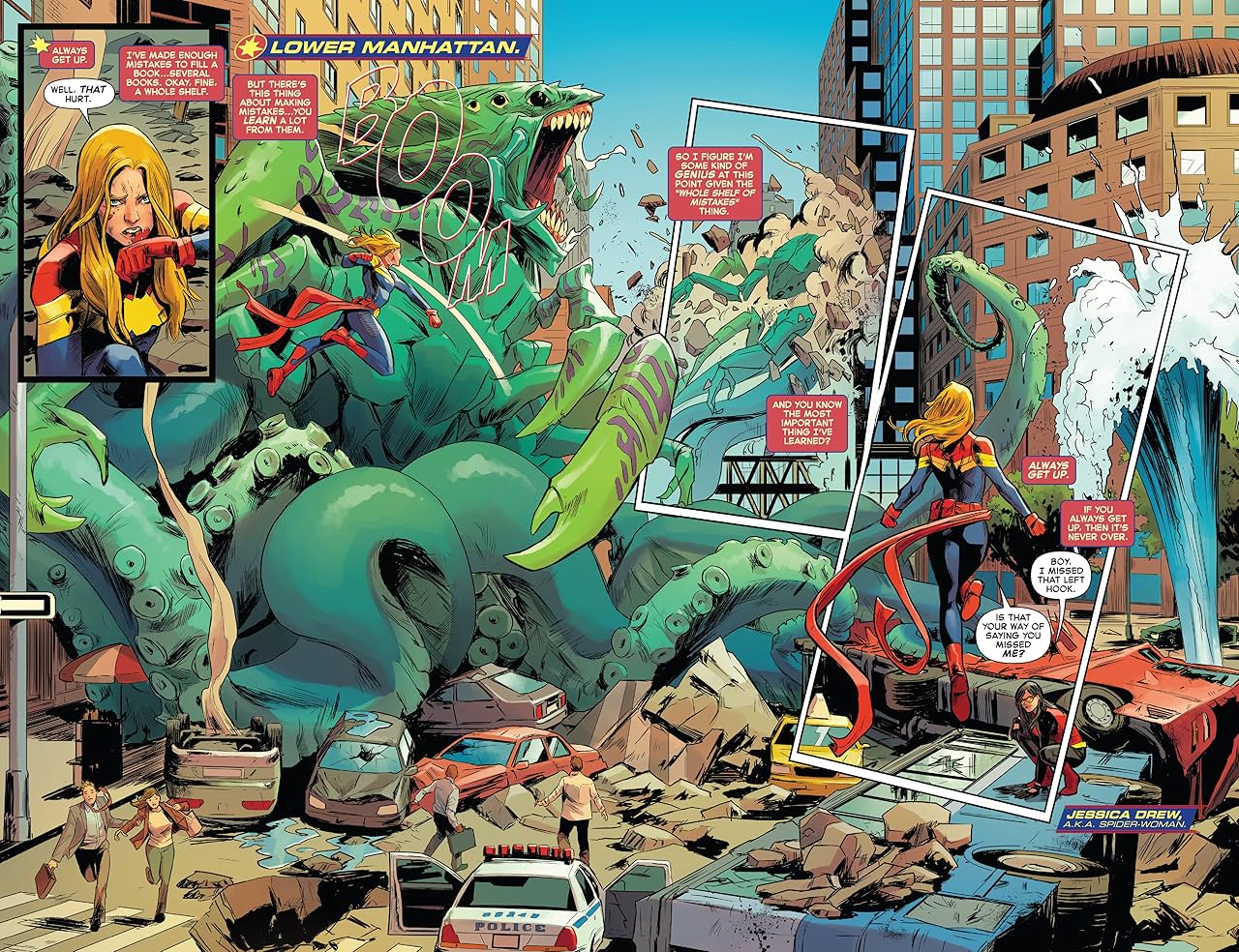
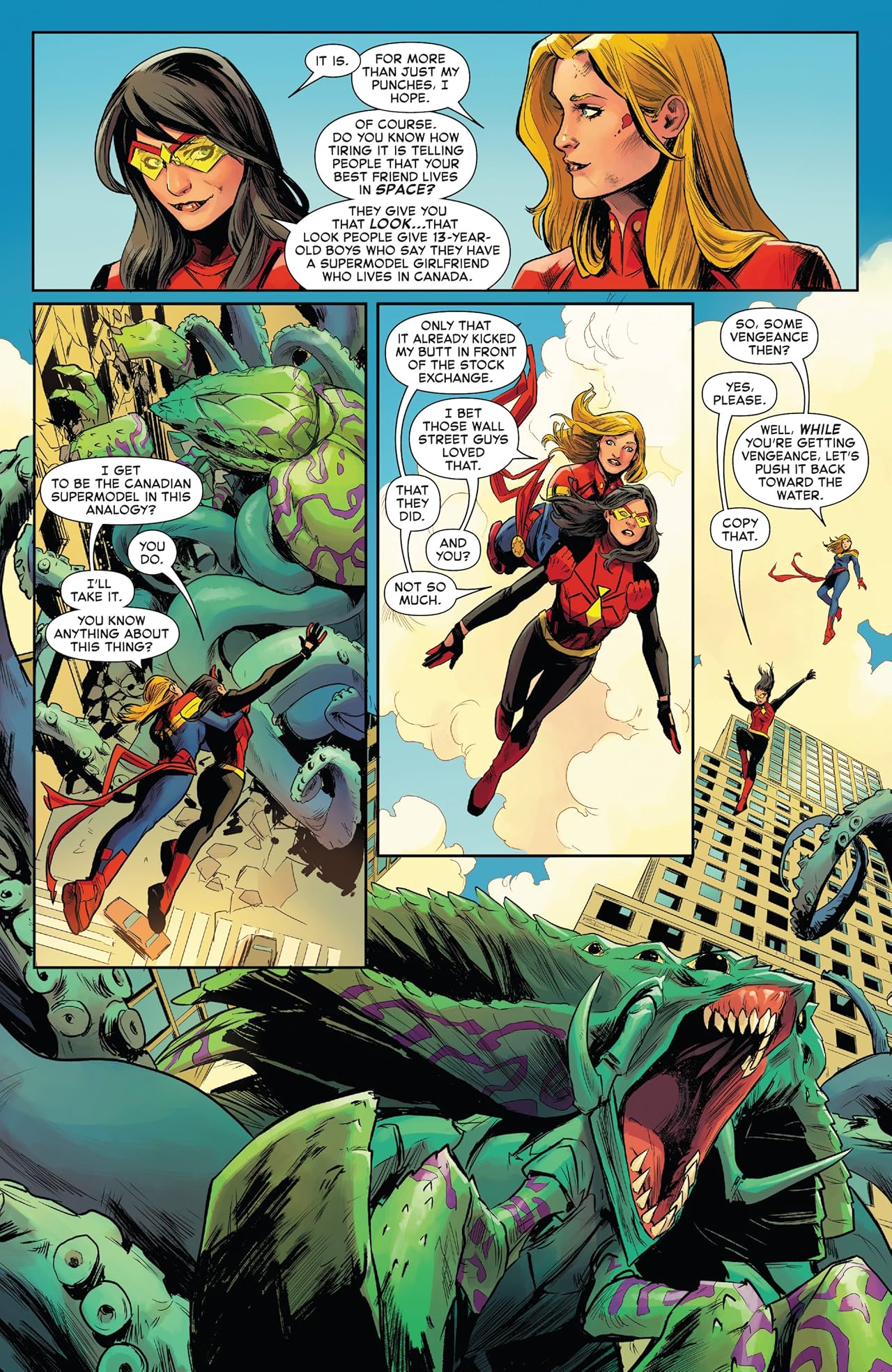
The Carol Danvers in “Captain Marvel #1” is more grounded and self-aware than the Carol Danvers of recent years. She’s focusing less on high-flying space battles and more on events unfolding on Earth. Since Earth also has the occasional Kraken attack in Lower Manhattan, it’s not like she’s short on things to punch.
Beyond just punching monsters, this comic establishes that Carol Danvers isn’t just a hero, an icon, and the star of an upcoming movie that seeks to challenge “Wonder Woman.” She’s an actual person who has thoughts, feelings, insecurities, and even pet peeves. Granted, most of those peeves center around how annoying Tony Stark can be, but that just helps show how human she is, at heart.
Only a small chunk of this comic is spent with her fighting monsters or saving the day. A lot more of it shows Carol rebuilding and reconnecting with the people in her life that matter. That includes her best friend, Jessica “Spider-Woman” Drew, and her frequent love interest, James “War Machine” Rhodes.
It makes for plenty of small, meaningful moments that bring out Carol’s humanity. It helps make the larger, more action-packed moments that much more enjoyable. There is a larger conflict unfolding. There are new threats emerging for Carol that have little to do with space aliens, superhero civil wars, or pre-ordering tickets to her movie.
The nature of those threats aren’t resolved in a few punches. In fact, it sets the stage for a larger story that’ll require Carol to raise the bar for heroes, as only she can. It shows Carol Danvers at her best in addition to showing her at her most human. It’s a perfect balance for a Captain Marvel comic.
It really is a great time to be a Captain Marvel fan. Even if you’re not, “Captain Marvel #1” makes a strong case on why she deserves to be in the upper ranks of Marvel’s greatest heroes. That makes my quick pick this week easier than usual. If you buy only one comic this week, make it “Captain Marvel #1.”
If nothing else, it’ll help tide fans over until the debut of her movie on March 8, 2019.






/cdn.vox-cdn.com/uploads/chorus_image/image/59516921/avengers_thanos_concept.0.jpg)




 Jack Fisher's Official Publishing Blog
Why The Outrage Over Brie Larson And “Captain Marvel” Is Misguided (And Counterproductive)
Celebrities sometimes say dumb things. I doubt most people would contest that. Sometimes, celebrities say things that aren’t dumb, but badly taken out of context. I imagine most people would agree with that too. However, in an era where outrage is a national pastime and social media makes it way too easy to blow things out of proportion, it’s easy for a celebrity to cause controversy for all the wrong reasons.
Brie Larson, whose star is set to rise considerably with the release of “Captain Marvel,” is learning this the hard way and a large consortium of angry people on the internet are intent on making it harder. What should’ve been a culmination of a young woman’s career and a female hero’s ascension to the superhero A-list is now mired in the ugliest kind of gender politics.
The origin of that controversy actually had nothing to do with Ms. Larson’s role on “Captain Marvel.” Back in June 2018, she made some overly political comments while accepting the Crystal Award for Excellence in Film. While celebrities making political statements is nothing new, Ms. Larson’s statement was hardly extreme.
It wasn’t some radical feminist tirade.
It wasn’t some angry rant about the outcome of 2016 Presidential Election.
It wasn’t even some act of elaborate virtue signaling by some smug celebrity.
All Ms. Larson did was advocate for greater diversity among film critics. She didn’t just make such a statement on a whim, either. She did so in response to a study published by the USC Annenberg School for Communication and Journalism that revealed a significant lack of representation in the industry of film criticism.
That’s not an unreasonable concern. The western world is becoming more diverse and the success of movies like “Black Panther” and “Crazy Rich Asians” shows that there’s a market for such diverse tastes. Advocating for greater representation in the field of film criticism makes a lot of sense.
Unfortunately, that’s not the message that some people gleamed from Ms. Larson’s comments. All they heard was that she doesn’t want to hear from white men anymore. They somehow got the impression that Brie Larson resents white men and her movies, including “Captain Marvel,” aren’t made for them. They’re not even welcome in the conversation.
Who these people are and the politics they represent is difficult to discern. I don’t think it’s accurate to call them conservative, liberal, feminist, anti-feminist, leftist, or any other political label. Outrage culture rarely gets that specific, but given the heated politics surrounding movies like “Ghostbusters” and “Star Wars: The Last Jedi,” it’s a frustratingly familiar narrative.
While I can understand some of the outrage surrounding “Ghostbusters” and “Star Wars: The Last Jedi,” in this case I don’t think it’s justified. That’s not just because I’m a big fan of Marvel Comics, superhero movies, and all things Captain Marvel. It’s because the actual substance of Ms. Larson’s words don’t warrant the controversy she has generated.
For specific reference, here’s what she actually said during her speech in June 2018. Read it very slowly and try to understand the context of her statement.
Remember, she said these words after learning how little diversity there was among movie critics. Unlike most people, she was actually in a position to do something about it. Being an Oscar winning actress who was poised to join the Marvel Cinematic Universe, her words carry more weight than most.
Even so, those words were construed as racist and sexist, two exceedingly loaded terms that bring out the worst in people, especially on the internet. Never mind the fact that she made clear in her original speech that she did not hate white men. Never mind the fact that she has since clarified her words. She is still being attacked as some angry radical feminist who hates men, especially those who are white.
It would be one thing if she had said outright that white men should be banned from criticizing certain movies. Many celebrities, including a few still relevant today, have said far worse. However, that’s not what Ms. Larson said. She never, at any point, advocated disparaging white men. She didn’t even say that people who hate her movies are racist and sexist, something the “Star Wars” crowd is painfully familiar with.
Again, all Ms. Larson spoke out against was a lack of diversity among film critics. That part is worth emphasizing because it renders the outrage surrounding her statement as utterly absurd. It also makes the targeted attack on the fan reviews for “Captain Marvel” both asinine and misguided.
Even though the movie isn’t out yet, the movie is being targeted with negative comments on Rotten Tomatoes. Since it has only screened for a handful of audiences, it’s unlikely that any of these people actually saw the movie or were inclined to see it in the first place. Some are even claiming that this has already impacted the projected box office for the movie.
Whether that impact manifests remains to be seen, but it’s worth noting that when “Black Panther” was targeted with similar attacks, it failed miserably. At the moment, early reactions to “Captain Marvel” have been glowing so the chances of these attacks hurting the box office are probably minor at best. If the pre-ticket sales are any indication, the movie will likely turn a hefty profit for Marvel and their Disney overlords.
Even if there were an impact, it would be for all the wrong reasons. It would send the message that there’s a large contingent of people who are willing to work together to tank a movie because of comments a celebrity said that had nothing to do with that movie and weren’t the least bit controversial, when taken in context.
In this case, it was simply twisting someone’s comments to make them sseem like they said things that they never said or even implied. Then, those who bought into that narrative simply use that as an excuse to disparage a movie that they haven’t seen. That’s not just absurd, even by the skewed standards of outrage culture. It sends the worst possible message from those who think they’re protecting their favorite movie genre.
It tells the world that they don’t care what a celebrity actually says. They actively look for an excuse to hate someone who doesn’t completely buy into their preferred status quo. It would be one thing if that status quo was just and reasonable, but that’s not the case here.
All Ms. Larson did was advocate for more diversity among film critics. If that is somehow too extreme, then the problem isn’t with her or celebrities like her. It’s with those determined to hate her. There are a lot of issues in the world of celebrities and movies that warrant outrage, but advocating for more diversity in film criticism isn’t one of them.
I can already hear some people typing angry comments stating that if she had said those same words, but changed the demographic to something other than white men, then it would be an issue. However, the fact remains that this isn’t what she said.
It also doesn’t help that Brie Larson identifies as a feminist and that term has become incredibly loaded in recent years. However, she has never embraced the kind of radical rhetoric that other, less likable celebrities have espoused. Until she does, those determined to identify her and “Captain Marvel” as racist, sexist propaganda are only doing themselves and their politics a disservice.
16 Comments
Filed under Celebrities and Celebrity Culture, extremism, gender issues, Marvel, media issues, men's issues, movies, outrage culture, political correctness, superhero movies
Tagged as anti-feminism, Brie Larson, Brie Larson comments, Captain Marvel, Carol Danvers, celebrities, celebrity controversy, celebrity culture, celebrity scandals, ComicsGate, female superheroes, feminism, gender, gender disparity, gender inequality, gender politics, internet outrage, internet trolls, Marvel, Marvel Cinematic Universe, Marvel Comics, Men's Rights Activists, movie criticism, movie critics, movies, MRA, outrage, outrage culture, political correctness, politics, Racism, Rotten Tomatoes, Superheroes, trolls