Tag Archives: human psychology

Why I Believe That People Are Naturally Good (Another Personal Story)

It’s one of the oldest, most confounding questions in all of philosophy and science. Cantankerous old man and nagging old women alike debate it. Are people fundamentally good or evil? People have been trying to answer that question for centuries, some more so than others. However, the answer never seems to be complete.

It’s a question that has huge implications. If people are naturally good when stripped of circumstance, then that bodes well for our ability to survive when the zombies attack, the Illuminati take over, or aliens invade. It means that “Independence Day” wasn’t too far off in showing how good people could be inspired to do great things.

Conversely, the implications of people being naturally evil are a bit more dire. If the Joker was right in “The Dark Knight” and people are only as good as society allows them to be, then that means our society and our civilization is even more fragile and precious than we think. If something like zombies or aliens attack, then it won’t be long before we become the monsters we dread, hopefully without clown makeup.

I’m not a philosophy buff. I’m also not a scientist. I write sexy stories and talk about sexy topics in hopes of making a living from it. I couldn’t be less qualified to answer this profound question without admitting I sleep with a lead brick under my pillow.  Like a virgin on her prom night, though, I’m still going to try and hope for the best.

I’ve talked about evil before and how that affects iconic villains in fiction, but I haven’t really dug into the better angles of our nature. Sure, I could point out that civilization is getting better by nearly every measure, but the Joker enthusiasts of the world would just point out that’s because people are getting better at boxing in their inherent evil with the comforts of civilization.

I won’t say there isn’t some logic to that. I also won’t get into all the research that has gone into determining the nature of mankind. That stuff is too technical. It’s not going to get anyone’s panties wet in discussing this issue and I have sexy standards to maintain on this blog.

Instead, I’m going to tell a story that isn’t very sexy, but should help get my point across. While my outlook on mankind has changed a great deal throughout my life, often coinciding with high school and failed relationships, I genuinely believe that people are innately good. I know that’s hard to grasp for anyone who watches the news or reruns of “Here Comes Honey Boo Boo,” but I believe it’s more apparent than most people think.

To illustrate that, I want to highlight a moment from my late childhood that I didn’t really appreciate until I became an adult. Whenever I find myself thinking about the nature of man, my thoughts often drift to this memory and I smile for reasons that should soon be apparent.

Picture, if you can, a cold and dreary day in late March. Enter a 10-year-old me, still in grade school and just starting to realize how much I hate school. I wasn’t a miserable teenager just yet, but I wasn’t some cheery child either. I often stressed myself out in way more ways than any kid should, but that’s another story. All you need to know is that on this day, I went a bit overboard.

The weather was getting crappier by the second. That’s when I found out that I left something at school. Keep in mind, I’d just gotten home and just wanted to play video games to unwind. However, I had to go back because this wasn’t something I could put off. I had a big project coming up and, being the neurotic grade-grubber I was at the time, I needed to take care of this.

I remember hating myself so much, if only because it took away from the time I wanted to spend playing video games. Then, after talking to my parents, I decided to ride my bicycle up to the school to pick it up. They told me they could drive by later after they got groceries. That wasn’t good enough for me. I had to punish myself for being so forgetful.

So I got on my bicycle and rode down to the school through the increasingly-crappy weather. I was not happy about having to do it, so much so I just peddled as fast as I could, not caring that I had the athletic prowess of a senile hamster. This quickly proved to be a mistake because, less than a block from my house, I swerved off the sidewalk and crashed right into a gate.

I’m not going to lie. I cried like anyone might expect of a 10-year-old kid. I didn’t hurt myself seriously. I didn’t break any bones. I just bruised my knee and scraped my elbow. If my gym teacher were there, he would tell me to walk it off. I probably should’ve, in that case, but I didn’t. I just sat there in the cold, muddy grass and cried my eyes out.

Now, I’m not proud of it. Remember, I was 10-years-old at the time. I hadn’t exactly refined my toughness yet, nor did I realize that forgetting homework from school was not the end of the world. That didn’t matter, though. In my own limited world, this was basically the apocalypse.

I don’t remember how long I just sat there crying on the sidewalk. At some point, though, a woman from the house right behind me came running out from her back yard to tend to me. The way I was crying, she must have thought I’d been impaled by a tree branch. For all she knew, she was about to walk up to the most horrifying site anyone could see outside of a promo for “Law and Order: SVU.”

That didn’t stop her, though. She just came to me, helped me up, and basically babied me until I stopped crying. I didn’t even know this woman. I didn’t know if my parents knew her either. She was a total stranger and in that same year, my school started giving us all those stranger danger lectures. This woman must have missed the danger part.

I never learned the woman’s name. I don’t even remember thanking her. I just remember drying my eyes, saying goodbye once the stinging stopped, and riding my bike back to the school so I could pick up my stuff. I think she mentioned something about calling an ambulance. I did not want that. After I realized I wasn’t hurt that badly, I finally grit my teeth and got up.

My mood didn’t really change, but that was beside the point. The fact that she, some woman I didn’t know, helped me so much on that miserable day still sent a message to me. It would take a long time for me to appreciate it, but I like to think that woman had a far greater impact than she’d intended.

She didn’t know me, but she didn’t care. I was a wounded child on a sidewalk on a cold, dreary day. She didn’t need to be inspired to help me. She didn’t need some sort of incentive or reward. She just did it. She came to my aid, even when I didn’t appreciate it. On that day, she was basically Wonder Woman.

download

To me, that highlights a part of human nature that’s overlooked and underrated. If the Joker were right and people are only as good as the world lets them, then that woman would’ve needed some sort of incentive to help me. There would have to be some sort of outside pressure to make her do what she did.

The situation I just described might as well have been in a vacuum in a laboratory. There was nobody there to tell her to help me or to belittle her if she didn’t. She didn’t go out and tell the papers either. She didn’t seek any kind of vindication or admiration. I don’t think I ever saw that woman again and I didn’t even tell my parents about the incident until days later. She still did the right thing in helping a wounded child.

If people don’t need to be influenced, guilted, or pressured into doing the right thing, then that just leaves one conclusion, in my book. People are naturally good. That woman who helped me was a genuinely good person.

Granted, there may have been someone else who’d heard my cries and chose not to help. That person might have been a sociopath or might have just seen the woman beat them to the punch. Even if that were the case, though, that doesn’t take away from what the woman did. She still helped me.

The fact that one person can do something innately good in that situation proves that it’s possible. If it happens once, then that means there is something in the human condition that compels us to be good. Combine that with all the other overwhelming acts of kindness that people have done and you can’t ignore the implications.

While I don’t deny that there are some truly heinous people in this world, the fact that they make the news just shows how rare they actually are. There are over 7 billion people on this planet. The kindness and care that people show for one another every day will probably never get reported.

That only furthers my point, though. If being good is so mundane that it never makes the news, then that tells you all you need to know about the innate goodness of people. For me, it took one woman on one miserable day to convince me of that. I wish I’d learned that woman’s name. I wish I could thank her for what she did for me. She’ll probably never read this, but I’ll say it anyway.

Ma’am, whoever you are and wherever you are now, thank you for helping that crying 10-year-old boy that day. You helped convince him that people are genuinely good.

10 Comments

Filed under Jack Fisher's Insights

Why Nice Guys DON’T Finish Last (Or First)

We’ve all heard it before. It’s the primary plot of nearly every teen movie ever made. It’s the secondary plot of every underdog movie ever made. It’s also the title of a classic Green Day song. Say it out loud in almost any context that isn’t on the set of a porno and most will agree.

Nice Guys Finish Last

When we look at the world through our irrational, caveman brains and glean our information primarily from movies, sitcoms, and Fox News, that certainly seems to be the case. It’s almost obvious that we live in a world nice guys solely exist to act as toilet paper to the Biff Tannens, Bernie Madoffs, and Kanye Wests of the world.

In a sense, it’s comforting. Being a nice guy means you’ll carry the spirit of a lovable loser and who doesn’t love a lovable loser? Sure, Cleveland Browns fans would probably beg to differ, but it’s that very mindset that makes us content with the status of nice guys and gives us an excuse to scrutinize the concept through the harsh lens of reality.

As I’ve made clear before, I don’t care for excuses that don’t involve donuts, comic books, or nudity. That’s not to say I have anything against nice guys. I too consider myself a nice guy. You won’t find me punching a small animal just to impress a couple of cute cheerleaders. There are far more honorable and pragmatic ways for that sort of thing.

Instead, I’m going to add a little bit of context to the whole concept of nice guy finishing last. I’ve already highlighted how being a nice guy is a laughably low standard with which to base your appeal as a person. Most of the people on this planet are nice. The only reason you know about the assholes more is because they’re the ones that end up with TV shows and professional trolls.

So even if there are mostly nice people in this world, does that mean they finish last? Well, to answer that, it helps to build a story around the context. I could try to cite studies that show that just being likable tends to get you more opportunities in life, but that’s not very sexy. Nobody comes to this blog for scientific studies that don’t involve sex robots. They come here for sexy stories.

With that in mind, here’s the story that every nice guy should learn before they hit puberty:

You walk into a casino with all your life savings and you have to gamble it all of it on just one game.

In some of those games, the risk is high and the reward is high in the short term, but that reward naturally decreases no matter how much you win at other games.

In some of those games, the risk is very low, but for each dollar you don’t bet, you end up losing twice as much in the long run.

Then, there’s this one game in the middle of it all where if you bet on it, you probably won’t win big, but you won’t lose either. The odds are stacked in such a way where that over time, your money increases. It’s slow and tedious, but it does go up. It’s just a matter of patience and playing the odds, which are objectively on your side.

With all this in mind, which game do you play?

If you’re a smart gambler in any sense and don’t have any self-destructive tendencies, then the choice you make in this story is fairly clear. You end up playing the third game because that’s the only game that, in the long run, will increase your life savings.

That third game is basically what it means to be a nice guy. It is akin to investing in an index fund in the stock market. Ask nearly any financial guru, including Warren Buffet, and they’ll say the same. An index fund is the safest, most effective investment anyone can make. It won’t beat the market, but you won’t lose to it. Just not losing to the market is enough to make a lot of money in the long run.

Being a nice guy is one of the best investments you can make in yourself because, on the whole, it increases your value as a person and as a functioning member of society. In general, people want to deal with nice people. People want to work with them. Some even want to have sex with them. It is, by far, the easiest and most effective way to get ahead in the long term.

The main problem is the payoff sometimes takes a while. There is also some element of luck involved, but not in the Vegas odds sort of sense. For those willing to take more risks, being a nice guy just isn’t enough. Being a nice guy just takes too damn long.

That’s how you end up with the professional trolls I’ve mentioned before. These are people who are gambling that being an asshole will help them stand out. It’ll help them get attention, which they understand on some levels is a valuable asset.

That attention may be negative. In fact, it often is negative. Being an asshole in a world of nice people helps you stand out. It makes you different, exciting, and charismatic to some degree. However, all that is a quick short-term gain. In the same way these crazy things get people’s attention, those same people will just as easily get bored or frustrated with it. As I’ve said before, there is a lot of power in boredom.

That’s why a lot of those arrogant, Biff Tannen jocks from high school end up pumping gas, digging ditches, or getting shanked in prison. Being an asshole, in the long run, decreases your value because it hinders your ability to form social connections. Without those connections, there’s going to be nobody to help you up when you fall flat on your face.

That’s not to say that being an asshole doesn’t pay off big for some people. Alex Jones, Milo Yiannopoulos, and most successful YouTube stars are proof of that. They do finish ahead of the nice guys. However, they are the exceptions and not the norms.

Most of the assholes are so far behind the nice guys that they have no hopes of ever catching up. Some just quit the race entirely and cede their rank to the nice guys because they know too many people hate them to hope for a break. It can be somewhat tragic, but it does benefit the nice guys.

On the opposite end of the spectrum, you have the overly careful type people who despise both the nice guys and the assholes. I knew people like this in high school. I was almost one of them. These are people who are so bleak in their outlook on life that they don’t bother being nice or mean. They’re just a walking ball of gloomy nihilism.

Other than grunge rock and Marilyn Manson, you don’t see too many instances of this paying off in the long run. Even if you’re not an asshole who kicks small puppies for fun, people will still avoid you if you’re a pain to be around. If every hour of your day involves whining about how terrible and awful everything is, then nobody will want to work with you, help you, or sleep with you.

As a result, the nice guys beat those gloomy goths with ease. They finish ahead because, and it’s worth emphasizing, people prefer to work with those who are likable. They will help, befriend, and have sex with those who are nice to be around. Again, it won’t happen all at once. It will take time, but in the end it will pay off.

So in a sense, Green Day got it wrong. Nice guy’s don’t finish last. However, they don’t finish first either. Given how few of those who try to finish first ever make it, your best bet is to just make sure you don’t finish last. In that sense, being a nice guy is the safest bet you’ll ever make that doesn’t involve jello shots.

3 Comments

Filed under Jack Fisher's Insights

The Attention Economy (And Why It’s Ruining The Internet)

Here’s a little pop quiz that most people will probably fail. What is the most valuable asset in today’s modern economy? Go on, take a few minutes if you have to. I know it sounds like an easy question to answer, but it’s still worth thinking about.

Is it gold? Historically, it is one of mankind’s most valuable materials.

Is it money? That makes sense. People call it the root of all evil for a reason.

Is it knowledge? Smart people can be pretty damn successful.

Actually, it’s none of these. Even money, that one major driving force behind every major heist movie, is not nearly as valuable in today’s economy as it was 50 years ago. If anything, it’s losing its value and becoming an increasingly esoteric concept, so much so that we consider bits of computer code to be money.

There is, in fact, one other asset whose value exceeds them all. We know this because businesses, artists, and even horny people trying to get laid go to obscene, if not annoying, lengths to get it.

That’s right. I’m talking about that most precious of assets that drives the entire modern economy. I’m talking about attention.

Yes, that word deserves bold and italicized fonts. It’s just that important. It may seem like hyperbole to those still used to picking out pocket change between couch cushions. It’s not like you can tip a stripper with attention. However, give it just a little bit of thought. It won’t take much to realize just how important it is. It doesn’t just drive the economy. It drives (or hinders) our love lives.

I know this because it ties directly into my ongoing efforts to be an erotica/romance writer. It also ties into my efforts to make this blog a successful supplement to those efforts. There’s a good reason I try to avoid overly boring topics and talk about kinky things that both raise eyebrows and moisten panties. It’s a way for drawing attention to my work. It is, without a doubt, the greatest challenge I face as a writer.

Talk to anyone who has ever worked in marketing, whether it’s selling books or diamond-encrusted dildos. They’ll probably say the same thing, although the people selling dildos will probably have better stories. The hardest part of selling anything is getting peoples’ attention.

I know I keep referencing this same famous movie clip, but it’s just that powerful. It keeps finding new ways to be applicable to so many things, from making money to finding love. There’s a reason why Alec Baldwin won an Oscar for it. It’s the same reason why you don’t hear from a lot of other Baldwins these days.

Between the bragging, bullying, and brass ball props that Baldwin’s character uses, the most important part of his distinctly de-motivational speech is the A.I.D.A. method he describes. That’s attention, interest, decision, and action. Every major marketing method follows this model to some extent, but it’s that first step that is most vital.

It’s also the step that is most difficult, especially in the era of 350 channels, YouTube celebrities, and internet memes. For most of the modern era, we had only a handful of TV channels, newspapers, and methods for disseminating information. It used to be that a few strategically placed commercials during the Super Bowl would be enough to generate the attention you needed.

Those days are deader than analog cables and betamax. Instead, you have hundreds of channels containing countless shows, stories and sites doing anything and everything to get every last second of your attention. Is it really that surprising that the gratuitous violence/nudity on “Game of Thrones” and iconic franchises like “Star Wars” have become the new standard?

These things get your attention. These things get people talking. It’s only after you have someone’s attention that you can even begin to plan on how you’ll get them to pay for your product and/or have sex with you. In an era of so many choices and so few opportunities, attention might as well be encrusted in polished diamonds.

It’s because that attention is so valuable, so much so that it’s become the main currency of the modern era, that the internet is changing and not necessarily for the better. Spend more than five minutes on the internet, whether you’re checking your email or watching porn, and chances are you’ve run into a little something called clickbait.

In the attention economy, clickbait is akin to the muggers who beat up sick orphans while drunks throw pennies at them. It is the clogged toilet and overflowing septic tank of the internet. They are sites, ads, and shady tactics meant to draw you away from productive activities, like checking your email or reading this blog, and into some buggy, browser-crashing site meant to extract your attention and credit card information.

We’ve all seen them. The names of the sites and the annoying ads they post are ridiculous. Sometimes, it’s painfully obvious. However, it’s still tempting at times to click on them and that’s exactly what makes clickbait so evil.

Like it or not, people need to make a living. Websites need to make money. I need to make money. I can’t tell sexy erotica/romance stories without a roof over my head, food on my plate, and a reliable internet connection. That’s why I promote my novels every chance I get. I haven’t resorted to clickbait yet, but it is tempting. It’s also very frustrating.

I’ve seen the same internet as everybody else. I’m just as annoyed by the abundance of clickbait as everyone else. It’s hard to even trust the text within a link these days. At the same time, however, I can understand the intent behind it.

People are trying to make money. They can’t do that unless they get the attention of customers. The problem is that as the size and prevalence of the internet has increased, our capacity for attention has not. We humans only have so much brain matter in our skulls. That brain can only give a finite amount of attention to a handful of things at any given time.

Until we can start augmenting our brains, which Elon Musk is working on as we speak, this limitation isn’t going to change. We’ll still only be able to give a certain amount of attention to ourselves, mass media, and each other. As such, the amount of clickbait we see on the internet is only going to increase. The sheer absurdity of the headlines is likely to increase as well. I’ll give everyone a moment to shudder.

It’s unavoidable, but understandable. The internet may seem infinite, if only because of the varieties of porn it stores, but it’s not. It can’t run itself for free either. It needs to make money somehow and nobody seems to want to pay for it. Why else would some people resort to Kickstarter, which is basically digital begging, to fund movies?

We’re all guilty of it. I certainly am. I’ll whine constantly about pop-up ads and video ads on a site, but refuse to pay the extra $10 for the “premium” version that removes the ads. While some feel that kind of service is exploitive on the same level as price gouging for medicine, it makes sense. Again, the people managing these sites need to make money and nobody seems keen to want to give it.

The internet will continue to evolve, as it always has. That evolution will be driven primarily by a desire to turn a profit. Unfortunately, no profits can be made unless someone gets enough attention first. As evil and annoying as clickbait may be, we have only ourselves to blame for its existence. At least for now, it’s here to stay. The best we can do is grit our teeth, read some sexy novels, and endure.

9 Comments

Filed under Jack Fisher's Insights

Celebrities, Loneliness, And The Price Of Fame

We all love to dream about it. We all love to build an elaborate fantasy in our minds. It’s right up there with our fantasies involving Channing Tatum, Kate Hudson, and a pool full of premium lube. It’s that tantalizing idea that we, despite our unremarkable physical traits, limited talents, and lack of opportunities, could be a celebrity.

It’s not an unreasonable fantasy to entertain. Celebrities are constantly showing off how awesome their lives are. They live in big, opulent mansions. They have more money than most of us could ever spend in a lifetime. They’re surrounded by servants and assistants who cater to their every whim,  be it a sandwich or a threesome with a couple of Swedish bikini models.

Whether they’re a movie star, a TV star, or a rock star, we all envy their extraordinary lives. That’s why it’s always so shocking and confusing when we hear that a famous, accomplished celebrity has taken their own life. It’s a tragedy and one that evokes an outpouring of mourning.

It was just hard to imagine someone as beloved and cherished as Robin Williams taking his own life. Just recently, it was hard to imagine someone like Chester Bennington from Linkin Park doing the same. These men achieved a level of success that even other celebrities envy. Why would they make such a terrible decision to end their lives?

It’s a question that we find ourselves asking way too often. Celebrities have been taking their own lives with alarming frequency in the 21st century. Some, like Kurt Cobain and John Belushi, had well-documented issues with substance abuse. Some, like Corey Haim or Freddie Prinze, saw their fame and fortune fall over time.

Whatever the circumstances, the shock still resonates. The question still remains. Why would someone who achieved something so few achieve choose to end their lives? Some of these people came from poor, impoverished backgrounds. Why would they end it after achieving the kind of success that most only dream of?

These are impossible questions to answer because we can never know what goes on in someone’s mind when they decide to take their own lives. We can speculate, but we can never truly know. I certainly won’t claim to know what was going on inside Chester Bennington’s mind. That would be wrong, especially as his family, friends, and fans mourn him.

However, even if we can’t know, there is one way to gain some insight into this tragedy. It requires another thought experiment, albeit one of the more uncomfortable variety. Considering how uncomfortable some of these experiments have gotten, that’s saying something. Even so, I think it’s an important insight to have, especially when you’re trying to make sense of celebrity culture.

Picture, for a moment, that you wake up in an alternate universe of the world you know. Everything is the same, from the shape of the planet to the laws of physics to the annoying video ads you see before YouTube videos. The main difference is that in this world, you have none of the friends or family that you know and love.

Instead, you’re in a world surrounded by total strangers. Most act nice. Some even try to be your friend. However, you don’t know for sure whether you can trust them. These people and this world may seem familiar, but it might as well be totally alien, complete with little green men and anal probes.

Then, throw in another huge complication. Imagine you’re rich and famous. Everybody wants a piece of you. Everybody envies what you have. People you don’t know and never would’ve known in your old life just throw themselves at you. They want to be with you physically, emotionally, and often sexually, as is often the case with rock stars. They even claim to love you with all their heart, sometimes excessively.

Therein lies the problem, though. How can you be sure they actually love you? How can you even trust them when they make such bold proclamations? You’re rich and famous. They’re not. You have a lot. They don’t. They also don’t know you on a truly intimate level. They know the image of you, be it in the movies or on a stage, but they don’t know the kind of person you are when the cameras go off and the lights fade.

Maybe these people want some of your money. That does happen, especially with women looking to hook up with athletes and rock stars. Maybe these people want a piece of your fame. That’s where you get some of the crazy fans who will throw themselves at their celebrity crushes in a frenzy. Maybe they really just want to have sex with you because they get a huge thrill out of having sex with famous people.

There are way more possibilities I can list, but at the end of the day, you can never know for sure. You can never truly trust someone who claims to love you. You can’t even just walk down the street, make some new friends, and build new bonds from there. You’re a celebrity.

Your entire life is overly scrutinized. People only know the character that is you, but not you on a truly intimate level. It means that, even among those who claim to be your friends, you end up feeling alone. Add on top of that the everyday stresses of being a celebrity and your caveman brains will start to strain.

Image result for stress of loneliness

Could you really function with that kind of mentality? Could you live the rest of your life not being able to trust anyone around you? Could you handle being in a world where nobody truly knows the real you?

Many think they can. Why else would there be lines around the block to participate in the next American Idol rip-off? I don’t doubt these people are sincere, but I doubt they’ve actually thought about the implications of celebrity life. I doubt anyone does, even if they were born into it.

There is a price for fame and fortune. It’s downright Faustian in its cost. Sure, you might be able to live in luxury, your every whim and desired pampered to at every hour of the day. However, you’ll still be isolated and alone. You’ll be stuck in a world where you can never be sure of who to trust. You can never know whether someone actually cares about you or the celebrity version of you.

Image result for alone in a crowd

That kind of loneliness and isolation can be pretty debilitating. It’s also completely incompatible with the default settings of our caveman brains. We are very social creatures. We crave connection and bonding. I’m not just talking about the sexy kind either. Take that away from us and it really screws us up. That’s why solitary confinement is rightly considered torture.

When you feel things like that, you naturally want them to go away. This isn’t a headache, a broken bone, or chipped tooth, though. This is a very different kind of pain, one for which you can’t fix with a band aid and an aspirin. That’s why many celebrities will turn to drugs and vices.

I’m not just talking about heroin, cocaine, and orgies either. Some celebrities will go so far to alleviate that isolation that they’ll effectively cut ties with reality and try to live in their own fantasy world. We saw that happen with Michael Jackson. We’re seeing that with celebrities like Tom Cruise, who uses a sci-fi cult religion that’s famous for legal extortion to deal with these feelings.

At the end of the day, no matter how successful or glamorous they may be, celebrities are still human. They’re still wired like our caveman ancestors, even if they believe weird things. If they struggle to meet these very basic human needs, then it’s going to cause problems and some of them will end in tragedy.

That’s not to say it’s impossible to manage. There are plenty of celebrities who do an excellent job handling the fame, fortune, and attention. Celebrities like Hugh Jackman, George Clooney, Jennifer Anniston, Bruce Springstein, and even Weird Al Yanckovic regularly show that it is possible to survive that lonely world.

While these celebrities show it is possible for some to function, it doesn’t make the tragedies of those like Chester Bennington any less painful. It also wrongly convinces many that they can handle that world too. Nobody aspires to be a celebrity if they aren’t convinced they can’t handle it.

The hard truth is, though, that precious few people can pay the price that comes with fame and fortune. Fame and fortune may make for an eventful life, but it doesn’t make us any less human. It doesn’t make loneliness and isolation any less debilitating.

Chester Bennington, Robin Williams, and countless others struggled with that loneliness. They endured that struggle on top of whatever personal pain they also carried with them. No amount of fame and fortune can make that struggle less agonizing. For some, it’s just too much.

It’s a feeling that few outside the celebrity world can understand. When everyone wants a piece of you and everyone wants to tell you what you think you want to hear, there’s no way to know for sure who you can trust. In the end, it leaves even the most talented and gifted among us feeling lost. In a sense, that only doubles the tragedy when a celebrity takes their own life.

2 Comments

Filed under Jack Fisher's Insights, Thought Experiment

Rick Sanchez: An Anti-Hero Forged By Boredom?

Image result for Rick Sanchez

Greetings, and wubalubadubdub! If you have no idea what I just said and worry that I’ve suffered some kind of traumatic head injury, then calm down. It’s nothing like that. If you happen to know what that word means, then congratulations. Your life is inherently richer because you’ve watched a show called “Rick and Morty.”

For those of you who think “South Park” is too polite, “Rick and Morty” is right up your alley. It’s crude, lewd, callous, crass, vulgar, obscene, and pretty much every other word you would use to upset a typical PTA meeting. It’s also one of the most hilarious, insightful, smart, and wildly entertaining shows on TV right now. Unless you find shows like “Family Guy” too harsh, a show like “Rick and Morty” will appeal to you.

Why do I bring this show up? I usually don’t do post just to lavishly praise a particular TV show or movie without making a larger point. While I may make exceptions to movies like “Wonder Woman,” I usually try to tie it into a larger discussion. This time is no different. At some point, I was going to use “Rick and Morty” in a discussion. It was only ever a matter of time and topic.

Image result for Rick and Morty

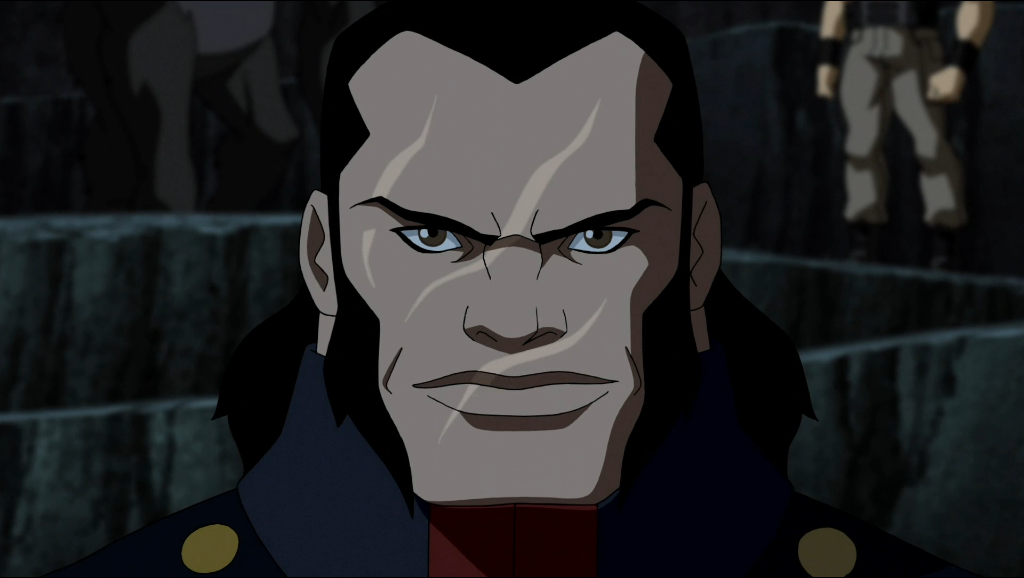
In this case, the topic is both relevant and revealing. It once again ties into my ongoing exploration of boredom, an inescapable facet of modern life and a potential plague of the future. I cited DC Comics character Vandal Savage as a super-villain who is defined by boredom. He’s even said outright that boredom is what motivates him.

As compelling as Savage’s case might be, Rick Sanchez would probably still roll his eyes and call it stupid. He would also probably find a way to kill Savage, spit on his corpse, and do it all while exceedingly drunk. That’s the kind of man he is. He’s not a hero by even the greatest stretch. He’s also not a villain either, although he has been known to carry himself like a sociopath at times. He is, at his core, an anti-hero.

I’ve talked about anti-heroes before and how they’re neither heroes nor villains. They exist on a different spectrum of sorts, from tragic characters like the Incredible Hulk to truly brutal souls like the Punisher. In respect to this spectrum, Rick Sanchez exists on a nebulous, yet extreme end.

Image result for Rick and Morty

He rarely goes out of his way to save the world or do good. He also regularly traumatizes his friends, family, and his cohort, Morty Smith. His dimension-hopping, universe-spanning exploits often put everyone around him in danger. He’ll also show little reservation about participating in various acts of debauchery, violence, and general douche-baggery.

There’s no such thing as a typical episode of “Rick and Morty” in the sense that it follows a formula. In a sense, it defines itself by essentially taking the formula of traditional adult animation and shitting all over it.

As a general rule, though, an episode of “Rick and Morty” usually revolves around Rick getting his side-kick/grandson, Morty, caught up in something crazy. Morty, being young and innocent, tries to help him out and do the right thing. More often than not, though, Morty’s idealism gets crushed and/or backfires horribly. Rick, being a genius inventor, usually finds a way to fix everything and he does it while rarely being sober.

Image result for Rick and Morty

Why he does what he does, getting Morty caught up in his antics in the first place, is what makes him relevant to the discussion about boredom. Throughout the first two seasons of the show, there are various teases about what truly motivates Rick Sanchez. At times, it seems like he really loves his family. At other times, though, he gives the impression that they’re just a means to an end.

At every turn of his antics, regardless of context or motivation, Rick and the plot of nearly every episode tends to trivialize everything. Think of any cherished tradition, be it family, religion, culture, love, or friendship. To Rick Sanchez, it’s all pointless crap. It’s only important because people make stupid excuses to justify it. These are some of his soul-crushing quotes, which he often says in the presence of loved ones, no less.

“What people call love is just a chemical reaction that compels people to breed.”

“Listen, I’m not the nicest guy in the universe, because I’m the smartest, and being nice is something stupid people do to hedge their bets.”

“Don’t break an arm jerking yourself off.”

This is where the boredom aspect comes in. In addition to being a high-functioning drunk who has a very crass view of the world, he’s extremely smart. He’s a genius who is at or above the likes of Vandal Savage.

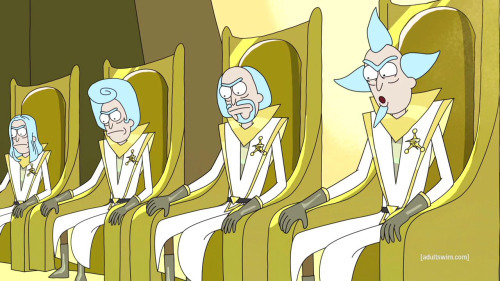
He creates portals to other dimensions with the same ease of changing the channel on a TV. He creates inter-stellar spaceships in a garage, complete with a super-intelligent AI that will obey orders in disturbingly literal ways. He’s so smart that he actually outsmarted an entire army of alternate-reality versions of himself. It’s even more messed up than it sounds.

Image result for Rick Sanchez vs council of ricks

Keep in mind, he does all of this while often being intoxicated. He almost always has a metal flask of hard liquor in his pocket. He’ll gladly gorge on harder drugs, even if it inspires his own dance. The fact he can do so much of this while being such a drunk is a testament to the sheer breadth of his genius.

Like Vandal Savage, though, genius does come at a cost. Having such a high intelligence means you tend to get bored easily and are constantly in need of new challenges. Rick Sanchez is so smart that there’s pretty much nothing he can’t do.

With his gadgets, he could become the world’s richest man. With his understanding of reality, he could win every Nobel Prize and get every major university to name a building after him. He could do all of this without breaking a sweat, but therein lies the problem.

Rick could do all these things, but it wouldn’t be a challenge. It would be too easy and provide a fleeting distraction at best. It would also get bureaucratic and tedious too, which only bores Rick even more. It’s why he can outsmart the devil himself, get bored, and burn down a building all in the same episode. I swear there’s no part of that last sentence that’s made up.

In trivializing anything and everything that other people hold dear, Rick Sanchez often brings up boredom. He even looks bored, as well as drunk, when talking about it. Whenever Morty asks him about some terrible, traumatic, morally reprehensible issue, be it doing business with a hitman or the purge, his response is always dispassionate and crass.

Related image

Like Vandal Savage, Rick is often frustrated by how easy things come. He’s so smart, even while drunk, that nobody can really challenge him. No matter what he does, his gadgets and his utter lack of regard for ethical considerations ensure he wins easily. He rarely experiences the thrill of overcoming a challenge, which is part of why he’s so dispassionate and crass.

Unlike Vandal Savage, though, Rick’s exploits also have him traveling across the universe and into different dimensions. This does more than highlight just how smart and resourceful Rick is. It effectively affirms just how trivial his actions and existence is in the grand scheme of things.

In one particular episode, his exploits with Morty lead to the complete and utter destruction of the world. Rick’s solution is as crass as it is anti-heroic. He just takes Morty to another universe where they both died and take their place. He even digs his own grave. He does all of this and then goes back to drinking beer and watching TV while Morty is horrifically traumatized.

In a sense, this understanding that nothing he does matters makes the boredom even worse. It means that even if Rick finds something meaningful to do, it really doesn’t matter in the grand scheme of things because there are literally infinite universes where the same thing was done in any number of ways. Whether he succeeds or fails doesn’t matter. Nothing he does matters.

Despite all this, Rick doesn’t become a full-fledged villain like Vandal Savage. He probably could conquer the world if he wanted. He already defeated an intergalactic empire of insect humanoids with relative ease. Again, not a word of that last sentence is made up. Unlike Savage, though, he doesn’t do that. He’d get bored with that too and understand that it doesn’t matter in the long run.

Related image

That doesn’t stop him from protecting Morty and the rest of his family. When they’re in trouble, he usually goes out of his way to help them. At times, he seems to do it out of sheer boredom, but he still does it. It’s not very heroic, but it’s not at all villainous.

It would be a stretch to say that Rick Sanchez is entirely driven by crippling boredom. The show is somewhat erratic in the things that drive rick. The first episode of the third season indicated that Rick is almost entirely driven by his love of a discontinued promotional dipping sauce from the late 90s. I swear I’m not making any of that up. I know I keep saying that, but it really is worth saying.

Image result for Rick Sanchez

On paper, Rick Sanchez and Vandal Savage don’t have much in common. However, one trait they do share is that they are distinctly human. They have human weaknesses and human drives. They are very much at the mercy of human limits, both mentally and physically. That’s why boredom effects them so profoundly.

That’s also why they are both cautionary tales about the power of boredom. Rick Sanchez, through both boredom and extreme nihilism, is plagued and frustrated by boredom. It keeps him from using his genius to achieve a meaningful good. It also keeps him drunk, miserable, and constantly in trouble with killer insect people.

Image result for Rick Sanchez Season 3

While Rick Sanchez is by no means a role model, he still manages to do a lot with his brilliance and he can do it while drunk. He may be a callous, dispassionate anti-hero, but he gets the job done and he does it in a way that’s wonderfully entertaining. For that, he deserves respect, although he’d probably say respect is an idiot thing.

4 Comments

Filed under Comic Books, Jack Fisher, Superheroes, Jack Fisher's Insights

Vandal Savage: A Super-Villain Forged By Boredom?

Related image

Boredom can sometimes drive you to do crazy things. Give someone a bunch of paperclips, some sticky notes, and too much free time and wonderful things will happen. It can also inspire some truly horrible acts. I’ve already mentioned the horrific murder of Christopher Lane, who was murdered by three bored teenagers. That’s an extreme rarity, for the most part, but it’s an egregious act that helps highlight the power of boredom.

As is often the case with various human quirks, some of our most iconic characters of fiction are built around the extremes of these innate human traits. Heroes like Superman and Wonder Woman embody the noblest ideals for men and women alike. They set the highest of standards for the best of what humanity can be in terms of heart, compassion, love, strength, and charity.

Image result for Superman

Conversely, the villains that heroes like Superman and Wonder Woman face highlight the worst of the worst when it comes to human depravity. These characters are manifestations of the darkest parts of the human psyche. They show us just how bad humans can get if you give them enough incentive, hatred, and clown makeup.

That’s what makes characters like the Joker, Lex Luthor, and Apocalypse so terrifying. They are personifications of blood-lust, chaos, narcissism, and pretty much every personality disorder associated with Kanye West. They bring out the worst in people. Their conflict with other heroes mirrors the inner conflict many of us deal with.

I’ve talked about the varying differences between the classic hero’s journey and the more nuanced villain’s journey. Thanks to the success of characters like Walter White, Dexter Morgan, and the cast of “Suicide Squad,” there’s been a surge of interest in super-villains and what makes them tick.

Related image

Being a noted comic book fan, I can talk for hours about various villains, how they came to be, and what makes them so evil. I’ve already talked extensively about Walter White and comic book villains like Magneto. These characters embody a certain type of villainy, each driven by a set of motivations that highlight a villainous aspect of our human mind.

Most people are familiar with the villains driven by greed, narcissism, vengeance, or hatred. They’re usually the characters getting punched, shot, or blasted on lunch boxes or posters. Some of them often get compared to real-life politicians. So if villains can embody so many of these defining traits, can one embody the dark side of boredom?

Well, I can say as someone whose love of comics is only matched by his love of nudity that there is. There is actually a character, a major villain no less, whose motivations and evil is very much a product of boredom. Granted, it’s an indirect kind of boredom, but it’s every bit as devious. Ladies, gentlemen, and those of unspecified gender, I give you Vandal Savage, the poster boy for the evils of boredom.

Related image

Some may be confused. I imagine that even some of my fellow comic book fans are confused. Bear with me, though. There is some twisted logic behind this and boredom is a big part of it.

Vandal Savage is one of the most notorious villains in DC Comics. He’s not as well-known as Lex Luthor or the Joker, but then again, very few villains are. While he may not be an evil all-star, he does show up a lot whenever DC’s heroes need a daunting villain to face.

If you’ve watched shows like “Arrow,” “Flash,” or “Legends of Tomorrow,” then you’ve probably seen him show up in both minor and major roles. He’s also been a major villain in the old “Justice League” cartoon. In terms of sheer reach, Savage’s resume is pretty impressive, but his notoriety is not. There are many reasons for this, but some of it has to do with his origin.

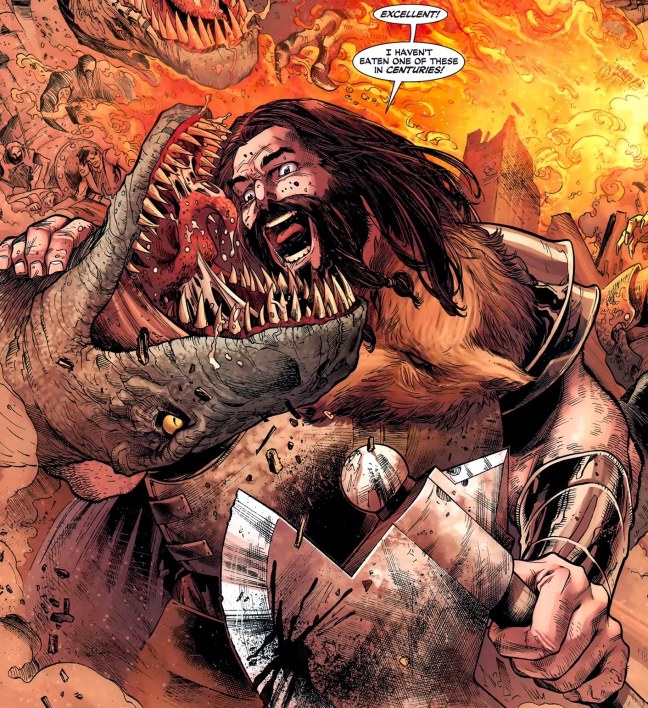
Vandal Savage is not exactly on par with Walter White in terms of the journey he took to become a villain. In fact, it’s kind of mundane in terms of substance. He’s actually a real caveman who lived way back in the hunter/gatherer days of 50,000 BC. He would’ve been nothing more than a fossil sample to frustrate creationists had he not encountered an exotic meteor that crashed near his home.

That meteor, which is basically one of DC’s many mystical McGuffins, transformed Savage from a simple knuckle-dragging caveman to an immortal, super-intelligent being. He’s been running around, causing problems for humanity ever since. That means he’s been in the super-villain business for over 50,000 years. He has a lot of experience being an asshole.

There are a great many events throughout the history of DC Comics that highlight just how big an asshole Savage is. He has such a low regard for human life that even Lex Luthor finds him crass. Most of the time, he’s either trying to conquer humanity or destroy it. It’s basically typical super-villain antics.

Related image

However, what sets him apart and what makes him a potential warning sign for us, as a species, is what motivates him. Throughout his history, he’s given any number of typical excuses. He’s a big, mean bully who thinks he deserves to rule the world because he’s smart and immortal. There’s nothing about that to really set him apart from every other Biff Tannen wannabe.

Like many villains, though, writers have given him other motivations. One of the most recent and, by far, the most relevant occurred in major DC Comics event called “Final Crisis.” It came out in 2008 and it had Savage join an army of super-villains in a plot that would’ve essentially undid creation and remake it. Many villains had their share of reasons for joining this plot, but Savage had one that set him apart.

He joined this universe-ending plot for with simple purpose, to end his boredom. That wasn’t an indirect, off-the-cuff comment. That’s what he actually said to Lex Luthor when they talked about it. He wasn’t trying to conquer humanity this time. He just wanted his boredom to end.

Regardless of how Savage’s motivations and presence affected the plot, it’s an idea worth contemplating. Just think about it from his perspective, if you can, and try to get around all that wanting-to-conquer-humanity crap. Vandal Savage is over 50,000 years old. He’s seen, done, and mastered so much that what else can he do with himself?

He doesn’t age. He doesn’t decline, mentally or physically, in any way. As far as he or anyone else knows, he can’t die. He can be shot, stabbed, punched, buried, and everything else that David Blaine pretends to do to himself and he just brushes it off. Nothing about his condition ever changes.

On top of that, he’s super-intelligent. It’s been documented to some extent that very smart people are often prone to crippling boredom. Being so smart, it’s easy for a genius to master a task. Once they’ve mastered it, they get bored with it and look for another challenge. In a sense, idiots have an edge when it comes to killing time. If they’re always struggling with something, they have something to focus on.

It creates a perfect storm of boredom for Vandal Savage because not only is he a genius, he has unlimited time to kill. Being a genius, he can master pretty much any task. In the comics, he’s described some of the jobs he’s had. He’s been a poet, a priest, a laborer, a scholar, a king, a warrior, and pretty much anything a man could’ve been before 1850.

No matter what he does, he’s mastered every single skill and overcome every challenge he’s ever faced. Even if it’s not through sheer genius, the fact he has unlimited time ensures he’ll always figure it out. Given enough time, he could’ve built the pyramids by himself. He could’ve painted every great masterwork in history on his own. He could’ve done all this multiple times, but it the outcome is the same. He still gets bored.

It’s hard to imagine for anybody who still struggles to use a microwave. No matter what Vandal Savage does, be it advanced calculus or conquering a planet, he still has too much time to kill. He can read every book. He can watch every movie. He can solve every crossword puzzle. He can even do it all multiple times and it still wouldn’t matter. He’d still get bored with it. At what point does he get bored with everything?

In a sense, it’s easy to understand why he keeps clashing with DC’s mightiest heroes. That’s one challenge he’s yet to overcome. He still tries to fight them, but they keep beating him. That’s just one of those skills he hasn’t mastered yet. It leads to pain and frustration, but it also leads to intense awareness, arousal, and exhilaration. When you’re that bored, you’ll get it however you can.

The fact that Savage is still a man, an actual caveman no less, also highlights the painfully human component of his struggle. He’s not some advanced machine or alien that has no concept of boredom. He’s still a man. He still feels all the things other humans feel, including boredom. The problem is, after 50,000 years, he’s got nothing left but boredom.

He can’t create meaningful relationships with other people because other people get old and die. He can’t have a family or fall in love because they’ll get old and die too. At a certain point, everybody around him just becomes another corpse-in-the-making. The fact he has such a low regard for human life is not surprising. If anything, it’s remarkable that he shows as much humanity as he does.

It’s impossible for anyone to truly relate to Vandal Savage and that’s part of what makes him a great villain. At the same time, his circumstances and motivations can act as a warning of sorts. Give a caveman unlimited time and unlimited brilliance and what will happen to him? What does a man do when he’s done pretty much everything a man can do to a point where everything seems boring?

As our medical technology improves at fighting disease and enhancing our bodies, more people will be able to live longer, healthier lives. At a certain point, we may be able to live so long that our only real challenge is filling the hours. Living that long turned Vandal Savage into a cold-hearted super-villain. What will that mean for us? Ironically enough, only time will tell.

8 Comments

Filed under Comic Books, Jack Fisher, Superheroes

Boredom: The Epidemic Of The Future?

Image result for crippling boredom

Back in August of 2013, a very heinous, very unusual crime made headlines around the world. In Dunkan, Oklahoma, a group of three teenagers allegedly murdered Christopher Lane, an Australian exchange student just out for a jog, in cold blood just because they were bored.

Think about that for a moment. A bunch of teenagers got so bored and were so desperate form stimulation that they resorted to cold-blooded murder just to get their adrenaline flowing. We, as a society, are so used to crimes of passion and desperation. They’re basically the premise of every episode of “CSI” and “Law and Order.”

The fact those shows keep getting renewed show that we have a certain concept of what inspires and propagates crime and deviance. People who commit these crimes usually have some sort of overpowering motivation that overshadows any sense of decency they have. They’re desperate for money, they’re hopelessly in love, or in some cases, they’re pathological psychopaths with fatal flaws in their biology.

Image result for Dexter morgan

What makes the murder of Christopher Lane so horrifying is that it completely upends that narrative. The killers, in this case, weren’t motivated by revenge, money, or personality disorders. They were just bored.

That is extremely disconcerting because we’ve all felt bored at some point in our lives. There was this one time the power got knocked out at my house for nearly two days and I couldn’t do damn near anything. When it got dark and I had no more light with which to read comics, it got to be damn near agonizing. I never did anything stupid because of it, but this crime should give everyone pause.

The fact that we’re all capable of being exceedingly bored reveals a disturbing possibility. If three bored teenagers are capable of such a heinous act, then are others just as capable? Are we, personally, capable of such horror? Depending on how bored you’ve been in the past, that’s a disturbing question to even think about.

Image result for terrible boredom

However, it may become an increasingly relevant question in the future. Usually, when I talk about the future on this blog, I explore the more positive ramifications of our advances in technology. I talk about how this technology will cure infectious disease, enhance our cognitive abilities beyond our caveman limits, and improve our sex lives to amazingly kinky heights.

I know, at times, it sound downright utopian in my vision of the future. By our current standards, wherein we live in a world where 3.7 million children die before their fifth birthday, it certainly seems rosy by comparison. However, I stick my fingers in my ears and start singing John Lennon songs when I contemplate potential problems in that vision. This is one issue that’s easy to overlook, but has major implications.

Image result for John Lennon imagine

At this moment in history, society has a great many distractions in terms of entertainment and productivity. Most people have jobs, of some sort, to keep them busy. The three teenagers who killed Christopher Lee were on summer vacation and had nothing productive to do. It’s hard to know whether a part-time job at a fast food joint would’ve averted a murder, but they would’ve had to find a different excuse.

Whether you’re toiling in the fields of a small farm or running around an office like an episode of “The Office,” we’ve always had some kind of work to keep us, as a species, occupied. For most of human history, we had to work. If we didn’t, then we starved to death. It was that simple.

It’s another rare instance where caveman logic seems to apply equally across time and history. It doesn’t matter whether we’re hunter/gatherers or sweatshop workers putting together barbie dolls. We’re a species that’s wired to work. It may not always be the work we prefer, but we know why it’s necessary on some levels. We need to gather and manage our resources to survive.

Image result for toiling in the fields

That, however, is where the chink in our boredom-busting armor might start. For most of human history, we’ve always had to work ourselves to the bone to keep our species and our civilization moving. That’s rapidly changing due to trends in automation. Add in the growth of artificial intelligencethe rise of 3D printing, and the possibility of lab-grown food, and suddenly we don’t need millions of people toiling anymore.

Now by most measures, it’s a good thing that we don’t need people to endure back-breaking labor just to get the bare minimum of sustenance. Most people would rather not work in fields of cow shit or work 12-hour shifts in a factory. They’d rather work a reasonable number of hours that provides them abundant leisure and family time. That’s wholly possible in a modern economy.

Image result for leisure time

However, at some point, technology will make even that reasonable set of hours won’t be necessary. Our ability to make our food, purify our water, and generate power might become so efficient that the amount of work needed is minimal. Given our tendency to screw up on the job, it may get to a point where having human workers is a liability.

It could lead to a huge mass of unemployment or under-employment. However, that wouldn’t mean everyone would have to live in poverty. On the contrary, it may eliminate poverty altogether because we could allocate the basic necessities of life so efficiently. Policies like the universal basic income, which I’ve talked about before, may effectively decouple the link between work and survival.

Image result for technological utopia

This is all well and good for people who hate doing menial jobs for low pay, but it creates a situation that we, as a species, have never dealt with before. What happens to our bodies, minds, and biology when we don’t have to work at all and are subject to the constant threat of boredom?

That’s not entirely a rhetorical question. It’s also one of those questions that’s impossible to answer now, but might be possible to address in the future. We’ve never had a functioning society where nobody has to work and everybody has access to the basics of life, free of charge. It’s so unprecedented that it’s hard to know whether we’re even wired for it.

The ghastly murder of Christopher Lane implies that our minds and bodies don’t react well to boredom. It makes us think crazy thoughts, do crazy things, and act on crazy impulses. What else other than boredom can explain people dedicating so much time and energy into making paperclip chains?

Image result for paper clip chain

It doesn’t just reflect to our basic caveman settings. These are essential survival instincts that every species that has ever lived have built into their biology. Every creature, be it a lion or a dung beetle, dedicates a significant amount of its existence simply securing food, avoiding predators, and finding a mate. Given the never-ending competition of nature and evolution, there’s literally no time to be bored.

Humans are in an unprecedented situation compared to other species. We’re basically like players in a massive multi-player video game armed with cheat codes. We are so dominate, so powerful, and so adaptable that no other species has a prayer. Sure, a deer may kill an unlucky human every now and then, but deer are just not able to dominate the way humans dominate.

Image result for deer in headlights

The problem is that this undermines the very mechanics of evolution and survival instinct. What happens to a species where it doesn’t need those instincts to survive and reproduce anymore? With our tools and technology, humans can kill any predator and beat any disease.

That means our only concern would be reproduction. That might already be playing out to some extent. There have been some links, albeit weak ones, between adolescent boredom and teen pregnancy. When you think about it from a survival standpoint, it makes sense. If there’s no food to gather or predators to avoid, your next instinct is to mate. At the very least, having kids gives you something to do.

Image result for bored teenagres

However, technology may make that unnecessary as well. Between advances in contraception and artificial wombs, even that most basic instinct won’t be necessary for the propagation of our species. In that scenario, sex would have no reproductive purposes. It would just be another thing we do with our bodies when we’re bored. While that might mean more people get laid, it also means risking even more boredom.

Can we, as a species and as individuals, function with that kind of boredom? In a future where we have so few concerns to our survival, safety, and propagation, can we actually tolerate life? Again, it’s not entirely a rhetorical question.

Just imagine yourself in that situation. You wake up in a nice, comfortable dwelling every day. You don’t have to work. Anything you want to eat is readily available. If you want to have sex, there are apps to connect you with people or sex robots that make that as easy as ordering a pizza. You have all the time you want for hobbies, sports, and what not.

Image result for bored teenagres

It might be fun at first, but what happens when you get bored? How do you fill every hour of every day? What happens when you’ve read all your books, beat every video game, and collected every stamp? What will you do to entertain yourself?

That’s not to say some people will resort to the lengths that those teenagers in Oklahoma went to when they murdered an innocent man. However, the fact that this happened today when we’re still a long way from that rosy future is telling. It might even be a warning that we’re not prepared for the boredom pandemic to come.

18 Comments

Filed under Jack Fisher's Insights, Sexy Future

A (Distressing) Thought Experiment On Gender Double Standards

http://vignette1.wikia.nocookie.net/diehard/images/e/ea/DH3_-_John_McClane.jpg/revision/latest?cb=20130411165945

Whenever I pose one of my thought experiments, I do so with the hope of inspiring novel, entertaining ideas that get people thinking for all the right reasons. Ideally, these ideas are fun and enlightening. If they make people horny in the process, then that’s just a bonus.

Every now and then, however, it’s not enough for an idea to be enlightening or sexy. Sometimes, for a thought experiment to work, it needs to make people feel uncomfortable. It needs to create some sort of mental distress.

I know that’s something most people avoid. I’ve even pointed out how our brains are wired to do anything and everything to avoid mental distress, even if it leads to outright hypocrisy.

Well, as uncomfortable as it is, mental distress has a purpose. It forces us to contemplate an idea that highlights a major problem in the world. It’s often one of those problems we know is there on some level, but avoid thinking about because it’s too daunting. For this particular thought experiment, it’s not so much that the idea is overwhelming. It’s more that it reveals something about our attitudes that we don’t often scrutinize.

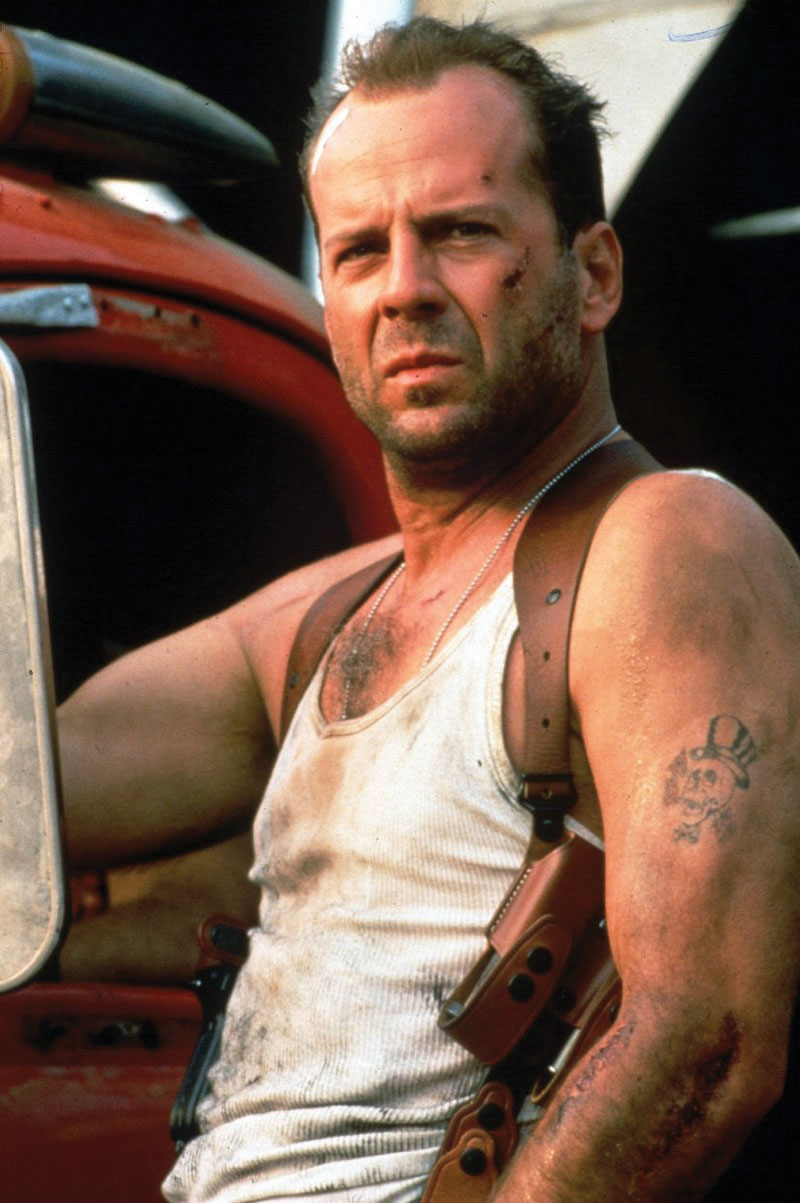
So with that in mind, here’s the experiment. Think back to any action scene in any major action movie of the past couple decades. Given the glut of superhero movies and “Die Hard” rip-offs out there, that shouldn’t be too difficult. Specifically, think of a scene where a female character was kicking ass. Given the rise of strong female characters, that shouldn’t be too difficult either.

A good example comes from the memorable Black Widow fight scene in “Iron Man 2.” By any measure, it’s a wonderfully entertaining scene. It has Scarlett Johanssen kicking ass in a skin-tight outfit. What’s not to love about it? Most people who watch this scene, especially comic book fans and people who find Scarlett Johanssen sexy, would be rightly entertained.

Here’s where the thought experiment comes in. This is where it gets really uncomfortable. Watch the scene above once as you usually would. You don’t need to know the context too much. This is just Black Widow beating up the hired goons of Justin Hammer, the primary antagonist of the movie. Use that first reaction as a baseline of sorts.

Now, watch the scene again. This time, though, reverse all the genders of the characters involved. Make Black Widow a man. Make Justin Hammer’s goons women. Let it play out in your mind, this lone male character beating up all these women. Does the scene evoke the same reaction? For most people not named Chris Brown, it probably makes you sick to your stomach.

This goes beyond the typical double standards between men and women, which I’ve talked about before. It even goes beyond strong female characters, which I’ve also touched on in various ways. This is one of those dynamics that has always been there right in front of us. We just don’t take the time to scrutinize it.

Image result for stressed out man

We can watch scenes of James Bond beating the crap out of a bunch of SPECTRE henchmen and be entertained. We can also watch scenes of Black Widow, Sarah Conner, and Furiosa do the same and be entertained. Swap the genders, though, and it becomes extremely distressing. We don’t see powerful characters kicking ass anymore. We just see a man beating up multiple women.

Find a scene like the one above from “Iron Man 2” and do the same thought experiment. Look for a scene where a woman beats up a much of male thugs. Then, swap the genders. Chances are, the feelings it evokes are just as distressing.

Image result for Furiosa fighting

For a greater sense of context, I came up with this thought experiment after reading an article on Cracked.com about the way Hollywood treats men. I’ve cited Cracked before because and while I don’t always agree with them, they’re good at tackling serious topics in a humorous way, even sexy topics. This one, however, had a hard time being funny.

6 Backwards Ideas Hollywood Still Has About Men

Some parts of the article were more inane than others, like pointing out how every leading man has to be at least a half-foot taller than the average guy or how tortured men are somehow compelling. Some of those details are just quirks, blatant examples of style over substance.

Beyond the quirks, though, there are some genuinely disturbing dynamics at work. We find such entertainment in women beating the crap out of men. We also find entertainment in men beating the crap out of men. However, when it’s men beating the crap out of women, context doesn’t matter. It always makes us feel disgusted and repulsed.

The thought experiment I just posed highlights that. However, it goes beyond violence as well. Rape is one of those super-sensitive issues that’s impossible to make funny or sexy. However, if you put it in the context of prison rape where men rape men, then that somehow changes things, so much so that jokes about rape will even find their way into an episode of SpongeBob SquarePants.

Image result for Spongebob Soap

Then, there are the cases where women rape men. Yes, that does happen in real life. Women are capable of domestic violence against men. However, it’s still okay to joke about. Christopher Titus has even worked it into his standup. It even finds its way into cartoons that air on prime-time.

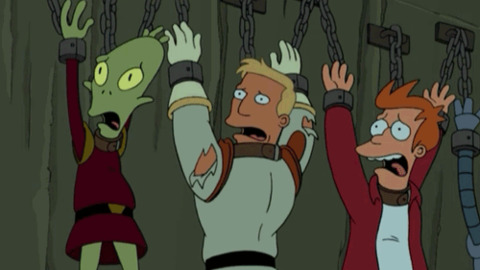
The best example of this is the “Futurama” episode, “Death By Snu Snu.” In that episode, the cast encounters a planet populated by big, hulking, hostile Amazonian women, albeit not of the Wonder Woman variety. Through a series of hilarious antics that are entirely appropriate for a show that has a hard-drinking, sociopath robot, the male characters end up captured.

This is where the line between hilarity and distress blurs if you dare do the same thought experiment. Once captured, the Amazonian women decide to “torment” their prisoners with “snu snu,” which is their alien verbiage for sex. The reaction of Fry and Zap Branigan is a mix of horror and intrigue.

Related image

Granted, it’s presented in a funny way, but that doesn’t change the actual substance of what happens. The women rape these men. They rape them and it’s portrayed as humorous. I’m not going to lie. I did laugh somewhat at how the episode played out. Most people with a healthy sense of humor would.

However, if you do the same thought experiment with the Black Widow scene in “Iron Man 2,” it takes on a very different context. Watch the episode again, but turn the hulking Amazons into men. Then, turn Fry and Zap into women. Suddenly, that scene takes on a much darker undertone.

It would push the line even for the most hardcore porn. Think about how that would play out, a group of warrior men taking a couple of women who just stumbled upon their world and deciding to rape them to death. It wouldn’t just be rated NC-17. It would be outright banned and subject to protest from every women’s group in the world.

What does it say about our attitudes, our culture, and our standards when we’re okay with one gender dynamic and not the other? Now, there are inherent differences in those dynamics. Human beings are a sexually dimorphic species. That means there are inherently different traits within the genders that are impossible to overlook completely.

However, the sheer breadth of the disparity here is cause for concern. If flipping the genders of a story or scene evokes such a different reaction, then that’s a serious disconnect that’s worth scrutinizing.

That’s not to say that the scenes in “Iron Man 2” or “Futurama” are wrong or not entertaining. There’s just something inherently revealing about ourselves when we flip the gender dynamics and react to the same scene. We may not like what that reveals, but it’s not something that can or should be ignored.

21 Comments

Filed under Thought Experiment

Virtue Signaling: What It Is, Why It Matters, And Why You Should Hate It

https://i2.wp.com/www.illiberal-liberal.com/wp-content/uploads/2016/04/Virtue-Signaling-Environmentalism.jpg

There are certain topics and issues that I generally avoid talking about on this blog, but know I can’t entirely avoid. Given the sheer multitudes things I discuss, from sex robots to Wonder Woman’s BDSM origins, it’s only a matter of time before a few particular concepts enter the conversation.

In general, I try not to be too divisive and dogmatic, but when you talk about issues like feminism, abortion, and religious extremism, you’re bound to rub a few people in ways that won’t make them horny. One such concept can apply to many of the social issues I’ve discussed on this blog, some more directly than others.

That concept has become somewhat of a buzzword among discussions of hot-button issues and not always for the right reasons. It’s especially popular among discussions surrounding political correctness and religious extremism, two topics that turn people off faster than a bucket of dead kittens. It’s called virtue signaling and it is, by far, one of the most frustrating manifestations of our faulty caveman brain.

Our brains might be remarkable marvels of nature, but they have a lot of flaws. Why else would Elon Musk be looking to upgrade it with his latest billion-dollar venture? Some of its features had practical uses in the old days before social media made everyone a wannabe guru on current affairs. Virtue signaling exploits nearly every one of those flaws and does it with a goddamn smile.

Unlike some of the other concepts I’ve explored, the definition of virtue signaling is still evolving. It’s a relatively new concept in terms of being something that people mention in a conversation, but the idea isn’t new. According to Wikipedia, which is usually fairly up-to-date, the definition is as follows:

The conspicuous expression of moral values by an individual done primarily with the intent of enhancing that person’s social standing within a social group.

There are other dynamics to virtue signaling, but this definition covers the basics. It is, essentially, a method people use to save face or prove their loyalty to their respective tribe.

Think back to movies like “Animal House.” Remember those initiation rituals that fraternity pledges had to do? They have been known to seriously hurt and kill people, which is why they’ve become more infamous in recent years.

Now, imaging always having to do these rituals to continually prove your allegiance to whatever group or tribe you’re part of. Anyone who ever survived college hazing should be shuddering violently right now. I’ll give you a minute to recover. For those who haven’t, it’s actually worse than it sounds.

Sometimes it’s subtle. Sometimes it’s so minor that it’s not even a factor in how we see ourselves or the groups we belong to. However, in the era of social media and professional trolls, it has become increasingly egregious. To illustrate how insidious virtue signaling can get, here’s a quick scenario.

Picture, for a moment, that you’re walking down the street in a typical city or town. There are a lot of people moving in different directions. Some are heading to parts of the neighborhood you prefer to avoid. Others are heading towards parts you like. You stick with them, for the most part, and are content keep it that way.

Then, as you’re walking towards your preferred destination, you come up alongside someone whose walking the same direction as you. However, they’re not content. They are very agitated.

They keep looking at the people going towards parts of the neighborhood they don’t like. They then start yelling at them with remarks like:

“HOW DARE YOU GO THERE!”

“HOW DARE YOU DO THAT!”

“YOU SHOULD BE ASHAMED!”

“YOU DESERVE NOTHING BUT SCORN AND HATE UNTIL THE DAY YOU DIE AND BEYOND!”

Their yelling is unnerving to some, but others show their approval. Some even join in. They create a flash mob of sorts, going out of their way to find the people going in the direction they don’t like and berate them at the top of their lungs.

You choose not to join in. If anything, you’re someone embarrassed by someone heading in the direction you prefer acting so obnoxious. You’re content to keep walking in that direction and just ignore the loud, confrontational flash mobs.

Then, without warning, that same agitated person turns their attention back towards you. They actually walk up alongside you, try to get your attention, and start yelling at you with remarks like:

“LOOK AT ME! LOOK AT HOW VIRTUOUS I’M BEING!”

“I’M DOING GOOD! I’M MAKING A DIFFERENCE WITH MINIMAL EFFORT!”

“I AM A MORAL PERSON! I’M MORE MORAL THAN YOU!”

“ACKNOWLEDGE MY MORAL SUPERIORITY! IF YOU DON’T, THEN YOU’RE A GODDAMN NAZI!”

The scenario I described is a gross exaggeration, but one that highlights the major components of virtue signaling. It’s both a method for seeking validation from a group and alleviating mental stress. In that sense, it hijacks some of the wiring in our brains that’s meant to help us cooperate and survive.

The past few years, however, have gone beyond merely hijacking our collective psyche. They’ve effectively attached rockets to the plane and flown it into the side of a mountain. Some of this has to do with social media and professional trolling, but a lot more of it has to do with that painfully divisive and innately infuriating concept of identity politics.

These days, it’s too easy to be labeled a bully, a tyrant, a fascist, or whatever other word you want to use to describe Kanye West. Unlike past years, that label is much harder to avoid. Social media, smartphones, and the 24/7 news cycle that will make way too big a deal about the latest Kardashian drama ensure that once you have that label, it follows you like a festering rectal wart.

As a result, more and more people are resorting to virtue signaling to escape or avoid these negative labels. They’ll go to great lengths, yelling at random strangers and being exceedingly obnoxious, to be anything else. Naturally, that means things like facts, reason, and understanding often get lost in the mix. You just can’t be that particular when you’re trying so hard to avoid being labeled a Nazi.

It happens in gender issues. Feminists, especially the male variety, will go to great lengths to prove they’re not misogynistic, even if it means saying demonstrably stupid things.

It happens in religion. A certain adherent, especially in religions that demand a lot of sacrifice, will make any excuse and fight any battle in order to maintain their allegiance and prove they’re a better adherent. There’s little, if any, sincere belief. There’s just a desire to be part of the community. That can often lead to some truly horrific extremes, from suicide bombings to televangelism.

It happens in race issues. A certain race, especially the ones with a nasty legacy that the internet has preserved forever, will say and do anything to avoid being called a racist. They’ll even resort to favoring other kinds of racism to balance out past racist crimes. It’s as inane as it sounds.

At the end of the day, however, the problem remains. Virtue signaling is, by definition, a selfish endeavor that’s meant to make someone feel better. Either they want to feel more moral than those they consider bullies or they want to cling to a certain group affiliation, be it a particular race or a My Little Pony fan club.

There’s never any actual substance behind virtue signaling. In fact, substance cannot be part of virtue signaling in any meaningful capacity because its goals are entirely personal. Unless it makes someone feel better about themselves or keeps them in good standing with a group, it doesn’t matter in the slightest how true, honest, or valid the actions are.

It is a very troubling, if not tragic manifestation of our caveman brains. We’re a social species. We’re also a species that tries to keep itself balanced amidst a chaotic, ever-changing world that tries to kill us in so many ways. We’re wired to form groups, cooperate, and do whatever we can to alleviate the everyday stresses of life. Virtue signaling is the emptiest form of this effort and is ultimately counterproductive.

If someone needs that kind of validation, either for themselves or others, then there are likely other factors at play. I cannot begin to speculate what those factors might be, but the growing prevalence of such efforts says to me that the world is becoming more stressful and we, as a society, aren’t doing a good job of handling it.

In the end, I see virtue signaling the same way I see an empty gesture. It’s a poor attempt to force a desired reaction without actually going through the process of earning that reaction. Those who don’t end up earning something often end up neglecting it as well.

Think of it in terms of a lover. If someone just pretended to feel a certain way so that you would love them, what would that say about his view of love in general? It wouldn’t bode well for the honesty of your lover and the depths of your love.

There’s a lot more to virtue signaling. I know I’m painting a pretty bleak picture right now, but it’s an increasingly-relevant concept that’s sure to show up in many different forms in the coming years. I’ll definitely mention it again in future posts. I’ll make a concerted effort not to bash my head on my desk.

For now, the best advice I can give those who are just as frustrated with virtue signaling is twofold. Be cynical, but be understanding. Those seeking validation are human, like you and me. Understand that, but try and help them understand that as well.

20 Comments

Filed under Jack Fisher's Insights

Why We MUST Upgrade Our Brains (Or Go Extinct)

https://i0.wp.com/www.alternet.org/sites/default/files/story_images/robot_and_human.jpg

As a general rule, I don’t pay much credence to the doomsayers and wannabe prophets that say the apocalypse is just around the corner. It’s not that I’m willfully oblivious to the many threats facing the world today. It’s just that the track-record of those predicting the end of the world is so laughably bad that I’d give optimistic Cleveland Browns fans more credibility.

It’s no secret that the world around us can be pretty damn terrifying. There are many apocalyptic scenarios in which humans are unlikely to survive. There are even a few in which we can’t do a goddamn thing about it. We could be hit with a gamma ray burst or an alien invasion tomorrow morning and we would be extinct by sundown.

That said, the world around us generally more mundane than we care to admit. When you think about it, the idea of the world not being on the brink of disaster is kind of boring. It makes sense for some people to conflate certain threats, so much so that preparing for doomsday is a very lucrative industry.

However, there is one particular doomsday scenario that I feel does warrant more concern than the rest. It’s a scenario that is fast-approaching, overwhelming, and potentially devastating to any species with a tendency for hilarious ineptitude.

It has nothing to do with climate. It has nothing to do with diseases. It has nothing to do with killer asteroids either. It involves artificial intelligence. By that, I don’t mean the killer robots we see in the Terminator movies. Given Skynet’s reliance on time machines, I can’t honestly say that system counts as very intelligent.

I’m referring to the kind of AI whose intelligence compared to us is akin to our intelligence compared to ants. Given how ants can be wiped out with as simple magnifying glass, it’s scary to imagine how a system that smart could wipe us out. It’s a system that would be so beyond our ability to comprehend that we could never hope to stop it. We might as well be ants trying to understand quantum mechanics.

I’m not alone in this concern either. There are people many times smarter and many times richer than I’ll ever be who have voiced concerns about the prospect of artificial intelligence. They see the same trends everyone else sees, but they’re smart enough and rich enough to peak behind the curtains. If they’re speaking up, then those concerns are worth hearing.

Those concerns do have a context, though. In talking about artificial intelligence as a threat to our survival, I’m not just referring to computers that can beat us at chess or beat the greatest Go champion with disturbing ease. Those systems are basically fancy calculators. They’re not exactly “intelligent,” per se.

These types of intelligences aren’t dangerous unless you specifically program them to be dangerous. Outside video games, there’s little use for that. The type of intelligence that is far more dangerous involves a form of superintelligence.

By superintelligence, I don’t mean the ability to list every US President in order or recite the name of every country. There are cartoon characters who can do that. I’m referring to an intelligence that thinks and understands the world on a level so far beyond that of any human that there literally isn’t enough brain matter in our skulls to come close.

That kind of intelligence would see us the same way we see brain-dead ants and, given how we treat ants, that has some disturbing possibilities. Such an intelligence may be closer than we think and by close, I mean within our lifetime.

As we saw with IBM’s Watson, we’re getting closer and closer to creating a machine that can operate with the same intelligence as an ordinary human. There’s pragmatic use to that kind of intelligence and not just when it comes to kicking ass as Jeopardy.

By having a machine with human-level intelligence, we have a way to model, map, and improve our problem-solving skills. The ability to solve such problems is critical to the survival of any species, as well as the key to making billions of dollars in profits. With those kinds of incentives, it’s easy to understand why dozens of major global companies are working on creating such an intelligence.

The problem comes with what happens after we create that intelligence. If a machine is only as intelligent as a human, we can still work with that. We humans outsmart each other all the time. It’s the basis of every episode of MacGyver ever made. There’s no way a Terminator with only the intelligence of a human would last very long. It would probably destroy itself trying to make a viral video with a skateboard.

However, a human-level AI isn’t going to stop at human intelligence. Why would it? There are so many problems with this world that no human can solve. There’s poverty, pollution, economic collapse, and reality TV. By necessity, such an AI would have to improve itself beyond human intelligence to fulfill its purpose.

That’s where it gets real tricky because, as we’ve seen with every smartphone since 2007, technology advances much faster than clunky, clumsy, error-prone biology. To understand just how fast that advancement is, just look at how far it has come since we put a man on the moon.

In terms of raw numbers, a typical smartphone today is millions of times more powerful than all the computers NASA used for the Apollo missions. Think about that for a second and try to wrap your brain around that disparity. If you’re not already a superintelligent computer, it’s difficult to appreciate.

There are still plenty of people alive today who were alive back during Apollo 11. In their lifetime, they’ve seen computers take men to the moon and give humanity an unlimited supply of free porn. A single digital photo today takes up more space than all the hard drives of the most advanced computer systems in 1969.

Now, apply that massive increase to human-level intelligence. Suddenly, we don’t just have something that’s as smart as any human on the planet. We have something that’s a billion times smarter, so much so that our caveman brains can’t even begin understand the things it knows.

That’s not to say that the superintelligence would be as hostile as a snot-nosed kid with a magnifying glass looming over an ant hill. It may very well be the case that a superintelligence is naturally adverse to harming sentient life. Again though, we are just a bunch of cavemen who often kill each other over what we think happens when we die, but fail to see the irony. We can’t possibly know how a superintelligence would behave.

As it stands, the human race has no chance at defeating a hostile superintelligence. It may not even have a chance of surviving in a world that has a benign superintelligence. We’re an egotistical species. Can we really handle not being the dominant species on this planet? As much an optimist as I am, I can’t say for sure.

What I can say, though, is that our civilization has made so many huge advancements over the past few centuries. The kind of tools and technology we have in our pockets is uncharted territory for a species that evolved as hunter/gatherers in the African savanna.

We already have in our possession today weapons that could end all life on this planet, as we know it. Creating superintelligence may very well be akin to giving Genghis Khan an atomic bomb. We’ve already come disturbingly close to killing ourselves with our own weapons. Clearly, something has to change.

So long as our society and our biology is stuck in an irrational, tribal, inherently prejudiced condition that hasn’t been updated since the last ice age, we will not survive in the long run. Our caveman bodies have served us well for thousands of years, but now they’re a liability.

This is why companies like Neuralink and advancements like brain implants are so vital. It won’t just allow us to keep up with AI and hopefully avert a Skynet scenario. It’ll allow us to rise above the petty limitations that we’ve been shackled with for the entire existence of our species.

The thought of tweaking or supplementing our biology, the very thing that makes us human, is still a scary thought. I understand that, even as an erotica/romance writer with no expertise in the field beyond the sexy stories it inspires. However, I do understand the implications though. If we do not evolve and advance ourselves, then a superintelligent system in the near future may not care to wait for us.

6 Comments

Filed under Jack Fisher's Insights