Tag Archives: love

Important Announcement: It’s OKAY To Be Sexy

https://s-media-cache-ak0.pinimg.com/736x/ae/be/5a/aebe5ac078080a1ecda3ea09cc7d6be2.jpg

Today, I have a very important announcement to make. No, it has nothing to do with the release of my upcoming book, “Passion Relapse.” That’s still coming out on April 18th though. Yes, I’m going to promote the hell out of it in the coming weeks so get used to that.

This announcement is every bit as important as my first book. It may even be more important. Since I’m a long way from success as an erotica/romance writer, I don’t say that lightly. However, I do feel that this is worth saying. It needs to be said so brace yourself. This may shock a few people.

It’s OKAY to be sexy!

I’ll give everyone a moment to recover from the shock. Take all the time you need. I know. This is a startling revelation, but hang in there. We’ll get through this together. I promise.

Okay, that’s enough sarcasm for now. I’ll ease up on the melodrama, but it was necessary for a reason. I say it’s a good reason too because this is one of those topics that has no middle ground. Either people just shrug it off or they’re downright hysterical about it.

https://i0.wp.com/img09.deviantart.net/8c00/i/2016/141/e/5/triggly_puff_by_toadman005-da39lfh.png

Since I’m trying to break into the erotica/romance world, this subject actually affects me and could very well affect my future career. The stakes are higher for me is what I’m saying. So what exactly makes this announcement so vital?

Well, to answer that, here’s some context. It wasn’t that long ago that people didn’t make too big a deal about characters in movies, video games, and comic books who were overtly sexual. I’m not saying some people got their panties in one too many knots. I’m saying that, for a time, it really wasn’t high on the list of things that pissed us off.

That time wasn’t too long ago. For reference, allow me to cite one of the most iconic female characters of the past couple decades, Lara Croft. She’s always been one of those characters with a special kind of sex appeal. You could argue that her sex appeal helped make her an icon. How could it not? This is what she used to look like.

https://s-media-cache-ak0.pinimg.com/originals/93/bb/28/93bb28ef011c5477d9bf4cf1760b3226.jpg

That’s pretty sexy. I won’t deny that it’s somewhat impractical for a soldier or a fighter, but Lara Croft is still a badass, globe-trotting fighter who happens to look good in short shorts and bikinis. There’s nothing wrong with that. As a man, I greatly appreciate that sort of visual appeal.

Then, back in 2013, her character was essentially revamped and rebooted. The sex appeal was downplayed, if not outright purged. Lara Croft went from being a badass, globe-trotting fighter with a sexy attitude to just a badass, globe-trotting fighter. She’s still a beautiful woman by most objective standards, but she’s not allowed to be quite as sexy anymore. This is what she looks like now.

https://i0.wp.com/about-games.info/images/photos/photos-of-lara-croft-from-tomb-raider/photos-of-lara-croft-from-tomb-raider-4.jpg

Now I’m not saying there’s anything wrong with how Lara Croft looks now. That hasn’t made her video games any less enjoyable to play. However, the removal of her sex appeal is somewhat jarring.

Lara Croft isn’t the only female character to undergo that change either. Remember when I did my list of female characters that make men hate women? Well, on that list, I put a character named Felecia “Black Cat” Hardy. She’s a typical female vixen character from the Spider-Man comics. She’s another character whose persona is built around sex appeal, as evidenced by her costume.

https://static.comicvine.com/uploads/original/9/93920/1972405-black_pussy_cat_by_artgerm_d3l66kh.jpg

Well, like Lara Croft, she underwent a change too. No, she didn’t become any less likable. Yes, she’s still a character who will make men hate women on some levels. The only difference now is that she doesn’t show as much cleavage.

It’s part of an ongoing story in the Spider-Man comics to make Black Cat more of a crime lord than a vixen. The story has been mediocre for the most part. I won’t say it’s bad, but I will say that it has done nothing to change the parts of Black Cat’s character that make her so unlikable. Whether she’s fully clothed or wearing a G-string thong, she’s still a character that make men say stupid crap about women.

https://i0.wp.com/www.newsarama.com/images/i/000/131/238/original/ASM2014003_int3_00002.jpg

I find this trend somewhat troubling and not just because it means less visible boobs. It troubles me because for some reason, the image of sexy women is somehow a bad thing. Granted, sexy women have always made people feel a bit uncomfortable and not just in their pants, but this is getting into dangerously regressive territory.

There’s no doubt that there’s a certain level of sexism in the media. There’s also a vocal component of radical feminism that has this mentality that any man who admires the image of a sexy woman is somehow sexist, perpetuating sexism, or contributing to rape culture. For a guy just admiring a beautiful woman, that’s pretty extreme.

Beautiful women, pictures of beautiful women, and any female character that has some form of sex appeal is now somehow contributing to this concept of “toxic masculinity.” That’s basically a catch-all term for all the terrible things men do and, conveniently enough, the cause is something that’s hard-wired into their own biology. That’s like calling a man sexist because he sweats more than most women.

Never mind the fact that the ideas of toxic masculinity and rape culture are somewhat flawed concepts. Never mind that since 1995, rates of sexual assault against women have declined by 58 percent. Apparently, all these sexy images are causing a crisis somehow.

Regardless of the facts, these crises are becoming more and more petty. Last year, I mentioned some of the laughable outrage generated by a comic book cover for Invincible Iron Man. Maybe I should’ve pointed it out then too, but that was just one sign among many.

Whether it’s due to concerns about body image or female representation in media, there’s a new moral crusade brewing. This time, however, it’s not being led by clerics, mullahs, monks, and popes. It’s being led by ordinary, educated people who have somehow convinced themselves that being sexy or admiring sexy things is somehow wrong.

I’m here to say that’s simply wrong. It’s okay to be sexy. It’s okay to admire sexy images. Whether you’re a man or a woman, you’re not a bad person for enjoying things you find sexy. You’re just a healthy mind in a healthy body. There’s no reason to apologize for that.

6 Comments

Filed under Sexy Sunday Thoughts

“Passion Relapse” Is Now Available For Early Download

passionrelapse_800

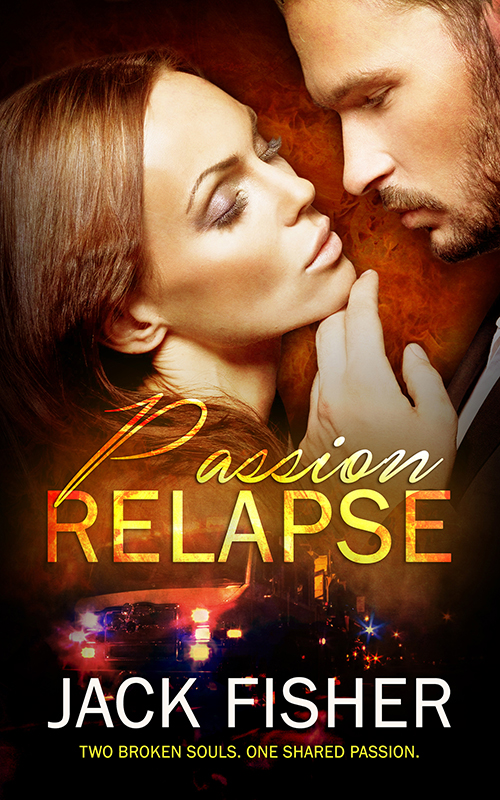
It’s almost here. The release of my first published book is drawing near and I’m more excited than a school girl in a kitten factory. So far, the folks at Totally Entwined Group have been wonderfully cooperative. As far as I know, April 18th, 2017 is still the full release date for “Passion Relapse.”

That’s the date where you can get both the ebook and the paperback copy. However, if you just can’t wait that long or if you just don’t have enough clean panties until then, there is another option. As part of Totally Entwined Group’s promotional efforts, they allow for early download of a book.

That means it’s possible, if you have standard ebook-reading software, to download “Passion Relapse” early and enjoy my first sexy tale in a published world. You don’t have to wait anymore. You don’t have to nervously watch your stock of dry panties dwindle. You can download the book today and enjoy its sexy narrative in all its glory.

To do, please visit Totally Entwined Group’s website. Again, this is just for the ebook version. If you want to get the paperback book, which is a version I can actually sign for those of you who want it, you’ll still have to wait until April 18th. In the meantime, check out the ebook version of “Passion Relapse,” the first published erotica/romance novel by Jack Fisher. Just typing that puts a big smile on my face.

“Passion Relapse” By Jack Fisher Early Download

Make no mistake. I’ll still be hyping up the release date like Don King on crack. This is my first published book. I want it to be as successful as possible. I know it’s not going to be a best seller. I know it’s not going to make me rich. It is, by and large, another step for me and one I’ve been eager to take. For those who support this book and my efforts, I thank you from the bottom of my heart.

So what are you waiting for? Check out “Passion Relapse” now and change your panties later. I promise the extra laundry is worth it.

Leave a comment

Filed under Book Announcement

Would You Let An AI Choose Your Spouse?

Image result for robots that love

It’s that time again. I’m pitching another one of my sexy thought experiments. I don’t know exactly how many people actually dedicate a significant portion of brain matter to these thought experiments, but I’m one of those guys who just like to put strange, sexy ideas out there. What people do with them is up to them.

This latest sexy thought experiment is actually a spin-off, of sorts, of another post I did that asked the semi-serious question on whether we should actually marry for love. That question wasn’t a thought experiment. I admit some of the points I made were done in a very tongue-in-cheek manner. This time, however, I want to ask a serious question with serious implications for us and future generations.

I’ve already pointed out that the concept of actually choosing your spouse is a new and radical idea in terms of the history of marriage, family, and relationships. Today, over half of all marriages in the world are arranged and some even champion this form of marriage because it boasts a lower divorce rate. That’s a debate for another post. For this thought experiment, I want to focus on the underlying principle of arranged marriages.

Image result for old time marriage

The logic is not entirely flawed or heartless. The idea is that finding a spouse or long-term partner is hard and shouldn’t be entrusted to the erratic whims of love. Men can fall in love with a nun and a cocktail waitress in the same day. Women can fall in love with their high school sweetheart and tennis instructor just as quickly. Love and passions are chaotic to say the least. That makes them an unstable foundation on which to build a relationship.

Arranged marriages are usually arranged by parents. That makes sense because who knows you better than your parents? They birthed you. They raised you. They changed your diapers, cleaned up your messes, and listened to you whine when your favorite TV shows got cancelled. In many respects, they know you better than anyone. Why wouldn’t they be qualified to find you a spouse?

I know it still doesn’t sit right for those in the freedom-loving, I-choose-my-own-path-and-I-DARE-you-to-get-in-my-way spirit of the modern west. It’s sort of a rite of passage in western culture, escaping the influence of your parents and authority figures to set your own path. There’s nothing wrong with this, but let’s not lie to ourselves. Sometimes we use that freedom to make stupid decisions.

Image result for making stupid decisions

For a decision like this, choosing a life-long companion with which to share our lives and passions, it’s generally a good idea not to make a stupid decision. The near-50 percent divorce rate in the United States, as well as every episode of “Married With Children,” is a testament to how bad it can get when we make stupid decisions about our love lives.

This is where the thought experiment enters speculative territory. We can argue whether or not our parents know us well enough to choose our spouse. Some parents know their kids more than others. My parents know when I’m lying, when I’m sad, when I’m upset, and when I just farted. Not every person can say that about their parents.

So what if there was something far smarter, far more informed, and far more resourceful than our parents could ever hope to be? What if there was very powerful, very intelligent authority figure that we trusted and respected because they’re such a critical part of our lives? Would we trust that to pick our spouse?

Image result for love robots

Enter artificial intelligence. I’ve brought that up a lot on this blog. I’ve posted warnings about just how quickly our future robot overlords are catching up to us. I’ve even made the argument that our future overlord will be a dominatrix.  However, I’m not ready to dread our overlords as Skynet rip-offs just yet. I believe our robot overlords may very well earn our submission before it ever needs to impose it.

Finding us the perfect spouse would go a long way towards earning trust. Human beings are a very social, very passionate species. That’s why it should come as no surprise that science has uncovered a wide range of benefits of a long-lasting, healthy relationship. When you’re in love, sexually satisfied, and with that special someone, it makes your life better. That should be more obvious than Pamela Anderson’s cleavage.

Image result for Pamela Anderson

An artificial intelligence, loaded with enough information about us and potential lovers, would be able to, in theory, find us the perfect spouse that complements us in every way. Now this would require insight into people that even our parents don’t know.

For a machine like this to work, it wouldn’t just need to know whether we prefer blondes or brunettes. It would need to know everything about everything, right down to which side of the bed we like to sleep on, and locate someone who finds that sexually appealing. That’s a lot of information about us and not everybody shares that kind of information easily, even if people are too eager to share every wet fart on social media these days.

Those limitations aside, let’s take the thought experiment to its greatest extreme. Let’s imagine an AI that has perfect knowledge about us. Perhaps it actually reads our thoughts and feelings, something computers are just starting to do. We all want to find love. If we had a chance for a machine to do it for us, wouldn’t we take that chance? After all, we already trust machines with our email, our schedules, and our porn stash.

It has a massive database of our thoughts and millions of others. It can then perfectly process all that information, determine which individuals are compatible, and hook them up with an efficiency that puts eHarmony, Match, and Tinder to shame.

Image result for love robots

Now we may never create a machine that works that perfectly, but we could conceivably create one that is powerful enough make determinations that no human mind can possibly make. Even if it wasn’t perfect, would you still take that chance? Would you still let that machine find you your perfect spouse?

Personally, I would give it a try. In fact, I would’ve tried it the second I became legally allowed to try it. I’m not saying I’d be that eager to get married, but I would definitely be eager to find someone who is truly compatible with me and complements me in every meaningful way.

I say this because when it comes to choosing a spouse and finding someone who is truly the one for you, it’s hard. Don’t get me wrong. It’s definitely worth doing, but it’s still very hard and prone to a lot of mistakes.

You’re bound to make mistakes. You’re bound to find someone you think is compatible with you, only to find out that they bring out the worst in you. You’re also bound to endure plenty of heartache along the way. I certainly have had my share. I know as well as anybody how much it sucks. If there’s any way to get around it or minimize it, I’d say it’s worth doing.

Image result for heartbreak pain

We’re already trying. The growth of online dating shows that we want technology to help us find better lovers, spouses, or one-night-stands. We want our technology to make this easier for us. My own less-than-memorable experience with online dating shows that this technology has a ways to go.

Like all technology, there is a growth and maturity period. Right now, we’re at the very nascent stages. We’re just starting to let AI assistants like Alexa, Cortana, and Siri into our lives. The kids born today will grow up having always had these AI’s in their lives. In some cases, they may trust them more than they trust their parents, especially as they become more advanced.

As a new generation comes to trust computers with more and more, doesn’t that mean it’ll only be a matter of time before we trust them to choose our spouse? I’m not saying it’s inevitable, but we’ve seen marriage and cohabitation evolve a lot over the centuries. The one constant, though, is that we all continue to seek love. If we have tools that can better help us find that love, then shouldn’t we make the most of it?

Related image

I’ll leave others to do this thought experiment themselves. Again, it probably won’t come to pass anytime soon, but there’s no reason to think that it wouldn’t. We already trust computers with so much. We’re bound to trust them even more as our lives and the world around us gets more chaotic.

5 Comments

Filed under Jack Fisher's Insights

Animation: A Possible Solution For Erotica/Romance Movies?

This is a follow-up to a post I did a couple of days ago on the future of erotica/romance in movies. It’s an issue that I find myself contemplating more and more with the success, financially speaking, of the “50 Shades of Grey” movies. Since it’s an issue that may end up affecting the industry I work in, namely that of erotica/romance, it’s one in which I’ll keep a close eye on in the coming years.

I’ve already laid out the unique challenges facing erotica/romance in cinema. Even with the success of “50 Shades of Grey,” those challenges are pretty daunting. We’re still a long way away from a sexy erotica romance movie getting as much hype as a “Guardians of the Galaxy” movie. Given how that movie has the sex appeal of Chris Pratt going for it, it’s not  affair fight to say the least.

Fair or not, the obstacles for erotica/romance are still pretty daunting. Between its association with the porn industry and a society that is still horrified of the idea of women being excessively sexual, it really does seem as though this genre on which I’ve chosen to build my writing career has a long way to go.

At the moment, there is a sizable, but not exceedingly large gap to overcome. On one side, you have mature stories with erotic themes like “50 Shades of Grey” and “Showgirls.” On the other, you have porn and the poorly-acted skin flicks that only air after midnight on Cinemax.

Bridging this gap, telling a serious story in a movie with a non-gratuitous amount of sex, is the key. As the success of “Die Hard” and all its assorted rip-offs can attest, it only takes one solid movie to kick-start a new trend.

In giving this issue some serious, sexy thought, which I like to think I’ve gotten pretty good at on this blog, I think there might be one avenue that erotica/romance can take. It would help circumvent some of the biggest obstacles that I laid out before and complement other emerging trends as well. It could even completely reinvent the way movies, sexy or otherwise, are told.

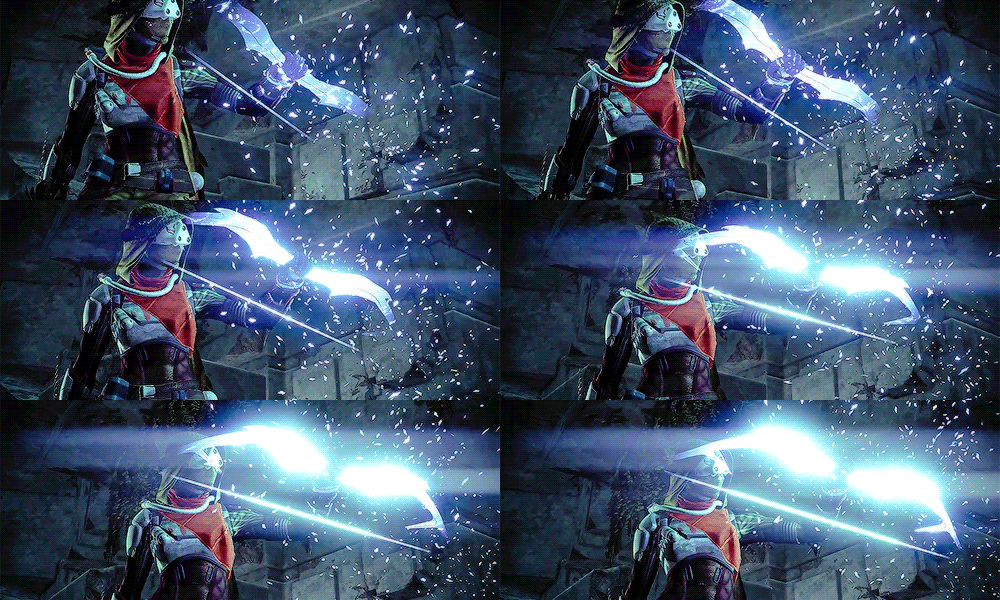
What is this sexy solution, you ask? Well, it already exists in a major way, but it’s due for a major leap forward. It’s this:

That, my friends, is high-quality animation from the video game, “Destiny: The Taken King.” Take a moment to admire it. Then, think back to how animation used to be. If you’re with me to this point, you’ve already made the overtly-sexy connections.

This may be the key. This may be the secret weapon with which to shatter the seemingly-impenetrable walls that keep erotica/romance relegated to midnight skin-flicks on Cinemax. Animation, namely the high-quality kind that companies like Pixar and Bungie pay top notch for, could be the key to making erotica/romance work.

On paper, it makes perfect sense. With animation, you overcome one of the biggest obstacles in producing a quality movie, namely finding actors and actresses that can both emote the necessary passion and not shrivel, literally and figuratively, when they have to get naked and make love on demand.

Animated characters don’t complain about mood, chemistry, or how their trailers are painted. They don’t age. They don’t get fat. They can look as beautiful or as ugly as a director wants them to be. They are, by default, the perfect medium for bringing a character to life. A number have already become quite iconic.

Related image

Now this isn’t a wholly radical idea. In fact, it’s already an established industry in a magical land called Japan. There’s an entire genre of animated porn called anime porn. This brand of porn utilizes themes and stories so outlandish, so extreme, and so disturbing that even the worst moments in “Game of Thrones” cannot compare. Look up something called “Futanari” for proof. Be warned though, you won’t be able to unsee it.

Radical or not, Japanese anime has the same problem that our softcore skin flicks on Cinemax have here in the United States. The stories are flat. The acting and dialog is atrocious. The main point of these movies is to titillate and not enchant.

Pretty much every male character in an anime porn acts a certain way, just like every bleach-blond, big-breasted woman in a softcore porn acts a certain way. There’s no real depth. It’s just basic, bland, and blunt.

Image result for anime nosebleed

That may be a product of sticking to a winning formula. Japanese anime porn has been around for decades, has an established fan base, and isn’t going to risk that fan base by doing something different. That’s just how an established industry works.

That said, it does prove that there’s a market for mature, animated content. We’re already seeing major studios attempting to tap that market beyond the usual “Simpsons” and “Family Guy” demographics.

In the past few years, new cartoons with mature things like “Archer” and “Bojack Horseman” have found a major audience. Even among younger audiences, shows like “Samurai Jack” reveal that there is a market for a more mature cartoon.

The timing of this growing market couldn’t be better because as this audience is growing, technology in graphics and animation is improving. Moreover, video game companies and developers are using those improvements to tell better stories. Some of these stories are every bit as engaging, dramatic, and emotional as movies. I know this personally, as I’ve freely admitted that the end of Final Fantasy X and Mass Effect got me choked up.

Major video game makers are already exploring deeper, more mature stories that don’t just rly on killing zombies or shooting aliens. Games like “Heavy Rain” utilize mature themes, a rich story, and intimate moments. Having played the game, I can say that this definitely strikes plenty of chords, including the sexy kind.

Image result for Heavy Rain love scene

So there’s a growing market for mature cartoons. The technology for graphics in animation is also improving and being refined through the $5.2 billion video game industry. What’s the hold up then? Why aren’t we seeing an animated “50 Shades of Grey” movie that isn’t limited to Jamie Dornan’s acting abilities?

As is often the case in the entertainment industry, it all comes down to money. That’s the simplest and most complete explanation. It’s safe to assume that if every major movie studio could replace every actor and actress with a 3D animated model, they’d do it in a heartbeat, thereby ensuring that they never have to work with Shia LeBeouf or Lindsey Lohan again.

The reason they can’t do that is because, as much as animation has improved, it’s still expensive. Toy Story 3, the current gold standard for animated movies, cost $200 million to make. For TV, the average cost of a half-hour animated show is about half-a-million and the cost of a top-quality show like “The Simpsons” is about $2 million.

For comparison sake, entire movies like “Boyhood” and “Whiplash” cost less than $5 million. Animation is also more labor-intensive, which requires a great deal of outsourcing, something the cast of a typical sitcom doesn’t have to worry about.

Image result for outsourcing

As it stands right now, animation is not a preferable option for making movies, TV shows, or erotica/romance. It’s costly, labor-intensive, and affiliated with too many talking animals. However, that may be changing in a major way very soon.

This is where I try to channel my inner psychic and see a bit into the future. Granted, I’m about as much a psychic as I am a starting point guard for the Golden State Warriors. Don’t assume I know more than someone working at Starbucks, but at least trust me when I say I do try to see the forest from the trees and make connections where I see them.

While the cost of animation is going up, advances in computing power and AI are growing as well. Most are content to let AI’s run their schedule or make annoying telemarketing calls, but they can’t make are, right? That’s intrinsically human, right?

I’m sorry to say that our future robot overlords are catching up faster than you think. Back in 2014, the University of Spain created, Iamus, a program that creates its own melodies. Not to be left out, Google followed suit with a program of their own in 2016.

Image result for robot musicians

That’s all well and good, even if it sucks for the future Taylor Swifts of the world. That doesn’t mean robots can draw, right? Humans still have that on the machines, don’t they?

Again, our future robot overlords are catching up faster than you think or feel comfortable accepting. In 2016, Google created another AI called “Quick Draw,” which can recognize simple doodles. A number of robots have even been able to produce their own artwork.

Granted, these works of art are a long way away from being Picasso or Elvis Presley. It’s a start though and, as our recent history with technology has shown, the pace of that technology will only accelerate. Given how slow and clumsy we humans are, it’s only a matter of time before they’re a billion times better at it than we are.

On top of that, the technology for computers to read our minds is emerging as well. This too is in the very early stages of development, but there’s a lot of money in technology, art, and doing things a billion times better. If a computer can make a movie like “Frozen” a billion times faster and a billion times cheaper, you can assume Disney will be all over it like Homer Simpson in a donut factory.

Image result for computers that can read thoughts

This has huge implications for every art-based industry in the world, but what does this mean for animation and erotica/romance? Well, most importantly, it means at some point the cost of animation is going to come down.

Eventually, a future version of Google’s drawing software will be so advanced that it can do the job of 100 animators 100 times faster and a million times cheaper. That means movies like “Toy Story 3” no longer cost $200 million. They could cost only a couple million. That means episodes of shows like “The Simpsons” can cost less than a used car.

This opens up countless possibilities for new stories to be told, which don’t have to rely on the bloated budgets or corporate backings of major studios. Since AI is also developing to a level where it can mimic voices, it means that even the cost of voice actors will go down or be replaced altogether.

It won’t happen all at once. There won’t come a day when entire animation studios go out of business or new studios pop up overnight. These types of technology trends take time to develop. They never happen all at once. Cell phones took 40 years to get to where they are now. Modern TV took over a half-century. Expect this kind of technology to take a few decades at the very least.

Image result for old tv

However, there’s a lot of money to be made. The rising cost of producing movies is creating a strong incentive to find an easier, cheaper way to create a similar product, minus all the zeroes at the end of the price tag. When there’s that much incentive, then economics usually makes it an inevitability.

That means the first real erotica/romance movie may not be the same live-action piece we saw with “50 Shades of Grey.” It may very well take the form of colorful, sexy animated feature that doesn’t require self-conscious actors or actresses to use body doubles. Maybe one of my own novels will one day take that form. I hope I live long enough to see it.

Again, that day will not be tomorrow. However, this may be the future of erotica/romance. In that sense, Jessica Rabbit may be less a cartoon sex icon and more a prophet. If so, she may go down in history as the sexiest prophet of all time.

4 Comments

Filed under Jack Fisher's Insights

The Orgasm Gap: Biological Or Psychological?

When it comes to talking about an issue, I generally avoid the kind of crisis fear-mongering you’d see on a CNN special report, a Fox News segment, or an Alex Jones podcast. More often than not, those who resort to fear-mongering are a few steps too close to fitting their heads for tin-foil hats.

However, I’m about to bring up an issue that I believe really is a crisis. It does warrant a little fear-mongering, if only because it directly affects the erotica/romance industry, of which I’m trying to be part of. That’s because it involves orgasms.

Usually, my posts about orgasms are of the fun, positive, sexy variety. That’s to be expected. It’s not hard to make a discussion about orgasms fun. Unfortunately, it’s also not hard to make that discussion dire because when a significant portion of the population isn’t having them, then I consider that to be a big problem.

This isn’t just the sexy musings of an aspiring erotica/romance writer. This is a real issue. There really is an orgasm gap, so to speak. Men, not surprisingly, don’t have a hard time achieving orgasm. Thanks to an unfiltered imagination and internet porn, an orgasm for a man is as routine as a morning cup of coffee.

For women, however, it’s a very different story, one I wish were relegated to the kinds of sexy novels I write. The data doesn’t lie. Women are having a harder time taking a trip to O-town during intimate moments with their male lovers. Regardless of whether you’re a radical feminist or a douche-bag frat boy from an 80s teen movie, we know that’s not fair. Given the universal joys of orgasm, that kind of disparity just isn’t tenable.

Why is this an issue though? Why does this orgasm gap even exist in the first place? Evolution has given both genders a wonderful incentive to have sex, make love, and everything in between. What’s keeping us from enjoying it?

By and large, there are two major theories to explain this injustice. One theory says this gap is primarily due to biology, which is bad news for women because it means the gap is impossible to close. The other says the cause is psychological, which is somewhat less dire because it means the gap can be addressed, albeit with expensive therapy.

Most of the time, when there are two competing theories about why something exists, the truth often lies somewhere in between. In some instances, though, such as the case of creationism and evolution wherein one is definitively right and the other is a religiously-motivated fever dream, the truth is not so balanced.

So with respect to the orgasm gap, which theory is correct? I’m not a scientist and am woefully unqualified to be one. Thankfully, there are some scientists out there who value equal access to orgasms as much as I do and they have done research on this. These people are the true heroes of the erotica/romance world. So what did their research find?

Well, a recent TED talk by Peggy Orenstein does a nice job of summing up these results. I’m not saying her talk is definitive. These TED talks never are. However, her conclusions have some pretty powerful implications and not just for our collective sex lives.

There’s a lot to unpack here. As an aspiring erotica/romance writer, it reveals some major flaws in the proverbial narrative that is our intimate lives.

Parts of her talk definitely resonated with my own personal experience. I remember sex ed when I was in high school. Since my community wasn’t run by uptight religious zealots, I had the good fortune of receiving a fairly comprehensive education about sex, especially compared to Texas standards.

They were pretty thorough, talking about everything from contraception to childbirth. When it came to certain body parts, though, I do recall a distinct difference. Descriptions about male anatomy and how a penis works was fairly concise. Most of my male classmates didn’t learn anything they hadn’t already found out and were fairly assured that their manly bits were operating fine.

When the time came to discuss female anatomy, however, I sensed a distinct shift in mood. Everybody, girls and boys alike, shifted like they were trying to hide a nasty fart. The intricacies of female genitalia wasn’t so much about their beauty or aesthetics. It mostly boiled down to the idea that blood and babies come out of it. That’s about it.

On a personal note, I’ll just say I learned about the existence of the clitoris from “South Park.” What’s that say when a comprehensive sex education program from a major school overlooks something that can be gleaned from watching “South Park?” I’ll give everyone a minute to stop banging their heads against their desk.

Then again, self-image is something every teenager struggles with. I certainly did, but I had a damn good excuse because of my horrible acne problem. It’s one of those things that improves with maturity. Sure, some people mature faster than others, but most of the time, it’s women who do the maturing so how does that orgasm gap not disappear?

This is where the psychology, it would seem, overpowers the biology. Make no mistake. Our thoughts and attitudes can influence our bodies. Anyone who has tried to sleep the night before midterms knows this all too well. Then, there’s the attitudes that we, as a society, collectively impose on each other.

In this case, it’s an attitude we impose on women. Whether by the spirits of angry Puritans or the agendas of old men who vomit uncontrollably at the thought of their daughters having sex, we tell women that they’re not supposed to enjoy sex that much. They’re told the orgasm disparity is normal.

There’s supposed to be this orgasm disparity between men and women. Somehow, this disparity is supposed to keep society intact so that people don’t waste too much time enjoying orgasm. This is where Orenstein gets really personal when she recounts the woman who says:

“I guess we girls are just socialized to be these docile creatures who don’t express our wants or needs.”

The girl who said that claimed to be this fiery, assertive woman. That should reveal just how powerful these attitudes can be.

It’s not just one type of attitude either. Orenstein points out how girls see their vaginas with shame while boys let their dicks hang with pride. Being proud of a body part tends to affect it. I used to play baseball. This works with arms. It works just as well with genitals, if not more so.

However, I think Orenstein overstates genital attitudes in some areas, ignoring the fact that men will shave their balls and undergo circumcision to avoid being aesthetically unpleasing. That’s something that affects both genders more than she lets on.

That said, I agree with her wholly when she brings up one of the most telling details about the orgasm disparity. When same-sex partners are involved, that gap disappears quicker than a cold beer at a Red Sox game in July. This is where the biology theory starts to fall apart.

Now it may seem obvious on some levels, the idea that same-sex lovers can climax at the same rate. It makes intuitive sense. They’re two people working with the same equipment, so to speak. Naturally, they would know how to make that equipment perform.

I don’t doubt that’s part of it. I also think there’s more to it and Orenstein seems to agree.

“Girls’ investment in their partner’s pleasure remains regardless of the gender of the partner. So in same-sex encounters, the orgasm gap disappears. And young women climax at the same rate as men. Lesbian and bisexual girls would tell me that they felt liberated to get off the script — free to create an encounter that worked for them.”

How telling is that? Put women in a situation where certain attitudes about sex and female pleasure don’t apply and they can enjoy a trip to O-Town as much as any man. As an erotica/romance writer, it brings tears of joy to my eyes.

So the orgasm gap disappears with same-sex partners. That’s all well and good, but what about the women out there who can’t get too horny around other women? What about the women who actually want to share the joy of orgasm with men? Well, Orenstein gives hope to those women too when she cites surveys done in cultures that aren’t haunted by the spirits of angry Puritains.

Consider a survey of 300 randomly chosen girls from a Dutch and an American university, two similar universities, talking about their early experience of sex. The Dutch girls embodied everything we say we want from our girls. They had fewer negative consequences, like disease, pregnancy, regret — more positive outcomes like being able to communicate with their partner, who they said they knew very well; preparing for the experience responsibly; enjoying themselves. What was their secret? The Dutch girls said that their doctors, teachers and parents talked to them candidly, from an early age, about sex, pleasure and the importance of mutual trust. What’s more, while American parents weren’t necessarily less comfortable talking about sex, we tend to frame those conversations entirely in terms or risk and danger, whereas Dutch parents talk about balancing responsibility and joy.

Let’s all take a moment to thank the Dutch. Let’s also take a moment to understand what this reveals.

Again, no theory is truly definitive, but Orenstein lays out fairly concisely how the orgasm gap is largely a psychological issue. Men define satisfying sex by their orgasm. Women define it by the ability to please their partner, which sets the bar low and ensures an unequal outcome.

That means we, as a society, should set new standards and I can say with a fair amount of certainty that men are all for that. How do I know this? Well, let me let all the women out there on a little secret about us men that really shouldn’t be a secret.

We WANT you to have orgasms when you have sex with us.

It’s true. Men really do want the women they have sex with to orgasm. Most of the time, they don’t want women to just lie there and act like a glorified barbie doll with a pulse. They actually want their partners to feel pleasure.

It shouldn’t require a real stretch in logic. Men understand that if women feel a lot of pleasure during sex, then they’ll want to do it more often with them. More sex makes us happy. We have a powerful incentive to make sure you women share in the joys of orgasms. The problem, albeit a sexy problem, is that it requires a mutual effort.

I believe we can close that orgasm gap for coming generations. I can only do so much as an erotica/romance writer, but we collectively can do so much more. When the day comes where men and women can expect to have an equal potential for orgasms during sex, then we will have achieved true equality. I look forward to that day.

15 Comments

Filed under Jack Fisher's Insights

Sexy Sunday Thoughts: St. Patrick’s Day Edition

Top of the morning to ye, my lovely lasses and laddies! I hope everyone here had a safe, fun, hangover-free St. Patrick’s Day this past week. Whether you stayed sober or got more drunk than Homer Simpson at happy hour, I hope you all had a fun, sexy time.

I know St. Patrick’s Day isn’t exactly Christmas in March. I know it doesn’t involve elaborate gifts, fancy deserts, or family gatherings that coincide with football games. However, it does involve a damn good excuse for heavy drinking, bad dancing, and public nudity. We all live such stressful lives these days. I say we need something like that every now and then.

I won’t go into detail about how I spent my St. Patrick’s Day. Just assume it involved more than a few beers and resulted in some form of nudity. For me, that constitutes a successful holiday in any capacity. Considering how sick I was a week ago, it’s a damn good feeling and one that has inspired some sexy musings.

As such, I’m proud to present my official St. Patrick’s Day edition of “Sexy Sunday Thoughts.” I can’t guarantee that all of these musings were surmised with a sober mind. I also can’t guarantee they won’t disturb those still recovering from a hangover. I’ll just say that they’re a product of a mind that’s just glad to not be sick anymore and eager to celebrate any holiday that inspires public nudity. Enjoy!


“Women underestimate how much breasts make men act stupid and overestimate how much they’ll regret that stupidity in the morning.”

I’ve seen men do many stupid things when in the presence of exposed breasts. I, myself, have done my share of foolish things in the presence of breasts. I don’t think that women understand just how much power their breasts have over us.

It often leads to cases where women complain about male stupidity when in the presence of beautiful women. I get why some women feel that way. Even some men feel that way. However, they don’t seem to understand how futile it is to make men feel sorry for appreciating the power of breasts. You can shame men for a lot of reasons. Being stupid around breasts isn’t one of them.


“It’s inherently hypocritical for men to insult a woman for being a bitch, but still wanting her to fuck like one.”

I’m a man. I have a lot of male friends. As such, it’s not uncommon for some of those friends to complain about a woman being too bitchy, whether it’s a co-worker, a girlfriend, a sibling, or a spouse. In some cases, the insult is justified. In most, however, it’s somewhat misguided.

That’s because I’ve also noticed how men expect so much from their women. They want a loyal, gentle, nurturing lady they can parade in front of their grandparents, but they also want a kinky nymphomaniac who will fuck like Jenna Jameson on crack. That’s expecting too much, in my opinion, and insults mixed with hypocrisy is never sexy.


“A man who shaves his balls assumes way too much about the role they play in his sex appeal.”

I don’t know who started this trend. Whoever it is, I wish to personally punch them in the jaw. The male nutsack has a purpose and shaving it does nothing to enhance or facilitate that purpose. I get the logic behind grooming pubic hair and being mindful of one’s genitalia. I just don’t think the presence or absence of hair on a man’s balls has much influence on how sexy he is.


“We live in an era where a text message can count as foreplay and a compliment on a woman’s breasts can count as harassment.”

Honestly, I’m scared to compliment a woman on her appearance these days. Anything and everything said about her body can be construed as harassment of some kind. It’s frustrating because women say they want us to respect their bodies, but get offended when we compliment it. It’s enough to frustrate any man’s brain and genitals.

Then, there’s the idea of sexting. Apparently, this is how a new generation of horny men and women are getting around that issue. For them, a simple text message is the equivalent of tongue-kissing and copping a feel. I’m all for the power of the written word, but some kinds of power need not be that skewed.


“The fact that so many young people learn about sex through internet porn makes me worry that they overestimate the impact of spanking.”

Now I love internet porn as much as the next guy. I’m grateful for the service and convenience it provides. However, I worry that our collective unwillingness to talk to young people about sex is essentially deferring the issue to porn stars, porn studios, and Howard Stern.

That would be like ditching driver’s education and letting teenagers learn about driving by watching “The Fast and The Furious” in conjunction with having multiple orgasms. That’s going to leave a flawed impression. Given the amount of lubricant, tattoos, anal bleaching, and spanking involved in the average porn, I worry that an entire generation of youth will have a flawed understanding of what constitutes intimate, sensual experiences.


“Sex appeal is like the meat on the bone of a juicy stake. Romance is a willingness to slow-cook that steak and marinate it in special sauce.”

As an aspiring erotica/romance writer, it’s important to understand the difference between raw sex appeal and romance. Sex appeal is pretty basic. A woman with big breasts and a man with a big dick has inherent sex appeal. Those traits trigger the kind of basic, primal responses that made our cavemen ancestors horny.

Romance, on the other hand, goes beyond the mere primal. Romance requires a certain amount of thought, patience, and planning. Whether you’re a man or a woman, romance is the icing while the sex appeal is merely the sugar. Our willingness to be patient, thoughtful, and intimate goes a long way towards crafting that perfect dish, be it a dinner or desert.


“When you think about it, romantic gestures that cost money are down payments towards future orgasms.”

Economics and finance are rarely that sexy. That doesn’t mean they can’t influence our love lives. When you get down to the basics, romantic gestures are like emotional investments. Instead of interest, the payoff is love, intimacy, and hot sex. Even by Warren Buffet standards, that’s a pretty good return on investment.


That’s all for now. Hope this helps others recover from their St. Patrick’s Day festivities and/or reconcile with their liver. Laughter is supposed to be the best medicine. So long as it isn’t coupled with blackouts and dry-heaves, I like to think I’ve helped.

Leave a comment

Filed under Sexy Sunday Thoughts

Should We Marry For Love? Wait What?!?!

Should we really marry the person we love? That’s not a rhetorical question. That’s not the beginning of some elaborate joke or rant either. It’s an actual, honest question that we, as a society, stopped asking very recently in the grand scheme of things.

As an erotica/romance writer, these kinds of questions are pretty darn relevant. The way people see love, marriage, sex, and everything in between shapes the novels I write. I’ve written several books thus far, but I’ve never really dealt with this question directly. Given the rate at which the concepts of marriage and love are changing, this question is pretty important.

So why is it relevant to begin with? Why should this be a controversial issue? Well, contrary to what registered republicans and the church would have us believe, the modern concept of traditional marriage isn’t that traditional.

In fact, for most of human history, marrying for love was the exception and not the norm. For some people, the very idea of marrying for love was an affront to marriage itself. There’s even an old Egyptian proverb that says:

“One who marries for love alone will have bad days, but good nights.”

Let that sink in for a moment. Up until very recently, and by recently I mean the 17th century in Europe, people didn’t marry for love. They married because it was just part of how old, pre-industrial societies worked. From Europe to China, most marriages were arranged by families. Sometimes, the bride and groom didn’t even meet each other until their wedding day.

This was because marriage was not seen as a romantic gesture. It was seen as a cooperative partnership, of sorts, between families. You didn’t marry your spouse as much as you married into their family. It was how pre-modern societies ensured a proper exchange of property, bloodlines, and procreation.

That’s not to say love was completely absent. Ideally, the hope was that a couple would marry first and then fall in love. It may seem backwards today, but that was the ideal espoused in the past.

Why was this? Why was love divorced from marriage, if that’s not too loaded a term? Well, there is a social and political reason for that, one that a brilliant woman named Stephanie Coontz articulates far better than I ever could. She explains:

In some cultures and times, true love was actually thought to be incompatible with marriage. Plato believed love was a wonderful emotion that led men to behave honorably. But the Greek philosopher was referring not to the love of women, “such as the meaner men feel,” but to the love of one man for another.

Other societies considered it good if love developed after marriage or thought love should be factored in along with the more serious considerations involved in choosing a mate. But even when past societies did welcome or encourage married love, they kept it on a short leash. Couples were not to put their feelings for each other above more important commitments, such as their ties to parents, siblings, cousins, neighbors, or God.

In ancient India, falling in love before marriage was seen as a disruptive, almost antisocial act. The Greeks thought lovesickness was a type of insanity, a view that was adopted by medieval commentators in Europe. In the Middle Ages the French defined love as a “derangement of the mind” that could be cured by sexual intercourse, either with the loved one or with a different partner.4 This cure assumed, as Oscar Wilde once put it, that the quickest way to conquer yearning and temptation was to yield immediately and move on to more important matters.

In China, excessive love between husband and wife was seen as a threat to the solidarity of the extended family. Parents could force a son to divorce his wife if her behavior or work habits didn’t please them, whether or not he loved her. They could also require him take a concubine if his wife did not produce a son. If a son’s romantic attachment to his wife rivaled his parents’ claims on the couple’s time and labor, the parents might even send her back to her parents. In the Chinese language the term love did not traditionally apply to feelings between husband and wife. It was used to describe an illicit, socially disapproved relationship. In the 1920s a group of intellectuals invented a new word for love between spouses because they thought such a radical new idea required its own special label.

In Europe, during the twelfth and thirteenth centuries, adultery became idealized as the highest form of love among the aristocracy. According to the Countess of Champagne, it was impossible for true love to “exert its powers between two people who are married to each other.”

In twelfth-century France, Andreas Capellanus, chaplain to Countess Marie of Troyes, wrote a treatise on the principles of courtly love. The first rule was that “marriage is no real excuse for not loving.” But he meant loving someone outside the marriage. As late as the eighteenth century the French essayist Montaigne wrote that any man who was in love with his wife was a man so dull that no one else could love him.

It sounds as unromantic as it does unsexy, the idea that love is actually a liability in marriage, so much so that people in the past were shunned for loving their spouses too much. However, there is a context to consider.

These are pre-modern, pre-industrial, mostly-agrarian cultures where infant mortality is high, maternal mortality is high, and plagues are exceedingly common. Love, as anyone whoever listened to a Beatles song, is a very fickle emotion. It cannot be channeled, controlled, or changed. Some have tried, but most efforts fail. Just ask anyone who endured conversion therapy.

That kind of chaos just doesn’t fit in a society that is only one bad harvest or one nasty plague away from total collapse. These societies need to exert some level of social control in order to function.

Societies still change. Civilization, as we know it, changes with it. We no longer live in a society where such social control is necessary, but there are still plenty of societies all over the world where arranged, loveless marriages are common. Some will even claim that such marriages are better than love marriages.

It may sound ridiculous to the freedom-loving west, but think about it. Why go through the trouble of finding a spouse when your parents can just do it for you? Besides, who knows you better than your parents? Wouldn’t that save everyone a lot of time, energy, and heartbreak?

That last part wasn’t entirely sarcasm, but that’s the logic behind arranged marriages. The fact it’s still so prevalent all over the world indicates the logic isn’t entirely flawed. It also acknowledges that there are some fundamental issues with marrying for love.

As many writers far more accomplished than me have said, love is a very fickle emotion. It changes on a whim more than it lingers. You could love someone for 30 years and one day find someone else you love even more. It happens. That’s what love can do. That’s why it’s so scary/amazing/powerful.

There’s no doubt that marriage, as an institution, is destined to change even more than it already has. Every church, mosque, and synagogue may fight it. Every social conservative may oppose it. That still won’t stop it. The institution will keep changing, probably in ways that nobody, especially not an aspiring erotica/romance writer, can predict.

This brings me back to my original question. Should we marry for love? Should marriage even be connected to love? It’s as serious a question as anyone can ask, regardless of time period or generation. It’s also a question that we, as a society, will have to answer at some point in our lives. Let’s hope we answer it right.

10 Comments

Filed under Jack Fisher's Insights

Sexy Sunday Thoughts: Spring Leap Edition

I know. It sucks when we lose an hour of sleep. Even if you don’t have to work and got a lot of sleep the night before, it still sucks. Sleep is one of those things we don’t like to compromise. That’s why daylight savings, at least in the spring, is so frustrating.

We all need as much rest as we can get, if only to ensure our beds are ready for other activities. If you’ve been following this blog for any length of time, you know what I mean so I won’t spell it out. I’ll just let your dirty, filthy imagination fill in the blanks.

Dirty or not, there’s no getting around it. We here in America have all lost an hour of sleep today. That sucks, but it’s not a goddamn tragedy. The best we can do is suck it up, sleep in next weekend, and do what we can to make up the difference. I can’t give you that hour back, but I can make it easier with some of my Sexy Sunday Thoughts.

Even if you’re tired, a little sexy musings should help re-energizing your mind, body, and everything in between. Consider it my makeshift remedy to this most inconvenient of practices. Enjoy!


“Eating, sleeping, breathing, and sex are all basic needs, but only one of them is illegal to do in public.”

Unless you live in a nudist colony, this is one of those odd little proclivities about society and how we meet our basic needs. Now I’m not saying that people having sex in broad daylight is a good thing. Traffic is bad enough in some cities. The last thing we need is blowjobs holding up a crosswalk.

That said, sex is still one of those basic needs that we all seek as humans. Like food, air, and rest, it’s as critical to our survival as any other basic function. Despite this, there are all sorts of taboos and laws that prevent us from doing it out in the open. Not saying it’s inherently wrong, but it is kind of odd in that context.


“An orgasm for women is one of the few bodily functions that has been both a symptom and a remedy for disease.”

It’s true. There have been times in history where orgasms have been seen as a sign of disease. For some societies, especially those run by celibate holy men and chaste women, an orgasm might as well be a malignant tumor. No self-respecting woman would seek such toe-curling pleasure without some form of ailment right?

At the same time, orgasms have also been used as treatments for certain diseases, most of which have since stopped being diseases. In terms of treatment, you can’t get much better without morphine or weed.


“Marriage is the bureaucracy of love and divorce is the hidden legal fee of heartbreak.”

Let’s not lie to ourselves. Marriage, as an institution, is very much a bureaucracy. It’s next to impossible to make it sexy or romantic, but we, as a society, have done our best. I’m not saying it’s perfect, but it still works.

Divorce, on the other hand, is never sexy or romantic. It is, for all intents and purposes, the legal equivalent of a kick to the balls or an ice pick to the heart. By comparison, a hidden legal fee is almost merciful. Like I said though, bureaucracy obscures our capacity for love and romance. You take the good, the bad, and the downright painful that comes along with it.


“Jealousy is to love what projectile vomit is to erections.”

I’ve written about jealousy before and questioned just how natural it is, but I don’t deny how toxic it can be to love. Jealousy is like kryptonite. It can take an otherwise-healthy relationship and drag it through piles of elephant shit.

It’s a toxic emotion, that’s for sure. When it comes to lust though, namely those that inspire erections, it doesn’t take something so esoteric. Something as simple as projectile vomiting, both as a participant and an observer, will kill any sexy mood faster than a surprise visit from the Pope. It’s just basic biology.


“The first person to try anal must have been very convincing and the first person to agree to it must have been very gullible.”

I’ve got nothing against anal and those who enjoy it. I don’t consider myself an enthusiast though. I’m more than happy to leave that sort of thing to gay men, experienced porn stars, and the kinky women who inspire them.

However, I still can’t help but wonder what into the first act of anal sex. What exactly where those involved thinking? Were they drunk? Were they feeling adventurous? What kind of conversation did they have? I don’t know, but I suspect one person was very persuasive and the other was exceedingly susceptible to being persuaded.


“A young woman’s annoying personality traits are directly correlated by how much she spends on her dog.”

Maybe this is just Paris Hilton’s influence being too damn prevalent, but I’ve noticed a fairly common trend among certain women. If they’re young, beautiful, and annoyingly upbeat, they tend to pamper their dog in ways most human babies can only dream of. Short of breast feeding, these dogs have a pretty sweet deal.

The cost, unfortunately, is a woman with an annoying personality who sees her dog as more worthy of affection than other people. Now I love dogs as much as the next guy, but there’s a fine line between care and infatuation. Those who never see that line tend to be more annoying than they’ll ever admit.


“Men can’t experience the pain of childbirth, but they spent their whole lives vulnerable to a kick in the balls so it kind of balances out.”

I know women will debate me on this. Being a man, I can never know the pain of childbirth. I’ve seen how pregnancy effects friends and family members. It really does a number on a woman’s body that makes me think twice about taking a sick day because my stomach hurts.

That said, women will never know the pain that comes with being hit in the balls. Growing up, I played sports. As a result, I’ve been hit in the balls with a baseball, a basketball, a hockey pick, and a lacrosse ball. That’s a pain I wouldn’t wish on my worst enemy. It’s also a pain that I, as a man, will always be vulnerable to. I’m not saying this puts men and women on equal footing. I’m just saying the gap isn’t as big as you think.


“Those who give oral sex are heroes. Those who receive oral sex are lucky. Those who do both are true champions.”

I’m of the strong believe that oral sex is the ice cream of sex. No matter what form it takes, it’s usually pretty damn delicious. Those eager to give it deserve the highest of praise. Those lucky enough to get it deserve a high-five, a hug, and an ounce of respect.

However, it’s those that do both who are the real legends. Those that do both and do them well don’t just make things better for their lovers. They raise the bar for those around them. As far as I’m concerned, oral sex can’t have too high a bar. A world where everyone can give and receive oral sex masterfully is a world of true peace.


That’s all for now. Hope this helps make up for the lost hour you would’ve otherwise spent in bed, not contemplating such sexy subjects. As an aspiring erotica/romance writer, I can only do so much. However, I’m certainly willing to do my part.

1 Comment

Filed under Sexy Sunday Thoughts

The (Lack Of) Consensus Surrounding Consent

Some issues really shouldn’t be that controversial to begin with. Things like treating pets well, not hitting kids, and not putting wasabi in your cereal are just common sense. There should be no controversy. Anyone who wasn’t raised by Jeffrey Dahlmer should understand that.

That’s why I find it so frustrating that the simple issue of consent has become so heated. It’s not just a trending buzzword. It’s a goddamn trigger word these days, so much so that blowhards like Rush Limbaugh feel compelled to say incredibly stupid shit about it.

Again, it shouldn’t be controversial. The idea of getting consent from someone before you have sex, kiss, or massage their prostate fits perfectly within the realm of common sense. So why the hell is it such an issue? Why are star athletes and ardent feminists struggling with it to begin with?

There are any number of elaborate, politically-charged factors I could talk about. Since I don’t want people to treat this blog as a cure for insomnia, I’m going to try and keep it simple, funny, and sexy, although when it comes to consent, there’s only so much sexiness I can manage.

The problem, if you really want to call it that, is common sense itself. By that, I mean we think human beings are wired to have it. That’s only half-true at most. As I’ve made clear before with my use of caveman logic, the human brain is not wired for common sense. It’s wired for survival and reproduction. Anything beyond that is just extra icing.

That means that people frustrated with other peoples’ inability to understand consent don’t understand the biological wiring of their own species. Whether you’re a feminist or an extra in a Lil Wayne video, we’re still part of the same species. We’re still prone to the same flaws. Failing to take that into account is akin to joining the Navy without remembering you get seasick.

This leads me to a recent video that the fine folks at Cracked.com put up a while back. Now I’m usually a big fan of Cracked. I’ve cited them before on this blog and they generally do a good job of exploring sensitive issues in a funny, often sexy sort of way. This time, however, I’m a bit torn.

This video, despite having undeniable sex appeal in talking about a serious issue, tries too hard to make this issue simple. I can totally understand that. Cracked is a humor website, not a lecture hall at Oxford. However, in trying to make things simple, it misses a few key details.

Like almost every major issue or political movement, the controversy surrounding consent began with the best of intentions. In previous decades, the rates of sexual assault and rape were atrocious. The issues associated with handling these crimes was just as bad. One side said it was consensual. The other side says the other has a fucked up definition of the word. In a courtroom not run by Judge Judy, that’s a difficult crime to resolve.

In recent years, especially with the rise of third-wave feminism and greater emphasis on women’s issues, there has been a concerted effort to address the uncertainties surrounding consent. I don’t doubt the motivations or the heart. In principle, they’re coming from the right place. In practice, however, there’s a big problem.

To illustrate this problem, let me paint a scenario. Picture a man and a woman, totally sober and in a sound state of mind. They’re at a party, a bar, a barn dance, or wherever people meet these days. They start chatting. They laugh. They like each other. Then, things get heated.

The man asks if the woman wants to go somewhere more private. She says yes.

The man asks if the woman wants to get into bed with him. She says yes.

The man asks if the woman wants to take off their clothes. She says yes.

The man asks if the woman wants to have sex with him. She says yes.

The man and the woman start having sex. Body parts are in other body parts. Basic biology takes over. All the while, the woman still says yes.

Then, for any number of reasons that are too vast to specify, the woman says no. There’s little to no warning. There’s little to no reason. She just starts saying no. Under the emerging concept of consent, as espoused by the very vocal wings of third-wave feminism, that man is now a rapist.

Does that clarify the issue? Does it now make sense why the concept of consent isn’t quite as easy as the editors of Cracked makes it out to be?

It’s an unavoidable facet of being human. People don’t always say what they mean. People don’t always mean what they say. Until brain-to-brain communication and perfect lie detectors are perfected, there’s really no way to know for sure.

This creates an unequal dynamic between men and women, those most dreaded of predicaments that make feminists and men’s rights activities hulk out. Just look at the Duke Lacrosse incident or the Rolling Stones UVA case. It’s not just a matter of he said/she said anymore. It’s a matter of unequal gender dynamics creating a confusing, conflicting, and in some cases detrimental understanding of intimacy.

Unlike decades in the past, an accusation of sexual assault is almost as bad as a conviction. Up until very recently, it was possible to deal with a sensitive incident privately and not incur the wrath of the public. Provided you weren’t a politician, pastor, or celebrity, it was something you could put behind you.

Thanks to social media and the internet, that’s not possible anymore. As soon as the story surrounding the UVA case came out, there was no real effort to check the facts. The entire world just assumed the men were guilty. There were protests. There were lawsuits. The whole ordeal became a rallying cry for protesting the macho-manly frat culture that we’ve seen in every 80s teen movie.

Despite all this outcry, though, it wasn’t true. It never happened. The story was totally fabricated and Rolling Stone had to apologize for that story. In this issue, the concept of consent was conflated and twisted to create a false narrative. The problem was that certain people cared more about the narrative than the truth.

This is where consent gets especially muddled, especially for men. In both the UVA and Duke case, the assumption was that the men were guilty. That’s because, for those seeking a narrative, men are horny beasts who look for any opportunity to sexually assault a woman. Being a man, I can safely say this is not true. I can also say it scares the bejesus out of me.

It’s because of these expectations and assumptions that consent is difficult to grasp. If a woman accuses a man of assault, then she’ll be taken very seriously. If a man accuses a woman of the same, he’ll probably be laughed at. It’s one of those harsh double standards that few talk about.

In our current culture, it’s not okay to joke about men assaulting women, as comedian Amy Schumer found out. As for women assaulting men, it’s not just okay to joke about it. One of my favorite comedians of all time, Christopher Titus, did an entire routine about it in one of his specials.

Given this inequality in understanding and humor, how can women expect men to understand consent and how can men expect to empathize with women? When there’s this kind of discrepancy, it’s next to impossible.

As a man, I can only attest to my own experience. Personally, I’m terrified of a woman accusing me of something so horrible because I know, as a man, I’m not going to get the benefit of the doubt.

This means I’m very reluctant to hug people, ask them out, or talk about intimate issues. I know that if a woman wanted to, she could make an accusation against me and my life would be over. It wouldn’t even matter if I’m innocent. The accusation still ruins my life, my reputation, and everything in between.

Women want men to understand consent. Men want women to understand the kind of power and leverage they have over them. Both still have this innate drive to connect and be intimate. Our culture, our flawed assumptions, and our inability to be certain of one another’s intent just gets in the way.

Being the optimist I am, I believe it’ll change. I believe the arc of history still trends towards equality and justice. It won’t happen all at once. It might not even happen within my lifetime. Whenever it happens, I believe it’ll be worth the wait. When the day comes when men and women can talk about what kind of anal beads they prefer without fear, that’ll be a glorious day indeed.

14 Comments

Filed under Jack Fisher's Insights

Cyclops And Jean Grey Of The X-men: A Prelude To The Future Of Romance?

Admit it. You knew it was going to happen at some point. I start talking about brain-to-brain communication, sharing thoughts, and techno-telepathy and eventually, I was going to relate it to comic books.

If you’ve been reading this blog in any capacity over the last year or so, you know how much I love comic books and superhero movies. I’ve also made clear how much I love X-men in particular. Hell, I even argued that Storm was a better female superhero than Wonder Woman. Make that argument on a comic book message board and you can expect a lot of angry responses, including certain remarks about your mother.

My point is that if I haven’t made my love of comic books and X-men clear now, then there’s not much more I can do that doesn’t involve tattoos. That’s why it really should surprise no one that I’m about to relate my recent discussions about the future of sex and intimacy to the X-men.

Yes, I know the X-men were created in 1963 and using them as a precursor to the future is like using old reruns of “The Simpsons” to predict the future. Then again, given the Simpsons’ track record, that may be a bad example.

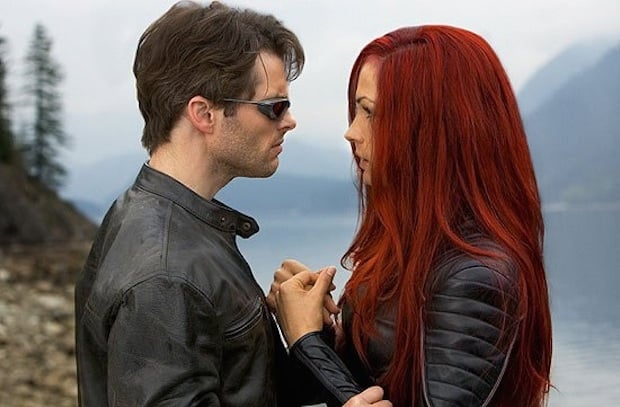
Specifically, I’m going to focus on Cyclops and Jean Grey of the X-men in discussing the future of love and intimacy. They’re not just one of my favorite comic book romances of all time. I’ve also cited them before as an strong example of a relationship of equals. I’ve also cited them as a way to highlight just how mind-numbingly awful love triangles can be. Overall, they’re a pretty useful couple is what I’m saying.

Now in talking about them with respect to the future of love and intimacy, I’m not going to focus on the particulars of their relationship. There are plenty out there who despise this romance, just as there are plenty out there who despise every romance that involves vampires. I get that. There are vocal X-men fans who would rather see Cyclops and Jean Grey involved with someone else. I’m not here to argue with those fans.

Like every superhero romance, Cyclops and Jean Grey has been prone to many complications that go beyond bad love triangles. Look at any romance in comics. Without exception, there’s always some amount of uncertainty, drama, death, rebirth, and reboots. It’s just how comics work.

For the purposes of this post, I’m not just going to focus on what makes the Cyclops/Jean romance work. I’m going to focus on one of the unique components about it, namely the fact that Jean Grey is a powerful telepath. She can read, project, and manipulate thoughts and she doesn’t need future technology or hypnosis to do it. As a mutant, it’s just one of those talents she’s born with. In that sense, it’s definitely more useful than sewing.

Now Jean Grey isn’t the only telepath in the X-men or the Marvel universe, for that matter. She’s not even the most powerful. Professor Charles Xavier, who was played by the insanely-charming Patrick Stewart in the X-men movies, is often cited as the most powerful psychic in the X-men comics. However, Jean Grey is often cited as a close second.

I mention that to make clear that Jean’s talent for telepathy isn’t just good by comic book standards. It’s first team all-pro good. Why does that matter? Well, being such a powerful psychic, it’s hard for her to filter out the thoughts of others. She even remarked in “X-men Apocalypse” that she knows what everyone thinks. Not much surprises her.

This makes her relationship with Cyclops all the more intriguing in the sense that she develops such a strong romantic connection with him, despite being able to read his thoughts and sense his emotions. He, in turn, falls in love with her, knowing full-well she has this kind of power. There isn’t a dirty, deviant thought he can hide from her and he doesn’t mind in the slightest.

Think about that for a moment. Cyclops falls in love with a woman from which he can’t readily hide his thoughts. He can’t even hide his emotions from her. She’s even commented in the comics and in the movies on numerous occasions how she can pick up on his emotions.

Lying to her is impossible. Hiding his feelings from her is impossible. Now on many occasions, Jean Grey tries to make clear that she doesn’t read peoples’ thoughts without permission. The keyword there is she tries. It doesn’t always work. Sometimes she can’t help it. Just ask the recently-outed Iceman.

Regardless of how much Jean Grey respects the privacy of others, it doesn’t prevent her and Cyclops from forging a relationship. It also doesn’t stop that relationship from blossoming into one of the most iconic romances in the history of comics, culminating in X-men #30 where they got married. Even if you’re among those X-men fans who despise their relationship, it’s hard to deny that were pretty damn serious about their love.

Why does this matter? What does it have to do with the future of romance and relationships? Well, think about the dynamics of such a relationship. Cyclops and Jean Grey don’t just share love, intimacy, and legal obligations. They actually share thoughts, as in real, unfiltered thoughts. That’s a dynamic that doesn’t exist in the real world yet, but as brain-to-brain communication technology matures, it will exist soon enough.

If communication is the key to every relationship, then Cyclops and Jean Grey have a master set. With them, there’s no need to put thoughts and feelings into words. There’s no need to make these elaborate gestures to convey how they feel. They don’t even need to argue about it. Their own thoughts convey whatever sentiment they want, be it love, lust, or a craving for corn dogs.

How many relationships in the real world fail because two people can’t properly communicate certain feelings? It happens all the time. It manifests in all kinds of sitcoms, some more than others. Hell, it happens in my own novels, especially in “Skin Deep.”

In addition to those relationships, how many others form on a foundation of lies because two people don’t know what the other is thinking? Someone might think they really love someone. The other might just fake it to get back at an ex-lover or land some big inheritance. It happens and, because these thoughts can be hidden, they can’t know for sure how genuine the romance really is.

In a future where brain-to-brain communication is available and couples can wield it like Cyclops and Jean Grey, the entire dynamic of love and romance changes. There’s no need to carefully navigate social cues in an effort to figure out what someone it thinking, feeling, and wanting. Everything becomes that transparent.

On one hand, this means the self-obsesses douche-bags who see others as walking masturbation toys that breath can’t hide anymore. The pick-up artist, the ladies man, and the Regina Georges of the world are exposed for all to see.

On the other, it also means that people can be certain that they’ve found a lover who genuinely loves them. It means we can be sure that the thoughts our lovers think are honest and true. We’re not blindsided. We’re not mislead. We know because we can make our thoughts known.

From a practical standpoint, it means that society will have to reshape the way people find love, intimacy, and connection. For some, it’ll be downright scary, having to share intimate thoughts with one another. However, we’ve reshaped those concepts before. Remember, there was once a time when marrying for love seemed like a crazy idea.

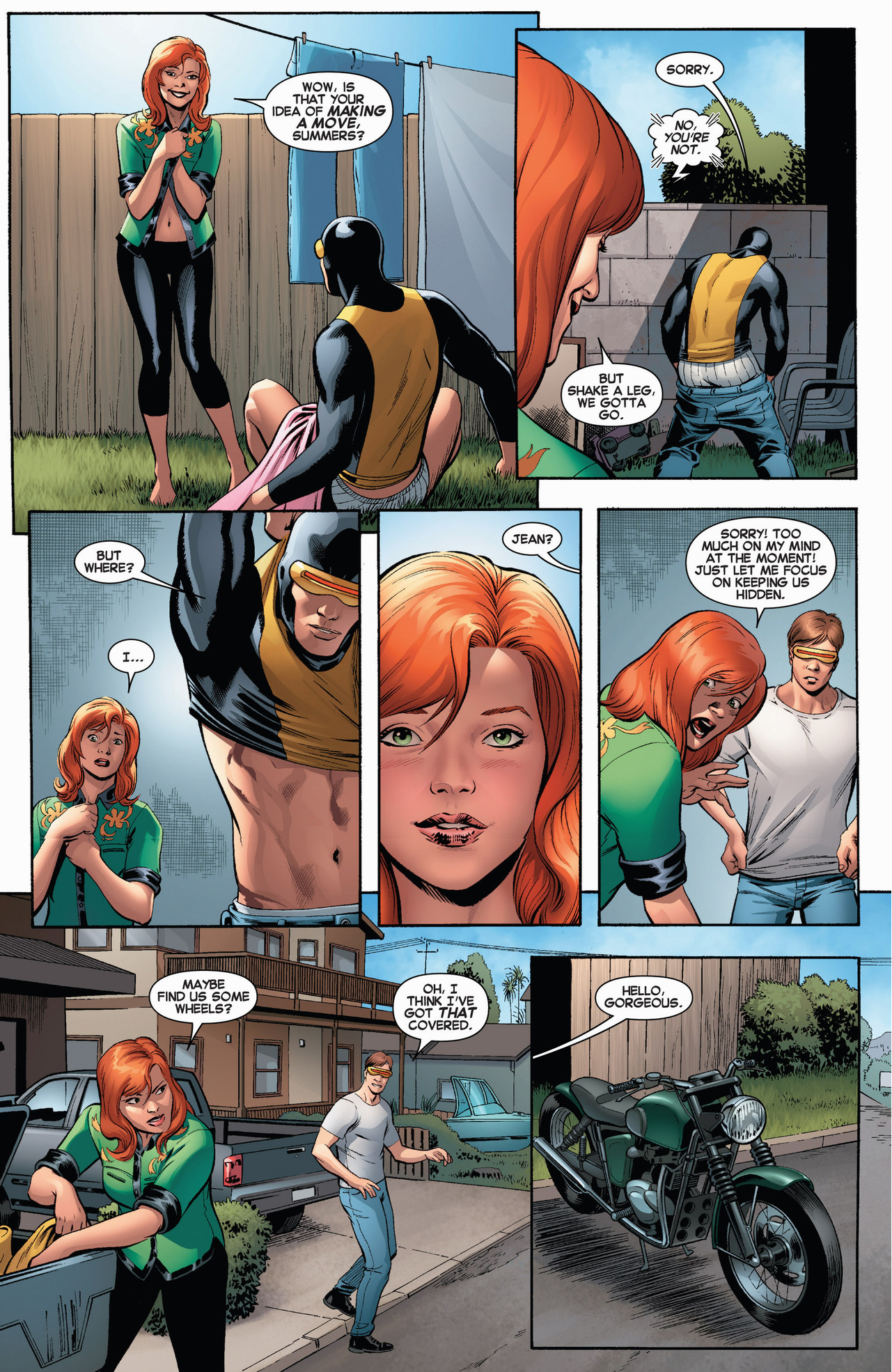
As is often the case, though, popular culture tends to be ahead of the curve when it comes to social and technological evolution. Star Trek did it with cell phones. Cyclops and Jean Grey may end up doing the same for romance. With that in mind, I’ll leave you with this iconic panel that highlights everything I’ve come to love about the Cyclops/Jean romance.

5 Comments

Filed under Jack Fisher's Insights