

The following is a review I wrote for PopMatters for X-men Blue #35. Enjoy!
The following is a review I wrote for PopMatters for X-men Blue #35. Enjoy!
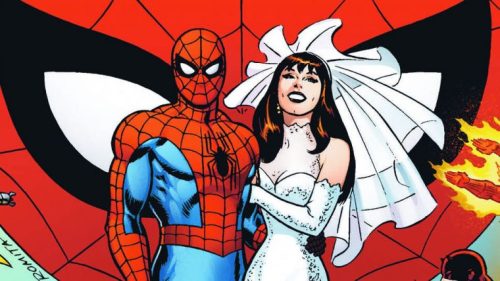
What is more emotionally satisfying than seeing someone you care about find happiness? Whether it’s a friend, a sibling, or even a celebrity you admire, don’t you feel a twinge of joy when you see them achieve something special? Unless you’re a cynic or a sociopath, you’ve probably had those feelings at least once in your life.
With those warm and fuzzy feelings inside, why shouldn’t that also extend to the iconic superheroes we know and love? When our favorite heroes finally get around to marrying the love of their life, it’s natural to want to cheer them on the same way we would cheer for our best friend as he and his bride do karaoke at the reception.

However, those tasked with building the canon seem to have an aversion to married superheroes. Just this past summer, that aversion was on full display. Two major superhero weddings were set up, one involving Kitty Pryde and Colossus in X-men Gold #30 and the other involving Batman and Catwoman in Batman #50.
Sadly, both events ended without tearful vows and a drunken toast, although one salvaged a matrimonial quickie at the last second. I’ve already broken down how one wedding just prolonged an already drawn out romance while the other denigrated the entire concept of romance, as a whole. Rather than bemoan those romantic misfirings, I’d like to step back and look at the bigger picture of married superheroes.

This is actually a controversial issue among fans of superhero comics and those who create them. I’ve been browsing comic book message boards for years. I can attest to just how much fans care when their favorite characters get married. They continue caring long after the wedding reception.
On the other side of the controversy, though, there are the creators that work for Marvel, DC, and their corporate overlords. They have a slightly different view of married superheroes and one that’s not nearly as sentimental. To say their views are complex is like saying a plumber has mixed opinions on food poisoning.
While many of those writing, editing, and producing superhero media are fans themselves, they often have to leave their fandom at the door. Companies like Marvel and DC Comics don’t pay them to write fan fiction. They pay them to tell stories that will sell, increase the value of their brand, and improve market share.

A writer or editor’s ability to do this is prone to many challenges. Fans, especially comic book fans, are notoriously fickle with their passions. If they see something they don’t like happening to a character they love, they’re pretty vocal about it. Just ask fans of Captain America, the Fantastic Four, or Cyclops of the X-men.
In that respect, I have some sympathy for the people responsible for handling beloved characters. They’re basically playing with someone else’s toys and getting paid for it. However, if they break those toys or damage them in any way, there can be hell to pay. Just look at the current situation with Star Wars.
That sympathy, though, only goes so far and I can’t extended to how some at Marvel and DC have approached marriage. DC Comics editor, Dan Dido, once went on record as saying that superheroes should not get married. Long-time Marvel editor and COO, Joe Quesda, even had to justify breaking up Spider-Man’s marriage to Mary Jane Watson by claiming that it “stabilized” Spider-Man too much.

Now in general, I try to be understanding and respectful when people hold positions that I disagree with. I’ve even tried to do that with hot-button issues like abortion, feminism, and organized religion. In this case though, I just have to call bullshit.
Claiming marriage does too much to stabilize a superhero is like saying ketchup makes food too red. It gives the impression that stability is somehow a liability with superheroes, as though they can only be interesting when their world is falling apart and they’re one stubbed toe away from a nervous breakdown.
It’s true that we superhero fans love seeing our favorite heroes fight back invading aliens, punch Nazis, and even take on renegade alien gods. However, it’s also true that we don’t expect or want that to be the only story that superheroes tell. We’re also interested in the lives they live outside their flashy costumes. It doesn’t just humanize them. It gives us more reasons to root for them.

Both Mr. Quesada and Mr. Dido try to make the case that part of being a hero involves sacrificing parts of their personal life in order to serve the greater good. There’s little doubt that being a hero comes at a price, as many of Batman’s former lovers can attest, but that doesn’t have to involve outright isolation.
It also doesn’t mean being a superhero makes a functioning marriage impossible, either. Yes, it’s a lot harder to be a loving spouse and a superhero, but I wouldn’t say it’s as daunting as battling planet-eating space gods or surviving a team-up with Deadpool. In fact, it can enhance their heroics in ways that go beyond romance.

I’m not the only one to make that point either. In wake of the recent wedding debacles by Marvel and DC, Comic Books Resources asked why publishers are so afraid of married superheroes. They cited the same excuses I did about heroes needing to sacrifice, but they also pointed out how these kinds of real-life, mundane events help people connect with these characters.
What the article didn’t get into is why this matters. Superman is a hero with god-like power who can move planets and create diamonds with his bare hands. He’s also married to Lois Lane and still has to put in the effort to make that marrage work, even when it becomes prone to complications.
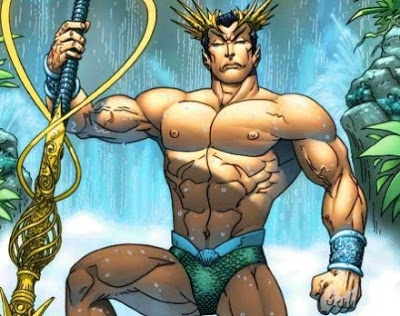
Reed Richards of the Fantastic Four is among the smartest beings in the entire Marvel Universe. He creates thought projectors, flying cars, and personal robots without breaking a sweat. He too has to work hard to keep his marriage and family functioning, especially when a handsome Atlantean king keeps trying to sleep with his wife.
Then, there’s Spider-Man. I know I’ve brought him up a number of times and not always in a positive light, but what happened to him and his marriage is still one of the most controversial things that have ever happened in comics. In many ways, he embodies the ultimate flaw in the excuses to undercut married superheroes.
In the infamous story, One More Day, Spider-Man’s marriage to Mary Jane Watson wasn’t just undone. He actually made a deal with Mephisto, Marvel’s stand-in for the devil, to sacrifice his marriage in exchange for saving his Aunt May’s life. Considering his Aunt had told him just a few issues ago that she didn’t want to be saved, Spider-Man still went through with it.

To say fans were upset by that decision would be like saying the Hulk has a slight anger management problem. This act didn’t just undercut an iconic superhero romance. It essentially reverted Spider-Man back to the state of an immature loser who had barely grown up since high school.
Again, Marvel made plenty of excuses. Long-time Spider-Man writer, Dan Slott, claimed that Spider-Man has to remain within a particular status quo. He has to keep being this lovable loser who is always struggling to hold down a job, keep a girlfriend, and still be a hero. In order to keep that unique appeal he has, and all the merchendising money it makes, he can’t be married.
I understand that logic, but I still call bullshit. You know what happens to characters who never change, grow up, or evolve over time? It’s the same thing that happens to real people. They become boring and unlikable. In Spider-Man’s case, he becomes something worse. He becomes the guy who sold his marriage to the devil to save someone who didn’t even want to be saved. That’s not heroic. That’s just plain selfish.

That’s the price a superhero pays for remaining in a prepetually regressed state. I contend that price is far higher than any associated with the inherent difficulty of writing married characters. With Spider-Man, One More Day established that no matter what he did in his personal or heroic life, he would never change. He’d always end up sleeping on his Aunt May’s couch.
It doesn’t matter if he pursues a new romance. It doesn’t matter if he becomes a billionaire and runs his own company. A reader can just assume he’ll screw it all up somehow and end up right back where he started. It’s just hard to root for any character that keeps regressing like that.
It’s like rooting for a sports team that never wins. Even terrible teams can turn it around at some point. Yes, that includes the Cleveland Browns. If that team never wins, though, why even root in the first place?

This is why marriage is so vital to the growth and evolution of superheroes. When a hero gets married, it’s not just an excuse to have a big event full of superhero-themed cakes. It’s a culmination of a much larger story about love, growth, and strength. It takes a lot to make a marriage work and not all of it can be done with superpowers.
Therein lies the ultimate appeal, though. When a superhero gets married, they go from simply pursuing a relationship to actually making it work. They have to learn how to build a life with another person and become part of a larger family, something that cannot and should not be exclusive to the Fantastic Four.

It fundementally changes how superheroes approach their lives, in and out of costume. It adds new layers of complexity and intrigue. Yes, it’s considerably harder than telling stories about Superman rescuing Lois Lane from Lex Luthor’s evil clutches. That’s exactly what makes it more compelling.
I don’t doubt that Marvel and DC will continue making excuses about married superheroes. Whether or not their approach to the issue evolves remains to be seen. However, since they’re in the business of keeping their characters relevant, they will have an incentive to adapt these characters for changing times and maturing audiences.

Being the romantic I am, I believe love will eventually win out in the end because love is part of why we root for superheroes in the first place. Love isn’t just about being unselfish. It’s also about achieving something special after so much sacrifice. Fans of superheroes want to see them achieve the things they struggle for. It affirms that all those heroics have meaning and purpose.
Marriage doesn’t have to be the ultimate achievement for a superhero. It can be part of it, though. It doesn’t have to be an end. It can be a beginning, as well. Until Marvel and DC lets its heroes get to that point, though, those stories won’t get told and hearts will keep getting broken for all the wrong reasons.

There’s an important, but understated difference between negative expectations and a self-fulfilling prophecy. Expectations are like reflexes. They’re somewhat involuntary, reflecting our assumptions and understanding of a situation. A self-fulfilling prophecy involves actual effort. Whether intentional or not, it guides our perceptions in a particular direction, one often associated with a particular bias.
To some extent, a self-fulfilling prophecy is akin to self-hypnosis. We convince ourselves so thoroughly of a particular outcome that to consider otherwise would be downright shocking, if not distressing. That’s why it’s so difficult, at times, to escape a particular expectation, especially if it’s negative.

I bring up expectations and self-fulfilling prophecies because they do plenty to shape our reactions and attitudes, especially in the media we consume. For better or for worse, often varying from person to person, we tend to determine how much we enjoy something before we even experience it.
Sometimes, it works to the benefit of a particular movie, video game, or TV show. The powerful brand of the Marvel Cinematic Universe is built heavily on the expectations that a long list of quality, well-received movies have established. Conversely, the DCEU struggles with negative expectations, thanks largely to a catalog of movies that have failed to consistently deliver.
Then, there’s “X-men: Dark Phoenix.” It’s a movie for which I’ve made my passion and my excitement very clear over the past year. It’s also a movie that is in the midst of an emerging crisis. It’s not the kind that involves negative press, actors melting down on set, or sordid sex scandals, for once. Instead, it’s an issue that involves negative expectations that may very well become a self-fulfilling prophecy.

As big an X-men fan as I am, I don’t deny that the X-men franchise is not on the same level it was in the early 2000s when it dominated the box office alongside Spider-Man. Even though I loved “X-men: Apocalypse,” I can’t deny it under-performed and underwhelmed.
Despite that, “X-men: Dark Phoenix” has more going for it. It’s attempting to tell the Dark Phoenix Saga, the most iconic X-men story ever told. Moreover, it’s attempting to tell that story after it botched it horribly in “X-men: The Last Stand.” Even the director, Simon Kinberg, has gone on record as saying that he wants to “X-men: Dark Phoenix” to succeed where the last one failed.
Given how rare that kind of humility is in Hollywood these days, X-men fans and fans of superhero movies in general have every reason to expect better things from this movie. Given how low the bar is after “X-men: The Last Stand,” I’m more optimistic than I dare to be when it comes to comic book movies.

Unfortunately, that sense of optimism seems to beg getting less and less prevalent. Whether due to the underwhelming performance of “X-men: Apocalypse” or a growing impatience to see the X-men join the MCU after the Disney/Fox merger is complete, there’s a general sentiment that this movie is going to be bad.
I see it on popular YouTube channels. I see in the many comic book message boards I frequent. The overall consensus is that this is a Marvel movie that isn’t part of the MCU. Therefore, it’s going to be terrible. That is, by every measure, a terrible excuse to dismiss a movie, especially when we haven’t even seen a trailer.
To make matters worse, a recent string of leaks from an alleged test screening revealed details that have only fueled those negative expectations. For reasons that I’ll make clear in a moment, I won’t list the details of those links. I will, however, offer a direct quote that aptly sums up the prevailing attitude for this movie.
“I do believe some things won’t change. What can’t change is the movie being really underwhelming. Really lower your expectations because this one is not good.”
This news, if accurate, is not encouraging to anyone hoping to see a well-done Dark Phoenix Saga on the big screen. To make matters worse, those who already had negative expectations about this movie have even more excuses to resent it.

As I’ve noted before, people tend to cling to excuses that justify their preconceived notions. It doesn’t even matter if the excuse is true. Once they have it, they cling to it. It’s usually not done out of malice. It’s just a lot easier to keep thinking what you’ve already thought rather than adjust your expectations.
In this case those, the story surrounding the leaks has already confirmed to be untrue. That leak came from a Reddit post, of all things, which is akin to getting your news from 4chan. On top of that, and this is a testament to Reddit’s users, the mods have stated outright that the user was not credible. This is an exact quote.
Apparently test screen guy is Atlanta Filming, created an account and sent fake spoilers/leaks. Trying to discredit other bloggers because he wants to be “the only legit source”.
If that weren’t telling enough, it was already announced back in March that the movie was going to undergo reshoots in August. Now thanks to “Justice League,” reshoots have gotten a bad name, but they’re a fairly common practice. Even the heavily-hyped, positively-perceived “Avengers 4” is scheduled for reshoots.
Even if those leaks were accurate, chances are the cut of the movie shown at test screenings isn’t the final cut. Kinberg himself has said that the reshoots are intended to shore up the final product, as one would expect of any piece of art. It sounds so reasonable and logical.

That still doesn’t matter, though. It doesn’t change the expectations. This movie still isn’t meeting the impossible set of criteria that fans spoiled by the MCU have so unreasonably set. It’s not in the MCU, nor is it being guided by Kevin Feige. Therefore, it must be terrible.
It’s unfair, unreasonable, and just plain asinine to judge “X-men: Dark Phoenix” by those standards, especially with reshoots to come and no official trailer. At this point, the negative expectations are so heavy that they’re starting to sound more and more like a self-fulfilling prophecy.
With that being the case, I feel like I can predict the reactions from people once the trailer drops. Sure, there will be some like me who are eager to give this movie a chance after what happened with “X-men: The Last Stand,” but I think there will be more comments like this.
“It’s not the MCU. I’ll pass.”
“X-men Apocalypse sucked! I’m not even giving this one a chance.”
“To hell with this movie! Just let Marvel have the rights back already! Fox can’t do anything right!”
Now, far be it from me to defend Fox, the same company that gave us “Wolverine: Origins,” but these are all intensely petty reasons to judge a movie. I say that as someone who is guilty of setting low expectations for movies, cartoons, comics, and TV shows. Hindsight has done plenty to reveal which of those were the result of self-fulfilling prophecies. That still doesn’t make the expectations any less absurd.

Even for those who aren’t just ardently opposed to any superhero movie that isn’t a product of the MCU, I think I can predict the criticisms they’ll probably levy against this movie even after it comes out. Chances are, they’ll be every bit as petty and include comments like this.
“It’s too dark and not cosmic enough!”
“It’s too cosmic and not grounded enough!’
“It’s too much like the comics!”
“It’s not enough like the comics!”
“It doesn’t have enough [Insert Favorite Character Here]!”
“It has too much [Insert Intensely Hated Character Here]!”
There will probably be plenty more excuses for hating this movie, far more than I can list. It doesn’t even matter how subjective they are or how empty they may be. People who are determined to hate something will find an excuse that satisfies their psyche and vindicates their feelings. Anything else would require that someone actually re-evaluate their expectations and that’s just untenable.
It’s frustrating and tragic that a movie or any piece of media would be subject to this kind of debasement before it’s even completed. It’s one thing for a movie to face skepticism because of production troubles, “Solo: A Star Wars Story” being the most recent example. For a movie whose primary crime is not being in the MCU, that’s just plain absurd.
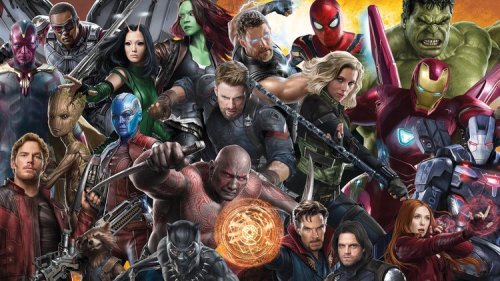
In terms of the bigger picture, it’s good for superhero movies, as a whole, if “X-men: Dark Phoenix” succeeds. It’s unhealthy for the genre if the MCU is the only acceptable avenue for quality superhero movies. We’ve seen with “Wonder Woman” that it is possible for a superhero movie to succeed in a world that doesn’t have Robert Downy Jr. or Chris Pratt.
“X-men: Dark Phoenix” deserves the same chance. That’s why I intend to keep my expectations high, but cautious for this movie. Even if it turns out to be good, though, I worry that it’ll be undercut by too many people who are too eager to hate it. It would be both a tragedy for the movie and all those involved, as well as a bad omen for the genre as a whole.
Filed under Comic Books, Jack Fisher, Superheroes, media issues, movies, X-men
Who doesn’t enjoy a good revenge story? That’s not a rhetorical question. I’m dead serious. Is there anyone out there who isn’t enamored with a story about sweet, bloody revenge? I know the success of movies like “John Wick” and the iconic status of Batman do plenty to answer that question.
The question is still worth asking because the answer says just as much about the appeal of stories about forgiveness. To some extent, it shows that forgiveness isn’t as sexy as revenge. A revenge story can be bloody, action-packed, exciting, and cathartic. Almost every moment in “John Wick” and every issue of the Punisher is like that. It’s not hard to see why that is the basis of so many movies, TV shows, comics, and video games.
That’s not to say that a story about forgiveness can’t have appeal as well. It most certainly can. Forgiveness may not offer the same spectacle as revenge, but it can incur a uniquely powerful emotional impact. There’s a reason why forgiveness has been shown to have therapeutic effects and was the basis of a major religion.

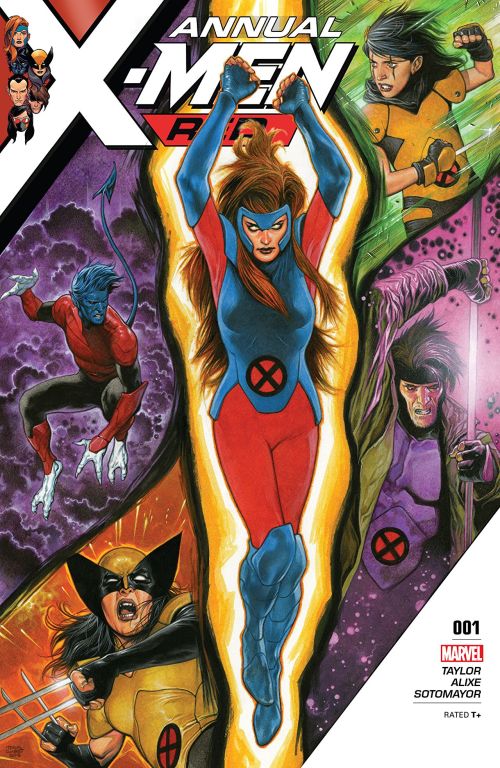
This brings me to a very special comic book entitled “X-men Red Annual #1.” Yes, I am going to tie this powerful human experience to a comic book. No, I’m not going to apologize for it. If you’ve had a chance to read this comic, you’ll understand why.
It’s been a while since I singled out a specific comic that I believe conveys a much larger message, but sometimes a comic comes along at just the right time and strikes just the right emotional chords. This one does all that and so much more, especially for a die-hard X-men fan like me. However, it’s the forgiveness themes I want to focus on here.
Without spoiling too much about the comic itself, which I encourage everyone to go out and buy, it’s important to establish the circumstances that make those themes work here. Those circumstances revolve around Jean Grey, a character who is no stranger to death, resurrection, love triangles, and clones. Even by superhero standards, she deals with a lot of emotional baggage.

Until recently, though, she didn’t have to deal with any, largely because she was dead. From 2004 until earlier this year, Jean was among the numerous superheroes who were “officially dead.” I put that in quotes because “dead” in the world of comics tends to have a pretty loose meaning, well past the point of absurdity. The fact that Jean Grey stayed dead for that long is, in and of itself, pretty remarkable.
However, it was never a matter of if she would return from the dead or even whether Marvel would resort to time travel to replace her. It was only ever a matter of when. Her return was bound to have a huge impact on the X-men and the entire world of Marvel comics. “X-men Red Annual #1” simply built a story around it and it’s a damn good one.
It unfolds mere moments after Jean officially comes back to life again on the final page of “Phoenix Resurrection #5.” That moment, in and of itself, is full of emotions that writer, Tom Taylor, captures beautifully. It provides insights into Jean’s thoughts, feelings, and emotions at that moment. It’s a lot to take in, but in addition to the joy, there’s also a heavy bit of sorrow thrown in.
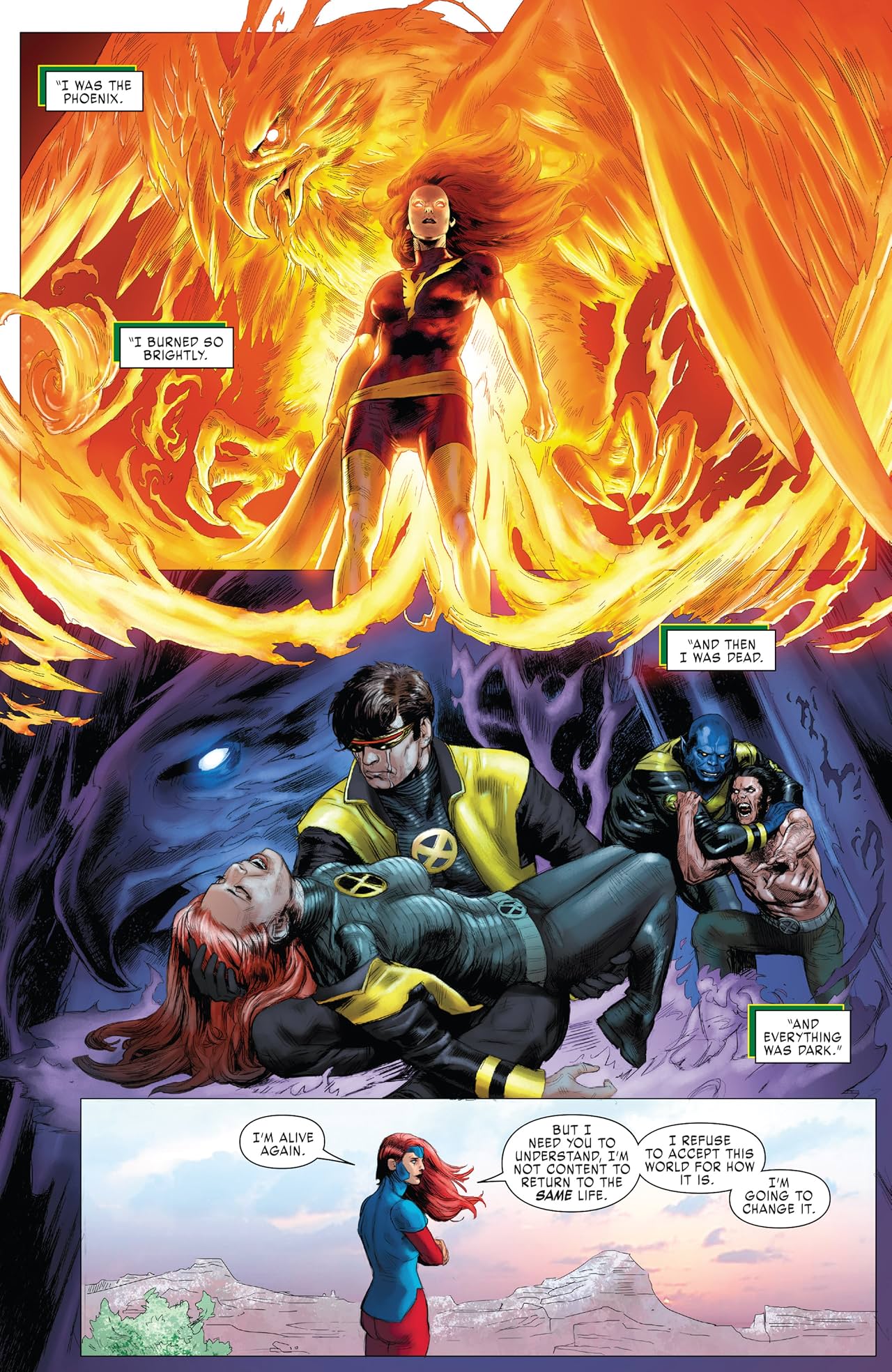
In a sense, Jean Grey picked a lousy time to come back to life. She’s coming into a world where her mentor, Charles Xavier, is dead. Her best friend and occasional love interest, Wolverine, is also dead, although that’s already changing. Most painful, though, is that her husband, Cyclops, is dead due to the events that unfolded in a series aptly named Death of X.
These are people near and dear to Jean Grey. She’s not the kind of character who just brushes off that kind of loss, hardens her heart, and moves forward. She’s someone who wears her emotions on her sleeve and does it with pride. It’s part of what makes her such a lovable, endearing character. Sure, those passions attract destructive cosmic forces every now and then, but she makes it one of her strengths.
As she reconnects with those who’ve sorely missed her, she has an opportunity to confront the one most responsible for her husband’s death, namely Black Bolt of the Inhuman royal family. While Cyclops’ death was largely an accident, he’s still the one whose decisions ended up killing him and many other innocent mutants. For that, Jean has many reasons to hunt Black Bolt down and make him pay.
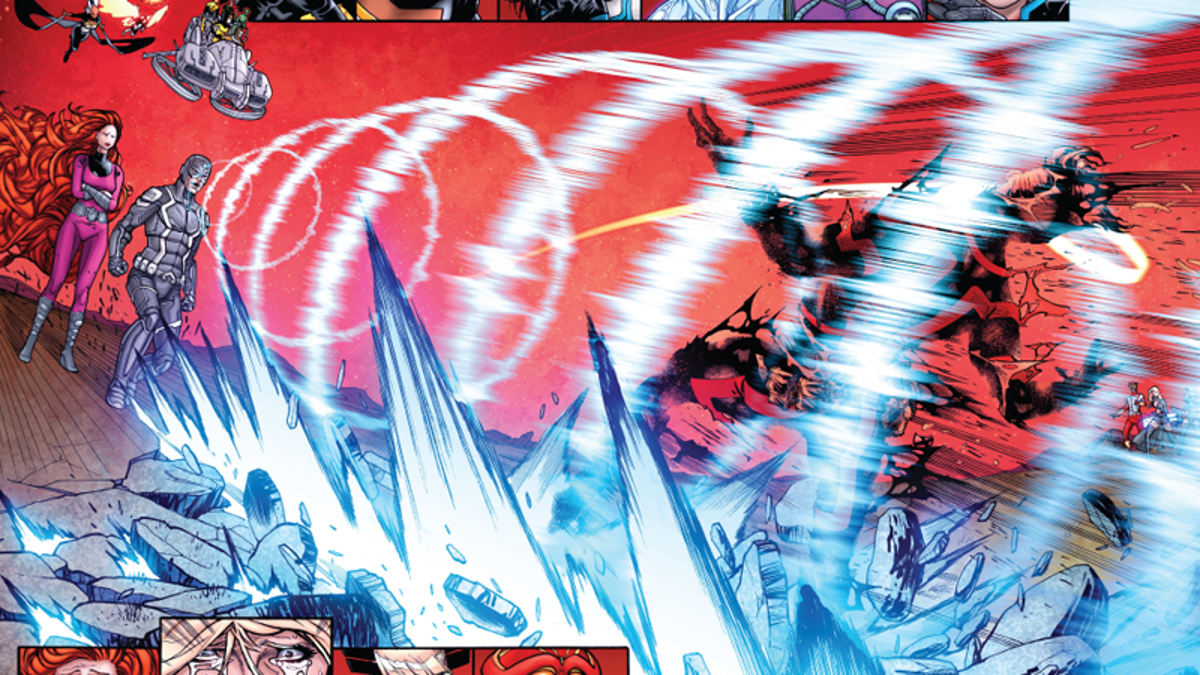
Had she gone that route, I don’t think anyone would’ve blamed her. Hell, some within the X-men would’ve gladly fought by her side, including a few who hate her guts. Accident or not, Black Bolt killed her husband by doing what he did. There’s no way around that. She has every possible excuse to channel her inner John Wick.
However, that’s not what happens. Yes, she still assembles a team of X-men to confront Black Bolt and the Inhumans. Yes, she has a very tense exchange with Black Bolt. What she doesn’t do, though, is seek vengeance for her husband’s death. Instead, she seeks forgiveness and that ends up being far more powerful.

Think about the mentality it takes to forgive someone like that. Imagine you knew there was someone responsible for the death of a loved one. Even if it was an accident or unintentional, chances are your first inclination wouldn’t be to forgive them. More than likely, you would rather see them suffer and pay for their crime.
Even if that person ends up going to jail or is held legally liable for your loved one’s death, you’re still going to resent them. They took the life of someone you loved and, assuming you’re not in a world where people regularly come back from the dead, you can never get back what you’ve lost.
That feeling would be even more intense if the person responsible never faces consequences for what they did. In the case of Black Blot, he didn’t face any repercussions for killing Cyclops. He wasn’t charged with murder or even for involuntary manslaughter. In fact, Cyclops becomes vilified for a while.
If anyone would be motivated to pursue retributive justice, it’s Jean Grey. She even has the perfect opportunity to do so when she fights her way towards Black Blot. At one point, she uses her telepathy to show him just how much she loved Cyclops and how much losing him hurt. She even admits she could make him feel some of that pain, if only to let him know why he deserves punishment.
She doesn’t do that, though. She doesn’t attempt to impart her pain onto him. What she ends up doing is much more heartfelt and meaningful. She gives Black Bolt a chance to offer genuine, sincere remorse for his role in Cyclops’ death. He ends up taking that chance. He apologizes for what he did and, more importantly, Jean accepts it.
For a woman confronting a man responsible for her husband’s death, even if she is a comic book character, it’s a pretty powerful moment. It’s one that carries a unique emotional weight that you wouldn’t otherwise get if Jean had just shot him in the head with a 44 magnum. It very much reflects the power of forgiveness.
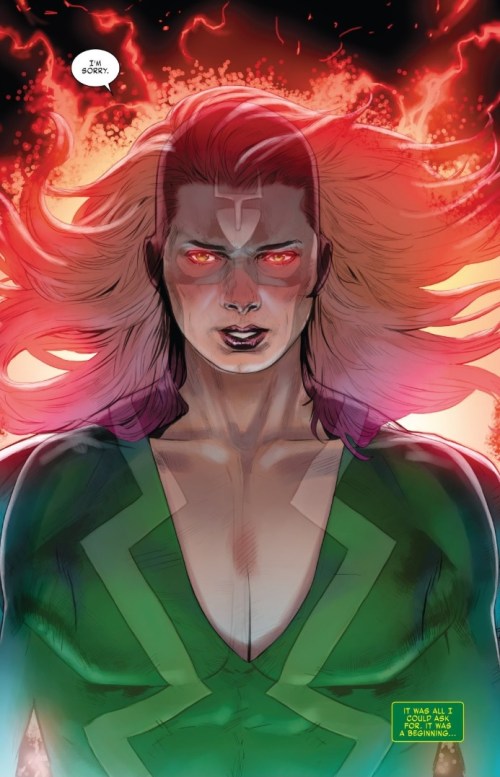
It’s the kind of heart that is exceedingly rare outside of Superman comics. At a time when we expect our superheroes to be edgy and tough, Jean Grey offers a very different approach in “X-men Red Annual #1.” It’s one that Tom Taylor uses to full effect, reaffirming Jean’s incredible capacity for love and compassion. It’s an approach that feels refreshing in an era of superhero civil wars.
It also reminds us that while vengeance may still be more appealing to our most basic instincts, it’s also incomplete at times. No matter how many criminals the Punisher kills or how many villains that Batman beats up, their loved ones are still dead. The pain continues and so too does the struggle. Forgiveness, on the other hand, offers a way forward.

Jean Grey feels the pain of loss like anyone else. She also has the choice to seek retribution or forgiveness. Forgiveness is, by far, a much harder recourse because it means accepting painful circumstances and even a certain level of injustice. Given how most of us are wired with an innate sense of justice, such acceptance seems untenable.
That’s what makes forgiveness so hard, but that’s also what makes it more impactful. Rather than focus on making Black Bolt pay for her husband’s death, Jean chooses to channel that pain into something positive. The very end of “X-men Red Annual #1” has her acknowledging how much it hurts losing her husband, but it also shows how this pain has inspired her.
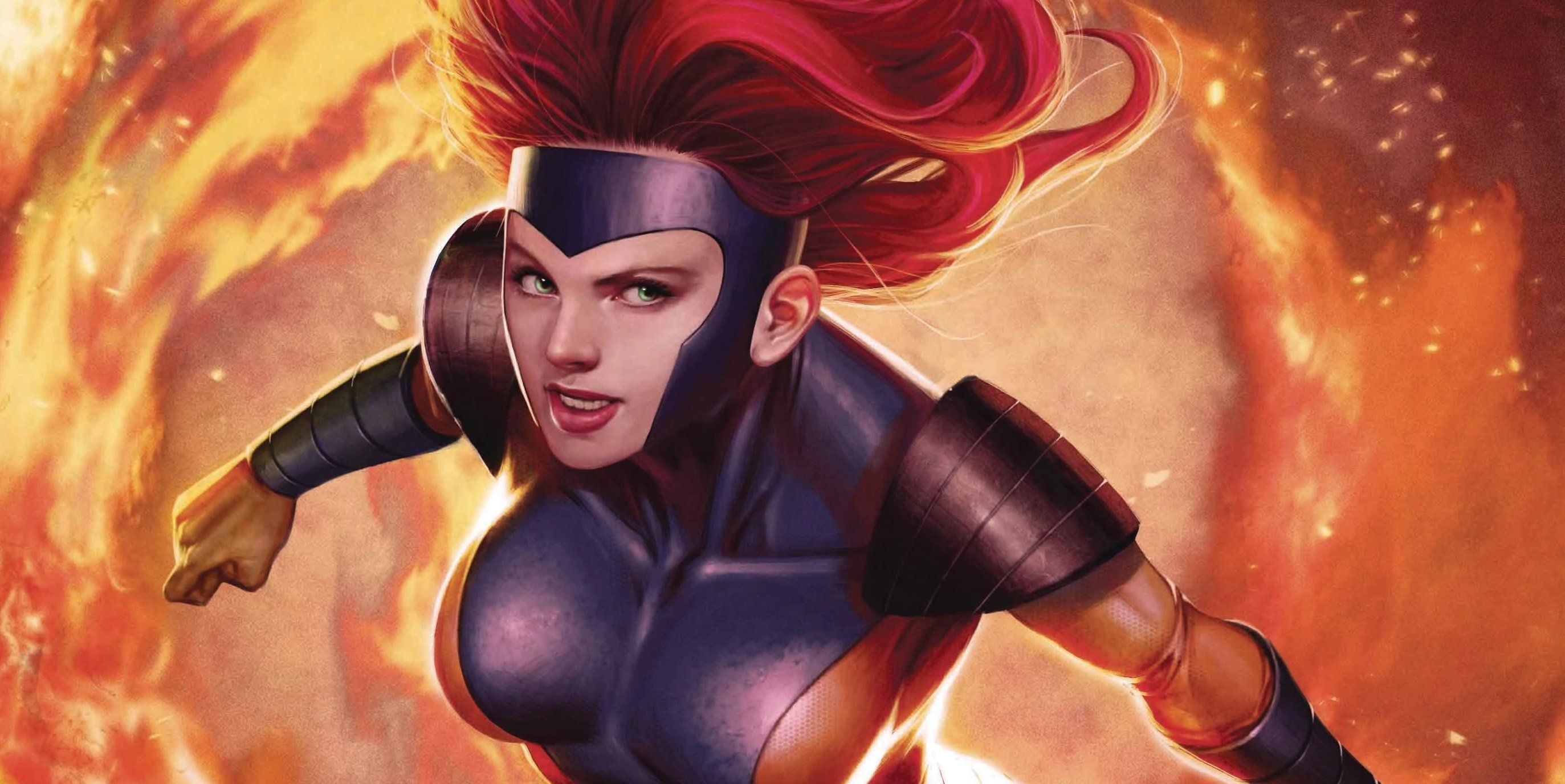
Jean Grey is, essentially, doing the most heroic thing a superhero can do and it doesn’t even involve her powers. She decides to forgive the transgression that killed her husband and chooses to use that pain as motivation to make the world around her better. It’s still not as big a spectacle as watching John Wick kill 77 people over a dog, but it’s more dramatic for all the right reasons.
Filed under Comic Books, Jack Fisher, Superheroes, human nature, philosophy, X-men

The following is a review I wrote for PopMatters for X-men: Red Annual #1. Enjoy!
Overdue Resurrections and Heartfelt Reflections: ‘X-men Red Annual #1’

I normally try not to report the news too much on this blog, unless it’s extremely urgent or extremely sexy. Sadly, this is more in line with the former rather than the latter.
Just this morning, Entertainment Weekly reported that “X-Men: Dark Phoenix” is being delayed until 2019. It had been originally scheduled for release this coming November, just in time for the holidays, no less. I even went out of my way to explain why I’m more excited for this movie than I am “Avengers: Infinity War.” It now seems I’ll have to temper that excitement.
Thankfully, unlike a few other movies that keep getting delayed, this change doesn’t seem to have much to do with the movie itself and has more to do with Fox’s scheduling. “X-Men: Dark Phoenix” is just one of several Fox movies getting delayed or pushed up, some of which aren’t related to superhero movies, including the upcoming biopic on Freddy Mercury, “Bohemian Rhapsody.”
While it’s still only minor comfort for me, as a comic book fan and an X-men fan desperate to erase memories of “X3,” I’m willing to be patient for this movie. To see Sophie Turner do justice to one of the greatest X-men stories of all time is definitely worth waiting for.
Filed under Comic Books, Jack Fisher, Superheroes, X-men
When it comes to two genres that are often associated with one another, romance and tragedy are the literary equivalent of peanut butter and jelly. When you think of one, it’s not long before you associate it with another. Romance without tragedy is like fries without ketchup. Both are still good on their own, but it’s only when they’re together that they maximize their potential.
In that same spirit that the likes of Shakespeare and “Titanic,” superheroes often follow that narrative, but with more spectacle than old playwrights and even James Cameron could ever imagine. Being such a huge fan of superhero movies and comic books, I’m more familiar with their take on romance and tragedy than most aspiring erotica/romance writers.
As such, when an amazing, uncanny, astonishing, or whatever other adjective that a comic book puts before their title tells a story that truly embodies those ideas, I take notice. Seeing as how I’m also an unapologetic romance fan on top of being a comic book fan, those kinds of stories resonate especially well for me. They don’t come around too often, but when they do, they’re worth appreciating.
This particular story involves the X-men, which should surprise nobody who has followed this blog over the past couple years. It also involves the romance/tragedy of Cyclops and Jean Grey, which should also not surprise anyone. I’ve mentioned them before when talking about balanced romances and insufferable love triangles. This might end up being the most heart-wrenching, albeit for all the right reasons.

The name of the story is called Phoenix Resurrection: The Return of Jean Grey by Matthew Rosenberg. Now, if you don’t want to be spoiled, I strongly encourage everyone to read it. Either buy it at a comic shop or buy the digital version. Even if you’re not a comic book fan, it’s a great story that will still evoke all the right emotions.
That’s because this story does something that’s very rare and very difficult to do. It’s something that everyone form Shakespeare to Tolken to Stan “The Man” Lee struggled with at some point in their creative endeavors. It gets the balance between romance and tragedy right. It gets it so right, in fact, that I intend to judge all future romance/tragedies by this comic. That includes any I write.
To understand how I came to this conclusion, it’s important to understand the context of the story and why it had such a powerful impact. To do that, it’s necessary to point out the circumstances of this story. When it was announced last year, it’s stated goal was to bring Jean Grey back from the dead. Anyone who has even a passing familiarity with comics knows that’s not all that groundbreaking.

Superheroes have been dying and coming back to life for decades. While “The Death of Superman” might have been the most high-profile, the initial death of Jean Grey in the original Phoenix Saga is probably the most iconic. That story established Jean Grey as a character who would be defined by death, rebirth, and everything in between. That’s part of the reason it’s the foundation of the “X-men: Dark Phoenix” movie.
That original story had a lot of romantic elements in it, but it was largely defined by its tragic ending. In that original story, Jean Grey willingly sacrificed herself in front of Cyclops and her friends to stop herself from becoming corrupted by the cosmic power of the Phoenix Force.
It was a truly gut-wrenching moment. It’s because of that moment, though, that it’s often singled out as one of the best X-men stories of all time. It was the culmination of Jean Grey’s struggle to deal with the immense power with which she’d been imbued. Moreover, she reached out to that power in order to do the impossible to protect those she loved, even if it corrupted her.

That’s an important detail to note because that’s a theme that would go onto play out on many occasions for Jean, eventually culminating in her second death in 2004. Her constant struggle to manage the immense power granted by the Phoenix Force and the corruption that often came with it is one of the primary driving forces behind Jean’s character. It’s also a big part of her appeal.
Rosenberg uses those same themes, as well as the immense power afforded by the Phoenix Force, to build the tragedy and romance that plays out in Phoenix Resurrection: The Return of Jean Grey. It’s a story that has more drama going for it than most because, despite the presence of time travelers, Jean Grey has been dead since 2004. Her coming back after such a long absence is a big deal for X-men fans and for her character.
The challenge Rosenberg faced was making that resurrection feel more compelling than overdue in an era where dead characters come back all the time. On top of that, Jean’s association with a cosmic force known for death and resurrection means her character basically has a built-in cheat code for bringing her back. How can that be so compelling, let alone raise the bar for romance and tragedy?

This is where the spoilers come in so again, please take the time to read the comic if you can. That’s because the way Jean comes back in this story has less to do with tragedy and more to do with agency. Way back in the original Phoenix Saga, Jean reached out to Phoenix Force in an act to save her friends. It was a choice of desperation.
Well, since that fateful choice, the Phoenix Force has been like a clingy ex, wanting desperately to stay bonded to her, even thought it often corrupts her. I’ve argued before how the context of that corruption might be more complicated than it seems, but on the basis of history alone, Jean Grey has many reasons to regret that choice.
The Phoenix only gives her another in this series. After having bonded with plenty of other hosts since her death, it goes to great lengths to bond with Jean again. It goes so far as to resurrect both her and everyone she ever cared about, creating this own little world in which Jean never experiences the many tragedies that befell her. It’s like the Matrix, but with a volatile cosmic bird running the show.

As part of that fantasy world, Jean Grey’s long-time love, Cyclops, is alive and well. That’s critical because, at least for the time being, he’s also dead. The Phoenix Force basically gives her everything to be happy, content, and loved. Keep in mind, though, it’s not doing this out of pure altruism. It wants to bond with Jean again. That’s the goal and the fantasy world is just a means to an end.
That makes the tragedy inevitable. As is often the case with fantasy worlds, even those created by a cosmic power, they tend to crumble under the harsh weight of reality. The way in which this happens is best revealed through the story. However, the part of the story that really balances out that tragedy occurs in the final issue.
In that issue, the fantasy world crumbles, thanks largely to the efforts of Jean’s fellow X-men. Naturally, the Phoenix Force fights this and tries to tempt Jean into bonding with it again, saying its power can give her everything she desires. It can even bring back those she loves.

As part of a last-ditch effort, it demonstrates this by bringing Cyclops back to life. He’s not a clone. He’s not a time traveler. He’s not some illusion either. He’s the real, flesh-and-blood Cyclops, complete with the thoughts, feelings, and passions of the man she married.
It’s a dick move on the part of the Phoenix Force, to say the least. It’s also the moment where the romance balances the tragedy in an important way. That’s because in that moment, Jean makes another fateful choice, one every bit as dire as the one she made in the original Phoenix Saga. This time, though, she lays her heart on the line, knowing damn well it’ll be broken.
Rather than just reject this tactic as another attempt by the Phoenix to lure her in, she embraces it for a brief moment. In that moment, she gets to say goodbye to her husband. She and Cyclops even go out of their way to make clear how much they love each other, both in life and in death. Even if you’re not a big romance fan, this is a moment of pure, unadulterated heart.
We still know the tragedy is coming. We know it’s a moment that’s going to end with tears and sorrow. Anyone that ever had to read “Romeo and Juliet” in high school English class knows it’s coming and is might think they’re numb to it, especially if they flunked the test.
That’s why it was so important for the story to reaffirm that sentiment. Rosenberg did something critical when he had Cyclops and Jean Grey remind each other just how deep their love went. He gave even greater weight to the loss.
At least with “Romeo and Juliet,” the characters involved had just met. They barely knew each other. Cyclops and Jean Grey’s love story spans 50 years of X-men comics, complete with weddings, clones, and raising a child together in the future. To know the extent of their love is to know just how much that tragedy hurts.
That, more than anything, is what puts Phoenix Resurrection: The Return of Jean Grey in a league of its own in terms of romance and tragedy. Instead of the tragedy defining the romance, it’s the other way around. It’s the romance that gives that tragedy such immense weight.
In too many stories, both in comics and in other mediums, tragedy relies too heavily on its own weight to make an impact. Making a love story dependent on that tragedy gives the impression that the love needed it in order to have depth. That’s why, when the tragedy eventually occurs, it doesn’t always hit all the emotional chords.
Rosenberg left no emotional chords unstruck with this story. It’s because Jean shared that special moment with the man she loved that her decision to reject the Phoenix Force carries so much weight. That decision comes with so much pain, anguish, and sorrow. It’s one thing to just depict it. It’s quite another to truly convey it.

That’s what truly makes Phoenix Resurrection: The Return of Jean Grey so special. It conveys both the breadth of the romance and the extent of the tragedy. Moreover, it does that in a way where one complements the other. For a romance built heavily around two characters operating as equals, I can’t think of anything more fitting.
Again, if you’re fan of romance, tragedy, or both, check out Phoenix Resurrection: The Return of Jean Grey. Even if you hate comics and the X-men, this one will evoke all the right emotions. You’ll shed tears of sorrow and joy at the same time. It’ll feel so weird, but so right.

Not long ago, the internet stopped for a brief moment and had a shared orgasm over the “Avengers: Infinity War” trailer. I’m not going to lie. I enjoyed my share of the collective ecstasy. I had a smile on my face for the rest of the day. Sure, I had a hard time hiding my comic book loving boner, but compared to other awkward boners I’ve dealt with, I was more than happy to wear loose pants for the rest of the day.
I honestly didn’t think I could be more excited about the impressive slate of superhero movies set for release in 2018. Then, Entertainment Weekly had to come along and offer a first glimpse into “X-men: Dark Phoenix,” a movie I’ve talked about before with the same anxious excitement as Wonder Woman. Honestly, I don’t think anyone not named MC Hammer makes pants loose enough.
I don’t know if the timing was on purpose. I just know that my erection can only get so hard when it comes to superhero movies. Me being an unapologetic X-men fan, which I’ve belabored more than once on this site, I’m inherently more excited about this movie than I am “Avengers: Infinity War.”

I get it. Marvel Studios and Kevin Feige are on a win-streak that would make an entire team of Michael Jordan’s envious. To date, the Marvel Cinematic Universe has raked in over $13 billion and “Avengers: Infinity War” is guaranteed to add to it and at a time when even highly-touted X-men movies can’t rake in more than $800 million.
Why, then, should anyone who isn’t an unapologetic X-men fan be more excited about “X-men: Dark Phoenix?” There are many reasons, more so than most who aren’t X-men fans probably realize. Some are more obvious than other. The first, and most notable, can best be summed up by two words: Sophie Turner.
In case anyone needs a reminder why she’s such a big deal, take a look at these first glimpses of Ms. Turner in all her Jean Grey/Dark Phoenix glory. Be sure you have loose pants and clean underwear handy. Don’t say I didn’t warn you.
I’ll give everyone a moment for their heart to settle and their pants to untighten. Take all the time you need. Believe me, it took me longer than I expected.
That one picture, in addition literally burning with Ms. Turner’s sex appeal, checks the most important box I listed in my article about how to not screw up a Dark Phoenix movie. It unleashes the fiery passion of the Phoenix and uses Sophie Turner’s sex appeal to do it.
While I doubt that director Simon Kinberg read that post, it’s a big deal that he’s emphasized this aspect of “X-men: Dark Phoenix.” That’s primarily because that critical element that makes the Phoenix Saga one of the greatest X-men stories of all time was omitted from the last attempt to do a Dark Phoenix movie, “X-men: The Last Stand.” The less said about that craptactular failure, the better.

Beyond capturing the necessary elements for a decent Dark Phoenix story, it also reflects a fundamental difference between this movie and “Avengers: Infinity War.” At its core, the Phoenix Saga is about a beloved friend and hero becoming corrupted. It involves high drama, heart-breaking sacrifices, and beautiful redheaded women kicking ass.
The core of “Avengers: Infinity War” is decidedly not that, especially after Black Widow died her hair. This movie is banking less on high drama and more on over-the-top battles involving the most powerful heroes of the Marvel Cinematic Universe against Thanos, one of Marvel’s most overpowered villains with a disturbingly extreme death fetish.

Now, there’s nothing inherently wrong with that approach. In fact, it’s probably the best possible approach for a movie that has been built up over the course of over a dozen big-budget films. Nobody can ever claim that Kevin Feige hasn’t been thorough in establishing the scale for this movie.
The problem, if you can call it that, is because of that scale, it’s difficult for a movie like “Avengers: Infinity War” to be anything other than what you expect it to be. It’s going to be an intense, over-the-top battle that will triple down on the themes that made the first Avenger’s movie so successful. At this point, that’s all it can do.
“X-men: Dark Phoenix” offers something more than that. Like “Avengers: Infinity War,” it’s expanding the scope and scale of the movie to a level that no previous X-men movie has ever attempted. Whereas the first X-men trilogy tried way too hard to stay grounded, this one is letting the X-men push the boundaries like they do every other week in the comics.
“X-men: Dark Phoenix” will let the X-men go into space. It’ll let Jean Grey get overwhelmed and surrounded by cosmic fire, something “X-men: The Last Stand” barely even attempted. It’ll even let Sophie Turner get naked. That alone is worth the bloated ticket price.
Those elements, both the cosmic fire and the nudity, don’t even have to be forced. They’re actually in line with the canon X-men comics. Jean Grey has been known to fly around in the cosmic buff every now and then. I won’t say it’s a critical element to Phoenix Saga movie, but as someone who values nudity more than most, I can safely say it’s a hell of a bonus.
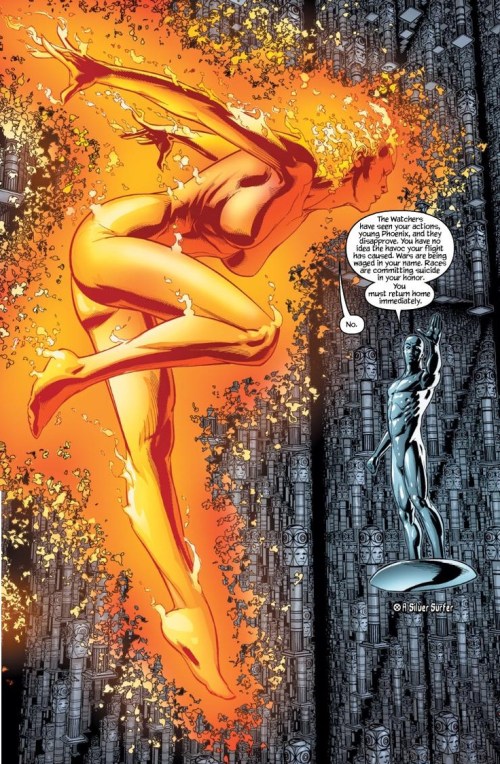
While I doubt anyone will pay extra to see Thanos get naked in “Avengers: Infinity War,” there’s one more element that helps sell me on “X-men: Dark Phoenix.” It has less to do with spectacle or nudity and more to do with underlying theme.
In a sense, “X-men: Dark Phoenix” is an opportunity to go beyond superhero movies. Like “Logan” and “Deadpool” before it, this movie has elements that can help it go beyond superhero movies, just as the original Phoenix Saga dared to go beyond stories about super-powered people in spandex costumes defeating villains.
There are all sorts of genres that “X-men: Dark Phoenix” can encompass. It can be a tragedy. It can be a sci-fi adventure. It can be a romance, which I’ve touched on before. It can be so many things, all within a single narrative. The ability for one movie to encompass all those elements, be it a superhero movie or a Disney musical, is a rare and special thing.

“Avengers: Infinity War” has its place and chances are, it’s going to make more money than “X-men: Dark Phoenix.” It may end up making more money than any movie in history that doesn’t involve exploding death stars or blue aliens.
For me, someone who isn’t one of Fox or Disney’s accountants, you can’t put a price on the breadth of experiences offered by “X-men: Dark Phoenix.” Given the early fan responses to these new teasers, it’s safe to say I’m not a alone in this sentiment. Hopefully, those sentiments only grow once the first trailer drops.

If Fox, Simon Kinberg, and Sophie Turner can get it right in all the ways X-men: The Last Stand” failed and/or didn’t attempt, then it promises to be a truly special cinematic experience.
Also, and it’s worth repeating, the prospect of Sophie Turner getting naked outside a disturbing scene in “Game of Thrones” should appeal to everyone. Besides, why should Jennifer Lawrence’s nudity-loving Mystique have all the fun?
Filed under Comic Books, Jack Fisher, Superheroes, X-men

There are some romantic sub-plots that cannot and will not work, no matter how well they’re written. You could resurrect Shakespeare, Tolken, and Faulkner, merge their brains, and still never salvage those plots. More often than not, most of those un-salvageable sub-plots involve love triangles and I’ve made it abundantly clear how much I despise love triangles.
In a sense, love triangles are a symptom of a much larger problem with romance. They’re basically a reverse cheat code in that they’re supposed to be an easy way to inject drama into a romance, but only ends up making things harder in the long run. While it’s not impossible for a love triangle to work, as fans of “Buffy the Vampire Slayer” might argue, it’s exceedingly rare.
That brings me back to what I’ve identified as the worst love triangle of all time, namely the one involving Cyclops, Jean Grey, and Wolverine of the X-men. I could talk for days as to why it’s so awful. However, I don’t want to re-hash those old arguments. I want this article to be more productive in that it offers solutions instead of whining.

In general, this is an aspect of comics I don’t enjoy talking about and avoid at every turn. I probably would’ve kept avoiding it and talked more about my sexy college experiences, but a few recent announcements by Marvel Comics has me and many X-men fans contemplating this god-awful love tingle once again.
It started a couple weeks ago when Marvel announced that Jean Grey, the one that isn’t a time traveler, is returning from the dead after 14 years. Needless to say, this sparked a firestorm of cheers and squees from X-men fans who have been longing for her return for years. I’m not going to lie. I did my share of squeeing.
Then, less than a week later, Marvel dropped another bomb in the pages of Marvel Legacy #1, their latest blockbuster event comic meant to bump sales and soak the panties of collectors. Wolverine, who has been dead since 2014 and was subsequently replaced by multiple characters, is alive again.
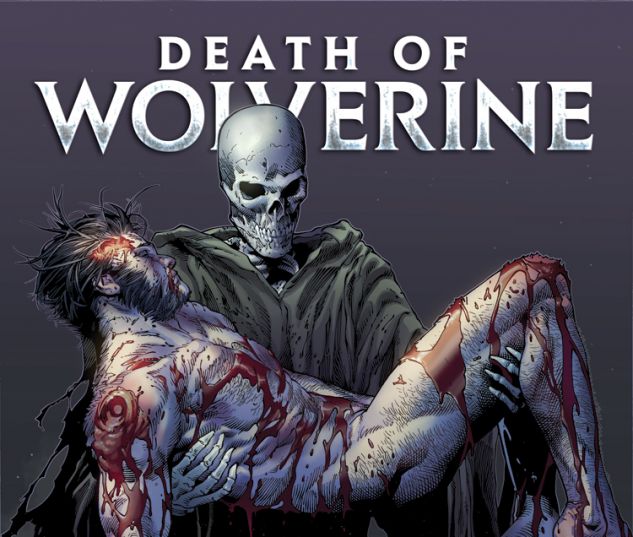
That surprised nobody so there wasn’t as much squeeing. Wolverine has survived a nuclear explosion, getting his flesh blown off, and being run over by a steamroller. It was only ever a matter of when and not if he would return. However, him returning at the same time as Jean Grey is one of those coincidences that no self-respecting X-men fan believes to be a coincidence.
If there was any silver lining to Jean Grey being dead for so long, it was that it kept anyone from dragging that god-awful love triangle back into the forefront. With Jean dead, Wolverine could move on and pursue other relationships, like he did with Storm. Cyclops pursued a brief, but passionate relationship with Emma Frost. Both characters seemed to move on from that horrible affront to romance.

Now, with Jean Grey and Wolverine back in the picture and a time-traveling Cyclops still running around, these three are finally in the same universe again. That means there will be the temptation to revisit this malignant tumor of a love triangle. As someone who loves all three of those characters dearly, I am not looking forward to that.
It’s too early to say how the story will play out. Marvel hasn’t revealed anything about how Wolverine came back from the dead. There also isn’t much information on the particulars of Jean Grey’s resurrection. We only know the outcome in that they’re both alive again and that’s usually all anyone needs to re-visit that infuriating love triangle.

Given the circumstances of how it played out, which I’ve noted before, it’s hard to twist this love triangle in a way where anyone comes out looking good. No matter what happens, someone gets screwed over.
If Jean Grey chooses to be with Cyclops, then it screws Wolverine over by reducing him to an obsessive, whiny stalker instead of the ultimate loner.
If Jean Grey chooses to be with Wolverine, then it screws Cyclops over by reducing him to nothing more than an obstacle for Wolverine.
In both cases, Jean Grey comes off as either a prize to be won or a heartless bitch who plays with the heart of any man who dares to fall in love with her. In the end, nobody wins in a love triangle, especially one that was so horribly contrived to begin with.

All that said, I don’t deny that the love triangle is hard to ignore. While it’s not an integral part for each character, it is one of those unresolved issues that has never truly been laid to rest. It’s like a dangling plot hole that can never be totally ignored.
Even so, the love triangle is so toxic to all three characters involved. It only ever brings out the worst in them at every turn. So if it’s only a matter of time before the love triangle re-surfaces again in the X-men comics, then what’s the ultimate endgame? Is there a solution to this omega-level migraine of a plot?

I’m not a writer at Marvel, nor do I have a sliver of influence with them. However, I am a passionate X-men fan, as well as an unapologetic romantic who writes sexy love stories. Given that passion and experience, I have a solution that I doubt Marvel will ever take seriously, but one that essentially fixes the worst love triangle in the history of romance. The solution is as simple as it is sexy.
Make Cyclops/Jean Grey/Wolverine the first polyamorous relationship in comics.
I’ll give comic fans a moment to stop rolling their eyes and/or laughing. I’ll give the ardent proponents of the Cyclops/Jean and Wolverine/Jean relationship a moment to stop shaking their heads as well. This may be the only time both sets of fans are on the same page. I assure you, though, it’s no joke. I’m as serious as an attack by Thanos.

Just think about it from a purely pragmatic point of view. Jean Grey’s love for Cyclops is beyond dispute, being the oldest and most serious relationship in the history of X-men. Her attraction to Wolverine is also beyond dispute, which has made for more than a few sexy moments in the history of X-men.
On top of that, both Cyclops and Wolverine have a history of wanting to hook up with more than one woman. I’ve gone over the long list of romance/hook-ups that Wolverine has gone through. This is a guy who hooked up with Squirrel Girl, for crying out loud. That should be proof that this man cannot handle monogamy.

Cyclops, despite his reputation as a boy scout, also has a history with wanting to hook up with other women. Granted, he’s not even in the same time zone as Wolverine, but the sentiment is there. Unlike other heroes, such as Superman or Mr. Fantastic, he can’t seem to shake it off.
That makes him, Wolverine, and Jean ideal candidates for a polyamorous relationship. They exist in the real world. There is even some evidence that polyamory can be beneficial to certain couples because they require a great deal of communication and understanding, two key requirements to any successful relationship.
Given that Jean Grey is a powerful psychic and Cyclops has a history of attracting psychics, they’re better equipped than any other couple in the real world or the fictional world the create a functioning polyamorous relationship. When real psychics are involved, the obstacles associated with communication become an instant strength.

It works great for Wolverine too because it means he can still be Wolverine. He can still strike out on his own every now and then, stab some monsters, and hook up with a few crazy women. He wouldn’t be tied down by Jean Grey and unable to be what makes him awesome. He can still live, love, and fight like Wolverine.
It may very well be the only way that the nauseatingly overplayed melodrama that is the Cyclops/Jean Grey/Wolverine love triangle gets resolved. With a polyamorous relationship, all three characters get to share in the emotional fulfillment. They all get to feel loved and nobody gets left out in the cold. It may even bring them all closer together.
That might be impossible for some to imagine with Cyclops and Wolverine, two characters who have been at odds since the moment they met. However, they have shown throughout their history that they can get along. They can work together and bond over a shared goal, especially when that goal involves Jean Grey.

On paper, a polyamorous relationship between Cyclops, Jean Grey, and Wolverine would solve so many problems. Everyone involved could have their cake and eat it too. That might be the primary reason why Marvel would never do it, though. It makes too much sense.
I don’t think that a polyamorous relationship would be too taboo for Marvel. In recent years, Marvel has shown a willingness to explore non-traditional relationships. Back in 2012, they celebrated their first same-sex wedding in the pages of Astonishing X-men. They have a fairly lengthy list of LGBT characters as well. Even Daken, Wolverine’s son, has a history of eccentric sexual preferences.

The timing would even be right because polyamorous relationships are on the rise and monogamy is on the decline, especially among young people. While there will always be a place for strong, monogamous couples in comics, why not mix things up a relationship that everyone at Marvel seems eager to strain?
A polygamous relationship isn’t necessarily taboo these days, but it’s something nobody has really tried. It seems like the only way comics, TV, or movies can ever inject drama into a romance is to throw in a love triangle. On behalf of all hopeless romantics, I’d like to go on record as saying that tactic is old, not to mention detrimental.
Cyclops, Jean Grey, and Wolverine are in a perfect position to try something different, creating a new kind of romance that we haven’t seen in comics, TV, or anything that didn’t used to air late night on Cinemax. It would be challenging, but that’s exactly what would make it so appealing.

That may also be why Marvel would never try it. It’s so different and there’s no successful formula to follow. Sure, William Marston, the kink-loving creator of Wonder Woman, did it to great effect, but it would require all sorts of dynamics that take a great deal of effort. That effort might just be more than Marvel, or any comic company, is willing to put in at the moment.
Maybe a time will come when polyamorous relationships find their way into comics, just like same-sex relationships. It may not happen with Cyclops, Jean Grey, and Wolverine, but they are the ones that stand to benefit the most from it. Compared to another exceedingly toxic triangle, it would be a welcome change to the world of superhero romance.
We’ve all heard it before, a saying so common and overplayed that our first reflex is to roll our eyes and think briefly whether those leftovers in the refrigerator are still edible. It manifests in many forms and is the theme of 98.7 percent of every movie featuring evil empires and overly rich assholes. We use many words, but most of us know the basics.
“Power corrupts. Absolute power corrupts absolutely.”
I’ll give everyone a moment to finish yawning. I don’t blame you. As someone who has spent three quarters of his life reading superhero comics and seen nearly every movie that tried to rip off “Star Wars,” I’ve neither the energy nor the bandwidth to list all the stories that play with this theme so I’m not going to try.
Instead, I’m going to be a little bold and challenge that overplayed, overused theme that has been more belabored than a puke bucket at a bulimics convenstion. I’m also going to do it while citing X-men comics again, specifically another one featuring Jean Grey. Yes, I’m aware I’ve done that multiple times already. Yes, I’m going to keep doing that. No, I’m not going to apologize for it.
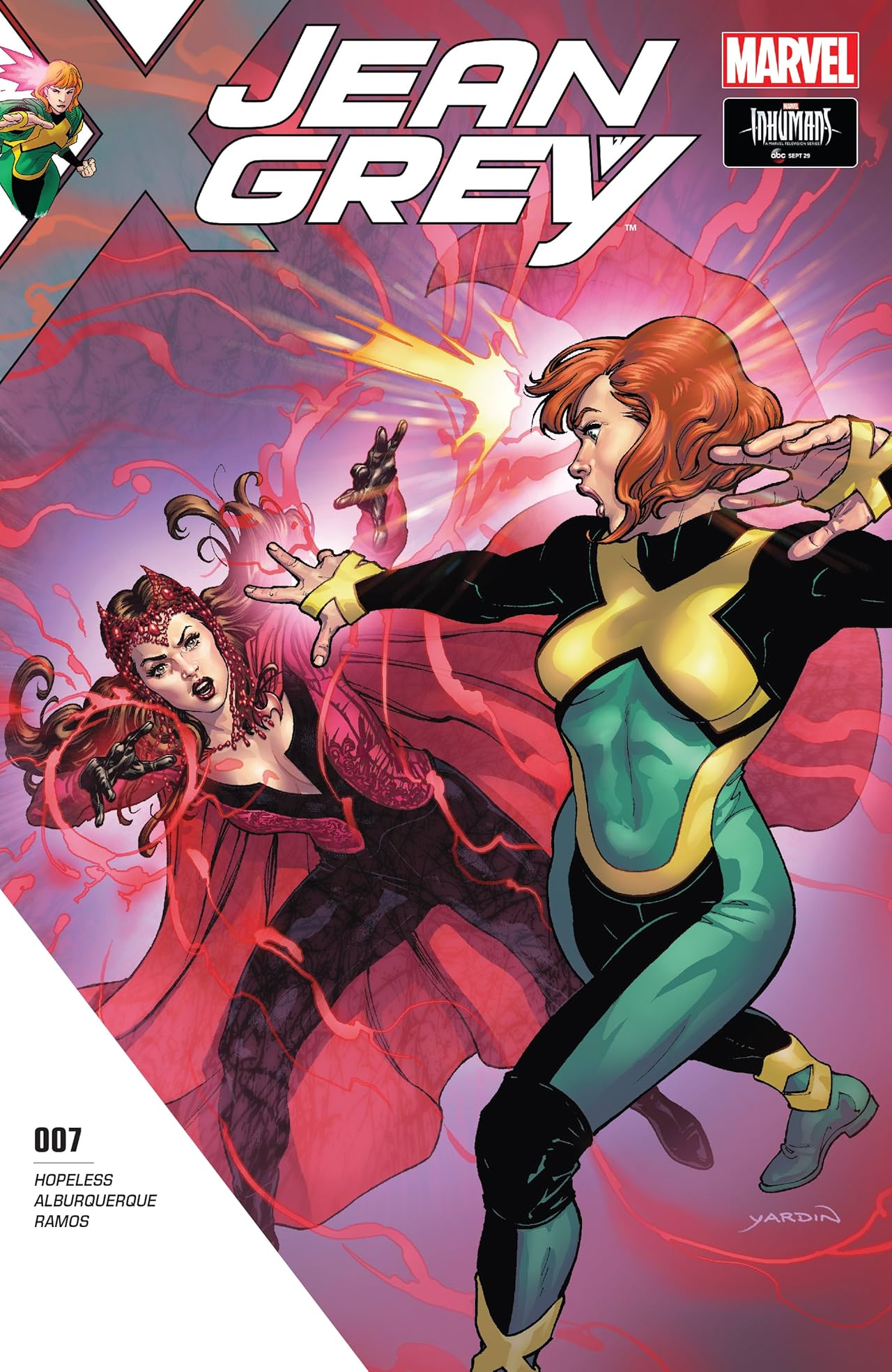
However, I’m not just going to focus on the events of a particular comic. While this post was inspired by Jean Grey #7, a comic written by Dennis Hopeless and drawn by Alberto Jimenez Alburquerque, it’s the bigger picture the story highlights that I want to focus on. I still encourage everyone to read the comic, but you don’t have to in order to appreciate its theme. It’s almost subversive in the larger message it implies.
Think back to that overplayed saying about power corrupting and try, if you can, to do it without yawning. Now, ask this follow-up question and try to do it with a straight face.
“Is it really power that corrupts? Is it possible that the stress that comes along with power is the true danger?”
I hope nobody’s yawning after that because that’s not a question that gets asked very often, but it’s one that Jean Grey ends up answering in Jean Grey #7, albeit indirectly. Given that it’s a question so few ask in the first place, it’s easy to overlook, but it’s worth thinking about.
Think, for a moment, about the impact that stress has on your life. That’s much easier than thinking/fantasizing about what it would be like to have absolute power. Unlike absolute power, there is some actual science behind the effects of stress. According to the Mayo Clinic, the impact of stress is basically the grand slam of negative health effects. Those effects include, but certainly aren’t limited to, nasty stuff like:
These are all issues that negatively impact your personal life, your work life, your sex life, and pretty much every other life you hope to have as a functional human being. We all endure stress on some levels, but having too much of it is kind of like being really horny. You know when it happens and it’s hard to ignore.

With those effects in mind, imagine just how stressful it is wielding great power. It doesn’t even have to be like the cosmic power Jean Grey is destined to wield in Jean Grey #7. It could be a powerful political position. It could be a powerful business leader. Hell, it could just be the power that comes with being the head of a household.
It’s somewhat paradoxical in that it seems unavoidable. Gaining more power means dealing with more stress. However, we seek power, to some extent, in order to achieve our goals. More often than not, those goals involve alleviating certain stresses on our lives, be they poverty, strife, or simple inconvenience. In a sense, we exchange one form of stress for another and hope the other is easier to deal with.
Sometimes, those hopes don’t pan out. Sometimes, the stress that comes with whatever role that power brings us is more than we expect. In that state of mind, is it really that surprising that people become corrupt?

When I talked about powerful fascist states, I noted the extent to which they have to control the personal lives of others and how that can often be used against them. Those efforts, if you ignore the egregious abuses they entail, require some pretty stressful efforts that anyone not named Dr. Doom isn’t equipped to manage.
It creates, sort of, a chicken-and-egg scenario for the corruption that often follows. Was it the power in and of itself that led that corruption or was it the stress it entailed? While I doubt every situation has the same answer, the one in Jean Grey #7 has some intriguing possibilities.
In the context of this story, the same out-of-time Jean Grey that I’ve covered in previous posts is still dealing with the prospect of a cosmic power known as the Phoenix Force coming after her. She knows it’s destined to kill her. She knows how much it corrupts her, so much so that Fox is making a movie about it. It’s a stressful situation, to say the least.

However, Jean Grey isn’t the only overly powerful character in the diverse menagerie that is the Marvel Universe. Hell, overpowered characters in Marvel probably have their own lobbying group. One of their most notable members is Wanda “the Scarlet Witch” Maximoff. Like Jean Grey, she also wields exceedingly immense power that has driven her insane on more than one occasion.
Like a friend staging an intervention for someone they care about, Wanda seeks Jean out and basically has a girl’s day with her. She shows her that obsessing over the power they wield, or are destined to wield, will drive her just as crazy as the power itself. She dares to help Jean do normal, healthy things that don’t involve stressing out over that power.
Some of those things involve stuff actual people do, like going to a beach or running on a hot sunny day. Others are a bit more exotic, like a cooking class that involves monster meat. I swear on Jennifer Lawrence’s ass that I’m not making that up.
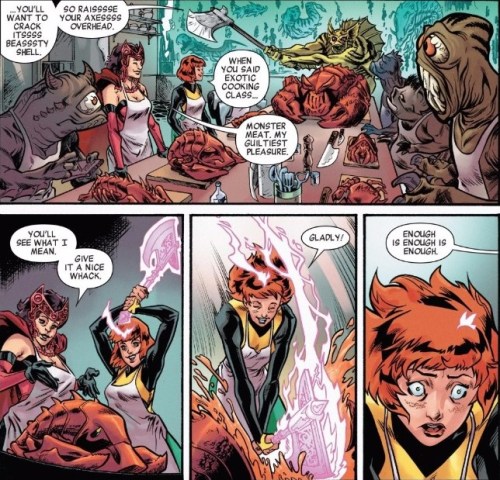
The events of Jean Grey #7 make a compelling case about the impact of stress over power. The fact that there are other powerful characters throughout the Marvel universe that manage to function on a day-to-day basis without going insane proves, to some extent, that power and corruption need not be the same thing.
Eventually, circumstances within Jean Grey #7 that are beyond Jean’s control derail her efforts to better manage her stress. In a sense, that’s another part of wielding power and the corruption that comes with it. No matter how much power anyone has, be they a comic book character or a warlord in a third-world country, they are still at the mercy of various circumstances beyond their control.

Jean Grey, and most other superheroes, often learn that the hard way. People in real life who wield great power deal with that as well, sometimes in a very public way. Whether you’re Jean Grey or Emporer Palpatine, it’s impossible to deal with every conceivable circumstance that may undermine your power or stress you out. For some people, that just compounds the stress.
In the end, Jean Grey #7 leaves the question surrounding power, corruption, and stress unanswered. However, the fact it dares to ask that question in the first place and make a concerted effort is what really sets it apart. The original Phoenix Saga never asked that question directly, but its indirect implications reveal a lot about how we think of power, corruption, and beautiful female superheroes played by Sophie Turner.


 Jack Fisher's Official Publishing Blog