Category Archives: Jack Fisher’s Insights

Why Fascists Want To (And Need To) Control Your Sex Life

Whenever I bring up a topic on this blog, be it advances in biotechnology or news on the “Wonder Woman” movie, it’s only a matter of time before I explore the sexy side of that topic. Sometimes that also involves the kinky side, but sometimes sexy and kinky aren’t mutually exclusive issues in certain topics.

Now, when it comes to issues of fascism and totalitarian governments, it’s hard to make that too sexy. However, it’s hard to discuss these issues without also discussing the implications on our sex lives. Even the most repressive governments still need people having sex o they can make babies that will eventually become works, soldiers, etc.

Throughout history, the government has always had some interest or policy in our sex lives. From state-sanctioned fertility festivals in Ancient Rome to rigid traditions in Ancient China, there’s always been some amount of government between the sheets. So those yelling for government to get out of their bedrooms probably don’t realize just how long it has been there.

For the most part, a government’s only real interest in your sex life extended to whether or not you were producing children that would become soldiers, workers, and tax payers. Beyond that, it could care less what you do with your genitals and how you do it. Those governments usually lacked the power, resources, and will to micromanage.

There were some exceptions, primarily with the sex lives of rulers and aristocrats. Since preserving the royal lineage was of the most vital importance, often leading to massive upheaval in a kingdom, they had to micromanage to some extent. If they weren’t producing heirs to the throne or to inherit the family land, then that was a problem. The entire premise of “Game of Thrones” is proof of that.

However, the world has changed a great deal since the days of kings, feudalism, and fertility rituals. Industrialization, modernization, and a better understanding of how our sexy anatomy works has changed how the people and the government approaches matters of sexuality. Sure, some people in government still have a poor understanding of certain lady parts, but our knowledge is more comprehensive for the most part.

It’s because of that knowledge, though, that a fascist or overly authoritarian regime has an even greater interest in controlling your sex life. At least the kings and emperors of the ancient world lost interest at the part where your sex life made the babies that would become soldiers and workers. Modern rulers with a keen interest in controlling a population know to go much further than that.

The best example of this is how Nazi Germany and Fascist Italy approached its citizens’ sex lives. For these governments, it wasn’t enough for people to make babies that would become soldiers and workers. They had to make perfect, super-babies and a lot of them. That whole “master race” ideology wasn’t just about subverting minorities. At some point, they need to have the race they prefer to propagate.

Sometimes, they did this through incentives. Giving birth to a healthy, racially pure baby in Nazi Germany came with all sorts of benefits. However, those benefits sometimes hid the heavy hand of the state. Women in this society were not expected to work. Their sole focus was supposed to be on producing more racially pure babies.

It wasn’t much different or better for women in Fascist Italy. While it didn’t rely heavily on concepts of genetic purity or racial supremacy, there was this ideal espoused by the state. The perfect woman, in their eyes, was supposed to be poor, subservient, and doing everything she could to give birth to as many babies as possible.

Beyond simply controlling the population, these fascist states also sought to control the nuts and bolts of family life. There was only one ideal family structure and one form of acceptable sexual activity. Any citizen that deviated from it in any way, be it homosexuality or watching certain types of porn, was prohibited.

Again, it goes several steps further than the prudish policies we sometimes get in non-fascist states. In America, we had policies like the Comstock Laws that effectively made talking about sexual issues a crime. Even today, issues surrounding sex education, which are prescribed by the government, are subject to plenty of controversy.

However, it’s that very presence of a controversy that highlights just how different a fascist state approaches sexuality compared to a non-fascist one. Say what you will about America and western governments. At least it’s possible to have a debate about sexual issues. It’s not always productive, but having that debate won’t get you killed.

The same can’t be said in a fascist state because controlling sexuality isn’t just necessary for population control. It’s a primary component of maintaining its overall power. A fascist state, by definition, needs to exercise a lot of control over its people. In general, people don’t like to be controlled. History shows it’s hard to control people. Even organized religion is finding this out.

For any fascist state to maintain control, it needs to be able to control the two most important drives in human beings, namely survival and reproduction. It needs to make sure that the citizens are completely dependent on the state to fulfill those drives.

It’s somewhat easier to confiscate food and use hunger to keep people in line. If someone is hungry, they’ll say or do anything to get a good meal, especially if a government dangles it in front of them as incentive.

The same applies to sex. Through policy, policing, and public shaming, it can dissuade people from exercising their sexuality in ways that the fascist state does not sanction. Like hunger, those who are horny will do anything they can to fulfill that basic drive. Some religions have already weaponized this drive. A fascist state would make it part of a larger system.

It’s because of that systemic approach to sexuality that it’s hard to claim that modern conservatives or liberals are seeking to control sexuality on the same levels as a fascist state. I know I make a lot of jokes about Rick Santorum’s views on sexuality, but he’s never favored creating an entire bureau of government to ensure that people have only the kind of sex that he approves of.

I also make a lot of jokes about how sex-negative radical feminism is making us more sexually uptight. While those on the more extreme liberal side of the spectrum may protest and shame those who dare exercise a form of sex they don’t like, they don’t actively ask the government the manage the sex lives of others.

That’s not to say both sides don’t have ridiculous, harmful, and often detrimental views of sexuality. They’re just not even in the same hemisphere as a fascist state, which would use human sexuality as a method of controlling its population.

It’s not just that a fascist state tends to be inherently prudish and tradition. It has to control things like sexuality because it has to control the people to achieve its goals, be it stability or some sort of racial agenda. So if and when the day comes when you need government approval to have an orgasm, you’ll know you’re living in a fascist state.

4 Comments

Filed under Jack Fisher's Insights

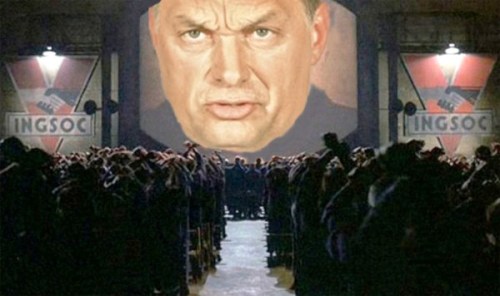
George Orwell, 1984, And The Perfect Totalitarian State

There were a lot of reasons I hated high school. I’ve listed more than a few of them on this blog. Somewhere on that list, but nowhere near the top, involved the books I had to read. To say they weren’t very sexy would be like saying a baseball bat to the head isn’t a very good massage.

However, every now and then, my English and social studies teachers managed to assign a book that didn’t make me want to make me stick my head in a deep fryer. One of my favorite non-sexy books of all time, which also happened to be a homework assignment, is George Orwell’s “1984.” It’s a book that always seems relevant and insightful, albeit for all the wrong reasons.

When I read Orwell’s depiction of the ultimate dystopian future, I see it as the ultimate thought experiment, of sorts. Orwell wrote this book in the 1940s, a time when there were actual, dystopian totalitarian regimes operating in the world. Sadly, one of them was a chief ally during World War II.

He had a lot to reference in his time, much more so than we have today. Other than North Korea, most people today aren’t as familiar with rigid, totalitarian governments. Since the fall of the Soviet Union, there’s an entire generation of people whose idea of a totalitarian regime is relegated to detention at a high school. They can’t even begin to fathom the kind of world that “1984” described.

That’s a good thing in some respects. In a sense, those governments are almost impossible these days. The rise of the internet, modern technology, and complex geopolitics makes it next to impossible for a regime to be as totalitarian as “1984.” North Korea comes close, but even that regime is wholly inept compared to Big Brother.

However, I believe there’s a unique value, of sorts, when it comes to understanding what makes a totalitarian regime work. I also think there’s value in knowing the tenets behind it, the ways in which it operates, and why it takes hold in the first place. Even in an age of people protesting the removal of the McRib from McDonald’s menu, we’re not immune from the threat of a totalitarian regime.

With that in mind, let’s dig a little deeper into Orwell’s extreme thought experiment that played out in “1984.” If you haven’t read the book or had even worse English teachers than I did, you might not be familiar with Big Brother, how it operates, what what it represents. You might have heard the term, but you might not be familiar with what it is.

For the sake of providing context, here’s a quick video from the Alternate History Hub channel on YouTube. It’s a channel that focuses primarily on alternate history scenarios, which I’ve touched on before, but it also provides remarkable insight onto other subjects. Given how many totalitarian regimes are involved in alternate history, it makes sense to explore the ultimate extreme, as it played out in “1984.”

It’s hard for most people in the industrialized world to imagine a system like this. The idea that facts, history, and the very thoughts we think are all controlled by this all-encompassing, all-powerful government seems insane. It’s hard to imagine living in a world like that. It almost seems impossible. In a sense, it is.

No government in history has ever come close to wielding the kind of power that Big Brother does in “1984.” Some have tried. There’s the first emperor of China, the sun king in France, and our old frenemy, Joseph Stalin. They only ever succeeded in part and often failed in the long run.

That’s because, as we’re seeing with the ongoing health care debate in America, human beings are impossibly chaotic creatures. We all have so many different needs and wants. We’re all petty about different things and apathetic towards others. No two people are completely wired the same. We all think different thoughts for different reasons, sometimes with downright kinky undertones.

It’s because of all that chaos/diversity within the human condition that no government can hope to achieve what Big Brother achieved in “1984.” It would require so much power, so much micromanaging, and so much information that it just wouldn’t be practical for any one human or party of humans.

Again, that won’t stop some from trying and that’s where Orwell’s thought experiment becomes relevant. In looking at the structure of Big Brother, we can observe the nuts and bolts of the perfect totalitarian regime. We can see what the ultimate fascist is seeking when they want to create an all-power, completely centralized government.

Impossible or not, the features of this government reveal some common themes that have a basis in the real world. Those are themes worth understanding because they help us know when someone is trying too hard to emulate Big Brother. Without getting too deep into the book, here are the key features of a perfect totalitarian regime.

  • There’s a single, unambiguous ruling party and no opposition of any kind

  • The ruling party makes up a small percentage of the population, never more than one or two percent

  • The members of the ruling party rarely, if ever, interact with the public directly

  • The public consists of two classes, a professional middle class that never makes up more than a quarter of the population and a working lower class that usually makes up over two-thirds of the population

  • The middle class is educated to some degree, but wholly controlled by the ruling party and is completely dependent on them for their livelihood

  • The lower class is uneducated, under-informed, and easily manipulated

  • All economic activity is controlled or guided by the party, ensuring the middle class has just enough to do their job and the lower class has just enough to propagate

  • The ideals for family structure and social structure are imposed by the party with any variations being deemed deviant

  • The lower classes are allowed to be more deviant and decadent in order to keep them content with their state

  • The middle class is held to a higher standard of conduct to ensure their loyalty and submission to the party

  • The flow of information, the accepted knowledge of the world, and the entire history of the state is dictated by the party and accepted by the masses

There are probably more features I could list, but these are the core elements of Big Brother and the society we see in “1984.” Now, some people will attempt to apply these features to whatever state, country, or office environment they’re in at the moment. Some might actually apply, but never to the same degree as Orwell depicted.

The biggest takeaway from these traits, as well as the themes in “1984,” is how a society structures itself in the face of such overwhelming control. At the top, there’s always a ruling class. That class has only one primary purpose, which is to preserve its power. From the Galactic Empire in “Star Wars” to the battle for the iron throne in “Game of Thrones,” preservation is always the top concern of a totalitarian regime.

Part of preserving that power means relying on a professional middle class, of sorts, to deal with the bureaucracy and administration of the state. It’s in this area where totalitarian regimes tend to be most vulnerable. History has shown that authoritarian states like Nazi Germany were anything but efficient, which in turn undermined the ruling party’s primary goal.

It seems like a paradox, but it’s more a matter of pragmatism. A state needs people to run these massive, complex machinations to maintain so much control. To not impose such control would mean granting people freedom and that’s dangerous to any ruling party that wants to preserve control.

This is why those in these middle class professions are subject to such greater scrutiny. A poor, unemployed man taking a piss on a street corner creates no controversy. However, if a highly educated professional did that, it would be a major scandal. We often see this in how major corporate scandals play out.

In a sense, the lower classes have more freedom in this system than the professional middle class. That’s because the ruling party doesn’t really care about them. They don’t have to because they’re not a threat.

Uneducated, lower class people are too stupid and gullible to really pose a threat. So long as they work and breed, the ruling party has no reason to micromanage them. They don’t care if they have orgies in the streets, drink paint thinner for breakfast, or wear horse masks to work. Their only purpose is to work and breed. If they do that, then the ruling party couldn’t care less.

In a sense, the ruling party will always be at odds with a certain segment of the population. In order to exercise control in an authoritarian regime, there needs to be a sizable number of loyal, competent underlings to carry out the functions of the state. Finding people who can act as such underlings with perfect loyalty is difficult, if not impossible.

It’s hard to say whether Orwell knew this on some level. Keep in mind, he was heavily influenced by what he saw around him, a massive world war and the rise of communist states. Perhaps he had studied how powerful, repressive governments had operated in the ancient past and saw parallels in the present. Perhaps he saw that as an inevitable recourse for humanity.

I choose to have a more optimistic, albeit cynical view of human affairs. I don’t believe a system like Big Brother could ever take hold in a world where people can’t even agree on pizza toppings, let alone a singular vision for human civilization. I also don’t believe any government is equipped to exercise the kind of control that Big Brother did in “1984.”

However, that still won’t stop some from trying and the very process of trying can be very dangerous. Seeking order within the chaos is a very human trait, but one that can easily get derailed by pettiness and corruption. That’s why Orwell’s lessons in “1984” are more relevant than ever and may always be relevant to some extent.

6 Comments

Filed under Jack Fisher's Insights

On Fascism (And Why It Fails)

Brace yourself and temper your outrage because I’m about to talk about fascism. No, I’m not talking about the kind of fascism that teenagers whine about whenever they have a strict teacher in high school. I’m not even talking about the kind of fascism that that certain people attribute to college professors, LGBT rights, Hollywood, the NRA, the Catholic Church, and Negan from “The Walking Dead.”

Today, I’m going to talk about actual, real-world fascism and how it functions. I’m also going to talk about why it tends to fail in the long run and why it’s become such an empty term. Now, I know that means putting a big target on my ass and daring the more vocal parts of the internet to take a shot. I like think my ass is harder and more durable than most so I’m prepared to take that chance.

I know people like to throw the word fascism around like middle fingers in mid-day traffic, but it does have a definition. That definition has been twisted and amended many times over the past half-century, so much so that the word evokes so many different connotations.

For the sake of this post, I’ll be using the definition from Merriam-Webster’s dictionary. It offers a fairly concise assessment of what it entails.

A political philosophy, movement, or regime (such as that of the Fascisti) that exalts nation and often race above the individual and that stands for a centralized autocratic government headed by a dictatorial leader, severe economic and social regimentation, and forcible suppression of opposition.

Under this definition, America and most developed countries are not fascist. No matter what some kale-eating hippie or Jerry Falwell wannabe theocrat may claim, the systems and laws in place are antithetical to fascism.

Western countries have codified laws and traditions that value individual rights, protect minorities, and restrain central government power. Now, that’s not to say it’s perfect in practice. There are plenty of examples, historical and contemporary, that of inequality and oppression by the government.

However, those examples are more a product of misguided groups of people and inherent systemic corruption. To call an entire system fascist because of those instances would be like calling an entire swimming pool dirty because a few people spit in it. With fascism, the entire pool is spit so there’s no need for cherry picking.

Thanks to the cruel mistress that is history, we have a few well-known examples of true fascism that even vegan hippies can agree on. By most objective measures, Fascist Italy and Nazi Germany are the alpha and omega of all things fascist. If fascism were music, these two would be Elvis and the Beatles.

These governments were repressive, authoritarian, corrupt, and powerful. They could do whatever it wanted to its citizens and act however it wanted on a national stage, not giving a damn about public support of any kind. There was no hesitation to lie, cheat, and mislead the people. In these governments, people are either pawns or cogs in a machine. The very notion of freedom might as well be as fanciful as a unicorn fart.

There’s no question that these fascist governments did a lot of damage and caused a lot of suffering. There’s also no question that their actions scared and traumatized an entire world. They revealed to a modern world that wars between despots and industrial powers was truly horrific. Most human beings tend to avoid such horrors. A massive world war was enough to make everyone hyper-vigilant of all things fascist.

It’s in this heightened mentality where I think it’s worth having some perspective about fascism. We hear pundits, politicians, and protesters throw that word around, as though it’s the rhetorical equivalent of an “avoid critical thinking” card. It’s an easy label to throw around, but it rarely sticks because actual fascism is actually pretty frail.

In a modern context, fascism is different from the kings and despots of the ancient world. In those times, corrupt and blood-thirsty kings could only get away with so much. A kingdom and a nation state, complete with modern infrastructure, are two very different things.

A king needs to only hold a kingdom together and fight off the occasional invader. A nation state has to deal with bureaucracy, social welfare, and legal issues. No matter how big a king’s castle is, there’s just no way to manage all that in a modern context. There needs to be some sort of system in place.

A fascist government tries to centralize that system and organize it in a simple, stable way that definitively benefits certain persons or groups. Nazis sought to benefit a favored race. Italian Fascist sought to benefit a favored class. The argument could be made that Stalinist Russia and the current regime in North Korea are fascist in nature. I would tend to agree with those claims.

The goal is almost always the same. A fascist government directly and overtly attempts to control and centralize power for a select group of elites. It’s for this very reason that fascism tends to fail in the long run or never succeed in the first place.

Now, don’t go cheering and waving American flags just yet. That’s not to say that fascism inevitably falls under the glowing light of freedom, democracy, and bald eagles. That’s a romantic idea that makes for great war movies and comic book characters. It’s not necessarily reflective of real-world machinations.

The biggest flaw in fascism is its attempt to control and manage an entire state. That’s not just difficult. It’s impossible for any ordinary human or groups of humans. Our caveman brains can barely control when we get horny. How can we expect to control an entire government, let alone one meant to benefit a specific group of people?

The short answer is we can’t. The long answer is that such centralization and power requires a lot of bullying, corruption, subversion, and back-stabbing. That’s why you have Nazi Storm Troopers and Stalinist purges. It isn’t just because powerful people get a thrill out of ordering rampant death. They need to scare, bully, and intimidate everybody into going along with their agenda and being completely loyal.

That’s a huge problem though because, as I’ve pointed out before, it’s impossible to know how truthful someone is. You can never know who is truly loyal and who is plotting against you. That’s why men like Joseph Stalin were obscenely paranoid, which guaranteed that allies and enemies alike would die by his hand. Without those allies, any system is inherently weaker.

On top of that problem, there’s also the issue of the terrified masses who live under a fascist thumb. Say what you will about whiny protesters complaining about weed, but at least they’re willing to tell the government what they don’t want to hear. In a fascist system, the impoverished masses will likely keep their mouth shut.

That may help a paranoid fascist get through the day, but it limits their ability to make it through the year. That’s because in a complex world, having incomplete facts tends to be a huge detriment. If nobody is willing to tell a fascist ruler that their rusty old trucks with canons are no match for drone strikes, then that’s going to be a problem.

That’s why, contrary to what the History Channel and video games may claim, fascist regimes like Nazi Germany were never close to winning the war. Between major blunders and micromanaging, there was never a scenario that didn’t involve time travel or aliens that would’ve allowed them to win.

That’s because a fascist regime can’t trust anyone, be it military generals or the public. At some point, the political ties break down and the system just can’t handle it. They can delay the collapse, but they usually can’t stop it. It’s remarkable that Nazi Germany lasted as long as it did, given all the assassination attempts.

It’s the dirty, but unavoidable secret of almost every fascist governments. They function only to live another day, rather than build a future. Some are better at it than others. Castro’s Cuba has managed to survive for over a half-century, albeit with significant support from other neighboring countries.

The same goes for North Korea. The only reason that country still exists is because China doesn’t want a failed state on its border. At this point, North Korea can only endure, but not build. As the old dynastic cycle in China often proved, a system concerned only with survival tends to collapse in the long run.

I say this not as a way to undermine the horrors that fascism has and could potentially unleash on this world. It is a real danger in a world that’s full of crazy dictators and obscene corruption. However, it’s a danger with an inherent weakness and an expiration date. It’s one instance where you can depend on caveman logic to win out in the end.

It may not inspire the kind of ravenous patriotism that Americans tend to enjoy. However, it does show that, despite protests the contrary, there’s a lot to appreciate about our current system. It’s not perfect, but it’s building towards a better, sexier future more so than any fascist government ever will.

2 Comments

Filed under Jack Fisher's Insights

A Piece Of Furniture (Specifically) Designed For Sex?

Every so often, in between writing sexy novels and sharing sexy thoughts, I come up with ideas that I’m not sure what to do with. I don’t know whether or not I can turn them into novels. I can’t really relate them to more serious issues, like religious extremism or sex robots. However, they’re ideas I just can’t seem to forget or throw away.

This is is one of those ideas that just kind of came to me when I was taking a shower. Now, I don’t deny that a lot of great ideas come to me in the shower. I’m naked, dripping wet, and feeling sexy as hell. That usually does wonders for my mind. This, however, kind of came from nowhere and it’s best summed up in one question.

Is there a piece of furniture specifically designed for sex and if so, what would it look like?

This isn’t an exercise in caveman logic or some kinky thought experiment. This is an honest question about the fundamentals of sex. When it comes to kinky ideas, be it sexy role playing or sexy Halloween costumes, we humans can be astonishingly creative. Just look up something called “Furries” and be prepared to clear your browser history.

When it comes to simple pragmatics, though, we kind of have a blind spot. We tend to give so much thought to the kink that we overlook the basics. Now, I’m not saying that’s wrong or misguided in any way. It’s because people give so much thought to kinky stuff that I have a potential audience for my novels. In this case, though, I think we can stand to be a little practical.

When most people think about the furniture people have sex on, they usually think of a bed. That’s the most basic and common site for sexy time, be it romance or a one-night stand. It more than does the job, but let’s not miss the trees from the forest here. A bed, as a piece of furniture, wasn’t designed specifically for sex. It was designed for sleeping. I’ll give everyone a moment to stop rolling their eyes.

Think about the rest of the common furniture we use. From recliners to coffee tables, they’re all designed with a specific purpose in mind. Granted, that doesn’t stop people from having sex on them. The basic rule of thumb is that if it’s physically possible for two people to have sex on a piece of furniture, they have or they will at some point. That’s just the power and breadth of human ingenuity/horniness.

That leads me to wonder, though. Has a piece of furniture ever been designed specifically for the purpose of sex? If not, what sort of features would that piece of furniture have? It’s one of those overly-obvious ideas that has exceedingly sexy implications.

Now, I get that there are some kinds of furniture with distinctly sexy twists. I also get there are some beds that accommodate sex more than others. However, for this kind of furniture, I’m talking about something that is designed specifically to maximize sex.

Since I’m not an artist or an engineer, I can’t provide detailed schematics. If I could, then I’d have patented this sexy idea long ago and sold it on “Shark Tank.” I’m not saying the idea would’ve made me a millionaire. I’m just saying it would’ve raised a few eyebrows for all the right reasons.

That said, I can imagine a few important features for a piece of furniture like that. It’s one instance where being an erotica/romance writer gives me an edge, of sorts. My novels are filled with situations about people finding creative ways to have sexy, make love, and everything in between. I’ve already thought this partially through without knowing it.

With that in mind, here are few of the key features of this sexy piece of furniture that I think should be included. I admit the need for such features varies between couples. Everyone makes love in their own unique way. Ideally, this piece of furniture will help maximize every one of those ways so here we go.

  • It is about the size of a small sofa with dimensions specifically designed to accommodate and support two people

  • It has a slight incline, which ensures maximum leverage and visibility between partners

  • It doesn’t have a handrail or anything on the sides, but there are strategically-located gripping areas so that partners can maintain a certain level of balance during sex

  • The surface must be smooth and soft, ensuring that naked or partially-clothed bodies can move effortlessly along its surface without uncomfortable chafing

  • The base must be wide and sturdy in order to accommodate high amounts of physical exertion

  • The surface must be easy to clean and/or replace in order to minimize the stains caused by various sexual fluids

  • The entire unit must be light and easy to move from room to room

  • The unit must also be customizable for people of different body shapes, preferences, and physical capabilities

I know some of these details are either common sense or overly general. That’s the point, though. The furniture I’m describing here is all about pragmatics. It’s designed specifically for sex, lovemaking, and everything in between. It’s meant to accommodate one-night stands, quickies, and intimate lovemaking that goes on for hours. It’s not something you fall asleep on. It’s something you have sex on.

I imagine this description conjures all sorts of different images in peoples’ minds. I don’t claim that my ideas of sexy furniture are the same as anyone else’s. I also don’t claim that I would use this piece of furniture the same way as someone else. The key here is both pragmatics and flexibility. Put them together and you’ve got something that makes a great thing even better.

Image result for sexy look gif

Again, this is just my overly-kinky idea. I’m sure plenty of other people who are much smarter and more capable than I am have other concepts for sexy furniture. If so, please share those ideas with me. I’d love to turn this into a sexy debate, of sorts. What exactly would the perfect piece of sex-enhancing furniture look like? It’s hard to say, but it’s fun to think about.

Leave a comment

Filed under Jack Fisher's Insights

Why You Should NOT Take Documentaries Too Seriously

Throughout my life, I’ve gone through various phases where I become immersed in certain genres of movies. For a time, I was really into slasher movies. Then, I picked up on the distinct sex-negative themes of those movies and lost interest.

At another time, I became immersed in documentaries. Not surprisingly, that interest also coincided with me getting a subscription for Netflix, a service that puts you in immediate contact with documentaries of all kinds. From government conspiracies involving aliens to stories about porn stars after their career in porn ends. There’s something for everyone is what I’m saying.

On top of that, I also went through a phase where I was pretty big into government conspiracies. It wasn’t just that I believed them to some extent. It was the story around them that fascinated me. Given my love of telling stories, which has since manifested in some sexy novels, it checked all the right boxes for me.

It’s true. There was a time when I actually believed that the government was covering up evidence of an alien presence on this planet. There was also a time when I genuinely believed that the government colluded to manufacture wars from Vietnam to Iraq. I actually believed the government, and people in general, were capable of such confidence. I’ve since learned to temper my expectations.

While I’m no longer a fan of documentaries, I do watch them from time to time. However, I watch them with an overly critical eye. With every documentary I see, even if it has a message I agree with, I still assume that it only offers a tiny part of the story. Chances are a good chunk of this message is a result of cherry picking, clever cinematic, and outright lies.

Now, that’s not to say that the people making these documentaries are total frauds. I don’t doubt for a second that Michael Moore and Morgan Sporlock genuinely believe in the work they’re doing. They wouldn’t sink so much time and money into it if they didn’t. However, these men have agendas. That’s the flaw in every documentary.

This leads me to what specifically inspired this post. Last week, I couldn’t sleep so I decided to fire up Netflix and find some random show. Usually, certain documentaries help make me sleepy, usually the ones that narrated by soft British voices from the BBC. For some reason, I ended up watching a new documentary that came recommended on my list. It was called “What The Health.”

The premise of the documentary was simple. Pretty much all the food you enjoy eating, from fast food to candy to beef jerky to fried eggs, is terrible for you. It’s not just bad for you health-wise. It will give you cancer. I swear on Pamela Anderson’s tits that’s the actual message.

Kip Andersen, the director of this documentary, has a simple message. If your food has any animal products, then you might as well be sprinkling plutonium on your food. It’s also worth mentioning that Kip Andersen is an ardent vegan with a very pro-vegan agenda. He is to health conspiracy theories what Alex Jones is to government conspiracy theories.

That’s not to say that “What The Health” is completely devoid of facts, but it is very much an extended slate of pro-vegan, anti-meat, anti-corporate, pro-hippie propaganda. Even by liberal standards, this documentary is pretty slanted. It would be like a anti-gun control documentary that claims not having a gun makes your penis small, your tits shrink, and your asshole itch. It’s that bias.

Again, I don’t doubt for a second that Kip Andersen believes in what he’s saying. He comes off as the kind of guy who just obsesses so much over his health. That’s what gets him up in the morning. That’s what makes his dick hard at night. What sexy novels are to me, health is to Kip Andersen.

The problem with that, which also happens to be the problem with every documentary, is that it’s produced with an agenda in mind. The size and scope of that agenda varies. There are some documentaries that try to be objective. Most of those produced by PBS tend to be fairly balanced, but even they can fall into the same Alex Jones trap every now and then.

What bothers me about documentaries like “What The Health” is that it’s produced in a way that really preys on our caveman brain’s biggest flaws. There’s just no way to shrug off something like cancer. Pretty much everyone, myself included, knows someone who has suffered from cancer. According to the CDC, cancer killed nearly 600,000 people in 2014 alone. The suffering these people endured cannot be understated.

The problem is that cancer is such a complex disease. There are all sorts of genetic, environmental, lifestyle, disease, and chemical factors that go into it. There’s no one single virus, one single gene, or one single food group that causes it. The human body is too complex, as anyone who has ever studied the female orgasm can attest.

The message “What The Health” sends is not only horribly skewed to the hippie end of the political spectrum, but it’s downright misleading. It gives the impression that cancer and disease have a singular cause. All anyone needs to do to avoid is to just shun animal products, become a vegan, and eat cardboard for the rest of their lives. The fact that this is the same lifestyle as the director is just a hell of a coincidence.

I won’t deny it. “What The Health” does a damn good job of painting itself as credible. However, every documentary does that to some extent. They parade out all these doctors and experts in the field, making bold claims that they can legitimize with their PhDs and titles. However, it’s worth remembering that, as smart as these people are, they’re still human.

It’s also worth remembering that doctors do get things wrong more than we care to admit. There’s also a distressingly large amount of medical research that turns out to be wrong. Like I said, the human body is extremely complex and our caveman brains aren’t wired for that kind of complexity.

On some levels, Kip Andersen and Michael Moore exploit those flaws in our brains. They know how to craft a message that seems credible. They craft a slick, polished narrative that appeals to certain fears and misgivings that everybody has to some degree. They create a false or half-true narrative that preys on our desire to understand the world.

What often happens is that they’re very selective about the information they present. In a sense, they’re taking advantage of the same paradox I pointed out with health care. It’s not just very difficult to offer all the facts in a simple, two-hour documentary. It’s physically impossible. There isn’t enough film on a reel or enough seconds in two hours to convey all that information.

As a result, the message in every documentary is incomplete. In some cases, they’re so incomplete that someone else will try to verify those messages, only to find out how wrong they were.

This actually happened with Morgan Sporlock after his hit film, “Super Size Me.” That movie, much like Kip Andersen, had a very clear agenda. It was anti-corporate, anti-fast food, pro-nutrition. Sporlock even put himself in the line of fire, eating nothing but McDonald’s for 30 days. The proof seemed so clear and apparent.

Then, another documentary called “Fat Head” by Tom Naughton tried to replicate Sporlock’s experiment. There was just one glaring problem, though. The math didn’t add up. He literally could not eat as many calories as Sporlock claimed in “Super Size Me.” You can push an agenda all you want, but if the math doesn’t add up, you’ve got a problem.

On top of that, other people have done similar experiments and come up with different results. A science teacher armed with none of Sporlock’s movie-making resources was able to eat nothing but McDonald’s and actually lost weight. When there’s this kind of inconsistency on all sides, chances are there’s something missing from the story.

Again, I don’t believe that these people do what they do entirely out of malice and greed. Some might, but I choose to have a higher opinion of people in that respect. I think Andersen and Moore sincerely believe the messages in their documentaries, just as creationists ardently believe in their message, despite all the evidence to the contrary.

Now, you can choose to side with men like Moore, Sporlock, and Andersen on various issues. That doesn’t make you a bad or foolish person. However, it’s important to understand that documentaries are not the same as verified, scientific research. They are movies, made for the purpose of telling a story and gaining an audience. They may contain some elements of truth, but they will never tell the whole story.

1 Comment

Filed under Jack Fisher's Insights

Tropes, Strong Female Characters, And Challenges

Whenever I talk about an issue on this blog, I never claim to be an expert or an authoritative voice. Given the topics I discuss, from sex among shape-shifters to pro-nudity superheroes, I hope a disclaimer isn’t necessary. My capacity to research and understand an issue extends only to my own personal experiences and simple Google search.

It’s for that very reason that I’m not too surprised whenever I find something or someone that explains an issue down better than I ever could. I fully concede that I’m not as smart as I wish I were on any number of topics. I’m an aspiring erotica/romance writer with no PhD’s, Nobel Prizes, or daytime talk show. I’m not stupid, but I’m not a genius either.

Even in fields where I feel I’m smarter than most, such as writing sexy stories and talking about sexy topics, I know I’m hardly the best. I’m fully aware that there are others who are much smarter than I am in that field and understand topics better than I ever could.

Sometimes, though, you don’t expect to find that something or someone after having recently explored a particular issue. Recently, I talked about something called the Galbrush Paradox, which is a blanket term used to describe the challenges of writing female characters in a story. I like to think I broke it down in a fairly comprehensive way. It turns out, though, someone already did and they were much more thorough.

Someone on a comic book message board, which I frequent, posted a video that was made in late 2016 on this very topic. It’s from a channel called Overly Sarcastic Productions. It’s almost exactly what it sounds like.

This channel, though some colorful animation and rapid rhetoric, breaks down a number of topics and issues in a concise, informative, and entertaining way. They touch on things like history, philosophy, and various forms of art.

Image result for Overly Sarcastic Productions

One of their regular shows involves something called Trope Talk, which effectively breaks down certain tropes in popular culture. Unlike other discussions about such issues, they try to remain objective and make no over-arching judgments. That’s pretty rare these days because when people usually talk about tropes, they often make them part of some sort of sinister agenda. Alex Jones fans know what I’m talking about.

One such video covered the issues surrounding strong female characters, which is at the heart of the Galbrush Paradox. It’s also an issue that I tend to bring up often on this blog, from the misconceptions about such characters to those who deserve their own movie. I tried my best to break it down with my post on the Galbrush Paradox. However, I know when I’m beat.

Overly Sarcastic Productions definitely did it better. Their video on the issue is far more comprehensive and far more detailed than I ever managed. Just watch the video and I think most would agree.

There’s a lot to unpack in this brief, but dense video. More than anything else, it covered a few important details that I avoided. When I talk about strong female characters, I often put them in the context of the challenges they face within a contemporary context. I look at recent trends, like sex-negative feminism and evolving trends in sexual attitudes, and try to apply them to recent challenges.

This video stakes another step back and tries to see the forest from the trees. It breaks down the how and why these challenges exist, how to deal with them, and how to approach them in a reasonable sort of way. Again, I know when I’m beat.

It’s good advice for anyone who has ever attempted to write a story or publish a novel. Just as there are many double standards when it comes to gender issues, there are many ways to approach writing certain characters. I’m learning that more and more with every novel I write.

Given the dynamic nature of cultural attitudes and popular culture, there will some sort of disparity between the genders. That’s why it’s so important to learn about those dynamics. Having great female characters can only help a story. Given how one of them is now a monumental box office success, the stakes are even higher now. As an aspiring writer, I hope I can contribute to that one day as well.

2 Comments

Filed under Comic Books, Jack Fisher, Superheroes, Jack Fisher's Insights

Politics, Safety, And The Impossible Paradox

political_debates_in_the_usa_by_brokenteapot

As I’ve said before, I really don’t like talking about politics. I’ve learned over the course of my life, often the hard way, that nothing makes people less comfortable, less horny, and more insufferable than politics. It couldn’t have less sex appeal without involving a clogged toilet, a dead rabbit, and Sean Hannity.

For the most part, I try not to get too political on this blog. I’d much rather be talking about comic books, sex robots, and Leslie Knope. However, there are times when I feel compelled to say something about a particular issue. I often do that with gender issues like feminism because that indirectly ties to the sexier topics I talk about. I try not to take too strong a position. More than anything else, I try to give perspective.

That’s what I did with my post about the health care debate. I tried to be fair to both sides. I tried to frame the issue in a way that both Michael Moore and Ted Nugent could appreciate. I didn’t offer any easy fixes. I didn’t try to denigrate one political ideology over the other. I just tried to point out the inherent flaws in the issue itself.

In the course of writing about that particular debate, I wanted to apply it to a few other issues. However, I quickly realized that there was no way I could do so in a single article and remain concise. When I write on this blog, I tend to assume that part of the audience is drunk, horny, or some combination of the two. That means I can’t drone on for too long, even though I have a habit of doing that when it comes to comics.

Health care is just one issue. Granted, it’s an exceedingly complex issue, but it’s still one issue. The underlying argument I made was that, beyond the complexity, both sides of the political spectrum have the same goal. The problem is that what they want isn’t just logistically difficult. It’s physically impossible.

It’s another hard truth, one that I’d argue is even harder than the truth surrounding O.J. Simpson. Sometimes, even when the politics involved have a noble goal, the particulars of an issue are just beyond our capabilities as humans to produce. We humans can do all sorts of amazing things, from the Great Pyramids to solar-powered vibrators. However, we are a species of many limits, many of which we often fail to acknowledge.

This leads directly to an even bigger picture, of sorts. It also involves something that’s currently impossible in a world without superheros, super-powers, or computers that can’t be hacked for hilariously stupid reasons. Until we start enhancing ourselves, it’ll remain impossible for the foreseeable future.

I call it the impossibility paradox because most people, regardless of their political persuasion, act as though the impossible aspects aren’t there. They’re often smart, driven people who are every bit as driven as their ideological opponents. They work so hard to accomplish something that’s physically impossible. Then, they’re surprised when they come up short.

On top of that, the people they claim to represent or help get upset with them because they didn’t accomplish what they promised. Never mind that what they promised was never possible to begin with. Human beings just aren’t that reasonable, even if they like to pretend that they are. Everybody is still subject to the constraints of reality and, like a moody dominatrix, it doesn’t mind telling us who’s dominant.

Now, apply that dynamic to what might be an even bigger issue than health care for some people. Whether you’re gun-toting conservative or a pot-smoking liberal, most agree that a central function of any government entity is to keep citizens safe.

No state, kingdom, or Dungeons and Dragons guild can survive without providing some level of safety. People, society, and the economy can’t function unless there’s some level of safety. Nobody wants to make iPhones and exchange brownie recipes if there are barbarian hordes just a few miles away, ready to raze your home to the ground.

Since the dawn of civilization, every functioning society has had to provide some measure of safety and protection to its citizens. In exchange, citizens pay taxes to the state so that it can have the resources to perform these duties. Ideally, they’ll use those taxes carefully in accomplishing this goal. In the real world, however, nobody will ever say with a straight face that all taxpayer money is spent wisely.

However, this is where even the anti-government, Ron Swansons of the world have to face another cold, hard fact of reality. It’s every bit as inescapable as the health care debate. Even if, however unlikely, a government spent every penny of taxpayer money wisely and dedicated every resource into ensuring safety and security, it still wouldn’t be enough. That’s because of one simple truth.

“Nobody knows ALL the facts and nobody CAN know all the facts.”

If that sounds a bit too similar to the advice I recently gave on making sense of the world, then bear with me. There’s a reason for that. It’s similar, but not the same because the scope of the issue is different. Every issue takes on twisted, often frustrating new dimensions when politics enter the picture. Just ask Major League Baseball.

When it comes to safety, though, there’s an inescapable complication that has plagued every government entity that ever existed and will continue to plague governments until our robot overlords take over. To provide safety, you need to know everything about a situation and have the resources to deal with it. Unfortunately, or fortunately for privacy-minded folks, nobody can know everything about a given situation.

Nobody can know for sure when and where a terrorist attack will occur.

Nobody can know for sure whether or not a rival nation is plotting against them.

Nobody can know for sure whether a handful of countries are colluding to undermine them.

Nobody can know for sure whether that weird-looking guy walking down the street is about to go on a shooting spree or just skipped laundry day.

There are just so many unknowns in the world of geopolitics. There are a lot of unknowns for individuals as well. Hell, we still can’t figure out just how useful or useless pubic hair is. How are we supposed to know everything about the threats to our safety and sovereignty as people?

That’s just it, though. We can’t know. It’s physically impossible for any one human or group of humans to know everything about a certain situation, individual, or threat. Sure, the CIA could bug your phone and hack your browser history. That may even give them plenty of reason to believe that you’re conspiring with a hidden network of BDSM enthusiasts to take over the entire state of Montana.

At the end of the day, though, even the CIA can’t know for sure and that has proven costly throughout history. No agency, no matter what they call themselves or what sort of fancy acronyms they use, can know everything about a situation. I’m sure they’d like to know. If you’re of the mind of Alex Jones, you might even believe they’re working with aliens to remedy that.

Even if they did have some way to read all our thoughts, there’s still the matter of sifting through random daydreams and outright plots. Honestly, who hasn’t contemplated whipping out a can of lighter fluid and setting a coffee shop on fire because they got your order wrong? The difference between those thoughts and real action, though, is huge.

I’m not saying that governments and police forces should give up trying to keep people safe. We still need some measure of safety in order to function as a society. The problem is that because of this safety paradox, we end up in these brutal cycles that only make us more fearful. It goes like this.

  • Some strange, complex, dire threat is out there and the media blows it up to scare people

  • The people demand action from their politicians and authority figures

  • Those politicians and authority figures try to respond, if only to maintain their hold on power

  • Those politicians and authority figures fail to provide perfect safety because doing so is impossible

  • The public gets upset with the existing people in power and looks for alternatives

  • Some new power-seeking people enter the picture, making impossible promises to fix impossible situations’

  • The citizens, desperate to fix the impossible problem, put these people into power because anything seems like an improvement over the status quo

  • The people who made the impossible promises, predictably, fail to deliver and generate another round of disillusion

  • The cycle starts all over again

This is part of why congress’ approval rating is so low. It’s also why western countries keep cycling through political parties, constantly voting new people into office in hopes that they’ll find a way to solve impossible problems. In every case, they are unable to deliver. Most people don’t see the impossible logistics, though, so they just look to the next power-broker who can deliver.

For now, we’re very much at the mercy of impossible situations and the people who claim they can solve them. Some of these situations will become less impossible as we develop better tools. Until then, though, let’s be mindful of the impossible demands we make on those we entrust with our safety. It’s often when we have impossible standards that we doom ourselves to unlimited disappointment.

7 Comments

Filed under Jack Fisher's Insights

The Galbrush Paradox And The Challenge Of Female Characters

rey1

Anyone who’s written anything longer than a haiku will tell you that one of the biggest challenges is coming up with great characters. Stan Lee may make it look easy, but it’s most definitely not. Without great characters, your story might as well be a sandwich without bread. It just can’t function.

I can certainly attest to the challenge of creating great characters. In the eight novels I’ve written, I’ve tried to put as much energy and nuance as possible. Whether it’s Ben Prescott in “Skin Deep” or Mary Ann Scott in “Passion Relapse,” I make a concerted effort to help them stand out for all the right reasons.

In doing so, I have noticed something that’s both distinct and frustrating. It’s something I think every writer, including the Stan Lees and J.K. Rowlings of the world, have noticed at some point. When it comes to creating great characters, there’s a lot of flexibility when it comes to male characters. With female characters, though, there are too many unwritten rules to keep track of.

It’s only gotten more frustrating in recent years because the demand for strong female characters has never been greater. The success of movies like “Wonder Woman” and “Mad Max: Fury Road,” as well as novels like “Harry Potter” and “Twilight,” have raised the bar. Make no mistake. There are a lot of incentives to create these characters.

I’ve talked about why characters like Wonder Woman matter now more than ever. However, there’s one caveat that I didn’t mention and for good reason. I think it’s an issue that the William Marstons and Stephanie Meyers of the world understood, albeit indirectly. When it comes to creating female characters, the margin for error is painfully small.

By that, I mean there are a lot of things you can do with a male character that you just can’t do with a female character. Even male minority characters have a lot more flexibility, in terms of what you can put them through. Every character that Samuel L. Jackson has ever played is proof of that.

With female characters, it’s a lot trickier. If you don’t believe me, think back to that disturbing thought experiment I pitched a while back that reversed the genders of certain famous scenes, thereby creating a much more disturbing result. With that in mind, try to craft a story about a flawed, vulnerable character that has the potential to be interesting.

Maybe the character is a former cop who suffered a terrible injury at the hands of a deranged criminal.

Maybe the character is someone who made a huge mistake with a former lover and is haunted by it.

Maybe the character is someone who found themselves in a vulnerable state, had a few too many drinks, and had a messy one-night stand with a total stranger.

These are all fairly standard setups for typical characters. Think about those characters for a second. Chances are the character that comes to mind is a man. That’s not too surprising. That doesn’t make you a terrible sexist who deserves to lick the mud off the shoes of every radical feminist form now until the end of time. By and large, most of the iconic characters in popular culture are male.

Now, try to imagine that same character as a female. Chances are your reaction will be different. Even if it isn’t, there’s a good chance you’ll be more reluctant to develop this character because you know the kind of responses you’ll get from certain people.

Remember that cop who suffered a terrible injury? Well, if that cop is a female, then you’re a horrible misogynistic monster because you subjected that woman to violence and we can’t tolerate that.

Remember that character who made a huge mistake with a former lover? Well, if that character is a female, you’re also a horrible, misogynistic monster because you utterly failed the Bechdal Test by defining her through a relationship with a man.

Remember that character who was vulnerable and had a one-night stand? Well, guess what? You’re also a horrible, misogynistic monster because you overtly sexualized the female character in a way that propagates the idea that women are sexual objects to be used by men.

Are you seeing the pattern here? Are you getting that twinge of pain in your palms while you grind your teeth? Don’t worry. You’re not having a stroke. That’s normal. It also gives you a taste of just how hard/frustrating it is to create good female characters without making it an agenda.

That agenda didn’t used to be that big a deal. Then, in recent years, with the rise of third-wave feminism and social media scandals that have made people hyper-sensitive to sexism, the challenge got that much harder.

That’s not to say there isn’t some merit behind the sentiment. There are only so many Disney Princesses and horny vixens in “James Bond” movies before the narrative gets old, predictable, and outright insulting. Even I think Super Mario has had to rescue Princess Peach way too many times.

The problem is that when people try to create characters that aren’t princesses or Joss Whedon characters, they run into a wall, of sorts. They quickly find that creating those characters is a minefield, one where a single misstep can get you labeled a racist, misogynist, homophobe at a time when a single misworded tweet can ruin your life.

It’s such a frustrating challenge that someone gave it a name. It’s called the Galbrush Paradox and it emerged during the infamous GamerGate scandal in 2014. I won’t get into the particulars of that shit storm, if only because every discussion about that topic tends to lower people’s IQ by at least a dozen points. I’ll just focus on what the Galbrush Paradox is, as defined by its creators.

Do you know why there’s so many white male characters in video games? Especially leads? Because no one cares about them. A white male can be a lecherous drunk. A woman can’t or it’s sexist. Sexualizing women and what all. A white male can be a mentally disturbed soldier who’s mind is unraveling as he walks through the hell of the modern battlefield. A woman can’t or you’re victimizing women and saying they’re all crazy.

Consider Guybrush Threepwood, start of the Monkey Island series. He’s weak, socially awkward, cowardly, kind of a nerd and generally the last person you’d think of to even cabin boy on a pirate ship, let alone captain one. He is abused, verbally and physically, mistreated, shunned, hated and generally made to feel unwanted.

Now let’s say Guybrush was a girl. We’ll call her Galbrush. Galbrush is weak, socially awkward, cowardly, kind of a nerd and generally the last person you’d think of to even cabin boy on a pirate ship, let alone captain one. She is abused, verbally and physically, mistreated, shunned, hated and generally made to feel unwanted.

Now, you might notice that I’ve given the exact same description to both of these characters. But here’s where things deviate. While no one cares if Guybrush takes a pounding for being, for lack of a better term, less than ideal pirate, Galbrush will be presumed to be discriminated against because of her gender. In fact, every hardship she will endure, though exactly the same as the hardships Guybrush endured, will be considered misogyny, rather than someone being ill suited to their desired calling.

And that ending. She goes through ALL that trouble to help, let’s call him Eli Marley, escape the evil clutches of the ghost piratess Le Chuck, it turns out he didn’t even need her help and she even screwed up his plan to thwart Le Chuck. Why, it’d be a slap in the face to every woman who’s ever picked up a controller. Not only is the protagonist inept, but apparently women make lousy villains too!

And that’s why Guybrush exists and Galbrush doesn’t. Men can be comically inept halfwits. Women can’t. Men can be flawed, tragic human beings. Women can’t. And why? Because every single female character reflects all women everywhere.

It’s a fairly new concept, but a relevant one. We’ve already seen it play out in a number of ways in recent years. The best example is probably Rey from “Star Wars: The Force Awakens.”

If you’ve done any digging whatsoever into “Star Wars” beyond seeing the movie and listening to arguments about whether Han shot first, then you’ve probably seen some of the criticisms about her. She’s what some call a “Mary Sue.”

A Mary Sue is a byproduct of the Galbrush Paradox in that she’s a character who’s too perfect. While this character can be a man, it most often takes the shape of a female character who’s so skilled, so beautiful, so perfect that it’s hard to make her interesting.

Rey faced this issue, and for good reason. Throughout “Star Wars: The Force Awakens,” she was perfect at everything she did. She flew the Millennium Falcon, wielded a light sabre, and used the Force as though she’d been doing it all her life. Everything that happened to her just happened so easily. She was never allowed to struggle, suffer, or slip up too much like Finn or Poe Dameron.

I can even understand why. If she had been tortured like Poe or lied like Finn, there would be mass protests and hashtags. A very vocal contingent of fans and professional whiners with nothing better to do would’ve condemned Rey as an affront to women everywhere. Her flaws would’ve been taken as huge insults against an entire gender. If she were a man, though, nobody would’ve batted an eye.

It’s tragic, in a sense, because it shackles characters and stories. It creates self-imposed limits that don’t need to be there. It’s true that there is real sexism in the world. There’s even plenty in movies, especially slasher movies. However, nitpicking every little detail of a female character to ensure sufficient purity, so to speak, is counterproductive. All it does is discourage people from even trying to create these characters in the first place.

That’s not good for either gender because it is possible to create great female characters. From Furiosa in “Mad Max: Fury Road” to Sarah Conner in “Terminator” to Ripley in “Alien,” there are plenty of great female characters that go onto become iconic in their own right. That’s why it’s so important to avoid the pitfalls of the Galbrush Paradox, otherwise we’ll be doomed to a future of Mary Sues.

20 Comments

Filed under Jack Fisher's Insights

Health Care, Politics, And The Impossible Paradox

As a general rule, it’s my policy to ignore major political issues until after the protests have died down and people have stopped trying to strangle each other through computer screens. Politics is rarely sexy, unless it involves Monica Lewinsky and whoever John F. Kennedy was screwing. In my experience, nothing kills the mood faster than a heated political debate.

I know I’ve spoken on certain hot-button issues before. I did a quick response to the Women’s March earlier this year and the March for Life that quickly followed it. Those weren’t debates, though. Those were protests with simple, clear messages that were easy to break down. Debates aren’t just a little trickier. They’re downright infuriating.

There was a time when I used to enjoy engaging in such debates. I would even go out of my way to find people who disagreed with me, try to understand their position, and then try to argue my own. It was a good mental exercise, but that’s all it ever was.

At no point did I ever change anyone’s mind about anything. At no point did anyone change my mind either. Like debating creationists, they might as well have just been glorified shouting matches. They weren’t meant to actually persuade the other person. The debate was just a spectacle and nothing more.

The fact remains that people don’t like to change their minds about anything. I’ve mentioned time and again how rigid and stubborn the human brain is. Changing an opinion about something is a last resort. Before that happens, people will do the kinds of mental gymnastics that would make a Russian gymnast cringe to justify their opinion.

That brings me to the ongoing health care debate in the United States. I know everybody has an opinion on it and they want to shout that opinion from the highest hill over a bullhorn while Uncle Sam and Lady Liberty give them a back massage. It’s one of those issues that a lot of people are sick of, which is kind of ironic when you think about it.

It’s a frustrating debate to have in the first place because most other industrialized countries have resolved it. The United States of America, despite all the flexing it does of its patriotic nuts, is one of the only industrialized countries that doesn’t have universal health care.

It’s been argued over endlessly by politicians and presidential candidates. Every now and then, one will even build a platform around it. There have been any number of initiatives and policies, some of which do result in meaningful legislation. However, the debate still continues and so does the whining.

Now, I’m not going to take a position in that debate. That’s not the purpose of this post. I’m writing this because someone needs to point something out in this debate that nobody seems to recognize. It’s something that both sides of the debate need to understand, if only to maintain a sense of perspective.

It’s not a thought experiment. It’s not an opinion. It’s not even an argument or a policy idea. It’s a cold, unambiguous fact that is at the heart of the health care debate and others like it. This is a hard truth so whether you’re a card-carrying liberal or a die-hard conservative, you might want to brace yourself.

What we’re trying to accomplish with our health care system is physically IMPOSSIBLE.

Let that sink in for a moment. I don’t usually write in all caps, but this is something that’s worth shouting. If you’re reading this out loud, please read it over again and shout it as loud as you want because it needs to be belabored.

Health care, be it universal or reserved for rich people with decent insurance, is an impossible endeavor that tries to account for infinite possibilities with finite resources. There are over seven billion people on this planet. There are hundreds upon hundreds of diseases that afflict the human body. Treating every person to the utmost just requires too many resources with too few people qualified to administer them.

That’s why the answer to the health care debate isn’t as simple as adopting the same universal health care policies as Europe. Contrary to what Bernie Sanders fans might believe, health care in Europe faces some pretty huge challenges for the exact same reasons. There are too many people who need health care, but there just aren’t enough resources to go around.

Go to any country with any type of health care system you can think of. Don’t be like Michael Moore and focus narrowly on one particular part of a system. No matter where you go and no matter what system you encounter, be it universal or administered by wizards, you’ll always find cases of people not getting the care they need.

Within those cases, you’ll find plenty of unusual cases, such as people who resort to do-it-yourself dental care. You’ll also find plenty of tragedy about people suffering horribly due to their inability to get the care they need. So long as demand outstrips supply, they’ll always happen. That’s just basic economics and dispassionate logic.

In the end, whatever health care policy or reforms get enacted, it won’t be enough. There will still be people who suffer because of it. There will also be people who end up paying more for both their care and that of others. There’s just no way around it. Health care requires resources and people. When there aren’t enough of both, you’re going to get people who get screwed over.

It doesn’t help that many countries, including the United States, face a shortage of qualified doctors. Despite the generous salaries and sexy nurse fantasies, the actual process of becoming a doctor is extremely costly and very difficult. No matter how sexy Hugh Laurie makes it look, becoming a doctor is hard and laborious.

It also doesn’t help that pharmaceutical companies and insurance companies are for-profit companies whose incentives aren’t always in line with providing the best of care. There are people in this world who will risk doing real harm to sick people in order to turn a profit. These people aren’t super-villains or sociopaths, for the most part. They’re just working within a system with flawed parts.

This is not to say that the health care debate is hopeless. For the moment, the situation is impossible. There really isn’t a way to provide adequate care to everybody. However, there are some rays of hope that should keep everyone’s panties from getting too dry.

To combat the doctor shortage, companies like IBM are using Watson, their Jeopardy champion, to help diagnose disease and research treatments. Major biotech companies are using tools like CRISPR, which I’ve talked about before, to alleviate diseases that were once fatal and expensive.

Further into the future, advances in technology like smart blood or brain implants will improve overall efficiency in determining appropriate care. However, there will still be a cost. There will still be a bureaucracy, which both sides of the political spectrum find inherently unsexy. So long as that process is determined by humans and for humans, there will be flaws.

Remember this the next time someone debates health care. No matter what side they’re on, the issues they’re highlighting are literally impossible. It’s still a debate worth having. We should still strive to give the most amount of quality care to the most amount of people. That’s good for society, the economy, and even politicians.

Let’s just remember that there’s a difference between a solvable problem and an impossible situation. Health care, at the moment, is an impossible situation. We shouldn’t lose sight of that, no matter how the debate unfolds moving forward.

6 Comments

Filed under Jack Fisher's Insights

How To Break A Taboo (Or Stop It From Becoming One)

It’s not easy talking about taboos, sexual or otherwise. It’s kind of in the definition. Taboos, by default, are hard to talk about and hard to make sense of. Some don’t even make sense indirectly. If you’ve seen more than two seasons of “South Park,” you understand that.

In talking about weird taboos and the quasi-logic behind them, I try my best to make sense of them. We all have to do that to some extent over the course of our lives. I just try to do it in a way that’s sexy and could potentially lead to sexy stories that I can turn into novels.

While every taboo is unique in the sense that it’s uniquely weird, they are prone to fads, trends, and people just getting bored of them. As I’ve pointed out before, there are certain innocuous behaviors that we do every day that most used to be on par with public masturbation.

A lot of taboos fade over time, often as new generations enter the picture and form taboos of their own. Some linger and refuse to die gracefully. That’s why we still have blurred female nipples on cable TV and not a hint of BDSM in the “Wonder Woman” movie. I refuse to believe that there’s any justification for blurring nipples on network TV in the area of ubiquitous internet porn.

There’s no doubt that we’ll be dealing with taboos for as long as we’re a bunch of cavemen running around with smartphones and nuclear weapons. That may change when we get around to upgrading our brains, but even that may inspire a whole host of taboos that we can’t begin to imagine, although I did try.

For now, there aren’t many ways to break a taboo or stop something from becoming taboo. In some cases, it’s downright impossible. No matter what you do, people are going to get weird around certain proclivities, some of which involve some pretty kinky fetishes. Look up something called “cake farts” and try to find a way to not make that weird.

While there may not be a way to completely eliminate some taboos from our society, there are some ways to confront them. It is possible to break certain taboos and/or avoid them from becoming one altogether. Now, that’s not to say it can be done overnight or with a few strategic tweets. People are really stubborn when it comes to taboos, but they will come around if the conditions are right.

With that in mind, here are some of my tips on breaking and/or circumventing taboos. A lot of these tactics can apply to the sexy kind of taboos, but they also apply to others, many of which involve poor people and minorities. Again, don’t take this as a magic pill or something. Breaking taboos is hard and for good reason. We’re a petty species, but we can be reasonable if the conditions are right. That’s a big if though.


Tip #1: Make Taboos Profitable And Lucrative For Business Interests

This probably won’t surprise anyone who tips generously and has never found used bubblegum wrappers on their pizza. Money talks. It talks a lot. It also influences, more so than we’re comfortable admitting. It can, and often is, a source of corruption. In some parts of the world, that corruption is a big part of the economy. When there’s money to be made by politicians and business people, it can get messy.

That said, it’s a two-way street. Money and business interests can be corrupt, but that same corruptive force can be channeled. We’re seeing that with the growth of the marijuana industry. We saw it with the rise of the porn industry. These industries generate billions of dollars. That’s a lot of money by any measure.

No matter how regressive or uptight people may be, when there’s money to be made, people generally follow the money. A taboo that makes nobody any money is easy to clamp down on. A taboo that generates billions of dollars and significant tax revenue is a lot harder to fight.

While I don’t agree with Gordon Gekko’s famous quote about greed, it can sometimes work to others’ advantage. When it comes to legitimizing a taboo, being profitable and taxable on some level really goes a long way. At some point, the money just overpowers the weirdness.


Tip #2: Make Taboos Expensive To Preserve

This is more a preventative than confrontational measure. After a taboo becomes entrenched, it can usually find ways to endure any number of expensive lawsuits and litigation. Just look at the Church of Scientology. Truly robust taboos will find ways of exploiting the legal system to their advantage.

If you have a chance to be proactive, though, the legal system can work for you. It’s not too hard to sue for discrimination or harassment, these days. If you’re a minority, it’s even easier and you may end up on the news with Bernie Sanders. They key here is to focus more on the bigger picture, though. One lawsuit alone isn’t going to break a taboo. Many lawsuits, however, will make it impossible to maintain.

This is how a lot of our modern anti-discrimination laws emerged, using a series of successive lawsuits that made preserving old taboos too damn expensive. People may be stubborn, but when it comes to getting their lawyer’s bill, they will eventually grit their teeth and change their perspective. Even if they have the money to pay the lawyers, you can’t always put a price on frustration.


Tip #3: Make Sure Taboos Scare And/Or Inconvenience Rich People

This is one of those uncomfortable, if not infuriating, aspects of taboos and social norms. There are usually a disproportionate number of them that are directly effected, or in some cases imposed, by the rich and powerful. Taboos can be a form of excuse banking, helping rich people justify their treatment of the poor and minorities.

That’s how many people justified segregation, slavery, and feudalism. The system was such that any changes would’ve grossly inconvenienced the rich and powerful. In some cases, it might have completely ruined them.

Say what you will about rich people. They can afford to accept such criticism. They, like any other rational human being, seek to preserve their resources and their power. That’s the entire theme of the “Star Wars” movies. If giving minorities equal rights or allowing women to show their tits in public somehow undermines profits or power, then you can bet they’ll fight it with every ounce of their considerable resources.

Conversely, the act of frustrating the rich can help break taboos and even end them. Rich people want more money. Powerful people want more power. One of the major problems with segregation, among many, is that it effectively cut off an entire customer base. Once minorities could work and earn money, they wanted to do what everyone else does and spend it. The desire to spend money knows no race or gender.

Eventually, rich companies will want that money. At the same time, powerful people will want those votes and support. At that point, a taboo’s days are numbered. Being a racist asshole may be fun for some people, but it gets old fast once it starts costing money.


Tip #4: Make A Taboo Boring Or Bland

I’ve spoken before about the power of boredom. It can create super-villains and drive teenagers to cold-blooded murder. It is a powerful force, one that’s plenty powerful to break a taboo.

It’s not easy, though. In fact, I would argue that this is probably the hardest tactic to use if you’re trying to combat a taboo. Taboos usually emerge because something gets a rise out of people, often revulsion or outrage. It’s hard to temper that sort of thing. However, it can be done.

It’s happening right now with taboos surrounding marijuana. When I was growing up, the mere mention of marijuana conjured fear and horror. These days, it mostly conjures scenes from Seth Rogen movies. You could make the argument that public attitudes changed because of growing awareness of the effects of marijuana compared to alcohol. I would argue that the debate just got too boring.

Now that marijuana is becoming a full-fledged industry, there’s a financial incentive to break the taboo. However, it’s the lack of horror and outrage that comes with smoking a joint these days that really undermines the taboo. Say what you will about Seth Rogen. The man isn’t exactly scary. Without that fear, boredom usually follows.


Tip #5: Give A Taboo Political Connections

This is another aspect of making a taboo too expensive to preserve. Sometimes, it’s just not enough that taboos cost businesses money, as racial segregation often does. Even when the economics are on your side, you still need powerful allies when combatting or preventing a taboo.

This is where it pays to have powerful friends who owe you money and/or favors. You don’t always need compromising pictures of them either, but that can help. This is a big part of how the gay rights movement got off the ground. They had the support of billionaires and well-connected individuals who could influence people in power. Money talks, but sometimes political connections shout.

Again, it can cut both ways. There are billion-dollar organizations that fight to preserve taboos, but at least it’s a level playing field. Unlike the working poor, some taboos have billionaires who spend time, money, and favors to fight them. That’s a big part of how same-sex marriage became legal.

So as a rule-of-thumb, it helps to have both rich people and powerful connections in fighting a taboo. Granted, those same taboos could use similar tactics, but they’re at the mercy of the same limits. That means that if, despite the battles between billionaires and power brokers, a taboo simply doesn’t jive with our caveman brains, then it’s going to fail in the long run.


Tip #6: When In Doubt, Turn A Taboo Into A Party

This tactic is probably the most enjoyable, as well as the most satisfying. We humans love to party. We’ll look for any excuse to throw a party, have some fun, and take our clothes off without public shame. Taboos can be serious, scary, and depressing. Parties are the exact opposite of that.

Fighting a taboo with a party is like fighting fire with a waterfall. It’s using a diametrically opposing force to combat something. Mix in music, dancing, alcohol, festivities, exposed body parts, and an excuse to leave work early and you have the perfect antidote to a taboo.

This is what Mardi Gras does once a year. This is what Brazil does with Carnival. Taboos, reservations, anxieties, and fears all melt away in the spirit of having fun and enjoying yourself. This is especially potent for sexual taboos. These taboos, and the social norms built around them, tend to be frustrating and difficult for those who preserve them. A party is like a release, one that’s easy and enjoyable for all those involved.

So if you want to start the ball rolling on breaking a taboo, don’t hire a lawyer or make friends with a billionaire. Start by throwing a party. Make it fun, festive, and happy for all those involve. No taboo will stand a chance.


There are probably more tips and tricks for beating taboos that I didn’t list. There are likely a lot more that I didn’t even think of. Again, I’m not an expert. I’m an aspiring erotica/romance writer who tends to overthink certain subjects more than most, be they comic books or sleeping naked.

While I don’t expect these methods to spare us from a future of censor bars and blurred tits, I hope it makes people aware of the mechanisms behind taboos. They’re rarely logical and they tend to reflect certain proclivities in our society that we’d rather ignore. If we’re to make progress as a species, though, we should confront them and, if necessary, kick them in the ass.

4 Comments

Filed under Jack Fisher's Insights