Tag Archives: romance

Why Stupid Love Is Honest Love (According To Batman)

Whenever someone says love is stupid, they’re usually getting over having their heart broken or upset that other people aren’t lining up to fuck them. It’s a cynical, jaded position on one of the most fundamental and powerful emotions there is in the human experience. As an aspiring erotica/romance writer, I’m often reminded of its power.

Sometimes, though, you need other kinds of reminders to appreciate the breadth of love. In a sense, it is stupid, but not in the way ex-lovers, recent divorcees, and Evanescence fans often claim. It is an inherently irrational, exceedingly overwhelming emotion that drives us to do some pretty crazy things. However, that’s exactly what makes it beautiful.

That beauty isn’t easy to see. Sometimes, it manifests in subtle ways. Other times, though, it’s front and center in a Batman comic. No, that’s not some colorful aside. I’m dead serious. The stupidity of love has actually manifested itself in a Batman comic and it’s beautiful to a level that only Batman can achieve.

This beauty was on full display in Batman #35, which picks right up from the huge development that occurred a few issues back when Catwoman accepted Batman’s marriage proposal. It has little to do with wedding plans, overpriced engagement rings, or how good Catwoman looks in skin-tight outfits. It actually goes out of the way to highlight the stupidity of love and all its uncanny beauty.

The context of the issue is secondary. If you really want to know the particulars, I highly recommend you read Batman #35 to get the full context of the situation. With respect to the topic at hand, namely the stupidity of love, all you need to know is that Catwoman has a chance to confront one of Batman’s other famous flames, Talia Al Ghul.

That’s a big deal for anyone who dares to get involved with Batman’s personal life. Talia Al Ghul isn’t just someone that both Batman and Bruce Wayne were fond of seeing naked. She’s also the mother of Damien Wayne, but not in the classic sense. He wasn’t conceived in the classic, fun sort of way.

The creation of Damien Wayne, much like Baman’s relationship with Talia, was largely a byproduct of a cold, unfeeling agenda. It had a specific purpose, a defined goal, and very little passion involved. It’s even less sexy than it sounds. It’s basically the antithesis of the stupidity of love.

That’s very much who Talia Al Ghul is. Sure, she looks almost as good as Catwoman in skin-tight outfits, but she’s not much of a romantic. She’s a cold, calculating bitch who sees love as an asset at best and an inconvenience at worst. She’s also the one Catwoman has to deal with in Batman #35 and not just because she’s marrying her baby daddy.

The clash between these two women may not be as sexy as nude oil wrestling at the Playboy mansion. It may not even be as epic as a battle between Superman and Doomsday. However, the way this fight plays out perfectly highlights both the stupidity and the beauty of love. Catwoman herself articulates it perfectly.

It’s not just that loving Batman carries with it a lot of baggage. It’s not just that being involved with the goddamn Batman is overwhelming and not just because he tends to attract homicidal clowns. To love someone like Batman is not to ignore the sheer stupidity of being involved with him in the first place. It’s to embrace it.

It’s a message that fans of romance and aspiring erotica/romance writer alike can get behind. Instead of scrutinizing or overthinking why someone loves another person, you just focus on the love itself. Sure, it’s stupid in the sense that it ignores the logistics. Sometimes, though, that’s the key to making love work.

When you’re in love with a complex person with loads of baggage, like Batman, there’s a lot to think about and scrutinize. It’s one of the many reasons that Batman has had such a colorful history with women. Between being a costumed crime fighter and a billionaire playboy, he’s a complicated man with a lot of moving parts.

It’s because of those complications that many of those women who may genuinely love him find plenty of reasons to walk away. Talia Al Ghul is a perfect example of this because she approaches her love with Batman in a way that’s cold and calculated.

To love him, in her mind, isn’t to embrace his baggage. It’s to re-shape and re-mold it into something she sees as greater. What she tries to do with Batman is very similar to what many people try to do with their lovers in the sense that they try to change and mold them into the person they want them to be, even if it means undermining the person they are.

That’s not just a losing battle that only leads to greater heartache. It goes against the very principles of love. You don’t love someone for who you want them to be. You love them for who they are.

Talia Al Ghul wants Batman to be a certain way for her. She feels she knows what’s best for him, their future, and their family. She’s also willing to lie, cheat, and manipulate him into achieving those goals. She may leave his balls intact, but she’ll make sure his soul is hers to guide. Even Regina George isn’t quite that ambitious.

Catwoman does the exact opposite. She doesn’t try to change Batman into some ideal version of a man that she has in her head. She loves him for who he is and doesn’t want to mold him into something else. On paper, that’s still kind of stupid in the sense that it basically permits him to keep doing the crazy things he does. However, it’s probably the most sincere and honest love anyone can offer.

That does more than contrast Catwoman’s love for Batman from that of Talia Al Ghul. It shows how genuine love compares to the shallow brand of love that comes with caveats. Some people build their relationships around an agenda, much like Talia Al Ghul. They see it as a means to an end. Love, in that context, is indistinguishable from a mortgage application.

Loving someone honestly means loving their flaws as much as their strengths. Catwoman doesn’t overlook or deny those flaws in Batman. Batman himself doesn’t try to hide them either. That honesty, making themselves so vulnerable to one another, is stupid from a purely logistical point of view.

However, that’s exactly what makes their love so sincere. Even if you’re not a comic book fan or a fan of beautiful women in skin-tight outfits, it’s still a love that’s worth celebrating.

 

2 Comments

Filed under Comic Books, Jack Fisher, Superheroes, Marriage and Relationships

Cheap Sex, Sexual Revolutions, And Why It’s A GOOD Thing

When something is cheap, you tend to get what you pay for. I learned that the hard way when I tried to spend as little money as possible on a trip to Florida. I ended up staying in an awful hotel with dirty sheets, piss-poor room service, and towels that felt like sandpaper. I definitely paid for not wanting to pay too much.

In any functional economy, that’s how it’s supposed to work. If you’re not willing to put effort and resources into a product, then you’re not going to get much out of it. It’s the cornerstone of how western society has prospered, according to Adam Smith. With sex, however, you can’t always apply the same rules.

Granted, I’ve often tied certain sexual attitudes to economic factors. I still stand by some of those comparisons, but I don’t deny some special circumstances, with respect to sex. Unlike the stock market, new smartphones, or junk bonds, sex isn’t a product, nor is it a simple service.

We’re not hard-wired to want to buy the new iPhone X, even if some people feel otherwise. We are, however, hard-wired to seek sex. It’s one of the most basic drives any animal can have, including humans. Unlike other markets, we can’t just opt out or cash in our investment, so to speak. Even those who try to avoid it, the desire is still there. In some cases, avoiding it can have a high cost as well.

I bring this up because current sexual trends have certain people who care a lot about how much sex other people are having seem to be taking our society into uncharted territory. Even though sexual activity among younger people is down, there’s a growing sentiment that the sex people are having is cheap, dispassionate, and empty.

Now, I’m certainly not the one saying this. As a man who writes erotica/romance novels, I always put a special premium on all thing sexy. That may make me an anomaly, but others interpret our sexual trends differently.

That brings me to the article that inspired this post. According to Ian Snively of the Daily Signal, our society is being undermined by the notion of cheap sex. While I certainly don’t agree, this is the argument he makes.

He says people’s dependence on “cheap sex” has a lot to do with the influences of the “sex market.” Specifically, the products and media that promote sex don’t cater to women’s best interests.

“The mating market no longer seems to favor women’s interests like it once did,” said Regnerus. “It favors men’s interests, which is why so many women find dating in their 20s and early 30s so frustrating.”

Regnerus thinks that because women generally want a long-term commitment in a relationship, their interests make selling sex more difficult. Instead, the sex market plays into the interests of men, who generally prefer less commitment.

“If you asked men and you asked women, ‘What is your ideal relationship?’” he said, “more men than women will say, ‘Oh, I would love something short-term, where I can just go over, and replace whenever I feel like it.’”

And because the market has exposed society to “cheap sex” for so long, Regnerus thinks people have a hard time getting out of that mindset.

“People have been so trained into cheap sex, that they don’t know how to get out of this pattern that’s been bothering them,” he said.

Now, I’m going to resist the urge to go on a long-winded tirade about how this man interprets our current sexual climate. In many ways, he’s not much different from any priest, mullah, monk, or rabbi who claims that too many people aren’t having monogamous, missionary-style sex for the sole purpose of producing new adherents/tax payers/workers/etc.

The one aspect in which he’s all too similar to these age-old, anti-sex sentiments is how he makes the broad assumption of what women want in a long-term commitment and what men want, conversely. The idea that all women want the same thing and men always want something inherently different is, to be honest, both insulting and misguided.

Mr. Snively doesn’t entertain the possibility that maybe some women might want a casual relationship wherein the sole purpose to have regular, recreational sex for the sole purpose of enjoying the toe-curling pleasure it brings them. At the same time, he doesn’t entertain the possibility that men actually want love and commitment.

He’s basically assuming that every gender stereotype that every teen movie ever made is correct. Never mind the fact that movies have a horrible track record when it comes to reflecting reality, especially with firearms. The man here is building his entire understanding about “cheap sex” around assumptions that anyone with even a little non-Hollywood life experience knows are flawed, at best.

Mr. Snively calls these trends in cheap sex a new sexual revolution. Having already written about the prospects of future sexual revolutions, I can say his standards for revolutions are laughably low. In addition, just researching sexual revolutions reveals that there’s nothing revolutionary about cheap sex.

No matter what religion, government, culture, or peer pressure tries to do, horny men and horny women, alike, will seek outlets. Some will be legitimate. Some will be illicit. In any case, the culture and attitudes will ascribe a cost to getting that outlet.

If the cost is high and sex is expensive, then not everyone can afford it. Sure, the rich and the powerful will have their mistresses, concubines, and side-lovers. The not-so-rich, however, will have a problem. They will have an unmet need that their biology won’t allow them to ignore completely. Like famine, you can only do so much to ignore how hungry you are.

It’s for this reason that others have argued that societies full of sexually-deprived people will be an unstable one. When the cost of sex is that high and your biology won’t let you forget you have this unmet need, you’ll do anything to meet that need, no matter how irrational or horrific it might be.

That’s cost of expensive sex. Flip the scrip, make sex cheaper, and suddenly, there’s a different dynamic at work. In a world of cheaper sex, it’s easier to meet those needs. With the rise of dating apps like Tinder and eHarmony, it’s easier today to seek both cheap sex and deeper relationships. Individuals have options to pursue, depending on what they seek and why.

Mr. Snively sees this as revolutionary. It’s really not and I’m not just talking about the old hippie concept of free love. There have been numerous cultures where sex was even cheaper than it is today. Those cultures functioned and faltered in their own unique way. The cheapness of sex was not seen as all that groundbreaking.

That’s not to say that cheap sex came without a cost. It certainly did. Cheap sex does have consequences that include increased transmission of diseases, unwanted pregnancies, and unstable family structures. However, I would argue that those costs are far less than the alternative.

I’ve mentioned before how fascist regimes need to control sexuality to some extent. Therein lies the key, though. It takes an extremely authoritarian government to impart the kind of force necessary to counter something as powerful as the human sex drive. Pretty much every government/church that has tried that in the past has failed in the long run.

In a sense, the cost of trying to make sex more expensive is actually far higher than making it cheap. It requires a lot of power, suppression, and micromanaging to manage, let alone contain the sex drives of every person in a society. That kind of effort requires a level of cost and resources that no government can hope to manage, especially in the long run.

That’s why I believe Mr. Snively is wrong. Cheap sex is not that revolutionary. In addition, cheap sex is actually far better for a free and open society than the alternative. In that sense, it should be celebrated and I intend to use my sexy novels to contribute to that effort.

1 Comment

Filed under Current Events, gender issues, Second Sexual Revolution, sex in media

Sex Education Vs. Love Education: Why We Need More Of The Latter

Talk to most teenagers about the awkward moments of their lives and they’ll usually agree on a couple themes. Puberty did all sorts of weird things to their bodies, talking about sex with parents is very uncomfortable, and there’s no easy way to explain certain stains in your underwear.

Even adults who survived their teenage years would agree. That jarring transition from kid to adult is fraught with all sorts of challenges, obstacles, and exceedingly embarrassing moments. I’m not just talking about awkward boners either. It’s overwhelming, so much so that we often need guidance, even though most never admit to seeking it.

This is a big reason why sex education is so difficult, which I’ve discussed before. At least parents, teachers, priests, and poorly-produced after school specials tried to teach kids about these topics. Sure, some of it was misguided and misleading, but at least it wasn’t ignored.

There was one particular topic, which happened to be closely related to sex, that rarely got mentioned. In fact, it was only ever hinted at indirectly, if not overlooked purposefully. It might very well be the greatest oversight that school, parents, and society have committed, short of informing teenagers that pictures of their genitals are never secure.

It has to do with love. No, I’m not talking about the kind we make in a bedroom or within my sexy novels. I’m talking about the real, sincere love that most of us only know from old Beatles songs. Yes, I realize that sounds cheesy as hell, but that’s exactly my point.

Growing up, talking about sex was awkward and uncomfortable. It evoked all sorts of giggles, jokes, and crude remarks, often with respect to certain aspects of human anatomy. At least we talked about it. At least we acknowledged that it’s there and it’s something adults at least try, albeit haphazardly, to teach us about.

The same can’t be said for love. In some respects, talking about love is even more taboo than talking about sex. There was never a class about love. There was never an open discussion about what it meant, how it felt, and how to approach it. We, as hormonal teenagers, were left to figure it out on our own. That already leads to all sorts of problems with sex. Why wouldn’t the same apply to love?

Unlike sex, though, the silence on love has nothing to do with the agenda of religious zealots, government bureaucrats, or parents too horrified to think about their children getting naked. It had more to do with our attitudes, as teenagers.

I don’t know how it is now, but when I was a teenager, I hid the fact that I enjoyed romance. In many ways, my love of comics provided a shield since comics have all sorts of great romance stories. If someone found out I read comics, that wasn’t too big a deal. Liking comics wasn’t too taboo, but liking romance was different.

To enjoy romance, especially for a man, was to be a sissy. It was like there was something wrong with you to actually be into that sort of thing. Just talking about love made you less manly. Never mind the fact that men have done some insanely manly things in the name of love. Just being a fan of love and wanting to explore it was akin to dressing up in bunny pajamas and going to a Metallica concert.

For women, it was somewhat easier, but not by much. Girls were more expected to be into love and melodrama, but that came at a cost too. I knew girls in high school and college who got a lot of crap for being too sentimental, so to speak. Whenever they would talk about love, I could actually see others rolling their eyes and secretly wishing they could mute their friend.

In any case, talking about love was just something that seemed uncool, lame, or insipid. Never mind the fact that everyone seeks love, on some level, and that it goes onto become a major driving force in our lives, just like sex. We just didn’t talk about it and were expected to know it when we felt it.

That, unfortunately, was the most anyone ever dared teach me about love. It was the advice I got from parents and relatives. It was the advice I got from teachers. They would tell me the same things.

“Love is just one of those things you’ll know when you feel. Trust me!”

Now, I trust my parents and teachers with a lot of things. For the most part, the advice my parents give me is pretty damn good. When it comes to love, though, their advice felt empty and unsatisfying.

To some extent, I suspect they said that because even they didn’t know. I doubt they got an education on love, even if they got an education on sex. It’s also worth remembering that our concept of love and actually marrying for it is fairly recent. However, that doesn’t make the lack of insight any less jarring.

Even as a kid, I wanted to learn more about love, but had no idea how to go about it or who to talk to. I suspect others felt the same, but didn’t want to bring it up because it was just too uncool. I ended up learning most from comic books, TV shows, and movies like “Crazy/Beautiful.”

While those offered some insights, you generally don’t want to learn too much from mass media. That’s why we have an ongoing issue about kids learning about sex through porn. It’s also why we, as a society, don’t trust movies to teach teenagers how to drive. We understand mass media is going to horribly skew reality. However, we seem okay with letting it teach us about love.

Naturally, that’s going to cause problems. There are any number of doomed or toxic romances that the media loves to convey as romantic ideals. At least with sex, given the physical elements involved, it’s a bit easier to figure out you’re doing something wrong. Usually, your partner will tell you. With love, though, its a bit harder.

How do you know your understanding of love is healthy or even feasible? How do you know that your concept of love isn’t misguided or flawed? How do you even go about pursuing love, forging intimate bonds, and working with someone to strengthen that bond?

Those are not rhetorical questions. Those are actual questions that never get asked, let alone answered. Humans are a very emotional species. Love is among the most powerful emotions any human can feel. To not talk about it is akin to ignoring that at least half your body is on fire. At some point, the burning becomes too intense.

I don’t deny that our current standards for sex education have room for improvement. However, we haven’t even contemplated standards for education about love. Like our desire for sex, love is one of those innate human feelings that we cannot and should not turn off. It shouldn’t be one of those issues that’s uncool to talk about. It sure as hell shouldn’t be one of those issues that we ignore, especially for young people.

In a sense, though, maybe this is one of those rare issue where adults and teenagers are on the same page. Neither can claim to have a firm understanding of love. That may mean we have to learn and teach it together, but as an aspiring erotica/romance writer, I can think of few things more worthy of learning.

2 Comments

Filed under gender issues, Love Or Obsession, Marriage and Relationships

Scare Tactics, Sex Education, And The (Post-AIDS) Future

Let’s face it. We all have embarrassing memories about how we learned about sex. It might as well be a law of physics among youth. At some point, you’re going to learn about sex. Shortly after that, you’ll probably learn something you didn’t want to learn from a parent, teacher, or priest.

For me, one particular memory stands out and it’s one I suspect most people my age share, as well. It happened in health class during middle school, just as puberty kicked in. It had nothing to do with male or female anatomy. I already knew about that, thanks to my parents. This particular lesson was more basic in that it had a simple message.

“If you get AIDS, you will die.”

It wasn’t as much a lesson as it was a warning. Everyone in that class had been learning about sex, at least as much as any public school was allowed to teach us. We were all at that age when we started thinking, wanting, and obsessing over it. Then, this distressing caveat gets thrown into the mix and suddenly, these overwhelming desires we can’t turn off take on a whole new context.

I’m not going to lie. That was pretty terrifying. The idea that doing something you were hardwired to do, and needed to do for the propagation of the species, could kill you was akin to being forced into a cage match with a chainsaw-wielding John Cena.

It’s one thing to avoid angry predators, sharp cliffs, and confined spaces with O.J. Simpson. It’s quite another to avoid the natural horniness that comes with being human. It gives the impression that sex is so dangerous and so risky that we might as wear hazmat suits while doing it.

Thankfully, I was mistrustful enough of my health teachers to learn more on my own. Even with lousy, dial-up internet, I was able to find out that a some of the dangerous claims my teachers had given me about sex, disease, and all those other lurid topics was not entirely accurate.

Granted, I understood why they used those kinds of tactics on young, hormonal pre-teens like me. Back then, AIDS was a death sentence. A diagnosis with AIDS was like a diagnosis of terminal cancer. When it started claiming the lives of celebrities like Rock Hudson and Eazy-E, even hormonal kids took note of the danger.

It was still a dick move, though, using those kinds of scare tactics on hormonal teenagers. I remember entire classes dedicated to teaching kids the horrors of AIDS and other nasty diseases that we could get if we didn’t have sex in the way the Catholic Church or the Saudi Arabian government approved. In case you’re wondering, yes, some schools still use these tactics.

Ignoring, for a moment, the outright cruelty of scaring kids like that, it’s worth noting that the situation with AIDS and other diseases is very different. Medical science has advanced. Innovations in antibioticsanti-viral drugs and vaccines have improved treatment or even cured some of those terrible diseases that my teachers used to scare me with.

While AIDS still has no cure, it’s not a death sentence anymore. Just ask Magic Johnson. There’s even a pill called Truvada that, when taken daily, can prevent the spread if the HIV virus. While it’s still a huge problem in places like Sub-Saharan Africa, we’re at the point in modern medicine where it can be managed.

However, it’s not going to stop there. At some point, medical science will cure diseases like AIDS. We’re already closer than you think and I’m not just referring to recent advances in technology like CRISPR.

Just this past month, a research team at the Scripps Research Institute developed a method that effectively blocks the HIV virus from infecting new cells. They’re calling it a “functional cure” in that, while it doesn’t remove the virus from the body, it effectively stops it from spreading.

This news comes shortly after the National Institutes of Health announced that they had produced an anti-body that blocks 99 percent of all HIV strains. If the results are replicated, that means a functional vaccine is not that far off. Add tools like CRISPR to the mix and it’s entirely possible that there are children alive today that will never have to worry about diseases like AIDS.

Given the amount of suffering this disease has caused, that’s an undeniable good. However, it removes a major tactic from the arsenals of sex educators who don’t want teenagers experimenting with their genitals. Now, I can understand that worry to some extent. Teenagers do have a history of doing stupid things and not just with their genitals.

Even without that stupidity, how are teachers going to convince horny teenagers to keep their pants on when they can’t scare them with diseases like AIDS? How many parents are going to gasp in horror at the notion that their precious little angels might be able to have sex with minimal consequences?

I ask these questions only half-jokingly. I also ask them with the full understanding that I may have kids of my own at some point and I too might vomit uncontrollably at the thought of them having sex. Given our collective capacity for excuse banking, I don’t doubt that anxious parents and teachers will come up with some sort of scare tactic to discourage teenagers from having sex.

It’s just going to get a lot more challenging in a world where diseases like AIDS are no longer a factor. History is certainly not on the side of those clinging to such puritanical attitudes. As I’ve mentioned before, the advent of modern antibiotics played a major part in the sexual revolution of the 1960s. A cure for AIDS might incur the same.

If that weren’t challenging enough, advances in contraception are sure to compound that effort. Advances like Vasalgel for men and IUDs for women will make it so that even the fear of pregnancy won’t be much of a scare tactic. Unlike every other generation of teenager, those in the near future may never have to worry about the kinds of consequences that have plagued horny teenagers for centuries.

That naturally doesn’t sit well with the uptight regressive crowd that belabors personal responsibility and bemoans any level of sexual freedom that goes beyond what the Catholic Church sanctions. In years past, they could refer to diseases and unwanted pregnancy to justify those attitudes. Once those factors are removed, what will they have left?

Never mind the fact that teenagers are already having less sex now than previous generations. In the minds of parents, priests, and health teachers, it’s still too much. I could bemoan how much of that reflects our poor, unhealthy attitudes towards sex, but that’s not going to change minds or sell sexy novels.

A part of me genuinely worries that there will be some people who actively oppose treating diseases like AIDS. There’s already a precedent. There are people out there who oppose the widespread use of Gardasil, a vaccine meant to treat HPV, a common virus that is often transmitted during sex and known to cause cancer.

Think about that for a moment. There are people in this world who are willing to risk young people, including their own children, getting cancer rather than risk them having care-free sex. That shows the lengths certain people will go to in order to ensure sex still has serious consequences. It says something about these attitudes when they feel they need those consequences to get their message across.

In time, some of these regressive attitudes may fade. These days, most people aren’t going to be publicly scorned for not being a virgin on their wedding night. Some parts of the world still cling to those attitudes, but most people in the developed world don’t have to worry about the Spanish Inquisition bursting into their bedroom and arresting them for having sex just for fun.

Better education will help improve attitudes and addressing the orgasm gap will go a long way, as well. It’s hard to know for sure what a future health class will look like in a world without AIDS or major disease. That world isn’t here yet, but it’s fast approaching. Parents, priests, and puritans of all stripes need to prepare. However, we should worry about how far they’ll take those preparations.

1 Comment

Filed under gender issues, Marriage and Relationships, Second Sexual Revolution, Sexy Future

The Unspoken Gender Disparity (Of Sex Toys)

I talk a lot about our current attitudes towards sex and the various problems it causes in our society. There are a lot of ways those attitudes manifest and my sexy novels can only do so much to expose them. Many of those attitudes have a clear and frustrating gender bias, which always inspires heated debates.

To reveal the breadth of this disparity, here’s a quick little test you can take. It doesn’t matter if you’re a man, woman, or something in between. It’ll reveal a little something about yourself and the way this disparity affects us. It goes like this.

A young woman walks up to you. She seems healthy, happy, and sane. She then tells you, “I own a vibrating dildo that has the look, feel, and texture of a real penis and I use it regularly to pleasure myself.” How do you react?

Shortly after, a young man walks up to you. He seems just as healthy, happy, and sane. He then tells you, “I own a sex doll that has the look, feel, and texture of a real vagina and I use it regularly to pleasure myself.” How do you react?

If we’re being honest with ourselves, and I know that’s not always easy or possible, we’ll react very differently to the man than we do the woman. Fundamentally, they’re both saying the same thing. They use a sex toy as a means of satisfying their basic desires when they don’t have a partner.

However, we don’t see either person the same way. The idea of a woman using a sex toy conjures all sorts of lurid mental images about a woman alone, surrounded by candles, touching herself in all sorts of wonderfully erotic ways. That imagery is the basis of a good chunk of the porn out there.

The idea of a man doing something similar conjures a very different kind of imagery. We don’t see that scene as erotic. Most likely, we’ll picture an ugly, lonely man in his basement, humping an imitation of a vagina because he’s too pathetic to experience the real thing.

Unlike the woman, there’s nothing sexy about it. At most, it just reminds us of that iconic scene in “American Pie” that had Jason Biggs going to down on a pie. On top of making everyone inherently suspicious of warm pies, it acts as a testament to how hilarious/pathetic men can be in their pursuit of sex.

It’s a double standard in the highest order, a concept I’ve explored before. It’s just one of those double standards that gets lost in arguments about a woman’s body image or the basics of sexual harassment. You could even argue that it’s an extension of the war on horny men. It’s hard enough being that horny. Any effort to satiate it is going to be met with added scrutiny.

In the middle of this huge double standard is a fundamental engineering challenge that mankind has yet to solve. Specifically, it involves sex toys. While these wondrous tools of pleasure have made incredible advances in recent years, there are still certain deficiencies that further the disparity for men and women.

Go into any place that sells sex toys and chances are you’ll be bombarded by every phallic-shaped accessory that it’s possible to imagine. If you want something that looks like an erect penis, you have an abundance of riches.

You can choose a penis made of glass, plastics, or a hyper-realistic synthetic. You can get one that vibrates. You can get one that has a clitoral stimulator. They even come in every imaginable size, shape, and color. Given the simple, basic structure of an erect penis, it’s fairly easy to replicate with our amazing tool-making skills. That’s a major reason why dildos are among the oldest, most successful sex toys of all time.

Contrast this with the options for toys resembling female genitalia. Sure, you’ll see the occasional blow-up doll, hand-held pussy, or molding based on a famous porn star, but chances are it won’t look or feel very real. These things are basically rubber and plastic. They’re incapable of mimicking the intricacies of actual vaginas.

While this is a testament to wonder that is a real vagina, it leaves the straight men who seek them at a frustrating disadvantage. It’s bad enough their natural, fully-functioning penises can never compete with a dildo that is always hard and vibrates to stimulate the deepest recesses of female anatomy. They don’t have something similar that delivers an equally intense experience.

At the moment, the closest approximation men can enjoying a real, artificial vagina comes from extremely advanced sex dolls like those made by Real Dolls. However, those super-real synthetics are extremely expensive, especially when compared to the average dildo.

It’s possible to get a quality vibrator these days for around fifty bucks and no shame. Even the cheapest accessory offered by Real Dolls will run you over four hundred dollars. On top of that, a man who admits he owns one is going to be subject to a fair amount of scrutiny and ridicule. Bud Bundy from “Married With Children” is proof enough of that.

That kind of disparity is bound to cause problems and not just through egregious double standards. As technology advances and sex dolls become more advanced, as well as full-fledged sex robots, the realism gap will narrow. It may have taken way too long, but there will come a day where a sex toy will give a man a sexual experience that’s indistinguishable from that of a woman.

However, this has already inspired controversy. There are some out there who would decry the use of such realistic sex toys because it literally objectifies the female body into something men can purchase. That’s something the radical, sex-negative crowd has been bemoaning for decades.

Ironically, these same individuals are relatively silent when it comes to the continued sale of realistic dildos. I imagine if someone came along and argued that if sex toys that mimic the female body should be banned, then all those penis-shaped accessories should be banned too in the name of gender equality. I imagine that would not go over well, even among radical feminists.

For now, though, the disparity remains. A woman has access to every kind of penis-shaped satisfaction she could hope for at a price most anyone can afford. An average man with an average income is out of luck and any effort he makes to satisfy his desires will be subject to added scrutiny. If he tries too hard, he’ll be labored a creep.

It’s not fair. It’s a complete affront to anyone who claims to be in favor of gender equality. If we’re going to endure the current disparity between male and female sex toys, we should at least offer a measure of understanding and sympathy.

Both genders have desires. Both genders want to share those desires. Let’s work together in that effort. I intend to do my part with my sexy novels. Those busy/horny scientists in sex toy labs like Real Dolls will surely do theirs. Collectively, in the name of all things sexy, we must be willing to do ours.

5 Comments

Filed under gender issues, sex robots, Sexy Future

Al Bundy Syndrome: The Face Of Learned Helplessness

Some concepts are so vague that it’s hard to put a human face on it. I suspect that’s part of why many people suck at math. You can’t personalize it, humanize it, or imagine it on a pair of breasts. Even things that directly affect people, like learned helplessness, are hard to grasp.

That’s why if you find a way to put a human face on a serious issue, you jump at the chance. It doesn’t just make it easier. It makes them memorable in an unexpected way. I consider the concept of learned helplessness a serious issue that affects our personal lives, our professional lives, and our sex lives. It goes beyond the world of an aspiring erotica/romance writer. It’s way bigger than we’re comfortable admitting.

That’s why, in the interest of putting a human face on a serious issue, I’d like to present the greatest personification of learned helplessness in the history of media. Some of us grew up with him. Some of us were appalled by him. He’s a myth, a legend, and an icon in his own tragic right.

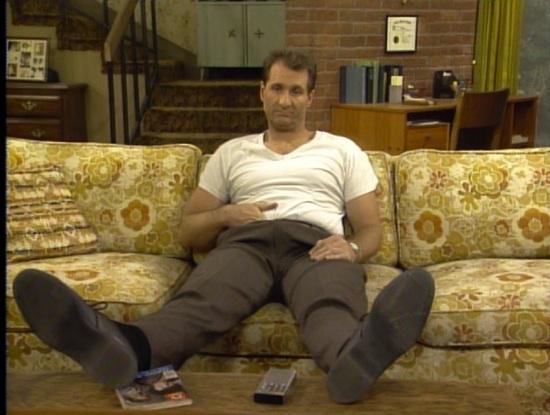
His name is Al Bundy, the hapless husband and father of the Bundy family from the Fox classic, “Married With Children.” To those who have watched every episode and love the show as much as I do, you already understand why Al is the perfect embodiment of learned helplessness.

For those who aren’t familiar with “Married With Children” or why it was such a groundbreaking show, I feel sorry for you. For most people under the age of 20, they have no idea how much this show shook our collective understanding of modern television.

Say what you will about the trash currently on TV now, but before “Married With Children,” it was much worse. By worse, I mean they were boring. Most sitcoms were bland, generic, feel-good stories that tried to paint the world in an overly-rosy picture. Every one of them basically tried to capture the spirit of “Father Knows Best” or “Leave It To Beaver.”

Married With Children” saw that and decided to do the exact opposite, so much so that when it was in development, the title of the show was called “Not The Cosbys.” It was a show where all the conflicts weren’t solved at the end. It was a show where the world wasn’t idealized, perfect, or fair. In other words, it was more in line with the real world.

In that world, Al Bundy gets dealt a worse hand than most. At one point, he was a high school football star with a promising future. Then, he got hit with a streak of bad luck that effectively crushed his spirits.

He got injured and lost his football scholarship. He got involved with Peggy Bundy, a woman I’ve cited before as a character that men should rightly dread. He eventually has two kids that don’t respect him and works a dead-end, low-paying job as a shoe salesman.

While other sitcoms glorify the innate dignity of working class men like Ralph Cramden, Archie Bunker, and even Homer Simpson, there’s nothing glorious about Al Bundy’s life. There’s nothing noble about his poverty. He doesn’t even try to come off as sympathetic. His life doesn’t raise the bar or embody an ideal. If anything, it reminds ordinary people just how bad things can get.

Whereas other TV sitcoms try to uplift an audience by showing how loving, functional families solve their problems in a simple, 30-minute show, “Married With Children” sent a different message. It presented the audience with a level of dysfunction so extreme, so exaggerated that even if you’re home life was a mess, you could take comfort in the fact that you were not the Bundy family.

What makes that message so powerful is also what makes Al Bundy such a perfect example of learned helplessness. Fittingly enough, the actor who played him, Ed O’Neill, actually drew inspiration from someone in his own family.

In a sense, Al Bundy was built around the idea that he was just resigned to his fate. He realized how much his life sucked, that his family didn’t respect him, and that his best days were behind him. Dealing with all that in addition to working a dead-end job effectively destroyed his spirit, so much so that he stopped trying to better his situation.

That perfectly reflects some of the early experiments done about learned helplessness, namely those involving a poor dog that just stopped trying to avoid painful shocks. Al Bundy is basically that dog after it has been shocked so many times that it just doesn’t bother anymore. It accepts that it will suffer and doesn’t try to avoid it.

In a sense, it becomes a mentality akin to a psychological illness. In the spirit of caveman logic and excuse banking, I’ll give it a name. From here on out, let’s call it “Al Bundy Syndrome.” That’s a much more memorable name than the overly-technical term, learned helplessness. With Al Bundy Syndrome, the condition has a name and a face that Ed O’Neill made iconic.

Given that we already have weird diseases like restless leg syndrome and walking corpse syndrome, which I swear is a thing, I don’t see why we can’t create a syndrome out a fictional character. In fact, it wouldn’t even be the first time.

I’m not a doctor, nor do I claim to be an expert in anything that doesn’t involve telling sexy stories, but it’s for that reason that I feel it’s so important to put an actual face on an issue that’s hard to understand. Psychology is tricky, complicated, and messy. Al Bundy is simple, crude, and crass. One is innately funnier than the other.

In that sense, it’s easier to see the signs and symptoms of learned helplessness, so long as you frame it in Al Bundy syndrome. Watch any old episode of “Married With Children” and the symptoms reveal themselves. They include feelings like:

  • Being hopelessly numb to the misery around you, like Al Bundy
  • Making little to no effort to improve your situation, like Al Bundy
  • Assuming the worst in every situation, like Al Bundy
  • Having an extremely cynical outlook, like Al Bundy
  • Not caring about whether the world likes or respects you, like Al Bundy
  • Having no shame or filter about what you say, like Al Bundy

The list goes on, but there are too many to list and watching old episodes of “Married With Children” is probably far more informative than any list, not to mention funnier. It’s a show that probably couldn’t get made today, due to how politically incorrect it was, even for its time. That makes its impact all the more vital.

I doubt that Ed O’Neill or the producers of “Married With Children” intended Al Bundy to be the poster boy for learned helplessness, but sometimes the connections are there and all we have to do is make them. So, moving forward, if you want to know what learned helplessness is and how to avoid it, just remember this face. It may save your life, your marriage, and your soul.

For that, I thank you Ed O’Neill.

5 Comments

Filed under gender issues, Marriage and Relationships

How Learned Helplessness Dooms Your Sex Life (Among Other Things)

When I was growing up, I considered myself lucky to be surrounded by so many loving people. I like to think my fondness of romance, as well as my desire to become an erotica/romance writer, is a direct result of seeing so much love among friends, family, and all those close to me.

It wasn’t all smiles, chocolate, and gratuitous tongue-kissing. Every now and then, I encountered certain couples that stood in stark contrast to the love I saw so much of throughout my life. They weren’t abusive or hateful. In a sense, they were their own tragedy, albeit not of the Shakespearean variety.

Picture a couple that’s about as passionate as a sick cat. There’s no fire in their romance. If there was, it burned out years ago and neither one of them cares enough to spark it again. They don’t necessarily hate each other. At best, they tolerate one another on a day-to-day basis, resigned to the fact that this is their life.

What I just described is not the kind of relationship that ends up on Jerry Springer or leads to protracted divorce hearings. They’re rarely that dramatic. If anything, they’re the antithesis to drama. That’s why those involved are so miserable. In a relationship like that, a clogged toilet counts as an adventure.

These kinds of relationships are not as easy to notice, but they do happen. You might even know a few, but I’d bet a stack of old Playboys that there are more than you think. Instead of love, passion, and heart, these relationships are fueled misery, laziness, and failure. At some point, those involved just stop trying to escape it.

In a world where people get worked up over dipping sauces and dress colors, it seems outrageous that anyone could be that callous and numb. It’s even more outrageous to think that a relationship could be built around it. However, there are powerful, unsexy forces at work and they’re not to be taken lightly.

This brings me to the concept of learned helplessness. If you’ve every taken a psychology course, you know what it is and you probably have an idea as to how it acts as kryptonite to love, romance, and passion. For those of you who don’t know, it’s a fairly easy concept. According to Wikipedia, the phenomenon is defined as follows:

[A] behavior typical of a human or an animal and occurs where the subject endures repeatedly painful or otherwise aversive stimuli which it is unable to escape or avoid. After such experience, the organism often fails to learn or accept “escape” or “avoidance” in new situations where such behavior would likely be effective. In other words, the organism learned that it is helpless in situations where there is a presence of aversive stimuli, has accepted that it has lost control, and thus gives up trying.

In terms of common behavioral traits, it’s somewhat bland. That doesn’t make it any less powerful, though. There is real, distressing science behind it, starting with experiments conducted in the 1960s. If you’re a dog lover, though, these experiments should be particularly disturbing.

If you’re also a fan of meaningful love, then you should be even more disturbed because it’s not hard to see how something like learned helplessness can creep into a relationship. For those trying to tell powerful, sexy stories, it’s important to know the signs.

The challenge, however, is that learned helplessness is one of those things that doesn’t happen all at once. Whether it’s those cruel experiments on dogs that I mentioned or continuous torture by the CIA, one painful experience is rarely enough. While love can manifest in a single moment, as is the case with “love at first sight,” learned helplessness takes a longer, more tedious road.

Sometimes it starts with boredom, a powerful feeling that I’ve discussed before. Sometimes it starts with frustration. Maybe a couple tries a few times to spice things up, but it doesn’t work. Maybe they try to shake up their routine, but that doesn’t work either. The key ingredient here is failure and frustrations, two experiences that tend to accumulate rapidly.

The couple involved may never get angry, resentful, or bitter to one another. Learned helplessness rarely inspires abuse or outright hatred. However, that’s part of what makes it so debilitating. When a relationship becomes abusive, one part of the relationship has a much stronger incentive to either escape or fight back. It’s hard to be lazy or apathetic when you feel like your well-being is at risk.

With learned helplessness, laziness and apathy are weaponized. That’s because without that incentive, neither side has the energy or desire to shake up the situation. Ending a relationship always requires some amount of upheaval, work, or effort. Someone under the influence of learned helplessness sees that as more trouble than it’s worth.

Beyond just rendering a relationship stale, the effects on your sex life can be just as debilitating. Once a couple gets to a point in their relationship where they’re just resigned to the fact that this is their normal, sex becomes less a treat and more a chore. Even if the orgasms still feel good, they’re barely distinguishable from masturbation.

That, by far, is the clearest sign that learned helplessness has consumed a relationship. As soon as sex becomes a chore, then it’s safe to say that two people have crossed the point of no return. They are beyond the point of rekindling whatever flame they once had. They just accept their misery and dispassion.

In defense of those poor souls, they don’t always have the luxury of ending that relationship and starting fresh. Sometimes, it’s because of their age. Sometimes, they’re in an environment where they don’t have anywhere else to go and few resources to work with. Then, there are times when the inconvenience just doesn’t justify the cost. It’s just easier to stay miserable than deal with the stress of rebuilding.
There’s little question that misery, depression, and boredom are bad for your love life, your sex drive, and everything in between. Learned helplessness is just the catalyst. Instead of blowing up in your face, love just whithers slowly like a piece of rotting fruit, getting emptier and deader with each passing day.

In some cases, it’s difficult to avoid. Some people just find themselves in relationships where they lose control and accept their misfortune. They’re content to just accept the misery and make the best of it, however fruitless it might be.

In others, you can take steps to avoid that kind of misery. Think back to those awful experiments involving dogs. After a while, the dog just stops trying to avoid the pain. The key to avoiding that kind of misery is to keep making an effort. Don’t stop trying. Do what you can to avoid mistakes. Moreover, do what you can to improve your situation, however possible.

That might mean pushing yourself when you don’t want to. It’s like exercising, which sometimes requires extra motivation. Within a relationship, it’s even more difficult because both you and your lover have to share in that motivation. You have to want to maintain that passion, even as you get older, have less energy, and feel less sexy.

In my experience, the most successful couples I know never truly stop dating each other. Even when they’ve been married for decades, they still carry themselves as a couple that’s still dating. They still go to interesting places, try new things, and explore new activities. Some aren’t always sexy, but they have the potential to be.

Every couple is different, but nobody benefits from learned helplessness. Whether you’re a dog, a dumb-ass, or a hopeless romantic, falling into that pit of apathy will never inspire your passion or increase your sex appeal. It’ll drain it, bit by bit.

Nobody deserves that. I certainly want to avoid that if and when I ever find a steady lover. I’m not a relationship expert or a therapist, nor should anybody assume I’m one, but I hope to help in whatever way I can. Whether it’s making people aware of learned helplessness or writing sexy novels, I intend to do my part.

2 Comments

Filed under gender issues, Marriage and Relationships, War on Boredom

The War On Horny Women (And Why We Keep Fighting It)

People have been waging wars since the dawn of civilization. These never-ending struggles have people clash over ideas, concepts, and identities that cannot and will not be resolved. Some of these conflicts have literally reshaped society and the world we live in. They are a fundamental, and at times inescapable, part of civilization.

Then, there are the subtle, less obvious wars that we never win, but insist on fighting. These wars rarely have epic battles or iconic names like Waterloo, D-Day, or Super Bowl XLII. On some level, we know these wars can’t be won. We know we inflict a lot of collateral damage by fighting them. We’ve just been doing it for so long that we don’t know how not to fight it.

The war, in this case, involves horny women. Yes, that’s a war too. I know I dedicated an entire post to documenting the war on horny men. Even though I am a man with functioning genitals and a healthy sex drive, I don’t deny that women experience plenty of horniness, as well. I also don’t deny that those same women have endured a war that has spanned generations, cultures, and rap battles.

Despite not being a woman, I think it’s important to touch on that struggle, especially since recent scandals and trends in our sexual culture have taken the war to uncharted territory for both genders. For women, in particular, the conflict is far different from the one they’re used to fighting.

Anyone who has studied history, or just listened to Pat Robertson for more than five minutes, understands that civilization hasn’t exactly been kind to the female libido. For a good chunk of human history, a horny woman had exceedingly limited options.

If they weren’t having sex with their husband, who they probably didn’t even choose, then they weren’t having much sex. For the most part, a man could get away with having a few mistresses or seeing a prostitute every now and then. If a woman dared stray from her wifely duties, though, the punishments were severe.

Even today, a woman sleeping around on her husband is dangerous in some parts of the world. Even when it doesn’t get you killed, it can ruin your life in many other ways that men rarely deal with. It’s not fair. It’s certainly not in line with notions of gender equality. That’s the problem with wars, though. Things like logic, justice, and compassion are the first to go.

Why is this war even being fought in the first place, though? Moreover, why are women dealing with a different war than men? Well, there are many answers to that question and most of them will piss off most feminists, egalitarians, or people who just value any semblance of fairness.

I’ve touched on it before, to some extent, but the foundation for the war on horny women has its roots in a mix of biology and economics. Humans are a sexually dimorphic species in that each gender bears distinct traits that set them apart, beyond the presence or absence of certain organs. However, the trait that most distinguishes women is their ability to have children.

It’s a beautiful, but critical skill that any species needs to survive. A great deal of energy goes into giving incentives for humans to make babies and some of those incentives are pretty damn powerful. However, because of the biology involved, there are circumstances that set a horny woman apart from a horny man.

In terms of raw numbers, horny women are at a evolutionary disadvantage. No matter how horny they are or how much sex they have, they can only bear one or a few children at the same time over the course of nine months. Men, on the other hand, can impregnate dozens of women and sire a much larger volume of offspring.

From an evolutionary perspective, it’s like one person has a butter knife and the other has a machine gun. One tool is just inherently better at doing more damage. Now, if men and women are living in some hippie commune where nobody cares about which kid belongs to who and nobody has to deal with messy child custody hearings, then a horny woman doesn’t have much issues.

Unfortunately, hippie communes are few, far between, and prone to poor hygiene and clogged toilets. Much of our civilization was built on complex, hierarchical societies that required men to work the fields, women to care for children, and a certain assurance that the kids you had were yours.

Before the days of Maury Povich, though, the only way to be sure of that was to be sure that a woman was faithful from her wedding night onward. Since people rarely trust the horniness of their spouses or the men who may seduce them, this led to traditions and taboos that demanded modesty and subjugation for women.

It didn’t matter how horny or sexually unsatisfied they were. From the perspective of society, it was more important that these women remained “untainted” so that men could be sure their kids were legitimate and there were no nasty diseases, a common problem that plagued ancient societies to no end. It wasn’t as much a war of misogyny as it was a war of practicality.

Even after we learned to treat disease, control conception, and test for paternity, the idea of a horny woman is still taboo. There are some that even claim that promiscuous women bring down entire civilizations. These are not claims that anyone should take seriously, but they do reflect the ongoing struggles of this war.

The idea of a woman being horny, sexual, and feeling no shame about it just seems wrong to many people. They see that and they see an affront to how they believe society should work. Never mind the fact that society is always changing and technology promises to accelerate that change. We, men and women alike, are still stuck in this war-like mentality when it comes to horny women.

It often manifests in subtle ways. Watch any slasher movie, sitcom, or poorly-scripted reality show and you’ll see a similar theme. The horny, promiscuous women are the villains. They are an evil, corruptive force that undermines all that is good and noble. Why else would Regina George be so easy to despise?

Beyond the media, female horniness is often presented as something that has to be contained and hidden. Unlike men, who are expected to fight the wars and work the fields, the standards for women are different. A “good woman” is someone who doesn’t sleep around, flash her tits, or show off her thong to an entire basketball team. A “good woman” stays home, has babies, and dresses in a way that doesn’t attract horny men.

That’s why modesty is conveyed as such a virtue for women, but not so much for men. That’s also why exceedingly repressive societies segregate women from men. The possibility that someone might get horny and might act on that horniness is seen as a bomb going off in house full of puppies. It’s just that terrifying.

However, despite this centuries-old war, ripe with traditions and taboos, women still get horny. Women still want to have sex and not just to make babies, but to enjoy the toe-curling pleasure that comes along with it. No amount of modesty, shame, or scorn can stop it. That says a lot about the strength of horny women. As an aspiring erotica/romance writer, I can’t help but admire that.

As much an optimist I am, at heart, I don’t see the war ending anytime soon. Like the war against horny men, certain taboos and insecurities still linger. Some are cracking, though. Just recently, Mayim Bialik from “The Big Bang Theory,” generated a lot of criticism for daring to claim that women should dress more modestly in order to avoid harassment, as though horny men aren’t that determined.

Naturally, albeit unfairly, she got accused of blaming the victim for the misdeeds of horny men. The idea that horny women are somehow responsible for crimes committed against them is rightfully absurd, but the notion that horny women need to contain themselves while some men can still push the boundaries is beyond absurd.

As I said at the beginning, the basis of the war on horny women is neither fair nor logical. Compared to the war on horny men, though, it’s just unfair and illogical in a very different way. There reasons and justifications for the war are changing and will likely continue to change, especially as certain medical advancements emerge.

Whatever the change, though, the war will continue to rage. Horny women will still be considered this taboo force of chaos that could potentially undermine the whole of society. This may be a taboo that’s impossible to break, but that may not matter much in the long run.

No matter how the war is fought, whether by religious dogma or excessive shaming, it won’t turn off that fundamental drive to make love or to enjoy good orgasm. In the long run, the horny women will win, if only because the horny men will want to hang out with them more. I’m not one to take sides in a war, but if my sexy novels can act as battle cries, I’m happy to do my part.

5 Comments

Filed under Current Events, gender issues, Marriage and Relationships

A Helpful (And Sexy) Romance Tip (From Joe Rogan)

I’ve said it before, but it’s worth belaboring. Do not take advice from celebrities. I know they’re so rich, powerful, and rarely have to pay women to show them their tits. Some could spit in a glass and sell it for fifty bucks if they wanted. With all that clout, it’s tempting to think that they have some sort of secret knowledge.

More often than not, a celebrity is the byproduct of knowing the right people, having the right amount of talent, and being willing to work so hard that it makes functional relationships damn near impossible. There’s also an element of dumb luck to it all. Just look at how Justin Bieber got discovered and prepare to run head-first into the nearest brick wall.

Celebrities live in a world that might as well be an alien planet. Their understanding of how things work is so skewed, so distorted, and so flawed they can’t really relate to ordinary people anymore. Does anyone really believe that someone with the eccentricities of Tom Cruise can ever grasp a sense of normal again?

That said, every now and then, one celebrity will come out with a bit of advice that is worth taking seriously. Stranger things have happened, even on game shows. That’s why it’s worth making note of whenever it happens.

Recently, in wake of the Harvey Weinstein scandal, a brilliant bit of advice came out of these disturbing revelations. It came courtesy of Joe Rogan, a comedian and color commentator whose insights I’ve found to be refreshingly honest. Being a huge fan of his podcast, which I totally recommend, I was very interested in learning his take on the scandal.

However, it was his unusual advice on love and relationships that stole the show for me. It actually had less to do with discussions of the scandal and more to do with topics involving how men behave around women. As someone who has had more than his share of awkward moments around women, it’s something I can appreciate.

His advice isn’t very complicated. It doesn’t even require any special skills or coaching. It’s something every man can do and something they already know how to do. The key is doing it in the right situation, within a certain context. Since I know a lot of men will likely need this advice at some point in their lives, I’ll offer it as freely and openly as Mr Rogan did. With all that said, here it is.

Before you go on a date with a woman, masturbate ahead of time. 

It’s crude. It’s crass. It’s even kind of dispassionate, when you think about. However, from a psychological and biological standpoint, it makes perfect sense for men hoping to form strong, meaningful relationships with women.

There’s no way around it. From a purely hormonal standpoint, men are hornier than women. That’s just how testosterone works. It effects how man pursue sex, love, and everything in between. It also affects other aspects of their behavior, for better and for worse.

Now, apply this to the lens of caveman logic and it makes even more sense. If we work within the context that our brains are primarily wired for survival and reproduction, then it’s unreasonable to assume that our thoughts and feelings will be optimized for determining whether the romance we’re pursuing is right for us.

From our brain’s perspective, when we go out with a pretty girl, we’re basically taking the scenic route to getting that sweet sexual release that we’re wired to seek. Everything else, including the romance, is secondary or tertiary, at best. That creates a major problem, though.

If our brains are more concerned about that release than it is about determining whether we’ve found a suitable lover, then we’re prone to making bad, misinformed decisions. Our pursuit of that release, and the role it serves in the reproduction part of cavemen logic, effectively obscures our more intimate pursuits.

As Rogan himself describes, that incredible desire made him tolerate a beautiful woman who he knew, on some levels, wasn’t right for him. However, he was just so driven by that crude desire of his caveman brain that he avoided the hard truth. He effectively employed a form of excuse banking. I can only imagine the kinds of justifications he came up with, being so driven to fulfill that primary need.

That’s why masturbating beforehand made perfect sense. It effectively froze his excuse bank and uncluttered his mind so that all that wiring in his brain that emphasized reproductive efforts, namely sex, were tempered. Orgasms effect a lot of bodily functions, as I’ve noted before. That includes, to a large extent, the brain.

By giving himself that orgasm ahead of him, Rogan did himself and his love life a huge favor. It allowed him to deal with the woman in a more logical, unfiltered sort of way. It probably saved him a lot of heartache and frustration in the long run.

Even if his experience is purely anecdotal, the science is sound. That’s why it counts as good, legitimate advice for other, non-celebrity men to follow. I encourage those reading this blog with significant others to try it.

The next time you go out on a date with a significant other, get that orgasm ahead of time and see how it affects your approach to the date. It may make for some unusual situations, but that might be a good thing. No matter how unusual they end up being, I’d love to hear the results so please share them in the comments.

Now, I know I singled men out for this advice and there’s a reason for that. While both genders tend to agree on the joys of orgasms, there are some variations in the biology. Since I’m not a woman, I don’t know whether this sort of advice would work the same way.

That’s not to say women shouldn’t try it too before their next date. I honestly don’t see how having an extra orgasm before a date or meeting with a prospective lover can be a negative. If women can provide some insight on this in the comments as well, I think it’s definitely worth discussing.

However, when it comes to men trying to make sense of their love lives and the complications that their incessant desire may bring, I think Mr. Rogan’s advice is sound. It may very well be the best, and sexiest, advice you ever get from a celebrity. For that, I thank Mr. Rogan for his contributions towards improving the romantic lives of his fans.

Leave a comment

Filed under Celebrities and Celebrity Culture, gender issues, Marriage and Relationships

What “Big Mouth” Gets Right (And Wrong) About Puberty

When you’re a platform that has created shows like “House of Cards” and “BoJack Horseman,” the bar for quality is higher than most. That’s the benefit/burden of being successful. Say what you will about how Netflix has evolved over the years, it has produced some amazing content in an age that some call the third golden age of TV.

Then, there are shows like “Big Mouth.” I’m not saying that Netflix is lowering the bar for the sake of balance, but I’m still struggling to make sense of this show. When I heard about it, especially with comedian Nick Kroll attached to it, I hoped I had found another show to pass the time in between seasons of “BoJack Horseman.” I’m won’t say I was disappointed, but I do feel like I took the quality of Netflix content for granted.

I’m not going to say that “Big Mouth” is a bad show, but I won’t make excuses for it. It’s the kind of show that goes out of its way to be crude for all the wrong reasons and not in the traditions of “South Park” either. It doesn’t go for the cheap laugh or even the mid-priced laugh. It’s a show that just goes out of its way to sensationalize teenagers going through puberty.

On paper, it sounds like a great concept. Going through puberty is wrought with all sorts of craziness, some funny and some embarrassing as hell. I’ve shared some on this blog, including a story about the most awkward boner I’ve ever gotten.

Big Mouth” tries to extract humor from similarly awkward situations. It takes a lot of swings and it misses a lot of pitches, but it does manage to hit a few balls here and there. Yes, I also mean that in a literal sense. This show does resort to that kind of humor.

It may not be the kind of high-concept insight you get from an episode of “Rick and Morty,” but it does at least try to send a message about the horrors of puberty. Even if the product is crude and exceedingly exaggerated, that message is relevant, so much so that it’s worth talking about.

I honestly didn’t expect to write about “Big Mouth” in any capacity, especially when writing about sexy memories from my college years is so much more interesting. However, after gritting my teeth and watching the show, I feel the horrors of puberty are worth talking about, especially with ideas about toxic masculinity being so prevalent lately.

Big Mouth” doesn’t attempt to wade too deeply into those kinds of issues. It’s too crude and too crass a show to even attempt that kind of commentary. However, it does do a good job at showing just how powerful and, at times, overwhelming that flood of hormones can be to a young person. For some, it’s downright traumatic.

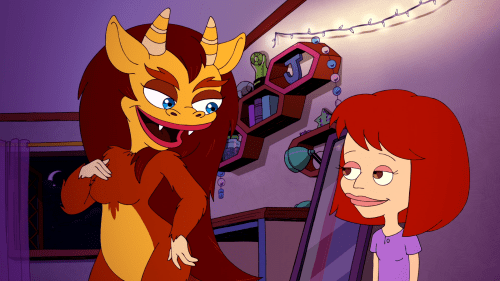
Throughout the show, the main characters, Nick Birch, Andrew, Glouberman, and Jessi Glaser, are often hounded by literal manifestations of a monster that personifies their hormones. It’s never clear whether the monster is invisible or not, but this creature basically says everything the FCC won’t allow teenagers to say out loud.

For the boys, the monster is named Maurice and his advice usually amounts to things like, “Go ahead and jerk off!” or “Look at her tits!” or “Too bad, buddy! You’re getting a boner!” I’m not going to lie. That monster kind of triggered some awkward moments from my teenage years where I found myself thinking thoughts too crude, even for my novels.

The girls aren’t spared from that awkwardness either. There’s another hormone monster every bit as crude, but reserved for female characters. Her name is Connie and she embodies all the alpha bitch, hyper-feminine extremes that Sam Kinison ever joked about. She’s emotional, dramatic, and demands that every female character be confused or overwhelmed by her body. That’s basically puberty in a nutshell.

In a sense, “Big Mouth” is unique in its balanced approach to showing how boys and girls both struggle to endure puberty. That’s rare in most coming of age stories that either focus on horny guys trying to get laid or bitchy girls trying to get popular. This show doesn’t give a pass to either gender.

This is what “Big Mouth” actually gets right about puberty, to some extent. It’s not just overwhelming and frustrating for one gender. The male experience is unique. They have to deal with constant erections and that annoying voice in their head urging them to think dirty thoughts about anything that even looks like a beautiful women.

Since I’m a man who has more than his share of bad memories from my awkward teen years, that’s a sentiment I can appreciate. However, it’s the female perspective in “Big Mouth” that I found most intriguing. The idea that girls are just as freaked out about the changes in their bodies, minds, and everything in between shouldn’t be such a novel concept, but this show goes out of its way to belabor it.

Now, I don’t know for sure that the girls I went to high school with had an actual hormone monster on their shoulder, telling them to cry irrationally at a moment’s notice or lash out at anyone who dared to look at them the wrong way. It’s just somewhat refreshing to think that teen awkwardness knows no gender.

If gender balance is a strength in “Big Mouth,” though, it’s biggest weakness is portraying how the characters deal with it. The show is so over-the-top with the extremes of puberty that it’s hard to glean a meaningful story from it all.

It’s not just that puberty takes the form of actual hormone monsters that sound like uncensored commentary from a bad porno. It’s not that the show makes puberty sound overly traumatic either. There’s never a sense that the characters, even Jessi and Nick, actually grow through the experience. That’s kind of a big oversight with puberty.

From a purely biological standpoint, puberty is the maturation of a child into adulthood. That maturation part is never even hinted at in the show. After watching the first season of “Big Mouth,” it’s hard to imagine any of the characters involved growing into functioning adults.

In the real world, puberty tends to bring out the best or worst in a person. If someone starts becoming an asshole in puberty, they usually stay that way into adulthood. If someone shows an ability to deal with it and grow, as a person, then they’re usually in good shape. It can even get pretty hilarious when both kinds of people have to deal with one another. Unfortunately, we don’t get that with “Big Mouth.”

I won’t go so far as to say the show is terrible. It does have its moments and some of those moments are genuinely funny or insightful. It is, as the end of the day, an overly comedic take on the rigors of puberty. It doesn’t try to be coy or deceptive. It doesn’t try to use colorful metaphors involving flowers or cucumbers. It gets right down the dirty, gritty details.

I can see the show appealing to those who suffered more during puberty than most. I can even see the show appealing to “South Park” and “Family Guy” fans. It’s hardly a guide or a warning with respect to the rigors of puberty, but it reflects a common truth. Being a teenager sucks and puberty is a big reason why.

Leave a comment

Filed under gender issues, Marriage and Relationships