Category Archives: gender issues

A (Non-Preachy) Lesson In Tolerance In Supergirl #19

635764-_sx1280_ql80_ttd_

Growing up, every TV show that aired between 3:00 p.m. and 6:00 p.m. seemed air some sort of pro-tolerance, anti-bigotry message. These shows assumed, rightly in my case, that a lot of kids who’d just gotten home from school would plop themselves in front of the TV and rather than doing their homework. In terms of targeting a market, it was pretty brilliant.

Having been fed those messages for over two decades now, I think they’ve been belabored to the point where most kids and young adults have gotten the message. Some are even annoyed by it. Even I admit there’s only so many times I can hear some poorly-rendered cartoon character say that tolerance is good and bigotry is bad.
Image result for care bears 90s

In recent years, especially with the rise of certain regressive elements within popular media, these pro-diversity, anti-bigotry messages have gone to distressing extremes. It’s no longer enough to just send the message. It has to be angrily protested by media critics, internet mobs, and hyper-sensitive crowds that push political correctness way past its previous extremes.

I could spend fill several blog posts of instances of people whining about a lack of diversity or complaining that political correctness has gone too far. I can understand the frustration of both sides to some extent. Both see a problem with the way tolerance is being promoted within society and they want to fix it. They both want to make society better and that’s entirely commendable.

Instead of focusing on the frustrations, though, I want to highlight an example of a pro-tolerance, anti-bigotry message done right. By that, I mean it sends a message in a way that doesn’t sound preachy, heavy-handed, or denigrating to another group. As it just so happens, it unfolds in a comic book, a medium that has provided me with many deeper messages in the past.

In this instance, the comic is Supergirl #19 by Steve Orlando and Vita Ayala. Being a fan of the “Supergirl” TV show and of beautiful, lovable female heroes in general, I’ve been following this comic since it relaunched in 2016. It’s a series that deals with heroic conflicts typical of DC Comics and anyone remotely associated with Superman. This issue, however, takes a moment to get personal.

Image result for Supergirl Rebirth

The story itself is a brief, self-contained narrative often referred to as a one-shot. You don’t have to know the full story of the character or even the events of the past several issues to understand what’s going on. You don’t even have to know the first thing about Supergirl to appreciate the message that this issue conveys.

It’s built around a personal story told by a character named Lee Serano, a character whose life Supergirl recently saved. That, in and of itself, isn’t too remarkable. Supergirl, Superman, and pretty much every major DC hero saves the life of a random character in almost every issue. However, it’s Lee’s struggles beyond being in the wrong place at the wrong time that make her note-worthy.

Supergirl (2016-) 019-009

Lee identifies as genderqueer or non-binary, a concept that tends to make headlines for all the wrong reasons. More often than not, stories about people who identify with this label are only identified as a way to point out how far political correctness has gone. It’s often a classification that certain people cite when making fun of those who think there need to be over 58 genders.

Whatever your attitudes towards gender, it’s still generally a dick move to ridicule and degrade someone for identifying that way. Throughout Supergirl #19, Lee doesn’t come off as someone who is just craving attention by identifying as some extreme minority. She comes off as someone who is genuinely conflicted with her gender and is afraid how it’ll affect her.

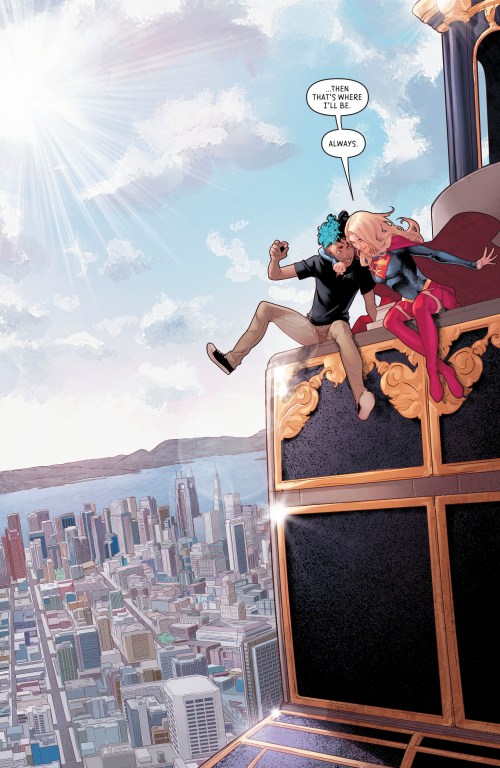
That’s where Supergirl comes in and this is where the anti-bigotry message gains some unexpected, but welcome dimensions. Like any good hero, Supergirl goes out of her way to help Lee beyond saving her life. She offers her both consolation and sincere affection, as any decent person would to someone who is in distress. The fact she has superpowers is basically an afterthought.
Supergirl (2016-) 019-017

It’s here where Lee stands up for Supergirl in a way that might catch even the anti-PC crowd by surprise. She acknowledges that there are those who look at Supergirl and only see this blond-haired, blue-eyed, traditionally beautiful, able-bodied, cis-gendered woman with superpowers. Her very presence is seen as part of the problem.

The fact she acknowledges this has an important context. This issue takes place at a time when Supergirl is trying to regain the trust of the public. Unlike her more famous cousin, she hasn’t been around long enough to earn everybody’s implicit trust when she makes a mistake. The extent of that mistake is covered in previous issues, but you don’t need to know them to get the message here.

In one of the most revealing scenes, Lee confronts the argument that certain regressive types would use against Supergirl if she ever tried to get involved with gender minorities, social justice, and everything in between. She makes this important comment that sets the tone for the entire story.

“People are out there talking, saying Supergirl’s dangerous, that she can’t be trusted. Saying that her hiding her dad – trying to help him get better – is wrong. I heard the talk. Believed it for a while, even. I mean, she’s the “All-American Ideal – blonde, white, pretty – and she can fly. She MUST think she’s better than us – above us,” and, “There’s no way she could understand,” right? But that’s not the truth.”

This statement is critical in that it highlights the most frustrating part of discussing these issues with the overly-regressive crowd. Their politics and attitudes are so skewed in one direction that they see anyone who doesn’t line up with their particular group, however eccentric it might be, as somehow unworthy of being part of the conversation.

It often happens in discussions involving race, gender, religion, and most other minority issues. For certain people in those discussions, often the angrier, more radical wings, just associating with the majority is seen as fraternizing with the enemy. It doesn’t just limit the conversation. It dehumanizes the opposing side.

Image result for dehumanizing the other side

Supergirl #19 takes the opposite approach in that both Supergirl and Lee are humanized to the upmost. Lee isn’t some confused, attention-seeking teenager. Supergirl isn’t some arrogant, stereotypical stand-in for majority. They’re just two individuals, connecting like mature individuals do to help one another in a time of need. It’s basically a template for simple human decency.

Contrast that with those who claim white people shouldn’t contribute to conversations about race. Contrast that with those who claim beautiful people shouldn’t contribute to issues surrounding body shaming. Contrast that with those who claim men should shut up when discussing women’s issues, scorning anyone who dares to follow Matt Damon’s example.

These instances don’t just take the anti-bigotry, pro-tolerance message to an unhealthy extreme. It angers and alienates those on the other side of the argument. It gives them no reason to listen to what someone who considers themselves gender non-binary has to say, relying instead on prejudices and assumptions.

Image result for prejudice

Neither side benefits from that approach. Nobody helps anyone when two sides of an issue harbor so much animosity that the very presence of another is seen as an insult. Yes, Supergirl does check most of the boxes for someone who faces far fewer issues than a non-white, gender non-binary individual in the United States. That doesn’t mean she’s part of the problem.

I don’t want to spoil the rest of Supergirl #19. Like other comics I’ve singled out in the past, I’d rather people take the time to read it in order to experience the breadth of the story. It’s a story worth heeding during these contentious times. I would argue it offers something far more important than those old after-school PSAs.

More than anything else, it emphasizes treating people as individuals and not lumping them into a particular group with a particular agenda. Lee points out that people just assume Supergirl thinks and feels a certain way because of how she looks and acts. That’s a flawed assumption that dehumanizes and denigrates her.

Image result for Supergirl hugs

It doesn’t matter if Supergirl, or anyone else who gets involved in contentious social issues, looks a certain way or doesn’t check the right boxes. She’s still a human being, albeit one with alien origins. Unless you can actually read her thoughts and feelings, as some DC characters can, then making those assumptions is just a different form of bigotry hiding behind the guise of anti-bigotry.

Supergirl #19 is a solid story with an important message. I would argue it’s more important now than it would’ve been in the days of after-school specials. It’s a good thing to promote tolerance, but not to the point that it inspires intolerable attitudes. Supergirl’s compassion helped Lee in her time of need. Her life and Supergirl’s are better because of it.

The fact that Supergirl didn’t even need to use her powers that much to help Lee is a testament to her character, as well as an inspiration. If she can help a total stranger that much, just by being decent and compassionate, then what’s our excuse?


Image result for Supergirl comics

2 Comments

Filed under Comic Books, Jack Fisher, Superheroes, Current Events, gender issues, human nature

Why Sex Addiction (Probably) Doesn’t Exist

shutterstock_133047971

When it comes to human psychology, addiction is like quantum physics in that few understand it and Hollywood constantly gets it wrong. I know I say it a lot on this blog, but it’s worth belaboring. People are complicated. One person may watch “Star Wars” and think it’s the greatest piece of cinema of all time. Another may watch it and say it has no redeeming values.

That’s an important context to consider when discussing topics of addiction, which affects a significant portion of the human population. According to Addiction Center, there are approximately 20.6 million people over the age of 12 struggling with an addiction. According to the Centers for Disease Control, over 200,000 people have died since 1999 from prescription drug abuse alone.

Addiction is a serious issue. I know people who have struggled with addiction. I think everybody knows someone in their lives, be they a friend or relative, who has struggled with an addiction of some sorts. Addiction is real and there’s actual biology behind it. As such, it stands to reason that the rising instance of sexual addiction is real.

Image result for struggling with addiction

Before I scrutinize this sexy, yet unsexy phenomenon, I need to preface this by acknowledging that our collective understanding of these issues is still developing. What we consider a psychological dysfunction today may end up just being a healthy variation within the diversity of human thought. That’s why homosexuality is no longer considered a disease.

That context is important to establish because the term “sex addict” has been thrown around a lot lately. It’s not quite on the level of “fake news” or “soy boy,” but it has been cropping up, especially in wake of the recent scandals in Hollywood. Both Harvey Weinstein and Kevin Spacey claimed to be sex addicts after their scandals.

Image result for sex rehab

Needless to say, not everybody buys that excuse. Given my propensity to bemoan excuses, I count myself among them. These men claiming that sex addiction caused their deplorable behavior comes off as a pitiful attempt to gain sympathy, trying to paint themselves as sick. It also assumes a lot about the complex nature of addiction.

It’s true that we can become addicted to damn near anything, but it’s not just a matter of one particular activity flooding the pleasure centers of our brain more than others. Alcoholics don’t get the same orgasmic release from a cold beer that a sex addict gets from a quickie in the shower. There are other psychological forces behind it.

Since we can’t yet read the minds of an individual person, we have only a cursory understanding of those forces. However, there is an established criteria for addiction within a medical context. The American Psychiatric Association, describes addiction as follows:

Addiction is a complex condition, a brain disease that is manifested by compulsive substance use despite harmful consequence. People with addiction (severe substance use disorder) have an intense focus on using a certain substance(s), such as alcohol or drugs, to the point that it takes over their life. They keep using alcohol or a drug even when they know it will causes problems.

At the same time, it establishes a clear difference between just being addicted to a certain activity, like sex, eating, or playing World of Warcraft for 29 hours straight, and the addiction caused by drugs. They don’t even call it addiction. They have a more official label called Substance Use Disorder. Their description of this condition is a lot scarier than just someone who has more orgasms than most.

People with a substance use disorder have distorted thinking, behavior and body functions. Changes in the brain’s wiring are what cause people to have intense cravings for the drug and make it hard to stop using the drug. Brain imaging studies show changes in the areas of the brain that relate to judgment, decision making, learning, memory and behavior control.

These substances can cause harmful changes in how the brain functions. These changes can last long after the immediate effects of the drug — the intoxication. Intoxication is the intense pleasure, calm, increased senses or a high caused by the drug. Intoxication symptoms are different for each substance.

I bring up this distinction because more than one person has described sex like a drug. In doing so, it’s easier to accept that those claiming to suffer from sex addiction have a real ailment. Sex is a powerful drive that evokes pleasure that some brain scans have compared to heroin. Does it not stand to reason that sex addicts are in the same boat as heroin addicts?

Image result for heroin addict

The short answer is no. Sex addicts and heroin addicts are as different from one another as an arm-wrestling contest and an underground fight club. Addiction to heroin has a strict criteria for diagnosis. Sex addiction doesn’t meet that criteria in that alleged addicts don’t respond the same way that those suffering from Substance Use Disorder respond.

According to research done by UCLA, the reactions of those claiming porn addiction did not mirror those addicted to other activities like drinking, smoking, etc. Within that same research, it was also uncovered that sex addiction lacks one of the most important features of an addiction, namely that of diminished response from the pleasure centers of the brain.

That’s key because one of the most damaging factors of an addiction is that over time, the addictive behavior doesn’t light up the pleasure centers of the brain like it used to. That’s why alcoholics need more alcohol and crack addicts need more crack to get the same high. Brain scans show that in drug abuse. They don’t show it in sex addiction.

Image result for sex on the brain

In fact, the conclusions of the researchers on sex addiction were somewhat mundane. According to the data gathered from the brains and experiences of real people, the idea of sex addiction is nothing more than having a high sex drive and poor impulse control. That’s not an addiction. That’s a personality quirk. If anything, the very term “sex addiction” undermines the suffering of real addicts.

I know those conclusions is not going to convince those who genuinely believe that they’re struggling with sex addiction. I don’t doubt that these people are struggling and it’s negatively impacting their lives, their families, and their relationships. However, I believe putting it in the same category as drug abuse only skews our understanding of addiction and sexuality.

Image result for thinking about sex

Some people are really just a lot hornier than others. In the same way some people have a bigger appetite for food, some have a bigger appetite for sex. Unlike food, though, those suffering from eating disorders don’t blame the entire concept of food. There are often other psychological factors behind it.

Sex also has another complication that food and eating don’t. Our culture has an established set of sexual norms that idealize some forms of sexuality and shame others. Even though we’ve accepted more diversity in recent decades, we still idealize monogamous romances where those involved only have sex to make babies or explore the kind of passion reserved for a scene in “Titanic.”

As a result, anything that deviates from that narrative, be they an open relationship or just wanting to hump for the sake of humping, is subject to scorn or shaming. I’ve noted the flaws in this sort of narrative before, but on a much larger scale, it creates a situation where certain manifestations of sex become less a variation and more a disease.

Image result for thinking about sex

Like homosexuality, though, treating those variations as flawed or damaged doesn’t make them go away. It’s possible for a drug addict to get treatment to repair the damage those drugs have done to their bodies and minds. It’s not possible to complete reshape and remold someone’s baseline sexual desires without causing serious damage.

To really get an idea of how this can motivate self-professed sex addicts to engage in such erratic behaviors, imagine for a moment that you’re a heterosexual person in a world where only homosexuality is accepted. As such, you’re expected to enter a homosexual relationship with someone and remain in that relationship indefinitely.

That means you have to ignore or temper your basic sexual desires in order to operate in that society without shame or scrutiny. You have to pretend that the relationship you’re in is sufficient when you know it’s not. Since you can’t turn off your brain or your basic desires, it’s going to mess with your mind and inspire erratic behavior.

It’s for that reason that sex addiction, as it’s currently understood, probably doesn’t exist. I say probably because, as I pointed out earlier, our understanding of sexuality, psychology, and the human experience is still limited. For now, though, our conclusions are fairly simple. You’re not an addict. You’re just really horny and you live in a society that doesn’t afford you the opportunities to explore those feelings.

1 Comment

Filed under gender issues, human nature, sex in media, sex in society, sexuality

A Better Way To Promote Diversity

Tracer

How do you encourage meaningful change in media, culture, and social attitudes? That’s a reasonable and relevant question to ask these days. It seems everyone is either trying to push for greater diversity or whining about the lack thereof. More often than not, however, those efforts aren’t mutually exclusive.

Even if nobody has a definitive answer to the question of how, that hasn’t stopped many from trying. There have been major diversity pushes in every form of media from video games to comics to movies to TV shows. Not all of them have been successful. In some cases, they backfired horribly and cost people money.

I don’t want to belabor the specifics of those failures, but I do think it’s worth pointing out that they also have the effect of angering and/or insulting the audience. For franchises that have a huge fan base, that can be pretty detrimental. Some franchises never recover.

Image result for green lantern movie

It certainly doesn’t help that there are those who push for diversity for all the wrong reasons. There’s a very vocal contingent of critics/professional trolls who go out of their way to bemoan the lack of diversity in a certain piece of media. Whether it’s a video game having too many people of the same race or a lack of strong female characters, these people will whine about it as loud as the internet will allow.

For the most part, I don’t think anyone should give much attention to such whining. We’ve all dealt with whiny children at some point in our lives. Most people learn, often the hard way, that arguing with them rarely works out. Most people just give up to stop the whining. I’ve pointed out before why this can lead to bigger problems down the line.

It quickly becomes a brutal cycle. The more attention you give to these whiny children, the more incentive they have to whine so they can get what they want. The same applies to these “critics” who keep whining about diversity. It’s not enough for them that “Black Panther” is doing so well with a diverse cast. Some will still whine that it had no LGBT characters.

Image result for whiny children

It’s inescapable. You simply cannot win against a whiny child. No matter how much you go out of your way for them, they’ll find another reason to whine and so long as they keep getting their way, they’ll keep doing it. In the long run, though, that’s still a terrible way to promote diversity.

Ideally, producers of media will pursue diversity because they want to appeal to a broader audience. They want to make money and money doesn’t care about race, religion, or genital configuration. However, when critics/trolls rely on whining to get their way, then those efforts become less about diversity and more about stopping the whining.

Image result for whiny SJW

I believe there is a better way to promote diversity and it does not involve any whining. It doesn’t require some radical rethinking of how we go about producing, consume, or discussing media. It doesn’t even require some major protest, a new law, or diversity quotas. It’s just a simple change in approach that anyone can do for free and without that much effort.

That change can be summed up in two words: positive reinforcement. If you’ve taken a basic psychology class at any point in your education, you already know what this means. Even if you haven’t taken any classes and just deal with a lot of annoying people/children/whiners, you probably know the idea.

Rather than complaining about what is so bad about something, positive reinforcements involve focusing on the good. Rather than whine about what isn’t there, you celebrate what is there. Most importantly, though, you turn that outrage once reserved for those bad things into apathy. Most forms of media can survive outrage. They cannot survive apathy.

Image result for positive person

To illustrate this approach, consider the following scenario that tends to play out whenever someone criticizes a movie, TV show, video game, etc. for a lack of diversity.

“Just look at this terrible affront to women, minorities, and LGBTQ people! It’s so racist/sexist/homophobic/transphobic! It sends a terrible message and appeals to an audience that wants to cling to their regressive attitudes. It’s perpetuating a destructive, unhealthy mindset that directly impacts our culture. This affront should be censored, changed, or condemned endlessly until the world changes!”

Chances are, you’ve heard something like this over the past few years. Sometimes it involves a female character that doesn’t check the right boxes. Sometimes it involves a story that tries to check too many boxes. In any case, the whiners I mentioned earlier will find a reason to get upset about it. Moreover, they’ll demand some sort of change, coupled with condemnation over anyone who disagrees.

Image result for whiny SJW

That’s not going to promote diversity. If anything, that’s going to give people one too many reasons to resent pushes for diversity. Some media companies are already learning that the hard way, with Marvel being the most recent example. Ideally, you want someone to promote diversity because they want to and not because they’re afraid of a backlash.

With that in mind, here’s a second scenario that shows how positive reinforcement can further that effort.

“That thing some claim is racist/sexist/homophobic/transphobic? I don’t really care for that. Let me tell you about this other thing that I just think is amazing! I love it. It’s so much fun and it sends such a good message to men, women, and minorities of all kinds. I want more of this. I’m willing to pay for more of this. Please make more of this!”

It may come off as some peppy kid who is way too excited about something. Then again, wouldn’t you rather be around that kid instead of the one that whines to get what they want? When someone is happy and excited about something, it’s kind of infectious. It makes us want to share in that feeling.

Throw money into the mix and suddenly, the same producers that make all the media that regressive types whine about actually have a good incentive to promote diversity beyond just placating whiners. Instead of just avoiding controversy, they actually want to do diversity and do it right.

Image result for Black Panther on throne

The key is focusing on instances where it is done right. They are there. There have been plenty of examples of the media actually getting diversity right. They just don’t make the news because outrage is louder and garners more attention. Even so, excitement and praise can be just as loud.

Instead of complaining about Rey being a Mary Sue in “Star Wars,” focus on how great Princess Leia was in the first trilogy or how great Ahsoka Tano is in “Star Wars: Clone Wars.”

Instead of complaining about Lara Croft being too sexy, focus on how great Samus Aran is in the Metriod games.

Instead of complaining about the lack of diversity on shows like “Seinfeld,” focus on how great the minority characters are in shows like “Fresh Off The Boat” or “House.”

It may not sound as vocal or satisfying as venting outrage about a flaw, but it sends the kind of message that others are more likely to want to get behind. Whereas positive feelings can have many benefits to yourself and those around you, venting outrage can be very unhealthy.

Image result for venting anger

In the long run, getting others to want to promote diversity is the best way to further it. Whining about it isn’t going to accomplish that. It’s just going to make others want to stop the whining. That may work for kids, but not functioning adults.

Movie producers, TV executives, comic book writers, and video game programmers alike are all still human at the end of the day. Human beings respond positively to positive feelings. Channel those feelings into promoting diversity and you won’t just get more of it. You’ll get people who are actually excited about producing it.

1 Comment

Filed under gender issues, sex in media, sexuality, video games

The Law Of Proportional Backlash And The Anti-Harassment Movement

tolentino-rising-pressure-of-the-metoo-backlash

There comes a point in every social movement where the momentum seems unstoppable. Whether it’s same-sex marriage, racial equality, or finally having a female Dr. Who, there’s a sentiment that certain trends are just going to play out and there’s nothing anyone can do about it.

That’s a false impression, by the way. Human beings are complex, erratic, and fickle creatures. I’ve touched on this before and will likely bring it up again because human beings are just that interesting. That said, they can also be quite frustrating.

Image result for human nature

When it comes to highlighting those qualities in the midst of an ongoing controversy, though, I have to be careful because I don’t want my points to get lost in the anger. I know as well as anyone else with an internet connection that digital outrage has a nasty habit of undermining meaningful dialog. I want to avoid that as much as possible cause this is one point I feel is worth making.

As I write this, the latest major social movement to combat sexism and sexual misconduct is close to that point I mentioned earlier. It’s still a very hot-button issue and I’ve tried to be fair in discussing it on this blog. However, the current momentum of this movement, which has the wholly noble goal of preventing harassment, is coming up against a force that reflects the eccentricities of human nature.

That force doesn’t have an official or scientific name, but it has many familiar components. For the sake of this discussion, I’ll label it as follows:

The Law Of Proportional Backlash

I’m not claiming this law is definitive or on the same level as the laws of relativity. To make sense of what’s going on, and what often happens with these social movements, it’s just helpful to have a unifying idea to tie it all together.

The essence of this law that I just randomly coined is pretty simple. It’s the human equivalent of Newton’s Third Law, which says for every action, there is an equal and opposite reaction. When it comes to social movements, though, the reaction is more than that. It’s can also be an outright backlash.

Image result for social backlash

To illustrate, you need only look at the frequency with which political parties gain and lose power. Throughout the latter part of the 20th century, as society has become more connected, open, and diverse, these tendencies have played out with stunning regularity. It often plays out like this:

“Hey! The current social order isn’t the perfect, utopian society I want. Let’s kick the people in power out of office and put in these people making impossible promises to achieve impossible things.”

A few years later.

“Hey! These people we put in power haven’t created the perfect, utopian society I waned either. Let’s kick them out and put in other people in power who are also making impossible promises to achieve impossible things. Moreover, let’s hate, shame, and spit on the other side for failing to do all those impossible things!”

I fully concede that’s a very basic illustration of how political power fluctuates in the modern world. I also concede there are many variations, but in terms of the big picture, this is how the Law of Proportional Backlash works.

A movement begins, be it political or social. It gains momentum. Usually, there’s some sort of event that acts as a catalyst. With racial segregation, events like the ruling in Brown v. Board of Education helped get things going. With same-sex marriage, Massachusetts being the first state to legalize it did the same.

Image result for same-sex marriage legalized

For the current movement against sexism and sexual misconduct, I think most would point to either the 2016 presidential election or the Harvey Weinstein scandal as the catalyst. I would argue it’s a combination of both, but I don’t think there’s any doubt that the movement gained a lot of momentum. If it could take down someone as powerful as Harvey Weinstein, then it’s safe to say that movement is pretty strong.

As often happens, though, the momentum provokes backlash. That happens whenever a movement fails to achieve every goal and, spoiler alert, no movement ever achieves every goal. The world is too complex and impossible problems tend to frustrate human limitations. As a result, a movement has to overreach and that will spurn a backlash.

With the movement against sexual misconduct, there are plenty of signs of overreach. There are people scorning others for making reasonable arguments about there being a spectrum of harassment. Careers are being ruined on the basis of anonymous accusations and mixed messages that are impossible to discern.

Image result for Matt Damon comments

There was even a distressing article on BigThink that argued that crimes involving sexual violence should not be subject to the traditional standards of proof. The underlying reason for that is too many guilty people get away with their crimes so it’s worth the risk of punishing the innocent to remedy that issue.

It’s that kind of sentiment, one in which the proportion becomes increasingly extreme, that tends to hasten the backlash. Whenever a movement gets to a point it’s deemed appropriate to sacrifice innocent people for the sake of a cause, then that’s usually a sign that it’s reaching beyond its ideals and emboldening opponents.

There are already major news outlets reporting on that phenomenon. Publications like the New Yorker, the Washington Post, and even the liberal Huffington Post have discussed it in various forms. The reactions to those speaking out against sexual misconduct is no longer one of unity and support. Now, there’s criticism and animosity, the first signs of a real backlash.

Image result for angry feminist protest

Those behind the movement need only look at the LGBT movement to see what that backlash can entail. Even though same-sex marriage is legal, the resulting backlash triggered a surge in “religious freedom” bills that promoted a new kind of discrimination. That backlash is still ongoing. The one surrounding sexual misconduct may just be getting started.

I still don’t doubt the sincerity and ideals behind the movement against sexual misconduct. People want justice for those who have been victimized. Justice is an inherent aspect of the human condition. We’re literally wired to seek it when we feel there’s an injustice in the world.

Unfortunately, in the pursuit of that justice, anger and resentment end up clouding those ideals. We’ve seen that anger directed towards the political process that played out in 2016. We’ve seen it used to demonize and denigrate entire groups of people, including an entire gender in some cases.

Image result for man hating women

When people are attacked, their first instinct isn’t to admit defeat. It’s to fight back. That’s just basic survival instinct and there’s no way any movement, be it political or social, can circumvent that. By fighting back, the backlash itself gains momentum. Sometimes that backlash gains enough momentum to become a movement in it’s own right. Then, it too may be subject to a backlash.

It seems like an never-ending cycle, one in which little is gained in the long run. While I don’t deny it can be disheartening, I believe there are gains that make many movements worthwhile in the long run. Just ask any same-sex couple who can get married now if they’re willing to risk such a backlash. They would probably do so in a heartbeat.

I don’t know how the movement against sexual misconduct is going to play out, even if the backlash it inspires ends up being minor. I hope, in the long run, it has a net-positive effect on society. It still won’t be a perfect society, but whether it’s from the movement or the backlash, even a little gain in justice and human progress can still mean a lot in the long run.

12 Comments

Filed under Current Events, gender issues, sex in media, sex in society, sexuality

Why Prostitution Is Illegal And Why It Shouldn’t Remain Illegal

prostitution_racket_hyderabad_1513578588_800x420

When it comes to matters of sex, there are usually two components. One involves passion, emotion, and intimate connection. That’s the romantic side of the equation, the one often glorified in my novels and in centuries worth of romantic media. That side is rarely controversial. In a perfect world, the primary purpose of sex would be to celebrate that connection and propagate the human species. That’s it.

Sadly, and unsurprisingly, we don’t live in a perfect world. That’s why the second component exists. That’s the economic side of sex, the one that involves utilizing sex as a means of exchanging value. That value doesn’t always involve money, resources, or vengeance for a bitter ex-lover. However, the nature of that value is what gives this form of sex greater taboo.

It’s because we glorify the romantic aspects of sex that the idea of treating it like any other exchange makes some people feel uncomfortable. The idea that the intimate act we do with the love of our life in a candle-lit bedroom in Paris is no different from a couple of strangers having a quickie in a gas station bathroom on the Jersey Turnpike just doesn’t sit well.

Image result for prostitutes

It’s that sentiment that has kept prostitution and sex work of all kinds illegal in most of the developed world. It’s also why efforts to change the legal status of sex work often encounters strong opposition. It’s not just from the uptight Puritanical crowd who are against anything that feels to good. Even those within secular organizations oppose it.

Prostitution, sex work, or whatever you want to call it has a long, colorful history. It has always had a place in every society in some form or another. It’s in the bible, it’s in the ancient world, and it has found a way to thrive even in the most repressive of eras. Wherever there are resources to be exchanged or just a large collection of horny individuals, prostitution finds a way. It’s kind of like life itself.

Related image

It’s for that reason that making prostitution illegal and keeping it illegal seems both asinine and futile. It’s one of those issues that has too many forces from both sides of the political spectrum working against it to ever change. Considering the growing concerns over our current approach to sex, it’s an issue that deserves greater scrutiny.

While efforts to regulate or prohibit prostitution are nothing new, the reasons for doing have changed. For most of human history, the reasons were entirely pragmatic. In the days before modern medicine, unregulated prostitution could lead to outbreaks of deadly diseases. Some of those diseases were so debilitating that it’s entirely understandable that many would adopt a very prohibition-centered approach.

As with other prohibitions though, the effects only went so far. Despite all the health risks and moral considerations, there seemed to be this unspoken understanding that prostitution is inevitable. Even St. Thomas Aquinas, a man who had a very narrow view of sin, is said to have said this about prostitution.

“Prostitution is like a sewer in a palace. Take away the sewer and you will fill the palace with pollution.”

Older societies might not have had access nearly as much knowledge as we do today, but they did notice one thing. A society full of horny people with no outlet for all that sexual energy is not a stable one. We even see evidence of that today. Even with the risk of disease in an era before modern medicine, those societies understood that.

Image result for medieval prostitute

It wasn’t really until the early 20th century that the western world really made a push for prohibition. It coincided with other social purity movements that fought for the prohibition of alcohol, gambling, and anything else you can do in Las Vegas on a weekend. It had less to do with pragmatics and more to do with a moral resurgence fueled by religion and political zeal.

While that movement eventually conceded that prohibition of alcohol was fruitless, the anti-prostitution laws they inspired still lingers. As it stands, prostitution is illegal in most of the United States, except for a few places in Nevada. In Europe, there’s a messy patchwork of legality that ranges from fully legal, to quasi-legal, to outright illegal.

Regardless of what the laws say, prostitution exists and will continue to exist. The only thing that changes are the reasons for combating it. Most people these days won’t get into a moral debate about whether two consenting adults having sex is immoral, even if they’re not married. They will, however, show great concern about exploration and subjugation.

Image result for women protests

Today, anti-prostitution attitudes are shaped largely by concerns over human trafficking, a crime that is horrible on too many levels to list. Whether by coincidence or agenda, prostitution is so closely tied to human trafficking that the two are sometimes used interchangeably. Considering how human trafficking often involves more than just sex, that’s not a fair comparison.

Fair or not, it’s that underlying concern that ensures attitudes about prostitution remain predominantly negative. It certainly doesn’t help that many of the victims of human trafficking are mostly disadvantaged women, whose suffering has become a much larger issue in recent years.

While nobody doubts the awful nature of human trafficking and the exploitation of innocent women, it still undercuts the very understanding that many societies in the past either accepted or learned the hard way. A society without a sexual outlet is not a stable one.

Image result for angry muslim men

Whether you’re concerned about the effects of “toxic masculinity” or people developing unhealthy attitudes about sex in general, the attitudes the fuel the prohibition are the same sentiments that keep people from exploring their sexuality. If their desire to just have sex for the sake of sex is seen as a flaw, then that’s going to cause problems. As I’ve noted before, treating sexual desires as a disease rarely works out.

There’s no doubt that there are those who become prostitutes out of desperation, just as there are people who work in fast food restaurants out of desperation. There are also those who freely choose to become prostitutes and even enjoy their work. Ironically, laws prohibiting prostitution hurts both by relegating it to the criminal underworld.

Treating prostitution as a crime seriously undermines the impact of real crimes. It’s not like murder, theft, or violence. These are activities that actively harm other individuals and involve someone going out of their way to subvert someone else’s will or property. Prostitution, namely the kind that involves two consenting adults, involves no such subversion.

Related image

However, by making it illegal, it ensures that there will be criminal elements involves. Criminal elements, by default, involve the kind of violence, theft, and deviance that supporters of prohibition cite. It’s a self-fulfilling prophecy of the worst kind. It’s like shooting yourself in the foot to protest gun violence.

That’s not to say there’s no hope for reforming our attitudes surrounding prostitution. There are branches of sex-positive feminism out there that support recognizing sex work as actual work. Back in 2016, Amnesty International even adopted an official position stating that the decriminalization of prostitution is critical to the pursuit of human rights.

Image result for sex workers rights

While society is probably a long way from full legalization, at least until sex robots are perfected, the attitudes that keep it illegal may end up being more harmful in the long run. The late, great George Carlin said it best with a simple, succinct, and naturally hilarious question.

“I don’t understand why prostitution is illegal. Selling is legal, fucking is legal. So why isn’t it legal to sell fucking?”

The fact that such insightful logic is so funny also makes it kind of frustrating. It’s almost tragic, to some extent, that we insist on complicating what should be a very simple concept. Not every sex act can be an act of passion, just as not every act of passion need be a sex act.

Image result for George Carlin

If society is going to develop healthier attitudes towards sex, then we’re need to give people the ability and opportunities to explore. Prostitution, whatever our attitudes may be, will likely be part of that effort. Any effort to eliminate it completely is doomed to fail. That’s why it’s called the world’s oldest profession.

4 Comments

Filed under gender issues, sex in society, sexuality

Being Offended, When It Matters, And What To Do About It

image

Let’s face it. We live in a pretty offensive world. As much progress as we’ve made, as a species, there are still a lot of hateful, insulting, and outright disgusting things in this world. I’m not just talking about war atrocities, injustices, and reality TV shows either. You don’t have to look too far to find something that offends you to your core.

Therein lies the problem, though. In this era of super-connected, hyper-vigilant people who can’t always tell the difference between actual news and “fake news,” it’s exceedingly easy to find something offensive. Look hard enough, deep enough, and with a reckless disregard for facts and context, and you’ll probably find a way to be offended.

Image result for snowflake millennial

I hope I’ve made clear, by now, that I don’t particularly care for the politically correct, inherently regressive attitudes that undermine our ability to live, love, and even make love. In fact, I’ve gone on record as saying that this crude approach to evaluating our society and culture needs to go the way of dial-up internet.

While I doubt political correctness will fade anytime soon, there are signs that it is cracking under the annoying strain it has caused, as the 2016 Presidential Election showed. It still rears its head constantly in controversies involving movies, video games, and even my beloved world comic books. However, it doesn’t quite have the momentum it used to when it really got going during the 2014 GamerGate saga.

Image result for gamergate

I expect that momentum to fluctuate in accord with whatever controversies and/or outrages emerge over the course of 2018 and beyond. I also expect those who claim offense will demonstrate wildly varying degrees of pettiness in their outrage. For some, it’ll be genuine. For most, though, I don’t expect it to go beyond the “I hate it and it makes me upset, therefore it shouldn’t exist” variety.

With that exceedingly varied pettiness in mind, I’d like to offer a quick a service, of sorts, to those who will inevitably be offended and those who will be annoyed by the degree of pettiness that such offense requires. I won’t give it a fancy name or anything. I just want to lay out some guidelines for interpreting offense.

Having watched political correctness and regressive attitudes evolve a great deal over the course of my life, I’ve noticed more than a few patterns in the attitudes of those who are genuinely offended. They tend to be very different compared to those whose offense is indistinguishable from trolling.

Image result for internet trolls

At its core, the exceedingly regressive, politically correct forms of offense require a certain set of attitudes. Those attitudes include, but aren’t restricted to the following:

  • Being offended on behalf of an entire group of people, regardless of whether or not you’re actually a member of that group
  • Demanding broad, systemic change from the top down, imposed either by rules or by public scorn
  • Demanding some form of reparation or acknowledgement of past wrong-doing, regardless of whether or not someone was directly involved
  • Seeking to fix broad, non-specific injustices all at once
  • Re-shaping society through petty scrutinizing of media, language, and thought

There are probably more attitudes I could highlight, but for now, I’ll use these as the core tenants of those whose offense requires a significant absence of context or specifics. I won’t cite certain groups or sub-cultures, but those who spend any amount of time on social media or message boards can probably discern a few that fit that criteria.

Now, before I go any further, I want to add one important caveat. Regardless of how petty or asinine someone’s sense of offense may be, I don’t doubt for a second that it feels relevant from their perspective. Granted, there are a few professional trolls out there who will pretend to be offended, but I think those people are the minority. The rest do feel offense, but only to the extent that it has limited substance.

Image result for Ann Coulter

Genuine or not, there are certain types of offending sentiments that carry more weight than others. Offense over the historical treatment of minorities, the inflammatory remarks of a public figure, and general insults from ordinary people exists on a vast spectrum.

It’s one thing to take offense to the depiction of minorities in an episode of “Family Guy,” but it’s quite another when someone makes a direct threat to an entire segment of people. That’s the key element to the substance of the offending behavior, though. It’s a matter of how direct it is.

Think of it as a forest-from-the-trees concept, but from the opposite direction. A person actively promoting a policy that would murder an entire group of people is different from one who just says horrible, disgusting things about that group in general. Promoting a policy is a tangible act in the same way a tree is a tangible thing, whereas a forest is more a concept.

Image result for forest from the trees

This gets even trickier for those who claim to be offended for an entire group of people. That offense requires that everyone within the group actually think and feel the same way about a particular issue. Absent mass telepathy or a Borg-style hive-mind, that’s neither feasible, nor logical.

Even for those who are part of that group, be they a race, religion, or sexual minority, attitudes can vary wildly because people are complex. Every individual has unique thoughts, feelings, and experiences. The more a type of offense relies on everyone sharing those sentiments, the more petty and empty it has to be.

Image result for being offended for someone else

As a result, the endgame for those offended in such a way requires a recourse that is either antithetical to a just society or exceedingly unreasonable, if not wholly impractical. You know a form of offense is petty when it requires things like:

  • Condemning people just for thinking certain thoughts or holding certain beliefs
  • Demanding that other people sacrifice a part of their freedom, assets, or autonomy on behalf of another
  • Apologizing for past injustices that they did not directly commit

The pettiness is really on display whenever the offense requires the interpretation of other peoples’ thoughts. This often comes up whenever media like TV, movies, and video games are deemed offensive. It’s not that they’re triggering actual crimes, despite what some may claim. They’re somehow influencing the process.

This sentiment has gotten much more extreme in recent years, especially when it comes towards sexism. Never mind the fact that rates of sexual assault are declining and have been since the mid-1990s. It’s the thoughts and attitudes this media is instilling that’s so offensive.

Related image

Again, that kind of offense requires someone to actually know what’s going on in the minds of other people when they consume certain media and see certain images. While we are working on that technology, that’s not possible right now. Absent a case where someone can tie a specific crime directly to a real victim, this kind of offense is empty at best and disingenuous at worst.

Those specifics matter even more when it comes to really sensitive issues like reparations for slavery, affirmative action, or the gender pay gap. These issues are sensitive because they often require a particular context. Namely, they require that part of that context be ignored in order to seem palatable to a large group of people.

To get behind slavery reparations, people have to ignore the fact that there’s nobody alive today who directly enslaved someone else. To get behind affirmative action, people have to ignore the fact that promoting diversity will come at the expense of disadvantaging someone who might be more qualified. To get behind the gender pay gap, even, it’s necessary to ignore all the other factors that go into that disparity.

Image result for PC Bros

With all this in mind, how does anyone determine how much their offense matters beyond their own personal feelings? Well, the criteria for that is a bit trickier to determine, but there are concepts that pass the Simpson Filter. They can include, but aren’t limited to:

  • Tying a specific incident to actual, verifiable harm suffered by another person
  • Recourse that involves a specific, feasible goal that reforms a situation and addresses a direct injustice
  • Establishing a phenomena that has actual causation and not just correlation in a way that other people can verify
  • Incorporated the entirety of context within a given issue

It may seem like an impossible set of standards, but it can and has been done. The civil rights reforms that men like Martin Luther King Jr. fought for were targeted, specific, and addressed an ongoing injustice. More recently, the protests at Standing Rock created a real movement to address a real injustice with a clear goal in mind.

Image result for Standing Rock protest

Again, that’s not to say that someone who takes offense to a shirt a man wore during an interview is entirely empty, but it is exceedingly petty and a little selfish to seek vindication for that offense on a larger scale. That’s where the really damaging effects of political correctness and regressive attitudes take hold.

At the end of the day, the universe and society at large is under no obligation to change in order to accommodate your hurt feelings. Sure, you can attempt to persuade others that your offense is somehow legitimate, but attempting to force it only undermines those whose offense is real and genuine.

6 Comments

Filed under Current Events, gender issues, human nature

Why Wolverine Of The X-men Is The Perfect Counter To Toxic Masculinity

During a debate, the biggest challenge is making a point that strikes the right chords, evokes the right emotions, and has some semblance of logic. Anyone who has ever engaged in a meaningful debate, be it a formal contest or an argument on a message board, understands the extent of that challenge.

Sometimes, you have to get creative to make those points. Thankfully, getting creative for an aspiring erotica/romance writer and die-hard comic book fan is easier than it is for most people. Every now and then, your mind makes unexpected connections that perfectly encompasses the message you’ve been trying to convey.

This brings me back to “toxic masculinity,” a term I still believe should be retired from the English language, and every other language for that matter. I’ve dedicated multiple posts to deconstructing this concept. Now, I want to take it a step further.

I want to re-frame my stance on this concept by offering a different kind of argument. I’ve already argued that context and social situations are the primary driving force of the traits often ascribed to toxic masculinity.

I still think the point I made about context and social situation is difficult to grasp, even with the references to the rat park experiments. Most people outside of psychology buffs aren’t familiar with those experiments. Instead, I want to make my point by referencing a character that the vast majority of people have heard of to some extent.

Some know him as Logan, James Howlett, Weapon X, or that snarling guy with the claws who helped make Hugh Jackman famous. Most simply know him as Wolverine.

Yes, I’m going to bring Wolverine, one of the most famous male superheroes of all time, into a discussion about toxic masculinity, but not in the way you think. Being an ardent X-men fan who has used superheroes to make points in the past, I feel uniquely qualified to link this iconic character to this concept that so many resent.

On the surface, that sounds like a losing battle. Bear with me, though. When you take a step back and look at Wolverine in the context of masculinity, as a whole, you’ll find that he’s the perfect embodiment of a man who guts the idea of toxic masculinity with his claws and spits on its corpse.

That may seem counter-initiative because anyone who is even somewhat familiar with Wolverine might see him as a man who embodies all the negative traits associated with masculinity. He’s brutish, crude, ill-mannered, ill-tempered, impulsive, violent, and irresponsible. He has all those traits on top of a tendency to go after married women.

However, before anyone starts attributing those traits to toxic masculinity, it’s important to understand the complexities of Wolverine’s story. There’s a reason why he’s often ranked as one of the most compelling characters in the history of comics. His life, persona, and story are full of all sorts of twists and turns. More than anything else, though, Wolverine’s story is one built on dehumanization.

Whether it’s the comics, movies, are cartoons, this is the primary driving force of Wolverine’s story. From his earliest origins to his most defining moments, Wolverine is a man who has been subjected to extreme forms of dehumanization. Some of them, especially those involved in the Weapon X program that made him, have no real-world parallel outside the mind of a North Korean mad scientist.

He’s had his memories erased, his mind warped, his body tortured, and even his soul stolen by a demon. Even by comic book standards, Wolverine has been roughed up more than most. Many people of exceedingly villainous tendencies have tried to strip him of his humanity and turn him into a living, breathing weapon. Needless to say, most of those people died horribly.

As a result, Wolverine is one of the most violent and unpredictable characters in all of comics. He’s also one of the most dangerous, having killed every major hero in the Marvel universe at one point and survived death itself on more than one occasion.

The most remarkable feat though, which also happens to strike directly at the very foundation of toxic masculinity, is his continued desire to cling to his humanity and be the iconic hero that so many X-men fans love.

It’s that drive, and the endearing persona that emerges from it, that makes Wolverine the perfect counter-punch to toxic masculinity. Despite all these dehumanizing forces, he still clings to his humanity. That effort, which has played out in many comics, movies, and cartoons over the years, reflects one important concept.

In essence, Wolverine reflects the idea that it’s really hard to make a man behave in such a toxic way. In order for him to be the kind of man that most people attribute to toxic masculinity, it’s necessary to torture him endlessly, strip him of all identity, and undercut his humanity in the worst way possible. If that kind of force is required, then how can anyone claim that masculinity is inherently toxic?

If those sorts of traits were inherent in men, then someone like Wolverine wouldn’t need that kind of conditioning. He wouldn’t need to be tortured or coerced into being the brutish, blood-thirsty monster that Weapon X wants him to be. If toxic masculinity were valid, someone would just have to give him some metal claws, send him out into the world, and let the magic of testosterone do the rest.

That’s not how men work, though, even in the fictional world. In X-men comics, as well as real life, ideas of masculinity guide men in different ways. For Wolverine, those ways led him to becoming an X-men, an Avenger, and an iconic hero who helped make Hugh Jackman famous. It shows in more than just his heroism.

Throughout his history in the X-men comics, Wolverine has shown that when he’s not being coerced or tortured, he makes an effort to live an honorable life. He seeks love, having even married a couple of a times. He seeks friendships and relationships, some of which have helped make characters like Kitty Pryde and Jubilee famous in their own right. He basically tries to be his own man.

Even though he’s still an asshole at times, he’s an asshole in a way that’s gender neutral. The things Wolverine does that make him an ass are the same things that apply to women. Whether it’s going after someone else’s spouse, undercutting someone’s authority, or randomly running off to do his own thing, there’s nothing Wolverine does that a woman couldn’t also do.

That leads directly to what might be an even more compelling argument for Wolverine being the antithesis of toxic masculinity. That’s because there is a female character who shares many of Wolverine’s experiences and exemplifies the same traits. Those who saw the “Logan” movie last year already know where I’m going with this.

It’s his clone/daughter, Laura “X-23” Kinney. In a sense, she doubles down on the idea that these “toxic” traits are not inherently masculine because she endured dehumanization to a similar extent. In fact, her dehumanization was even worse because she wasn’t given a name, only a number.

Like Wolverine, being subjected to such dehumanization rendered Laura violent, impulsive, and callous. If she were male, then it would be easy for advocates of toxic masculinity to slap her with that label, just like Wolverine. However, her being female undercuts that argument from its very foundation.

Together, the character and story surrounding Wolverine and X-23 undercuts toxic masculinity by establishing that the toxic effects of dehumanization don’t apply to just one gender. Strip away someone’s identity, social support, and humanity and they’ll demonstrate more than a few toxic traits.

What this means in terms of the bigger picture is that those traits attributed to toxic masculinity have a larger context that goes beyond gender. These traits that are tied to certain male behaviors are correlated to one thing, but not necessarily tied to the actual cause. Being a man doesn’t make Wolverine who he is. Being a man who was subject to dehumanizing treatment did that.

Now, apply that to a world where the very idea of masculinity is being subject to all sorts of scrutiny. Joss Whedon went so far as to call certain masculine tendencies a disease when making excuses for his infidelity. By linking everything bad in the world to masculinity, it dehumanizes men by making them seem inherently flawed.

That’s the most insidious implication of toxic masculinity. It’s very much akin to the forces behind Weapon X in that it attempts to deconstruct a core part of someone’s identity, reducing them to a hunk of flesh to be molded for someone else.

Most men don’t want that. Most people, in general, don’t want that. It’s yet another reason why the idea of toxic masculinity needs to be gutted with adamantium claws, locked in an adamantium case, and thrown into the deepest, darkest pits of the real and fictional world.

5 Comments

Filed under gender issues, sex in media, sex in society, sexuality

On “Demolition Man” And The Path To A Dispassionate Dystopia

dm1

When it comes to foreseeing the future, be it a “Star Trek” utopia or a “Mad Max” wasteland, Hollywood can be downright prophetic at times. While movies are wrong way more often than they’re right, there are the times when certain movies are more prophetic than they probably intended. Every vision of the future varies wildly, but a few of those visions end up being more relevant, albeit for distressing reasons.

One movie that I find myself contemplating a lot more lately is “Demolition Man.” To date, it’s still one of my favorite Sylvester Stallone movies that doesn’t involve Rocky Balboa. When I was a kid who was just beginning to appreciate R-rated movies, “Demolition Man” ranked right up there with “Terminator 2: Judgment Day.”

It wasn’t just because it was a great action movie, complete with over-the-top violence and a charismatic villain that Wesley Snipes played to perfection. Like “Terminator 2: Judgment Day,” it had depth to it, something that’s rare in action movies, even today. However, after seeing it again recently on cable, I think it’s vision of the future is more relevant now than it was in 1993.

In terms of predicting certain trends, “Demolition Man” already had a pretty good track record. The movie foresaw things like video chat, self-driving cars, mass surveillance, and Arnold Schwarzenegger getting into politics.

There is, however, one vision that even “The Simpsons” didn’t predict and it’s downright distressing at how accurate it was. Beyond the technological advances, the shiny world of “Demolition Man” has a very dystopian undertone.

While it looks peaceful and prosperous on the surface, the movie quickly reveals that this is a world dominated by an extremely authoritarian system run by the well-mannered, yet devious Dr. Raymond Cocteau. It’s a system that willfully and proudly employs draconian laws that ban anything and everything that might be bad for you, from cigarettes to loud music to spicy food.

It’s a system that doesn’t just punish people for cussing. Anyone who doesn’t go along with Cocteau’s rules is basically doomed to live in the sewers as part of a permanent underclass, as Dennis Leary’s character, Edgar Friendly, so eloquently put it. His world regulates intimate human contact to a level that even the Catholic Church would find egregious.

This is a world where people don’t touch each other. They don’t hug each other. Even when they try to high-five each other, they stop just short so that their skin never touches. Needless to say, the people in this world don’t have much of a sex life. In fact, it makes for a very awkward scene at one point.

This is pretty revealing in the sense that when John Spartan, Stallone’s main character, asks about “the old fashioned way” to Sandra Bullock’s character, Lenina Huxley, she’s repulsed by the idea. She then goes on this long rant about how sex is so dangerous. She even notes that in this future, sex requires a goddamn license from the government.

It seemed so laughably ridiculous back in 1993. Unfortunately, it makes a distressing amount of sense in 2018. We may not need a license to have sex, but we’re already developing apps and legal framework surrounding sex and consent. Is the idea that we may one day need a license to have sex really that outrageous?

The situation we have now is not the same in “Demolition Man,” but the themes are eerily similar. As I’ve noted before, the war against horny men and horny women has been escalating. While we’ve done a lot to reduce the stigma of people having sex for reasons other than procreation, society is giving people others reasons to be as repulsed as Huxley was by the idea of “old fashioned” sex.

We’re now in an era where the mere act of depicting a beautiful woman in a video game is considered oppressive to women. Given the recent surge of sex scandals and public displays by celebrities, there’s a growing undercurrent in our culture that would’ve made Dr. Cocteau’s job that much easier.

There’s now a full-fledged movement against sexual misconduct in all forms, be it harassment in the workplace or flirting in public. Reactions to that movement are still ongoing and changing by the day. Some are adopting the so-called Mike Pence rules when dealing with the opposite sex. Some are taking a more radical approach and attempting to just distance themselves from the entire gender setup.

Both approaches play right into Dr. Cocteau’s hands. Both seem to manifest in the dystopian order that we see in “Demolition Man.” It’s a world that came from a society that only ever saw the bad in people. Dr. Cocteau himself said that before he took charge, people trembled in fear at what society had become. That fear made it easy for someone like him to step in and impose his order.

In “Demolition Man,” the violence and crime of the past was used as the source of that fear. Today, violent crime is at record lows, but fear of crime is prevalent as ever thanks largely to media depictions. At the same time, fear of sexual harassment or being accused of it is growing, even as rates of sexual assault declined by more than half.

Given that potent combination of fear, which perfectly entwines sex with violence, is it any wonder that people in 2018 are avoiding being alone with the opposite sex and are less inclined to resist the growth of mass surveillance? Dr. Cocteau may be a fictional character, but we’re following a similar path without him.

Demolition Man” takes place in the year 2032. Is it really that impossible to think our collective fear surrounding violence and sex in 2018 won’t lead to a similarly dispassionate world? As much an optimist as I am about the future, a part of me does worry that we’ll walk the path that Cocteau laid out in the movie.

In that world, fear about crime and sex is so great that basic touch is seen as a pre-cursor to deviance. We already saw Matt Damon get in trouble for suggesting there was a spectrum for harassment. As a result, our future interactions will have to be micromanaged. Even if the crime rates continue to drop, the slightest chance that someone could harass or assault another has to be taken as a certainty.

That may not mean we dress in the strange robes that the people wear in “Demolition Man,” but it’s very likely that world won’t allow for much provocative attire. We already know how cultures like that manifest today and they’re not sexy or friendly, to say the least.

What makes these manifestations worse than those in “Demolition Man” is that these conditions may not need to be imposed by someone like Dr. Cocteau. We may just become so crippled by our fears of violence, harassment, or being accused of harassment that we’ll just create the repressive world of Cocteau without him. That, in my mind, would be an even worse dystopia.

Now, I concede we’re still a long way from that kind of society. If someone like Dr. Cocteau came along today and tried to impose the kind of society that required a license for any kind of sexual activity, he would probably fail. I take some comfort in that.

However, the more our fears surrounding sex, gender, harassment, and violence escalate, the more inclined we’ll be to craft a more repressive, disconnected world. History and basic human biology has shown that sort of effort never works in the long run and can be very damaging.

There are a lot of lessons to be had from a movie like “Demolition Man” while still enjoying Sylvester Stallone delivering his memorable one-liners. Beyond the over-the-top action that makes the movie such a spectacle, there’s a message that is more important in 2018 than it ever was in 1993.

A world built around elaborate, authoritarian rules that try to regulate human expression may seem utopian on the surface, but it becomes distinctly dystopian when you look at the implications. Some of forces behind that dystopia in “Demolition Man” are already starting to manifest. If it ever gets to a point where a high-five has to be rethought, then we should worry.

1 Comment

Filed under Current Events, gender issues, sex in society, sexuality

When “Progress” Isn’t Really Progress

mass-effect-andromeda-0009

After I graduated college, I got my first full-time job at a software company providing technical support. Out of respect for my former employer, I won’t name the company or the type of software it made. I’ll just say that, like all software, it sometimes malfunctioned and users got really upset.

For the most part, those seeking support were polite and reasonable. I enjoyed helping them. It made the job feel rewarding, despite the erratic hours and mediocre pay. However, there were certain customers who, for whatever reason, just weren’t satisfied complaining about the product. They basically went out of their way vent all their problems on whoever was unlucky enough to get their call.

At my office, we called these people “rubber wall users” because they weren’t just an impenetrable wall of whining. Any time you tried to throw something at them to fix their issue, it just bounced right back at you. While we tried to be professional, there was an unwritten rule that even my supervisor understood. You say whatever you have to say to get that person off the phone and on with their miserable lives.

I’m sharing that story because it’s a fitting metaphor for a phenomenon we’re seeing more and more of these days. I see it in movies, TV shows, video games, and even novels, which especially concerns me. It involves pressuring artists, producers, and developers to be more inclusive and diverse with their media. Then, when it finally happens, that’s labeled “progress.”

With respect to the sincerity of those efforts, as well as the memories of some of the angry customers I dealt with, I disagree.

I’ve talked about progress on this blog before, mostly within the context of just how much the human race has made over the past century. You won’t find many people who celebrate that progress as much as I do. By nearly every measure, we’re far more prosperous, tolerant, and well-behaved than we’ve ever been.

That said, there are certain kinds of progress that shouldn’t count as progress. They’re only progress in the same way that getting an unruly customer off the phone with some moniker of professionalism counted as progress at my old job. It’s not motivated by a sincere acceptance of diverse opinions. It’s just a way to stop the whining.

Image result for SJW whining

For the past couple years, I’ve found myself wondering just how much of this false progress is being mislabeled. I’ve been seeing it in multiple mediums. Comic books, a medium for which I regularly express my love on this blog, is just one of them.

While I’ve avoided talking about such controversies, I have noticed the same trend that others have vocally criticized in other mediums. Major publishers, including Marvel, have been pushing for more diversity in their books, but their efforts haven’t always been well-received and the resulting “progress” isn’t necessarily cause for celebration.

Beyond the diversity push, Marvel even made an effort to de-sexualize their characters. While that’s only possible to some extent for overtly sexual characters like Emma Frost or DC’s Starfire, some of those efforts have had a noticeable effect on characters like Carol Danvers and Black Cat. It’s now much rarer to see female characters flaunt their sexuality.

Image result for Black Cat Marvel

For some, that counts as progress. Specifically, for those who believe depictions of sexy female characters promotes misogyny and sexism, it counts as a victory. If it upsets the fans and robs an inherently visual medium of a unique form of beauty, then so be it. That’s the price of “progress.” If I could say that with more sarcasm, I would.

Again, I disagree. In fact, I would go so far as to say those efforts by Marvel backfired and not just because it cost their editor-in-chief his job. Marvel, like all media companies, is a business. Businesses need to please their customers. When certain customers are especially vocal, they have to listen to some extent, just as I had to listen to those customers.

It’s debatable how much those at Marvel actually bought into the “progress” that certain critics were asking for. I don’t doubt that some creators were sincere in their desire to improve diversity and expand the appeal of their comics. However, I also don’t doubt that a part of that effort was just to temper some of the whining by people who know how to be extra loud in the era of social media.

Image result for social media outrage

While the impact on Marvel comics concerns me greatly, I noticed a much bigger effort late last year from an industry that has been prone to much louder criticisms. Specifically, it happened in one of my favorite video game franchises of all time, “Mass Effect.” Unlike what happened with Marvel, I’m not sure this beloved series will survive.

Prior to 2014, “Mass Effect” was the cream of the crop of video game franchises. It had a little of everything. There was action, drama, romance, exploration, insight, and yes, even a little sexiness. Characters like Miranda Lawson, Liara T’soni, Samara, EDI, and even the female protagonist, Shepard, had undeniable sex appeal.

Image result for Miranda Lawson

Then, in between the release of “Mass Effect 3” and the 2017 sequel, “Mass Effect: Andromeda,” a scandal broke out in the video game industry that involved everything from sexism to harassment to just how visible a character’s butt could be in a video game. I wish I were exaggerating, but it really happened and I don’t think the industry has fully recovered.

In the midst of that scandal, the demand for “progress” soared more than it did for most other mediums. Suddenly, the act of making a video game character too sexy was seen as contributing to a toxic culture of misogyny, sexism, and violence against women and minorities. It’s not like sex appeal had nothing to do with Lara Croft becoming so successful. Again, if I could say those words with more sarcasm, I would.

Image result for Lara Croft

Mass Effect: Andromeda” was developed in the eye of that storm. EA and Bioware couldn’t use the same approach they did with previous “Mass Effect” games. They had to be very careful with how they designed their characters, especially their female characters. One misplaced curve is all it would take to reignite a controversy that nobody wanted to deal with, given all the negative press the gaming industry had incurred.

As a result, the female characters in “Mass Effect: Andromeda” didn’t just dial down the sex appeal. In some cases, there was a concerted effort to make their female characters less attractive. This is best shown in the female model used for Sara Ryder, the main female protagonist. To say it didn’t translate to the game would be like saying drinking a gallon of bleach might make you a little queasy.

Related image

Ryder wasn’t the only female character to have her looks tempered. Pretty much every female character, from the supporting cast to background characters, was designed with minimal sex appeal in mind. That’s not to say the game didn’t have some sexier moments, but compared to what other games attempted before that, it was pretty watered down.

That was just one of many problems that “Mass Effect: Andromeda” faced when it launched in March 2017. Now, games launching with bugs and glitches is nothing new. It’s standard practice for a game to get patched after launch. However, the extent of those bugs in “Mass Effect: Andromeda,” combined with unattractive characters, did not help the game’s reception.

I say that as someone who played the game and still loved it, for the most part. Since I love “Mass Effect” games so much, I found plenty of reasons to love “Mass Effect: Andromeda.” However, I found myself having to overlook more flaws than usual. I also found it hard to really admire the visual aspects of the game. Like comics, undermining that part of the experience can be pretty detrimental.

There were a lot of criticism levied against “Mass Effect: Andromeda.” Some are legitimate. Some are painfully valid. More than any other game, though, it was developed with the intent to promote a more diverse and inclusive product that appealed everyone and offended no one. As the sales and reception seem to indicate, though, even female gamers don’t like looking at unattractive characters.

As a result, nobody really hailed “Mass Effect: Andromeda” as progress. However, nobody staged a mass online protest claiming the game made its female characters too sexy and promoted toxic behaviors among its users. Some might count that as progress too. I am not one of them.

Image result for Anita Sarkeesian meme

In a sense, “Mass Effect: Andromeda” is a case study in a product where efforts towards progress just masked a desire to avoid outrage. Just avoiding outrage does not count as progress in any capacity. It just counts as a company trying to shield itself from bad publicity that might damaged its brand. Say what you will about corporate greed, but brand still matters to them, often more than money.

I don’t blame Bioware or EA at all for going that route, but simply avoiding outrage set the bar pretty low and it might have doomed “Mass Effect: Andromeda” before it ever had a chance. At the moment, the “Mass Effect” franchise is on indefinite hold because the response to “Mass Effect: Andromeda” was not what the developer had hoped.

Beyond the tragedy of damaging a beloved franchise, “Mass Effect: Andromeda” reflects a dangerous and potentially regressive sentiment in the industry. Rather than focus on pushing the envelope and doing something bold, artists and developers are more concerned with avoiding outrage. The actual quality of the final product can only ever be secondary, at most.

Related image

There are a great many challenges facing the video game industry, as anyone who followed the news surrounding “Star Wars: Battlefront II” can attest. However, the precedent set by “Mass Effect: Andromeda” may very well be the most damaging.

Most agree that video games, like any other media, should work to appeal to a broad audience. However, as Marvel found out, forcing certain kinds of “progress” can have some pretty detrimental effects in the long run. It alienates consumers, frustrates developers, and limits the incentives to innovate and try new things.

At the end of the day, making female superheroes less sexy in comics and making characters in “Mass Effect” less attractive did nothing to reduce sexism, promote gender equality, or foster a more inclusive culture. All it really did was go out of its way to stop exceedingly vocal critics from whining.

Image result for whining feminists

Bioware and EA didn’t suddenly become more enlightened about video games, female characters, and the impact of mass media. They simply took the path of least resistance, doing what would generate the least amount of outrage, at least in terms of sexist accusations. That’s not progress. That’s just frustration and, like my old job, very little good comes from it.

9 Comments

Filed under gender issues, sex in media, sexuality, video games

What Men Lose From Circumcision

I know it’s been a while since I talked about circumcision. Believe me, that’s not a mistake. Most men would rather have root canal while recovering from a hangover than talk about circumcision. There just aren’t many ways to make it an easy conversation.

I’ve talked about my own circumcision and why many attitudes about circumcision, at least in North America, comes from a man who believed that it would stop boys from masturbating. I’d hoped that was the most I would ever need to discuss it on this blog. Unfortunately, those hopes collapsed after a recent conversation I had.

The context of the conversation isn’t that important, but involved a woman I knew online and the recent efforts to end female genital mutilation. By and large, most people in the industrialized world oppose female genital mutilation. It’s seen as a barbaric, brutal practice meant to control women by limiting their ability to experience sexual pleasure. I count myself among those who share in that sentiment.

When it comes to male circumcision, though, those same people just shrug it off. This led to an awkward part of the conversation where I asked why male circumcision gets overlooked while female genital mutilation is considered a major social issue. It led to a somewhat lengthy exchange that I won’t repeat word-for-word, but it came down to this argument.

Men don’t lose as much from circumcision compared to female genital mutilation.

According to the World Health Organization, female genital mutilation is prone to many negative health impacts beyond simply losing the ability to enjoy sex. While male circumcision is prone to its share of complications, the general perception is that it’s a minor issue that does not impair sexual functioning. Even the American Academy of Pediatrics state that the benefits outweigh the risks.

I wasn’t really able to continue the conversation much beyond that. However, I wish I’d had a chance to present more information because, at the end of the day, male circumcision still involves hacking off a part of a man’s anatomy. This isn’t a vestigial tail or a wisdom tooth. This is a man’s penis, a pretty critical part of the body, to say the least.

Even if there are potential health benefits, as the Mayo Clinic states, there is a cost and it’s not just restricted to what a man feels during sex. The most obvious cost is an overall decrease in sensitivity, which leads decreased sexual pleasure and lower orgasm intensity for the man. As with female genital mutilation, the first casualty of this procedure is the basic feelings of sex.

It doesn’t stop there, though. Think about the implications of decreased sensitivity, for a moment. Specifically, if you’re a woman or a gay man, think about how that effects someone’s ability to actually pursue the satisfaction they seek from intimacy. If the sensitivity isn’t there, then that means circumcised men have to work harder to get that same feeling.

This can make for some less-than-intimate experiences. Ever hear of someone complain about how some men resort to “jack-hammering” during sex? Well, those men may not actually be trying to recreate something they’ve seen in porn. That may just be a side-effect of having decreased sensitivity.

Naturally, that can make things uncomfortable for a circumcised man’s partner, be they male or female. Beyond the sensitivity issue, there’s something else that’s lost when a man’s foreskin is absent. However, it’s felt primarily by the man’s partner.

According to a study from Denmark, female partners of uncircumcised men report far less discomfort and far greater lubrication when getting intimate with their partners. Here’s a direct quote from that study that might interest some women if they’ve never been with an uncircumcised man.

“The uncircumcised penis is much glossier, a more velvety feel,” says Dr. Paduch. “So for women who aren’t lubricating well, they have much less discomfort having sex with a guy who is uncircumcised.”

Despite these benefits, there’s still this popular perception that an uncircumcised penis is unattractive and unsightly. Given how prevalent circumcision has been for the past century or so, that’s understandable. However, if that’s the only reason for continuing the routine mutilation of male genitals, it’s not a good one by any stretch.

Now, I don’t doubt that there are some instances in which circumcision is necessary. There are even some drawbacks to having an uncircumcised penis, but it’s debatable just how significant those drawbacks actually are.

The most common issues usually relate to hygiene and risks of infection. That might have been a more pressing issue in the era before anti-bacterial soap and sanitation, but it’s not quite as serious in the modern era. We have soap, showers, indoor plumbing, and condoms. All can work together to mitigate those risks, significantly. Honestly, does it really take that much to convince a man to wash his penis?

For the moment, the primary obstacle to reducing circumcision involves cultural attitudes. For now, uncircumcised penises are still taboo. I’ve written about how taboos come and go. Given that the overall circumcision rate is in decline, there may already be signs that the taboo is waning.

Evolution may be clunky and erratic, but it when it comes to emphasizing survival and reproduction, it’s pretty damn effective. The fact that human beings are among the most successful, dominant species on this planet is a testament to that. That same process created genitals that give us many reasons to enjoy sex. Genital mutilation, for men and women, overtly undermines that to the utmost.

At the moment, society deems any effort to undermine a woman’s ability to enjoy sex to the utmost as immoral, misogynistic, and downright oppressive. As someone who writes erotica/romance novels, I wholly support efforts to preserve a woman’s sexual autonomy. However, when something like circumcision goes on so routinely and without scrutiny, that feels like an egregious double standard.

As it stands, it’s criminal to mutilate a woman’s genitals so that she can’t feel as much pleasure, but it’s accepted to do the same to a man. That’s a fundamental disconnect that cannot sustain itself logically or ethically. If one gender’s pleasure becomes more critical than another’s, then that undermines everyone’s satisfaction in the long run.

8 Comments

Filed under gender issues, sex in society, sexuality