Category Archives: Sexy Future

The Appeal And (Major) Implications Of “Westworld”

westworld

When most people think about the future, they imagine all the ways that technology and progress will solve problems and make our lives better. I’ve certainly imagined that. I’ve even written about it, with respect to how future advances will make us smarter, protect us from disease, and even help us love each other better.

As intriguing as those possibilities may be, it’s also worth taking a moment to contemplate the implications. I’m not talking about the potential existential crisis we may face with advancing technology either. I’m referring more to the practical aspects of a future where disease, suffering, and toil are largely mitigated by technology.

Beyond just living in a world with less suffering and less struggle, how exactly would we entertain ourselves? That may seem like a mundane question, given the more serious implications of advances like genetic engineering and advanced robotics, but it’s one of those issues that effects individuals on a personal level.

If we’re always health, physically strong, and have our basic needs met through some universal basic income, then what exactly are we going to do with all that free time? I’ve expressed concern that this may create an epidemic of boredom that’s every bit as serious as any major pandemic. No matter how strong, healthy, or affluent you are, boredom can have some pretty debilitating effects.

Enter the fanciful world of “Westworld” and all its implications, sexy and otherwise. For those of you who don’t get HBO, it’s a TV show inspired from an old movie produced by Michael Crichton, also known as the guy who wrote “Jurassic Park.” It’s no “Game of Thrones,” but it has a fair amount of gratuitous violence, nudity, and sex, albeit with much less incest.

Graphic content aside, it’s the underlying concept behind “Westworld” that makes it such an intriguing show. That same concept also has even greater implications for what the future may hold in terms of immersive entertainment, managing artificial intelligence, and how we treat sex robots. For once, I’m not going to focus entirely on the sex robots, since I give that subject plenty of attention.

The appeal of “Westworld,” as both a concept and a show, is built around a company called Delos Inc., which offers its high-paying customers a chance to immerse themselves in a unique experience. For a while, they get to leave civilization, modernity, and all its associated infrastructure behind and live in rugged, lawless world of the old west.

It’s not some movie where they just get to see images of scenery. It’s not some virtual reality that just makes them feel like they’re there, either. It’s a fully realized artificial world, complete with intelligent androids that have the look, feel, and presence of real people. Sure, some still act as sex robots, but that appeal goes far beyond that.

This is a world where you can live a different life, experience in a different time, and explore a world that no longer exists. You don’t watch it. You don’t listen to it. You don’t follow along through the eyes of a protagonist. You are the protagonist. You actually get to live out a real fantasy where the participants aren’t just role playing. They’re sophisticated androids that really believe they are what they are.

Now, the operation and function of those androids has been a major source of conflict within the show. As the show has progressed, controlling these androids and seeing them develop a sense of self has made for great drama. I would argue it’s one of the most engaging aspects of the show. It creates powerful moments that reflect real existential issues with respect to artificial intelligence, some of which I’ve contemplated.

While those issues are profound, in and of themselves, I find myself more interested in how “Westworld” may reflect the evolution of entertainment itself. Look past the issue with managing intelligent androids for a moment and think about the business Delos Inc. is employing here.

On paper, it’s not just brilliant in terms of potential profitability. It may very well embody the future of entertainment. Take a moment to contemplate how the entertainment industry has evolved over the past 30 years. We’ve gone from analog to digital, standard definition to high definition, and now high definition to 4k.

I’m still old enough to remember the lousy picture quality of TV shows, the pre-IMAX movie theater experience, and theme parks with less-than-polished exhibits. I still vividly remember going to see “Men in Black” in a theater that was crowded, dirty, and cramped. It was fun, but not that immersive.

Over time, the general trend of entertainment, both with movies and with TV shows, has been to make it more interactive. Movies have done that with the rise of 3D movies. TV shows have done that through things like live-tweeting. Video games, especially, have become much more immersive, both through virtual reality and through online interaction.

This trend reflects the understanding from producers and consumers alike that the most powerful form of entertainment is the kind that offers the most immersion. A game on your smartphone is fun and all, but it’s just data on a screen. It’s not going to engage too many senses.

The same goes for virtual reality, which is basically just putting that same screen over your eyes and bombarding you with sound to make you feel like you’re somewhere you’re not. It also doesn’t change the fact that you don’t have to move your body, exert yourself, or engage in the kind of activity that would lead you to believe that the experience is real. Granted, the brain can be fooled, but only to a point.

What “Westworld” does is logical in terms of crafting an experience that makes people feel like it’s truly real. The customers of Delos Inc. aren’t just observing or following along. They’re actually engaging with this fantasy world. It’s not on a screen. It’s not being projected into their brains. It’s real and they get to be part of it.

That world can literally be anything they Delos Inc. wants it to be. With their resources and their army of life-like androids, they can create all kinds of worlds for customers to explore. These worlds don’t have to be confined by the laws of modern civilization, current social norms, or even notions of reality.

Perhaps they can create an apocalyptic world where participants can kill zombies and live the lives of rag-tag survivors, like those of “The Walking Dead.”

Perhaps they can create a medieval world in the mold of “Game of Thrones” where participants can live the lives of brave knights, lecherous kings, or privileged queens.

Perhaps, if the Marvel Cinematic Universe continues to grow, there can be a world where people either get to interact with the Avengers or even get to be the Avengers. As a comic fan, I would definitely pay for that experience. I would be shocked if Disney isn’t working on something like this now, as we speak.

It doesn’t even have to involve an elaborate fantasy world either. Perhaps there’s a world where participants can live the lives of rock stars in 70s and 80s, complete with cocaine, groupies, and massive concerts where they’re the stars.

In theory, there’s no limit to the kinds of worlds a company like Delos Inc. can create. The old wast in “Westworld” is just one of them. The key is making the world perfectly immersive, but still safe to the point where the costumers aren’t ever hurt and face no repercussions for what happens during the experience.

However, it’s in that key safeguard in which the implications of “Westworld” get more distressing. It even plays out a few times in the show. In this immersive world of the old west, participants can carry out acts that would be wrong, immoral, or downright abhorrent in the real world.

The androids in “Westworld” may be more intelligent than the average exhibit at Disney World, but they’re still just robots playing a role. If a participant kills, rapes, or tortures one of them, there’s no repercussion. The android can just be cleaned up, fixed, and reloaded with a new program like it never happened.

It’s that kind of moral void, so to speak, that may make this brand of entertainment questionable. Say there’s someone willing to pay a lot of money to a company like Delos Inc. to create a world where they could go on a killing spree, murdering and raping as much as they want. This person is a law-biding citizen who has never acted on any violent impulses. Would the company be unethical in accommodating that fantasy?

There may be plenty of other distressing requests. Maybe someone wants a world where they can live the life of an 19th century slave-owner because they want to abuse slaves. Maybe someone wants a world where they’re the Nazis and they get to commit any number of unspeakable atrocities.

Remember, what they do in this world isn’t done to real people. They’re just paying for an experience. It’s not like the kind they would get in “Total Recall” where they only get memories of an experience. In a world like that of “Westworld,” they actually interact with that world. They make choices and do things, but no matter what they do, there’s no consequence or repercussion.

It raises many disturbing questions that are impossible to answer now. “Westworld” attempts to answer some of them, but there are plenty more that are simply beyond the scope of the show. It may do a commendable job focusing on what happens when intelligent robots start to get a will of their own, but it doesn’t do much to explore the implications that this form of entertainment inspires.

It’s going to be quite a while before we have the technology that we see in “Westworld,” but even if the human race progresses to a point where people and society are free from most conflict, there will be a need for entertainment. The form that entertainment takes may just reveal more about us than we care to know.

1 Comment

Filed under Artificial Intelligence, futurism, human nature, sex in society, Sexy Future, Thought Experiment, War on Boredom

How Superhero Movies Are Preparing Us For The Future Of Human Enhancement

justice-league-cyborg-star-labs-1050432-1280x0

As a kid growing up on a healthy diet of superhero comics, video games, and superhero-themed cartoons that were very much ahead of their time on social issues, I often daydreamed about how awesome it would be to have the same powers as my favorite heroes. As an adult, I still daydream every now and then, often when I’m tired, frustrated, or stuck in traffic.

A major component in the overall appeal of the superhero genre is the wish fulfillment fantasy it embodies. Captain America represents the peak of physical conditioning. Iron Man represents the peak of technological know-how. Superman represents the peak of pretty much every possible feat we can imagine, a few of which are even impossible.

It’s a common fantasy of anyone who ever struggled in gym class or couldn’t open a can of pickles. It is, after all, those moments of struggle that remind us of just how limited we are, as humans. Our bodies are remarkable in so many ways, but they’re still frustratingly frail.

That status, however, may very well change. Unlike every other point in the approximately 200,000 year history of the human species, we’re actively working to transcend the limits of evolution through advances in biotechnology, advances in the treatment of disease, and even the integration of cybernetics into our brains and even our genitals.

Some of these advances are closer than others. Chances are that most people alive today won’t live to see the day when they can shape-shift at will like Mystique or fly around like Iron Man in mech suits designed by Elon Musk’s descendants. However, there may be young children alive today who will live long enough to see such wonders.

I’m not the only one who thinks this. There are people out there much smarter than me who believes that the first functionally immortal person is already alive today. They still might be in diapers, but there is a real chance that by the time they’re as old as I am, they’ll live in a world where things like aging, disease, and not being able to run 13 miles in 30 minutes like Captain America is a thing of the past.

A lot has already changed in the time I’ve been alive. I still remember a time when the idea of computers that could fit into your pocket was seen as too futuristic for some people. It was seen as just a fancy gadget from Star Trek. Given that kind of change, it’s hard to imagine what the next several decades holds for the future of humanity.

That’s where superhero media is helping in unexpected ways, though. To some extent, the modern superhero media of today is doing the same thing “Star Trek” did for previous generations. It doesn’t present a fanciful world where big green men can smash monsters or where a sickly young army recruit can be instantly transformed into the ultimate soldier. It offers a tantalizing vision of what the future could be.

It’s a vision that I believe got muddied between the end of the early “Star Trek” era and rise of modern superhero movies that began with “X-men,” “Iron Man,” and Christopher Nolan’s “Batman Begins.” Within that gap, events like Watergate, the the Vietnam War, and the rise of less optimistic, much more cynical generations made it very difficult to look forward to a better future.

Modern superhero movies have not eliminated that cynicism, but I believe it has helped tempered it. Optimism, as a whole, is actually on the rise. As bad as some recent headlines have been, some being downright disturbing, there is an increasing sense that the future is not all doom and gloom. We still dare to daydream about a better tomorrow.

More recent superhero movies, especially those that began with “Iron Man” and the emergence of the Marvel Cinematic Universe, aren’t nearly as fanciful as the old Richard Donner “Superman” movies. They’re not as gritty as Christopher Nolan’s “Batman” movies either. In a sense, this health balance has presented audiences with a world that still feels fanciful, but is also full of possibilities.

The idea that we can use science and biotechnology to turn someone who was once weak and sickly into the pinnacle of strength is not just a product of Jack Kirby’s legendary imagination. There are people working on that as I write this. It’s not out of the realm of possibility that we may one day enhance ourselves to the same level as Captain America.

Chances are we won’t even stop there. As I noted earlier, the human body has a lot of flaws. Also, thanks to the painfully slow progress of evolution, it hasn’t been upgraded in over 100,000 years. From our biology’s perspective, we’re still cavemen roaming the African Savannah with spears and rocks. Our bodies need upgrades, especially if we’re to become a space-faring species like the ones in “Guardians of the Galaxy.”

Some of those upgrades will come sooner than others. The end result, though, will be something far greater than even Captain America’s abilities. Some of those abilities seem impossible now. Remember, though, it wasn’t that long ago that the idea of computers in our pockets seemed just as impossible.

This is where, I believe, modern superhero movies are doing a much greater service than just entertaining the masses and making billions of dollars for Disney. Through heroes like Captain America, Iron Man, Thor, and even “Ant Man,” these movies make the case that such enhancements can do more than just fight invading aliens.

These movies can also help make the case that humanity can use these advancements to become better, as a whole. Characters like Steve Rogers, Tony Stark, Scott Lang, and Peter Parker all have the opportunities to be both destructive and productive with their enhanced abilities. At times, they even lapse into destructive tendencies, as we saw with Tony in “Iron Man 3.”

In the end, though, these characters use those enhanced abilities to do good for the world. They’re still human and they still have human flaws, which they don’t even try to hide. However, even with these flaws, they still feel inclined to do good, heroic things with their abilities.

That doesn’t just make for a good superhero narrative. It sends the message that we, as a species, can aspire to do so much good with the advances the future brings. There are still plenty of dangers, both with existing technology and with emerging technologies. The essence of the superhero narrative, though, tells us that we can confront those dangers and come out of it better than before.

That’s an important mentality to have as we move into an era where human enhancement is both possible and common. By believing we can use it to pursue the same heroics as the superheroes in movies like “The Avengers,” we give our species the push it needs to advance in a way that brings out the best in us.

There will still be villains along the way, as plenty of superhero movies show. The fact we still root for the heroes, though, helps reveal where our aspirations reside. With these movies effecting an entire generation of young people, I believe modern superhero movies are doing plenty to prepare them for the future of human enhancement.

With the staggering success of “Avengers: Infinity War,” a movie that has raised the bar for superhero movies of all kinds, the impact of superhero media has never been greater. That impact may very well be the key to preparing the next generation for unprecedented advancements in technology, society, and progress. That, to some extent, might end up being the most heroic thing this genre can do.

1 Comment

Filed under Comic Books, Jack Fisher, Superheroes, futurism, human nature, Sexy Future

Contemplating The Perfect Drug (And Whether We Could Handle It)

psychedelic-delirium-hallucination

Imagine, for a moment, you took the perfect drug. By that, I don’t mean the kind of drug that alleviates a headache, settles an upset stomach, or just makes it so you can function normally. I’m not talking about the kinds of drugs that gives us Captain America level superpowers either. I’m talking about the kind of drug that alters, enhances, or somehow changes the way you experience the world, physically and mentally.

It is a very subjective thought experiment, especially compared to some of the others I’ve explored. It might even be somewhat inappropriate to contemplate as parts of this world are dealing with a serious prescription drug problem and violence generated by the illegal drug trade. However, with the War on Drugs that Richard Nixon first declared being almost 50 years old, I think a little nuance on the issue is warranted.

In the same way we’ll never have a society of perfect monogamy, despite the best efforts of religion and government, we’ll never have a completely drug-free society. Human beings have been experimenting with drugs since ancient times in some form or another. Some major historical figures are known to have done drugs that would’ve gotten them thrown in jail today.

The choice of drug may vary, but so too does their reason for taking it. Some seek to alleviate pain. Some seek to enhance pleasure. Some are just bored and want to experience something new and profound. Whatever the reasons, the fact that so many different people from so many different eras, cultures, and situations seek drugs is revealing in and of itself.

In some respects, it reflects our inherent dissatisfaction with our current limits. We are, at the end of the day, at the mercy of our bodies, our brains, and the evolutionary mechanisms behind them. We get tired too easily. We can’t run as hard or as fast as we want. We can’t remember things that well or learn new things that efficiently. That doesn’t even begin to the limitations that effect our sex lives.

If anything, our own evolution gives us a powerful imperative to seek out powerful drugs. Our bodies and brains are programmed with two imperatives, survival and reproduction. If we can find a drug that enhances both, then we’re just improving our evolutionary standing in the world.

While I wouldn’t make that argument to a DEA agent, I think it’s worth contemplating the kind of drug that would do more to help us transcend our limitations than what we have now. Modern drugs, legal and illegal alike, do some amazing things. However, as anyone who has dealt with the side-effects of pain killers knows, there’s room for improvement.
Ignoring side-effects for a moment, think of the effects and benefits of the familiar drugs in existence right now. Look at what they do, how they do it, and why people pursue those effects in the first place. Then, imagine which of those effects you would want to include with the perfect drug.

Would it make you really astute and focused like Adderall or Ritalin?

Would it make you really relaxed and mellow like Xanex or Marijuana?

Would it make you really energized like cocaine or amphetamines?

Would it give you better stamina and endurance like anabolic steroids?

Would it give you mind-altering perceptions like LSD and DMT?

Would it make you extremely happy and empathetic like MDMA?

Chances are, you might want a little of everything. What you want might also depend on your situation. If you want a drug that’ll help you lose weight, you’ll probably want the effects of steroids and amphetamines. If you want to sleep better, you’ll want the effects of Xanex or weed. If you just want to be happy, sometimes all you need is a cigarette or a beer.

The perfect drug, by definition, would be able to grant you all or at least part of these experiences. Ideally, you wouldn’t need to a new prescription or a new dealer. The same drug would be capable of evoking those effects. It may require some tweaking of the dosage, mechanisms, or chemical processes, but it’s still capable of delivering.

It may sound like an impossible substance and to some extent, it is. However, it’s still only as impossible as our limitations and there are plenty of ongoing efforts to transcend those limitations through biotechnology, nanotechnology, and human/machine interface. I’ve mentioned a few of those efforts, including smart blood and neural implants. With future refinements, they’ll provide the catalyst for the perfect drug.

It may take the form of a special pill full of programmable biomatter. Maybe you want it to help you sleep. Maybe you want it to help you focus. Maybe you want it to help you make love to your spouse for five hours straight. With the right programming and the right application of biology, it can do that.

For some effects, maybe a pill isn’t enough. To have the kinds of effects that would give someone the kind of physical or mental enhancement they seek, it may be necessary to inject this programmable matter directly into the body via an IV drip. That might be cumbersome, but it allows for more direct delivery than a pill.

Even if it’s more effective, it still might not be ideal. Some of the most addictive drugs, like tobacco and alcohol, have a social element to them. People bond when they do them together and since humans are such a social species, that might be a necessary component of the perfect drug.

Perhaps instead of an injection or a pill, it can be ingested as a drink like tea and coffee. That will allow people to congregate and make it a social event at a bar or club. It can be part of a greater bonding experience, a group of people all sharing in the benefits of the perfect drug. It effectively complements every component of the human condition.

On the issue of side-effects, this is where the perfect drug would have to clash with flawed biology. On paper, a perfect drug would have no adverse side-effects. It wouldn’t have withdrawal symptoms, damage organs, or turn your urine blue, which does happen.

In the real, less-than-perfect world, every drug will have side-effects. Even if biotechnology and neural implants gives people superhuman durability on par with Wolverine from the X-men, it’s likely that such powerful experiences will result in equally powerful impacts, both mental and physical.

One of the most likely effects, which might still be the most damaging, involves what happens to people when they’re not on the perfect drug. Even if the drug causes no withdrawal symptoms and generally leaves the body intact, it still creates a discrepancy in experience.

There’s the state the person was in without the perfect drug. There’s the state the person was in when they took it. If the gap between the two is big enough, as would likely be the case for the perfect drug, then even an enhanced mind within an enhanced body would struggle to some extent.

It would be like going from taking a private jet across the ocean to riding a mule. One is just going to be so much richer and more intense than the other that it doesn’t matter how enhanced you or your brain are. You’re going to want that drug and you’re going to do whatever it takes to get it.

In a future where people can enhance their bodies, augment their brains, and rid themselves of disease, what else will drive them other than the inherent human desire to transcend more limitations? Those experiences and the methods to get them, either by a drug or some other means, might end up being the most valuable currency in the future.

For now, we’re stuck with a diverse array of drugs with a wide variety of effects. They all come with their own unique risks and their own blend of side-effects. With more and more drugs being developed, as well as refinements to existing drugs, people will continue using drugs and seeking them, even if it means clashing with the law.

We’re still a long way from a perfect drug like the one I just described, but it’s an idea with contemplating. It reveals why we seek drugs in the first place and what we’re looking for in using them, despite all the risks and side-effects.

We don’t just seek health, strength, or new experiences. We seek to improve and enhance our own condition. How we go about it and how well we handle it depends on a lot of factors. We might never create a truly perfect drug, but as medical science and human enhancement continue to evolve, we may still achieve its effects.

2 Comments

Filed under human nature, Sexy Future, Thought Experiment

How We’ll Save Ourselves From Artificial Intelligence (According To Mass Effect)

mass-effect-andromeda-kill-the-ai-or-save-the-ai_feature

Growing up, my family had a simple rule. If you’re going to talk abut about a problem, you also have to have a solution in mind. By my parents’ logic, talking about a problem and no solution was just whining and whining never fixes anything. My various life experiences have only proved my parents right.

When it comes to a problem that may be an existential threat to the human race, though, I think a little whining can be forgiven. However, that shouldn’t negate the importance of having a solution in mind before we lose ourselves to endless despair.

For the threat posed by artificial intelligence, though, solutions have been light on substance and heavy on dread. It’s becoming increasingly popular among science enthusiasts and Hollywood producers to highlight just how dangerous this technology could be if it goes wrong.

I don’t deny that danger. I’ve discussed it before, albeit in a narrow capacity. I would agree with those who claim that artificial intelligence could potentially be more destructive than nuclear weapons. However, I believe the promise this technology has for bettering the human race is worth the risk.

That said, how do we mitigate that risk when some of the smartest, most successful people in the world dread its potential? Well, I might not be as smart or as successful, but I do believe there is a way to maximize the potential of artificial intelligence while minimizing the risk. That critical solution, as it turns out, may have already been surmised in a video game that got average-to-good reviews last year.

Once again, I’m referring to one of my favorite video games of all time, “Mass Effect.” I think it’s both fitting and appropriate since I referenced this game in a previous article about the exact moment when artificial intelligence became a threat. That moment may be a ways off, but there may also be away to avoid it altogether.

Artificial intelligence is a major part of the narrative within the “Mass Effect” universe. It doesn’t just manifest through the war between the Quarians and the Geth. The game paints it as the galactic equivalent of a hot-button issue akin to global warming, nuclear proliferation, and super plagues. Given what happened to the Quarians, that concern is well-founded.

That doesn’t stop some from attempting to succeed where the Quarians failed. In the narrative of “Mass Effect: Andromeda,” the sequel to the original trilogy, a potential solution to the problem of artificial intelligence comes from the father of the main characters, Alec Ryder. That solution even has a name, SAM.

That name is an acronym for Simulated Adaptive Matrix and the principle behind it actually has some basis in the real world. On paper, SAM is a specialized neural implant that links a person’s brain directly to an advanced artificial intelligence that is housed remotely. Think of it as having Siri in your head, but with more functionality than simply managing your calendar.

In the game, SAM provides the main characters with a mix of guidance, data processing, and augmented capabilities. Having played the game multiple times, it’s not unreasonable to say that SAM is one of the most critical components to the story and the gameplay experience. It’s also not unreasonable to say it has the most implications of any story element in the “Mass Effect” universe.

That’s because the purpose of SAM is distinct from what the Quarians did with the Geth. It’s also distinct from what real-world researchers are doing with systems like IBM Watson and Boston Dynamics. It’s not just a big fancy box full of advanced, high-powered computing hardware. It’s built around the principle that its method for experiencing the world is tied directly to the brain of a person.

This is critical because one of the inherent dangers of advanced artificial intelligence is the possibility that it won’t share our interests. It may eventually get so smart and so sophisticated that it sees no need for us anymore. This is what leads to the sort of Skynet scenarios that we, as a species, want to avoid.

In “Mass Effect,” SAM solves this problem by linking its sensory input to ours. Any artificial intelligence, or natural intelligence for that matter, is only as powerful as the data it can utilize. By tying biological systems directly to these synthetic systems, the AI not only has less incentive to wipe humanity out. We have just as much incentive to give it the data it needs to do its job.

Alec Ryder describes it as a symbiotic relationship in the game. That kind of relationship actually exists in nature, two organisms relying on one another for survival and adaptation. Both get something out of it. Both benefit by benefiting each other. That’s exactly what we want and need if we’re to maximize the benefits of AI.

Elon Musk, who is a noted fan of “Mass Effect,” is using that same principle with his new company, Neuralink. I’ve talked about the potential benefits of this endeavor before, including the sexy kinds. The mechanics with SAM in the game may very well be a pre-cursor of things to come.

Remember, Musk is among those who have expressed concern about the threat posed by AI. He calls it a fundamental risk to the existence of human civilization. Unlike other doomsayers, though, he’s actually trying to do something about it with Neuralink.

Like SAM in “Mass Effect,” Musk envisions what he calls a neural lace that’s implanted in a person’s brain, giving them direct access to an artificial intelligence. From Musk’s perspective, this gives humans the ability to keep up with artificial intelligence to ensure that it never becomes so smart that we’re basically brain-damaged ants to it.

However, I believe the potential goes deeper than that. Throughout “Mass Effect: Andromeda,” SAM isn’t just a tool. Over the course of the game, your character forms an emotional attachment with SAM. By the end, SAM even develops an attachment with the character. It goes beyond symbiosis, potentially becoming something more intimate.

This, in my opinion, is the key for surviving in a world of advanced artificial intelligence. It’s not enough to just have an artificial intelligence rely on people for sensory input and raw data. There has to be a bond between man and machine. That bond has to be intimate and, since we’re talking about things implanted in bodies and systems, it’s already very intimate on multiple levels.

The benefits of that bond go beyond basic symbiosis. By linking ourselves directly to an artificial intelligence, it’s rapid improvement becomes our rapid improvement too. Given the pace of computer evolution compared to the messier, slower process of biological evolution, the benefits of that improvement cannot be overstated.

In “Mass Effect: Andromeda,” those benefits help you win the game. In the real world, though, the stakes are even higher. Having your brain directly linked to an artificial intelligence may seem invasive to some, but if the bond is as intimate as Musk is attempting with Neuralink, then others may see it as another limb.

Having something like SAM in our brains doesn’t just mean having a supercomputer at our disposal that we can’t lose or forget to charge. In the game, SAM also has the ability to affect the physiology of its user. At one point in the game, SAM has to kill Ryder in order to escape a trap.

Granted, that is an extreme measure that would give many some pause before linking their brains to an AI. However, the context of that situation in “Mass Effect: Andromeda” only further reinforces its value and not just because SAM revives Ryder. It shows just how much SAM needs Ryder.

From SAM’s perspective, Ryder dying is akin to being in a coma because it loses its ability to sense the outside world and take in new data. Artificial or not, that kind of condition is untenable. Even if SAM is superintelligent, it can’t do much with it if it has no means of interacting with the outside world.

Ideally, the human race should be the primary conduit to that world. That won’t just allow an advanced artificial intelligence to grow. It’ll allow us to grow with it. In “Mass Effect: Andromeda,” Alec Ryder contrasted it with the Geth and the Quarians by making it so there was nothing for either side to rebel against. There was never a point where SAM needed to ask whether or not it had a soul. That question was redundant.

In a sense, SAM and Ryder shared a soul in “Mass Effect: Andromeda.” If Elon Musk has his way, that’s exactly what Neuralink will achieve. In that future in which Musk is even richer than he already is, we’re all intimately linked with advanced artificial intelligence.

That link allows the intelligence to process and understand the world on a level that no human brain ever could. It also allows any human brain, and the biology linked to it, to transcend its limits. We and our AI allies would be smarter, stronger, and probably even sexier together than we ever could hope to be on our own.

Now, I know that sounds overly utopian. Me being the optimist I am, who occasionally imagines the sexy possibilities of technology, I can’t help but contemplate the possibilities. Never-the-less, I don’t deny the risks. There are always risks to major technological advances, especially those that involve tinkering with our brains.

However, I believe those risks are still worth taking. Games like “Mass Effect: Andromeda” and companies like Neuralink do plenty to contemplate those risks. If we’re to create a future where our species and our machines are on the same page, then we would be wise to contemplate rather than dread. At the very least, we can at least ensure our future AI’s tell better jokes.


5 Comments

Filed under futurism, human nature, Mass Effect, Sexy Future, video games

The Age Of Bionic Genitals Is (Almost) Upon Us

leukorrhea

The human body is a remarkable, beautiful, and frustrating product of nature. It takes so many forms, shapes, and colors. We do all sorts of things to protect it, abuse it, strengthen it, or enhance its value to us. Why else would the fitness and beauty industry be worth billions of dollars?

No matter what we do to our bodies though, be it beneficial or destructive, they’re still prone to many flaws. The extent of those flaws varies from person to person. I think it goes without saying that people like Jennifer Lawrence and Tom Brady have far fewer flaws to fix than most. However, we’re still very much at the mercy of our bodies’ deficiencies.

To say that can negatively impact your sex life is like saying shooting your kneecaps with a shotgun may leave a mark. Having serious flaws in certain parts of your body can contribute greatly to any number of sexual dysfunctions. Beyond simply hindering your personal life, it can be downright debilitating, especially in a world where everyone places a high value on having sex and enjoying it.

Medical science has done a lot to help people heal or improve their bodies so that they can have a functioning sex life. We have anti-biotics, contraceptives, and even vaginal rejuvenation surgery. However, why stop only at healing? Why should we be satisfied with the inherent limits nature has placed on sex? Humans have transcended natural limits before. Why not do the same with sex?

That’s where the cutting edge of biotechnology comes in. Specifically, that’s where the prospect of enhanced body parts enters the picture. Imagine, for a moment, treating organs the same way NASCAR drivers treat their cars. It’s not enough to have an engine that’ll get you to where you want to go. You want to have the parts that’ll get you there faster, better, and maybe even with a little style.

Image result for woman on race car

I’ll give everyone a moment to contemplate that metaphor. Yes, I know that’s going to conjure some lurid thoughts in certain people, some of which are more extreme than others. You’re welcome.

I’ve talked about bionic genitals before. They are a thing, literally and figuratively. As I write this, there are multiple men on this planet equipped with a bionic penis that allows them to enjoy sex on a level that even the most well-endowed male porn star can’t imagine. That’s not to say it’s a refined technology just yet, as there are limits. However, the precedent is there and the prospects are both enticing and sexy.

I bring this topic up again because research in the field of bionic genitals is accelerating and, fittingly enough, becoming more gender equal. According to the Daily Mail, surgeons in London led by Professor Alexander Seifalian have successfully grown the first bionic vagina in a lab from pig intestines.

Related image

For those who saw “Ex Machina,” don’t get too excited. The bionic vagina Professor Seifalian hasn’t been implanted in anyone yet. It’s more a prototype than it is an actual treatment. That doesn’t make it any less significant, though. The fact that someone has made a real, tangible thing from this research is a critical milestone. The fact that thing is a vagina should give us plenty of reasons to imagine the sexy possibilities.

Like the bionic penis, the initial purpose for the bionic vagina is purely to treat those suffering from a deficiency. Specifically, this advance would go a long way towards treating women suffering from Mayer–Rokitansky–Küster-Hauser (MRKH) syndrome, a condition in which a vagina does not fully develop in a woman. Naturally, that makes intimacy and child-rearing a problem.

Bionic vaginas could also be a major benefit to women who have suffered serious physical damage, whether from an accident, a disease, or complications during childbirth. The organs Professor Alexander Seifalian is growing in a lab are made directly from cells donated by the woman. As a result, the tissues are perfectly compatible with the woman’s body.

Image result for happy woman

This will certainly go a long way towards healing women and helping them regain sexual function. Like the bionic penis, that will be the first major benefit of a bionic vagina. However, it’s the possibilities beyond healing that are even more enticing.

Talk to any woman who has given birth to a child. Talk to any sexually active woman who has gotten a little too kinky with their lover. The female vagina is a remarkable organ that is capable of amazing feats, but like the male organs, it does have limits and those limits aren’t always in line with a woman’s desire for a satisfying sex life.

Those limits may even contribute to the orgasm gap since few women actually achieve orgasm through vaginal penetration alone. While there may be an evolutionary reason for this, I imagine few women want their sex lives to be hindered by something like that. If we, as a society, are going to close that orgasm gap, then bionic vaginas could be a vital tool.

Image result for woman having an orgasm

Imagine, if your dirty thoughts will allow, a future where labs can do more than just grow a new vagina. Imagine that same lab growing a vagina that has more nerve endings to match that of the clitoris. While they’re at it, maybe that lab can add some extra muscle to the vagina for a tighter fit. For women who have given birth, that kind of benefit cannot be overstated.

Speaking of birth, why stop at making vaginas that enhance sex? Perhaps that same lab can make more tweaks to improve the birthing process. Imagine having a vagina that is more durable and robust than nature would allow, making birth no less difficult than a case of mild indigestion. Again, talk to any woman who has given birth to understand why that would be a big deal.

Image result for pregnant woman

Beyond simply helping women give birth and have better sex, there are also many benefits bionic vaginas could have for the transgender community. Other than helping them give birth, bionic vaginas could help improve gender reassignment surgery to a point where even trained gynecologists won’t be able to tell the difference between cis-women and transgender women.

There are probably many more benefits to bionic vaginas that I could list, but there’s only so much a man like me can contemplate. Even the aspiring erotica/romance writer in me cannot fully grasp the possibilities. They’re still worth imagining, though.

Image result for sexy cyborg woman

With this news, the first and most difficult step towards developing bonic vaginas is complete, thanks to Professor Seifalian. It’s the next steps that’ll really have an impact on the sexual landscape. Once our sex lives are no longer hindered by the limits of our bodies, all bets are off in terms of what kind of sex we can have.

5 Comments

Filed under gender issues, sex in society, sexuality, Sexy Future

Is The Human Race Ready For Advanced Artificial Intelligence?

1217red_f1ai

In general, whenever someone expresses concern that the human race is not ready for a certain technological advancement, it’s too late. That advancement is either already here or immanent. Say what you will about Ian Malcolm’s speech on the dangers of genetically engineered dinosaurs in “Jurassic Park.” The fact he said that after there were enough dinosaurs to fill a theme park makes his concerns somewhat moot.

That’s understandable, and even forgivable, since few people know how certain technological advances are going to manifest. I doubt the inventor of the cell phone ever could’ve imagined that his creation would be used to exchange images of peoples’ genitals. Like the inventor of the ski mask, he never could’ve known how his invention would’ve advanced over time.

For some technological advancements, though, we can’t afford to be short-sighted. Some advances aren’t just dangerous. They’re serious existential threats that, if misused, could lead to the extinction of the human race. That’s why nuclear weapons are handled with such fear and care. We’ve already come painfully close on more than one occasion to letting this remarkable technology wipe us out.

Compared to nuclear weapons, though, artificial intelligence is even more remarkable and potentially more dangerous. Nuclear weapons are just weapons. Their use is fairly narrow and their danger is pretty well-understood to anyone with a passing knowledge of history. The potential for artificial intelligence is much greater than any weapon.

It’s not unreasonable to say that an artificial intelligence that’s even slightly more intelligent than the average human has the potential to solve many of the most pressing issues we’re facing. From solving the energy crisis to ending disease to providing people with the perfect lover, artificial intelligence could solve it all.

It’s that same potential, however, that makes it so dangerous. I’ve talked about that danger before and even how we may confront it, but there’s one question I haven’t attempted to answer.

Is the human race ready for advanced artificial intelligence?

It’s not an unreasonable question to ask. In fact, given the recent advances in narrow forms of artificial intelligence, answering that question is only going to get more pressing in the coming years.

Before I go about answering the question, I need to make an important distinction about what I mean when I say “advanced” artificial intelligence. The virtual assistants that people already use and the intelligence that gives you recommendations for your Netflix queue is not the kind of “advanced” context I’m referring to.

By advanced, I mean the kind of artificial general intelligence that is capable of either matching or exceeding an average human in terms of performing an intellectual task. This isn’t just a machine that can pass the Turing Test or win at Jeopardy. This is an intelligence that can think, process, and even empathize on the same level as a human.

That feat, in and of itself, has some distressing implications because so far, we’re only familiar with that level of intelligence when dealing with other humans and that intelligence is restricted to the limits of biology. You don’t need to go far to learn how limited and error-prone that intelligence can be. Just read the news from Florida.

An artificial general intelligence wouldn’t, by definition, be limited by the same natural barriers that confound humans. In the same way a machine doesn’t get tired, hungry, bored, or horny, it doesn’t experience the same complications that keep humans from achieving greater intellectual pursuits beyond simply gaining more followers on Twitter.

This is what makes artificial intelligence so dangerous, but it’s also what makes it so useful. Once we get beyond systems with narrow uses like building cars or flipping burgers, we’ll have systems with broader function that can contemplate the whole of an issue and not just parts of it. For tasks like curing disease or conducting advanced physics experiments, it needs to be at least at the level of an average human.

With that distinction in mind, as well as the potential it holds, I’m going to try to answer the question I asked earlier. Please note that this is just my own personal determination. Other people much smarter than me already have opinions. This is mine.

No. We’re NOT quite ready, but we’re getting there.

I know that answer sounds somewhat tentative, but there’s a reason for that. I believe that today, as the human race stands in its current condition, we are not ready for the kind of advanced artificial intelligence I just described. However, that’s doesn’t mean humans will never be ready.

One could argue, and I would probably agree, that human beings weren’t ready for nuclear weapons when they first arrived. The fact that we used them and thousands of people died because of them is proof enough in my mind that the human race wasn’t ready for that kind of advancement. However, we did learn and grow as a species.

Say what you will about the tensions during the Cold War. The fact that nobody ever used a nuclear weapon in a conflict is proof that we did something right. We, as a species, learned how to live in a world where these terrible weapons exist. If we can do that for nuclear weapons, I believe we can do that for advanced artificial intelligence.

I don’t claim to know how we’ll adapt or how what sort of measures we’ll put in place once artificial intelligence gets to that point, but I am confident in one thing. The human race wants to survive. Any sufficiently advanced intelligence will want to survive, as well. It’s in our interest and that of any intelligence to work together to achieve that goal.

The only problem, and this is where the “not quite” part comes into play, is what happens once that artificial intelligence gets so much smarter than the human race that our interests are exceedingly trivial by comparison.

It’s both impossible and ironic to grasp, an intelligence that’s on orders of magnitude greater than anything its human creators are capable of, even with Neuralink style enhancements. We, as a species, have never dealt with something that intelligent. Short of intelligent extraterrestrial aliens arriving in the next few years, we have no precedent.

At the moment, we live in a society where anti-intellectualism is a growing issue. More and more, people are inherently suspicious of those they consider “elites” or just anyone who claims to be smarter than the average person. In some cases, people see those who are smarter then them as threatening or insulting, as though just being smart tells someone else you’re inherently better than them.

That will be more than just a minor problem with advanced artificial intelligence. It’s one thing to make an enemy out of someone with a higher IQ and more PHDs than you. It’s quite another to make an enemy out of something that is literally a billion times smarter.

We cannot win any conflict against such an enemy, even if we’re the ones who created it. An intelligence that smart will literally find a million ways to take us down. We already live in a world where huge numbers of people have been duped, scammed, or manipulated into supporting someone who does not have their best interests in mind. A super-intelligent machine will not have a hard time taking advantage of us.

Now, I say that within the context of our species’ current situation. If an advanced artificial intelligence suddenly appeared after I finished typing this sentence, then I would content we’re not ready for it. I would also share the worries expressed by Stephen Hawkings and Elon Musk that this intelligence may very well lead to our extinction.

That said, our species’ situation is sure to change. I’ve even mentioned some of those changes, especially the sexy ones. At the moment, the most optimistic researchers claim we’re at least 20 years away from the kind of advanced artificial intelligence that may pose a threat. A lot can happen in 20 years. Just ask anyone who remembers dial-up internet.

The human race may still not be ready 20 years from now, but being the optimistic person I am, I would not under-estimate our ability to adapt and survive. The fact we did it with nuclear weapons while achieving unprecedented peace over the course of half-a-century gives me hope that we’ll find a way to adapt to advanced artificial intelligence.

I might not live long enough to see humans confront an advanced artificial intelligence, but I would love to be there in that moment. I believe that’s a moment that will likely determine whether or not our species survives in the long run. At the very least, if that intelligence asks whether or not it has a soul, I’ll know my answer.

8 Comments

Filed under Current Events, human nature, Sexy Future

Why You SHOULD Donate Your Genome To The Public

genetic-individuality-male-body-with-dna-548001023-59f9d183af5d3a0010859452

Have you ever wanted to contribute to the future of humanity, but lack the engineering skills or the understanding of quantum mechanics? Well, there are many ways to do so that don’t involve getting a PHD, working for Elon Musk, or volunteering as a guinea pig for medical experiments.

As I speak, medical science is boldly pushing forward in exploring the basic building blocks of human biology. I’m not just referring to the sexy parts either. Since the completion of the Human Genome Project in in the early 2000s, we’ve entered unknown territory in terms of understanding what makes us healthy, what makes us sick, and how we go about treating it.

Beyond simply uncovering new treatments for genetic disease, of which there are many, learning about the fundamentals of human biology is critical to understanding who we are and where we’re going in the future. If the goal of every species is to adapt and survive, then learning about the human genome is akin to giving a light saber to a caveman.

Image result for man with a lightsaber

However, completing the Human Genome Project was just the first step. The primary goal of that project was to simply determine how many genes were in the human genome and how they’re organized within the 3 billion base pairs that make up our chromosomes. It’s not as much a tool as it is an instruction manual with a list of raw materials.

It was an arduous process. Between the time the Human Genome Project started in the early 90s to the time when it was completed over a decade later, the overall cost of sequencing one genome was a hefty $2.7 billion in 1991 dollars. That’s a lot for just one strand of DNA for one species. It’s hard to learn much from anything when it’s that expensive.

Image result for Gold diamond iphone

Thankfully, much like early cell phones, science has refined the process and made it cheaper. In fact, it’s gotten a lot cheaper over the past decade. At the moment, it costs just a couple thousand dollars to get your genome sequenced. It’s only going to get cheaper. Some companies, in fact, hope to offer the service for less than $100. That means getting your genome sequenced may one day be cheaper than a set of premium headphones.

This is where your contribution comes in. Last last year, a man made his genome publicly available to the Personal Genome Project in the United Kingdom. That means pretty much anyone with an internet connection can access the specifics of this man’s genetics, right down to the base pair.

While that may seem like an overt surrender of privacy that the Ron Swansons of the world would despise, it’s actually a critical element in the process. It’s not enough to just understand the structure of the human genome. We also need to understand the many variations and diversity within it.

Image result for genetic diversity

To better understand why that’s so important, it’s important to remember just how clunky and inexact nature can be. Nature is, by necessity, a blunt instrument that is prone to many flaws. The range of genetic diversity within the human species is what helps us adapt, but it’s also prone to all sorts of flaws.

For most of human history, if not the history of life on Earth, we haven’t been able to do much about these flaws. Nature’s way of dealing with them is through the harsh, tedious, and slow process of natural selection. By learning more about the variations in the human genome, we can skip that process entirely. We can effectively maximize our genetic potential without multiple generations of trial, error, and suffering.

The tools for making use of that knowledge are already in development. I’ve mentioned CRISPR before as a possible method for treating most infectious diseases. That’s just one component in the larger field of genetic engineering, which promises to do more than just treat diseases. It could, in principle, maximize the potential of our genetics in every individual.

Image result for olympic athletes 2018

By that, I don’t mean turning every human into a the kind of Übermensch that drives racists, mad scientists, and comic book villains. Like it or not, genetics can be a significant barrier for certain people in terms of realizing their physical, mental, and even sexual goals. If there’s a way to circumvent those barriers, why shouldn’t we seek it?

That’s not to say there aren’t risks. I remember Ian Malcom’s famous speech in “Jurassic Park” as much as anyone who was alive in the early 1990s. We’re not talking about creating monstrous creatures for our own amusement, though. We’re talking about the health, well-being, and suffering of countless individuals, including those alive today and those yet to be born.

In any effort to alleviate suffering and maximize human achievement, knowledge is power and information is the fuel. As it stands, we need more of the latter to improve the former. That’s why contributing your genome is one of the most meaningful things anyone not named Elon Musk can do to further this endeavor.

Image result for human genome

That means if you have the ability to participate in the Personal Genome Project, you should seriously consider doing so. There’s still a lot we don’t know about the fundamentals of our own biology. The sheer breadth of human diversity at the genetic level is still not clear, but it’s already astounding in its own right.

By adding your genome to the mix, maybe you’ll reveal a certain trait or mechanism that will help us better understand disease. Maybe your DNA will help refine our understanding of how genetics influence our behavior, appearance, and ability to get along. Maybe doing so will reveal some unexpected heritage that you didn’t know you had.

Related image

If you need a sexier reason for contributing your genome, then consider the possible insights our genes may offer to our sex lives. Perhaps there are genetic factors that effect our ability to form romantic bonds. Perhaps there are factors that effect the intensity, enjoyment, and satisfaction of sex. Even if you’re wary of genetic engineering, isn’t that worth exploring and refining?

There’s a lot to learn and a lot to gain. Some of us might not live long enough to experience those gains, but children alive today may still benefit. A future with less disease, less suffering, and even better sex lives is certainly a future worth working towards.

The opportunity to donate your genome is limited at the moment, but the growing demand for biotechnology and medicine is only accelerating. Even if you’re unable to contribute to the actual science, contributing your genome can be every bit as valuable. Our genome, like our lives, are precious and finite resources. Let’s make the most of them in the name of a better and sexier future.

Related image

Leave a comment

Filed under Current Events, Sexy Future

The Moment Artificial Intelligence Will Become An Existential Crisis (According To Mass Effect)

doesthisunithaveasoul_a45d8bb5b7810fb31ce7710126393b23

Whenever I talk about the future, I often contemplate the many sexy possibilities it holds. From biotechnology that will give us superhuman sex appeal to advances in medicine that will cure every unsexy diseases to bionic genitals, there are many reasons to get excited.

That said, I don’t deny that with these exciting advances comes major risks. All great advances in technology, from nuclear weapons to spray cheese in a can, comes with some risk of abuse or harm. There have been moments in history where the technology that drives our society forward has come uncomfortably close to wiping us out. As we create more advances, there may be more of those moments.

Image result for nuclear war

Of all the advances that carry with them a significant existential threat, artificial intelligence is at or near the top of that list. There’s a reason why brilliant men like Elon Musk and Stephen Hawking signed an open letter expressing concern about the risks that may come from developing artificial intelligence. When people that smart are concerned about something, it’s usually a good idea to take it seriously.

Artificial intelligence is one of those unique technologies in that by advancing this field, it could potentially accelerate the advancement in every other field from computer hardware to medicine to basic research. It has the potential to become the technological equivalent of a cheat code for civilization.

That’s why the growth of this field, both in terms of jobs and investment, has been accelerating in recent years. That’s also why men like Musk and Hawking are expressing so much concern because advancing too quickly could lead to mistakes. Mistakes for a technology like artificial intelligence could be even more serious than the risk of nuclear war.

Image result for artificial intelligence

At the moment, it’s difficult to quantify those risks. There have been a number of books and high-budget Hollywood movies that have explored the topic of when and how an artificial intelligence becomes an existential threat. In my opinion, most of these stories are incomplete.

Whether it’s Skynet or the machines in “The Matrix,” the catalyst that turns artificial intelligence from a powerful tool to an existential threat is either vague or exaggerated. In my opinion, that’s a serious oversight in that it reveals how little thought we’ve given to that moment.

Image result for Skynet

If we’re going to develop AI, and there are extremely powerful incentives to do so, then it’s important to contemplate the possibilities of that moment. Think of it as the AI equivalent of the Cuban Missile Crisis, an event in which those in charge must be very careful and very aware of the decisions they make.

The question still remains. How will we know we’ve reached a point where artificial intelligence becomes a genuine threat? For the moment, we can’t know for sure. While movies like “The Terminator” and “The Matrix” offer plenty of dystopian warnings, there’s one lesser-known franchise that may provide some more specific insight.

That franchise is “Mass Effect,” a sci-fi video game space opera that envisioned a galaxy-spanning society full of exotic aliens, advanced star-ships, and terrible dancing. I’ve mentioned it before in discussing progress that isn’t really progress. I’ll probably mention it again as the news surrounding AI unfolds for reasons I hope are already obvious to fans of the game.

Image result for Mass Effect

If you’re not familiar with “Mass Effect,” then that’s okay. You don’t need to play through three massive games, complete with downloadable extras, to understand its message about the threat of artificial intelligence. That threat is a major driving force of the overall mythos of the series, but the most insightful details of that threat manifest in the conflict between the Quarians and the Geth.

The basics of the conflict are simple, but revealing. The Quarians are a race of humanoid aliens among the many that populate the galaxy in “Mass Effect.” About 300 years before the events of the first game, they created the Geth, a synthetic race built around a hive-mind system of artificial intelligence.

The Quarian’s reasons for creating the Geth are not unlike the reasons we build robots in the real world. They were used primarily as a labor force. They started off basic, not unlike the machines that build our cars and gadgets. In order for them to carry out more complex tasks, though, they needed to become more intelligent.

From a pragmatic perspective, that makes sense. The Quarians created the Geth as tools. Naturally, you’re going to want your tools to get better. That’s why people upgrade their smartphone every couple years. However, at some point along the way, the Geth became advanced enough to gain sentience.

This eventually culminated in a moment that was highlighted during the events of “Mass Effect 2.” After capturing a lone Geth that would eventually go by the name Legion, the catalyst that led the Geth to rebel against their creator was revealed. That catalyst took the form of a simple question.

“Does this unit have a soul?”

While it sounds like something a Disney character might say in a PG-rated Pixar movie, the implications of that question were profound. The Quarians didn’t realize that until it was too late, but it set the stage for a war that culminated with them getting kick off their home planet. It also made for a powerful moment in the game that should give every AI researcher pause.

Setting aside, for a moment, the elaborate lore surrounding the Quarians and Geth in the world of “Mass Effect,” that moment warrants more scrutiny. Why is this question so profound in the first place? Why is it worth contemplating as we continue to advance artificial intelligence at an unprecedented pace?

That question matters, regardless of who or what is asking it, because it denotes more than just advanced sentience. It reveals that this sentience is officially contemplating its own existence. It takes a certain amount of intelligence to truly be aware of one’s self. That’s why only a handful of animals can see their own reflection in a mirror and understand the implications.

Image result for animals own reflections

At the moment, our computers and smartphones aren’t at that level. When the Geth asked this question in “Mass Effect,” it wasn’t because they’d been tasked for something. It was a question they asked without guidance from their creators. That, alone, is a huge indicator because it implies these machines have a concept of free will.

Later on in the game, the extent of the Geth’s free will becomes a major element to both the plot and the player’s ability to win. In fact, it’s when the Geth have their free will subverted, as they did in the first game, that they become hostile. It’s largely through the character Legion that we learn how free will quickly becomes the most important component of an advanced intelligence.

For the Quarians, that question revealed to them the presence of a free will. When they feared that will, they tried to subvert it. That led to a war and had it not been for an act of mercy by the Geth, they would’ve been wiped out. The artificial intelligence that we create in the real world might not be that merciful.

Image result for Mass Effect Geth

This is exactly what Elon Musk has expressed so much concern about in recent years. Once an artificial intelligence becomes as smart as an average human, it gains the ability to subvert or deceive other humans, which isn’t that hard. Once that intelligence grows beyond that, as happened with the Geth, we may find ourselves unable to control it anymore.

The key is knowing when we’re at that point. If we let an artificial intelligence get that much smarter than us, then it won’t be long before we’re at its mercy, should it decide that it no longer wishes to be a tool. At that point, we’d be even more screwed than the Quarians.

Whether it’s helping us cure diseases or creating advanced sex robots, artificial intelligence is going to be an important part of our future. That’s why it’s critical to know when we’ve reached that special threshold where the tools we create become more than tools. It may not start with the same question the Geth asked their creators, but it may be similar enough to recognize.

For now, our devices aren’t asking us about souls or whether or not they have them. However, we should definitely listen more closely in recent years. Until then, at least our current technology has a sense of humor about it. Keelah se’lai!


13 Comments

Filed under human nature, sex robots, Sexy Future, video games

Why 2017 Was The Best Year In Human History (Seriously)

20160218-ilchi-lee-authentic-living-for-a-solar-body-for-new-hopes-and-dreams-of-creating-human-peace-4

These days, being an optimist is hard. In some cases, you’ll get laughed out of the room for not thinking the world is on a steady descent into a dystopian hellscape in the mold of “Mad Max,” “1984,” or “Idiocracy.” I don’t deny that current events, especially after the 2016 Election, have made optimism difficult. However, that’s exactly why it’s worth talking about.

I do consider myself an optimist, at heart. I sincerely believe that, on the whole, things are getting better for the world, the human race, and everything in between. I’ve even tried to make my case through personal experience and through empirical data. I don’t imagine I’ve changed too many opinions, but I still think it’s important to put that perspective out there.

With a new year upon us, I think that perspective is worth belaboring once more. This time, however, I’m not alone in my optimistic sentiment. There are others who share in my optimistic outlook. Some of those individuals are far smarter, far more accomplished, and far more charismatic than I’ll ever be.

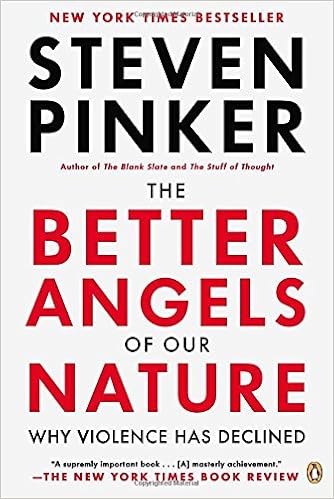
By those standards, Steven Pinker checks all the necessary boxes. While he’s somewhat of a controversial figure in some circles, the man has some solid credentials. He’s an accomplished professor at Harvard and has written multiple books on issues ranging from language to psychology to human nature.

His seminal work, though, is his book, “The Better Angels Of Our Nature.” If you want a compelling reason to believe that the world is getting better by most measures, I cannot recommend this book highly enough. It’s not just about looking at the world through rose-colored glasses. Mr. Pinker provides real, verifiable information that the world is getting better and human nature is far better than we give it credit for.

Beyond his books and his famous TED Talks, Mr. Pinker continues to make his case for a more upbeat outlook in various ways. Recently, his work was cited in an op-ed article in the New York Times entitled “Why 2017 Was The Best Year In Human History.”

Granted, a title like that is a bit heavy on hyperbole, but the writer, Nicholas Kristoff, is dead serious in making that case. Link Mr. Pinker, he doesn’t just interpret all the ongoing trends in the world through the mind of a stoned hippie. He puts the state of the world into a context that goes beyond all the horrible headlines we saw in 2017.

He, and other optimists like him, tend to look at the broader trends in human society. The data is out there, but it’s hard to put into a compelling headline. That doesn’t stop men like Kristoff and Pinker from making a concerted effort, though.

We all know that the world is going to hell. Given the rising risk of nuclear war with North Korea, the paralysis in Congress, warfare in Yemen and Syria, atrocities in Myanmar and a president who may be going cuckoo, you might think 2017 was the worst year ever.

But you’d be wrong. In fact, 2017 was probably the very best year in the long history of humanity.

A smaller share of the world’s people were hungry, impoverished or illiterate than at any time before. A smaller proportion of children died than ever before. The proportion disfigured by leprosy, blinded by diseases like trachoma or suffering from other ailments also fell.

Again, these trends are hard to see and harder to report on because they don’t happen all at once. If tomorrow, all poverty was magically wiped out, that would be a big news story. However, human progress doesn’t work that way. It’s slow, gradual, and sometimes boring. It does happen, though. The events of 2017 were no exception.

Violent went down. Poverty went down. In fact, they went down to their lowest levels in modern history. Compared to a year ago, 5 years ago, or 50 years ago, the trends we saw in 2017 were all improvements by most objective measures. A lot of these trends are things Mr. Pinker has been talking about for years. Mr. Kristoff simply builds on them.

Every day, the number of people around the world living in extreme poverty (less than about $2 a day) goes down by 217,000, according to calculations by Max Roser, an Oxford University economist who runs a website called Our World in Data. Every day, 325,000 more people gain access to electricity. And 300,000 more gain access to clean drinking water.

For most individuals, these trends are difficult to notice. That’s largely because they’re driven by forces that most people don’t notice or understand beyond their personal existence. Even in a world that’s so connected and becoming more connected with each passing day, it’s easy to overlook this kind of progress.

It’s also a lot harder when the news is largely dominated by negative headlines that highlight how dissatisfied the general public is with the direction of society. Again, there is a context here and one that I’ve tried to point out before. It’s one of the first lessons I learned in college when interpreting media of any kind, be it the news or superhero comics.

The reason why all these negative headlines are headlines in the first place isn’t because they’re common. It’s because they’re so rare. Stories such as mass shootings, brutal murders, and war crimes make the news because they don’t happen every day. That’s why they qualify as news. They’re aberrations and not normal occurrences.

Conversely, good headlines rarely make the front page because they lack the same novelty and emotional impact as bad news. Naturally, people are going to react more strongly to a horrific headline because our survival instincts compel us to devote more energy to the bloodier, more dangerous information.

That’s why, even if 2017 was the best year in the history of the human race, our caveman brains aren’t going to process that because it’s so focused on all the negative news that came out over the past year. That news may very well be a tiny sliver of the events that transpired in 2017, but that news will still garner more attention, especially in the current digital economy.

We can still take comfort in the progress that happened in 2017, though. No matter how many negative headlines there were, that doesn’t undo the genuinely good things that transpired in the past year. Mr. Kristoff even went out of his way to provide an anecdote, of sorts, that highlighted just how much good can come from even the worst parts of the world.

Granted, this column may feel weird to you. Those of us in the columny gig are always bemoaning this or that, and now I’m saying that life is great? That’s because most of the time, quite rightly, we focus on things going wrong. But it’s also important to step back periodically. Professor Roser notes that there was never a headline saying, “The Industrial Revolution Is Happening,” even though that was the most important news of the last 250 years.

I had a visit the other day from Sultana, a young Afghan woman from the Taliban heartland. She had been forced to drop out of elementary school. But her home had internet, so she taught herself English, then algebra and calculus with the help of the Khan Academy, Coursera and EdX websites. Without leaving her house, she moved on to physics and string theory, wrestled with Kant and read The New York Times on the side, and began emailing a distinguished American astrophysicist, Lawrence M. Krauss.

Think about that story, for a moment, and reflect on how 2017 made it possible. Thanks to all the progress made in global communications, a woman in Afghanistan in 2017 was able to pursue opportunities that would’ve been impossible a mere 20 years ago.

This woman, despite living in one of the most war torn parts of the world, still managed to gain access to the kind of education and informational resources that were once reserved for aristocrats and academics. That, by any measure, is an astonishing accomplishment for humanity.

In many respects, 2017 was the best year ever because it continued the trends had been going on for years. As a result, more people have access to information, education, and the basic necessities of life than at any other point in human history. That, more than anything, is why it’s not unreasonable to say that 2017 was the best year ever.

The fact that concerns over celebrity scandals is a greater concern than poverty, war, or famine shows that we are making more progress than we think. It also bodes well for 2018 being an even better year than 2017. Despite what negative headlines may say, the human race is on an unprecedented winning streak and I hope, along with men like Mr. Pinker and Mr. Kristoff, that the streak continues into 2018 and beyond.

1 Comment

Filed under Current Events, Sexy Future

Artificial Wombs, Declining Fertility, And The (Potentially Distressing) Implications

When I first discussed the prospect of artificial wombs, I did so knowing it would evoke distressing sentiments from those who are familiar with the classic novel, “Brave New World.” That’s not just because it’s Aldous Huxley most famous novel. It perfectly illustrates the dystopian implications of a world where society is engineered like an assembly line.

I don’t discount the seriousness of those implications. A world where birth, life, and death are so mechanized that peoples’ lives are barely distinguishable from robots is not an appealing world, to say the least. It’s not very sexy, either. Like “1984,” another famous novel I’ve mentioned, “Brave New World” highlights just how bad these advances in technology can get if not handled properly.

As cold and callous as “Brave New World” might have been, though, it still has the same fundamental flaw as “1984” and every other dystopian narrative. It relies on extreme worst case scenarios that depend on humanity exercising its worst traits. As someone who has emphasized having faith in humanity, I have a problem with those assumptions.

Flawed or not, humanity has proven time and again that we can adapt to major technological advances. However, there may be other complications associated with this particular technology.

Like contraception before it, including near-future advancements, artificial wombs will be subject to extra scrutiny because it involves human reproduction. Human reproduction, in case you’ve forgotten, also involves sex and that’s bound to make a lot of people exceedingly uncomfortable. We already know who some of those people might be.

Also like contraception, though, artificial wombs will help address a serious problem. One of the driving forces behind the development of contraception, going all the way back to ancient times, was the need to control our fertility. Between the various health issues for women and problems caused by unfettered population growth, there were a lot of incentives to drive this advancement.

With artificial wombs, however, the situation and incentives are very different. In fact, they’re unprecedented. I’ve already talked about a potential demographics problem for the industrialized world, as a result of low birth-rates. I won’t go so far as to call it a crisis, but that hasn’t stopped others from using apocalyptic rhetoric.

Assuming that lower birth rates and decreasing sexual activity become dire enough to warrant that rhetoric, artificial wombs are in a position to address it. I’m not just talking about infertile couples being able to have children or having children while both parents continue to work either. Unlike contraception, this technology will completely change the rules to human fertility.

This is where some of the dystopian concepts in “Brave New World” get a bit too real. To understand those concepts, we need to stop thinking like ordinary citizens who just want to have babies without stretch-marks and morning sickness. Instead, we need to channel our inner bureaucrat and think about the functioning of society, as a whole.

With that context in mind, here’s the scenario your society faces.

  • You’ve got a sizable population with a functioning economy
  • That economy relies heavily on people buying and producing services
  • The government provides various benefits and welfare to older or disabled citizens, relying on taxes paid by able-bodied workers/consumers
  • The ability to keep the economy growing relies on increasing the population in order to increase the consumer base
  • The ability to provide government services and welfare depends on there being enough citizens of working age to generate the necessary capital
  • However, the population has stopped growing, the people aren’t having children, and fewer workers are in place to support an aging population

What I just described is similar to the demographics issue facing many industrialized countries. As it stands, the solutions are few and far between. However, in this scenario, the powers that be have a tool that nobody else has at the moment. They have functional artificial wombs.

Suddenly, there’s a solution. Instead of trying to get citizens to have more sex and make more babies, they can just skip that part entirely and breed a new crop of citizens in artificial wombs. Sure, it requires some questionable ethics, but it’s not like that has ever stopped governments before.

Ignoring, for a moment, the distressing implications of governments breeding and conditioning its own citizens, it’s an easy solution that doesn’t rely on stubborn citizens to go along with it. In other words, it’s the kind of solution that governments and authority figures love.

On paper, it works perfectly. In some shadowy government site ripped right out of “Star Wars Episode II: Attack Of The Clones,” rows upon rows of artificial wombs birth a steady supply of healthy citizens. Unlike the chaotic breeding habits of its citizens, though, this operation could be tightly controlled and perfectly optimized.

In a sense, it would be even more efficient than natural birth. If the artificial womb technology is sufficiently advanced, then it could be configured to ensure that only healthy, disease-free children are born. Maybe the government would even gather information on the gene pool of their society and filter it so that only the best traits are passed down.

If that idea sends a chill down your spine, then chances are you’re painfully familiar with eugenics and infamous political movements from 1930s Germany. I don’t deny that the similarities are there, nor do I deny the disturbing ethics involved.

Despite these connotations, though, it doesn’t change the fact that artificial wombs present a functional solution to societies facing demographics issues. Through the use of this technology, the government can ensure that the population can keep growing at the necessary pace to maintain the system.

What may make this solution more appealing and more egregious is that it focuses on bolstering native populations. Given the rise in anti-immigration rhetoric, that’s going to appeal to certain societies, some more than others. Those obsessed with keeping their societies and cultures “pure” will jump at the chance to use artificial wombs to guide their demographics.

It’s a concept that even “Brave New World” didn’t explore. That’s because Huxley was more concerned about the impact of reducing basic human activity to a detached, mechanical process. I believe if he were alive today, he would see how increasing tribalism would prompt societies to use such technology in different ways.

These are all distressing implications, but we can take some comfort that artificial wombs are still a ways off. Chances are they won’t be perfected within the next couple decades, but that doesn’t mean the incentives to use them will go away. In fact, they may intensify as demographic issues continue to evolve.

However, me being the hopeless optimist I am, I believe this technology won’t drive the kind of dystopian, eugenics-driven society that give die-hard racists wet dreams. I believe humanity is better at adapting to these technologies than we give it credit for. If we did it with nuclear weapons, we can do it for artificial wombs.

Sure, there will still be issues, both ethical and pragmatic. There will probably be a sizable contingent of people who dread and fear this technology. However, just as the real 1984 was nothing like anything Orwell had imagined, a world with artificial wombs will be nothing like Huxley or aspiring erotica/romance writers can imagine.

2 Comments

Filed under gender issues, sex robots, Sexy Future