Category Archives: gender issues

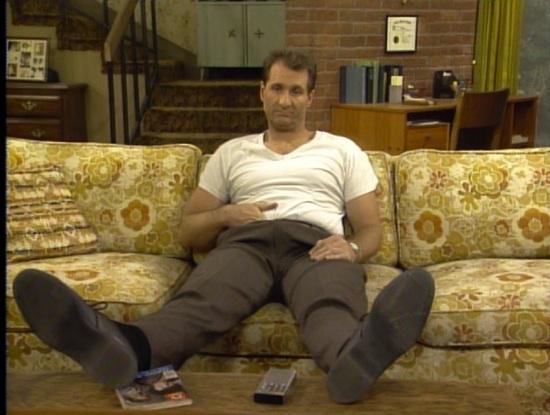
Al Bundy Syndrome: The Face Of Learned Helplessness

Some concepts are so vague that it’s hard to put a human face on it. I suspect that’s part of why many people suck at math. You can’t personalize it, humanize it, or imagine it on a pair of breasts. Even things that directly affect people, like learned helplessness, are hard to grasp.

That’s why if you find a way to put a human face on a serious issue, you jump at the chance. It doesn’t just make it easier. It makes them memorable in an unexpected way. I consider the concept of learned helplessness a serious issue that affects our personal lives, our professional lives, and our sex lives. It goes beyond the world of an aspiring erotica/romance writer. It’s way bigger than we’re comfortable admitting.

That’s why, in the interest of putting a human face on a serious issue, I’d like to present the greatest personification of learned helplessness in the history of media. Some of us grew up with him. Some of us were appalled by him. He’s a myth, a legend, and an icon in his own tragic right.

His name is Al Bundy, the hapless husband and father of the Bundy family from the Fox classic, “Married With Children.” To those who have watched every episode and love the show as much as I do, you already understand why Al is the perfect embodiment of learned helplessness.

For those who aren’t familiar with “Married With Children” or why it was such a groundbreaking show, I feel sorry for you. For most people under the age of 20, they have no idea how much this show shook our collective understanding of modern television.

Say what you will about the trash currently on TV now, but before “Married With Children,” it was much worse. By worse, I mean they were boring. Most sitcoms were bland, generic, feel-good stories that tried to paint the world in an overly-rosy picture. Every one of them basically tried to capture the spirit of “Father Knows Best” or “Leave It To Beaver.”

Married With Children” saw that and decided to do the exact opposite, so much so that when it was in development, the title of the show was called “Not The Cosbys.” It was a show where all the conflicts weren’t solved at the end. It was a show where the world wasn’t idealized, perfect, or fair. In other words, it was more in line with the real world.

In that world, Al Bundy gets dealt a worse hand than most. At one point, he was a high school football star with a promising future. Then, he got hit with a streak of bad luck that effectively crushed his spirits.

He got injured and lost his football scholarship. He got involved with Peggy Bundy, a woman I’ve cited before as a character that men should rightly dread. He eventually has two kids that don’t respect him and works a dead-end, low-paying job as a shoe salesman.

While other sitcoms glorify the innate dignity of working class men like Ralph Cramden, Archie Bunker, and even Homer Simpson, there’s nothing glorious about Al Bundy’s life. There’s nothing noble about his poverty. He doesn’t even try to come off as sympathetic. His life doesn’t raise the bar or embody an ideal. If anything, it reminds ordinary people just how bad things can get.

Whereas other TV sitcoms try to uplift an audience by showing how loving, functional families solve their problems in a simple, 30-minute show, “Married With Children” sent a different message. It presented the audience with a level of dysfunction so extreme, so exaggerated that even if you’re home life was a mess, you could take comfort in the fact that you were not the Bundy family.

What makes that message so powerful is also what makes Al Bundy such a perfect example of learned helplessness. Fittingly enough, the actor who played him, Ed O’Neill, actually drew inspiration from someone in his own family.

In a sense, Al Bundy was built around the idea that he was just resigned to his fate. He realized how much his life sucked, that his family didn’t respect him, and that his best days were behind him. Dealing with all that in addition to working a dead-end job effectively destroyed his spirit, so much so that he stopped trying to better his situation.

That perfectly reflects some of the early experiments done about learned helplessness, namely those involving a poor dog that just stopped trying to avoid painful shocks. Al Bundy is basically that dog after it has been shocked so many times that it just doesn’t bother anymore. It accepts that it will suffer and doesn’t try to avoid it.

In a sense, it becomes a mentality akin to a psychological illness. In the spirit of caveman logic and excuse banking, I’ll give it a name. From here on out, let’s call it “Al Bundy Syndrome.” That’s a much more memorable name than the overly-technical term, learned helplessness. With Al Bundy Syndrome, the condition has a name and a face that Ed O’Neill made iconic.

Given that we already have weird diseases like restless leg syndrome and walking corpse syndrome, which I swear is a thing, I don’t see why we can’t create a syndrome out a fictional character. In fact, it wouldn’t even be the first time.

I’m not a doctor, nor do I claim to be an expert in anything that doesn’t involve telling sexy stories, but it’s for that reason that I feel it’s so important to put an actual face on an issue that’s hard to understand. Psychology is tricky, complicated, and messy. Al Bundy is simple, crude, and crass. One is innately funnier than the other.

In that sense, it’s easier to see the signs and symptoms of learned helplessness, so long as you frame it in Al Bundy syndrome. Watch any old episode of “Married With Children” and the symptoms reveal themselves. They include feelings like:

  • Being hopelessly numb to the misery around you, like Al Bundy
  • Making little to no effort to improve your situation, like Al Bundy
  • Assuming the worst in every situation, like Al Bundy
  • Having an extremely cynical outlook, like Al Bundy
  • Not caring about whether the world likes or respects you, like Al Bundy
  • Having no shame or filter about what you say, like Al Bundy

The list goes on, but there are too many to list and watching old episodes of “Married With Children” is probably far more informative than any list, not to mention funnier. It’s a show that probably couldn’t get made today, due to how politically incorrect it was, even for its time. That makes its impact all the more vital.

I doubt that Ed O’Neill or the producers of “Married With Children” intended Al Bundy to be the poster boy for learned helplessness, but sometimes the connections are there and all we have to do is make them. So, moving forward, if you want to know what learned helplessness is and how to avoid it, just remember this face. It may save your life, your marriage, and your soul.

For that, I thank you Ed O’Neill.

5 Comments

Filed under gender issues, Marriage and Relationships

How Learned Helplessness Dooms Your Sex Life (Among Other Things)

When I was growing up, I considered myself lucky to be surrounded by so many loving people. I like to think my fondness of romance, as well as my desire to become an erotica/romance writer, is a direct result of seeing so much love among friends, family, and all those close to me.

It wasn’t all smiles, chocolate, and gratuitous tongue-kissing. Every now and then, I encountered certain couples that stood in stark contrast to the love I saw so much of throughout my life. They weren’t abusive or hateful. In a sense, they were their own tragedy, albeit not of the Shakespearean variety.

Picture a couple that’s about as passionate as a sick cat. There’s no fire in their romance. If there was, it burned out years ago and neither one of them cares enough to spark it again. They don’t necessarily hate each other. At best, they tolerate one another on a day-to-day basis, resigned to the fact that this is their life.

What I just described is not the kind of relationship that ends up on Jerry Springer or leads to protracted divorce hearings. They’re rarely that dramatic. If anything, they’re the antithesis to drama. That’s why those involved are so miserable. In a relationship like that, a clogged toilet counts as an adventure.

These kinds of relationships are not as easy to notice, but they do happen. You might even know a few, but I’d bet a stack of old Playboys that there are more than you think. Instead of love, passion, and heart, these relationships are fueled misery, laziness, and failure. At some point, those involved just stop trying to escape it.

In a world where people get worked up over dipping sauces and dress colors, it seems outrageous that anyone could be that callous and numb. It’s even more outrageous to think that a relationship could be built around it. However, there are powerful, unsexy forces at work and they’re not to be taken lightly.

This brings me to the concept of learned helplessness. If you’ve every taken a psychology course, you know what it is and you probably have an idea as to how it acts as kryptonite to love, romance, and passion. For those of you who don’t know, it’s a fairly easy concept. According to Wikipedia, the phenomenon is defined as follows:

[A] behavior typical of a human or an animal and occurs where the subject endures repeatedly painful or otherwise aversive stimuli which it is unable to escape or avoid. After such experience, the organism often fails to learn or accept “escape” or “avoidance” in new situations where such behavior would likely be effective. In other words, the organism learned that it is helpless in situations where there is a presence of aversive stimuli, has accepted that it has lost control, and thus gives up trying.

In terms of common behavioral traits, it’s somewhat bland. That doesn’t make it any less powerful, though. There is real, distressing science behind it, starting with experiments conducted in the 1960s. If you’re a dog lover, though, these experiments should be particularly disturbing.

If you’re also a fan of meaningful love, then you should be even more disturbed because it’s not hard to see how something like learned helplessness can creep into a relationship. For those trying to tell powerful, sexy stories, it’s important to know the signs.

The challenge, however, is that learned helplessness is one of those things that doesn’t happen all at once. Whether it’s those cruel experiments on dogs that I mentioned or continuous torture by the CIA, one painful experience is rarely enough. While love can manifest in a single moment, as is the case with “love at first sight,” learned helplessness takes a longer, more tedious road.

Sometimes it starts with boredom, a powerful feeling that I’ve discussed before. Sometimes it starts with frustration. Maybe a couple tries a few times to spice things up, but it doesn’t work. Maybe they try to shake up their routine, but that doesn’t work either. The key ingredient here is failure and frustrations, two experiences that tend to accumulate rapidly.

The couple involved may never get angry, resentful, or bitter to one another. Learned helplessness rarely inspires abuse or outright hatred. However, that’s part of what makes it so debilitating. When a relationship becomes abusive, one part of the relationship has a much stronger incentive to either escape or fight back. It’s hard to be lazy or apathetic when you feel like your well-being is at risk.

With learned helplessness, laziness and apathy are weaponized. That’s because without that incentive, neither side has the energy or desire to shake up the situation. Ending a relationship always requires some amount of upheaval, work, or effort. Someone under the influence of learned helplessness sees that as more trouble than it’s worth.

Beyond just rendering a relationship stale, the effects on your sex life can be just as debilitating. Once a couple gets to a point in their relationship where they’re just resigned to the fact that this is their normal, sex becomes less a treat and more a chore. Even if the orgasms still feel good, they’re barely distinguishable from masturbation.

That, by far, is the clearest sign that learned helplessness has consumed a relationship. As soon as sex becomes a chore, then it’s safe to say that two people have crossed the point of no return. They are beyond the point of rekindling whatever flame they once had. They just accept their misery and dispassion.

In defense of those poor souls, they don’t always have the luxury of ending that relationship and starting fresh. Sometimes, it’s because of their age. Sometimes, they’re in an environment where they don’t have anywhere else to go and few resources to work with. Then, there are times when the inconvenience just doesn’t justify the cost. It’s just easier to stay miserable than deal with the stress of rebuilding.

There’s little question that misery, depression, and boredom are bad for your love life, your sex drive, and everything in between. Learned helplessness is just the catalyst. Instead of blowing up in your face, love just whithers slowly like a piece of rotting fruit, getting emptier and deader with each passing day.

In some cases, it’s difficult to avoid. Some people just find themselves in relationships where they lose control and accept their misfortune. They’re content to just accept the misery and make the best of it, however fruitless it might be.

In others, you can take steps to avoid that kind of misery. Think back to those awful experiments involving dogs. After a while, the dog just stops trying to avoid the pain. The key to avoiding that kind of misery is to keep making an effort. Don’t stop trying. Do what you can to avoid mistakes. Moreover, do what you can to improve your situation, however possible.

That might mean pushing yourself when you don’t want to. It’s like exercising, which sometimes requires extra motivation. Within a relationship, it’s even more difficult because both you and your lover have to share in that motivation. You have to want to maintain that passion, even as you get older, have less energy, and feel less sexy.

In my experience, the most successful couples I know never truly stop dating each other. Even when they’ve been married for decades, they still carry themselves as a couple that’s still dating. They still go to interesting places, try new things, and explore new activities. Some aren’t always sexy, but they have the potential to be.

Every couple is different, but nobody benefits from learned helplessness. Whether you’re a dog, a dumb-ass, or a hopeless romantic, falling into that pit of apathy will never inspire your passion or increase your sex appeal. It’ll drain it, bit by bit.

Nobody deserves that. I certainly want to avoid that if and when I ever find a steady lover. I’m not a relationship expert or a therapist, nor should anybody assume I’m one, but I hope to help in whatever way I can. Whether it’s making people aware of learned helplessness or writing sexy novels, I intend to do my part.

2 Comments

Filed under gender issues, Marriage and Relationships, War on Boredom

Being A Good Person In The Age Of Social Media (And Why We Obsess Over It)

Whenever there’s an argument on the internet, and there are no fewer than 1,029,296,198 going on at any one moment, they tend to fall into a fairly standard pattern. Whether it’s politics, religion, video games, comic books, Harry Potter, or the series finale of “Lost,” the crux of every outraged outburst usually boils down to this.

“I believe that [insert crazy idea/opinion/theory here] and that’s that.”

“You’re a horrible person for believing [insert crazy idea/opinion theory here] and should be a ashamed of it! I demand that everyone shun, scorn, and marginalize you and everyone like you from now until the end of time!”

I want to say that’s an extreme example, but I’ve been navigating comic book message boards, Reddit fan theories, and the comments section of every major news site for too long. I can pretty much set my watch to when, how, and to what extent the argument with devolve.

Follow any thread on politics and within five minutes, someone will accuse someone else of being a Nazi. Spend more than a day on any message board, be it Harry Potter or the Walking Dead, and you’ll find entire sub-groups of fans that have tacitly declared war on another.

Some of it is a product of the passion people have for certain issues and ideas. Some of it is just plain tribalism, a factor I’ve highlighted before as the underlying source of a great many problems in our world. However, recent trends in social media, along people just being more able to anonymously share every crazy thought and feeling on a whim, have created a new source of conflict that more and more people stress over every day.

Think back to that generic argument I mentioned earlier. There’s one more component to it that doesn’t always play out on any message board, comment section, or video chat. It’s something that most people are reluctant to acknowledge, but on the inside, we’re all telling ourselves the same thing.

“I’m NOT evil! I’m a good person! I know it! Why can’t these people see that? For them to feel that way about me, THEY must be the bad ones!”

Again, that’s a very generalized summation. I doubt this mentality has played out anyone’s mind, word for word. However, I think it’s a near certainty that everybody is concerned with how they’re perceived by others, to some extent. Unless you’re a sociopath or playing a villain in a movie, you want others to see you as a good person.

It’s not just because being a dick rarely does anything to improve your life or those around you. We kind of need people to think we’re good on some levels. Otherwise, we have problems functioning.

Even if you are a sociopath, you need to at least give the impression of decency so you can live a functional life in between torturing small animals for fun. If not, then the Dexter Morgans of the world would get weeded out fast and characters in sitcoms would be a lot less interesting.

While society has always had some pretty nasty people, the growth of the internet and social media is changing the rules. It used to be that you could get away with being a terrible person because news of your terrible deeds rarely went beyond the small town or city you lived in. For most of human history, you only ever moved along with your tribe or community.

Now, there are entire generations of people in this world who have grown up in a society of unprecedented mobility and connection. The generation being born now will likely continue that trend, so much so that they’ll never have to know how an old 56k modem sounds. In that world, being perceived as a good person, even if you’re an asshole, will be that much more vital.

It’ll be impossible to hide. In a world where everyone has a smartphone and those phones can broadcast crimes in real time, it’ll be much harder to hide our more rotten tendencies. While it might be helpful to know who the real assholes are out there, it comes at a price. It means the margin for error is that much smaller.

That’s because in this hyper-connected world, it’s a lot easier for someone to call us out on being a lousy person. Even if we’re not, someone can effectively create that perception and, as I’ve said before, perception beats reality 99 times out of 100.

When someone is accused or accosted of being a bad person, it can be pretty traumatic. It’s like being a kid on a playground and everyone ganging up on you all at once. With the internet, though, it’s like legions of other kids from every other playground on the planet joining the battle. It can get pretty damn harsh, so much so that it can seriously undermine our sense of identity.

For a clear example, I don’t even need a thought experiment. Seth MacFarlane already did that for me. In one of the harshest scenes in the history of “Family Guy,” Glenn Quagmire basically lays into Brian, pointing out every harsh truths about his phony, pseudo-intellectual douche-baggery. For Brian, it’s pretty soul-crushing.

What Quagmire does to Brian is basically a microcosm of what people face today whenever they create a presence online. Whether it’s on social media or in the anonymous comments section in digital sewers like 4chan, there are legions of faceless strangers out there who are not afraid to lay into you, even if you are the nicest person it’s possible to be in real life.

Therein lies the problem, though. The identities we create online are so fluid and prone to corruption. One misplaced tweet, one viral video, and one ill-conceived comment on FaceBook is all it takes to ruin a life now. Even if it’s unintentional or misconstrued, it doesn’t matter. It will still be used to make you a bad person in the eyes of the world.

In a sense, we have to obsess over whether we’re a nice person, both in real life and online. It’s just a lot harder online because once something bad or embarrassing is out there, it’s almost impossible to remove. If you don’t think that matters, keep one thing in mind. When you’re out there looking for a job, employers are looking you up. They can and will use the crap you put online to decide whether or not to hire you.

When you consider the stakes that come with having be perceived as a good person, it makes perfect sense that people might get unreasonably defensive with their positions. I’ve noticed this in any discussion online about politics.

Everyone in the debate thinks they’re the good person. They think they’re on the side of everything that is good and pure. They may or may not be right, but that’s the narrative they craft in their minds. For them to lose an argument doesn’t just mean admitting that they’re wrong, which is extremely distressing, in and of itself. Losing means conceding you might be a bad person and that’s just untenable.

Being the optimistic person I am, I tend to believe that most people are inherently good. My own life experiences have convinced me of that. I recognize that some have very different experiences and I cannot blame them for thinking otherwise. However, our very identity and sense of self requires us to believe that we’re a good person at heart.

It can sometimes twist our perceptions and make us cling to irrational, immoral, and downright weird believes. In many ways, it’s an extension of excuse banking and virtue signaling. In the past, we didn’t have to work so hard to maintain that narrative of ourselves that has us believe that we’re the heroes of our own story. Now, thanks to the internet and social media, it’s harder than ever to escape it.

I suspect that our collective obsession with winning arguments and being the good guy will escalate as we become more connected, as a world. I don’t doubt that our obsession will get downright unhealthy at times. However, the mere fact that we obsess that much over being good also convinces me that we want to be good.

That should offer some comfort to those who feel as though the world is filled with angry internet trolls who exist only to make good, decent people feel miserable. Granted, there are some very mean trolls out there. Most people, though, don’t see themselves that way. They think they’re the good guys, just like you and me.

The more we recognize that shared effort, the less inclined we’ll be to call each other a Nazi. Given recent events, I think that should count as progress to everyone.

Leave a comment

Filed under Celebrities and Celebrity Culture, Current Events, gender issues, Marriage and Relationships

The War On Horny Women (And Why We Keep Fighting It)

People have been waging wars since the dawn of civilization. These never-ending struggles have people clash over ideas, concepts, and identities that cannot and will not be resolved. Some of these conflicts have literally reshaped society and the world we live in. They are a fundamental, and at times inescapable, part of civilization.

Then, there are the subtle, less obvious wars that we never win, but insist on fighting. These wars rarely have epic battles or iconic names like Waterloo, D-Day, or Super Bowl XLII. On some level, we know these wars can’t be won. We know we inflict a lot of collateral damage by fighting them. We’ve just been doing it for so long that we don’t know how not to fight it.

The war, in this case, involves horny women. Yes, that’s a war too. I know I dedicated an entire post to documenting the war on horny men. Even though I am a man with functioning genitals and a healthy sex drive, I don’t deny that women experience plenty of horniness, as well. I also don’t deny that those same women have endured a war that has spanned generations, cultures, and rap battles.

Despite not being a woman, I think it’s important to touch on that struggle, especially since recent scandals and trends in our sexual culture have taken the war to uncharted territory for both genders. For women, in particular, the conflict is far different from the one they’re used to fighting.

Anyone who has studied history, or just listened to Pat Robertson for more than five minutes, understands that civilization hasn’t exactly been kind to the female libido. For a good chunk of human history, a horny woman had exceedingly limited options.

If they weren’t having sex with their husband, who they probably didn’t even choose, then they weren’t having much sex. For the most part, a man could get away with having a few mistresses or seeing a prostitute every now and then. If a woman dared stray from her wifely duties, though, the punishments were severe.

Even today, a woman sleeping around on her husband is dangerous in some parts of the world. Even when it doesn’t get you killed, it can ruin your life in many other ways that men rarely deal with. It’s not fair. It’s certainly not in line with notions of gender equality. That’s the problem with wars, though. Things like logic, justice, and compassion are the first to go.

Why is this war even being fought in the first place, though? Moreover, why are women dealing with a different war than men? Well, there are many answers to that question and most of them will piss off most feminists, egalitarians, or people who just value any semblance of fairness.

I’ve touched on it before, to some extent, but the foundation for the war on horny women has its roots in a mix of biology and economics. Humans are a sexually dimorphic species in that each gender bears distinct traits that set them apart, beyond the presence or absence of certain organs. However, the trait that most distinguishes women is their ability to have children.

It’s a beautiful, but critical skill that any species needs to survive. A great deal of energy goes into giving incentives for humans to make babies and some of those incentives are pretty damn powerful. However, because of the biology involved, there are circumstances that set a horny woman apart from a horny man.

In terms of raw numbers, horny women are at a evolutionary disadvantage. No matter how horny they are or how much sex they have, they can only bear one or a few children at the same time over the course of nine months. Men, on the other hand, can impregnate dozens of women and sire a much larger volume of offspring.

From an evolutionary perspective, it’s like one person has a butter knife and the other has a machine gun. One tool is just inherently better at doing more damage. Now, if men and women are living in some hippie commune where nobody cares about which kid belongs to who and nobody has to deal with messy child custody hearings, then a horny woman doesn’t have much issues.

Unfortunately, hippie communes are few, far between, and prone to poor hygiene and clogged toilets. Much of our civilization was built on complex, hierarchical societies that required men to work the fields, women to care for children, and a certain assurance that the kids you had were yours.

Before the days of Maury Povich, though, the only way to be sure of that was to be sure that a woman was faithful from her wedding night onward. Since people rarely trust the horniness of their spouses or the men who may seduce them, this led to traditions and taboos that demanded modesty and subjugation for women.

It didn’t matter how horny or sexually unsatisfied they were. From the perspective of society, it was more important that these women remained “untainted” so that men could be sure their kids were legitimate and there were no nasty diseases, a common problem that plagued ancient societies to no end. It wasn’t as much a war of misogyny as it was a war of practicality.

Even after we learned to treat disease, control conception, and test for paternity, the idea of a horny woman is still taboo. There are some that even claim that promiscuous women bring down entire civilizations. These are not claims that anyone should take seriously, but they do reflect the ongoing struggles of this war.

The idea of a woman being horny, sexual, and feeling no shame about it just seems wrong to many people. They see that and they see an affront to how they believe society should work. Never mind the fact that society is always changing and technology promises to accelerate that change. We, men and women alike, are still stuck in this war-like mentality when it comes to horny women.

It often manifests in subtle ways. Watch any slasher movie, sitcom, or poorly-scripted reality show and you’ll see a similar theme. The horny, promiscuous women are the villains. They are an evil, corruptive force that undermines all that is good and noble. Why else would Regina George be so easy to despise?

Beyond the media, female horniness is often presented as something that has to be contained and hidden. Unlike men, who are expected to fight the wars and work the fields, the standards for women are different. A “good woman” is someone who doesn’t sleep around, flash her tits, or show off her thong to an entire basketball team. A “good woman” stays home, has babies, and dresses in a way that doesn’t attract horny men.

That’s why modesty is conveyed as such a virtue for women, but not so much for men. That’s also why exceedingly repressive societies segregate women from men. The possibility that someone might get horny and might act on that horniness is seen as a bomb going off in house full of puppies. It’s just that terrifying.

However, despite this centuries-old war, ripe with traditions and taboos, women still get horny. Women still want to have sex and not just to make babies, but to enjoy the toe-curling pleasure that comes along with it. No amount of modesty, shame, or scorn can stop it. That says a lot about the strength of horny women. As an aspiring erotica/romance writer, I can’t help but admire that.

As much an optimist I am, at heart, I don’t see the war ending anytime soon. Like the war against horny men, certain taboos and insecurities still linger. Some are cracking, though. Just recently, Mayim Bialik from “The Big Bang Theory,” generated a lot of criticism for daring to claim that women should dress more modestly in order to avoid harassment, as though horny men aren’t that determined.

Naturally, albeit unfairly, she got accused of blaming the victim for the misdeeds of horny men. The idea that horny women are somehow responsible for crimes committed against them is rightfully absurd, but the notion that horny women need to contain themselves while some men can still push the boundaries is beyond absurd.

As I said at the beginning, the basis of the war on horny women is neither fair nor logical. Compared to the war on horny men, though, it’s just unfair and illogical in a very different way. There reasons and justifications for the war are changing and will likely continue to change, especially as certain medical advancements emerge.

Whatever the change, though, the war will continue to rage. Horny women will still be considered this taboo force of chaos that could potentially undermine the whole of society. This may be a taboo that’s impossible to break, but that may not matter much in the long run.

No matter how the war is fought, whether by religious dogma or excessive shaming, it won’t turn off that fundamental drive to make love or to enjoy good orgasm. In the long run, the horny women will win, if only because the horny men will want to hang out with them more. I’m not one to take sides in a war, but if my sexy novels can act as battle cries, I’m happy to do my part.

5 Comments

Filed under Current Events, gender issues, Marriage and Relationships

The War On Horny Men (And Why It’s Doomed To Fail)

I won’t deny it. Men do stupid things when they’re horny. That’s just a cold, hard fact. I realize I’m inviting any number of dick jokes by saying that, but it’s still worth saying. It’s partly because of that fact that there’s a market for the erotica/romance novels I write in the first place so I have more appreciation for it than most.

Unfortunately, we live in a world where facts are about as relevant as a giraffe’s shoe size. It doesn’t matter how true or vindicated something is, be it a scientific theory or a documented observation. Unless it makes people feel a certain way or allows them to push some sort of agenda, it either doesn’t matter or gets twisted to suit a purpose.

When it comes to horny men, though, evolution and global warming got nothing on them. It’s not so much that they exist that’s the problem. It’s that they are now the face of all that is wrong and evil in the world.

Look at any controversy or social issue in recent years, from Hollywood scandals to trends in feminism, and chances are a horny man is involved and that man isn’t the good guy in that narrative. I’ve seen it become more magnified in recent years, but in a sense, there has always been a war over horny men. It takes many forms and has gone to disturbing extremes, but it rarely succeeds in the long run.

In the past, you could argue that battling horny men was a frustrating, but necessary endeavor to some extent. Up until the 20th century, the status of women in society and concerns over the spread of debilitating diseases gave society a valid reason for wanting to temper men’s desire to bone everything in sight. A society full of diseases and children without fathers is not a stable society.

On top of that, organized religion had often tried to play a part in that war. In general, they espouse traditions that value modesty and restraint. Naturally, some try to take it too far. Some have gone so far as to create a special circle of Hell to endlessly punish those who give in to readily to their horniness.

There are time when it’s worth questioning the motivations of organized religion in this war, though. As I’ve pointed out before, religion has an incentive to want people to bone only for procreation.

For one, they want all that pent up energy reserved for helping out at the church/temple/mosque/synagog. Second, they know that children of adherents tend to adopt their parents’ religion so they want them making as many babies as possible. More children means more adherents. More adherents means more money. Even when deities are involved, it often comes back to money.

However, as the influence of religion has faded and the status of women has improved, the war on horny men has taken a very different form. In some respects, it has been escalating lately. It’s not just a matter of horny men cheating on their wives with their secretary anymore. Horny men have basically become the de-facto enemy that are determined to hold women, minorities, and society back.

It’s horny men who become sleazy Hollywood producers that try to get sex out of ambitious young women. It’s horny men who demand that the women in comic books, video games, and movies be beautiful, thereby contributing to the objectification and degradation of women.

I won’t get into the issues I have with the concept of objectification, but it’s becoming increasingly taboo for a horny man to like and appreciate sexual imagery. It has become especially taboo to voice that appreciation, so much so that some countries are looking to criminalize men who cat-call women. That’s right. It one day might be a crime to say how sexy you find a beautiful woman.

For an aspiring erotica/romance writer, it’s a distressing trend. I get some of the logic behind it. Men still commit the majority of the sexual assaults in this world. That’s another cold, hard fact that can’t be denied.

It’s also a fact that sexual assault, as a whole, is on the decline. That’s a good thing, but thanks to the rise of mass media, terrible stories about sexual assault are easier to come by. It’s even easier to sensationalize, sometimes to the detriment of the truth. Whatever the statistics say, though, there’s still a horny man with poor impulse control at the center of it all.

At the moment, it’s not illegal to be a horny man or express some of that horiness. We don’t live in the days of John Harvey Kellogg and most horny men have access to abundant free porn, giving them an outlet for their horiness. However, even with all that free porn and a lack of uptight religious figures demanding that men not pleasure themselves, horny men are still subject to shame and ridicule.

If you like your female superheroes wearing chain mail bikinis, then congratulations! You’re a sexist, misogynistic pig.

If you like admiring beautiful women and go to strip clubs to exercise that admiration, then congratulations! You’re a sexist, misogynistic pig.

If you like having sex with beautiful women and seek to do so with every resource available to you, then congratulations! You’re still a sexist, misogynistic pig.

Are you seeing a trend, here? Whether it takes the form of porn or involves casual flirting, there seems to be no way around it. Any effort a man makes to get with a beautiful woman, sexually or otherwise, is somehow vilified. Just the act of wanting to sleep with a beautiful woman can now be construed as sexist, misogynistic, or whatever the hopelessly outraged can scream at the top of their lungs.

A man just looking for sex or some kind of sexual outlet garners no sympathy. Even a man looking for love is somehow prone to ridicule, as evidenced by the prominence of the beta male in shows like “The Big Bang Theory.” A man can’t ask for sex because he’ll get accused of being a creep or worse. He can’t even admit he wants sex because that somehow means he sees women as glorified sex objects.

There seems to be no way around it. No matter what a man does, he’s practically doomed himself and his reputation for daring to admit that he’s that horny. If he just masturbates to satisfy his desires, he’s a loser. If he eagerly pursues sex, then he’s a creep. If he just tries to repress it all, then he’s a dork who can’t get laid. Unless he’s a rock star with a foot-long dick, the average horny man has no hope.

This is an issue and it affects both genders because both genders are wired to seek love, sex, and everything in between. Nature, itself, gives us plenty of reasons, considering the various health benefits of orgasms. All those pursuits are effectively undermined if one side is overtly shamed for wanting something so basic and beautiful.

I’m not saying horny men don’t do stupid things. They most certainly do. I’m also not saying horny men don’t do heinous things too. They do that too and it’s become major news. People should be mindful of crimes like sexual assault and issues like consent. The problem is that the outrage over scandals and sex in the mass media is overshadowing the basic desire behind it.

Men, and humans in general, are sexual creatures. No matter how much people try to temper sex in society, whether by forcing women to cover their faces or designing video game characters to be less sexy, it’s impossible to subvert basic biology.

That’s the ultimate tragedy of the war on horny men. It can’t succeed in making men less horny. It can only ever succeed in making men feel guilty about feeling something that they’re hard-wired by biology and evolution to want, pursue, and enjoy. Guilt can keep us from stealing a cookie as a kid, but it can be downright debilitating if heaped on someone to excess.

All that guilt can make people angry, depressed, desperate, hopeless, and irrational. For a man that is already irrationally horny, that can be dangerous and frustrating. That kind of mentality is not going to help in efforts to curb sexual violence. If anything, it’s going to make those efforts even harder.

For now, I don’t see the war on horny men abating, nor do I see one side claiming victory over the other. I’ll just say that the hostilities are doing a lot more harm than good. They’re hindering those seeking love, sex, and all the good stuff that comes with it. As an aspiring erotica/romance writer, that’s a dangerous trend.

To those who still insist on fighting this war, claiming horny men are the bane of all societies in all times, I have one simple message for you. For several centuries, the Catholic Church wielded immense power throughout Europe. If even they couldn’t stop horny men, despite being armed with the Spanish Inquisition, then what chance do you have?

14 Comments

Filed under Current Events, gender issues, Marriage and Relationships

A Helpful (And Sexy) Romance Tip (From Joe Rogan)

I’ve said it before, but it’s worth belaboring. Do not take advice from celebrities. I know they’re so rich, powerful, and rarely have to pay women to show them their tits. Some could spit in a glass and sell it for fifty bucks if they wanted. With all that clout, it’s tempting to think that they have some sort of secret knowledge.

More often than not, a celebrity is the byproduct of knowing the right people, having the right amount of talent, and being willing to work so hard that it makes functional relationships damn near impossible. There’s also an element of dumb luck to it all. Just look at how Justin Bieber got discovered and prepare to run head-first into the nearest brick wall.

Celebrities live in a world that might as well be an alien planet. Their understanding of how things work is so skewed, so distorted, and so flawed they can’t really relate to ordinary people anymore. Does anyone really believe that someone with the eccentricities of Tom Cruise can ever grasp a sense of normal again?

That said, every now and then, one celebrity will come out with a bit of advice that is worth taking seriously. Stranger things have happened, even on game shows. That’s why it’s worth making note of whenever it happens.

Recently, in wake of the Harvey Weinstein scandal, a brilliant bit of advice came out of these disturbing revelations. It came courtesy of Joe Rogan, a comedian and color commentator whose insights I’ve found to be refreshingly honest. Being a huge fan of his podcast, which I totally recommend, I was very interested in learning his take on the scandal.

However, it was his unusual advice on love and relationships that stole the show for me. It actually had less to do with discussions of the scandal and more to do with topics involving how men behave around women. As someone who has had more than his share of awkward moments around women, it’s something I can appreciate.

His advice isn’t very complicated. It doesn’t even require any special skills or coaching. It’s something every man can do and something they already know how to do. The key is doing it in the right situation, within a certain context. Since I know a lot of men will likely need this advice at some point in their lives, I’ll offer it as freely and openly as Mr Rogan did. With all that said, here it is.

Before you go on a date with a woman, masturbate ahead of time. 

It’s crude. It’s crass. It’s even kind of dispassionate, when you think about. However, from a psychological and biological standpoint, it makes perfect sense for men hoping to form strong, meaningful relationships with women.

There’s no way around it. From a purely hormonal standpoint, men are hornier than women. That’s just how testosterone works. It effects how man pursue sex, love, and everything in between. It also affects other aspects of their behavior, for better and for worse.

Now, apply this to the lens of caveman logic and it makes even more sense. If we work within the context that our brains are primarily wired for survival and reproduction, then it’s unreasonable to assume that our thoughts and feelings will be optimized for determining whether the romance we’re pursuing is right for us.

From our brain’s perspective, when we go out with a pretty girl, we’re basically taking the scenic route to getting that sweet sexual release that we’re wired to seek. Everything else, including the romance, is secondary or tertiary, at best. That creates a major problem, though.

If our brains are more concerned about that release than it is about determining whether we’ve found a suitable lover, then we’re prone to making bad, misinformed decisions. Our pursuit of that release, and the role it serves in the reproduction part of cavemen logic, effectively obscures our more intimate pursuits.

As Rogan himself describes, that incredible desire made him tolerate a beautiful woman who he knew, on some levels, wasn’t right for him. However, he was just so driven by that crude desire of his caveman brain that he avoided the hard truth. He effectively employed a form of excuse banking. I can only imagine the kinds of justifications he came up with, being so driven to fulfill that primary need.

That’s why masturbating beforehand made perfect sense. It effectively froze his excuse bank and uncluttered his mind so that all that wiring in his brain that emphasized reproductive efforts, namely sex, were tempered. Orgasms effect a lot of bodily functions, as I’ve noted before. That includes, to a large extent, the brain.

By giving himself that orgasm ahead of him, Rogan did himself and his love life a huge favor. It allowed him to deal with the woman in a more logical, unfiltered sort of way. It probably saved him a lot of heartache and frustration in the long run.

Even if his experience is purely anecdotal, the science is sound. That’s why it counts as good, legitimate advice for other, non-celebrity men to follow. I encourage those reading this blog with significant others to try it.

The next time you go out on a date with a significant other, get that orgasm ahead of time and see how it affects your approach to the date. It may make for some unusual situations, but that might be a good thing. No matter how unusual they end up being, I’d love to hear the results so please share them in the comments.

Now, I know I singled men out for this advice and there’s a reason for that. While both genders tend to agree on the joys of orgasms, there are some variations in the biology. Since I’m not a woman, I don’t know whether this sort of advice would work the same way.

That’s not to say women shouldn’t try it too before their next date. I honestly don’t see how having an extra orgasm before a date or meeting with a prospective lover can be a negative. If women can provide some insight on this in the comments as well, I think it’s definitely worth discussing.

However, when it comes to men trying to make sense of their love lives and the complications that their incessant desire may bring, I think Mr. Rogan’s advice is sound. It may very well be the best, and sexiest, advice you ever get from a celebrity. For that, I thank Mr. Rogan for his contributions towards improving the romantic lives of his fans.

Leave a comment

Filed under Celebrities and Celebrity Culture, gender issues, Marriage and Relationships

What “Big Mouth” Gets Right (And Wrong) About Puberty

When you’re a platform that has created shows like “House of Cards” and “BoJack Horseman,” the bar for quality is higher than most. That’s the benefit/burden of being successful. Say what you will about how Netflix has evolved over the years, it has produced some amazing content in an age that some call the third golden age of TV.

Then, there are shows like “Big Mouth.” I’m not saying that Netflix is lowering the bar for the sake of balance, but I’m still struggling to make sense of this show. When I heard about it, especially with comedian Nick Kroll attached to it, I hoped I had found another show to pass the time in between seasons of “BoJack Horseman.” I’m won’t say I was disappointed, but I do feel like I took the quality of Netflix content for granted.

I’m not going to say that “Big Mouth” is a bad show, but I won’t make excuses for it. It’s the kind of show that goes out of its way to be crude for all the wrong reasons and not in the traditions of “South Park” either. It doesn’t go for the cheap laugh or even the mid-priced laugh. It’s a show that just goes out of its way to sensationalize teenagers going through puberty.

On paper, it sounds like a great concept. Going through puberty is wrought with all sorts of craziness, some funny and some embarrassing as hell. I’ve shared some on this blog, including a story about the most awkward boner I’ve ever gotten.

Big Mouth” tries to extract humor from similarly awkward situations. It takes a lot of swings and it misses a lot of pitches, but it does manage to hit a few balls here and there. Yes, I also mean that in a literal sense. This show does resort to that kind of humor.

It may not be the kind of high-concept insight you get from an episode of “Rick and Morty,” but it does at least try to send a message about the horrors of puberty. Even if the product is crude and exceedingly exaggerated, that message is relevant, so much so that it’s worth talking about.

I honestly didn’t expect to write about “Big Mouth” in any capacity, especially when writing about sexy memories from my college years is so much more interesting. However, after gritting my teeth and watching the show, I feel the horrors of puberty are worth talking about, especially with ideas about toxic masculinity being so prevalent lately.

Big Mouth” doesn’t attempt to wade too deeply into those kinds of issues. It’s too crude and too crass a show to even attempt that kind of commentary. However, it does do a good job at showing just how powerful and, at times, overwhelming that flood of hormones can be to a young person. For some, it’s downright traumatic.

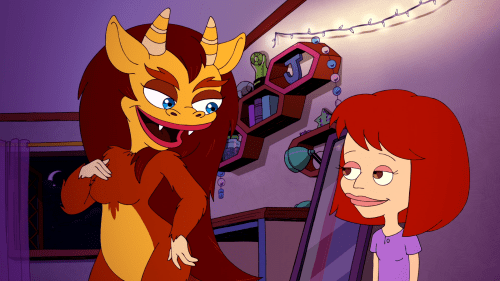
Throughout the show, the main characters, Nick Birch, Andrew, Glouberman, and Jessi Glaser, are often hounded by literal manifestations of a monster that personifies their hormones. It’s never clear whether the monster is invisible or not, but this creature basically says everything the FCC won’t allow teenagers to say out loud.

For the boys, the monster is named Maurice and his advice usually amounts to things like, “Go ahead and jerk off!” or “Look at her tits!” or “Too bad, buddy! You’re getting a boner!” I’m not going to lie. That monster kind of triggered some awkward moments from my teenage years where I found myself thinking thoughts too crude, even for my novels.

The girls aren’t spared from that awkwardness either. There’s another hormone monster every bit as crude, but reserved for female characters. Her name is Connie and she embodies all the alpha bitch, hyper-feminine extremes that Sam Kinison ever joked about. She’s emotional, dramatic, and demands that every female character be confused or overwhelmed by her body. That’s basically puberty in a nutshell.

In a sense, “Big Mouth” is unique in its balanced approach to showing how boys and girls both struggle to endure puberty. That’s rare in most coming of age stories that either focus on horny guys trying to get laid or bitchy girls trying to get popular. This show doesn’t give a pass to either gender.

This is what “Big Mouth” actually gets right about puberty, to some extent. It’s not just overwhelming and frustrating for one gender. The male experience is unique. They have to deal with constant erections and that annoying voice in their head urging them to think dirty thoughts about anything that even looks like a beautiful women.

Since I’m a man who has more than his share of bad memories from my awkward teen years, that’s a sentiment I can appreciate. However, it’s the female perspective in “Big Mouth” that I found most intriguing. The idea that girls are just as freaked out about the changes in their bodies, minds, and everything in between shouldn’t be such a novel concept, but this show goes out of its way to belabor it.

Now, I don’t know for sure that the girls I went to high school with had an actual hormone monster on their shoulder, telling them to cry irrationally at a moment’s notice or lash out at anyone who dared to look at them the wrong way. It’s just somewhat refreshing to think that teen awkwardness knows no gender.

If gender balance is a strength in “Big Mouth,” though, it’s biggest weakness is portraying how the characters deal with it. The show is so over-the-top with the extremes of puberty that it’s hard to glean a meaningful story from it all.

It’s not just that puberty takes the form of actual hormone monsters that sound like uncensored commentary from a bad porno. It’s not that the show makes puberty sound overly traumatic either. There’s never a sense that the characters, even Jessi and Nick, actually grow through the experience. That’s kind of a big oversight with puberty.

From a purely biological standpoint, puberty is the maturation of a child into adulthood. That maturation part is never even hinted at in the show. After watching the first season of “Big Mouth,” it’s hard to imagine any of the characters involved growing into functioning adults.

In the real world, puberty tends to bring out the best or worst in a person. If someone starts becoming an asshole in puberty, they usually stay that way into adulthood. If someone shows an ability to deal with it and grow, as a person, then they’re usually in good shape. It can even get pretty hilarious when both kinds of people have to deal with one another. Unfortunately, we don’t get that with “Big Mouth.”

I won’t go so far as to say the show is terrible. It does have its moments and some of those moments are genuinely funny or insightful. It is, as the end of the day, an overly comedic take on the rigors of puberty. It doesn’t try to be coy or deceptive. It doesn’t try to use colorful metaphors involving flowers or cucumbers. It gets right down the dirty, gritty details.

I can see the show appealing to those who suffered more during puberty than most. I can even see the show appealing to “South Park” and “Family Guy” fans. It’s hardly a guide or a warning with respect to the rigors of puberty, but it reflects a common truth. Being a teenager sucks and puberty is a big reason why.

Leave a comment

Filed under gender issues, Marriage and Relationships

How Some People Get Bored With Sex (But Not In The Way You Think)

I’ve talked a lot about the crippling effects of boredom, as well as its potential to become a plague in a future. Make no mistake. It is a powerful force, one that has led to at least one ghastly murder in the modern era. That means it’s more than powerful enough to effect our sex life.

It’s something I’ve been meaning to explore for a while, but I haven’t found the right context yet. I don’t want to just talk about how boredom may one day render sex as dull an affair as getting your tires rotated. Considering few, outside of those with a serious car fetish, ever achieved orgasm through general automotive care, extracting the impact of boredom on sex requires a special approach.

Unlike that toy you got sick of as a kid or that brand of cereal that just doesn’t do it for you, sex is a major biological imperative. In the same way you can’t get bored with surviving a bear attack, you can’t necessarily get bored with sex in the same way. That’s not to say boredom doesn’t find a way. It just has to be sneaky about it.

That brings me to an article out of Germany from Deutsche Welle, which explored the reason why men lose their sex drive as they age. It may seem like one of those obvious issues that doesn’t need much thought. It makes sense that men will lose their sex drive as they age. Pretty much every other bodily function declines as we age so why not our sex drive?

This is where I give credit to the Germans for something other than beer and bratwurst. They try to break down the components of this seemingly-obvious idea that our interest in sex declines as our bodies decline and we get more prone to boredom, among many other things. What they describe is somewhat revealing.

But what if you are bored of sex, bored of all the humping, grinding and groaning, the bad breath and false teeth, and the pretending you’d rather do this in that way than watch the footie, or, I don’t know, clip your toe nails?

Don’t laugh: it can happen.

A study published in 2017 by BMJ Open reported that 15 percent of men and 34 percent of women among the participants had experienced “a lacking interest in sex.” This was based on a survey of 4839 men and 6669 women, aged between 16 and 74, in opposite-sex and same-sex relationships.

Now, the numbers are not all as straight forward as that. There are various reasons why people lose or lack interest in sex, and not all of them are about age, but they are similar for men and women.

For instance, if you’ve experienced what the researchers call “non-volitional sex” or if you’ve had a sexually transmitted infection, you may lose interest. Being unemployed is downer too. Interestingly, though, retired women were “less likely to lack desire.” Also, and this is odd, having sex will actually lower your interest in it. Who said sex gets better with practice, hey? Instead it sounds like laying off and getting some kip will do you wonders.

The bold parts are my doing. I wanted to single those out because they highlight some variation among certain individuals and not just in terms of how much blood they can direct into their genitals. Life experiences, for better and for worse, can very much affect how we view the world, which includes sex, romance, and boredom. Certain experiences are more influential than others, to say the least.

This is where the article gets a little coy, mentioning both the late Hugh Hefner and societies with more uptight attitudes towards sex. On one end, you have Hugh Hefner, who lived well into his golden years having sex with beautiful women a third his age. On the other, you have people who have been taught about sex through scare tactics and conditioned to see it as some crippling addiction to be overcome.

Hugh Hefner Gründer Playboy Magazin Bunnies (picture alliance / Globe-ZUMA)

Needless to say, those wildly varied experiences are going to produce equally varied results, if not more so. Hefner, whether by natural endowment or just being surrounded by so many beautiful women, didn’t get bored with sex. Age didn’t slow him down as much as it required him to get creative. Given how great a motivator sex can be, that makes sense.

It makes just as much sense that someone who has had negative experiences with sex will also be likely to avoid it or get bored with it quicker. To them, sex isn’t just this fun activity you can do in a hot dub with a bunch of Playboy Playmates. It’s this big, stressful ordeal that everybody tells them should be stressful. As a result, we tend to get bored more readily, if only to avoid the stress.

This is the key in understanding how certain people get bored with sex and lose their desire. That’s not to say that if we all lived Hugh Hefner’s life, as though our imaginations aren’t lurid enough, we would never lose our sexual prowess. It’s more a matter of how we condition ourselves.

Some of it is physical. Hefner was in great shape for a man his age. Being surrounded by beautiful women and working so hard to become the epitome of the Playboy lifestyle has a way of keeping a man motivated to be healthy.

Some of it is mental, as well. Attitudes go a long way towards influencing how we see ourselves, how we act, and how others react to us. When our thoughts and attitudes about sex are shaped by the prudish proclivities of the FCC and the Vatican, they’re going to shape how we approach those ideas, even if they are hard-wired into us.

When we see something as stressful and daunting, it’s going to require more of our energy, even if we need it to survive and propagate. Eventually, we’ll get tired of that stress and output, more so than the act itself. In a sense, it’s not so much that people get tired of orgasms. They get tired of what they have to do to get them and how they have push themselves to do it.

There are cases, such as those with serious health problems, that can’t avoid that kind of stress. Those cases are tragic, but it’s the mental cases, which are more directly influenced by boredom, that are their own tragedy. The sheer variation of how people conduct themselves sexually as they age is proof of that. The article even touched on it.

Men don’t experience a menopause, as women do in the 40s or 50s, but the lower testosterone levels are cited as a reason why older men have fewer orgasms – from an average of three per week in a man’s 20s to less than one a week in his 60s.

But this is no “hard and fast” rule. Plenty of men and women continue to enjoy sex well into their 70s and sometimes into their 80s. And we haven’t even touched on masturbation. You may find that comforting.

Again, the bold parts are my doing. I apologize if they evoke mental images that you could’ve done without, but those images of wrinkly bodies and sweaty liver spots should help emphasize the point I’m trying to make here.

It is possible for people to sustain their interest in sex over a long period of time. It’s also possible for people to get bored with it, but that boredom often has a larger context with larger implications.

It’s sure to become more obvious as we live longer lives and are better able to overcome the physical limitations that keep us from having sex in our 90s, as the pharmaceutical industry has shown. It will likely become a larger issue for couples and individuals alike. Whatever happens in the battle against boredom, I intend to continue fighting it with this website and my sexy novels.

1 Comment

Filed under gender issues, Love Or Obsession, Marriage and Relationships, War on Boredom

The Lessons (And Misguided Agendas) Of The Harvey Weinstein Scandals

I promise I’m going to stop talking about the Harvey Weinstein scandal at some point. I know everyone is probably sick of it. Make no mistake, I’m sick of writing about it. Unfortunately, it’s one of those issues that grows way beyond its original context.

It’s not enough to highlight the sheer breadth of the transgressions committed by such a powerful man. It just has to be part of a larger issue that brings out the best and worst of all those eager to comment on it, myself included. Never mind the fact that Weinstein is being punished severely for his many transgressions. People just have to make it part of a much larger agenda, and not necessarily for the right reasons.

It’s that component of this tragedy/crime/outrage that compels me to keep talking about it. Make no mistake, I’d much rather be talking about resolving love triangles in superhero comics and products made specifically for female breasts. However, I see the massive uproar over the Harvey Weinstein affair as entering dangerous territory.

Now, I don’t deny the good that this scandal has inspired. Sexual assault is a serious crime and powerful men like Weinstein have too long a history of getting away with it. In a just and peaceful society, these kinds of crimes shouldn’t be overlooked. That said, there’s a big difference between pursuing justice and a misguided moral panic.

To provide some context, there’s plenty of recent history that should provide some perspective to the ongoing outrage. Back in the 1990s, before hashtags and dick pics, there was a huge outrage over the impact of violent video games and the role they played in mass shootings like Columbine.

Never mind the fact that there’s no established causal link between violent video games and actual violence. Never mind the fact that all available data has shown an overall decrease in violence over the past several decades. The moral panic allowed people with agendas to pursue those agendas to the utmost, even when the truth isn’t on their side.

This brings me back to sexual crimes committed by men like Harvey Weinstein. What he did was egregious. What he did to his victims, if even half-true, warrants full prosecution to the utmost. Unlike the panic over violent video games, this issue involves real people who were subjected to real harassment. That’s beyond dispute.

Unfortunately, the media, the public, and everyone with a Twitter handle aren’t content to just ensure that Weinstein faces justice for his crimes. They just have to turn it into a kind of rallying cry that exposes the depths of misogyny, corruption, and abuse. It happened with video games in 2014. Now, it’s happening again.

It’s getting dangerous because people who express concern about the implications of taking every accusation of sexual assault seriously are being labeled sexist, misogynist monsters. Like many moral panics before it, there comes a point where anyone who doesn’t subscribe to the panic is guilty of thought crimes that deserve the kind of scorn that even George Orwell would find excessive.

We’re already seeing this happen as everyone gets in line to voice their outrage and virtue signal, accordingly. In wake of the Harvey Weinstein scandal, everyone seems eager to become the hero in the battle against powerful men abusing vulnerable women. I’ve mentioned before how that kind of mentality is dangerous and misguided. We’re seeing a similar mentality emerge as everyone seeks to push their agenda.

Among those pushing that agenda include our friends at Cracked.com, a website I usually enjoy and often cite on this blog. They’ve already jumped at the chance to push an agenda, conflating the Harvey Weinstein scandal as an indictment of all men who ever dared to lust after a pretty woman.

It’s not just websites like Cracked either. There’s already a hashtag on Twitter called #MeeToo that has people recounting their experiences with sexual harassment and sexual assault. I don’t doubt that there are plenty of these stories that are both disturbing and true. However, there is a context to consider.

Sexual assault is a crime. It’s prosecuted like a crime. Like all crime, there are standards by which to process it. Chief among those standards is evidence. Those voicing outrage over the fact that neither Weinstein, nor Bill Cosby, are being charged with a crime is seen as a failure of justice. However, there’s another point to consider.

Sexual assault is hard to prove. So much of the evidence relies on testimony and in a court of law, that often gets conflated with anecdotal evidence. Science has revealed, time and again, that eyewitness testimony is among the least reliable forms of evidence you can have. Without better evidence, the high burden of proof that comes with a justice system that presumes innocence takes over.

In a sense, I can understand why those lamenting over men like Weinstein are so furious. It is frustrating to think that a man can commit such crimes against women and get away with it. In that frustration, things like facts and context tend to lose meaning.

I still don’t doubt that men like Weinstein and Bill O’Reilly are guilty of making life miserable for women. However, the extent and veracity of that misery is hard to quantify. The fact that they haven’t been charged with sexual assault tells me that the evidence just isn’t strong enough, even if it occurred. Where the justice system fails, though, mobs of hate and disdain will fill the gaps.

While that can help the voices of victims, it can also be dangerous. It can, in some respects, drown itself by claiming everything is harassment, everything is sexist, and everything is some sort of agenda to silence women. People want to believe that they’re Superman and men like Harvey Weinstein are the Lex Luthors of the world.

At some point, though, outrage burns itself out. Our collective capacity for emotional catharsis has its limits. Once it reaches that limit, we start rolling our eyes and become numb to it. For something as serious as sexual assault, we cannot and should not let that happen.

That’s a challenge, though, when everybody is so eager to virtue signal and ally themselves with the so-called right side of history. By over-blowing the outrage, victims of true sexual assault get lumped in with those who just didn’t like the person flirting with them.

Since harassment is so subjective and some people are more sensitive to it than others, the context will often get skewed. However, a scandal like Harvey Weinstein provides a sense of clarity on an issue that is so frustratingly subjective.

Therein lies the issue, though. Harassment, unlike assault, is subjective. Sexual assault is not. One is an emotional reaction. The other involves real, physical harm. Conflating one with the other is a dangerous precedent that will make people more reluctant to interact. As a fan of love, intimacy, and sexy novels, that’s not a world I want to live in.

9 Comments

Filed under Celebrities and Celebrity Culture, gender issues

The (Kind Of) Silver Lining To Recent Sex Scandals

Given the number of lurid sex scandals that have popped up in recent years, and not just the ones I’ve mentioned, you can be forgiven for thinking that there’s an epidemic of powerful men being a dick to women. Go to any social media site or comments section and you’ll usually find angry rants that are nothing short of apocalyptic.

I certainly don’t blame people for being angry about these scandals. What the Harvey Weinsteins, Bill O’Reillys, and Bill Cosbeys of the world have done is egregious. There are no excuses for being that unapologetically crude.

These are men in positions of power. They know, on some levels, that they have leverage that they can use to exploit others. It’s impossible to know whether they would do what they did without this power. So few people have that kind of power that it’s difficult and disturbing to know how most people would use or abuse it.

At the end of the day, though, they still decide whether or not to exploit their power for personal gain. Even if they’re able to cover it up for years, it’s still their choice and it’s all the more egregious.

As bad as these scandals are, though, I think it’s worth taking a step back to acknowledge an understated upside to this string of lurid news. It’s easy to forget sometimes that good news hides in the shadows of bad news. In fact, good news in general tends to hide behind the glut of horror and dread we’re fed every day by the media.

So what kind of good news can we possibly glean from the increasingly lurid sex scandal involving Harvey Weinstein? What good can come out of any sex scandal where a powerful man exploits his position to seduce desperately driven women? Well, if you’re willing to look beyond the infuriating details, it’s actually pretty revealing.

It’s getting MUCH harder for people to get away with sex scandals in general.

Think about it for a moment. Take a step back and look at the world we’re in now, with respect to sex scandals. Ignore, for a moment, the extreme voices from radical feminists and men’s rights activists who would use this scandal to push an agenda. The fact that everyone is so outraged by this scandal should count as good news.

Very few people are making excuses for Harvey Weinstein. Former allies are abandoning him. His wife is leaving him. The film industry that he helped expand is cutting ties with him at every turn. Despite being such a powerful, influential figure in Hollywood, this lurid scandal is costing him dearly.

Compare that to how scandals of the past often unfolded. Other than hilariously dishonest tabloids claiming that Madonna had a secret affair with Martian ambassador, most scandals rarely drew this kind of scrutiny and condemnation.

One of the most infamous examples is that of O.J. Simpson, who had a documented history of spousal abuse prior to the murder of his ex-wife, Nichole. However, despite this abuse, he was still largely a beloved celebrity figure. He was so beloved that some people just refused to believe that he was the kind of monster who would beat a woman.

If O.J. Simpson had carried out such abuse today, it would trend on social media immediately and there would be no way to sweep it under the rug. Say what you will about the prevalence of the internet, but it does carry out one important function. It makes hiding bad, sometimes criminal behavior a lot harder.

Go back 30 years and it was possible, albeit inconvenient, for someone with money and influence to hide a scandal. They just had to pay off the right people, sweet-talk the authorities, and have some damn good lawyers. When used wisely, it’s like it never happened.

Fast forward to today and no amount of money, influence, or overpaid lawyers can stop some random person with a smartphone from tweeting about a celebrity having a major meltdown or cheating on their spouse. Once it’s online, it’s next to impossible to stop.

Now sometimes, this can be a problem. Every now and then, a false rumor will start trending and lead to a lot of frustration. However, given the breadth and speed of modern media, it tends to correct itself. Once a rumor is obviously false, it tends to disappear quickly.

When it’s not a rumor and there’s a lot of digital evidence to back it up, as was the case with Harvey Weinstein, social media does not hold back. No amount of lawyers, PR agents, or hit men can stop it. Once the lurid truth gets out, people will respond and the internet ensures their responses won’t be filtered by the FCC.

This is where we, as a society, show another kind of progress. When it comes to powerful men exploiting women, we as a people have very little tolerance for that these days. We’ll tolerate a certain amount of douche-baggery, but when it becomes criminal, most people draw the line.

Harvey Weinstein is now paying the price. While I think it’s still important to see how valid the accusations against him are, the amount of evidence that has come out thus far leads me to believe that a significant chunk of these lurid stories are true. For what he did, he should pay a price.

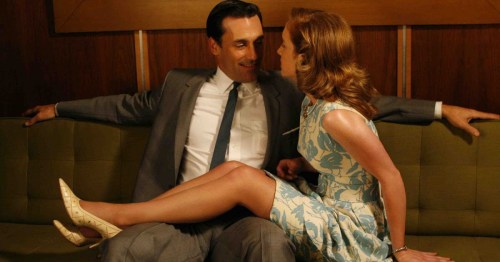
Given the price he’s already paid, in terms of his reputation and loss of job opportunities, it sends a powerful message to powerful men. This isn’t the era of “Mad Men” anymore. You can’t expect to get away with these kinds of sex scandals anymore. Social media and the reactionary masses that use it will find out. When they do, you will pay a huge price.

In a world where powerful people can get away with atrocious behavior, some of which is downright criminal, it’s hard to have faith in people. While our world is far from perfect, I think the response to the Harvey Weinstein scandal shows that we’re making progress.

Even powerful men like Weinstein can’t hide their misdeeds anymore. People today are far less willing to turn a blind eye to these kinds of crimes. It won’t completely eliminate the kinds of lurid scandals that frustrate celebrities and titillate gossip magazines, but it will ensure that those kinds of scandals will be much harder to avoid. It won’t stop certain people, but it will help prevent them from using celebrity to hide their misdeeds.

12 Comments

Filed under Celebrities and Celebrity Culture, Current Events, gender issues