Tag Archives: social psychology

The Attention Economy (And Why It’s Ruining The Internet)

Here’s a little pop quiz that most people will probably fail. What is the most valuable asset in today’s modern economy? Go on, take a few minutes if you have to. I know it sounds like an easy question to answer, but it’s still worth thinking about.

Is it gold? Historically, it is one of mankind’s most valuable materials.

Is it money? That makes sense. People call it the root of all evil for a reason.

Is it knowledge? Smart people can be pretty damn successful.

Actually, it’s none of these. Even money, that one major driving force behind every major heist movie, is not nearly as valuable in today’s economy as it was 50 years ago. If anything, it’s losing its value and becoming an increasingly esoteric concept, so much so that we consider bits of computer code to be money.

There is, in fact, one other asset whose value exceeds them all. We know this because businesses, artists, and even horny people trying to get laid go to obscene, if not annoying, lengths to get it.

That’s right. I’m talking about that most precious of assets that drives the entire modern economy. I’m talking about attention.

Yes, that word deserves bold and italicized fonts. It’s just that important. It may seem like hyperbole to those still used to picking out pocket change between couch cushions. It’s not like you can tip a stripper with attention. However, give it just a little bit of thought. It won’t take much to realize just how important it is. It doesn’t just drive the economy. It drives (or hinders) our love lives.

I know this because it ties directly into my ongoing efforts to be an erotica/romance writer. It also ties into my efforts to make this blog a successful supplement to those efforts. There’s a good reason I try to avoid overly boring topics and talk about kinky things that both raise eyebrows and moisten panties. It’s a way for drawing attention to my work. It is, without a doubt, the greatest challenge I face as a writer.

Talk to anyone who has ever worked in marketing, whether it’s selling books or diamond-encrusted dildos. They’ll probably say the same thing, although the people selling dildos will probably have better stories. The hardest part of selling anything is getting peoples’ attention.

I know I keep referencing this same famous movie clip, but it’s just that powerful. It keeps finding new ways to be applicable to so many things, from making money to finding love. There’s a reason why Alec Baldwin won an Oscar for it. It’s the same reason why you don’t hear from a lot of other Baldwins these days.

Between the bragging, bullying, and brass ball props that Baldwin’s character uses, the most important part of his distinctly de-motivational speech is the A.I.D.A. method he describes. That’s attention, interest, decision, and action. Every major marketing method follows this model to some extent, but it’s that first step that is most vital.

It’s also the step that is most difficult, especially in the era of 350 channels, YouTube celebrities, and internet memes. For most of the modern era, we had only a handful of TV channels, newspapers, and methods for disseminating information. It used to be that a few strategically placed commercials during the Super Bowl would be enough to generate the attention you needed.

Those days are deader than analog cables and betamax. Instead, you have hundreds of channels containing countless shows, stories and sites doing anything and everything to get every last second of your attention. Is it really that surprising that the gratuitous violence/nudity on “Game of Thrones” and iconic franchises like “Star Wars” have become the new standard?
These things get your attention. These things get people talking. It’s only after you have someone’s attention that you can even begin to plan on how you’ll get them to pay for your product and/or have sex with you. In an era of so many choices and so few opportunities, attention might as well be encrusted in polished diamonds.

It’s because that attention is so valuable, so much so that it’s become the main currency of the modern era, that the internet is changing and not necessarily for the better. Spend more than five minutes on the internet, whether you’re checking your email or watching porn, and chances are you’ve run into a little something called clickbait.

In the attention economy, clickbait is akin to the muggers who beat up sick orphans while drunks throw pennies at them. It is the clogged toilet and overflowing septic tank of the internet. They are sites, ads, and shady tactics meant to draw you away from productive activities, like checking your email or reading this blog, and into some buggy, browser-crashing site meant to extract your attention and credit card information.

We’ve all seen them. The names of the sites and the annoying ads they post are ridiculous. Sometimes, it’s painfully obvious. However, it’s still tempting at times to click on them and that’s exactly what makes clickbait so evil.

Like it or not, people need to make a living. Websites need to make money. I need to make money. I can’t tell sexy erotica/romance stories without a roof over my head, food on my plate, and a reliable internet connection. That’s why I promote my novels every chance I get. I haven’t resorted to clickbait yet, but it is tempting. It’s also very frustrating.

I’ve seen the same internet as everybody else. I’m just as annoyed by the abundance of clickbait as everyone else. It’s hard to even trust the text within a link these days. At the same time, however, I can understand the intent behind it.

People are trying to make money. They can’t do that unless they get the attention of customers. The problem is that as the size and prevalence of the internet has increased, our capacity for attention has not. We humans only have so much brain matter in our skulls. That brain can only give a finite amount of attention to a handful of things at any given time.

Until we can start augmenting our brains, which Elon Musk is working on as we speak, this limitation isn’t going to change. We’ll still only be able to give a certain amount of attention to ourselves, mass media, and each other. As such, the amount of clickbait we see on the internet is only going to increase. The sheer absurdity of the headlines is likely to increase as well. I’ll give everyone a moment to shudder.

It’s unavoidable, but understandable. The internet may seem infinite, if only because of the varieties of porn it stores, but it’s not. It can’t run itself for free either. It needs to make money somehow and nobody seems to want to pay for it. Why else would some people resort to Kickstarter, which is basically digital begging, to fund movies?
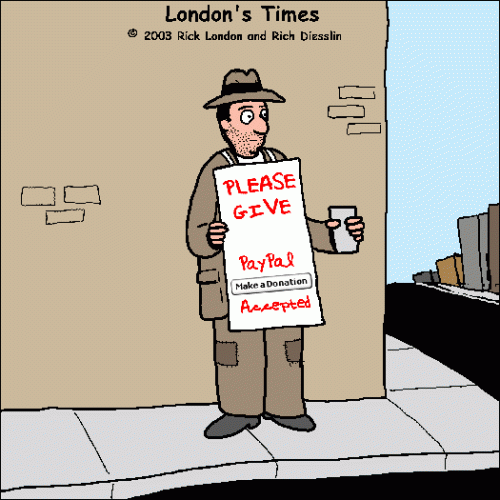
We’re all guilty of it. I certainly am. I’ll whine constantly about pop-up ads and video ads on a site, but refuse to pay the extra $10 for the “premium” version that removes the ads. While some feel that kind of service is exploitive on the same level as price gouging for medicine, it makes sense. Again, the people managing these sites need to make money and nobody seems keen to want to give it.

The internet will continue to evolve, as it always has. That evolution will be driven primarily by a desire to turn a profit. Unfortunately, no profits can be made unless someone gets enough attention first. As evil and annoying as clickbait may be, we have only ourselves to blame for its existence. At least for now, it’s here to stay. The best we can do is grit our teeth, read some sexy novels, and endure.

9 Comments

Filed under Jack Fisher's Insights

How To Break A Taboo (Or Stop It From Becoming One)

It’s not easy talking about taboos, sexual or otherwise. It’s kind of in the definition. Taboos, by default, are hard to talk about and hard to make sense of. Some don’t even make sense indirectly. If you’ve seen more than two seasons of “South Park,” you understand that.

In talking about weird taboos and the quasi-logic behind them, I try my best to make sense of them. We all have to do that to some extent over the course of our lives. I just try to do it in a way that’s sexy and could potentially lead to sexy stories that I can turn into novels.

While every taboo is unique in the sense that it’s uniquely weird, they are prone to fads, trends, and people just getting bored of them. As I’ve pointed out before, there are certain innocuous behaviors that we do every day that most used to be on par with public masturbation.

A lot of taboos fade over time, often as new generations enter the picture and form taboos of their own. Some linger and refuse to die gracefully. That’s why we still have blurred female nipples on cable TV and not a hint of BDSM in the “Wonder Woman” movie. I refuse to believe that there’s any justification for blurring nipples on network TV in the area of ubiquitous internet porn.

There’s no doubt that we’ll be dealing with taboos for as long as we’re a bunch of cavemen running around with smartphones and nuclear weapons. That may change when we get around to upgrading our brains, but even that may inspire a whole host of taboos that we can’t begin to imagine, although I did try.

For now, there aren’t many ways to break a taboo or stop something from becoming taboo. In some cases, it’s downright impossible. No matter what you do, people are going to get weird around certain proclivities, some of which involve some pretty kinky fetishes. Look up something called “cake farts” and try to find a way to not make that weird.

While there may not be a way to completely eliminate some taboos from our society, there are some ways to confront them. It is possible to break certain taboos and/or avoid them from becoming one altogether. Now, that’s not to say it can be done overnight or with a few strategic tweets. People are really stubborn when it comes to taboos, but they will come around if the conditions are right.

With that in mind, here are some of my tips on breaking and/or circumventing taboos. A lot of these tactics can apply to the sexy kind of taboos, but they also apply to others, many of which involve poor people and minorities. Again, don’t take this as a magic pill or something. Breaking taboos is hard and for good reason. We’re a petty species, but we can be reasonable if the conditions are right. That’s a big if though.


Tip #1: Make Taboos Profitable And Lucrative For Business Interests

This probably won’t surprise anyone who tips generously and has never found used bubblegum wrappers on their pizza. Money talks. It talks a lot. It also influences, more so than we’re comfortable admitting. It can, and often is, a source of corruption. In some parts of the world, that corruption is a big part of the economy. When there’s money to be made by politicians and business people, it can get messy.

That said, it’s a two-way street. Money and business interests can be corrupt, but that same corruptive force can be channeled. We’re seeing that with the growth of the marijuana industry. We saw it with the rise of the porn industry. These industries generate billions of dollars. That’s a lot of money by any measure.

No matter how regressive or uptight people may be, when there’s money to be made, people generally follow the money. A taboo that makes nobody any money is easy to clamp down on. A taboo that generates billions of dollars and significant tax revenue is a lot harder to fight.

While I don’t agree with Gordon Gekko’s famous quote about greed, it can sometimes work to others’ advantage. When it comes to legitimizing a taboo, being profitable and taxable on some level really goes a long way. At some point, the money just overpowers the weirdness.


Tip #2: Make Taboos Expensive To Preserve

This is more a preventative than confrontational measure. After a taboo becomes entrenched, it can usually find ways to endure any number of expensive lawsuits and litigation. Just look at the Church of Scientology. Truly robust taboos will find ways of exploiting the legal system to their advantage.

If you have a chance to be proactive, though, the legal system can work for you. It’s not too hard to sue for discrimination or harassment, these days. If you’re a minority, it’s even easier and you may end up on the news with Bernie Sanders. They key here is to focus more on the bigger picture, though. One lawsuit alone isn’t going to break a taboo. Many lawsuits, however, will make it impossible to maintain.

This is how a lot of our modern anti-discrimination laws emerged, using a series of successive lawsuits that made preserving old taboos too damn expensive. People may be stubborn, but when it comes to getting their lawyer’s bill, they will eventually grit their teeth and change their perspective. Even if they have the money to pay the lawyers, you can’t always put a price on frustration.


Tip #3: Make Sure Taboos Scare And/Or Inconvenience Rich People

This is one of those uncomfortable, if not infuriating, aspects of taboos and social norms. There are usually a disproportionate number of them that are directly effected, or in some cases imposed, by the rich and powerful. Taboos can be a form of excuse banking, helping rich people justify their treatment of the poor and minorities.

That’s how many people justified segregation, slavery, and feudalism. The system was such that any changes would’ve grossly inconvenienced the rich and powerful. In some cases, it might have completely ruined them.

Say what you will about rich people. They can afford to accept such criticism. They, like any other rational human being, seek to preserve their resources and their power. That’s the entire theme of the “Star Wars” movies. If giving minorities equal rights or allowing women to show their tits in public somehow undermines profits or power, then you can bet they’ll fight it with every ounce of their considerable resources.

Conversely, the act of frustrating the rich can help break taboos and even end them. Rich people want more money. Powerful people want more power. One of the major problems with segregation, among many, is that it effectively cut off an entire customer base. Once minorities could work and earn money, they wanted to do what everyone else does and spend it. The desire to spend money knows no race or gender.

Eventually, rich companies will want that money. At the same time, powerful people will want those votes and support. At that point, a taboo’s days are numbered. Being a racist asshole may be fun for some people, but it gets old fast once it starts costing money.


Tip #4: Make A Taboo Boring Or Bland

I’ve spoken before about the power of boredom. It can create super-villains and drive teenagers to cold-blooded murder. It is a powerful force, one that’s plenty powerful to break a taboo.

It’s not easy, though. In fact, I would argue that this is probably the hardest tactic to use if you’re trying to combat a taboo. Taboos usually emerge because something gets a rise out of people, often revulsion or outrage. It’s hard to temper that sort of thing. However, it can be done.

It’s happening right now with taboos surrounding marijuana. When I was growing up, the mere mention of marijuana conjured fear and horror. These days, it mostly conjures scenes from Seth Rogen movies. You could make the argument that public attitudes changed because of growing awareness of the effects of marijuana compared to alcohol. I would argue that the debate just got too boring.

Now that marijuana is becoming a full-fledged industry, there’s a financial incentive to break the taboo. However, it’s the lack of horror and outrage that comes with smoking a joint these days that really undermines the taboo. Say what you will about Seth Rogen. The man isn’t exactly scary. Without that fear, boredom usually follows.


Tip #5: Give A Taboo Political Connections

This is another aspect of making a taboo too expensive to preserve. Sometimes, it’s just not enough that taboos cost businesses money, as racial segregation often does. Even when the economics are on your side, you still need powerful allies when combatting or preventing a taboo.

This is where it pays to have powerful friends who owe you money and/or favors. You don’t always need compromising pictures of them either, but that can help. This is a big part of how the gay rights movement got off the ground. They had the support of billionaires and well-connected individuals who could influence people in power. Money talks, but sometimes political connections shout.

Again, it can cut both ways. There are billion-dollar organizations that fight to preserve taboos, but at least it’s a level playing field. Unlike the working poor, some taboos have billionaires who spend time, money, and favors to fight them. That’s a big part of how same-sex marriage became legal.

So as a rule-of-thumb, it helps to have both rich people and powerful connections in fighting a taboo. Granted, those same taboos could use similar tactics, but they’re at the mercy of the same limits. That means that if, despite the battles between billionaires and power brokers, a taboo simply doesn’t jive with our caveman brains, then it’s going to fail in the long run.


Tip #6: When In Doubt, Turn A Taboo Into A Party

This tactic is probably the most enjoyable, as well as the most satisfying. We humans love to party. We’ll look for any excuse to throw a party, have some fun, and take our clothes off without public shame. Taboos can be serious, scary, and depressing. Parties are the exact opposite of that.

Fighting a taboo with a party is like fighting fire with a waterfall. It’s using a diametrically opposing force to combat something. Mix in music, dancing, alcohol, festivities, exposed body parts, and an excuse to leave work early and you have the perfect antidote to a taboo.

This is what Mardi Gras does once a year. This is what Brazil does with Carnival. Taboos, reservations, anxieties, and fears all melt away in the spirit of having fun and enjoying yourself. This is especially potent for sexual taboos. These taboos, and the social norms built around them, tend to be frustrating and difficult for those who preserve them. A party is like a release, one that’s easy and enjoyable for all those involved.

So if you want to start the ball rolling on breaking a taboo, don’t hire a lawyer or make friends with a billionaire. Start by throwing a party. Make it fun, festive, and happy for all those involve. No taboo will stand a chance.


There are probably more tips and tricks for beating taboos that I didn’t list. There are likely a lot more that I didn’t even think of. Again, I’m not an expert. I’m an aspiring erotica/romance writer who tends to overthink certain subjects more than most, be they comic books or sleeping naked.

While I don’t expect these methods to spare us from a future of censor bars and blurred tits, I hope it makes people aware of the mechanisms behind taboos. They’re rarely logical and they tend to reflect certain proclivities in our society that we’d rather ignore. If we’re to make progress as a species, though, we should confront them and, if necessary, kick them in the ass.

4 Comments

Filed under Jack Fisher's Insights

Weird Taboos (And Why They Exist)

When it comes to taboos, we love to laugh at the crazy practices of the past while ignoring the equally-crazy ones in the present. We look at how ancient people used to sacrifice goats, sheep, and parts of their genitals and laugh and/or cringe. Then, we go back to wearing our lucky underwear because we think it’ll help our favorite football team win.

The failure to see the irony in that sentiment reveals the power of taboos. I’ve talked about them before, but usually in a narrower context. Being an aspiring erotica/romance writer, I’m naturally going to focus on the distinctly sexy taboos, as well as the overtly non-sexy ones. I doubt that surprises anyone.

However, taboos actually get much more ridiculous than what we can or can’t do with our genitals. You don’t even have to go back to the Bronze Age to see them. Some of those taboos happened within the past two centuries. Some of our grandparents were alive when they were popular. It’s kind off funny when you think about it, but it’s also kind of tragic.

Recently, our old friends at Cracked.com did a little article on some of the weird/crazy taboos we had in the past. They called it “15 Everyday Things That Used To Be Scandalous.” Today, they seem so innocent. Back then, though, they were a big deal. Breaking them meant social stigma, condemnation, or even arrest. These days, most people are just concerned about becoming an internet meme.

Make no mistake, though. A lot of these taboos are pretty ridiculous, even by non-21st century standards. There’s a damn good reason why they didn’t last or fell out of favor. We humans may be slow when it comes to embracing social change, but we eventually get around to it. It’s just never as fast as we’d like.

To give you an idea of how ridiculous those taboos were, here’s a quick sample from the Cracked article. Remember, they may seem crazy now, but there was a time when simply talking about it would earn you unwanted attention from the nearest constable, priest, or parent/teacher association.

Entry 15

Entry 14

Entry 12

Entry 7

Entry 6

Entry 1

I know. They are pretty ridiculous. I mean soda pop and reading at night? How could that possibly count as taboo? You can kind of understand why people would be a little reluctant about women in bikinis, especially in the days before internet porn, but soda pop?

Ridiculous or not, there are a few common themes in these taboos. If you go back far enough and look at some of the most overt taboos, you’ll notice how a lot of them deal with female sexuality, rebellious teenagers, and empowering poor people in any way. I know that all sound like stuff that angry rich old men whine about when they haven’t taken their meds, but it actually runs much deeper than that.

Taboos don’t happen in a vacuum. People don’t just make them up because they want another excuse to be a dick to each other. We already have plenty of those. There are reasons they often take the shape they do. It’s rarely due to some grand, patriarchal/communist/hippie conspiracy. A lot of it just has to do with people being weary of things they don’t see as “normal.”

I put “normal” in quotes because the very concept of “normal,” even in a legitimate scientific context, is laced with bullshit. However, there is something to be said about the unspoken social norms under which we all live. Those norms, as crazy as they might be, are an integral part of how we function as a society and a species. The fact those norms tend to screw up our sex lives is kind of a nasty side-effect.

The way it works uses a mix of both caveman logic, faulty brain writing, and skewed common sense. We, as individuals and as groups, tend to function better when there’s a sense of predictability. If we can be more certain of how people will react in certain circumstances, then that can help us create a system, of sorts, to carry out the various functions of a tribe or a society.

Think about it. The systems we have for standing in line, driving on the highway, and complimenting someone’s ass all have certain checklists of sorts that we go through in our minds. Not all of them are enforced by laws. Some aren’t even enforced by anything. It’s just one of those basic understandings that we all collectively acknowledge, albeit indirectly.

Here’s a simple example. When I was going through the soul-crushing process that was high school, there was this unspoken taboo on the bus. When you got on, you never just sat in the front seat. You always went to the back and filled it up from there. If you did dare sit up front, you got weird looks, as though you’d just rubbed your ass on the window. Nobody ever talked about why we did this. We just did it.

That’s a fairly simple display of how unspoken social norms manifest. Considering it happened in high school, it wasn’t even the tenth most awkward thing I endured. However, it does help put some perspective into these ridiculous taboos.

Now, take that perspective and add a little sex appeal to it. Suddenly, you’ll sense a few assholes tightening. There’s no getting around it. Even in 2017, we still have weird attitudes towards sex, especially when it comes to female sexuality and teenage sex. We have almost as many weird attitudes about the poor. As such, it makes sense that so many of our taboos are built around both.

To understand the ridiculousness behind those taboos, you have to imagine yourself in a society that’s very different from your own and operates under a very different set of social norms. That’s not easy for some people. Being an aspiring erotica/romance writer, I like to think I have more imagination than most.

You’re living by a certain set of norms and practices. They don’t always seem logical. Maybe you never wear red clothes on a Friday. Maybe you salute every pregnant woman you meet in public. Maybe you shave your ass every other Tuesday as part of some elaborate cleansing ceremony. It can be anything really. The key is that it just doesn’t have to be too detrimental to our ability to survive and reproduce.

By living with these norms and practices, they start seeming right. They seem like this is how society is supposed to function. Anyone who questions them might as well be promoting dead puppies on every street corner. You, and everyone around you, are convinced that these taboos have merit, even when they have no logic behind them.

That sentiment is understandable to some extent, but it’s when you inject sex and social class into the mix that it gets really messed up. As I’ve pointed out before, people have all sorts of weird hang-ups and attitudes about sex. Some of them have some merit, such as the real health issues that often come with sexual promiscuity. Others are more subversive.

The key to any successful society is some measure of stability. To have stability, you need some level of control over various social functions. Like it or not, sex is a major social function. Without it, societies can’t propagate. New generations can’t take over for those that die off. Naturally, people are going to put a lot of emphasis on it, sometimes directly and sometimes indirectly.

This is why you get societies where most marriages are arranged and marrying for love is actually taboo. It’s also why controlling female sexuality is so heavily emphasized. They’re the ones who carry the babies inside them. They’re the ones who nurture them after their born. Since sex makes babies, people are going to want to control it to some extent, as fruitless an effort that might be.

It’s just as bad for the poor. In every society thus far, there has to be some sort of underclass that toils in factories, farms, and various low-paying, low-skilled labor. I say there has to be because, until we can get robots to do it for us, their work is literally the foundation on which civilization is built.

That puts the rich despots, kings, and business people in a tough position. They understand on some levels that if the poor knew how much they were being screwed over and how their toil subsidized the obscenely lavish lifestyles of the rich, they wouldn’t be too happy about it.

That’s why having taboos that discourage laziness, education, and questioning persist. That’s why there’s an entirely mythology around the “dignity of work.” They’re an indirect way of maintaining existing social norms and protecting whoever happens to be benefiting from them from the horrors of inconvenience.

Not every taboo can be attributed to repressing sexuality or keeping the poor in their place, but the dynamics are the same. They have just as much potential to be ridiculous, illogical, and even downright cruel, as many boys can attest. So long as our caveman brains keep using them to preserve our social norms, they’ll always be here. I just hope we can one day ditch those that involve mutilating our genitals.

13 Comments

Filed under Jack Fisher's Insights

Vandal Savage: A Super-Villain Forged By Boredom?

Related image

Boredom can sometimes drive you to do crazy things. Give someone a bunch of paperclips, some sticky notes, and too much free time and wonderful things will happen. It can also inspire some truly horrible acts. I’ve already mentioned the horrific murder of Christopher Lane, who was murdered by three bored teenagers. That’s an extreme rarity, for the most part, but it’s an egregious act that helps highlight the power of boredom.

As is often the case with various human quirks, some of our most iconic characters of fiction are built around the extremes of these innate human traits. Heroes like Superman and Wonder Woman embody the noblest ideals for men and women alike. They set the highest of standards for the best of what humanity can be in terms of heart, compassion, love, strength, and charity.

Image result for Superman

Conversely, the villains that heroes like Superman and Wonder Woman face highlight the worst of the worst when it comes to human depravity. These characters are manifestations of the darkest parts of the human psyche. They show us just how bad humans can get if you give them enough incentive, hatred, and clown makeup.

That’s what makes characters like the Joker, Lex Luthor, and Apocalypse so terrifying. They are personifications of blood-lust, chaos, narcissism, and pretty much every personality disorder associated with Kanye West. They bring out the worst in people. Their conflict with other heroes mirrors the inner conflict many of us deal with.

I’ve talked about the varying differences between the classic hero’s journey and the more nuanced villain’s journey. Thanks to the success of characters like Walter White, Dexter Morgan, and the cast of “Suicide Squad,” there’s been a surge of interest in super-villains and what makes them tick.

Related image

Being a noted comic book fan, I can talk for hours about various villains, how they came to be, and what makes them so evil. I’ve already talked extensively about Walter White and comic book villains like Magneto. These characters embody a certain type of villainy, each driven by a set of motivations that highlight a villainous aspect of our human mind.

Most people are familiar with the villains driven by greed, narcissism, vengeance, or hatred. They’re usually the characters getting punched, shot, or blasted on lunch boxes or posters. Some of them often get compared to real-life politicians. So if villains can embody so many of these defining traits, can one embody the dark side of boredom?

Well, I can say as someone whose love of comics is only matched by his love of nudity that there is. There is actually a character, a major villain no less, whose motivations and evil is very much a product of boredom. Granted, it’s an indirect kind of boredom, but it’s every bit as devious. Ladies, gentlemen, and those of unspecified gender, I give you Vandal Savage, the poster boy for the evils of boredom.

Related image

Some may be confused. I imagine that even some of my fellow comic book fans are confused. Bear with me, though. There is some twisted logic behind this and boredom is a big part of it.

Vandal Savage is one of the most notorious villains in DC Comics. He’s not as well-known as Lex Luthor or the Joker, but then again, very few villains are. While he may not be an evil all-star, he does show up a lot whenever DC’s heroes need a daunting villain to face.

If you’ve watched shows like “Arrow,” “Flash,” or “Legends of Tomorrow,” then you’ve probably seen him show up in both minor and major roles. He’s also been a major villain in the old “Justice League” cartoon. In terms of sheer reach, Savage’s resume is pretty impressive, but his notoriety is not. There are many reasons for this, but some of it has to do with his origin.

Vandal Savage is not exactly on par with Walter White in terms of the journey he took to become a villain. In fact, it’s kind of mundane in terms of substance. He’s actually a real caveman who lived way back in the hunter/gatherer days of 50,000 BC. He would’ve been nothing more than a fossil sample to frustrate creationists had he not encountered an exotic meteor that crashed near his home.

That meteor, which is basically one of DC’s many mystical McGuffins, transformed Savage from a simple knuckle-dragging caveman to an immortal, super-intelligent being. He’s been running around, causing problems for humanity ever since. That means he’s been in the super-villain business for over 50,000 years. He has a lot of experience being an asshole.

There are a great many events throughout the history of DC Comics that highlight just how big an asshole Savage is. He has such a low regard for human life that even Lex Luthor finds him crass. Most of the time, he’s either trying to conquer humanity or destroy it. It’s basically typical super-villain antics.

Related image

However, what sets him apart and what makes him a potential warning sign for us, as a species, is what motivates him. Throughout his history, he’s given any number of typical excuses. He’s a big, mean bully who thinks he deserves to rule the world because he’s smart and immortal. There’s nothing about that to really set him apart from every other Biff Tannen wannabe.

Like many villains, though, writers have given him other motivations. One of the most recent and, by far, the most relevant occurred in major DC Comics event called “Final Crisis.” It came out in 2008 and it had Savage join an army of super-villains in a plot that would’ve essentially undid creation and remake it. Many villains had their share of reasons for joining this plot, but Savage had one that set him apart.

He joined this universe-ending plot for with simple purpose, to end his boredom. That wasn’t an indirect, off-the-cuff comment. That’s what he actually said to Lex Luthor when they talked about it. He wasn’t trying to conquer humanity this time. He just wanted his boredom to end.

Regardless of how Savage’s motivations and presence affected the plot, it’s an idea worth contemplating. Just think about it from his perspective, if you can, and try to get around all that wanting-to-conquer-humanity crap. Vandal Savage is over 50,000 years old. He’s seen, done, and mastered so much that what else can he do with himself?

He doesn’t age. He doesn’t decline, mentally or physically, in any way. As far as he or anyone else knows, he can’t die. He can be shot, stabbed, punched, buried, and everything else that David Blaine pretends to do to himself and he just brushes it off. Nothing about his condition ever changes.

On top of that, he’s super-intelligent. It’s been documented to some extent that very smart people are often prone to crippling boredom. Being so smart, it’s easy for a genius to master a task. Once they’ve mastered it, they get bored with it and look for another challenge. In a sense, idiots have an edge when it comes to killing time. If they’re always struggling with something, they have something to focus on.

It creates a perfect storm of boredom for Vandal Savage because not only is he a genius, he has unlimited time to kill. Being a genius, he can master pretty much any task. In the comics, he’s described some of the jobs he’s had. He’s been a poet, a priest, a laborer, a scholar, a king, a warrior, and pretty much anything a man could’ve been before 1850.

No matter what he does, he’s mastered every single skill and overcome every challenge he’s ever faced. Even if it’s not through sheer genius, the fact he has unlimited time ensures he’ll always figure it out. Given enough time, he could’ve built the pyramids by himself. He could’ve painted every great masterwork in history on his own. He could’ve done all this multiple times, but it the outcome is the same. He still gets bored.

It’s hard to imagine for anybody who still struggles to use a microwave. No matter what Vandal Savage does, be it advanced calculus or conquering a planet, he still has too much time to kill. He can read every book. He can watch every movie. He can solve every crossword puzzle. He can even do it all multiple times and it still wouldn’t matter. He’d still get bored with it. At what point does he get bored with everything?

In a sense, it’s easy to understand why he keeps clashing with DC’s mightiest heroes. That’s one challenge he’s yet to overcome. He still tries to fight them, but they keep beating him. That’s just one of those skills he hasn’t mastered yet. It leads to pain and frustration, but it also leads to intense awareness, arousal, and exhilaration. When you’re that bored, you’ll get it however you can.

The fact that Savage is still a man, an actual caveman no less, also highlights the painfully human component of his struggle. He’s not some advanced machine or alien that has no concept of boredom. He’s still a man. He still feels all the things other humans feel, including boredom. The problem is, after 50,000 years, he’s got nothing left but boredom.

He can’t create meaningful relationships with other people because other people get old and die. He can’t have a family or fall in love because they’ll get old and die too. At a certain point, everybody around him just becomes another corpse-in-the-making. The fact he has such a low regard for human life is not surprising. If anything, it’s remarkable that he shows as much humanity as he does.

It’s impossible for anyone to truly relate to Vandal Savage and that’s part of what makes him a great villain. At the same time, his circumstances and motivations can act as a warning of sorts. Give a caveman unlimited time and unlimited brilliance and what will happen to him? What does a man do when he’s done pretty much everything a man can do to a point where everything seems boring?

As our medical technology improves at fighting disease and enhancing our bodies, more people will be able to live longer, healthier lives. At a certain point, we may be able to live so long that our only real challenge is filling the hours. Living that long turned Vandal Savage into a cold-hearted super-villain. What will that mean for us? Ironically enough, only time will tell.

8 Comments

Filed under Comic Books, Jack Fisher, Superheroes

Why Bigotry And Prejudice Can NEVER Be Resolved (For Now)

https://i0.wp.com/cdn.thedailybeast.com/content/dailybeast/articles/2014/09/28/why-bigotry-persists/jcr%3Acontent/image.crop.800.500.jpg/47066895.cached.jpg

It’s all around us. It generates protests, outrage, and angry rants of every variety on cable news. It floods social media, infects college campuses, and drowns out any and all meaningful dialog that might actually lead to productive change. I don’t even have to reveal it at this point. Everybody knows what I’m talking about on some level or they at least have a vaguely accurate idea.

It goes by many names. Call it racism, reverse racism, sexism, man-hating, homophobia, islamophobia, or transphobia. It all falls under the same overly-divisive rhetoric that is bigotry and prejudice. It always seems to be in the news. It always makes a conversation awkward and unsexy. It seems to get better some days and regress the others.

Now I know I’m making everybody’s panties very dry by bringing this up, but bear with me. This post is not going to get as bleak or depressing as it would if it were a Michael Moore documentary. I prefer to convey a more optimistic spirit to my audience. It puts them in a better mood, which is important if you’re trying to sell erotica/romance novels.

On the surface, though, there’s no way around it. This is as ugly a topic as it gets these days, the concepts of bigotry and prejudice. If it isn’t the stereotypical white male patriarchal types bemoaning how lazy and violent minorities are, it’s the radical left-wing hippies who call everyone who doesn’t support interracial gay couples kissing in the streets Nazi supporters.

It really is a strange, distressing state in which we find ourselves in. There used to be just one extreme in terms of prejudice, namely that which tried to preserve the overtly-unequal status quo that favored one particular group, be it white men or one particular religious group. Now, the extremes are all over the place.

I’ve talked about a few of them, like radical feminism. They’re just one of the many extremes that have emerged in recent years, often in conjunction with trends in identity politics. It’s not peace-loving hippies who put flowers in guns anymore. It’s angry, entitled, hashtag-starting narcissists who go into a Hulk-like rage whenever someone dares contest their utopian worldview.

There’s an extreme for women, who want men to suffer for their historical crimes against gender. There’s an extreme for race, some of which favor completely disenfranchising all white men for their historical crimes. There’s even an extreme for those who dare to use the wrong pronouns when describing boys and girls. Yes, it really has gotten that crazy.

That says nothing about the craziness that has emerged from extremes within religious groups, but we’re all kind of used to that. We expect extremes in religion, whether they’re favoring the execution of cartoonists or demanding that their particular religion be given a right to discriminate. It’s just the same bigotry and prejudice, but with holy decrees and a convenient excuse to not pay taxes.

No matter the extreme, the outcome is the same. It divides people. It makes them angry, unruly, and hateful. It makes the comments section in every YouTube video about feminism and race relations a raging tire fire that undermines whatever faith in humanity you might have had at this point.

It’s as frustrating as it is tragic. It often leads us to ask the same question Rodney King once asked. Can’t we all just get along? Well, with all due respect to Mr. King, I’m sorry to say that there’s a wholly valid answer to that question.

Unfortunately, the answer is a definitive no. We cannot.

That’s not the solemn musings of cynical man who has read one too many BuzzFeed articles. It’s a cold, inescapable fact. However, there is a context here and a fluid context, which means we shouldn’t be too cynical. If anything, we should be even more hopeful.

The reason why prejudice and bigotry exist is simple and it has nothing to do with some vast, elaborate conspiracy by cisgendered white heterosexual males. Any conspiracy involving that many straight men probably involves fantasy sports or a “My Little Pony” marathon. Once again, this immutable problem in our society has roots in our biology.

It’s another byproduct of caveman logic. Those same settings in our brains that haven’t been updated in 200,000 years essentially guarantee that there will always be some level of prejudice and bigotry. The fact we’re able to function as well as we do as a global society is nothing short of miraculous.

To understand why this is, you need to recall the circumstances of our distant ancestors. They did not live in big cities full of a diverse mix of people from various cultures and ethnicities. They didn’t even live on farms in rural towns where cow-tipping counts as entertainment. They were hunter/gatherers, roaming and foraging in small, close-knit tribes.

For most of the history of our species, that’s how we lived. As such, that’s how our brains are wired and that wiring has not changed much. Due to the slow, clunky processes within our biology, it really can’t and that’s the crux of the problem.

Modern neuroscience has revealed a great deal about our brain’s capacity to form groups and cooperate. These groups become tribes and we, being the very social species that we are, come to tie our identity to those tribes. We work with them. We trust them. We rely on them. Most importantly, as it pertains to prejudice, we defend them and make endless excuses for them.

Picture, for a moment, how this works in our hunter/gatherer context. You’re an individual living 100,000 years ago. You have only a loin cloth, a spear, and functioning genitals. On your own, you’re not going to survive for very long. In a fight against a hungry lion, you’re basically a walking snack.

Then, you join a tribe. You ally yourself with other people who can help you, share resources, and give you an opportunity to use your genitals with others in a more enjoyable, intimate way. Suddenly, that hungry lion loses its appetite. One human is easy to maul. A hundred humans, each armed with spears and an incentive to impress fertile women, is much harder.

Being in that tribe, you come to rely on them and cherish them. Being around them gives you a sense of purpose and identity. You come to love and respect them. You form your own rituals and quirks. You sing certain songs. You do certain dances. You wear certain loin cloths that you think are stylish as hell. This tribe makes you feel complete.

Then, one day, you encounter another tribe. However, this tribe is not yours. They look different. They talk funny. They believe weird things. They wear weird clothes. They follow different rules. Everything about them is so strange and that freaks you out, so much so that you cling harder to your tribe.

Maybe there’s something about that other tribe that’s scary. Maybe they have weapons that are bigger. Maybe they have talents that your tribe can’t do. Maybe their food tastes better and their gods are more powerful. This is all causing you some serious stress and when your brain gets stressed, it does a lot of crazy things to mitigate it.

The next thing you know, your tribe goes to war with the other tribe. Your tribe loudly proclaims that theirs is the greatest tribe in the world. Their gods are better, their food is better, and their rituals are better. The other tribe is so wrong and misguided that they can’t be human. As such, killing them or demeaning them isn’t a big deal. It’s no more distressing than putting down a rabid dog.

Now, extrapolate this tribal mentality, carry it out a billion times in a billion ways within large multi-cultural societies, and apply the reaction to the comments section of a Justin Bieber video, and you now understand why prejudice and bigotry exists. You also understand why nothing can be done about it for now.

Remember those last two words though. I bolded them for a reason. This is where I offer readers a sliver of hope. Does racism, sexism, and homophobia truly disturb you? Do you wish that our society could move past it and forge a more peaceful existence? Well, you may live to see that day.

Keep in mind, these traits that make us so hateful and divisive all stem from our brains. It’s that flawed wiring that still thinks we’re hunter/gatherers picking nuts out of elephant shit on the African savanna that fosters so much bigotry and prejudice. We humans are capable of a great many technological and intellectual feats, but we cannot circumvent the wiring of our brains.

Thanks to companies like Neuralink and advances in human enhancement, like smart blood, we are very close to finally tweaking those outdated settings that make us mute certain people on Twitter. It may very well happen in our lifetime. We may see a new breed of humans whose brains can function beyond brutish tribalism.

We don’t know how these humans will think, how they’ll function with those still stuck in caveman mode, or how they’ll relate to one another. If they aren’t as hateful or petty as we are today, then perhaps they’ll find creative new ways to relate to one another, connect with one another, and make love to one another.

We can only imagine/fantasize for now, but I do take some comfort in the progress we’ve made as a species. We’ve done remarkably well, despite our caveman brains. It’s fun to imagine how much more we can do once we update the software. It may make for a more promising future and some very sexy stories, some of which I intend to write.

24 Comments

Filed under Jack Fisher's Insights

Reasons Vs. Excuses: Why The Difference Matters

https://i0.wp.com/www.realmenrealstyle.com/wp-content/uploads/Blame.jpg

Has anyone ever asked you to do something you really don’t want to do? Actually, let me rephrase that. How many times does someone ask you to do something you don’t want to do in the past 24 hours? Let’s face it. Unless you’re a king, a dictator, or Taylor Swift, it’s happened at least once.

Whatever was asked of you, how did you try to get out of it? I know some people will just grit their teeth and do it. Those people deserve ten times the respect they get. Every now and then, if not most of the time, we try to do something to get out of doing what we don’t want to do. Whether you’re in New York City or the Gobi desert, you can’t escape these situations. They’re just part of life.

Whenever we’re in these situations, we usually try any number of things to get out of it. Whether it’s chores, homework, or ballet recitals, we all have our own set of tactics. Some are more elaborate than others.

I knew a kid in school who could throw up on demand. He didn’t even have to put his finger in his mouth. He could just concentrate, cough, and then spew the kind of chunky bile that would dissuade any teacher from giving him an exam. I lost count of how many times that skill got him out of trouble.

Most of us don’t have that talent though. We all still look for ways to get out of things we don’t want to do. I sure have. I don’t deny that. I’m not saying that’s a bad thing either. It’s a good skill to have, knowing how to avoid situations that make you miserable. However, it does reveal an important concept that I find myself noticing more and more as I get older, although sometimes I wish I didn’t.

It has to do with two simple words: reasons and excuses. They both have similar definitions. Most of the time, outside of a scientific context, we use these words interchangeably. For the most part, we understand the meaning behind them.

However, for the purpose of this discussion, as well as future discussions since this is a big topic, I’d like to focus on a particular context. Specifically, I’d like to focus on the situations and justifications we individually use to do or avoid doing something. Make no mistake. There is a difference between a reason and an excuse.

A reason is logical, narrow, and concise. It can be understood by anyone with a functioning brain and verified with simple tools. That’s not to say a reason has to be cold and callous like a Vulcan. It just has to be valid and clear.

I’ll offer a simple example. Growing up, there were a certain set of chores for which me and my siblings were responsible. If we didn’t do these chores, we didn’t get an allowance. It was that simple. The one chore I did most often was mowing the lawn. I didn’t enjoy doing it, but I still did it.

Then, one day, I got sick. I’m not talking about a headache either. I mean I got really sick, so much so that I ran a 102-degree fever. I know because my mother took my temperature twice. I was then bed-ridden for the next two days. Somebody else mowed the lawn, but I still got my allowance because I had a valid reason. My parents understood that. I understood that. There was no need for debate.

Using this same example in lawn care, I’ll highlight why an excuse is so different. If I wanted to use an excuse to get out of mowing the lawn, I sure as hell wouldn’t have chosen something that could be verified. Sure, I could’ve claimed to be sick, but that would’ve been pushing it because they could check. They could take your temperature and see if you’re running a fever.

On top of that, your parents may be really good at knowing when you’re lying. Mine certainly were. It might as well have been their mutant power. They knew when I was lying and if I ever tried, I’d just make an ass of myself.

Plus, lying to your parents isn’t just a dick move. It’s a bad long-term investment. If you lose your parents trust, especially over something as trivial as mowing the lawn, then you’ll give them way too many valid reasons not to trust you in the future, even when you have a good reason of your own.

So in order to make a more valid excuse, you need to come up with something more believable. It doesn’t have to be a lie. It doesn’t have to be completely true either. You could claim you’re depressed that your lover broke up with you. You could say there’s a movie you’d rather watch instead. You could say you just don’t feel like it. These aren’t lies. However, they are still excuses.

The primary trait of an excuse is that it doesn’t physically prevent you from doing whatever is asked of you. It defends and/or justifies your particular decisions, preferences, and what not. Being on vacation in Fiji ensures I can’t physically mow the lawn. That’s a reason. Being in a lousy mood and just wanting to sleep in does nothing to prevent me from operating the lawnmower. That’s an excuse.

With that in mind, let’s take the concept of reasons and excuses to a larger stage. Let’s assess how this applies to the overall process we use in rendering the various decisions and actions of our lives. What we do and why we do it is at the core of what it means to be a conscious human being.

For practical purposes, we like to think that we’re reasonable people. We like to think that we have valid reasons for what we do and why we do it. We break up with a lover because they’re not right for us. We buy organic food because it’s better for our health. We smoke pot because it makes us more fun to be around. Some of that may be true, but we still think of them as reasons and not excuses.

The problem with this is basically everything about it. Once again, caveman logic enters the picture and spits all over that rosy picture we have of ourselves and others. Based on our growing understanding of cognitive science and neurobiology, we have a better idea of how we make decisions and how we justify them.

When it comes to reasons and excuses, the two main factors are choice-supportive bias and cognitive dissonance. I know those sound like terms that Sheldon Cooper would use in a skit on “The Big Bang Theory” that somehow makes him sound like more of an asshole, but unlike 98 percent of what Sheldon says, these concepts are useful.

Choice-supportive bias is our tendency to ascribe positive attributes to the choices we make. It’s also a byproduct of cognitive dissonance, which is just a fancy way of saying our brain feels stressful and uncertain.

In essence, our brain is wired to avoid wrong decisions and for good reasons. Back in the caveman days, if we made a wrong decision, it usually meant we ended up as dinner for a hungry grizzly bear or ate poison berries that made us shit out our lower intestines. We’re alive because of this wiring so let’s not discount its use.

Unfortunately, nature is still a blunt instrument and our brains don’t know we only encounter bears in zoos that charge ten bucks for a soda. That aversion to making wrong decisions is still there, even when we decide something as simple as which breakfast cereal to buy.

With that in mind, we’ll do anything and everything to avoid wrong decisions and the brain stress they cause. Unfortunately, that often means making excuses to reduce the stress and justify our choice, even if it ends up being wrong.

If that weren’t bad enough, our brains don’t run our decisions through a logic filters first. Don’t worry though. That filter is still there in our brains. It’s just not at the front of the line like we all wish it were. If it were, then half the videos on YouTube wouldn’t exist.

Instead, according to current neuroscience, we make most of our decisions on snap judgments and emotions. Then, we’ll use reasons and excuses to justify those decisions after the fact. Unfortunately, since reasons are so rigid and stubborn, we’re more inclined to make excuses. Even if those excuses are mostly true, they’re still excuses.

There are so many other dynamics behind reasons and excuses. There’s no way I’ll be able to cover even half of them in a single blog post. However, there is a reason why I’m discussing this topic and it’s a good reason. It’s applies to both my novels, as well as other topics with very sexy implications.

That reason will become clearer in later posts. For now, consider this a trailer of sorts, minus the cheesy one-liners and explosions. If possible, take a moment to analyze how many excuses you make for your decisions compared to reasons. You may be shocked/appalled/disgusted by what you uncover. I promise you, though, it gets much crazier.

15 Comments

Filed under Reasons and Excuses

The Future (And Caveman Past) Of Privacy

Let’s face it. There are just some things in the modern world that are destined to disappear. Things like coal power, overt racial discrimination, and the Macarena are destined to become relics of a bygone era. Some already have to some extent. Others, like snail mail, poor WiFi, and the Kardashians, can’t go away soon enough.

So what does this have to do with privacy? Why am I even bringing up privacy? Is this another case of an erotica/romance writer having a few too many glasses of whiskey when he writes? Well, except for the whiskey part, those questions already have answers.

For the past couple of days, I’ve been talking about the emerging technologies that will allow brain-to-brain communication. Like an updated iPhone, it’s one of those technologies that we know is coming. It’s just a matter of getting here and having a major company profit the hell out of it.

You may not think it’s likely now, but at some point someone will find a way to make sharing thoughts an obscenely profitable business. We get people to pay for bottled water and a haunted rubber duck. There are plenty of gullible people with money in this society is what I’m saying.

Going back to privacy, it’s fairly obvious that we’re already in the process of ditching it to some extent. It used to be that the craziest, dumbest, most asinine stuff we said in our day-to-day lives never left our close circle of friends. Now, we feel compelled to share all those crazy thoughts online.

Look at me. I’m doing that right now. I’m sharing thoughts I never would’ve shared in polite conversation 20 years ago. Then again, 20 years ago I had a horrible acne problem and the piss-poor social skills of a ferret so it’s not like I was in a position to do much sharing. The internet and social media has changed all that. It’s given us an opportunity to kick our concepts of privacy in the balls and beat it with a hammer into something else.

This has had consequences. Just ask anyone who had an Ashley Madison account a few years ago. It’s bound to have more consequences, especially as an emerging generation matures into a world that has never known the pain of dial-up internet. This is a generation for whom sexting will be akin to copping a feel in the back seat of a car. Admit it. You envy that generation to some degree.

However, it’s the generation after that who may really deliver the final nail in the coffin of privacy. That generation will likely come into a world where brain-to-brain communication has matured, is a growing business, and has people bitching about fees for sharing certain thoughts. How will that generation view privacy?

Well for once, we really don’t need a thought experiment or some exercise in existential logic. In fact, we need only a history book and a general understanding of how humans form tribes. Go to any message board that celebrates a certain romantic pairing on “Buffy The Vampire Slayer.” It doesn’t take much.

Nature has wired our bodies to be good at a lot of things, albeit in hilariously crude ways. Just look at the design of the male scrotum. However, one design that has been remarkably efficient is our ability to form tribes and groups. It’s that kind of coordination and cooperation that has helped us dominate this planet, build civilizations, and form Hugh Jackman fan clubs.

It’s also this uncanny ability to form tribes that’ll make the techno-telepathy of brain-to-brain communication so appealing to future generations. It may seem crazy now to those of us who still dread the thought of someone hacking our phones and sharing all the embarrassing pictures of us on FaceBook. I’ve always worked under the assumption that someone has already hacked my phone and that keeps me from capturing anything too compromising in my private moments.

However, with techno-telepathy, there’s nothing left to compromise. Everything is laid out for someone else to see. Your hopes, dreams, fears, and perverse sexual fantasies are all laid out in a beautifully rendered image. Can we even cope with that kind of transparency?

Well, the average congressperson notwithstanding, we have kind of done it before. In fact, we had that kind of transparency for a good chunk of human history. This brings me back to “Sex At Dawn,” a book that has been remarkably useful in discussing such sexy, taboo topics. In addition to talking about the shapes of penises and female orgasms, it does talk about privacy.

Granted, it’s not as sexy as the other topics discussed, but it is relevant in that it explores the pre-interent, pre-agriculture concepts of privacy. In short, there was none. In fact, from a purely practical standpoint, there couldn’t be any privacy.

That’s because those societies were hunter/gatherer societies. These societies were small, close-knit tribes of people who worked together, cooperated, and shared resources to survive. This is not some hippie commune out of John Lennon fantasy. These were very functional, very adaptive groups that played a big part in how human beings evolved.

In those societies, privacy is kind of redundant because they need to share resources. They don’t have big cities or elaborate infrastructure. They need to cooperate or they won’t survive. Part of cooperation means being overly transparent. That means sharing shelter, living space, food, and lovers. Yes, sharing can be sexy. It just comes at the cost of privacy. Some may think that’s a fair trade.

When you don’t have a lot of property or resources of your own, what’s the point of privacy? It’s not that it’s ignored. It’s not that it doesn’t exist to some degree. It’s just redundant in a hunter/gatherer setting. Keep in mind though, it’s in this setting that our species evolved. For the caveman in us, privacy is more a construct than an innate trait.

That’s because our concept or privacy really didn’t exist until the modern concept of property rights emerged. The concept of a public/private sphere is a fairly modern invention. Again, it’s largely out of necessity. When you have a society that relies heavily on accumulating and distributing resources on a large scale, the need for some measure of privacy is unavoidable, if only to avoid extortion and exploitation.

This is where the techno-telepathy of brain-to-brain communication really gets interesting. Whereas modern notions of privacy are relatively recent, less private habits of our cavemen ancestors are still hardwired into our tribal traits. That means the growth of techno-telepathy could be one of those tools actually complements our caveman nature rather instead of conflicting with it.

What could this mean for us as individuals and as a society? What could it mean for our love lives? Well, if our history as hunter/gatherers is any indication, this tool would make it far easier for us to form telepathic tribes, of sorts. We find people who appreciate and share our thoughts. We develop close bonds with those people. Some may even become romantic and sexual. When you’re sharing your most intimate thoughts with people, that’s kind of inevitable.

It could be disruptive or it could be productive for society. When we start sharing both literal and figurative thoughts with one another, privacy as we know it will take on a whole new meaning. It won’t disappear completely. It’ll just change. We’re terrified of sharing naked pictures of ourselves now. How will we feel when we start sharing are deepest, dirtiest, sexiest thoughts?

It’s an interesting notion to consider and one I hope to see play out in the coming decades. I have a feeling it’ll give me plenty of sexy ideas for future novels.

2 Comments

Filed under Jack Fisher's Insights

A (Partially) Sexy Thought Experiment: Work Vs. Life

Here’s a question I’m sure everybody has asked themselves at some point in their lives, probably during a long day at work or during mid-terms at school. What if we didn’t have to work? What if our jobs was not critical to our survival?

That’s actually a question a lucky few don’t even have to answer because they live it. The trust fund babies of the rich elites, some of which go onto be the rich, arrogant shits on Instagram, already know that luxury. To them, it’s their perverse concept of normal. The idea of working to survive might as well be alien as having to cook their own meals. It just doesn’t resonate with them.

It’s because there are so few rich, arrogant fucks like that in this world that we can’t answer the question completely. Sure, we all fantasize about how we would live if we won the lottery. I sure have. That’s why I didn’t ask what you would do if you didn’t have to work. I asked what we would do so that means no elaborate fantasies about quitting your job.

By we, I mean us as a society. I mean us as a functioning, lawful, economically viable society and not some liberal utopia that exists only in Bernie Sanders’ dreams. I ask this question because I’ve been talking a lot about poverty recently. I’ve also talked about potential solutions, including the still-radical notion of a universal basic income. Now, I’d like to turn off the cold, harsh reality of politics and facts so we’re free to speculate.

I’m an erotica/romance writer so contemplating fantasies is easy for me. I kind of have to be good at it to write the stuff I write. That often means twisting and stretching my imagination in ways that even a team of Russian gymnast porn stars can’t match.

Every so often, I do try to think in extremes, like radical redesigns of the human body. Other times, I try to think of something a bit more feasible, like entirely eliminating all sexually transmitted diseases.

This experiment falls somewhere in the middle. It hasn’t been tried yet, but there are some places in the world that are conducting active experiments. The results of those experiments are a long ways off and it may be decades before a country has the balls to try it. Even so, like driverless cars and VR porn, it is conceivable that this will happen within my lifetime.

With that in mind, I want to create a scenario for people to imagine. It’s a scenario I think applies equally to men and women alike. The year is 2065. Society has progressed to a point where machines and AIs do pretty much all the work that humans used to do. This is an ongoing trend and one that will likely accelerate.

As a result, basic things like food, water, shelter, and utilities are pretty much free. No intensive labor is needed. To ensure that everyone has the means to live, every adult over the age of 18, although that age could be fluctuate depending on certain conditions, receives a regular basic income that’s today’s equivalent of $52,000 a year, which is the median income in 2013 for the United States.

Without getting into specifics about how the nuts and bolts of this system would operate, let’s just assume for the sake of the experiment that people receive this money the same way the elderly receive social security checks today. They can do with it what they please. They can still work. They can just sit home all day, smoke weed, and watch Netflix if they want. They have that freedom.

What would this do for our collective lives? What if working and surviving were no longer the same thing? This isn’t just a luxury for a bunch of rich fucks on instagram. This is an entire society where nobody has to worry about their next meal, their next rent check, or their utilities bill.

For some people, sitting at home all day, smoking weed and watching Netflix, is the first thing that comes to mind. However, not everybody is wired to do that and only that every day until they die.

People are diverse, eccentric, and erratic. They have all sorts of varying tastes, motivations, and aspirations. Many are stifled because they have to spend a good chunk of their time and energy working just to survive. How many more people would be inclined to pursue different passions if they didn’t have to work?

For someone like me, that passion involves writing erotica/romance. I know if I didn’t have to work, I would certainly spend more time writing more books. I may even find time to write about things I’ve never even contemplated. Not having to worry about money, food, or poor wi-fi would free me up to pursue entirely new ideas.

Beyond the lonely erotica/romance writers of the world, that extra time and energy could translate into more time focusing on family affairs. Parents could spend more time with their children. They would even have time to raise more children. As I’ve stated before, the birth-rate tends to decline when the economy tanks. Would a world like this lead to a never-ending baby boom?

How many families fall apart because the parents are too stressed to hold it together? How many children turn into assholes because their parents don’t have time to love them? How many families never even get started because the stress of work keeps them from having sex?

This is where the thought experiment takes on its sexier connotations. In this world, we don’t have to spend as much time worrying about work, money, or making the next rent payment. We actually have time to get out there, meet people, and form new social connections. Yes, some of these social connections would result in more sex.

Given the decline in sexual activity among millennials, who often enter a lousy job market with thousands of dollars in student debt, I can’t think of anything that would boost more libidos. When you’re less stressed and have more time, you can devote more energy into pursuing the relationships you want, sexual or otherwise.

Now for some uptight religious types, this is downright horrifying. There’s a reason why institutions like the Catholic Church and various protestant denominations revere the whole “protestant work ethic.” The impotent old men who run these institutions know that if young, sexy people are too busy working, they won’t be able to engage in large levels of fun and fornication. If they don’t know, it’s indirectly implied.

Maybe that ethic applied for an era where it took hundreds of people to farm land and hundreds more to protect that land from bandits, but in a future where technology and automation deliver our essentials, it’s kind of outdated. Like sacrificing a goat to ensure the rains come, it doesn’t need to be part of society anymore.

Being the optimist I am, I believe that a future like this will be a lot sexier than what we have now. I concede there will be those who use exploit this world and become fat, lazy slobs that would disgust Homer Simpson. However, I believe that the vast majority of people would use this world to forge new intimate connections.

Some of those connections will be simple fan clubs. Maybe more people will get together to share their fondness of baking dildo-shaped pottery. Who knows what gets certain people excited? Sure, some of those connections will lead to more sex, some of it of a kinky variety that will make every Catholic priest and mullah alive today faint in horror. I still think that, overall, it would be a net gain for the human race.

These are still the ramblings of an optimist who’s trying to make a living writing erotica/romance novels. This experiment may play out very differently in the minds of others, depending on how cynical they are about human nature or how many Nirvana songs they’ve listened to.

Whatever your outlook, I encourage you to do this experiment. I encourage you to contemplate a society where nobody has to work to meet their basic needs. What kind of society would it be? What kind of person would you be in that society? It’s an intriguing thought and, like so many of the others on this blog, one that has a lot of sex appeal.

4 Comments

Filed under Jack Fisher's Insights

What BDSM Tells Us About Authority And Our Future

Let’s face it, we humans need some semblance of order in our lives. As a species, we just don’t function well in chaos. We’re a species that will riot in the streets because we’re glad our favorite basketball team won the championship. If aliens landed tomorrow, we’d have a very hard time explaining that to them.

Order and authority is a big part of what makes society function. It’s a big part of what helps humanity survive. As caveman logic tells us, our brains and bodies are wired for only two things: survival and reproduction. They’re wired, designed, and maintained poorly, as I’ve pointed out many times before, but there are over 7 billion of us surviving and reproducing on this planet right now so we must be doing something right.

This leads me to the wonderful world of BDSM. Yes, I know that sounds like a non-sequiter. Yes, I know that sounds like an excuse for me to talk about overtly sexual topics again. No, I will not apologize for it. I don’t think I need to explain myself at this point, nor should I have to.

In reading and writing about BDSM, I’ve picked up on a few underlying themes. Since my brain works in elaborately perverse ways, I often find myself applying those themes to the world around me. BDSM is no exception. If anything, it’s the basic standard.

Earlier this year, I completed a draft of a book called “The Big Game.” It’s a book that explores various forms of BDSM, but not just because I think readers enjoy the mental image of a star male athlete being whipped in the ass by a sexy female librarian type, although I’m sure that has its own kind of appeal.

In this story, I try to apply the principles of BDSM to a bigger picture. That bigger picture has a lot to do with how we function as a society and how we see authority. Some people inherently flaunt authority. Some people desperately need it. Human thought is incredibly diverse on the subject, but whatever our sentiment, it still affects us.

At its core, BDSM cuts through all the chaff, uncertainties, and formalities. When you read about BDSM or practice it, you know who’s in charge. You know who has the authority and who doesn’t. It’s an extremely simplistic scenario that requires little thought. The fact it often involves sex is just a bonus and a damn good bonus if done right.

In many respects, BDSM takes advantage of the biological wiring that’s already in place. There is actual science behind our inclination to obey and conform. A large body of research shows that humans have a genetic and psychological predisposition to obedience and conformity.

When you look at it through the lens of caveman logic, it makes sense. In our caveman state, we can’t dedicate all this mental energy into deciding whether or not we should trust or obey someone. That would be like holding a jury trial just to determine who gets to pick the restaurant on a date night. It’s a wholly inefficient use of our time and energy.

We need to use those resources for more vital issues like securing meat for the winter and doing enough humping to ensure our tribe has enough people to continue. Natural selection does the rest. That’s why nature instills this in our collective psyche. It helps us get along, work together, and survive long enough to get frisky.

However, like most other natural forces within our biology, it’s not that fine-tuned. Nature is a blunt instrument and not a scalpel. If our brains and bodies were computers, then they we’d say they had been wired by a drunk office temp with a bad attitude and a knack for laziness. As a result, this vital programming for obedience and conformity lay the foundation for BDSM.

It’s in this context where our biological programming for obedience goes to an extreme. The fact those extremes bring some people to orgasm only makes it more powerful. When there’s a lot of uncertainty in the world, we naturally look for whatever certainty we can find. As I said before, you can’t get much more certain than who dominates who in BDSM.

Submission, dominance, obedience, and authority are all streamlined in BDSM. You don’t need to dedicate a lick of mental energy to scrutinize the situation. Everything is perfectly structured. Everything is perfectly laid out. For many perfectly healthy people who are concerned about an unhealthy world, there’s a lot of appeal in that situation.

At its core, BDSM acknowledges that we human beings aren’t built, physically or mentally, to be complete independent. We need to submit or dominate certain aspects of our lives. It’s the only way we can make sense of the world and ourselves. That’s a big reason why BDSM experiences are so powerful for some people. It’s also a big reason why it has such appeal.

So what does this mean for our future? Well, that’s a bit trickier to answer. We like to think we’re progressing to a point where we can meet all our physical and emotional needs through technology. That’s not entirely wrong, but a big part of those needs is to have some form of stable authority.

As kids, that authority is our parents. As young adults, that authority is our teachers, law enforcement, and fellow peers. As adults, that authority is our spouses, our bosses at work, or our friends. We built our lives around authority. A part of us needs some kind of authority to submit to. Some need it more than others. Most of us need it more than we care to admit.

The future will create all sorts of new uncertainties. With over 7 billion people with countless (often conflicting) needs, we’ll need some form of authority to make sense of ti all. I don’t know what form that authority will take, but it’s an idea I intend to explore.

It’s also an idea I intend to make sexy in some strange way, but that should be a given at this point. After all, if BDSM can give authority so much sex appeal, then why not embrace it along with our future as a species?

2 Comments

Filed under Jack Fisher's Insights