Tag Archives: female sexuality

The (Not So Secret) Sex Appeal Of Ron Swanson

nickoffermanpr

What is it about certain men who seem to attract women without even trying? What’s their secret? What are they doing that other men aren’t? These are questions that many self-proclaimed love gurus and pick-up artists have attempted to answer. Since many of those gurus are frauds and many pick-up artists are assholes, I wouldn’t put much stock into those answers.

As a man, I’ve known men who can attract women so easily that it seems second nature. I’ve also known men who can barely talk to women, let alone attract them. Most men, and I would put myself in this category, fall somewhere in the middle. Whether you’re a hopeless romantic or a Don Draper level womanizer, it’s worth understanding the qualities that attract women.

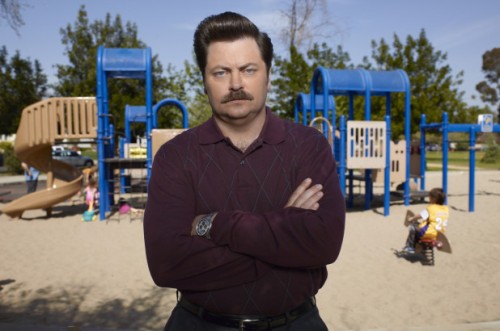
That’s where Ron Swanson comes in. If you’ve watched every episode of “Parks and Recreation” like I have, you know why just saying that name out loud fills the immediate area with greater masculinity. That’s because Ron Swanson is a true man’s man. He has more masculinity in his mustache than most men have in their entire bodies.

I’ve cited Ron Swanson before as someone who embodies a type of masculinity that even self-proclaimed feminists can get behind. He’s strong without being a bully. He’s assertive without being cruel. He’s stern without being heartless. While he doesn’t always exercise good judgment when it comes to ex-wives, Ron reflects a level of manliness that men, women, and everyone in between can respect.

As such, Ron is in a unique position to provide insight into the world of masculine sex appeal. There are multiple instances throughout “Parks and Recreation” in which Ron attracts women. Whether he’s in a serious relationship with Diane Lewis or whipping a crowd of women into a frenzy as Duke Silver, it’s well-established that women find this man attractive.

While that probably isn’t surprising, considering Ron’s character is played by an equally-manly romantic in Nick Offerman, I feel it’s worth scrutinizing the particulars of that sex appeal. I believe there’s insight to be gained from Ron’s masculinity and how it attracts women.

Now, and I wish I didn’t have to disclose this, I don’t mean to imply that this assessment speaks for all women. I am not a woman, nor do I claim to know the various intricacies of the female thought processes. I understand that women have a variety of tastes when it comes to men. Not all of them are going to find Ron Swanson attractive.

When it comes to high standards of male sex appeal, though, Ron checks more boxes than most. That’s why I feel he’s worth singling out in the interest of scrutinizing the most attractive traits associated with masculinity. In doing so, I hope other men can learn from his example.

There are many ways Ron demonstrates these place throughout plays out in “Parks and Recreation,” but one episode in particular encapsulates the essence of his sex appeal. That episode is entitled “Lucky.” It takes place in Season 4 while Leslie Knope is in middle of her campaign for City Council, but Ron’s role in the side-plot to the campaign drama is where there’s more action, including the sexy kind.

That plot involves April Ludgate trying to hook up overly-energetic, exceedingly-dramatic Chris Traeger with Andy’s female professor. It’s not out of the goodness of her heart. Anyone who is familiar with her mannerisms knows that’s not her style. Her intentions are more self-serving because Chris recently suffered a break-up and April believes finding a new love interest will make him less annoying.

Her plan seems good on paper. She invites Andy’s professor, Linda Lonegan, to lunch with her, Andy, and Ron. There, they just happen to run into Chris, who’s eating alone. At first, everything seems to be working. Chris, through the charisma of Rob Lowe, shows a keen and overt interest in her.

While he’s doing this, though, Ron is sitting right next to Linda. He’s showing no romantic interest in her. He’s at a restaurant. His only interest is in how much steak he can eat and how many vegetables he can throw away. Ron does have a romantic side, but he also has priorities, especially when steak is involved.

It’s also worth noting that Linda is a women’s studies professor. In previous episodes, she makes very clear that she identifies as a feminist. I also have to note that she’s not the kind of radical, man-hating feminist that loves to fuel outrage culture. I would categorize her feminism as a healthy, balanced brand of second-wave feminism that dealt with more overt forms of gender inequality.

While Ron doesn’t bring those issues up, they’re a big part of Chris Traeger’s efforts to attract Linda. He effectively filters everything he says to Linda through a feminist lens, going out of his way to use the kind of rhetoric that demonstrates he understands her worldview and embraces it. Initially, Linda does seem interested in him.

Even though he’s very sensitive with his rhetoric, Chris is no beta male. He’s very masculine in his own right with how he takes care of himself and pursues things so energetically. He’s also played by Rob Lowe, who certainly has many traits of an attractive man, even by Hollywood standards.

Despite those traits, Linda ultimately rejects Chris’ invitation to join her for some land kayaking, which isn’t nearly as sexy as it sounds. Then, shortly after Chris leaves, she turns to Ron and invites him back to her place for activities that don’t involve kayaking. Ron, having had three steaks at this point, accepts and it’s overtly implied that they make love, as evidenced by him wearing his red polo shirt the next day.

To understand why Linda chose Ron over Chris, though, it’s important to break down how Ron acts in this scene. Even though Ron wasn’t attempting to attract Linda, she was still drawn to him more than Chris. According to some of the science behind the traits women find attractive in men, that actually makes sense.

From the moment Ron joined Linda in that scene, he was his usual poised self. He didn’t ask for specials from the waiter. He knew what he wanted, which was a porterhouse steak, medium rare. He was confident in his decision, as well as polite and assertive. Those are traits that are both attractive and respectful.

In addition to his demeanor, Ron’s mannerisms reflect confidence and certainty. Even though he eats three steaks, he’s not a slob. He conducts himself in a way that feels approachable and unimposing. Even if he doesn’t try to attract Linda, he does everything necessary to avoid repulsing her.

Beyond what he does, the way Ron speaks is just as powerful. He’s a man of few words whereas Chris will literally go overboard with adjectives and adverbs every chance he gets. His persona is endearing, but he also comes off as intense. For many women, including Linda, that can be a turn-off. Intense men tend to be complicated men and many reasonable women don’t have the energy for that.

On the other end of the spectrum, Ron is much simpler and transparent with his wants and desires. He says it himself in the early episodes of “Parks and Recreation.” He likes pretty, dark-haired women and breakfast food. That kind of simplicity makes him easier to understand and easier to work with. From Linda’s perspective, keeping up with Ron is much less tedious than keeping up with Chris.
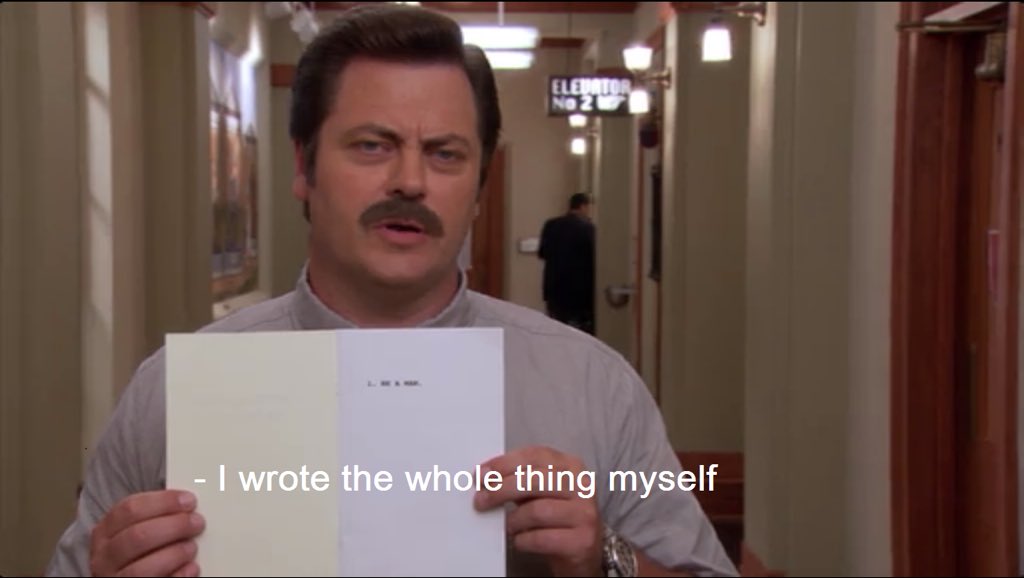
Even from a physical standpoint, Ron conveys more raw masculinity than the health-obsessed Chris. While Chris may have six-pack abs and a very healthy resting heart rate, Ron has a manly mustache and studies show that women find facial hair more attractive. While the presence of facial hair probably wasn’t the determining factor for Linda, it likely played a part.

In the end, Linda found herself between two very masculine men. She ultimately went with the man who demonstrates the most attractive masculine traits just by being himself. Her decision doesn’t just highlight the many ways in which Ron Swanson is personifies manliness. It singles out the traits that appeal to women on a basic level.

Ron Swanson is assertive, protective, frugal, stern, loyal, dedicated, and hard-working. He would function just as effectively as a hunter in ancient times as he does as the Director of Parks and Recreation for the city of Pawnee, if not more so. He’s someone who could still care for his lover if civilization collapsed and zombies overran the cities.

It’s here where Ron’s sex appeal goes beyond simply attracting women. Unlike egocentric pick-up artists or hyper-sensitive ladies men, Ron Swanson conducts himself in ways that men and women alike can respect. In turn, he treats men and women with similar respect.

He doesn’t hold women to a different standard. He treats Linda as an equal and not a prize to be won. He leaves it up to the woman to decide if she finds him attractive enough to be with. In the end, he made Linda’s decision both easy and appealing. It’s the kind of masculinity that men, women, feminists, men’s rights activists, egalitarians, and Americans of all stripes can get behind.


Leave a comment

Filed under gender issues, human nature, noble masculinity, psychology, romance, sex in society, sexuality

The Humor In Mutilating Men Versus The Atrocity Of Harming Women

45ee4ed9041461da247f826745881661e77f2046

It’s one of the most traumatic things a man can experience, the permanent damage or total removal of his penis. Whether by accident or intentional violence, he’s badly injured on a physical physical and psychological level. His ability to identify as a man, experience intimacy with others, or just feel basic pleasure is irreparably damaged.

Just mentioning the possibility of losing his penis will make most men cringe. Joke all you want about how much men glorify their genitals, but it really is an important part of their bodies and their identities. Losing it is like losing a limb, which does plenty to cause serious mental trauma. Add losing a key aspect of their masculinity to the mix and that trauma becomes amplified.

Despite that trauma, men losing their genitals is fodder for comedy. Recently, Netflix released a movie called “The Package,” the plot of which is built entirely around a man who loses his penis in an accident. That movie, if you look it up on IMDB, is listed as a comedy. Imagine, for a moment, a movie that tried to make a comedy out of female genital mutilation. How much outrage would that generate?

There’s nothing funny about women’s bodies getting mutilated or even harmed in any serious way. For men, though, it’s actually a pretty common trope. You don’t have to look too deep into the history of media to find jokes about men losing their genitals.

It’s a famous line in “The Big Leboswki.”

It’s a recurring theme in “Fight Club.”

It’s a sub-plot in an episode of “Rick and Morty.”

It’s a primary plot in an episode of “Family Guy.”

Even in media that isn’t overtly comedic, it still becomes a joke. Just look up the various internet memes about Theon Greyjoy from “Game of Thrones” for proof of that. In each case, the mutilation of men and the loss of their masculinity is portrayed as something that’s inherently funny. The fact that Netflix made a movie about that premise shouldn’t surprise anyone.

Even in the cases of real stories about real men losing their genitals, it’s prone to plenty of humor. The most famous case is probably that of John Wayne Bobbitt, whose wife cut off his penis after he raped her. While Bobbitt was, by all accounts, a horribly abusive man who deserved plenty of condemnation for what he did, his name still inspires jokes.

When people say the name Bobbitt, they don’t think of all the abuse he imparted on his wife. They think of how funny it is that his wife cut his dick off. While he was able to get it re-attached, many other men aren’t so lucky. Whether it’s public perception or daytime talk shows, a man losing his penis is still seen as funny.

Conversely, any media that shows a woman being harmed in any way, even if it’s just a slap in the face, is seen as an irredeemable atrocity. Watch shows like “Married With Children” or “The Simpsons” and you’ll see plenty of scenes where Al Bundy and Homer Simpson badly injure themselves through their antics. However, there are exceedingly few scenes that ever lead to the women being harmed.

Anything that leaves any lasting scar on a woman is inherently abhorrent. There are even major international organizations that work to combat practices like female genital mutilation. When women lose their reproductive organs from disease or injury, it’s seen as a tragedy. Anyone who laughs at their pain is rightly scorned.

Why is this, though? Why is it that an entire comedy can be built around a man losing his penis while any plot that involves a woman getting hurt in any way is dead serious? That’s not an easy question to answer. It can’t be entirely attributed to the gender-driven  double standards that I’ve singled out before.

I don’t claim to know the full answer, but I think it’s worth discussing, if only for the sake of maintaining a balanced perspective. I don’t doubt that many have their theories. Some may attribute the humor we find in men getting mutilated to trends in modern feminism. I would strongly disagree with that.

I believe that this idea of laughing at male mutilation while gasping at female victimization preceded modern feminism by a great deal. I would go so far as to say it goes back much further than that. I believe this unique quirk in gender dynamics has roots in ancient pre-modern societies that transcend geography, culture, and ethnicity.

At the core of this phenomenon is one unpleasant, but inescapable truth. I’m probably going to upset some of my fellow men by saying this, but I think it needs to be said.

We NEED to be comfortable with men getting mutilated on some levels.

Take a moment to stop fuming. Then, take a moment to consider why we would need to be okay with this in both current and ancient societies. From a purely logistic standpoint, it makes sense.

For most of human history, men were expected to carry out the dangerous, back-breaking, body-maiming work that built our civilization. Regardless of location, culture, or traditions, putting men in these situations was necessary. Someone needed to fight the wars, plow the fields, hunt dangerous animals, and work in factories.

Until very recently, men had to fill that role because women were at a severe disadvantage due to the dangers and risks of child-rearing. In the pre-modern world, the most vulnerable individuals in a society were pregnant women, newborn infants, and women in labor. In 18th-century England alone, there were 25 deaths per 1,000 births.

With odds like that, there was a legitimate reason to give women extra protection and care that was not afforded to men. Men didn’t have the babies and no society could survive in the long run if it didn’t have a growing population. That’s why, for better or for worse, there are so many cultural and religious traditions that encourage women to remain in domestic roles.

Those same traditions, however, establish a dynamic requiring that we accept a certain level of male victimization. It’s one thing for a man to die in battle or having his genitals maimed in an accident. It’s quite another for a woman, who are tasked with birthing and caring for a new generation, to endure similar harm. Another man can still impregnate a healthy woman. No amount of men can impregnate an injured woman.

I know that dynamic is offensive to both feminists and men’s rights activists because it reduces their value to their reproductive capacity. I get why that’s offensive. Even I find it offensive, as a man. However, therein lies the most critical detail with respect to male mutilation versus male victimization.

These disparate standards, which predate the modern era by centuries, are still very much ingrained in our society. We still see women, especially those of breeding age, as more valuable than men. We romanticize young men who heroically sacrifice themselves in war, but recoil at the idea of young women suffering a similar fate.

Add emerging demographic issues with respect to declining fertility rates and the same incentives for accepting male mutilation are there. We still need people to have children for society to grow and function, but more women are having fewer children and more men are eschewing the pursuit of families entirely.

In terms of logistics, that increases the value of every woman who wishes to have a children and decreases the value of men who refuse to go along with that plan. In that system, a man losing his genitals or suffering a severe injury has to be funny in order for the situation to be tenable. By the same token, any harm coming to a woman has to remain extremely taboo.

Logistics aside, it’s still an unfair predicament that undermines the suffering and trauma that men endure. The fact that we have to be okay with their suffering while overvaluing the suffering of women is bound to fuel more egregious double standards. Movies like “The Package” certainty don’t help, but so long as this age-old gender disparity persists, men losing their penises will remain fodder for comedy rather than tragedy.

10 Comments

Filed under circumcision, gender issues, human nature, media issues, men's issues, outrage culture, political correctness, psychology, sex in media, sex in society, women's issues

The Other Orgasm Gap (Involving Men) And Why We Should Confront It

basic-secrets-male-orgasm

There are many disagreements about gender these days, but when it comes to orgasms, most reasonable people are on the same page. In general, regardless of politics or genital configuration, we’re in favor of them. We support efforts to experience more for ourselves and for our partners. In matters of sex, it’s one of the few unifying issues.

Even if most people agree that orgasms are awesome, there are still some sources of tension. I’ve already touched on the current status of the orgasm gap, as it pertains to women. That is still an unresolved issue and the current status of gender relations can only improve if that gap is reduced or eliminated.

However, there is another orgasm gap that is rarely touched on, but inescapably linked to the current pleasure parity. This one pertains to men and, unlike the female orgasm gap, is shackled by hard biological limits. Any man, myself included, knows those limits all too well.

It’s no secret, but it might as well be one because it’s rarely talked about. Without getting too graphic, I’ll just say that the female orgasm is a symphony whereas the male orgasm is like a kazoo. It’s a one-note instrument that is simple, basic, and blunt. You can still make music with it, but the range is limited.

That’s because men have something called a refractory period. It’s basically the cool-down period that men experience after orgasm. From a biological standpoint, it’s the part of sex where the brain and genitals tell one another that the job is done and it’s time to rest. That process involves releasing all sorts of hormones and chemicals that are responsible for men getting sleepy after sex.

It’s the reason why men have a difficult time getting aroused again after sex, both physically and mentally. Once a man reaches that peak, it takes a while to get to that level again. It can take as little as 15 minutes to almost an entire day. During that time, though, a man’s ability and desire are significantly hindered.

This inescapable process is also the source of many jokes about premature ejaculation and men who can’t last long in bed. I don’t doubt it’s a factor in the orgasm gap. Whereas it takes a man only two to three minutes to achieve orgasm, it takes a woman an average of 12 minutes to do the same. That is not a trivial gap.

Conversely, women aren’t hindered by a refractory period. Even though it takes women longer to climax, they’re capable of having more orgasms in rapid succession. To give you an idea of just how many more women are capable of, the record for most female orgasms in an hour is 134 whereas the most a man has ever had is 16. Again, that is not a trivial gap.

While men don’t have to look far for tips and tricks that allow men to have multiple orgasms, many of these so-called techniques are just gimmicks. They’re methods for improving stamina and control, which is a great thing to have with any partner. However, it doesn’t change the fundamental biology of refractory periods.

That’s not to say this particular gap is impossible to close. That’s also not to say that there aren’t documented cases of men achieving multiple orgasms. They do exist, but there’s not a lot of research on the topic, especially compared to the amount of research on the female orgasm.

If we’re to close the orgasm gap for everybody, though, this is something that’s worth studying. I would even argue that we can’t solve the orgasm gap with women without confronting this lesser-known gap with men. In essence, that refractory period is the greatest hindrance to true orgasm parity.

Just talking about it only goes so far, though. Unlike the female orgasm gap, the refractory period is rooted in biology rather than psychology. From an evolution standpoint, it makes sense. By achieving orgasm quickly, a man can spend less time impregnating a woman and more time surviving. It was a necessary trait for managing the survival/reproduction dynamic of the human species.

Like many other traits from our pre-modern ancestors, though, these traits are less necessary in the modern era. In fact, they can be a liability. In a world of low infant and maternal mortality, we have more incentive to seek quality over quantity in our lovers. The refractory period, much like our body’s tendency to get fat, is a real hindrance to that effort.

Addressing it is probably not going to be as simple as telling men to do kegel exercises. Men being able to achieve multiple orgasms may require an effort similar to that of developing the female birth control pill. In the same way modern medicine has given women control over their fertility, it may end up doing the same for male orgasms.

How modern medicine would go about that is well-beyond my expertise. However, we already do have some clues as to what goes into reducing the refractory period. Studies has shown that a chemical called prolactin may play a major role.

Specifically, when a man climaxes and goes through a refractory period, levels of prolactin in the body spike. In rare cases of multi-orgasmic men, though, it doesn’t rise in conjunction with an orgasm. Now, that could be only be part of a much more complex process, as is often the case in medicine, but it’s a start.

In the same way some people are already hacking their biology for reasons relating to health and beauty, it may be possible to tweak certain bodily processes to enable men to have the same orgasmic potential as women. It doesn’t even have to extend to modifying genetics. It can just involve tweaking chemical and hormonal processes, something we’ve been doing in medicine for years.

Unfortunately, research on this phenomenon is scant at best. However, given how much money pharmaceutical companies have made treating sexual dysfunction, I believe the incentives are there. It may take a long time, but given the progress medicine has made on male contraception lately, I think the infrastructure is in place and so is the market.

It’s hard to predict what form modern medicine will take in treating any condition, be it the limits of the male orgasm or the current orgasm gap with women. However, I am confident in saying that any advance that puts everyone on the same level of orgasmic potential will be a game-changer of the sexiest kind.

Leave a comment

Filed under gender issues, Marriage and Relationships, sex in media, sex in society, sexuality

How Atheism May Improve Your Sex Life

Relationship with passionate affection

When it comes to improving your sex life, there’s no one way to go about it that works for everyone. Human sexuality is complex, diverse, and exceedingly kinky. What works for one person won’t work for another and may even be detrimental in some cases.

Conversely, there are also variety of ways to undermine or ruin your sex life. That same sexual diversity that helps the human race find novel ways to get intimate with one another can also backfire horribly. Some are minor, in terms of effect, but other forces can have a much greater impact.

That brings me to religion, a topic that tends to inspire the best and worst in people. Like sex, it’s a complex phenomenon that impacts everybody differently. It can inspire great charity and compassion in some. It can just as easily incur greed, exploitation, and outright atrocity.

For those reasons, and plenty more that are too numerous to list, any effort that involves mixing sex with religion is akin to mixing napalm with TNT. I’ve made an effort to discuss both topics in a fair, balanced manner in the past. I feel as though I can only go so far before I totally inflame certain audiences.

I’m still going to try to push the conversation a bit farther. That means taking a few risks and since religion is still such a prominent force in the world, it’s effect on our collective sex lives is unavoidable.

For this particular discussion, want to focus on what happens when religion is removed from the equation. If religion is really that powerful an influence on our lives, and both history and current politics indicate that influence is not entirely trivial, then it stands to reason that the impact of its absence can reveal something about the extent of that influence.

That’s not to say that this is going to be a glowing endorsement of atheism. I prefer to let the data, the logic, and the implications speak for themselves. Since religion is on decline in many parts of the western world, I think exploring the potential impact is critical and even a little urgent.

Information on the sex lives of atheists compared to those who consider themselves religious is somewhat difficult to come by. The act of assessing and measuring someone’s sex lives, as well as the extent of their religiosity, is extremely difficult without the aid of lie detectors or mind-readers. The information we do have, though, does offer some intriguing insights.

Back in 2011, a survey entitled “Sex and Secularism” surveyed approximately 14,500 people revealed that those who identified as religious had less satisfying sex lives than their non-religious counterparts. On top of that, those same religious participants reported a high level of guilt that came along with their sex lives. Given how some religions build their theology around guilt, that shouldn’t be too surprising.

Conversely, those identifying as non-religious didn’t just report better sex lives. They had better sexual education and were more open to discussing sex in general. Everything from personal fantasies to simple tastes was fair game and less affected by guilt. That openness, along with considerably less stigma, was conducive to a more fulfilling sex life.

That effect was more pronounced by those who had once been religious, but had since become atheist. Between the absence of religiously-motivated guilt and the sexual taboos that are often theologically driven, the cumulative effect is pretty striking. This notable quote from the researchers summed it up nicely.

“People who had lost their belief and became atheists reported a significant improvement in sexual satisfaction,” the paper went on to say. Apparently the guilty feelings that religion creates around sex dissipate after a while.

Now, I can already hear the outrage sincerely devout religious crowd on the conclusions of this study. More than a few people who consider themselves religious will claim that their sex lives are superior and they may even have a case to make. Many religions offer a simple, one-size-fits-all approach to sex that is uncomplicated, straightforward, and safer. The fact that it’s also ordained by a divine power is also a factor.

I don’t deny that there are plenty of religious couples out there who have satisfying sex lives. There are probably plenty of atheists out there who have terrible sex lives, as well. However, in order to draw larger conclusions about the impact of religion on sex, we can’t just go by a few anecdotal experiences. We have to step back and see the forest from the trees.

From a psychological and physiological perspective, it makes sense that guilt, religiously-motivated or not, would undermine anyone’s sex life. Guilt has measurable effects on people. It makes it harder to focus. It keeps us from enjoying things. It’s a powerful distraction that makes us feel stress and anxiety. All of these forces can do plenty to undermine your sex life.

In my musings on taboos, I often cite religion as a driving force behind them. Organized religion has made no secret of its intent to regulate, control, or outright exploit human sexuality. There’s plenty of theology, especially among the Abrahamic religions, that imparts divinely-mandated guilt on sex.

In these religious cultures, sex isn’t just some basic biological act that people do for intimacy, procreation, and recreation. It’s subject to all sorts of holy and unholy connotations. The deities involved in these religions aren’t just interested in the kind of sex you’re having. They’ll actually punish you if you do it the wrong way.

That does more than just impart extra guilt for doing anything that strays from what priests, mullahs, monks, and rabbis deem appropriate. It also instills a very rigid family structure, one centered around a specific manifestation of sex that has very little room for fun, kink, and exploration.

That manifestation involves strict gender roles where men do the hard labor and women do the child rearing. The only sex that is sanctioned is the one that involves producing babies who subsequently grow up to be adherents/soldiers/patrons of a particular religion. The fact that type of sexual expression indirectly benefits religious institutions is probably just a coincidence.

The act of enjoying sex for non-procreative purposes would constitute a distraction. A distraction is dangerous in any religion because if people become too distracted, then they pay less attention to the religious institutions and the duties they espouse. As such, it’s in the interest of any successful religion to maintain a strict control over someone’s sex life.

That kind of control is naturally prone to stress. Given how the biological wiring of human sexuality is not conducive to that kind of narrow expression, there’s bound to be temptation. The best way to combat temptation is through stigma and taboo. By hijacking powerful feelings like guilt, it’s possible heavily influence peoples’ sex lives, even if it’s impossible to control them.

It’s akin to putting lead weights on somebody’s limbs and convincing them that the weight is normal. Even if they come to accept that, the weight still skews perceptions and that can only do so much in terms of circumventing basic biology. It also means that when those weights come off, the effect is pretty striking.

Suddenly, the stigma that once kept someone from seeking the sex they desired are gone. The burdens associated with thoughts and feelings that religious institutions deem unholy are lifted. Like any form of stress relief, it can be pretty liberating.

That doesn’t necessarily mean the 2011 survey is conclusive. It has been criticized for being unscientific in some aspects. Some of those criticisms are valid and the researchers concede that, but to the extent the data is consistent with what we understand about how religion can affect our sexuality, it passes some critical filters.

Our sex lives are complicated. Religion, in its many forms, is complicated as well. Regardless of how you feel about one or the other, mixing them is almost certain to compound both. Atheism, like not playing a sport or not having a hobby, simply removes one of those complications.

It’s not a universal fix. It doesn’t subvert other potential issues that may undermine someone’s sex life. There’s plenty more research to be done and religion is still evolving with each passing year, but when it comes to removing divinely-imposed, theologically-driven guilt, atheism stimulates the necessary aspects that make for a satisfying sex life.

1 Comment

Filed under gender issues, human nature, Marriage and Relationships, philosophy, psychology, religion, romance, sex in society, sexuality

What It Means To “Man Up” And Why It’s Changing (For The Worse)

man-up-and-military-press

It wasn’t that long ago that parents and peers emphasized the importance of “manning up” to young boys. There would come a point in a kid’s life where he was encouraged to do more than just grow up. He was expected to push himself in a unique way, fighting and sacrificing for those who couldn’t. Sometimes, those expectations were unreasonable and a little unhealthy, but it was part of the overall gender dynamic.

That dynamic has been changing a great deal over the past several decades. I’m young enough to have grown up during many of those changes, but old enough to remember the old traditions associated with “manning up.” The sheer breadth of that change has been remarkable, but not entirely in a good way.

For the most part, I was never pushed too hard to man up by others. My friends and family encouraged me to push myself, but never to the point where I felt pressure or anxiety. I often ended up pushing myself, whether it involved going to college or moving out of my parents’ house.

That’s not say I didn’t feel any pressure to “man up” at any point in my life. Beyond my friends and family, I was as vulnerable to expectations surrounding masculinity as anyone. Most of the time, those expectations involved little things like stepping up to fix a problem, helping out those who were physically limited, and enduring pain or discomfort in the name of a particular goal.

Overall, I feel as though these expectations were either healthy or benign. Some of those standards could’ve been gender neural. When you see someone in a wheelchair at the grocery store struggling to get something from a shelf, it’s neither masculine nor feminine to help them. That’s just common courtesy.

In recent years, however, the whole notion of “manning up” has gained new a new complications. Some of them are ideological. Some of them are politically motivated. It’s because of these various nuances that I put the term in quotes because its meaning keeps shifting, gaining and losing connotations year by year. At some point, the term itself may become empty.

In contemplating that meaning, I thought briefly about the connotations that term had back when I was a kid. I doubt my interpretation was definitive, but I like to think it captured the spirit of the term. When someone told me to “man up,” this is what I took it to mean.

  • Grow up and mature
  • Take responsibility and solve your own problems
  • Stop whining and start doing something about it
  • Quit being satisfied with mediocrity and push yourself
  • Be stronger and tougher in difficult situations
  • Work hard and endure for the good of others who can’t

I don’t think it’s a coincidence that many of these same traits associated with superheroes, as espoused by the comic books I read and the cartoons I watched. They might have colored my perspective on masculinity and “manning up,” but I suspect these ideals were still consistent with healthy masculinity. The fact that characters like Wonder Woman and Storm of the X-men had some of these traits was just a bonus.

Now, as I contemplate the meaning of “manning up” in its current context, those don’t seem to have the same prominence they once did. There are also a new host of expectations surrounding the term that are fueled, in part, by identity politics. Some even conflict with others, which adds even more complications.

To get a feel for those complications, I posed a question on Reddit on what “manning up” meant to them. The response somewhat surprised me. Most wouldn’t have found their way into the comic books or cartoons I consumed as a kid, to say the least. They involved ideas such as this.

  • Checking your privileged and making way for those your kind has oppressed
  • Acknowledging the crimes and guilt of your gender, as a whole
  • Sacrificing any advantage or benefits that being a man might have once conferred
  • Subjecting yourself to greater degradation in the name of greater equality
  • Learning about all the ways men have ruined society and the world
  • Accepting that the things men love are unhealthy, damaging, and detrimental

None of these are very positive traits for those being told to “man up.” It’s basically a less overt way to tell them that them being a man is “problematic,” a term that has also gained one too many complications. It’s a term reserved for those who appear to be benefiting too much from being a man who isn’t subject to the rigors of childbirth, rampant sexism, and a long history of exploitation.

Never mind the fact that no one alive to day is directly responsible for the injustices their ancestors committed. They’re also not responsible for the injustices their particular race, gender, or ethnicity committed. It happened in the past. Yes, parts of that past were horrible, but punishing people in the present doesn’t make it less horrific. If anything, it just tries to fight one injustice with another.

This is where the concept of “manning up” really loses whatever positive connotations it once held. It’s a sentiment that many responders to my Reddit question shared. When they contemplate that term, they interpret as someone telling them that they need to endure, suffer, or overlook a particular aspect of their identity.

A few posters went so far as to say the term can be replaced with “serve my interests” and carry the same meaning. While I don’t entirely agree with that notion, I can understand why it would feel that way. Being a man, I sometimes feel like I’m expected to get to the front of the line when the time comes to sacrifice. I won’t go so far as to say I find it oppressive, but it certainly feels like I’m held to a different standard.

Sometimes, that standard can be unreasonable. That was another common theme of the responses I got. The notion of “manning up” denotes operating in a way to avoid a particular stigma that others wouldn’t incur for the same behavior. It’s not always ideological, but the pressure is there.

A man who is too emotional is considered a sissy and has to “man up.” A woman or even a gay man who does this won’t face that stigma.

A man who is reluctant to sacrifice for the well-being of another group is considered selfish and should “man up.” A woman or another minority who show a similar reluctance can do the same, but won’t face the same stigma.

A man who shows his pain when he’s harassed is told to suck it up and “man up.” A woman or minority who is harassed can expect plenty of supporters who will cheer them on. Even if men are subject to more overall harassment, they don’t get any sympathy. They’re told to “man up” while everyone else is allowed to seek social support without much scrutiny.

This, I feel, is the ultimate tragedy of the concept. A term that once use to reflect certain ideals for men has now become an instrument of ridicule. It’s no longer a lesson for boys to learn. It’s a rhetorical shortcut that allows someone to hold an entire group of people to a different standard, one that requires them to go out of their way for someone else.

I don’t doubt that there are instances where it’s good for society that some people go out of their way to help others. For those who are disabled, elderly, or ill, it’s just more just and compassionate to set a different standard for ourselves. We don’t ask someone who is missing a limb or suffering from ALS to “man up.” We go out of our way to help them.

It’s the extent of those instances, however, that seems to be damaging the notion. It’s no longer sufficient to just have a particular ailment or shortcoming. Just being someone who isn’t a man who can claim some sort of injustice, be it historical or contemporary, is sufficient.

I believe that’s a dangerous precedent for men and women, for that matter. It sends the message that in order for there to be more justice and equality, an entire group of people need to sacrifice to an extent where they have to be the villains. They have to come to the table, surrender unconditionally, and admit they were wrong and they were the cause of the problem.

That may not be sentiment of those telling someone to “man up,” but that’s how it’s being interpreted. It’s less a masculine ideal and more a shaming tactic, one that is more likely to incur a backlash rather than get someone to reconsider their understanding of gender roles.

I still feel like there’s a way to recapture the positive elements of “manning up.” Gender dynamics is one of those concepts that’s always evolving. Sometimes, there’s progress. Sometimes, there are setbacks. At the moment, I think masculinity and femininity are going through some growing pains as they adapt to a changing world. That process is likely to involve plenty of conflicts and controversies along the way.

In the long run, though, I think society will find a healthy balance with respect to “manning up.” I think there’s a way to use that notion to bring out the best in men and women alike. It’ll likely take plenty of work, toil, and sacrifice from everyone involved in gender-driven controversies, but it’s definitely worth doing.

1 Comment

Filed under gender issues, human nature, Marriage and Relationships, media issues, political correctness, sex in society, sexuality

When Your Lover Uncovers Your Porn Collection (And What Their Reaction Reveals)

porn-addictive-1000x500

I talk a lot about taboos, double standards, and various gender quirks. I don’t just do that because it highlights significant disparities among people trying desperately to get along and/or make love to each other. I do it because it offers some fascinating insight into the conflicting mentalities that drive such conflicts.

A lot of those conflicts, however, are on a larger, more impersonal scale. A typical couple, be they heterosexual, homosexual, or something else entirely, can only do so much to impact larger cultural forces that they had no role in choosing, propagating, or subverting.

These forces, from our approach to marriage to the assumptions that guide our understanding of romance, usually only effect individuals and couples indirectly. We’re all somewhat at the mercy of what our culture has built for us and we can only do so much to guide it forward.

However, there are a few lesser-known aspects of that culture that we can influence on a day-to-day basis. One such aspects involves porn and whatever porn collection that you or your significant other might have, be it hidden or not. I’m sure just mentioning it has made certain individual’s tense for various reasons that I won’t state outright.

Regardless of how you or your lover feels about porn, it exists and it exists in a big way. It’s also a huge multi-billion dollar industry. The fact it’s so huge is a telling sign that both you and your lover have probably consumed it at some point. It’s also very likely that anyone claiming that porn is immoral has probably consumed it as well.

Despite this prevalence, porn is still immersed in taboos and quirks. I don’t want to focus too much on those, since I’ve already touched on a few. The ones I want to focus on have to do with how those in a romantic relationship react to it. That reaction, in many ways, goes beyond double standards and reflects something deeper about our concept of relationships as a whole.

Most people probably don’t need much imagination to surmise how their lover would react to their porn collection. Whether or not it’s a secret, there’s this underlying sentiment about someone in a relationship who consumes porn. That sentiment usually manifests in two scenarios. This is the first and probably most basic.

A woman casually walks by her lover’s desk. Their computer screen is open and so are a wide number of files. Curious, she takes a closer look, only to find out that there’s a sizable collection of pornographic videos on the computer. She’s utterly shocked at just how much content there is.

There are videos featuring extreme, hardcore scenes. There are videos featuring bondage, S&M, and various fetishes. When her lover returns, she is outraged. She sees this level of porn consumption as an affront to their relationship and demand that the files be deleted.

This isn’t just a basic thought experiment. This sort of thing does happen in real life. A part of what inspired this article were stories like this one where a woman kicked her husband out of the house after finding some porn on his phone. Granted, her reaction was extreme, but it reflects a similar sentiment.

There are those who, when they find their lover’s porn stash or just part of it, see it as an insult and an affront to their relationship. They see their lover’s desire to seek another sexual outlet as proof that they aren’t enough and their lover isn’t attracted to them anymore. For some, it can be fairly traumatic and for understandable reasons.

Now, I didn’t specify the gender of the person who voiced that outrage like I did in the scenario. I did so because I don’t want to generalize too much. From a purely anecdotal perspective, which is admittedly flawed, women are more angered by their lover’s porn consumption than men.

Again, that’s a generalization. It also says nothing about how homosexual or transgender relationships couples react to porn. I honestly had a hard time finding research to that effect. However, I found plenty that indicated how common porn consumption is among couples and how reserved many are to admit it.

That leads me to the next scenario, which isn’t as common, but is a bit more colorful. It involves a different kind of reaction for a couple that probably has a very different dynamic from the first, but that dynamic is key in understanding the implications.

A man casually walks by his lover’s desk. Their computer screen is open and so are a wide number of files. Curious, he takes a close look and discovers a sizable collection of pornographic videos. For a moment he’s shocked, but then he’s impressed at the sheer breadth of the collection.

There are videos featuring lesbian couples. There are videos featuring bondage, S&M, and various fetishes. When he confronts his lover, it’s awkward and a little funny. However, he’s also genuinely intrigued by this side to his lover and says they should talk about it so as to re-evaluate their outlook on their sex life.

It’s not nearly as dramatic, which is probably why it doesn’t make the news as often. Again, I was vague with the gender dynamics here and I’ll probably get in trouble for saying the person in the scenario was a man. I get it. That’s a general assumption fueled largely by existing cultural expectations.

Men are okay with porn. Women are a bit more sensitive about it. Not everyone is like that. Some women don’t have a problem with porn and even enjoy watching porn themselves. Some men don’t care for porn and are genuinely averse to it. Everybody has their own attitudes towards it.

That said, there is this prevailing sentiment that men are anxious about revealing their porn habits to their significant others and women don’t like the idea that their lover has a sexual outlet other than them. In both cases, there’s an anxiety over what this means for them and the relationship.

To some extent, porn consumption and learning that your lover consumes it undercuts the romantic script that we think we have to follow. Within that script, two people are in love. They only desire one another. They’re only attracted to one another. Anything that might diver that attraction must be a bad thing. Porn does all of that and then some.

In that context, it’s understandable why some would react harshly to their lover’s porn collection. It shatters the romantic ideal they once assumed. Suddenly, their love is not on part with Romeo and Juliet. Their relationship is not some epic romance. The idea that they’re still sexually aroused by other people makes it seem less special and less meaningful.

At the same time, such a reaction has more distressing implications. If someone is  disgusted by the notion that their lover is sexually aroused by something other than them, then that implies they somehow own their lover’s desires. They own their ability to have sex and be intimate. The idea of owning another person to that extent goes beyond love and into the realm of obsession.

In that circumstance, even a stray thought anyone has towards someone other than their lover is an affront. Given the many indications that humans aren’t entirely built for monogamy and the high divorce rate, this is wholly unrealistic and a little scary and it sets unreasonable expectations among couples that are bound to disappoint.

There are, indeed, certain cases where someone’s porn consumption is detrimental to a relationship. However, from a pure numbers perspective, those instances are the exception and not the norm. From a pure betting perspective, there’s a good chance that your current lover or future over consumes porn. How you deal with it will likely reveal the strength and/or weakness of your relationship.

Leave a comment

Filed under gender issues, human nature, Marriage and Relationships, romance, sex in media, sex in society, sexuality, Uncategorized

When Is It Okay To Exchange Sex For Favors?

get-a-job-film-role-play-1505903081

In case you missed the title of the article, I’ll ask the question again. When is it okay to exchange sex for favors? It’s not a rhetorical question. It’s a serious question about a serious issue in our culture that just so happens to be the premise of one too many porno scenes. I ask the question because I think it’s a lot more relevant now than it has been in recent years.

Concerns about exploitation, harassment, and corruption have never been greater. Some of that is a result of recent scandals. Some of it is a result of ongoing social movements that are a lot more sensitive to gender roles and expectations. Some of it is just a byproduct of living in an era of social media where it’s very hard to keep secrets.

I would argue that the relevance of this question has become even greater in recent years as attitudes towards sex have become more regressive in some areas. Depictions of beautiful women in the media and even beautiful women in video games have become controversial. It has created an atmosphere where everyone is more sensitive to how sexuality is depicted and pursued.

It doesn’t matter that those controversies rely heavily on egregious double standards that make extreme generalizations that can be both hypocritical and damaging. This is the world we live in. If you attempt to use your sexuality and sex appeal to gain favors, then that’s an issue. People have already lost jobs and had their lives destroyed because of it.

It’s understandable on some levels. Most reasonable people will agree that there’s a point where someone seeking a sexual favor from someone else is outright exploitation. There’s a reason why there are laws in place that say an employer can’t demand sex from an employee or risk losing their job.

Most who aren’t in positions of power probably agree that those laws should remain. However, they’re only part of a much more complicated dynamic. Within the context of the innate justice that most people have, there is a line between seeking a sexual favor and outright exploiting someone. It’s just not always clear where that line is.

Take, for instance, the classic casting couch scenario that plays out in so many pornos and Hollywood horror stories.

A beautiful, ambitious actress walks into a room. She badly wants a particular role. She’s willing to do anything to get it, even if it means sleeping with a producer. Being a legal adult, she offers this to the male producer. He accepts. They have sex and she gets the part. The actress furthers her career. The producer gets to have sex with a beautiful woman. Both are satisfied with the outcome.

Now, this particular manifestation of the scenario is probably the least distressing. The woman enters with a willingness to have sex in the name of furthering her career. The man is just as willing to accept her offer. You could even flip the genders and it would still work. Two consenting adults are each seeking something from one another. Sex is just the currency they use and in the end, they both get what they want.

There may still be some who think that scenario is a problem. Some may slut shame the woman for essentially whoring herself to get favorable treatment. Never mind the fact that a willingness to use your body to get favorable treatment is not an issue when it doesn’t involve sex, as every professional athlete can attest. They still see this use of sex to get favors as unfair.

Others may scorn the man for going along with it, using his influence to help the woman’s career in exchange for sex. Again, never mind the fact that being in positions of influence or just having a lot of resources in general will attract those seeking favors. Somehow, using sex as currency is still seen as unfair. Even so, it’s a stretch to say that anyone was exploited in this scenario.

The line may be obscure in that instance, but still clear enough. It’s fairly likely that sort of thing plays out in the real world, both in Hollywood and the business world. Joss Whedon even alluded to it during his own sordid scandal last year. However, it still represents a best case scenario, of sorts.

It doesn’t take too much tweaking to make that same scenario more distressing. Here’s another one that probably occurs fairly often in the world of Hollywood and business. For some, it may be a bit more difficult to discern the line.

A beautiful, ambitious actress walks into a room. She badly wants a particular role that would really help her career, but she wants to earn it on the merits of her skills. She auditions. The producer says she’s good, but so are several other actresses, a few whom have more experience than her. Her chances aren’t great.

Then, after the audition, the producer sits down with her and offers a deal. If she has sex with him, he’ll get her the part. The woman is reluctant, but the man doesn’t push it. He gives her a few hours to decide with the understanding that the offer expires in two hours. The woman agonizes over the decision, but eventually decides to go along with it.

She meets up with the producer. She willingly has sex with him. She doesn’t feel that good about it, but the man does what he promised. He gets her the part. The role really helps her career, just as she hoped. She still didn’t like that she had to sleep with the producer, but she doesn’t regret it. Both she and the man got what they wanted.

I imagine this scenario will generate more uncertainty, arguments, and even a little outrage. To some, the producer in that scenario sexually assaulted that woman, using his power to get her to sleep with him. To others, it may just be a simple case of having to jump through some unpleasant hoops to further your career.

The line in this case is a bit harder to identify. It is very much a quid pro quo exchange, the kind that would definitely result in a sexual harassment case if it occurred between an employer and an employee. However, the woman in this case is not an employee and an audition is not the same as a job. The man just has resources the woman wants for her own benefit. He gives them to her in exchange for something.

The fact the exchange involves sex is where the uncertainty comes in. You could also make the argument that there would be similar concerns if money is involved because that would constitute bribery, but that involves considerably different circumstances. It’s one thing to just pay for an opportunity, which isn’t as taboo, even if it’s unethical in many cases. It’s quite another for someone to offer their body.

On top of that, it’s fairly reasonable to assume there aren’t as many people who have those kinds of resources to bribe someone as there are people willing to have sex. It’s less a matter of legal constraints and more a matter of tangible assets. Most people only have so much money or skill to offer. Sex is one of the few inherently valuable acts that’s essentially built into us as a species.

Even if with those caveats in mind, it’s not entirely clear if there was outright exploitation in that scenario. Yes, the woman was reluctant and didn’t really like that she had to do it. However, she had a chance to refuse and even considered it. In addition, after she made the choice, she got what the producer promised. He delivered on his part. She delivered on hers.

That would change considerably if the man just slept with the woman and didn’t get her the part. In that case, it probably would count as exploitation because he was the only one who got what he wanted and the woman got nothing. Unless the woman got the man to promise on tape that he would get her the part in exchange for sex, she probably would have little recourse.

There are plenty of other distressing scenarios I could list, but I won’t go over the entire spectrum of sexual favors. I present them and the potential complications they incur to add substance to the initial question. Most people agree that exploiting someone for sex is wrong. People are a bit less certain when it involves consenting adults using sex to exchange favors.

It’s a question that covers so many issues, from concerns about prostitution to how we craft marriage laws. No matter how we answer that question, there will be people in this world who have resources and opportunities. There will also be people willing to perform sexual favors in exchange for one or both. It’s going to happen. It’s just a matter of understanding where the line is now and where it should be in a just and fair world.

Leave a comment

Filed under gender issues, human nature, sex in society, sexuality

Are Cheerleaders An Endangered Profession?

cheerlader

There are certain professions that go extinct and for perfectly valid reasons. Occupations like elevator operator, switchboard operators, and milkmen are all jobs that just don’t have a place in the economy or society anymore. Technology and trends have rendered them unnecessary or obsolete.

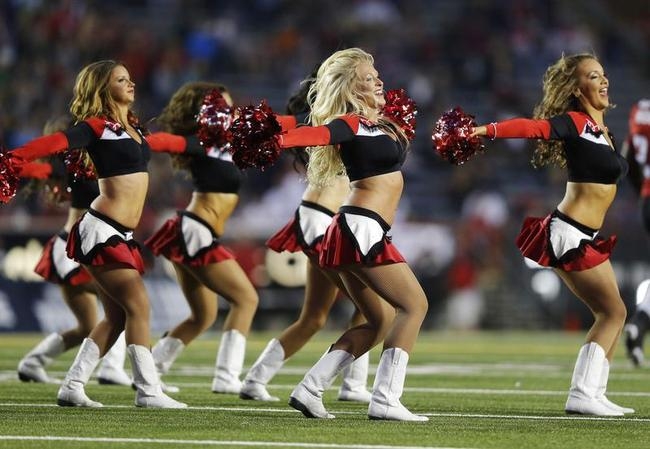
For a small, but vocal contingent of regressive individuals with a low threshold for outrage, there’s a particular occupation that they’d like to add to that list. That is the profession/hobby of cheerleading, specifically the kind that involves parading beautiful women in sexy attire so they can dance, shake pom-poms, and get a crowd excited. Hell, it’s not like there’s anything inherently appealing about that.

That last sentence was sarcasm, by the way. I want to make clear that, as both a man and an avid sports fan, I love cheerleaders. They embody so many wonderful concepts about the world. They combine sports, sex appeal, dancing, and excitement. They bring happiness, excitement, and spirit to an event. There is literally no downside.

Unfortunately, that regressive crowd who insist on seeing sexism, misogyny, and oppression at every corner sees none of that. They only see beautiful women being paraded around in sexy attire for horny men to gawk at. It doesn’t matter if those women choose to do so or are paid to do. Beautiful women attracting the attention of horny men is seen as inherently oppressive to all women everywhere.


That was sarcasm too. I’m sorry if I’m using more than usual, but I find it’s the best way to highlight the sheer absurdity of this attitude. However, it’s an absurdity with serious implications because it reflects a growing trend. Now, in an era where it’s suddenly scandalous to depict the female body in any sexual context, cheerleading is a growing target.

It’s a target that has already taken a few hits. Earlier this year, Formula One Racing announced that it would no longer utilize grid girls, who are basically cheerleaders for racing. This act was cheered by the radical anti-sex feminist crowd. It was probably secretly cheered by priests, mullahs, and monks, as well. While it did inspire somewhat of a backlash, it hasn’t stopped that same crowd from aiming at other targets.

More recently, NFL cheerleaders are in the spotlight. In terms of cheerleading, as a profession, this is basically going for the very top of the hierarchy. The NFL is for cheerleaders what the Pro Bowl is for NFL players. It’s seen as the very pinnacle of the profession and it may be in danger.

It hasn’t helped that there have been some distressing scandals involving how some NFL cheerleaders are treated. The recent scandal involving the Washington Redskins cheerleading squad has only added more fuel to the outrage. Never mind that the facts of these scandals are limited and anecdotal, in some cases. It gives the regressive crowd everything they need to cry sexism and misogyny.

Now, none of this is to downplay some of the real issues surrounding cheerleading, as a profession. There are certainly issues with respect to how much cheerleaders are paid and how their lives are micromanaged. Those issues should be addressed and reformed. However, that’s not the conversation anyone wants to have.

Instead, cheerleading is getting lumped into other outdated traditions like arranged marriages, virginity tests, and being forced to cover their ankles in public. It’s not a profession or a passion that needs to be reformed and improved. It’s something that needs to be outright purged from society.

That’s not just an extreme reaction to a job that isn’t even the most dangerous or the most prone to sex scandals. It’s an attack on the very idea that beautiful, sexy women can and should be used to promote anything, be it a sports team or a fast food meal. The problem isn’t how the job is unfairly managed. It’s the job itself.

From the perspective of cheerleading’s opponents, it objectifies the female body and commodifies female sexuality for the consumption of men. In an era where sexually harassing a woman is seen as the ultimate evil, whereas sexually abusing a man isn’t nearly as outrageous, that’s just unacceptable.

The attitudes of the women who seek this profession don’t matter. The attitudes of the men who enjoy the sexiness and excitement that cheerleaders inspire especially don’t matter. All that matters is that cheerleaders are too sexually stimulating to the masses and that’s feeding a culture of misogyny and sexism. I wish that were sarcasm, but that’s what these regressive people genuinely believe.

For them, undermining the freedom and agency of those who want to pursue cheerleading and those who want to admire cheerleaders is a price they’re willing to pay. While some, like the Grid Girls, try to fight back, they’re facing an uphill battle and it’s one that cheerleaders might end up losing.

That’s because these are exceedingly sensitive times. Just trying to inject reason and criticism into the movement against sexism is subject to irrational outrage. Matt Damon found that out the hard way. More and more, people are just avoiding the conversation altogether because it just keeps fueling more outrage.

The current dynamic is as simple as it is unfair. If you stand up for cheerleaders, then the regressive crowd can just claim you’re a sexiest who wants to gawk at beautiful women. Even if you’re a woman speaking on behalf of cheerleaders, your criticism can be cast aside because you’re just brainwashed by the patriarchy and you’re for the objectification of women.

Never mind the fact that the very concept of objectification is fundamentally flawed. Never mind the fact that that flawed concept is also prone to some pretty disturbing double standards. The protests against cheerleading is framed as a protest against sexism, misogyny, and patriarchal oppression. It doesn’t matter how wrong or misguided that notion is. That’s the perception and there’s just no way to win that argument.

These days, being called a sexist is bad for business and for your profession. I believe the regressive crowd knows that, to some extent. They understand that the NFL is a business and one that has already been ravaged by negative press. Their success and their profits are dependent on their brand. If they see something as potentially damaging to their brand, then they’re going to either get rid of it or downplay it.

I’m not good at predicting the future, but depending on how these recent cheerleading scandals play out, I suspect that the NFL might just slowly phase out cheerleaders, altogether. It’s the path of least resistance. Keeping them around means keeping the outrage around. That’s just more risk and frustration than it’s worth.

It would be another major loss, one far bigger than the loss of the Grid Girls. However, as much as I love cheerleaders and the sex appeal they bring, I can totally understand why a major organization like the NFL would resort to such an extreme. By just removing cheerleaders, altogether, the crowd of regressive outrage will move onto their next crusade and, hopefully, leave them alone.

It’s a scenario that nobody wins. If the NFL ends up eliminating cheerleaders, it won’t be because they’ve seen the error of their ways and are now champions of women’s empowerment. They’re just protecting their brand. They’re trying to stop the whining, an approach that only offers the illusion of progress and not actual progress.

Personally, I hope the NFL resists the outrage. The more ground we give to regressive attitudes, the more regressive our society becomes. This is a crowd that won’t stop until everything that might potentially evoke sexual feelings or portray women in a sexy way is either eliminated or stigmatized.

As both a fan of all things sexy and an aspiring erotica/romance writer, that’s not a world I want to live in. That’s not a world that even other women want to live in, as the Grid Girls have shown. It’s a boring, unsexy, downright dystopian world that’s worth resisting and I hope there are plenty of cheerleaders, male and female alike, who will cheer on that effort.

Leave a comment

Filed under Current Events, gender issues, media issues, political correctness, sex in society, sexuality, sports

On Gender Double Standards And Male Strippers

mc-gp-chippendales-bethlehem-sands-20150121

When I was 21-years-old, I took my first trip to Las Vegas. It was truly a magical experience. Even though I was young and socially awkward at the time, I had a lot of fun there. It was the first time I had been somewhere that really treated sex like a spectacle. That spectacle can bring out a very different side of people.

One incident, in particular, really exemplified this during that first fateful trip. It occurred when I was walking down Fremont Street, also known as the old part of Las Vegas. This is the area that gets glorified in gangster movies like “Casino.” Today, it’s largely full of street performers, tacky vendors, and Elvis impersonators.

Image result for old las vegas

However, the one spectacle that stood out most occurred when I passed by an unusual crowd near the Golden Nugget. The crowd was unusual because it consistent mostly of women and they were making noises that I had never heard women make to that point in my life.

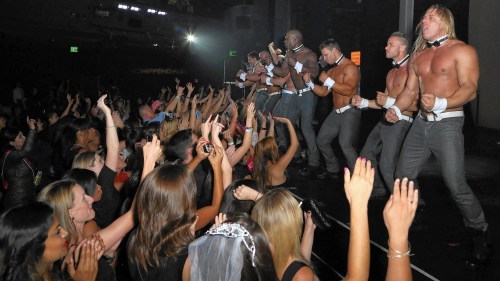
When I moved in closer, I saw that the source of the spectacle were a few male strippers, specifically the big, muscular types that worked at places like Chippendales. Despite being straight and shy at the time, even I found these guys to be attractive. However, it was the behavior of the women that really stood out.

They were all over these guys. They were cheering and laughing as though they had just won the lottery. They were taking turns hugging them, kissing them, and feeling around their perfectly chiseled muscles. Some women had this look on their face that resembled a kid looking at a giant chocolate cake. It was quite a sight.

Image result for women with male strippers

Keep in mind, these weren’t Las Vegas showgirls. Most of these women looked like soccer moms who could’ve easily been friends with my parents. At that moment, though, they were utterly uninhibited. The things they said to those strippers, and on a public street no less, would’ve made an experienced porn star blush.

At the time, it was just an amazing sight that I hadn’t seen before in my youth. As the years have gone by, though, that experience has taken on a very different context. That context has gained even greater meaning as trends in feminism, popular culture, and social justice have really changed the conversations we have about gender.

The particulars of that conversation really stand out when you focus on strippers. Specifically, the double standards within those conversations become a lot more apparent. I know I talk about double standards a lot, but some are more egregious than others. I would even go so far as to say that those involving strippers are most revealing, if that’s not too loaded a term.

Related image

For any man who has gone to a strip club featuring female strippers, most quickly learn that there’s a lengthy set of guidelines to follow. I freely admit to going to multiple strip clubs so I’m pretty familiar with all of them. They usually involve these kinds of  rules.

  • Do NOT touch or grope the strippers while on stage or during a lap dance
  • Do NOT try to solicit sex or sexual services from the strippers
  • Do NOT yell at or disrupt the stripper while they’re on stage
  • Do NOT invite a stripper back to your hotel room or to a private residence
  • Do NOT address the strippers in a vulgar manner

There are usually other rules, but these are the most basic. Every strip club is different and some are better about enforcing those rules than others. For the most part though, these are the expectations and failure to meet them often means getting thrown out or arrested.

The rules and expectations for male strip clubs, however, are very different. It’s not just that it tends to be louder and more intimate, so to speak. There are things women do at male strip clubs that would get most men thrown out of female strip clubs, if not arrested.

Image result for men thrown out of strip club

A couple years ago, Vice compiled testimony from male strippers about some of the behavior they encountered during their work. Their experiences included, but weren’t limited to being puked on by drunk women, women getting up on the stage to dance with them, and being flat out groped.

It’s also both common and expected that women will hook up with male strippers. Sometimes they’ll offer money. Sometimes they won’t. In either case, it’s exceedingly rare for them to face scrutiny or arrest for that sort of behavior. In fact, some even see it as empowering.

Never mind the fact that such empowerment requires such an apparent double standard. Women being sexually uninhibited and free to pursue whatever decadence they want is seen as liberating. However, men doing the same is seen as oppressive. The principles and mechanics are the same. The social stigma is not.

Image result for man thrown out of strip club

That stigma also effects women in more indirect ways. There are more than a few stories about women being fired from their jobs after someone found out they worked as a stripper or porn star. Men who work as strippers, though, don’t usually have this issue. Former stripper Amber Rose pointed that out, noting how men like Channing Tatum get praised for his portrayal of a stripper while she still faces stigma for her past.

In both instances, the stigma is damaging. The double standards are asinine. Sure, you could argue that patriarchal traditions have helped forge these standards, making overly sexualized women taboo while overly sexualized men are prized. However, as with most double standards, they still require one too many assumptions and just as many taboos.

In both cases, the double standard is built around the idea that women should be sexually limited in most aspects of her life. There are even those who claim that women being sexually uninhibited undermines civilization. Nobody should take those claims seriously. Chances are those same people have unhealthy, regressive views about sexuality in general.

Related image

That same standard also asserts that men are unthinking, unfeeling beasts. They want to be objectified by women. They’re expected to be dispassionate brutes who exist only to lure women into their bed the same way a rancher would herd cattle. Never mind the fact that some male strippers do indeed feel objectified. Their feelings don’t matter as much as their female peers.

However, while female objectification is decried, male objectification is celebrated at male strip clubs and movies about them. At the same time, women who dare to be sexual, either as strippers or just in general, are subject to stigma and scorn. Both are a byproduct of sexual repression and both are equally wrong.

Therein lies the most revealing implications about this double standard. It essentially exposes the script that men and women are expected to follow with sexuality. In that sense, I honestly can’t blame the women I saw that day in Las Vegas for going so nuts around those male strippers. They’re scorned for doing that in every other aspect of their lives. When they finally get a chance to break free, they go all out.

Related image

Conversely, men still have to follow the script. They still have to jump through all the hoops and layers that tell them their desire for sex is inherently damaging. Their desire to just indulge in one of the most basic acts of intimacy in nature is an oppressive force, one that must be mitigated by the strict rules and guidelines prescribed by strip clubs.

In the end, strip clubs are a microcosm of the different sexual expectations for men and women. One form of sexuality is damaging, oppressive, and needs to be managed. The other is liberating, empowering, and forcibly contained by taboos and stigma. The fact that strip clubs even exist in the first place are a hint that those expectations are not entirely healthy for either gender.


8 Comments

Filed under gender issues, human nature, sex in society, sexuality

When Regressive Gender Politics Inspire Deviant Sexual Taboos

christian-grey-anastasia-steele-jamie-dornan-dakota-johnson

Take a moment to think about the many non-criminal, but still deviant behaviors that  society considers taboo. From not tipping the pizza guy to not asking for permission when you borrow your roommate’s toothbrush, there are plenty of behaviors that may not be illegal, but still make us recoil to some extent because they subvert social norms.

Now, consider for a moment that there was a point in time when these behaviors weren’t taboo. For some, you don’t have to go back too far. For others, you may need to go back a century or several, but the point is these taboos didn’t just arise randomly. There were factors that inspired it.

I’ve talked about the origins of taboos before, as well as ways to break them. When it comes to sexual taboos, though, it gets even more complicated, not to mention kinky. It’s one thing for an inane social norm to take on a life of its own. Add a powerful, instinctual drive to the mix and that taboo may gain a few extra lives in the process.

Image result for BDSM

Few things inspire more elaborate taboos than sex. Anyone familiar with a particular area’s porn consumption understands that to some extent. Sex is such an integral part of life, love, and passion that it’s bound to inspire more than a few taboos. We don’t usually think about where those taboos come from, but there’s usually a catalyst of sorts that inspires them.

I bring all this up because we live in sensitive times where it doesn’t take much to inspire a controversy, especially when it involves a sex scandal. It’s a world where everyone seems downright eager to get outraged about something, be it a sex scandal or something a celebrity wore.

Some of that outrage is built on a foundation of good intentions. Say what you will about the extent of the anti-harassment movement, but the goal is commendable. A world with less harassment, sexual or otherwise, is an objectively better world.

Image result for anti-harassment

However, problems arise when that movement becomes a moral panic and few things bring out our collective eccentricities than those. Just ask everyone still worried about Satanic cults operating day care centers. Those same panics can also inspire taboos. They can even turn something that wasn’t a taboo before into something far less mundane.

As I type this, there may be a new taboo forming before our eyes in wake of the anti-harassment movement. I’m not saying it’s official or anything, but the factors are in place and since it involves sex, it’s sure to evoke a wide range of feelings. To illustrate the extent of this emerging taboo, consider the following scenario.

There’s a woman in a room, casually lofting about. A man enters. He’s big, strong, and aggressive. He storms over to the woman, passion and desire in his eyes, and pins her up against the wall. Then, without asking, he kisses her and starts caressing her body. The woman is shocked and overwhelmed, but finds herself kissing back.

Then, after overpowering her with his strength and lust, he strips her naked and has sex with her right then and there. He doesn’t ask for permission. He just does it. He’s aggressive, but passionate. He’s not out to hurt her. He’s just there to take her. When he finishes, he wraps his powerful arms around her and holds her close so she cannot escape and kisses her again in a final act of domination.

This brief, but steamy scenario is a fairly familiar scene. It plays out in countless pornographic narratives, from the most hardcore content you can find on the internet to the erotica/romance novels that I like to write. It was even a big part of a best selling BDSM novel called “50 Shades Of Grey” that I’m sure everyone has heard of by now.

Image result for 50 shades of grey scene

In the recent past, that might have made a certain crowd a bit uncomfortable, but it wouldn’t have been taboo. Now, many would see this scenario as outright sexual assault and demand that the man be thrown in jail. It wouldn’t even matter if the woman in the scenario said she liked it. In the context of a moral panic, the man is an abuser.

I understand, to some extent, why certain people would feel that way. From an outside perspective, not knowing the thoughts and desires of those involved, it seems pretty distressing. In the past, such concerns would be addressed privately or by police. In the post-privacy world of social media, hash-tags, and professional trolls, it’s much easier for these sorts of matters to gain public scrutiny.

Image result for internet outrage

I know there are still those who say the anti-harassment movement isn’t at the level of a moral panic just yet, but it doesn’t have to be at the same level of the Satanic Panic to inspire taboos. That scenario I described above may not have checked all the necessary boxes before, but it sure does now and that’s going to complicate certain sexual attitudes.

The idea that such a scenario could become taboo didn’t cross my mind until someone on Reddit brought it up. They cited an article from the New York Times where a woman expressed outright dread that she was betraying the anti-harassment movement because she’d enjoyed those kinds of dominating experiences in the past.

In the article, a sex and intimacy therapist and psychologist named Michaela Boehm says that woman’s feelings aren’t deviant. She even goes onto make a statement that probably wouldn’t have been controversial a decade ago, but would certainly spark outrage now.

Many women like to be dominated in bed. “Not in their lifestyle, not in their career, but in the bedroom, many women would like to surrender,” Dr. Boehm said. This may explain why, on Amazon’s list of best-selling erotica — a medium that, unlike pornography, is mostly produced and enjoyed by women — themes of male dominance tend to, well, dominate.

Chances are if a man had said those words, he would be scorned as a modern day monster. Even though a licensed psychologist says there’s nothing wrong or unhealthy about women enjoying those kinds of experiences, the sentiment is there. As such, the roots of the taboo are already in place.

Now, the reasons why a woman may enjoy submissive sexual experiences are many and there is some research behind it, but I won’t go too deep into that issue. I want to focus on what happens when taboo is thrown into the mix. Even if there were no biological factors behind the appeal of that kind of sex, a taboo does plenty to complicate things.

Related image

Think back to that same scenario again. Now, add a few other forces to the mix. It’s not just erotic. It’s dangerous. The man could get into a lot of trouble if word got out and the woman could get into trouble if she admits she enjoys it. If you don’t think that doesn’t add appeal to an experience, then you’ll have a hard time explaining the appeal of skydiving.

Call it the forbidden fruit effect. Call it misattribution of arousal, a real phenomenon where your brain may not know the difference between being in danger and being horny. Whatever biological factors might be behind it, taboo only adds more fuel to the proverbial fire.

Suddenly, this simple manifestation of sex takes on a form of kink that it didn’t have before. Kink, much like skydiving, has appeal because there’s a thrill to it, both in terms of danger and the fact that it’s considered deviant. Add the basic pleasures that come with sex and suddenly, a mundane experience becomes a night with James Bond.

Image result for James Bond

I doubt that’s what those in the anti-harassment movement intended. It may very well be fine print in the law of proportional backlash that tends to affect major social movements. However, unintended consequences are often the pre-cursor to taboos and it may already be too late for this one.

Sexual attitudes are always evolving and at the moment, they’re evolving in a climate of fear and uncertainty. People are more vigilant with their sex lives and how they interact with women. That’s where practices like the Mike Pence rules comes in. There’s a risk that the way we publicly go about sex is making it difficult for anyone to know what’s acceptable anymore.

Conversely, taboos embrace the danger, the risk, and the utter abnormality of an act. They take something you didn’t once think was a big deal and make it seem like a trill ride at Disneyland. Given the ambiguity surrounding consent and inherent power of the human sex drive, this is one taboo that may be more potent than most.

Image result for women love bad boys

Now, that’s not to say that submissive sex is destined to exceed the Satanic Panic in terms of taboo, but the potential is there. History shows that efforts to re-shape attitudes is a messy process. Sometimes, it works beautifully. Sometimes, it fails spectacularly. There are many ways to combat a certain social ill, but making it taboo may end up doing more harm than good.

If you’re still not convinced, go to the nearest theme park and ride a few roller coasters. That should remind you of the kind of forces you’re working with here.

1 Comment

Filed under Current Events, gender issues, sex in society, sexuality