Tag Archives: Marvel

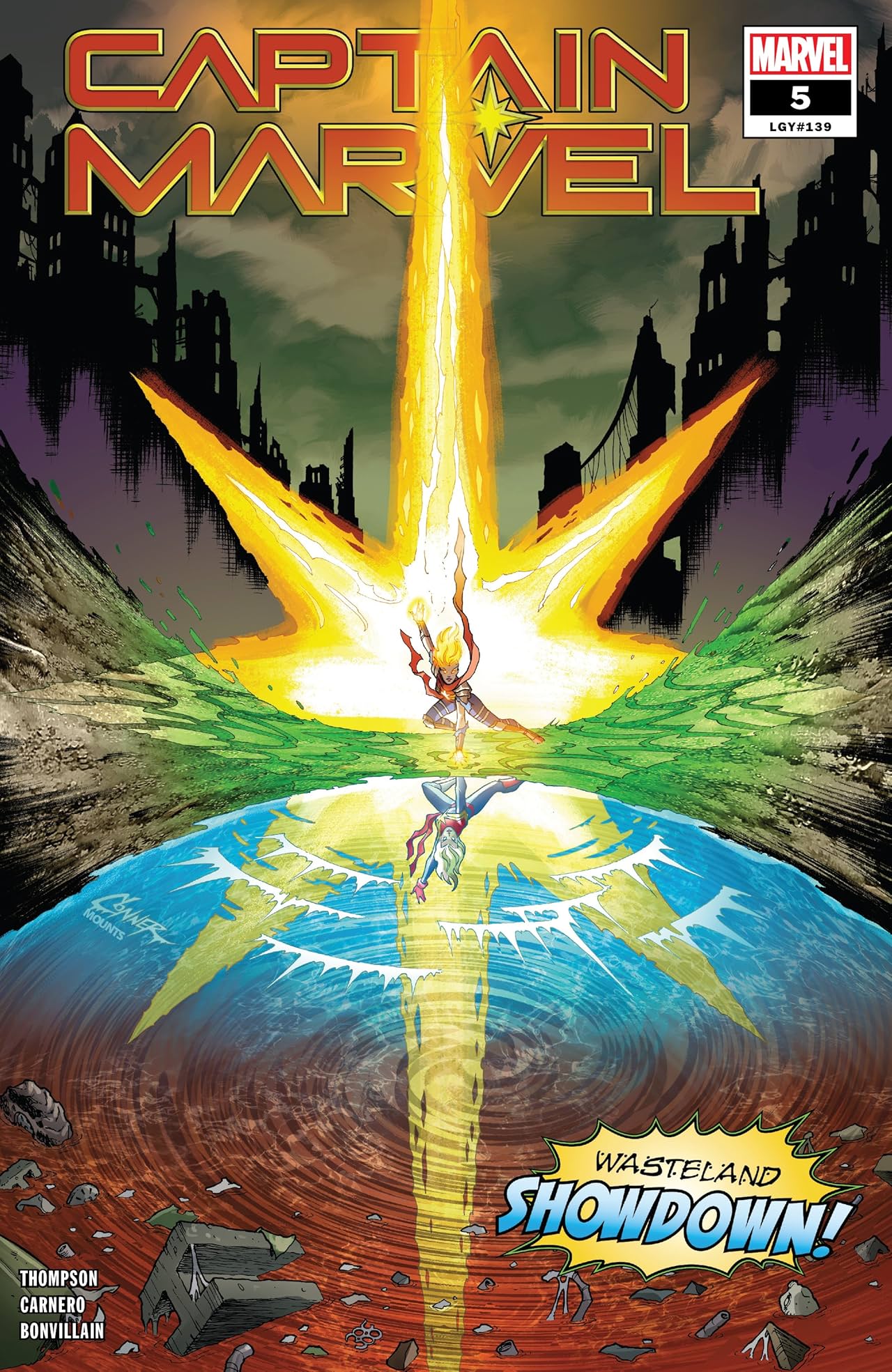
Jack Fisher’s Weekly Quick Pick Comic: Captain Marvel #5

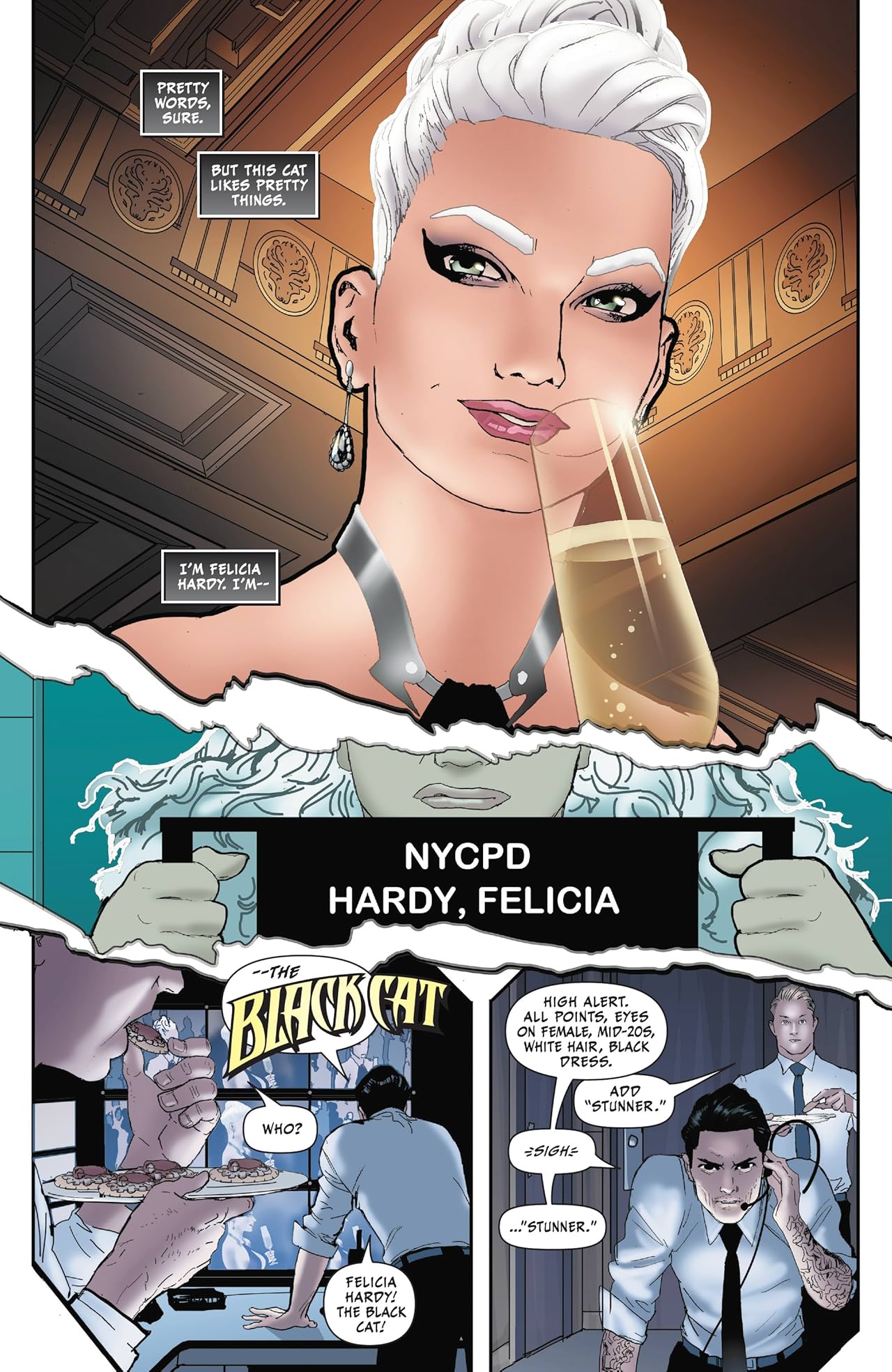
Every Wednesday, passionate comic book fans like myself wake up early to take in a fresh batch of awesome. I can’t think of a better way to start a morning that doesn’t involve a hot tub, a massage, and fresh donuts. In the spirit of making those mornings that much more special, I select one comic from that batch that I feel carries the satisfaction of a thousand hot tub massages.

This week, “Captain Marvel #5” delivers just that much satisfaction as writer, Kelly Thompson, caps off her first arc on this series. It’s a story that began just as all things Carol Danvers began ascending into the stratosphere, thanks to the “Captain Marvel” movie. Now, as Carol is still flying higher than ever, Thompson affirms why she soars like no other female superhero.

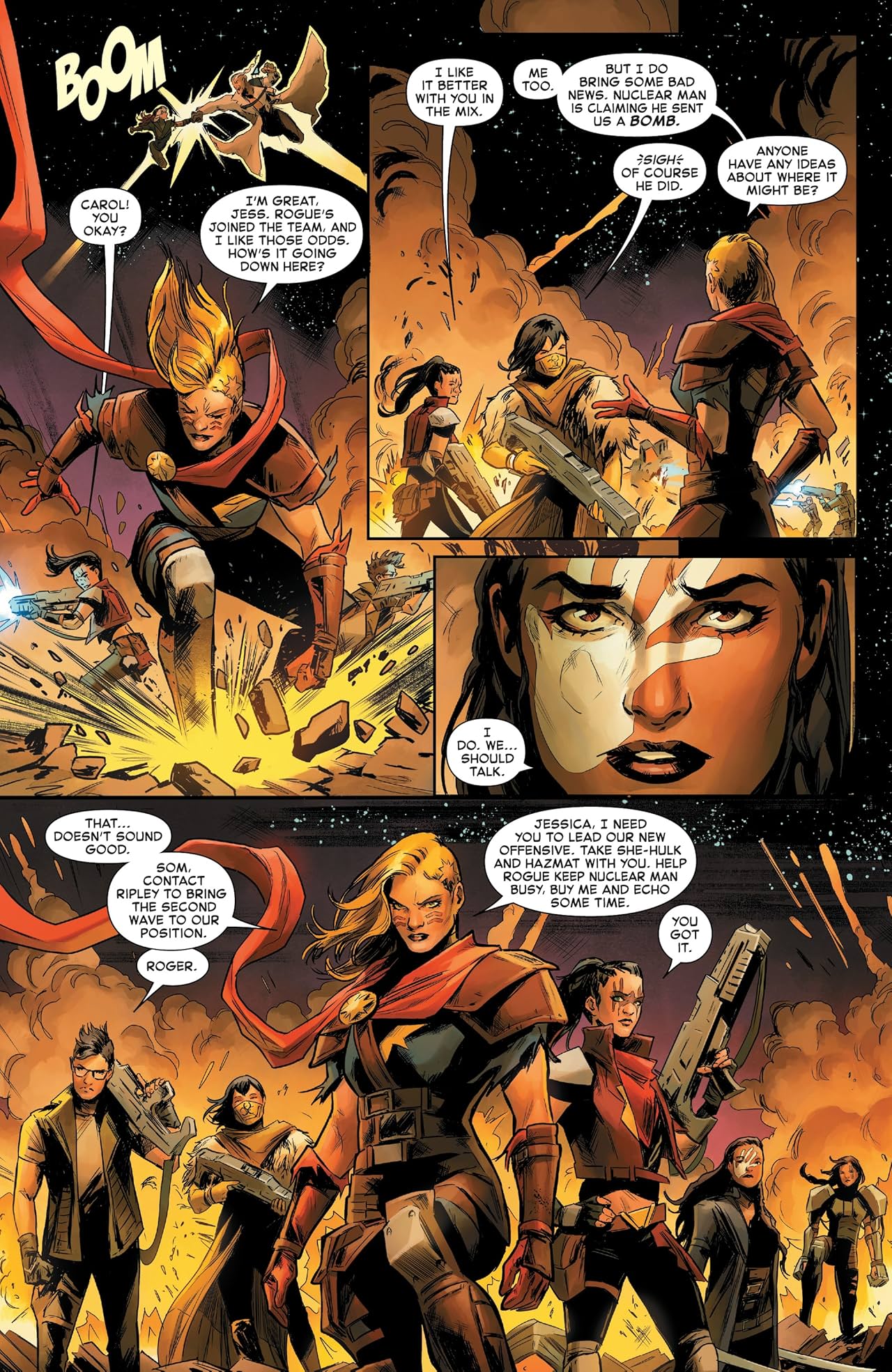
The stakes in this story aren’t quite as high as they were in her movie or in “Avengers Endgame,” but that actually helps her shine even more in some ways. For the past several issues, she’s been trapped inside a barrier that has covered Roosevelt Island in New York. Inside that barrier, she’s been waging a tough and gritty war alongside several fellow female heroes against Nuclear Man.

Now, you don’t need to know who Nuclear Man is. In terms of overall threats, he’s definitely no Thanos. He’s also an unlikable douche-bag by every measure. He’s equal parts King Joffrey, Ramsey Bolton, and Kanye West. He’s the kind of guy you want to see Carol punch, but he doesn’t make it easy for her. What he lacks in Thanos-level power, he makes up for with his ability to push Carol’s buttons.

For the past several issues, Nuclear Man has pushed, strained, and tested Carol in ways that don’t involve how hard she can punch an incoming asteroid. He certainly has enough power to fight her one-on-one, but that’s not his style, nor is it his goal.

He’s not out to defeat Carol. He wants to enslave her, along with every other woman who stands against him. He created the barrier to trap them, strain them, and wear down their ability to oppose him. Carol just happens to be his ultimate prize. He sees her as the strongest, most capable woman in the world. He’s not entirely wrong.

For him, enslaving her means forcing her to be his wife and bearing his future children. Given Carol’s distressing history with being manipulated by devious men, that just makes the fight more personal. Now, she has even more reasons to kick his ass. However, Nuclear Man still finds a way to hit her every bit as hard as Thanos.

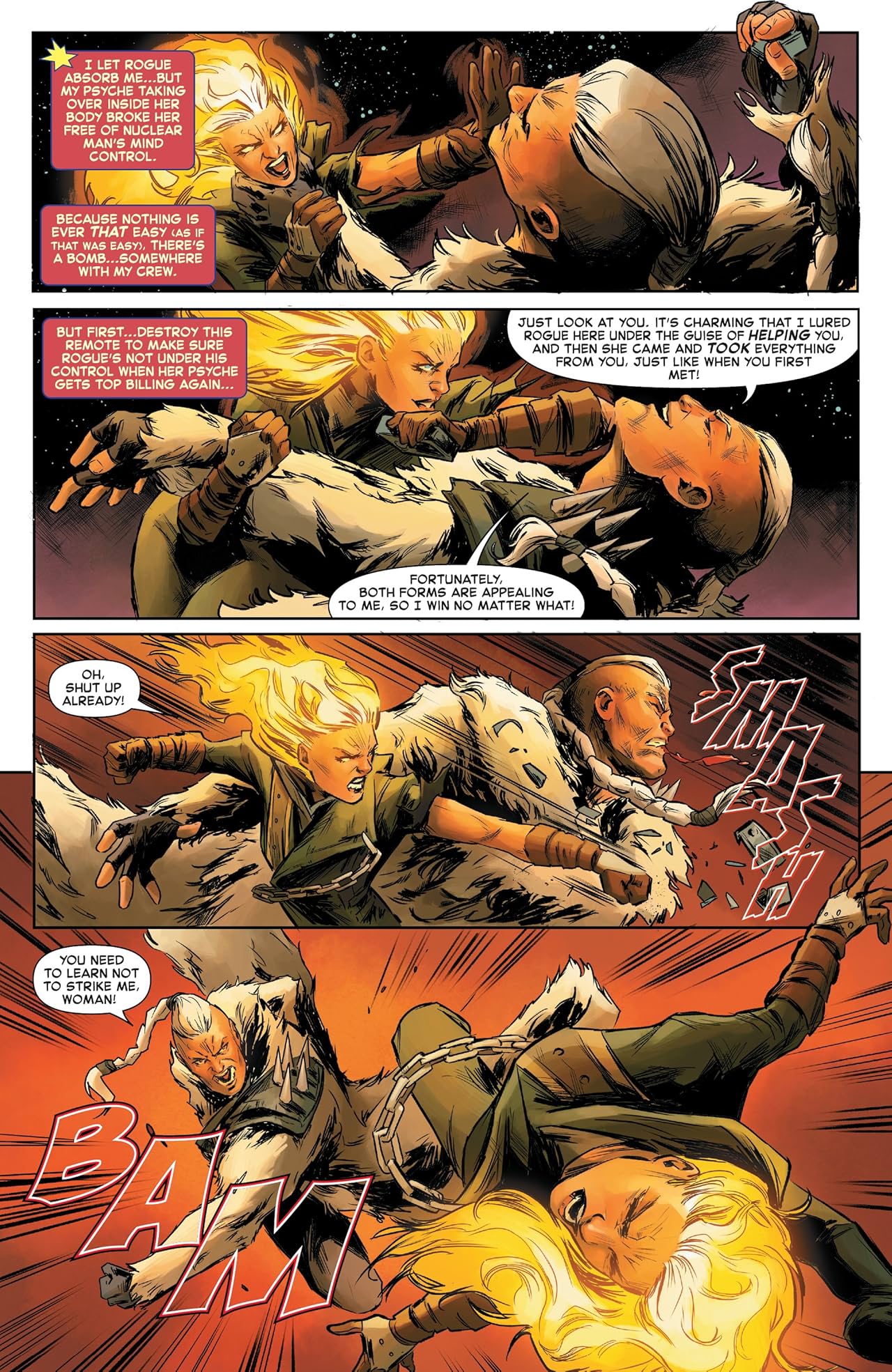
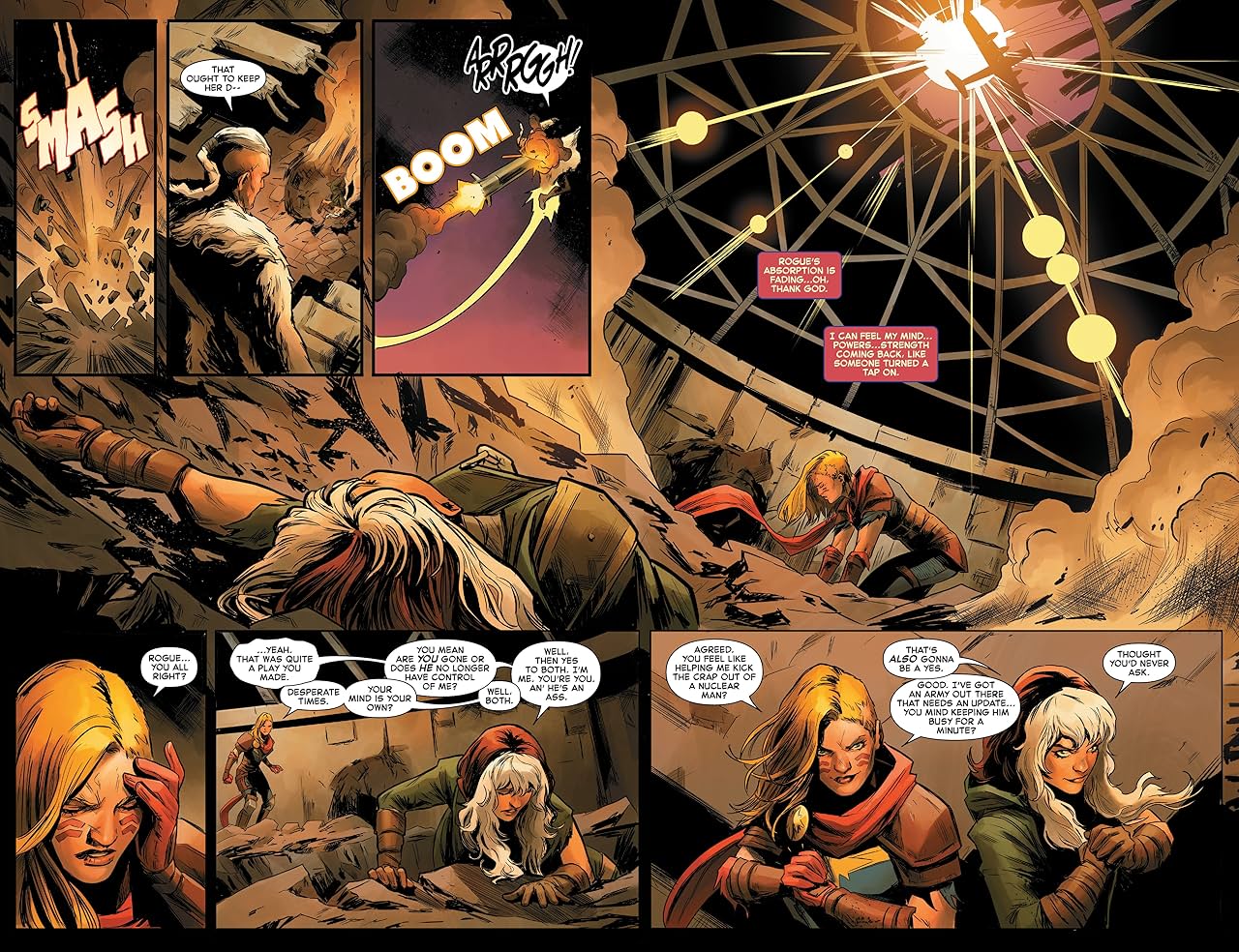
That’s where Rogue comes in. Make no mistake. She makes “Captain Marvel #5” worth reading every bit as much as Carol.

Rogue’s history with Carol is not a good one, to say the least. These two may be superheroes in their own right, but they’re not friends. They’ll never be friends. Carol even says as such at one point. That’s exactly why them having to work together to fight Nuclear Man is so satisfying.

That fight takes up a good chunk of the story, but Thompson goes out of her way to emphasize why Rogue still makes her feel vulnerable. Some of her weakest moments came by Rogue’s hand, literally in some cases. A sizable chunk of her journey as a superhero is defined by Rogue and Nuclear Man used that against her.

It helps give the battle the kind of dramatic weight that makes every punch, quip, and thought bubble feel more impactful. Both Carol and Rogue have to push themselves and each other to get through the final showdown against Nuclear Man. It’s not easy. Victory still comes at a cost, but the end result will still put a smile on your face, especially if you like seeing insufferable douche-bags fail.

If you’re a fan of Captain Marvel from the movie, “Captain Marvel #5” will give you plenty to enjoy. It’s a story in which you can easily imagine Brie Larson handling the action and drama, as only she could.

If you’re primarily a fan of Carol Danvers in the comics, then you’ll have plenty to enjoy as well. By bringing Rogue into the picture, Thompson connects Carol’s past struggles with her ongoing ascension. It’s a connection that feels overdue and welcome, if only to affirm why she’s such a great character.

Captain Marvel #5” doesn’t try to reinvent Carol Danvers, nor does it try to turn her into someone she’s not. It’s the culmination of a story that gives Carol a chance to rise up, affirm her status as Marvel’s premier female superhero, and battle some old demons that still haunt her. Between Thompson’s skilled quips and Carmen Carnero’s vibrant artwork, it’s a complete superhero experience that anyone can appreciate.

Leave a comment

Filed under Jack's Quick Pick Comic

Multiverses, Mutants, And The (Uncanny) Implications Of “Spider-Man: Far From Home”

download

Anyone who has read more than a few comics, seen a few movies, or consumed more than a little sci-fi knows what often happens when multiple universes enter the picture. First, the overall story becomes bigger in scope, scale, and complexity. Second, a host of major complications emerge. Third, when done poorly, it becomes next to impossible to follow.

In terms of a larger narrative, it’s a huge gamble. It’s one of those plot points that is easy to mess up, not unlike time travel, wizards, or clones. Very few franchises, be they movies, comics, or TV shows, can make that gamble pay off. If ever there was a franchise that could make it work, it’s the Marvel Cinematic Universe.

Between the record-breaking box office of “Avengers Endgame” and the adulation of countless fans, including myself, Marvel Studios is uniquely equipped to make the concept of a multiverse work within its over-arching story. To some extent, it has to. The finality of “Avengers Endgame” means it will have to find some way to grow without the iconic characters that helped make it.

The stage has already been set for a larger multiverse to emerge within the MCU. Just as fans like me are finally recovering from the emotional upheaval we experienced in “Avengers Endgame,” the second trailer for “Spider-Man: Far From Home” dropped and, beyond dropping some heavy spoilers, it revealed that the multiverse is officially a thing in this world.

There are a lot of implications for this, many of which go beyond Spider-Man’s story in the MCU. As the trailer reveals, the universe-altering events of “Avengers Endgame” opened a literal and proverbial door to new conflicts within the MCU. These conflicts offer many opportunities for some of Marvel’s many cosmic characters, but I believe the biggest opportunity is for the X-Men.

I say that not just as a huge X-Men fan who has already written extensively about their potential in the MCU. I believe that Marvel Studios could reinvent the X-Men and the entire concept of mutants in a way that’s fresh, engaging, and very relevant to events unfolding in the real world.

Marvel and their Disney overlords have already reported that the X-Men will be rebooted into the MCU in the coming years under the skilled hand of Kevin Feige. However, the method and details of that plan have yet to emerge and chances are, it’ll be several years before we see that full-on reboot that X-Men fans have been pining for since Hugh Jackman hung up his claws.

Imagining Wolverine without Hugh Jackman.

Even for Marvel Studios, it’s going to be a challenge. How do you introduce mutants, an entire race of super-powered beings, into a world in which they’ve never been mentioned? In fact, thanks to conflicts over movie rights, nobody in the MCU could even utter the word “mutant” without incurring the wrath of Fox’s lawyers.

That’s a problem because in over 10 years of movies, TV shows, and tie-ins, the Marvel Cinematic Universe has become populated with many super-powered beings that include gods, super soldiers, and teenagers armed with spider powers. On top of that, they already have a race of genetically modified people called the Inhumans, who basically acted as a stand-in for mutants at one point.

This complicates the whole premise of the X-Men. A big part of their story and their appeal is the parallels between mutants and real-world minorities. The X-Men emerged during the time of the Civil Rights Movement in the United States and have since come to represent oppressed minorities from many eras, from racial minorities to the LGBTQ community.

That’s a tougher parallel to establish in the MCU because how can mutants be hated and feared in a world where Asgardians, super soldiers, and talking raccoons exist? Granted, mutants have a unique aura of unpredictability in that anyone could potentially be a mutant. Unlike the Inhumans, there’s no catalyst or radioactive spider necessary to activate their powers. They need only survive to puberty.

It’s still a stretch because the hate and fear of the 1960s is very different from that of the early 2000s century. It’s one thing to just be afraid and hateful of mutants. It’s quite another to craft killer robots to hunt them while ignoring entire populations of similar super-beings.

This is where the multiverse could enter the equation. With the proper sci-fi machinations, it could both bring the X-Men into the MCU while framing mutants in a context that makes them very relevant to contemporary issues. The key is linking the struggle with mutants with that of refugees.

Whereas discussions over minority issues have become somewhat predictable in recent years, debates about refugees have been much more heated. It has triggered protests, empowered populist uprisings, and caused a rise in xenophobia that far exceeds the old-school racism of the mid-20th century. These are the kinds of heated politics in which the X-Men thrive.

The “Spider-Man: Far From Home” trailer establishes that something happened in the battle against Thanos that opened the door to the multiverse. It’s easy to envision a scenario in which a population from a more hostile universe seeks refuge in one that is already used to super-powered beings.

It’s not difficult to imagine things getting that bad for the X-Men or mutants. Both “X-Men: Days of Future Past” and “The Gifted” explored a world where mutants where hunted, imprisoned, and outright murdered. The comics also have a lengthy history of dystopian futures in which the X-Men could not stop humanity from hating and fearing their kind.

Then, just as things look hopeless, a doorway to another universe unexpectedly opens. Mutants suddenly have a chance to escape their rapidly-decaying world and start anew. It’s an opportunity many desperate and traumatized refugees seek in the real world. Their stories are full of horror and atrocity. It’s a story that resonates beyond the superhero genre.

In addition to providing a mechanism for entering the MCU, it also solves another critical issue with respect to narrative. It gives the X-Men a new type of story that hasn’t been told before in the movies. For the past 19 years, almost every X-Men movie has followed a similar formula.

Mutants are hated and feared.

The X-Men try to combat that fear.

Someone, often Magneto, tries to provoke a war between humans and mutants.

The X-Men stop that war from occurring.

It’s a story that has played out many times. Sometimes, it has been great. Other times, it has been god-awful. Just telling that same story again in the MCU won’t be enough. By making mutants refugees, the entire dynamics change in a way that could cause all sorts of upheavals that could impact many other MCU franchises.

One possibility.

Like real-life refugees, they come to a new world out of desperation, escaping horrors that they had no part in creating. The world they enter is inherently suspicious of them. They see them as strange, dangerous outsiders who could bring their problems to their homes. These are real concerns from people other than the reactionary radicals who often preach hate.

It’s one of those issues that has no good resolution. These people are victims of a war that they want to escape. They flee to wherever they feel they’ll be safe. Often, their options are limited and when an opportunity comes along, they have to pursue or die. If the events of “Avengers Endgame” somehow create such an opportunity, then why wouldn’t someone take a chance?

It would put mutants and the X-Men at odds with everyone in the MCU, from the Avengers to SHIELD to the average person still recovering from invading aliens in New York. It would also establish a clear divide that could one day manifest in a full-blown “Avengers Vs. X-Men” movie, which has already been teased.

All that being said, the powers that be at Marvel Studios may opt for an entirely different approach. In that case, everything I just described may be a moot point. This is just one approach that I found myself contemplating after seeing the “Spider-Man: Far From Home.” It’ll probably be a while before we know the full implications, both for the multiverse and for mutants in the MCU.

1 Comment

Filed under Deadpool, Marvel, movies, Spider-Man, superhero comics, superhero movies, X-men

A Fitting Endpoint: My (Spoiler-Free) Review For “Avengers Endgame”

avengers-endgame-poster-square-crop

Starting an epic journey is a daunting challenge. Keeping people engrossed in that journey for over a decade is exceedingly difficult. Ending that journey in a way that’s dramatic, appropriate, and satisfying is damn near impossible. Despite those insane stakes, that’s the primary goal of “Avengers Endgame.” It attempts to cap off the story that began in 2008 with “Iron Man.”

Without spoiling the many dramatic details of this three-hour cinematic experience, I can safely confirm that it did. “Avengers Endgame” achieved that seemingly impossible goal of completing a decade-spanning story that included 22 movies, a cast of top-notch actors, and one talking raccoon. It’s one of those feats that shouldn’t be possible, even with Disney’s deep pockets, but Marvel Studios pulled it off.

It isn’t hyperbole to say that “Avengers Endgame” is a historic cinematic achievement that fundamentally changes the standards for just how bold a movie can be. All the praise from fans and critics alike that this movie has garnered is well-earned, but still doesn’t do justice to what this movie achieved.

It’s not just another step in the ever-expanding saga that is the Marvel Cinematic Universe. This movie does not set the stage for another sequel or lay the groundwork for the next big battle between the Avengers and the next Thanos-level threat. The movie is true, polished ending that manages to beautifully encapsulate the scope and scale of the story it told.

As a life-long comic book fan and a fan of superhero media, going back to the days of Saturday morning cartoons, this movie was both satisfying and impactful. I came out of the theater with my heart still racing and my mind still reeling from what I just witnessed. Part of me was sad. Part of me was elated. In all, though, I felt like I’d completed a journey alongside these beloved characters.

Even if you’re not a fan of comics and only know these characters through the movies, “Avengers Endgame” still succeeds in terms of raw storytelling. Years of world-building and character development really come to ahead in this movie. The shared journeys of characters like Tony Stark, Steve Rogers, Thor, Black Widow, Hawkeye, and Bruce Banner provide plenty of dramatic weight to everything that happens.

Make no mistake, though. A lot happens. This movie will test your bladder almost as much as it tests your heart. There are so many characters to juggle and many of them have their own arcs. Tony, Steve, Thor, and Hawkeye are all in wildly different places throughout the story, literally and figuratively. Coming together again in a cohesive plot takes time and effort, something the Russo brothers do not shy away from.

As a result, “Avengers Endgame” is very different structurally from “Avengers Infinity War.” Whereas “Avengers Infinity War” played out like unfolding battle with Thanos leading the charge, “Avengers Endgame” is very much a reaction to the aftermath of that battle. To say it left some traumatic scars would be the understatement of all understatements.

There’s no getting around it. Thanos won and the Avengers failed. Before anyone can even contemplate undoing the damage, these characters have to adjust to a world that has been decimated on an unimaginable scale. Processing, exploring, and reacting to that decimation is a big part of what makes that final showdown sufficiently epic.

That means are sizable parts of this movie that don’t involve Hulk smashing things, Captain America fighting Hydra agents, or Iron Man blowing stuff up. “Avengers Endgame” puts much more time and energy into character moments and interpersonal drama, which were fewer and less developed in “Avengers Infinity War.” However, none of this time ever feels wasted or drawn out.

It helps make that final showdown all the more meaningful. It’ll get you to cheer, gasp, cry, and cringe every step of the way. I can even attest that there are moments in this movie that got the people in the theater out of their seats and cheering. In all my experience with superhero movies, I can’t remember the last time a movie got people that emotional.

There’s a lot I can say about how “Avengers Endgame” succeeds in making the emotional investment of the past 22 movies pay off. I don’t think I need to belabor how important this component was in making this movie work in a satisfying, climactic manner. While the movie succeeds in this critical aspect, there are other noteworthy details.

In terms of pure entertainment value, it is not as great as “Avengers Infinity War.” I would even argue the first “Avengers” movie had more spectacle and was more cohesive, overall. There were times when “Avengers Endgame” felt somewhat chaotic, due to all the character arcs it had to balance. While it managed to juggle them all effectively, there’s only so much that can be done to keep that narrative concise.

It’s also worth noting that some character narratives were managed better than others. I won’t cite specific characters for spoiler reasons, but they fairly obvious within the first hour of the movie. I’m sure fans of certain characters will be conflicted by how things play out, but I doubt those same fans will be too disappointed.

Fans of the distinct humor that often shows up in Marvel Studios productions will also have plenty to laugh at. Granted, the bleak circumstances of the movie make that tricky, but moments are there and they never feel too forced. They’re not quite as numerous as they are in other MCU movies, but given the various plots of the story, I’d say there’s just enough to balance the overall tone.

There are some other flaws within this movie, but the extent of those flaws is never more than minor. It would require an extreme level of pettiness and nit-picking to use those flaws to undercut the movie. “Avengers Endgame” is not perfect, nor does it try to be. Its primary goal is to end this era of the MCU and it does so beautifully.

The ending will leave many with tears in their eyes, both from joy and sorrow. There’s equal amounts of tragedy and triumph. Certain characters get a happy ending. Others must deal with loss and tragedy. Overall, it’s a perfect blend of satisfying conclusion and bittersweet finality. It reinforces the notion that these characters are true heroes.

For a movie that begins under such bleak circumstances, the ultimate conclusion really solidifies “Avengers Endgame” as an incredible cinematic experience. If I had to score the movie, I would give it a 9 out of 10. It hits all the right dramatic notes, evokes all the right emotions, and succeeds on a level that few could’ve imagined 11 years ago.

Like Captain America himself, this movie was willing to do whatever it takes to complete this superhero saga for the ages. Moving forward, it’s hard to say what will come of the MCU, especially in wake of the Disney/Fox merger, but it’s safe to say that “Avengers Endgame” has set a bold new standard for just how great a superhero movie can be.

Leave a comment

Filed under Marvel, Movie Reviews, movies, superhero comics, superhero movies

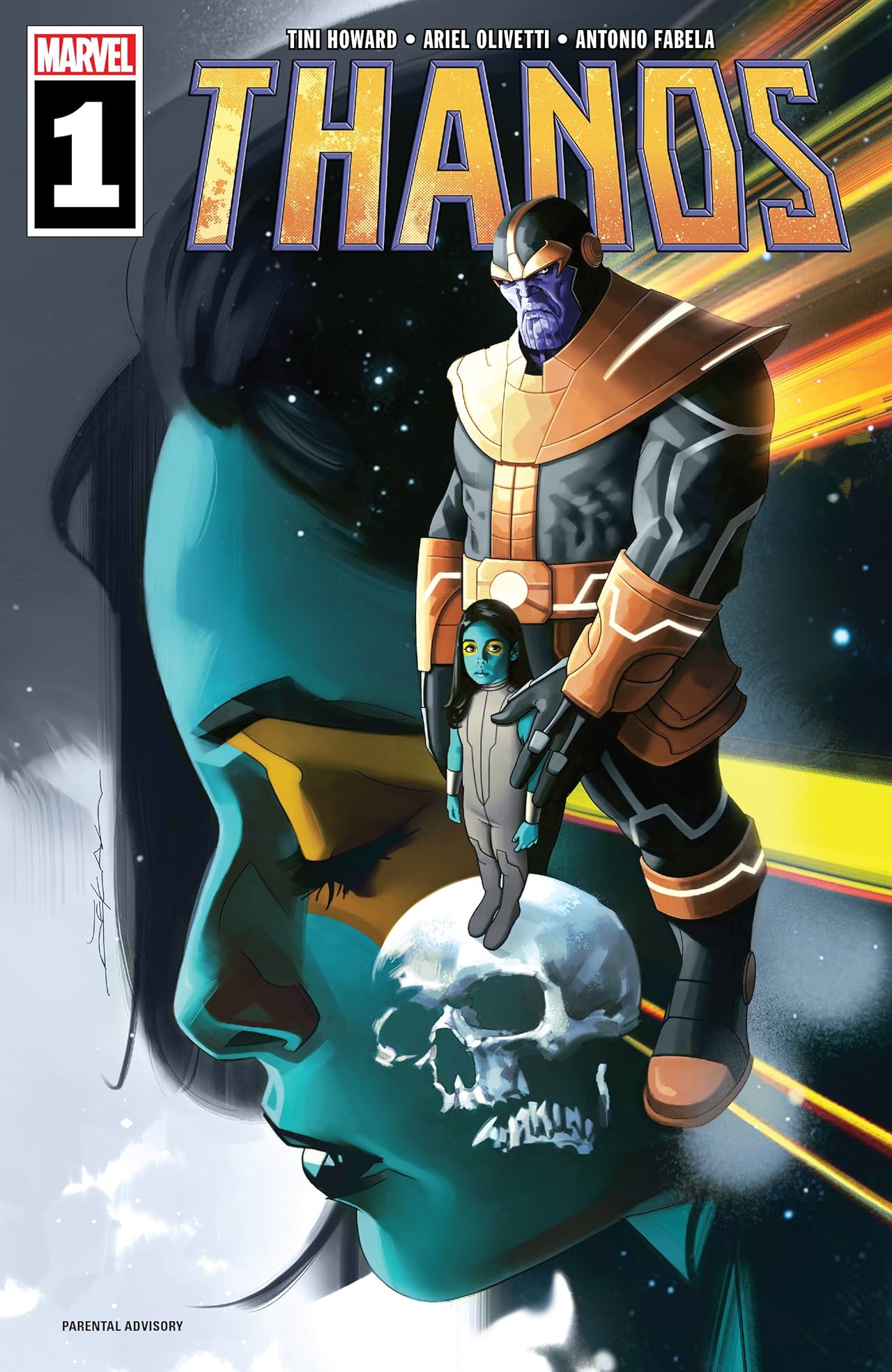
Jack Fisher’s Weekly Quick Pick Comic: Thanos #1

Every Wednesday, a new batch of comic books comes out to bring a badly-needed dose of awesome to a world that can never have too much. Not all of them are generic superhero comics. Not all of them are cheap kid-friendly comics full of talking animals and princesses, either. However, they all contribute to the overall awesome in their own unique way.

This week has more going for it than most. While new comics are certainly a joy to fans of superhero media, the upcoming release of “Avengers Endgame” is, by far, the bigger event. I would go so far as to argue that it’s the biggest event in the history of the superhero genre. However, that event wouldn’t be possible without the comics that birthed these iconic characters.

This week, one character is destined to stand out over everyone else and he’s definitely not a hero. He is Thanos, the Mad Titan who brings death, destruction, and wrath wherever he goes. He brought the Marvel Cinematic Universe to its knees in “Avengers Infinity War.” He’s done it more than a few times in the comics as well. However, “Thanos #1” dares to tell a different kind of story.

In this story, Thanos is still the death-loving, power-mad titan he’s always been. A good chunk of the narrative is spent reinforcing this in ways as brutal as anyone would expect of the Mad Titan. That brutality is important, but not just to Thanos. This story is more about Gamora than it is about him.

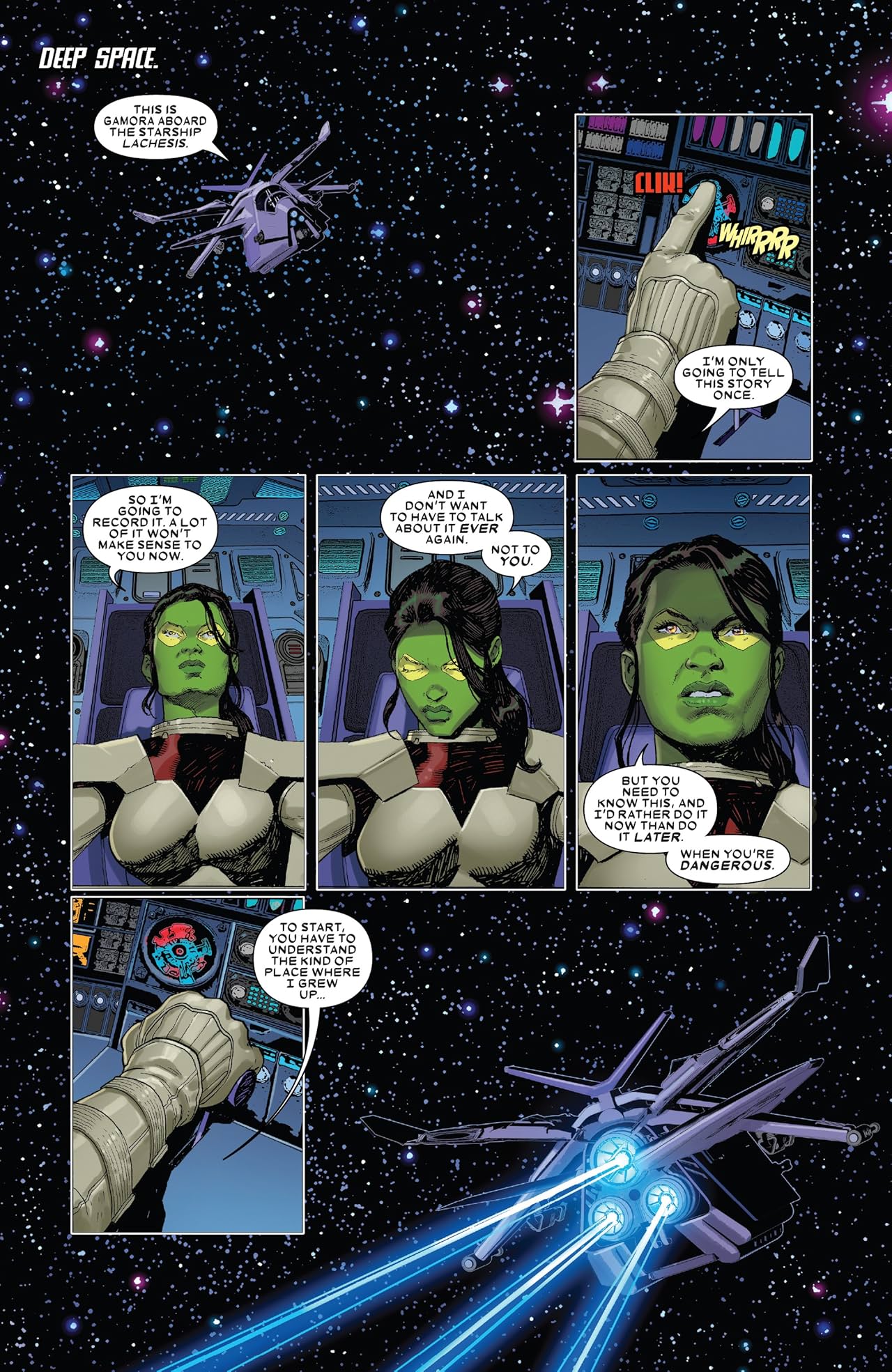
Thanos #1” isn’t just some extended flashback that reinforces how menacing Thanos is or why he’s one of Marvel’s greatest villains. This is Gamora telling her story about how she became the most dangerous woman in the universe under his guidance. It’s definitely a story worth telling and writer, Tini Howard, doesn’t gloss over the gruesome details.

Through Gamora, we see that Thanos isn’t just a cruel, mass murderer. He really is mad on many levels. There are times when he kills with a goal in mind. While that goal isn’t always logical, he does show that he knows how to employ tactics and he knows how to lead other killers into battle.

Then, there are the times when he just kills because he is not a stable mind. It doesn’t matter if it costs him valuable soldiers and crew members. He kills for the same reason other people collect Star Wars toys. He’s obsessed with it. In the same way some fans can never have too many Darth Vader action figures, Thanos can never have too much death.

Howard does plenty to flesh out this side of Thanos. By reinforcing the extent of Thanos’ madness, it makes Gamora’s role a lot more meaningful. That meaning is important because Thanos shows, time and again, that he’ll kill anyone and everyone without a second thought. Whether it’s an entire planet of pacifists or his own crew of murder-happy minions, he does not hesitate for a second when that murder itch strikes.

However, he does hesitate when he encounters Gamora. It’s not out of compassion or pity, either. Something about her stands out that sets her apart from the countless victims Thanos has killed throughout the cosmos. It’s not immediately apparent. It’s also substantially different than what we saw in “Avengers Infinity War,” but the underlying theme is the same.

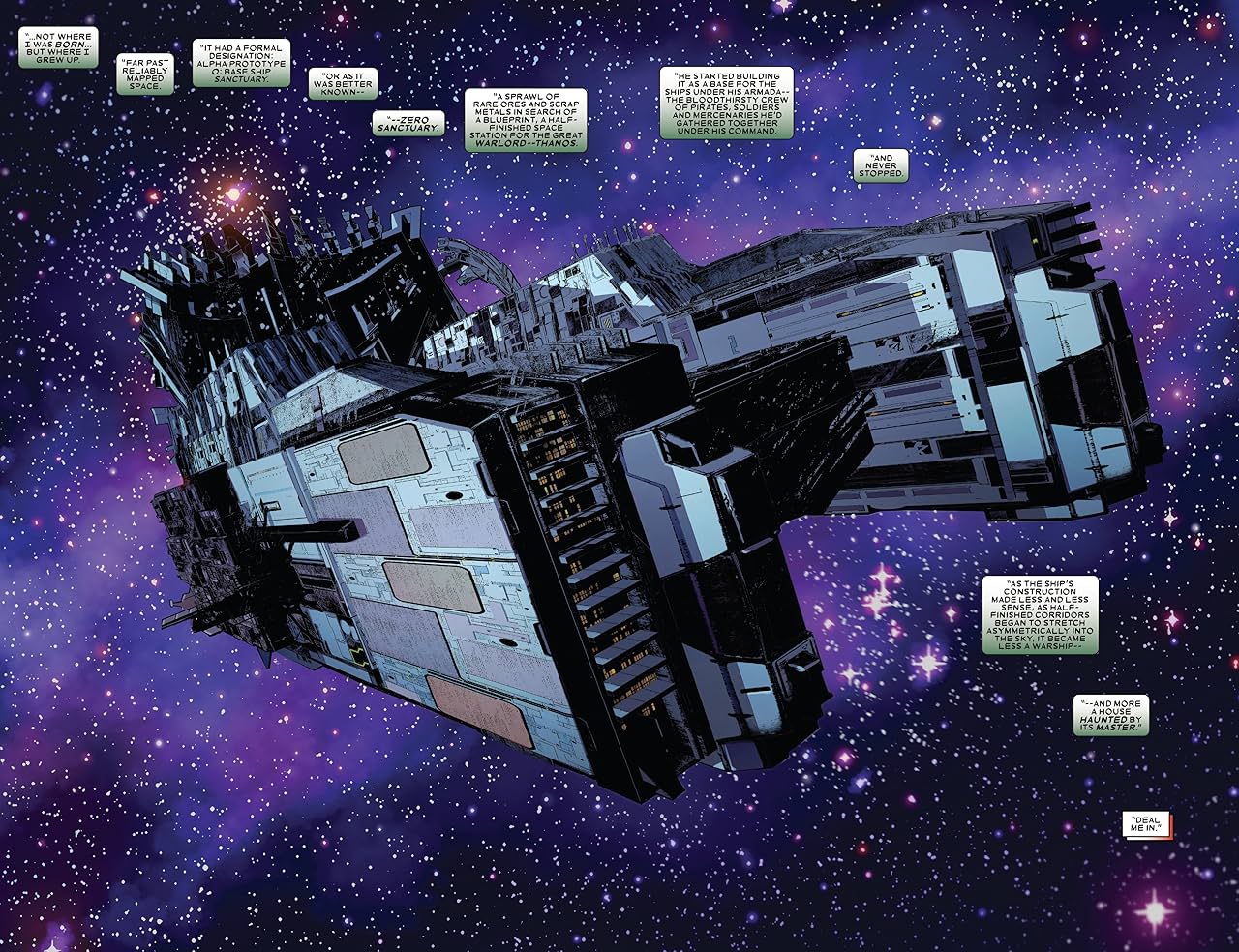
It still carries dramatic weight and the artwork of Ariel Olivetti nicely captures that drama. Gamora, who narrates the story, doesn’t portray herself as an impressionable victim who was eager for a power-hungry madman to corrupt her. She was, by and large, just a young girl trying to escape a massacre with her family.

She didn’t come from a warrior culture. She didn’t have a violent streak in her. She was, by all accounts, just an ordinary alien woman who wanted to live peacefully in the only world she’d ever known. For her to become the most deadly woman in the universe, she had to be forced down that path and molded in the most brutal way possible.

It’s yet another testament to just how devious Thanos is, both in the comics and the movies. He’s not just capable of leading a team of murderers from one slaughter to another. He’s also capable of turning an otherwise innocent woman into one of the most deadly killers in the universe.

Thanos #1” is one of those comics that came out at the best possible time. Thanks to the events of “Avengers Infinity War” and the upcoming release of “Avengers Endgame,” the extent of Thanos’ villainy has become a major component of the superhero genre. He is the standard by which other villains are measured now and, like the movies, Gamora is part of that story.

Despite the differences between Thanos in the movies and Thanos in the comics, they share a common link through Gamora. She is an integral part of his journey, as a villain. She embodies just how much Thanos’ cruelty can shape and mold those around him. She is who she is because of Thanos and, as much as she hates it, he defines her.

Gamora’s story is not a pleasant one, but “Thanos #1” proves that it’s worth telling. At a time when all things Marvel are fueled by all things Thanos, the timing couldn’t be better for such a story.

Leave a comment

Filed under Jack's Quick Pick Comic

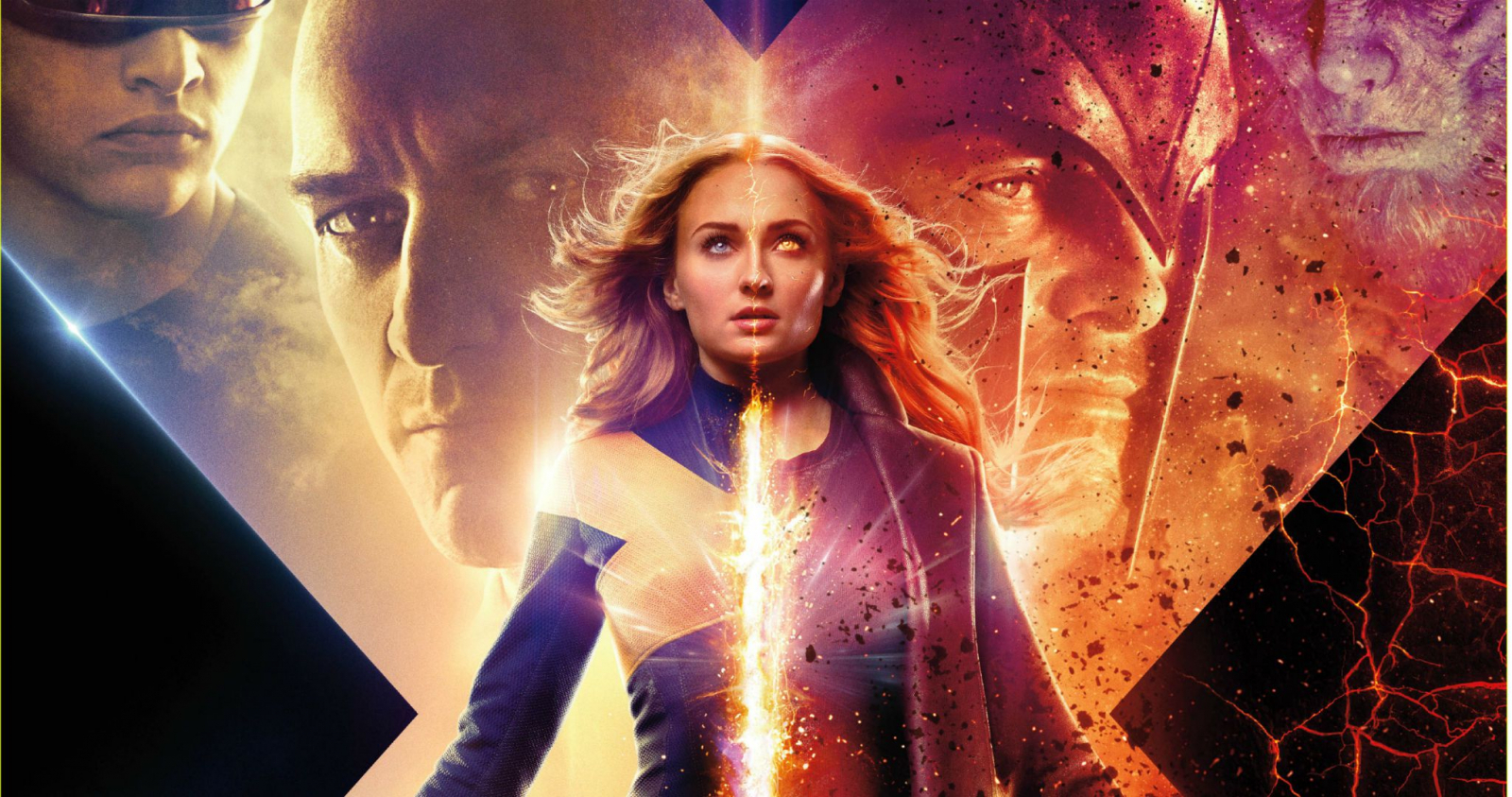
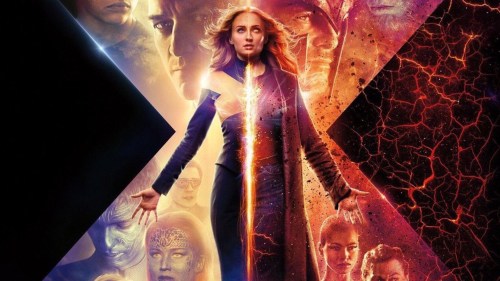
Final “Dark Phoenix” Trailer Is Threatening (In A Good Way)

new-poster-art-for-x-men-dark-phoenix-surfaces-and-a-new-trailer-is-coming-soon-social

These are wonderful, exciting times for fans of superhero movies, unless you’re a Hellboy fan. “Avengers Endgame” is poised to break all sorts of box office record. The Disney/Fox merger is complete. On top of all that, “Dark Phoenix” is still set to come out on June 7, 2019.

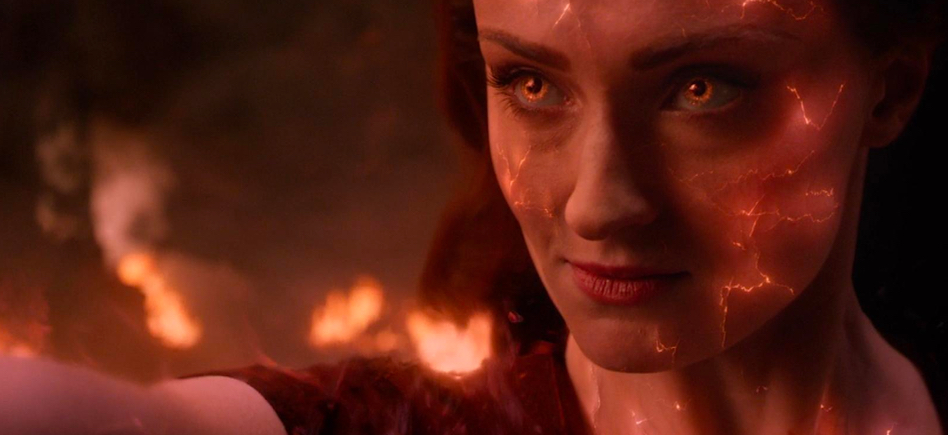
While some have opinions on this film that are petty and unwarranted, I’m still very excited and not just because Sophie Turner is flexing some cosmic sex appeal. This movie is poised to be the last of the X-Men movies that began way back in 2000. While I can understand why some are eager to jump ahead to the X-Men joining the MCU, lets’ not forget that there would be no MCU without the first “X-Men” movie.

It was X-Men that helped usher in this golden era of superhero movies. Now, both “Dark Phoenix” and “Avengers Endgame” promise to usher in a new era. As such, the final trailer for “Dark Phoenix” dropped today and it promises closure, along with cosmic threats.

Sophie Turner has never looked more menacing as Jean Grey.

Tye Sheridan has never looked more determined as Scott Summers.

Between them and the wondrous dynamic between James McAvoy and Michael Fassbender, this movie has everything necessary to cap off this era of X-Men movies in all the right ways.

I know “Avengers Endgame” will break most of the records and make more headlines. However, I believe “Dark Phoenix” will ultimately have a greater impact when all is said and done.

Leave a comment

Filed under Marvel, movies, superhero movies, X-men

Jack Fisher’s Weekly Quick Pick Comic: Uncanny X-Men #16

Every Wednesday, this crazy world of ours gets a little less intolerable thanks to a fresh batch of comics. At a time when most of our heroes are in movies and too many villains run free in the real world, we need a little something to remind us of all things good, upstanding, and awesome. As such, I make it a point to select one comic from this batch that’s a better reminder than most.

While the world of superhero comics goes through cycles of hope and despair as often as the Hulk goes through cheap pants, the state of affairs for the X-Men have been more dire than usual. Since the reality-warping events of “Uncanny X-Men #10,” the state of mutant affairs in the Marvel universe hasn’t just been tenuous. Mutants are essentially fighting for the right to be more than an afterthought.

As much of the mutant population is exploring the dystopian utopia that is “Age of X-Man,” the remaining X-Men have been trying to find their place in a world that seems all too happy to be rid of mutants. It has not been an easy endeavor, but “Uncanny X-Men #16” reminds us why it’s worth doing.

The X-Men have been beaten, demoralized, wounded, and marginalized. They’ve had to battle old enemies, attack old allies, and even clash with close family. To say they’re at a low point would be like saying John Wick likes his dog. This is one of the most dire situations the X-Men have ever had to endure, including everything ever written by Chuck Austin.

Despite all that, “Uncanny X-Men #16” finds a way to bring out the best in the X-Men’s most ardent champions.

If you’re a Cyclops fan, you’ll find something to love about this issue. If you’re a Wolverine fan, you’ll find something to love about it too. Hell, if you’re a fan of mutant ninjas fighting alongside magic-wielding Russian teenagers, you’ll find something love about it. That last one is not a metaphor, by the way.

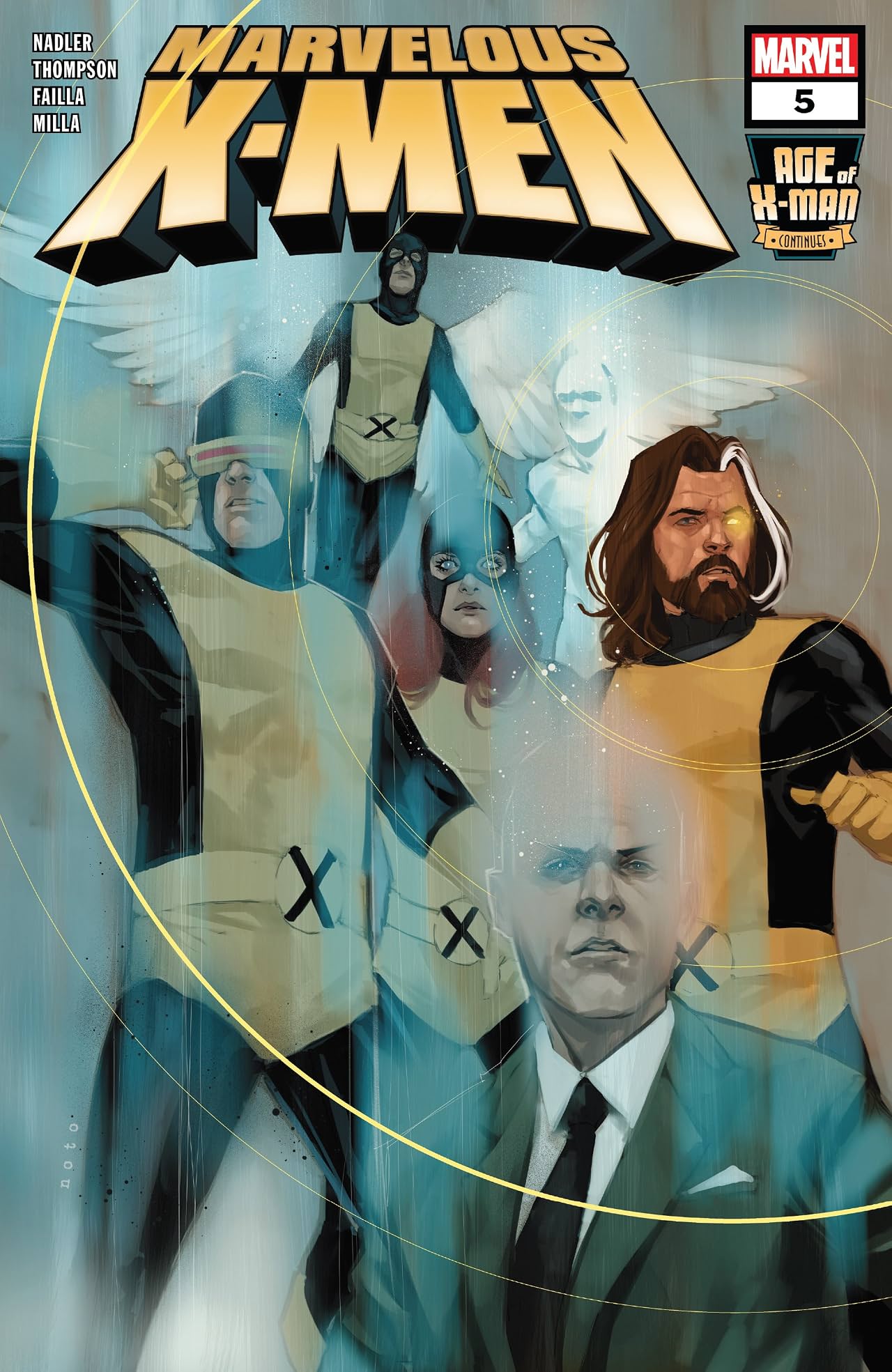
Uncanny X-Men #16” continues a story that has wounded the X-Men in so many ways. A lot of it is mental. Some of it is physical, as Cyclops’ lingering head injury shows. Even as the X-Men fight on, this issue finally shows all the struggle getting to the team. It’s not the first time these characters have expressed doubts, but in the context of the story, it does something important with respect to the past, present, and future of the X-Men.

Everyone on Cyclops’ team knows that mutants are in an existential crisis. They know their numbers are dwindling and that humanity is doing everything possible to make them an afterthought. How does anyone even go about being X-Men in a world like that? Thus far, that has been an unanswered question.

Cyclops and Wolverine tried to answer it by creating a new team out of what remained of the mutant population. They’re actually setting aside their differences and attempting to keep the spirit of the X-Men going. Keep in mind, these are two people who don’t like each other. One of them kept trying to sleep with the other’s wife and the other has shot him through a wall on more than one occasion.

Just putting the team together and fighting what’s left of the X-Men battles has been a struggle over the past several issues. However, “Uncanny X-Men #16” dares to step back and question what they’re fighting for and why they’re even fighting.
Writer, Matthew Rosenberg, explores some overdue discussion among the team. He also puts Cyclops in a unique position that somehow makes him more awesome. For much of his history, as well as his ill-fated roles in the movies, Cyclops has always been the uptight leader who barks orders and expects others to follow them. While we’ve seen hints of that Cyclops here and there, he finds himself in a more uncertain position.

Cyclops no longer trusts himself to be the leader he once was. Even his own brother, Havok, isn’t sold on his leadership at times. While it’s hard to be much of a leader when your entire species is on the brink of extinction, the criticisms aren’t without merit.

Essentially, Cyclops gives the X-Men a chance to show that they can be X-Men without him barking orders. He goes so far as to temper his own leadership in order to give the X-Men a chance to prove their causes is bigger than one person. I won’t say it’s Cyclops’ greatest tactical decision, but the results speak for themselves.

The criticisms and difficult discussions are relevant, giving “Uncanny X-Men #16” much more depth than a typical X-Men comic. It still has plenty of standard superhero action that artist, Salvador Larroca, renders beautifully with his skills. It’s not the flashiest battle, but it has a few twists and complications that require more than just better leadership.

Some of the choices made over the course of the story are questionable. Many of the wounds they’ve suffered haven’t entirely healed. These X-Men are still a far cry from the X-Men that hang out in mansions, fly around in high-speed jets, and fight killer robots. They’re not just struggling to find their place in a world where mutants are almost extinct. They’re trying to find a better way to do what they’ve always done.

The events of “Uncanny X-Men #16” prove that the X-Men still have plenty to offer. They’re still in a tenuous state, but they’re still intact. They’re still finding their way. They’re still learning overdue lessons that bring out the best in each character while not overlooking the worst.

These are exciting times for the X-Men and not just because the movie rights have returned to Marvel. Rosenberg and Larroca have broken the X-Men down in their darkest hour. Now, it feels like they’re becoming the superheroes they have to be. There’s bound to be setbacks, mistakes, and tragedies. However, that’s often when heroes like the X-Men are at their best.


Leave a comment

Filed under Jack's Quick Pick Comic, X-men

Jack Fisher’s Weekly Quick Pick Comic: X-23 #11

Every week, a new crop of comics enters this world to make the world a better place and/or help tide fans over until the release of “Avengers Endgame.” Whether you’re a fan of superheroes, melodrama, or just pretty artwork from artists not afraid to draw gaudy costumes, there’s something for everyone.

Every Wednesday, I take it upon myself to select one comic that I feel offers something extra beyond the price tag. Historically, few characters offer a wider range of appeals than Laura “X-23” Kinney.

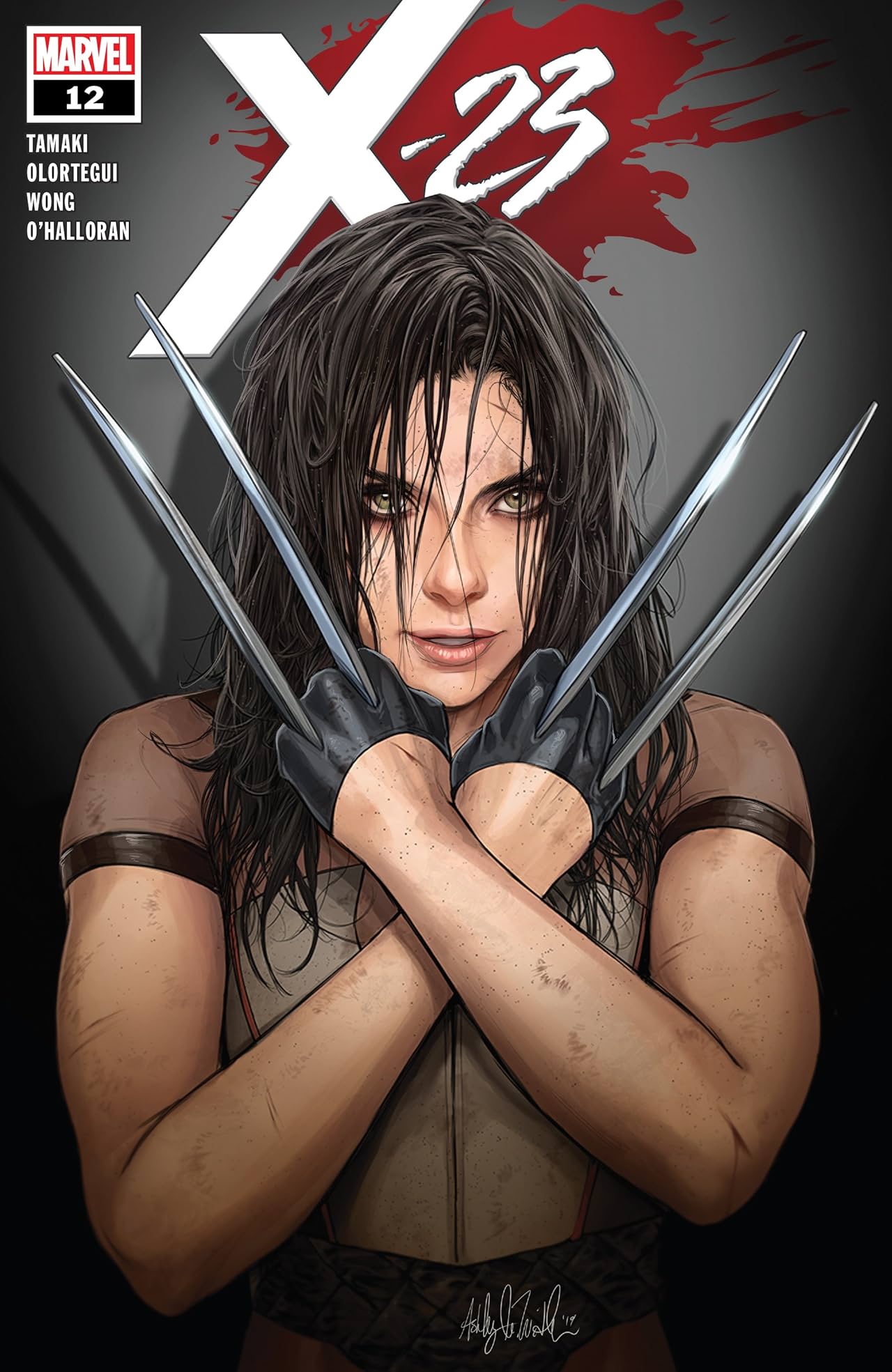
Some know her as the daughter of Wolverine. Some know her as the breakout star of the “Logan” movie who helped make Dafne Keen a star. Regardless of how you know her or the medium in which she comes, she often brings a diverse story of violence, brutality, melodrama, and heartbreak. This week’s pick, “X-23 #11,” delivers on all of this, and then some.

Since writer Mariko Tamaki took over the series, Laura has gotten back to basics in terms of her mission. While she served admirably as Wolverine for a while, her priorities often change when she finds out some mad scientist wannabe is trying to make living weapons again. Considering how often this results in a blood bath, such efforts should count as an elaborate suicide attempt.

It’s a bigger deal to Laura than most. Like Logan, these programs have brought her nothing but pain. Unlike Logan, though, she doesn’t have the benefit of having holes in her memory. She remembers all the horrible crap that these programs did to her, which included the murder of her mother. She has more incentive than most to take these programs down as quickly and brutally as her father would have.

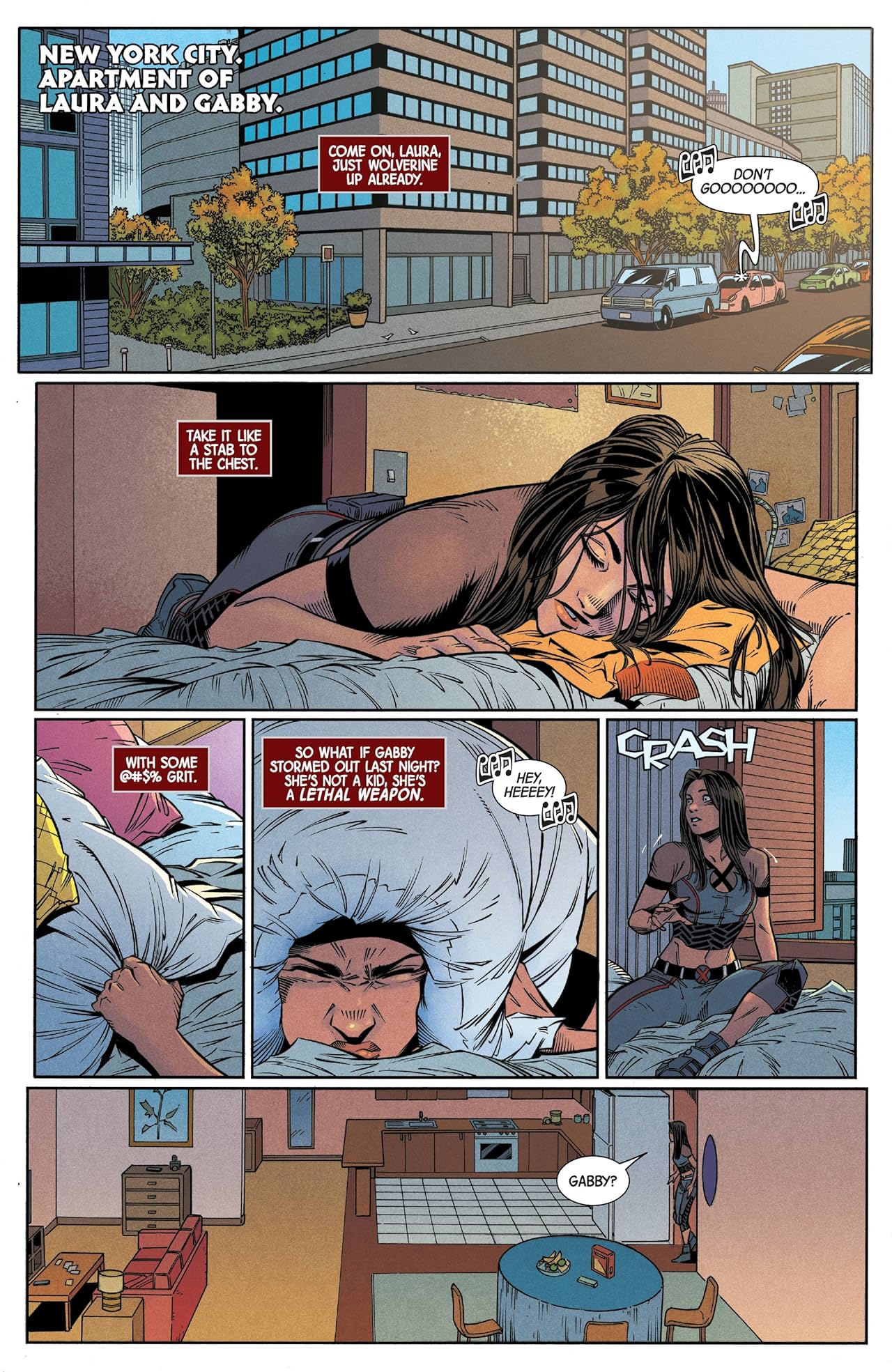
This is the primary goal in “X-23 #11,” but there’s a lot more at work than just someone with adamantium claws tearing through a weapons facility. In X-men comics, that’s basically a typical Monday. What makes this typical part of Laura’s mission harder than usual is the growing divide between her and her clone sister, Gabby “Honey Badger” Kinney.

That divide began several issues earlier. Like a pissed off Wolverine chasing the last can of beer, things have been getting anxious between the two. Since her debut in All-New Wolverine, Gabby has been a wonderful ray of sunshine mixed with omega-level cuteness for Laura. I’ve documented the breadth of that cuteness before, but it has never worked against Laura until now.

Laura knows it’s happening. She even senses that there’s some simmering resentment in Gabby, so much so that it affects her tastes in music. This isn’t just sisters bickering over what to binge-watch on a Friday night, though. “X-23 #11” establishes a fundemental divide between Laura and Gabby that may very well send the two sisters in a very different direction.

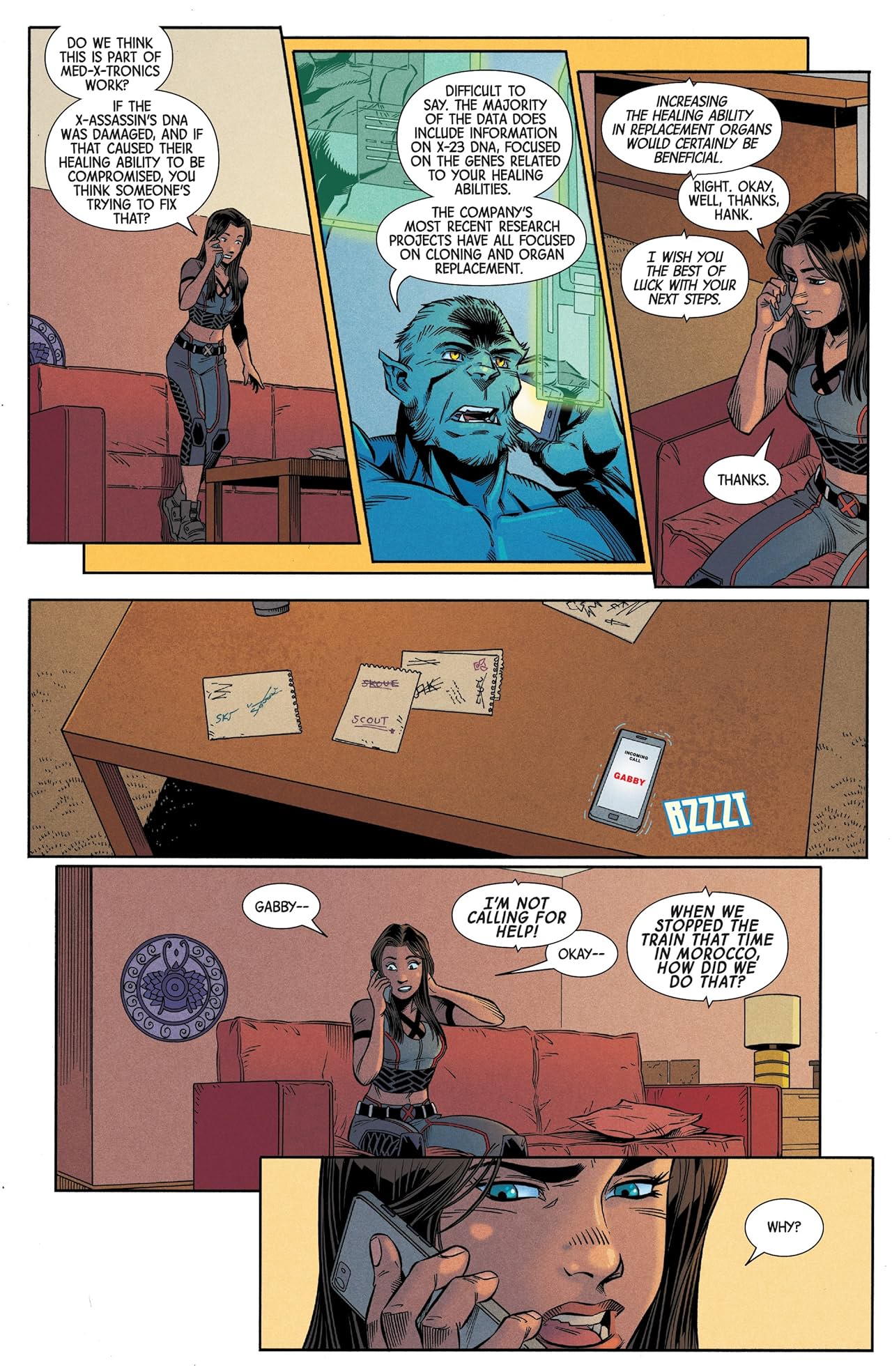
Tamaki has been setting up that divergence for several issues, but now there’s no putting it off any longer. It started with a debate over what to do when a shady company called Harvest made an army of X-23 clones that had been augmented/hijacked by cybernetics. While it made for some pretty brutal battles, it also highlighted the difference in Laura’s approach to dealing with other living weapons compared to Gabby’s.

Gabby, being the glowing ball of lovable cuteness that she is, wants to save these weapons. She sees them like other sisters. Even when it they come off as brain dead, like the cyborg X-23 army they battled, her first instinct is to save them and not destroy them. Laura, having seen too many clones cause too much suffering, favors a more direct solution that involves adamantium claws.

What makes the drama in those issues, as well as “X-23 #11,” so compelling is that it’s easy to see both points of view. Gabby knows that she wouldn’t even be alive if Laura hadn’t shown compassion when dealing with the clones that these living weapons programs produce. She also wasn’t subject to the same tragedies as Laura so she still has that wide-eyed optimism about helping other clones.

Laura, being older and a lot more damaged from her experiences, knows that the real world tends to crush optimism the same way Logan crushes beer cans. She has suffered and lost a great deal in dealing with these living weapon programs. She understands that not every clone can be saved. She knew that was the case with the cyborg clones that she and Gabby battled, but also knew Gabby was not going to agree with her.

Now, as the aftermath of that conflict sets in through “X-23 #11,” they both face some difficult, heart-breaking choices. For once, few of those choices can be made while stabbing heavily armed henchmen. There is some of that in this story and Diego Olortegui’s artwork does plenty to make that a visual spectacle. However, it’s the family drama that really sets this issue apart.

If you’ve been following the evolution of Laura and Gabby’s relationship since her debut, then the events of “X-23 #11” are genuinely heartbreaking. These two have steadily become a real family in their brief time together. Now, they’re being torn apart by bitter disagreements and painful choices.

Both Laura and Gabby experience the heartache. Even if you haven’t been following their respective stories, it’s easy to appreciate the bitter divide between two sisters. It happens in the real world and without mutant powers. Sometimes, things between siblings go bad and they drift apart. Seeing that happen with Laura and Gabby is nothing short of tragic.

It’s bittersweet, but it also helps set the stage for the future of both characters. “X-23 #11” is one of those comics that doesn’t avoid a difficult moment between two characters who no longer see eye-to-eye on an important issue. Even within family, these moments happen. This one was inevitable, but Tamaki and Olortegui made sure this one hit hard in all the right ways.

With Logan back from the dead, it promises a very divided Wolverine family, to say the least. For a family that has been subject to cloning experiments, constant torture, and even a trip to Hell, it’s a tough situation, but one that tends to make them all more badass in the long run.

Leave a comment

Filed under comic book reviews, Jack's Quick Pick Comic, superhero comics, X-men

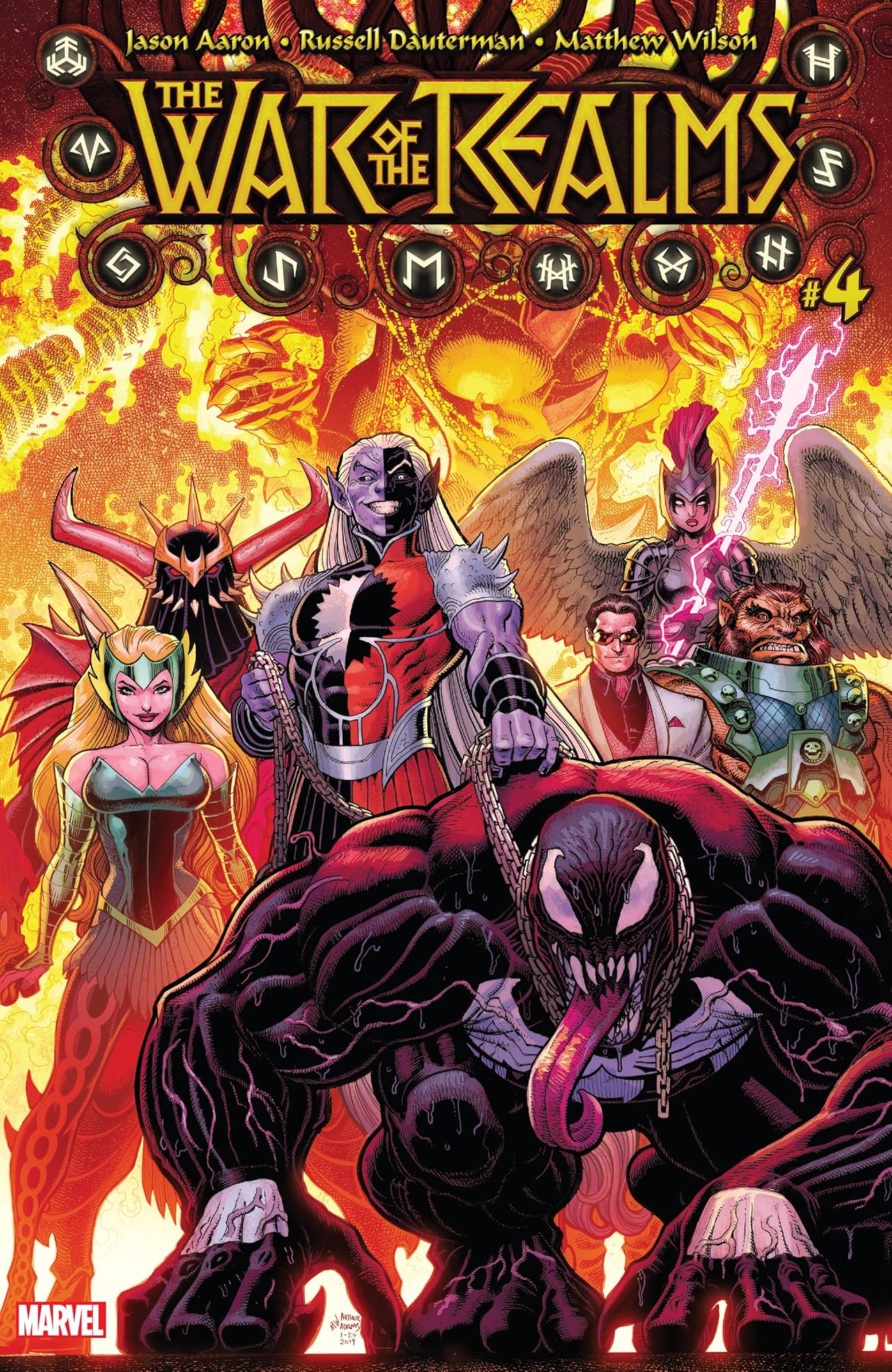
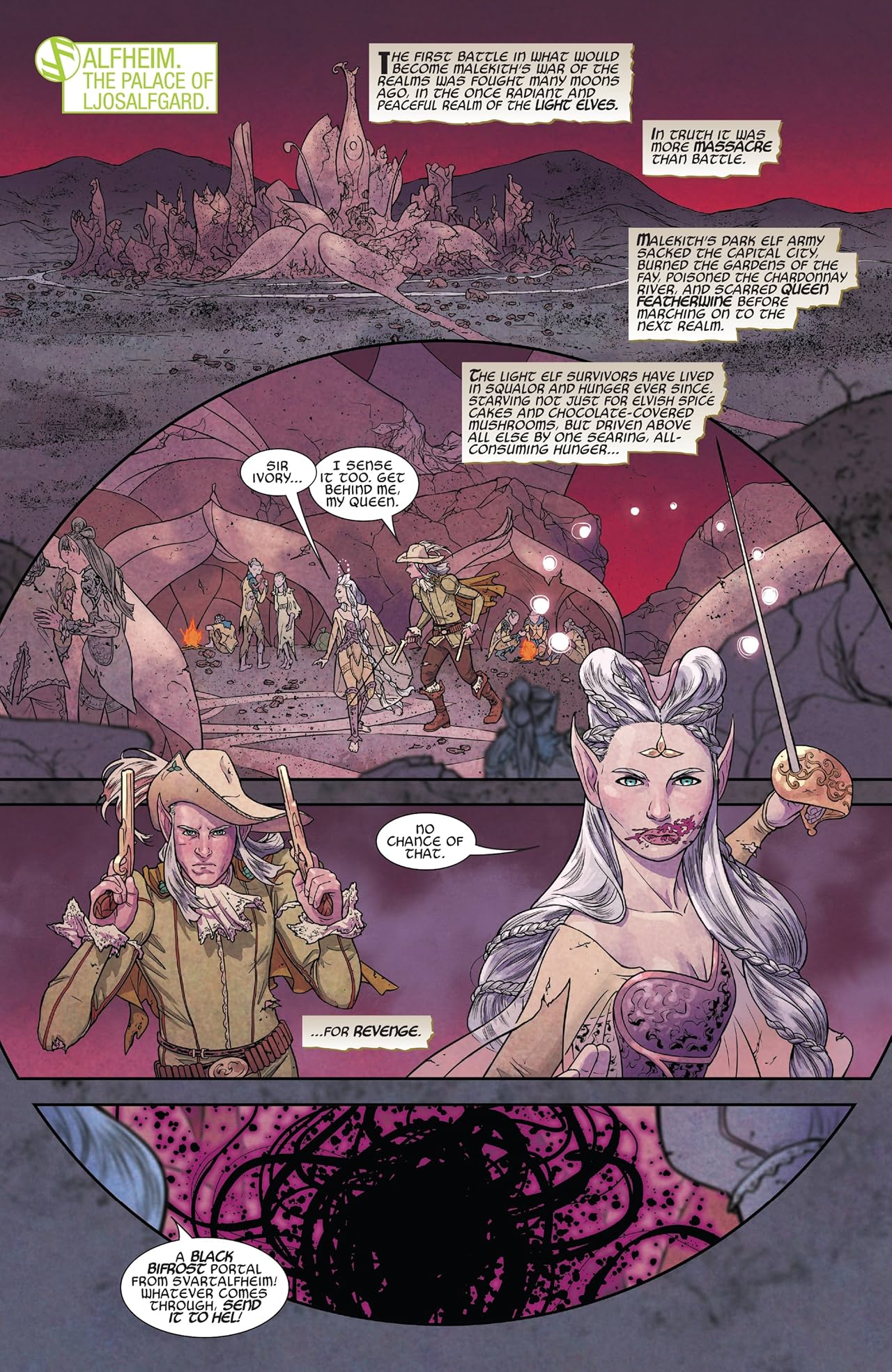
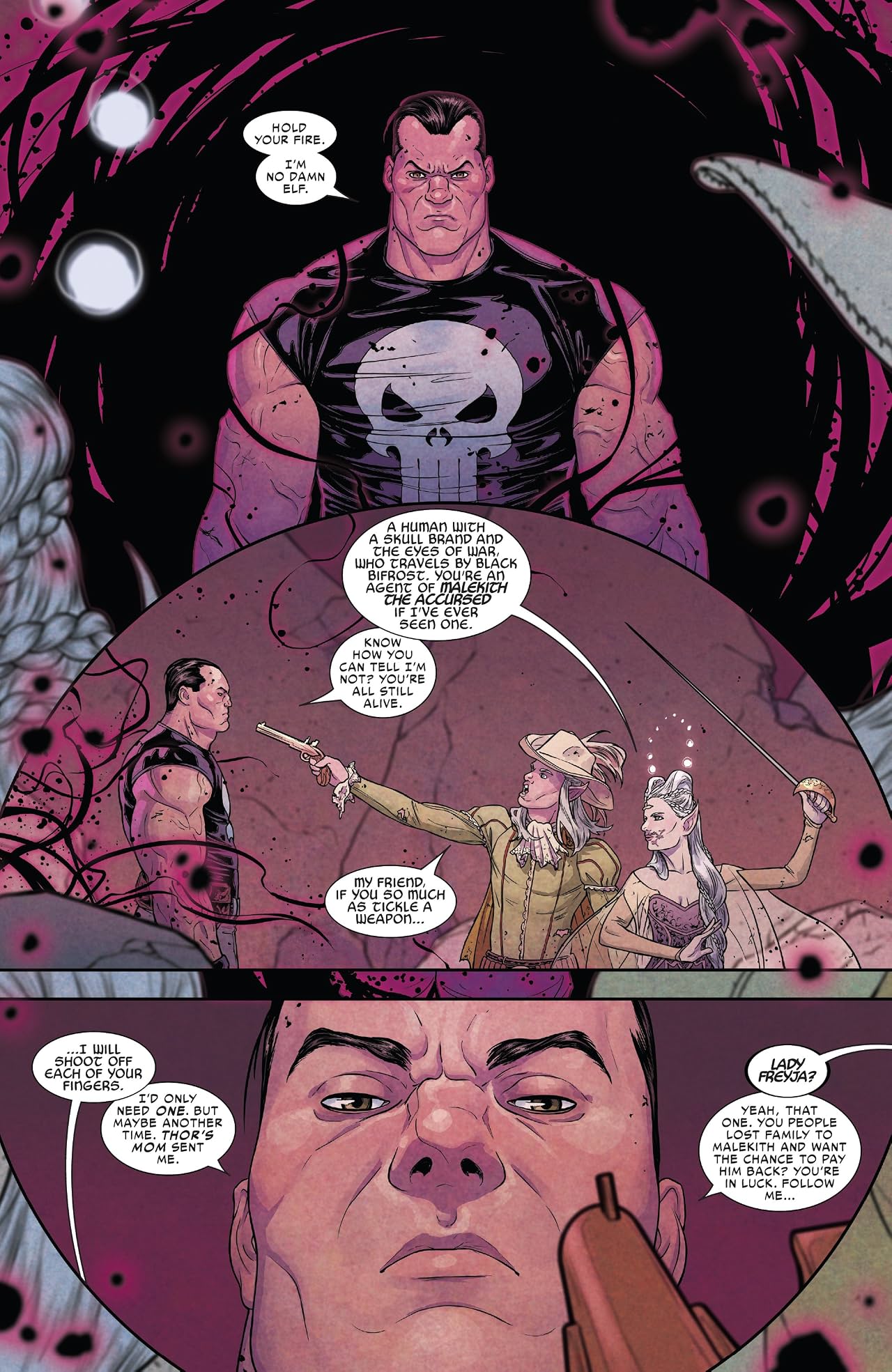
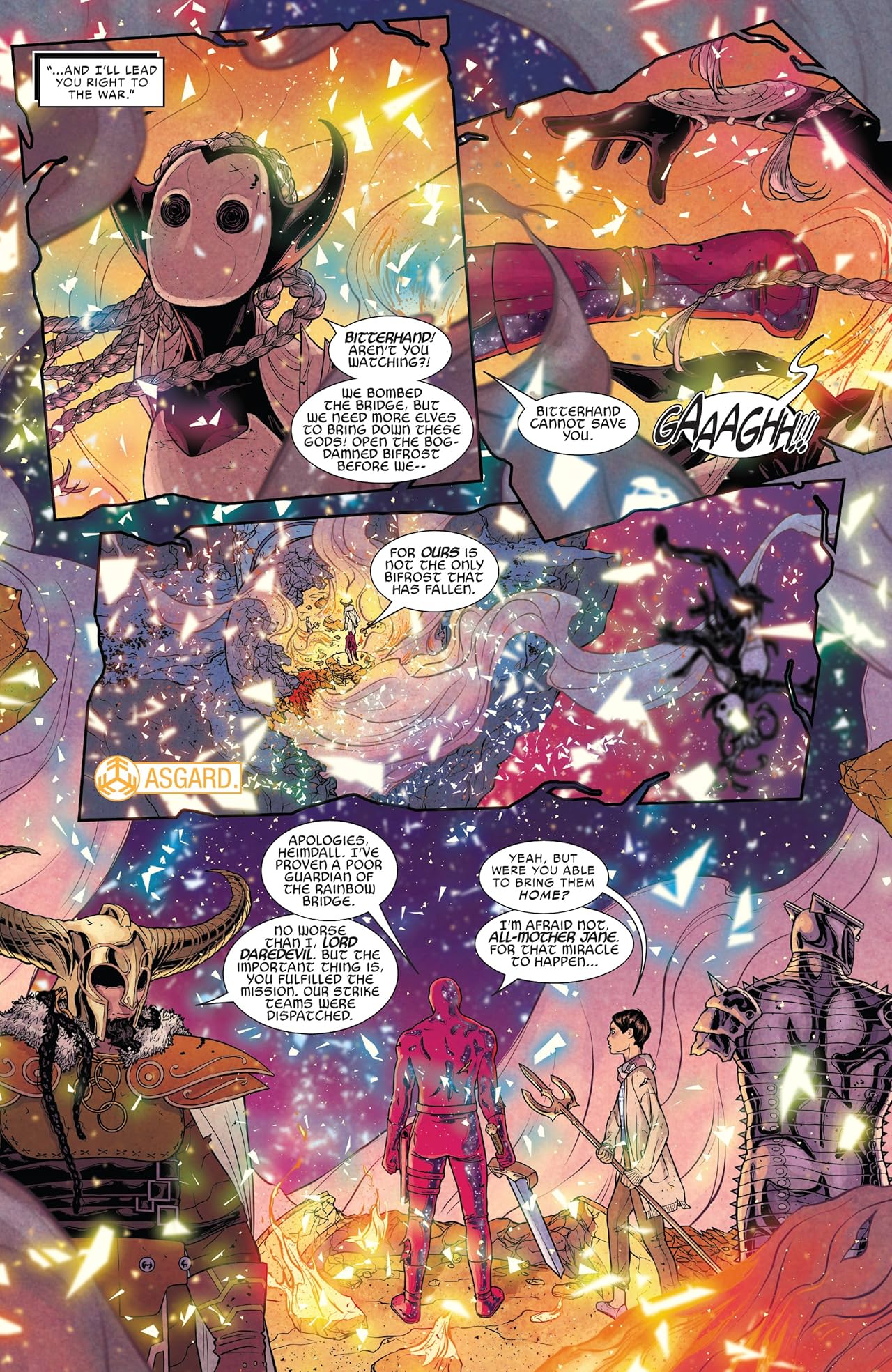
Jack Fisher’s Weekly Quick Pick Comic: War Of The Realms #1

Every week, the world is in desperate need of something to make it just a little more fun. As such, every Wednesday brings us a fresh batch of comics that achieves just that and then some. With the anticipation of “Avengers Endgame” at unprecedented levels, we all need something to tide us over until we cram into theaters and send piles of money to our Disney overlords.

Thankfully, a comic like “War of the Realms #1” does plenty to scratch that superhero itch and it doesn’t require anyone to deal with crashing websites. While the big gathering in the Marvel Cinematic Universe is taking shape, these kinds of gatherings seem to occur every other Tuesday in the comics. Some are more awesome than others and the one that unfolds in “War of the Realms #1” definitely qualifies.

You don’t have to have followed to recent comics to appreciate it, although it certainly helps. The world of Marvel comics is always in flux with respect to the threats the heroes face and the situations in which they find themselves. “War of the Realms #1” is a confluence of compounding factors that started in Thor’s world of gods and mythical monsters. Now, it has erupted to a level that even comic book gods can appreciate.

If you thought Asgard was in a rough place after “Thor Ragnarok,” then you’ll be unpleasantly shocked at how much worse it can get in the comics. However, it’s not solely because of giant fiery monsters set to 70s rock music. It’s largely because Odin, in stark contrast to the charm exuded by Anthony Hopkins, is a divine prick in the comics.

It’s because of him that Asgard is in ruins, much of his fellow gods have abandoned him, and the realms are ripe for invasion. Despite being the All-Father of gods, he’s powerless to stop it and the heroes of Earth/Midgard are the ones who have to fight it. Prick or not, it still makes for a hell of a spectacle that brings out the best in Russell Dauterman’s artwork.

The mystical machinations of the war aren’t overly complex, nor do they need to be. Asgard isn’t a shining bastion of order and stability anymore. That means Frost Giants, Dark Elves, and Trolls are free to organize and invade other realms. Leading the pack is Malekith the Accursed and if you thought he was a push-over in “Thor: The Dark World,” this comic should help shatter that notion.

Far from being the bland throw-away villain in the movie, Malekith is a forced to be reckoned with in “War of the Realms #1.” He has united gods, monsters, and entire races into one massive army right out of J. R. R. Tolkein’s worst nightmare. Now, he leads them into a full-scale invasion of Midgard and the battle that ensues is as epic as anyone could hope for.

It’s not just Avengers who rush to the front lines. We see the likes of Spider-Man, Wolverine, Daredevil, and the Punisher join the chaos. This is not just a battle for the Avengers. This is something that will bring in players from all ends of the Marvel Universe.

Even with the recent Disney/Fox merger closing, this isn’t something we’re going to see in the Marvel Cinematic Universe anytime soon. “War of the Realms #1” offers a taste of just how much bigger the world of Marvel can be when all its iconic characters occupy the same world. Even for those who can barely contain their excitement over “Avengers Endgame,” this comic should give those same fans plenty of possibilities to contemplate.

The underlying plot to “War of the Realms #1” may be basic, but Jason Aaron, who has been the architect of both Thor and the Avengers for years, finds plenty of ways to bring depth to such a colorful clash. He even finds a way to squeeze in a joke about colonoscopies and kidney stones. I promise I’m not making that up.

Much like the movies, there bits of humor that keep things from getting too dire. However, “War of the Realms #1” never feels like a joke or an excuse to see Thor beat up frost giants. Jason Aaron has shown, throughout his run, that he can incorporate layers into mystical, hammer-wielding spectacles. Those layers are definitely there and poised to affect the battle.

How that battle plays out is just starting to unfold. Even though this comic is padded with extra pages to go along with the inflated price, it’s very much a prelude to a much larger conflict. That conflict already has Spider-Man making dirty jokes and Loki getting eaten by a frost giant. If you can’t find entertainment in that, then you’re just being difficult.

Beyond the entertainment value, “War of the Realms #1” offers the kind of high-stakes superhero crossover story that movie fans have only recently come to appreciate while comic fans have been enjoying it for years. While Malekith the Accursed will never be on the same level as Josh Brolin’s Thanos, there’s something to be said about a character who can wage a cosmic war on the entire Marvel Universe.

Whatever your feelings about Malekith, Odin, or Spider-Man’s brand toilet humor, “War of the Realms #1” has plenty to enjoy while also setting up a much larger conflict. It’s a story that gives the superheroes we love a chance to unite, kick ass, and break stuff. It’s stories like that which remind comic fans why New Comic Book Day is truly the best day of the week.

Leave a comment

Filed under Jack's Quick Pick Comic

Jack Fisher’s Weekly Quick Pick Comic: Spider-Man Life Story #1

Every week, the world gets a brief reprieve from being a chaotic mess when a fresh crop of comics enters the world. Most call it Wednesday. Others, like myself, call it New Comic Day. It’s like a weekly holiday, minus the decorations, gift giving, and crowded airports. On this unique day, I pick one particular comic to single out as worthy of making this day feel extra festive.

This week brings us a special gem from everyone’s third favorite friendly neighborhood Spider-Man, after Spider-Ham and Spider-Gwen. It comes courtesy of one of Marvel’s top scribes in Chip Zdarsky and one of their top artists in Mark Bagley. While there has always been an abundance of Spider-Man comics, “Spider-Man: Life Story #1” stands out in a uniquely charming way.

For much of Spider-Man’s contemporary history, there has been an ongoing challenge, of sorts, when it comes to keeping him relevant. Writers, artists, and movie producers keep having to update Spider-Man’s story, somewhat, so that he feels modern. That’s not easy for a character who first debuted in 1962, courtesy of Stan Lee and Steve Ditko.

Over the years, Peter Parker has found himself reinvented into many eras, from disco to social media. Marvel has always been somewhat coy about how characters like Spider-Man can show up in these eras and not seem to age, but that’s exactly what makes “Spider-Man: Life Story #1” so unique.

It doesn’t try to put Peter Parker in a more modern context. It doesn’t try to radically change who he is so that he fits into a more familiar world. Instead, Zdarsky and Bagley do the complete opposite and just let his story unfold within the era that first created him.

There’s no sliding timescale here. The year is 1966. Peter has had his Spider-Man powers for four years. He’s in college, the Vietnam War is ongoing, hippies are starting to grow in population, and cigarette’s are still advertised for their health benefits. This is the world in which Spider-Man was initially birthed and this is the world in which his story unfolds.

It’s a familiar story, one that frequently relies on Peter trying to balance his life as a college student with his superhero life as Spider-Man. However, that familiarity is exactly what helps “Spider-Man: Life Story #1” work so well as a concept and a setting. While it isn’t bound by the same 50-plus years of comic book continuity, it is bound by the circumstances of the mid-1960s.

This is a very different time for superheroes and non-superheroes alike. It’s not just that soda costs a quarter and the idea of alternative facts can be attributed to bad acid trips. This is a time of major social upheaval, especially in places like New York. Issues surrounding the Vietnam War aren’t just affecting Peter. They’re affecting his friends and other heroes, like Captain America.

It’s a world in which Peter struggles with choices that don’t just involve being on time for class. He’s seeing friends/bullies like Flash Thompson get drafted into a war that is just starting to go poorly. He’s watching other superheroes who don’t have to deal with J. Jonah Jameson make difficult choices about whether to get involved. What does an aspiring superhero do in that kind of world?

It makes for an interesting and dramatic backdrop for “Spider-Man: Life Story #1.” Peter still deals with typical Spider-Man issues, like getting to class on time and pursuing a blossoming relationship with Gwen Stacy. There are also a few battles with familiar enemies, namely the Green Goblin, who’s an asshole in any era. However, neither Peter Parker nor Spider-Man are bigger than the issues of the world around them.

In many respects, it brings out a more balanced Spider-Man. His struggles in dealing with the times and circumstances around him makes Peter Parker feel more real. It has always been part of his appeal, going back to the era of Lee and Ditko. He’s not some billionaire playboy or legendary soldier. He’s just a nerdy kid who got super-powers by accident.

This is a Peter Parker who isn’t bound by the old Comic Code Authority or aversions to political undertones. Zdarsky and Bagley let him live and react to the world of 1966 in a way that’s both believable and engaging. Essentially, they let him be the character that Lee and Ditko created within the times of his creation.

Those turbulent times set up even more drama as issues like the Vietnam War and the growing mistrust between people and authority start to grow. Peter’s youth puts him in the front row of the emerging chaos while the adults around him, including other superheroes, find themselves affected in ways that would’ve abhorred 1960s censors.

In a sense, the times and the larger world of “Spider-Man: Life Story #1” is the biggest appeal of the story. It allows complexity and drama that isn’t typical of a modern Spider-Man comic, but somehow brings out the best in Peter Parker and those around him, even if J. Jonah Jameson is still an annoying blowhard.

Leave a comment

Filed under Jack's Quick Pick Comic

Done Deal: The Disney/Fox Merge Is Complete!

As Micky Mouse himself would say, “Oh boy!”

As of 12:02 a.m. on March 20, 2019, the deal that has been 18 months in the making is complete. Disney and Fox are officially merged in an intimate corporate entanglement that sounds extra-sexy to fans of the X-Men and Fantastic Four.

There are a lot of implications here. The media landscape will never be the same. I’m neither smart enough nor psychic enough to make sense of those implications. However, I’m certain there will be plenty to discuss in the coming years. As a fan of superhero movies and all things awesome, I’ll be keeping a close eye on it and I’ll certainly single out the stuff that’s extra sexy.

Until then, let’s all just take a moment to appreciate the bold new, Disney-dominated world we live in now.

Leave a comment

Filed under Marvel, movies, superhero movies, television, X-men