Category Archives: Celebrities and Celebrity Culture

A Note To Those Who Are Angry With Taylor Swift

As a general rule, I do not look to celebrities to inform my opinions on politics. And I strongly recommend that approach for everyone. Getting your politics from a celebrity is like getting medical advice from a plumber. It’s both misguided and irrational.

That even applies to celebrities with the star power of Taylor Swift. I’m fully aware that, in terms of celebrity star power, she’s on a very different level compared to most. I even referenced her when I said nobody should ever be as famous as Michael Jackson. Be that as it may, she might very well be the only one to come close to that level of star power.

Now, I don’t consider myself a full-blown Swifty, as they’re called. But I do have friends and relatives who are as passionate about all things Taylor Swift as I am about superhero comics. And I totally respect that. I get that kind of passion. But even those die-hard Taylor Swift fans understand on some levels that she’s not a political figure. She’s an entertainer and, by far, one of the most successful of the past 25 years.

Then, there are those who are angry at Taylor Swift for her recent politics. But unlike other instances in which celebrities mix star power with politics in objectively awful ways, this anger is even dumber than usual. It barely even has anything to do with politics, which makes it even dumber when people try to put a political spin on it.

While I’d rather not get into all the drama surrounding Taylor Swift’s foray into politics, going back to 2020, the current source of outrage is this. Taylor Swift is dating Travis Kelce, the star tight end of the Kansas City Chiefs. And her presence at Chiefs games has had a significant impact on both the ratings of those and the overall interest in this relationship.

Naturally, the NFL loves the extra attention they’re getting from Swift’s legion of dedicated fans. But there is also a sizable crowd of angry, politically motivated individuals who hate the attention she’s bringing to the games, as well as the “politics” she’s engaged in. And I put “politics” in quotes because the criteria these people are using is too stupid for me to put into words.

Officially, the only real political activity Swift has engaged in since 2020 is encouraging people to register to vote. She never told anyone who to vote for or even what party to vote for. She just used her massive platform as a celebrity to get people out to vote. In most circumstances, that’s an objectively good thing. Getting people to participate in the democratic process helps the country, as a whole.

But unofficially, those who hate this brand of “politics” think she and Travis Kelce are part of some elaborate conspiracy to rig the 2024 Presidential Election against their side. They genuinely believe in a real, tangible conspiracy theory that has shadowy political forces manipulating Swift into influencing the upcoming election in a certain way.

Again, it is too stupid for words. I could write an entire book on how stupid it is, but it still wouldn’t be enough.

So, without getting too deep into the politics, I just want to convey one important message to those who are angry with Taylor Swift, her politics, her current relationship, and her public persona.

Getting angry at her for such petty reasons is a huge mistake.

That’s not a warning or anything. That’s just a simple, logical observation. Because targeting public figures for their political views is bad enough. We’ve already seen this same crowd of angry reactionaries target companies, comedians, school boards, and even a children’s hospital.

Yes, they actually got angry at a children’s hospital. That, alone, should tell you all you need to know about the nature of these peoples’ anger.

But going after Taylor Swift is different. She is not someone who is unaccustomed to public scrutiny. She has been a celebrity for over a decade, long before the current political climate. She also is familiar with dealing with hostile fans. So, she’s likely not going to be intimidated by that sort of fiery rhetoric.

Most critically, Taylor Swift has legions of passionate fans who won’t hesitate to defend her. And in this case, they would be perfectly right in defending her because she’s doing nothing outrageous. Again, all she has done since 2020 is encourage people to register to vote. And the fact that this is what enrages these reactionaries so much is both telling and pathetic.

It’s as though they know for a fact that if more people vote, they’re more likely to lose major elections. They’re aware that their views are unpopular, untenable, and just plain wrong. And the only why they have a chance of winning is if enough people aren’t motivated to vote.

That, in and of itself, is pretty egregious. But take another step back and look at the larger message this outrage is sending. These people are utterly outraged at Taylor Swift, one of the most successful and celebrated entertainers of all time, for simply not agreeing with them politically. The way she carries herself, the way she navigates the world of celebrity, and the political stances she’s taken in the past are just too much for them.

And that, simply put, is pathetic.

On top of that, these reactionaries are telling Swift’s legion of fans that they hate her for this one simple disagreement. And many of those fans are young, passionate, and likely weren’t even interested in her politics until people from a certain end of the political spectrum started attacking her. How do you think they’re going to feel about those who hate her? Moreover, how do you think that’s going to impact their voting habits?

Personally, I still don’t care about Taylor Swift’s politics. Even if she didn’t agree with me politically, I would still have her songs on my workout playlist. Whenever there’s a disagreement like that with anyone, celebrity or otherwise, it’s just easier to shake it off.

But that apparently isn’t enough for these angry, reactionary whiners. They still feel compelled to attack her for the sin of not going along with their agenda. And they really think they’re more powerful than Taylor Swift’s legion of fans.

Well, if they really think that, by all means. Keep trying to villainize her. Keep pretending that hating her won’t have a significant influence on young people who love her music. Just don’t be surprised if the consequences aren’t something you can easily shake off.
Leave a comment

Filed under Celebrities and Celebrity Culture, politics, rants

Why NOBODY Should Ever Be As Famous As Michael Jackson

This is a video from my YouTube channel, Jack’s World.

In this video, I explore the world of fame, fortune, and celebrity. And for people of a certain age, none achieved more of that than Michael Jackson. While his legacy in the annuls of pop culture might be a bit mixed these days, it’s hard to overstate just how big an icon he was.

But as monumental a figure he might have been, I strongly believe that NOBODY should ever be as famous as him ever again. That kind of fame might not even be possible anymore. But I feel it’s worth revisiting. Enjoy!

Leave a comment

Filed under Celebrities and Celebrity Culture, Jack's World, music, psychology, YouTube

Jack’s World: Why Most Critics Of Superhero Media Are Wrong, Misguided, And Stupid

The following is a video from my YouTube channel, Jack’s World. I’ve been working on this for a while now. I’m aware of the various criticisms that superhero media has received in recent years, from political pundits to former writers like Alan Moore. I’ve been wanting to respond to that criticism in some comprehensive way. This video is my way of addressing it, as well as reaffirming why I love superheroes and why they mean so much to so many people. Enjoy!

Leave a comment

Filed under Celebrities and Celebrity Culture, DC Comics, Jack's World, Marvel, Marvel Cinematic Universe, superhero comics, superhero movies, YouTube

A Quick (And Critical) Lesson On Tolerance And “Cancel Culture”

There are certain topics that I find difficult to talk about, but I’ll still make the effort because they’re worth discussing. That’s why I’ll write something about abortion or religion every now and then. These are serious, emotionally charged issues. There’s merit to discussing them.

Then, there’s “cancel culture.”

I’m sorry, but I’ve yet to see a single discussion about “cancel culture” that has ever been productive. Some say it’s a threat to free speech and western values. Some say it’s not really a thing. I say both are wrong and both aren’t helping by making sub-par arguments.

Every few months or so, it starts trending and for bullshit reasons. Usually, what some bemoan as “cancel culture” depends heavily on their political affiliation. A conservative won’t see Colin Kaepernick being shut out of the NFL as cancel culture, but they’ll whine endlessly about Rosanne Barr getting fired from her show.

Conversely, a liberal will cheer when Lou Dobbs gets fired, but will make endless excuses for liberal celebrities who say objectively dumb shit. It always seems to boil down whether you’re politics align with whoever or whatever is canceled. It’s arbitrary, it’s petty, and it’s absurd. I really don’t have any other way to describe it.

Now, I could rant for hours about bullshit “cancel culture” arguments. However, I’d rather do something more productive with my time. I’d also prefer not to add to the whining. The only reason I’m bringing this up is because that’s all anyone has been doing since the story about Gina Carano broke.

If you’re not up to speed, consider yourself lucky. I won’t recount the details. The long and short of it is she got fired by Disney for some stupid tweets that mentioned the holocaust. Now, I won’t give my opinion on the contents of these tweets. Again, that’s not a productive use of my time or anyone’s time, for that matter.

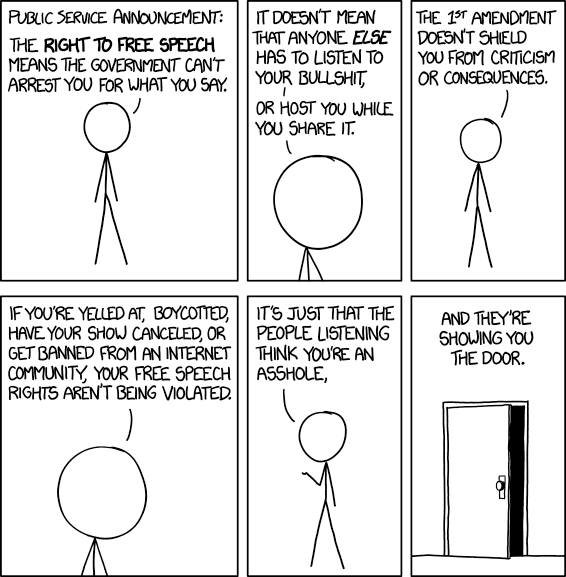
However, I don’t want to bring this topic up just to rant about it. Instead, I’d like to use the ongoing whining about “cancel culture” to offer some perspective about what it is, what it isn’t, and why it matters. I could try to put it into words. Thankfully, people far smarter and more talented than me already have.

The following image that I found on Twitter sums it up nicely.

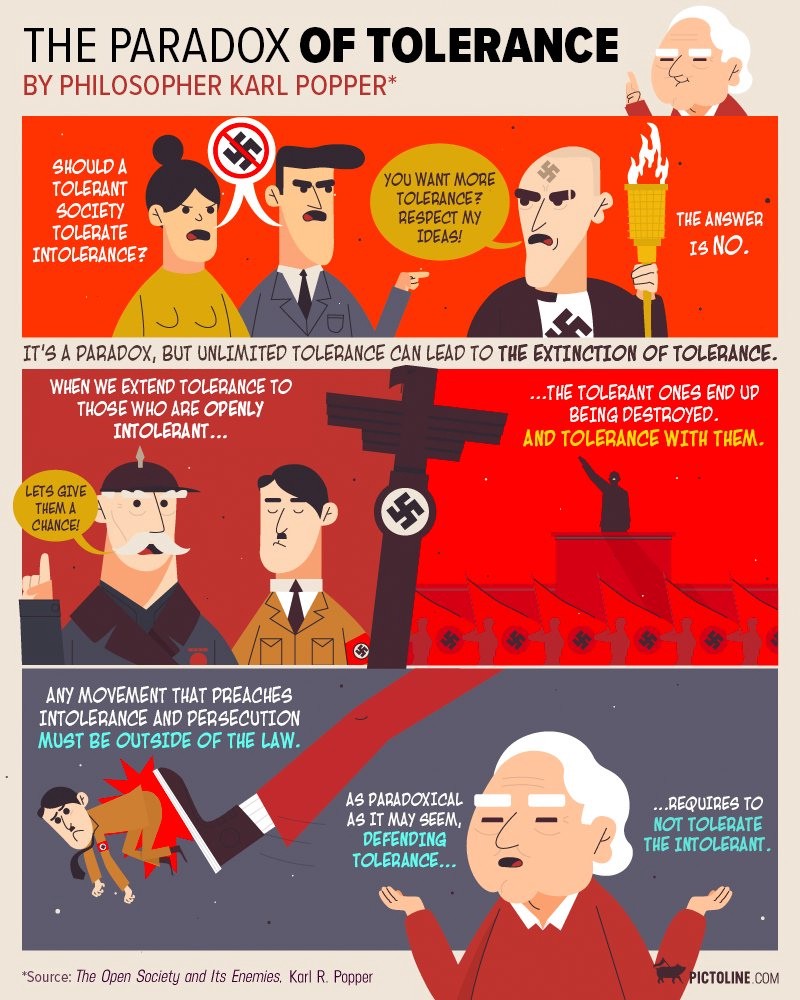
If that doesn’t get the point across, please see this helpful little image detailing the paradox of tolerance by Karl Popper.

In short, being tolerant is a good thing. Protecting free speech is a good thing. However, there are lines, limits, and context. Failing to understand them will only cause more outrage and whining. The world already has too much of that. Let’s not add to it.

Leave a comment

Filed under Celebrities and Celebrity Culture, censorship, Current Events, human nature, media issues, psychology, television

PSA: Disagreeing With Someone Is NOT A Violent Act

There are certain basic, inherently decent truths in this world. Most reasonable people understand them to some extent. We don’t need to be persuaded of their merits.

Being a selfish asshole is a bad thing.

Lying, cheating, and stealing is a bad thing.

Compliments and kind words help us and others like us.

Not everything you see on the internet is true.

These are just a few. I hope they’re not controversial. I like to think I have enough life experiences to make these statements with some credibility. Ideally, we don’t need to remind each other of these simple truths. They should be a given for anyone with a functioning brain.

Unfortunately, we live in an exceedingly imperfect world and years like 2020 only intensify those imperfections.

So, in that frustrating spirit, I’d like to make a quick public service announcement that I hope will function as a simple reminder. Please note I’m not referring to one particular person or a single group. I’m addressing as many people as possible. If you can, please forward this along because this needs to be said, reinforced, and belabored.

Someone disagreeing with you is not a violent act against you, nor should it be construed as one.

I know. That sounds like common sense. It is, for the most part. Most of us learn in grade school that someone disagreeing with you is not a big deal. You don’t have to like it. You may feel angry about it, but it’s hardly damaging. We live in a diverse society with diverse people. You’re going to encounter people who don’t think or believe like you do.

That’s fine.

That’s life.

However, lately it feels like the mere act of disagreeing with someone is somehow construed as this aggressive, violent political statement. Just telling someone you don’t agree with their politics or voted differently in the last election is no longer a simple point of disagreement. It’s an outright affront.

I see it in social media, comments sections, and in person debates. It gets incredibly ugly and it escalates way too fast. It often goes like this.

Person A: I voted for this candidate/hold this position/support this effort.

Person B: Really? I voted for the other candidate/position/effort.

Person A: You horrible piece of fucking shit! You’re ruining this country and this world! I hate your fucking guts and everything you stand for! You should fucking die a horrible death!

I wish I could say that was hyperbole. I really wish I could. Sadly, that’s a painfully accurate paraphrasing of the rhetoric I see whenever people start arguing. Whether it’s about politics, pop culture, video games, or which fictional characters they like, it gets so ugly, so fast that it’s disturbing.

It’s not treated as a difference of opinion. Some treat simple, differing opinions as a series of kidney punches delivered by Ivan Drago. It’s a gross, irrational, unbalanced response to the mere act of holding an opinion. If you don’t believe me, just try making these comments on any social platform.

I enjoyed Star Wars: The Last Jedi.

I support professional athletes protesting police injustice during the national anthem.

Brie Larson is a great actress.

There should be more diversity in certain franchises.

These are innocuous opinions. They don’t physically harm anyone. They reveal only a tiny sliver of who someone actually is. However, the mere utterance of these opinions is often a trigger for the most vile, hateful, rage-fueled reactions you can imagine.

That’s not just wrong.

That’s not just misguided, either.

It’s fucking stupid.

There’s no other way to describe it. These reactions are not the least bit warranted. Someone disagreeing with you is not an act of violence. It’s just not. Treating it as such is absurd, not to mention regressive.

Nobody, I don’t care who you are, is ever going to live in a world where everyone agrees with them. Humans just aren’t wired like that. Getting so upset about it is not a productive use of our time, energy, and passions.

I realize this will likely fall in deaf ears for some, but I hope others will take a step back and reassess how they react to someone voicing an opposing opinion. This world is messy enough. Let’s not make it worse by fighting each other for petty, unwarranted reasons.

Leave a comment

Filed under Celebrities and Celebrity Culture, censorship, Current Events, human nature, media issues, outrage culture, political correctness, politics, rants

George Carlin (Still) Perfectly Explains The Abortion Issue For 2020

These are scary times for many people. Between pandemics and politics, a simple scroll through your daily news feed might as well be a horror movie. However, for those concerned about abortion rights in the United States, it’s even scarier.

There’s a very real possibility that abortion rights could regress. Now, with a new vacancy on the Supreme Court, it’s very likely that the laws surrounding abortion will change considerably in the next several years, regardless of how the election pans out.

If you’re a woman, I feel for you. I honestly have no idea how frightening it must be, the prospect of going back to a world where abortion had to occur in the shadows.

Now, with abortion being such a relevant issue, I’m tempted to write about it more. I’m also considering doing a video about it for my YouTube channel, Jack’s World. I’m not quite sure I want to invite those kinds of politics to this site or my channel just yet. If I do, I’ll be sure to announce it.

In the meantime, I still want to leave those debating the abortion issue with something of substance. Thankfully, the late great comedian, George Carlin, already masterfully broke down this issue years ago. To date, I’ve yet to see anyone make a more effective statement on the abortion issue and the absurdities surrounding it. Just watch and see for yourself.

He could’ve said every word of this today and it still would’ve been relevant. It still would’ve been true, accurate, and concise. Honestly, it’s kind of sad that this didn’t end the debate completely. It’s even sadder that neither side has come up with better arguments.

We miss you, George Carlin.

This world really needs someone like you, right now.

Abortion is such a sensitive issue and one that will only get more divisive in the coming weeks. I don’t know what the endgame is. I just know it’s going to get a whole lot worse before it gets better.

1 Comment

Filed under abortion, Celebrities and Celebrity Culture, Current Events, politics, religion, women's issues, YouTube

Why Johnny Depp (And Men Like Him) Will NEVER Get The Benefit Of The Doubt

Let’s be honest with ourselves. We’re all subject to certain biases and assumptions. Whether it involves religion, politics, or which movies you like, we can only ever be so objective. We’re not machines. It’s next to impossible to analyze a situation with cold, unfeeling logic and render a perfectly objective judgment.

I make that disclaimer because I’m about to talk about the ongoing situation between Johnny Depp and Amber Heard. Please note that I’ve been avoiding this topic, but not because it involves serious, emotionally charged issues. I’ve touched on issues of spousal abuse and double standards in the past before. I’ve even attempted to pose distressing thought experiments about gender politics and double standards.

This case, however, is one of those instances where it’s just too late. There’s no possible way to have a balanced discussion anymore. It has gone beyond he said/she said, celebrity gossip, and double standards. At this point, this whole case is just one big, ugly affair in which any side can find a detail to confirm whatever bias they want.

The details of the case are simple, but disturbing. When the anti-harassment movement was picking up steam, Amber Heard accused her ex-husband Johnny Depp of serious abuse. Her stories were disturbing, but enough people believed them that he was ultimately fired from the Pirates of the Caribbean franchise.

At first, Heard’s story checked all the boxes for a standard #MeToo narrative. It was easy to believe because Johnny Depp, whatever you think about his movies, is an odd character. He’s no Tom Cruise, but many see him as eccentric, even by Hollywood standards. It’s not too hard to imagine him having a dark side.

Then, the narrative changed. During a number of legal battles, he accused Heard of being physically and emotionally abusive towards him. It’s not the typical narrative. There’s still a major taboo, as well as a gross double standard, surrounding women abusing men. It’s either not taken seriously or brushed off.

However, there’s one detail about Depp’s accusation that sets it apart from Heard’s. Unlike Heard, there’s actual audio evidence to back up his claims. This isn’t some rumored recording either. It was made public. It included direct quotes of Heard saying stuff like this:

“You didn’t get punched. You got hit. I’m sorry I hit you like this. But I did not punch you. I did not f***ing deck you. I f***ing was hitting you. I don’t know what the motion of my actual hand was, but you’re fine, I did not hurt you, I did not punch you, I was hitting you.”

To date, there has been no evidence to back up Heard’s claims about Depp. That didn’t stop her from doubling down on her claim as an ongoing libel trial wraps up. She still stands by her claims, even though she doesn’t have audio evidence to back up those claims. Even without it, there’s no guarantee the audio will make a difference.

This is where an uncomfortable, but unavoidable truth emerges. Regardless of your gender or your political leanings, this case has revealed something that has and will continue to disrupt any efforts towards gender equality.

Johnny Depp, and men like him, will never get the benefit of the doubt.

In making this statement, I’m not just referring to cases of spousal abuse. In the grand scheme of things, with respect to the various injustices driven by gender politics, we just can’t treat everyone by the same standard. We can try and we really should, but the results are always going to be mixed to some extent.

It’s hard to avoid. Were it not for that audio recording, how many would give Depp’s accusations of abuse by Heard any credence? He’s an eccentric, yet very successful actor in an industry that has a long history of enabling awful men. Him being an abuser just fits the standard narrative of how most people imagine spousal abuse.

Even before the anti-harassment movement, many of us already had that narrative ingrained in us. The idea of a woman abusing a man just doesn’t fit with every idea and assumption. We think spousal abuse and our immediate reflex is to think about a man abusing a woman. That’s the default. Anything other than that is going to draw skepticism.

On top of that, there’s also the beauty factor. That’s another distressing, but understated truth that this case has exposed. Amber Heard, however guilty she might be, is still a beautiful woman by most standards. Like it or not, beautiful women are far more likely to get the benefit of the doubt for pretty much everything, including abuse.

That’s not an extreme opinion. It’s well-documented that beautiful people have things easier and are given more credence. There’s even some biology to it. People are both drawn to beauty and feel compelled to trust, revere, and preserve it. Even if Johnny Depp was just as beautiful as her, relatively speaking, being a woman still gives her an edge.

Like I’ve noted before, women’s bodies tend to be more valued than men. As such, we’re just going to be more inclined to trust them, even if it’s for all the wrong reasons. That means, even with a verified audio recording of Amber Heard admitting physical abuse, we’ll give her the benefit of the doubt before Depp.

It’s not fair.

It’s not right.

It’s certainly not just.

Regardless of your gender politics, abuse is abuse. Women suffer from it, but so do men. Celebrities like Corey Feldman and Terry Crews have been vocal about it for years, but no matter how much awareness they raise, our biases don’t change. In cases of serious abuse, we’ll still never give them the benefit of the doubt.

There’s so much I can say about this case, which is one of the reasons I’ve avoided it. I’ve seen a lot of heated discussions between feminists, anti-feminists, liberals, conservatives, and even moderate-minded people. Very little actually comes of it. There’s no way this case will ever change anyone’s mind or shift their gender politics in any way.

Any instance of abuse is awful. Regardless of the outcome, it’s still going to leave everyone unsatisfied. Depp and Heard will have their respective supporters, but the overall narrative surrounding this case won’t change. A man accused of abuses a woman cannot and will not be viewed the same as a woman who abuses a man.

It’s tragic, as well as frustrating. That’s just the current state of affairs for gender politics. A lot will likely change because of this global pandemic, but this ingrained narrative will likely persist. The end result is more abuse and less justice.

Leave a comment

Filed under Celebrities and Celebrity Culture, Current Events, gender issues, media issues, men's issues, outrage culture, political correctness, politics, psychology, sex in society, women's issues

What Exactly Does “Canceling” Someone Solve?

In general, I try not to comment on “cancel culture.” It’s not because I don’t have an opinion. I just think it’s a waste of time, for the most part. I’ve never seen it lead to a productive conversation on anything. Most of the time, it just amounts to people publicly whining about something they find offensive to a point where others cave, if only to stop the whining.

I am not a fan of this, to put it mildly.

Every time I see it trend, I want to bash my head on my computer screen while telling some of these people to grow thicker skin.

The world is a chaotic, ugly, offensive place. We can only do so much to change it. No matter how much change we manage to implement, it won’t change the past or the context in which it transpired. That’s especially true if the people others are trying to cancel are long dead.

Now, as much as I despite the term and what it represents, I also understand that it’s not as simple as its critics make it out to be. At times, I find the people who whine about cancel culture to be just as insufferable. Their whining can basically be boiled down to, “Other people want to cancel the stuff I like and it hurts my feelings!” That’s just as pathetic as wanting to blackball a celebrity for old tweets from 2009.

Both efforts are equally absurd.

Both efforts do nothing to make the world a safer, more tolerant, more inclusive place.

Most of the time, I find the effects of “cancel culture” to be inconsistent, at best. People will complain about the lack of diversity in media, politics, business, and certain industries, but those same people can’t be bothered to vote or support the things that reflect those preferences. They always revert to whining.

People on both sides of the political spectrum will do this. The same people who laugh at those who complain about a video game character being too sexy while whine just as much because Brie Larson said something that hurt their feelings. They’ll claim their efforts are not contributing to cancel culture, but it’s the same damn concept.

Unfortunately, despite the best efforts of decent human beings with thick skin and a good sense of humor, cancel culture is still a thing. People are going to condemn celebrities and public figures for things they said or did years ago. We saw it with Kevin Hart, which cost him a chance to host the Oscars. We’re seeing that now with celebrities like Jimmy Kimmel and Sarah Silverman, who once did skits involving blackface.

All this is happening as statues of historical figures who did deplorable things are coming down. Never mind the context or bigger picture of why they’re historical in the first place. They did something awful. Any image that exists that may glorify them in any way is just too much for our tender sensibilities.

In addition to people, the urge to cancel all things offensive has extended to art. Movies like “Gone With The Wind,” which definitely had some offensive imagery, was removed from streaming recently. Shows like “Paw Patrol,” which is geared towards children, was seen as too offensive at a time when police brutality is a hot topic.

Now, I’m not going to justify old tweets or outrage about movies from a different era. I know there’s nothing I can say to change the minds of those who are so offended by statutes, celebrities, or the names of football teams that they want them all canceled. There’s also nothing I can say to change the minds who think it’s part of some elaborate censorship effort meant to destroy freedom.

Instead, I’d like to ask a few simple questions for both sides to consider.

What exactly does canceling something achieve in the long run?

At what point does canceling something amount to censorship?

Why is canceling something more viable than simply growing thicker skin?

At what point does context stop mattering for something that’s offensive?

How does condemning the ugly history of the past make the present or future any better?

What right do you have to be offended by the feelings and preferences of someone else?

I won’t claim these are easy questions to answer, but to those who are behind or protesting certain cancel-this hashtags, I hope they offer perspective. Like it or not, cancel culture isn’t going away anytime soon. People are always going to be offended by something or someone.

In years past, it was uptight religious zealots who were aghast at anything that didn’t reflect or promote the values of a 1950s sitcom. Now, it’s uptight activists who are aghast at anything that doesn’t reflect their utopian fever dream that just happens to align with their politics. The passion is real, but the motivations are misguided.

You can tear down every monument.

You can censor every byte of media.

You can rewrite every textbook or novel that ever reflected outdated attitudes.

It won’t change what happened in the past. It won’t prevent people from being assholes in the future. If anything, it sends the message that people are too weak, stupid, or traumatized to handle certain ideas. That, in my opinion, is the most offensive thing of all.

Leave a comment

Filed under Celebrities and Celebrity Culture, Current Events, media issues, outrage culture, political correctness, politics, rants, television

How I Came To Respect Red Foreman From “That ’70s Show”

Time, age, and hindsight have a way of changing how you see things. The attitudes and perspectives you have when you’re 35 are bound to be different than the ones you had when you were 15. It’s just part of life, as you get older. The world is such a different place through the mind of a teenager than it is to an adult.

This manifests in many ways, but the one I’ve found most revealing has to do with the way I see old TV shows that I watched in my youth. Some shows age better than others. I recently citedChuck” as one of those rare shows that seems to get better with age. Most shows don’t get that benefit. Some age so poorly that there’s no way they could ever air today.

Thanks to the joys of being quarantined, I’ve had a chance to re-watch and re-visit some of the shows I loved in my youth. Shows like “Chuck” have only reaffirmed why I loved it so much. Other shows evoke a different reaction. One such show is “That ’70s Show.”

When I was a teenager, this was one of my favorite shows. In terms of TV sitcoms, it checked all the right boxes. It didn’t try to revolutionize the genre. It kept things simple, using 70s aesthetics and proven sitcom tropes to make an entertaining show. It never got too extreme. It never tried to cross too many lines. It just tried to have fun with a certain time period and a cast of colorful characters.

Most of the characters were lovable in their own right. My personal favorite was Fez. Some of the best lines in the show came from him. However, one character often stood out even more. In many ways, he was the show’s primary antagonist. He was Red Forman and when he wasn’t threatening to put his foot in someone’s ass, he was a frequent obstacle to whatever scheme the kids had conjured.

In many respects, any sitcom that involves a cast of teenagers needs a character like Red. He embodies the hard-nosed, uncompromising, uncool authority figure. Most of his roles revolve around stopping the kids from doing what they’re doing or punishing them as soon as they get caught. In that context, he’s easy to root against most of the time.

I certainly did when I watched the show in my youth. In fact, Red was one of my least favorite characters in the show because he was just such a hardass. He didn’t have any of the charm or likability as other sitcom dads. Al Bundy might have been a lousy dad, but at least he was funny. Red was rarely funny, his foot-in-ass remarks notwithstanding.

Then, after watching a few episodes recently, I found myself looking at Red Forman differently. I also saw the teen cast differently. While there were certainly times when Red was an unambiguous asshole, those times were a lot less frequent than I remember. In fact, I came to appreciate Red a lot more as I watched the show from an adult perspective.

In hindsight, it’s easy to understand why. When you’re a teenager, authority figures are often barriers to all the things you want to do. They’re the reason you can’t stay out late at night, drink beer, smoke pot, or hook up with your significant other. They enforce the rules that keep you from having all the fun you want to have. They’ll rarely explain those rules. It usually comes down to them being the parent and you being their kid.

This certainly plays out in “That ’70s Show” throughout many plots. I remember watching those same plots as a teenager and rolling my eyes whenever Red Forman got involved. Then, after watching them again, I found myself siding with Red and not just with respect to who deserved a foot in the ass.

When Eric, Fez, Kelso, Jackie, and Donna do something stupid, it’s rarely because of the rules or the authority figures who enforce them. More often than not, they do what they do by choice. They don’t think things through. They think about the consequences to their actions. They are, after all, immature teenagers in the 1970s. They’re more inclined than most to do stupid things for stupid, selfish reasons.

Red Forman may not be the best when it comes to helping them mature, but he’s not wrong for calling them out on it. Most of the time, they are on the wrong side of the dumb-ass equation. Their efforts to eat, drink, have sex, and avoid responsibility are all products of their own immaturity. Someone like Red needs to be there to remind them of that.

Is he the best father figure for helping teenagers navigate their immaturity? No, he isn’t.

Is he better than most of the bumbling dads who tend to populate most TV shows? Yes, he is and he’d kick the asses of most of those dads.

As a teenager, I had a hard time relating to Red Forman. As an adult, I can’t help but respect him. He is surrounded by a lot of dumb-asses and a wife who’s on the verge of a nervous breakdown every other day. The fact he hasn’t put his foot in more asses is a testament to his restraint.

If you need more proof, please see this series of clips. If you haven’t seen the show in a while, then you may find yourself remembering Red more fondly than you thought.

Red Forman may be a hard-ass. He’ll never be father of the year or the first person you invite to a party. However, in a world of dumb-asses, he’s a beacon of order. For that, he deserves our respect.

2 Comments

Filed under Celebrities and Celebrity Culture, media issues, philosophy, psychology, television

Who Will Be The First (Digitally) Immortal Celebrity?

Back in 2012, Tupac Shakur appeared in concert at Coachella in 2012. That’s quite a feat, considering he died in 1996. The Tupac at the concert was just a hologram, but even his digital presence helped make that concert an experience to remember.

In 2019, Samuel L. Jackson played a young Nick Fury in the “Captain Marvel” movie. That too is quite a feat, considering Mr. Jackson was 70 years old at the time. He was able to appear young, thanks to advanced CGI that effectively de-aged him.

Other dead celebrities have shown up in other media. The since deceased Peter Cushing reprised his role as Grand Moff Tarken in “Star Wars: Rogue One” thanks to similar CGI technology. Paul Walker was able to get a proper send-off in “Fast and Furious 7” after his tragic death thanks to this technology. As the technology improves and other famous celebrities pass on, this practice is likely to continue and expand.

That raises some interesting questions that has some profound, yet disturbing implications. Some of those questions are easier to answer than others. This is the easy one.

Will there eventually be a celebrity who becomes digitally immortal?

The short answer is yes.

The long answer is eventually, but there will be some complications along the way.

Modern CGI technology is amazing. We’ve come a long way from the flashy, but wholly unrealistic graphics of “Tron.” Through the development of technology like artificial intelligence deep fakes, which has its own mix of dystopian uses, it’s possible to replicate someone’s appearance, voice, and mannerisms. This replication isn’t perfect, but it’s getting to a point where it’s hard to tell it’s fake.

As this technology improves, it’ll get to a point where a rendering of a celebrity isn’t just indistinguishable from the real celebrity. It’ll be capable of saying, doing, and acting in any way a studio or producer would want. While that has some dangerous possibilities for political ads and porn, it could also completely change the entertainment industry.

That Tupac hologram I mentioned earlier was basically just a recording synched to a projection. Even though Samuel L. Jackson was de-aged in Captain Marvel,” the actor still had to be there to give him the necessary voice, mannerisms, and attitude. He couldn’t have been a hologram and be believable. The technology just isn’t there yet.

It will get there, though. There doesn’t need to be some huge leap in computer technology or artificial intelligence to make an entirely digital celebrity. It’s just a matter of processing power, data crunching, and better hardware. It will happen. It might even happen within the next couple decades. That raises another key question.

Who will be the first digitally immortal celebrity?

By digitally immortal, I don’t just mean recordings set to holograms or faces projected onto body doubles. A truly digitally immortal celebrity will be capable of starring in new movies and TV shows long after their dead. They’ll be able to make new music and perform it, albeit through a hologram. While their bodies might be gone, they’ll never stop contributing to pop culture.

That definitely has some legal implications. I doubt any studio could get away with creating a digital rendering of Carrie Fisher to star in a new movie. However, I suspect one celebrity will eventually license their figure and likeness so that they can keep being celebrities, long after they’re dead. Maybe they’ll do it so their families can be fincianlly set for life. Maybe they’ll do it because they never want to leave the public eye.

Whatever their reasons, someone will eventually do this. It’s just a question of who.

Will it be Taylor Swift?

Will it be Tom Cruise?

Will it be Jennifer Lopez?

Will it be Samuel L. Jackson?

It’s hard to say. If I had to bet money, I’d put it on Samuel L. Jackson. Knowing Disney and their vast resources, I’d be shocked if they weren’t investing in this technology this instant. Bankable celebrities are an increasingly precious commodity in the entertainment world. The incentives are there. It’s just a matter of time and a matter of whom.

Personally, I’d love to hear Samuel L. Jackson call people motherfuckers for generations to come. That’s just me.

1 Comment

Filed under Artificial Intelligence, Celebrities and Celebrity Culture, futurism