Tag Archives: identity politics

Why Wonder Woman Matters Now More Than Ever

Image result for Wonder Woman movie

Today’s the big day. For comic book fans, superhero movies, and those who appreciate seeing beautiful women kick ass, it has been a long time coming. It shouldn’t have taken so long, but there were a few setbacks along the way. Well, we can forget about those now because the wait is over. The “Wonder Woman” movie has arrived.

I can safely say as a self-proclaimed comic book fan and a fan of sexy female superheros, I’ve been looking forward to this movie more than any other in a decade. I’ve said it before as I’ve tracked this movie’s approach, but I believe that “Wonder Woman” is the most important superhero movie since the original “X-men” movie made us forget about Joel Shumacher.

It’s not just that Wonder Woman is the most iconic female superhero of the past century. It’s not just that Wonder Woman can give female superhero movies some badly-needed credibility, especially after debacles like “Catwoman” and “Elektra.” The ideals and themes of Wonder Woman, as a character and an icon, are more important now than they’ve ever been. For once, though, it has nothing to do with her BDSM origins.

Image result for Wonder Woman Earth One

At the moment, we live in some very volatile times. I won’t get into the breadth and scope of that volatility. Pretty much anyone who has watched the news for more than five minutes understands what I mean. While I have argued that the world is getting better by most objective measures, there’s no denying that there’s still plenty of conflict.

Whether it’s wars in the middle east or uproars over comic book covers, there are so many things dividing us, as a species. We get into fights, both online and the real world, over both serious and trivial issues. We can never be too content as a society. We always have to be fighting a battle somewhere. We always have to be playing the hero to someone.

This manifests in everything from clashes over identity politics to gender-based double standards to real-world wars that take a horrific human toll. Improvements and context aside, the world is still a scary place and we’re still a bunch of scared children looking for anything or anyone to comfort us.

Image result for Wonder Woman saving children

That’s where Wonder Woman comes in. Like Superman or Captain America, she represents an ideal. Hers, however, is a unique ideal, one that embodies the greatest aspects of female strength. She stands for all that is good about women. Regardless of culture or creed, she represents the love and strength that brings out the best in women.

Regardless of whether you’re a man, woman, or something in between, Wonder Woman stands for a unique set of values that make her both a hero and an icon. She is someone every gender can look up to, but one that uniquely resonates with women. It’s not just that she can fight, fly, and wield power on the same level as Superman. She embodies a different kind of strength, one that sets her apart from other male heroes.

It’s this strength that her creator, William Marston, focused on when he created Wonder Woman. Beyond the BDSM themes, Marston was very ahead of his time in crafting Wonder Woman’s ideals. It wasn’t just about putting women in power. It was about rethinking the very concept that power should rule in the first place.

Image result for Wonder Woman

Wonder Woman, at her core, does not seek domination or destruction. She is, at her core, a voice for peace and love between innocents. She is also a warrior, but one who reserves her skills for those who would dare destroy such innocents. She will fight those who would harm innocent lives, but she won’t just use her fists.

In a very timely move by DC Comics, a recent issue of Wonder Woman’s ongoing comic series demonstrated that. In Wonder Woman #23, by Greg Rucka and Liam Sharp, Wonder Woman goes up against Phobos and Deimos, the devious sons of Ares, the God of War. They try to provoke Wonder Woman into freeing their imprisoned father. It’s a situation where Superman or Batman would’ve tried to fight their way out of.
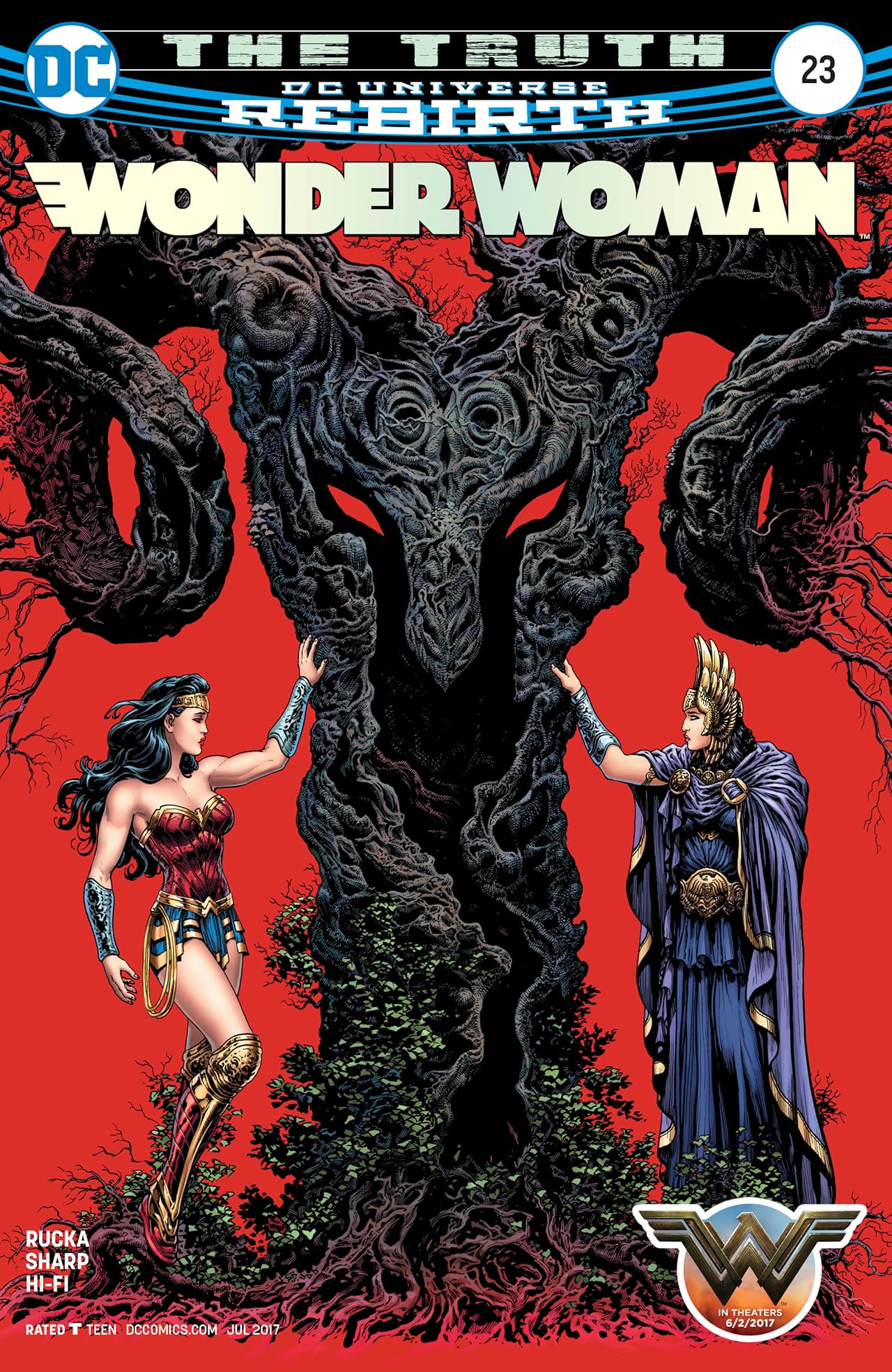
Wonder Woman (2016-) #23

However, that’s not what Wonder Woman does. She doesn’t defeat Phobos and Deimos through violence. She understands that such power with more power is bound to cause destruction, pain, and loss. Instead, she fights them in a different, wholly unique way. She fights them with love.

It’s not nearly as corny as it sounds. It’s a culmination of many conflicts that had been building over the course of a dozen issues, which included more than a few major clashes along the way. In the end, though, fighting power with more power wasn’t the answer. Wonder Woman understood this and chose a different path. It worked too. Phobos and Deimos were defeated and no innocents had to suffer.

Wonder Woman #23 is a perfect demonstration of what sets Wonder Woman apart from other heroes and why she’s such a strong female icon. Sure, the uptight asshats at the United Nations may think she’s too sexy to be an icon, but they’re dead wrong. Wonder Woman’s beauty is a reflection of her heart. That heart, and her ability to use it as well as her fists, is what makes her message more important than ever.

Image result for Wonder Woman

We currently live in an era where everything from feminism to beauty standards is becoming more and more tribal. It’s not enough to just fight for equality and understanding. Everyone has to form their tribe and help it dominate in some way, either by having it play the victim or resort to excessive virtue signaling.

That’s exactly the kind of endless power struggle that Marston criticized when he created Wonder Woman. It’s also the kind of struggle that Wonder Woman rises above. She may be a feminist icon, but she does not carry herself as one who favors one gender dominating the other.

She champions love and understanding for all. She seeks not domination of one idea over the other, but loving submission to the idea that none need dominate. It is possible for everyone, male and female, to humble themselves and open their hearts. We don’t need power over others to achieve peace.

Image result for Wonder Woman

Her message is one that should resonate now more than ever. With her movie finally released, that message has a chance to spread. Sure, there will be controversy. People make up controversies all the time. There was a controversy over Wonder Woman’s armpit hair, for crying out loud. That’s all the more reason to heed her ideals of fighting conflict with love.

It’s been a long, arduous journey for Wonder Woman to get to this point. I’m not equipped to document the sheer breadth of that journey, but the fine folks at Midnight’s Edge have already done the work for me. They recently released a chronicle, of sorts, on how Wonder Woman got to this point and why her movie is so vital to the future of DC and superhero movies in general.

However you feel about Wonder Woman or superhero movies, today is still an important day in our culture. There are still so many issues that plague men and women alike. Now, more than ever, we need heroes like Wonder Woman to show that there’s a better way for us to forge our future.

7 Comments

Filed under Comic Books, Jack Fisher, Superheroes

Virtue Signaling: Why We Are NOT The Hero Of Our Own Story

https://i0.wp.com/www.nsu-magazine.com/wp-content/uploads/2014/10/stupid-heroes-18a.jpg

Think back to any movie that ever involved a lovable underdog. For anyone who has been to a movie theater more than once since 1978, this shouldn’t be that hard. Hell, think about a popular TV show involving a lovable underdog, going all the way back to the “Leave It To Beaver” days. What do they all have in common?

The similarities aren’t exactly subtle. The lovable underdog isn’t someone who is big, strong, handsome, cocky, arrogant, or dumb. They’re often unremarkable, so much so that others don’t acknowledge their existence. They do little to stand out and even less to distinguish themselves, but the same story usually plays out for them.

Whether they’re John McClane from “Die Hard,” Peter Parker from “Spider-Man,” or the entire cast of “The Big Bang Theory,” they embody the traits of all that is good and right with the world. They overcome obstacles, bullies, and a world where pretty girls aren’t lining up to touch their dicks to become heroes in their own right.

In the end, everything works out for them. In the end, they get what they want. The world comes to love them. Everybody, male and female alike, loves them. They are respected and admired for their thoughts, actions, and ideas at every turn. They have every reason to feel good about themselves.

What I just described is both the standard narrative for no less than 95 percent of every underdog story ever told and the primary reason why virtue signaling is getting out of hand. If that sounds like a bit of a stretch, then please bear with me. There is a logic behind it and, unlike my previous post on virtue signaling, it has a major implications.

As with other topics, like sex robots and body shaming, it’s impossible to cover every aspect of a certain topic. Virtue signaling, having only recently become a major buzzword, definitely qualifies. It is very much an emerging trend that is finding its way into politics, gender issues, media, and even erotica/romance. Since I’m trying to make a living writing erotica/romance, that deeply concerns me.

For this particular post, I want to highlight the more direct impacts of virtue signaling that I’ve observed in recent years. Specifically, I want to focus on how it affects the way people see themselves and the way they relate to one another. There’s a lot of material to cover and I can only handle so much coffee before my brain starts to short out.

I’ll table my concerns about brain function for the moment because this is something that I haven’t just observed. I’ve experienced it as well. As a man, trends that affect how men and women relate to one another don’t just affect the kinds of sexy stories I tell. They effect me personally and how I conduct myself in my day-to-day life. They effect all of us, often in ways we don’t see or acknowledge.

https://68.media.tumblr.com/b664b64461e0d42f56e427ab57e978d6/tumblr_of2nn1s1fl1vho2i6o1_500.gif

With respect to virtue signaling, these effects have only recently become more pronounced to the growth of social media. Unlike every other point in human history, we no longer need a million people to march through a capital city or a massive rebellion to send a message. We just need a smartphone, an internet connection, and a willingness to castigate ourselves in a public sphere.

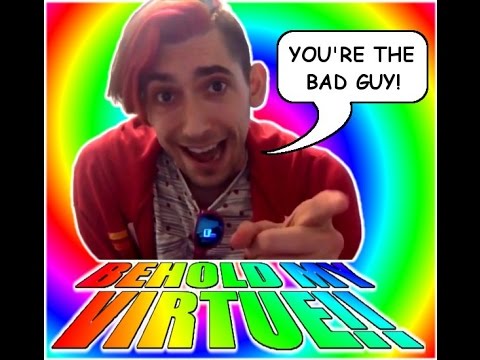
As a result, virtue signaling has become a popular pastime of sorts. Political leaders, media figures, and ordinary people with too much free time on their hands go out of their way to make these elaborate gestures to prove that they’re virtuous or pious or tolerant or not a Nazi.

More often than not, these gestures just aren’t enough and people end up doing more and more, thus creating a brutal cycle of sorts. Sometimes the gesture is misinterpreted, as often happens with poorly-worded Tweets. Sometimes it’s just part of a larger agenda, one that requires constant reaffirmation in light of incessant criticism. Video game critics found out just how bad this could get back in August 2014.

https://i0.wp.com/orig04.deviantart.net/5ec4/f/2015/363/1/f/gamergate_life_67_by_kukuruyoart-d9lx9tn.png

It’s a stressful endeavor, trying to loudly proclaim to the masses that you’re as virtuous, heroic, and understanding as any protagonist from a John Hughes movie. It’s also tearing us apart and making us despise one another.

So how exactly does it work and why is it so toxic? Well, to answer that, think back to lovable underdogs that I mentioned earlier. We, as a culture, love those characters for a reason. They live in a world where they do what they do, but come out on top. They win in every way they want to win, becoming the heroes of their own stories.

The problem with that world is that it’s a total fantasy and too many people try to make that fantasy fit into their reality. Unfortunately, reality is notoriously uncompromising. Just ask anyone who tried to make a romantic gesture that backfired horribly.

https://imgix.ranker.com/user_node_img/50052/1001036453/original/dead-flowers-and-a-ruined-car-interior-freestyle-list-photo-u1?w=650&q=50&fm=jpg

It’s not that they’re insincere or inept, though. They’re just part of an entire generation that has grown up seeing this narrative of the lovable underdog overcoming the odds and they’ve been led to believe that this is how you succeed. This is how you become the hero of your own story.

We, being the egotistical creatures we are, want to be that hero. We want to be the lovable underdog we see in the movies who can say they overcame the odds, succeeded, and got laid in the process. However, the tactics we see in movies and TV shows just don’t work in the real world or require an obscene amount of luck.

Since all the success, adulation, and sex doesn’t just immediately happen like it does over the course of a two-hour movie, those wanting to be the hero try to force it. That’s where virtue signaling comes in.

Since being a hero often requires hard work, sacrifice, talent, training, and the ability to be in the right place at the right time, virtue signaling offers a much easier alternative. It’s not solely about laziness. It’s just often the path of least resistance and the most readily available path. Can you blame anyone for taking it?

https://thehungryrabbitblog.files.wordpress.com/2017/01/virtue.jpg

Rather than actually doing something meaningful, virtue signaling allows people to feel like they’re the hero of their own story, even if they accomplish nothing heroic. To their caveman brain, it doesn’t matter. It already has a hard time processing what gets it aroused. How the hell is it going to determine whether someone qualifies as a hero?

The short answer is that it can’t. The longer answer is that our caveman brains still urge us to seek validation from our tribe and security in our identity. Virtue signaling allows us to do both, even when there’s nothing of substance behind it.

This can lead to a real identity crisis for some people. There are people who define themselves as members of a particular tribe, be they radical feminists, conservative Christians, or Twilight fans. When they feel as though they aren’t slaying the necessary dragons, s to speak, they become distressed and look for any way to alleviate it. Virtue signaling allows them to at least feel it’s alleviate, which is close enough.

https://www.blogcdn.com/massively.joystiq.com/media/2010/07/hero.jpg

That laughably low standard ensures that virtue signaling is almost always an empty, shallow gesture at most. It only ever functions as a means to help certain individuals feel better about themselves, alleviate the mental stresses that come with seeking validation, and ensure they can be the hero of their own story, even if they do nothing heroic.

In a real world full of unflinching, unyielding circumstances that keep most people from ever doing anything remotely heroic, virtue signaling offers empty promises that only feel real enough to keep our brains and tribes functioning. Even when there’s no substance whatsoever, it gives people an illusion to buy into and that can be dangerous because it gives people an excuse to not do something greater.

https://i.gse.io/gse_media/116/9/1476388021-Allen-Batista---Magic-Show-tickets.jpg?c=1&h=520&p=1&q=60&w=920

As I’ve pointed out before, people will cling to any excuse that allows them to justify their actions or lack thereof. Now that doesn’t make those who virtue signal bad. If anything, their desire to be the lovable underdog hero of their own story proves to me that such people are good at heart. They’re just misguided, clinging to the feelings and validation that virtue signaling earns them.

Since I like to be a bit more optimistic about people in general, I believe that the lack of substance that inherently comes with virtue signaling will eventually catch up with most people. There will be those who can never escape it. For most people, though, I believe they’ll learn that there are better ways to be the lovable underdog hero of your own story.

19 Comments

Filed under Jack Fisher's Insights

Virtue Signaling: What It Is, Why It Matters, And Why You Should Hate It

https://i2.wp.com/www.illiberal-liberal.com/wp-content/uploads/2016/04/Virtue-Signaling-Environmentalism.jpg

There are certain topics and issues that I generally avoid talking about on this blog, but know I can’t entirely avoid. Given the sheer multitudes things I discuss, from sex robots to Wonder Woman’s BDSM origins, it’s only a matter of time before a few particular concepts enter the conversation.

In general, I try not to be too divisive and dogmatic, but when you talk about issues like feminism, abortion, and religious extremism, you’re bound to rub a few people in ways that won’t make them horny. One such concept can apply to many of the social issues I’ve discussed on this blog, some more directly than others.

That concept has become somewhat of a buzzword among discussions of hot-button issues and not always for the right reasons. It’s especially popular among discussions surrounding political correctness and religious extremism, two topics that turn people off faster than a bucket of dead kittens. It’s called virtue signaling and it is, by far, one of the most frustrating manifestations of our faulty caveman brain.

Our brains might be remarkable marvels of nature, but they have a lot of flaws. Why else would Elon Musk be looking to upgrade it with his latest billion-dollar venture? Some of its features had practical uses in the old days before social media made everyone a wannabe guru on current affairs. Virtue signaling exploits nearly every one of those flaws and does it with a goddamn smile.

Unlike some of the other concepts I’ve explored, the definition of virtue signaling is still evolving. It’s a relatively new concept in terms of being something that people mention in a conversation, but the idea isn’t new. According to Wikipedia, which is usually fairly up-to-date, the definition is as follows:

The conspicuous expression of moral values by an individual done primarily with the intent of enhancing that person’s social standing within a social group.

There are other dynamics to virtue signaling, but this definition covers the basics. It is, essentially, a method people use to save face or prove their loyalty to their respective tribe.

Think back to movies like “Animal House.” Remember those initiation rituals that fraternity pledges had to do? They have been known to seriously hurt and kill people, which is why they’ve become more infamous in recent years.

Now, imaging always having to do these rituals to continually prove your allegiance to whatever group or tribe you’re part of. Anyone who ever survived college hazing should be shuddering violently right now. I’ll give you a minute to recover. For those who haven’t, it’s actually worse than it sounds.

Sometimes it’s subtle. Sometimes it’s so minor that it’s not even a factor in how we see ourselves or the groups we belong to. However, in the era of social media and professional trolls, it has become increasingly egregious. To illustrate how insidious virtue signaling can get, here’s a quick scenario.

Picture, for a moment, that you’re walking down the street in a typical city or town. There are a lot of people moving in different directions. Some are heading to parts of the neighborhood you prefer to avoid. Others are heading towards parts you like. You stick with them, for the most part, and are content keep it that way.

Then, as you’re walking towards your preferred destination, you come up alongside someone whose walking the same direction as you. However, they’re not content. They are very agitated.

They keep looking at the people going towards parts of the neighborhood they don’t like. They then start yelling at them with remarks like:

“HOW DARE YOU GO THERE!”

“HOW DARE YOU DO THAT!”

“YOU SHOULD BE ASHAMED!”

“YOU DESERVE NOTHING BUT SCORN AND HATE UNTIL THE DAY YOU DIE AND BEYOND!”

Their yelling is unnerving to some, but others show their approval. Some even join in. They create a flash mob of sorts, going out of their way to find the people going in the direction they don’t like and berate them at the top of their lungs.

You choose not to join in. If anything, you’re someone embarrassed by someone heading in the direction you prefer acting so obnoxious. You’re content to keep walking in that direction and just ignore the loud, confrontational flash mobs.

Then, without warning, that same agitated person turns their attention back towards you. They actually walk up alongside you, try to get your attention, and start yelling at you with remarks like:

“LOOK AT ME! LOOK AT HOW VIRTUOUS I’M BEING!”

“I’M DOING GOOD! I’M MAKING A DIFFERENCE WITH MINIMAL EFFORT!”

“I AM A MORAL PERSON! I’M MORE MORAL THAN YOU!”

“ACKNOWLEDGE MY MORAL SUPERIORITY! IF YOU DON’T, THEN YOU’RE A GODDAMN NAZI!”

The scenario I described is a gross exaggeration, but one that highlights the major components of virtue signaling. It’s both a method for seeking validation from a group and alleviating mental stress. In that sense, it hijacks some of the wiring in our brains that’s meant to help us cooperate and survive.

The past few years, however, have gone beyond merely hijacking our collective psyche. They’ve effectively attached rockets to the plane and flown it into the side of a mountain. Some of this has to do with social media and professional trolling, but a lot more of it has to do with that painfully divisive and innately infuriating concept of identity politics.

These days, it’s too easy to be labeled a bully, a tyrant, a fascist, or whatever other word you want to use to describe Kanye West. Unlike past years, that label is much harder to avoid. Social media, smartphones, and the 24/7 news cycle that will make way too big a deal about the latest Kardashian drama ensure that once you have that label, it follows you like a festering rectal wart.

As a result, more and more people are resorting to virtue signaling to escape or avoid these negative labels. They’ll go to great lengths, yelling at random strangers and being exceedingly obnoxious, to be anything else. Naturally, that means things like facts, reason, and understanding often get lost in the mix. You just can’t be that particular when you’re trying so hard to avoid being labeled a Nazi.

It happens in gender issues. Feminists, especially the male variety, will go to great lengths to prove they’re not misogynistic, even if it means saying demonstrably stupid things.

It happens in religion. A certain adherent, especially in religions that demand a lot of sacrifice, will make any excuse and fight any battle in order to maintain their allegiance and prove they’re a better adherent. There’s little, if any, sincere belief. There’s just a desire to be part of the community. That can often lead to some truly horrific extremes, from suicide bombings to televangelism.

It happens in race issues. A certain race, especially the ones with a nasty legacy that the internet has preserved forever, will say and do anything to avoid being called a racist. They’ll even resort to favoring other kinds of racism to balance out past racist crimes. It’s as inane as it sounds.

At the end of the day, however, the problem remains. Virtue signaling is, by definition, a selfish endeavor that’s meant to make someone feel better. Either they want to feel more moral than those they consider bullies or they want to cling to a certain group affiliation, be it a particular race or a My Little Pony fan club.

There’s never any actual substance behind virtue signaling. In fact, substance cannot be part of virtue signaling in any meaningful capacity because its goals are entirely personal. Unless it makes someone feel better about themselves or keeps them in good standing with a group, it doesn’t matter in the slightest how true, honest, or valid the actions are.

It is a very troubling, if not tragic manifestation of our caveman brains. We’re a social species. We’re also a species that tries to keep itself balanced amidst a chaotic, ever-changing world that tries to kill us in so many ways. We’re wired to form groups, cooperate, and do whatever we can to alleviate the everyday stresses of life. Virtue signaling is the emptiest form of this effort and is ultimately counterproductive.

If someone needs that kind of validation, either for themselves or others, then there are likely other factors at play. I cannot begin to speculate what those factors might be, but the growing prevalence of such efforts says to me that the world is becoming more stressful and we, as a society, aren’t doing a good job of handling it.

In the end, I see virtue signaling the same way I see an empty gesture. It’s a poor attempt to force a desired reaction without actually going through the process of earning that reaction. Those who don’t end up earning something often end up neglecting it as well.

Think of it in terms of a lover. If someone just pretended to feel a certain way so that you would love them, what would that say about his view of love in general? It wouldn’t bode well for the honesty of your lover and the depths of your love.

There’s a lot more to virtue signaling. I know I’m painting a pretty bleak picture right now, but it’s an increasingly-relevant concept that’s sure to show up in many different forms in the coming years. I’ll definitely mention it again in future posts. I’ll make a concerted effort not to bash my head on my desk.

For now, the best advice I can give those who are just as frustrated with virtue signaling is twofold. Be cynical, but be understanding. Those seeking validation are human, like you and me. Understand that, but try and help them understand that as well.

20 Comments

Filed under Jack Fisher's Insights

Why Bigotry And Prejudice Can NEVER Be Resolved (For Now)

https://i0.wp.com/cdn.thedailybeast.com/content/dailybeast/articles/2014/09/28/why-bigotry-persists/jcr%3Acontent/image.crop.800.500.jpg/47066895.cached.jpg

It’s all around us. It generates protests, outrage, and angry rants of every variety on cable news. It floods social media, infects college campuses, and drowns out any and all meaningful dialog that might actually lead to productive change. I don’t even have to reveal it at this point. Everybody knows what I’m talking about on some level or they at least have a vaguely accurate idea.

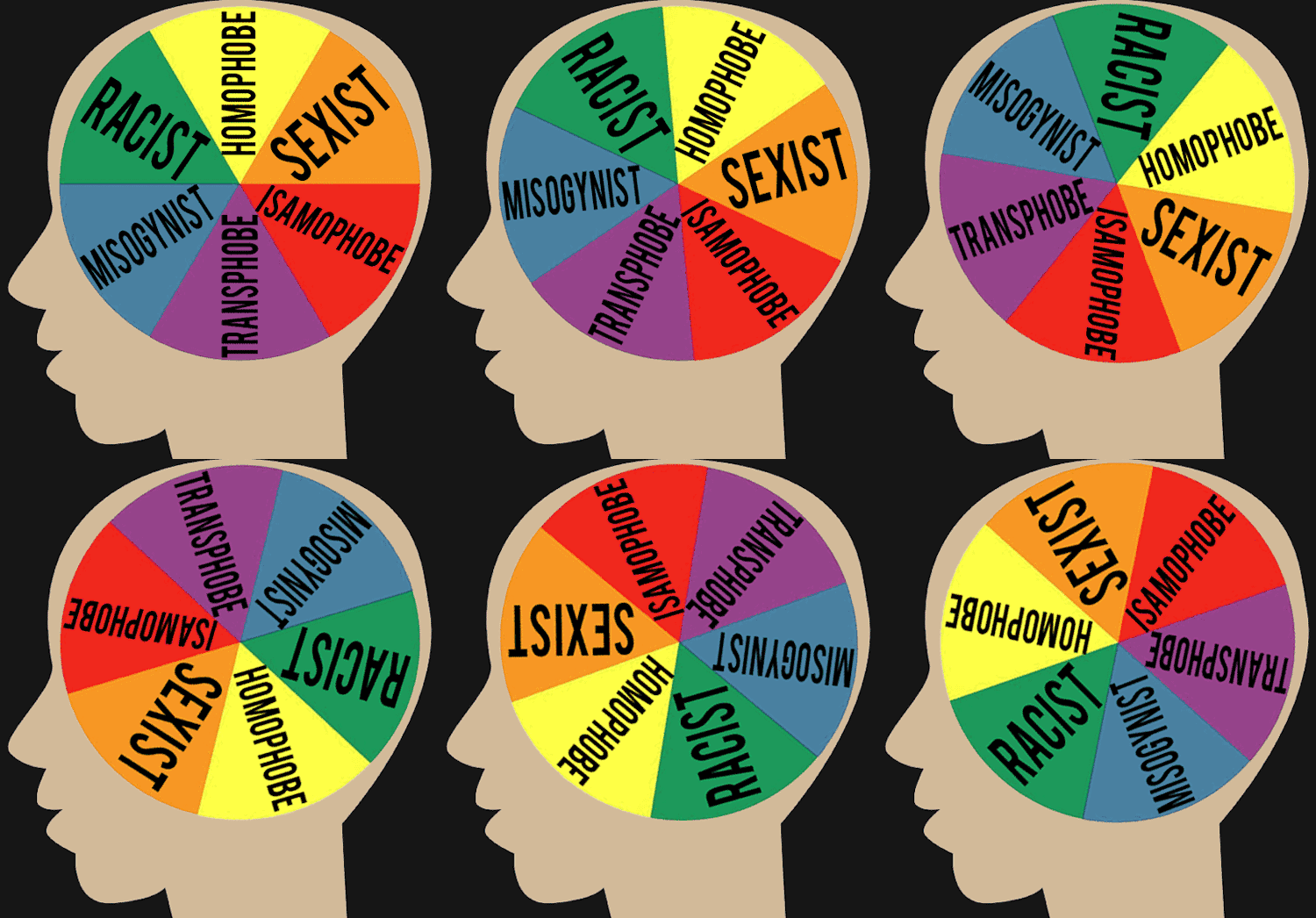
It goes by many names. Call it racism, reverse racism, sexism, man-hating, homophobia, islamophobia, or transphobia. It all falls under the same overly-divisive rhetoric that is bigotry and prejudice. It always seems to be in the news. It always makes a conversation awkward and unsexy. It seems to get better some days and regress the others.

Now I know I’m making everybody’s panties very dry by bringing this up, but bear with me. This post is not going to get as bleak or depressing as it would if it were a Michael Moore documentary. I prefer to convey a more optimistic spirit to my audience. It puts them in a better mood, which is important if you’re trying to sell erotica/romance novels.

On the surface, though, there’s no way around it. This is as ugly a topic as it gets these days, the concepts of bigotry and prejudice. If it isn’t the stereotypical white male patriarchal types bemoaning how lazy and violent minorities are, it’s the radical left-wing hippies who call everyone who doesn’t support interracial gay couples kissing in the streets Nazi supporters.

It really is a strange, distressing state in which we find ourselves in. There used to be just one extreme in terms of prejudice, namely that which tried to preserve the overtly-unequal status quo that favored one particular group, be it white men or one particular religious group. Now, the extremes are all over the place.

I’ve talked about a few of them, like radical feminism. They’re just one of the many extremes that have emerged in recent years, often in conjunction with trends in identity politics. It’s not peace-loving hippies who put flowers in guns anymore. It’s angry, entitled, hashtag-starting narcissists who go into a Hulk-like rage whenever someone dares contest their utopian worldview.

There’s an extreme for women, who want men to suffer for their historical crimes against gender. There’s an extreme for race, some of which favor completely disenfranchising all white men for their historical crimes. There’s even an extreme for those who dare to use the wrong pronouns when describing boys and girls. Yes, it really has gotten that crazy.

That says nothing about the craziness that has emerged from extremes within religious groups, but we’re all kind of used to that. We expect extremes in religion, whether they’re favoring the execution of cartoonists or demanding that their particular religion be given a right to discriminate. It’s just the same bigotry and prejudice, but with holy decrees and a convenient excuse to not pay taxes.

No matter the extreme, the outcome is the same. It divides people. It makes them angry, unruly, and hateful. It makes the comments section in every YouTube video about feminism and race relations a raging tire fire that undermines whatever faith in humanity you might have had at this point.

It’s as frustrating as it is tragic. It often leads us to ask the same question Rodney King once asked. Can’t we all just get along? Well, with all due respect to Mr. King, I’m sorry to say that there’s a wholly valid answer to that question.

Unfortunately, the answer is a definitive no. We cannot.

That’s not the solemn musings of cynical man who has read one too many BuzzFeed articles. It’s a cold, inescapable fact. However, there is a context here and a fluid context, which means we shouldn’t be too cynical. If anything, we should be even more hopeful.

The reason why prejudice and bigotry exist is simple and it has nothing to do with some vast, elaborate conspiracy by cisgendered white heterosexual males. Any conspiracy involving that many straight men probably involves fantasy sports or a “My Little Pony” marathon. Once again, this immutable problem in our society has roots in our biology.

It’s another byproduct of caveman logic. Those same settings in our brains that haven’t been updated in 200,000 years essentially guarantee that there will always be some level of prejudice and bigotry. The fact we’re able to function as well as we do as a global society is nothing short of miraculous.

To understand why this is, you need to recall the circumstances of our distant ancestors. They did not live in big cities full of a diverse mix of people from various cultures and ethnicities. They didn’t even live on farms in rural towns where cow-tipping counts as entertainment. They were hunter/gatherers, roaming and foraging in small, close-knit tribes.

For most of the history of our species, that’s how we lived. As such, that’s how our brains are wired and that wiring has not changed much. Due to the slow, clunky processes within our biology, it really can’t and that’s the crux of the problem.

Modern neuroscience has revealed a great deal about our brain’s capacity to form groups and cooperate. These groups become tribes and we, being the very social species that we are, come to tie our identity to those tribes. We work with them. We trust them. We rely on them. Most importantly, as it pertains to prejudice, we defend them and make endless excuses for them.

Picture, for a moment, how this works in our hunter/gatherer context. You’re an individual living 100,000 years ago. You have only a loin cloth, a spear, and functioning genitals. On your own, you’re not going to survive for very long. In a fight against a hungry lion, you’re basically a walking snack.

Then, you join a tribe. You ally yourself with other people who can help you, share resources, and give you an opportunity to use your genitals with others in a more enjoyable, intimate way. Suddenly, that hungry lion loses its appetite. One human is easy to maul. A hundred humans, each armed with spears and an incentive to impress fertile women, is much harder.

Being in that tribe, you come to rely on them and cherish them. Being around them gives you a sense of purpose and identity. You come to love and respect them. You form your own rituals and quirks. You sing certain songs. You do certain dances. You wear certain loin cloths that you think are stylish as hell. This tribe makes you feel complete.

Then, one day, you encounter another tribe. However, this tribe is not yours. They look different. They talk funny. They believe weird things. They wear weird clothes. They follow different rules. Everything about them is so strange and that freaks you out, so much so that you cling harder to your tribe.

Maybe there’s something about that other tribe that’s scary. Maybe they have weapons that are bigger. Maybe they have talents that your tribe can’t do. Maybe their food tastes better and their gods are more powerful. This is all causing you some serious stress and when your brain gets stressed, it does a lot of crazy things to mitigate it.

The next thing you know, your tribe goes to war with the other tribe. Your tribe loudly proclaims that theirs is the greatest tribe in the world. Their gods are better, their food is better, and their rituals are better. The other tribe is so wrong and misguided that they can’t be human. As such, killing them or demeaning them isn’t a big deal. It’s no more distressing than putting down a rabid dog.

Now, extrapolate this tribal mentality, carry it out a billion times in a billion ways within large multi-cultural societies, and apply the reaction to the comments section of a Justin Bieber video, and you now understand why prejudice and bigotry exists. You also understand why nothing can be done about it for now.

Remember those last two words though. I bolded them for a reason. This is where I offer readers a sliver of hope. Does racism, sexism, and homophobia truly disturb you? Do you wish that our society could move past it and forge a more peaceful existence? Well, you may live to see that day.

Keep in mind, these traits that make us so hateful and divisive all stem from our brains. It’s that flawed wiring that still thinks we’re hunter/gatherers picking nuts out of elephant shit on the African savanna that fosters so much bigotry and prejudice. We humans are capable of a great many technological and intellectual feats, but we cannot circumvent the wiring of our brains.

Thanks to companies like Neuralink and advances in human enhancement, like smart blood, we are very close to finally tweaking those outdated settings that make us mute certain people on Twitter. It may very well happen in our lifetime. We may see a new breed of humans whose brains can function beyond brutish tribalism.

We don’t know how these humans will think, how they’ll function with those still stuck in caveman mode, or how they’ll relate to one another. If they aren’t as hateful or petty as we are today, then perhaps they’ll find creative new ways to relate to one another, connect with one another, and make love to one another.

We can only imagine/fantasize for now, but I do take some comfort in the progress we’ve made as a species. We’ve done remarkably well, despite our caveman brains. It’s fun to imagine how much more we can do once we update the software. It may make for a more promising future and some very sexy stories, some of which I intend to write.

24 Comments

Filed under Jack Fisher's Insights

How NOT To Market Comic Books: A Marvelous Cautionary Tale

Let’s face it. We all make mistakes. We all do dumb things. We’re all just one “reply all” button away from humiliating ourselves and undermine our entire professional career. One time, I accidentally washed my hair with shaving cream instead of shampoo. It made me feel pretty stupid, but at least it happened in the shower and in private.

It’s only when we make mistakes that become public shit storms that we really agonize over our mistakes. For most people, that’s difficult enough, but usually manageable, provided you avoid the “reply all” button and don’t watch porn at the office.

For celebrities, it’s like walking on egg shells on top of land mines on top of hungry lions. If Taylor Swift accidentally washed her hair with shaving cream and did it on camera, it would blow up Twitter and turn into a week-long national scandal. We envy a lot of things about celebrities, but nobody should envy that circus act.

https://i0.wp.com/akns-images.eonline.com/eol_images/Entire_Site/2015718/rs_560x415-150818105404-1024-taylor-swift-performance.jpg

Then, there are the non-celebrities who still find a way to make their minor mistake into a national shit storm. Taylor Swift doing something that blows up the internet is kind of an inevitability. A non-celebrity creating that kind of shit storm is an accomplishment.

A man named David Gabriel found that out the hard way last week. Who is David Gabriel, you ask? He’s not a celebrity. He’s not a pop star. He’s not even a famous internet meme. He’s the Vice President of sales at Marvel Comics, a company that’s very important to me as an admitted comic book fan.

It’s a job that’s probably much less glamorous than it sounds. He’s tasked with selling products that include iconic heroes, women dressed in skin-tight costumes, and talking raccoons. His products couldn’t sell themselves better without being laced with nicotine.


https://static.comicvine.com/uploads/original/14/145984/3419084-rocket_raccoon_by_crazymic-d64dqay.jpg

Despite this advantage, Mr. Gabriel’s job has been a lot tougher recently. Overall, Marvel’s sales and overall share of the comic book market has been declining for the past couple of years. That’s somewhat odd, given how Marvel’s movies have made more money than the gross national product of some countries.

Now the reasons for this decline are too numerous and too unsexy for me to cover in a single blog post or multiple blog posts, for that matter. The real story here comes back to David Gabriel, a man whose job it is to figure out why the company he works for isn’t swimming in a fresh pile of money every year.

What’s his explanation for the sales decline? Well, if you thought you’ve ever screwed up badly at your job, take a deep breath and put your feet up. You’re about to feel a lot better about yourself because this is what Mr. Gabriel said in an interview ICv2:

Now the million-dollar question.  Why did those tastes change?

I don’t know if that’s a question for me.  I think that’s a better question for retailers who are seeing all publishers.  What we heard was that people didn’t want any more diversity.  They didn’t want female characters out there.  That’s what we heard, whether we believe that or not.  I don’t know that that’s really true, but that’s what we saw in sales.

We saw the sales of any character that was diverse, any character that was new, our female characters, anything that was not a core Marvel character, people were turning their nose up against.  That was difficult for us because we had a lot of fresh, new, exciting ideas that we were trying to get out and nothing new really worked.

The bold parts are my doing because it’s the bold parts that got made David Gabriel the most hated, non-politician man on the internet for a week. Comic book fans, movie fans, and fans of people who publicly screw themselves all took the time to jump in and pile on a man who probably didn’t fully realize what he was saying.

https://i0.wp.com/www.kiddnation.com/wp-content/uploads/2014/10/foot-in-mouth-header.jpg

On the surface, the words themselves don’t mean much. Marvel made a push for greater diversity in its comics. I even covered some of the issues that came up during this push. That push didn’t work as well as they’d hoped. Compared to the efforts of DC Comics with their “Rebirth” initiative, there was a lot of room for improvement.

This is where Mr. Gabriel’s internal filter failed him. He looked at the situation, tried to make sense of it, and came up with something that indirectly insulted comic book fans and non-comic book fans alike. I get what he was trying to say, pointing out that the response to their diversity push wasn’t what Marvel had hoped. He just ended up saying way more, if not way too much.

Indirect or not, we’re living in an age where anything you say can and will be misconstrued as bigoted, sexist, racist, homophobic, or anything else associated with the republican party. With Mr. Gabriel’s comments, it didn’t take much for anyone with a Twitter feed to twist his words appropriately.

The implications are as apparent as they are misguided. Comic book fans don’t want diversity. They just want to read comics about the same old white guys who save beautiful women in bikinis that they’ve been reading since the Kennedy Administration. If a character is black, female, or does any that straight white men don’t approve of, then they’re not interested.

Again, that’s the implication. That’s not the actual substance of Mr. Gabriel’s words, but that doesn’t matter anymore. It doesn’t even matter if he meant something else entirely. The angry, politically correct whims of the internet and social media has spoken. David Gabriel and comic book fans are in league with the white male fascist order that’s intent on making the world one big sitcom from the 1950s.

That last part was sarcasm, by the way. I know it doesn’t take much to kick up a shit storm of outrage these days, but I feel like I have to cover my ass with an adamantium plate. There are too many people in the world who just can’t resist a good dose of whining.

Naturally, Mr. Gabriel’s remarks triggered a week-long sideshow where everyone weighed in to voice their outrage, even if they weren’t comic book fans. Most of the outrage was pretty standard. It can usually be boiled down to the following remarks:

“HOW DARE YOU ACCUSE OF US BIGOTRY!”

“HOW DARE YOU TRY TO SPEAK FOR ALL COMIC BOOK FANS!”

“HOW DARE YOU IMPLY THAT DIVERSITY IS A BAD THING!”

“HA! YOU ADMIT YOU’RE A RACIST, BIGOTED, HOMOPHOBE!”

No less than 95 percent of all reactions can be boiled down to something of that nature. One side claims the other is being a bigot/racist/insert-minority-hating-term-here. The other side claims Mr. Gabriel is wrong, stupid, and doesn’t speak for the majority of comic book fans. Somewhere in between the shit storm are just people who want to read awesome comics. They’re basically stuck smelling this stench.

I can already spoil how this is going to play out. The outrage will continue to be a controversy for a while. Then, something else will come along that’ll start another outrage-fueled shit-storm about racism, sexism, homophobia, etc. After that, David Gabriel will go back to being a nobody who wouldn’t be recognized if he had a two-foot cock plated in gold. I’m sure that day can’t come fast enough for him.

It’s not just human nature. It’s part of the system/flaws in marketing. People have very short attention spans. Unless it affects their livelihood, they get bored pretty easily. People are also very selective with their outrage. It doesn’t matter how asinine or misguided it is, even if it’s something as simple as a Halloween costume. Outrage is inherently irrational.

It’s an important, albeit bittersweet lesson for anyone looking to market anything in a day where we’re all just one offensive hashtag away from a really bad week. Since I’m trying to sell my own books and preparing to launch my first published book, it’s a lesson worth learning.

We don’t live in an age where a bad add or an off-hand remark can be swept under the rug or forgotten. We live in an age where everybody has a camera and a recorder in their pocket. We live in an age where anything you say or do can be misconstrued in any number of wholly ridiculous ways.

Whether you’re a straight white man working for Marvel or a black transgender lesbian working for BET, your words and actions can and well be skewed if you’re not careful. Professional trolls like Ann Coulter, Lena Dunham, Michael Moore, and Milo Yiannopoulos can get away with it. Most people trying to make a decent, honorable living can’t.

Now I believe that David Gabriel is as decent a person as the rest of us. I don’t think he believes that diversity is a bad thing in comic books or anything else in life. He just made the mistake of saying a certain sequence of words that evoked a knee-jerk reaction from a public that’s more and more sensitive to anything remotely bigoted, regardless of how valid that sentiment might be.

These are strange and volatile times. Today, the worst thing you can be is opposed to diversity. Marvel Comics is behind the curve, unfortunately, because so many of their iconic characters were created at a time when the market almost exclusively favored straight white men. They can’t undo that or the legacy that helped build their company, even if a new generation of politically correct hippies despise that.

If I could say one thing to David Gabriel, I would say, “Take a step back, open a cold beer, and just wait for everybody to get bored being upset with you.” Hell, I’d even buy him the beer.

Even as we forget about David Gabriel and what he said when he underestimated the internet’s capacity for outrage, there will be others like him who fall flat on their face in their effort to sell their products to a public that’ll jump at any reason to get outraged. It’s a challenge, and an annoying one at that, but it’s challenges that make us stronger.

That’s why I still have high hopes for the future of Marvel comics. It’s also why I have hopes for the future of my novels. I doubt I’ll sell anything as well as Marvel sells its comics, but if I can do that without generating misguided outrage, I’ll know I’ve done it right.

2 Comments

Filed under Jack Fisher's Insights