Tag Archives: democrats

Pro Life, The Sanctity Of Life, And The (Literal) Value Of Life

People participate in the annual March for Life rally on the National Mall in Washington

As a general principle, I limit my discussions on abortion to a maximum of three per year with zero still being the preferred amount. Last year, I wrote a couple articles about it, but that was it. I tried to make clear on both occasions that while I don’t deny the seriousness of this issue, I generally have little to contribute.

It’s not just because I’m a man and will never need an abortion. Pretty much all the arguments surrounding abortion are intractable. Like debating creationism, there’s no way to convince someone who is set in their opinions to change them. You’d have a better chance convincing someone the sky is green, Mars is made of cheese, and “The Emoji Movie” wasn’t terrible.

All that said, abortion is still a serious issue that is evolving before our eyes both culturally and legally. This is one of those issues that affects everybody, either directly or indirectly. Regardless of whether you’re a baby, an old man, or an aspiring erotica/romance writer, abortion’s reach is vast because it involves life, sex, family, and the propagation of our species. The stakes can’t get much higher than that.

Even with those stakes, the only reason I’m talking about it now is because I live less than two hours away from Washington DC. When there’s a major protest, I generally know about it before it starts trending on social media. The latest gathering was the annual March For Life protest, a demonstration dedicated to decrying the ills of abortion and supporting “pro-life” legislation.

Now, I put “pro-life” in quotes for a reason that I hope will make sense in a bit. I’ve already criticized that term because there are those who use it to hide the fact that they care more about maintaining consequences for those who have more sex than churches, mosques, and synagogues prefer. I don’t intend to belabor that argument, but it is somewhat related to the point I want to make.

Having seen plenty of these protests, I notice a common theme that is at the forefront of the “pro-life” movement, but is rarely scrutinized. That’s the whole concept of the “sanctity of life.” I put that in quotes too for the same reasons I hope are obvious by the end of this article. Unlike the anti-sex crowd, this concept is central to the overall movement.

Beyond the intractable belief that life begins at conception and abortion is the taking of a life, the idea that there’s an inherent value to all life, regardless of what stage it’s at or how it affects the life of the mother bearing it. Without there being substantial value, then the whole arguments about when life even begins becomes meaningless.

I’m not going to make the argument that life has no value or that life, in general, should be devalued. I’m of the belief that we only get one life to live and that makes it valuable to some extent. However, I do want to take a minute to try and quantify that value, if only to provide some context to the “pro-life” movement.

I’m not first one to try this. The late, great George Carlin dug into this issue with more candor and brilliance than I or anyone else ever could in 1996. He dared to ask this question in a way that still came off as funny, yet insightful.

“Only living people care about it, so the whole thing grows out of a completely biased point of view. It’s a self-serving, man-made bullshit story. It’s one of these things we tell ourselves so we’ll feel noble. Life is sacred, makes you feel noble.

Well let me ask you this, if everything that ever lived is dead, and everything alive is going to die, where does the sacred part come in? I’m having trouble with that. Because even with the stuff we preach about the sanctity of life, we don’t practice it.”

It may sound cynical, but it’s relevant if the “pro-life” movement is to have any logical and moral validity to it. If it’s going to ascribe a high value to life, then that value can’t be too vague. There has to be some part of it that translates into real, tangible value. Without that, “pro-life” arguments are just empty rhetoric wrapped in inflamed emotions.

So in order to give that value to life, I want to pose a couple questions to the “pro-life” crowd. I don’t expect anyone to answer, but I think it’s important to put this question out there to put context into the anti-abortion arguments that seem so intractable.

“If you truly believe abortion is murder and want to save the lives of unborn children, are you willing to pay women to carry their unwanted children to term?”

That’s a simple yes/no question that shouldn’t be too hard to answer. I have a feeling many answers will be quick and brash, as most are in highly emotional debates. I expect the phrase “personal responsibility” to get thrown around a lot. That seems to be a catch-all word that conveniently provides an excuse to not help someone in a bad situation.

I’ll set aside the issues with that concept for now and ask the second question. This is where it gets more specific.

“How much are you willing to pay someone to not get an abortion and carry a child to term?”

I expect more variation with this question. I also expect more vitriol because I’m basically asking someone to put a price on a human life. I understand that very thought makes a lot of people uncomfortable. Nobody likes to think of themselves, a loved one, or a child as having some sort of number attached to it.

Then again, we don’t seem to mind that when we get our social security numbers, our addresses, or our paychecks. Like it or not, we’re all ascribed some amount of numeric value at some point in our lives. That doesn’t mean some lives are inherently more valuable than others, but it highlights the fact that we can and do link life to numbers.

Now, in order to help out those who may struggle with this question, allow me to do some simple math that should help make this question more palatable.

According to the Centers for Disease Control, there were 652,639 legal induced abortions in the year 2014. In addition, the average total cost for pre-natal care according to the Kaiser Family Foundation is approximately $2,000. Since that’s only for healthy babies, let’s make it $2,500 to account for complications.

Now, multiply 652,693 by $2,500 and we get $1,631,732,500. For the sake of redundancy and accounting for other possible complications, let’s round that up to a total of $1.7 billion. So for $1.7 billion, you could conceivably cover the cost of pre-natal care to every woman seeking an abortion. For that price, there could’ve been zero abortions in 2014.

With that number in mind, would you be willing to pay that price? I know $1.7 billion seems like a lot, but in terms of the US economy, it’s pennies. The size of the US economy is measured in trillions these days. Even with respect to government spending, the defense budget alone in 2014 was $614 billion. A sum of $1.7 billion barely would’ve registered.

Even if you’re against the idea of the government spending money, on principle, that kind of money is out there in the private sector. According to OpenSecrets.org, the pharmaceutical companies alone spent over $3.7 billion in lobbying over a 10-year span.

Even religious organizations have money to spend on this issue. Back in 2015, CNN reported that the vehemently anti-abortion Vatican had over $8 billion in assets. That’s just one denomination, too. According to the Giving USA Foundation, churches received over $114 billion in tax-free charitable donations in 2014. Given that sum, is $1.7 billion really that much?

It gets even better than that, though. Abortion, as a whole, is on the decline. That means it would be even cheaper to pay the price to stop all abortions in 2018. Abortion still happens, though, and if you genuinely think abortion is murder, then there’s just one more question.

“If you’re NOT willing to pay any price to stop all abortion, then how can you say life is sacred and has intrinsic value?”

I understand that sounds like a loaded question after overly simplifying the issue. I concede that if stopping all abortions were as easy as writing a check for $1.7 billion, somebody would’ve done it by now. It’s not that easy an issue. Abortion wouldn’t be such a hot-button issue if it were.

What I’m trying to get at here is that a general unwillingness to put any tangible value on life essentially undermines the arguments of the “pro-life” movement. We’re willing to pay hundreds of dollars for a smart phone and more than five bucks for a latte. What does it say about someone’s stance on abortion if they say life is sacred, but won’t put up any actual money for the lives they’re trying to preserve?

The March For Life demonstration, as well as most anti-abortion demonstrations, didn’t stress measures like encouraging women to carry a child to term, lowering the cost of pre-natal care, or improving contraception access so that abortions aren’t necessary. Most of it centered on favoring legislation that would make abortion more difficult to obtain.

Never mind the fact that such legislation often has some fairly detrimental effects on women’s health, as John Oliver highlighted a couple years ago. That effort doesn’t vindicate the arguments of the “pro-life” movement, nor does it even accomplish their stated goals. It’s basically a way to claim they’re winning the debate and, as I’ve pointed out before, winning a debate isn’t the same as being right.

I feel like I’ve already talked enough about abortion for one day/month/year. If I want to make one point with this article on abortion and the March For Life protest, as a whole, it’s being “pro-life” and promoting the inherent value of life is a great emotional argument. However, if there’s no substance behind that argument, then it’s not a movement that can logically sustain itself in the long run.

Now, do you understand why I put “pro-life” in quotes?
7 Comments

Filed under Current Events, gender issues, sex in society, sexuality

Why The NFL Protests Matter Less Than You Think (And How To MAKE Them Matter)

Whenever I talk about football, the NFL, and how much I love it, I usually do it to lighten the mood. Sure, sometimes football inspires talk of some less pleasant issues, but in general I try to avoid them and focus on the parts that make my Sundays so enjoyable.

Then, the real world has to come around and shit all over it, compelling me to talk about it when I’d rather be talking about my sexy novels or movies involving Sophie Turner and Jennifer Lawrence. I wish I could resist that temptation, but as many of the characters in my sexy novels can attest, that’s not always possible.

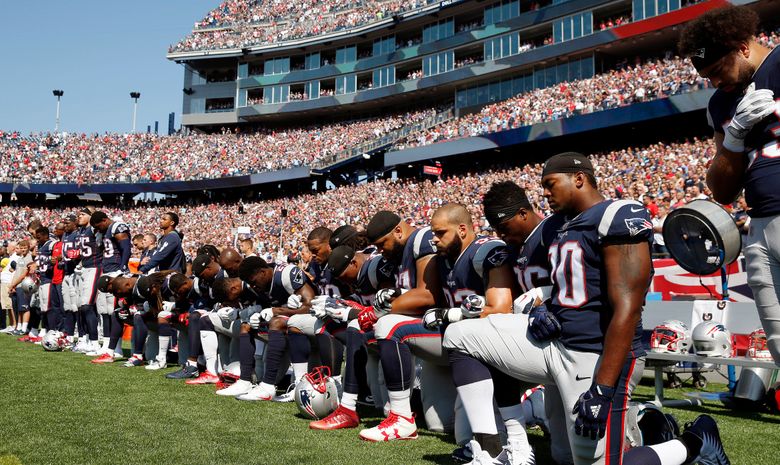
Unless you were in a coma under a rock inside a cave on Mars, you probably heard about the mass protests conducted across the NFL last Sunday. What exactly were they protesting, you ask? Well, that’s a hard question to answer and the fact that it’s hard to answer is pretty telling, in and of itself.

Officially, the protests were a stand against social injustice and a response to some trash talk by some high-ranking government official whose name I refuse to say, primarily because I don’t want to give him more attention than he deserves. Unofficially, it was the rhetorical equivalent of two colliding shit storms that only succeeded in creating a bigger storm.

There are many ways to protest injustice, corruption, and everything Gordon Gekko stands for. One of the perks of living in a relatively free society is that you get to attempt and experiment with a variety of ways. Sometimes petitioning works. Sometimes viral videos work. Sometimes just being Mr. Rogers and talking to people with unwavering kindness works.

Unfortunately, there are far more ways that fail instead of work. That’s just the nature of the world we live in. What Colin Kapernick did last year and what multiple NFL teams did last week succeeded to the extent that it raised awareness. While awareness is an important part of the process, especially in the era of the attention economy, that doesn’t mean that it achieved its goals.

More than anything else, it divided people within two tribes. In one, Colin Kapernick and the NFL are patriots in that they’re protesting in the name of the justice that the flag and the national anthem stands for. In the other, Colin Kapernick and the NFL are self-absorbed, virtue signaling drama queens who are disrespecting a symbol that many brave Americans fought and died for.

These are two irreconcilable ideas that kill any substantive conversation. They’re seeing the same picture, but interpreting it in wildly different ways. Instead of highlighting the egregious disparities in how the justice system treats certain minorities, it’s now a discussion about who has the a more patriotic hard-on for all things American.

That begs and important question. Which interpretation is right and which side is wrong? Who can truly say they’re being more patriotic than their counterparts? Well, here’s where it gets tricky and where I’m probably going to upset both sides. Bear with me, though. I promise I’ll try to inject some substance that both sides can use to further their cause.

First, I’ll answer those two questions definitively. I don’t expect everyone to agree with my answer, but I suspect I’ve already upset both sides already so I won’t bother making excuses.

“Both sides BELIEVE they’re true patriots. Both sides BELIEVE their opponents are anti-America. Neither side is inherently RIGHT, but BOTH are valid in their beliefs.”

I know. It sounds like I’m talking out of both sides of my mouth and a little out of my ass. Ignoring the influence of my ass, here’s where I’m certain I’ll upset both sides of the debate.

Regardless of how patriotic you feel, the American flag and the national anthem are symbols. No matter how universal you think they are, symbols are always subject to interpretation and those interpretations are rarely, if ever, agreed upon by every person in a society. Just look at all the symbols whose meaning has wildly changed over the centuries.

It’s because of this subjectivity that it’s possible for two people to look at it and interpret extremely different messages. That’s how one side can look at a flag and see the beauty of America. That’s how another can look at a flag and see the ideals America stands for and realizing that the people haven’t lived up to those ideals.

It seems impossible, but when you remember that irrational, tribal nature of the human species, it makes sense. In that context, the NFL and its players are patriots for telling Americans that they have not lived up to the ideals their flag stands for. The people booing them are patriots too for pointing out how they’re disrespecting the symbols and traditions that bind society together.

In either case, both sides can’t claim to be entirely objective. Those claiming that the NFL players are spoiled and using their positions of power to divide people probably wouldn’t feel that way if they were protesting something they agreed with. Change the message and the context and suddenly, they’re on the same side.

22008167_2038396299504671_1575711025395615984_n

Again, it’s an irreconcilable disagreement, as is often the case with such extreme tribalism. There’s nothing either side can do to convince the other that they’re the true patriots. It’s a downright tragedy because racial injustice is an important issue if we want to improve as a society. Once it becomes a discussion about who is more patriotic, then the protests and outrage behind them no longer matters.

That finally leads me to the practical part of this article. If you’re bummed out or frustrated at this point, then I thank you for sticking with me this long. I imagine some of you already hate my guts and think I’m trying to solicit money from George Soros and the Koch brothers.

I promise you I’m not doing this to win any favors with one particular political agenda. The suggestion I’m about to offer is being offered free of charge. Sure, I’ll kindly request that you buy one of my books or make a donation, but I won’t expect it. I’m still offering free insight into fixing a major problem.

With that said, and knowing that nobody in the NFL or their critics are listening, here’s how you protest social injustice effectively. It can be accomplished in one easy step.

“Make the protest easy, fun, and rewarding to join.”

I know that sounds easy on paper and for once, it kind of is. Granted, it’s not the same kind of spectacle as Colin Kapernick’s protest, but that’s kind of the point. It shouldn’t be that kind spectacle. It should be something else. Moreover, it should be fun.

The best example I’ve seen in recent years is the ice bucket challenge that briefly swept the nation a few years ago. For a brief time, celebrities and ordinary people alike participated in a fun show of solidarity that helped raise money for a worthy cause, namely the treatment of ALS.

It worked too. The ALS Association reported a record $3 million in donations because of this goofy ploy that was fun, easy, and entertaining to join. If it worked with ALS, why not racial injustice?

I’m not saying people should usurp the ice bucket part. I think the ALS folks have already branded that. Instead, protesting racial injustice should involve something different. Maybe it involves hugging someone, popping a balloon, or hitting yourself with a pie. It doesn’t have to be big. It doesn’t have to make sense. It just has to be fun, easy to join, and make people feel better about themselves.

Think of it as a way to weaponize the power of virtue signaling, making people feel better about themselves by doing something inane. In this case, there would be some substance behind it. In addition to the inanity, there would be a donation to organizations like the ACLU, Big Brothers and Big Sisters, or The Sentencing Project. It doesn’t have to be much, but if it’s more than zero, it helps.

If Colin Kapernick had taken this route instead of protesting the national anthem, would he be the poster child for all that is wrong with professional athletes not named O.J. Simpson? I don’t know, but it would attract more attention for the right reasons.

It would make his stand against racial injustice matter. It would get people to participate rather than remain numb or indifferent. Now that kneeling for the anthem has just become this never-ending argument about who’s the real patriot, the protest no longer matters. However, I don’t think it’s too late to change that.

2 Comments

Filed under Celebrities and Celebrity Culture, Current Events, Jack Fisher's Insights

Ted Cruz, Twitter Porn, And Why We Shouldn’t Make A Big Deal Of It

As a general principle, I don’t like mentioning certain politicians by name. That’s because to mention them is to give them more attention than they deserve and, as I’ve pointed out before, attention is the life blood of both the internet and the trolls that make it awful.

I only ever get specific once their propensity for bullshit reaches a level of absurdity and hilarity that both sides of the political spectrum can laugh out. That’s why I’ll drop names like Rick Santorum and Bernie Sanders. If they didn’t exist in real life, they’d probably exist as cartoon characters that Seth MacFarlane made up.

With that in mind, I have to say I’m shocked that I can add Ted Cruz to that list. In terms of politicians, there’s not much about him that makes him deserving of attention. He’s a cut-and-paste conservative republican who espouses everything you’d expect a guy who once called same-sex marriage a threat to liberty and makes one too many Nazi comparisons when he talks about health care.

It’s for that reason why nobody should be surprised that he’s as sex-negative as they come. While he was the solicitor general in Texas, he ardently defended a state ban on sex toy sales. He even went so far as to make this unsexy statement.

“There is no substantive-due-process right to stimulate one’s genitals for non-medical purposes unrelated to procreation or outside of an interpersonal relationship.”

Try to read that without cringing. I dare you. This is a man who honestly sided with people who believed in using taxpayer money and policing power to discourage people from touching their own bodies in ways they might enjoy. It’s enough to make the Ron Swanson in all of us fume.

Image result for Ron Swanson on government

It’s also for that very reason that nobody should be surprised that Ted Cruz just got himself into trouble by “accidentally” liking a porn video on Twitter. I put the word “accidentally” in quotes because it’s a loaded word in a situation where any word can turn into the dirtiest kind of innuendo. Since I prefer to save that sort of rhetoric for my novels, I don’t want to overdo it here.

Naturally, the idea of an uptight conservative republican who once argued for prohibitions on masturbation liking a porn video was like catnip for social media. Cruz is now the butt of a lot of crude humor and understandably so. It’s like catching a priest with a prostitute. It’s just inherently funny.

Now, as funny as this is and as detestable as Ted Cruz may be to anyone who enjoys stimulating their genitals, there’s a good chance the man may be completely innocent here. He has already gone on record as saying that a staffer managing his social media account liked the video and not him. Given how common that practice is among politicians, that’s the most likely scenario.

That doesn’t make situation any less hilarious, nor will it stop the onslaught of reactions from people calling Ted Cruz a hypocrite and a fraud. Given how much we, as a society, detest hypocrites, even from those from the non-political class, that’s understandable. Hypocrites are the epitome of everything that makes a human being unlikable.

However, in this case, I think the reactions to the hilarity may do more harm than good. Please don’t take that to mean I’m defending Ted Cruz, nor am I making excuses for him. I am not a big Ted Cruz fan. I would not vote for him to be my local dog catcher, let alone a politician of any standing.

That said, I’ve never met the man. I don’t know what he’s like outside of these ridiculous stories about the ridiculous things he says on the record. He might very well be a nice guy who only says what he says because his party’s platform involves decrying porn as a public health crisis. When the cameras go off, he may not really care much about the kinky stuff people do in the privacy of their bedrooms.

You could probably say the same about a lot of ardent conservatives like him, whose party gets a boatload of money from anti-sex, anti-porn, anti-fun organizations like the Family Research Council. What they say in public doesn’t always reflect what they believe in private.

Let’s not get too high and mighty here. If someone paid us enough money, then we would probably say all sorts of horribly unsexy things as well. I don’t deny that if someone gave me millions of dollars to only write novels that would appeal to Mormon clown enthusiasts, I would do it in a heartbeat.

Short of reading Ted Cruz’s mind or getting some private audio recordings that has him going on a Mel Gibson style rant about the evils of porn and masturbation, we have no way of knowing how he really feels about porn and sex. However, social media is still going to mock him as the ultimate hypocrite, right up there with Ted Haggard.

That, I feel, is a mistake because Ted Cruz is not Ted Haggard. Haggard got caught red-handed in a way he could not blame on a lazy staffer. In Cruz’s case, it’s very likely that this was just some staffer with too much free time, not enough coffee, and badly in need of a good orgasm. Attacking him for something he probably didn’t do makes us the assholes and not him.

There’s another more important reason why we shouldn’t make too big a deal about Cruz’s possible porn tastes and it goes beyond simply not being an asshole, an effort we should all value. There’s a time for mocking and a time for pointing out the hilarity of a situation, of which there are many. However, let’s not mistake mockery for an actual argument against the idea we find so abhorrent in the first place.

Mocking Ted Cruz does not make an effective argument against his regressive attitudes towards sex, porn, and all things fun in this world. Mockery outside of a “South Park” or “Rick and Morty” rerun never adds any kind of meaningful insight to an issue. Sure, it’s funny, but that’s the extent of the contribution.

For someone like Ted Cruz, who still wields real power and has real influence over public policy, mocking him isn’t going to change his mind about anything. If anything, it may make him that much more eager to send police into peoples’ houses to make sure they’re not pleasuring themselves. People get unreasonable when they’re mocked, especially when it’s not warranted.

Whether or not Ted Cruz genuinely believes his party’s platform on sex, porn, and minorities is beyond the point. At some point, just being an asshole to someone who likely didn’t have any role in an incident, other than having his name attached to it, helps nobody. It just gives Ted Cruz more reason to despise his opponents and not listen to them.

That’s the biggest reason why this whole ordeal with him liking a porn video on Twitter is already overblown and need not be an indictment on all things Ted Cruz. Instead of actually pointing out to Ted Cruz how regressive, harmful, and unproductive his attitudes are, people are taking the easier path and mocking him instead.

That approach is every bit as asinine as anything Ted Cruz has been part of. In fact, I dare you to find any person of power that ever changed their mind because of mockery. Men like Cruz should be challenged, but part of that process involves actually respecting them enough understand their situation. That’s harder for certain people, especially politicians who are beholden to donors.

It’s hard, frustrating, and not nearly as funny, but when our sex lives are at stake, I think it’s worth enduring. It might not be possible to persuade a man like Ted Cruz that his attitudes towards sex are wrong, but by being assholes about it, we’re doing a disservice to those who can be persuaded and for all the right reasons. In the end, that benefits both our sex lives and political discourse.


Leave a comment

Filed under Current Events, Jack Fisher's Insights, Reasons and Excuses

How To Resist A Fascist Government (And Survive)

There’s been a lot of talk about fascism lately and I don’t deny that I’ve contributed to it. I tried to make that contribution meaningful and even sexy, but I know I’m facing some pretty strong headwinds that have managed to undermine far more relevant voices, like CNN.

Even if it is an uphill, fruitless discussion to have in the long run, it’s still worth having, if only to understand the forces behind it. It’s only when we understand something so daunting and dire that we can better deal with it. Like divorce, a death in the family, or a slow internet connection, it helps to maintain some sense of perspective.

With that in mind, I want to shift the discussion somewhat to something more practical. No, that doesn’t mean I’m about to trivialize the horrors of fascist regimes or make light of their victims. I like to inject sex appeal into everything I talk about, including fascism, but even I can’t make those topics sexy.

To that end, I’d like to focus on what people can do to actually resist a fascist regime. The topic of “resistance” has been a major issue lately, especially after what happened in the 2016 Presidential Election. There have been major protests, some of which I’ve discussed and some of which have become talking points for major media figures.

There’s plenty of angry rhetoric. There’s plenty more whining, yelling, and personal insults. I’m pretty sure that everyone’s mother has been called a whore at least once since January 2017. None of it is very productive, though. Most of it is just fodder for cable news and cheap laughs for those in power.

The truth of the matter is that there’s a right way to do a resistance movement, even against a fascist regime. Even the most authoritarian governments in history are vulnerable to collapse. It’s worth pointing out that nearly every major empire in history has collapsed, including the repressive ones. It may seem like a fascist regime can never fall. History, to date, says otherwise.

So with that in mind, I’d like to make another contribution to the discussion about fascism and the best ways to resist it. Moreover, I want to list the ways people can resist and have a good chance of surviving.

History shows that the kind of violent uprisings glorified in movies like “Red Dawn” may get people excited, and even horny in some cases, but it also shows that such violence tends to breed more violence. You need only look at the French Revolution or the Tiananmen Square protests for proof of that.

To bring down a fascist regime requires patience, foresight, and perseverance. Most importantly, the resistance needs to have easy tactics that everyone can do. That’s why I’ve compiled a quick list of easy tips on how to resist a fascist regime the smart way. It’s easy to do. It requires no violence. It just requires patience, perseverance, and a little luck. If done right, you’re much more likely to survive.

Please keep in mind, though, these tips only apply to fascist regimes that are run by humans, administered by humans, and populated by humans. That means subjects of advanced alien overlords like the Borg or superhuman despots like Dr. Doom need not apply.


Tip #1: Leave If You Can, But Survive If You Can’t

This is the simplest, most obvious tip to anyone unlucky enough to be living under a fascist government. I understand it isn’t always possible. I also understand that dealing with refugees are a complex hot-button issue. However, when it comes to bringing down a repressive government, it can’t be avoided.

One of the ways a fascist regime is inherently unstable is how it deals with it’s smart, highly skilled population. Fascist leaders tend to not like anyone smarter than them. That usually means brilliant, highly skilled people end up leaving the country, taking their knowledge and expertise with them. Nazi Germany found that out the hard way.

Countries like Iran are finding out too. When your country is a repressive, uptight society that won’t let well-paid, well-educated people have a beer or go to a strip club in peace, they tend to take their talents elsewhere. Without that professional class of people, a fascist regime can’t really accomplish much. It’s hard to make weapons of doom when you scare all the mad scientists away.

For those who aren’t highly skilled individuals and are unable to leave, the best thing you can do is survive. I know that’s much easier said than done, especially in the inherent poverty of fascist countries. However, being alive is important because it means the state still needs you. Without you, who’s going to provide the slave labor and constant adulation that a fascist leader demands?

Brutal or not, a fascist regime still has to care for its citizens to some extent. It needs to spend time, money, and resources ensuring that its people are actually capable of providing the labor and human resources to make the system work.

They may not provide much, especially if you end up in prison or a work camp, but the mere act of being alive still undermines the regime. So long as your existence forces the regime to spend time and money making you a productive member of their agenda, you’ve got the edge to some extent. Letting yourself die would only do them a favor. So in a sense, the best resistance anyone can do in such a horrible situation is just survive.


Tip #2: Tell Rulers Exactly What They Want To Hear (But Don’t Mean It)

This is another one of those inescapable pitfalls of living in a fascist regime. On paper, it may sound like you’re just emboldening the regime. That’s true, if you’re only looking at it in the short-term. If you’re willing to play a little three-dimensional chess, though, you can turn the tables.

There’s no doubt that living in a fascist regime will require you to glorify some despotic leader. You may hate their guts. You may pleasure yourself to the idea of them dying a violent death. That’s fine. Keep that hatred and kink strong within you, but keep it within you. If ever you have to put on a fake smile and tell the ruler how big their dick is, just grit your teeth and do it.

You’ll hate it in the short-term, but you’ll see the benefits in the long run. It’s one of those few times when the harshness of reality is on your side. If people only ever tell a dictator what they want to hear, they’ll avoid telling them about serious issues that need to be addressed. They won’t give the full story. They’ll avoid the hard facts, but those facts won’t avoid them.

As a result, fascist rulers will have a poor understanding of a situation or crisis. They’ll be incapable of making the kinds of decisions that strengthen their hold on power. Eventually, those decisions will erode the regime’s ability to function. They’ll leave their society in such a poor state that no amount of adulation will change it. At that point, the regime is as good as gone.


Tip #3: Conform In Public, Defy In Private

This ties directly into the previous tip. If you’re going to survive a fascist regime, you’re going to have to put on a public face you hate and do everything the regime demands that you to do in order to be a good citizen. You’ll hate it inside, but you’ll still do it because that’ll help you survive.

In private, however, you can afford to let yourself go. In fact, doing so will help inoculate you from the propaganda that all fascist regimes depend on to keep their population in line. Even repressive places like Iran are finding out the hard way that while some people show the necessary piety in public, they tend to get really freaky in private.

Now, I understand this would be even harder in a regime like the one described by George Orwell in “1984.” However, keep in mind that the kind of surveillance described in that book is pretty much impossible in the real world. Even North Korea has a hard time preventing smuggling.

If anything, more intensive surveillance means that your actually winning. All that surveillance, costing the regime time and money that it would rather spend strengthening its power. Having to micromanage its citizens is a huge drain on any regime, fascist or otherwise.

Welcome that kind of micromanaging whenever you can. In the long run, the regime will run out of money before you run out of things for them to manage. That way, when the regime starts to collapse, it’ll be easier for you and others dissatisfied with the regime to help it collapse. All you had to do was be deviant in private. Most people do that anyway so it’s something everybody can do.


Tip #4: Create Impossible Issues For Rulers To Deal With

This is a bit harder, but still fairly critical. By creating impossible issues, I don’t mean protest and complain to the fascist government. That’s usually a quick way to end up dead, in prison, or in a forced labor camp. You can still frustrate the regime, but you can do it indirectly.

The easiest way to do this is to just not do your job very well. Channel your inner Wally from “Dilbert” and do just enough to avoid getting into trouble, but nothing more than that. Don’t do your best. Don’t go the extra mile. That forces the regime to commit more resources to doing something that shouldn’t take so many to begin with.

Beyond just being a marginal worker, go out of your way to make day-to-day issues complex and tedious for the authorities. Think of it as a form of trolling, minus the insults to other peoples’ mothers. The key is to get the government to deal with multiple issues on multiple fronts. They don’t need to be big issues. In fact, the smaller the issue, the better.

Small issues frustrate governments far more than larger issues. Government, and its assorted bureaucracy, is a blunt instrument by nature. It can’t deal with smaller issues for the same reason a doctor can’t perform brain surgery with a baseball bat. It just doesn’t have the tools. That won’t stop it from trying. It’ll just made a mess of things and that works to your advantage.


Tip #5: Weaponize The Power of Apathy, Boredom, And Dispassion

This goes along with the previous tip in that it takes being lousy at your job a step further. One of the most important tools that fascist rulers use is their ability to rally up the passions of the public. They use their gift for rhetoric and giving fancy speeches to work people into a frenzy so that they’ll ditch all forms of critical thinking and follow them into battle.

While it helps fascist governments come to power, it’s not very useful when it comes to maintaining power. Sure, fascist governments will hold military parades and create these big, gaudy monuments to their glory. However, it amounts to an oversized toilet for pigeons if it can’t generate the same solidary.

That solidarity is the glue that holds a fascist society together. Apathy, Boredom, and utter dispassion is the solvent that breaks up that glue. If a government spends all that time and money blaring their glorious message to the populous, only to have them look back with blank and tired stares, they’re screwed.

If the people aren’t united and in an orgasmic frenzy of support, they’re less likely to sacrifice or aid the regime. Sure, they’ll follow the rules. They’ll march in the parades. They’ll even put on happy faces. They just won’t put much energy or effort into helping the regime stay together. That’s why the greatest tool any citizen in the resistance can have is their apathy. Without that, a fascist society just falls apart.


Tip #6: Let The Rulers Frustrate Themselves (And Stay Out Of Their Way)

This is probably the most enjoyable tip on this list and not just because it doesn’t require much effort. Technically, you really don’t have to do anything to make this happen, so long as you follow the other tips I’ve listed.

That’s because government and bureaucracy, at least those run by humans, are inherently flawed. That’s because people are inherently flawed. No matter how dedicated or passionate they may be, they’re going to make mistakes. They’re going to fall flat on their faces. All you have to do is let them.

This is especially true of dictators, who everybody is afraid to restrain. Eventually, they’ll get back up, blame everyone but themselves, and try to correct it. Chances are, they’ll fall flat on their face again. They’ll get even angrier. That kick-starts a brutal cycle that the dictator can’t escape. Eventually, they’ll frustrate themselves to the point of utter failure. Once they fail, the regime fails.

When this happens, the best thing anyone can do is stay out of its way. Every fascist regime has inherent flaws. You just have to be patient enough and tough enough to let them happen. It can be grueling and downright dangerous. In the long run, though, human nature and inept dictators will be on your side.

That, in essence, is the greatest and most fitting irony of fascism.

6 Comments

Filed under Jack Fisher's Insights

On Fascism (And Why It Fails)

Brace yourself and temper your outrage because I’m about to talk about fascism. No, I’m not talking about the kind of fascism that teenagers whine about whenever they have a strict teacher in high school. I’m not even talking about the kind of fascism that that certain people attribute to college professors, LGBT rights, Hollywood, the NRA, the Catholic Church, and Negan from “The Walking Dead.”

Today, I’m going to talk about actual, real-world fascism and how it functions. I’m also going to talk about why it tends to fail in the long run and why it’s become such an empty term. Now, I know that means putting a big target on my ass and daring the more vocal parts of the internet to take a shot. I like think my ass is harder and more durable than most so I’m prepared to take that chance.

I know people like to throw the word fascism around like middle fingers in mid-day traffic, but it does have a definition. That definition has been twisted and amended many times over the past half-century, so much so that the word evokes so many different connotations.

For the sake of this post, I’ll be using the definition from Merriam-Webster’s dictionary. It offers a fairly concise assessment of what it entails.

A political philosophy, movement, or regime (such as that of the Fascisti) that exalts nation and often race above the individual and that stands for a centralized autocratic government headed by a dictatorial leader, severe economic and social regimentation, and forcible suppression of opposition.

Under this definition, America and most developed countries are not fascist. No matter what some kale-eating hippie or Jerry Falwell wannabe theocrat may claim, the systems and laws in place are antithetical to fascism.

Western countries have codified laws and traditions that value individual rights, protect minorities, and restrain central government power. Now, that’s not to say it’s perfect in practice. There are plenty of examples, historical and contemporary, that of inequality and oppression by the government.

However, those examples are more a product of misguided groups of people and inherent systemic corruption. To call an entire system fascist because of those instances would be like calling an entire swimming pool dirty because a few people spit in it. With fascism, the entire pool is spit so there’s no need for cherry picking.

Thanks to the cruel mistress that is history, we have a few well-known examples of true fascism that even vegan hippies can agree on. By most objective measures, Fascist Italy and Nazi Germany are the alpha and omega of all things fascist. If fascism were music, these two would be Elvis and the Beatles.

These governments were repressive, authoritarian, corrupt, and powerful. They could do whatever it wanted to its citizens and act however it wanted on a national stage, not giving a damn about public support of any kind. There was no hesitation to lie, cheat, and mislead the people. In these governments, people are either pawns or cogs in a machine. The very notion of freedom might as well be as fanciful as a unicorn fart.

There’s no question that these fascist governments did a lot of damage and caused a lot of suffering. There’s also no question that their actions scared and traumatized an entire world. They revealed to a modern world that wars between despots and industrial powers was truly horrific. Most human beings tend to avoid such horrors. A massive world war was enough to make everyone hyper-vigilant of all things fascist.

It’s in this heightened mentality where I think it’s worth having some perspective about fascism. We hear pundits, politicians, and protesters throw that word around, as though it’s the rhetorical equivalent of an “avoid critical thinking” card. It’s an easy label to throw around, but it rarely sticks because actual fascism is actually pretty frail.

In a modern context, fascism is different from the kings and despots of the ancient world. In those times, corrupt and blood-thirsty kings could only get away with so much. A kingdom and a nation state, complete with modern infrastructure, are two very different things.

A king needs to only hold a kingdom together and fight off the occasional invader. A nation state has to deal with bureaucracy, social welfare, and legal issues. No matter how big a king’s castle is, there’s just no way to manage all that in a modern context. There needs to be some sort of system in place.

A fascist government tries to centralize that system and organize it in a simple, stable way that definitively benefits certain persons or groups. Nazis sought to benefit a favored race. Italian Fascist sought to benefit a favored class. The argument could be made that Stalinist Russia and the current regime in North Korea are fascist in nature. I would tend to agree with those claims.

The goal is almost always the same. A fascist government directly and overtly attempts to control and centralize power for a select group of elites. It’s for this very reason that fascism tends to fail in the long run or never succeed in the first place.

Now, don’t go cheering and waving American flags just yet. That’s not to say that fascism inevitably falls under the glowing light of freedom, democracy, and bald eagles. That’s a romantic idea that makes for great war movies and comic book characters. It’s not necessarily reflective of real-world machinations.

The biggest flaw in fascism is its attempt to control and manage an entire state. That’s not just difficult. It’s impossible for any ordinary human or groups of humans. Our caveman brains can barely control when we get horny. How can we expect to control an entire government, let alone one meant to benefit a specific group of people?

The short answer is we can’t. The long answer is that such centralization and power requires a lot of bullying, corruption, subversion, and back-stabbing. That’s why you have Nazi Storm Troopers and Stalinist purges. It isn’t just because powerful people get a thrill out of ordering rampant death. They need to scare, bully, and intimidate everybody into going along with their agenda and being completely loyal.

That’s a huge problem though because, as I’ve pointed out before, it’s impossible to know how truthful someone is. You can never know who is truly loyal and who is plotting against you. That’s why men like Joseph Stalin were obscenely paranoid, which guaranteed that allies and enemies alike would die by his hand. Without those allies, any system is inherently weaker.

On top of that problem, there’s also the issue of the terrified masses who live under a fascist thumb. Say what you will about whiny protesters complaining about weed, but at least they’re willing to tell the government what they don’t want to hear. In a fascist system, the impoverished masses will likely keep their mouth shut.

That may help a paranoid fascist get through the day, but it limits their ability to make it through the year. That’s because in a complex world, having incomplete facts tends to be a huge detriment. If nobody is willing to tell a fascist ruler that their rusty old trucks with canons are no match for drone strikes, then that’s going to be a problem.

That’s why, contrary to what the History Channel and video games may claim, fascist regimes like Nazi Germany were never close to winning the war. Between major blunders and micromanaging, there was never a scenario that didn’t involve time travel or aliens that would’ve allowed them to win.

That’s because a fascist regime can’t trust anyone, be it military generals or the public. At some point, the political ties break down and the system just can’t handle it. They can delay the collapse, but they usually can’t stop it. It’s remarkable that Nazi Germany lasted as long as it did, given all the assassination attempts.

It’s the dirty, but unavoidable secret of almost every fascist governments. They function only to live another day, rather than build a future. Some are better at it than others. Castro’s Cuba has managed to survive for over a half-century, albeit with significant support from other neighboring countries.

The same goes for North Korea. The only reason that country still exists is because China doesn’t want a failed state on its border. At this point, North Korea can only endure, but not build. As the old dynastic cycle in China often proved, a system concerned only with survival tends to collapse in the long run.

I say this not as a way to undermine the horrors that fascism has and could potentially unleash on this world. It is a real danger in a world that’s full of crazy dictators and obscene corruption. However, it’s a danger with an inherent weakness and an expiration date. It’s one instance where you can depend on caveman logic to win out in the end.

It may not inspire the kind of ravenous patriotism that Americans tend to enjoy. However, it does show that, despite protests the contrary, there’s a lot to appreciate about our current system. It’s not perfect, but it’s building towards a better, sexier future more so than any fascist government ever will.

2 Comments

Filed under Jack Fisher's Insights

Politics, Safety, And The Impossible Paradox

political_debates_in_the_usa_by_brokenteapot

As I’ve said before, I really don’t like talking about politics. I’ve learned over the course of my life, often the hard way, that nothing makes people less comfortable, less horny, and more insufferable than politics. It couldn’t have less sex appeal without involving a clogged toilet, a dead rabbit, and Sean Hannity.

For the most part, I try not to get too political on this blog. I’d much rather be talking about comic books, sex robots, and Leslie Knope. However, there are times when I feel compelled to say something about a particular issue. I often do that with gender issues like feminism because that indirectly ties to the sexier topics I talk about. I try not to take too strong a position. More than anything else, I try to give perspective.

That’s what I did with my post about the health care debate. I tried to be fair to both sides. I tried to frame the issue in a way that both Michael Moore and Ted Nugent could appreciate. I didn’t offer any easy fixes. I didn’t try to denigrate one political ideology over the other. I just tried to point out the inherent flaws in the issue itself.

In the course of writing about that particular debate, I wanted to apply it to a few other issues. However, I quickly realized that there was no way I could do so in a single article and remain concise. When I write on this blog, I tend to assume that part of the audience is drunk, horny, or some combination of the two. That means I can’t drone on for too long, even though I have a habit of doing that when it comes to comics.

Health care is just one issue. Granted, it’s an exceedingly complex issue, but it’s still one issue. The underlying argument I made was that, beyond the complexity, both sides of the political spectrum have the same goal. The problem is that what they want isn’t just logistically difficult. It’s physically impossible.

It’s another hard truth, one that I’d argue is even harder than the truth surrounding O.J. Simpson. Sometimes, even when the politics involved have a noble goal, the particulars of an issue are just beyond our capabilities as humans to produce. We humans can do all sorts of amazing things, from the Great Pyramids to solar-powered vibrators. However, we are a species of many limits, many of which we often fail to acknowledge.

This leads directly to an even bigger picture, of sorts. It also involves something that’s currently impossible in a world without superheros, super-powers, or computers that can’t be hacked for hilariously stupid reasons. Until we start enhancing ourselves, it’ll remain impossible for the foreseeable future.

I call it the impossibility paradox because most people, regardless of their political persuasion, act as though the impossible aspects aren’t there. They’re often smart, driven people who are every bit as driven as their ideological opponents. They work so hard to accomplish something that’s physically impossible. Then, they’re surprised when they come up short.

On top of that, the people they claim to represent or help get upset with them because they didn’t accomplish what they promised. Never mind that what they promised was never possible to begin with. Human beings just aren’t that reasonable, even if they like to pretend that they are. Everybody is still subject to the constraints of reality and, like a moody dominatrix, it doesn’t mind telling us who’s dominant.

Now, apply that dynamic to what might be an even bigger issue than health care for some people. Whether you’re gun-toting conservative or a pot-smoking liberal, most agree that a central function of any government entity is to keep citizens safe.

No state, kingdom, or Dungeons and Dragons guild can survive without providing some level of safety. People, society, and the economy can’t function unless there’s some level of safety. Nobody wants to make iPhones and exchange brownie recipes if there are barbarian hordes just a few miles away, ready to raze your home to the ground.

Since the dawn of civilization, every functioning society has had to provide some measure of safety and protection to its citizens. In exchange, citizens pay taxes to the state so that it can have the resources to perform these duties. Ideally, they’ll use those taxes carefully in accomplishing this goal. In the real world, however, nobody will ever say with a straight face that all taxpayer money is spent wisely.

However, this is where even the anti-government, Ron Swansons of the world have to face another cold, hard fact of reality. It’s every bit as inescapable as the health care debate. Even if, however unlikely, a government spent every penny of taxpayer money wisely and dedicated every resource into ensuring safety and security, it still wouldn’t be enough. That’s because of one simple truth.

“Nobody knows ALL the facts and nobody CAN know all the facts.”

If that sounds a bit too similar to the advice I recently gave on making sense of the world, then bear with me. There’s a reason for that. It’s similar, but not the same because the scope of the issue is different. Every issue takes on twisted, often frustrating new dimensions when politics enter the picture. Just ask Major League Baseball.

When it comes to safety, though, there’s an inescapable complication that has plagued every government entity that ever existed and will continue to plague governments until our robot overlords take over. To provide safety, you need to know everything about a situation and have the resources to deal with it. Unfortunately, or fortunately for privacy-minded folks, nobody can know everything about a given situation.

Nobody can know for sure when and where a terrorist attack will occur.

Nobody can know for sure whether or not a rival nation is plotting against them.

Nobody can know for sure whether a handful of countries are colluding to undermine them.

Nobody can know for sure whether that weird-looking guy walking down the street is about to go on a shooting spree or just skipped laundry day.

There are just so many unknowns in the world of geopolitics. There are a lot of unknowns for individuals as well. Hell, we still can’t figure out just how useful or useless pubic hair is. How are we supposed to know everything about the threats to our safety and sovereignty as people?

That’s just it, though. We can’t know. It’s physically impossible for any one human or group of humans to know everything about a certain situation, individual, or threat. Sure, the CIA could bug your phone and hack your browser history. That may even give them plenty of reason to believe that you’re conspiring with a hidden network of BDSM enthusiasts to take over the entire state of Montana.

At the end of the day, though, even the CIA can’t know for sure and that has proven costly throughout history. No agency, no matter what they call themselves or what sort of fancy acronyms they use, can know everything about a situation. I’m sure they’d like to know. If you’re of the mind of Alex Jones, you might even believe they’re working with aliens to remedy that.

Even if they did have some way to read all our thoughts, there’s still the matter of sifting through random daydreams and outright plots. Honestly, who hasn’t contemplated whipping out a can of lighter fluid and setting a coffee shop on fire because they got your order wrong? The difference between those thoughts and real action, though, is huge.

I’m not saying that governments and police forces should give up trying to keep people safe. We still need some measure of safety in order to function as a society. The problem is that because of this safety paradox, we end up in these brutal cycles that only make us more fearful. It goes like this.

  • Some strange, complex, dire threat is out there and the media blows it up to scare people

  • The people demand action from their politicians and authority figures

  • Those politicians and authority figures try to respond, if only to maintain their hold on power

  • Those politicians and authority figures fail to provide perfect safety because doing so is impossible

  • The public gets upset with the existing people in power and looks for alternatives

  • Some new power-seeking people enter the picture, making impossible promises to fix impossible situations’

  • The citizens, desperate to fix the impossible problem, put these people into power because anything seems like an improvement over the status quo

  • The people who made the impossible promises, predictably, fail to deliver and generate another round of disillusion

  • The cycle starts all over again

This is part of why congress’ approval rating is so low. It’s also why western countries keep cycling through political parties, constantly voting new people into office in hopes that they’ll find a way to solve impossible problems. In every case, they are unable to deliver. Most people don’t see the impossible logistics, though, so they just look to the next power-broker who can deliver.

For now, we’re very much at the mercy of impossible situations and the people who claim they can solve them. Some of these situations will become less impossible as we develop better tools. Until then, though, let’s be mindful of the impossible demands we make on those we entrust with our safety. It’s often when we have impossible standards that we doom ourselves to unlimited disappointment.

7 Comments

Filed under Jack Fisher's Insights

Health Care, Politics, And The Impossible Paradox

As a general rule, it’s my policy to ignore major political issues until after the protests have died down and people have stopped trying to strangle each other through computer screens. Politics is rarely sexy, unless it involves Monica Lewinsky and whoever John F. Kennedy was screwing. In my experience, nothing kills the mood faster than a heated political debate.

I know I’ve spoken on certain hot-button issues before. I did a quick response to the Women’s March earlier this year and the March for Life that quickly followed it. Those weren’t debates, though. Those were protests with simple, clear messages that were easy to break down. Debates aren’t just a little trickier. They’re downright infuriating.

There was a time when I used to enjoy engaging in such debates. I would even go out of my way to find people who disagreed with me, try to understand their position, and then try to argue my own. It was a good mental exercise, but that’s all it ever was.

At no point did I ever change anyone’s mind about anything. At no point did anyone change my mind either. Like debating creationists, they might as well have just been glorified shouting matches. They weren’t meant to actually persuade the other person. The debate was just a spectacle and nothing more.

The fact remains that people don’t like to change their minds about anything. I’ve mentioned time and again how rigid and stubborn the human brain is. Changing an opinion about something is a last resort. Before that happens, people will do the kinds of mental gymnastics that would make a Russian gymnast cringe to justify their opinion.

That brings me to the ongoing health care debate in the United States. I know everybody has an opinion on it and they want to shout that opinion from the highest hill over a bullhorn while Uncle Sam and Lady Liberty give them a back massage. It’s one of those issues that a lot of people are sick of, which is kind of ironic when you think about it.

It’s a frustrating debate to have in the first place because most other industrialized countries have resolved it. The United States of America, despite all the flexing it does of its patriotic nuts, is one of the only industrialized countries that doesn’t have universal health care.

It’s been argued over endlessly by politicians and presidential candidates. Every now and then, one will even build a platform around it. There have been any number of initiatives and policies, some of which do result in meaningful legislation. However, the debate still continues and so does the whining.

Now, I’m not going to take a position in that debate. That’s not the purpose of this post. I’m writing this because someone needs to point something out in this debate that nobody seems to recognize. It’s something that both sides of the debate need to understand, if only to maintain a sense of perspective.

It’s not a thought experiment. It’s not an opinion. It’s not even an argument or a policy idea. It’s a cold, unambiguous fact that is at the heart of the health care debate and others like it. This is a hard truth so whether you’re a card-carrying liberal or a die-hard conservative, you might want to brace yourself.

What we’re trying to accomplish with our health care system is physically IMPOSSIBLE.

Let that sink in for a moment. I don’t usually write in all caps, but this is something that’s worth shouting. If you’re reading this out loud, please read it over again and shout it as loud as you want because it needs to be belabored.

Health care, be it universal or reserved for rich people with decent insurance, is an impossible endeavor that tries to account for infinite possibilities with finite resources. There are over seven billion people on this planet. There are hundreds upon hundreds of diseases that afflict the human body. Treating every person to the utmost just requires too many resources with too few people qualified to administer them.

That’s why the answer to the health care debate isn’t as simple as adopting the same universal health care policies as Europe. Contrary to what Bernie Sanders fans might believe, health care in Europe faces some pretty huge challenges for the exact same reasons. There are too many people who need health care, but there just aren’t enough resources to go around.

Go to any country with any type of health care system you can think of. Don’t be like Michael Moore and focus narrowly on one particular part of a system. No matter where you go and no matter what system you encounter, be it universal or administered by wizards, you’ll always find cases of people not getting the care they need.

Within those cases, you’ll find plenty of unusual cases, such as people who resort to do-it-yourself dental care. You’ll also find plenty of tragedy about people suffering horribly due to their inability to get the care they need. So long as demand outstrips supply, they’ll always happen. That’s just basic economics and dispassionate logic.

In the end, whatever health care policy or reforms get enacted, it won’t be enough. There will still be people who suffer because of it. There will also be people who end up paying more for both their care and that of others. There’s just no way around it. Health care requires resources and people. When there aren’t enough of both, you’re going to get people who get screwed over.

It doesn’t help that many countries, including the United States, face a shortage of qualified doctors. Despite the generous salaries and sexy nurse fantasies, the actual process of becoming a doctor is extremely costly and very difficult. No matter how sexy Hugh Laurie makes it look, becoming a doctor is hard and laborious.

It also doesn’t help that pharmaceutical companies and insurance companies are for-profit companies whose incentives aren’t always in line with providing the best of care. There are people in this world who will risk doing real harm to sick people in order to turn a profit. These people aren’t super-villains or sociopaths, for the most part. They’re just working within a system with flawed parts.

This is not to say that the health care debate is hopeless. For the moment, the situation is impossible. There really isn’t a way to provide adequate care to everybody. However, there are some rays of hope that should keep everyone’s panties from getting too dry.

To combat the doctor shortage, companies like IBM are using Watson, their Jeopardy champion, to help diagnose disease and research treatments. Major biotech companies are using tools like CRISPR, which I’ve talked about before, to alleviate diseases that were once fatal and expensive.

Further into the future, advances in technology like smart blood or brain implants will improve overall efficiency in determining appropriate care. However, there will still be a cost. There will still be a bureaucracy, which both sides of the political spectrum find inherently unsexy. So long as that process is determined by humans and for humans, there will be flaws.

Remember this the next time someone debates health care. No matter what side they’re on, the issues they’re highlighting are literally impossible. It’s still a debate worth having. We should still strive to give the most amount of quality care to the most amount of people. That’s good for society, the economy, and even politicians.

Let’s just remember that there’s a difference between a solvable problem and an impossible situation. Health care, at the moment, is an impossible situation. We shouldn’t lose sight of that, no matter how the debate unfolds moving forward.

6 Comments

Filed under Jack Fisher's Insights

My Reaction To The March For Life

When you live within a short drive of Washington DC, you tend be numb to all the demonstrations, protests, and what not. Talk to most folks who live in and around the DC area and they’ll tell you the same thing. Protests and detour signs are hard to distinguish.

That said, when protests are so big they enter the six or seven-figure range, it’s a lot harder to ignore. In fact, it’s a clear sign that it shouldn’t be ignored. This was the case with the Women’s March that took place last week. I’ve already reacted to that. However, there was another march right after that, namely the March For Life.

For those in the DC area, two big marches are like two all-night drinking benders. One alone is hard enough to handle. Two is really pushing it. At some point, you run out of energy and your body runs out of vomit to adequately process something. In the interest of fairness, though, I think I should react to this march as well because, like the Women’s March, it had a powerful message.

This means I have to talk about abortion again. I know. I don’t want to do it either. Nothing makes people less horny than talking about abortion, but it’s kind of hard to avoid when you’re reacting to a pro-life/anti-abortion march.

Again, even though it has come up before, I hate talking about this topic. I’m a man. I don’t get pregnant. I have nothing to contribute to this issue. This is one of those issues that affects women. Therefore, policies and decisions on abortion should be made by women. The fact that men make these laws is kind weird when you think about it.

I say all this with the hope that everybody uses this opportunity to brace themselves. I know this topic sucks and it riles people up in the worst possible way. Comedian Dennis Miller once commented that if America fights another civil war, it’ll likely be over abortion. Sadly, I think he’s right in the least funny way possible.

It’s controversial. It’s emotional. It literally deals in matters of life and death. It also deals with the most fundamental of freedoms in being able to make decisions on the most important issues affecting your life. This is not protests and outrage over the season finale of the Walking Dead last year. This is a powerful issue that affects women, children, and the most fundamental aspects of our society.

It’s for those very reasons that a major protest is entirely warranted. Abortion is an unresolved issue in this country, to say the very least. Some parts of the country are so vehemently anti-abortion that their state only has one functional abortion clinic. Overall, abortion clinics are being closed all over the country, sometimes directly and sometimes through shady TRAP laws.

In that context, the pro-life crowd is winning the war, even though Pew regularly reports that a majority of people are pro-choice. In some sense, the March For Life last week was a celebration of their recent victories and a push for more victories. For the pro-choice crowd, they are on the ropes. They are losing and, given the current regime in DC, those losses will continue.

Given this situation, it’s hard for someone like me to make sense of it. Again, I’m a man. I have next to nothing to contribute to this topic. However, being an erotica/romance writer, it does kind of affect me because abortion is linked to sex. For an abortion to occur, sex needs to occur. It’s just basic biology. Granted, it’s a sexy kind of biology that I love exploring, but it’s still biology.

So when I see these anti-abortion protests and the gains made by the pro-life movement, how do I react? How can I react? Well, I’ll let Steve Carell take convey the sentiment better than I ever could with words.

That, my friends, is a professional level blank stare. I’m only an amateur. My blank stare can only be so strong, but it’s enough to get the point across.

What exactly is that point? What sort of sentiment does a blank stare convey in the face of such a sensitive, emotionally charged issue like abortion? Well, allow me to explain.

A blank stare is not the same as being confused or ignorant. Think of Jenny McCarthy’s reaction to a quantum physics lecture. That is confusion. That is ignorance. A blank stare is the look we all give when we expect something more from a conversation.

It’s the natural response to something that we feel is incomplete. Someone ends a conversation mid-sentence, we’re going to be somewhat frozen in place, waiting for that final piece of the puzzle to come into place. It’s how our brains work. It makes connections and recognizes patterns.

With the abortion debate, which is very much incomplete, the pro-life side of the argument has a difficult oversight that’s hard to ignore. It’s easy to say you’re pro-life. It’s easy to say you’re against abortion. It’s easy to say you think abortion is murder and dead babies are wrong. These are all simple, basic sentiments that check every box of the Simpson Filter. It’s easy for everyone to understand and rally behind.

The problem that makes this issue so incomplete are the implications. These implications are reflected in the actual practice of abortion. In liberal states, there’s more abortion, but fewer unplanned pregnancies and fewer divorces. In conservative areas, it’s the reverse. There are fewer abortions, but the extra unplanned pregnancies create unstable family structures and are highly correlated with poverty.

In both cases, the people are subject to the same forces, namely the desire to have sex and procreate. This is the only unifying factor in the abortion debate. This force remains in place, regardless of whether abortion is punishable by death or available on every street corner. It’s also the factor that the pro-life movement cannot circumvent, although it sure as hell tries.

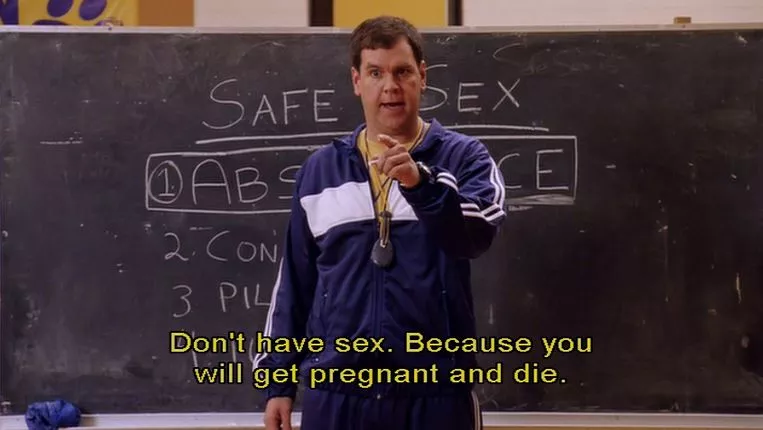
Their response to this issue is as simple as it is misguided. They just shrug it off by saying, “Then don’t have sex!” That approach might work for kids who eat paste, but not for one of the most fundamental drives in nature.

This best manifests in how many conservative, pro-life communities champion abstinence-only sex education, which has been proven time and again to not work. It turns out teenagers are very horny. For some reason, this is news to the pro-life crowd.

This is the reason why I have a hard time reacting to pro-life arguments and the overall spirit of the March for Life. I agree. Life is great. Life should be protected and cherished. However, this isn’t just about life. This is about abortion. There are two lives involved, the potential child and the mother. When you focus too much on one, you undermine the other.

I could process the rhetoric to some extent if the pro-life crowd was also the most vocal proponent of contraception and effective sex education, but that’s not part of their message. If anything, they make every effort to gloss over that part of the message, as though human sexuality can ever be truly glossed over.

Many have tried in that effort, attempting to circumvent human sexuality. All have failed. Human beings are wired for sex. They’re also wired to enjoy it, shockingly enough. Until the pro-life movement confronts this issue, then their current victories will not last. At some point, the human desire to just make love will overpower them. It won’t be sexy for them, but it will be for everyone else.

6 Comments

Filed under Jack Fisher's Insights

My Thoughts On The Women’s March

As a general rule, I try not react too quickly or too callously to major political events. My years of experiencing in arguing about Wolverine’s love life on comic book message boards have taught me that some subjects just can’t be discussed rationally. Add politics into the mix and you might as well swim naked in a pond full of hungry snakes.

However, I realize that some events are too big to just ignore. Make no mistake. I’m aware of all the upheaval, outrage, and shit storms that have erupted since the apocalypse that was Election Day transpired last year. I’ve chosen to minimize my discussions of it on this blog. I want this blog to make people horny, not hopeless.

That said, I also understand that there’s a difference between avoiding a subject and purposefully sticking your own head up your ass so that the most you’ll ever hear about a topic has to compete with the echoes of your own farts. I don’t want my head in such a dark place.

This brings me to the big event that transpired on January 21, 2017 in Washington, DC, a city that’s less than a two-hour drive from my house. It was called the Women’s March on Washington. On the heels of Inauguration Day, it flooded the streets of DC with thousands of men, women, and children protesting the new regime in Washington. Given the kind of people who support this regime, they definitely had plenty to protest.

It was a powerful display, unlike anything we’ve seen that didn’t involve a Super Bowl parade. It’s certainly the largest, most organized protest I’ve seen in the past couple decades. This isn’t some fringe protest of hippies claiming there are shape-shifting lizard people running banks and covering up the truth about UFOs. These are people who are genuinely afraid that their lives are going to be at risk because of this new regime.

I can understand that fear. I certainly sympathize with it. There are people in my immediate family who discussed joining this protest. I certainly support their effort to do so. I think this is worth protesting, much more so than pet issues marijuana or fur coats. Our society works best when we only seek to screw each other in ways we enjoy.

I say all this as a preface of sorts because my overall reaction to it probably won’t win me any awards from hippies, vegans, priests, mullahs, or anyone who voted for Rick Santorum. In my youth, I usually came down fairly hard on one particular side of the political spectrum. Then again, in my youth I thought UFO insurance was a good investment. That should reveal the extent of my political expertise.

With all that in mind, I thought I’d take a moment to just write about my reaction to this protest. It is a big deal. It is something that’s worth paying attention to. Even if I’m just a struggling erotica/romance writer, this is something that can and will affect me, both directly and indirectly. It already has in some respects. So how, in the grand scheme of things, am I supposed to react.

Well, my reaction can best be summed up in one way and I think my friend, Spongebob, says it best.

Please put the pitchforks down and stop for a moment before you start busting my balls. Give me a chance to explain myself because I’m trying to be both honest and helpful here, two concepts that might as well be alien to political discourse these days.

A part of me really was moved by these protests. I even support pretty much all their stated mission, as well as their stated principles. In terms of their values and policies, we are both on the same page. We’re on the same team. That’s beyond dispute. It’s the methods that leave me feeling somewhat underwhelmed.

Maybe it’s because I’m getting older. Maybe it’s because I grew up in a house where whining was about as productive as licking a toilet seat to clean it. Whatever the reason, I just look at these protests and see too much style and not enough substance. Seeing people wearing vagina costumes didn’t help.

Don’t get me wrong. I think those costumes are funny and topical. If someone wore those to a Halloween party, they’d definitely liven things up. In a serious protest though, it just makes me roll my eyes. It gives the impression that the issues at hand aren’t as serious as they should be.

As I’ve already said, these are serious issues. They’re issues worth fighting for and they’re worth protesting. However, there’s a right way to protest something and then there’s a shocking way to protest. More often than not, those methods are mutually exclusive.

If the goal of the Women’s March was to get attention, then they definitely succeeded. In terms of provoking change, that’s a good first step. Remember the technique pitched by this guy, albeit in the most vulgar way possible?

The first step of that process is to get attention. Some argue that’s the most important step and the Women’s March did just that. It’s the other three steps, namely interest, decision, and action where they come up short.

You see, my experience on comic book message boards has wired my brain to process a situation in a backwards sort of way. By that, I mean that when I see a situation like this, the first thing I do is ask, “Okay, how is the other side going to twist this in their favor?”

When you deal with a lot of dogmatic comic book fans, that’s an important question to consider because 99 times out of 100, that’s how discussions go. Someone makes a point and those who don’t agree with it will twist it in a way that makes them feel smart, superior, or whatever other emotion Lex Luthor feels when he wakes up every morning.

What manifests in message boards often manifests in political discourse as well. Some see the Women’s March and they see a huge group of concerned citizens, making their voices heard on issues that matter to them. Others, namely those who are inclined to lump protesters with hippies, see this protest as one giant act of whining. Neither side can be right, but both sides can be wrong.

This is why I can’t help but feel indifferent to these protests. They seek attention. They seek meaningful goals. They have so much style, but not nearly enough substance. For someone like me, who needs both in order to become a successful erotica/romance writer, lacking either really undermines the message.

Now I want the Women’s March to make for meaningful discourse. I want it to provoke real, meaningful change. However, based on what I saw, I don’t think that’s going to happen. Our collective attention span is too short and the powers that be are too callous. I’m not saying the Women’s March was a waste of time, but I don’t think it’s going to change much in the long run.


10 Comments

Filed under Jack Fisher's Insights

Fear, Dread, And Cute Animals

This is a quick message to all my fellow Americans out there. If you’re living in another country with good internet access at the moment, take a break and count your blessings. I think we can all agree that there are a lot of Americans right now who need a hug, a kiss, and maybe a bottle of hard liquor.

These are scary times, I know. The day after an election has never been this scary before. There are people out there who genuinely fear for their lives, their safety, and their livelihoods. I understand that. Some scary things are happening right now and at the risk of belaboring those things, I’m not going to repeat them. I’ll just say this.

Be calm

Be strong

Relax

The human race has endured its share of dark, dire times. We’ve endured horrific catastrophes that sent our species to the brink of extinction. We’ve fought world wars, major economic depressions, and the collapse of civilizations. We, the human race, have found a way to endure. We’re strong. We’re resilient. We also are very good at making love and making babies to make up for our lost numbers.

With all that in mind, I implore you to take a step back, take a deep breath, and look forward. There’s only so much we can control in this world. The best we can do is keep moving forward and contributing in our own way.

I can’t do much other than tell sexy, romantic stories with my novels. I intend to keep doing that for the foreseeable future. I have so many stories to tell and I look forward to sharing them with a world that really needs to get laid more.

Beyond that, I intend to keep moving forward. For those of you who may find that difficult, I give to you the best possible medicine for fear and dread: funny animal videos. Enjoy!

1 Comment

Filed under Uncategorized