

The following is a review I wrote for PopMatters for X-men: Red Annual #1. Enjoy!
Overdue Resurrections and Heartfelt Reflections: ‘X-men Red Annual #1’
The following is a review I wrote for PopMatters for X-men: Red Annual #1. Enjoy!
Overdue Resurrections and Heartfelt Reflections: ‘X-men Red Annual #1’

I normally try not to report the news too much on this blog, unless it’s extremely urgent or extremely sexy. Sadly, this is more in line with the former rather than the latter.
Just this morning, Entertainment Weekly reported that “X-Men: Dark Phoenix” is being delayed until 2019. It had been originally scheduled for release this coming November, just in time for the holidays, no less. I even went out of my way to explain why I’m more excited for this movie than I am “Avengers: Infinity War.” It now seems I’ll have to temper that excitement.
Thankfully, unlike a few other movies that keep getting delayed, this change doesn’t seem to have much to do with the movie itself and has more to do with Fox’s scheduling. “X-Men: Dark Phoenix” is just one of several Fox movies getting delayed or pushed up, some of which aren’t related to superhero movies, including the upcoming biopic on Freddy Mercury, “Bohemian Rhapsody.”
While it’s still only minor comfort for me, as a comic book fan and an X-men fan desperate to erase memories of “X3,” I’m willing to be patient for this movie. To see Sophie Turner do justice to one of the greatest X-men stories of all time is definitely worth waiting for.
Filed under Comic Books, Jack Fisher, Superheroes, X-men
When it comes to two genres that are often associated with one another, romance and tragedy are the literary equivalent of peanut butter and jelly. When you think of one, it’s not long before you associate it with another. Romance without tragedy is like fries without ketchup. Both are still good on their own, but it’s only when they’re together that they maximize their potential.
In that same spirit that the likes of Shakespeare and “Titanic,” superheroes often follow that narrative, but with more spectacle than old playwrights and even James Cameron could ever imagine. Being such a huge fan of superhero movies and comic books, I’m more familiar with their take on romance and tragedy than most aspiring erotica/romance writers.
As such, when an amazing, uncanny, astonishing, or whatever other adjective that a comic book puts before their title tells a story that truly embodies those ideas, I take notice. Seeing as how I’m also an unapologetic romance fan on top of being a comic book fan, those kinds of stories resonate especially well for me. They don’t come around too often, but when they do, they’re worth appreciating.
This particular story involves the X-men, which should surprise nobody who has followed this blog over the past couple years. It also involves the romance/tragedy of Cyclops and Jean Grey, which should also not surprise anyone. I’ve mentioned them before when talking about balanced romances and insufferable love triangles. This might end up being the most heart-wrenching, albeit for all the right reasons.

The name of the story is called Phoenix Resurrection: The Return of Jean Grey by Matthew Rosenberg. Now, if you don’t want to be spoiled, I strongly encourage everyone to read it. Either buy it at a comic shop or buy the digital version. Even if you’re not a comic book fan, it’s a great story that will still evoke all the right emotions.
That’s because this story does something that’s very rare and very difficult to do. It’s something that everyone form Shakespeare to Tolken to Stan “The Man” Lee struggled with at some point in their creative endeavors. It gets the balance between romance and tragedy right. It gets it so right, in fact, that I intend to judge all future romance/tragedies by this comic. That includes any I write.
To understand how I came to this conclusion, it’s important to understand the context of the story and why it had such a powerful impact. To do that, it’s necessary to point out the circumstances of this story. When it was announced last year, it’s stated goal was to bring Jean Grey back from the dead. Anyone who has even a passing familiarity with comics knows that’s not all that groundbreaking.

Superheroes have been dying and coming back to life for decades. While “The Death of Superman” might have been the most high-profile, the initial death of Jean Grey in the original Phoenix Saga is probably the most iconic. That story established Jean Grey as a character who would be defined by death, rebirth, and everything in between. That’s part of the reason it’s the foundation of the “X-men: Dark Phoenix” movie.
That original story had a lot of romantic elements in it, but it was largely defined by its tragic ending. In that original story, Jean Grey willingly sacrificed herself in front of Cyclops and her friends to stop herself from becoming corrupted by the cosmic power of the Phoenix Force.
It was a truly gut-wrenching moment. It’s because of that moment, though, that it’s often singled out as one of the best X-men stories of all time. It was the culmination of Jean Grey’s struggle to deal with the immense power with which she’d been imbued. Moreover, she reached out to that power in order to do the impossible to protect those she loved, even if it corrupted her.

That’s an important detail to note because that’s a theme that would go onto play out on many occasions for Jean, eventually culminating in her second death in 2004. Her constant struggle to manage the immense power granted by the Phoenix Force and the corruption that often came with it is one of the primary driving forces behind Jean’s character. It’s also a big part of her appeal.
Rosenberg uses those same themes, as well as the immense power afforded by the Phoenix Force, to build the tragedy and romance that plays out in Phoenix Resurrection: The Return of Jean Grey. It’s a story that has more drama going for it than most because, despite the presence of time travelers, Jean Grey has been dead since 2004. Her coming back after such a long absence is a big deal for X-men fans and for her character.
The challenge Rosenberg faced was making that resurrection feel more compelling than overdue in an era where dead characters come back all the time. On top of that, Jean’s association with a cosmic force known for death and resurrection means her character basically has a built-in cheat code for bringing her back. How can that be so compelling, let alone raise the bar for romance and tragedy?

This is where the spoilers come in so again, please take the time to read the comic if you can. That’s because the way Jean comes back in this story has less to do with tragedy and more to do with agency. Way back in the original Phoenix Saga, Jean reached out to Phoenix Force in an act to save her friends. It was a choice of desperation.
Well, since that fateful choice, the Phoenix Force has been like a clingy ex, wanting desperately to stay bonded to her, even thought it often corrupts her. I’ve argued before how the context of that corruption might be more complicated than it seems, but on the basis of history alone, Jean Grey has many reasons to regret that choice.
The Phoenix only gives her another in this series. After having bonded with plenty of other hosts since her death, it goes to great lengths to bond with Jean again. It goes so far as to resurrect both her and everyone she ever cared about, creating this own little world in which Jean never experiences the many tragedies that befell her. It’s like the Matrix, but with a volatile cosmic bird running the show.

As part of that fantasy world, Jean Grey’s long-time love, Cyclops, is alive and well. That’s critical because, at least for the time being, he’s also dead. The Phoenix Force basically gives her everything to be happy, content, and loved. Keep in mind, though, it’s not doing this out of pure altruism. It wants to bond with Jean again. That’s the goal and the fantasy world is just a means to an end.
That makes the tragedy inevitable. As is often the case with fantasy worlds, even those created by a cosmic power, they tend to crumble under the harsh weight of reality. The way in which this happens is best revealed through the story. However, the part of the story that really balances out that tragedy occurs in the final issue.
In that issue, the fantasy world crumbles, thanks largely to the efforts of Jean’s fellow X-men. Naturally, the Phoenix Force fights this and tries to tempt Jean into bonding with it again, saying its power can give her everything she desires. It can even bring back those she loves.

As part of a last-ditch effort, it demonstrates this by bringing Cyclops back to life. He’s not a clone. He’s not a time traveler. He’s not some illusion either. He’s the real, flesh-and-blood Cyclops, complete with the thoughts, feelings, and passions of the man she married.
It’s a dick move on the part of the Phoenix Force, to say the least. It’s also the moment where the romance balances the tragedy in an important way. That’s because in that moment, Jean makes another fateful choice, one every bit as dire as the one she made in the original Phoenix Saga. This time, though, she lays her heart on the line, knowing damn well it’ll be broken.
Rather than just reject this tactic as another attempt by the Phoenix to lure her in, she embraces it for a brief moment. In that moment, she gets to say goodbye to her husband. She and Cyclops even go out of their way to make clear how much they love each other, both in life and in death. Even if you’re not a big romance fan, this is a moment of pure, unadulterated heart.
We still know the tragedy is coming. We know it’s a moment that’s going to end with tears and sorrow. Anyone that ever had to read “Romeo and Juliet” in high school English class knows it’s coming and is might think they’re numb to it, especially if they flunked the test.
That’s why it was so important for the story to reaffirm that sentiment. Rosenberg did something critical when he had Cyclops and Jean Grey remind each other just how deep their love went. He gave even greater weight to the loss.
At least with “Romeo and Juliet,” the characters involved had just met. They barely knew each other. Cyclops and Jean Grey’s love story spans 50 years of X-men comics, complete with weddings, clones, and raising a child together in the future. To know the extent of their love is to know just how much that tragedy hurts.
That, more than anything, is what puts Phoenix Resurrection: The Return of Jean Grey in a league of its own in terms of romance and tragedy. Instead of the tragedy defining the romance, it’s the other way around. It’s the romance that gives that tragedy such immense weight.
In too many stories, both in comics and in other mediums, tragedy relies too heavily on its own weight to make an impact. Making a love story dependent on that tragedy gives the impression that the love needed it in order to have depth. That’s why, when the tragedy eventually occurs, it doesn’t always hit all the emotional chords.
Rosenberg left no emotional chords unstruck with this story. It’s because Jean shared that special moment with the man she loved that her decision to reject the Phoenix Force carries so much weight. That decision comes with so much pain, anguish, and sorrow. It’s one thing to just depict it. It’s quite another to truly convey it.

That’s what truly makes Phoenix Resurrection: The Return of Jean Grey so special. It conveys both the breadth of the romance and the extent of the tragedy. Moreover, it does that in a way where one complements the other. For a romance built heavily around two characters operating as equals, I can’t think of anything more fitting.
Again, if you’re fan of romance, tragedy, or both, check out Phoenix Resurrection: The Return of Jean Grey. Even if you hate comics and the X-men, this one will evoke all the right emotions. You’ll shed tears of sorrow and joy at the same time. It’ll feel so weird, but so right.

Not long ago, the internet stopped for a brief moment and had a shared orgasm over the “Avengers: Infinity War” trailer. I’m not going to lie. I enjoyed my share of the collective ecstasy. I had a smile on my face for the rest of the day. Sure, I had a hard time hiding my comic book loving boner, but compared to other awkward boners I’ve dealt with, I was more than happy to wear loose pants for the rest of the day.
I honestly didn’t think I could be more excited about the impressive slate of superhero movies set for release in 2018. Then, Entertainment Weekly had to come along and offer a first glimpse into “X-men: Dark Phoenix,” a movie I’ve talked about before with the same anxious excitement as Wonder Woman. Honestly, I don’t think anyone not named MC Hammer makes pants loose enough.
I don’t know if the timing was on purpose. I just know that my erection can only get so hard when it comes to superhero movies. Me being an unapologetic X-men fan, which I’ve belabored more than once on this site, I’m inherently more excited about this movie than I am “Avengers: Infinity War.”

I get it. Marvel Studios and Kevin Feige are on a win-streak that would make an entire team of Michael Jordan’s envious. To date, the Marvel Cinematic Universe has raked in over $13 billion and “Avengers: Infinity War” is guaranteed to add to it and at a time when even highly-touted X-men movies can’t rake in more than $800 million.
Why, then, should anyone who isn’t an unapologetic X-men fan be more excited about “X-men: Dark Phoenix?” There are many reasons, more so than most who aren’t X-men fans probably realize. Some are more obvious than other. The first, and most notable, can best be summed up by two words: Sophie Turner.
In case anyone needs a reminder why she’s such a big deal, take a look at these first glimpses of Ms. Turner in all her Jean Grey/Dark Phoenix glory. Be sure you have loose pants and clean underwear handy. Don’t say I didn’t warn you.

I’ll give everyone a moment for their heart to settle and their pants to untighten. Take all the time you need. Believe me, it took me longer than I expected.
That one picture, in addition literally burning with Ms. Turner’s sex appeal, checks the most important box I listed in my article about how to not screw up a Dark Phoenix movie. It unleashes the fiery passion of the Phoenix and uses Sophie Turner’s sex appeal to do it.
While I doubt that director Simon Kinberg read that post, it’s a big deal that he’s emphasized this aspect of “X-men: Dark Phoenix.” That’s primarily because that critical element that makes the Phoenix Saga one of the greatest X-men stories of all time was omitted from the last attempt to do a Dark Phoenix movie, “X-men: The Last Stand.” The less said about that craptactular failure, the better.

Beyond capturing the necessary elements for a decent Dark Phoenix story, it also reflects a fundamental difference between this movie and “Avengers: Infinity War.” At its core, the Phoenix Saga is about a beloved friend and hero becoming corrupted. It involves high drama, heart-breaking sacrifices, and beautiful redheaded women kicking ass.
The core of “Avengers: Infinity War” is decidedly not that, especially after Black Widow died her hair. This movie is banking less on high drama and more on over-the-top battles involving the most powerful heroes of the Marvel Cinematic Universe against Thanos, one of Marvel’s most overpowered villains with a disturbingly extreme death fetish.

Now, there’s nothing inherently wrong with that approach. In fact, it’s probably the best possible approach for a movie that has been built up over the course of over a dozen big-budget films. Nobody can ever claim that Kevin Feige hasn’t been thorough in establishing the scale for this movie.
The problem, if you can call it that, is because of that scale, it’s difficult for a movie like “Avengers: Infinity War” to be anything other than what you expect it to be. It’s going to be an intense, over-the-top battle that will triple down on the themes that made the first Avenger’s movie so successful. At this point, that’s all it can do.
“X-men: Dark Phoenix” offers something more than that. Like “Avengers: Infinity War,” it’s expanding the scope and scale of the movie to a level that no previous X-men movie has ever attempted. Whereas the first X-men trilogy tried way too hard to stay grounded, this one is letting the X-men push the boundaries like they do every other week in the comics.
“X-men: Dark Phoenix” will let the X-men go into space. It’ll let Jean Grey get overwhelmed and surrounded by cosmic fire, something “X-men: The Last Stand” barely even attempted. It’ll even let Sophie Turner get naked. That alone is worth the bloated ticket price.
Those elements, both the cosmic fire and the nudity, don’t even have to be forced. They’re actually in line with the canon X-men comics. Jean Grey has been known to fly around in the cosmic buff every now and then. I won’t say it’s a critical element to Phoenix Saga movie, but as someone who values nudity more than most, I can safely say it’s a hell of a bonus.
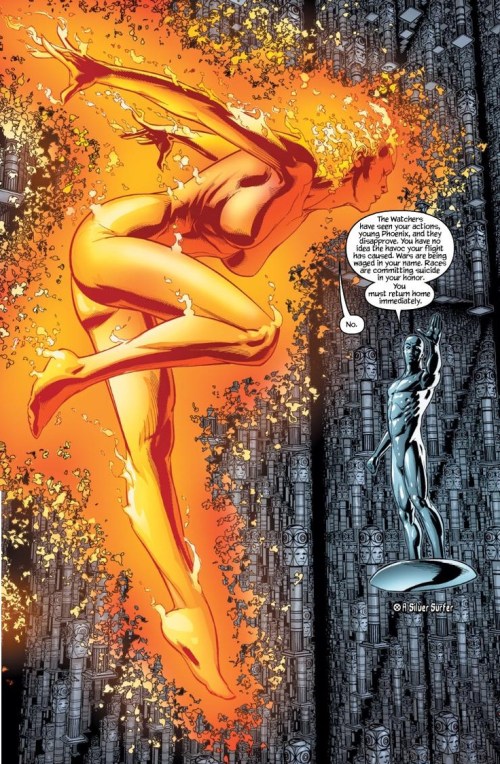
While I doubt anyone will pay extra to see Thanos get naked in “Avengers: Infinity War,” there’s one more element that helps sell me on “X-men: Dark Phoenix.” It has less to do with spectacle or nudity and more to do with underlying theme.
In a sense, “X-men: Dark Phoenix” is an opportunity to go beyond superhero movies. Like “Logan” and “Deadpool” before it, this movie has elements that can help it go beyond superhero movies, just as the original Phoenix Saga dared to go beyond stories about super-powered people in spandex costumes defeating villains.
There are all sorts of genres that “X-men: Dark Phoenix” can encompass. It can be a tragedy. It can be a sci-fi adventure. It can be a romance, which I’ve touched on before. It can be so many things, all within a single narrative. The ability for one movie to encompass all those elements, be it a superhero movie or a Disney musical, is a rare and special thing.

“Avengers: Infinity War” has its place and chances are, it’s going to make more money than “X-men: Dark Phoenix.” It may end up making more money than any movie in history that doesn’t involve exploding death stars or blue aliens.
For me, someone who isn’t one of Fox or Disney’s accountants, you can’t put a price on the breadth of experiences offered by “X-men: Dark Phoenix.” Given the early fan responses to these new teasers, it’s safe to say I’m not a alone in this sentiment. Hopefully, those sentiments only grow once the first trailer drops.

If Fox, Simon Kinberg, and Sophie Turner can get it right in all the ways X-men: The Last Stand” failed and/or didn’t attempt, then it promises to be a truly special cinematic experience.
Also, and it’s worth repeating, the prospect of Sophie Turner getting naked outside a disturbing scene in “Game of Thrones” should appeal to everyone. Besides, why should Jennifer Lawrence’s nudity-loving Mystique have all the fun?
Filed under Comic Books, Jack Fisher, Superheroes, X-men

There are some romantic sub-plots that cannot and will not work, no matter how well they’re written. You could resurrect Shakespeare, Tolken, and Faulkner, merge their brains, and still never salvage those plots. More often than not, most of those un-salvageable sub-plots involve love triangles and I’ve made it abundantly clear how much I despise love triangles.
In a sense, love triangles are a symptom of a much larger problem with romance. They’re basically a reverse cheat code in that they’re supposed to be an easy way to inject drama into a romance, but only ends up making things harder in the long run. While it’s not impossible for a love triangle to work, as fans of “Buffy the Vampire Slayer” might argue, it’s exceedingly rare.
That brings me back to what I’ve identified as the worst love triangle of all time, namely the one involving Cyclops, Jean Grey, and Wolverine of the X-men. I could talk for days as to why it’s so awful. However, I don’t want to re-hash those old arguments. I want this article to be more productive in that it offers solutions instead of whining.

In general, this is an aspect of comics I don’t enjoy talking about and avoid at every turn. I probably would’ve kept avoiding it and talked more about my sexy college experiences, but a few recent announcements by Marvel Comics has me and many X-men fans contemplating this god-awful love tingle once again.
It started a couple weeks ago when Marvel announced that Jean Grey, the one that isn’t a time traveler, is returning from the dead after 14 years. Needless to say, this sparked a firestorm of cheers and squees from X-men fans who have been longing for her return for years. I’m not going to lie. I did my share of squeeing.
Then, less than a week later, Marvel dropped another bomb in the pages of Marvel Legacy #1, their latest blockbuster event comic meant to bump sales and soak the panties of collectors. Wolverine, who has been dead since 2014 and was subsequently replaced by multiple characters, is alive again.
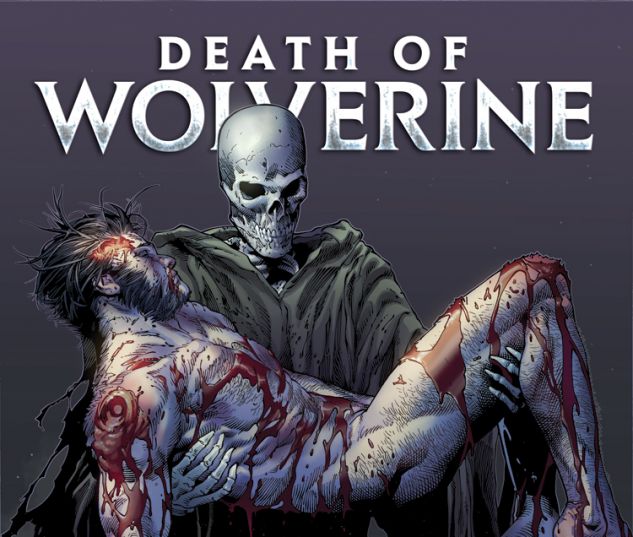
That surprised nobody so there wasn’t as much squeeing. Wolverine has survived a nuclear explosion, getting his flesh blown off, and being run over by a steamroller. It was only ever a matter of when and not if he would return. However, him returning at the same time as Jean Grey is one of those coincidences that no self-respecting X-men fan believes to be a coincidence.
If there was any silver lining to Jean Grey being dead for so long, it was that it kept anyone from dragging that god-awful love triangle back into the forefront. With Jean dead, Wolverine could move on and pursue other relationships, like he did with Storm. Cyclops pursued a brief, but passionate relationship with Emma Frost. Both characters seemed to move on from that horrible affront to romance.

Now, with Jean Grey and Wolverine back in the picture and a time-traveling Cyclops still running around, these three are finally in the same universe again. That means there will be the temptation to revisit this malignant tumor of a love triangle. As someone who loves all three of those characters dearly, I am not looking forward to that.
It’s too early to say how the story will play out. Marvel hasn’t revealed anything about how Wolverine came back from the dead. There also isn’t much information on the particulars of Jean Grey’s resurrection. We only know the outcome in that they’re both alive again and that’s usually all anyone needs to re-visit that infuriating love triangle.

Given the circumstances of how it played out, which I’ve noted before, it’s hard to twist this love triangle in a way where anyone comes out looking good. No matter what happens, someone gets screwed over.
If Jean Grey chooses to be with Cyclops, then it screws Wolverine over by reducing him to an obsessive, whiny stalker instead of the ultimate loner.
If Jean Grey chooses to be with Wolverine, then it screws Cyclops over by reducing him to nothing more than an obstacle for Wolverine.
In both cases, Jean Grey comes off as either a prize to be won or a heartless bitch who plays with the heart of any man who dares to fall in love with her. In the end, nobody wins in a love triangle, especially one that was so horribly contrived to begin with.

All that said, I don’t deny that the love triangle is hard to ignore. While it’s not an integral part for each character, it is one of those unresolved issues that has never truly been laid to rest. It’s like a dangling plot hole that can never be totally ignored.
Even so, the love triangle is so toxic to all three characters involved. It only ever brings out the worst in them at every turn. So if it’s only a matter of time before the love triangle re-surfaces again in the X-men comics, then what’s the ultimate endgame? Is there a solution to this omega-level migraine of a plot?

I’m not a writer at Marvel, nor do I have a sliver of influence with them. However, I am a passionate X-men fan, as well as an unapologetic romantic who writes sexy love stories. Given that passion and experience, I have a solution that I doubt Marvel will ever take seriously, but one that essentially fixes the worst love triangle in the history of romance. The solution is as simple as it is sexy.
Make Cyclops/Jean Grey/Wolverine the first polyamorous relationship in comics.
I’ll give comic fans a moment to stop rolling their eyes and/or laughing. I’ll give the ardent proponents of the Cyclops/Jean and Wolverine/Jean relationship a moment to stop shaking their heads as well. This may be the only time both sets of fans are on the same page. I assure you, though, it’s no joke. I’m as serious as an attack by Thanos.

Just think about it from a purely pragmatic point of view. Jean Grey’s love for Cyclops is beyond dispute, being the oldest and most serious relationship in the history of X-men. Her attraction to Wolverine is also beyond dispute, which has made for more than a few sexy moments in the history of X-men.
On top of that, both Cyclops and Wolverine have a history of wanting to hook up with more than one woman. I’ve gone over the long list of romance/hook-ups that Wolverine has gone through. This is a guy who hooked up with Squirrel Girl, for crying out loud. That should be proof that this man cannot handle monogamy.

Cyclops, despite his reputation as a boy scout, also has a history with wanting to hook up with other women. Granted, he’s not even in the same time zone as Wolverine, but the sentiment is there. Unlike other heroes, such as Superman or Mr. Fantastic, he can’t seem to shake it off.
That makes him, Wolverine, and Jean ideal candidates for a polyamorous relationship. They exist in the real world. There is even some evidence that polyamory can be beneficial to certain couples because they require a great deal of communication and understanding, two key requirements to any successful relationship.
Given that Jean Grey is a powerful psychic and Cyclops has a history of attracting psychics, they’re better equipped than any other couple in the real world or the fictional world the create a functioning polyamorous relationship. When real psychics are involved, the obstacles associated with communication become an instant strength.

It works great for Wolverine too because it means he can still be Wolverine. He can still strike out on his own every now and then, stab some monsters, and hook up with a few crazy women. He wouldn’t be tied down by Jean Grey and unable to be what makes him awesome. He can still live, love, and fight like Wolverine.
It may very well be the only way that the nauseatingly overplayed melodrama that is the Cyclops/Jean Grey/Wolverine love triangle gets resolved. With a polyamorous relationship, all three characters get to share in the emotional fulfillment. They all get to feel loved and nobody gets left out in the cold. It may even bring them all closer together.
That might be impossible for some to imagine with Cyclops and Wolverine, two characters who have been at odds since the moment they met. However, they have shown throughout their history that they can get along. They can work together and bond over a shared goal, especially when that goal involves Jean Grey.

On paper, a polyamorous relationship between Cyclops, Jean Grey, and Wolverine would solve so many problems. Everyone involved could have their cake and eat it too. That might be the primary reason why Marvel would never do it, though. It makes too much sense.
I don’t think that a polyamorous relationship would be too taboo for Marvel. In recent years, Marvel has shown a willingness to explore non-traditional relationships. Back in 2012, they celebrated their first same-sex wedding in the pages of Astonishing X-men. They have a fairly lengthy list of LGBT characters as well. Even Daken, Wolverine’s son, has a history of eccentric sexual preferences.

The timing would even be right because polyamorous relationships are on the rise and monogamy is on the decline, especially among young people. While there will always be a place for strong, monogamous couples in comics, why not mix things up a relationship that everyone at Marvel seems eager to strain?
A polygamous relationship isn’t necessarily taboo these days, but it’s something nobody has really tried. It seems like the only way comics, TV, or movies can ever inject drama into a romance is to throw in a love triangle. On behalf of all hopeless romantics, I’d like to go on record as saying that tactic is old, not to mention detrimental.
Cyclops, Jean Grey, and Wolverine are in a perfect position to try something different, creating a new kind of romance that we haven’t seen in comics, TV, or anything that didn’t used to air late night on Cinemax. It would be challenging, but that’s exactly what would make it so appealing.

That may also be why Marvel would never try it. It’s so different and there’s no successful formula to follow. Sure, William Marston, the kink-loving creator of Wonder Woman, did it to great effect, but it would require all sorts of dynamics that take a great deal of effort. That effort might just be more than Marvel, or any comic company, is willing to put in at the moment.
Maybe a time will come when polyamorous relationships find their way into comics, just like same-sex relationships. It may not happen with Cyclops, Jean Grey, and Wolverine, but they are the ones that stand to benefit the most from it. Compared to another exceedingly toxic triangle, it would be a welcome change to the world of superhero romance.

In general, I don’t always write these posts with a sense of timing in mind. My brain just doesn’t work that way. Usually, I get an idea, either through inspiration or just something that comes to me in the shower, and I just go with it. I find that to be the most effective means of exploring sexy and non-sexy issues alike on this blog.
Every now and then, I get lucky and fall ass-backwards into a perfectly timed topic. Sometimes, I even get obscenely lucky because that topic can relate to comics, which I love tying into sexy topics on this blog every chance I get. Well, whether by luck or outright fluke, I have a chance to link an issue I’ve been discussing lately directly to a comic book.
Trust me, I didn’t plan it. I didn’t expect it. I’m just going to run with it because it’s so relevant to the recent issues I’ve been exploring. It also involves X-men, which I go out of my way to talk about every chance I get, and a very particular character that I’ve mentioned before named Emma Frost. In case you need a reminder, this is Emma Frost.

I’m assuming I have your attention now, especially if you’re a heterosexual man or a homosexual woman with functioning genitals. I swear that pic isn’t some juvenile fan art, like the ones that drew big tits on Flintstones characters. That’s how Emma Frost actually dresses in the X-men comics. Can you now see why I’m so fond of them?
Sadly, I’m not writing this to talk about Emma Frost’s overtly sexy costumes. I’m writing this because recent events in the X-men comics tie directly into what I’ve been discussing with respect to conditioning our brains for love. While it’s an issue we’ll probably have to address once we start hacking our brain’s wiring, it’s something that comic book characters deal with regularly.
I’ve already mentioned how Carol “Captain Marvel” Danvers dealt with it during her early history. I’ve also cited past stories involving mind control, including one infamous story in Action Comics where Superman was brainwashed into making a porno tape with Big Barda. It’s one of those odd, but disturbing kinks that’s unique to worlds filled with psychics, aliens, and talking raccoons with machine guns.

However, this is one instance where a story about the mental manipulation of emotions and/or horniness isn’t quite as disturbing. If anything, it’s tragic in that reveals a lot about what some people are willing to do in the name of love.
To understand that tragedy, it’s necessary to understand the comic in question and the context behind it. The story unfolds in the pages of “X-men Blue #9” by Cullen Bunn, which is one of several ongoing X-men titles. This one focuses on the exploits of the time-displaced original five X-men, who are currently stuck in the future due to some time travel shenanigans that began back in 2012.
I’ll skip the part where I make a bunch of “Back To The Future” jokes and make clear that X-men Blue has much higher stakes compared to other X-men comics. That’s because what happens to these five time-displaced X-men, who also happen to be teenagers, could potentially affect the entire history of the X-men, which has already been subject to the kinds of time travel upheavals that would make Doc Brown’s head explode.

That’s where Emma Frost comes in. She knows, as well as any X-men regular who has encountered time travelers, that influencing these time-displaced teenagers could alter how things play out in their future. That’s important to her because she has a good, albeit tragic, reason to want to change that outcome.
Shortly before the events of this issue, Emma Frost endured a terrible loss. In an ominously-named event called “Death of X,” her former lover, Cyclops, died in her arms. To make matters even worse, it was one of those rare situations where there was nothing she could’ve done to stop it.
This isn’t akin to Spider-Man not stopping the Green Goblin in time or Superman not being able to save Lois Lane. This is basically someone being in the wrong place at the wrong time for the right reasons. In a sense, it’s a lot more realistic than the deaths most superheroes endure. It comes out of nowhere and there’s nothing anyone can do to stop it.
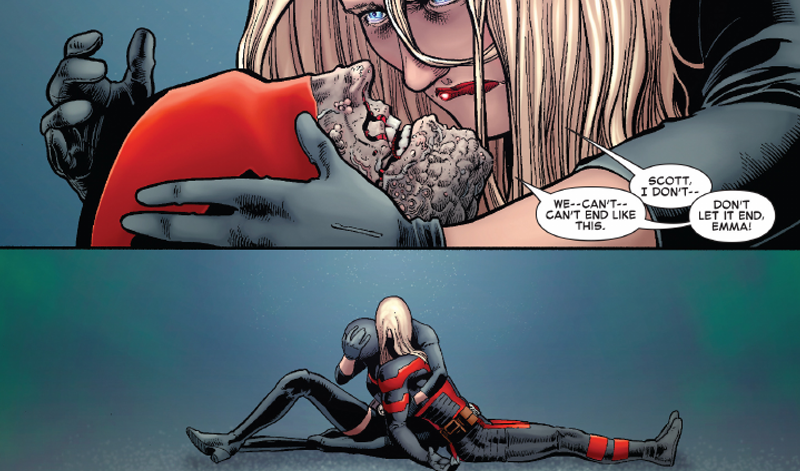
However, Emma Frost isn’t the kind of person to just accept that kind of tragedy and move on. This is a woman who once watched an entire classroom of her students die in an outright mutant genocide. When tragedy hits her, she hits back and looks damn sexy while doing it.
Granted, she does tend hit harder than she needs to or ought to. It has made her a lot of enemies, even alienating some of her former allies. However, Emma Frost isn’t one of those characters who does what she does out of malice. She’s not the Red Skull, Thanos, or even Dr. Doom.
She does see herself as a hero. She carries herself as a hero and has been on the front lines of some major Marvel conflicts. She’s also not a sociopath. She is capable of great love, both for her students and for lovers like Cyclops. So when Cyclops died, it hit her very hard.

When hit with a loss that hard, who wouldn’t jump at the chance to undo it? Even if it means crossing certain lines and hurting others, isn’t that worth getting back the person you love?
That’s a question that a lot of heroes and non-hero’s alike might debate in a philosophy class or a message board. However, there’s no debate for Emma Frost. She sees an opportunity to get her lover back and she takes it. Specifically, she sets her sights on the time-displaced, teenage Cyclops who has yet to grow into the man she fell in love with.
Finally, in X-men Blue #9, she’s in a position to get what she wants. As part of an ongoing event called “Secret Empire,” an event that’s hitting every major Marvel series, she abducts the time-displaced X-men and singles Cyclops out for some special treatment. Trust me, it’s nowhere near as sexy as it sounds.
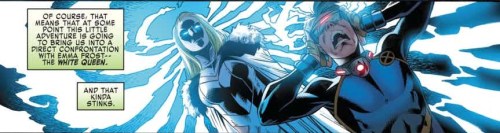
Emma basically does exactly what I described in my post about managing the future of brain hacking. She tires to twist and contort young Cyclops’ mind into being the man she once loved. She knows it may ruin the timeline. I’m sure Doc Brown would scream at the top of his lungs to get her to stop. It would still do no good.
That’s because Emma wants her lover back. She wants the man who has helped save the mutant race on more than one occasion. She’s willing to risk a time paradox and undermining the free will of someone who made clear in the issue that he doesn’t care for her. She’s just that desperate to get the man she loves back.
I won’t spoil how the book ends. I’d much rather people go out and read X-men Blue #9 because it’s a great comic that’s worth supporting. I’ll just say that the tragedy surrounding Emma Frost and her misguided efforts to subvert that tragedy really strike a chord.

It’s a tragic, but potentially prophetic story that may become more relevant over time. There’s no doubt that Emma Frost’s love for Cyclops in X-men Blue #9 is sincere. It’s not part of an agenda or some elaborate trick. It’s real, honest love that got destroyed through forces nobody could’ve foreseen.
Who’s to say that someone wouldn’t do something similar if they were in her position? I’ve said before in other posts that love is a powerful drug. It’s medically proven that love affects our brains like a drug. Compared to love, crack is watered-down diet soda.
Emma Frost is a powerful telepath, one of the most powerful in the Marvel universe, in fact. That means she can manipulate minds, twist thoughts, and conjure emotions in others. It does have limits, but it’s not that different from the kind of brain hacking that is in development as we speak.

What happens in the future when someone loses a loved one and refuses to accept it? What happens when someone just can’t stand the idea that someone they once loved no longer loves them? If there exists technology that could conjure or recapture that feeling, who wouldn’t be tempted to exploit it?
Our desire to love and be loved is a core, emotional need that every non-sociopath human feels. We don’t have the technology of Neuralink or the telepathy of Emma Frost to force it when we can’t have it. However, once it becomes possible, how long will it be before someone tries it?
Emma Frost didn’t need much temptation in X-men Blue #9. She just needed an opportunity and a plan. Again, it’s wrong to call it an evil plan. She was just trying to get back the man she loved and was willing to cross lines to do it. Love makes us do a lot of crazy, stupid things. What Emma Frost does in this comic is as much a lesson as it is a warning, albeit the sexy kind.


Admit it. You knew it was going to happen at some point. I start talking about brain-to-brain communication, sharing thoughts, and techno-telepathy and eventually, I was going to relate it to comic books.
If you’ve been reading this blog in any capacity over the last year or so, you know how much I love comic books and superhero movies. I’ve also made clear how much I love X-men in particular. Hell, I even argued that Storm was a better female superhero than Wonder Woman. Make that argument on a comic book message board and you can expect a lot of angry responses, including certain remarks about your mother.
My point is that if I haven’t made my love of comic books and X-men clear now, then there’s not much more I can do that doesn’t involve tattoos. That’s why it really should surprise no one that I’m about to relate my recent discussions about the future of sex and intimacy to the X-men.
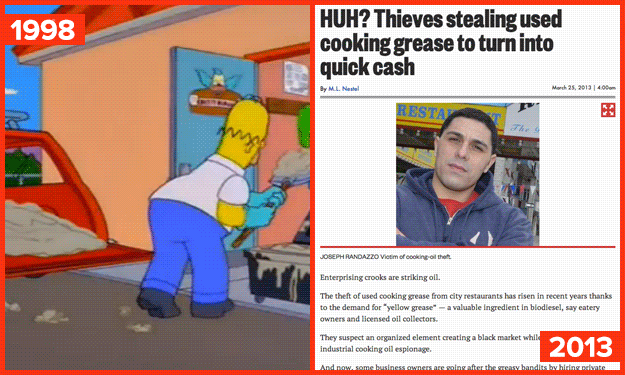
Yes, I know the X-men were created in 1963 and using them as a precursor to the future is like using old reruns of “The Simpsons” to predict the future. Then again, given the Simpsons’ track record, that may be a bad example.
Specifically, I’m going to focus on Cyclops and Jean Grey of the X-men in discussing the future of love and intimacy. They’re not just one of my favorite comic book romances of all time. I’ve also cited them before as an strong example of a relationship of equals. I’ve also cited them as a way to highlight just how mind-numbingly awful love triangles can be. Overall, they’re a pretty useful couple is what I’m saying.
Now in talking about them with respect to the future of love and intimacy, I’m not going to focus on the particulars of their relationship. There are plenty out there who despise this romance, just as there are plenty out there who despise every romance that involves vampires. I get that. There are vocal X-men fans who would rather see Cyclops and Jean Grey involved with someone else. I’m not here to argue with those fans.
Like every superhero romance, Cyclops and Jean Grey has been prone to many complications that go beyond bad love triangles. Look at any romance in comics. Without exception, there’s always some amount of uncertainty, drama, death, rebirth, and reboots. It’s just how comics work.
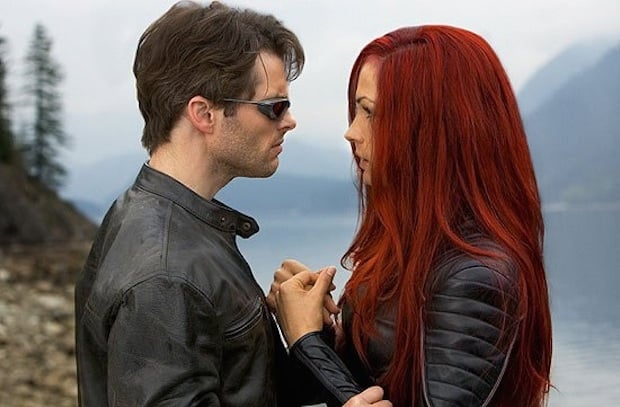
For the purposes of this post, I’m not just going to focus on what makes the Cyclops/Jean romance work. I’m going to focus on one of the unique components about it, namely the fact that Jean Grey is a powerful telepath. She can read, project, and manipulate thoughts and she doesn’t need future technology or hypnosis to do it. As a mutant, it’s just one of those talents she’s born with. In that sense, it’s definitely more useful than sewing.
Now Jean Grey isn’t the only telepath in the X-men or the Marvel universe, for that matter. She’s not even the most powerful. Professor Charles Xavier, who was played by the insanely-charming Patrick Stewart in the X-men movies, is often cited as the most powerful psychic in the X-men comics. However, Jean Grey is often cited as a close second.
I mention that to make clear that Jean’s talent for telepathy isn’t just good by comic book standards. It’s first team all-pro good. Why does that matter? Well, being such a powerful psychic, it’s hard for her to filter out the thoughts of others. She even remarked in “X-men Apocalypse” that she knows what everyone thinks. Not much surprises her.
This makes her relationship with Cyclops all the more intriguing in the sense that she develops such a strong romantic connection with him, despite being able to read his thoughts and sense his emotions. He, in turn, falls in love with her, knowing full-well she has this kind of power. There isn’t a dirty, deviant thought he can hide from her and he doesn’t mind in the slightest.

Think about that for a moment. Cyclops falls in love with a woman from which he can’t readily hide his thoughts. He can’t even hide his emotions from her. She’s even commented in the comics and in the movies on numerous occasions how she can pick up on his emotions.
Lying to her is impossible. Hiding his feelings from her is impossible. Now on many occasions, Jean Grey tries to make clear that she doesn’t read peoples’ thoughts without permission. The keyword there is she tries. It doesn’t always work. Sometimes she can’t help it. Just ask the recently-outed Iceman.

Regardless of how much Jean Grey respects the privacy of others, it doesn’t prevent her and Cyclops from forging a relationship. It also doesn’t stop that relationship from blossoming into one of the most iconic romances in the history of comics, culminating in X-men #30 where they got married. Even if you’re among those X-men fans who despise their relationship, it’s hard to deny that were pretty damn serious about their love.
Why does this matter? What does it have to do with the future of romance and relationships? Well, think about the dynamics of such a relationship. Cyclops and Jean Grey don’t just share love, intimacy, and legal obligations. They actually share thoughts, as in real, unfiltered thoughts. That’s a dynamic that doesn’t exist in the real world yet, but as brain-to-brain communication technology matures, it will exist soon enough.
If communication is the key to every relationship, then Cyclops and Jean Grey have a master set. With them, there’s no need to put thoughts and feelings into words. There’s no need to make these elaborate gestures to convey how they feel. They don’t even need to argue about it. Their own thoughts convey whatever sentiment they want, be it love, lust, or a craving for corn dogs.
How many relationships in the real world fail because two people can’t properly communicate certain feelings? It happens all the time. It manifests in all kinds of sitcoms, some more than others. Hell, it happens in my own novels, especially in “Skin Deep.”
In addition to those relationships, how many others form on a foundation of lies because two people don’t know what the other is thinking? Someone might think they really love someone. The other might just fake it to get back at an ex-lover or land some big inheritance. It happens and, because these thoughts can be hidden, they can’t know for sure how genuine the romance really is.
In a future where brain-to-brain communication is available and couples can wield it like Cyclops and Jean Grey, the entire dynamic of love and romance changes. There’s no need to carefully navigate social cues in an effort to figure out what someone it thinking, feeling, and wanting. Everything becomes that transparent.

On one hand, this means the self-obsesses douche-bags who see others as walking masturbation toys that breath can’t hide anymore. The pick-up artist, the ladies man, and the Regina Georges of the world are exposed for all to see.
On the other, it also means that people can be certain that they’ve found a lover who genuinely loves them. It means we can be sure that the thoughts our lovers think are honest and true. We’re not blindsided. We’re not mislead. We know because we can make our thoughts known.
From a practical standpoint, it means that society will have to reshape the way people find love, intimacy, and connection. For some, it’ll be downright scary, having to share intimate thoughts with one another. However, we’ve reshaped those concepts before. Remember, there was once a time when marrying for love seemed like a crazy idea.
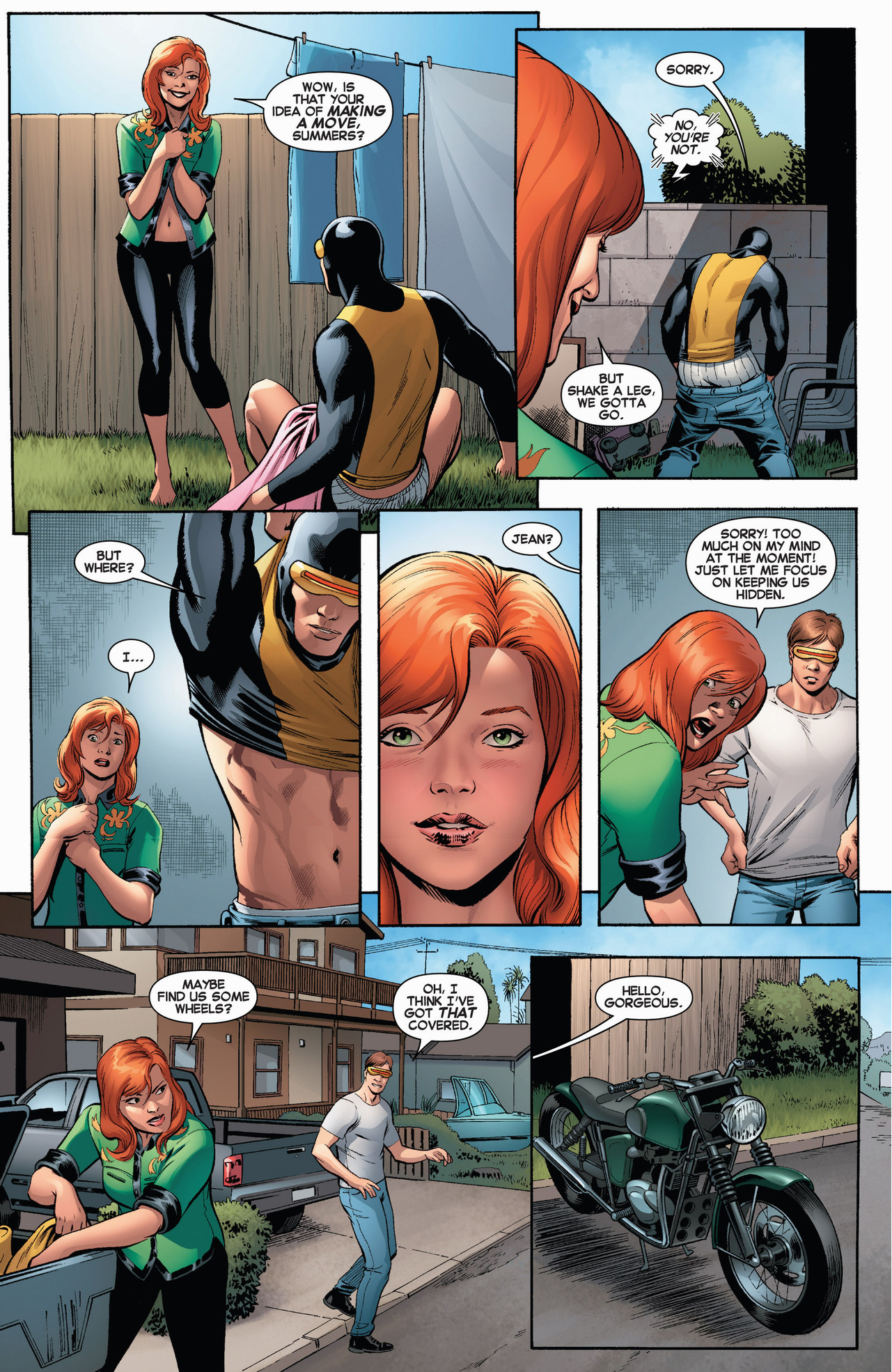
As is often the case, though, popular culture tends to be ahead of the curve when it comes to social and technological evolution. Star Trek did it with cell phones. Cyclops and Jean Grey may end up doing the same for romance. With that in mind, I’ll leave you with this iconic panel that highlights everything I’ve come to love about the Cyclops/Jean romance.

Filed under Jack Fisher's Insights

I’m not a successful writer yet. I’m not certain that I’m an overly skilled writer either. However, as someone who has been writing almost every day since he was 15-years-old, I like to think I know something about this topic. As such, I’m of the opinion that any overly bizarre or frustratingly inane plot can work if written well. With enough skill, a writer can make a story about snake handler hooking up with an alien compelling.
Then, there are certain plots that are so poorly structured, so inherently weak, and so intrinsically flawed that the combined efforts of Shakespeare, Tolken, and Faulkner can’t save it. For me, that plot is that of the love triangle. I even dedicated an entire post about why I think it’s one of the most overused, poorly written plot devices in all of romance.
I avoided getting into specifics in that post because I wanted to focus on the bigger picture as to why love triangles as a concept suck in general. For this post, I’m going to reach deep into the steaming pile of shit that countless stories featuring bad love triangles have excreted over the years and discuss the worst of the worst.
So which love triangle is the worst among the vast mountain of shit that occupies such a prominent position in popular culture? In this case, the worst comes from the world of X-men and involves the characters Cyclops, Jean Grey, and Wolverine.
For the sake of this blog, it’s very convenient that the absolute bottom of the pit that is terrible love triangles takes place in the world of superhero comics. This is, after all, a topic that’s near and dear to my heart. I’ve made my love of superhero comics known on this blog before. I will likely cite superhero comics again in future posts as I discuss similar issues. In this case, however, it really is an issue of pragmatism because I really could not find a worse example of a bad love triangle than this one.
What makes it so mind-numbingly terrible? Well, to answer that, here’s a quick rundown of the structure of this worst-of-the-worst brand of romantic drama. Cyclops and Jean Grey are founding members of the X-men. They were among the original X-men that were first introduced in 1963 by the ultimate creative dynamic duo, Stan Lee and Jack Kirby. They’re also, by far, one of the most iconic couples in the history of X-men, if not all of superhero comics.
Wolverine didn’t enter the picture until later. He doesn’t join the X-men until 1975, which is a while after he makes his first appearance as a supporting character in The Incredible Hulk. As the X-men’s resident bad boy, he’s basically the opposite of Cyclops. He’s brutish, crude, ill-mannered, quick-tempered, and bad-ass to an insane degree. So naturally, he pulls in a lot of ass. There’s actually a chart documenting Wolverine’s many romantic entanglements and it’s even more confusing/impressive than it looks.

So the very idea of Jean Grey falling in love with him while being in love with Cyclops is akin to a man being in love with both a nun and a crack whore. However, that discrepancy alone isn’t what makes this love triangle so horrendously bad. It’s all the circumstances surrounding it that make it the poster child for everything that sucks about love triangles.
First and foremost, the entire reason why Jean Grey developed an attraction to Wolverine in the first place is ridiculously contrived. X-men writer, Chris Claremont (also known as the most prolific X-men writer ever), indicated in numerous interviews that the attraction between them was extremely shallow.
“He sees Jean, Jean sees him, hormones kick in, the rational brain checks into the Happy Hour hotel, and everyone else runs for cover.”
There’s nothing wrong with basic attraction. That’s the sort of thing men feel whenever they see an attractive stripper or the sort of thing women feel when they see Channing Tatum without his shirt on. It’s a good setup for a one night stand. It’s not a good foundation for a meaningful romance, which is the only thing that makes a love triangle functional to some degree.
That never happens in X-men and for a very bad reason. Due to editorial decisions within the X-men comics that are too convoluted for a single blog post, Claremont soured on Cyclops as a character and openly despised his relationship with Jean Grey, despite having done more than any other X-men writer to solidify their status as the premier romance of the X-men. So what does he do? He tries everything he can to break them up and had editors not thwarted him in 1991, he would’ve succeeded.
That’s the entire reason that this love triangle exists. A writer grew to despise a certain character and decided to punish them by making his girlfriend fall for someone who is the exact opposite of him. Think about that long and hard for more than 15 seconds. Seriously, think about it as rationally as any human mind can manage on topics involving fictional characters.
Are you done? Then, I hope you can now see just how flawed that reasoning is. The writer hates one character and uses that as the sole justification for an entirely separate relationship between two characters who have next to nothing in common. That’s akin to loving soccer just because you hate American football. It’s a bad reason to love a sport and a worse reason for a love triangle.
In my post about why love triangles suck, I pointed out that they tend to devalue characters. It turns them into prizes to be won. It tends to override other meaningful traits a character may have. For Wolverine, it turns him from this bad-ass loner into an obsessive, petty asshat. That’s the trait of an insecure teenager, not a bad-ass loner.
The effect is just as bad on Jean Grey, who effectively becomes the ultimate prize of sorts for Cyclops and Wolverine. This is pretty insulting to her character because Jean Grey does so much to set herself apart as a strong female character from an era where the concept hadn’t been refined yet. She is the center of the Dark Phoenix Saga, also known as the greatest X-men story ever written. Reducing her to a prize for two men undermines a character with so much more to offer.
The comics do a terrible job setting up this love triangle, which the writer himself admits was created for petty reasons. However, it’s the way it plays out in the X-men movies that make this love triangle truly the worst of the worst.

How can the movies actually make this worse? Well, somehow they found a way. To this day, I have a hard time believing that the writers at Fox didn’t actively try to make this love triangle worse than it already was. What they came up with still confounds me, both as a writer and an X-men fan.
Anyone who has seen any of the X-men movies knows that most of them are structured around Wolverine. That’s entirely fair. He’s the most popular X-men character of all time and he’s played by Hugh Jackman. In case you’ve forgotten, Hugh Jackman looks like this.
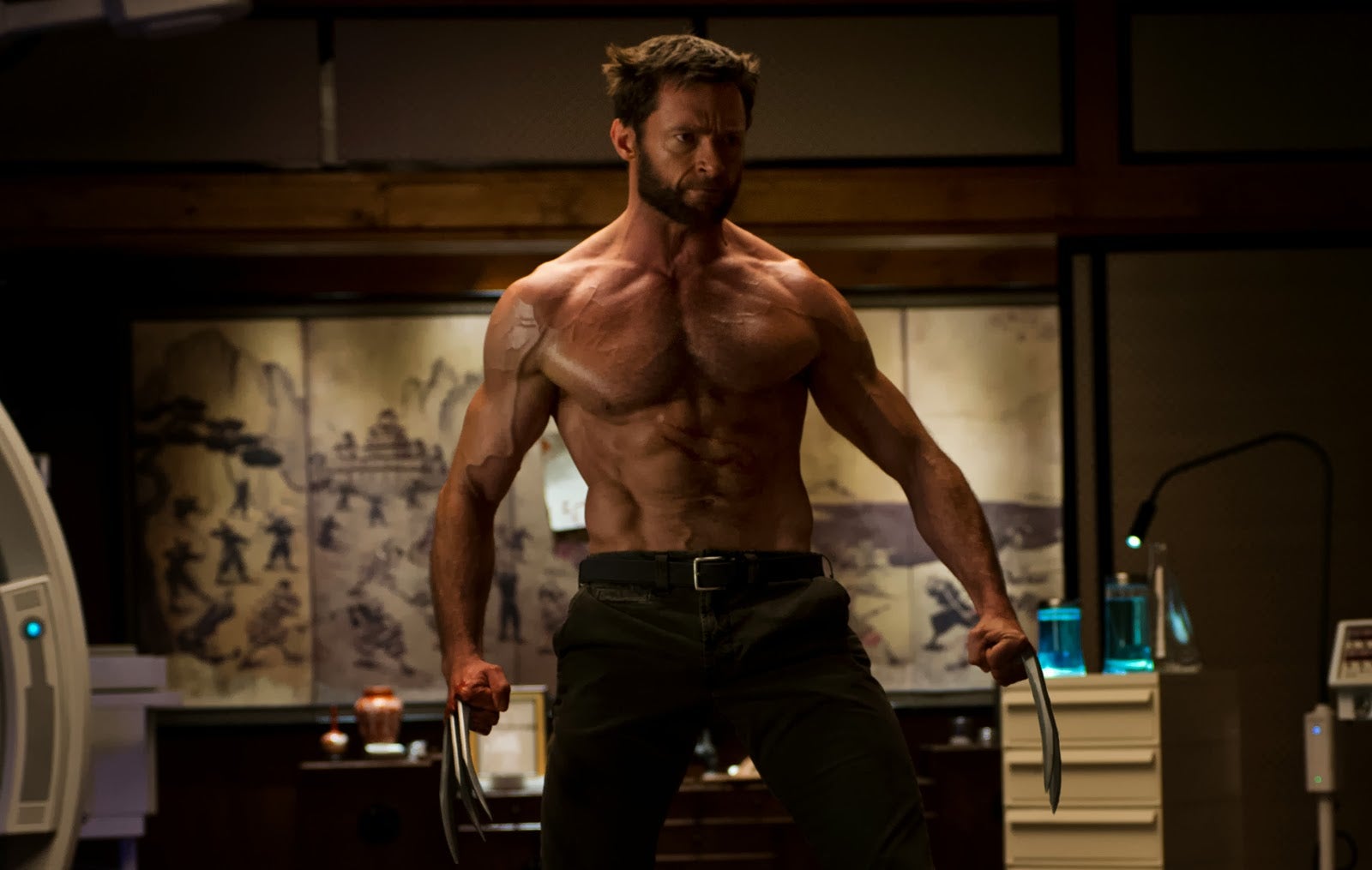
I’m not gay, but even I think he’s sexy. Naturally, he’s going to have a love interest. A man this sexy has to have one. The problem is, the writers of this movie don’t realize how terrible the love triangle is with him, Cyclops, and Jean Grey in the comics. That, or they see it and think they have a way to make it worse.
First and foremost, they gave no reason for Jean Grey and Wolverine to be attracted to one another. Hell, he tries to stab her when he first wakes up at the Xavier Institute in the first X-men movie. That alone should ensure her panties stay dry around him for the entire trilogy. Instead, the chemistry between them is outright forced.
It has to be because these two never really have a meaningful conversation. They never really get to know each other. They’re just physically attracted to one another and the only reason they don’t bone is because Jean Grey is engaged to Cyclops. As a result, Cyclops is reduced to the role of being an obstacle to Wolverine. That’s pretty much his only role in the first three X-men movies, being a hindrance to Wolverine getting into Jean Grey’s panties.
There isn’t even an effort to balance things out. Cyclops is portrayed as someone who’s not nearly as badass as Wolverine, but he’s still respectable and likable to an excessive degree. He helps save Wolverine the first time they meet. He offers to shake his hand, which Wolverine flat out refuses. He never gets overly upset with Jean about her being attracted to another man. He’s bland, but likable.
If anything, Wolverine does everything he can to make himself the asshole you don’t want Jean to end up with. He steals Cyclops’ motorcycle. He steals Cyclops’ car. When he dies in the third X-men movie, he doesn’t give a second thought to making out with his girlfriend. He does this after he tells Cyclops earlier that she chose him at the end of the previous movie. He couldn’t come off as more of an asshole without pissing on Cyclops’ grave and stealing Jean Grey’s panties.
As bad as this is, it actually gets worse. At least in the comics, Wolverine actually knows Jean Grey as a person to some extent. He’s worked with her. He’s been on the same team as her. He’s lived under the same roof as her. Chances are he knows how she takes her coffee, what she watches on TV, and what her favorite brand of cereal is. In the movies, he knows none of this.
I’ve seen all these movies and based on the sequence of events and the time that passes between them, it’s clear that Wolverine didn’t know Jean Grey for more than a few days at most. He leaves at the end of the first movie. Jean Grey dies shortly after he returns in the second movie. There’s never any indication that they remained in contact. There’s no hint of tortured love letters, long phone calls, or dick pics being exchanged. They literally have no time to get to know one another.
That’s what makes the events of the third X-men movie all the more infuriating. Towards the end of the movie, Wolverine professes his love for Jean Grey before he kills her, at her request. Never mind the fact that this is the exact opposite of what happens in the comics. He proclaims her to be the love of his life despite the fact he doesn’t even know her. He doesn’t know her hopes, her dreams, or even her middle name. So how are we, the audience, supposed to believe that this love is genuine?
It ruins Jean Grey, as a character. It makes her nothing more than a prop for Wolverine. She’s not just the prize he pursues. She’s the only reason he has any emotional development. The fact that he barely knows her makes his affection for her all the more shallow. On top of that, it reduces Wolverine to this mopey pretty-boy instead of the bad-ass loner he’s supposed to be. He’s supposed to be Wolverine and not this guy.

The combined efforts of the movies and the comics ensure that the Cyclops/Jean Grey/Wolverine love triangle is the alpha and omega of terrible love triangles. It’s a horrendous plot that still plagues the characters to this day.
The biggest tragedy is that the Cyclops/Jean relationship has been shown to function well as a meaningful romance. Just this past month, there was an entire issue dedicated to showing how these two are a romance of equals who can make each other better, just like a good romance is supposed to. Good love stories don’t need a love triangle to develop, grow, and thrive. They just need some actual effort and a basic understanding of what makes a relationship work.
As an aspiring writer who hopes to encourage other aspiring writers, I would only cite the Cyclops/Jean Grey/Wolverine love triangle as a case study in what not to do. There are few ways in which a love triangle can actually work in a romance story. None of those ways are used in this case. In fact, some of those ways are turned upside down, inside out, and gutted.
Quality romance and quality characters, be they superheroes or ordinary people, deserve better. In the same way it’s almost impossible to make a quality meal with bad ingredients, it’s almost impossible to craft a quality love story around a love triangle. The convoluted, misguided clusterfuck that is Cyclops/Jean Grey/Wolverine is just a tragic testament to how bad it can get.
Filed under Jack Fisher's Insights

This past week, I’ve been writing my thoughts about strong female characters and evolving trends in our concept of romance. I think these are thoughts worth sharing because popular culture is always evolving. Our tastes in stories, characters, and romance changes from person to person, from generation to generation, and from culture to culture. I’ve already seen plenty of changes in my lifetime. I expect to see plenty more, especially as I work on my own love stories.
One of the points I made in my article about doomed romances involves the flaws in dynamics of such romances. When one person, be it male or female, is unequal in terms of sacrifice and input, then that’s typically an obstacle that’s difficult to overcome. When a relationship is between equals, then the romance between them makes both characters stronger. That’s the kind of romance I’m hoping to create with one of my future books. As such, it’s important to take note of promising examples. Low and behold, I found one yesterday.
As I’ve already stated before on this blog, I’m a huge comic book fans. Some of my early exposure to love stories came from famous comic book romances. Among those romances are Cyclops and Jean Grey, two of the most prominent members of the X-men. I always had a soft spot for them. Their love story is among one of the most epic (and convoluted) in the history of comics, stretching all the way back to 1963 and involving multiple deaths along the way (long story).
Like many romances that began in different eras, it didn’t always make both sides equal. However, I would argue that the relationship of Cyclops and Jean Grey was far more equal than those of classic superhero romances like Superman and Lois Lane or Spider-Man and Mary Jane. Unlike those romances, Cyclops and Jean Grey are both superheroes on the same team. They both have superpowers and a superhero identity. On paper, they should be equals. In practice, however, it often led to tiresome tropes. A lot of them centered around Jean Grey fainting and needing to be rescued a lot. Case and point, here’s a clip from the famous X-men animated cartoon in the 90s.
Make no mistake. That happened A LOT. Jean Grey seemed to faint way too often in this cartoon. Things got slightly better for her in the X-men movies, but until her role in this years X-men: Apocalypse, she was largely relegated to being a prize for Cyclops and Wolverine to fight over. It’s a major reason why this romance isn’t quite as celebrated as other major comic book romances and I say it’s a valid reason.
So imagine my surprise when I picked up my comics yesterday and came across X-men 92 #5. In this issue, we catch up with Cyclops and Jean Grey, who are now retired from the X-men and trying to build a life as two normal, healthy lovers. Despite terrible tastes in sweaters, their efforts yield mixed results as superheroes rarely stay retired.
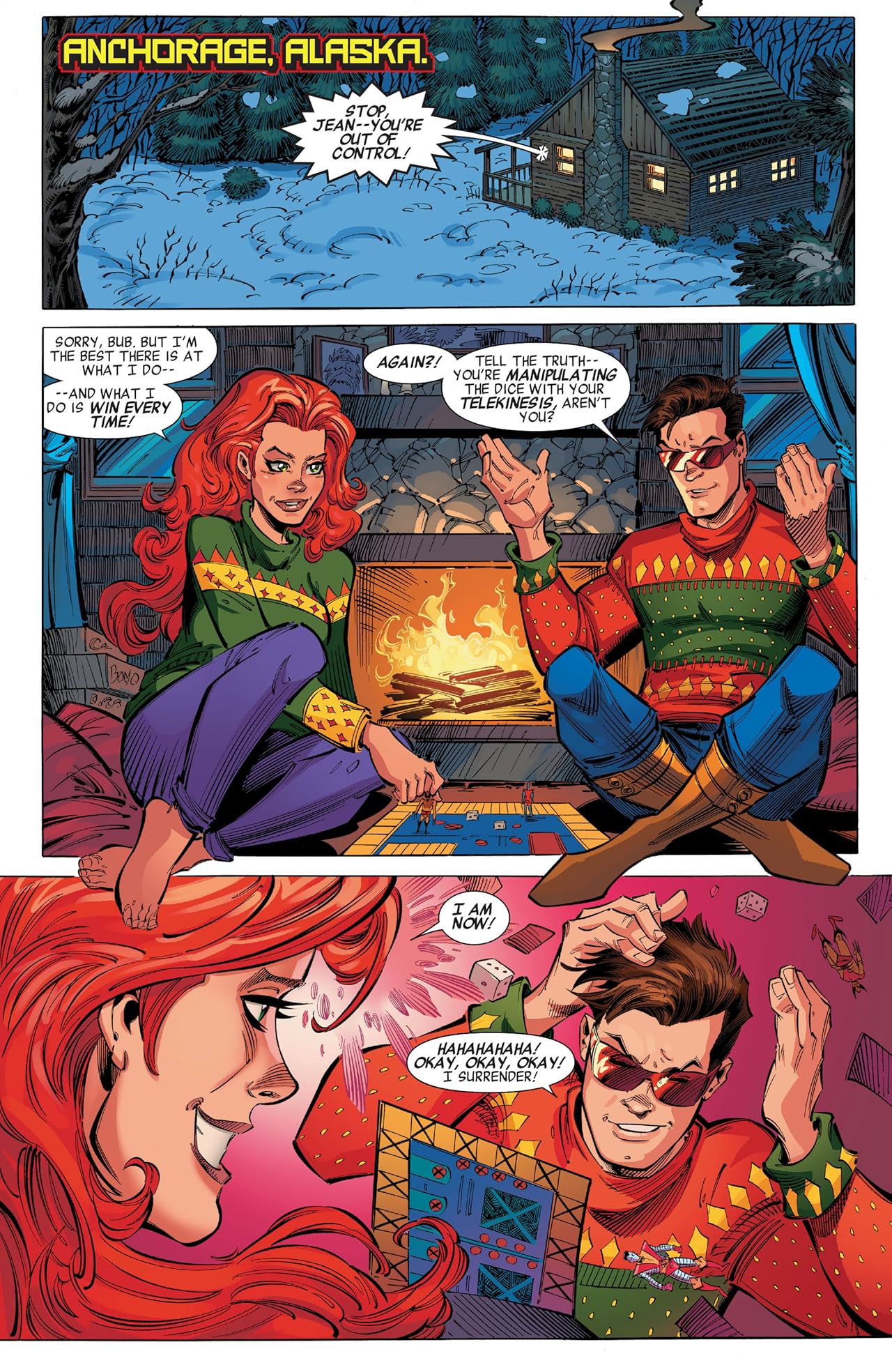
However, it’s not that Cyclops and Jean Grey end up having to don their superhero costumes again that strikes me about this issue. It’s how utterly refined their relationship dynamics are here. Remember that clip I linked to earlier with Jean Grey fainting? That doesn’t happen here. Not once. Anyone who watched all 76 episodes of the X-men cartoon in the 90s can probably appreciate how big a deal that is.
Instead, the comic does something special with these two, something that I actually don’t see very often in comics these days. It shows Cyclops and Jean Grey as two lovers, being superheroes on an equal playing field. At no point do they end up having to save one another. At no point do they undermine or frustrate one another. Every step of the way, they support and complement each other.
That’s not to say there aren’t some disagreements. Cyclops is initially mistrustful of some of the allies they come across, which is perfectly in line with his character, but Jean Grey vouches for them and he trusts in her. He trusts her as anyone should trust their lover and it pays off. He supports her. She supports him. It’s a beautiful thing that shows a relationship actually functioning.
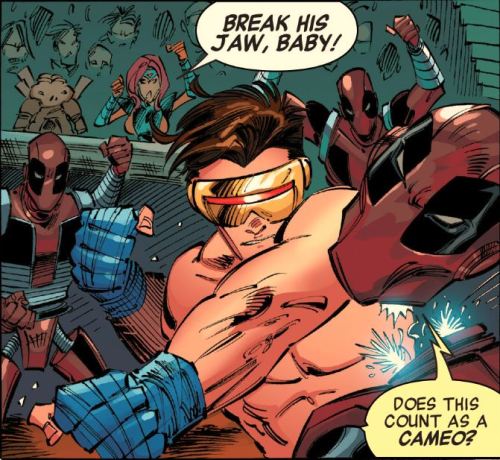
This is something that pop culture overlooks and for good reason. The narrative of how two people fall in love or how two people fall out of love is often more dramatic. However, it’s a story that gets told and retold too often and in too many different forms these days. Rarely do we get a story that shows two lovers actually functioning together on an equal playing field. That’s what makes X-men 92 #5 so astonishing. It uses the romance to complement the story rather than drive it.
This is an important insight and one that I definitely want to take note of for my own work. As I said before, I do have a few projects in mind that rely on relationships between equals. I want to use strong male and female characters who don’t have to rely too much on overplayed tropes because I want my work to stand out. I can’t do that if I tell the same kind of story that people have read a million times before in various forms. So comics like this are vital tools for writers like me.
For others seeking different kinds of love stories, I strongly recommend X-men 92 #5. It offers a different take on an under-appreciated, and often underrated, relationship between two iconic characters. I hope we see more stories like this in comics, as well as movies, books, and TV shows. I think the time is right for this kind of romance to take hold.
Filed under Jack Fisher's Insights, Uncategorized


 Jack Fisher's Official Publishing Blog