Category Archives: Jack Fisher’s Insights

The Orgasm Gap: Biological Or Psychological?

When it comes to talking about an issue, I generally avoid the kind of crisis fear-mongering you’d see on a CNN special report, a Fox News segment, or an Alex Jones podcast. More often than not, those who resort to fear-mongering are a few steps too close to fitting their heads for tin-foil hats.

However, I’m about to bring up an issue that I believe really is a crisis. It does warrant a little fear-mongering, if only because it directly affects the erotica/romance industry, of which I’m trying to be part of. That’s because it involves orgasms.

Usually, my posts about orgasms are of the fun, positive, sexy variety. That’s to be expected. It’s not hard to make a discussion about orgasms fun. Unfortunately, it’s also not hard to make that discussion dire because when a significant portion of the population isn’t having them, then I consider that to be a big problem.

This isn’t just the sexy musings of an aspiring erotica/romance writer. This is a real issue. There really is an orgasm gap, so to speak. Men, not surprisingly, don’t have a hard time achieving orgasm. Thanks to an unfiltered imagination and internet porn, an orgasm for a man is as routine as a morning cup of coffee.

For women, however, it’s a very different story, one I wish were relegated to the kinds of sexy novels I write. The data doesn’t lie. Women are having a harder time taking a trip to O-town during intimate moments with their male lovers. Regardless of whether you’re a radical feminist or a douche-bag frat boy from an 80s teen movie, we know that’s not fair. Given the universal joys of orgasm, that kind of disparity just isn’t tenable.

Why is this an issue though? Why does this orgasm gap even exist in the first place? Evolution has given both genders a wonderful incentive to have sex, make love, and everything in between. What’s keeping us from enjoying it?

By and large, there are two major theories to explain this injustice. One theory says this gap is primarily due to biology, which is bad news for women because it means the gap is impossible to close. The other says the cause is psychological, which is somewhat less dire because it means the gap can be addressed, albeit with expensive therapy.

Most of the time, when there are two competing theories about why something exists, the truth often lies somewhere in between. In some instances, though, such as the case of creationism and evolution wherein one is definitively right and the other is a religiously-motivated fever dream, the truth is not so balanced.

So with respect to the orgasm gap, which theory is correct? I’m not a scientist and am woefully unqualified to be one. Thankfully, there are some scientists out there who value equal access to orgasms as much as I do and they have done research on this. These people are the true heroes of the erotica/romance world. So what did their research find?

Well, a recent TED talk by Peggy Orenstein does a nice job of summing up these results. I’m not saying her talk is definitive. These TED talks never are. However, her conclusions have some pretty powerful implications and not just for our collective sex lives.

There’s a lot to unpack here. As an aspiring erotica/romance writer, it reveals some major flaws in the proverbial narrative that is our intimate lives.

Parts of her talk definitely resonated with my own personal experience. I remember sex ed when I was in high school. Since my community wasn’t run by uptight religious zealots, I had the good fortune of receiving a fairly comprehensive education about sex, especially compared to Texas standards.

They were pretty thorough, talking about everything from contraception to childbirth. When it came to certain body parts, though, I do recall a distinct difference. Descriptions about male anatomy and how a penis works was fairly concise. Most of my male classmates didn’t learn anything they hadn’t already found out and were fairly assured that their manly bits were operating fine.

When the time came to discuss female anatomy, however, I sensed a distinct shift in mood. Everybody, girls and boys alike, shifted like they were trying to hide a nasty fart. The intricacies of female genitalia wasn’t so much about their beauty or aesthetics. It mostly boiled down to the idea that blood and babies come out of it. That’s about it.

On a personal note, I’ll just say I learned about the existence of the clitoris from “South Park.” What’s that say when a comprehensive sex education program from a major school overlooks something that can be gleaned from watching “South Park?” I’ll give everyone a minute to stop banging their heads against their desk.

Then again, self-image is something every teenager struggles with. I certainly did, but I had a damn good excuse because of my horrible acne problem. It’s one of those things that improves with maturity. Sure, some people mature faster than others, but most of the time, it’s women who do the maturing so how does that orgasm gap not disappear?

This is where the psychology, it would seem, overpowers the biology. Make no mistake. Our thoughts and attitudes can influence our bodies. Anyone who has tried to sleep the night before midterms knows this all too well. Then, there’s the attitudes that we, as a society, collectively impose on each other.

In this case, it’s an attitude we impose on women. Whether by the spirits of angry Puritans or the agendas of old men who vomit uncontrollably at the thought of their daughters having sex, we tell women that they’re not supposed to enjoy sex that much. They’re told the orgasm disparity is normal.

There’s supposed to be this orgasm disparity between men and women. Somehow, this disparity is supposed to keep society intact so that people don’t waste too much time enjoying orgasm. This is where Orenstein gets really personal when she recounts the woman who says:

“I guess we girls are just socialized to be these docile creatures who don’t express our wants or needs.”

The girl who said that claimed to be this fiery, assertive woman. That should reveal just how powerful these attitudes can be.

It’s not just one type of attitude either. Orenstein points out how girls see their vaginas with shame while boys let their dicks hang with pride. Being proud of a body part tends to affect it. I used to play baseball. This works with arms. It works just as well with genitals, if not more so.

However, I think Orenstein overstates genital attitudes in some areas, ignoring the fact that men will shave their balls and undergo circumcision to avoid being aesthetically unpleasing. That’s something that affects both genders more than she lets on.

That said, I agree with her wholly when she brings up one of the most telling details about the orgasm disparity. When same-sex partners are involved, that gap disappears quicker than a cold beer at a Red Sox game in July. This is where the biology theory starts to fall apart.

Now it may seem obvious on some levels, the idea that same-sex lovers can climax at the same rate. It makes intuitive sense. They’re two people working with the same equipment, so to speak. Naturally, they would know how to make that equipment perform.

I don’t doubt that’s part of it. I also think there’s more to it and Orenstein seems to agree.

“Girls’ investment in their partner’s pleasure remains regardless of the gender of the partner. So in same-sex encounters, the orgasm gap disappears. And young women climax at the same rate as men. Lesbian and bisexual girls would tell me that they felt liberated to get off the script — free to create an encounter that worked for them.”

How telling is that? Put women in a situation where certain attitudes about sex and female pleasure don’t apply and they can enjoy a trip to O-Town as much as any man. As an erotica/romance writer, it brings tears of joy to my eyes.

So the orgasm gap disappears with same-sex partners. That’s all well and good, but what about the women out there who can’t get too horny around other women? What about the women who actually want to share the joy of orgasm with men? Well, Orenstein gives hope to those women too when she cites surveys done in cultures that aren’t haunted by the spirits of angry Puritains.

Consider a survey of 300 randomly chosen girls from a Dutch and an American university, two similar universities, talking about their early experience of sex. The Dutch girls embodied everything we say we want from our girls. They had fewer negative consequences, like disease, pregnancy, regret — more positive outcomes like being able to communicate with their partner, who they said they knew very well; preparing for the experience responsibly; enjoying themselves. What was their secret? The Dutch girls said that their doctors, teachers and parents talked to them candidly, from an early age, about sex, pleasure and the importance of mutual trust. What’s more, while American parents weren’t necessarily less comfortable talking about sex, we tend to frame those conversations entirely in terms or risk and danger, whereas Dutch parents talk about balancing responsibility and joy.

Let’s all take a moment to thank the Dutch. Let’s also take a moment to understand what this reveals.

Again, no theory is truly definitive, but Orenstein lays out fairly concisely how the orgasm gap is largely a psychological issue. Men define satisfying sex by their orgasm. Women define it by the ability to please their partner, which sets the bar low and ensures an unequal outcome.

That means we, as a society, should set new standards and I can say with a fair amount of certainty that men are all for that. How do I know this? Well, let me let all the women out there on a little secret about us men that really shouldn’t be a secret.

We WANT you to have orgasms when you have sex with us.

It’s true. Men really do want the women they have sex with to orgasm. Most of the time, they don’t want women to just lie there and act like a glorified barbie doll with a pulse. They actually want their partners to feel pleasure.

It shouldn’t require a real stretch in logic. Men understand that if women feel a lot of pleasure during sex, then they’ll want to do it more often with them. More sex makes us happy. We have a powerful incentive to make sure you women share in the joys of orgasms. The problem, albeit a sexy problem, is that it requires a mutual effort.

I believe we can close that orgasm gap for coming generations. I can only do so much as an erotica/romance writer, but we collectively can do so much more. When the day comes where men and women can expect to have an equal potential for orgasms during sex, then we will have achieved true equality. I look forward to that day.

15 Comments

Filed under Jack Fisher's Insights

Why Quality Erotica/Romance Movies Are (Almost) Impossible

most-sexually-charged-excerpts-from-erotica-books

A while back, I talked about the box office reception that “50 Shades Darker” received and the implications this had for the future of erotica/romance in movies. In my assessment, as someone with a keen interest in the future of erotica/romance, I painted a mildly optimistic picture.

I had good reason to. After all, “50 Shades Darker” turned a profit, just like its predecessor. Sure, it was panned by critics, but that has never stopped trends in movies before. Just ask Michael Bay. Critical reception aside, “50 Shades of Grey” made a lot of money for book publishers and movie studios. That should be all that’s necessary to spark a new wave of erotica/romance in movies, right?

Well, maybe it’s because I’ve had some spare time while recovering from a terrible cold, but I find myself re-assessing my assessment. In doing so, I’ve surmised a number of major, almost insurmountable obstacles that will keep erotica/romance stories, like the ones I write, from being Jaws-level blockbusters.

Now I say it’s almost insurmountable because Hollywood has defied the odds and/or common sense before. I thought the vomit-inducing shit storm that was “Batman and Robin” had killed superhero movies for the next several decades. Thankfully, I was wrong and three years later, “X-men” came out. However, the erotica/romance genre has challenges that even superhero movies never had to overcome.

With that caveat in mind, here’s a quick rundown of the obstacles that hinder erotica/romance in movies. Yes, they seem daunting, but keep in mind that when there’s money to be made, Hollywood usually finds a way to exploit the hell out of it.


Obstacle #1: The Porn Problem

While the Mike Huckabees of the world may hate it, porn exists. Porn, as a genre and an industry, exists in a big way. According to Forbes, it’s a multi-billion dollar industry with its own line of major brands, product lines, and superstars. Names like Brazzers, Adam and Eve, and Jenna Jameson are all well-known, even though many are still reluctant to admit just how much they know.

This may be good for the industry, but it’s also a big reason why the erotica part of erotica/romance has such a big problem getting into movies. It’s because porn is its own industry that there’s this hard, unambiguous line between porn and cinema.

Show any typical movie next to a typical porn and it’s usually pretty easy to figure out which is which. Even if none of the actresses involved have boob jobs, it’s painfully obvious which one was produced by a porn studio. If a movie is going to be overly sexual in any way, then it’s going to either get hijacked by porn or associated with it. In either case, the romance part will be lost completely.

This is why the erotica parts of movies like “50 Shades of Grey” and “Showgirls” are so watered down. Sure, you’ll see a pair of breasts. Sure, you’ll even see a penis or a vagina every now and then, if only briefly. However, it’ll never be as overt or uncensored as porn.

Some of this because too much T&A will earn a movie the dreaded NC-17 rating, which means no major theaters will carry it. At best, a movie with that rating will end up a late-night softcore porn movie on Cinemax or HBO, which directly ties into another obstacle.


Obstacle #2: The Acting Problem

Here’s a pop quiz everybody should be able to pass. How many Oscar-winning actors or actresses in the past 30 years have ever starred in a porno movie? If you can’t think of any, then congratulations. You passed.

That’s because for actors or actresses, acting in porn or being too eager to take your clothes off is the quickest way to lose credibility in Hollywood. Now some actresses can get away with showing their tits more than others, as Angelina Jolie has proven, but those are the exceptions and not the norms.

For men, it’s even worse. Many male actors are willing to get naked on screen, as Leonardo DiCaprio has proven, but chances are they’ll never do a full-frontal where their dick and balls are clear for everyone to see. That’s usually the quickest way to get laughed out of any future audition.

This is a problem because good acting is important to a good story, especially one that involves romantic themes. However, good actors and actresses can’t get quality work if they’re too eager to get naked on camera. That’s because they’ll just be seen as quasi-porn stars of sorts who rely more on their sex appeal than their acting skills to make a living.

Now there’s nothing wrong with relying on your natural or surgically-enhanced sex appeal to make a living. Pamela Anderson is proof that this can work, even if she has become somewhat of a hypocrite about it.

However, for serious actors in Hollywood, it’s an unbalanced balancing act of sorts. Too much sex appeal means your acting skills become secondary. Without those acting skills, it’s hard to tell a meaningful story. Even if the actor or actress has those skills, there’s also the erotic acts themselves to consider, which leads to the next major obstacle.


Obstacle #3: The Performance Problem

By performance, I don’t mean an actor or actress’ ability to cry on cue. Think back to porn for a moment without opening a new tab on your browser. Why is it that many porn actors or porn actresses have such poor acting skills? Well, there’s a simple reason for that. Their acting skills are a secondary concern at best, if not an afterthought at worst.

The biggest challenge to being a porn actor or actress has nothing to do with actual acting. It has everything to do with actually being able to have sex in front of a camera, under weird lighting, and with a director barking orders behind the scene. It’s not exactly an intimate setting is what I’m saying.

Most men can’t exactly rise to the occasion under those situations. As a man, I can attest that our biology makes that difficult for us. Just as many women can’t exactly get in the mood either. That’s why male porn stars are judged more on their ability to keep an erection and why female porn stars are judged by their ability to keep the sex going, even after the mood has passed.

This is why sex in movies is so overly-censored. Even in softcore porn movies, it’s extremely watered down. If you do see a penis, it’s never erect. If you do see a vagina, it’s rarely that wet. That’s why the sex never looks real or genuine. It’s a matter of skill more than story.

Good actors and actresses have the skill to make a character seem real. Good porn stars have the skill to actually have sex in front of a camera. Few, if any, have the ability to do both, which is why erotica/romance has so much working against it.


Obstacle #4: The Stigma Problem

As I’ve pointed out before, Hollywood still has a few oddly outdated attitudes when it comes to sex. Again, just go see any slasher movie made in the past 30 years. The first person to die is always the man or woman who is too eager to get naked or have sex.

In any major romance movie, a relationship that has too much sex will be portrayed as shallow. A relationship that lacks sex or sex appeal will come off as more genuine. It’s an either/or scenario that rarely gets challenged and for good reason.

Too much sex in a movie will cause it too lose credibility. Too much sex in a romance will make it seem shallow. The idea that sex can actually complement a romance might as well seem alien to a Hollywood producer. That would be like claiming Seth Rogan can do a good movie that doesn’t involve weed. It seems outrageous.

Beyond the stigma within the movie, there’s the stigma outside the studios as well. As I mentioned with the acting issue, those involved in an overly sexy movie will get labeled as the kind of people who can only do movies that involve a lot of sex.

This is why few victims in slasher movies go onto win Oscars. They commit the sin of getting naked in a few too many scenes and they’re basically blacklisted in Hollywood. It’s not fair, but that’s how the industry works.


Reasons For Hope

Now if these obstacles make it seem like erotica/romance will never be a legitimate movie genre, I apologize if I give that impression. Granted, these are obstacles that few genres have ever had to overcome. Even with the success of “50 Shades of Grey,” it’s not like studios are clamoring to make knock-offs on the same level we’ve seen with superhero movies.

That said, there does appear to be an emerging market for more mature content that doesn’t shy away from showing nudity in more than a few scenes. How do I know this? It can be best summed up by three words: Game of Thrones.

Say what you want about the critical reception of “50 Shades of Grey.” There’s no denying the cultural impact that “Game of Thrones” has had since it debuted on HBO. It’s violent. It’s sexy. It’s downright gratuitous in the way it glorifies Emily Clarke’s breasts. It’s also a damn good story full of great acting and compelling characters.

Now that’s not to say “Game of Thrones” qualifies as an erotica/romance story. It’s very much a different kind of story, one that fits more into established fantasy genres. However, it’s willingness to use a balance of sex, violence, and story offer hope that this balance can find its way into other genres.

So while it may be a while before we see an erotica/romance movie, like my upcoming book, “Passion Relapse,” we’re a lot closer than you think. Sex still sells. Meaningful romance still sells. It’s only a matter of time before Hollywood finds a way to combine the two and make a boatload of money off it.

8 Comments

Filed under Jack Fisher's Insights

Should We Marry For Love? Wait What?!?!

Should we really marry the person we love? That’s not a rhetorical question. That’s not the beginning of some elaborate joke or rant either. It’s an actual, honest question that we, as a society, stopped asking very recently in the grand scheme of things.

As an erotica/romance writer, these kinds of questions are pretty darn relevant. The way people see love, marriage, sex, and everything in between shapes the novels I write. I’ve written several books thus far, but I’ve never really dealt with this question directly. Given the rate at which the concepts of marriage and love are changing, this question is pretty important.

So why is it relevant to begin with? Why should this be a controversial issue? Well, contrary to what registered republicans and the church would have us believe, the modern concept of traditional marriage isn’t that traditional.

In fact, for most of human history, marrying for love was the exception and not the norm. For some people, the very idea of marrying for love was an affront to marriage itself. There’s even an old Egyptian proverb that says:

“One who marries for love alone will have bad days, but good nights.”

Let that sink in for a moment. Up until very recently, and by recently I mean the 17th century in Europe, people didn’t marry for love. They married because it was just part of how old, pre-industrial societies worked. From Europe to China, most marriages were arranged by families. Sometimes, the bride and groom didn’t even meet each other until their wedding day.

This was because marriage was not seen as a romantic gesture. It was seen as a cooperative partnership, of sorts, between families. You didn’t marry your spouse as much as you married into their family. It was how pre-modern societies ensured a proper exchange of property, bloodlines, and procreation.

That’s not to say love was completely absent. Ideally, the hope was that a couple would marry first and then fall in love. It may seem backwards today, but that was the ideal espoused in the past.

Why was this? Why was love divorced from marriage, if that’s not too loaded a term? Well, there is a social and political reason for that, one that a brilliant woman named Stephanie Coontz articulates far better than I ever could. She explains:

In some cultures and times, true love was actually thought to be incompatible with marriage. Plato believed love was a wonderful emotion that led men to behave honorably. But the Greek philosopher was referring not to the love of women, “such as the meaner men feel,” but to the love of one man for another.

Other societies considered it good if love developed after marriage or thought love should be factored in along with the more serious considerations involved in choosing a mate. But even when past societies did welcome or encourage married love, they kept it on a short leash. Couples were not to put their feelings for each other above more important commitments, such as their ties to parents, siblings, cousins, neighbors, or God.

In ancient India, falling in love before marriage was seen as a disruptive, almost antisocial act. The Greeks thought lovesickness was a type of insanity, a view that was adopted by medieval commentators in Europe. In the Middle Ages the French defined love as a “derangement of the mind” that could be cured by sexual intercourse, either with the loved one or with a different partner.4 This cure assumed, as Oscar Wilde once put it, that the quickest way to conquer yearning and temptation was to yield immediately and move on to more important matters.

In China, excessive love between husband and wife was seen as a threat to the solidarity of the extended family. Parents could force a son to divorce his wife if her behavior or work habits didn’t please them, whether or not he loved her. They could also require him take a concubine if his wife did not produce a son. If a son’s romantic attachment to his wife rivaled his parents’ claims on the couple’s time and labor, the parents might even send her back to her parents. In the Chinese language the term love did not traditionally apply to feelings between husband and wife. It was used to describe an illicit, socially disapproved relationship. In the 1920s a group of intellectuals invented a new word for love between spouses because they thought such a radical new idea required its own special label.

In Europe, during the twelfth and thirteenth centuries, adultery became idealized as the highest form of love among the aristocracy. According to the Countess of Champagne, it was impossible for true love to “exert its powers between two people who are married to each other.”

In twelfth-century France, Andreas Capellanus, chaplain to Countess Marie of Troyes, wrote a treatise on the principles of courtly love. The first rule was that “marriage is no real excuse for not loving.” But he meant loving someone outside the marriage. As late as the eighteenth century the French essayist Montaigne wrote that any man who was in love with his wife was a man so dull that no one else could love him.

It sounds as unromantic as it does unsexy, the idea that love is actually a liability in marriage, so much so that people in the past were shunned for loving their spouses too much. However, there is a context to consider.

These are pre-modern, pre-industrial, mostly-agrarian cultures where infant mortality is high, maternal mortality is high, and plagues are exceedingly common. Love, as anyone whoever listened to a Beatles song, is a very fickle emotion. It cannot be channeled, controlled, or changed. Some have tried, but most efforts fail. Just ask anyone who endured conversion therapy.

That kind of chaos just doesn’t fit in a society that is only one bad harvest or one nasty plague away from total collapse. These societies need to exert some level of social control in order to function.

Societies still change. Civilization, as we know it, changes with it. We no longer live in a society where such social control is necessary, but there are still plenty of societies all over the world where arranged, loveless marriages are common. Some will even claim that such marriages are better than love marriages.

It may sound ridiculous to the freedom-loving west, but think about it. Why go through the trouble of finding a spouse when your parents can just do it for you? Besides, who knows you better than your parents? Wouldn’t that save everyone a lot of time, energy, and heartbreak?

That last part wasn’t entirely sarcasm, but that’s the logic behind arranged marriages. The fact it’s still so prevalent all over the world indicates the logic isn’t entirely flawed. It also acknowledges that there are some fundamental issues with marrying for love.

As many writers far more accomplished than me have said, love is a very fickle emotion. It changes on a whim more than it lingers. You could love someone for 30 years and one day find someone else you love even more. It happens. That’s what love can do. That’s why it’s so scary/amazing/powerful.

There’s no doubt that marriage, as an institution, is destined to change even more than it already has. Every church, mosque, and synagogue may fight it. Every social conservative may oppose it. That still won’t stop it. The institution will keep changing, probably in ways that nobody, especially not an aspiring erotica/romance writer, can predict.

This brings me back to my original question. Should we marry for love? Should marriage even be connected to love? It’s as serious a question as anyone can ask, regardless of time period or generation. It’s also a question that we, as a society, will have to answer at some point in our lives. Let’s hope we answer it right.

10 Comments

Filed under Jack Fisher's Insights

The (Lack Of) Consensus Surrounding Consent

Some issues really shouldn’t be that controversial to begin with. Things like treating pets well, not hitting kids, and not putting wasabi in your cereal are just common sense. There should be no controversy. Anyone who wasn’t raised by Jeffrey Dahlmer should understand that.

That’s why I find it so frustrating that the simple issue of consent has become so heated. It’s not just a trending buzzword. It’s a goddamn trigger word these days, so much so that blowhards like Rush Limbaugh feel compelled to say incredibly stupid shit about it.

Again, it shouldn’t be controversial. The idea of getting consent from someone before you have sex, kiss, or massage their prostate fits perfectly within the realm of common sense. So why the hell is it such an issue? Why are star athletes and ardent feminists struggling with it to begin with?

There are any number of elaborate, politically-charged factors I could talk about. Since I don’t want people to treat this blog as a cure for insomnia, I’m going to try and keep it simple, funny, and sexy, although when it comes to consent, there’s only so much sexiness I can manage.

The problem, if you really want to call it that, is common sense itself. By that, I mean we think human beings are wired to have it. That’s only half-true at most. As I’ve made clear before with my use of caveman logic, the human brain is not wired for common sense. It’s wired for survival and reproduction. Anything beyond that is just extra icing.

That means that people frustrated with other peoples’ inability to understand consent don’t understand the biological wiring of their own species. Whether you’re a feminist or an extra in a Lil Wayne video, we’re still part of the same species. We’re still prone to the same flaws. Failing to take that into account is akin to joining the Navy without remembering you get seasick.

This leads me to a recent video that the fine folks at Cracked.com put up a while back. Now I’m usually a big fan of Cracked. I’ve cited them before on this blog and they generally do a good job of exploring sensitive issues in a funny, often sexy sort of way. This time, however, I’m a bit torn.

This video, despite having undeniable sex appeal in talking about a serious issue, tries too hard to make this issue simple. I can totally understand that. Cracked is a humor website, not a lecture hall at Oxford. However, in trying to make things simple, it misses a few key details.

Like almost every major issue or political movement, the controversy surrounding consent began with the best of intentions. In previous decades, the rates of sexual assault and rape were atrocious. The issues associated with handling these crimes was just as bad. One side said it was consensual. The other side says the other has a fucked up definition of the word. In a courtroom not run by Judge Judy, that’s a difficult crime to resolve.

In recent years, especially with the rise of third-wave feminism and greater emphasis on women’s issues, there has been a concerted effort to address the uncertainties surrounding consent. I don’t doubt the motivations or the heart. In principle, they’re coming from the right place. In practice, however, there’s a big problem.

To illustrate this problem, let me paint a scenario. Picture a man and a woman, totally sober and in a sound state of mind. They’re at a party, a bar, a barn dance, or wherever people meet these days. They start chatting. They laugh. They like each other. Then, things get heated.

The man asks if the woman wants to go somewhere more private. She says yes.

The man asks if the woman wants to get into bed with him. She says yes.

The man asks if the woman wants to take off their clothes. She says yes.

The man asks if the woman wants to have sex with him. She says yes.

The man and the woman start having sex. Body parts are in other body parts. Basic biology takes over. All the while, the woman still says yes.

Then, for any number of reasons that are too vast to specify, the woman says no. There’s little to no warning. There’s little to no reason. She just starts saying no. Under the emerging concept of consent, as espoused by the very vocal wings of third-wave feminism, that man is now a rapist.

Does that clarify the issue? Does it now make sense why the concept of consent isn’t quite as easy as the editors of Cracked makes it out to be?

It’s an unavoidable facet of being human. People don’t always say what they mean. People don’t always mean what they say. Until brain-to-brain communication and perfect lie detectors are perfected, there’s really no way to know for sure.

This creates an unequal dynamic between men and women, those most dreaded of predicaments that make feminists and men’s rights activities hulk out. Just look at the Duke Lacrosse incident or the Rolling Stones UVA case. It’s not just a matter of he said/she said anymore. It’s a matter of unequal gender dynamics creating a confusing, conflicting, and in some cases detrimental understanding of intimacy.

Unlike decades in the past, an accusation of sexual assault is almost as bad as a conviction. Up until very recently, it was possible to deal with a sensitive incident privately and not incur the wrath of the public. Provided you weren’t a politician, pastor, or celebrity, it was something you could put behind you.

Thanks to social media and the internet, that’s not possible anymore. As soon as the story surrounding the UVA case came out, there was no real effort to check the facts. The entire world just assumed the men were guilty. There were protests. There were lawsuits. The whole ordeal became a rallying cry for protesting the macho-manly frat culture that we’ve seen in every 80s teen movie.

Despite all this outcry, though, it wasn’t true. It never happened. The story was totally fabricated and Rolling Stone had to apologize for that story. In this issue, the concept of consent was conflated and twisted to create a false narrative. The problem was that certain people cared more about the narrative than the truth.

This is where consent gets especially muddled, especially for men. In both the UVA and Duke case, the assumption was that the men were guilty. That’s because, for those seeking a narrative, men are horny beasts who look for any opportunity to sexually assault a woman. Being a man, I can safely say this is not true. I can also say it scares the bejesus out of me.

It’s because of these expectations and assumptions that consent is difficult to grasp. If a woman accuses a man of assault, then she’ll be taken very seriously. If a man accuses a woman of the same, he’ll probably be laughed at. It’s one of those harsh double standards that few talk about.

In our current culture, it’s not okay to joke about men assaulting women, as comedian Amy Schumer found out. As for women assaulting men, it’s not just okay to joke about it. One of my favorite comedians of all time, Christopher Titus, did an entire routine about it in one of his specials.

Given this inequality in understanding and humor, how can women expect men to understand consent and how can men expect to empathize with women? When there’s this kind of discrepancy, it’s next to impossible.

As a man, I can only attest to my own experience. Personally, I’m terrified of a woman accusing me of something so horrible because I know, as a man, I’m not going to get the benefit of the doubt.

This means I’m very reluctant to hug people, ask them out, or talk about intimate issues. I know that if a woman wanted to, she could make an accusation against me and my life would be over. It wouldn’t even matter if I’m innocent. The accusation still ruins my life, my reputation, and everything in between.

Women want men to understand consent. Men want women to understand the kind of power and leverage they have over them. Both still have this innate drive to connect and be intimate. Our culture, our flawed assumptions, and our inability to be certain of one another’s intent just gets in the way.

Being the optimist I am, I believe it’ll change. I believe the arc of history still trends towards equality and justice. It won’t happen all at once. It might not even happen within my lifetime. Whenever it happens, I believe it’ll be worth the wait. When the day comes when men and women can talk about what kind of anal beads they prefer without fear, that’ll be a glorious day indeed.

14 Comments

Filed under Jack Fisher's Insights

Cyclops And Jean Grey Of The X-men: A Prelude To The Future Of Romance?

Admit it. You knew it was going to happen at some point. I start talking about brain-to-brain communication, sharing thoughts, and techno-telepathy and eventually, I was going to relate it to comic books.

If you’ve been reading this blog in any capacity over the last year or so, you know how much I love comic books and superhero movies. I’ve also made clear how much I love X-men in particular. Hell, I even argued that Storm was a better female superhero than Wonder Woman. Make that argument on a comic book message board and you can expect a lot of angry responses, including certain remarks about your mother.

My point is that if I haven’t made my love of comic books and X-men clear now, then there’s not much more I can do that doesn’t involve tattoos. That’s why it really should surprise no one that I’m about to relate my recent discussions about the future of sex and intimacy to the X-men.

Yes, I know the X-men were created in 1963 and using them as a precursor to the future is like using old reruns of “The Simpsons” to predict the future. Then again, given the Simpsons’ track record, that may be a bad example.

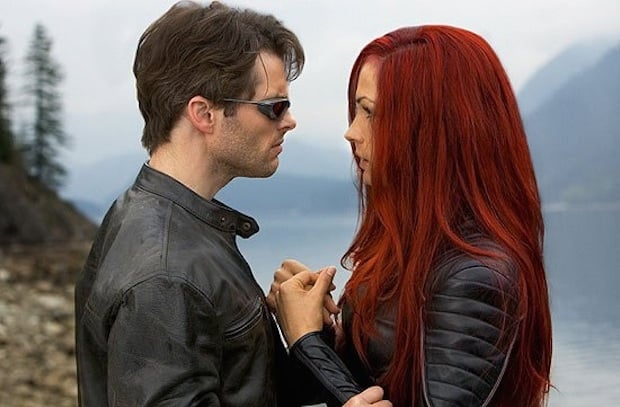
Specifically, I’m going to focus on Cyclops and Jean Grey of the X-men in discussing the future of love and intimacy. They’re not just one of my favorite comic book romances of all time. I’ve also cited them before as an strong example of a relationship of equals. I’ve also cited them as a way to highlight just how mind-numbingly awful love triangles can be. Overall, they’re a pretty useful couple is what I’m saying.

Now in talking about them with respect to the future of love and intimacy, I’m not going to focus on the particulars of their relationship. There are plenty out there who despise this romance, just as there are plenty out there who despise every romance that involves vampires. I get that. There are vocal X-men fans who would rather see Cyclops and Jean Grey involved with someone else. I’m not here to argue with those fans.

Like every superhero romance, Cyclops and Jean Grey has been prone to many complications that go beyond bad love triangles. Look at any romance in comics. Without exception, there’s always some amount of uncertainty, drama, death, rebirth, and reboots. It’s just how comics work.

For the purposes of this post, I’m not just going to focus on what makes the Cyclops/Jean romance work. I’m going to focus on one of the unique components about it, namely the fact that Jean Grey is a powerful telepath. She can read, project, and manipulate thoughts and she doesn’t need future technology or hypnosis to do it. As a mutant, it’s just one of those talents she’s born with. In that sense, it’s definitely more useful than sewing.

Now Jean Grey isn’t the only telepath in the X-men or the Marvel universe, for that matter. She’s not even the most powerful. Professor Charles Xavier, who was played by the insanely-charming Patrick Stewart in the X-men movies, is often cited as the most powerful psychic in the X-men comics. However, Jean Grey is often cited as a close second.

I mention that to make clear that Jean’s talent for telepathy isn’t just good by comic book standards. It’s first team all-pro good. Why does that matter? Well, being such a powerful psychic, it’s hard for her to filter out the thoughts of others. She even remarked in “X-men Apocalypse” that she knows what everyone thinks. Not much surprises her.

This makes her relationship with Cyclops all the more intriguing in the sense that she develops such a strong romantic connection with him, despite being able to read his thoughts and sense his emotions. He, in turn, falls in love with her, knowing full-well she has this kind of power. There isn’t a dirty, deviant thought he can hide from her and he doesn’t mind in the slightest.

Think about that for a moment. Cyclops falls in love with a woman from which he can’t readily hide his thoughts. He can’t even hide his emotions from her. She’s even commented in the comics and in the movies on numerous occasions how she can pick up on his emotions.

Lying to her is impossible. Hiding his feelings from her is impossible. Now on many occasions, Jean Grey tries to make clear that she doesn’t read peoples’ thoughts without permission. The keyword there is she tries. It doesn’t always work. Sometimes she can’t help it. Just ask the recently-outed Iceman.

Regardless of how much Jean Grey respects the privacy of others, it doesn’t prevent her and Cyclops from forging a relationship. It also doesn’t stop that relationship from blossoming into one of the most iconic romances in the history of comics, culminating in X-men #30 where they got married. Even if you’re among those X-men fans who despise their relationship, it’s hard to deny that were pretty damn serious about their love.

Why does this matter? What does it have to do with the future of romance and relationships? Well, think about the dynamics of such a relationship. Cyclops and Jean Grey don’t just share love, intimacy, and legal obligations. They actually share thoughts, as in real, unfiltered thoughts. That’s a dynamic that doesn’t exist in the real world yet, but as brain-to-brain communication technology matures, it will exist soon enough.

If communication is the key to every relationship, then Cyclops and Jean Grey have a master set. With them, there’s no need to put thoughts and feelings into words. There’s no need to make these elaborate gestures to convey how they feel. They don’t even need to argue about it. Their own thoughts convey whatever sentiment they want, be it love, lust, or a craving for corn dogs.

How many relationships in the real world fail because two people can’t properly communicate certain feelings? It happens all the time. It manifests in all kinds of sitcoms, some more than others. Hell, it happens in my own novels, especially in “Skin Deep.”

In addition to those relationships, how many others form on a foundation of lies because two people don’t know what the other is thinking? Someone might think they really love someone. The other might just fake it to get back at an ex-lover or land some big inheritance. It happens and, because these thoughts can be hidden, they can’t know for sure how genuine the romance really is.

In a future where brain-to-brain communication is available and couples can wield it like Cyclops and Jean Grey, the entire dynamic of love and romance changes. There’s no need to carefully navigate social cues in an effort to figure out what someone it thinking, feeling, and wanting. Everything becomes that transparent.

On one hand, this means the self-obsesses douche-bags who see others as walking masturbation toys that breath can’t hide anymore. The pick-up artist, the ladies man, and the Regina Georges of the world are exposed for all to see.

On the other, it also means that people can be certain that they’ve found a lover who genuinely loves them. It means we can be sure that the thoughts our lovers think are honest and true. We’re not blindsided. We’re not mislead. We know because we can make our thoughts known.

From a practical standpoint, it means that society will have to reshape the way people find love, intimacy, and connection. For some, it’ll be downright scary, having to share intimate thoughts with one another. However, we’ve reshaped those concepts before. Remember, there was once a time when marrying for love seemed like a crazy idea.

As is often the case, though, popular culture tends to be ahead of the curve when it comes to social and technological evolution. Star Trek did it with cell phones. Cyclops and Jean Grey may end up doing the same for romance. With that in mind, I’ll leave you with this iconic panel that highlights everything I’ve come to love about the Cyclops/Jean romance.

5 Comments

Filed under Jack Fisher's Insights

The Future (And Caveman Past) Of Privacy

Let’s face it. There are just some things in the modern world that are destined to disappear. Things like coal power, overt racial discrimination, and the Macarena are destined to become relics of a bygone era. Some already have to some extent. Others, like snail mail, poor WiFi, and the Kardashians, can’t go away soon enough.

So what does this have to do with privacy? Why am I even bringing up privacy? Is this another case of an erotica/romance writer having a few too many glasses of whiskey when he writes? Well, except for the whiskey part, those questions already have answers.

For the past couple of days, I’ve been talking about the emerging technologies that will allow brain-to-brain communication. Like an updated iPhone, it’s one of those technologies that we know is coming. It’s just a matter of getting here and having a major company profit the hell out of it.

You may not think it’s likely now, but at some point someone will find a way to make sharing thoughts an obscenely profitable business. We get people to pay for bottled water and a haunted rubber duck. There are plenty of gullible people with money in this society is what I’m saying.

Going back to privacy, it’s fairly obvious that we’re already in the process of ditching it to some extent. It used to be that the craziest, dumbest, most asinine stuff we said in our day-to-day lives never left our close circle of friends. Now, we feel compelled to share all those crazy thoughts online.

Look at me. I’m doing that right now. I’m sharing thoughts I never would’ve shared in polite conversation 20 years ago. Then again, 20 years ago I had a horrible acne problem and the piss-poor social skills of a ferret so it’s not like I was in a position to do much sharing. The internet and social media has changed all that. It’s given us an opportunity to kick our concepts of privacy in the balls and beat it with a hammer into something else.

This has had consequences. Just ask anyone who had an Ashley Madison account a few years ago. It’s bound to have more consequences, especially as an emerging generation matures into a world that has never known the pain of dial-up internet. This is a generation for whom sexting will be akin to copping a feel in the back seat of a car. Admit it. You envy that generation to some degree.

However, it’s the generation after that who may really deliver the final nail in the coffin of privacy. That generation will likely come into a world where brain-to-brain communication has matured, is a growing business, and has people bitching about fees for sharing certain thoughts. How will that generation view privacy?

Well for once, we really don’t need a thought experiment or some exercise in existential logic. In fact, we need only a history book and a general understanding of how humans form tribes. Go to any message board that celebrates a certain romantic pairing on “Buffy The Vampire Slayer.” It doesn’t take much.

Nature has wired our bodies to be good at a lot of things, albeit in hilariously crude ways. Just look at the design of the male scrotum. However, one design that has been remarkably efficient is our ability to form tribes and groups. It’s that kind of coordination and cooperation that has helped us dominate this planet, build civilizations, and form Hugh Jackman fan clubs.

It’s also this uncanny ability to form tribes that’ll make the techno-telepathy of brain-to-brain communication so appealing to future generations. It may seem crazy now to those of us who still dread the thought of someone hacking our phones and sharing all the embarrassing pictures of us on FaceBook. I’ve always worked under the assumption that someone has already hacked my phone and that keeps me from capturing anything too compromising in my private moments.

However, with techno-telepathy, there’s nothing left to compromise. Everything is laid out for someone else to see. Your hopes, dreams, fears, and perverse sexual fantasies are all laid out in a beautifully rendered image. Can we even cope with that kind of transparency?

Well, the average congressperson notwithstanding, we have kind of done it before. In fact, we had that kind of transparency for a good chunk of human history. This brings me back to “Sex At Dawn,” a book that has been remarkably useful in discussing such sexy, taboo topics. In addition to talking about the shapes of penises and female orgasms, it does talk about privacy.

Granted, it’s not as sexy as the other topics discussed, but it is relevant in that it explores the pre-interent, pre-agriculture concepts of privacy. In short, there was none. In fact, from a purely practical standpoint, there couldn’t be any privacy.

That’s because those societies were hunter/gatherer societies. These societies were small, close-knit tribes of people who worked together, cooperated, and shared resources to survive. This is not some hippie commune out of John Lennon fantasy. These were very functional, very adaptive groups that played a big part in how human beings evolved.

In those societies, privacy is kind of redundant because they need to share resources. They don’t have big cities or elaborate infrastructure. They need to cooperate or they won’t survive. Part of cooperation means being overly transparent. That means sharing shelter, living space, food, and lovers. Yes, sharing can be sexy. It just comes at the cost of privacy. Some may think that’s a fair trade.

When you don’t have a lot of property or resources of your own, what’s the point of privacy? It’s not that it’s ignored. It’s not that it doesn’t exist to some degree. It’s just redundant in a hunter/gatherer setting. Keep in mind though, it’s in this setting that our species evolved. For the caveman in us, privacy is more a construct than an innate trait.

That’s because our concept or privacy really didn’t exist until the modern concept of property rights emerged. The concept of a public/private sphere is a fairly modern invention. Again, it’s largely out of necessity. When you have a society that relies heavily on accumulating and distributing resources on a large scale, the need for some measure of privacy is unavoidable, if only to avoid extortion and exploitation.

This is where the techno-telepathy of brain-to-brain communication really gets interesting. Whereas modern notions of privacy are relatively recent, less private habits of our cavemen ancestors are still hardwired into our tribal traits. That means the growth of techno-telepathy could be one of those tools actually complements our caveman nature rather instead of conflicting with it.

What could this mean for us as individuals and as a society? What could it mean for our love lives? Well, if our history as hunter/gatherers is any indication, this tool would make it far easier for us to form telepathic tribes, of sorts. We find people who appreciate and share our thoughts. We develop close bonds with those people. Some may even become romantic and sexual. When you’re sharing your most intimate thoughts with people, that’s kind of inevitable.

It could be disruptive or it could be productive for society. When we start sharing both literal and figurative thoughts with one another, privacy as we know it will take on a whole new meaning. It won’t disappear completely. It’ll just change. We’re terrified of sharing naked pictures of ourselves now. How will we feel when we start sharing are deepest, dirtiest, sexiest thoughts?

It’s an interesting notion to consider and one I hope to see play out in the coming decades. I have a feeling it’ll give me plenty of sexy ideas for future novels.

2 Comments

Filed under Jack Fisher's Insights

Sex And Hypnosis: A Prelude To Telepathy?

How many times have you wished you could hypnotize your significant other into putting on that sexy costume they refuse to wear? Hell, how many times have you wished you could hypnotize the clerk at the DMV just to make them think you’re next in line? My point is there are all times when we wish we could manipulate the minds of others.

There are some out there who think it’s already happening. They’re mainly Alex Jones fans who think that fluoride in drinking water is a secret plot by the Illuminati to make us dumb, submissive, and gullible enough to listen to men like Alex Jones. Those kinds of people probably aren’t going care much about this post, but those with functional frontal lobes should be able to get something out of this.

Why do I bring up hypnosis? Well, it sort of builds on what I discussed before about the future brain-to-brain communication, or techno-telepathy if you want to call it that. That technology is underway and it is progressing. It’s very likely that within my lifetime, people will be able to share their most intimate thoughts with somebody and that probably includes their deepest sexual fantasies, including those that involve clowns.

Before we get to that point, though, there are other ways to tap into the vast and perverse abyss that is the human mind. Granted, it’s not as scientific, nor is it as effective as we wish it were, but it still has some merit. It’s called hypnosis. It is a real thing. It’s just not as effective as cartoons, movies, and bad pornos would have us believe.

As such, I’m not talking about the kind of stage hypnosis you see in Las Vegas that involve bikini models for assistants. That’s not real hypnosis. That’s a stage act. That’s Hamilton with more partial nudity. Real hypnosis has some basis in psychological phenomena. According to Psychology Today, real hypnosis is defined as:

A state of highly focused attention or concentration, often associated with relaxation, and heightened suggestibility.

That makes sense on some levels. When you’re so focused and relaxed, you’ll basically admit you stole the Mona Lisa. You’re relaxed. You don’t care. It’s more a brain hack than it is mental manipulation.

In a sense, it’s an indirect form of brain-to-brain communication. It doesn’t involve actually hearing thoughts. It doesn’t even involve manipulating them. It just involves putting people into a state where they actually share the thoughts they don’t usually share.

Naturally, this can get sexually charged and not in the way a bad porno would suggest. Most everyone concedes that we live in cultures with some pretty mixed up or repressed views about sexuality. As such, it’s going to really mess up our thoughts and attitudes about sexuality. Just look at Texas.

Being able to share those thoughts, either through hypnosis or techno-teleapthy, will go a long way towards refining sexual attitudes. It gives people with anxieties and uncertainties a chance to share these feelings in ways that don’t involve using exceedingly uncomfortable words. We can, in turn, leave those words to aspiring erotica/romance writers like myself.

With hypnosis, there’s a way to tap into those messed-up, exceedingly repressed thoughts. I’m not talking about the kind of thoughts that reveal some uptight Texas pastor is having sex with gay prostitutes on the side either. I’m talking about the kind of thoughts that would make registered republicans gasp in horror.

The fact that hypnosis is necessary to reveal these thoughts is somewhat troubling. Being more open about sex has been shown on many occasions to be much healthier than repressive alternatives. The future of techno-telepathy may help effectively circumvent that awkwardness down the line.

For now, hypnosis is the closest we have to work with. It has shortcomings, but it’s better than expensive therapy. It can also make for some pretty sexy manifestations. As it just so happened, the fine folks at Cracked.com did a whole article on it. If you’re wearing dry panties, it’s definitely worth a read if only for three words: hands free orgasm.

The Sexy Things I Learned Working As An Erotic Hypnotist

Yes, by the way, being an erotic hypnotist is a thing. I only wish I could punch my old high school guidance counselor in the jaw for not letting me know that was an option. Granted, it’s an occupation that can get creepy, as revealed in the article, but I think you can say that about any job that deals with peoples’ inner-most fantasies.

I don’t know for sure how brain-to-brain communication will affect this process. I imagine it will build on what erotic hypnotherapists have been doing for years. I still look forward to the day when we can give each other orgasms with our thoughts alone. When our brains and genitals have that kind of synergy, the world will be a better place.

1 Comment

Filed under Jack Fisher's Insights

Sharing Thoughts: The Ultimate Intimacy?

What would you do if you could share your most intimate thoughts directly with your lover? That’s not a rhetorical question. That’s not another one of my sexy thought experiments either. It’s a real, honest question that may end up having major implications in the real world.

I like to keep up with technology. I’ve always been interested in what the future holds. However, I’m one of those guys who likes to contemplate how this future technology will impact our sex lives. It’s not just because it makes for some crazy sexy thoughts. As an aspiring erotica/romance writer, it helps give me new ideas. Some have already found their way into my novels, namely “Skin Deep.”

So why does something like sharing thoughts seem so relevant? It’s not like it’s a new idea. Sharing thoughts, or telepathy as some call it, is already a major part of popular culture. From movies like “Inception” to iconic superheroes like Charles Xavier from the X-men, it’s just one of those fun concepts that makes for interesting plots, but doesn’t exactly surprise anyone anymore.

That could change one day though. In fact, that day may come sooner than you think. Brain-to-brain communication, or techno-telepathy if you want to call it that, has been under development for a long time now. It’s not just so we can share our dirtiest fantasies, including those that involve clowns and steel dildos. There are major medical applications to this concept.

Earlier this year, the first major tests in brain-to-brain communication allowed two humans to exchange thoughts, albeit in a very limited fashion, to answer a series of yes-or-no questions. This isn’t David Blaine playing mind games with card tricks. These are ordinary people using extraordinary technology to share thoughts. For those trapped in comas or paralyzed by strokes, this technology is critical.

While I’m all for helping those in comas or those who are paralyzed communicate, I think the larger implications of techno-telepathy are more enticing, especially when applied to our love lives. All technology starts out bulky, expensive, and limited at first. Then, once it matures and people realize it has profitable, non-medical uses, it gets more compact and efficient. It happened with smartphones. It can happen with techno-telepathy.

This technology may still be a ways towards maturing, but it’s no longer something that’s just on the drawing board. This technology has already come out of the womb and is starting to grow. All the incentives are there. It’s just a matter of time and energy.

So going back to my original question, what would you do if it were possible to share your intimate thoughts with another? What kind of thoughts would you share? Would it make you and your partner closer? Would it make them run away in disgust, traumatized that anyone could think about their old history teacher in that sort of way?

Granted, there may be some awkward moments. The entire first half of the movie “What Women Want” explores those moments. However, we humans are capable of overcoming awkwardness. If we can overcome puberty, we can overcome pretty much very kind of awkwardness that doesn’t involve our mothers and the delivery guy.

There’s also a pragmatic element to sharing thoughts with someone. Poor communication is one of the quickest ways to kill a romance that doesn’t involve bankruptcy. Poor communication, or a failure to understand the context of someone’s words, isn’t just damaging to our love lives. It’s basically the plot to half of every episode of every sitcom and romance movie ever made.

It happens so often that we think it’s normal. Two people are in love. They want to build a relationship. They struggle because someone says something that gets taken the wrong way. They can’t be sure what they meant or how they meant it so they get all upset and agitated about it. Hilarity, heartache, and entertainment follow, usually culminating in some big romantic speech by Hugh Grant at the end.

Pretty much all of that crap could be avoided if those involved could just share their thoughts. There would be no ambiguity. There would be no doubt, uncertainty, or reservation.

Imagine a relationship where you knew your partner really loved you. They weren’t trying to get your money. They weren’t trying to impress their parents. They weren’t secretly gay or bisexual. They just really love you and you didn’t have to doubt that. What would that mean for your relationship and others like you?

If we live in a world where we can share our most intimate thoughts, then would that strengthen our romantic bonds? Would that reduce the amount of stagnant, passionless relationships? Would it also necessarily undermine the privacy of our thoughts?

These are all important questions to contemplate, especially for those of the coming generation who already share so much of themselves on social media. Is this the natural evolution of intimacy and romance? Only time will tell. I just hope I can turn it into some sexy stories before then.

7 Comments

Filed under Jack Fisher's Insights

Our New Robot Overlords Are Coming And They’re Not That Sexy (Yet)

When it comes to the future, I like to think of myself as an optimist. I know that’s a radical position these days. In fact, I think it’s always been a radical position. When you consider how many times the end of the world has been predicted, it’s easy to see why any kind of optimism might as well be on par with Adam Sandler’s chances of winning an Oscar.

Radical or not, I am very hopeful about what the future will bring. I’ve highlighted some emerging technologies with huge social implications, as well as a few that may very well affect our sex lives. I think there will be more advancements down the line, some of which defy our expectations and dirty imaginations. I’m hoping some if it will inspire some more sexy novels for me.

However, I’m not immune to some of the concerns that come with emerging technology. There are some advances, like nuclear weapons, that are pretty damn scary. The fact that these weapons exist and aren’t exactly maintained very well, as John Oliver frighteningly explained, is real cause for concern.

Beyond nuclear weapons, though, there is one advancement that does have me worried at times. That involves robotics. Now when I say robotics, I’m also including artificial intelligence in that discussion. However, it’s one thing to have a simple box that has much greater intelligence than a human. It’s quite another to put that intelligence in a robot body and give it a gun.

Now I’m not among those who think “The Terminator” or “The Matrix” are legitimate scenarios. Many have pointed out the obvious flaws in these apocalyptic futures far better than I ever could. However, that’s not to say that there aren’t some ominous hints that we may be taking one too many ideas from the imagination of James Cameron.

Enter Boston Dynamics, a company that’s the closest real-world equivalent to Cyberdyne. As a subsidiary to Google, with access to their insane piles of wealth, they specialize in creating advanced robots. However, some of the robots they create are a bit too advanced for comfort.

Recently, they introduced the world to their latest creation, which they call Handle. Granted, it’s not nearly as intimidating as the Terminator, but what it lacks in an Austrian accent, it more than makes up for in mobility. It’s actually even scarier than it sounds. See for yourself.

Are you done trembling? Are you ready to call John Conner? I’m not saying this robot will rise against us. I’m just saying that if someone were trying to run from this robot, they would have no chance. Hell, put a gun on this robot’s shoulders and we’re all fucked.

Okay, I’m turning off the sarcasm and doom-saying now. I’d like to get a bit more serious now because this trend is not going to stop. There are too many economic incentives for developing these robots. Automation is growing trend and one that is poised to increase because more automation means cheaper manufacturing. Cheaper manufacturing means more profits. It’s just basic economics.

Add artificial intelligence into the mix and the basics get real advanced. I’ve talked before about how people may come to see advanced AI the same way some people see a dominatrix. That wasn’t just to create some uncomfortably sexy thoughts, although I do concede it was part of it. I really do suspect that when it comes to powerful authority figures, these same sexy dynamics still apply.

With Boston Dynamics, however, those dynamics go a step further. While others, like Google and Microsoft, are working on the nuts and bolts of artificial intelligence, Boston Dynamics looks poised to give it a body. Once that kind of intelligence is in a body like that, then all bets are off.

Granted, that body doesn’t look very sexy now, but there’s already ongoing work in that department too. Just wait until it’s smarter, stronger, and more agile than any human being alive. That’ll change its sex appeal really fast. I just hope I live long enough to write a sexy story about it.

5 Comments

Filed under Jack Fisher's Insights

The Logan Movie And Why It Matters

Today is a big day for X-men fans. As such, that means it’s a big day for me. I hope I’ve made it abundantly clear on this blog that I’m a big comic book fan and a big X-men fan. Hell, I dedicated an entire post to explaining why Storm is a better role model for girls than Wonder Woman. If that’s not enough to get my point across, then you’re just being difficult.

Today, the X-men fan in me is giddier than a school girl in a house full of puppies because this is the day the “Logan” movie comes out. This is not just another superhero movie for me, nor is it just another attempt by Fox to keep the X-men movie rights from returning to Marvel, although that certainly is part of it. This movie represents the end of an era for X-men and the potential beginning of another.

This movie was destined to be bittersweet because Hugh Jackman made clear that this movie would be his last time playing Wolverine. For X-men fans of the past 17 years, this is a big fucking deal. Hugh Jackman is to Wolverine what dick jokes are to Deadpool. They’re so intrinsically tied to one another. They make each other inherently better.

The fact that anyone can play the same character for 17 years in a major action movie that requires a ridiculous workout regiment says just as much about Hugh Jackman as it does about Wolverine. In that same time, we’ve had three actors play Spider-Man, two actors play Batman, and two actors play Superman. There has always been one Wolverine. Jackman sets that high bar. The cast of Justice League should take notice.

As an X-men fan, I will be sad to see Jackman hang up his claws after this. Wolverine will never be the same without him, but he’s better as a character because of him. For that, I will be eternally thankful to Mr. Jackman for his passion and dedication.

However, there’s another reason to be excited about this movie and it has little to do with Hugh Jackman or his sex appeal. I know. That’s a bold claim. I know many of the ladies out there would passionately disagree, but that reason is every bit as important as Jackman’s sexiness.

For this particular movie, as well as the future of the X-men in general, Wolverine isn’t the alpha and omega of all things X-men. It’s not just because the cast for X-men is so large and diverse. In this movie, Logan literally can’t be that guy anymore. His body, his spirit, and his resolve are breaking down. Even with metal bones and a healing factor, he just can’t do what he does anymore, nor does he even want to.

That’s where Laura “X-23” Kinny comes in. Who is X-23 and why should you care? Well, make no mistake. X-23 is a major reason to see this movie. She’s also a major reason to read the X-men comics because she is very much a part of the legacy that Wolverine has created.

X-23, who is played by Dafne Keen this movie, is one of the most important characters to enter the X-men comics in the past 20 years. She debuted in 2004 in season 3 of the X-men cartoon, X-men Evolution. For a kids show that aired on Saturday mornings, her story is pretty damn harsh.

On paper, she’s a clone of Wolverine. That’s not a new concept. Comic books are full of clone characters and stories about clones. Some of them are decent. Some are infamously terrible. However, X-23 took it many steps further.

Like Wolverine, she’s prone to outbursts of violent rage. She prefers solving her problems by stabbing them and she’ll spit, swear, and snarl in ways that would make any man’s balls feel a little bit smaller. She’s not a tomboy. She’s the kind of girl who beats the shit out of tomboys and looks badass doing it.

However, her story goes even deeper than that. X-23 never carried herself as a clone. She always carried herself as a part of Wolverine’s family. At first, she hated it. In fact, in her debut episode of X-men Evolution, she tried to kill him. Her reasons are best summed up by one succinct quote.

This is your fault, everything I am is because of you!

What exactly is she and why does she blame Wolverine? Well, one of the most defining traits, aside from his convoluted romantic history, about Wolverine is his mysterious past. It’s mysterious because a good chunk of it has been wiped from his memory. This mystery is a big part of what drove the first two Wolverine movies.

With X-23, however, she has no such luxury. She remembers everything and not just because she’s just a teenager. She remembers all the ways her creators tortured her. At least Logan got to live a life before he became a living weapon. X-23 was created from birth to be that same weapon. Every waking hour of her childhood was dedicated to turning her into a heartless killing machine.

Now I know I joke about how traumatic high school is for some teenagers, but what X-23 went through defies even the worst high school experiences, including gym class. She has been so systematically conditioned, trained, and abused to become more a thing than a person that it pisses her off and rightfully so.

In both X-men Evolution, and her comic book origin story “X-23: Innocence Lost,” she turns on her creators. By that, I mean she fucking maims every one of them. However, she still sees Logan as the reason she exists. It’s his DNA that made her. At first, she sees him as a source of pain. Eventually, though, she comes to see him as her salvation.

This is what is so meaningful and relevant about X-23 and her story. She was literally created to be more weapon than human. She was not supposed to have family, emotions, or attachments of any kind. Despite this, and all the torture that came with it, she still sought those connections out.

She even achieved it, thanks to her own efforts, as well as Logan. She came to see him as a father rather than an enemy. Logan, despite his predilection for beer and married women, embraced the opportunity to be a father to this girl. He brought out the best in X-23 and she brought out the best in him.

As a character, X-23 is both compelling and relevant. With Hugh Jackman leaving the X-men movies, who else can carry on his legacy? Deadpool can do a lot, even with his pants on, but even the sex appeal of Ryan Reynolds has its limits.

The X-men comics have already taken that step. After Wolverine died in a final battle against his creators, X-23 decided to honor her father’s legacy by taking on his mantle. On top of that, the yellow spandex looks better on her.

There’s one more reason why X-23 is so important to the future of the X-men, superhero movies, and female characters as a whole. At the moment, every comic company and movie producer not on a cocaine binge is trying to create better female characters. In many respects, they have plenty to work with.

DC and the Justice League have Wonder Woman, who is a already a female icon. Marvel has Captain Marvel, who they are working tirelessly to make into a female icon. The X-men also have Storm, a female character whose grace and badassery transcend race, gender, or whatever else hippies bitch about. However, X-23 represents something that’s different and vital.

It’s not just that these iconic female characters are all adults who have established themselves in competent roles. These characters try to embody the best of what women can be. X-23 follows a different struggle. She fights to overcome the dehumanization she endured as a child and become her own person. It’s a constant struggle, one that leads to some pretty brutal moments, but one that’s wholly relevant in 2017.

While “Logan” may be Hugh Jackman’s swan song to an iconic character, it’s also a celebration of the emergence of X-23. At a time when women have plenty of reasons to dread, X-23 represents the will and strength to confront those challenges, stab them, look damn good while doing it.

All his life, and through Hugh Jackman’s charisma, Wolverine claimed to be the best he was at what he did. Now, thanks to X-23, he can rest easy knowing that his legacy is secure.

5 Comments

Filed under Comic Books, Jack Fisher, Superheroes, Jack Fisher's Insights