Tag Archives: Charles Xavier

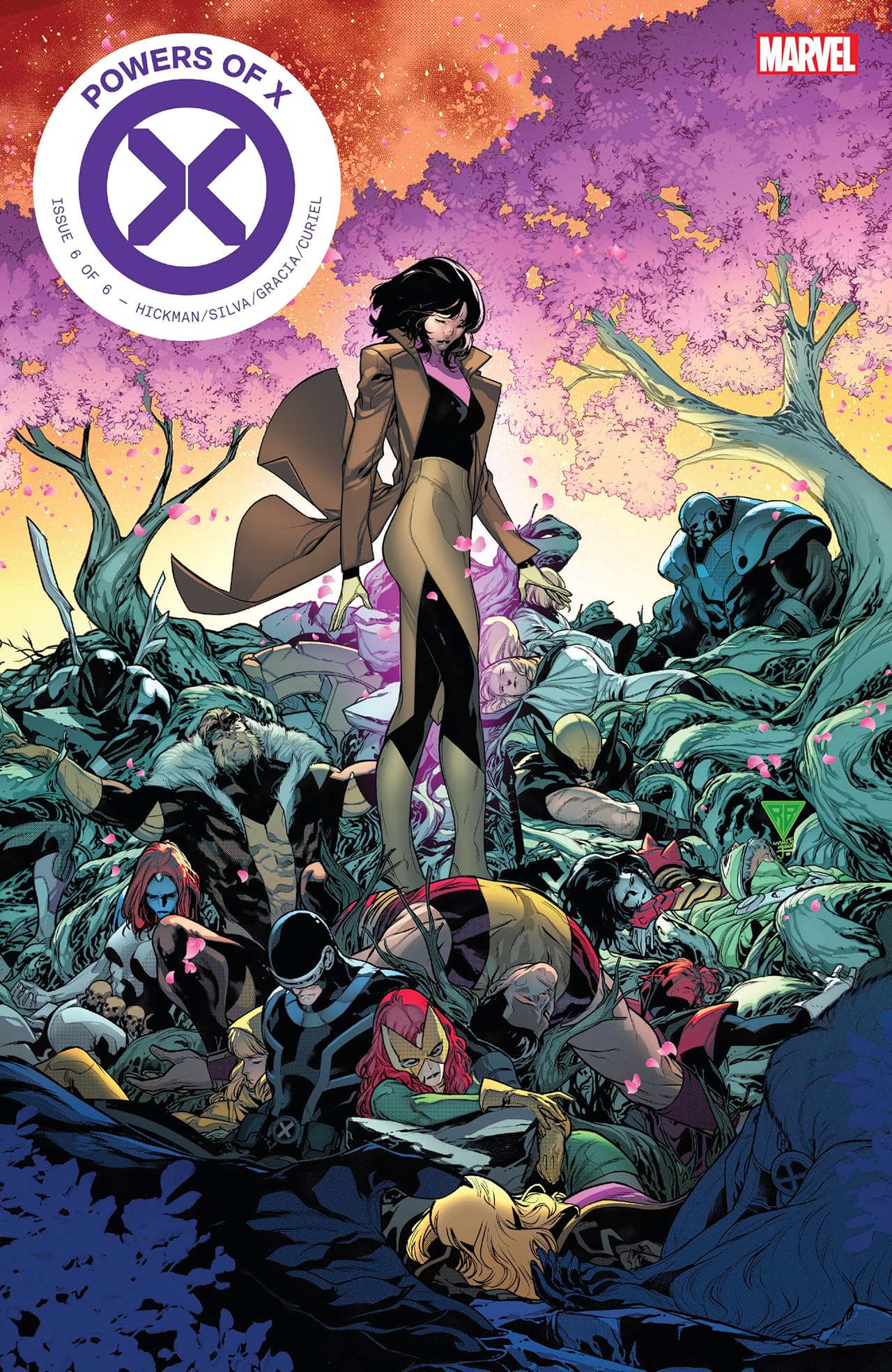
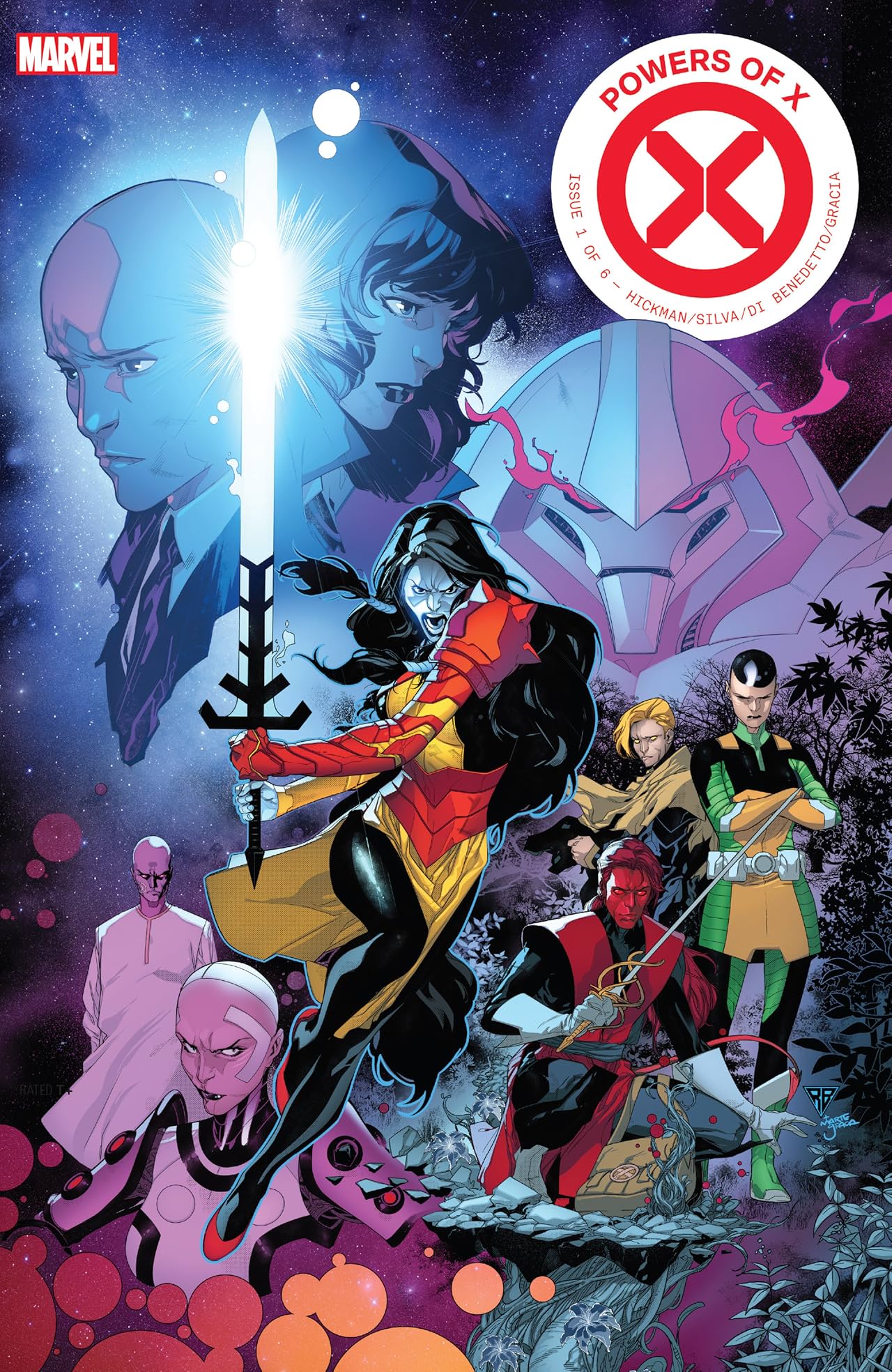
Jack Fisher’s Weekly Quick Pick Comic: Powers of X #6

When assessing the greatness of a particular story arc in comics, there are many factors to consider. There’s the quality of the writing, the strength of the characterization, the cohesiveness of the plot, the vibrancy of the artwork, and how it all fits together in terms of the greater narrative. Many comics succeed in some of these areas and are worth reading. Very few manage to succeed in most.

I usually try to avoid spoiling too much of a great story, but I will spoil one thing. “Powers of X #6,” and the overall story arc it capped off, is among those select few. In the history of X-Men comics, Marvel Comics, and superhero comics in general, this is one of those stories that will likely stand out as an example of what’s possible when all the right story elements are in place.

Writer Jonathan Hickman has always been someone with big ideas who builds even bigger stories around them. He starts with a concept. Then, he positions the characters around it in such a way that requires them to evolve in ways that they’ve never dared. From there, the story only gets bigger in terms of scope, scale, and impact.

He did it with the Avengers. He did it with the Fantastic Four. Now, he’s done it again with the X-Men. As a lifelong X-Men fan, who has seen some pretty awful runs and some exceedingly dark times, I cannot overstate how refreshing this story is. I honestly cannot think of a time when an X-Men story arc felt so meaningful and relevant.

I’ve highlighted and praised various issues of House of X and Powers of X before, but “Powers of X #6” faces a unique challenge that many story arcs fail to overcome. It can’t just end the story on a particular note. It has to fill in some lingering plot holes while leaving just enough unfilled for future stories to build on. It’s a difficult balance to strike and one past X-Men story arcs have come up short.

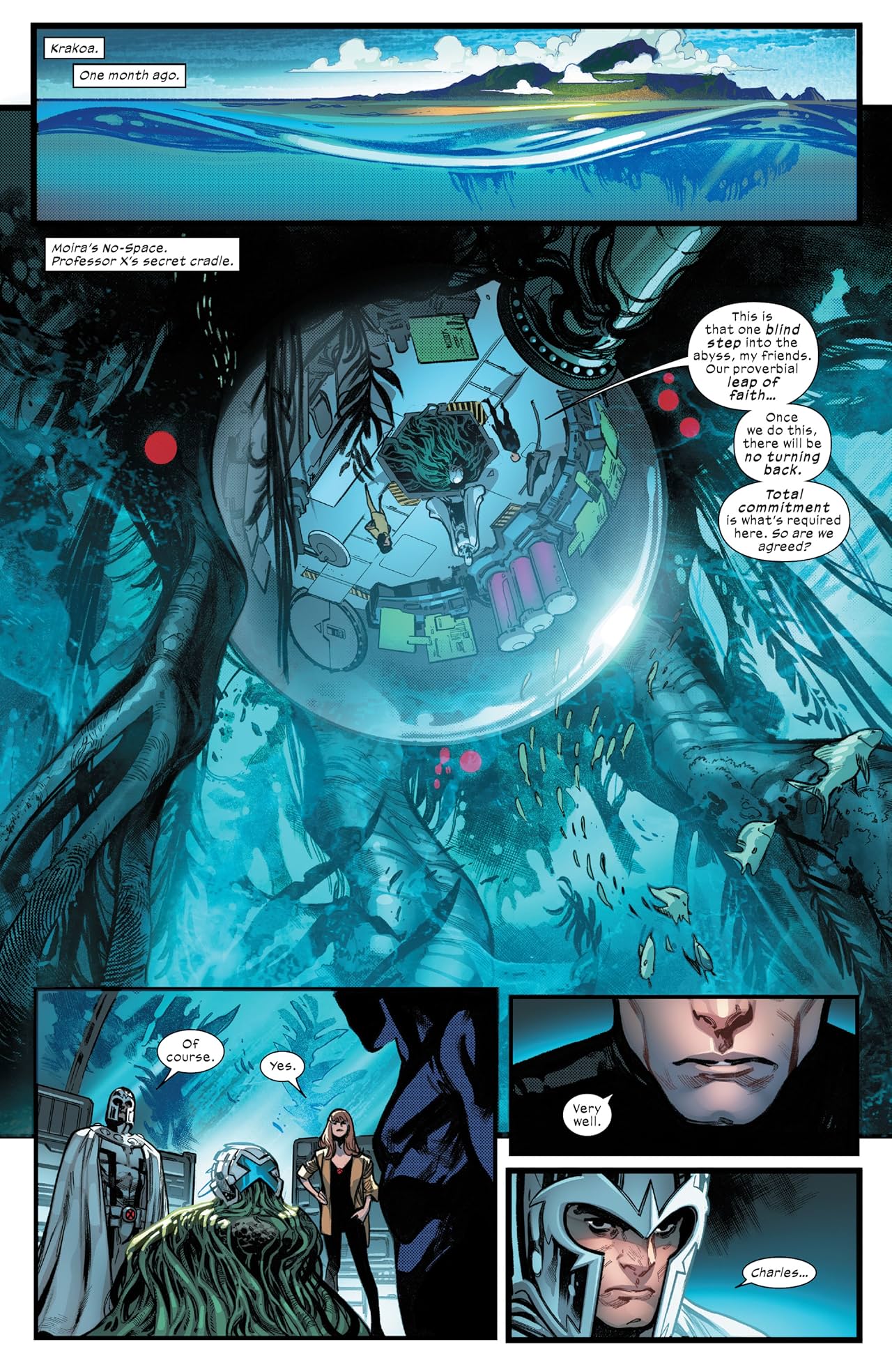
That balance never falters in “Powers of X #6.” It fills in a few key plot holes, most notably the events of Moira MacTaggart’s mysterious sixth life. At the core of this story, and everything that stems from it, is the impact of Moira MacTaggart. It’s not hyperbole to state that she is now the most important character in the X-Men mythos.

Her role doesn’t just involve revealing what worked and didn’t work in terms of mutants trying to survive in a world that hates and fears them. In “Powers of X #6,” she witnesses the ultimate endgame for the human/mutant conflict. She sees the inevitable result of this conflict, regardless of which side she takes.

It doesn’t matter if someone sides with Magneto.

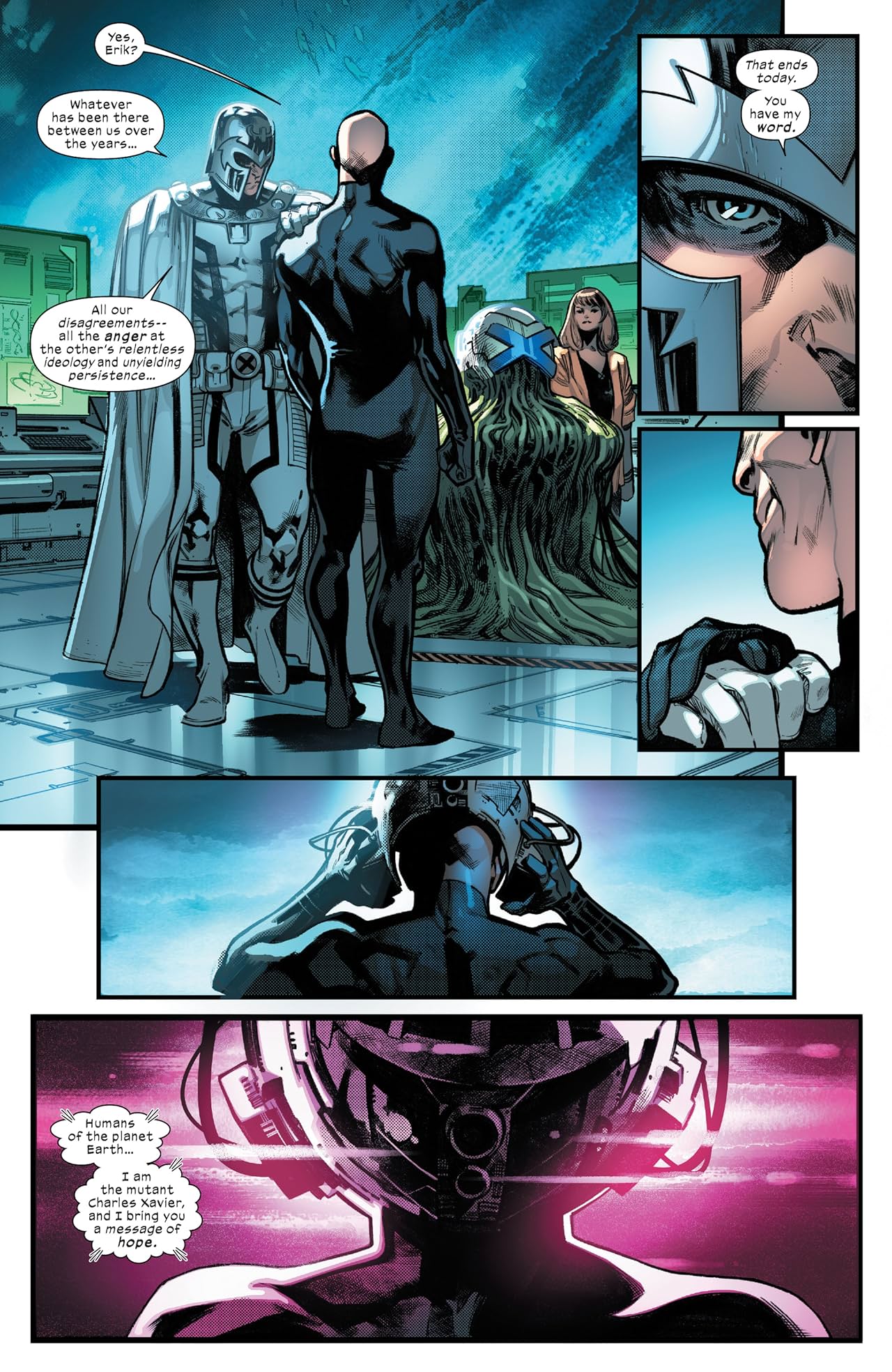
It doesn’t matter if someone sides with Professor Charles Xavier.

It doesn’t even matter if someone swears allegiance to Apocalypse and fights by his side.

The events in “Powers of X #6” establish that none of these conflicting groups, who have been clashing in X-Men comics since the Kennedy Administration, will be vindicated in the long run. Ultimately, they will be defeated, but not by the forces they think.

It’s a point that Hickman makes clearly by building on key moments established in past issues of Powers of X and House of X. Within these moments, harsh truths are dropped and fateful choices are made. They help give the achievements that played out in “House of X #6” even more weight. They also establish the stakes the X-men, and the entire mutant race in general, face moving forward.

These are powerful moments that impact the past, present, and future of the X-Men. Through Moira, the greatest threats facing mutants takes a very different form. It’s not a menacing new Sentinel. It’s not some mutant tyrant, either. It’s not even some bigoted human who thinks interment camps are still a good idea. I won’t spoil the particulars, but c makes clear that the X-Men have an uphill battle.

That’s saying a lot, considering the mutant race is more united than it has ever been. They have a home in Krakoa. Teammates who have been dead or missing for many years are back. They have valuable resources that the world wants. They’ve even won over their greatest enemies, like Apocalypse.

However, even with Moira’s foresight, that still might not be enough.

It might be the greatest achievement of “Powers of X #6.” It is an ending to a bold new beginning for the X-Men, but it also redefines the challenges they face. Through Hickman’s skilled world-building and artist R. B. Silva’s brilliant renderings, it genuinely feels like a true paradigm shift for X-Men comics.

They’re still mutants. They’re still the same superheroes they’ve always been. Their goals haven’t fundamentally changed that much. What has changed are the stakes, the forces opposing them, and their approach to dealing with them. It feels both hopeful and dire at the same time.

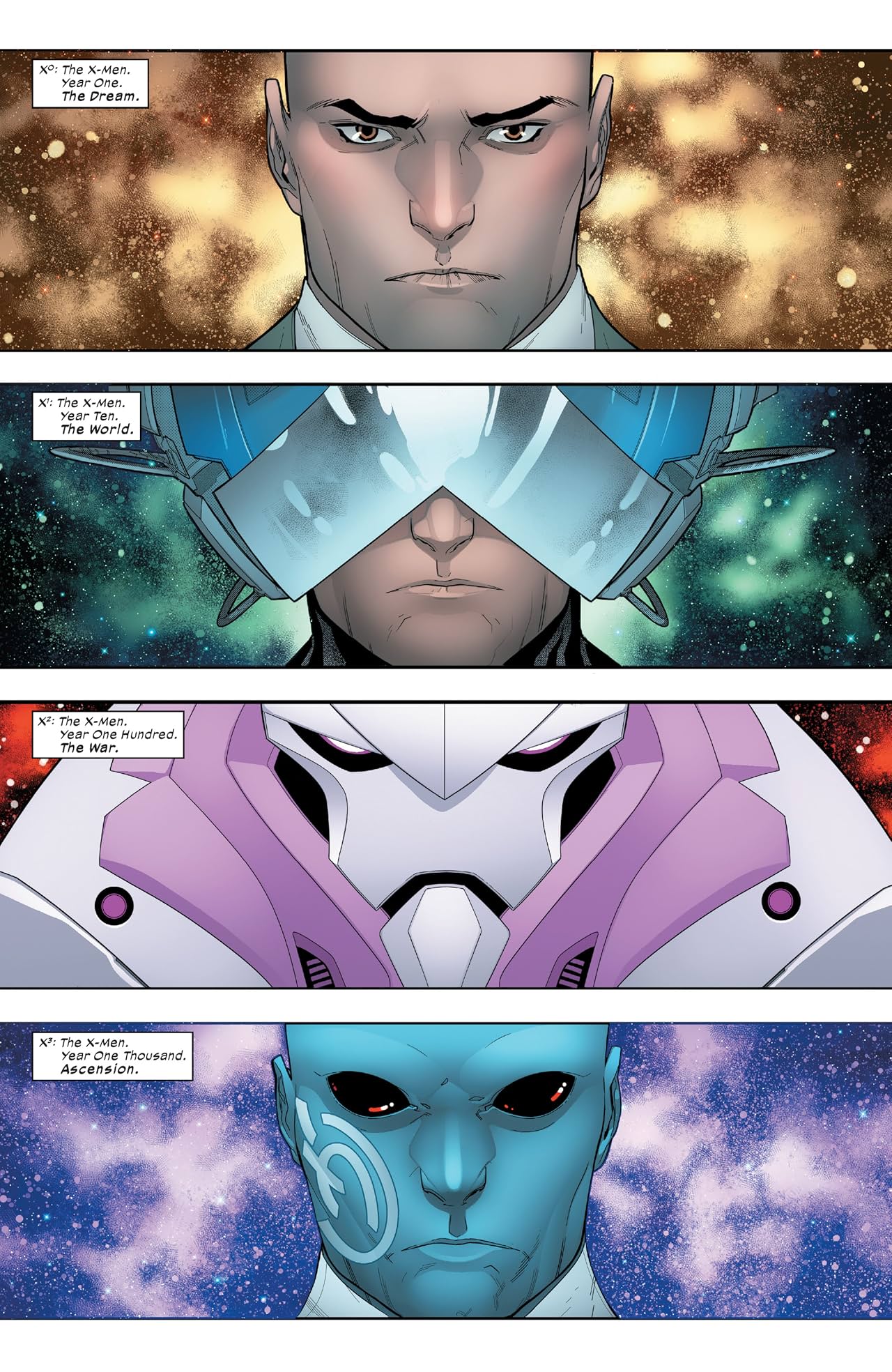
Whereas “House of X #6” establishes the promise of a brighter future for mutants, “Powers of X #6” reveals the ultimate barrier to that future. It’s not something they can shoot, blast, stab, or punch. If they want to succeed, then they have to fundamentally change how they go about Charles Xavier’s dream. Moreover, the dream itself needs to evolve.

Years from now, X-Men fans will likely look back on “Powers of X #6” as a defining moment for a narrative that has been unfolding for over 50 years. Those moments are few, far between, and precious. This one in particular may go down as one of the most uncanny.

Leave a comment

Filed under Jack's Quick Pick Comic, X-men

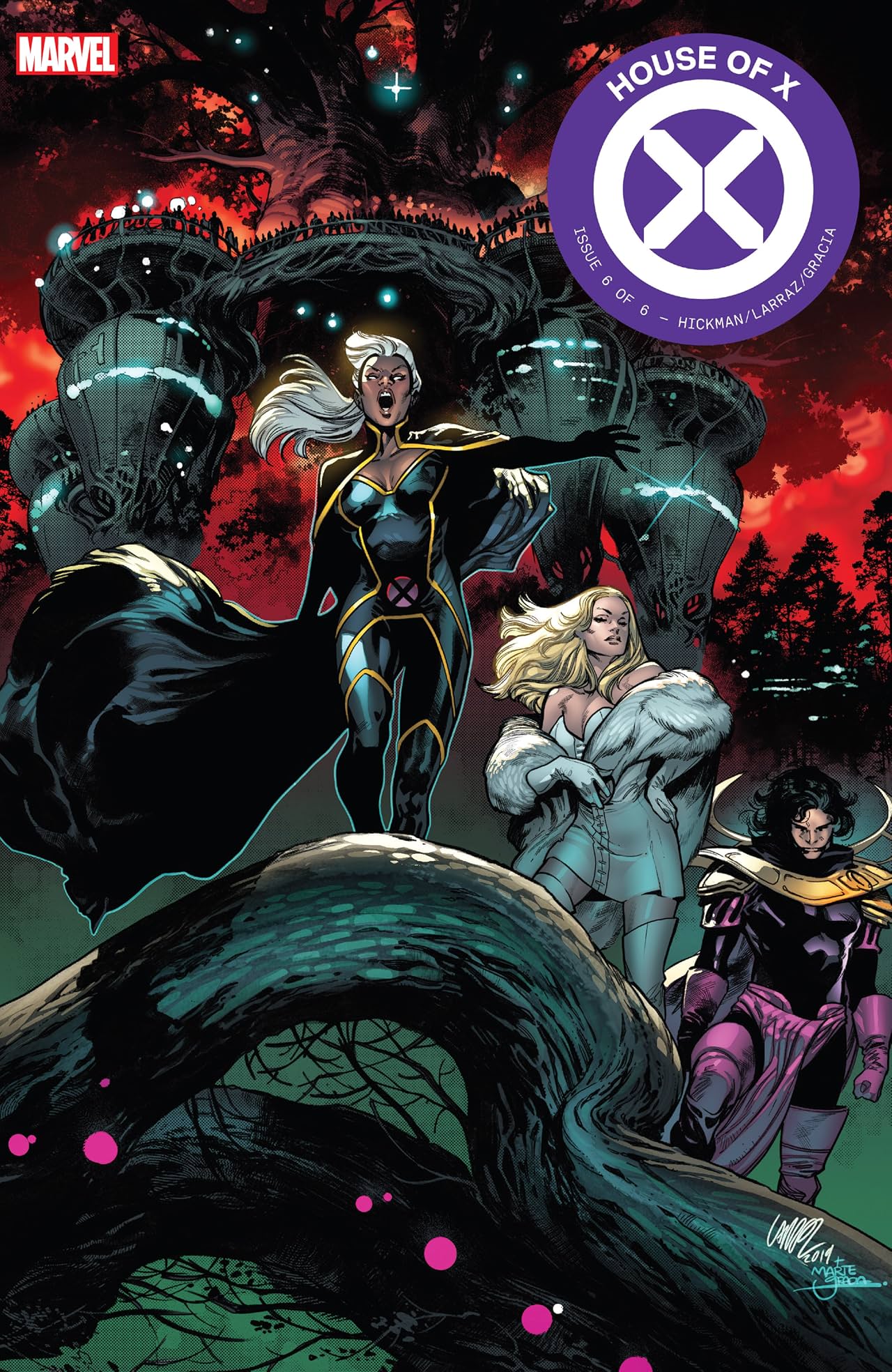
Jack Fisher’s Weekly Quick Pick Comic: House Of X #6

There’s an unwritten rule in superhero comics. Heroes can enjoy a happy ending every now and then. However, it can only go so far. For every happy ending, there must also be a setup for the next conflict. It also can’t be too happy. The struggle can never stop or slow down. More epic battles must follow. Where else will Marvel and their Disney overlords get ideas for new billion-dollar movies?

Sometimes, the happy endings are as short-lived as they are shallow. This is especially true of X-Men comics. Their struggle is more complicated than fighting hordes of Hydra soldiers or battling invading Chitari armies. Sure, they regularly battle killer robots, but the primary source of their problems come from hatred and fear. There’s only so much they can triumph over that. A typical internet comments section is proof of that.

As a result, any victory the X-Men enjoy seems fleeting. Any semblance of a happy ending or true progress comes off as shallow or temporary. That has been my experience, as a lifelong X-Men fan. Then, “House of X #6” comes along and in the span of a single book, those unwritten are bent, broken, and redefined.

Throughout the X-Men’s colorful history, there have been many defining moments. Unfortunately, most of them often involve tragedy, destruction, and decimation. The moments that involve a triumphant, happy ending that feels like real progress in their struggles are few and far between. That only makes “House of X #6” more precious in the grand scheme of things.

This epic, world-building narrative began with a simple proclamation from Charles Xavier. While humanity slept, the world changed. In “House of X #6,” the sheer breadth of that change becomes clear. Xavier doesn’t just announce to the world that things are different. He explains why and how they got to this critical point.

It’s the kind of speech that leaves you anxious, astonished, concerned, and elated, all at the same time. He doesn’t talk around the truth or rely on alternative facts. He lays out clearly what mutants have been through. Even if you haven’t been following the X-Men comics for the past several decades, you get a clear understanding of how they got to this point.

They’ve been bullied, attacked, ignored, and driven to the brink of extinction more than once. They’ve clashed with other superheroes while being held to a different standard. In a world where so many other people have superpowers and aren’t subject to constant killer robot attacks, mutants are seen as a menace.

Now, they’re not just outcasts fighting for their lives and working towards impossible dreams. They’re a full-fledged society. They now have a home in Krakoa, which is now a full-fledged nation. They have their own culture and identity that they’re willing to fight for. These all feel like changes that are exceedingly overdue. Writer Jonathan Hickman finally put it into words while artist Pepe Larraz gave it vibrant visuals.

It’s a beautiful, cathartic moment that X-Men fans of all kinds can appreciate. On top of this momentous announcement, Hickman adds a few more details to the world-building. Now that mutants have their own nation, they have to go about governing it. It’s the kind of detail that tends to get overlooked in most superhero narratives, but it’s those same details that give depth to this emerging status quo.

The government of Krakoa is not overly complicated, but it’s still comprehensive in its vision. Hickman does not skimp on the details. We even get to see how Krakoa handles difficult issues, such as major laws and what to do with those who break them. It’s not quite like watching a mutant version of C-SPAN, but it gets the point across.

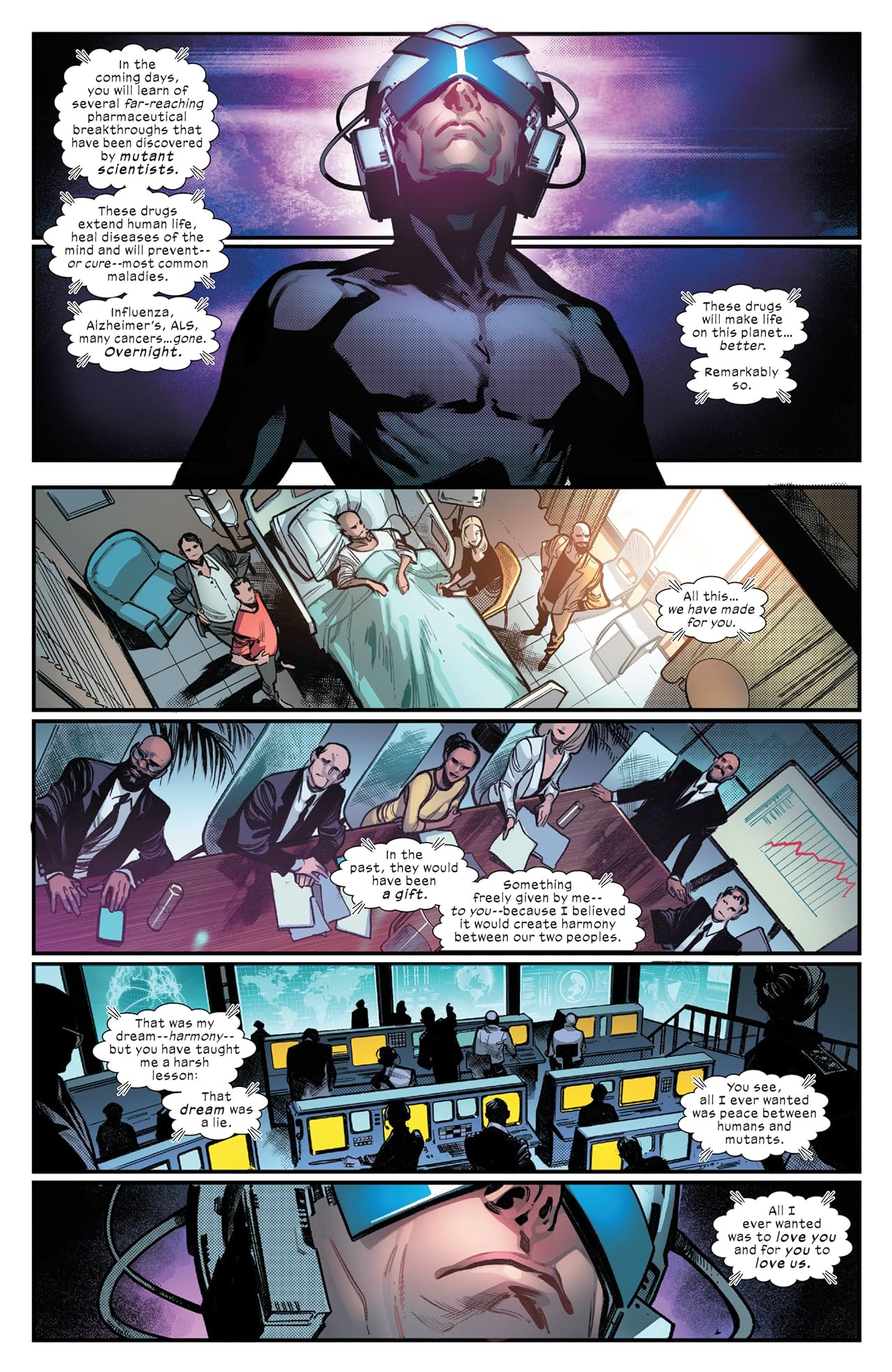
This isn’t just mutants consolidating their power. They’re trying to function as a real nation with real connections in the international community. They’re not going to be some isolated enclave. They actually have something to offer the world with the miracle drugs Krakoa produces. However, they’re not treating them as bargaining chips or gifts. They’re real assets with which to create standing in the world.

It’s uncharted territory for mutants. It also opens the door to a new host of complications, but for once, they don’t involve drawing battle lines between humans and mutants. Xavier still seeks peace, but not through impossible dreams anymore.

This is a huge shift for Charles Xavier’s character. It’s a huge shift for the X-Men, as well. They’re not just a team of mutant superheroes anymore. They’re something greater and “House of X #6” is their way of announcing that to the world.

I won’t spoil the many other ways Hickman and Larraz explore this exciting new world. There are plenty of moments that set the stage for a very different kind of struggle with the X-Men. There are also a few hints that they’ll be dealing with a few threats down the line, some more familiar than others. That’s unavoidable, both for superheroes and blossoming nations.

However, I will spoil one critical detail. “House of X #6” gives the X-Men, mutants, and long-time fans a reason to celebrate. It wasn’t that long ago that the X-Men were in a dire state. Marvel was going out of their way marginalized them in favor of propping up the Inhumans. Major characters were being killed off, left and right. Now, in wake of this issue, those dark days feel like distant memories.

The events of “House of X #6” feel like the end of a long, tumultuous period of tribulations and the beginning of a new era. It’s not all doom and gloom, for once. There’s reason to be happy. There’s reason to grab a beer and celebrate. If the X-Men comics were to end with this issue, it would be a damn good ending.

A new world has been built. A new era has arrived for the X-Men. It’s as satisfying as it is overdue. To X-Men fans of all kinds, get some friends, grab a cold beer, and have a party. Hickman has given us a reason to celebrate.


1 Comment

Filed under Jack's Quick Pick Comic, X-men

Five Reasons Why Joss Whedon Should Direct The First X-Men Movie In The Marvel Cinematic Universe

x-men-mcu-disney

These are exciting times for X-Men fans. The Fox era of X-Men movies is over. With Disney’s purchase of Fox, a new era is set to begin. There are no more divergent timelines or soft reboots. The X-Men are coming to the Marvel Cinematic Universe. It may not happen for a while, but the process has already begun. It’s only a matter of time.

As a lifelong X-Men fan, I’ve discussed both the possibilities and the immense potential of this development. I’m sure I’ll discuss it plenty more as news, rumors, and what not emerge over the next few years. Until then, there isn’t much to go on.

While there are plenty of details to explore, in terms of story, there’s one logistical issue that I feel is worth addressing. It has to do with who will help guide the X-Men into the MCU. Now, it’s a given that Kevin Feige will be the mastermind behind it all. He is, after all, the alpha and omega of all things Marvel Studios. He’ll be the one with the vision, but he’ll still need someone to turn that vision into a tangible product.

That’s not going to be easy for the X-Men. This isn’t the same as making “Ant Man” a viable franchise. The scope and scale of the X-Men franchise is immense. There’s a reason why it lasted 19 years with Fox. It has a wealth of characters, iconic stories, and endearing themes that are as relevant as ever.

Bringing X-Men to the MCU will be a massive undertaking. With that in mind, I’d like to make the case that there’s one director who is uniquely qualified to take on this challenge. Most already know his name and he has already left his mark on the MCU. I think he’ll leave an even bigger mark by taking this on. That name, of course, is Joss Whedon.

Hold your applause/outrage, please.

Now, I know Whedon’s name doesn’t carry the weight it once does. His success really peaked with the first “Avengers” movie, but since then, he’s somewhat faltered. It hasn’t helped that he suffered some bad press, some of which I’ve touched on. Even with these setbacks, and even because of them, I believe he’s the best choice for leading the X-Men into this new era.

As always, I know there will be those who vehemently disagree. I understand that and even welcome those counterarguments in the comments. That said, I’d like to offer five reasons to make my case that Mr. Whedon is the man for the job.


Reason #1: He Has (Successful) Past Experience With X-Men

Joss Whedon is no stranger to the X-Men. In fact, he probably has more experience with this franchise than he did with the Avengers. He did script work on the first X-Men movie. He was also on the short-list to direct multiple X-Men movies at one point. He’s gone on record as saying that he’s an X-Men fan.

Outside the movies, Whedon’s credentials run even deeper. In the early-to-mid-2000s, he penned an acclaimed run for the Astonishing X-Men comic. If you were to talk to any X-Men fan during that time, myself included, they would’ve said the same thing. Whedon’s run on Astonishing X-Men was one of the best of its era.

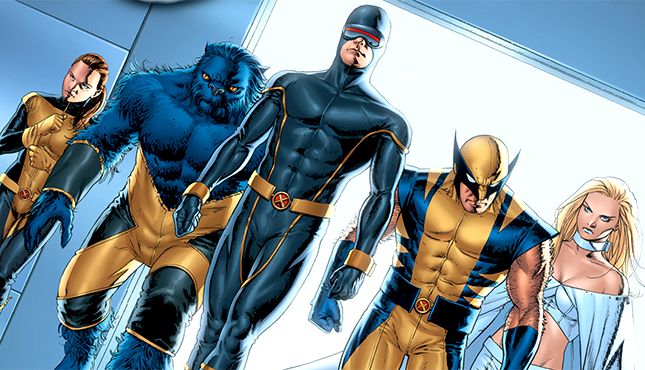
Through that run, he demonstrated a strong appreciation of these character. It wasn’t just the female characters either, although they definitely shined. He understood the personalities, dynamics, and quirks with characters like Cyclops, Emma Frost, Wolverine, and Kitty Pryde. He gave them all a chance to demonstrate why they’re so iconic.

While the Fox era of X-Men movies did plenty for Wolverine, Charles Xavier, and Magneto, they rarely succeeded for other major characters. Some, like Cyclops and Rogue, were outright butchered. While Whedon has mishandled characters in the past, his experience with X-Men should help avoid that.

Given the size and scope of the MCU, the margin for error will be small. Having a director who knows, understands, and cares about these characters will go a long way compared to one who is unfamiliar with them. Just ask Josh Trank.


Reason #2: His Style Will Give The X-Men The Right Tone For The MCU

Whether it’s a movie or TV show, Joss Whedon’s work has a distinct tone and style to it. There’s often a tight blend of light-hearted character moments mixed with serious drama. There are also plenty of jokes and quips, but not nearly on the level of an Aaron Sorkin script. For the most part, Whedon works to humanize his characters while making them lovable and relatable in their own way.

That kind of approach is exactly what the X-Men need in the MCU. It’s an approach that has already been proven with the first “Avengers” movie, as well as “Avengers: Age of Ultron.” In each case, both the heroes and the villains had moments where they could joke around, but still have heated arguments when necessary. It was a big part of what made these movies so entertaining and memorable.

The X-Men have had their share of funny moments during the Fox era. Unfortunately, most of them came from Deadpool and the always-charming Ryan Reynolds. By the standards of modern superhero movies, the original X-Men trilogy was very serious and even a little dark. Granted, that was necessary, if only to distance itself from the excessive camp in “Batman and Robin.” Things are different now.

The X-Men franchise has had plenty of bleak, serious moments in recent years. As great as “Logan” was, the franchise could benefit from something more uplifting and Joss Whedon’s style fits that perfectly.


Reason #3: He Knows How To Balance Action, Character Development, And Melodrama

This is something else that’s readily apparent to anyone who read Joss Whedon’s run on Astonishing X-Men or seen at least one season of “Buffy: The Vampire Slayer.” Say what you will about his feminist credentials. The man knows how to strike that critical balance between action, character development, and melodrama.

He did plenty of balancing with action and character development in “Avengers,” but X-Men will need a lot more melodrama to succeed. That’s because all those soap-opera elements that tends to complicate other action franchises are a core part of the X-Men’s DNA. They have been since the heyday of Chris Claremont’s run on the comics.

I’m not just talking about romantic sub-plots and love triangles, which have been a detriment to previous X-Men movies. Being an X-Men and a mutant is full of both personal and interpersonal drama. It’s part of what makes these characters relatable and iconic. People might not be able to relate to the Asgardian God of Thunder, but they can relate to someone who is born different and struggles to cope with those differences.

Add clashes with killer robots and murderous bigots to the mix and you’ve got plenty to work with. In the MCU, where superheroes and super-powers already exist, these are exactly the kinds of complications that can keep things interesting and Whedon has experience doing just that.


Reason #4: He Has Something To Prove (And So Does The X-Men Franchise)

As I noted earlier, Joss Whedon’s career and personal life have taken quite a downturn in recent years. In addition to his divorce, his creative decisions during “Avengers: Age of Ultron” were subject to controversy. Some may argue the extent of that controversy, especially given the box office of that movie, it’s still telling that Whedon hasn’t been involved with the MCU ever since.

On top of that, Whedon name has been unfairly linked to the massive commercial failure of “Justice League.” Now, there’s a lot to be said about the problems with “Justice League,” but I think it’s wrong to lump them on Whedon. He came into a movie that was radically different from his usual style and was already grossly overbudget and behind schedule.

Fair or not, Whedon’s credibility has taken hits on multiple fronts. By spearheading the X-Men’s arrival into the MCU, he has a chance to rebuild it. His career is far from over. Even with the upheavals in his personal life, he hasn’t burned too many bridges or completely lost the trust of fans.

If he has any kind of ego, and most people in Hollywood do, he’ll be more motivated than most to succeed with the X-Men in the MCU. At the same time, the X-Men franchise has just as much to prove. Even with the success of “Logan” and “Deadpool,” not one X-Men movie has ever topped a billion dollars.

As a franchise, the X-Men have fallen behind in the superhero hierarchy. Entering the MCU is their chance to show that they deserve to be in the same world as these multi-billion dollar success stories. To some extent, both Joss Whedon and the X-Men franchise need each other.


Reason #5: He Knows How To Balance New Ideas With Classic Elements

The X-Men that show up in the MCU will be different from the X-Men we saw in the 19 years of movies. That’s a given. It’s only a question of how different they’ll be. That will likely be a key consideration because while the X-Men movies had their share of flaws, they did a number of things that worked exceptionally well, Deadpool being the most notable.

While it’s likely that Marvel Studios won’t do much to change Deadpool, there will definitely need to be some fresh nuance to the X-Men. As it just so happens, Joss Whedon is better than most when it comes to balancing new ideas with classic themes. He did that with Astonishing X-Men in the comics. He did that in both “Avengers” movies, as well.

While some elements worked better than others, they still came together in a polished product that made billions. The X-Men will need that balance as they enter the MCU. Unlike other characters and teams that have been introduced, the X-Men come in with 19 years of cinematic baggage. It must distinguish itself in this new era.

That’s not going to be easy. Depending on when they show up, the MCU could be very different from the one that just culminated with “Avengers Endgame.” Whedon, given his experience, is certainly up for that challenge.


There’s little doubt that mutants coming to the MCU will be a huge upheaval. How Marvel Studios and Disney go about it could determine whether the MCU continues to dominate at the box office or finally runs out of steam. This incredible cinematic world has delivered time and again, overcoming immense challenges and breaking box office records along the way. They’ve earned the benefit of the doubt.

Joss Whedon may or may not be the one to lead the MCU into this new era. I think he has what it takes. I hope he gets a chance. There’s a lot of uncertainty with the X-Men franchise right now, but this is a franchise that has overcome major struggles before. With the Disney machine and the MCU behind it, I don’t doubt for a second that it can become uncanny once more.

1 Comment

Filed under Marvel, Marvel Cinematic Universe, movies, superhero comics, superhero movies, X-men

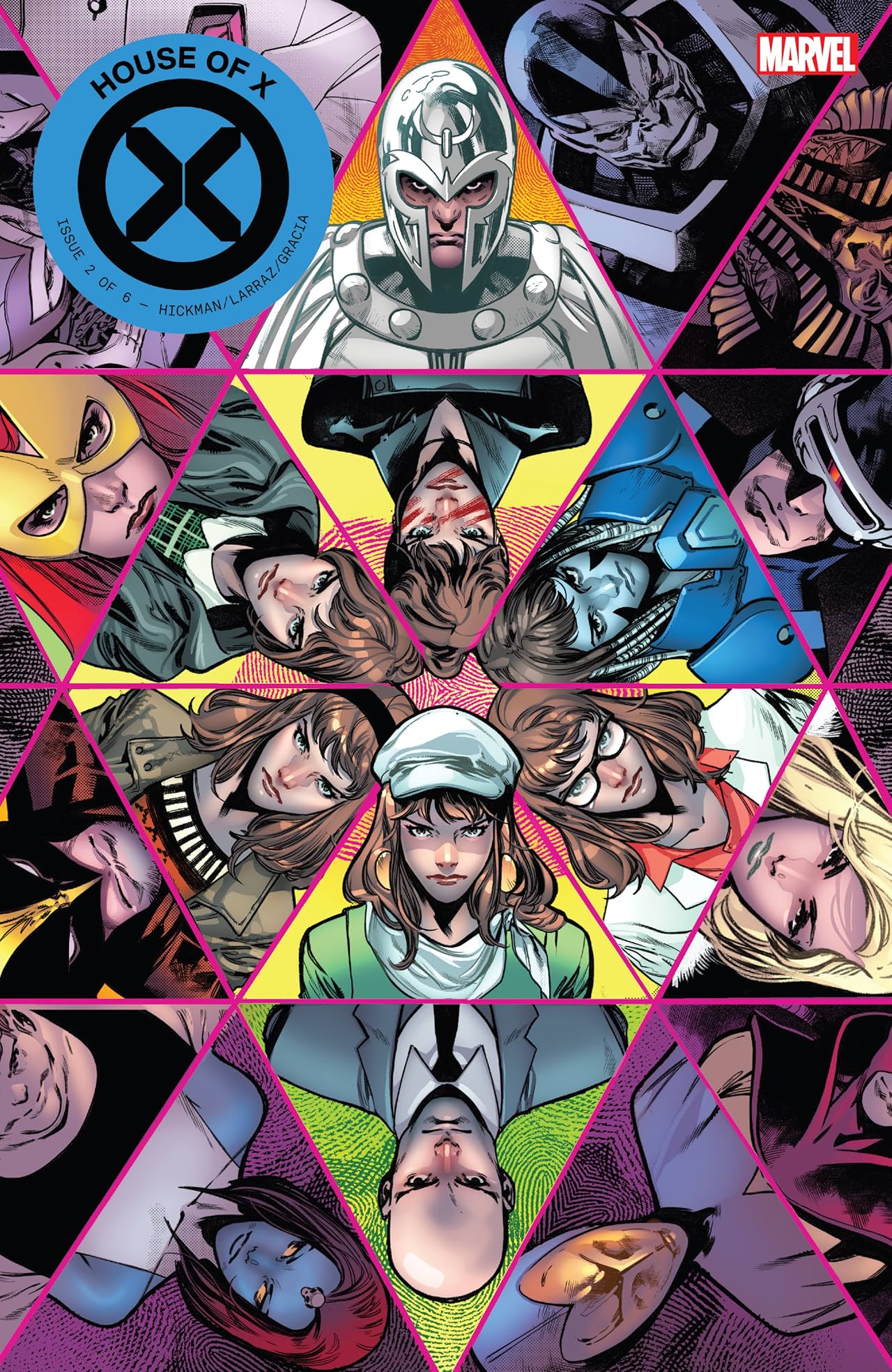
Jack Fisher’s Weekly Quick Pick Comic: House of X #2

What would you do if you could live your entire life over again with all the memories of your previous life? What if you could do that more than once and come into the world with knowledge and experience equivalent to multiple lives? Movies like “Groundhog Day” and “Edge of Tomorrow” attempted to answer that question in part. Jonathan Hickman tries to answer that question more fully in “House of X #2.”

As someone who has been reading comics for a sizable chunk of his life, I know how rare it is to see a single issue come along that both redefines a character and explores a host of new, exciting concepts. I thought “House of X #1” was one of those once-in-a-decade comics that wasn’t going to be matched for a good long while. I was wrong.

I’m glad I was wrong too because what Hickman accomplishes in “House of X #2” is as remarkable as it is engaging. It doesn’t just give context to the previous events that were revealed in both “House of X #1” and “Powers of X #1.” It completely redefines the entire history of the X-Men.

For a series that includes multiple time travel plots and multiple dystopian timelines, that’s quite an accomplishment. It’s how Hickman and artist Pepe Larraz go about it that makes “House of X #2” so impactful. It begins and ends with how the story rewrites the role of Moira MacTaggart.

It’s not hyperbole to say that this single issue makes Moira the most important character in the history of the X-Men, the mutant race, and their future. For a character who was either a love interest for Charles Xavier or a side-character who often got overshadowed by other mutants, that’s quite an accomplishment.

This is not the same Moira from the “X-Men First Class” movie. This version of Moira is a mutant with a very unique power. It doesn’t involve shooting lasers out of her eyes, reading minds, or shape-shifting. Her power is basically a more complete version of the abilities that Bill Murray and Tom Cruise enjoyed in the aforementioned movies.

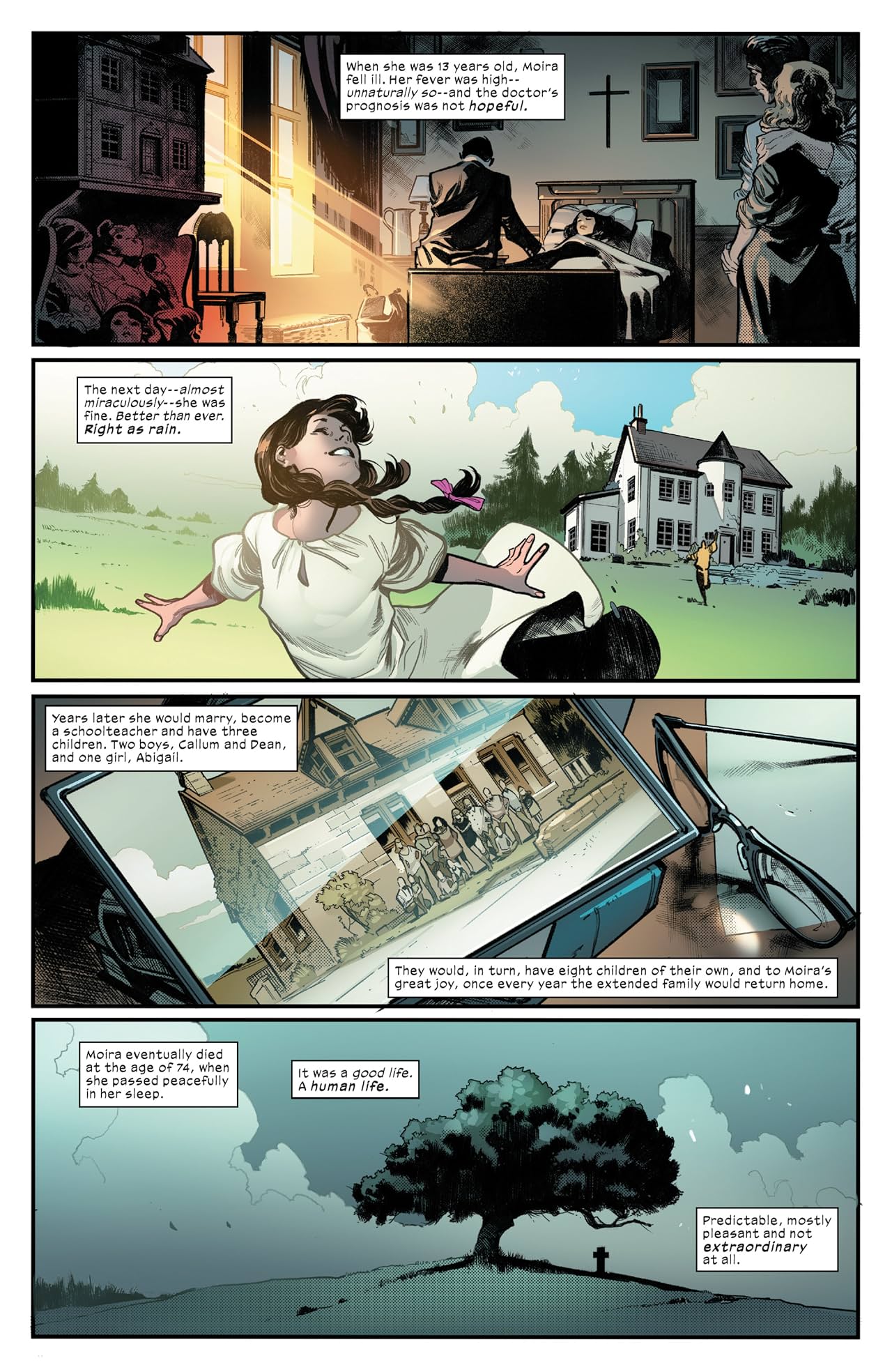
In essence, Moira lives her entire life, dies, and is reborn with all her memories and experiences intact. It’s not restricted to a single day. It’s not indefinite, either. Like an old Mario game, she has a limit to the number of lives she can live. What she does with them is up to her. Knowing what happens to mutants, humans, the X-Men, and Charles Xavier informs her choices.

It raises many profound questions about Moira’s role in the history of the X-Men and the Marvel universe in general. It also expands on how Moira came to influence the events of “House of X #1” and “Powers of X #1.”

The story, itself, is built around the multiple lives that Moira has lived. I won’t spoil the details, since this is one of those comics that needs to be read to appreciate the impact. I’ll simply confirm that she tries multiple approaches to averting yet another dystopian future for the X-Men, mutants, and humanity as a whole.

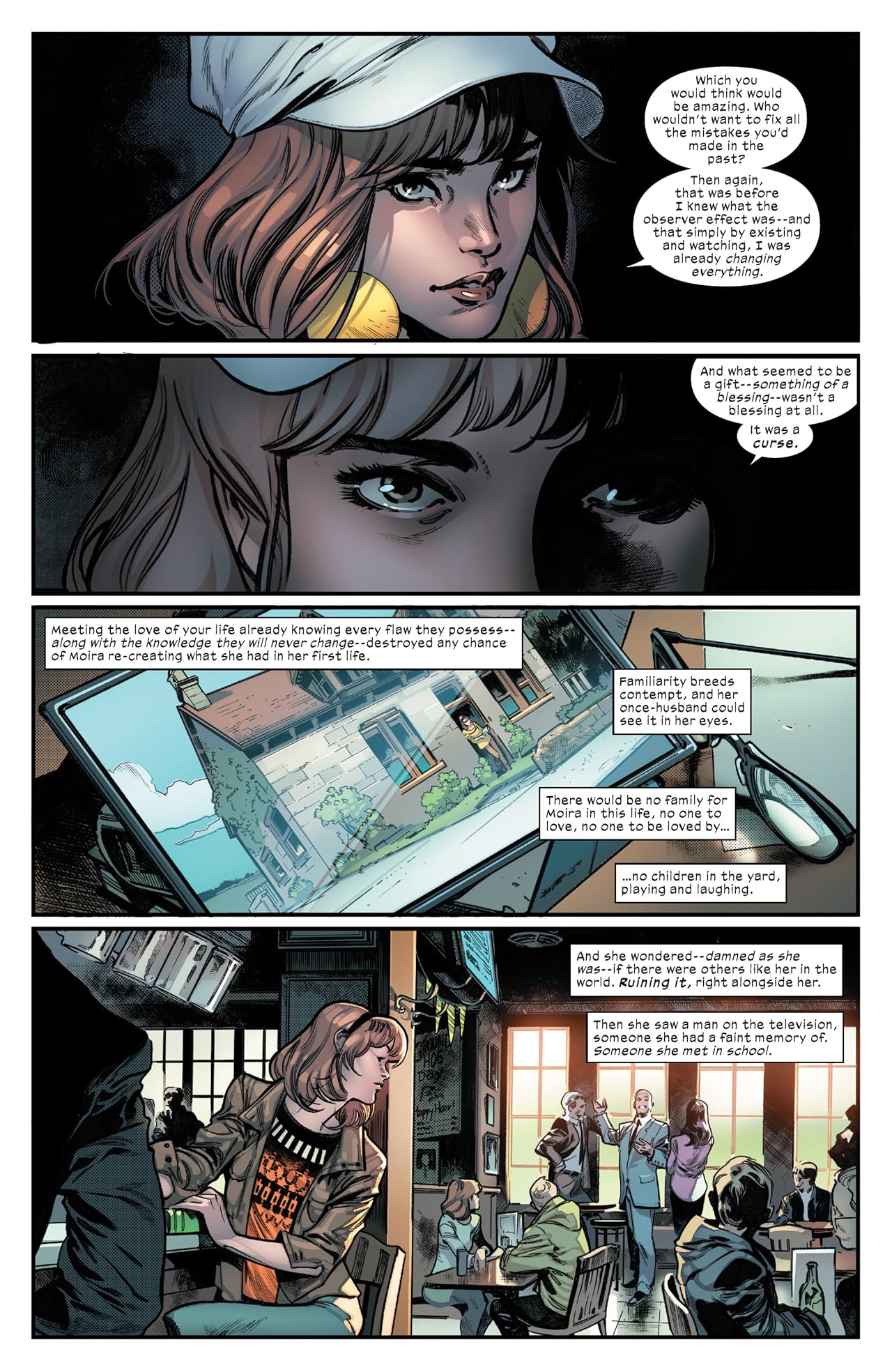
Some of those approaches involve working with Charles Xavier. Others involve actively opposing him. In all the lives leading up to her tenth, there are a few common themes. When two competing species inhabit the same world, there’s bound to be conflict. Efforts to escape or preemptively win that conflict rarely pan out.

Like Phil Connors constantly waking up on Groundhog Day, no matter what he does, Moira keeps hitting a proverbial wall. No matter what she attempts, there doesn’t seem to be a way around this conflict. It’s not until her 10th life that she comes to the realization that leads to “House of X #1.”

It’s hard to overstate how much “House of X #2” changes the overall context of the X-Men comic. Suddenly, Moira MacTaggart is the most influential character in the history of the X-Men, mutants, and everything in between. What she does, why she does it, and how she goes about it changes how we see the past, as well as the present.

The benefits of hindsight make it seem simple, but it isn’t. It also raises a great many questions. If Moira has all this knowledge, why didn’t she use it to achieve more? What made her choose the path that led to the most recent events for the X-Men and the Marvel universe, as a whole? Most of these questions go unanswered, but there are some telling clues that add even more intrigue.

Hickman and Larraz achieve something truly uncanny with “House of X #2.” I know I said the same thing about “House of X #1,” but that comic now has a greater meaning thanks to this one. The stakes for every other X-Men story that unfolds after this has a new meaning as well. Few comics can boast that kind of impact without being written by Jack Kirby, but “House of X #2” is definitely one of them.

Even for those unfamiliar with the convoluted history of the X-Men can appreciate the concepts this comic explores. We see someone who has lived multiple lives, cursed with knowing how things play out for those she cares for. She wants to make that life better for herself and the world as a whole. She’s in a unique position to pursue that change, but it’s fraught with more complications than any “Groundhog Day” rip-off could convey.

1 Comment

Filed under Jack's Quick Pick Comic

Jack Fisher’s Weekly Quick Pick Comic: Powers of X #1

Lifelong comic book fans like myself wake up every Wednesday morning with a mix of excitement, anticipation, and dread. It’s a weekly event in which the worlds we love grow just a little bit bigger. However, not all New Comic Book Days are treated the same. Some are more memorable than others and I have a feeling that “Powers of X #1” will make this particular Wednesday feel special for X-Men fans.

The X-Men comics are in a major state of transition and upheaval. In the past, that has usually meant they’re facing yet another extinction event. Whether it’s Sentinels killing 16 million mutants or the Scarlet Witch going crazy, big change usually means the X-Men have to stave off another genocide.

Writer Jonathan Hickman is not taking that approach. As someone who has been reading X-Men comics for a good chunk of his life, I find it both overdue and refreshing. In “House of X #1,” he set out to build a bold new world for mutants. In “Powers of X #1,” he puts this world into a much greater context that will likely have X-Men fans talking for years to come.

This new vision for the X-Men isn’t just causing major upheavals in the present. It’s having an impact on the past and future, as well. Historically, this usually means that there’s yet another terrible dystopian future about to unfold and the X-Men already have way too many of those.

With Hickman, however, it’s not nearly as clear-cut and that’s exactly what makes “Powers of X #1” so engaging.

This isn’t just another case of some fateful decision in the past having dire consequences in the future. There’s no moment with Skynet or time traveling assassins. With “Powers of X #1,” the story unfolds across four distinct time periods. One takes place in the X-Men’s past. The other continues part of the story in the present that begins in “House of X #1.” The last two take place at multiple points in the future.

While much of the story unfolds in the future, there’s a never a sense that they’re too disconnected from the past or present. There are a host of new characters with familiar powers and appearances. Artist R. B. Silva is not subtle in who inspired the designs of these characters and that’s critical because a lot transpires in a short span of time.

We don’t get to know these characters very well, given their limited face time, but they do plenty to establish distinct personalities and motivations. We get a sense for what they’re after and what’s at stake. It’s not entirely dystopian in tone, but it is dire and not just for mutants.

Once again, Hickman goes heave on the world-building. In between Silva’s colorful depictions are little insights into how this future took shape. It’s not a simple as one fateful choice or one fateful death. It’s more a culmination of conflicts.

Mutants are on the brink, but it’s not because of a plague or a genocidal war. In this future, humans aren’t the enemy, but what they’ve become certainly is. They’re not just a bunch of fearful, mutant-hating zealots trying to product themselves with killer robots. They’ve actually become something more menacing.

The details aren’t all in place, but the hints are there. While mutants built on the foundation that Charles Xavier established, humanity went down a different path and it’s not one conducive to peace, love, puppies, and whiskey. Familiar faces like the Nimrod Sentinel make that abundantly clear, but it’s the new faces that add the most intrigue.

Nimrod and the other humans around it aren’t just human anymore. They’ve become part machine, as well. However, these aren’t Terminator knock-offs. They still have personalities. They even talk and converse like humans. They’re a whole new order of humans that Hickman identifies as the Man-Machine Supremacy. Given the events of “House of X #1,” it fits perfectly.

It also makes a twisted bit of sense in a not-so-dystopian way. In a world where mutants are suddenly organized, complete with a homeland and collective vision, humanity seems doomed to obsolesce. They’re only choice is to evolve in a new way so they have a chance at competing.

The story covers many concepts and raises many questions, but “Powers of X #1” works because there are just enough hints at the answers. It perfectly complements what “House of X #1” established with respect to setting, tone, and vision. Hickman creates a perspective that neither humans nor mutants want to go extinct. They both seek a bold vision for their future, but there’s only room for one in the future.

Every vision begins with a dream. Bold visions inspire bolder actions. This is the heart of what makes the X-Men who they are. It’s also the driving force behind the many conflicts they face. A book like “Powers of X #1” doesn’t attempt to subvert that conflict. It simply dares to evolve it in a new direction.

What this means for the X-Men comics moving forward remains to be seen, but it’s very likely that “Powers of X #1” will be one of those comics that gets cited for years to come as a major turning point. It affirms that while all New Comic Book Days are special in their own right, some will always be more special than others.

2 Comments

Filed under Jack's Quick Pick Comic

Jack Fisher’s Weekly Quick Pick Comic: House of X #1

Ever comic book fan has been conditioned to revere Wednesdays as New Comic Book Day. It’s basically Christmas every week. However, much like Christmas, not all Wednesdays are equal in terms of the presents they bring. Every now and then, a Wednesday comes along that a certain segment of comic fans come to revere for years to come.

For X-Men fans, this will likely go down as one of those Wednesdays because “House of X #1” is just that astonishing. Every now and then, a book comes along that is presented as a major paradigm shift for the characters, the themes, and the over-arching narrative of a series. In superhero comics, books like that are hyped up at least once a month. Very few deliver on that hype. “House of X #1” is one of those select few.

To say that the X-Men comics needed a book like this is like saying an insomniac needs a good night’s sleep. For years now, going back to the days of “House of M,” both the X-Men and the entire mutant population of the Marvel Universe has been in a constant state of extinction-level crisis. Even when they’re not about to go extinct, they’re caught up in something that has them just one slip-up away from another dytopian future.

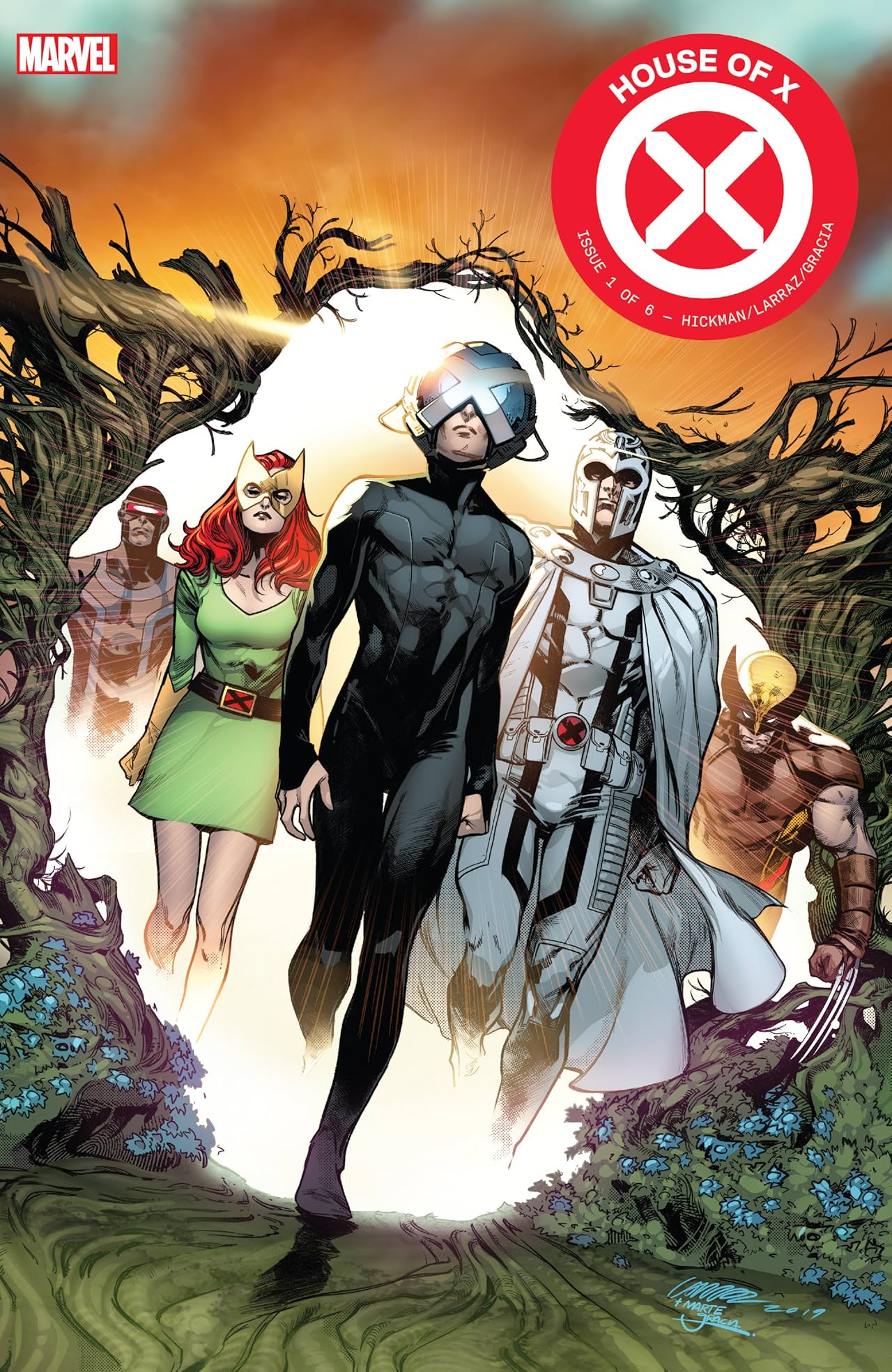
In “House of X #1,” writer Jonathan Hickman dares to rebuild the X-Men’s world without first sending them to the brink of extinction. For anyone who has followed X-Men comics for more than two years, this is like a breath of fresh air, a massage, and a chocolate milkshake all rolled into one. It shouldn’t be that radical a concept, but between Hickman’s vision and Pepe Larraz’s beautiful artwork, it sure feels like it.

This bold new world for the X-Men isn’t built around mansions with high-tech jets hidden below the tennis court. You won’t find orbiting asteroids, isolated nations, or island sanctuaries in the middle of San Francisco Bay. This world is more than a nation or sanctuary. It’s a bold new form for Charles Xavier’s dream.

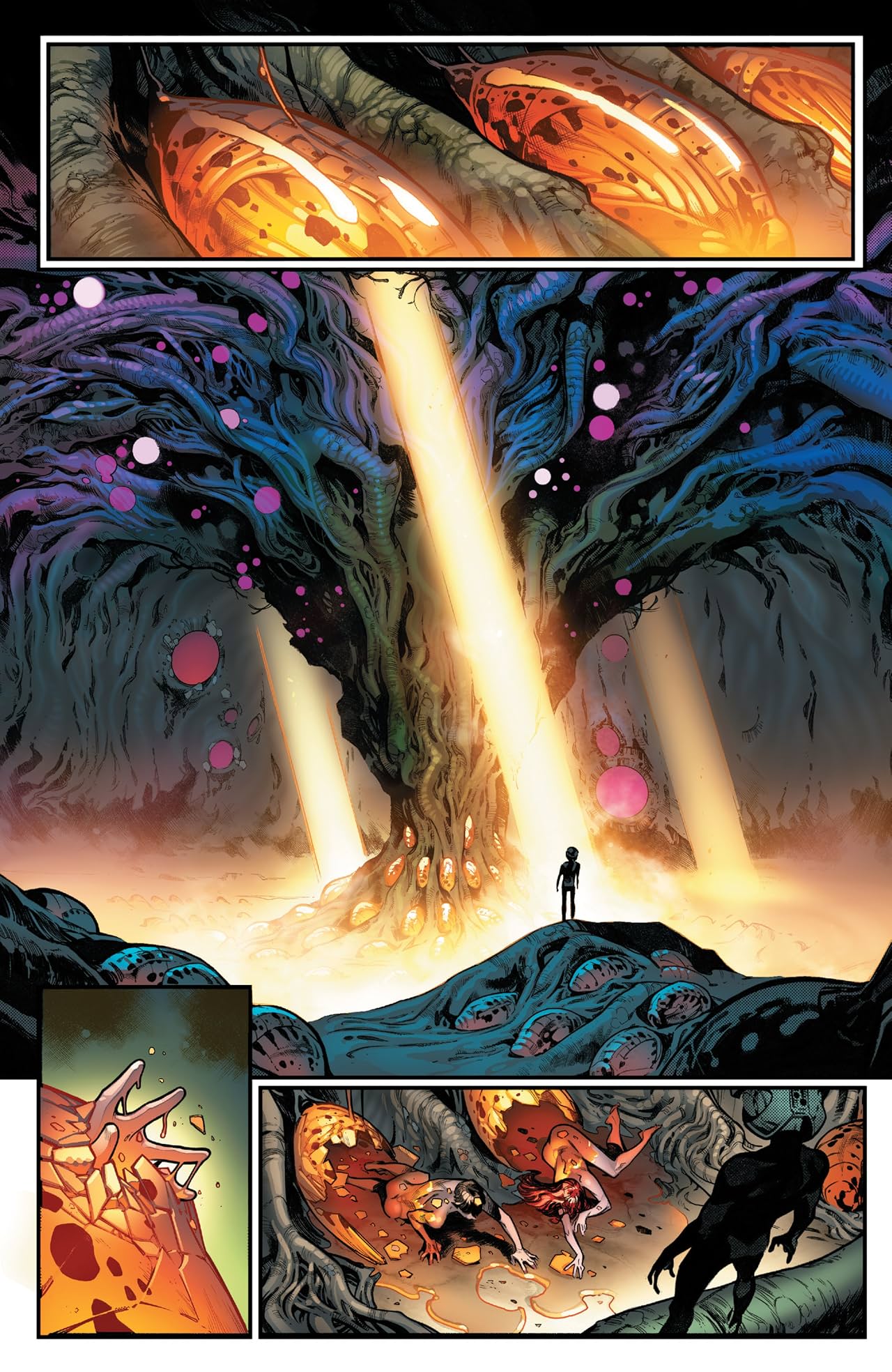
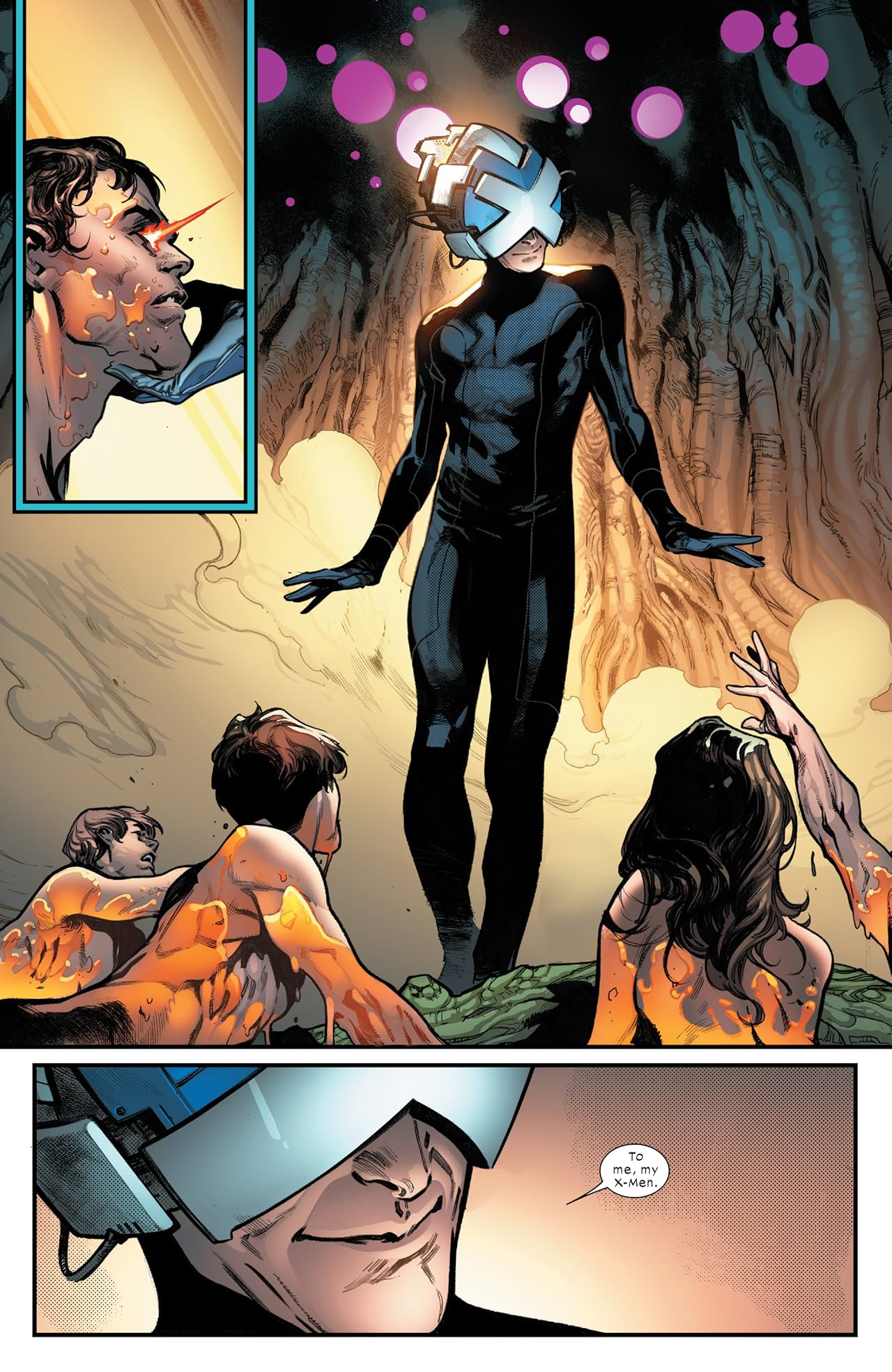
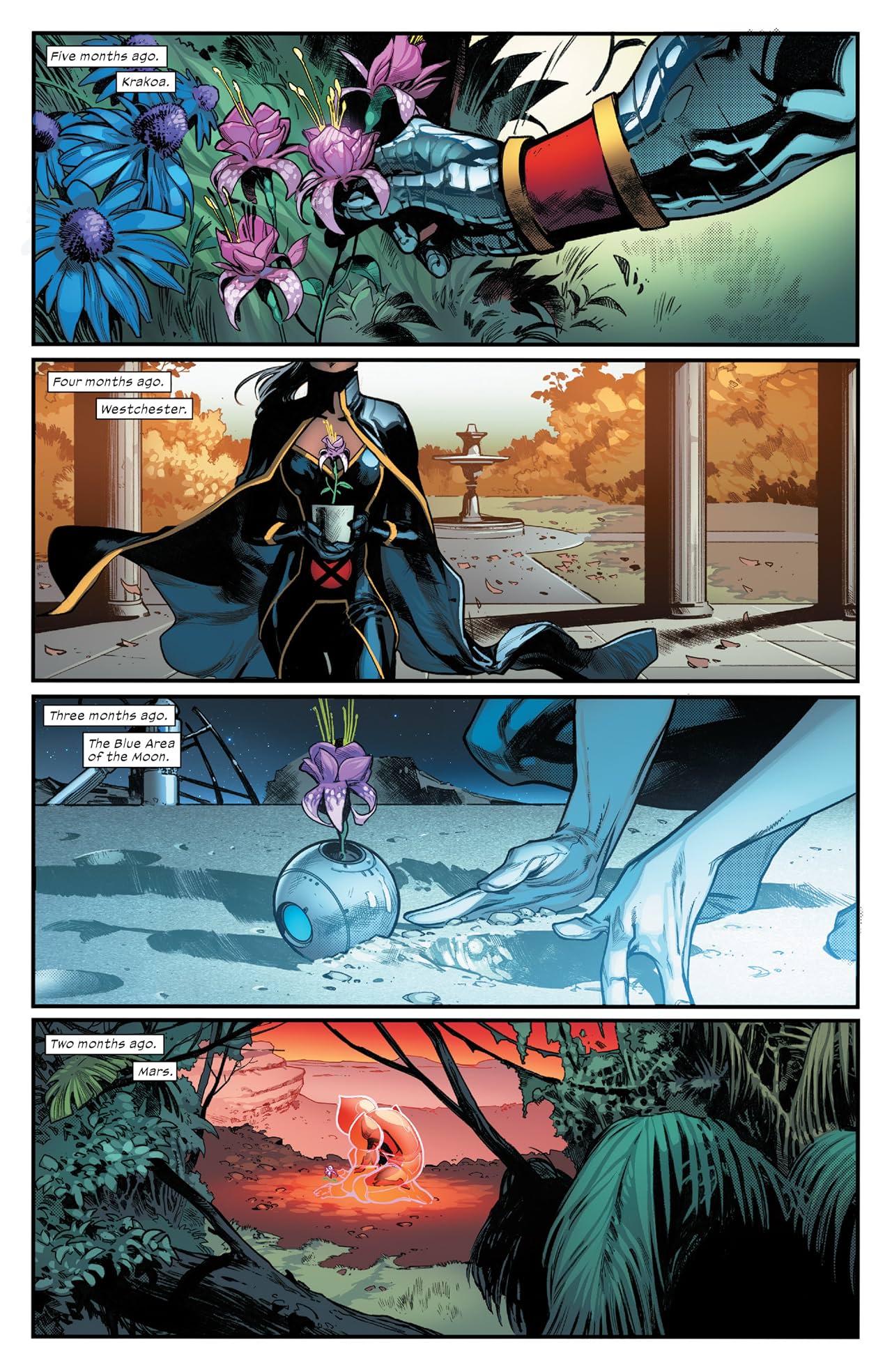
It comes courtesy of Krakoa, a name right out of one of the most iconic X-Men comics of all time. This living island has evolved and Charles Xavier is maximizing its potential with intriguing results. He comes off as more than just a visionary or messianic figure in “House of X #1.” He has a bold new plan for the entire mutant race and it’s big.

By that, I don’t just mean it’s big in terms of goals and scope. This plan is something that changes the way the X-Men operate. It’s not just flying around in X-Jets anymore. It’s not just peaceful protests and confronting bigotry. Charles Xavier is rallying mutants to his cause in a bold new way. He’s also dealing with humans in a new way, as well.

It’s here where “House of X #1” explores some very interesting concepts that take the X-Men into uncharted territory. For much of their history, the X-Men have been either reacting to attacks by their enemies or trying to counter intense hatred and mistrust of mutants. It hasn’t just hindered Xavier’s efforts at peace and understanding. It has kept them isolated and always on the brink.

Rather than simply brace for the worst, Charles Xavier decides to offer something tantalizing to both humans and mutants alike. I won’t spoil too many details. I’ll just say that he puts the X-Men in a unique position, in terms of how the world sees them. It may not win them the love and adulation that the Avengers get, but it does provide some bold incentives.

That’s something that few X-Men comics have ever attempted on this scale. It’s not enough to confront hatred and mistrust. Hickman puts the X-Men in a position to be more diplomatic with the world. They have something to offer the world. Accepting that offer benefits humans and mutants in a tangible, positive way.

Again, that should not be such a radical concept, but Hickman and Larraz present it in a way that feels both novel and vast. It’s not entirely utopian in its potential, but it has the potential to bring positive change to a world and a narrative that needs it.

As a lifelong X-Men fan, “House of X #1” fills me with both curiosity and awe. There’s a lot to love about this bold new world that Hickman and Larraz are building. For once, it’s not just another threat that puts the mutant race on the brink of extinction. There’s a larger effort to do something bigger.

That’s not to say the threats aren’t there. Just as Charles Xavier pursues his bold new vision in “House of X #1,” other visions forged by other characters emerge to present obstacles. Some parts of that vision are new, but there is some familiar imagery that X-Men fans will recognize. It ensures that there will still be plenty of mutant-powered fights in this new world.

At the same time, “House of X #1” creates a clear impression that fighting killer robots will only be a small part of this new vision for the X-Men. There’s so much more going on, both with the characters and with the larger Marvel Universe. After all the upheavals they’ve had over the past 15 years, it finally feels like they have room to grow again.

It’s an exciting time to be an X-Men fan. On top of Kevin Feige confirming that mutants are finally coming to the Marvel Cinematic Universe, Hickman and Larraz are taking X-Men in a bold, if not overdue direction in the comics. This sentiment is even captured perfectly in Charles Xavier’s first lines of the book.

“Humans of the planet Earth. While you slept, the world changed.”

Truer words were never spoken. In a world that gets invaded by aliens, Hydra, and renegade gods every other day, that’s saying something.

2 Comments

Filed under Jack's Quick Pick Comic

Why Jennifer Lawrence’s Mystique Is The Best Version Of The Character

x-men-jennifer-lawrence_612x380jpg

Everybody has at least one unpopular opinion that draws ire from the vast majority of people. I’m not referring to extreme political stances, though. Those who identify as full-fledged communists, anarchists, or theocrats are more defined by an ideology than an opinion. I’ve shared plenty of opinions in the past, some of which I’m sure qualify as unpopular.

Regardless of what those opinions entail, I’ve tried to make my point and most of the time, I can find a substantial group of people who share my views. It’s part of why I enjoy doing what I do. However, there’s one particular opinion I have that might be the most unpopular position I’ve ever held.

It has nothing to do with politics or ideology. It has to do with comics and superhero movies, another popular topic I’ve discussed many times before. I’ve shared it before in other forums and in almost every case, I have a hard time finding anyone who agrees with me. Knowing how dangerous it can be to share unpopular opinions on the internet these days, I’m going to take a chance and share it here.

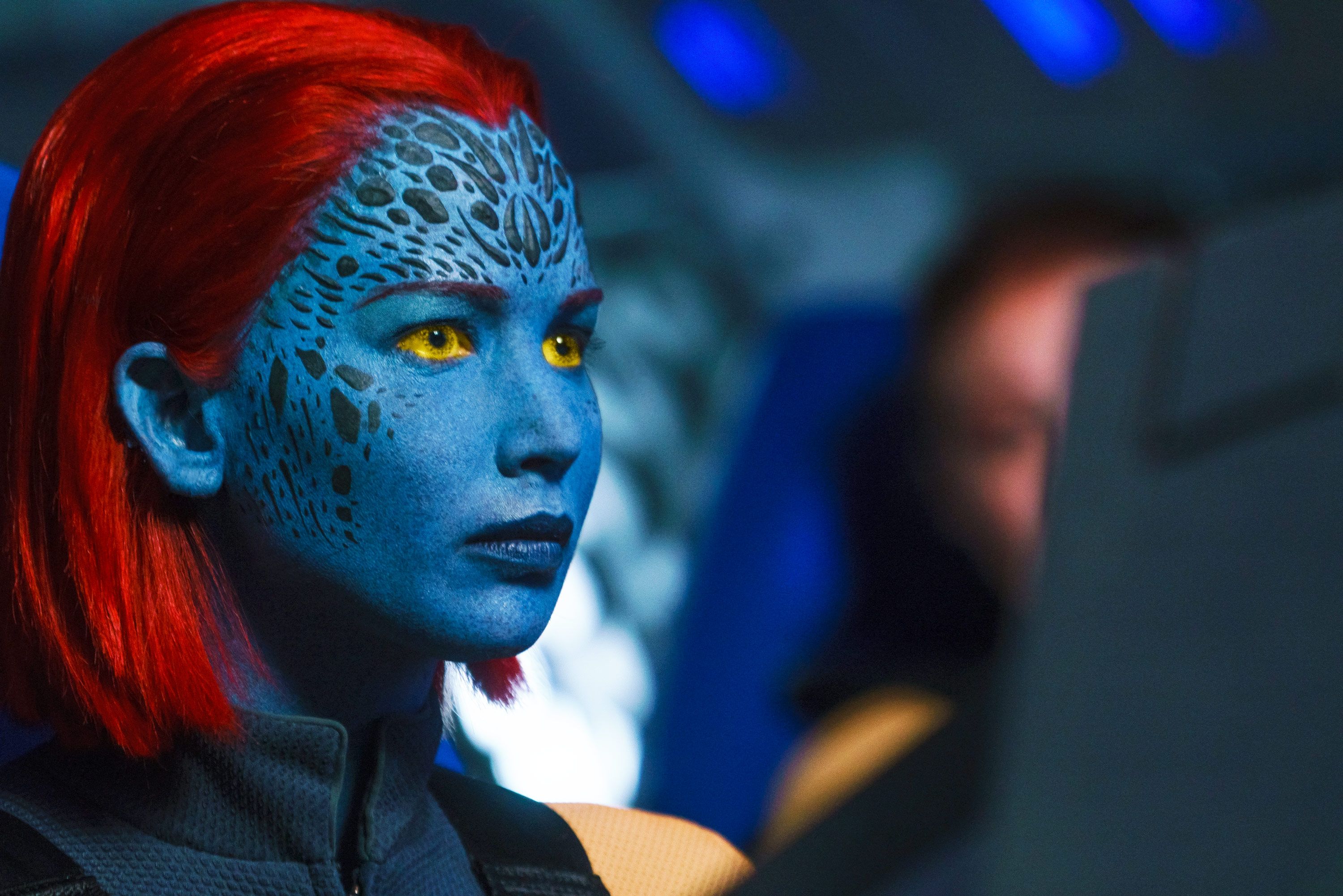
I believe that Jennifer Lawrence’s take on Mystique is one of the best version of the character in any medium.

I’ll give X-men fans, comic book fans, and fans of superhero movies a moment to stop fuming. Take all the time you need. Believe me, I’ve heard and read all the vile insults you want to throw at me. Before you flood the comments section with a fresh batch of frothing hate, please hear me out because I feel like there’s a point worth making here.

If not, please take this stunning image as a consolation prize.

Before I get into the details of the comics and movies, I freely acknowledge that Jennifer Lawrence is one of those high-profile celebrities for which many have mixed opinion. Ever since she rose to fame, she has been a polarizing figure. People either love her or hate her with very little in between.

Regardless of how you might feel about her, as an actress, there’s no denying that she played an instrumental role in revitalizing the X-Men movies, beginning with “X-Men: First Class.” As Mystique, she succeeded a very popular version in Rebecca Romijn, who set the precedent for blue-skinned shape-shifters who favored nudity. However, there was one important distinction with Ms. Lawrence’s version.

Unlike Ms. Romijn, and every other version for that matter, Ms. Lawrence’s take on Mystique included a backstory that provided unprecedented depth for the character. That story, and the depth that came with it, proved critical in the role that this Mystique would play in “X-Men: Days Of Future Past.” I would go so far as to argue that both movies work largely because of how Ms. Lawrence carried this character.

I can probably find more than a few people who agree that Ms. Lawrence’s Mystique was important in making her first two movies in the role work. Where I probably lose those people is when I go a step further and claim that this version of Mystique is superior to most other versions.

Some might call that hyperbole and maybe it is, to some extent. I still contend that there is an argument to be made and anyone familiar with Mystique’s history in the comics can appreciate it. I doubt I’ll change anyone’s mind, but it’s that very history, or lack thereof, that helped make Ms. Lawrence’s take on the character so compelling.

Mystique, like many other comic book characters, has a history that is more convoluted than most. She’s been around since 1978, but in all that time, her character has never been developed beyond a certain point. In fact, in the grand scheme of Marvel’s vast universe, it’s remarkable that she has managed as well as she has with so little backstory.

There’s no canonical information about where she was born, who her parents are, or even how old she is. She has never appeared as a child or a teenager. She’s always been an adult who goes by the name, Raven Darkholme. It’s not even clear that’s her actual name. Being a shape-shifter, it’s impossible to tell.

Beyond her unexplored history, Mystique’s personality has been pretty flat over the years. She’s a villain. That much is made clear. However, her brand of villainy is not nearly as refined as others. She’s basically a sociopath whose only purpose in life revolves around tormenting the X-Men, especially Wolverine.

How she goes about it varies, but why she does it rarely gets explored. Granted, there have been times when she has joined the X-men, but it never lasts and often ends with her betraying them. It has happened so often that it’s somewhat predictable. Even when it seems like she has undergone some major growth, she always ends up regressing back to her psychotic ways.

She still looks sexy every step of the way.

That’s not to say she has no depth. Being the biological mother of Nightcrawler and the adopted mother of Rogue has been a major source of drama over the years. Her romantic and sexual entanglements have also been colorful to say the least, albeit not always in a good way. However, this drama rarely ever adds depth to her villainy.

While Rebecca Romijn’s version had some nuance, especially in the second movie, she didn’t deviate much from her comic book counterpart. For three movies, she was one of Magneto’s top henchmen and little else. Jennifer Lawrence’s version of Mystique dared to be more than that.

The first minutes of “X-Men: First Class” did more for Mystique’s backstory than three movies and four decades of comics had done to that point. It established her as a mutant who’d run away and had nowhere to go, something that has real-life parallels for certain minorities. From there, she develops a close sibling bond with James McAvoy’s Charles Xavier, which does plenty to develop his character as well.

However, what truly makes this version of Mystique special is how she grows over the course of several movies. Like her comic version, she shifts her allegiances repeatedly. She starts off as an ally of Charles Xavier. Then, she leaves and follows Magneto. Eventually, she returns to Xavier’s side, but not without undergoing major personal upheavals.

In both “X-Men: First Class” and “X-Men: Days Of Future Past,” she finds herself at a crossroads on multiple occasions. Sometimes, she walks a more villainous path. Other times, she’s more virtuous. They’re all contingent on difficult choices and, regardless of where they take her, there’s an underlying sentiment to those choices.

In “X-Men: First Class,” she chooses Magneto because she believes Charles wants her to hide her true form. In “X-Men: Days Of Future Past,” she choose Charles because she realizes the consequences of her actions. Friends and enemies alike try to influence her. When she finally makes a choice, it feels like something a real character would make.

In the comics, you can always assume Mystique will make villainous choices and be right most of the time. With Ms. Romijn’s, you can assume she’ll choose whatever Magneto chooses and be right, as well. The choices of Ms. Lawrence’s Mystique are truly uncertain and for a character defined by her shape-shifting traits, that’s more than fitting.

It wouldn’t be accurate to call Ms. Lawrence’s Mystique a hero. In “X-Men: Apocalypse,” she resents that label. It wouldn’t be accurate to call her a villain either, even though she doesn’t always side with the X-Men. She adapts to whatever her situation requires, like anyone would expect of a skilled shape-shifter. It’s an understandable, and even admirable, take for a character in a superhero movie.

While her ultimate fate was tragic, as revealed in “Dark Phoenix,” her journey has been remarkable. Regardless of how the events of “Dark Phoenix” played out for everyone else involved, it’s still the most complete story that Mystique has ever had. That’s why I feel Jennifer Lawrence’s take on Mystique is the best we’ve seen to date.

That’s not to say she’s without flaws. I don’t doubt that her diminished role in “X-Men: Apocalypse” undercut her development. Even with those flaws, she’s still more balanced than anything the comics or previous X-Men movies have given us. Whatever happens with the X-Men as they joint he MCU, I hope Ms. Lawrence’s Mystique inspires the future of the character for years to come.

To all those who disagree with me, and I’m sure there are many, I welcome your comments and thoughts. I only ask that you keep it civil.

4 Comments

Filed under Comic Books, Jack Fisher, Superheroes, Marvel, movies, superhero comics, superhero movies, X-men

“Dark Phoenix” Review: An Astonishing End To An Uncanny Era

x-men-dark-phoenix-new-poster-1200-1777-81-s

It’s never easy, trying to capture the essence of an iconic story. It’s even harder when you’ve tried once before and failed miserably. To say that “Dark Phoenix” faced more challenges than most movies would be like saying tobacco companies have an image problem. Many of those challenges go beyond the story, the franchise, the studios, and even the movie industry, as a whole.

Despite so many confounding circumstances, the most important challenge of “Dark Phoenix” was always the same. After this iconic X-Men story was horribly botched in “X-Men The Last Stand,” this movie’s primary goal was to do that story justice. The director and long-time X-Men producer, Simon Kinberg, has gone on record as saying he failed in his first attempt. This movie gives him a chance to rectify that.

Before I get into the fiery details, which may include light spoilers, I’d like to offer my personal sentiment after having seen the movie. I understand that not everyone will agree with me, but as a long-time lover of X-Men, this movie means a lot more to me than most in the superhero genre so I like to think that sentiment is strong.

Yes, “Dark Phoenix” does justice to the X-Men’s most iconic story.

Yes, “Dark Phoenix” succeeds where “X-Men The Last Stand” failed.

Yes, “Dark Phoenix” is a satisfying conclusion to this era of X-Men that has spanned nearly two decades.

I realize that many might disagree with my assessment. That’s perfectly fine. Every movie impacts people in different ways. For me, though, “Dark Phoenix” struck all the necessary chords and then some. It focused on the core components of what makes the Phoenix Saga so endearing and runs with it.

That means that there aren’t multiple plots being juggled constantly. From the very first scene, the focus is on Jean Grey and her journey towards becoming Dark Phoenix. It’s a journey that has a foundation in tragedy, lies, love, betrayal, and loss. What happens to her is never just a matter of circumstance. There are tough, meaningful decisions made before, during, and after the darkness consumes Jean.

At every turn, there is plenty of drama. Jean Grey isn’t just some obscure side-character. She’s surrounded by people who love her. Charles Xavier loves her like a surrogate daughter. Mystique loves her like a sister. To Cyclops, she’s the woman he loves and for once, there’s no terrible love triangle that detracts from that love.

That love gives the drama incredible weight, which is critical for any story derived from the Phoenix Saga. It also ensures the losses leave a major impact and, as one of the trailers revealed, those losses are pretty devastating. They’re not just glossed over or forgotten, which was a huge issue with “X-Men The Last Stand.” They resonate throughout the story and inform the decisions of multiple characters.

That’s not to say every aspect is caught up in personal dramas. “Dark Phoenix” still utilizes a villain to maintain some basic superhero dynamics. That villain, played by Jessica Chastain, isn’t as iconic as Magneto or Apocalypse. She and her villainous henchmen are aliens known as the D’Brai, who actually play a critical role in the original story from the comics.

While Chastain is no Thanos, she and her fellow D’Brai have clear, understandable motivations. They’re not just there to cause more suffering and upheaval. They sense the power in Jean and they want to use it to serve their agenda. That’s perfectly consistent with what Jean and the X-men faced in those same comics.

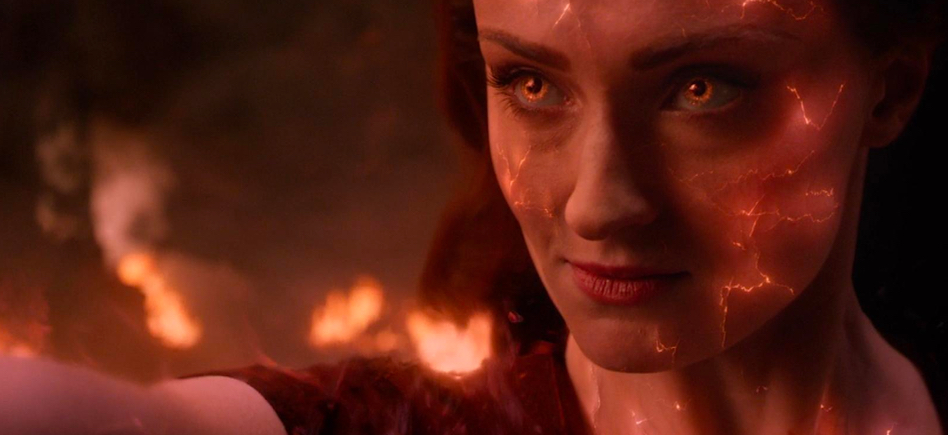
It also firmly establishes that the Phoenix Force in “Dark Phoenix” is not at all like the one on display in “X-Men The Last Stand.” The Phoenix isn’t some split personality within Jean. This movie actually embraces the more cosmic aspects of that story. While it only does so to a point, it helps raise the stakes in a way that goes beyond trying to save or kill Jean Grey.

Even with these cosmic elements, however, “Dark Phoenix” never loses its focus on Jean, her struggles, and the X-Men’s efforts to save her. The pace of the movie rarely slows down. Things happen quickly and concisely. There are still plenty of intimate character moments along the way, but they never drag. The plot keeps unfolding until the very end.

I won’t spoil too many of the details, but I will say that the ending is far less dire and depressing than what unfolded in “X-Men The Last Stand.” Jean isn’t a coward this time around. She doesn’t constantly whine or beg others to kill her before it’s too late. She is the one who ultimately decides her fate. More importantly, she is the one who makes those difficult choices.

Making all this drama and action work wouldn’t be possible without Sophie Turner turning in a truly uncanny performance as Jean Grey. She goes through many emotions over the course of the story. There are scenes in which she goes through more in five minutes than Famke Janssen did in the first three X-Men movies combined. She carries herself wonderfully through the movie’s most intense moments.

The collective efforts of James McAvoy as Charles Xavier, Michael Fassbender as Magneto, Tye Sherridan as Cyclops, and Nicholas Hoult as Beast perfectly complement Turner every step of the way. They capture those essential elements of family and team that’s so critical for every X-Men movie. This being their last ride with these characters, they make the most of the opportunity.

Unfortunately, some characters don’t get as many chances. Alexandra Shipp’s Storm and Evan Peters’ Quicksilver have fairly limited roles, although Shipp turns in a powerful performance in the final battle. Chastain’s alien character, and the D’brai in general, only gets so much refinement. However, that doesn’t make “Dark Phoenix” any less effective because it is, at its core, a story about Jean Grey.

There are other flaws in the movie. To some extent, the constant focus on Jean and the rapid pace of the action prevent other characters or side-plots from getting much emphasis. The long-running romantic sub-plot between Beast and Mystique had some moments, but not nearly enough to maximize the impact of the story.

There are also times when the visuals of “Dark Phoenix” aren’t as colorful as they could’ve been. To some extent, that’s more a reflection on the overall style of the X-Men movies, going back to the first one in 2000. These movies have never focused too much on the flashy costumes that are so prominent in the comics. Considering the iconic styles teased at the end of “X-men Apocalypse,” it’s somewhat disappointing.

This movie might have been able to get away with that 10 years ago, but the rise of the Marvel Cinematic Universe and its embracement of iconic superhero attire make the overall style of the movie seem uninspiring. For most of the movie, nobody even wears a uniform or costume. While a movie like “Logan” can pull that off, it doesn’t work nearly as well in “Dark Phoenix.”

There are some moments where the visual effects really shine, but not in the ones that would’ve really complemented Jean Grey’s journey. While that fiery halo does show up at one point, it feels like it doesn’t show up enough and wasn’t quite as radiant as its brief appearance in “X-men Apocalypse.”

The finer details of the story aren’t flawless either. While they remain concise until the end, there’s a bit of ambiguity in terms of how the events in this movie tie to the epilogue in “X-Men: Days of Future Past.” There’s certainly enough to imply that this movie does not completely undermine that ending, but a lack of specifics leaves a lot of gaps for the audience to fill in.

Even with these shortcomings, the most important components of “Dark Phoenix” still work. It seeks to tell a focused Phoenix story for Jean Grey and it never loses sight of that goal. The acting, the drama, and a brilliant musical score by Hans Zimmer simply add more gravitas to the mix.

Over two years ago, I wrote an article that laid out how the “Dark Phoenix” could succeed in this golden age of superhero movies. Pretty much everything on that list came to pass. This movie embraced the passion surrounding this iconic story. It made use of the Cyclops/Jean romance, kept the Phoenix as the primary plot, and ensured every dramatic moment felt genuine. It didn’t check every box, but it came pretty damn close.

Does that mean that “Dark Phoenix” is among the greatest superhero movies ever made? No, I wouldn’t make that case, especially when it came out the same year as “Avengers Endgame.” The bar for superhero movies is higher than it has ever been before and it’s a difficult standard to apply to a movie like “Dark Phoenix.”

Does that mean that “Dark Phoenix” is the greatest X-Men movie ever made? No, I wouldn’t make that case, either. There are other X-Men movies that rank above this one in terms, but it still captures the most important elements that makes these movies so endearing.

Is it a great movie in general? Yes, I certainly would say it is. If I had to score this movie, I would give it an 8 out of 10. It sets out to do a fitting adaptation of the Phoenix Saga and it succeeds, utilizing all the necessary drama and action along the way. It also caps off 19 years of X-Men movies.

Now, as the X-Men stand poised to enter the MCU, this part of their journey can end and “Dark Phoenix” ended it on a truly uncanny note.

6 Comments

Filed under Movie Reviews, movies, superhero comics, superhero movies, X-men

Five Reasons Why Marvel SHOULD Make An Avengers vs. X-Men Movie

avengers_vs._x-men_event

What can be said about the Marvel Cinematic Universe that hasn’t already been said, affirmed, or celebrated? I know I’ve said plenty about it, both in glowing terms and with real concern. Being a fan of superhero comics and the superhero genre, in general, I don’t think I can add much more to the near-cosmic status of this cinematic achievement.

The support of the fans and the billions made at the box office speaks for itself. Say what you will about Disney’s desire to exploit fandoms out of their money. They know how to give the people what they want. Between the recent success of “Captain Marvel” and the insane expectations surrounding “Avengers Endgame,” it’s hard to imagine this decade-spanning franchise ascending to greater heights.

I believe it will, though. I also believe that part of that ascension will involve pitting the Avengers against the X-Men in a clash that is sure to rock the foundations of the MCU. I know that’s somewhat of a reversal of my previous opinions, but recent events have led me to reconsider my position on the Avengers fighting the X-Men.
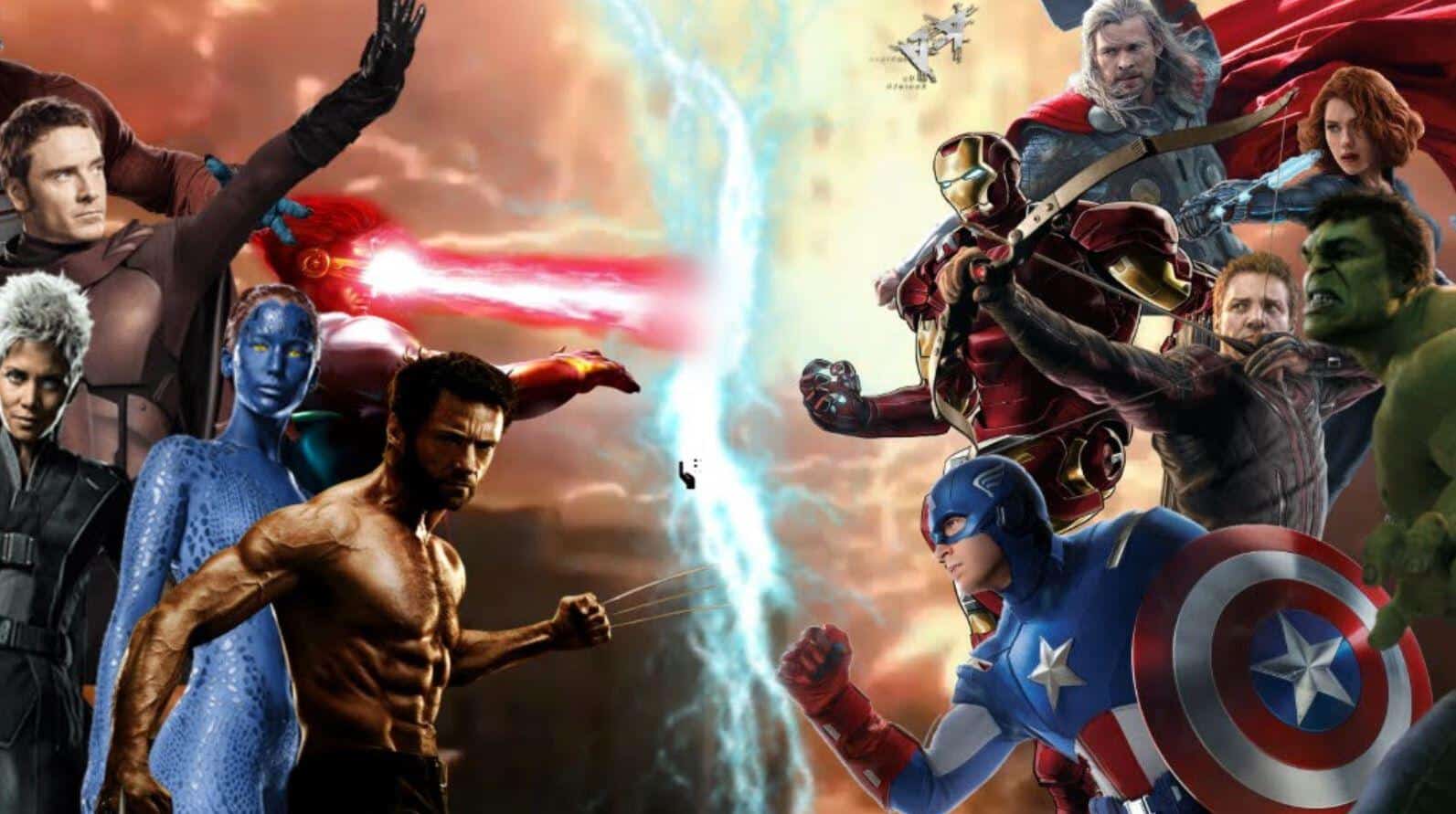
This isn’t just me, a passionate fan, speculating on what I think will happen once “Avengers Endgame” and the Disney/Fox merger is final. We already know that the X-Men and Fantastic Four are scheduled to arrive in the MCU at some point. It’s the impact they’ll have that’ll set the tone for the future of the MCU and there are already rumors about that impact swirling.

Now, all internet rumors should be taken with the smallest grains of salt, but according to We Got This Covered, a site with a mixed reputation at best, the top brass at Marvel Studios are already plotting a future Avengers vs. X-Men movie. If true, in whole or in part, it would be a bold move, even by the lofty standards of Marvel and their Disney overlords.

It would definitely be a gamble, that’s for sure. That’s because the Avengers and X-Men have clashed in the comics before. There was even a major crossover event entitled “Avengers vs. X-Men” back in 2012. While I won’t get into the specifics surrounding that event, I will go on record as saying that it’s not one of those iconic Marvel stories that fans hold dear.
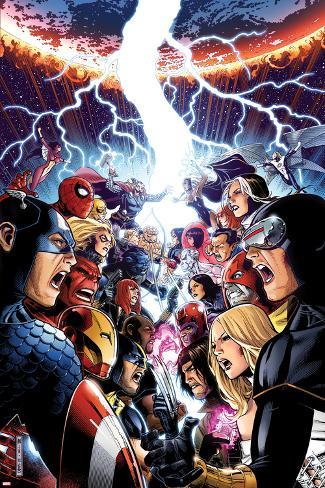
In fact, “Avengers vs. X-Men” is probably the most controversial and divisive story Marvel has told in the past 15 years. It’s not just because it pitted two iconic superhero teams against one another for reasons that weren’t properly fleshed out. It marked the point where heroes fighting other heroes officially got old.

It doesn’t help that the MCU already had a major clash like that with “Captain America: Civil War.” It helps even less that “Batman v. Superman: Dawn of Justice” burned fans out even more on the topic. However, by the time Marvel and Disney get around to making an Avengers vs. X-Men movie, I believe the time will be right to tell this story.

Right now, the MCU is in a bit of a transition. “Avengers Endgame” is set to conclude the story that began with “Iron Man” back in 2008. The arrival of the X-Men and the Fantastic Four in the MCU hasn’t even begun yet and the powerful voices at Marvel Studios have already indicated that they’ll be starting from scratch.

Whatever form their arrival takes, it’s sure to take the MCU in new directions. However, I believe an Avengers vs. X-Men movie would unite the new aspects of the franchise with the old. It would act as a catalyst, of sorts, to connect the stories of the present to those in the past. If done right, it could carry the MCU to heights that Thanos himself couldn’t have achieved.

While I am not a fan of how the conflict played out in the comics, I believe the likes of Kevin Feige and Laura Shuler Donner could craft a superhero battle for the ages that will leave fans like me excited for another decade. What follows are my top five reasons why I believe Marvel and Disney should pursue Avengers vs. X-Men movie.

I concede there are many who don’t share my sentiments. I welcome any comments arguing to the contrary. For now, though, this is why I believe such a movie would fit perfectly into the cinematic marvel that is the MCU.


Reason #1: It Would Highlight (And Confront) The Discrepancies On How The World Approaches Superpowers
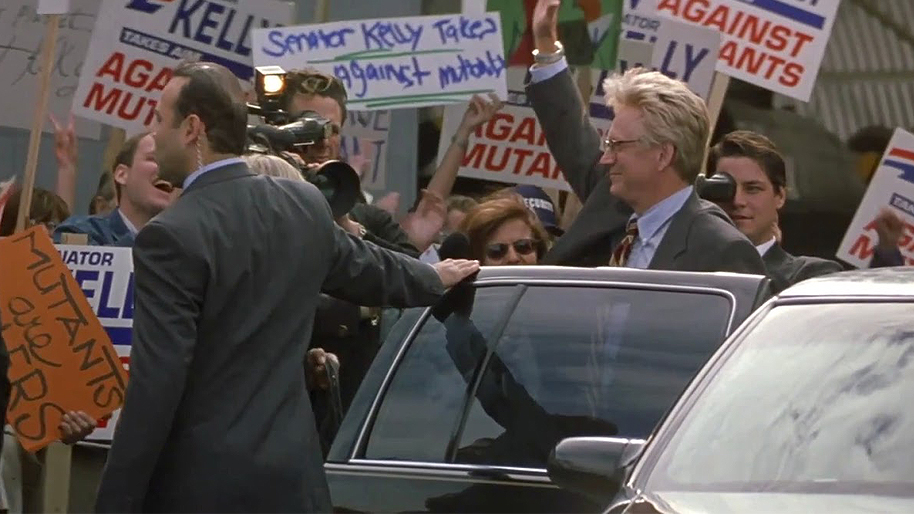
As soon as the X-Men arrive in the MCU, they’ll be faced with a frustrating double standard. Spider-Man has superpowers that he uses to swing around New York City, fight bad guys, and save the day. In general, he’s celebrated as a hero, along with most of the Avengers. The X-Men use their superpowers to do the same, but are labeled dangerous threats. What gives?

There are a lot of political and logistical reasons for this. Unlike other heroes, the X-Men are mutants. They were born with their powers. They’re part of an emerging sub-species that may or may not render homo sapiens extinct. That scares ordinary people more than some kid who just got superpowers in a random accident. How does society and established superhero teams deal with that?

It’s a relevant question and one the Inhumans failed miserably at addressing. Part of what made “Captain America: Civil War” such a compelling movie was that it didn’t avoid the complexities of this issue, acknowledging how difficult it is to hold people with superpowers accountable. That conflict was never fully resolved. In an Avengers vs. X-Men movie, the stakes would be even higher.

Unlike “Captain America: Civil War,” however, neither side can leave the conflict unresolved. Mutants will still emerge. People will superpowers will continue to exist. It puts iconic heroes in difficult positions that they can’t punch, stab, or smash their way out of and that often brings out the best and worst in these iconic characters.


Reason #2: It Would Raise The Stakes Surrounding Mutants In The MCU
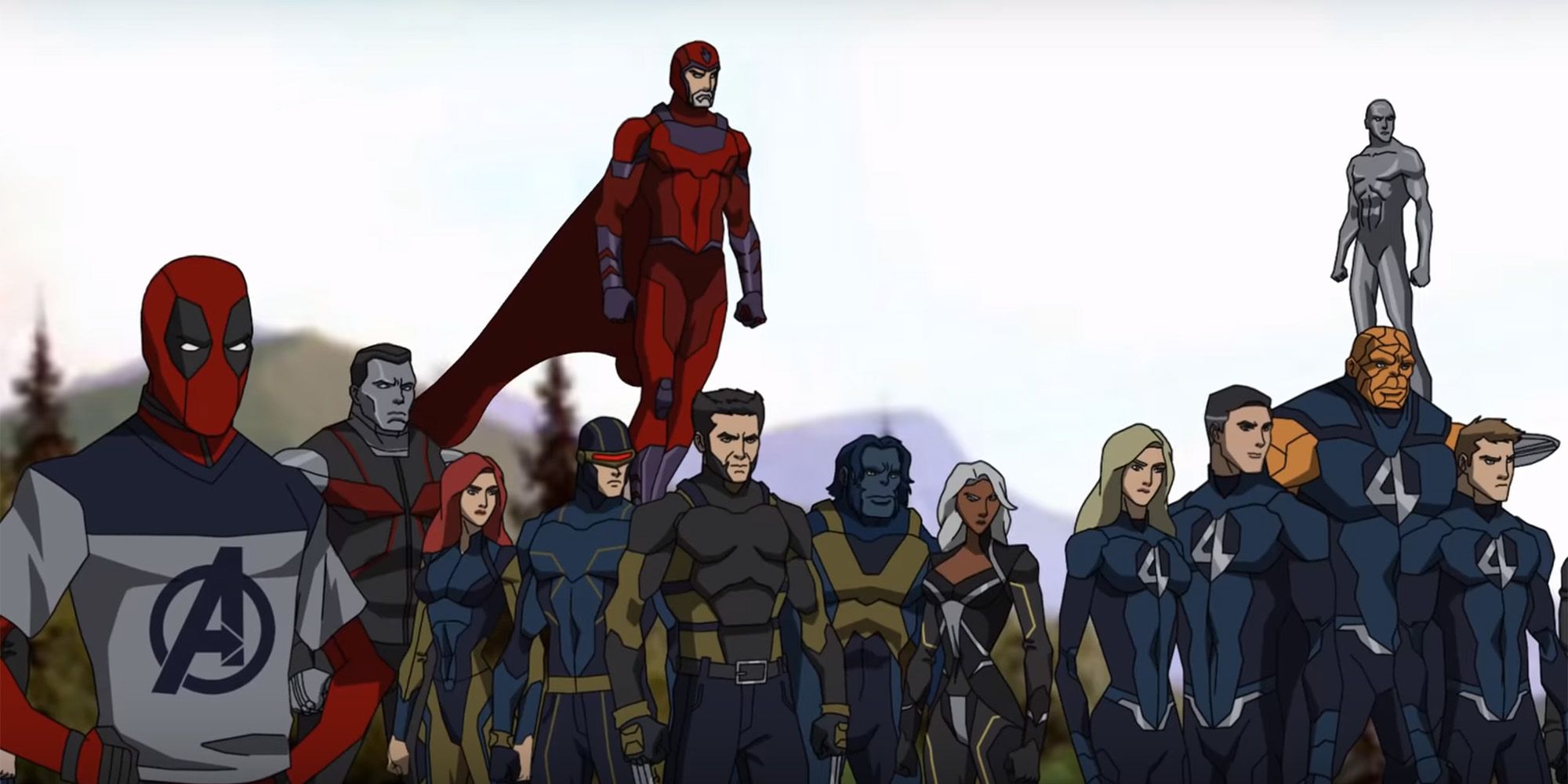
In many ways, a clash with the Avengers would be the best way to show just how big an impact they’ve had on the MCU. Once the Avengers take notice, there’s no ignoring it anymore. Neither mutants nor the X-men would be able to operate in their own little niche of the MCU. They would have to play a larger part in a world that has already incurred a lot of damage from super-powered beings.

This sort of step is necessary in the overall narrative surrounding mutants in the MCU. It would be their coming out party, so to speak. It would show how far they’ve come and how much farther they have to go in terms of gaining legitimacy in the MCU. The X-Men, especially, have a lot to gain and a lot more to lose.

Unlike the Avengers, they can’t fall back on their reputation of having saved the world from Ultron or a Chitari invasion. They’ll be this upstart superhero team fighting to protect a group of vulnerable minorities who may or may not present a clear danger to those around them. It’ll be their chance to show that they belong on the same stage as the Avengers and the MCU will be better because of it.


Reason #3: It Would Intensify Rivalries And Ruin Friendships

There are plenty of rivalries in the comics that haven’t yet made their way into the MCU. Some are more prominent than others. The recent arrival of Captain Marvel lays the foundation for an especially big rivalry between her and Rogue, which would certainly add more personal stakes to an Avengers vs. X-men movie.

Beyond rivalries, the comics are full of friendships and connections that run quite deep. Wolverine had close personal ties to both Captain America and Black Widow in the comics. Storm has an extensive, albeit flawed, relationship with Black Panther. A number of X-Men have even been Avengers at some point.

Any clash between the Avengers and X-Men is sure to complicate every friendship and rivalry the two teams may have. Some of those connections will take time to develop. It’s very likely that the next phase of the MCU will probably focus on that in addition to integrating mutants into the MCU. An Avengers vs. X-men movie could simply act as a boiling point where it all comes to a head.


Reason #4: It Would Complicate What It Means To Be A Superhero (In A Good Way)

To some extent, the Avengers were lucky that Marvel Studios couldn’t use the X-Men in the early days of the MCU. In a world without mutants, being a superhero was less complicated. They just needed to use their powers and abilities in a heroic way. Then, they had to assemble and show that they could win wars against invading aliens.

The presence of an entire race of super-powered people, many of which are not inclined to be superheroes, adds a huge complication to the path towards heroism. The fact that mutants have powers presents them and non-mutant heroes with a conundrum.

Are mutants who don’t use their powers to be heroes irresponsible?

Are mutants who choose to use their powers for heroics on the same level as those who got their powers through another means?

These questions don’t have clear-cut answers. In a world where superpowers exist, mutants are a huge complication and the X-Men are on the front lines of it all. They try to inspire other mutants to do what they do while protecting those who choose a different path. They do so knowing that it only takes one mutant using their powers irresponsibility to do a lot of damage.

In an Avengers vs. X-Men movie, the very merits of being a superhero will suddenly be up for debate. That debate won’t likely be resolved with civil conversation and intelligent discourse. Whenever someone like Wolverine and the Hulk are involved, it’s a given there’s bound to be plenty of stabbing and smashing.


Reason #5: It Would Create New Opportunities For Better Villains (With Better Motivations)

Every clash between superheroes comes with a cost. “Captain America: Civil War” effectively divided the superhero community, which made them ill-prepared when Thanos arrived in “Avengers: Infinity War.” The comics followed a similar theme. After the original Civil War event, the entire world became vulnerable to a Skrull invasion.

A battle between the Avengers and X-Men will create a new host of vulnerabilities. For villains, it’s a golden opportunity to establish themselves in a world that is suddenly crowded with superheroes. While Thanos, Loki, and Killmonger all raised the bar for villainy, they couldn’t have emerged without the right opportunity.

With mutants, there aren’t just new opportunities. There are entirely new dynamics at work. It’s no longer a world in which superpowers are just complicated accidents. They can happen in individuals simply by being born. Within those dynamics, new kinds of villains with entirely new motivations can emerge.

Good villains are every bit as critical as good heroes, more so today than in previous eras. If the MCU is to continue to dominate, it needs to nurture the development of those villains while also creating vulnerabilities for them to exploit among heroes. An Avengers vs. X-Men movie would accomplish both.


There are probably other reasons I could list as to why I feel Marvel Studios should make this movie. There are probably plenty of other reasons why they shouldn’t. With the future of the MCU once again set to change after “Avengers Endgame,” the possibilities are vast. With the inclusion of the X-Men, and all the complications that come with them, it’s poised to evolve in bold new ways.

4 Comments

Filed under Comic Books, Jack Fisher, Superheroes, Deadpool, Marvel, movies, superhero comics, superhero movies, X-men

Second “Dark Phoenix” Trailer: Reaction And (High) Hopes

It’s been a long wait since the first trailer for “Dark Phoenix.” In that time, there have been plenty of distractions and upheavals, from who would host the Oscars to trolls attacking the “Captain Marvel” movie for asinine reasons. Plenty still find excuses to whine about this movie, also for asinine reasons. Finally, despite all that proverbial noise, we get a second trailer and it was so worth the wait.

There are a lot of things that a quality story about the Phoenix Saga needs to capture all the right feelings. This one checked nearly every box, more so than the first.

It had drama.

It had devastating emotional upheaval.

It had elements of cosmic influence.

It had inner turmoil.

It had heartfelt sorrow.

It had despair.

It had desperate people trying desperately to save someone they loved.

Even if you haven’t read the originals story, these are all important components for a powerful story. It’s part of the reason why the Phoenix Saga is often identified as the greatest X-men story ever told. Unlike previous attempts, this movie is making that story front and center.

That, more than anything, should give me and other X-men fans hope that this one will be done right. I’ve seen more than a few people whine about how similar this movie is to “X-men: The Last Stand.” I don’t blame those people for seeing this as a bad thing, given how poorly that movie handled the Phoenix plot.

Nuff said!

However, this trailer does much more than the first one to set itself apart. Yes, Jean is still wearing a large red overcoat instead of her iconic Phoenix attire, complete with the waist sash, but attire was not the reason why the previous attempt to tell that story failed.

As I’ve noted before, the most critical part of telling any story about the Phoenix Saga is capturing the right emotions with the characters. With all due respect to Famke Jansen, Sophie Turner shows more emotional range in this trailer than Ms. Janssen did over the entire course of “X-men: The Last Stand.” Moreover, it highlights the emotional impact that her growing powers have on everyone Jean loves.

That impact includes a heavy loss, as evidenced by the funeral scene. It also shows in how both Jean’s friends and enemies react to handling her. Some, even those who think themselves her friend, think she’s beyond saving. Others, namely Cyclops, are still determined to save her.

Not ignoring the fact that Cyclops is actually playing a major role here instead of getting killed off in the first 10 minutes of the movie, thereby worsening the worst love triangle of all time, this trailer leaves one other important element unspoiled and up in the air.

We know there will be death and loss in this movie, as is often the case in any X-men story involving the Phoenix Force. I even uncovered some critical hints during my trip to New York Comic Con last year. There’s still one burning question that will likely determine how this movie is received.

What is the ultimate fate of Jean Grey?

This is one instance where the answer could take us down many paths. If Jean Grey ultimately dies, as happened in the original story, it would be keeping in the spirit of loss and sacrifice. It’s difficult to pull off, but given how bland, cowardly, and unceremonious her fate was in “X-men: The Last Stand,” it wouldn’t be that hard to improve upon.

If she lives, though, which actually was the initial ending to the story in the comics, it would require a very different recourse compared to the previous movie. That may ultimately be the best way to silence those who keep bemoaning how much this movie resembles “X-men: The Last Stand.” However, getting Jean to a place where she could survive, even after losing control, would be a difficult task.

Whatever the outcome, the stage is set. “Dark Phoenix” is coming and will likely be the swan song of this era of X-men movies. With Disney about to take over Fox and set to bring the X-men into the MCU, it would be perfectly fitting if this movie ended on a high note. We saw how powerful that kind of story can be with “Logan.” After seeing this trailer, I believe this movie has that potential, but with more cosmic flare.

1 Comment

Filed under movies, superhero comics, superhero movies, X-men