Tag Archives: technology

The Future (And Caveman Past) Of Privacy

Let’s face it. There are just some things in the modern world that are destined to disappear. Things like coal power, overt racial discrimination, and the Macarena are destined to become relics of a bygone era. Some already have to some extent. Others, like snail mail, poor WiFi, and the Kardashians, can’t go away soon enough.

So what does this have to do with privacy? Why am I even bringing up privacy? Is this another case of an erotica/romance writer having a few too many glasses of whiskey when he writes? Well, except for the whiskey part, those questions already have answers.

For the past couple of days, I’ve been talking about the emerging technologies that will allow brain-to-brain communication. Like an updated iPhone, it’s one of those technologies that we know is coming. It’s just a matter of getting here and having a major company profit the hell out of it.

You may not think it’s likely now, but at some point someone will find a way to make sharing thoughts an obscenely profitable business. We get people to pay for bottled water and a haunted rubber duck. There are plenty of gullible people with money in this society is what I’m saying.

Going back to privacy, it’s fairly obvious that we’re already in the process of ditching it to some extent. It used to be that the craziest, dumbest, most asinine stuff we said in our day-to-day lives never left our close circle of friends. Now, we feel compelled to share all those crazy thoughts online.

Look at me. I’m doing that right now. I’m sharing thoughts I never would’ve shared in polite conversation 20 years ago. Then again, 20 years ago I had a horrible acne problem and the piss-poor social skills of a ferret so it’s not like I was in a position to do much sharing. The internet and social media has changed all that. It’s given us an opportunity to kick our concepts of privacy in the balls and beat it with a hammer into something else.

This has had consequences. Just ask anyone who had an Ashley Madison account a few years ago. It’s bound to have more consequences, especially as an emerging generation matures into a world that has never known the pain of dial-up internet. This is a generation for whom sexting will be akin to copping a feel in the back seat of a car. Admit it. You envy that generation to some degree.

However, it’s the generation after that who may really deliver the final nail in the coffin of privacy. That generation will likely come into a world where brain-to-brain communication has matured, is a growing business, and has people bitching about fees for sharing certain thoughts. How will that generation view privacy?

Well for once, we really don’t need a thought experiment or some exercise in existential logic. In fact, we need only a history book and a general understanding of how humans form tribes. Go to any message board that celebrates a certain romantic pairing on “Buffy The Vampire Slayer.” It doesn’t take much.

Nature has wired our bodies to be good at a lot of things, albeit in hilariously crude ways. Just look at the design of the male scrotum. However, one design that has been remarkably efficient is our ability to form tribes and groups. It’s that kind of coordination and cooperation that has helped us dominate this planet, build civilizations, and form Hugh Jackman fan clubs.

It’s also this uncanny ability to form tribes that’ll make the techno-telepathy of brain-to-brain communication so appealing to future generations. It may seem crazy now to those of us who still dread the thought of someone hacking our phones and sharing all the embarrassing pictures of us on FaceBook. I’ve always worked under the assumption that someone has already hacked my phone and that keeps me from capturing anything too compromising in my private moments.

However, with techno-telepathy, there’s nothing left to compromise. Everything is laid out for someone else to see. Your hopes, dreams, fears, and perverse sexual fantasies are all laid out in a beautifully rendered image. Can we even cope with that kind of transparency?

Well, the average congressperson notwithstanding, we have kind of done it before. In fact, we had that kind of transparency for a good chunk of human history. This brings me back to “Sex At Dawn,” a book that has been remarkably useful in discussing such sexy, taboo topics. In addition to talking about the shapes of penises and female orgasms, it does talk about privacy.

Granted, it’s not as sexy as the other topics discussed, but it is relevant in that it explores the pre-interent, pre-agriculture concepts of privacy. In short, there was none. In fact, from a purely practical standpoint, there couldn’t be any privacy.

That’s because those societies were hunter/gatherer societies. These societies were small, close-knit tribes of people who worked together, cooperated, and shared resources to survive. This is not some hippie commune out of John Lennon fantasy. These were very functional, very adaptive groups that played a big part in how human beings evolved.

In those societies, privacy is kind of redundant because they need to share resources. They don’t have big cities or elaborate infrastructure. They need to cooperate or they won’t survive. Part of cooperation means being overly transparent. That means sharing shelter, living space, food, and lovers. Yes, sharing can be sexy. It just comes at the cost of privacy. Some may think that’s a fair trade.

When you don’t have a lot of property or resources of your own, what’s the point of privacy? It’s not that it’s ignored. It’s not that it doesn’t exist to some degree. It’s just redundant in a hunter/gatherer setting. Keep in mind though, it’s in this setting that our species evolved. For the caveman in us, privacy is more a construct than an innate trait.

That’s because our concept or privacy really didn’t exist until the modern concept of property rights emerged. The concept of a public/private sphere is a fairly modern invention. Again, it’s largely out of necessity. When you have a society that relies heavily on accumulating and distributing resources on a large scale, the need for some measure of privacy is unavoidable, if only to avoid extortion and exploitation.

This is where the techno-telepathy of brain-to-brain communication really gets interesting. Whereas modern notions of privacy are relatively recent, less private habits of our cavemen ancestors are still hardwired into our tribal traits. That means the growth of techno-telepathy could be one of those tools actually complements our caveman nature rather instead of conflicting with it.

What could this mean for us as individuals and as a society? What could it mean for our love lives? Well, if our history as hunter/gatherers is any indication, this tool would make it far easier for us to form telepathic tribes, of sorts. We find people who appreciate and share our thoughts. We develop close bonds with those people. Some may even become romantic and sexual. When you’re sharing your most intimate thoughts with people, that’s kind of inevitable.

It could be disruptive or it could be productive for society. When we start sharing both literal and figurative thoughts with one another, privacy as we know it will take on a whole new meaning. It won’t disappear completely. It’ll just change. We’re terrified of sharing naked pictures of ourselves now. How will we feel when we start sharing are deepest, dirtiest, sexiest thoughts?

It’s an interesting notion to consider and one I hope to see play out in the coming decades. I have a feeling it’ll give me plenty of sexy ideas for future novels.

2 Comments

Filed under Jack Fisher's Insights

Our New Robot Overlords Are Coming And They’re Not That Sexy (Yet)

When it comes to the future, I like to think of myself as an optimist. I know that’s a radical position these days. In fact, I think it’s always been a radical position. When you consider how many times the end of the world has been predicted, it’s easy to see why any kind of optimism might as well be on par with Adam Sandler’s chances of winning an Oscar.

Radical or not, I am very hopeful about what the future will bring. I’ve highlighted some emerging technologies with huge social implications, as well as a few that may very well affect our sex lives. I think there will be more advancements down the line, some of which defy our expectations and dirty imaginations. I’m hoping some if it will inspire some more sexy novels for me.

However, I’m not immune to some of the concerns that come with emerging technology. There are some advances, like nuclear weapons, that are pretty damn scary. The fact that these weapons exist and aren’t exactly maintained very well, as John Oliver frighteningly explained, is real cause for concern.

Beyond nuclear weapons, though, there is one advancement that does have me worried at times. That involves robotics. Now when I say robotics, I’m also including artificial intelligence in that discussion. However, it’s one thing to have a simple box that has much greater intelligence than a human. It’s quite another to put that intelligence in a robot body and give it a gun.

Now I’m not among those who think “The Terminator” or “The Matrix” are legitimate scenarios. Many have pointed out the obvious flaws in these apocalyptic futures far better than I ever could. However, that’s not to say that there aren’t some ominous hints that we may be taking one too many ideas from the imagination of James Cameron.

Enter Boston Dynamics, a company that’s the closest real-world equivalent to Cyberdyne. As a subsidiary to Google, with access to their insane piles of wealth, they specialize in creating advanced robots. However, some of the robots they create are a bit too advanced for comfort.

Recently, they introduced the world to their latest creation, which they call Handle. Granted, it’s not nearly as intimidating as the Terminator, but what it lacks in an Austrian accent, it more than makes up for in mobility. It’s actually even scarier than it sounds. See for yourself.

Are you done trembling? Are you ready to call John Conner? I’m not saying this robot will rise against us. I’m just saying that if someone were trying to run from this robot, they would have no chance. Hell, put a gun on this robot’s shoulders and we’re all fucked.

Okay, I’m turning off the sarcasm and doom-saying now. I’d like to get a bit more serious now because this trend is not going to stop. There are too many economic incentives for developing these robots. Automation is growing trend and one that is poised to increase because more automation means cheaper manufacturing. Cheaper manufacturing means more profits. It’s just basic economics.

Add artificial intelligence into the mix and the basics get real advanced. I’ve talked before about how people may come to see advanced AI the same way some people see a dominatrix. That wasn’t just to create some uncomfortably sexy thoughts, although I do concede it was part of it. I really do suspect that when it comes to powerful authority figures, these same sexy dynamics still apply.

With Boston Dynamics, however, those dynamics go a step further. While others, like Google and Microsoft, are working on the nuts and bolts of artificial intelligence, Boston Dynamics looks poised to give it a body. Once that kind of intelligence is in a body like that, then all bets are off.

Granted, that body doesn’t look very sexy now, but there’s already ongoing work in that department too. Just wait until it’s smarter, stronger, and more agile than any human being alive. That’ll change its sex appeal really fast. I just hope I live long enough to write a sexy story about it.

5 Comments

Filed under Jack Fisher's Insights

Truth, Lies, And Why “Daria” Is More Relevant Now Than Ever Before

For the past couple of days, I’ve been talking about the best and worst when it comes to fictional female characters. Since I deal in fictional characters as an aspiring writer, it’s a relevant topic of discussion. I want to create great female characters for my novels. I think I’ve made some strides with novels like “The Final Communion” and “Holiday Heat,” but I always feel there’s room for improvement.

That brings me back to Daria Morgendorffer from the classic MTV show, “Daria.” In both my lists discussing the best and worst female characters of fiction, “Daria” found a way to the top of the list. There’s a damn good reason for that too. Daria, as a character, represents something that is more relevant now than it ever was in the late 90s.

As I said in my past posts, Daria is one of those characters who was just ahead of their time, but not in a Nikola Tesla or Elon Musk sort of way. She came during an era when dial-up internet was still popular, boy bands were still relevant, and pagers were still in use. It was a strange and different time.

It was also a time when concepts like “alternative facts” and “fake news” were more associated with skits on “Saturday Night Live” than actual concepts that the general public has come to dread. In that sense, Daria is downright prophetic in the sense that she highlights a concept that become increasingly obscure over the past decade.

Throughout the five seasons of “Daria,” as well as two movie specials, one Daria’s most defining traits is her ability to point out the harsh truth that nobody wants to acknowledge. She doesn’t shy away from it. She doesn’t celebrate it either. She just points it out and lets the harsh truth do its thing.

For the overall narrative of this series, this is kind of necessary because Daria is often surrounded by those who constantly avoid the harder truths of life. Sometimes, as with air-headed dumb-asses like Kevin Thompson and Brittney Taylor, it’s out of ignorance. Other times, as with her sister Quinn and her eccentric teachers, it’s out of hopeless self-delusion.

Daria, being an outcast who isn’t afraid to think for herself, sees all of this from a distance and isn’t afraid to point it out. She doesn’t care that it alienates others. Even her sister, Quinn, refused to publicly acknowledge that they were even related until the final season.

Her parents constantly think something is wrong with her. Her teachers and peers constantly think she’s weird. Everyone thinks there’s something wrong with her. Daria even acknowledges that. However, as crass and callous as she may be, Daria may actually be the most sane person in her world.

This is best shown in Season 4, Episode 47 entitled, “Psycho Therapy.” In this episode, Daria’s family undergo a psych evaluation as part of a screening process for her mother’s promotion. It makes for some odd and entertaining escapades, but the most revealing moment comes when he doctors reach a remarkable, albeit unsurprising conclusion.

Daria, despite being so emotionally withdrawn and overtly sarcastic about everything around her, is by far the most well-adjusted person in her family. She understands and acknowledges all of her family’s quirks, but she doesn’t obsess over them or lament over them. She just accepts them and moves on with her life. I’m not a psychologist, but that’s way more healthy than we can expect of most teenagers these days.

In fact, Daria might as well be a unicorn dipped in gold with diamond-encrusted hoofs. She isn’t just accepting, understanding, and well-adjusted to her surroundings. She actively thinks for herself and no one else. She doesn’t shy away from the facts, nor does she avoid their implications. She is, by all accounts, the very antithesis of this current era of buzzwords, fake news, and alternative facts.

That’s what makes her so much more relevant now than she was back in the early 90s. She came at a time when people who said the cold, hard truth didn’t get it twisted through internet memes, social media feeds, and hashtags. Daria doesn’t do beat around the bush or try to twist the story. If something is true, honest, and blunt, then that’s the end of the conversation.

In an era where everyone, from our politicians to our gym teachers, has to have some kind of personality, Daria Morgendorffer is a breath of fresh air and from 1999 no less. What’s that say about our current state of affairs? I could spend the next 38 blog posts discussing it, but that wouldn’t be very sexy for a blog run by an aspiring erotica/romance writer.

I will say, though, that the attitude Daria embodies is something that’s a lot more critical now than it was in 1999. We live in an era where everyone seems intent on joining a trend, becoming part of a movement, or denigrating those who oppose your movement. Daria, being the consummate realist and independent thinker, would roll her eyes at both.

The idea of someone who just thinks for themselves shouldn’t be such a radical concept, especially when it was the core of a successful animated show that ran for five seasons on a network best known for documentaries about teenage mothers. However, that idea couldn’t be more important in 2017.

We current live in an unpleasant convergence, of sorts, where truth and brutal honesty are easily circumvented by fake news, alternative facts, and online trends. It’s too easy for someone to insulate themselves from the harsh realities of life. We all need a Daria Morgendorrfer in our lives to keep us anchored and too many don’t have one.

Being the optimist I am, I believe Daria’s words of wisdom will one day pierce the many veils of bullshit that permeate our culture at the moment. It may take a while. It may be painful, arduous, and distressing in the process. However, that’s exactly why it’s worth doing.

Thankfully, Daria herself gives us some memorable words of wisdom to make the process easier. In the spirit of celebrating everything Daria represents, here it is.

4 Comments

Filed under Jack Fisher's Insights

A Bionic Penis: It’s Real (And Has Implications)

When I ever I discuss or report on a certain topic, I do so with the hope that nobody mistakes me for a serious journalist or reporter. I’m as much a journalist and reporter as I am rocket scientist and a basket weaver. This blog is an insight into the kinky thoughts of an aspiring erotica/romance writer and not a news source.

I say this because in my exploration of artificial wombs, human enhancement, and sex robots, I missed something. I actually missed something pretty major that may have some major implications on these topics, as well as many others that may or may not become ideas for a future erotica/romance novel.

Now I usually try to be pretty thorough when it comes to researching certain issues. Well, I’m as thorough as a basic Google search will allow me to be so take from that what you will. Again, I’m an erotica/romance writer. I’m not a goddamn reporter. However, I’m also human. That means things are going to slip through the cracks every now and then.

Even so, the idea that I missed this kind of makes me feel inept. I feel like I owe my readers an apology for this one because it is pretty remarkable that I missed something like this. What is it, you ask?

Well, in my research into artificial wombs, it turns out that there’s already some major developments on the other side of the gender equation. By that, I mean that science actually begun rebuilding parts our bodies in an effort to make them function better. No, I’m not talking about an artificial heart either, although that is in development. I’m talking about a bionic penis.

Those are two words many of us never thought we’d hear outside science fiction and Star Wars porn parodies. Just saying them out loud is enough to conjure all sorts of dirty, kinky thoughts that’ll ensure we never look at the Terminator the same way again.

It’s real though. This really is a thing and I mean that in the most literal and figurative way possible. It’s also a fairly recent thing so that may be why I missed it.

It happened in late 2015 over in Scotland, a place more associated with kilts rather than bionic body parts. A man named Mohammed Abad, who lost his penis in a horrible car accident when he was six-years-old, became the first recipient of a bionic penis. The man is basically the Neil Armstrong of bionic manhoods. I’d throw him a parade if I could.

So how does this thing work? How does a bionic penis function? Well, according to the article, these are the basics:

The University of London team has spent more than three years crafting a new, 8-inch wang out of skin grafts culled from Abad’s forearm and becomes erect by mechanically pumping fluid into it. This pump is activated by a button located near his remaining testicle.

Read over that again and try not to conjure a crazy mental image of how this revolutionary technology looks, feels, and works. It can’t be done. I’m pretty sure of that.

It apparently works too. A year later, after a lengthy recovery period, Mr. Abad got to test it out, courtesy of a Charlotte Rose, an escort and sexual trainer. Apparently, that’s a real job. I don’t remember my high school guidance counselor mentioning it, but then again, that same counselor thought I’d make a good accountant for some reason.

This isn’t a one-time medical oddity either. Mr. Abad isn’t the only one to get this done. Another man from England named Andrew Wardle, who was born without a penis, is having one put in with the same procedure.

Sure, it’s comes with a lengthy recovery process that includes a two-week erection, but there are worse recovery processes. At the very least, he has a valid excuse for wearing loose pants and boxers.

Now the fact that this has been done more than once and is likely to be done again in the future opens up some pretty astonishing, not to mention damn kinky possibilities. This is the part where the erotica/romance writer in me starts to get overly excited, but I’ll do my best to temper my giddiness. As a man, I know this is serious business. You can’t get much more serious than the future of a man’s penis.

Whenever a new technology like this comes along, it goes through a fairly predictable process of development. We’ve already seen that with artificial limbs, which have been getting more and more efficient with each passing year. We also see it with technology like smart phones. Anybody remember what the first iPhone looked like?

It seems so long ago, but within a decade, smartphones have become so advanced that we’re using them for advanced medical procedures. That’s a lot of advancement in just 10 years. Think of what kind of advancement we’ll see for something like a bionic penis. Ladies, I’ll give you a moment to change your panties.

Now I’m not saying that bionic penises will advance at the same rate as smartphones. Medical technology has to progress slower, just because it’s harder to test and refine. However, as we’ve seen with other advancements like Lasik eye surgery, which I’ve actually had done, there will be progress as the market demands.

Make no mistake though. There will be a market for bionic penises. Mr. Abad is already having to fend off countless offers for sex with curious women. I imagine as the technology improves, it’ll become a full-fledged fetish. Some women may try a bionic penis and never be able to go back. It’ll spark a whole different breed of dick jokes.

At some point, possibly within my lifetime even, the technology will get to a point where a bionic penis is more effective than any natural penis. It may become so effective that men who are dissatisfied with the perfectly functional penis they were born with will opt to get a bionic one. It’ll be for men what breast implants are for women.

Right now, it seems extreme that a man would abandon the penis he was born with. I imagine women felt the same way when they heard about breast implants though. If the technology advances sufficiently, then the benefits would just be too much to ignore.

At the moment, the penises most men have are fairly durable. However, they do have flaws. They don’t stay hard for as long as some men would like. They tend to get ahead of themselves, thereby creating embarrassing moments that can ruin any romantic moment. They don’t always work on command either. Some men need a pill to get them working whereas Mr. Abas just has a button he pushes to get a boner.

Imagine, provided you have clean panties, a future where a man’s bionic penis is pretty much indistinguishable from what we consider natural today. It looks, feels, and functions like an ordinary penis. However, when it’s time for action, things get real interesting and damn sexy.

There’s no need to take a pill. There’s no need to repeatedly stroke it or maintain a mental image of Pamela Anderson in a thong. Just push a button or use an app on a smartphone and that’s it. You’re as erect as Ron Jeremy for hours on end. That greatly expands the sexual possibilities for men and women alike. All those jokes about men not lasting long in bed suddenly become relics of “Married With Children” reruns.

It’s an exciting and sexy future, one I think men and women alike can look forward to. I’m not going to lie. This gives me some pretty crazy ideas for a future erotica/romance novel. I look forward to sharing those ideas as they become more developed/sexy.

Whatever the case, men everywhere may look back on the day and cheer the name Mohammed Abad. He helped make the bionic penis a reality. On behalf of men everywhere, gay and straight alike, we thank you. You are a true pioneer Mr. Abad. May your bionic penis bring you all the joy you deserve.

17 Comments

Filed under Jack Fisher's Insights

Advances In Male Contraception And What It Means For Women

I wasn’t planning to do a follow-up on yesterday’s big post about male contraception. In fact, I originally had an entirely different set of topics to discuss this week. However, some issues are just so relevant and so tantalizing that I can’t resist. I know contraception isn’t an overly sexy topic, but let’s face it. It has some very sexy implications.

It’s not hard to see why. Contraception does affect our sexual behavior as a society and a culture. The fact that the Catholic Church hates it is proof enough of that. Their hate doesn’t change the fact that contraception is as old as civilization, if not older. The problem is that, with the exception of condoms, most of these methods focus on the women.

Now there are logical reason for this that have nothing to do with some grand patriarchal conspiracy and everything to do with the inescapable tenants of male/female biology. Radical feminists may claim otherwise, but high school level biology is working against them.

It’s due to these biological restrictions that the modern history of contraception is closely tied to the modern women’s movement. It’s no coincidence that the advent of reliable birth control in the 60s also coincided with the women’s movement that began in the mid-60s.

From a logistical point of view, it makes sense. Contraception didn’t just give women more control over their fertility than they have at any time in human history. It leveled the playing field. Now women could participate in the economy and not be subject to the frequent interruptions of pregnancy, which could even prove fatal in some cases.

Again, the Catholic Church hates this. The idea of genders being equals does not sit well with certain institutions that would rather see women as breeding factories who regularly pump out new adherents/workers/tax-payers/soldiers/consumers. However, if we’re to create a more equal society with more balanced romances, then contraception is key.

That balance has already played out in ways that modern generations don’t even realized. Despite what the anti-gay marriage crowd would have you believe, modern marriage is very different from what it has been for most of human history.

The biggest difference, by far, is the concept of marrying for love. As an erotica/romance writer, that’s pretty jarring because marrying for love is often part of the narratives we craft when molding romantic stories.

However, for most of human history, we didn’t marry for love. We often married whoever our parents told us to marry. Love was even seen as disruptive to this institution. So whenever someone talks about “traditional marriage,” they might as well be referring to a loveless marriage.

Contraception changed that. Contraception made it so people didn’t have to get married for children. They didn’t have to get married because they got too horny one night and the woman ended up pregnant. People could actually choose who they married. What a concept right?

This concept couldn’t have worked without contraception because it gave couples control over their fertility. Men and women could spend time to find out whether they were romantically and sexually compatible. If done right, then it makes for a more loving, intimate bond. However, as the divorce rate indicates, there’s room for improvement.

That brings me back to Vasalgel, a potential game-changing contraceptive that the Catholic Church is sure to hate. What the birth control pill did for women in the 60s, Vasalgel could do for men today. It effectively levels the playing field in a way human civilization has never experienced.

It’s exciting and somewhat scary, but it is coming. The effectiveness of Vasalgel has already been proven to work in monkeys with no ill-effects. There are now monkeys in labs that can hump all they want and never have to worry about a monkey baby mama. Those are probably some very happy monkeys.

Within the next three to five years, after further testing with the FDA, this product could become available for men everywhere who also want to avoid baby mamas. Unlike condoms or pills, Vasalgel is as close to idiot-proof as you can get when it comes to contraception. For certain men, that’s very important for reasons I hope are obvious.

As a brief refresher, Vasalgel works in a way that’s not unlike a non-hormonal IUD for women. It involves injecting a special gel into the vas deferens of a man, which are the tubes that carry the sperm from the testes. This gel allows seminal fluid to pass through, but not the sperm. Without the sperm, there’s no possibility for conception. Even the anti-abortion crowd can’t complain about this.

There are no hormones involved so it doesn’t mess with any biology, which has been a big problem with past male contraceptives. It’s also easily reversible, requiring only another injection into the vas deferens to dissolve the gel. After that, the man can go back to making babies like a wannabe Dugger.

It’s also completely passive. Men don’t have to think or worry about it in any capacity. They don’t have to remember to put on a condom. They don’t have to remember to take a pill. Given how much thought and energy men put into video games, football, and extreme sports, that’s also very important.

Once injected, Vasalgel lasts for approximately 10 years. That’s 10 years of men never having to worry about a woman showing up on their doorstep with a baby and a legal document saying they owe them back child support. Ask any guest on Maury Povich why that’s very important to many men.

Beyond giving lawyers one less recourse to screw men out of their money, there will likely be other major impacts on men, women, and society as a whole. Think about it. What will this do for men and male sexuality in general?

Make no mistake. There will be an impact. We saw it with the birth control pill for women. We’ll definitely see something similar with men. I already painted a scenario in my last post for a man who doesn’t want to worry about having children. For this post, I’d like to focus on the women.

In order to do that, I’ll have to remind women of a few unpleasant, unspoken truths that some men harbor towards women. Remember last year when I did a post where I tapped into the mind of a misogynistic man? Well, there’s one key component to that mentality that needs to be highlighted.

One of the unspoken, but rarely-discussed attitudes that men have towards women has to do with using their horniness against them. Men hate it when women use their insatiable desire to have sex to manipulate them. As men and as human beings, we can’t turn off our horniness. It’s what drives us to jump through all the hoops that women make us jump through, even when they have serious legal ramifications.

The biggest manifestation of this disdain comes in the form of women who get with men for the sole purposes of locking them in with marriage and/or child support. While marriage is difficult in that it requires legal documents, getting pregnant does not. It just requires that a woman have sex with a man at a time when he’s too horny to remember to put on a condom. Given how horny men can get, this is not a difficult feat.

It’s this kind of manipulation that makes men say and think some of the horrible, misogynistic crap that makes radical feminists hulk out. They hate that women use their sexuality against them. They hate that they can’t always control the outcome of their short-sighted sexual escapades. When you’re that horny, you just don’t think things through.

Vasalgel changes that in a big way by removing that traditionally easy method that women can use to manipulate men. If a man uses Vasalgel, then it doesn’t matter what the woman does to get him into bed. He won’t get her pregnant. He won’t give her that baby that’ll entitle her to a healthy chunk of his paycheck. It wouldn’t just put Maury Povich out of business. It would change the way women have to relate to men.

Suddenly, women can’t extort men in a way that is far too easy, as many professional athletes can attest. They can’t hook up with him with the sole purpose of extracting valuable children from him. If they want access to his money and resources, they actually have to put in the time, effort, and passion to make him want to be with her. What a concept, right?

Beyond baby mamas for pro athletes, Vasalgel could have an even greater impact on the sexual behavior of youth. Many of us, minus those in Texas, endured sex ed in high school. We learned all about contraception, diseases, and all the ways that getting knocked up when you’re young can ruin your life.

Well, to this point, only the teenage girls could do something about that. For the teenage boys, they could never be sure whether the girl they were trying to hook up with was on birth control. It’s not just stressful in a way that makes it hard to get a boner. It gives the girls a significant amount of leverage over the boys. Give any gender that kind of leverage and you’re just asking for trouble.

Throw Vasalgel into the mix and things change. Suddenly, a teenage boy knows that he won’t be getting any girls pregnant for the duration of high school or college. He can be as irresponsible as he wants, banging every drama student and cheerleader in his path, and never have to worry about knocking them up in a way that’ll make some girl’s father hunt him down with a shotgun.

Once again, this levels the playing field. This means girls are the ones who can’t be sure if a man has Vasalgel or not. That means they actually have to talk to each other about who does what to avoid getting pregnant. It’s sure to be an awkward conversation, but the mere fact that they talk this stuff out is important for two people who are thinking about having sex.

At a time when young people are less sexually active than ever before, this could very well change that. Take away the stress and anxiety of contraception, especially among the exceedingly horny men of this world, and there are far fewer reasons for young people not to bone.

Assuming that Vasalgel makes it through the necessary testing phases, it could very well be available for the coming generation entering their teen years. Granted, those teen years will surely be awkward for many different reasons, but not having to worry about unplanned pregnancy will definitely help.

This means that we’re on the cusp of a major dynamic shift between genders. What will happen to the way men and women relate to one another when they both have equal control over their sexuality? It’s not just a thought experiment anymore. We’re going to find out very soon. As an aspiring erotica/romance writer, I look forward to the possibilities.

8 Comments

Filed under Jack Fisher's Insights

The Future Of Contraception (For Men)

There are some technological advancements that are exceedingly overdue. It’s easy to be caught off-guard by some advancements. Who the hell besides “Star Trek” and “The Simpsons” would’ve thought that advances like smart-phones and farm simulators would’ve caught on?

These kinds of advances are nice/shocking/annoying surprises. However, there are some enhancements that seriously need to happen for society to fix a major problem. I’m not talking about nuclear fusion, flying cars, jet packs, or sex robots though, although there has been some recent development in that field. I’m talking about male birth control.

Like nuclear fusion and a “Fantastic Four” movie that doesn’t suck, this is one of those advancements that science has been working on for decades now. Unfortunately, progress has been slow, regressive, or non-existent in some cases. At the same time, however, options for female birth control have only grown, so much so that the amount of choices is almost on part with the flavors of potato chips.

So what’s the hold-up? Why is science dragging its feet here and keeping the burden of contraception solely on the backs of women? Well, before all the radical feminists out there break out their pitchforks and bullhorns, take a deep breath and calm down. It has nothing to do with some vast, misogynistic conspiracy perpetrated by the patriarchy. It’s just a matter of human biology.

The basic science of contraception is simple. There are dozens of steps that go into making a pregnancy happen. All contraception has to do to be effective is stop just one. That’s easy for women because it only involves stopping a single cell, namely the ovum. You can stop it with hormones. You can stop it with implants. In biological terms, it’s relatively easy because it’s one cell. It’s the science equivalent of fighting zombies with a tank.

For men, it’s a bit trickier. It’s akin to trying to hit a barrage of baseballs the size of marbles with an undersized plastic bat. The average “load” of a man contains between 40 million and 200 million sperm cells. Even a hulked-out Barry Bonds on his best day can’t hope to hit every one of those cells.

This is why, with the exception of condoms, it’s so difficult to create a reliable form of contraception for men. It’s a matter of volume, biology, and sheer numbers. Again, the patriarchy isn’t behind this. It’s purely a matter of pragmatics.

That hasn’t stopped science from trying. Naturally, there’s significant demand for a product that’ll ensure men that they’ll never be on the wrong end of a paternity test. For the Evander Holyfields and DMX’s of the world, that’s an important bit of assurance because failing that test can cost a lot in terms of legal recourse.

Earlier this year, one attempt at male birth control ended in miserable failure when men couldn’t handle the side-effects. It made men everywhere the butt of a lot of jokes, especially among women who had been dealing with the side-effects of contraception for decades. As a man, I definitely felt an unseen kick to the balls. That said, it did highlight the inherent difficulty in achieving this critical advancement.

Well, the promise of male birth control might actually be closer than we think and not in the flying cars sort of way. According to ScienceAlert, a new product called Vasalgel is making its rounds through testing and so far, it may hold the most promise to giving men the same control over their fertility that women have enjoyed for decades.

How does it work? It’s basically a dissolvable gel that is injected into vas deferens, which are those tiny tubes that sperm flow through after they leave the testes. The gel blocks the sperm, but not the rest of the seminal fluid that gets released upon ejaculation. That means men still get the sweet, sexy release they crave, but that release contains no sperm. It’s the semen-equivalent of calorie-free soda.

This method is far more preferable in the sense that it doesn’t use hormones, which apparently men aren’t as equipped to handle as women. It’s also not a regiment that requires men to take a pill daily. Given the “meathead effect” caused by testosterone, that’s pretty damn important.

When used properly, which is always key in any medical application, Vasalgel works for approximately ten years. That’s basically then years of baby-free boning for men. Considering how many kids certain professional athletes tend to father, that’s a big deal.

Beyond reducing the need to make child support payments, this form of male contraception is vital with respect to leveling the playing field for genders. Let’s not lie to ourselves, guys. We’re playing an unfair game with unequal rules in the contraception game.

We put the burden on the women to manipulate their bodies accordingly so they don’t get pregnant when they don’t want to. They have to down pills, shoot themselves up with chemicals, or implant little devices up into their lady parts. All we men have to do is put on a latex sheath over our dicks. That’s just not fair.

Beyond putting all these expectations on the ladies we want to love and make love with, we’re also putting ourselves at a disadvantage. You want to know why Maury Povich is in business? It’s because men just don’t have any options beyond condoms or vasectomies to control their fertility. Absent those options, we’re still incredibly horny and, as we routinely demonstrate, we don’t think clearly when we’re horny.

With Vasalgel, assuming it works as advertised, the playing field isn’t just level. The whole contraception game is basically on easy mode. This isn’t something we have to apply in the heat of the moment when we’re so horny that we can barely do basic math. This is something we do at a doctor’s office once every decade and then basically forget about it. Like hot pockets and breakfast burritos, it helps when things are that easy.

Picture the following scenario. A 16-year-old boy is an aspiring athlete. Everyone tells him he has what it takes to play at the college level and maybe even the pros. He’s a big star at the school and, naturally, that attracts a lot of women. He knows that getting a teenage girl pregnant is a very good way to derail any promising future. Just ask Travis Henry.

To nip this issue early on, he goes to a doctor and gets a Vasalgel injection. That means for the rest of his high school and college career, at least, he doesn’t have to worry about getting a girl knocked up. He can enjoy all the naked cheerleaders he wants without worry.

Now this wouldn’t stop some girls from claiming he fathered their child. This does happen. Look up something called “Baller Alert” and prepare to become an angry Al Bundy. Some women do prey, and smartly so, on the horniness of men and use it to their advantage. Vasalgel could stop that.

I believe that if and when Vasalgel gets approved, it’ll also come with a certificate or some indisputable receipt that shows that a man does have this injection. Perhaps it even has a date and time stamp with it because that would help establish timelines for paternity suits, if and when they come up. It would give men an extremely powerful tool not just to control their fertility, but to fight back against predatory baby mamas.

Think back to those professional athletes who couldn’t keep it in their pants. How much money and frustration would they have saved if they had something like Vasalgel?

That’s why I believe that male contraception is a vital advancement. So long as there is an unequal dynamic between genders, there will always be conflict. Balance out that conflict and maybe we can focus less on paternity suits and more on finding better ways to relate to one another. If those ways involve a more honest way of making love, then that’s just a nice bonus.

19 Comments

Filed under Jack Fisher's Insights

Universal Basic Income: A Sexy Idea For The Future?

Whenever a bold, ambitious new ideas comes along, there are sure to be skeptics and critics. It’s an unfortunate part of human nature. Our caveman brains get too comfortable with a situation, even if that situation is terrible and involves us shitting in a ditch. We’ll resist change at every turn until it becomes exceedingly inconvenient.

While I imagine there was plenty of resistance to those who introduced ideas like democracy, gender equality, and circumcision, some ideas make so much sense that people have to go out of their way to make excuses. Granted, they’ll still find those excuses. People are tragically adept at clinging to outdated ideas, even when they’ve been thoroughly debunked. Just look at creationists.

There’s no question that our current situation in the world has room for improvement. It’s true, although you’d never know it by watching Fox News for more than five minutes, that the human race is getting better. It’s also true that there’s still a lot of suffering.

According to GlobalIssues.org, there are over one billion people living in poverty. I’m not just talking about the kind of poverty that makes a Big Mac seem like a luxury either. According to UNICEF, around 21,000 children die a day because of poverty-related issues. I think most of us can agree that when children are dying, it’s a big freaking issue.

Even rich countries, like the United States, can’t escape the effects of poverty. According to the most recent census data, about 13.5 percent of the population, which amounts to approximately 43.1 million people, are living in poverty. For a country where people get rich for making a pet rock, that’s just inexcusable.

Poverty is a very serious, very unsexy issue. I could spend multiple posts whining and lamenting about the breadth of this problem. However, if you’ve been following this blog for any length of time, you know I find whining to be right up there with dry heaves, severe head trauma, and clown porn in terms of utterly unsexy wastes of time.

I’m not big on lamenting over problems. I like contemplating the solutions. The crazy creative side in me that comes up with sexy stories just loves to imagine bold new ways to solve overwhelming problems. Could there be such a solution to a problem as big as poverty? Well, there might be and it’s not just some crazy musing of an aspiring erotica/romance writer.

Ladies, gentlemen, and those of unspecified gender, I give you the Universal Basic Income. Like assless chaps, it’s exactly what it sounds like. It’s the idea that the state shouldn’t waste time trying to distribute resources based on need, requiring a bureaucracy that makes the DMV look like a goddamn day spa. Instead, it should just provide a bare minimum cash payment to every citizen, regardless of wealth or need.

If that sounds too simple, then don’t bother bracing yourself. For once, it really is that simple. If you’re a legal citizen, you get a monthly cash payment. It’s not enough to help you afford a golden toilet seat, but it is enough to keep you from starving to death.

If it sounds familiar, it should. The United States has had something similar, but it’s reserved for those lucky enough to live beyond a certain age. It’s called Social Security and, by and large, it’s one of the most popular social programs the United States has ever created. Yes, it’s even more popular than programs that study the economic structures of World of Warcraft.

A Universal Basic Income, or UBI for those who hate excessive syllables, just takes social security a step further. It ditches the whole age requirement, exotic math formulas, and bureaucracy components and just gives a simple, flat payment to everyone. It could come in the mail. It could be sent via PayPal. Even the government can’t screw that up too much.

If it sounds like the kind of radical idea that emerged from one of Bernie Sanders’ fever dreams, then settle down and drink some tea. This idea is actually older than 99 percent of all the nations that currently exist today. Like so many other crazy ideas, it emerged in different times under a different label.

Way back in 483 BC, a time when Bernie Sanders was still fighting for the rights of serfs and peasants, the ancient Athenians came up with something called a Citizens Dividend. It’s basically the same concept, saying that the state should pay its citizens for its use of communal property and various resources.

Sure, the Athenians didn’t adopt the idea and went back to warring with the Persians, but the concept didn’t end there. It re-emerged again through the works of an influential Founding Father by the name of Thomas Paine, a man Glen Beck goes out of his way to admire.

In his essay, “Agrarian Justice,” Paine argues for a citizens dividend wherein the wealth of some obscenely rich landowners would go to some of the poorer citizens to alleviate poverty. It wasn’t a universal income, but it was a method for raising the floor, so to speak, on the poorest citizens.

Again, it wasn’t adopted and for good reason. Rich landowners generally don’t like the idea of having the government take their money and give it to poor people. That has never sat well with super rich folk who need these poor people toiling in the fields so they can bathe in gold and concubines.

However, that might be changing because, unlike the days of Ancient Athens and Thomas Paine, technology is making it so we don’t need a massive underclass of peasants toiling in factories or in fields. Machines are rapidly becoming advanced to a point where even jobs such as trucking, mining, and ordering a Big Mac is destined to become automated.

Last year, the White House issued a report that stated that approximately 47 percent of the existing jobs will become automated in the next decade or so. That’s a lot of jobs that will leave a lot of people out of work with no money and nothing to do. That’s a recipe for disaster, as those enduring Greece’s recent economic troubles can attest.

The UBI could be a way to effectively bridge the gap between the era of making poor people work their asses off to prop up the rich and the era where machines do all the work so people can do more productive things with their time. That means more time for aspiring erotica/romance writers to write sexy stories. Isn’t that a future worth fighting for?

This isn’t just a matter of technology. This is basic economics. Machines don’t get tired, don’t take sick days, and until Skynet becomes active, they don’t unionize. Why else would Amazon be investing so heavily in using robots to operate its warehouses? At some point, you won’t be able to blame immigrants or minorities for taking your job. It’ll be a robot and you’re not going to win a fight with a robot.

So long as automation increases profits and efficiency, it’ll keep happening. Along the way, more and more people will struggle to find work. Sure, those who are well-educated and well-connected will find something to do, even if it means just getting grossly overpaid for speaking gigs. For everyone else, though, the options are limited.

The UBI could be the key to truly alleviating poverty on a mass scale while providing even more incentives to get machines to do the work that crushes one too many souls. It will require a rough transition. A UBI doesn’t exactly fit with the old “Protestant Work Ethic” that some people still go by, but like the Catholic Church’s position on masturbation, it might be one of those concepts we just shrug off.

A world where people don’t have to work to survive is a very different world, one that’s hard to imagine in an America that glorifies working yourself to death while those lazy Europeans enjoy things like paid vacation, maternity leave, and unlimited sick time. However, that image will eventually clash with trends in technology and our need to alleviate poverty to keep society from strangling itself.

This is a world I do hope to see in my lifetime. I may be old, gray, and shitting in bags by then, but I’d like to see what this world would inspire. Would not having to work as much or as hard mean more meaningful relationships? Would it mean more time for sex and intimacy? We can only hope. As always, though, an aspiring erotica/romance can come up with some pretty kinky fantasies.

11 Comments

Filed under Jack Fisher's Insights

Food and Sex: A (Non-Kinky) Precedent?

Loosen your pants and untuck your shirt because I’m going to talk about food and sex. No, this isn’t going to be that kind of discussion. I know there’s an entire sub-genre that mixes food and sex in a way that is bound to confuse multiple body parts. I’ll save that topic for another day. For now, I want to have a different kind of discussion.

Like it or not, knowing that some will like it a bit too much, food and sex are intrinsically related. They are both vital components in our two primary drives as living beings, survival and reproduction. We need food to survive. We need sex to reproduce. These are as basic a drives as any animal can have.

As such, it’s also fitting that both topics have their fair share of taboos and I’m not just talking about create ways to use whipped cream. Even our old, uptight friends at the Catholic Church have linked food to one of their moral sins. In the same way they condemn excessive sex through lust, they also condemn excessive eating through gluttony.

Granted, the Catholic Church doesn’t make a big deal about gluttony anymore. I figure they know that too many of their adherents have grown fond of buffets, McDonalds, and ice cream. They can still get away with condemning sex because the basic functions of sex still apply today as much as they did 2,000 years ago. However, that may not be the case for much longer.

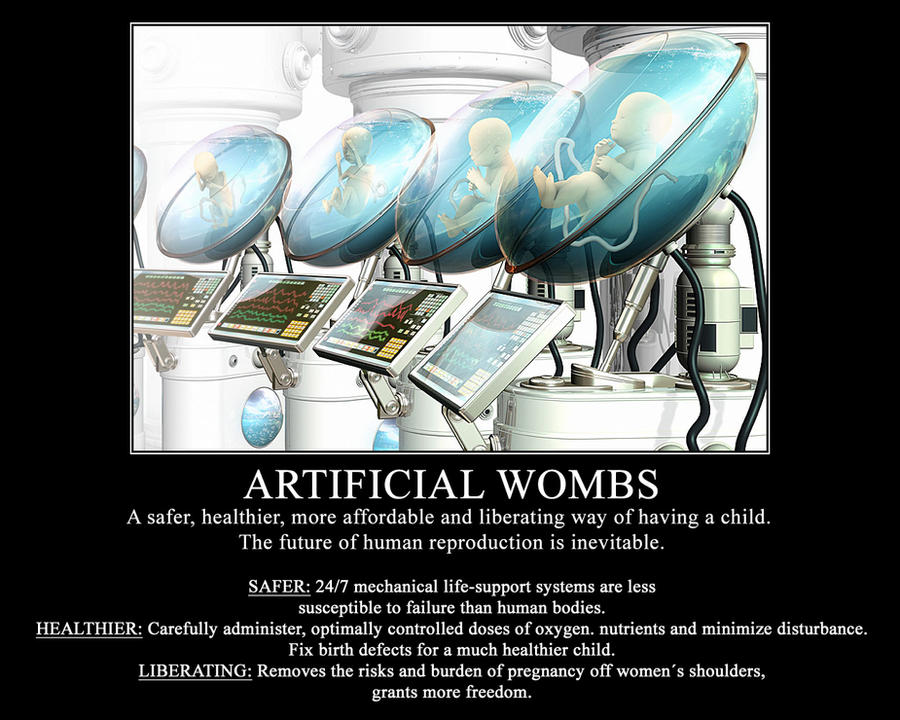
As I discussed in an earlier post, science is rapidly progressing to a point where we won’t even need sex to reproduce. There will be far safer, less strenuous options that don’t result in stretch marks and mood swings. The most promising is the artificial womb. This technology is the ultimate endgame in terms of decoupling sex from reproduction entirely.

If that term sounds familiar, it should and not just because Gweneth Paltrow used something similar in a way to make herself even less likable. It’s actually a term that I’ve referenced before because it was used frequently in Ray Kurzweil’s book, “The Singularity Is Near.” I’ve lauded this book many times before on this blog and parts of this issue are closely tied to the topics he explores.

In his book, he cites advances in contraception as the catalyst for this growing disconnect between sex and reproduction. He’s not wrong to cite such advances because we’ve spent the last 60 years or so adjusting to a world that contraception has created. It’s a world where women and men have more control than ever in when and how they have children. Such control was truly unprecedented.

Considering how birth control in the past involved pulling out, crocodile poop, and condoms made of animal entrails, we’re still in uncharted territory as a species. We humans have never lived in an age where we had this much control over our facility. The rise of the birth control pill was ground-breaking in terms of its effects on society. We’re still struggling to build a new foundation with those effects.

There’s no question that contraception technology will continue to improve, as Kurzweil discussed. It may get to a point where we have a perfect form of contraception for men and women alike, one that’s as easy to get as aspirin and just as easy to take. Such a time would truly be the Catholic Church’s worst nightmare.

However, despite Kurzweils’ many discussions on contraception and fertility, he never mentioned artificial wombs. To be fair, it’s still an emerging technology with a lot of hurdles. Contraception technology is likely to take priority over the next couple of decades, if only because it has so much momentum. At some point, though, artificial wombs will enter the equation.

This technology will do much more than make it easier for women to avoid getting pregnant when they don’t want to, thereby freeing them up to just enjoy the toe-curling pleasure of sex. It will give society an entirely new way grow. For some, it’ll be strange, sterile, and cold. For others, it offers a bold new vision for the future of the human race.

It’s hard to imagine. As such, it’s easy for writers like Aldous Huxley to have overly-dystopian visions of it in his book, “Brave New World.” Even radical feminists and ardent traditionalists, most of whom are men, worry that this technology will render the other gender completely obsolete. It’s scary, I know, but there is a precedent for this sort of thing. Society can adapt to these kinds of dramatic upheavals. It’s done so before.

This brings me back to food. Here’s a quick question for everyone to contemplate. When was the last time you had to worry about a harvest going bad or not having any animals to hunt? Take as much time as you need. I’ll wait.

Are you done rolling your eyes? Good, because the answer to that question, at least in first-world industrial societies, is pretty clear. They stopped worrying about famine, harvests, and hunting a long time ago. Today, food is cheap, plentiful, and so easy to get that our primary problem is that we eat too much of it.

Compare this with 99 percent of human history. From hunter/gatherer societies to early agricultural societies, the most pressing concern from kings to peasants was having enough food. Every year, societies all over the world lived with the constant dread that a harvest would go bad and they would all starve to death. Famine was like a bad blizzard. It was just a fact of life that you had to endure, accept, and dig out of.

A lot of that changed over the past 150 years. Going all the way back to the 1800s, advances in agriculture technology and farming techniques allowed fewer people to grow more food, so much so that there was time and land to grow cash crops like tobacco, cotton, and weed. It happened slowly, but it picked up steam thank to someone others have called, “The greatest human being who ever lived.”

His name is Norman Borlaug. He’s the father of the so-called green revolution. He’s also the primary reason why billions of people aren’t starving to death. He worked tirelessly to advance agricultural science to a point where even non-industrial societies can grow abundant food, so much so that famine isn’t just rare. It’s an aberration that warrants big budget fundraisers.

As a result, the act of growing, procuring, and preserving food is basically an afterthought in our society. We’re at a point in human civilization where we don’t eat to survive. Hell, we sometimes eat when we’re not even hungry, sometimes for a holiday, sometimes for social purposes, and sometimes just because we damn well fell like it.

Technology gave us this luxury. Technology will continue to improve, ensuring that our growing population will never have to till a field, pick fruit, or kill a deer for anything other than sport. Food is no longer as vital to survival as having a job or knowing where the dumpster behind a fast food restaurant is located.

With this in mind, apply the same concept to sex. Try to keep your pants on, but still try to imagine the world that would emerge. Sex is no longer quite as complex in the sense that people have to worry about the physical, social, and biological implications. In the same way they no longer worry about harvesting food, they don’t have to worry about any major consequences from sex.

In this world, sex isn’t linked to reproduction anymore. It’s just a physical act that two people do for whatever reason they want. It can be romantic. It can be social. It can just be for the hell of it. That’s really all there is to it. There’s no constant worry that it will lead to pregnancy, thanks to improved contraception. There’s also no worry that the population will stagnate because artificial wombs will take care of that.

As a result, the very concept of reproduction is very different from the concept of sex. Society may get to a point where the idea of making someone endure nine-months of pregnancy, and all the physical hell that comes with it, downright inhumane.

Now there will be those who contemplate this world and faint. I imagine many of them are affiliated with the Catholic Church, the Mormon Church, or the Duggars. However, like food production before it, science will change the way we think about sex, reproduction, and intimacy. It’s a matter of when and not if. I do hope it comes in my lifetime because that means the market for erotica/romance is sure to grow.

2 Comments

Filed under Jack Fisher's Insights

Artificial Wombs: The Solution To Gender Equality?

Let’s face it. There’s a lot to whine about these days. As much as I despise whining, I don’t deny that this world gives us plenty of reasons. From war, famine, injustice, to poor wi-fi, there are a lot of issues that upset us on multiple levels.

When it comes to issues between the sexes, the whining and anger is that much more amplified and for good reason. Biologically, we’re very different. One sex has organs that hurt like hell when they’re kicked. Another has organs that hurt like hell when bringing a new life into the world. Despite these differences, we have powerful drive that urges us to come together, form intimate bonds, and even have sex if we’re lucky.

It’s because of these differences and that powerful drive that there’s so much conflict between men and women. It’s a driving force behind every sitcom, from “Leave It To Beaver” to “Modern Family.” It also fuels every conflict in every romantic comedy ever made, even the ones with Matthew McConaughey.

These conflicts are still an annoyingly persistent part of our political discourse. Modern feminism is driven, in large part, by these differences that manifest in everything from the wage gap to boob sizes on comic book characters. These differences can become so profound that it leads to genuine upheaval, as we saw with the Women’s March.

These upheavals have been with us for years and, given how the last election turned out, it’s likely to stay with us for years to come. There seems to be no end to it. Are men and women doomed to always be at odds?

Well, I try to be more optimistic about the future. I like to think a few extra miles past the finish line to imagine solutions that don’t necessarily always solve the problem, but do essentially render it obsolete. In the same way cell phones made LAN lines obsolete, some problems can just cease at some point.

In that spirit, I believe I’ve found something that would effectively end most ongoing conflicts between genders. It wouldn’t just level the playing field for men and women. It will effectively remove the many excuses that both sides make to hate, despise, and denigrate each other.

It’s not a legal solution. It’s not some ambitious social revolution either that requires everyone to sit through a gender studies class either. It’s a purely technical solution, one that is achievable. Some bold scientists are already working on it as we speak. Ladies, gentlemen, and those of unspecified gender, I give you the Artificial Womb.

I hope it doesn’t need too much of an explanation. It’s exactly what it sounds like. While it’s still on the drawing board, an artificial womb’s function is pretty simple. It’s an external device that allows for the growth, development, and eventual delivery of an infant outside of a physical womb. It’s basically all the joys of creating life, but with none of the stretch marks or morning sickness.

It’s not a new idea. In fact, there has been work on the development of embryos outside the womb going on for years now. It’s also a concept explored in fiction, most family by Aldous Huxley in his book, “Brave New World.” However, that book was basically a dystopian fever dream. I prefer to assess artificial wombs on a more constructive level.

Let’s ditch the dystopian fears and the horrors of some traditionalists who believe that life should only ever be created when a penis and vagina are involved. Instead, let’s think for a moment what an artificial womb would mean for men and women.

First and foremost, an artificial womb would remove one of the main driving forces behind that wage gap I mentioned earlier. When women get pregnant, they need to take time off to deal with their health and their newborn. This means they can’t work as much as men. As such, they don’t make as much money or have as many opportunities.

It’s not a patriarchal conspiracy. It’s basic biology. However, when you circumvent that biology, then suddenly women are free to compete with men more equally. They can still have babies, but they don’t need to put their bodies through nine months of hardship that has been tragically fatal for countless women over the centuries.

Beyond the job opportunities, an artificial womb means a woman has more control over her body. If she doesn’t want the stretch marks from pregnancy to undermine her rock-hard abs, then she doesn’t have to. She can keep looking like a young Janet Jackson while still having kids.

Beyond employment and vanity, though, an artificial womb does something else that might be even more profound. It effectively uncouples sex from reproduction. At the moment, even with things like in vitro fertilization, sex is the primary method for how we reproduce.

Granted, it’s extremely imperfect and prone to error. Then again, you could say the same thing about our immune systems until antibiotics and vaccines came along. In that instance, technology allowed us to rely on something other than the limits of our own biology. An artificial womb is just the next step in that process.

When that process plays out, it effectively changes everything we think we know about sex, which isn’t saying much for some people. Even though we humans have all sorts of reasons for having sex, rather it’s for love or a step in landing a big movie role, we can’t really escape the part where it leads to babies. Sure, we have contraception, but even that only goes so far.

An artificial womb won’t just change how genders relate to one another. It’ll change our fundamental concept of what it means to be intimate. What happens when sex just becomes an act of intimacy and not reproduction? What will that do to our love lives? What will that do to a new generation of children born in these wombs? What will it do for aspiring erotica/romance writers like me?

These are all difficult questions that are worth contemplating, even if they can’t be answered. I know artificial wombs are probably a ways off, but I do think this is one of those technologies that could occur in our lifetime. The next generation may very well be the first to never know the rigors of entering this world through a vagina. What kind of generation will that be? I don’t know, but I hope I have a chance to write sexy stories about it.

19 Comments

Filed under Jack Fisher's Insights

What BDSM Tells Us About Authority And Our Future

Let’s face it, we humans need some semblance of order in our lives. As a species, we just don’t function well in chaos. We’re a species that will riot in the streets because we’re glad our favorite basketball team won the championship. If aliens landed tomorrow, we’d have a very hard time explaining that to them.

Order and authority is a big part of what makes society function. It’s a big part of what helps humanity survive. As caveman logic tells us, our brains and bodies are wired for only two things: survival and reproduction. They’re wired, designed, and maintained poorly, as I’ve pointed out many times before, but there are over 7 billion of us surviving and reproducing on this planet right now so we must be doing something right.

This leads me to the wonderful world of BDSM. Yes, I know that sounds like a non-sequiter. Yes, I know that sounds like an excuse for me to talk about overtly sexual topics again. No, I will not apologize for it. I don’t think I need to explain myself at this point, nor should I have to.

In reading and writing about BDSM, I’ve picked up on a few underlying themes. Since my brain works in elaborately perverse ways, I often find myself applying those themes to the world around me. BDSM is no exception. If anything, it’s the basic standard.

Earlier this year, I completed a draft of a book called “The Big Game.” It’s a book that explores various forms of BDSM, but not just because I think readers enjoy the mental image of a star male athlete being whipped in the ass by a sexy female librarian type, although I’m sure that has its own kind of appeal.

In this story, I try to apply the principles of BDSM to a bigger picture. That bigger picture has a lot to do with how we function as a society and how we see authority. Some people inherently flaunt authority. Some people desperately need it. Human thought is incredibly diverse on the subject, but whatever our sentiment, it still affects us.

At its core, BDSM cuts through all the chaff, uncertainties, and formalities. When you read about BDSM or practice it, you know who’s in charge. You know who has the authority and who doesn’t. It’s an extremely simplistic scenario that requires little thought. The fact it often involves sex is just a bonus and a damn good bonus if done right.

In many respects, BDSM takes advantage of the biological wiring that’s already in place. There is actual science behind our inclination to obey and conform. A large body of research shows that humans have a genetic and psychological predisposition to obedience and conformity.

When you look at it through the lens of caveman logic, it makes sense. In our caveman state, we can’t dedicate all this mental energy into deciding whether or not we should trust or obey someone. That would be like holding a jury trial just to determine who gets to pick the restaurant on a date night. It’s a wholly inefficient use of our time and energy.

We need to use those resources for more vital issues like securing meat for the winter and doing enough humping to ensure our tribe has enough people to continue. Natural selection does the rest. That’s why nature instills this in our collective psyche. It helps us get along, work together, and survive long enough to get frisky.

However, like most other natural forces within our biology, it’s not that fine-tuned. Nature is a blunt instrument and not a scalpel. If our brains and bodies were computers, then they we’d say they had been wired by a drunk office temp with a bad attitude and a knack for laziness. As a result, this vital programming for obedience and conformity lay the foundation for BDSM.

It’s in this context where our biological programming for obedience goes to an extreme. The fact those extremes bring some people to orgasm only makes it more powerful. When there’s a lot of uncertainty in the world, we naturally look for whatever certainty we can find. As I said before, you can’t get much more certain than who dominates who in BDSM.

Submission, dominance, obedience, and authority are all streamlined in BDSM. You don’t need to dedicate a lick of mental energy to scrutinize the situation. Everything is perfectly structured. Everything is perfectly laid out. For many perfectly healthy people who are concerned about an unhealthy world, there’s a lot of appeal in that situation.

At its core, BDSM acknowledges that we human beings aren’t built, physically or mentally, to be complete independent. We need to submit or dominate certain aspects of our lives. It’s the only way we can make sense of the world and ourselves. That’s a big reason why BDSM experiences are so powerful for some people. It’s also a big reason why it has such appeal.

So what does this mean for our future? Well, that’s a bit trickier to answer. We like to think we’re progressing to a point where we can meet all our physical and emotional needs through technology. That’s not entirely wrong, but a big part of those needs is to have some form of stable authority.

As kids, that authority is our parents. As young adults, that authority is our teachers, law enforcement, and fellow peers. As adults, that authority is our spouses, our bosses at work, or our friends. We built our lives around authority. A part of us needs some kind of authority to submit to. Some need it more than others. Most of us need it more than we care to admit.

The future will create all sorts of new uncertainties. With over 7 billion people with countless (often conflicting) needs, we’ll need some form of authority to make sense of ti all. I don’t know what form that authority will take, but it’s an idea I intend to explore.

It’s also an idea I intend to make sexy in some strange way, but that should be a given at this point. After all, if BDSM can give authority so much sex appeal, then why not embrace it along with our future as a species?

2 Comments

Filed under Jack Fisher's Insights