
The following is a video I made for my YouTube channel, Jack’s World. It’s a video version of an article I wrote a while back. I added and removed a few details to the video. If necessary, I’ll do a follow-up. Enjoy!
The following is a video I made for my YouTube channel, Jack’s World. It’s a video version of an article I wrote a while back. I added and removed a few details to the video. If necessary, I’ll do a follow-up. Enjoy!

It’s getting closer.
It may not feel like it, given how this year has played out, but trust me. It’ll be here sooner than you realize.
Election Day 2020 less than three months away. In any other year, of which 2020 is not, we’d already be sick of election news. We’d be whining about how much energy it has sucked up from the news cycle and how ugly it has made public discourse. You don’t need to convince me. I remember the 2016 election vividly.
Now, I almost envy those days. At least during that clusterfuck, we could still go to a movie theater and hang out in bars without wearing masks.
The sad truth is 2020 is a year unlike any other. There aren’t many stories, at least in the United States, that could usurp the news surrounding a Presidential Election. The worst pandemic in over 100 years is one of them. That has been our focus. That has been our chief concern, and for good reason. It’ll continue to be our main concern, well into 2021.
However, there’s still an election set for November 3, 2020. Even if you’re not registered to vote or living in the United States, you’re aware of just how high the stakes are. Every election can change the course of history, but few have ever occurred during a situation like this.
Set aside, for a moment, your political leanings. Set aside who you voted for last time. This election is pivotal in ways that are impossible to overstate, so I won’t bother trying. Instead, I’m just going to offer a simple message to everyone who is eligible to vote in this election.
Start preparing. Be proactive. Act now.
I say this message because, just recently, I requested an absentee ballot from my local election office. I did so because I currently do not know whether my usual polling place will be open or sufficiently staffed. In most years, that’s not an issue. Again, this is not most years.
I have every intention of voting in this election, by whatever means I can legally do so. I have not voted with an absentee ballot since I was in college, but I am trying to be proactive. I’ve every intention of making sure I have everything I need to vote by the first of October. Even then, I’m going to check in with my polling place, just to make sure my vote is cast.
I encourage everyone to do the same and not just because voting by mail has become a hot button issue. This situation really is unprecedented. We’ve had to vote during times of war, economic depression, and social unrest. We haven’t had to vote during a pandemic in 100 years. There’s no playbook or precedent that anyone alive today can follow. We’re going into this scared, uncertain, and half-blind.
That’s why now is the time to educate yourself on voting by mail and casting an absentee ballot. The information is out there. John Oliver even did a segment on it in his show, Last Week Tonight. Here’s the clip, in case you haven’t seen it.
There are also plenty of online resources to utilize. Check out this website to learn more about your jurisdictions laws and regulations regarding absentee ballots. If you still intend to vote in person, make plans now. Whether that involves taking time off work or coordinating with your community, do not procrastinate. Start now. Make a plan. Make a backup plan. Then, make a backup plan to your backup plan.
This isn’t your fantasy football draft.
This is the most critical and integral part of democracy.
The United States already has a poor record of voter turn-out. It has an even worse record when it comes to making those votes count, due to the electoral college. The only way to compensate for the deficiencies in this system is just get out and vote in overwhelming numbers. It’s the only way you can exert what little political voice you have.
Make no mistake. Those who currently benefit in the existing system will only benefit more if you don’t vote. If you are not benefiting or feel left behind, then the worst thing you can possibly do is not vote. That’s essentially giving those in power right now a free gift and getting punished in return. There is literally no downside to casting your vote this November.
I’m sorry if my words sound like hyperbole. I’m not trying to sound like a doomsayer. I’m just trying to encourage others to be proactive. This is not a normal year. This is not a normal election. If it’s going to work in any capacity, we must be proactive. The very ideals of our democracy depend on it.
Filed under Current Events, political correctness, politics

We currently live in a golden age of villains. Between Thanos, Erik Killmonger, the Joker, and Walter White, there has been a veritable surge of complex characters who also happen to be compelling villains. While there’s still a place for the kind of pure evil that Disney villains have relied on for years, this trend in a more refined brand of villainy feels both refreshing and overdue.
I’ve written extensively on villains before. As a lifelong fan of superhero comics and movies, I’ve consumed, contemplated, and scrutinized hero/villain dynamics more than most. In doing so, I’ve noticed plenty of trends. Like most aspects of popular culture, it’s always evolving. Very few themes and details remain constant, especially when it comes to antagonists.
That said, there’s one trend in villains that has remained somewhat constant over the course of my lifetime. It’s also a trend that I see as intensifying, albeit in a subtle way. Some of it coincides with the growing complexity of villains in popular culture, but most of the trend precedes the current era of superhero-dominated media. If anything, superhero media helped accelerate it.

While most villains and heroes rarely identify with a certain political affiliation, it’s usually not hard to discern how most would vote in a contemporary election. I would even argue that it’s easier to surmise what a villain’s political leanings are compared to that of heroes. Take any villain from the past 10 years of movies, be they superhero or otherwise. Chances are a vast majority of them would identify as conservative.
Now, I understand conservatism is an exceedingly broad term. It has a dictionary definition, but as a political philosophy, there are many sub-sets, divisions, and variations. From fiscal conservatives to social conservative to neoconservatives, there are many wildly different ideologies that still identify as conservative. A few actively clash with one another.
Those complexities aside, there are some core tenants associated with conservatism and it’s those very tenants that make it such an effective basis for villains. Chief among conservative values is the idea that traditional norms, institutions, and values be maintained. Change isn’t actively dissuaded, but it is viewed with caution and suspicion. To be conservative is to affirm the status quo, to some extent.
That’s all well and good if the status quo is beneficial to everyone. It’s not so preferable for those who either fail to benefit or are actively screwed over by that same status quo. Since there has never been a society in history that has achieved perfect prosperity for everyone, regardless of their minority status, there’s bound to be people who get left behind.
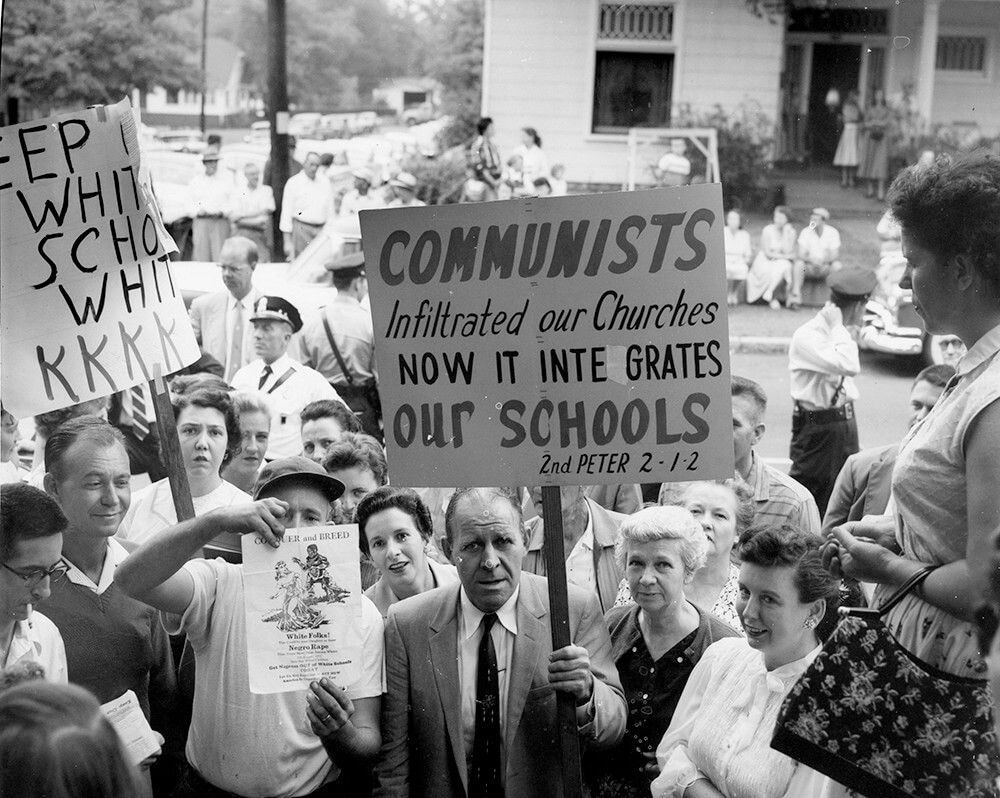
In our own real-world history, we’ve seen people from those disaffected groups organize and fight the status quo to better their lives. That struggle has played out in the Civil Rights movement of the 1960s, the movement for women’s rights, and the LGBT rights movement that’s still going on today. Those who oppose these movements tend to have, broadly speaking, conservative leanings.
Look at the groups that opposed the Civil Rights movement.
Look at those who actively oppose LGBT rights, women’s rights, and immigrants.
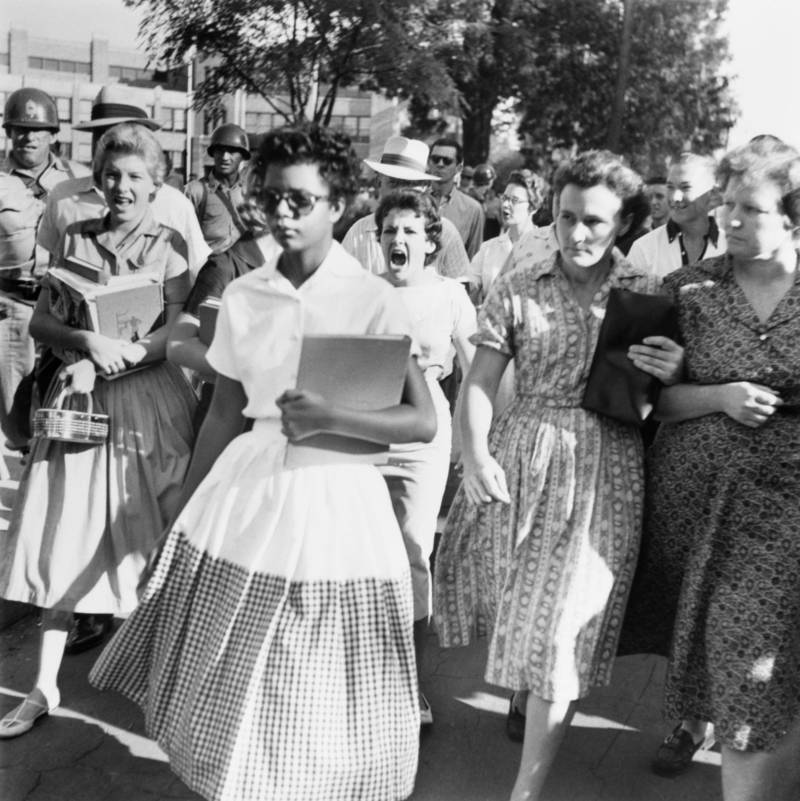
They all espouse rhetoric that would put them at odds with Superman, Captain America, and most other superheroes who value justice, truth, and peace. For some, their talking points sound like ideas that only villains in the mold of Lex Luthor would agree with. While not all of them identify as overtly conservative, the standard principles are there.
Anything too different from the status quo must be wrong or evil.
Anybody too different from the people everyone else in a society must be bad, evil, or devious.
Any idea, trend, or movement that is disruptive or deviant in any way is something to be opposed.
It doesn’t just manifest in superhero movies or underdog stories, either. Look at a movie like “Footloose.” In this story, the people who ban dancing are uptight, dogmatic, religious zealots who likely voted for Ronald Reagan in 1984 when this movie came out. They were the antagonists of that story and the kids, while not overtly liberal, dared to defy them.

It can even manifest subtly in other media. In kids shows like “Recess,” “Hey Arnold,” and “Rocko’s Modern Life,” the most common antagonists are uptight authority figures who have no tolerance for new ideas, big changes, or anything remotely fun. It’s hard to imagine any of these characters voting for someone who builds their slogan around change, reform, and reinvention.
They like things the way they are. Most of them benefit from the current system and will naturally seek to preserve their place in that system. While they won’t always see themselves as villains, it’s difficult for them to come off as heroes. You can only be so heroic when your side is closely aligned with predatory business practices, fun-hating religious zealots, and unabashed war-mongers.
That’s not to say it’s impossible for liberals to be villains too. It does happen and it can be done very well when done right. I would argue that Erik Killmonger in “Black Panther” was more in line with an extreme liberal revolutionary who didn’t just want to pursue change. I would make a similar argument for Ra’s Al Ghul in “Batman Begins.”

These characters didn’t just seek to change society from its current unjust state. They sought to violently destroy it and rebuild it from the ground up. That kind of liberalism exists in the real world and it can make for compelling villains.
However, the number of villains who align with the politics of Killmonger are far fewer than those who would align with the politics of Lex Luthor. In general, it’s easier to resist change rather than embrace it. It’s also necessary to some extent for those to resist change to be uptight authority figures who are okay with coercing others to maintain traditions. Logistically, the villains in many conflicts must be conservative.
Now, that’s not to say that villains will always lean conservative in popular media. What it means to be conservative changes over time. If you were to listen to conservative rhetoric 50 years ago, they would sound very different. They might even sound liberal by today’s standards.
The same goes for liberalism of previous eras. It hasn’t always been closely aligned with the politics surrounding minority rights, income inequality, or political correctness. The liberals of the 1920s would likely clash with the liberals of today. That’s just part of the ever-evolving nature of politics.
For the time being, though, being a villain in popular culture usually means being conservative to a certain extent. Conservatives are more likely to be the rich, greedy business people who would gladly burn down a rain forest or exploit slave labor to raise profits. Conservatives are more likely to be the rule-loving, fun-hating, curfew-enforcing religious zealots who wouldn’t mind electing theocrats with every election.
These types of individuals are far more likely to be villains in a story. At the very least, they’ll side or tolerate the villain. It’s easy to believe that those who side with the religious right and well-connected rich people will generally oppose a selfless, likable protagonist. From a narrative perspective, these kinds of villains are better in that we tend to root for heroes who oppose authoritarian bullies like that.
Again, it’s guaranteed that political and cultural trends will likely change what it means to be conservative, liberal, and everything in between. For the time being, if you were to bet on the political leanings of an antagonist, the odds are mostly in favor of that antagonist being conservative.
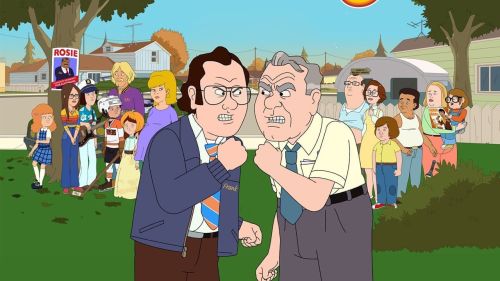
The following is another video for my YouTube channel, Jack’s World. Once again, it focuses on “F is for Family.” I know it’s a show I’ve talked about a lot, even on my burgeoning YouTube channel. I’d hoped to post something like this earlier, but I had to delay it a few times to ensure it had the necessary polish. I think it’s finally ready.
Please let me know what you think. Just be warned, some of the topics in this video are going to make you want to put someone through a fucking wall. Enjoy!
Filed under F is for Family, Jack's World, philosophy, politics, YouTube

First off, I need to apologize in advance because I’m about to go on a rant. I promise it’s related to current events, relatively speaking. I can’t promise it’s the most serious issue in the world, but I still think it’s worth saying.
Let’s face it. We’ve seen a lot of terrible things these past few months. That includes, but isn’t restricted to, images of mass graves, angry protests, and videos of people committing egregious atrocities. It’s all over the internet, broadcast daily on network TV, and streaming in on news feeds of all kinds. We’ve seen so much violence and injustice. We’re outraged by it, and rightly so. It’s horrible. Most everyone agrees with that.
With all that in mind, I have one simple question that I think needs answering at some point.
With all this horrific imagery, why is it still so obscene to depict a female nipple?
I’m serious. I’m not trying to be funny or cute. I’d like an explanation.
Why the hell are we still censoring female nipples? What good does it do? What purpose does it serve? Blurring genitals? Okay, I can accept that to some degree. At least it’s blurred for everyone, regardless of gender. But why blur female nipples at this point?
We know what they look like. They’re not some graven images that’ll make people burst into flames. Granted, female nipples look different than male nipples, but not so radically different that they’re fucking alien. So, why censor them?
On TV, they’re still blurred. On social media, they immediately get labeled as porn, as though female nipples, by default, make something porn. That makes no sense. We’re not talking hardcore sex acts here. We’re talking about the slightest glimpse of female nipples.
Why, in a world where extreme violence finds its way into cable news, are female nipples so egregiously obscene? This isn’t the 1950s. This isn’t Victorian England. Anyone with an internet connection can see an unlimited number of uncensored nipples. Are they really that shocking anymore?
To those who whine about the innocence of children, here’s a quick anatomy lesson. They know what nipples look like too. They have them. They’ve probably been breast fed at some point. You really think they can’t handle it?
To those who think it’s too sexy, I have to ask why do you think that is? Do you really think censoring a basic body part makes it less sexy? I’m sorry to be the one to tell you this, but it doesn’t. It just doesn’t.
At most, you’re just fetishizing it, treating it as this powerful trigger that will turn anyone into perverts. People don’t work like that. You’re not doing them any favors by treating them like they’re that sensitive.
Also, if you’re a woman who hates being objectified, I have to ask. How do you feel about this? How do you feel that a part of you is deemed too obscene for network TV, yet that same network has no problem depicting people getting choked to death? How is it fair that a man can walk around a park without a shirt, but if a woman does the same, she gets arrested? That’s not just objectification. It’s insane!
Seriously, after everything we’ve experienced in 2020, isn’t it time we get over our hang-ups about female nipples? I know it won’t solve much, but we cannot be strong as a people, yet still too weak to handle depictions of female nipples. We’re better than that. We need to be.
Thanks for bearing with me on this rant. Again, I apologize. I just wanted to get that out. If nothing else, I hope this gives everyone something less awful to think about.
Filed under censorship, political correctness, politics, rants
Recall, for a moment, an instance where you were faced with a difficult choice. You had a pretty good idea of what choices were right and what choices were wrong, but could not be completely certain. What choice did you make and why did you make it? What motivated you to do what you did? What were the results?
We’ve all been in situations like that at some point in our lives. Most of the time, it’s mundane. It effects only us and those in our immediate surroundings. In those instances, motivations tends to be basic. You make a decision you feel works best and you deal with whatever consequences that occur. However, when it comes to larger decisions by people in powerful positions, it tends to get more complicated.
Those complications have become a lot more visible in recent years, due to the internet and social media. Now, if you’re a rich celebrity or in a position of power, your choices are always scrutinized. Doing the right thing is not just a matter of morality anymore. It’s an added complication for public relations and advertising.
People will do the right thing because it’s good for their image.
People will do the right thing because it’s for a cause they believe in.
People will do the right thing because they’re being pressured, criticized, or condemned.
Whatever the case, the decision is usually the same. Even the moral components of the decision are the same. It’s just the motivation that’s different.
With that in mind, and given the dynamics I just described, I have one more question to add to this issue.
When it comes to doing the right thing, how much or how little do motivations actually matter?
It’s a relevant question in a connected world where it’s painfully easy to overreact. Recently, I speculated on the reactions to the recent news that the Washington Redskins were changing their controversial nickname. It didn’t take long for those speculations to become real.
Less than a day after this announcement was made, people were already saying that it was too late. Even if it was the right thing to do and was the desired result that advocates had fought for, it’s somehow not enough. They’ll point out that the only reason the name was changed was because major sponsors pressured it.
That point is probably valid. If the franchise stood to lose a great deal of money over clinging to its old nickname, even if they sincerely believed it wasn’t offensive, the economic pressures were just too great. When it comes to impassioned pleas versus financial pressure, money usually wins out.
It’s unfortunate, but that’s the world we live in. Money talks louder than outrage. It always has. It always will. No matter how much we resent that, that’s not something we can change right now. Regardless of how you might feel about that system, the question remains.
Does it truly matter? Advocates got their wish. The name of the team is changing. It might not be changing for the reasons they want, but it is changing. Isn’t that enough?
Do the results matter more than the motivations? We can never see, touch, feel, or measure someone’s motivations. We can only ever experience the results. One is tangible. The other is not. Which matters more to you?
I think it’s a relevant question because those continue to complain, protest, and whine about the team are only doing a disservice to their cause and future causes like it. They’re setting it up so that, no matter what their opponents do, there’s no way they can ever appease them.
If they don’t change the name, they inspire more outrage and criticism.
If they do change the name, they’re still subject to outrage and criticism because they didn’t do it soon enough or for the right reasons.
How is that fair? How is that even logical? If anything, that kind of approach only gives everyone a good excuse to never engage with opponents. They know there’s nothing they can do to placate them, so what’s the point? Short of getting in a time machine and undoing history, there’s literally nothing they can do.
Either results matter or they don’t. It’s as simple as that. If you’re not happy with the results, then you’ll never be happy with anything.
Filed under Current Events, human nature, philosophy, political correctness, politics
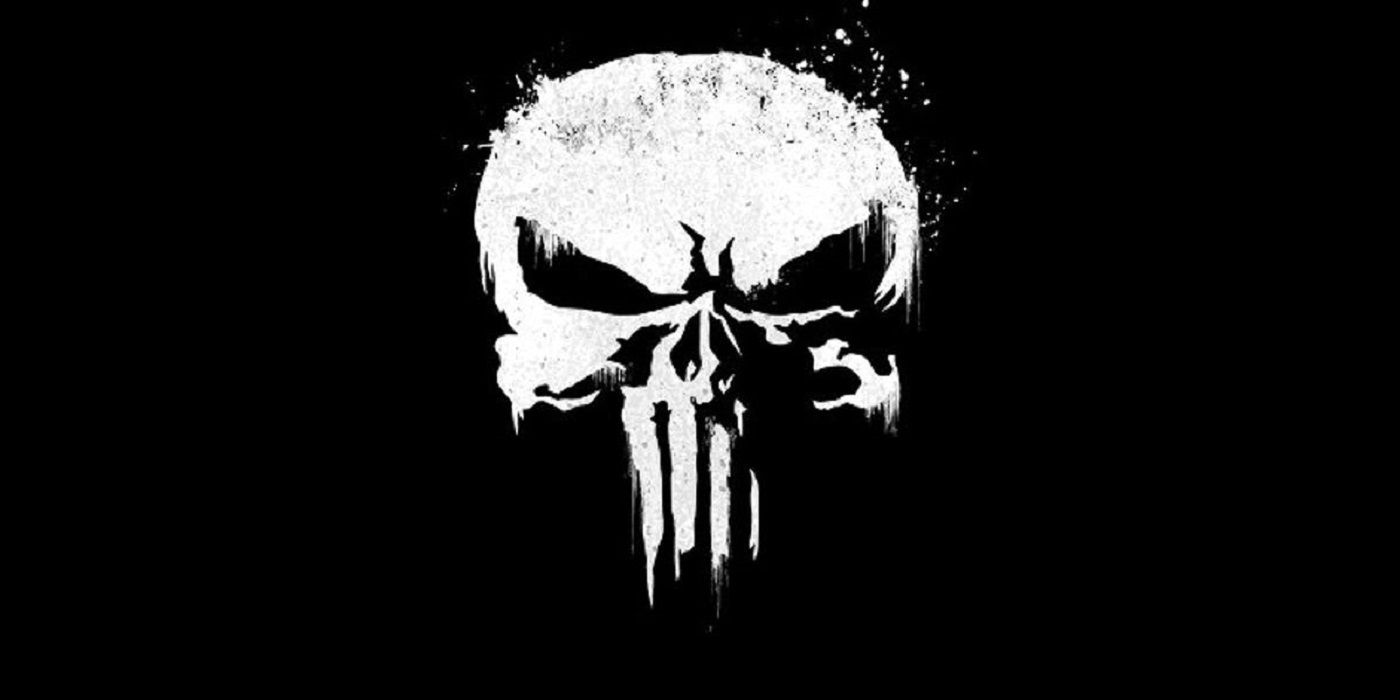
A while back, I wrote a piece about cops using the Punisher’s logo. In looking over news clips of that story, I decided that it warranted a full-fledged video on my YouTube channel, Jack’s World. I believe this is an important story and an important point worth making in multiple forms. I hope others feel the same.
There are some topics I generally avoid talking about. It’s not because I’m ignoring or downplaying the issue. I just feel like I don’t have anything meaningful to contribute. It’s for that reason that I haven’t touched on recent issues surrounding police brutality, Black Lives Matter, and defacing statues of historical figures. I’m neither qualified, nor knowledgeable enough to add anything to the conversation.
I support the efforts of Black Lives Matter to raise awareness of police brutality.
I’m against police brutality.
I’m in favor of prosecuting the officers responsible for George Floyd’s death to the fullest extent of the law.
I’m in favor of police reform, which includes demilitarization and criminal justice reform.
I have little else to contribute beyond that. I acknowledge that my perspective is limited. I’m not a young black man living in an urban area that’s subject to significant police brutality. I won’t claim to understand anything about the issues people in that situation face every day for years on end. That’s not why I’m finally talking about this.
I only decided to throw my voice into the mix when I read a story about police officers using the famous emblem of the Punisher as a logo. As someone who is a lifelong comic book fan, and a general proponent of a fair and just society, this bothers me in so many ways. I’ll even take it a step further. I’ll make a larger statement that I hope other cops, comic book fans, and overall decent human beings can appreciate.
The cops who are co-opting the Punisher’s logo are hypocrites.
There’s no way around it. There’s no nicer way to say it, either. These police officers, who took an oath to uphold the law, are hypocrites on a level that would make Ted Haggard blush.
If they’d read more than one Punisher comic, they would understand why and think twice about plastering that logo on their cars. I doubt they know the Punisher as anything other than that tough, badass ex-soldier who kills criminals in the most brutal ways possible. That’s not even a half-accurate representation of who Frank Castle is and why he does what he does.
Now, I won’t get into the elaborate lore surrounding the Punisher. Most people can find that information easily. But you don’t have to know much of that lore to understand why cops using his logo is antithetical to Frank Castle’s mission.
The basics are simple. Frank was just a normal, law-biding citizen. He served his country. He loved his family. He did everything a decent, upstanding person is expected to do. Then, while picnicking with his family, a group of criminals who have no appreciation for the law, the people who uphold it, or human life in general, brutally murder his wife and children.
That’s what begins Frank Castle’s mission, but it’s a mission that decent, law biding people can’t take part in. That’s especially true if you’re a police officer and not just because Frank is a former soldier. A cop joining Frank’s mission would be like a vegan opening a chain of slaughterhouses.
At his core, the Punisher carries out this mission so others don’t have to. He’s already lost everything. He’s already broken. He’s got nothing left, other than the killer instincts he’d honed as a soldier. That’s why he chooses to channel those skills into taking out the kind of people who murder an innocent family just trying to enjoy a picnic.
It’s worth noting that the targets of this mission are not kids selling drugs, petty thieves, and assholes who park in a handicap spot. Those people may break the law, but they still live within the society the law helps foster. The kind of people who murdered Frank’s family do more than just break the law. They scoff at the very notion of it. They’ll hurt anyone they want and not give a damn about the consequences.
The Punisher is extremely selective. He reserves his wrath for those he knows deserve it. He also breaks the law to inflict it. That part is worth emphasizing too. Frank is a vigilante who murders. He is not and cannot be part of the justice system because he ignores it. He has to because the monsters he hunts ignore it too.
Someone still has to be around to both respect and uphold the law. That’s what good, respectable police officers are supposed to do. To use the Punisher’s brutal methods undermines that critical purpose.
Unlike Frank, Cops also have families, friends, and communities to uphold. They are supposed to enforcers of the law. They’re part of a system meant to serve and protect. If they start ignoring those critical parts, then the system just doesn’t work. It goes back to Frank doing what he needs to do so that others don’t have to.
When a cop usurps the Punisher’s logo, they’re sending a message that they don’t give a damn about a fair and just society. They just want to punish the people they think need punishing. That’s a crude, misguided interpretation that is antithetical to the basics of law enforcement. They may think they’re being badass heroes in their minds, but they failing to see the hypocrisy of subverting the law to enforce it.
This is a big reason why the Punisher’s creator, Gerry Conway, has gone on record as saying he opposes cops using the logo. They’re not just co-opting his creation. They’re using it to justify atrocities. That’s not just wrong. It’s disturbing that anyone who claims to champion the law would take that approach.
It’s also worth noting that in one iconic Punisher story, Welcome Back Frank by Garth Ennis, the Punisher encounters a group of people who tried to follow his example. They became vigilantes as well and tried to punish those who they thought deserved it. They said they admired him. They even wanted to join him. What was Frank’s response?
He shot them dead on the spot.
That, more than anything, proves the hypocrisy of cops who use that logo. They already have a logo. They have a badge and a uniform that tells society they’re there to uphold the law. If that’s not enough for them, then maybe they shouldn’t be cops.
Filed under Current Events, human nature, Marvel, political correctness, politics, psychology, superhero comics
In general, I try not to comment on an ongoing surge of internet outrage. In my experience, joining the digital riot often leads to misguided and misappropriated anger. Sometimes, it’s based on flawed assumptions that mirror the same flaws as the moral panics of old.
That said, I’m going to make an exception for the recent case of the “Central Park Karen,” as she’s come to be known. I hope this is a rare exception, but I feel compelled to comment because I think perspective is important when the outrage is fresh. In addition, I have some personal experience with some stereotypical “Karens.”
To those who don’t know the story yet, consider yourselves lucky. This is one of those stories that won’t damage your faith in humanity, but it will raise some challenging questions. The basics are as follows:
Overall, it’s a case of a woman being an asshole and potentially putting a black man’s life in danger. Sadly, around the same time this incident unfolded, a black man was killed while being subdued by police in Minneapolis. She might not have realized how dangerous it was for her to threaten this man in such a manner, but it’s still a dick move. She could’ve gotten him killed or seriously hurt over a goddamn leash law.
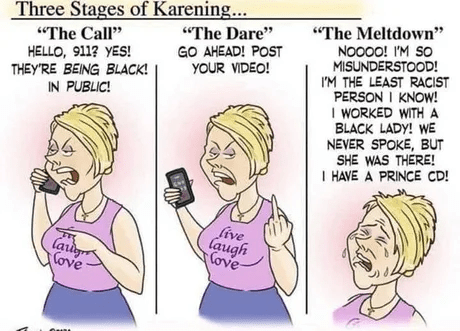
In this case, the facts are hard to dispute. The whole incident was captured on video. There’s no ambiguity on who was being the asshole here. It has become the ultimate manifestation of a stereotypical “Karen.” For those not familiar with this term, it’s an internet meme turned slur towards a certain type of woman. Here’s a quick rundown of those traits by Wikipedia.
The Karen archetype carries several stereotypes that are common to “basic white women”; the most notable is the stereotype that a Karen will demand to “speak with the manager” of a hypothetical service provider.[5] Further common stereotypes associated with the Karen pejorative include anti-vaccination beliefs, racism against black people, use of Facebook and a bob haircut with blonde highlights—pictures of Kate Gosselin during the airing of Kate Plus 8 were used in earlier memes about a “can-I-speak-to-your-manager haircut”,[6] and continue to be used in Karen memes[5]—engagement in multi-level marketing schemes, and Facebook posts sharing trite motivational messages.
With respect to this incident, the woman in question, whose name I won’t use out of privacy concerns, epitomized one too many of these traits. She acted like the law didn’t apply to her and threatened an innocent person of color, likely knowing that she had an advantage by being a white woman. In watching the video, it’s hard to much have sympathy for her.
I say that as someone with some admitted bias. That’s because I’ve had multiple jobs in the past in which I’ve encountered quite a few “Karens.” In fact, every job I’ve had has resulted in at least one encounter with someone who fits one too many traits of this stereotype.
When I worked at a fast food restaurant, I had Karen yell at me for trying to clean parts of a nearby table while her family was still eating.
When I worked at a software company, I had to respond to numerous Karens who demanded urgent assistance for issues that were trivial at best.
I know these kinds of women. I understand why they evoke so much animosity. I’ve harbored some of that resentment before. I don’t deny that my past experience affects how I interpret this story. While I try to be understanding in situations involving internet outrage, that’s considerably difficult in this case.
The outrage for this woman has already led to some major impacts. The woman has already been fired from her job and has had to make a public apology. On top of that, since her name has already been made public, she’s been subject to plenty of hate and harassment. By any measure, she has faced severe consequences for her actions.
That still raises one important question.
Has this woman been punished too harshly?
It’s not an unreasonable question, even from someone with a bias against stereotypical Karens. There’s a good chance that this woman’s life has been damaged for years to come. She lost her job. She’s being relentlessly harassed. She even had to give up custody of her dog. That’s quite a harsh punishment for someone who wasn’t arrested or charged with any crime.
At the same time, we can’t lose sight of the fact that she threatened an innocent man in a way that could’ve ended very badly for him. She openly and eagerly abused her status as a white woman flaunting the law. Had this not occurred, or had the video not gone viral, she wouldn’t have changed her ways. She would’ve just kept doing what she was doing.
That kind of behavior doesn’t just put innocent people of color at risk. It gives no reason for this kind of Karen-like behavior to stop. It’s only by facing consequences for her behavior that she realizes how wrong it was. Hopefully, others like her see what could happen to them if they were to behave in a similar manner.
That’s the best case scenario, but those scenarios are rarely the end result. At worst, this woman now has even more reasons to resent people of color. She might not have harbored overtly racist attitudes before, but she might feel differently now. She and others like her will now just have to be more tactful with their hate, which could subsequently lead to worse incidents that don’t go viral.
It’s hard to say without knowing the woman personally. I’m usually inclined to accept someone’s sincere apology. I genuinely hope that the woman was sincere. If the man she threatened accepts her apology, then I think the right thing to do is for the rest of us to accept it as well. She has faced plenty of consequences already. Forgiveness should be our first inclination when it is an option.
In a perfect world, the outrage would cease if the person wronged decides to forgive. Unfortunately, we don’t live in that world. I sincerely doubt the after-effects of this incident are over for the woman involved. It may take a long time for her to recover and in the long run, the outrage could do more harm than good.
It leaves me genuinely torn. I believe that asshole behavior like this should be confronted and punished, especially when it puts an innocent person’s life in danger. I also believe there should be a limit to that punishment. I just don’t know what that limit is and I think it’s worth contemplating.

Throughout the history of television, the best shows are often the ones that resonate with audiences through different eras, cultures, and places. It’s one thing for a show to be a hit when it’s on the air. It’s quite another for a show to still have appeal many years later.
Within that rare collection of TV shows with that special level of appeal, “Parks and Recreation” is in a class of its own. It started as a generic rip-off of “The Office.” It eventually developed into one of the most beloved and endearing TV shows of the past several decades.
Personally, it’s one of my all-time favorite shows. The recent reunion special only reminded me how much I loved it. I’ve gone out of my way to praise it in the past, from highlighting the respectable ideals of Ron Swanson to celebrating the joyous spirit of Leslie Knope. There are many more lovable characters on this show that are worth highlighting. I could write entire articles on the secret appeal of Jerry Gergich.
For now, I want to highlight another element of “Parks and Recreation” that I believe has become much more relevant lately. At the rate we’re going, we’ll come to see certain themes in “Parks and Recreation” as prophetic warnings, of sorts. It might not be as prophetic as “The Simpsons,” but it’s still critical, given the current state of affairs.
To understand the importance of those themes, take a moment to think about politicians. I’ll give everyone’s inner Ron Swanson a moment to endure the nausea. What ideas and images come to mind when you think of politicians? What’s the most common perception that most people would agree with? If you walked up to a random person, they’ll probably describe politicians as follows.
They’re all corrupt.
They’re all crooks.
They’re all power-hungry.
They’re all evil.
They’re all arrogant.
They’re all narcissistic.
They’re all greedy.
They’re out to steal our money/land/guns/rights/whatever someone happens to value.
It’s easy to have negative perceptions about politicians. To their credit, they do plenty to affirm those perceptions. You don’t have to look hard to find cases of laughably corrupt or downright evil politicians who couldn’t care less about their constituents. It’s enough to make understand where Ron Swanson is coming from when he brilliantly chastises government.
That said, there’s another side of the story that rarely gets explored. A big part of the comedy in “Parks and Recreation” stems directly from how it explores the challenges that governments face. It doesn’t avoid cases in which government officials behave in deplorable ways. It also doesn’t avoid the role the voting citizens play in enabling those same officials.
It’s the lesser known, but equally distressing aspect of government corruption. It’s not always the case that they just muscle their way into positions of power. In fact, it’s not that uncommon for these deplorable human beings to be legally elected to office. Some don’t even need to rig the vote. They’re able to win within the existing democratic institutions.
That’s the case for multiple politicians in the world of “Parks and Recreation.” Some characters are so laughably scandalous that it’s easy to forget that some of them were inspired by real-world events. However, this only compounds the underlying issues that the show explores, both directly and indirectly. At the heart of those issues is a simple question about the nature of government corruption.
Is it us, the people, or the politicians who foster corruption?
It’s not a strict either/or question with a clear answer, but it’s one that “Parks and Recreation” does more than most shows to explore. Take, for instance, the chaotic town hall meetings that the department holds in multiple episodes. Just look at how the citizens of Pawnee conduct themselves.
Some of these people are just obnoxious. Others are downright malicious. However, every one of them still votes. They’re the ones who ultimately decides who gets elected and who wields the power in their city. As a result, the many absurdities surrounding the fictional city of Pawnee tend to reflect that sentiment.
Throughout the show, the citizens of Pawnee aren’t depicted as exceptionally informed. They often make unreasonable, absurd demands. They’re quick to react and cast blame on others. They hold government officials to impossible standards. Even genuine, sincere public servants like Leslie Knope get attacked for not delivering, even when their requests are unreasonable and/or misguided.
On top of that, many of these same people are easily swayed by corrupting influences. In Season 5, Episode 2, “Soda Tax,” Leslie works with her good friend and competent nurse, Ann Perkins, to implement a soda tax that would curb the sale of exceedingly unhealthy soda consumption. It’s based on a real-world proposal. It addresses a real-world health issue. It’s the kind of thing you’d want a caring government to address.
Even so, the Pawnee Restaurant Association restaurant lobby rallies the people against it. Even though it passes, it ultimately plays a part in Leslie being voted out of office in a recall election during Season 6. That means her reward for trying to do public good is to lose her job while those mired in multiple sex scandals continue to hold power.
Take a moment to think about the bigger picture. In every season in “Parks and Recreation,” Leslie Knope conducts herself as an ideal politician who simply wants to do good for her community. She has to fight, tooth and nail, just to get elected in Season 4. Even when she does good by her citizens, they still vote her out.
Leslie dares to tell the truth and be honest with the people. Others, like Jeremy Jamm and Bill Dexhart, simply tell people what they want to hear and/or hire the right people to manipulate the public. They don’t force the public to vote a certain way. They don’t even rig the votes because, in the end, they don’t have to. The people are swayed by the necessary forces and vote accordingly.
Now, you can make the claim that the people of Pawnee are more gullible than most and, as the show often depicts, it would be a valid observation. They still have the power of the vote. They’re still the ones who ultimately make the choice to elect or depose public officials like Leslie Knope or Jeremy Jamm.
Politicians do all sorts of shady things with their power, but that power is still contingent on the will of the people, to some extent. Are the people not somewhat responsible for enabling the corruption that they so deplore? The plot and themes of “Parks and Recreation” don’t attempt to provide a definitive answer, but the show makes a relevant observation that has become even more relevant in recent years.
There are multiple real-world cases of people voting against their own interests for reasons that often confound outside observers. Even an alleged child predator managed to get 48.4 percent of the vote in his state in running for the United States Senate. Even though he lost, the margin for his loss was so narrow that it’s disturbing to think that people are willing to put a man like that in a position of power.
That’s not to say that the people who voted for such a deplorable human being are bad people. Chances are they either didn’t believe in the allegations levied against him or simply voted for him out of loyalty to a political party. Given the limitations of the democratic system, sometimes people are simply left with two bad choices and have to pick the one that’s least awful to them.
Limitations aside, the fact remains that very few of these corrupt politicians would be in positions of power if people just didn’t vote for them. Even if they had power, they wouldn’t have much influence if those same people didn’t support them, even if they aren’t overly corrupt. It’s why politicians often pander to their base supporters so much. They need that support, even if they’re corrupt.
Since “Parks and Recreation” went off the air, people have only become more politically divided. The rhetoric on both sides of the political spectrum has gotten increasingly extreme and the COVID-19 pandemic only made it worse. Both politicians and the voters are guilty of conducting themselves as arrogant assholes. Thanks to the internet and social media, this conduct is being captured for everyone to see.
There’s a lot of ugliness to go around in politics. Part of what made “Parks and Recreation” so endearing was how it forged humor in that environment. In doing so, it also shed some light on the absurdities surrounding politics, democracy, and society in general. It didn’t hide from the flaws. The show even magnified them in many cases.
As real-world politics gets uglier and meaner, the insights within the characters and plots of “Parks and Recreation” may prove more impactful in the long run. The show will always be funny, if only for the moments involving Ron Swanson and Jean-Realphio. It’ll give us a chance to laugh at how corrupt elected officials can be, but it won’t hide the fact that we still voted for them.
Filed under Current Events, Parks and Recreation, politics, television


 Jack Fisher's Official Publishing Blog