
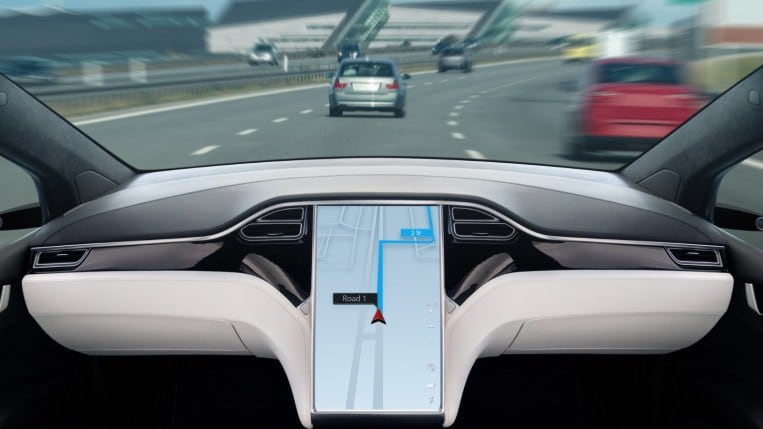
According to the Centers for Disease Control, 10,497 people died in traffic accidents caused by drunk driving in 2016 alone. That accounted for 28 percent of all traffic-related deaths in the United States. A non-insignificant chunk of those deaths were children. Even if you’re not good at math, you know that is not a trivial figure.
There’s also a good chance you know someone who has been hurt or worse because of a drunk driver. This sort of thing is personal for me because one of my cousins was killed by a drunk driver many years ago. He wasn’t even drinking. He was just unlucky enough to be in the back seat of the car at the time.
It’s an issue that has existed for as long as cars. It’s also an issue that policy makers and car manufacturers have tried to address through awareness programs and safety features. However, these measures can only do so much. So long as human beings are drinking and driving cars, this will be an issue.
That dynamic will likely change considerably when self-driving cars enter the picture. To some extent, they’re already making an impact. You can buy a car today that has some measure of self-driving features. They’re still not fully autonomous, but we’ve taken the first critical steps. From here on it, it’s just a matter of refinement.
Even though it might be years before self-driving cars are common, they’re already making an impact and it’s not just in terms of sheer novelty. Very recently, a Tesla Model S, which has an autopilot feature, did something cars of old could never do.
It saved a drunk driver who passed out behind the wheel, which likely saved or prevented serious injuries to others around him. Here are the details, according to the site, Telsarati.
Teslarati: Tesla Autopilot prevents drunk driver from making a fatal mistake
As explained by the Eastern Police District on its official Twitter account, a 24-year-old Tesla owner ended up passing out while driving his Model S. Fortunately for the driver, the vehicle’s Autopilot system was activated, which allowed the Model S to stay in its lane without causing trouble to other drivers.
Upon detecting that its driver was unresponsive, the vehicle eventually came to a stop and engaged its hazards. The man was later attended to by emergency services. No one was injured in the incident.
The police noted that the Tesla driver, who was found unconscious in the Model S, was evidently drunk, though he denied that he was driving. Video evidence showing the Tesla owner passed out in the driver’s seat have been shared online, however. The police stated that necessary tests have been taken, and that the Tesla owner’s driver’s license has been temporarily suspended. A case has also been filed against the driver.
Such an incident could have easily been a lot worse. It is very easy for drunk drivers to harm themselves, after all, but what’s even worse is that they could very easily harm other people just as easily. These scenarios would likely not be as prevalent if vehicles are capable of safely stopping on their own once their human drivers are incapacitated.
The bolded text represents the most relevant details. Without these features, this incident could’ve played out like so many other drunk driving tragedies. A drunk driver passing out behind the wheel would’ve, at the very least, led to the car going off-road and crashing, thus resulting in significant injury. At worst, the driver could’ve hit another car, thus compounding the tragedy.
However, thanks to these emerging systems, that didn’t happen. The safeguards in the car worked. The only real harm done involve a hangover and a DUI. Compared to the alternative, that’s far more preferable.
We should not understate the importance of this development. Think back to that 10,497 figure from 2016. Thanks to the autopilot system in that Tesla, the figure for 2021 will be at least one less. It doesn’t eliminate the tragedy of drunk driving all at once, but it’s a start and an important one, at that.
Driving is inherently dangerous, but a lot of that danger comes from the people behind the wheel and not the machines themselves. Anything operated by a human is prone to human error. An autonomous system, even if it isn’t a full-fledged artificial intelligence, can and will mitigate those errors.
That’s not to say those same autopilot systems aren’t prone to error. They certainly are, but remember that this technology is still very new. The first cell phones couldn’t send an email or reliably play streaming video. That took time, energy, and better hardware.
At this very moment, car companies and tech companies are putting in all that work. There is a lot of potential profit in refining this technology. However, I would point out that you can’t put a price on human life and, as it stands, thousands will continue to die every year because of traffic accidents, especially drunk driving. This one incident might not seem like much in the grand scheme of things, but it’s still one tragedy averted, one accident prevented, and at least one life saved. For anyone who knows the pain of losing a loved one to drunk driving, that’s worth celebrating.





 Jack Fisher's Official Publishing Blog
An Artificial Intelligence That Can Debate: The Promise And The Perils
Even in an era as divided and chaotic as this, there’s still a place for reasonable debate on important issues.
Yes, I understand it’s hard to say that with a straight face these days.
Yes, I’ve been to comments sections, Reddit, and 4chan.
Yes, I know how ugly the discourse is right now, but that’s exactly why I’m bringing this up.
In general, people are curious. Even though they cling to cherished beliefs and refuse to change their minds when confronted with evidence, we’re still curious about things that are different. It’s not always honest, but it’s a powerful feeling. Even if you despise those on the other side of the debate, a part of you will still wonder why they hold the opinions they have.
That’s why debate is such a powerful tool. Humans are such a social species by nature. We’re hard-wired to interact, connect, and discuss things with one another, even when we don’t agree. It may frustrate us to no end, as anyone who has debated a creationist can attest. However, the fact we keep doing it is proof, in my opinion, that there’s still value in the process.
Regardless of how you feel about the merit and value of debating, the whole process might become more complicated in the near future. That’s because IBM, the same company behind Watson, the Jeopardy playing computer, just created an artificial intelligence that can debate at the same level as a skilled human debater.
Here’s an excerpt from a piece in TechXplore on this new system. It’s not as scary as some of the things we’ve seen from Boston Dynamics lately, but it’s still intriguing.
TechXplore: IBM’s AI debating system able to compete with expert human debaters
Now, before you get too nervous, it’s worth noting that this AI is far from the kind of advanced artificial intelligence systems I’ve mentioned before. This is not the kind of AI that will become Skynet or Hal 9000, no more so than Watson or AlphaGo. This is a system is very much a narrow AI, as in it’s made to excel at a specific task.
We have AI’s that can beat world class chess players and Jeopardy champions. This AI just happens to excel at debate. However, that has implications that go beyond simply outclassing the best human debaters in the world at the moment. In fact, this is one form of AI that might not need human-level intelligence to incur a major impact.
Take a moment to think about how erratic and inconsistent most debates are. No matter how intelligent or informed you are, it tends to get messy fast. That’s why so many comments sections and Reddit threads devolve into shouting matches and personal attacks. The end result is people becoming more angry and unreasonable, which can have major real-world consequences.
However, what would happen if every debate on any issue included someone who was better than the best debater on the planet? Even if the two people on each side of the debate were dumb and inept, such a presence would have a major impact on the discourse.
That’s because winning a debate has little to do with how well someone knows a particular subject. It also has little to do with how forcefully and clearly someone explains a topic. Again, people who debate creationists know this all too well. Winning a debate doesn’t mean proving your expertise. It means proving the merit of your argument.
An AI that can do that may not convince someone that they’re wrong about something. However, losing a debate tends to have a lasting impact. Just ask any aspiring politician. It can also lead people to question their beliefs, even if they still cling to them. That, alone, can be powerful.
For proof, look no further than the story of Megan Phelps-Roper, a former member of the infamously hateful and dogmatic Westboro Baptist Church. She was as locked into her beliefs as anyone could possibly be. She was raised by religious zealots and indoctrinated into strict religious dogma from the time she was a child. She’s not someone whose mind is prone to change.
Then, she got into a discussion with someone on Twitter of all places. That person began a conversation. It started as a nasty debate, but it evolved into something that led her to question her beliefs. Ultimately, she left that hateful and bigoted environment. She’s now an activist against the same religiously motivated hate that she once fostered.
It’s a powerful story, but one that couldn’t have happened without a debate. To date, people have only been able to have those debates with other people. Not everyone is equally skilled. In fact, I would argue most people are woefully unskilled at debating anything and I include myself in that category. I am not good at it, either. I freely admit that.
Now, there’s an AI system that can theoretically win any debate the same way other systems can defeat any chess player. That does hold promise if it can be used to temper the heated rhetoric that has caused real-life hostilities. At the same time, there are reasons for concern.
What side would this system be on?
Moreover, who decides what position these AI systems take?
If no one decides, then how does the AI determine which side on a debate it takes?
These are relevant questions because if you have an AI that can win any debate, then the side it takes really matters. That can be used for good when countering dangerous disinformation, like those from the antivaxx crowd or hate groups like the Westboro Baptist Church. Like any tool, though, it can be weaponized for ill.
I can easily imagine political organizations getting a hold of these systems and trying to use them to benefit their agenda. I can also see some trying to use it to spam message boards, social media, and Reddit threads to derail certain movements or arguments. That’s a powerful tool and we can’t be certain that those using it will use it responsibly. That’s the dilemma with all technology. It can be used for good and for evil. With technology like artificial intelligence, the stakes are a lot higher, as are the perils. This technology may not be as dangerous as a more advanced AI, but it could be a precursor to just how disruptive this technology can be.
1 Comment
Filed under Artificial Intelligence, futurism, technology
Tagged as AI, AI Systems, Artificial General Intelligence, Artificial Intelligence, artificial superintelligence, comments section, debate, debate strategies, debating, futurism, IBM, IBM Watson, internet debates, Narrow AI, Strong AI, tech, technological progress, technological singularity, technology, technology and society, Watson, Weak AI, winning debates