Category Archives: psychology

Tales From The Comments Section: When Hypocrisy, Lying, And Trolling Converge

Even the most luxurious palace has a septic system that contains its foulest shit. It’s not just a fact of life. It might as well be a law of physics. In the same way the brightest light still casts a shadow, there’s always a dark underbelly to any world we explore.

The internet is no exception. If anything, the internet has more dark underbellies than most and I’m not just referring to porn sites or nefarious Google searches. Those are all plenty disturbing, but if the internet has an overflowing septic tank, it’s the collective comments section of many sites.

They’re not just the comments section to certain news sites.

They’re not just anonymous image boards like 4chan that pride themselves on excess shit-posting.

Even the comments section of mainstream websites like YouTube, Facebook, and Reddit have comments sections that will give your faith in humanity a hefty gut punch. They come in many forms, but they tend to follow the same patterns.

They’re degrading, insulting, whiny, vulgar, immature, and just plain wrong on multiple levels. I’m not calling for them to be censored or banned, outside the kind of comments that incite violence in the real world. I’m just pointing out that this is the ugly side of the internet and we can’t deny its stench.

I say that as someone who has spent many hours, much of them wasted, in comments sections and message boards over the years. Even during the early days of the internet, complete with dial up and AOL keyword searches, I’ve seen this ugliness firsthand. I also don’t deny that there are times when I’ve contributed to it. That’s something I genuinely regret.

While all toxic comments are different, they often employ similar rhetoric. It really hasn’t changed much from the AOL days. Just the other day, I made the mistake of browsing the comments of a YouTube video. I saw the same whiny, angry ranting that I saw on old message boards in 1999.

The topics may change. The verbiage may differ. Even the arguments made, if there are any, tend to be fairly similar. I could single out plenty of ugly comments I’ve encountered. However, I want to highlight one that I’ve seen a lot more of lately, especially among fans of superhero comics, Star Wars, and Star Trek.

They usually go like this.

“Everybody hates [insert character, show, actor/actress, etc.]!”

“Nobody likes [insert character, show, actor/actress, etc.]!”

It’s a sweeping, generalized statement. It’s usually said out of a mix of hate, resentment, and tribalism. Ironically, it’s often Star Wars fans who say stuff like this when talking about characters like Rey. It’s ironic because Obi-Wan Kanobi himself once said, “only a Sith deals in absolutes.”

It doesn’t help that these kinds of absolutes are total bullshit encased in wishful thinking that’s built entirely around head-canon. Certain fans want to believe that everyone agrees with them and those who don’t aren’t “true” fans.

No true Star Wars fan can like Rey.

No true Marvel fan can like Captain Marvel.

No true Star Trek fan can like “Star Trek Discovery.”

It’s basically the old “no true Scotsman” fallacy, but this one is laced with a mix of lies and hypocrisy. That’s because it’s demonstrably provable that these kinds of sweeping statements are wrong.

Not everyone hates Rey, Captain Marvel, or whoever else is the object of resentment at the moment. For one, Captain Marvel’s movie raked in $1 billion at the box office. Clearly, more than a few people liked her.

The same can be said for Rey. You can go onto Amazon and readily find merchandise featuring her. She may not be on the same level as Luke Skywalker, but that’s not a reasonable bar for a character who has only recently entered the franchise.

I can also attest that Rey has plenty of fans. It’s not just that I’m one of them. I’ve been to comic book conventions. I’ve seen women, young girls, and even a few men dress up as Rey. I’ve seen even more dress up as Captain Marvel. She clearly has plenty of fans.

That makes the whole idea that “nobody likes this character” or “everyone hates this character” demonstrably false. Those who say it aren’t just lying trolls. They’re hypocrites.

Now, I’ve made the mistake of arguing with these people before. I can safely conclude that it’s not a productive use of my time. These people will never be dissuaded. They still want to live in their head-canon where everyone hates exactly who they hate and anyone who thinks otherwise is just part of an evil conspiracy out to get them.

It’s a dangerous, toxic mentality that extends beyond fandoms and into politics. We saw just how bad it could get on January 6th during the Capitol riots. I’m not saying angry Star Wars fans are that bad, but the mentality is the same and it’s just as dangerous.

Again, I freely admit I’ve posted my share of dumb comments. I’ve said dumb things before, as well. Everyone has. We’re only human. We’re not perfect and never will be. I believe in free speech strongly and I understand that this is a byproduct of that. I’m willing to accept that.

I’m also willing to use that same freedom to point out the idiocy and hypocrisy of those kinds of comments. They’re not just a useless waste of bandwidth. They’re a symptom of a much larger problem. For now, the best thing to do is ignore these people and let them live in their fanciful head-canon. It may not fix the problem, but it’ll keep it from getting worse.

Leave a comment

Filed under Current Events, psychology, rants, Star Wars, superhero comics, superhero movies, television

A Quick (And Critical) Lesson On Tolerance And “Cancel Culture”

There are certain topics that I find difficult to talk about, but I’ll still make the effort because they’re worth discussing. That’s why I’ll write something about abortion or religion every now and then. These are serious, emotionally charged issues. There’s merit to discussing them.

Then, there’s “cancel culture.”

I’m sorry, but I’ve yet to see a single discussion about “cancel culture” that has ever been productive. Some say it’s a threat to free speech and western values. Some say it’s not really a thing. I say both are wrong and both aren’t helping by making sub-par arguments.

Every few months or so, it starts trending and for bullshit reasons. Usually, what some bemoan as “cancel culture” depends heavily on their political affiliation. A conservative won’t see Colin Kaepernick being shut out of the NFL as cancel culture, but they’ll whine endlessly about Rosanne Barr getting fired from her show.

Conversely, a liberal will cheer when Lou Dobbs gets fired, but will make endless excuses for liberal celebrities who say objectively dumb shit. It always seems to boil down whether you’re politics align with whoever or whatever is canceled. It’s arbitrary, it’s petty, and it’s absurd. I really don’t have any other way to describe it.

Now, I could rant for hours about bullshit “cancel culture” arguments. However, I’d rather do something more productive with my time. I’d also prefer not to add to the whining. The only reason I’m bringing this up is because that’s all anyone has been doing since the story about Gina Carano broke.

If you’re not up to speed, consider yourself lucky. I won’t recount the details. The long and short of it is she got fired by Disney for some stupid tweets that mentioned the holocaust. Now, I won’t give my opinion on the contents of these tweets. Again, that’s not a productive use of my time or anyone’s time, for that matter.

However, I don’t want to bring this topic up just to rant about it. Instead, I’d like to use the ongoing whining about “cancel culture” to offer some perspective about what it is, what it isn’t, and why it matters. I could try to put it into words. Thankfully, people far smarter and more talented than me already have.

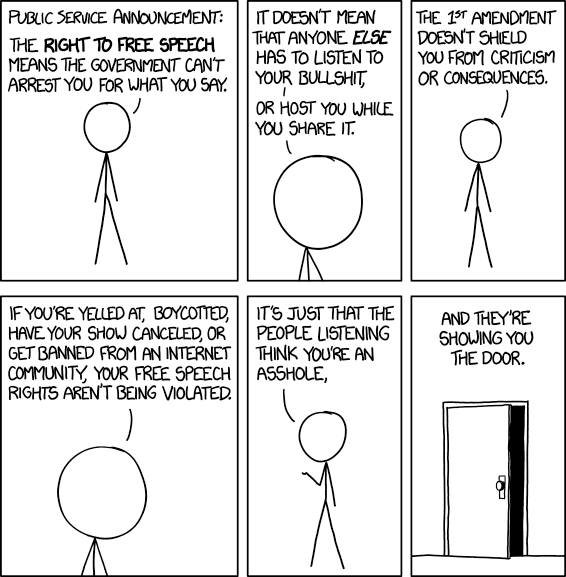
The following image that I found on Twitter sums it up nicely.

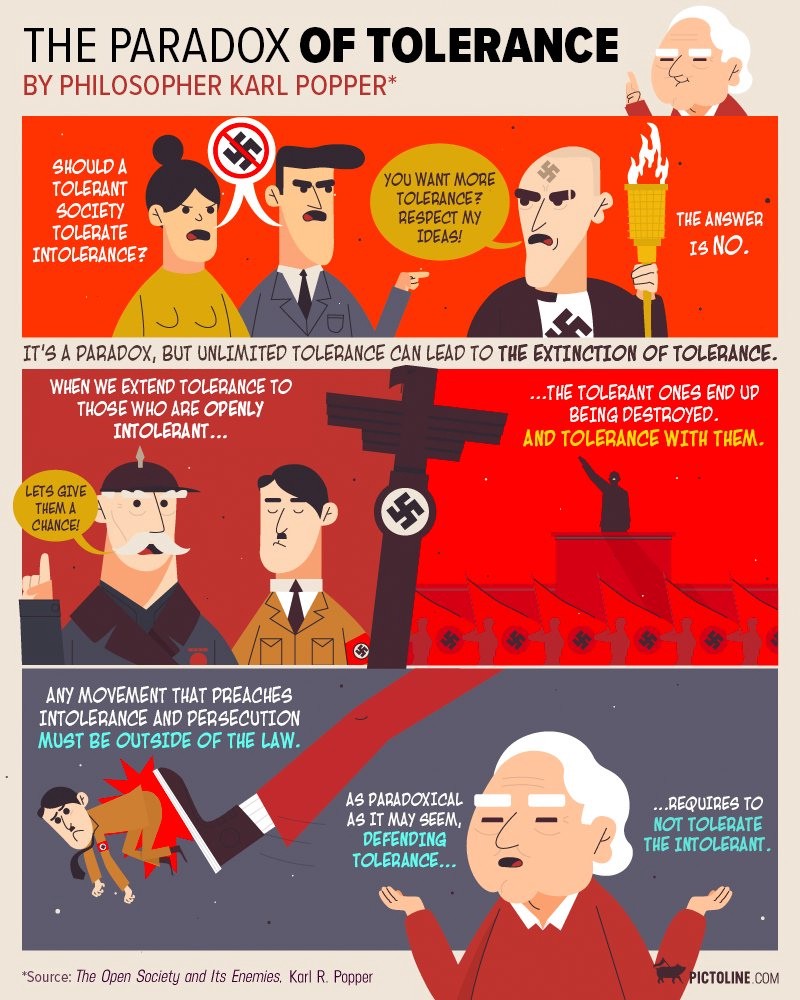
If that doesn’t get the point across, please see this helpful little image detailing the paradox of tolerance by Karl Popper.

In short, being tolerant is a good thing. Protecting free speech is a good thing. However, there are lines, limits, and context. Failing to understand them will only cause more outrage and whining. The world already has too much of that. Let’s not add to it.

Leave a comment

Filed under Celebrities and Celebrity Culture, censorship, Current Events, human nature, media issues, psychology, television

A Subreddit Exploited Wall Street Hedge Funds (And I Applaud Them)

Every now and then, a news story comes along that just puts a smile on my face for all the right reasons. Granted, a lot of those news stories involve comic books and sex robots, but certain news transcends my preferences. They’re just too inherently awesome and cathartic to ignore.

This recent story surrounding a sub-reddit beating a multi-billion dollar hedge fund on Wall Street is definitely one of them. In the process, it suddenly turned Gamestop, a store I haven’t been in for three years, into the hottest stock on the market.

It’s the kind of story that would make a ridiculous movie. It’s not “The Big Short.” Hell, reads like a “Robot Chicken” sketch, plus or minus a few poop jokes. Except, this actually happened in the real world.

For those who haven’t been following this story, here’s a colorful breakdown by Esquire.

Esquire: How WallStreetBets Redditors Used Their Collective Power to Manipulate the Stock Market

News about the stock market rarely crosses over into the cultural mainstream, and historically when that’s happened, it’s meant some catastrophic financial event has taken place. (See: The housing and stock market crashes of 2008.)

But the stock market was the single biggest news story Wednesday, financial or otherwise, due to a group of Reddit shitlords pumping up a collection of stocks and pushing some billion-dollar financial institutions to the brink of bankruptcy.

Hedge fund Melvin Capital needed a $2.75 billion bailout on Monday after the stock price for GameStop, the video game retailer, spiked to more than $70 a share over the weekend. Just a month earlier, the stock was hovering near $15. Melvin was shorting the stock, hence the need for a bailout. Reports of Melvin Capital’s financial struggles sent GameStop’s share price soaring even higher, though, to more than $100 a share on Monday, putting the hedge fund in an even more precarious financial decision. As of this writing, the stock was trading for $330 per share—77 times higher than its share price of $4.28 a year ago.

The GameStop stock rally is the handiwork of r/WallStreetBets, a Reddit community where people share news, memes and personal anecdotes about playing the stock market.

Let’s all take a moment to shed a fake tear for a hedge fund that sought to make money by hoping a company would die. Let’s also take a moment to contain our rage that those assholes still got a multi-billion dollar bailout with little to no debate, but I digress.

That article gave us the basics. In short, a bunch of people on Reddit decided to exploit the short positions that a bunch of hedge funds had on Gamestop and make a ton of money on the side. It’s the kind of gimmicky stock trading tactics that you’d see in “The Wolf of Wall Street,” minus the strippers and ludes. The only difference is this didn’t break any laws and only fucked over hedge funds.

If you need a more thorough breakdown of just how those hedge funds were fucked over, here’s a video by the YouTube channel TLDR News. They break it down beautifully. I must warn you, though. If you get excited by seeing hedge funds get screwed over by a bunch of Reddit trolls, you might not be able to contain yourself.

Now, why do I love this story so much?

Why am I making such a big deal of it?

Why is this even news on such a large scale?

The answer is fairly simple. It’s not just that I love Reddit and have been an active user for years. This kind of thing just doesn’t happen that often. A bunch of normal, everyday people on Reddit getting the best of a Wall Street hedge fund? It just doesn’t seem possible.

Even if you’re a die hard capitalist or an dogmatic liberation, you can’t be too fond of hedge funds. In addition to being fertile grounds for fraudsters, con-men, and Gordan Gecko wannabes, they have just one goal. They seek to make rich people even richer. How they go about that varies, but they’re not above lying, cheating, and effectively gaming every capitalist system to their advantage.

They’re basically villains for both capitalists, socialists, and communists alike. They’ll screw over anyone, be they individuals or companies, so long as they can turn a profit. They don’t make anything. They don’t create or develop products that they sell to willing consumers. They mostly dick around with math, balance sheets, and stock prices to make money. That’s it.

I’m not a fan, to say the least. Watching them lose is like watching Lex Luthor get beat up by a five-year-old girl. You don’t think it’s possible, but it’s a glorious sight when you see it.

Honestly, this is the kind of story we need right now. A bunch of nobodies on the internet find a way to screw over a hedge fund whose business model involves screwing over struggling companies. What’s not to love? That’s a superhero narrative wrapped in true capitalism wrapped in American ingenuity. Ron Swanson himself would be proud.

There’s a lot more I could say about this. Since the story is still unfolding on many fronts, I’ll hold off. I’ll just say that if r/WallStreetBets does nothing more than screw over a hedge fund trying to profit from Gamestop’s demise, they’ll still have done a great good for this world.

Leave a comment

Filed under Current Events, psychology, rants

How Many Streaming Services Can We (Realistically) Have?

It’s official. The streaming wars are on.

Hell, it’s been official for the past several years and 2020 only accelerated it. The battle to dominate digital media in all forms is raging on multiple fronts and while many have their favorites, none can say they’ve won.

It’s Netflix versus Hulu versus Amazon versus Disney versus CBS/Viacom versus YouTube versus whatever other media companies are fighting for every possible eyeball. The stakes are high for consumers and content creators alike. There are billions in profits to be made and plenty of epic, culture-defining content to be made. It’s going to get intense is what I’m saying.

I don’t think I need to remind everyone just how much the streaming market has changed in the past 10 years. Even if you’re still a teenager, chances are you still vaguely remember the days before Netflix and chill. Media back then was movies, TV, and Blu-Ray/DVD collections. I’m not saying it was ideal, but that’s what we had to work with.

Then, Netflix came along and changed everything.

Then, every company and their deep-pocketed subsidiaries tried to catch up.

It hasn’t always been smooth. Some people are still not over “The Officeleaving Netflix. Chances are there will be more upheavals like that as companies fight over who streams what and who has the streaming rights to a particular show or movie. That’s sure to get messy and I’m not smart enough to make sense of it.

However, as this war rages, I think there’s a relevant question worth asking. It’s a question that I’m sure both consumers like me and big media companies like Netflix and Disney ask as well. The answer could depend on how the war plays out.

How many streaming services can the average customer have?

Most people already pay for some form of streaming media. Most people subscribe to some form of pay TV, although that trend is in flux. The days of having all the entertainment you want with a simple cable subscription alongside Netflix is long gone and it’s not coming back.

Now, you have to be very selective and self-aware of what you want.

Do you want access to Disney’s vast library of content?

Do you want access to the library of shows from NBC or CBS?

Do you want access to the content from Warner Brothers, Universal, Dreamworks, Discovery, Cartoon Network, or 20th Century Fox?

You can have some, but you can’t have them all without paying way more than you ever would for cable. Even if you did, could you even watch all those streaming services enough to justify the cost? There are only so many hours in a day and there’s only so much attention we have to give. Even if we dedicated half our day to binging movies and TV, we couldn’t watch it all.

That’s the big limiting factor on streaming. It’s also the biggest obstacle any company faces with respect to their effort in the streaming wars. People can only watch so much and they only have so much they can reasonably spend on a streaming service. There comes a point where, even if the content is appealing, they just can’t justify the cost.

Personally, I have subscriptions to five streaming services. They are as follows:

Netflix

Hulu

Amazon Prime

Disney Plus

HBO Max

Now, it’s worth noting that I got HBO Max through my cable subscription. I’ve subscribed to HBO for years so it’s not something I consciously sought out. With Amazon Prime, I primarily used it for the 2-day shipping instead of streaming media, but I’ve certainly found some quality shows on that platform.

I’m not sure I can justify another subscription beyond this. Once my subscriptions cannot be counted on one hand anymore, I think that’s too much. I just cannot watch enough content to warrant paying extra. I say that knowing companies like Paramount and NBC have just launched their own streaming services.

Even though both networks include shows that I love, I’ve no intention of buying their streaming service. If my cable company offers it for free, like it did with HBO, then that’s great. I’ll certainly watch it, but I’m not paying extra.

I feel like a lot of people are in that boat. If they don’t have a cable subscription, then they’re already trying to save money and paying more for a streaming package just defeats the purpose. If they do have cable, then they’re probably not willing to pay more for something they’re already paying too much for.

It’s a tougher situation and one that I’m sure will get tougher in the coming years. It’s not cheap to run a streaming service. The profit margins can be thin if you don’t have the content. There’s a good chance that some streaming services will either fail or get absorbed into another, like CBS All Access did.

Then, there are the pirates and no, I’m not talking about the ones with eye-patches.

Before Netflix streaming, pirating copyrighted content was already pretty rampant. Since the streaming wars began, there has been an uptick in pirated streaming content. That is also likely to intensify the more fragmented the streaming market becomes. If people are really that unwilling to pay a whole subscription to watch just a single show, they will resort to piracy. It’s still distressingly easy.

That’s why this question matters, both for us and the companies who provide our entertainment. I don’t claim to know how it’ll play out. By the time it settles, there might be another major upheaval in the media to supplant it. Whatever happens, I feel like I’ve reached the limit on the number of streaming subscriptions I have.

That’s just me, though. What about you?

How many streaming services do you have and are you willing to pay for another? Our collective answer could very well change the course of the streaming wars.

2 Comments

Filed under Current Events, human nature, media issues, psychology, technology, television

A Former Israeli Space Security Chief Says Aliens Exist And Have Visited Earth: Why I Don’t Believe Him

There was a time in my life when I was convinced that aliens were real, UFOs were alien space crafts, and the government was keeping it a secret. It was a strange time, indeed. It coincided with a phase where I watched every documentary involving UFOs, aliens, and conspiracy theories I could get my hands on.

Like Fox Maulder, I wanted to believe. In hindsight, I was too eager to believe.

I’ve since refined my perspective. I still believe there’s other intelligent life in the universe. I just don’t believe they’ve come to this planet and are hiding while the government keeps them secret, “Men In Black” style. That’s just a fanciful conspiracy theory that makes for great movies and TV shows, but not much else.

It’s not the part about intelligent aliens I find unbelievable. It’s peoples’ ability to keep a secret that big that I find so implausible. I don’t care how big a conspiracy theory you are. People can’t keep secrets, especially big ones. There are legitimate psychological reasons for that.

That’s just one of the reasons why I don’t believe the Haim Eshed, the former Israeli Space security chief, when he says aliens exist and humanity has been in contact with them. In a year like 2020, it would almost be fitting that aliens entered the picture. However, this is one story that warrants more than a little skepticism.

In case you missed it, this is what was reported by the Jerusalem Post. Now, it’s no disreputable tabloid, but it’s not exactly the BBC.

The Jerusalem Post: Former Israeli space security chief says aliens exist, humanity not ready

Has the State of Israel made contact with aliens?

According to retired Israeli general and current professor Haim Eshed, the answer is yes, but this has been kept a secret because “humanity isn’t ready.”

Speaking in an interview to Yediot Aharonot, Eshed – who served as the head of Israel’s space security program for nearly 30 years and is a three-time recipient of the Israel Security Award – explained that Israel and the US have both been dealing with aliens for years.

And this by no means refers to immigrants, with Eshed clarifying the existence of a “Galactic Federation.”

The 87-year-old former space security chief gave further descriptions about exactly what sort of agreements have been made between the aliens and the US, which ostensibly have been made because they wish to research and understand “the fabric of the universe.” This cooperation includes a secret underground base on Mars, where there are American and alien representatives.

These are some remarkable claims, to say the least. It is impossible to overstate the implications here. We’re not talking about some scandal involving a politician and an intern. We’re talking about the biggest scientific discovery in the history of humanity.

The discovery that we’re not alone in the universe and there are other alien beings out there would be profound, to say the least. Even in a year like 2020 when we have so many problems to deal with on this planet, such a discovery would have an enormous impact on how we see ourselves and the universe.

That’s exactly why it’s laughable to think that anyone, let alone a vast government conspiracy, could keep such a discovery under wraps. People can keep small secrets to a point, but not secrets this big. That’s not just my opinion. There’s some actual math behind it.

According to Oxford physicist, David Robert Grimes, the large number of people involved in a conspiracy essentially guarantees that it won’t stay secret. It takes thousands of people not saying anything to sustain itself, but it only takes one Edward Snowden to expose it.

For something like intelligent aliens, it would be even harder to suppress. Even if they’re advanced and intelligent, they would leave traces, especially if they were nearby. That would be difficult to hide and even harder to keep quiet on a global scale.

This is a world that can’t even agree on the metric system. How could we, with all our different agendas and politics, all agree to keep a secret this big?

I won’t say it’s completely impossible. I don’t like being that absolute in my statements. I’ll just say it’s exceedingly improbable. I’d put it right up there with the sun being made of radioactive cheese.

However, if that’s still not convincing enough, there’s one other reason why I don’t by Mr. Eshed’s statement. It also has nothing to do with my position on government conspiracies and why people can’t keep secrets.

The man is trying to sell something. Specifically, he’s trying to sell a book. In the same article in which he makes his bold claim, there’s this little tidbit that the headline doesn’t mention.

Eshed provided more information in his newest book, The Universe Beyond the Horizon – conversations with Professor Haim Eshed, along with other details such as how aliens have prevented nuclear apocalypses and “when we can jump in and visit the Men in Black.” The book is available now for NIS 98.

For me, that’s the reddest of red flags. The man is selling a book and this bold claim is basically a sales pitch. He’s making this ground-breaking revelation that could potentially change the world. Then, he directs people to buy his book to learn more.

Anyone who has ever dealt with public relations or sales people should immediately realize what’s going on. The rule of thumb is that if it looks like a sales gimmick, chances are that’s exactly what it is. This certainly matches that critera.

Even Fox Maulder would be skeptical at this point. Honestly, what’s more likely?

Could it be that a retired space security chief is finally breaking his silence and revealing to the world that thousands of people have been keeping this secret about aliens for decades?

Or could it just be a man making a bold, but false claim that he hopes will help him sell more books?

I know the Fox Maulder in us all wants to believe, but sometimes Occam’s Razor just cuts too deep. I still believe aliens are out there and I hope they visit us one day. I just don’t think they’ve arrived yet. Chances are, when they do arrive, we’ll know and no conspiracy will be necessary.

1 Comment

Filed under Aliens, Current Events, human nature, psychology

Why Liars, Cheaters, And Hypocrites Get Away With It

We all deal with them.

We all encounter them.

We all despise them on some levels.

Call them any vulgar insult you want. It’s perfectly warranted, but it doesn’t change what they do. The liars, cheaters, and hypocrites of this world will keep doing it. They’ll keep lying to your face, cheating you out of money, and breaking promises or precedents without a second thought.

I know it’s a depressing thought. It has become a lot more in our collective faces in recent years, given how political rhetoric has become so heated. Both sides argue with one another. They each lie or cheat to varying degrees. They jump at the chance to call the other out on it, but nothing really changes.

They keep on lying and people who align with their politics buy into it, even when they know it’s a lie. It’s frustrating. I argue it’s gotten even more infuriating in recent years. It does, however, raise an important question.

Why do people who lie, cheat, and break promises keep getting away with it?

It’s a valid question. Nobody likes being lied to. Even kids know on some level how wrong it is. So, why does it keep happening and why does nobody seem to pay a price? Well, the very nature of those questions already answer that to some extent.

In short, people keep getting away with it because they never get punished, pay a price, or face any consequences for their dishonesty.

It’s not a very comforting answer, I know. It’s probably just as infuriating as being lied to. That doesn’t make it any less true.

Think about it. What price does someone really pay for lying? Sure, there’s the accompanying guilt that comes with it, but for some people, that’s not much of a price. You don’t have to be a psychopath incapable of guilt to lie. You just have to be capable of enduring the momentary discomfort that comes with it.

That’s not much of a price for certain people, especially when there’s money to be made and power to be gained. Granted, certain liars and hypocrites will lose credibility with certain people. Lie too much to one person and they won’t trust you, let alone be inclined to do you any favors.

On a larger scale, though, that’s less of an issue. Add mass media and the internet to the mix and it’s basically an afterthought. Right now, anyone can tweet or post some completely dishonest information to any number of major sites.

They could claim a certain politician beat up a child.

They could claim that a certain celebrity sexually assaulted someone.

They could claim that the theory of evolution is a plot by the Illuminati to keep people from finding out about the shape-shifting lizard people that secretly run our government.

That last one is a real conspiracy theory that some people actually believe, by the way. I wish I had made up something that absurd.

Some of these lies may incur lawsuits or blocks, but again, is that really much of a price? Some people can afford frivolous lawsuits. Many don’t care if certain people block them. Even when major websites try to clamp down on it, that only seems to fuel the liars.

That’s another critical element as to why it keeps happening. Not only do liars, cheats, and hypocrites pay little to no price for their dishonesty. In some cases, they’re rewarded. In some cases, the reward is huge.

We may hate hypocrites and liars, but so long as they have something to gain and little to lose, not much will stop them. If they have no sense of guilt or shame, as many politicians and CEOs often do, they have every incentive to do what they do. There’s just too much money and power to be gained.

On top of that, there are some people who want to believe in their lies. Everyone has their own reason for doing so. It often boils down to the lies being more appealing than the truth or reinforcing some position they already have. Whatever their reason, they keep give even more incentives to those willing to exploit that inclination.

I say this not to be dire, although I don’t deny the election last month is a motivating factor. I offer this as a means of adding perspective to those frustrated by the dishonesty and hypocrisy that seems so prevalent, no matter where you look.

There’s a reason it’s there and is a painfully valid reason. As long as the liars, cheaters, and hypocrites we despise keep gaining so much and losing so little, they will continue with their deplorable behavior. They have no reason not to. It’s just the nature of our flawed world.

We can only do so much to make it less flawed. One way you can help is to keep voting, even if it’s just for the least dishonest candidate. It’s not a perfect fix, but it’s a start.

1 Comment

Filed under Current Events, human nature, media issues, outrage culture, philosophy, political correctness, politics, psychology, rants

Jack’s World: Homelander: The Perfect Villain For A Cynical Era

The following is a video for my YouTube channel, Jack’s World. It’s just a brief video essay on why Homelander from “The Boys” is the perfect villain for this particularly messed up era. Enjoy!

Leave a comment

Filed under Jack's World, political correctness, politics, psychology, superhero comics, superhero movies, television, YouTube

Shaming Vs. Criticism: Why The Difference Matters

Let’s be honest. It’s very difficult to have honest, civil discourse with anyone these days. I won’t say it’s impossible, but it sure feels that way sometimes. Try expressing any opinion about any issue that’s even mildly controversial. Chances are you won’t spark a civil discussion. You’ll likely trigger a flame war, especially once Godwin’s Law comes into play.

Now, I’m not going to blame all of this on the internet and social media. I don’t deny that it plays a role, but let’s not miss the forest from the trees here. We, the users of these tools, are the ones driving the content. We’re the ones who guide these discussions towards angry, hate-filled outrage. The medium is only secondary.

There are a lot of reasons why civil discourse is so difficult, but I want to highlight just one that has become far more prominent in recent years. It’s an objectively bad trend and one I genuinely believe we need to reverse. It involves this inability to distinguish shaming someone from criticizing them.

It goes like this. Two people connect, either in person or via the internet. They have a disagreement. When there’s criticism, it tends to go like this.

Person A: I hold Opinion X.

Person B: I hold Opinion Y.

Person A: Why do you hold that opinion? I don’t understand how you could.

Person B: Well, it’s because of X, Y, and Z.

Person A: I don’t disagree with Y and Z, but I take issue with X.

Person B: Why is that?

Person A: Well, it goes like this…

Ideally, both people in this exchange get something out of this discourse. Person A offers Person B another point of view. Person B has their opinion challenged and they’re now in a position to defend it. In doing so, they may reaffirm or question their position. They may even convince Person A of the merit of their position.

That’s a healthy level of discourse, guided by fair and civil criticism. There’s certainly a place for that. I even see it on social media from time to time. However, that’s not what makes the headlines. It’s the shaming that usually generates the most noise. Shaming is very different from criticism, both by definition and by practice. At its worst, it goes like this.

Person A: I hold Opinion X.

Person B: I hold Opinion Y.

Person A: What? You’re a horrible human being for holding an opinion like that! You must be a fucking asshole fascist Nazi prick!

Person B: Fuck you! Your opinion is a goddamn atrocity! Only a true fucking asshole fascist Nazi prick would even entertain it! You should be fucking ashamed!

Person A: No, you should be ashamed! You should lose your job, your money, and all manner of sympathy for the rest of your fucking life!

Person B: No, you should be ashamed! You should cry like a baby, get on your knees, and beg everyone like me to forgive you! And you should also lose your job, money, and any semblance of sympathy until the end of time!

I don’t deny that’s an extreme example. I wish I were exaggerating, but I’ve seen stuff like this play out. I’ve seen it in comments section, message boards, Twitter threads, and Facebook posts. It’s not enough to just criticize someone for holding a different opinion. People have to outright shame them to the point where they’re mentally and physically broken.

In some cases, people look for that kind of rhetoric. Some people just love trolling others by posting opinions they know will piss people off and start a flame war. They don’t care about civil discourse. They just care about riling people up. It’s what gives them a cheap thrill.

Those people are trolls. The best thing anyone can do is ignore them.

They’re also in the minority. They may be a vocal minority, but they are the minority. Most people, in my experience, are inclined to be civil. They’ll give people a chance, even if they don’t agree with them. Things just go off the rails when they interpret criticism as shaming. It’s not always intentional, either. Some people just frame their criticism poorly, which sends all the wrong messages.

Whereas criticism is impersonal, shaming evokes some very basic emotions. There’s a tangible, neurobiological process behind it. It’s linked heavily to guilt, an objectively terrible feeling that most people try to avoid at all costs. Shame attempts to impose guilt. While there are some things we should definitely feel guilty about, holding certain opinions is rarely one of them.

Does someone deserve to be shamed for how they voted in the last presidential election?

Does someone deserve to be shamed for believing “Star Wars: The Last Jedi” was a terrible movie?

Does someone deserve to be shamed for thinking certain female characters in media are too sexualized?

Does someone deserve to be shamed for thinking they shouldn’t believe every claim a woman makes about being sexually harassed?

These are difficult, emotionally charged issues. With that kind of complexity, there’s going to be many points of criticism. Some have real merit and they should be discussed. That’s how we learn and make sense of our world and the people in it. Once shame enters the picture, though, the merit tends to vanish.

The problem is that once the shaming starts, it escalates quickly. It doesn’t even need to escalate that much before a person stops listening and gets defensive. At that point, there’s basically no going back. It’s less about understanding someone else’s perspective and all about defending yourself.

That’s not a metaphor, either. Like it or not, people take their opinions seriously. Attacking them with words, even if it’s through a computer screen, still feels like a physical attack on some levels. You’re not just attacking an opinion, anymore. You’re attacking a person. You’re throwing metaphorical punches that have non-metaphorical meanings to those you’re attacking.

With that in mind, look at it from a purely instinctual level. When someone is physically assaulting you, is your first inclination to engage in a reasoned, civil discussion? For most people, it’s not. You go into survival mode and that often involves attacking the attacker.

You throw your punches.

They throw theirs.

They call you a fascist, Nazi-loving bully.

You call them a worse fascist, Nazi-loving bully.

There’s no logic or reason to it. Once emotions override everything, criticism becomes a moot point. It’s all about hitting back to defend yourself. It’s not about being right. It’s about survival, at least from your brain’s perspective.

If there’s one silver lining, it’s that people get burned out quickly on this kind of discourse. You can only hear two sides call each other fascist for so long before the rhetoric loses its impact. It also gets boring. It takes too much energy to sustain that kind of hatred towards someone you don’t know. Most people who aren’t trolls have better things to do with their time.

As I write this, I understand that we live in contentious times. I see the same heated debates online and in person as everyone else. I know that civil discourse is a scant and precious commodity at the moment. That’s exactly why we should make the effort, regardless of what opinions we hold.

Once we stop shaming each other for daring to think differently, we’ll realize just how much we have in common. We don’t have to agree with one another. We don’t even have to like one another. We can and should still be civil with one another. That’s the only way we’ll make any real progress.

Leave a comment

Filed under Current Events, human nature, outrage culture, philosophy, political correctness, politics, psychology

On Privilege, Resentment, and Lottery Winners

Think of a person you knew in high school that you just didn’t like. The reason why you didn’t like them isn’t important. They’re just someone you don’t care for and would prefer not to think about them in any capacity.

Now, imagine that same person won the lottery.

Suddenly, this person you seriously resent has been gifted a glut of random, unfeeling luck. They now have access to wealth, resources, and opportunities that you can only dream of.

From afar, they look happy and thrilled. Their life seems destined to be one of excitement, leisure, and fulfillment. They did nothing to deserve it. They didn’t work for it or earn it. They just got lucky.

Would that make you resent them even more? Before you answer that question, ask yourself another.

Is it even right to resent a person who just got lucky?

Most reasonable people might have a problem despising someone, just because they got lucky. It’s petty, resenting someone for their good fortune. It implies that you don’t think they deserve it.

It also implies that you think you deserve it more. There’s something inherently wrong with a system that allows someone like that to get lucky while you are stuck in your current circumstances.

I bring this up because it helps illustrate the hot-button debates surrounding privilege. It has become somewhat of a dirty word in recent years. In many discussions surrounding race, politics, religion, and gender, the topic of which group has which privileges tends to come up. These discussions can get downright ugly, especially when they’re racially charged.

Now, I’m going to be very careful with my words here. I want to make a valid point, but I don’t want it to inspire even more ugly discussions. I also don’t want to give the impression that every side of the issue is equally substantive. Some arguments are more absurd than others. That’s an unavoidable pitfall when discussing sensitive issues. That’s where you’ll get argumentative equivalent of flat-earthers.

With that context in mind, I want to try and deconstruct the rhetoric surrounding which group has privilege, what it implies, and why it matters. The concept of social privilege is pretty simple. In a diverse, multi-cultural society, like the one we’ve established over the past few centuries, certain groups have inherent advantages over others. However, not all of those advantages are the same.

If you’re a straight, cis-gendered man, you have certain advantages.

If you’re a straight, cis-gendered woman, you have certain advantages.

If you’re white in a society that’s predominantly white, you have certain advantages.

The same concept applies to disadvantages. Being a minority in most societies, regardless of development, will incur some disadvantages. If you’re black, gay, Muslim, Jewish, transgender, bisexual, or disabled in a society where the majority is none of those things, you will face challenges that others won’t. For anyone who values fairness, justice, and equality, that’s an issue.

It can be even subtler than that. If you’re born with natural beauty, you’ll have advantages as well. Like it or not, people tend to help someone who’s physically attractive. The same applies if they happen to have a special talent, such as throwing a football or playing an instrument. People without those skills are at a disadvantage, if only with respect to attention.

As a social species, humans already have an innate sense of fairness. These disparities don’t go unnoticed by both the majority and minority. Like playing a game where someone is using cheat codes, people are going to strive for greater fairness.

Some will be more aggressive than others in that pursuit. At the same time, those who have those advantages will try to maintain them. They may not even see them as advantages.

While that seems simple in the context of a game, it gets exceedingly complex when you apply it to society at large. It also gets contentious, as both historic and contemporary protests have shown.

It has even become popular to tell people to “check their privilege” at the door when entering a conversation. Even if it’s done in the spirit of fairness, it can still come off as downright resentful.

That may be understandable, to some extent. It may even be acceptable for some because achieving perfect fairness and perfect equality just isn’t realistic. There’s always going to be someone who gets lucky or is just naturally more talented or beautiful. It’s the nature of reality. It still doesn’t answer the same question I posed earlier.

Is it right to resent a person who just got lucky?

For anyone attempting to answer it, there’s probably a short and long version of that answer. It may depend on the nature of the luck involved. Someone who wins the lottery is easy to envy, but difficult to resent. If you don’t know the person, then chances are you’re not going to resent them. You’ll just be jealous of their luck.

However, the random luck of a lottery winner isn’t that different from the random luck that makes someone straight, white, Christian, and male at a certain point in history within a certain society in which they have advantages. When we’re born, we don’t have a choice in the circumstances. We simply grow, develop, and react within them along the way.

Those circumstances can include some very distressing facts. There’s no getting around the fact that certain groups have brutally oppressed others and effected the system to preserve their advantages while disadvantaging others. Even if it happened centuries ago, the effects of those injustices are still felt today.

Most reasonable, decent people are in favor of righting such injustices. However, the right way to go about it is where a lot of resentment starts to emerge. Some of that is unavoidable, given how easy it is to derail an argument, but there’s another component to discussions about privilege that goes beyond lottery winners.

Whenever someone protests the privileges of any group, be they white men, affluent middle-class women, or people born with natural beauty, there’s often an angry backlash and not just from those seeking to protect their privilege. In fact, most of that backlash comes from people who fit the generalization, but are not privileged.

There are straight white men who, despite their demographics and circumstance, have no advantages whatsoever. They’re poor, destitute, and miserable. They work every bit as hard as those in minority groups, but still struggle.

Then, despite their dire circumstances, they hear rhetoric that claims they’re somehow the most privileged people in the world. Chances are, they’re going to feel resentful too.

That’s because, statistically speaking, only a handful of people who fit the stereotype of “privileged” individuals really enjoy those advantages. These are individuals in positions of power and authority, both politically and economically. Some are identifiable by name. Others are just indirectly influential, due to their wealth, status, and resources.

The vast majority of men don’t have a say in how patriarchal or egalitarian society is.

The vast majority of white people don’t have a say in how racially segregated society is.

The vast majority of women don’t have a say in how men are disadvantaged men are in divorce court, child custody, or alimony.

The vast majority of straight people don’t have a way in how the law handles issues LGBTQ discrimination.

The vast majority of Christians, Muslims, Jews, Buddhists, and Hindus have no say in how their religion conducts itself as an organization.

However, since there’s rarely a single, mustache-twirling villain who exists solely to oppress on certain issues, our only choice is to generalize. We’re already a tribal species, by nature. It’s depressingly easy to channel that into what we perceive as the source of an injustice.

It’s also easy to resent people who are clearly privileged and go out of their way to abuse it. Those individuals deserve that kind of resentment. Like a lottery winner who becomes an insufferable asshole because of his luck, the resentment is both understandable and justified.

The problem with resenting the privilege of entire groups is that it’s difficult to see the forest from the trees. The existence of one asshole lottery winner doesn’t mean that every lottery winner is an asshole by default. By that same token, the existence of one group of people who enjoy egregious advantages doesn’t mean everyone like them enjoys them as well.

There are all sorts of complexities and nuances that go into what gives certain people advantages over others. Sometimes, it’s objectively unfair how certain people exploit their advantages and we should all work for a more fair and just system.

However, it’s a simple matter of removing the privileges to level the playing field. It’s also not realistic to yell at people until they purposefully disadvantage themselves for the sake of others. That’s akin to demanding that lottery winners give up their winnings in the spirit of fairness. It doesn’t just defeat the purpose. It makes us the resentful assholes.

Leave a comment

Filed under Current Events, extremism, gender issues, human nature, LGBTQ, media issues, outrage culture, political correctness, politics, psychology

Jack’s World: Why Conservatives Make Better Villains (For Now)

The following is a video I made for my YouTube channel, Jack’s World. It’s a video version of an article I wrote a while back. I added and removed a few details to the video. If necessary, I’ll do a follow-up. Enjoy!

Leave a comment

Filed under Current Events, extremism, human nature, Jack's World, media issues, philosophy, political correctness, politics, psychology, superhero comics, superhero movies, Villains Journey, YouTube