
The following is a video from my YouTube channel, Jack’s World. This video is my second attempt at writing and narrating a CreepyPasta. This one has a bit more cosmic horror than the first. Enjoy!
Tag Archives: Reddit
A Perfect Cartoon To Highlight The Frustrating Absurdity Of Anti-Vaxxers
I know I’ve been giving those who refuse to get the COVID-19 vaccine a hard time in recent months. I won’t apologize for that because I don’t regret that in the slightest.
I’ll say it again. These people are being assholes. They’re the reason why this pandemic is still raging. They’re also the reason there’s a new variant that’s causing cases to spike in various parts of the country. I’m sorry, but I can only be so understanding when people are being assholes to a point that gets other people killed.
However, rather than bemoan these people for their dumb decisions and dumber politics, I thought I’d share something I found on Reddit that perfectly illustrates why the anti-vaxx crowd are so infuriating. It’s funny and it’s dumb, but it’s also painfully relevant.
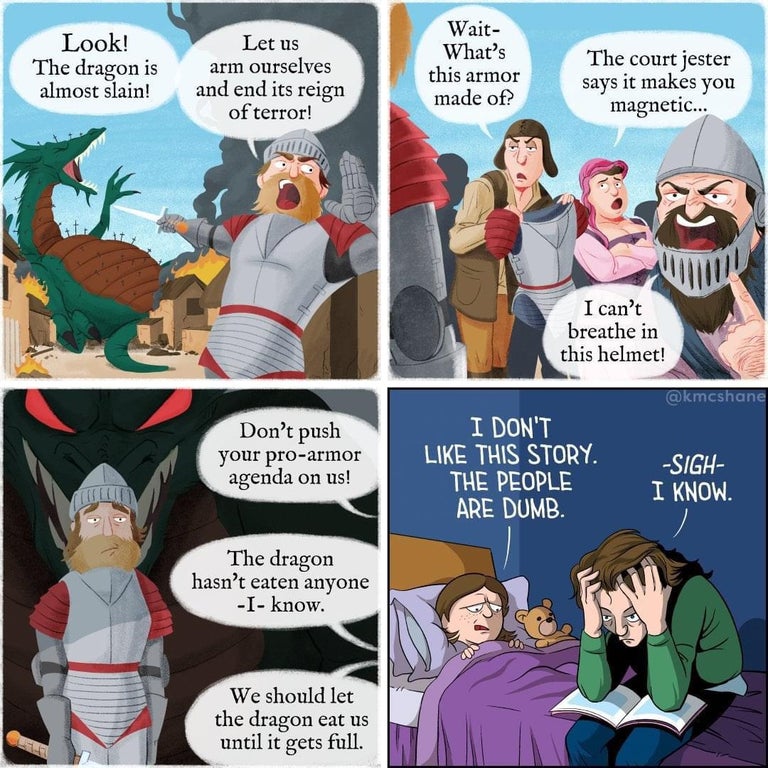
Again, get vaccinated people. Quit being assholes.
Filed under Current Events, health
Signs Someone Truly Loves You (According To Reddit)
How do you know when someone truly, sincerely loves you?
That’s a question that every love song, chick flick, and romance novel attempt to explore. I’ve certainly done my share of exploring with the novels and sexy short stories I’ve written. They don’t always answer the question, but they do give it drama and substance.
What about love in the real world? Stories are fanciful and theatric. The real world is not. However, true love still exists in this world. Being a lifelong lover of romance, and having seen it manifest first-hand in real people, I know just how real and powerful it can be.
Those real-life love stories are often more powerful than anything in fiction. Those stories are still out there, even in this cynical world we live in. You just have to know the signs, but that’s easier said than done.
What are those signs? Well, I certainly have my theories, but I understand the love manifests in many diverse ways. My experiences are limited, as are those of most people. Thankfully, that’s where Reddit comes in.
While it may have its dark corners, there are some genuinely heartfelt threads to explore. These threads will make your day for all the right reasons if you find them. Below is a video from the YouTube channel, Radio TTS, on a thread from r/AskReddit on signs that someone truly loves you.
If you’re a romantic or just want to explore the question, this is something that will definitely help. It may even help you realize for yourself just how much that special someone loves you. Enjoy!
Filed under Love Or Obsession, psychology, romance, sex in society, YouTube


Tales From The Comments Section: When Hypocrisy, Lying, And Trolling Converge
Even the most luxurious palace has a septic system that contains its foulest shit. It’s not just a fact of life. It might as well be a law of physics. In the same way the brightest light still casts a shadow, there’s always a dark underbelly to any world we explore.
The internet is no exception. If anything, the internet has more dark underbellies than most and I’m not just referring to porn sites or nefarious Google searches. Those are all plenty disturbing, but if the internet has an overflowing septic tank, it’s the collective comments section of many sites.
They’re not just the comments section to certain news sites.
They’re not just anonymous image boards like 4chan that pride themselves on excess shit-posting.
Even the comments section of mainstream websites like YouTube, Facebook, and Reddit have comments sections that will give your faith in humanity a hefty gut punch. They come in many forms, but they tend to follow the same patterns.
They’re degrading, insulting, whiny, vulgar, immature, and just plain wrong on multiple levels. I’m not calling for them to be censored or banned, outside the kind of comments that incite violence in the real world. I’m just pointing out that this is the ugly side of the internet and we can’t deny its stench.
I say that as someone who has spent many hours, much of them wasted, in comments sections and message boards over the years. Even during the early days of the internet, complete with dial up and AOL keyword searches, I’ve seen this ugliness firsthand. I also don’t deny that there are times when I’ve contributed to it. That’s something I genuinely regret.
While all toxic comments are different, they often employ similar rhetoric. It really hasn’t changed much from the AOL days. Just the other day, I made the mistake of browsing the comments of a YouTube video. I saw the same whiny, angry ranting that I saw on old message boards in 1999.
The topics may change. The verbiage may differ. Even the arguments made, if there are any, tend to be fairly similar. I could single out plenty of ugly comments I’ve encountered. However, I want to highlight one that I’ve seen a lot more of lately, especially among fans of superhero comics, Star Wars, and Star Trek.
They usually go like this.
It’s a sweeping, generalized statement. It’s usually said out of a mix of hate, resentment, and tribalism. Ironically, it’s often Star Wars fans who say stuff like this when talking about characters like Rey. It’s ironic because Obi-Wan Kanobi himself once said, “only a Sith deals in absolutes.”
It doesn’t help that these kinds of absolutes are total bullshit encased in wishful thinking that’s built entirely around head-canon. Certain fans want to believe that everyone agrees with them and those who don’t aren’t “true” fans.
It’s basically the old “no true Scotsman” fallacy, but this one is laced with a mix of lies and hypocrisy. That’s because it’s demonstrably provable that these kinds of sweeping statements are wrong.
Not everyone hates Rey, Captain Marvel, or whoever else is the object of resentment at the moment. For one, Captain Marvel’s movie raked in $1 billion at the box office. Clearly, more than a few people liked her.
The same can be said for Rey. You can go onto Amazon and readily find merchandise featuring her. She may not be on the same level as Luke Skywalker, but that’s not a reasonable bar for a character who has only recently entered the franchise.
I can also attest that Rey has plenty of fans. It’s not just that I’m one of them. I’ve been to comic book conventions. I’ve seen women, young girls, and even a few men dress up as Rey. I’ve seen even more dress up as Captain Marvel. She clearly has plenty of fans.
That makes the whole idea that “nobody likes this character” or “everyone hates this character” demonstrably false. Those who say it aren’t just lying trolls. They’re hypocrites.
Now, I’ve made the mistake of arguing with these people before. I can safely conclude that it’s not a productive use of my time. These people will never be dissuaded. They still want to live in their head-canon where everyone hates exactly who they hate and anyone who thinks otherwise is just part of an evil conspiracy out to get them.
It’s a dangerous, toxic mentality that extends beyond fandoms and into politics. We saw just how bad it could get on January 6th during the Capitol riots. I’m not saying angry Star Wars fans are that bad, but the mentality is the same and it’s just as dangerous.
Again, I freely admit I’ve posted my share of dumb comments. I’ve said dumb things before, as well. Everyone has. We’re only human. We’re not perfect and never will be. I believe in free speech strongly and I understand that this is a byproduct of that. I’m willing to accept that.
I’m also willing to use that same freedom to point out the idiocy and hypocrisy of those kinds of comments. They’re not just a useless waste of bandwidth. They’re a symptom of a much larger problem. For now, the best thing to do is ignore these people and let them live in their fanciful head-canon. It may not fix the problem, but it’ll keep it from getting worse.
Leave a comment
Filed under Current Events, psychology, rants, Star Wars, superhero comics, superhero movies, television
Tagged as 4chan, angry trolls, Brie Larson, Captain Marvel, comic books, comments, Gina Carano, human nature, human psychology, hypocrisy, internet, internet subculture, Pop Culture, popular culture, psychology, rants, Reddit, Rey, Star Trek, Star Wars, superhero comics, trolls, YouTube, YouTube Comments, YouTube Comments Section