I’ve been waiting all year for it and with more anticipation than usual!
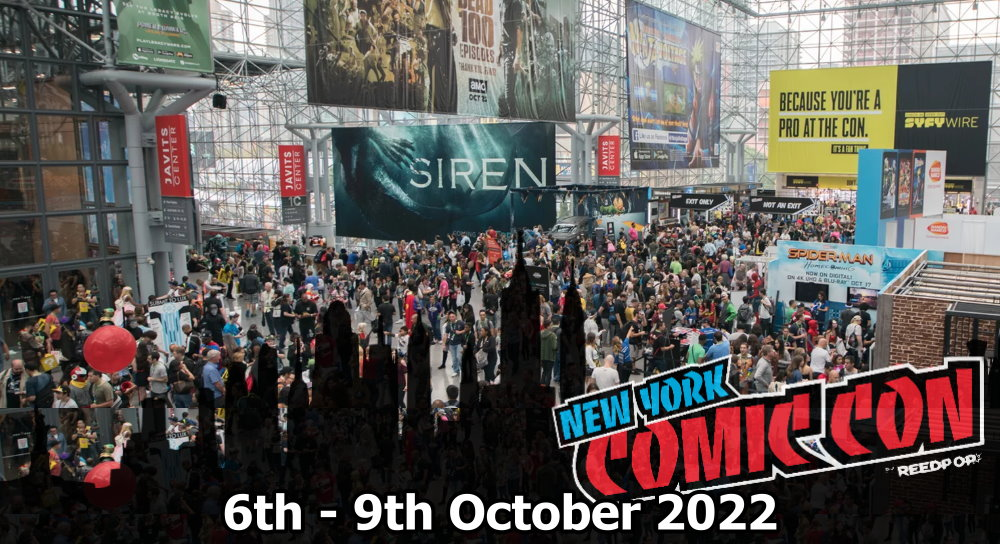
The New York Comic Con is finally here!
As I’m writing this, I struggle contain my excitement. It’s a familiar feeling I experience every year I’ve gone, but I’m still not tired of it. This year promises to be extra special.
After two years of being bogged down by the COVID-19 pandemic, New York Comic Con is set to return at full strength. That means no reduced capacity and no limited vendors. That means I’ll have to plan extra carefully in order to attend all the panels and get all the autographs I hope to get. But I’m willing to make that effort.
I even have a new costume this year that I can’t wait to show off. It cost me extra to get it customized, but I already feel it’s worth every penny.
So I hope New York is ready for me! Because I’m so ready for this.
The following is a video from my YouTube channel, Jack’s World. In the spirit of the success of “The Batman,” I decided to do a video about one of my favorite episodes from “Batman: The Animated Series.” It’s an episode that I feel perfectly encapsulates what makes Batman great, as well as his villains. Enjoy!
The following is a video from my YouTube channel, Jack’s World. It is my full review of “The Batman.” Please note that this review does contain major spoilers. Enjoy!
I’ve been reading comics for most of my life. In that time, I’ve seen many major upheavals and big events. A few of them even made mainstream news. I still remember how big it was when the Death of Superman first came out. That event made for some big headlines and its effect on the comic book industry is still felt today.
At the same time, reading comics for so long has given me a knack for sensing when an event will make mainstream news. It has also helped me get a feel for the kind of reaction it’ll get from those who don’t follow comics that closely. As a result, their reaction tends to be somewhat misguided.
With that in mind, I’d like to talk about Superman coming out as bisexual, a big reveal that made national headlines earlier this week. When I saw this, I was temped to post my immediate reaction. However, I held off because I suspected the oncoming storm of outrage would obscure any sentiment or point I made.
Sadly, it didn’t take long for some of that outrage to take hold.
Plenty of reactionaries whined about it for plenty of non-surprising reasons, ranging from your traditional anti-LGBTQ whining from religious zealots to people who just whine about comics becoming “political.” I put “political” in quotes because by political, it usually denotes “politics I don’t like.” It’s still just whining at the end of the day.
For me, personally, I’m all for this. I love that DC Comics is doing this with one of their characters. It’s something that I think fits the spirit and principles of Superman. He is someone who has love, compassion, and understanding for all. He saves men, women, and everything in between. His capacity for connecting with others knows no gender or preference. That’s what makes him Superman.
That being said, there is some important context to add to this. If you just read the mainstream headlines, you might get the wrong idea. For the most balanced take, I recommend the following NPR piece. It nicely sums up what’s going on here.
Yep: Superman, Champion of the Oppressed, the Man of Steel, the Man of Tomorrow, the Last Son of Krypton, the Big Blue Boy Scout, Mr. Not-A-Bird-Nor-A-Plane Himself.
Queer. All of a sudden.
And at 83 years old, no less! Bless his heart.
But that’s not what’s happening here. Comics being comics, the truth is a lot more granular.
We’re not talking about the classic, original-recipe Clark Kent/Kal-El Superman that’s been around since the June 1938 issue of Action Comics #1 first hit the stands. It’s not the Superman who’s infiltrated the global zeitgeist to become a part of our collective consciousness via comics, serials, radio, television, film, toys, roller coasters and the bedsheets I got for Christmas 1979.
No, it’s his son, Jonathan Kent. Whose precise backstory in the comics has been so ruthlessly pummeled by a series of reboots, retcons, space missions, time-travel and rapid aging as to render it so incomprehensible that it sends even diehards like me scurrying to the nearest wiki.
He’s slated to come out as bisexual in the pages of Superman: Son of Kal-El #5, written by Tom Taylor with art by John Timms, which will published on November 9th. Jonathan and his male friend Jay, introduced earlier in the series, will share a kiss.
I hope that clears things up. You don’t need to know all the complex continuity behind the details. You just need to know the basics.
In short, the Superman who came out as bisexual isn’t the primary Superman we’ve known since Action Comics #1. It’s Superman and Lois Lane’s son, Jon Kent. He’s actually a relatively new character, having debuted in 2015 just before DC’s Rebirth event. In that time, he’s grown and developed a lot, becoming one of the best Superman offspring characters we’ve seen in years.
He’s certainly grown on me in that time. This latest twist to his story only makes me love him more. I also encourage everyone curious about Jon Kent to read about him. If you need a starting point, I highly suggest a series called Super Sons. That firmly established Jon as someone who could wear his cape proudly.
In addition, it gives Jon something that further sets him apart from his father. Clark Kent will always be Superman, but that’s a title that need not be restricted to one man. Plenty of other characters have gone by that title and not all of them are directly related to Clark like Jon is. The title and the values behind it have always mattered more than the person.
Clark Kent understands that.
Jon Kent understands that.
The longtime fans of Superman also understand that.
Everyone who wields that cape protects, defends, and champions the values behind that name. Truth, justice, and the American way need not be the exclusive domain of a straight white man from Smallville. Someone like Jon Kent can also fight for them, but doing so doesn’t require that he be exactly like his father.
He can still be his own person and part of that persona just happens to involve bisexuality. That doesn’t at all detract from his ability to fight for those same values. It doesn’t change the importance of those values, either. At the end of the day, what matters most is that he fights for them with the same spirit and passion as his father.
That’s what makes him Superman.
It doesn’t matter whether or not he’s bisexual. He’s still Superman and one worth celebrating.
The following is a video from my YouTube channel, Jack’s World. This video is a brief exploration of one of the greatest fictional villains of all time, Lex Luthor. There has been an ongoing trend in recent year to develop more complex villains with equally complex motivations. However, there’s still room for the kind of old school, pure evil villain and nobody epitomizes that more than Lex Luthor. Hopefully, this video gives everyone a new appreciation of that. Enjoy!
The following is video from my YouTube channel, Jack’s World. It’s yet another entry in my Jack’s Comic Gems playlist where I highlight uniquely special gems from the world of comics. For this particular gem, we travel to the magical world of Key West, Florida where we meet a special, orange skinned princess in Starfire. If you’re a fan of DC Comics, this is one of those books that might have slipped under the radar, due to when it came out. However, it’s not too late to appreciate this uniquely endearing story about the empathic and endearing Tamaranea princess.
Also, I know the audio for this was choppy. I don’t know what caused it. I apologize. Rest assured, it doesn’t make the comic any less a gem.
Throughout the pandemic-fueled horrors of 2020, I speculated on multipleoccasions how movie theaters may never fully recover. I don’t doubt for a second the movie industry, as a whole, will adapt to changing markets and trends. However, the movie-going experience, as we know it, was suddenly in doubt.
I know I’m not alone in this sentiment. Many people far smarter than me have expressed concerns and made equally dire predictions. How things ultimately play out remains to be seen. The 2021 summer movie season will be a major test for theaters, as a whole.
On top of that, Disney is also trying their hand in simultaneous release. They announced that they’ll be releasing the long-delayed “Black Widow” both in theaters and on Disney-plus. While you’ll have to pay extra to see it on Disney-plus, the result is the same. Movie theaters are suddenly less relevant in the movie-viewing experience.
It’s hard to overstate just how big a deal this is for the industry.
It’s also hard to overstate just how big an impact the pandemic has had on the movie industry, as we know it.
It may very well be the case that “Avengers Endgame” was the last true blockbuster. We may never see a movie gross that kind of money ever again. That, alone has many implications.
However, I don’t want to focus too much on those just yet. Instead, I want to talk about my own movie-going habits and how they have changed recently. Like so many others, I was very excited to watch Zack Snyder’s “Justice League” on HBO Max. I built my entire Saturday night around watching it.
There’s a lot I can say about this movie. If you want a full review, you can check the YouTube video I made for it right here.
Beyond my excitement and reaction to that movie, I felt an impact beyond the general experience of seeing a movie that so many had fought to get released. This really didn’t come off as just me settling in on a Saturday night and binging a movie from a random streaming service, which I’ve done plenty of times before.
I feel like it may affect other movie-going experiences in the future.
To explain why, I also need to explain what I did to prepare to watch that movie. I didn’t treat it like watching any other movie on HBO Max or any other streaming service. Instead, I went out of my way to recreate the movie theater experience.
I closed the blinds to my windows.
I dimmed the lights in my living room.
I even ordered a pizza and got a six pack of beer. That’s not typically what I get when I go to a movie in the theaters, but since this was a four-hour movie and I wasn’t bound by theater rules, I wanted to make the most of it.
After all, this movie wasn’t ever coming out in theaters. If I wanted that experience, I had to recreate it myself. It was not exactly a perfect duplicate. I don’t live in a fancy house that I could turn into a make-shift movie theater. I haven’t sold enough novels yet.
Despite those limited resources, the experience I created for “Justice League” was both effective and personal. It allowed me to basically consume a new blockbuster movie in my own unique way. While I didn’t expect that effort to have too great an impact, I can say not that it definitely changed the experience.
This wasn’t just me re-watching a favorite movie of mine.
This wasn’t me watching a movie that I saw in theaters.
This was me creating my own experience for a new release.
When all was said and done, I found myself planning to do it again. I may ultimately do it with all HBO Max movies that come out this year. That doesn’t mean I won’t see some in theaters, but watching Zack Snyder’s “Justice League” showed me what a more personal movie-watching experience could be.
It also left me somewhat conflicted on how I’ll see “Black Widow” when it comes out. Before I saw “Justice League,” I had every intention of watching it in the theaters, like I’ve done with every Marvel movie since “Iron Man.” Now, I’m not so sure.
Do I go to a movie theater, buy my favorite refreshments, and watch it like I used to watch all new movies?
Do I try to recreate what I did with “Justice League” and consume movies that way?
I’m honestly torn. I still enjoy going to theaters. I don’t exactly have a big screen TV that comes close to matching the screens at a movie theater. I also don’t have a 3-D TV that can take advantage of that feature. However, I can’t sneak a six-pack of beer into a theater or pause the movie when I need to take a bathroom break.
There are positives and negatives for both. I’ll certainly attempt to refine my movie-seeing experience at home with future HBO releases. In doing so, that may ultimately make watching a movie from home more preferable to watching it in a theater. As a result, me going to a movie theater might become a rarity.
It may be the case that Zack Snyder’s “Justice League” was a one-time thing that I’ll never recreate. If not, then I’m very curious to see if others had a similar experience. I’m also curious to see how this will play out as the world emerges from this pandemic and the movie industry seeks to rebuild. If you had a similar experience Zack Snyder’s “Justice League,” or something similar, please share it in the comments. I have a feeling the way people consume movies and media is bound to change considerably in the coming years and not just because of the pandemic.
Whenever there’s an alternate version of an iconic character, writers often try to give them their own unique twist. Most of the time, it’s distinct, but still subtle. They try not to veer too far from the established canon of the character. Unless they’re writing weird fan fiction, writers stick to whatever is most prominent version of the character within the cultural zeitgeist.
However, Grant Morrison is not like most writers.
He doesn’t follow along with the cultural zeitgeist. Instead, he reverses it. When he writes iconic characters, he reshapes and reimagines them in big ways. All the cultural zeitgeist can do is try and keep up.
He did it for Superman in his critically acclaimed run on “All-Star Superman.”
These stories didn’t simply tell new stories with DC Comics’ most iconic characters. They channeled every element from every era to mold a unique narrative. That’s difficult enough for Superman, given his 80-year history. With Wonder Woman, the challenge is even greater.
Before I get too heavy into spoiler territory, I’ll just say this. Morrison successfully rose to the challenge when reimagining Wonder Woman in the first volume of “Wonder Woman: Earth One.” He succeeds even more in completing that story in “Wonder Woman Earth One: Volume 3.”
It’s challenging because most Wonder Woman fans, including older fans more familiar with her lengthy history, know her mostly as a proud warrior woman. They think Wonder Woman and they see Lynda Carter in the classic 70s show, Gal Gadot in the recent movies, and even the animated version in “Justice League Unlimited” that was voiced by Susan Eisenberg.
These are all great versions of this iconic character. That warrior spirit that makes her one of the fiercest fighters in the DC Universe is a major part of her persona. However, there are other aspects of that persona that have been either retconned or ignored. Morrison makes it a point to embrace those aspects in “Wonder Woman: Earth One.”
Yes, that does include some of the kinkier aspects of Wonder Woman’s origins, which I’ve highlighted before. Namely, it embraces some of the BDSM elements that were woven into the early lore of Wonder Woman by her creator, William Marston.
However, it would be wrong, shallow, and short-sighted to call this aspect of Wonder Woman’s character too crude for modern tastes. These elements aren’t just for sex appeal and titillation. They reflect an important element to Wonder Woman’s philosophy, as defined by Marston.
To use power to dominate over others is inherently cruel and repressive.
To willingly submit with love and compassion is the truth path to peace and justice.
This is the core philosophy that Grant Morrison spends the first two volumes of “Wonder Woman: Earth One” exploring. That philosophy faces its ultimate test in “Wonder Woman Earth One: Volume 3.” I’ll spoil another detail here. It passes with flying colors and in a way that makes for a satisfying conclusion to such a uniquely wonderful story.
The story isn’t just about Wonder Woman facing the worst elements of domination at the hands of arrogant men and powerful gods. It’s about how this unique philosophy ultimately wins.
Now, contrary to what a bunch of whiny trolls may say, this effort is not about “smashing the patriarchy.” Seriously, don’t give these trolls any attention. They’ll say that about any comic that doesn’t cater exclusively to their narrow tastes, which usually involve Wonder Woman being a glorified warrior/stripper.
The story in “Wonder Woman Earth One: Volume 3” is more ambitious. It also has an unusual structure, although not too unusual for Morrison. His writing style often takes advantage of different time periods, using future events to give context to the past. It’s what he did in the first volume of “Wonder Woman: Earth One.” He uses it again, but to tell a very different story.
In the past, Wonder Woman is still sharing her philosophy with man’s world. She continues her fight against what she sees as an endless cycle of domination by the powerful. To her, it’s no different than how the old Greek Gods attempted to dominate the Amazons. It just leads to more conflict and suffering for men and women alike.
This ideology of power domination isn’t exclusive to men, either. Early in the story, it’s established there are women who still fall into this trap, namely Artemis. She doesn’t care for Wonder Woman’s more compassionate approach to dealing with men. She sees them as extensions of Hercules, the man who once brutalized her sisters.
It’s a not-so-subtle nod to the more radical elements of feminism that tend to espouse the same hatred as their anti-feminist counterparts. It’s ironic, but one that Wonder Woman confronts with a unique blend of love, understanding, and warrior spirit.
That’s a potent, but critical combination. It’s very much in line with the persona that William Marston created for her in the early years of her story. While she is certainly capable of fighting with the tenacity of an Amazon warrior, she doesn’t approach conflict the same way as her male counterparts.
For her, fighting isn’t about dominating or subduing an opponent. It’s a way of countering and subsequently tempering their misguided passions. Whether it’s Artemis or Ares, she doesn’t win the battle by knocking them out. She wins it by convincing them to willingly submit. When they do, she embraces them with love and compassion.
This works well for Artemis, but the men outside her homeland are a lot harder to persuade. In both the past and the future, we see male characters trying to cling to or re-establish the domination that they once enjoyed.
In the past, it’s Ares trying to continue his war machine with help from the American military. In the future, it’s a member of an extremist faction of angry men who long for the days when they could dominate women. Given the atrocities committed by angry, misguided men in the real world, this struggle is more relevant now than ever before.
I won’t spoil all the details of how that conflict is confronted and resolved. Those simply looking for Wonder Woman to fight her way through the conflict are only going to get half of what they seek. There is plenty of fighting, courtesy of Ares, but the way those fights end don’t follow the same script as your standard superhero slugfest.
There’s always a larger conversation at play.
There’s always an effort by Wonder Woman and those who support her to confront these misguided passions.
It’s never with force, contempt, or scorn. They all listen with compassion, even to those who spew hate. They let angry men and angry gods voice their grievances, even while fighting back. However, they always counter with love. They understand that you can’t counter anger with more anger or hate with more hate.
Again, that’s a very relevant principle. Anyone who has visited 4chan or a Reddit comments thread understands that.
There’s also a larger story about this world’s version of Steve Trevor. He may not look like Chris Pine from the “Wonder Woman” movie, but the role he plays is just as critical. What he does and what he chooses is instrumental in helping Wonder Woman win the day.
Again, winning in this world doesn’t mean blowing up the bad guys or their weapons. It means winning the argument about which philosophy is more just. More than anything else, “Wonder Woman Earth One: Volume 3” makes the case that a philosophy of loving submission is more palatable than one of angry domination.
Morrison even refines some of Marston ideas from the early Wonder Woman comics. In this world, it’s not men or masculinity that’s the problem. It’s the domineering ideology they’ve embraced and relied on for so long. Letting it go isn’t easy, but convincing men to do so cannot be done with force. That realization must come from within.
In many respects, the philosophy in “Wonder Woman Earth One: Volume 3” transcends gender. Whether you’re a warrior woman or just some normal man with a family, there’s something to be gained by these insights. Loving submission offers something that angry domination does not. Embracing it comes with sacrifices, but Wonder Woman demonstrates that they’re worth making.
It makes for a powerful combination to a power story. Morrison really makes the extra effort to flesh out these ideas that Marston first established while artist, Yanick Paquette, crafts a beautifully colorful world that does justice to all its wonders.
It’ll challenge you perceptions while providing plenty of classic Wonder Woman type entertainment. It’ll also present a different kind of Wonder Woman, one that embraces both her modern iterations and the those of her past. The end result is a true wonder that does justice to this iconic character in a very unique way. If, by the end, you aren’t willing to submit to the loving authority of Wonder Woman, then you’re missing the point.
The following is a video from my YouTube channel, Jack’s World. It’s a video I never thought I’d get to make. In it, I review Zack Snyder’s “Justice League,” a movie that legions of fans, as well as the cast, fought for. I didn’t think it would succeed, but after years of advocacy, it came out on HBO Max. I made it a point to build my Saturday night around watching it and I’m glad I did. Watch this video to see why. Enjoy!
The following is a video from my YouTube channel, Jack’s World. I’ve been working on this for a while now. I’m aware of the various criticisms that superhero media has received in recent years, from political pundits to former writers like Alan Moore. I’ve been wanting to respond to that criticism in some comprehensive way. This video is my way of addressing it, as well as reaffirming why I love superheroes and why they mean so much to so many people. Enjoy!





 Jack Fisher's Official Publishing Blog