Tag Archives: robotics

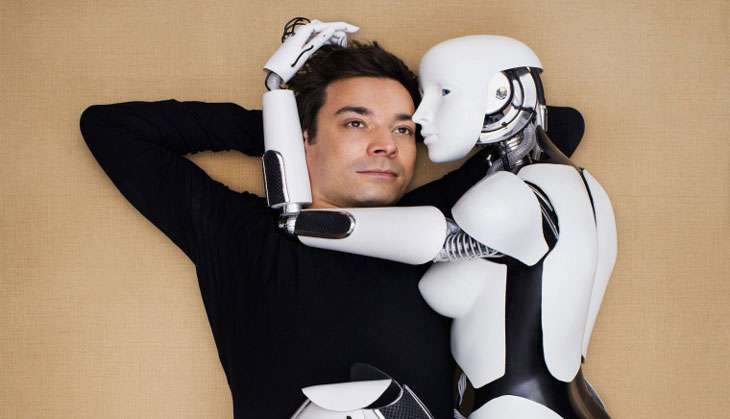
Using Sex Robots (As Therapy)

It feels like I joke about sex robots every chance I get on this blog. In my defense, this is a blog that sells sexy stories, promotes steamy romance, and dares to imagine a future with bionic genitalia. Make no mistake, though. sex robots are a serious issue.

Sure, they’re easy to make light of when they still look like over-sized blow-up dolls with tits, but they are steadily becoming more advanced. They’re already entering the sex industry, albeit in a limited capacity. There are actual companies working on them, as we speak, and for good reason. The demand for sex is like the demand for water. It’s a market that can always be counted on and one Amazon hasn’t monopolized yet.

I’ve talked a bit about how sex robots might impact us, but I always assume that impact will be far greater than anything an aspiring erotica/romance writer can imagine. Hell, I doubt even movies can imagine it, although some like “Ex Machina” make a concerted effort.

I intend to keep discussing the breadth of that impact on this blog in all sorts of ways, including those that’ll make people horny as hell and others that’ll make people more uncomfortable than a vegan at a butcher shop. In any case, it’s worth belaboring both the upheavals and the opportunities that functional sex robots will present.

Sure, there will always be truly deranged people who will become more deranged by presence and use of sex robots. Those people are always a minority, though. Like Charles Manson, they’re the disturbing exceptions that make the news, but not the norm.

Beyond the extremes, though, there’s another aspect of sex robots that I think warrants discussion and one that actually builds on other issues I’ve brought up on this blog, primarily those involving the challenges most people face in forging a healthy sex life in the modern era. If the failure of celebrity couples are any indication, then those challenges are more daunting than we think.

To illustrate the extent of those issues, take a moment to think about the number of people you know who have sought therapy or counseling in some form. Chances are you know more than one. I certainly do. Hell, I challenge anyone to find someone who doesn’t know anyone who has sought therapy.

According to the American Psychological Association, approximately half of American households had someone who’d sought therapy in some form or another. That data was gathered in 2004, though, and pointed out that some couldn’t even seek therapy, due to a lack of insurance. That’s a lot of therapy and a lot of people who need it that aren’t getting it.

Now, take a moment to consider how much of that therapy involved someone’s sex life. While I doubt it applied to every case, I imagine there’s a significant portion of psychological issues that are tied to sex. The fact that sexual dysfunction is so prevalent leads me to believe that more than a few psychological issues are at work here.

Hell, it’s practically part of our popular culture. Watch any sitcom, any movie that doesn’t involve talking animals, or any novel that involves a Biff Tannen/Regina George knock-off and you’ll see it. A man or a woman has an unsatisfying, frustrating, or non-existent sex life. It is the source of a lot of problems, plots, jokes, gags, and obstacles.

Enter the intelligent, interactive, fully-functional sex robot. What does that do to therapy and the reasons we seek it? I’m not just asking that because I want you to picture a world full of advanced sex robots that look and function like Jenna Jameson and Channing Tatum on crack. Granted, I always want people thinking those kinds of sexy thoughts on this blog, but I want people to keep their panties on and look at the bigger picture.

Think, for a moment, how much stress and frustration most people experience when dealing with their sexual desires. It doesn’t matter that it’s the 21st century, internet porn is everywhere, and women are legally allowed to have sex that doesn’t involve making babies. People who aren’t celebrities, supermodels, or as attractive as either struggle to satisfy those desires.

It can and does take a psychological and physical toll on people. If the documented health benefits of orgasms are any indication, then nature wants us to have plenty of sex. Not getting it is like denying the body and mind key nutrients. Without it, there will be issues that go beyond bad moods and morning wood.

At the moment, it’s not easy for a lot of people to explore their sexuality and actually engage in meaningful sexual exchanges. Between uptight religious attitudes, rampant slut shaming, and woefully unequal gender dynamics, finding an adequate sexual outlet is not like going to the grocery store to buy some snacks when you’re hungry. It also comes with all sorts of risks, including disease, pregnancy, and toxic relationships.

The sheer breadth of this difficulty is a major driving force behind the sexual frustrations of many men and women, alike. It’s hard enough just articulating those desires, even to a therapist that is legally obligated to never tell another living soul about your clown fetish. Actually exploring those feelings and achieving some level of sexual gratification is more difficult.

Sex robots don’t just change that situation. They don’t just rewrite the rules of the sexual playbook. They throw the playbook out, shoot the people who wrote it, and use their notes as toilet paper. Sex robots are destined to upend the sex industry and already are in some parts of the world. The impact they’ll have on therapy, though, may be just as great, if not underrated.

Picture a scenario, if you can, of a young man or women going into a therapist’s office in the not-so-distant future. In that future, sex robots are a mature technology in the sense that robots are nearly indistinguishable from humans. They look, feel, and sound real. They have a measure of intelligence, but it’s not much greater than that of the virtual assistants we already use today.

Knowing this, the therapist sits the man or woman down and talks to them. They find out quickly that this person is dealing with depression, anxiety, stress, and loneliness on a level that’s beyond that of most people. As part of the treatment, the therapist provides them with a specially-programmed sex robot. It’s here where the implications become both daunting and seamy.

Unlike the traditional sex robots that ordinary horny people use, or the sex bots you see in an “Austin Powers” movies, these sex robots are programmed with a specific purpose. They’re not just there to give their patients a good orgasm. They can get that from porn or sex toys. The sex robot, in this case, will have a more intimate function.

First, they’re molded to look like someone that the patient feels strong sexual attraction for. That may require some kinky tweaks, especially for those who have crushes on Jennifer Lawrence. However, that’s both doable and kind of necessary. There are already sex dolls molded after porn stars. That same process can be applied to sex robots.

Second, the robot is programmed with a specific personality profile that takes into account the patient’s mental issues. It won’t be enough to just get them off. They’ll need to create an emotional bond with them so that they can help them cope with those issues.

Maybe that involves a sex robots that’s a kinky, assertive dominatrix to help someone with authority issues. Maybe it’s a sex robot that’s meek and submissive to help someone with poor self-esteem. Maybe it’s a sex robot that’s just extra-durable to help someone who’s a real nymphomaniac. There are many ways a sex robot can help people is what I’m saying.

That process may not always include kinky sex. The sex robot may just be programmed to provide some sort of emotional intimacy that the person lacks or can’t find with another person. They could even be programmed to satisfy those who suffer from physical deformities, paralysis, or chronic disease. Thanks to these robots, everyone can have a physically and emotionally satisfying sexual experienced.

The possibilities are limited only by the extent to which a sex robot can be programmed for a specific purpose. Given how good we are at customizing our phones, cars, and even weapons, it’s very likely that we’ll do the same with sex robots for therapeutic and non-therapeutic use.

On the therapy side, though, those possibilities have the greatest implications. It’s one thing for normal, healthy people to enjoy regular, satisfying sex with a robot. It’s quite another when people who would otherwise be crippled or hindered by mental illness are suddenly able to function again and achieve some measure of happiness.

Think, for a moment, what that means for society. It elevates sex robots beyond a mere novelty or kink. Suddenly, they become a means to treat people who never would’ve gotten treatment otherwise. In addition, those who’ve lost loved ones, become ill, or just can’t attract those cute cheerleader types that gets their blood flowing can enjoy intimate, satisfying experiences.

In terms of quality of life, it’s a huge boost. In terms of how we approach our sex lives and sexuality, in general, that’s a bit harder to quantify, even for a mind as lurid as mine. Having a society where everyone, man and woman alike, is sexually satisfied is kind of unprecedented.

It’s really hard to know just how such a society functions or even if it can function. Throughout history, our species has struggled to channel and manage our sex drive. The extent to which we have so many sexual taboos and asinine double standards just proves that the struggle is still ongoing.

Modern medicine, contraception, and even the mainstreaming of the porn industry has helped make sex less dirty, to some extent. We still have a long way to go before full sexual satisfaction is achievable to everyone, not just the beautiful, the popular, and the mentally healthy.

Sex robots could very well be the most critical tool society creates in helping people achieve a level of emotional, physical, and mental satisfaction. In a world where everyone is that satisfied, how will we conduct ourselves? How will we interact with each other? It’s impossible to say, but if writing sexy novels has taught me anything, it’s that few things are more therapeutic than a satisfying sex life.

8 Comments

Filed under Marriage and Relationships, sex robots, Sexy Future

Our New Robot Overlords Are Coming And They’re Not That Sexy (Yet)

When it comes to the future, I like to think of myself as an optimist. I know that’s a radical position these days. In fact, I think it’s always been a radical position. When you consider how many times the end of the world has been predicted, it’s easy to see why any kind of optimism might as well be on par with Adam Sandler’s chances of winning an Oscar.

Radical or not, I am very hopeful about what the future will bring. I’ve highlighted some emerging technologies with huge social implications, as well as a few that may very well affect our sex lives. I think there will be more advancements down the line, some of which defy our expectations and dirty imaginations. I’m hoping some if it will inspire some more sexy novels for me.

However, I’m not immune to some of the concerns that come with emerging technology. There are some advances, like nuclear weapons, that are pretty damn scary. The fact that these weapons exist and aren’t exactly maintained very well, as John Oliver frighteningly explained, is real cause for concern.

Beyond nuclear weapons, though, there is one advancement that does have me worried at times. That involves robotics. Now when I say robotics, I’m also including artificial intelligence in that discussion. However, it’s one thing to have a simple box that has much greater intelligence than a human. It’s quite another to put that intelligence in a robot body and give it a gun.

Now I’m not among those who think “The Terminator” or “The Matrix” are legitimate scenarios. Many have pointed out the obvious flaws in these apocalyptic futures far better than I ever could. However, that’s not to say that there aren’t some ominous hints that we may be taking one too many ideas from the imagination of James Cameron.

Enter Boston Dynamics, a company that’s the closest real-world equivalent to Cyberdyne. As a subsidiary to Google, with access to their insane piles of wealth, they specialize in creating advanced robots. However, some of the robots they create are a bit too advanced for comfort.

Recently, they introduced the world to their latest creation, which they call Handle. Granted, it’s not nearly as intimidating as the Terminator, but what it lacks in an Austrian accent, it more than makes up for in mobility. It’s actually even scarier than it sounds. See for yourself.

Are you done trembling? Are you ready to call John Conner? I’m not saying this robot will rise against us. I’m just saying that if someone were trying to run from this robot, they would have no chance. Hell, put a gun on this robot’s shoulders and we’re all fucked.

Okay, I’m turning off the sarcasm and doom-saying now. I’d like to get a bit more serious now because this trend is not going to stop. There are too many economic incentives for developing these robots. Automation is growing trend and one that is poised to increase because more automation means cheaper manufacturing. Cheaper manufacturing means more profits. It’s just basic economics.

Add artificial intelligence into the mix and the basics get real advanced. I’ve talked before about how people may come to see advanced AI the same way some people see a dominatrix. That wasn’t just to create some uncomfortably sexy thoughts, although I do concede it was part of it. I really do suspect that when it comes to powerful authority figures, these same sexy dynamics still apply.

With Boston Dynamics, however, those dynamics go a step further. While others, like Google and Microsoft, are working on the nuts and bolts of artificial intelligence, Boston Dynamics looks poised to give it a body. Once that kind of intelligence is in a body like that, then all bets are off.

Granted, that body doesn’t look very sexy now, but there’s already ongoing work in that department too. Just wait until it’s smarter, stronger, and more agile than any human being alive. That’ll change its sex appeal really fast. I just hope I live long enough to write a sexy story about it.

5 Comments

Filed under Jack Fisher's Insights

Universal Basic Income: A Sexy Idea For The Future?

Whenever a bold, ambitious new ideas comes along, there are sure to be skeptics and critics. It’s an unfortunate part of human nature. Our caveman brains get too comfortable with a situation, even if that situation is terrible and involves us shitting in a ditch. We’ll resist change at every turn until it becomes exceedingly inconvenient.

While I imagine there was plenty of resistance to those who introduced ideas like democracy, gender equality, and circumcision, some ideas make so much sense that people have to go out of their way to make excuses. Granted, they’ll still find those excuses. People are tragically adept at clinging to outdated ideas, even when they’ve been thoroughly debunked. Just look at creationists.

There’s no question that our current situation in the world has room for improvement. It’s true, although you’d never know it by watching Fox News for more than five minutes, that the human race is getting better. It’s also true that there’s still a lot of suffering.

According to GlobalIssues.org, there are over one billion people living in poverty. I’m not just talking about the kind of poverty that makes a Big Mac seem like a luxury either. According to UNICEF, around 21,000 children die a day because of poverty-related issues. I think most of us can agree that when children are dying, it’s a big freaking issue.

Even rich countries, like the United States, can’t escape the effects of poverty. According to the most recent census data, about 13.5 percent of the population, which amounts to approximately 43.1 million people, are living in poverty. For a country where people get rich for making a pet rock, that’s just inexcusable.

Poverty is a very serious, very unsexy issue. I could spend multiple posts whining and lamenting about the breadth of this problem. However, if you’ve been following this blog for any length of time, you know I find whining to be right up there with dry heaves, severe head trauma, and clown porn in terms of utterly unsexy wastes of time.

I’m not big on lamenting over problems. I like contemplating the solutions. The crazy creative side in me that comes up with sexy stories just loves to imagine bold new ways to solve overwhelming problems. Could there be such a solution to a problem as big as poverty? Well, there might be and it’s not just some crazy musing of an aspiring erotica/romance writer.

Ladies, gentlemen, and those of unspecified gender, I give you the Universal Basic Income. Like assless chaps, it’s exactly what it sounds like. It’s the idea that the state shouldn’t waste time trying to distribute resources based on need, requiring a bureaucracy that makes the DMV look like a goddamn day spa. Instead, it should just provide a bare minimum cash payment to every citizen, regardless of wealth or need.

If that sounds too simple, then don’t bother bracing yourself. For once, it really is that simple. If you’re a legal citizen, you get a monthly cash payment. It’s not enough to help you afford a golden toilet seat, but it is enough to keep you from starving to death.

If it sounds familiar, it should. The United States has had something similar, but it’s reserved for those lucky enough to live beyond a certain age. It’s called Social Security and, by and large, it’s one of the most popular social programs the United States has ever created. Yes, it’s even more popular than programs that study the economic structures of World of Warcraft.

A Universal Basic Income, or UBI for those who hate excessive syllables, just takes social security a step further. It ditches the whole age requirement, exotic math formulas, and bureaucracy components and just gives a simple, flat payment to everyone. It could come in the mail. It could be sent via PayPal. Even the government can’t screw that up too much.

If it sounds like the kind of radical idea that emerged from one of Bernie Sanders’ fever dreams, then settle down and drink some tea. This idea is actually older than 99 percent of all the nations that currently exist today. Like so many other crazy ideas, it emerged in different times under a different label.

Way back in 483 BC, a time when Bernie Sanders was still fighting for the rights of serfs and peasants, the ancient Athenians came up with something called a Citizens Dividend. It’s basically the same concept, saying that the state should pay its citizens for its use of communal property and various resources.

Sure, the Athenians didn’t adopt the idea and went back to warring with the Persians, but the concept didn’t end there. It re-emerged again through the works of an influential Founding Father by the name of Thomas Paine, a man Glen Beck goes out of his way to admire.

In his essay, “Agrarian Justice,” Paine argues for a citizens dividend wherein the wealth of some obscenely rich landowners would go to some of the poorer citizens to alleviate poverty. It wasn’t a universal income, but it was a method for raising the floor, so to speak, on the poorest citizens.

Again, it wasn’t adopted and for good reason. Rich landowners generally don’t like the idea of having the government take their money and give it to poor people. That has never sat well with super rich folk who need these poor people toiling in the fields so they can bathe in gold and concubines.

However, that might be changing because, unlike the days of Ancient Athens and Thomas Paine, technology is making it so we don’t need a massive underclass of peasants toiling in factories or in fields. Machines are rapidly becoming advanced to a point where even jobs such as trucking, mining, and ordering a Big Mac is destined to become automated.

Last year, the White House issued a report that stated that approximately 47 percent of the existing jobs will become automated in the next decade or so. That’s a lot of jobs that will leave a lot of people out of work with no money and nothing to do. That’s a recipe for disaster, as those enduring Greece’s recent economic troubles can attest.

The UBI could be a way to effectively bridge the gap between the era of making poor people work their asses off to prop up the rich and the era where machines do all the work so people can do more productive things with their time. That means more time for aspiring erotica/romance writers to write sexy stories. Isn’t that a future worth fighting for?

This isn’t just a matter of technology. This is basic economics. Machines don’t get tired, don’t take sick days, and until Skynet becomes active, they don’t unionize. Why else would Amazon be investing so heavily in using robots to operate its warehouses? At some point, you won’t be able to blame immigrants or minorities for taking your job. It’ll be a robot and you’re not going to win a fight with a robot.

So long as automation increases profits and efficiency, it’ll keep happening. Along the way, more and more people will struggle to find work. Sure, those who are well-educated and well-connected will find something to do, even if it means just getting grossly overpaid for speaking gigs. For everyone else, though, the options are limited.

The UBI could be the key to truly alleviating poverty on a mass scale while providing even more incentives to get machines to do the work that crushes one too many souls. It will require a rough transition. A UBI doesn’t exactly fit with the old “Protestant Work Ethic” that some people still go by, but like the Catholic Church’s position on masturbation, it might be one of those concepts we just shrug off.

A world where people don’t have to work to survive is a very different world, one that’s hard to imagine in an America that glorifies working yourself to death while those lazy Europeans enjoy things like paid vacation, maternity leave, and unlimited sick time. However, that image will eventually clash with trends in technology and our need to alleviate poverty to keep society from strangling itself.

This is a world I do hope to see in my lifetime. I may be old, gray, and shitting in bags by then, but I’d like to see what this world would inspire. Would not having to work as much or as hard mean more meaningful relationships? Would it mean more time for sex and intimacy? We can only hope. As always, though, an aspiring erotica/romance can come up with some pretty kinky fantasies.

11 Comments

Filed under Jack Fisher's Insights