Category Archives: Current Events

Whistleblower Confirms That Facebook Is Harmful: So What Do We Do About It?

See the source image

There are certain products in this world that we know are harmful, but use them anyway. Cars kill thousands every year through traffic accidents. Thousands die every year by overdosing on drugs that were legally prescribed to them. However, we still use these products because they are essential for our way of life.

With that in mind, I think most people already know that certain social media platforms, such as Facebook, can be harmful. You don’t need to look that hard to find harmful or damaging misinformation on Facebook. Having been in college at the time Facebook really took off, I think most people understood to some extent that this product could be used for immense harm.

So, was it really that surprising when a whistleblower came out and revealed just how much Facebook was aware of the damage they were doing? Just like tobacco companies before them, they could see that harm unfolding in real time. They just weren’t willing to take the kinds of steps that would hinder their profits.

They’re a multi-billion dollar business. They want to keep making billions for years to come. That shouldn’t surprise anyone. That’s the nature/flaw of capitalism.

In case you haven’t been following this story, the fallout from this whistleblower’s revelations are still unfolding. If you want details on the story, here is what NPR reported:

NPR: Whistleblower to Congress: Facebook products harm children and weaken democracy

Facebook’s products “harm children, stoke division, weaken our democracy and much more,” Frances Haugen, the former Facebook employee who leaked tens of thousands of pages of internal documents, will tell lawmakers on Tuesday.

“When we realized tobacco companies were hiding the harms [they] caused, the government took action. When we figured out cars were safer with seat belts, the government took action,” she will say, according to her prepared testimony. “I implore you to do the same here.”

Haugen will urge lawmakers to take action to rein in Facebook, because, she says, it won’t do so on its own. “The company’s leadership knows ways to make Facebook and Instagram safer and won’t make the necessary changes because they have put their immense profits before people,” she will say.

There’s much more to the article, but I singled out this excerpt because it effectively sums up the situation. Again, most reasonable people probably suspected that a platform like Facebook was doing real harm to public discourse and the psychology of teenagers, especially girls. It’s still nice to have confirmation.

As someone who uses Facebook, I can attest to its harms. There is some pretty toxic crap throughout the site, as well as some equally toxic people. Sadly, some of that toxicity comes from friends and relatives sharing content, often of a political nature, that gets people upset and outraged. That’s not a bug, either. According to the whistleblower, that’s entirely on purpose.

Now, in the interest of maintaining some kind of perspective, I’m inclined to remind everyone where that content on Facebook comes from. Remember, they’re not the one’s producing it. They’re just the platform. It’s the users and the people who are creating that. It’s people willing to lie, denigrate, demean, and troll who create the content that makes Facebook and social media so toxic.

To blame Facebook entirely for these harms is like blaming car manufacturers for traffic fatalities. At the end of the day, the car itself doesn’t cause the harm. It’s the person using it.

That being said, Facebook is not a car, nor should we treat it like one. It’s also not a tobacco company and we shouldn’t treat it like that, either. Facebook doesn’t create a tangible product that we can hold in our hands to harm ourselves, nor is it a chemical we willingly put in our bodies. It’s a digital service that we engage with and, in turn, it engages with us.

From that exchange, real harm is possible. This whistleblower confirms that and, based on the available information, I think the data presented is valid. That still leaves one question to ponder.

What do we do about Facebook and other companies like it?

That’s still an unresolved question and one that too many people try to answer bluntly. Shortly after this story came out, the ever-popular #DeleteFacebook hashtag started trending. However, I doubt anything will come of that. I’ve seen that hashtag trend on multiple occasions and it has done little to affect Facebook’s growth.

These revelations are bad, but I doubt they’ll be enough to bring Facebook down completely. They may lose subscribers and revenue in the short-term, but they’ll adapt and grow in the long run. You don’t become a multi-billion dollar company without being able to adapt in lieu of bad press.

At the same time, I think we should take some action to mitigate the impact of Facebook and social media. What could that entail? I’m not smart enough to offer a comprehensive answer, but I do know the extremes people are throwing around just won’t work.

For one, Facebook can’t be banned or shuttered. It makes too much money and it would set a dangerous precedent for every business, online or otherwise. It’s also probably grossly unconstitutional, at least in western democracies like the United States and Britain.

Even if it were banned, people would find a way to get around it. Just look at the countries that have tried to ban porn. People still find a way to get it.

Others have thrown around ideas like splitting up Facebook, just like America once did with oil companies and phone companies. That would certainly be extreme and there are precedents for doing so. However, would that really change how Facebook and social media are utilized by real people? Would those not satisfied with the newly broken up Facebook simply create something similar under a different name?

The most logical recourse might just involve demanding that Facebook make the changes they refused to make, according to the whistleblower. They could also be subject to major fines and taxes, as we’ve done before with tobacco. Will those measures be effective? I don’t know, but I’m skeptical, to say the least.

I honestly don’t think there’s an easy answer to the question. I also think that, even if governments did implement new measures on social media companies to combat their harms, both the companies and the users would find a way around it. Both sides are just too motivated at this point.

I still believe there’s a better solution. I just don’t know what it is and if anyone has one to offer, please share it in the comments. In the meantime, I guess the best recourse we can all do is to just be careful about what we place on Facebook and be more mindful of the content we consume.
Leave a comment

Filed under Current Events, health, human nature, outrage culture, political correctness, politics, psychology, technology

New York Comic Con 2021 Pictures, Footage, And Sharing The Experience

The following is a video from my YouTube channel, Jack’s World. In years past, whenever I’ve gone to New York Comic Con, I’ve shared my collection of pictures in the days that follow. I want to continue doing that, but this time I’d like to use my YouTube video to share both pictures and videos I took. I also set it to some epic music. Enjoy!

Leave a comment

Filed under Current Events, Jack's World, New York Comic Con, superhero comics, superhero movies, YouTube

Rethinking Jobs And Business: How Pandemics And Relief Benefits May Change Both

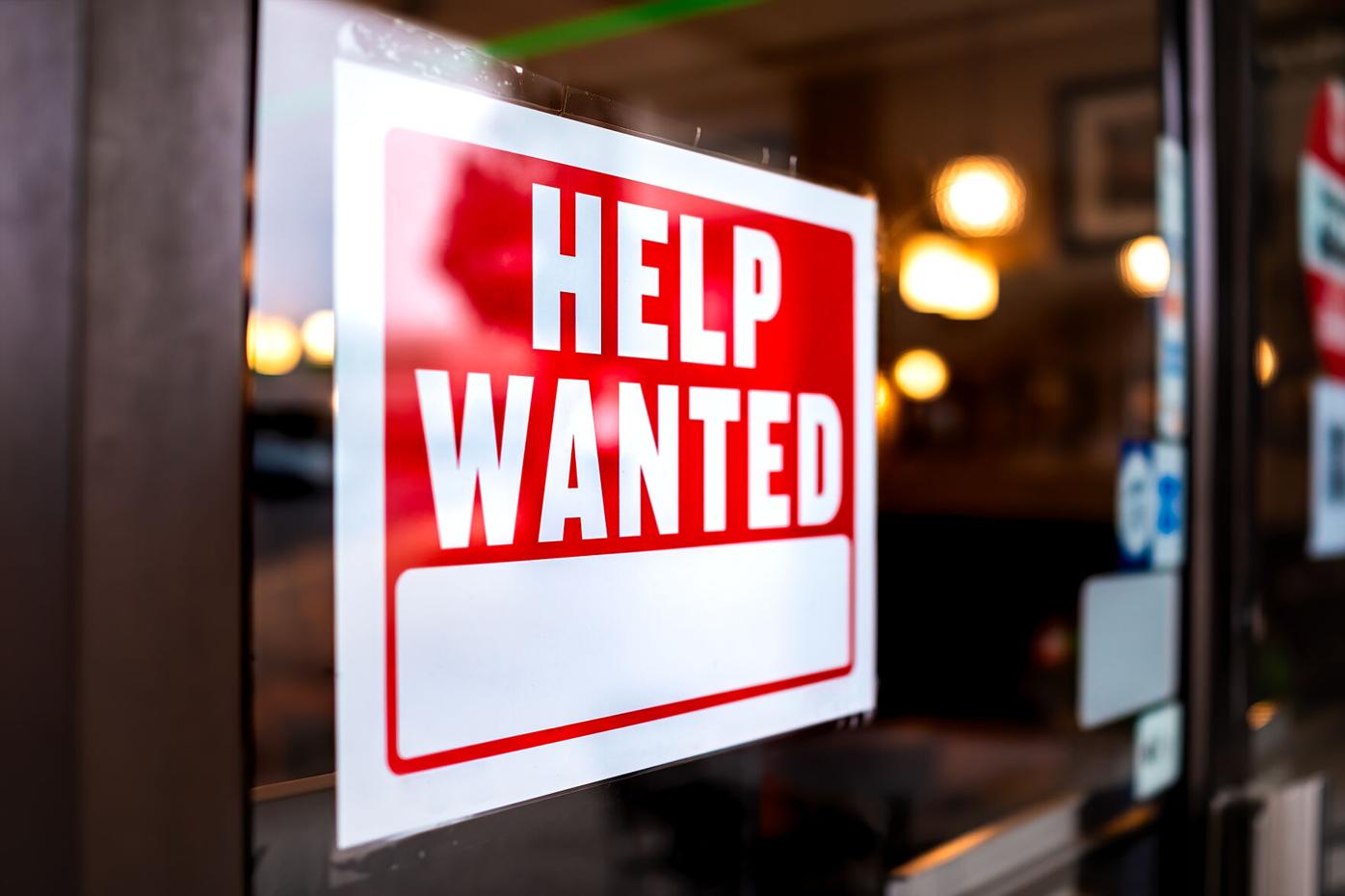
Help wanted? | Free | hometownsource.com

The world is always changing. That’s the only constant.

Sometimes, it changes more rapidly and chaotically than usual. That tends to happen a lot when major events transpire, such as a once-in-a-generation pandemic that infected millions and shut down entire countries. I hope I don’t have to belabor that to anyone with a news feed for the past year.

At the same time, these kinds of rapid upheavals can get us thinking harder about things we tend not to question. I’m not just talking about how much we take our health, our infrastructure, and our essential workers for granted. I’m referring to bigger concepts about how we approach life, society, and how we structure our lives.

One area that seems to be getting more scrutiny lately is how we approach jobs, work, and careers. I’ve certainly given it more thought, mostly in terms of the impacts of telework and how I used my stimulus check. I suspect many others have contemplated these topics in new ways in wake of recent events.

Now, as the pandemic nears its end, some of those concepts are already manifesting in the real world. One effect, in particular, has been especially jarring in America, mostly for reasons that other industrialized countries may find laughable. It has to do with people not wanting to work for a lousy, unlivable wage.

I know that shouldn’t be such a radical concept, but it is and as a proud American, I find it infuriating. There’s no getting around it. The ages for the average, non-CEO American have been stagnant for decades. It’s an issue that has been festering since long before the pandemic and even before I was born.

Before the pandemic swept in, there was an ongoing debate on whether the minimum wage should be increased to $15 nationally. I won’t get too heavily into the politics and talking points behind it, mostly because it ultimately descends into cycle of speculation and fallacies. I’ll just say that the pandemic has complicated that debate in unexpected ways.

During the height of the pandemic, the economy was basically shut down. Suddenly, millions were out of work and businesses had to shut down. Many still haven’t fully recovered. A big reason why many didn’t starve to death or end up on the streets was because of government relief packages, which included extended unemployment benefits.

While America’s relief package wasn’t nearly as generous as other countries, it was certainly better than nothing. I know plenty of people who genuinely needed that relief to stay afloat in terms of paying bills and feeding their families. It’s also not unreasonable to say that this was a critical measure in terms of preventing the pandemic from getting even worse.

However, this effort revealed something remarkable. According to a study done last year, the unemployment benefits that many workers received was actually better than their previous wages. It wasn’t an insignificant chunk of the work force, either. The benefits were greater for approximately 68 percent of American workers.

What does that say about the wages we’re paying our workers?

Moreover, what does that say about the system in general that workers can make more by not working than they would if they were?

Something about that doesn’t add up, literally and conceptually. I get that this was an unprecedented situation. At the same time, it reveal something about how we see work and workers. It’s something businesses are starting to realize too.

As the country and the world opens up, new job opportunities are arising. That’s good news for those who have been out of work. Unfortunately, those same businesses are having a hard time filling those positions.

The jobs are there.

The workers are there.

They just aren’t gravitating towards one another.

Here’s a brief rundown of the situation, courtesy of NPR. If you haven’t been working or are lucky enough to have kept your job during the pandemic, it should offer some insight and perspective.

NPR: Millions Are Out Of A Job. Yet Some Employers Wonder: Why Can’t I Find Workers?

At a time when millions of Americans are unemployed, businessman Bill Martin has a head-scratching problem: He’s got plenty of jobs but few people willing to take them.

“I keep hearing about all the unemployed people,” Martin says. “I certainly can’t find any of those folks.”

Martin helps run M.A. Industries, a plastics manufacturing company in Peachtree City, Ga. The company makes products used in the medical industry — specifically, in things like coronavirus tests and vaccine manufacturing and development.

But as he struggles to keep up with demand, Martin is finding it almost impossible to find new workers.

As someone who has worked his share of lousy, low-paying jobs, I can’t say I’m surprised by this. Don’t get me wrong. I still feel for the business owners who need workers to keep things going. I just can’t forget how arduous it was, working hard at a job that paid so little and left me so exhausted at the end of the day.

If the alternative is staying home and collecting unemployment, which ultimately pays more, then the choice is easy. That’s especially true for those who have kids or relatives they need to take care of. It’s not that they’re lazy, as some overpaid pundits love pointing out. It’s just that the nature of these jobs aren’t that appealing, especially when the pay is so low.

If anything, this situation has inspired us all to take a step back and look at how we approach work, jobs, careers, and business. When you think about it, it’s a little distressing that we build so much of our lives around work. It’s not just something we do out of obligation and responsibility. Many literally have to work in order to survive.

Is that right?

Is that just?

Is that healthy for society as a whole?

I say this as someone who has been lucky enough to have jobs that I’ve both loved and hated. I know what it’s like to work for a business that you hate. I also know what it’s like to have a job you find genuinely fulfilling. Not everyone is that lucky. In fact, I suspect the vast majority of the population, even in America, never experience that luck.

I get that there are economic reasons why some businesses can’t pay their employees high wages. I’ve worked in fast food restaurants. I know the profit margins aren’t exactly large. I also know that, even when I could make more than minimum wage, it was rarely enough to live on. That’s not even factoring the physical toll some of this work takes.

Despite that toll, there was still an undeniable stigma to those who didn’t work or those who simply avoided low paying jobs. In America, it’s a direct extension of that old protestant work ethic that equates moral worth with a willingness to do backbreaking labor for minimal pay. I’m not saying that work ethic is wrong, but I do think it needs to be re-evaluated.

The pandemic suddenly gave people an option on whether or not they wanted to do these kinds of low-paying jobs. Many understandably opt to just collect unemployment. They may not live luxuriously, but they will live. In some cases, they’re even better off.

It may be a sign of things to come. I already speculated on how the pandemic relief bills could be a precursor to a universal basic income. Now that people have experienced life in which their survival isn’t directly tied to having a low-paying job, I think it’ll be difficult to back.

I also think that’s a good thing. Regardless of how you feel about minimum wages, work ethic, or running a business, I think it’s generally a positive trend that we’re starting to decouple work with the right to survive. I think it’s a trend that has to happen, especially as automation does more and more of the low-skilled labor traditionally done by human workers.

It’s true. Some people are lazy and don’t like to work. Some people are just so driven and incapable of not working. Both still deserve to live without needed a job to keep them from starving to death or losing their home. As bad as this pandemic has been, I sincerely hopes it inspires us to rethink how we structure our society. There is a better way of doing things. We should always strive to do things better. Sometimes, that means rethinking everything we’ve come to believe about work, business, and life in general.

Leave a comment

Filed under Current Events, health, human nature, politics

How Bad Should We Feel For Certain Bad People?

New Research on TV Binge-Watching Behaviors – Department of Communication  Arts – UW–Madison

In general, I try to be forgiving, empathetic, and understanding, even towards people I think are total assholes. I also think it’s generally good for society to be forgiving and sympathetic to others, even when they’ve done bad things and fostered bad events.

Now, there are always exceptions. There are certain people on this planet who are genuine monsters and they deserve only scorn and condemnation. However, this isn’t about them.

I’m of the opinion that most people, broadly speaking, are decent human beings. They may act like assholes on occasion, especially online when they can be anonymous. When you’re actually with them, though, they will show some semblance of humanity.

That has been my experience. I have met people who are real assholes on Facebook, but genuinely nice in person. That’s why I generally favor being kind and understanding to others, even when you don’t like their personality, their opinions, or their agenda.

However, there is a line to that sentiment. I certainly have a few hard lines that, if crossed, will keep me from feeling any semblance of compassion for someone. I’ve only met a few people who have crossed that line over the course of my life. There are other celebrities and media figures who have done so. As a result, I refuse to support anything they do.

This brings me to a situation involving a man I’ll just call Dick Spencer. If you’ve been following politics for the past five years, you’ve probably heard of him. In fact, you probably know him as the guy who got punched in the face and that got people cheering. In case you haven’t seen it in a while, here it is again.

Racism Blacklivesmatter GIF - Racism Blacklivesmatter Neonazi GIFs

I’m not going to lie. That’s still very satisfying to watch. I try not to take too much pleasure in it, but if you’ve read up on this guy, you understand completely why he got punched.

I won’t go over all the deplorable things he’s said and done. I don’t even want to link to it because he’s not worth the energy. All you need to know is that this guy is a textbook neo-Nazi and that’s not an exaggeration. This is a guy who actually wants racist, sexist policies implemented and enforced on a large scale.

He’s as bad as you think he is and then some.

For that reason, and plenty of others, he’s made way more enemies than friends over the past several years. For a time, his voice carried weight and influence. That was then. Now, it’s a very different story.

A recent story from the New York Times revealed that Dick’s life has taken a massive turn for the worse. Apparently, being a hateful bigot who openly advocates neo-Nazi policies is not good for your career, your social standing, or your bank account. Vanity Fair offered a more colorful take on his situation, which I think encapsulates how many feel about this man.

Vanity Fair: Richard Spencer, Racist Putz, Is Having A Lousy Labor Day Weekend

Richard Spencer, the loathsome alt-right skunk best known for getting clocked in the jaw during an interview, is feeling the repercussions of his actions, according to a report published in The New York Times on Sunday. The article details how one of the central figures in recent white nationalism, who shouted “Hail Trump!” in a widely seen video as his followers made Nazi salutes, has been effectively silenced by his neighbors in Whitefish, Montana.

Spencer, who is “unable to get a table at many restaurants” according to the report, faced bipartisan pushback, led by local synagogues and human rights groups as the summer resident’s notoriety increased. Currently, Spencer, whose organization is dissolved and whose wife has divorced him, faces trial in Charlottesville, Virginia next month for his role in instigating the deadly white nationalist rally in 2017. However, the man who once lived in his mother’s $3 million summer house can not, according to the Times, afford a lawyer.

I’ll say it again. I try not to take too much pleasure in other peoples’ misfortunes. I try, but I don’t always succeed. I admit that hearing how this guys life has gone since becoming the face of racist hatred in America brought a smile to my face. It reaffirmed that the forces that oppose bigotry are generally stronger than those that ferment it.

At the same time, this guy is in a very bad place, to say the least. The organization he founded has been dissolved. He has little to no money. His wife divorced him. He’s been kicked off every major media platform. He’s being sued for instigating the 2017 riots in Charlottesville, Virginia. The man is in an objectively bad place.

However, he’s responsible for putting himself in that place. He’s not a victim. These are the consequences of being such a racist bigot. Dick probably didn’t think they would be this severe, but that doesn’t make him any less responsible.

Believe me when I say I’d rather not know anything about this person, his politics, or his egregious behavior in the past. I doubt I’m alone in wishing that Dick never became a relevant figure in any capacity. Unfortunately, he was and still is to some extent. We are aware of him, his past actions, and his current situation.

That still leaves us with one relevant question

How bad should we feel for this guy?

It’s relevant because this guy has no power, money, or influence. He’s not some politician or rich celebrity who can twist the narrative to his liking. He’s just a guy with some very deplorable political beliefs who may very well be broke, homeless, or in prison at some point within the next few years.

I’m not saying he doesn’t deserve those consequences. I think he deserves most of them. However, he’s still a human being. The hate and bigotry he spouted is no restricted to him. There are others who share Dick’s beliefs and who will not face the same consequences. Does he still deserve any sympathy or compassion, however small it might be?

I’m honestly torn here. In the Vanity Fair article, he claims he’s just a guy and he’s not the same racist firebrand he was several years ago. However, at no point does he come out and apologize for anything he’s done, nor does he concede that he was wrong to espouse such hateful rhetoric.

Near as anyone can tell, he hasn’t changed his mind on anything. He’s still a racist bigot and no amount of public shaming will change that. For that reason, I just can’t feel bad for him in the slightest.

If he actually tried to apologize, I might feel differently. If he came out and apologized tomorrow, while also committing to atone for his past behavior, I might even give him a chance. Right now, I just can’t muster any ounce of compassion for him.

A part of me worries that the utter lack of compassion he gets could only make him more hateful. Another part of me worries that any compassion whatsoever would only keep him from facing the consequences that he has brought upon himself.

I’m honestly torn. I don’t know how to feel about a guy like Dick. I guess time will tell.

In the meantime, I open this question up to everyone else. If you have any feelings or sentiments that you’d like to share, please do so in the comments.

Leave a comment

Filed under Current Events, politics, psychology, rants

A Question (And A Challenge) For Those Who Once Opposed Same-Sex Marriage (But No Longer Do)

Fighting for the right to recognize same-sex marriage in Japan | The Japan  Times

People change.

Societies change.

General attitudes towards certain subjects, ideas, or behaviors change.

None of that should be news to anyone. Change is the only true constant in this crazy, complicated world. I’ve certainly seen plenty over the course of my life. It really wasn’t that long ago that the idea of marijuana being legalized in one state, let alone a dozen, seemed unthinkable.

It also wasn’t that long ago that the idea of same-sex marriage being legalized nationwide seemed equally unthinkable. In terms of major social and/or political issues, that issue resonates with me because it became a hot button topic while I was a teenager. In essence, it grew as I grew.

I still remember all the headlines from 2004 when Massachusetts became the first state to legalize same-sex marriage. I also remembered all the heated discussions that came from it. I even participated in a few. I felt like I understood the arguments made by the proponents. I had little issue seeing the logic behind their points.

Two individuals love each other and want to get married.

The state currently prevents them from doing so, thereby denying them the many benefits associated with marriage.

That denial is simply not reasonable in a free society that permits people to marry whomever they choose.

However, it was the arguments made by the opponents that I often struggled to understand. Honestly, their arguments from tradition, morality, or the idea of “defending marriage” just didn’t make sense to me. Even as I got older and saw arguments against it from major pundits and thinkers, often from those who identified as conservative, I still didn’t get it.

How does two gay people getting married affect anyone?

How does it tangibly and measurably undermine marriage between heterosexual couples?

I never got a straight answer. Most of the time, I just got hit with a bunch of bible verses from the Old Testament or some variation of “marriage has always been this way.” I never found any of those arguments convincing.

Fast forward two decades and suddenly, the lack of substance in those arguments really show. More and more, people are started to realize that too, including those who identify as conservative and likely opposed same-sex marriage at one point.

Just recently, Gallup released a poll indicating that support of same-sex marriage was at a record high. On top of that, even those who vote republican and identify as conservative have since come to support it. It’s still not quite on the same level as that of liberal democrats, but it’s still a majority and that’s a big deal.

Gallup: Record-High 70% in U.S. Support Same-Sex Marriage

U.S. support for legal same-sex marriage continues to trend upward, now at 70% — a new high in Gallup’s trend since 1996. This latest figure marks an increase of 10 percentage points since 2015, when the U.S. Supreme Court ruled that all states must recognize same-sex marriages.

Republicans, who have consistently been the party group least in favor of same-sex marriage, show majority support in 2021 for the first time (55%). The latest increase in support among all Americans is driven largely by changes in Republicans’ views.

Now, I welcome this news. I think it’s an objectively good thing that more and more people support same-sex marriage. The opposition to it never came off as anything more than varying degrees of bigotry.

I also think homosexuality and LGBTQ issues have gotten to a point where they’re no longer so unfamiliar or radical. We see them on TV, in movies, and in major positions of power. At the same time, the brand of reactionary religious zealotry that condemns homosexuality has fallen out of favor.

Again, this is good news. Accepting same-sex marriage and affording same-sex couples the same rights and protections isn’t just fair and just. It’s the right thing to do. Even if you despise homosexuality, you can’t justify having your personal preferences imposed and enforced by law. That’s just un-American.

Beyond that news, though, I have a question and a challenge for those who once opposed same-sex marriage, but no longer do. I’ll even extend it to those who still oppose same-sex marriage. Now that same-sex marriage has been legal for over five years, I think this question is worth asking.

How much or how little has your life changed since same-sex marriage was legalized?

It’s an honest, sincere question. I’d really like to know. There was a lot of fearmongering on the part of opponents to same-sex marriage. I won’t get into the specifics, but there were real concerns by opponents that legalizing same-sex marriage would have dire consequences.

Have any of those consequences even played out? If so, what data indicates as such?

Again, that’s an honest inquiry. I’d really like to know.

In addition, I also have a challenge to those who once opposed same-sex marriage. It’s a bit broader in scope, but is just as relevant.

What other issues besides same-sex marriage have you come around on?

Like I said earlier, change is the only true constant. What’s considered normal and acceptable today might be considered atrocious tomorrow. The same goes for what we consider immoral or deviant. A couple decades ago, it was same-sex marriage. A century ago, things like divorce and interracial marriage were just as taboo.

It’s hard to understand the attitudes of generations that have long since passed on. However, the vast shift in attitudes do offer some perspective. I believe they challenge us all to contemplate our current attitudes and how differently they’ll be seen in future generations.

We can’t know for sure which position will change drastically between now and twenty years into the future. We should still make a concerted effort in refining our perspective. Same-sex marriage showed just how much attitudes towards one single issue can change within a couple decades. Which issue will undergo a similar change two decades from now? Only time will tell.

Leave a comment

Filed under Current Events, LGBTQ, Marriage and Relationships, outrage culture, political correctness, politics, psychology, Uncategorized

Happy Labor Day 2021!

Sexy Sunday Thoughts: Labor Day 2018 Edition | Jack Fisher's Official  Publishing Blog

It’s been another rough year. Compared to last year, though, I’d still say it counts as an improvement. We’re still a long way from where we want to be, thanks largely to a vocal crop of idiots who insist on making everything worse for everyone else. As frustrating as that might be, improvement counts as improvement.

Today is Labor Day and this is a day in which we should celebrate the hard work we’ve done and the progress we’ve made. It has been another trying year and it’s far from over. However, we’ve made it this far. We’ve managed as best as we can under difficult circumstances. I feel like we’ve all earned a day off to enjoy the fruits of our labor.

Whether that means hanging out with friends, going to a barbecue, or taking one last trip to the pool, use this day to take a step back and relax. That’s especially true if you’re an overworked health care worker, paramedic, nurse, or doctor. You’ve more than earned a breather.

I’m a firm believer that everyone deserves to taste the fruits of their labor at some point. It shouldn’t happen just once a year, but it should still happen. Working hard is all well and good. Let’s just make sure we’re working for something better.

Take care, stay safe, and have a Happy Labor Day!

Leave a comment

Filed under Current Events

What Going Through The D.A.R.E Program Taught Me (And What It Failed To Teach Me)

Was D.A.R.E. Effective? | Live Science

Don’t do drugs. They’re bad for you.

We’ve been telling that to kids for decades. Many people reading this probably remember hearing it as well when they were kids. They heard it at school, form parents, from churches, and from any number of anti-drug PSAs. “South Park” has even done entire episodes about it.

The message is out there.

It’s not exactly ambiguous.

Drugs are bad and you shouldn’t do drugs. We get it. It’s so belabored at this point that it might as well be background noise.

However, it’s for that very reason that we should scrutinize that message. I don’t know if anyone has noticed, but despite all those anti-drug ads and programs, drug abuse is still a big problem. People are still doing illicit drugs and thousands still die from it.

Why is that?

Did these people not hear the same anti-drug messages that we’ve all been hearing for years?

It’s very likely they did. It just didn’t have any effect on them. That raises plenty of other questions. Before I even try asking those, I’d like to share a brief personal story about my experience with these anti-drug programs. Once I do, I hope it reveals why their impact is so muted.

When I was in grade school, the now-infamous Drug Abuse Resistance Education Program, better known as DARE, was in full-swing. All over the country, various schools and community programs would take time out of their schedules to hold these DARE-sponsored events. Those events were meant to be informative, but they always came back to just telling kids not to do drugs.

I was in the third grade when I first went through it. I distinctly remember only caring about it because it meant an entire afternoon had been cleared of other schoolwork. That’s how most of my friends at the time thought of it, too.

The program itself wasn’t that elaborate. We just had two men, a DARE spokesman and a police officer, sit down in front of our class to talk about drugs. I don’t recall any discussions about addiction or why people do drugs in the first place. Almost everything revolved around identifying certain drugs and learning to say no to them.

Some of those drugs, namely marijuana, are now legal in large parts of the country.

Curiously, the two drugs they never mentioned were alcohol and tobacco, which are far more likely to be abused.

I’m sure there was a reason for this and it had to do with these two drugs having billion-dollar companies behind them, but I digress.

What my third-grade brain took away from this was mixed, at best. Going through this program, these well-meaning adults painted a strange picture. They made it seem like there are these evil, nefarious drug dealers lurking in the shadows, looking to jump you on your way home from school, and shove illegal drugs in your face.

As a kid who read a lot of comics and watched plenty of cartoons, I found that to be very strange. Even crazed supervillains had some motivation behind it. These DARE people never talked about that. They didn’t mention things like drug cartels or gang violence. They just said these drug dealers are evil people who just want to get you addicted to drugs.

I honestly wanted to ask questions, but we never got a chance. This whole program was basically a lecture, not a discussion. The only questions they answered involved what certain drugs looked like and what they were often called.

Things got even more confusing in later years when I went through other parts of the program, which often included watching cheesy, poorly produced videos about the horrors of drugs. We would see pictures of ugly drug addicts and people getting arrested. At no point did we ever learn why these people were addicted or what happened to them after they got arrested. It was all so basic and bland.

Now, I understand keeping things basic for school kids, but it’s also worth noting that kids have bullshit detectors. They may not be as smart or as knowledgeable as an adult, but they’re not stupid. As a result, the way DARE framed drugs, drug dealers, and drug abuse never came off as something serious. It just felt like another case of adults talking down to kids again.

In that sense, I really didn’t get much out of DARE. If anything, it often left me confused.

I understood what drugs were, but the way DARE talked about them left little room for nuance. I still remembered at the time my parents often saying we had to stop off at the drug store on our way home. I knew what they meant. Some of us had prescriptions that needed filling. My parents explained it to me. I understood that, despite my age.

Now, here’s this program that constantly tells us drugs are bad and you should never do drugs, but never specifying what exactly they mean by “drugs.” Technically, aspirin and cough syrup are drugs. Were those just as dangerous? Again, I never got a chance to ask questions to clear that up.

Even as I reached middle school and high school, DARE programs didn’t change much. They just hammered away at that same message. Somebody from a police department would come to talk to a bunch of students and tell them not to do drugs. At this point, though, we were so numb to it that I remember some of my classmates falling asleep or doodling on their notepads the whole time.

To date, I’ve never met anyone who says the DARE program stopped them from doing drugs. That sentiment is mirrored in actual research done on the effectiveness of this program. For the most part, it didn’t work. In some cases, it actually had the reverse effect because it sent the message to kids that drug use was far more common than it actually was.

Then, there were the kids and teenagers who did drugs just to spite adults. Tell them not to do something and they’re just going to want to do it even more. I don’t know how common they were, but I know for certain those people exist.

Now, I’m an adult and looking back on it, I won’t say the DARE program was a total farce. I don’t doubt for a second that the intentions behind it were good. I know people who’ve had drug problems. Drug abuse is serious and it really does a lot of harm. However, there are far better ways of talking about it with kids and adults alike. None of them involve talking down to anyone.

I also feel like DARE was incomplete. It talked about drugs, but not the kinds of drugs people most often abuse, namely alcohol and tobacco. I didn’t learn about that until I was nearly in college. By then, most people already knew about it from other, non-DARE sources, so it was far too late to do anything about it.

It also felt like a missed opportunity because drug addiction has evolved since I was a kid. Today, abuse of prescription drugs is a far more serious issue than crack cocaine ever was. It’s killing people at a terrible rate and the way it manifests is nothing like what the DARE program described.

These days, DARE is largely seen as some cheesy relic from the late 80s and early 90s. That’s true to some extent, but having gone through it, I also think it’s worth looking beyond the dated references. It showed that we all realized there was a drug problem in this country. We needed to address that problem. We just went about it the wrong way with DARE.

I’m not saying we’ve fixed our approach to educating people about drug abuse. People are still using, abusing, and dying from drugs at an alarming rate. If DARE taught us anything it’s that there’s plenty of room for improvement. We just have to be willing to be serious, realistic, and understanding of this issue. If we aren’t, it’ll only get worse.

1 Comment

Filed under Current Events, human nature, politics, psychology

To Those Taking Horse De-Wormer To Treat COVID-19: Expect Little Sympathy

Ivermectin, a livestock medication that can be used to treat lice and other conditions in humans, has exploded in popularity as people have tried to self-medicate against COVID-19.

There comes a point during a crisis where something that should be horrifying just becomes funny. You’re so numb to all the awfulness you’ve seen over an extended period that you just don’t have the strength to be horrified anymore. Instead, you can’t help but see the complete and utter absurdity that’s causing real suffering and laugh at it.

With that context established, I’d like to talk about the people taking horse de-wormer, Ivermectin, to treat COVID-19.

I know that just by mentioning that, I’m inviting a great deal of jokes, anger, frustration, and whining. I’ll take that risk. After almost two years of a pandemic that didn’t have to be this bad, I just can’t bring myself to care at this point. Every time I think this pandemic cannot possibly bring out the worst of the worst in people, some world class idiots find a way.

Now, the idiots and assholes of this world are really upping their game by resorting to horse de-wormer. It was bad enough when these same people were pushing anti-malaria medications as a treatment. At least those were actually made for human consumption. This time, they’re pushing their stupidity and gullibility even further by pushing a treatment intended for horses.

If this weren’t real life, I’d swear this was a failed sub-plot of “Bojack Horseman.” Sadly, it’s very real.

To most sane and informed people of this world, I hope I don’t need to explain why you shouldn’t ingest things intended for farm animals. If the package the medicine comes in includes an animal of any kind, it’s probably not intended for human consumption.

To anyone else who genuinely believes that this drug, Ivermectin, is somehow a game-changing treatment for COVID-19, I only ask that you see the following tweet from the FDA.

That’s a government agency, by the way. They’re not a comedy channel. Sometimes, though, you have to be blunt to get the point across. I honestly don’t know how much clearer they can make it.

Despite this clear warning, people are still going out of their way to obtain horse de-wormer from animal feed stores. It’s happening so often that some animal feed stores are running low on supplies. Never mind the fact that the side-effects of this drug include nasty things like skin rash, nausea, vomiting, diarrhea, stomach pain, facial or limb swelling, dizziness, seizures, confusion, and sudden drop in blood pressure. People are still taking it.

How Ivermectin became the latest miracle cure for a pandemic that has multiple vaccines is quite a story, albeit one that’ll further dampen your faith in humanity. At this point though, it doesn’t matter how it ended up being the treatment of choice for those who espouse vaccines. It’s clear that people have already made up their minds.

Like it or not, some people just don’t trust the government, doctors, or anyone who knows more than a typical high school graduate. They genuinely believe that the government, big pharma, and the media are conspiring against them to censor the truth about COVID-19, Ivermectin, and shape-shifting lizard people.

To those people, I just have one simple message.

Expect little to no sympathy at this point.

Seriously, this pandemic has dragged on for over a year now and most reasonable people just don’t have patience for this shit anymore. We have not one, but three vaccines that prevent this disease. On top of that, even if you do get infected, the vaccines significantly reduce your chance of severe illness. It basically reduces COVID-19 to that of a bad cold.

Also, the vaccine is completely free. You don’t need to go some animal feed store out in the country, try to convince the clerk behind the desk that you’re buying it for an animal, and pay a marked up price for some brand name Ivermectin. You just have to walk into any corner drug store, ask for an appointment, and they’ll give you the vaccine.

Again, it’s completely free.

I feel like that part needs to be emphasized.

I did got mine and I went to the gym the same day.

This is a proven treatment that’s free for anyone, but you’re still choosing to go with the drug intended for horses. There’s being misinformed and misguided. Then, there’s just being willfully ignorant. One warrants some level of sympathy. The other doesn’t.

At this point in the pandemic, I just can’t have any sympathy for someone who refuses a free and proven vaccine in lieu of a drug intended for horses. I know I’m not alone. It’s already fodder for late night comedy. It’ll only get funnier and more pathetic as more people try to justify taking horse de-wormer.

In general, I try to be compassionate and understanding of those who have different beliefs than me. I really try to be decent to those same people. However, that only goes so far in cases like this. People who turn down a free, proven treatment and choose to take horse de-wormer should not expect a sliver of sympathy, let alone understanding.

Again, you’re not a goddamn farm animal.

1 Comment

Filed under Current Events, health, real stories

A Brief Message To Afghan Refugees Arriving In America (And My Fellow Americans)

There are some news stories that I go out of my way to avoid. It’s not that I actively ignore them. I just prefer not to discuss them because I either have nothing of value to offer or they’re just way outside my expertise. In some instances, the story itself is just too tragic and depressing. Talking about it only belabors how miserable things are and how bad they’re bound to get.

That’s why I haven’t said anything about the ongoing situation in Afghanistan. Believe me, I have opinions about it. I’m reluctant to link to articles about it because every aspect of this story is just too awful for words.

We all know the basics. After nearly 20 years of occupation, the United States is leaving Afghanistan and the Taliban has already taken over. Basically, the country is back to where it was 20 years ago, ruled by a collection of extreme religious zealots who seek to govern and oppress like 7th century warlords.

It’s an objectively terrible situation. There’s no other way to describe it.

However, there is one part of this horrific story that is worth highlighting and it’s actually somewhat uplifting. It has to do with refugees, a subject I know sparks some extreme opinions among certain segments of America.

Now, this issue hits a little closer to home for me, personally. I grew up in a pretty diverse community. Many of my neighbors were either first or second generation immigrants from various parts of the world.

Just a block from my house was a neighborhood full of immigrants from Korea. Not far from that was a neighborhood with a sizable Nigerian population. A few miles away, there was a neighborhood full of Indian and Middle Eastern immigrants. There were also a few stores that catered specifically to Spanish speaking people.

That was my normal. Every time I went to a mall or crowded area, I was bound to hear at least two different languages. It also showed in my school. I’ve always been around a large mix of nationalities, ethnicities, and cultures. In fact, whenever I traveled to areas that were predominately one race or ethnic group, it felt weird.

Growing up, I just came to associate this with America being a melting pot. This was not a country defined by one particulate race or ethnic group. Yes, many of the Founding Fathers were old rich white guys, but the nation they set up accommodated many people from many different nations. To me, that wasn’t just a distinct trait. It was a defining characteristic.

That’s why when I heard stories about refugees from Afghanistan arriving in America after such an arduous trip, I found it oddly uplifting. In fact, it was the first uplifting story I’d heard from this geopolitical tragedy.

It helped that some of them arrived in areas that I was familiar with. Very recently, hundreds of refugees arrived at Dulles International Airport outside Washington, DC. That’s an airport I actually know pretty well, having flown out of there numerous times on trips and transfers. Some of the stories these people have told is nothing short of harrowing.

Here is a story of just one such arrival.

WJLA: ‘I feel relieved’: 200 more Afghan refugees arrive at Dulles Airport after Kabul bombing

Roughly 200 Afghan refugees arrived at Dulles International Airport on Thursday afternoon.

Their arrival came hours after deadly suicide bombings outside the Kabul Airport. Thirteen U.S. were killed in the blast. Afghan officials told The Associated Press that more than 140 Afghans were wounded.

An organization, known as Team Hope, assisted them. According to United Airlines, United has operated three international missions, with the fourth departing shortly, in total carrying nearly 1,500 U.S. citizens and Afghan evacuees to the U.S. over the last four days.

United says they are working with “a number of non-profit and corporate partners to ensure our passengers are well-cared for both during and after their flights land.”

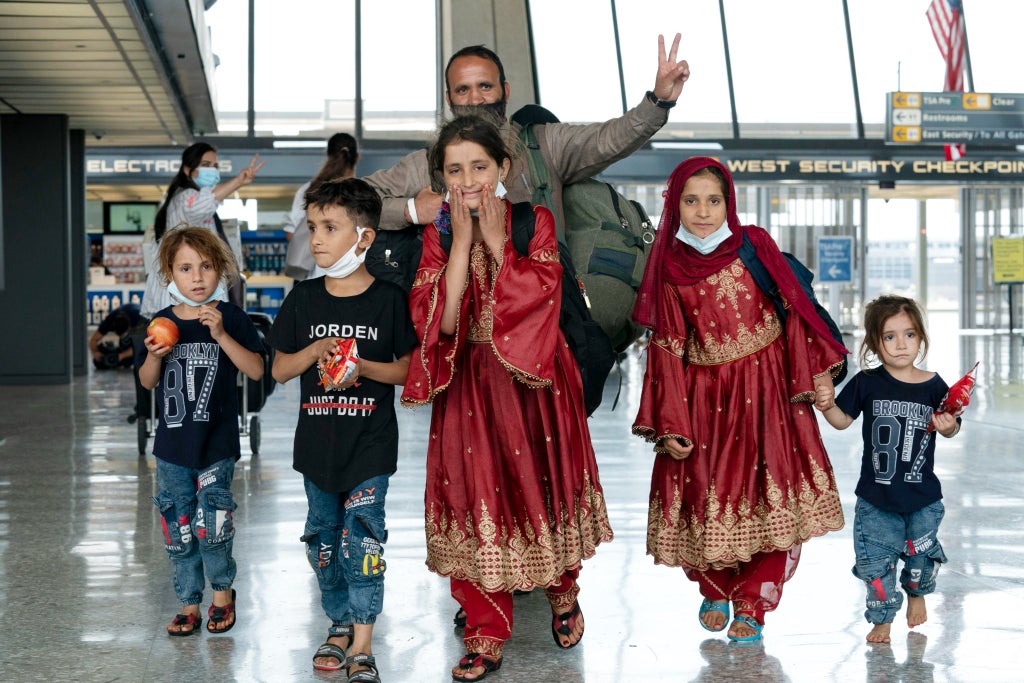
In addition to this story, I also found this photo on Reddit of a family from Afghanistan arriving at that same airport. Seeing them arrive, flashing peace signs after coming from an actual war zone, was incredibly uplifting. If you haven’t yet, I encourage you to look up these stories and see images of these people as they arrive from one of the worst situations imaginable.

What makes this image more personal is that I’ve actually walked that exact same area of Dulles. If I went there now, I could find it with ease. Knowing what these people went through and how hard they worked to come here gives me a small sliver of hope for this country and our future.

In that spirit, I’d like to offer a brief message to these incoming refugees, as well as my fellow Americans. There’s a good chance one of them will end up living in a neighborhood not far from mine. I hope that day comes. I will gladly welcome them with donuts and coffee. Even if I never meet them, I’d like to offer this sentiment.

Welcome to America.

Thank you for fighting so hard to make it here, leaving behind everything you knew in order to start a new life. I sincerely hope that the lives you build here, both for yourselves and your children, are better than anything you dreamed of.

I truly cannot imagine what you went through. I’ve never been to a war zone. Very few Americans have. I can only imagine the horrors you’ve seen and the hardship you’ve lived. I won’t pretend to understand. All I can do is help you and your family look forward.

I won’t claim that America is a perfect nation. We certainly have our flaws. Most Americans are wonderful, loving people. However, we do have an angry, vocal minority who will try to make you feel unwelcome.

Do not listen to them.

Do not let their hate keep you from realizing the American dream.

Take comfort in the knowledge that these voices are only loud because they are so few. Take even greater comfort in the knowledge that the number of Americans who will stand by your side will vastly outnumber those who would do otherwise. We can be a strange, erratic people, but our hearts are usually in the right place. Give us a chance and we’ll help you become proud Americans, like our ancestors before us. It’s because of what you’ve overcome that you embody the best of what America can be. Let that be your strength as you build new lives in this new land.

Having said that, I also have a far shorter message for my fellow Americans. I know we are a very diverse and divided people. There are many out there who, because of their politics and their prejudices, will not welcome any refugees from any country that doesn’t remotely resemble them. To you, I just have one thing to say.

Don’t be assholes. Every nation has assholes, but these people have been through enough. Give them a chance. Let them prove that they can be the kind of Americans that will truly make this country as great as we all want it to be.

Leave a comment

Filed under Current Events, Uplifting Stories

Contemplating The Lies, Sincerity, And Dishonesty Of Public Figures

53,509 Lying On Back Stock Photos, Pictures & Royalty-Free Images - iStock

When you lie down in bed at night, alone in the dark with your thoughts, I believe that’s when you’re most honest with yourself. Whether you sleep alone or with a lover, this is one of those few times when we can allow our minds to wander freely. Sometimes, we find ourselves thinking things that make us uncomfortable. While it may be distressing, I would argue that’s healthy.

I freely admit that I find myself contemplating a lot of strange things when I lay down to go to sleep at night. I doubt I’m alone. I would question the honesty of anyone who claims their private thoughts perfectly match those they contemplate in public.

With this in mind, I’d like to pose a relevant question. I wouldn’t go so far as to call it a thought experiment because this is one of those questions that may have a definitive answer. Granted, it’s an answer we’ll probably never know for sure. However, I still feel it’s worth asking for the sake of the bigger picture.

It has to do with public figures. By that, I don’t just mean major celebrities like movie stars, musicians, and what not. I’m also referring to well-known politicians, political commentators, and even popular social media figures on sites like YouTube and Tik-Tok. To all of them, I pose this question.

When these people lie in bed at night, do they genuinely believe the things they do, espouse, or support?

I think the answer to that question, even if we cannot know it, is incredibly revealing.

Let’s face it. These are all people who have a very public persona. Most people who know who they are know them only through that persona. Whether they’re a politician known for saying dumb things, a celebrity with a nasty reputation, or religious preachers with controversial views on certain subjects, they have a public face and a public personality.

It’s also incredibly common for people to not be honest with themselves. Most of us have done that at some point in our lives to varying degrees. We carry ourselves as someone we’re not. We convey feelings, ideas, and emotions that are not entirely in line with our true selves. Why we do this varies, but it can be incredibly damaging if taken too far.

For certain public figures, though, there are many additional layers of complications. For some people, especially politicians, shock jocks, and social media personalities, they have to present a certain version of themselves to the public. That version is almost always carefully crafted and refined. It rarely reflects a completely honest version of that person.

On top of that, this version of themselves is presented as a means to obtain money, power, influence, attention, and everything that comes with that. They say and do whatever reaffirms or builds upon that persona. If it gets any level of attention, be it positive or negative, it gets reinforced.

It can quickly become a cycle, but one that’s reinforced with money, power, and influence. At that point, a public figure doesn’t just have an incentive to keep up this persona. They have incentives to double down and take it to new levels. Even if it makes them infamous and hated, they still get enough out of it to justify the effort, no matter how dishonest it might be.

With those incentives in mind, I often find myself wondering how much or how little certain public figures are aware of them. Perhaps when they lay in bed at night and are alone with their thoughts, they acknowledge that hard truth to themselves, but wouldn’t dare acknowledge it to anyone else.

Think about someone like Bernie Madoff. Before he got caught in his infamous Ponzi scheme, he knew what he was doing. He knew he was a fraud. How much or how little did he realize that when he was in bed at night before he got caught?

Think about some of the most radical, right-wing or left-wing politicians you know. Think about some of the craziest beliefs they espouse. When they lay down at night, do they realize how crazy they are? Do they even truly believe what they say? Do they just say what they need to in order to keep their persona going?

Think about some of the radical religious preachers who bilk money from the faithful. Do they truly believe the terrible things they espouse? Do they really believe that they are somehow more holy than everyone else? When they lay in bed at night, do they realize that what they’re doing is antithetical to their religion? Is it possible that some don’t even believe and are simply doing what they do because it earns them money and influence?

We’ll probably never know the answer. Regardless of how you feel about these public figures, especially the ones most decent people find deplorable, the question is still relevant. It should also inform our perspective about certain public figures. If someone has a powerful incentive to keep being who they are in public, then expect them to keep doing what they’re doing. The only time they may acknowledge it is when they lay in bed at night.

Leave a comment

Filed under Current Events, philosophy, political correctness, politics, psychology, religion, Thought Experiment