This is a video from my YouTube channel, Jack’s World.
This video is part speculation and part thought experiment on the impact of artificial intelligence and the entertainment industry. Since the WGA/SAG strikes of 2023, the impact of AI on entertainment is impossible to ignore. While the technology is still in a very early stage, we’re already seeing it affect the course of multiple industries, but entertainment might be the most profound.
What could this mean for consumers?
What could it mean for the companies, studios, artists, and workers that produce our entertainment?
It’s difficult to determine at this early stage, but I make an effort to imagine what artificial intelligence could mean for the future of entertainment.
I believe people have the right to work, buy, sell, and do business as they see fit. There certainly need to be rules. No social, economic, or political system can function without rules that are fair and well-enforced. That’s not a political statement. That’s just cold, hard realism.
In that same mold, I am not in favor of unmitigated capitalism in the mold that most libertarians and conservatives envision. I do not believe corporations, businesses, and industries should be given excessive leeway when it comes to dealing with fraud, failure, or environmental destruction. There needs to be some level of regulation to curtail the excesses of the market.
In my youth, I used to be a lot more libertarian in my views on how much or how little capitalism should be regulated. But as I’ve gotten older, I’ve become more aware of just how dangerous unfettered capitalism can be. You need only deal with Comcast’s customer service for any length of time to be convinced of that.
Now, I’m at an age where I feel like I’ve reached a new crossroads with respect to my view of capitalism. I won’t say I’ve completely lost faith in it or the idea. But I’ve seen way too many instances of big corporations doing objectively evil things to not be critical. And when they get in bed with political institutions, that evil only compounds.
Seriously, there are companies and state governments colluding to roll back child labor laws. This is not a joke. These companies want to make children work for them because it’ll result in greater profits.
This brings me to billionaires. They are the most celebrated figures in all of capitalism. They’re regularly ranked and whenever someone else becomes the world’s richest person, it generally makes the news. Like many others, I often celebrated their achievements too. I used to think that making a billion dollars, let alone over $100 billion, took a special kind of drive.
I admit I was wrong about that.
Now, I don’t think that billionaires, as a class, should even exist.
That may sound like a radical position. It’s often a talking point that comes up among those on the extreme left of the political spectrum. And those who espouse anything close to it are often ridiculed as being anti-business, anti-American, or outright communists.
Those criticisms are bullshit, by the way. They’re also just a distraction to avoid the distressing implication about billionaries.
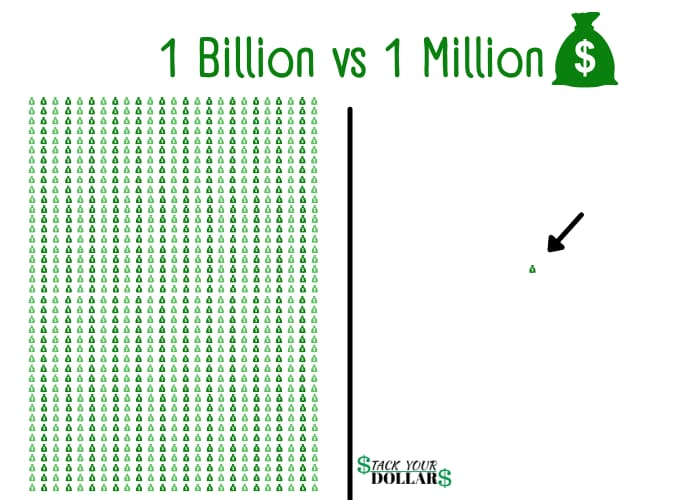
To understand, just take a moment to appreciate how much more a billion dollars is than a million dollars. I know those three extra zeros might not mean much to most people. But in simple mathematical terms, the gap is vast. In case you need something visual, here’s a quick image to help illustrate the concept.
Again, it’s not a trivial difference.
But if you need another way to conceptualize just how big a billion dollars is, consider the following.
One million seconds is about 11 days. Most of us can grasp that length of time.
One billion seconds is 31.5 years. That’s a third of an average person’s lifetime.
I hope that helps belabor the point because with that now in mind, ask yourself one critical question.
Is it humanly possible for anyone to work hard or long enough to justify having a billion dollars?
In the past, I might have considered that a dumb question. But now, I would answer that question with an emphatic no. I don’t care how smart, skilled, capable, or dedicated anyone is. The idea that someone even could work hard enough to earn a billion dollars just doesn’t work.
Again, look at the visuals above. The difference between a million and a billion is extreme.
It also helps to think back to the hardest, most laborious job you ever worked. Whether it was working in fast food, construction, or retail, just think about how hard that job was and how much it paid you. Now, consider how hard your boss worked and how much they got paid. Did the extent of their work actually reflect their salary?
In some cases, it might. But in most, I doubt it. Apply that to how much more billionaires make compared to even senior managers at a company and the disparity becomes even more absurd. If that doesn’t convince you, then maybe this video highlighting a speech by Jesse “The Body” Venture will.
Beyond just the work, take a moment to think about what it would take to spend that kind of money. How many houses could you buy that you could reasonably live in? How many yachts or ships could you buy and actually use in any meaningful extent? How much fancy jewelry could you buy and actually wear?
I’m sure there are those who think they could spend a billion dollars with ease. I doubt those same people truly understand how much more a billion dollars is compared to a million. And even if they could, it would take real, considerable effort to spend that kind of money in a single lifetime.
There’s also the argument that billionaires donate a lot of money to charity and that effort is worth their massive wealth. I used to think there was value in that too. But I’ve also come to see that endeavor as little more than virtue signaling laced with tax avoidance.
And finally, there’s the idea that billionaires are somehow special and they have a unique set of skills that somehow warrants them having that kind of wealth. That’s partially true, but not in a good way. If you just look at how most billionaires made their money, you’d notice that a lot of them either involve inheriting wealth that they didn’t do a damn thing to earn or being exceedingly ruthless in exploiting the labor of others and/or avoiding taxes.
On top of that, those with that level of wealth can literally afford to manipulate the system, legally and illegally, to ensure that their wealth and status is preserved. Whether it’s through tax loopholes or lobbying for laws that benefit them (and only them), billionaires can basically shape the world as they see fit, even if it hurts people, the environment, and everything in between.
Even if you’re in favor of capitalism, it’s hard to deny the corrupting factors that just a few billionaires could have. No system can work when it’s so top-heavy that just three people have more wealth than the bottom half combined. You can still have a functional, vibrant capitalist system that encourages entrepreneurs and wealth creation. You can also have a system that allows for billionaires. But you cannot have both.
As an alternative, I propose this.
Once you make a dollar over $999,999,999, that money gets taxed at 100 percent. And every year, the government sends you a nice trophy that says “Congratulations! You won Capitalism!”
If that much money and the trophy is still not enough for you, then you’re not just greedy. You’re an asshole and you can’t be trusted with millions of dollars, let alone a billion dollars.
This is a video from my YouTube channel, Jack’s World.
This video is my review of Ultimate X-Men #2. After this newly rebooted Ultimate Universe delivered so many amazing first issues, Ultimate X-Men really disappointed. It was one of the most underwhelming comics I’ve read in a long time, lacking anything that would make it an appealing X-Men comic, let alone an Ultimate comic on par with what others have done.
My review of the first issue earned quite a bit of flak. But I always intended to review the second issue. I don’t let one bad issue define a series. And while this second issue was an improvement over the first, it was still lacking.
This is a video from my YouTube channel, Jack’s World.
This video Livestream discussing the first four episodes of X-Men 97, the soap opera sub-plots being developed, and theories and speculation on where it will all lead.
I was also joined by a friend of mine, Warlioncomics. Enjoy!
I understand why the exist. I understand that content creators, media outlets, and individuals need to make money for their efforts. It’s a necessary evil to fund the many good things the internet provides.
That being said, fuck paywalls. They’re one of the most annoying things to manifest on the internet that don’t involve whiny trolls with too much free time.
With each passing year, it seems, more and more websites are resorting to paywalls to restrict or limit access to their content. This is especially common with news outlets, including major newspapers like the Washington Post and the New York Times. But I’m also seeing it on smaller outlets that aren’t major newspapers, especially those that cover sports, entertainment, or various genre news.
They’re all annoying as hell. They’re basically asking for a newspaper subscription that can range anywhere from a couple of dollars to the equivalent of a yearly Netflix subscription. At a time when most people are already annoyed by the amount of subscriptions they have to pay for, this is making a bad problem much worse. It’s essentially segmenting the internet in ways that run counter to how it began.
But rather than lament on this annoying trend, I’d like to offer some guidance to those who hate paywalls as much as I do. Even if you too understand why they exist, nobody will blame you for not wanting to purchase an entire subscription just to read one or two articles. For those instances, there are some ways to get around that.
For the sites that offer a handful of free articles before requiring a subscription, you could always use a VPN. These VPNs, also known as Virtual Private Networks, basically mask your IP address so that it always seems like you’re coming from a new location. While some sites are aware of this tactic, it’s very difficult for them to filter it out. VPNs offer many other uses aside from getting around paywalls. They do come at a cost, but you do get a lot out of them.
But if you don’t want to invest in a VPN, another way to get around paywalls is to use certain free sites. They don’t necessary get around the paywall. They just allow you to see the content in a more raw format. It’s like seeing copying the sheet music instead of the song and letting another program play it. All you do is put in the URL to an article or site section into the site and let it work.
There a number of sites that do this. Not all of them work on every site, but here are the ones that work best.
Please note that these don’t work for every site. For some media outlets, you will get errors or your browser will just freeze. But in most cases, you can usually expect to get around the paywall and at least read the main substance of an article.
It works for now. I don’t doubt for a second that many outlets are already looking for a way to block this sort of thing. And if there comes a day when all paywalls can be circumvented, then those same outlets will find another annoying way to fund their operations.
Again, I get why this happens. Before paywalls, there were all sorts of insufferable pop-up ads, banner ads, and mailing lists. Once those fell out of favor, site operators looked for another way to monetize their content. Paywalls are just the latest manifestation of that effort.
They’re annoying and most people still hate them. But, so long as they exist, we need to live with them and know how to get around them. I hope this helps.
This is a video from my YouTube channel, Jack’s World.
This video is my full review of Ultimate Spider-Man #3 by Jonathan Hickman and Marco Checchetto. This all-new, all-different Ultimate Universe has given us a new vision of Peter Parker and Spider-Man. But so far, he has struggled to become a capable in hero in a world without many left. In this issue, he continues to grow, thanks to some help from his daughter and an unexpected ally. Enjoy!
This is a video from my YouTube channel, Jack’s World.
This is video another entry in my ongoing “Jack’s Comic Gems” collection. And in this gem, I single out one of the most unapologetically fun comics to come out in years. And at a time when everything and everyone takes themselves too seriously, a comic that’s just plain fun is just what we need.
X-Terminators by Leah Williams was not billed as some ground-breaking, genre-defining mini-series. It was just a simple, straightforward story about Dazzler, Jubilee, Tabitha, and Laura Kinney going on a crazy adventure that was joyously entertaining every step of the way.
It made for a unique, but refreshing comic experience and one that’s certainly worthy of being a true comic gem. Enjoy!
I doubt anyone will disagree with that sentiment. No matter who you are or how many years you’ve been out of school, you probably don’t miss doing homework. It’s one of those special shared hatreds reserved only for traffic jams, parking tickets, and slow internet. But unlike those undeniable frustrations, homework isn’t an inescapable force of nature or law. It’s something we, as a society, choose to continue.
I’ve certainly questioned that choice, going back to when I was still in school. Having to do homework was among the many reasons why I was so miserable in school. And even though it was required, I can’t honestly say it ever helped me learn anything. Most teachers and administrators often explained why it was important to ensure we were adequately learning the material. But as I’ve gotten older, I’ve come to realize that, even if that were a valid reason, it still was still ineffective.
Just ask yourself honestly. Did you ever do homework because you were curious and wanted to learn?
Now, I could rant and lament on why homework sucks for days on end. But rather than torture myself to such an extreme, I wanted to highlight something that might offer hope to those who still remember how much homework sucked, as well as those currently in school at this very moment. It has to do with the impact of artificial intelligence and chatbots like ChatGPT.
I know I’ve talked a lotabout artificial intelligencein the past. I’ve also highlighted the impact and hype surrounding ChatGPT. It is definitely one of the most intriguing and disruptive technologies to come along in decades. But unlike other discussions about whether artificial intelligence and ChatGPT will lead to the destruction of the human race, this is one issue in which the impact is already happening.
Recently, Vox produced an intriguing video about how ChatGPT has impacted education, especially homework. Even as someone who graduated school years ago, I found the issues and insights of this video remarkable. I encourage everyone to check it out.
The long and short of it is simple. ChatGPT is rendering most homework assignments, be they essays or worksheets, obsolete. Students are using ChatGPT to basically do the bulk of the work for them. The only real effort they need to do is make sure that whatever they produce isn’t obviously the product of a chatbot.
That alone can be difficult. It is well-documented that chatbots like ChatGPT can be inaccurate. But when compared to having to do a long, boring assignment that a student probably isn’t interested in, that kind of challenge seems manageable by comparison.
Also, in the interest of full disclosure, I freely admit that I probably would’ve used ChatGPT when I was in school if I had access to it. I promise it wouldn’t be entirely out of laziness or an unwillingness to learn. I just found most homework assignments to be so dull and pointless that I cared more about just getting them done rather than actually learning anything.
I imagine I’m not the only one who feels this way. I suspect the majority of students simply see homework as a means of ensuring grades rather than actually learning something. And even if that assumption is flawed, it’s still an issue that speaks to major flaws in how we educate ourselves and others.
And until ChatGPT, it was easy to ignore that issue. Schools, teachers, and administrators had no reason to stop giving homework or question whether it was an effective tool. It was just one of those things that our education system had always done. So, why not keep doing it?
Well, now there’s a valid reason. Homework, as we know it, can be easily completed by any student with an internet connection. If there was any learning potential, it’s pretty much lost. As the Vox video stated, it has led schools and educators to consider an entirely new recourse.
The knee-jerk response that I suspect most will adopt is to try and ban or limit the use of chatbots. There are software programs out there that can help detect content that has been generated by a chatbot. However, I liken these programs to using scotch tape to seal the ever-widening cracks of a faulty foundation.
Because, like it or not, these AI chatbots are becoming more advanced. And the tools to keep up with them are always going to lag behind. That is a losing race and one no education system should attempt.
There’s even precedent for surmising why that’s a bad approach. When I was in college, there was a blanket ban on using Wikipedia. But enforcing that ban was a losing battle that caused more problems than it solved. It also created some nasty situations where students were accused of plagiarism when they did nothing of the sort. It took a few high-profile incidents, but most schools eventually came to embrace Wikipedia as a useful tool when approached correctly.
I think the impact of chatbots will have to go through a similar process. But unlike Wikipedia, the application of chatbots is a lot broader. These are tools that can effectively summarize books, write essays, and even write poetry with a few simple prompts. And in the same way young people have become more tech savvy than their parents, I suspect they’ll become more adept than most with respect to navigating chatbots.
That means homework, as we’ve been doing it for the past several decades, will be obsolete. While that’s certainly cause for celebration for many, it’s also an opportunity to take a step back and evaluate the process of education, as a whole.
It’s still very important that we educate young people in a meaningful way.
It’s also important to acknowledge that young people today will have access to resources that others have not.
If homework is no longer useful in that regard, what else could we do? What’s a more effective way to teach kids a concept, even when they’re not that motivated to learn it?
I don’t claim to know the answers. I am not a teacher, but I do remember how miserable I was in school and how little it really taught me. Hopefully, the impact of chatbots like ChatGPT will prompt a more thorough evaluation of how we approach education. Because if we keep clinging to old methods, then nobody will benefit in the long run, especially kids.




 Jack Fisher's Official Publishing Blog