Tag Archives: psychology

A Personal Story The Day Before Valentine’s Day

It’s the day before Valentine’s Day. For spouses, lovers, mistresses, and fuck buddies, it’s almost time to begin a day of romance. There will be kissing, chocolate, love-making, and just plain fucking, although not necessarily in that order. It’s a beautiful thing. I don’t deny that. As an aspiring erotica/romance writer, I have a strong appreciation for all the things that Valentine’s Day represents.

That said, it’s also my least favorite holiday and has been for a while now. I know I’m not alone either. Some have gone so far as to create an entirely new holiday called “Singles Awareness Day” to balance out all the annoying reminders that Valentine’s Day gives. It’s basically a weaker version of Festivus, minus the famous Seinfeld connotations.

Now I don’t take my disdain of Valentine’s Day quite that far. I don’t believe that creating one bullshit holiday to counter another is that productive. It also doesn’t change the underlying reasons why many people hate Valentine’s Day.

For many, Valentine’s Day is a harsh reminder that finding love is hard for a lot of people. Let’s face it. If you’re a pretty, young woman with big tits or a handsome young man with a fat wallet, finding love is easy. You can walk down the street in a thong and you’ll probably find someone to celebrate a holiday with. It’s just that easy.

For the rest of us, though, we don’t have that luxury. We’re at the mercy of our circumstances and some of us don’t handle those circumstances very well. In fact, we find ways to make them worse, even when we don’t have to.

In that spirit, as well as the spirit of those who would rather spend this Hallmark Holiday drunk, I’d like to share a little anecdote that should help explain why Valentine’s Day is so difficult for me.

I’ve gotten personal on this blog before. I’ve confessed to sleeping naked and shared a story about my first trip to Las Vegas. Those stories have some inherent sexiness to them. Unfortunately, there’s nothing sexy about this one. It’s mostly just somber recollection of a very lonely part of my life, long before I ever had an outlet in erotica/romance.

It happened when I was a teenager in high school, also known as my extended stay in Hell. I’ll probably say this many times on this blog, but it’s worth emphasizing. I hated high school. I was absolutely miserable. I wasn’t just a whiny, self-loathing teenager. I basically went out of my way to be miserable. It’s even more pathetic than it sounds.

This particular story highlights just how bad it got for me. It happened right around January of my freshman year, which also happened to be the year I developed a horrible acne problem that plagued me for most of my teenage life. So I was already feeling pretty bad about myself to begin with. However, being the miserable little fuck I was, I just had to make it worse.

During this time, we had a major snowstorm, which happens pretty often in my part of the country. We get at least two a year and this one was probably the biggest of the year. The whole neighborhood was a winter wonderland. It would’ve been so pretty if I weren’t such a miserable little shit.

In addition to the snow, it was colder than a snowman’s nut-sack in the morning. Given how early class started, I had to be out at the bus stop at around 6:30 a.m. Remember, this is the middle of winter. It’s still dark out and most of my body is still asleep.

Why is this relevant? Well, it matters because the bus stop I stood at was just across the street from my house. The neighbors were nice and our families got along. So when it was so damn cold and dark out, they would let me and the other kids stay indoors where it was warm. It was a good deal. The kids in my neighborhood were all very nice and friendly. I had no reason at all deny such a generous offer.

Then, I remembered that I was a miserable, self-loathing teenager who had the social skills of a brain-dead fish. Even when the weather was nice, I never talked to anyone. I never tried to strike up a conversation. I would literally spend an entire morning not saying a goddamn word to anybody. The most I did was stare at my shoes and daydream about not being in high school.

As a result, I didn’t take my neighbors up on their generosity. I just remained out there by the curb in the freezing cold, shivering to myself and finding more reasons to be miserable. All the while, the other kids at my bus stop stayed indoors and stayed warm. They probably even chatted, supporting one another in any way they could, knowing that high school always found new ways to make teenagers miserable.

I really could’ve used that support. I really could’ve used friends like that. I believe that if I had chosen to hang out with them while we waited for the bus, I probably would’ve been less miserable in addition to being warmer. They probably wouldn’t have said a word about my acne problem. They were teenagers, but most of them weren’t assholes.

Sadly, I just decided to stay miserable. I decided to keep to myself. For an entire week during the coldest time of the year, I stayed out at that bus stop, alone and miserable. I never said anything. I just stood there, endured the cold solitude, and waited for the bus. It’s as sad and pathetic as it sounds.

Why am I sharing this the day before Valentine’s Day? Well, I want to tell this story to help illustrate how bad I was at connecting with people. I had horrible social skills. I had no charisma whatsoever. It certainly didn’t help that I was exceedingly self-conscious, mostly due to my acne. It is a sad, pathetic feeling that I wouldn’t wish on anyone.

Now don’t get the wrong impression. This pathetic loneliness was my fault and mine alone. My family did damn near everything to support me in every possible way. They went out of their way to make me less miserable. I basically rejected them. I made the decision to be miserable. I wish I could unmake it because it still affects me to this day.

Looking back on those cold, lonely mornings, I feel as though I set myself back. I eventually did improve my social skills, but I was very behind the curve and still am to this day. It shows when I talk to new people and especially when I try to talk to women. I can handle myself a bit better, but I really did handicap myself for reasons that have never been justified.

So on the day before Valentine’s Day, I find myself remembering those cold mornings in high school again. I remember the loneliness and isolation that I imposed on myself during that time. I don’t doubt for a second that there are many others like me who share that feeling. Not all of them are in high school, but I imagine there’s never a shortage of miserable teenagers.

To those out there who do feel lonely, especially during this time of year, I would urge you to fight the urge to stay miserable. Fight the inner demons saying you deserve to be lonely. You’re better than that. You deserve to connect with others because guess what? They’re human, just like you. They seek connection as well. Look for it and you’ll find that you don’t have to be alone.

For this year, at least, I’ll probably be spending Valentine’s Day alone. The only companion I’ll have is named Jack Daniels. However, I refuse to remain in that cold, lonely place I put myself in all those years ago. I want to find love. I want to connect with people. Hopefully, my work as an erotica/romance writer will help me achieve this.
26 Comments

Filed under Jack Fisher's Insights

What Lawrence Phillips Taught Me About “Evil”

Every now and then, I come across a story, sometimes fictional and sometimes non-fictional, that resonates with me in an unexpected way. Sometimes it’s a movie. Sometimes it’s a comic book. Sometimes it’s even a video game with a powerful story that actually gets me choked up at the end.

I don’t deny it. I’m human. I may be a heterosexual man, but I do get emotional at times. Sure, I’m not one to cry when Bambi’s mother dies in a Disney movie. Everybody responds differently to certain things. It’s part of what makes us such a diverse species and it’s part of what frustrates every single marketing department that ever lived.

With that in mind, try not to bust my balls too much when I say a recent sports documentary really struck a nerve with me. That alone might not surprise too many people. Sports fans can be an emotional bunch. Just ask any Eagles fan since 1960.

However, this particular documentary involved a guy by the name of Lawrence Phillips. Okay, now try even harder not to bust my balls.

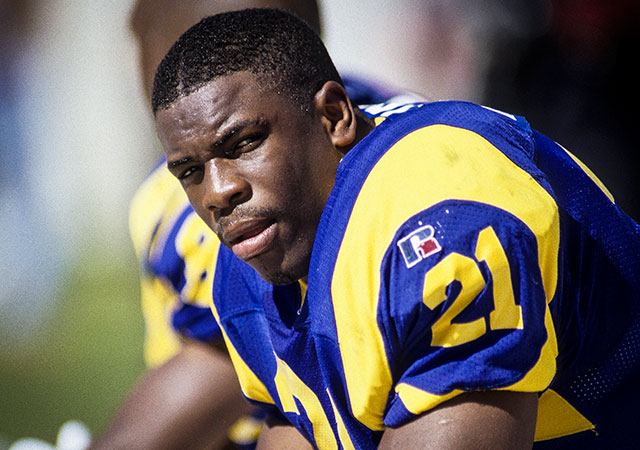
Who is Lawrence Phillips and why should we give a damn? Well, anyone who has followed the NFL or college football over the past 25 years has probably heard his name at least once. He’s not so much an athlete or a football player anymore. He’s become the ultimate cautionary tale. Get football fan talking about him and they’ll usually talk about him with the kind of disdain they usually reserve for bullshit pass interference calls.

To be fair, Phillips earned that disdain in multiple ways. He was an insanely gifted athlete who helped the University of Nebraska go undefeated for two consecutive seasons and win two BCS National Championships in the process. After that, he was drafted 6th overall by the St. Louis Rams in 1996. This is the ultimate dream for a football player and Phillips, despite all his talents, proceeded to piss it all away.

It didn’t happen all at once, but in many ways, that just made it worst. This was a guy who seemed to get arrested every other week and kept finding excuses to beat up women. By the end, he was less respected by the NFL than Scott Norwood is by Buffalo Bills fans. He is now regularly cited as one of the greatest NFL Draft Busts of all time.

Now as a noted NFL fan, I fully admit that I saw Lawrence Phillips in this light. When I follow the NFL and I see someone get into serious legal trouble, a part of me rolls my eyes and things, “At the rate he’s going, he’ll be another Lawrence Phillips.”

That’s what happens when someone becomes a cautionary tale. They become a symbol for the flaws we see in others. As a result, that person ceases to be a person. We don’t even see the person anymore. We just see what he or she represents. It’s harsh, but it’s how we process certain concepts about ourselves.

Then, when we get a chance to actually learn about that person, we find out that just calling them a “cautionary tale” is kind of a dick move because it ignores a much bigger, much more complex picture.

That’s where this documentary comes in. It’s called “Running for His Life: The Lawrence Phillips Story.” Even if you’re not a football fan, I highly recommend this movie. It accomplishes something truly remarkable. It peels back the layers of the cautionary tale that is Lawrence Phillips and reveals the man.

This isn’t a documentary that tries to make excuses. It does not try to glorify Phillips or gloss over his egregious flaws. It just explores the whole of a complicated, volatile, yet gifted man.

It spends a lot of time exploring where he came form and this is important because where we come from has a huge impact on who we are. He was born in Little Rock, Arkansas, but his mother moved him out to California. He was estranged from his father and did not have the best relationship with his biological mother. His home life, to put it mildly, was anything but stable.

The documentary tells stories about the abuse he suffered as a child. It even recounts a story where one of his mother’s boyfriends held him down an urinated on him. Sadly, it gets even more disturbing than that.

After running away from home, Phillips became a ward of the state and bounced around foster homes. Along the way, he lived in a few group homes with other kids. The way the documentary describes this place sounds like something that would make Charles Dickens himself cringe. These are places where things like love and innocence go to die.

Eventually, Phillips did end up in a foster home with a loving mother who tried to help him. However, the damage had been done. The boy had been scarred in ways that never truly healed. The documentary described these scars as demons that he struggled to deal with. A lot of people claim to have demons, but let’s not lie to ourselves. Some are more powerful than others.

Despite these demons, Phillips still had insane God-given talent. The documentary make sit a point to highlight just how talented this man was. By every measure, he had all the physical tools of a gifted athlete. He did try to use those tools as well. Football helped him escape the rough, abusive world he came from. He could’ve been a success story like John Randall or Randy Moss. Unfortunately, that’s not what happened.

The documentary eventually starts to reveal just how dark a turn this man’s life took after college. It described a man who was cold, unloved, and did not know how to show love to others. The women interviewed described a man who just could not control his emotions and when there was upheaval, violence was his first, second, and third reaction.

This fits perfectly with the mold of someone who has an abusive personality. When women’s centers list warning signs, Lawrence Phillips checks most every box. He came from a world of abuse. Naturally, that’s the kind of world he forges around him.

However, the women also took the time to emphasize how good he could be at times. That good cannot and should not be completely ignored. It’s still not an excuse, but it does make clear that this man had other aspects to his personality. He wasn’t just the scary ex-football player who abused women.

This, in my opinion, is the most important message of this documentary. It’s also the most important lesson we can glean from the story of Lawrence Phillips. I’ve talked a lot about evil on this blog. There are plenty of people who would rightly call Phillips evil for the crimes he committed, one of which may have been the murder of his cell mate in prison. However, he was still a human being.

No matter what anyone thinks about Lawrence Phillips, whether he’s a cautionary tale or a violent abuser, it doesn’t change the fact that he was a person. He was a child once. He had a life and he tried to live it. We like to think about evil people as nothing more than monsters. It’s easy to just think of them as wannabe Biff Tannen’s from “Back to the Future.” That still ignores the person and the full story of their lives.

At the end of the documentary, there’s a haunting message about Lawrence Phillips that I think many of us can relate to. It talks of a man who was so physically gifted that he could outrun anybody, but he could not outrun his demons. At one point, an old friend of his said he was always running from his demons, but in the end, the demons caught him.

Whether you’re an aspiring erotica/romance writer, a football fan, or just a decent human being trying to make sense of this crazy world, it’s a message that’s worth hearing. It’s a message we shouldn’t forget. There may very well be another Lawrence Phillips-type story in the future, but let’s not make light of that story. In the end, they’re still people. As soon as we forget that, we cease heeding the lessons of that story.

1 Comment

Filed under Jack Fisher's Insights

The (Sort Of) Problem With Evil

I’ve decided to take a break from deciding whether music form boy bands and burned out pop stars counts as love or obsession so I can focus on a far more relevant issue. It’s relevant in that it affects more directly than the annoying songs we have to endure. It also affects me as an aspiring erotica/romance writer because it’s an important component of every character, be they protagonists or sidekicks.

Yes, I’m talking about evil again. My first post yesterday ended up covering so much that I quickly realized I’ll have to stretch this out to cover the full range of the topic. Make no mistake. This is an important topic. Evil, whether we believe in it or not, will impact us in some way and I’m not just talking about the kind that gets shows like Firefly canceled.

Our understanding of good, evil, and the morality that governs both is an important part of our civilization and our species, as a whole. It’s one of those things we all acknowledge, but can’t quite agree upon. It’s not unlike George Clooney. We all agree he’s sexy. We just don’t agree why.

This directly ties into the so-called “Problem of Evil.” Anyone who has endured a debate between an overly atheist and an overly religious type is probably familiar with this concept. The “problem” is that evil exists and, as a result, it undermines a lot of theological and ethical issues. It’s something two people can argue about for days on end and not accomplish a goddamn thing.

For me, personally, I have a big problem with calling evil a “problem” in the first place. It’s not that I think it’s unimportant. It definitely is. I just take issue with use of the word “problem.”

While I was in college, one of my professors did this lecture where he said one of the most brilliant things I ever heard from any human being not inspired by George Carlin. He started by saying this:

“We don’t deal in problems. We deal in dilemmas. Problems are easy. Problems, by definition, have solutions. Dilemmas don’t have solutions. Dilemma’s are harder to manage because they often require compromise.”

There are a lot of amazing things I remember from college. Not all of them have to do with how willing some people are to get naked at a party. The professionals there really had some smart things to say. This, more than almost anything, really stuck with me.

I think it nicely applies to the concept of evil because its a concept that’s so diverse and ambiguous, at times. At one point in history, marrying someone from another tribe is considered evil. At another, admitting to owning a Nickelback album is evil. It’s fluid, overly vague concept that keeps moving the goalposts.

As a dilemma, evil can’t have a solution. It can have various understandings. There can be compromises along the way in which the idea of evil skews towards or away from a certain direction. That’s why concepts like slavery took so much time to fade into that special domain of evil and even then, we still have problems eliminating it.

More than most concepts, the dilemma surrounding evil has many religious connotations. Nearly every religion, including those that involve chakra, crystal energy, and aliens, tries to address the source of evil in some form or another. Some use it as a means of proving their particular theology. Others use it as a means of disproving that very theology. It’s a never-ending argument that rarely ends with someone changing their mind.

Even so, it’s an important concept to explore. Even if I do take issue with the use of the word “problem,” it is a concept that reveals many facets of evil and how we see it. Rather than try to break down every one of those facts, knowing that would require more posts than anyone is comfortable reading, I found a very helpful YouTube video that nicely sums it up.

This comes courtesy of Crash Course, a very helpful YouTube channel in terms of explaining complex issues in a simple, basic way. This is basically a 101 class, one that does not get into the finer details of an issue. This reveals the forest without scrutinizing any of the trees. For those who want to learn more about the “Problem of Evil,” this video breaks it down nicely.

Whether you’re religious or non-religious, both sides of the problem/dilemma should give you pause. It certainly has for me. I’ve even seen it in my writing. I’ve had to mold “evil” characters to make the stories in “Skin Deep” and “The Escort and the Gigolo” work. It’s challenging, but it’s an important part of a larger narrative.

The presence of evil raises questions about what we believe spiritually and how we see ourselves as a species. The simple fact we can’t be certain in both the theological and scientific analysis of evil reveals just how complex this issue is. When neither science nor religion can offer a clear-cut understanding, you know it’s a hell of a dilemma, if that’s not too fitting a term.

So what does this mean for evil as a whole? What does this mean for evil in a religious, scientific, and philosophical respect? Well, these are questions I hope to keep exploring. Right now, I want to use the “Problem of Evil” to create the right context.

We live in a world where we can’t help but acknowledge that evil exists, but can’t agree on the source or mechanisms behind it. With every evil act, there seems to be more and more complexity.

The evil of today is not always the evil of tomorrow. Evil characters in novels today can easily become heroes and/or anti-heroes tomorrow. We don’t know when or how this will manifest. We just know it’ll continue to confound and conflict us in our minds and souls, however we define them.

Leave a comment

Filed under Jack Fisher's Insights

Why We Make (And Fail) New Years Resolutions

It’s that time of year again. No, I’m not talking about that time when people start making a list of all those who ruined their holiday and how they’ll get back at them. That time has already passed. It’s a new year. It’s 2017. That means we’ve all got a clean slate so to speak. We have a chance to shake off the burdens of 2016 and make 2017 better.

It’s that very sentiment that leads many to make New Years Resolutions. I’m definitely among that crowd. For most of my adult life, especially in recent years, I’ve tried to make New Years Resolutions that will help me improve myself, my life, and all those around me.

I know it sounds cheesy. Some might not even think it’s very sexy. I think it’s an important part of being an adult, finding ways to improve yourself. Isn’t improvement supposed to be sexy? Isn’t that why women get breast implants and why men smother themselves in aftershave? Call it whatever you want. Improvement on any level should be sexy.

I know I’m not alone in making these resolutions. Around this time of year, I notice a significant uptick in crowd sizes at the gym I go to. In fact, there have been some instances where the gym is so crowded on the first week of the new year that it’s hard to get a good workout in.

Fortunately (or unfortunately, as may be the case), those crowds tend to taper off. Usually by mid-February, the crowds are almost back to normal. I think that says a lot about New Years Resolutions and how hard they are to fulfill.

I think we’re all guilty of it at some point in our lives. We make a promise to ourselves to do better or be better in some capacity. Then, for reasons that aren’t always our fault, we fail. It’s sad. It’s frustrating. It can be downright demoralizing. Unless you’re rich enough to pay someone to meet your goals for you, it’s downright inevitable.

Why is this though? Why is it that so many people fail at New Years Resolutions? Well, some of that goes back to the “caveman logic” I’ve cited many times before on this blog. In some respects, our own evolutionary biology is working against.

This isn’t just a case of our brains being wired primarily for survival and reproduction. This is more a product of our brains favoring certainty over uncertainty. Back in the caveman days, not knowing where we would get our next meal, when we would hump our mate, or whether there was a hungry bear around the corner caused a lot of stress. We needed to feel stress so that we’d do something about it. That’s just the laws of nature.

Once again, the problem with our brains is that it still hasn’t gotten the memo that this is 2017. We’re not living in caves anymore. Our wiring still confuses the uncertainty surrounding our whole weight-loss resolution with the uncertainty that comes with not knowing whether a bear will steal the meat we gathered from our last hunt.

Being so crude and blunt, reorienting our brain is like trying to cut glass with a hammer. Technically, it is possible. It’s just not very precise. Our brains are wired to avoid the distress that comes with uncertainty. That’s why it’ll fight you tooth and nail when you try to change something in your life.

I know this because I certainly had to fight it when I pursued some of my resolutions. As I documented before, my efforts to get in shape did not happen overnight. I had to slowly work my way into a healthier mindset. It took time. It took patience. It took a whole lot of frustration as well, but I did it.

In some respects, I was lucky. I had some strong motivating factors behind that resolution, namely recent health issues that some close relatives endured. That, along with getting older, helped provide incentives that my brain just couldn’t work around. Those incentives have served me well, so much so that not exercising causes me distress.

This has been the key to a lot of my resolutions. It’s not so much that I make bold promises. It’s how I go about it. I try to work my new resolutions into a system of sorts. I’ve always been a very regimented person by nature. So when I want to do something, I try to fit it into a schedule or a system that I can live by. If possible, I try to make it as flexible as possible.

A lack of flexibility in setting a goal or a system is usually the first step towards failing. I don’t like to fail. That’s why flexibility is so important. Some of that actually comes from my parents, who made it a point to make everyone flexible to deal with the daily chaos of our lives. It worked when I was a kid. It works even better as an adult.

Now I’m not saying I’m an expert in helping you achieve your New Years Resolution. I’m as qualified to be a self-help guru as I am to be starting quarterback of the Green Bay Packers. However, I’m not one of those late night infomercial scam-artists who will charge you a hundred bucks just to tell you what you want to hear. I prefer to keep things simple and practical.

I know my experiences with New Years Resolutions won’t work for everyone. My situation is wholly unique and it probably won’t work for everybody. I can definitely relate to those seeking a career in publishing or wanting to explore the world of superhero comics. I can’t exactly relate to those whose resolutions involve buying the perfect Ferrari or not getting mauled by a hungry cheetah.

So in the interest of not overplaying my hand or making light of the fact that I’m still an aspiring erotica/romance writer who has yet to accomplish many of his goals, I’ll try to keep my New Years advice simple and concise. It goes like this:

  • Take a moment to analyze your routine/system, how you go about your day, and how well it’s working at the moment
  • Highlight specific areas of that routine/system that has room for improvement and identify those areas as “blanks” that you can reorganize
  • Assess how flexible you are in your current routine/system and, wherever possible, try to improve that flexibility to the greatest extent possible
  • Set small, concise goals at first within the “blanks” and try to work it into your system
  • Do not try to pursue more goals than you can count on one hand at the same time
  • Be realistic and be willing to fail
  • Above all else, learn from your failures

There, that is Jack Fisher’s unofficial guide to pursuing your New Years Resolution. It’s simple. It’s free. You don’t need a guru charging you by the hour. You just need commitment, motivation, and a willingness to try, fail, and learn from those failures. In the long run, the successes will emerge in places you don’t expect.

Also, in keeping with my admission that I am as much an expert as I am a rocket scientist, I’ll cite another more comprehensive list from the fine folks at Psychology Today. The people on this site are likely more qualified than me to assess the intricacies of self-improvement. Their article “Why New Years Resolutions Fail” offers more in depth advice that I’m not qualified to give.

Whatever advice you choose to follow, I strongly encourage everyone to pursue a New Years Resolution. We should all strive to improve as best we can with what little time we have in this world. Why not start now?

6 Comments

Filed under Jack Fisher's Insights

Romance And Reason: Can They Co-Exist?

God gave us a penis and a brain, but only enough blood to run one at a time. It’s a running joke among men, but it’s no laughing matter. We need our brains to function. We need our genitals to propagate. These are two important functions of life and they aren’t always on the same page.

Women aren’t immune from it either. Sure, they don’t need to worry about their pants getting too tight when they walk by a Victoria’s Secret, but they’re just as prone to other functions overriding their capacity for reason. That’s not a joke about periods either. Women, like men, have a nasty habit of not thinking things through while in an emotional state.

It happens all the time. It’s one of the bugs in the 1.0 beta version of nature that we’re all stuck in (for now). When we’re in an emotional and/or agitated state of mind, we don’t think clearly.

We’ve all been there. Ever go grocery shopping when you’re really hungry? It really does screw with your mind and your wallet. If you’re hungry enough, everything from stale cookies to expired milk seems appetizing.

I’ve certainly been there. Back when I was in college, there was this one winter where I was just really, really depressed for reasons that are too pathetic to describe. Then, some guy came around my dorm selling magazines and, because I was in a such a pathetic state of mind, I bought a subscript to Maxim magazine that I didn’t want, need, or care for.

My point is that we humans inherently suck at balancing reason with emotion. It’s the reason why Captain Kirk and Mr. Spock clashed so many times on Star Trek. Coincidentally, that’s also why there’s this huge fandom of them as gay lovers, but that’s a story for another post.

For me, an aspiring romance/erotica writer, I need to use both. I need to use reason when crafting a story, less my novels turn into one long incoherent string of rants, babble, and whining. I’ll leave that sort of thing to 4chan and Twilight message boards. For my brand of romance/erotica, I want to strike some kind of balance between heavy thoughts and hot loins.

That raises a fundamental question. Is it possible for romance and reason to co-exist? Are they even on the same length? Can they even exist isn’t the same universe? That’s an argument some would passionately debate. There’s an inherent irony in that debate, but it’s not entirely misguided. There is some science behind it even.

Anyone who has been on the wrong end of road rage or eaten an entire bucket of ice cream after a bad breakup understands the clash. On some levels, we know we do dumb shit when we’re in an emotional state. We even know how dumb it is. We still do it anyways. I’m sure there are times when my brain wanted to kick my ass.

However, I’m of the belief that since our passions and our higher thoughts both come from the same organ, namely our brain, they can coexist. That’s not to say it’s a perfect coexistence. That’s not even to say it’s all that peaceful. I’m just saying they can occupy the same space without the universe exploding.

Once again, this conflict is a byproduct of our caveman brains, which still don’t realize that we’re not living in caves and fighting off hungry tigers anymore. Those brains are wired in a way to prioritize certain things more than others. Survival and sex is at the top of that list. The capacity for reason isn’t even top five. Hell, for some it isn’t even top ten.

It’s still there though. Our capacity for reason is a vital tool. Some would argue it’s the most vital tool in our species’ arsenal. It allowed us to do more than just avoid tigers, make tools, and set up nicer caves for humping. It allowed us to understand our world, build cities, and forge assault rifles that ensure no hungry tigers dare mess with us.

There’s a lot of value with respect to reason. Unfortunately, not a lot of that value plays out in sex and romance. That seems to be a massive blind spot of sorts, one that leads to many wrecked relationships/marriages/drunken hook-ups.

It doesn’t help that using logic and reason in a relationship isn’t considered sexy. It doesn’t matter how skilled you are in the philosophy, engineering, or science. Brad Pitt is still going to get laid more than you. From an evolutionary standpoint, he wins big time.

From a logical stand point though, his recent divorce and past breakups show that even Brad Pitt has room for improvement. Could he have saved those relationships by employing more brain power and less sex appeal? It’s hard to say, but I’m of the belief that hindsight tends to remind us of just how many opportunities we tend to miss.

I’m also of the belief that we all need to step back and give a little extra scrutiny to how we organize our relationships. We’re still going to act erratically. We’re still going to make foolish decisions. I’ve had that play out in my novels, from “Skin Deep” to “Holiday Heat.” In those same novels, though, I also allow for moments of clarity.

This is where I think romance and reason can find some common ground. Clarity is something that both value. Reason values the clarity of facts and the logical paths around them. Romance values the clarity that comes with knowing how you feel about someone and how they feel about you. It is, in essence, the scotch tape that links these two forces.

Clarity is what sobers us up when we find out we’ve made a dumb decision while in an emotional state. If that decision takes place in a town like Las Vegas, it can have some major legal implications. Hell, there are entire movies built around that premise.

That same clarity also reveals to us when we know we’ve found someone we want to love with all our hearts and without reservation. It removes any uncertainty and hesitation when we feel the urge to make love to one another. In that sense, clarity is a damn good aphrodisiac.

This isn’t just something I believe. This is something I hope to demonstrate in my upcoming book, “Passion Relapse.” Since this is the book that finally got the attention of a publisher, I feel like now is as good a time as any to start building some hype around it. I’m no Don King, but I feel like I should get people excited/horny about it.

There are a lot of aspects to “Passion Relapse” that are built primarily on overwhelming emotions and a serious lack of forethought. The characters involved in this story struggle more than most to balance their reason with their loins, even more so than Brad Pitt. However, it’s only when clarity enters the equation that things get really heated.

By the end of this book, I hope to give readers a new appreciation for the value of clarity and just how much it can improve your love life. I’m not saying it’ll be scientific proof that reason and romance can form a harmonious union that leads to passionate lovemaking and a greater appreciation of higher thought. It will be damn sexy though. That much I can promise.

1 Comment

Filed under Jack Fisher's Insights

What BDSM Tells Us About Authority And Our Future

Let’s face it, we humans need some semblance of order in our lives. As a species, we just don’t function well in chaos. We’re a species that will riot in the streets because we’re glad our favorite basketball team won the championship. If aliens landed tomorrow, we’d have a very hard time explaining that to them.

Order and authority is a big part of what makes society function. It’s a big part of what helps humanity survive. As caveman logic tells us, our brains and bodies are wired for only two things: survival and reproduction. They’re wired, designed, and maintained poorly, as I’ve pointed out many times before, but there are over 7 billion of us surviving and reproducing on this planet right now so we must be doing something right.

This leads me to the wonderful world of BDSM. Yes, I know that sounds like a non-sequiter. Yes, I know that sounds like an excuse for me to talk about overtly sexual topics again. No, I will not apologize for it. I don’t think I need to explain myself at this point, nor should I have to.

In reading and writing about BDSM, I’ve picked up on a few underlying themes. Since my brain works in elaborately perverse ways, I often find myself applying those themes to the world around me. BDSM is no exception. If anything, it’s the basic standard.

Earlier this year, I completed a draft of a book called “The Big Game.” It’s a book that explores various forms of BDSM, but not just because I think readers enjoy the mental image of a star male athlete being whipped in the ass by a sexy female librarian type, although I’m sure that has its own kind of appeal.

In this story, I try to apply the principles of BDSM to a bigger picture. That bigger picture has a lot to do with how we function as a society and how we see authority. Some people inherently flaunt authority. Some people desperately need it. Human thought is incredibly diverse on the subject, but whatever our sentiment, it still affects us.

At its core, BDSM cuts through all the chaff, uncertainties, and formalities. When you read about BDSM or practice it, you know who’s in charge. You know who has the authority and who doesn’t. It’s an extremely simplistic scenario that requires little thought. The fact it often involves sex is just a bonus and a damn good bonus if done right.

In many respects, BDSM takes advantage of the biological wiring that’s already in place. There is actual science behind our inclination to obey and conform. A large body of research shows that humans have a genetic and psychological predisposition to obedience and conformity.

When you look at it through the lens of caveman logic, it makes sense. In our caveman state, we can’t dedicate all this mental energy into deciding whether or not we should trust or obey someone. That would be like holding a jury trial just to determine who gets to pick the restaurant on a date night. It’s a wholly inefficient use of our time and energy.

We need to use those resources for more vital issues like securing meat for the winter and doing enough humping to ensure our tribe has enough people to continue. Natural selection does the rest. That’s why nature instills this in our collective psyche. It helps us get along, work together, and survive long enough to get frisky.

However, like most other natural forces within our biology, it’s not that fine-tuned. Nature is a blunt instrument and not a scalpel. If our brains and bodies were computers, then they we’d say they had been wired by a drunk office temp with a bad attitude and a knack for laziness. As a result, this vital programming for obedience and conformity lay the foundation for BDSM.

It’s in this context where our biological programming for obedience goes to an extreme. The fact those extremes bring some people to orgasm only makes it more powerful. When there’s a lot of uncertainty in the world, we naturally look for whatever certainty we can find. As I said before, you can’t get much more certain than who dominates who in BDSM.

Submission, dominance, obedience, and authority are all streamlined in BDSM. You don’t need to dedicate a lick of mental energy to scrutinize the situation. Everything is perfectly structured. Everything is perfectly laid out. For many perfectly healthy people who are concerned about an unhealthy world, there’s a lot of appeal in that situation.

At its core, BDSM acknowledges that we human beings aren’t built, physically or mentally, to be complete independent. We need to submit or dominate certain aspects of our lives. It’s the only way we can make sense of the world and ourselves. That’s a big reason why BDSM experiences are so powerful for some people. It’s also a big reason why it has such appeal.

So what does this mean for our future? Well, that’s a bit trickier to answer. We like to think we’re progressing to a point where we can meet all our physical and emotional needs through technology. That’s not entirely wrong, but a big part of those needs is to have some form of stable authority.

As kids, that authority is our parents. As young adults, that authority is our teachers, law enforcement, and fellow peers. As adults, that authority is our spouses, our bosses at work, or our friends. We built our lives around authority. A part of us needs some kind of authority to submit to. Some need it more than others. Most of us need it more than we care to admit.

The future will create all sorts of new uncertainties. With over 7 billion people with countless (often conflicting) needs, we’ll need some form of authority to make sense of ti all. I don’t know what form that authority will take, but it’s an idea I intend to explore.

It’s also an idea I intend to make sexy in some strange way, but that should be a given at this point. After all, if BDSM can give authority so much sex appeal, then why not embrace it along with our future as a species?

2 Comments

Filed under Jack Fisher's Insights

Fixing The Flawed Wiring Of The Human Brain

I talk a lot about the flaws, failures, and absurdities of the human species on this blog. It’s not by accident, I assure you. It’s not entirely by choice either. I’d love to be able to attribute shortcomings in the human condition to evil spirits, curses, and watered down beer. It’s just a matter of inescapable pragmatism that I constantly circle back to the flaws in our collective human brains.

These flaws extend to issues like unhealthy attitudes towards sexuality, religiously-motivated self-torture, and irrational understandings of gender differences. There’s no escaping it. We, as a species, are a buggy beta version at best and a 10-year-old, malware infested laptop running Windows Vista at worst. The fact we’ve been able to survive this long is a testament to our adaptability and/or dumb luck.

There are a lot of complexities and intricacies to these flaws in the human condition. I’ve touched on many to date on this blog and I intend to explore many more, both here and within my own books. Some may argue that these flaws are part of what make us human. That may be true to some extent, but I also believe that we’re way overdue for an upgrade.

The problem with these upgrades is that the flaws in the human condition are closely tied to the flaws of nature as a whole. Nature, by its own overly-pragmatic accord, is a blunt instrument that is stuck using painfully slow processes to fix and tweak its creations.

Natural selection, adaptation, genetic variation are all painfully slow. They’re akin to bunch of blind rats trying to direct traffic down a busy city street during rush hour. This means they can’t be precise, calculated, or measured. They basically have to build a house using nothing but a baseball bat and globs of wet cement. It is possible, but it’s not going to be very refined.

This clunky, crude process is a big reason why humans are at the mercy of the caveman logic that’s hardwired into our brains. Human civilization progresses quickly and chaotically, but our collective brains are still stuck on the same settings they were when we were hunting sabretooth tigers in the African savanna and shitting in gopher holes.

These are some pretty serious flaws, but the human species, like other species that manage to survive this long, can still adapt because of and/or in spite of these flaws. The human brain itself can do this to a significant degree thanks to brain plasticity, the wonderfully complex process that allows the brain to adapt and tweak its wiring in accord with new experiences.

While this plasticity is somewhat limited, it does provide a mechanism for tweaking our faulty wiring when it gets too faulty. This mechanism can be used to treat issues like addiction, depression, or learning disabilities like dyslexia. There’s a whole cottage industry of sorts, complete with accomplished experts and outright frauds, for rewiring the brain in this way.

About a year ago, Big Think did an article that focused on methods for rewiring the brain to improve performance in their careers. They cited a study where people who actively practiced a particular skill on a piano affected their brains in a similar way as people who just thought about practicing that same skill.

It once again reveals the crudeness of our biology. Our brains don’t always know the difference between action and thought. Both will help tweak the wiring to some degree. Crude or not, it does show the power of this mechanism. It’s easy to exploit if you understand and appreciate the clunky processes it uses.

We can use these new findings about the brain to help us become better performers at work, more successful in our business dealings, and more fulfilled professionally. By consistently training our thoughts, like those imaginary piano players, we can expand the number of branches and synaptic connections in our hippocampus, potentially leading to an increased ability to retain new information and adapt to new situations.

This alone should give some people hope that they can wire themselves to be more efficient in their jobs, their personal lives, and everything in between. Just understand that thoughts and actions can have a similar impact. Thoughts will inspire your actions and vice versa.

So when a parent tells their kid, “If you think it’s going to be awful, then it will be!” they’re not bullshitting them. They are actually telling the truth and they have scientific studies to back it up. That’ll be handy to have for when I have kids one day.

It’s even possible to push this process even further. In his book, “How To Fail At Everything And Still Win Big,” Scott Adams talks about using self-hypnosis to re-wire your thoughts into a more successful framework. He even provides actual instructions for those seeking to get in shape, eat a healthier diet, and deal with idiots at work. It’s a great book that I highly recommend. Given the amount of idiots in this world, this kind of advice is invaluable.

While having a faulty brain that can be hacked is nice to some degree, there are limits. Human beings are complex creatures who are at the mercy of equally complex and exceedingly clunky natural processes. Sure, we have Einstein, Mozart, and Shakespeare, but we also have Stalin, Dahlmer, and Bieber as well. The sheer range and breadth of that margin of error is a tad disconcerting.

This is the point where I close my eyes, ignore the doomsayers, and speculate on the progress mankind will make with its technology one day. We have a distinct advantage compared to the gorillas, elephants, and raccoons of this world. We can do more than just gather food from trees and trash cans. We can build shit. We can build some pretty amazing shit. Hell, we built this.

Our ability to build awesome shit gives me some hope that one day mankind will find a more comprehensive way to fixing the egregious flaws of our biology. It’s not enough to just train our minds and bodies to be better. We need to build shit that’ll make us better beyond anything that biology will allow.

Nature can create the grand canyon. We can make Mount Rushmore, the Hoover Dam, and spray cheese in a can. These are things that can’t happen naturally and, in some cases, are impossible even in ideal conditions. At a certain level of complexity, there needs to be an intelligence force armed with more than a blunt instrument to shape the world around it.

When it comes to the wiring of the human brain, the biggest promise at the moment is nanobots. These are little tiny robots that we can put in our bodies or in anything else and have them perform processes that are impossible to achieve with blunt natural forces.

These processes include going into our brains and physically rewiring the parts that are making us dumb, dispassionate, and depressed. Since these things would have a measure of intelligence, they could do more than just slap duct tape on the structure. They could break it down and rebuild it with shiny new fixtures, polished marble, un-rusted nails.

What does that mean for us? What does that mean for society? How will men and women function in a society where our brains are not at the mercy of the cavemen logic that has guided, for better and for worse, since our hunter/gatherer days?

It’s very difficult to say since I, like the rest of the human race, am limited by my caveman brain. However, it is an idea that I’ve toyed with to some extent in my books. One of my first novels, “Skin Deep,” explored the idea of using technology to reconfigure the human body, which vastly changed how certain characters interacted with one another.

I’ve been contemplating ways to explore this idea in other books. I find myself imaging a future where the brains of men and women are bereft of the flaws and limitations of our current condition. I don’t see us all being these mindless drones in such a future. I actually see us becoming more emotional, more connected, and more passionate than we would be otherwise.

Since this is the internet and pretty much any bit of technology will be applied to sex, I also find myself thinking about how this would affect intimacy. What would it be like for two people, be they gay or straight, to have sex when their brains have been enhanced to such a degree that they don’t have any biological limitations?

What sort of emotions would we feel? What sort of thoughts would we think? What sort of orgasms would we have? These are the kinds of kinky ideas that keep me up at night, among other things. They’re ideas worth contemplating because this future may manifest in some form or another down the line.

According to futurist, Ray Kurzweil, nanorobotic technology will advance to a point where it can re-wire our brains at some time in the 2030s. He claims:

We’re going to expand the brain’s neocortex and become more godlike.

That’s a pretty bold claim, but one that only seems bold from our limited, caveman brains. I’m sure a mouse looks at a hot pocket or a cup of Ramen noodles and struggles to comprehend that as well.

Unlike a rat, we can speculate and tell stories about the lives of those who live in a world where their brains are functioning beyond that of mere cavemen. Will these brains be absent of the flaws, taboos, and hindrances that hinder our ability to be intimate with one another? It’s amazing to contemplate and could make for a damn good, damn sexy story.

9 Comments

Filed under Jack Fisher's Insights

Jealousy vs. Rejection

This post is a follow-up to both yesterday’s post on jealousy and another earlier post where I asked the readers for ideas. That request for other topics of discussion wasn’t rhetorical. I really do want to hear what readers want to talk about on this blog. It’s a good way for me to gauge the audience and adapt my work accordingly. Knowing the audience is among the first steps to becoming successful in any media, be it erotic fiction or clown porn.

One reader in particular, InsidousTemptation, read my post about jealousy and how natural/unnatural it may be and brought up an equally relevant topic. I’d like to talk about that topic because it’s closely related to jealousy. In fact, it’s the uglier side of jealousy, as if jealousy itself weren’t ugly enough. That’s right. I’m talking about rejection.

For this concept, there’s far less context to consider. Rejection feels awful in pretty much every form. Other than being rejected by a crippling disease, it’s one of those few things that every society and every culture can agree is universally bad. I’ve certainly dealt with it before. Recently, I announced that my manuscript for “The Big Game” had been rejected by a publisher. For this post though, I want talk about a more specific rejection.

Have you ever loved someone and learned they don’t feel the same way? Have you ever put time and effort into showing sexual or romantic interest in someone, only to be shot down? It doesn’t matter if it’s thoughtful, callous, or cruel. It still sucks. It feels like a gut punch, a slap in the face, and a pin to the heart all at once. It can even be worse in some cases. Just ask this guy who had his marriage proposal rejected in a very public way.

As an awkward teenager, I certainly had my share of rejections. I was not charismatic. I was not attractive. I was not confident. I had very little to offer the opposite sex. For me, every girl I showed interest in felt like a looming gut punch because they all had boyfriends. Every girl I liked was either dating someone, not interested in dating anyone, or didn’t know I existed. Being a teenager was hard enough. Adding rejection to it was like breaking a few extra bones along the way.

So what makes rejection so much worse than jealousy? What does it have to do with the concepts I discussed yesterday? Well, the difference isn’t only in degree. The difference involves sentiment and style. Jealousy mostly involves thoughts and feelings. Rejection is more active. Rejection is a tangible behavior with tangible effects that are fairly universal for the most part. It’s hard for rejection to be misconstrued or mixed. With jealousy, it is possible to feel and think things for the wrong reasons.

That said, there’s a case to be made that our culture and our approaches to romance and sexuality don’t just evoke unnatural sentiments of jealousy. They make rejection even worse. Why do I say this? Well, let’s go back to that primal mindset I call “caveman logic.”

I said in my article about jealousy that from a caveman’s perspective, jealousy makes no sense. We evolved to be a social, communal species that can work together, love together, and share intimacy together. Being jealous or upset about the romantic and erotic affections of others may make sense in some situations, but is overly arbitrary in most. It wasn’t until society developed concepts of property ownership and passing down assets through family lines that jealousy really took hold.

So how does this make rejection worse? Well, the fuel to the fire comes with turning sexuality and romance into a commodity of sorts. Keep in mind that for most eras in human civilization, marriages were arranged. They were loveless business arrangements whose sole purpose was to ensure that land and assets remained within a family. That’s why so many epic love stories involve forbidden romance because most individuals didn’t get a choice in their partner.

This callous commodification treats love and intimacy as something to be bought and sold. That’s bad enough, but popular culture in the 20th century somehow found a way to make it worse. How did it do this? Well, the media we love and consume sold entire generations on all these false promises. Think about every romantic movie. The hero is a nice, honorable, upstanding guy or girl (but mostly a guy). They fight and they struggle to win the love of a stereotypical beautiful partner and they succeed by being themselves.

Spoiler alert. That doesn’t happen in real life. There’s one scene in one movie that accurately encapsulates real modern life. It comes courtesy of Alec Baldwin and its this:

Is it harsh? Yes. Is it cold? Definitely. Is it accurate? Sadly, it is. This speech reveals something sad, but relevant. We, as a free and modern society, care about results and what others can do for us. If we’re not “closing,” then why should we be accepted? We aren’t entitled to all the love, sex, and satisfaction we want. We have to earn it.

This is why rejection feels so awful within our culture. When someone rejects us, we feel like we’re being denied something we’re owed. We want sex. We want love. We want it from this specific person. How dare they reject us! Say that out loud to a mirror and see if it sounds right. It shouldn’t.

So what’s the solution? I don’t like to just complain about things on this blog. I do like to leave some slivers of hope in the mix. In this case, I do hold out some hope that changes in technology will help us overcome a culture that makes rejection worse.

We’re entering a world where we can interact and inform one another more effectively than ever. Social media, online dating, and smartphones give us an ability to find others who share our passions. It gives us a chance to circumvent the worst rejection in some cases.

That said, technology can only do so much. For us to really minimize the pain of rejection, certain parts of our culture and our sexual practices need to be reassessed. What parts am I talking about? Well, that’s a discussion for another post.

Thanks again to InsidiousTemptation for suggesting this topic. I appreciate it. If anyone else has ideas on topics of discussion, feel free to let me know in the comments.

5 Comments

Filed under Jack Fisher's Insights