Tag Archives: social division

Has Tribalism And Ideology Supplanted Religion?

If you’re an American, chances are you’re painfully aware that 2020 is an election year. That means that, on top all the other awful crap that has transpired this year, we’re in the midst of a political firestorm that regularly brings out the worst in people. Trust me, my non-American audience. It’s even uglier than you think.

As proud as I am to be an American, I’ve grown increasingly frustrated with politics and discourse. I know that’s not saying much. I didn’t live through the turbulent eras of the 60s and 70s. My parents have told me it has been very bad before, but even they admit that this year is a special case of awful. They almost long for the hippie-style protests of the 60s.

I won’t get into why things have become so contentious, although most people can probably discern the most noteworthy source. I don’t have the patience or the sanity to digest that. Instead, I want to offer an observation that I’ve noticed as this election drama has played out. It has to do with both politics and religion, two incredibly divisive forces with a strong basis in absurdities.

I’ve done plenty to highlight the flaws, failures, and outright atrocities that have been committed or justified in the name of religion. I’ve also touched on some of the frustrations and annoyances that manifest in politics. Together, both can be extremely damaging to people and society alike. History has proven that on multiple occasion.

Lately, however, I get the sense that a new kind of zealotry has taken hold. It’s not entirely political or entirely religious. It just take the most destructive elements in both and channels them in a way that inspires some objectively deplorable behavior.

In essence, the same dogmatic stubbornness that often fuels religious extremists has now been applied to someone’s political leanings. By that, I don’t just mean what party they belong to or who they voted for in the last election. I’m saying they now see their political affiliation in the same light some see their religious adherence.

To some extent, this makes sense. Organized religion, in general, has been in a steep decline for decades. The rise of the internet, as well as a more educated public, has significantly undermined religion’s ability to lock in adherents for generations. However, a lack of a religion doesn’t make someone any less inclined to believe absurd, misguided, or demonstrably false concepts.

The same tribalism that often fuels religious rhetoric is becoming a larger factor in politics. I won’t go so far as to say that political ideology is replacing organized religion outright. I just think that same tribalism is becoming a more prominent factor.

It often goes like this. In the past, I often saw discussions like this play out.

Liberal: I believe the minimum wage should be raised to $15 an hour.

Conservative: I respectfully disagree. I think a minimum wage ultimately harms the working poor by limiting the number of entry level jobs.

Liberal: I don’t think the data bears that out, but can we agree to disagree?

Conservative: Of course.

That’s fairly civil. Ideally, that’s how political debates should go. It’s not an argument about whose deity is better and who’s going to Hell when they die. It’s just a simple exchange of ideas to further a discussion about real-world issues. It can get ugly at times, but it rarely ventures into the same damaging extremism that often comes with religion.

That kind of civil exchange now feels so long ago. These days, you need only look at a comments section or a thread on social media to see how outrageous the discourse has become. It tends to go more like this.

Liberal: I believe the minimum wage should be raised to $15 an hour.

Conservative: You American-hating, baby-murdering, politically correct cuck! What kind of Marxist wannabe are you? Get the fuck out of this country! You don’t belong here!

Liberal: Fuck you! You’re a racist, sexist fascist, gay-bashing hypocrite! Go back to Nazi Germany and beat your women somewhere else! You’re destroying America!

Conservative: No, you’re destroying America!

Liberal: No, you are!

Conservative: Fuck you!

Liberal: Fuck you!

I admit, this is a generalization, but it’s not that far off. Between Reddit, Twitter, Facebook, and 4chan, this kind of hateful rhetoric is fairly common. Even the street preachers who hold up signs, telling everyone that their deity wants to send them to Hell, isn’t nearly this vitriolic. Anyone who tries to be civil or inject some simple facts into the discussion is quickly drowned out by hateful dogma.

The internet and social media has acted as a catalyst, of sorts. It’s one thing to hold extreme, dogmatic political views. It’s quite another to share them in a community that constantly reinforces, reaffirms, and encourages those views. It’s become incredibly easy to exercise your own confirmation bias. If you have an opinion or want evidence for a crazy belief, chances are you can find it on some dark corner of the internet.

It’s at a point where if you try to criticize someone’s political leanings, it’s not just a point of disagreement. It’s treated as outright blasphemy. I’ve seen it on both sides, although I think those who lean right/conservative are worse offenders. Trying to convince any side that they’re wrong is akin to trying to convince a creationist or flat-Earther that they’re wrong. It just evokes more extremism.

This is not a healthy trend. Religious extremism is bad enough. Plenty of people have died because someone was convinced that a certain holy text was literally true and it was their duty to attack those who don’t agree. To religious zealots, the mere act of disagreeing and disbelieving as they do is seen as an insult, an affront, and an act of violence. That can’t be how we treat politics.

At the same time, the ugly forces of tribalism are still as strong as ever, if not more so in the age of the internet. Those influences aren’t going away anytime soon. Being part of a tribe or group is fine. We’re a very social species. It’s part of why we’re so successful. However, that same force that unites us can also inspire the ugliest kind of hate.

At its worst, it makes view anyone who disagrees with us as a non-person. They’re not sub-human, but they are someone we would rather not have in our domain. It’s not enough to disagree with them. We’d prefer they not even exist in any way that affects us.

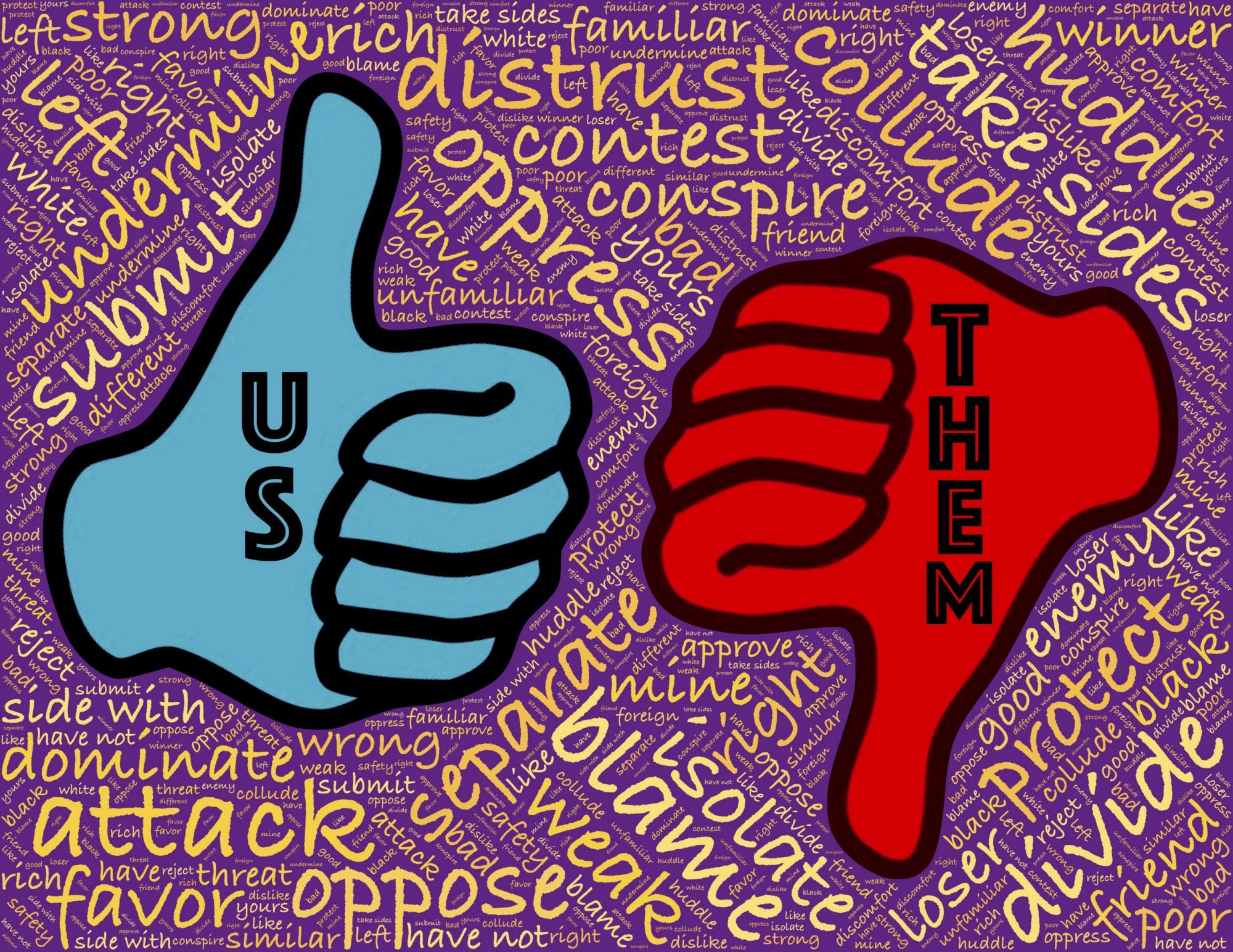
It’s a special kind of dehumanizing and something religion has done for centuries, weaponizing the age-old us-versus-them mentality. We can only do so much to temper our tribal nature, but there comes a point where the line between differences and hatred become too blurred. We share this same planet. We also live in countries full of people who don’t agree with us.

That’s okay. We can still be friends with these people. We don’t have to hate, scold, insult, demean, or dehumanize them. That’s a conscious choice we make and, unlike religion, it requires little in terms of indoctrination. As society becomes less religious, it’s important to remember why we’re moving away from organized religion in the first place.

In the same way most religious people are decent, good people, most people of any political affiliation are the same. We’re still human at the end of the day, but I sincerely worry that the increasing ugliness of politics is making us forget that.

Leave a comment

Filed under Current Events, human nature, media issues, outrage culture, political correctness, politics, religion

Why Bigotry And Prejudice Can NEVER Be Resolved (For Now)

https://i0.wp.com/cdn.thedailybeast.com/content/dailybeast/articles/2014/09/28/why-bigotry-persists/jcr%3Acontent/image.crop.800.500.jpg/47066895.cached.jpg

It’s all around us. It generates protests, outrage, and angry rants of every variety on cable news. It floods social media, infects college campuses, and drowns out any and all meaningful dialog that might actually lead to productive change. I don’t even have to reveal it at this point. Everybody knows what I’m talking about on some level or they at least have a vaguely accurate idea.

It goes by many names. Call it racism, reverse racism, sexism, man-hating, homophobia, islamophobia, or transphobia. It all falls under the same overly-divisive rhetoric that is bigotry and prejudice. It always seems to be in the news. It always makes a conversation awkward and unsexy. It seems to get better some days and regress the others.

Now I know I’m making everybody’s panties very dry by bringing this up, but bear with me. This post is not going to get as bleak or depressing as it would if it were a Michael Moore documentary. I prefer to convey a more optimistic spirit to my audience. It puts them in a better mood, which is important if you’re trying to sell erotica/romance novels.

On the surface, though, there’s no way around it. This is as ugly a topic as it gets these days, the concepts of bigotry and prejudice. If it isn’t the stereotypical white male patriarchal types bemoaning how lazy and violent minorities are, it’s the radical left-wing hippies who call everyone who doesn’t support interracial gay couples kissing in the streets Nazi supporters.

It really is a strange, distressing state in which we find ourselves in. There used to be just one extreme in terms of prejudice, namely that which tried to preserve the overtly-unequal status quo that favored one particular group, be it white men or one particular religious group. Now, the extremes are all over the place.

I’ve talked about a few of them, like radical feminism. They’re just one of the many extremes that have emerged in recent years, often in conjunction with trends in identity politics. It’s not peace-loving hippies who put flowers in guns anymore. It’s angry, entitled, hashtag-starting narcissists who go into a Hulk-like rage whenever someone dares contest their utopian worldview.

There’s an extreme for women, who want men to suffer for their historical crimes against gender. There’s an extreme for race, some of which favor completely disenfranchising all white men for their historical crimes. There’s even an extreme for those who dare to use the wrong pronouns when describing boys and girls. Yes, it really has gotten that crazy.

That says nothing about the craziness that has emerged from extremes within religious groups, but we’re all kind of used to that. We expect extremes in religion, whether they’re favoring the execution of cartoonists or demanding that their particular religion be given a right to discriminate. It’s just the same bigotry and prejudice, but with holy decrees and a convenient excuse to not pay taxes.

No matter the extreme, the outcome is the same. It divides people. It makes them angry, unruly, and hateful. It makes the comments section in every YouTube video about feminism and race relations a raging tire fire that undermines whatever faith in humanity you might have had at this point.

It’s as frustrating as it is tragic. It often leads us to ask the same question Rodney King once asked. Can’t we all just get along? Well, with all due respect to Mr. King, I’m sorry to say that there’s a wholly valid answer to that question.

Unfortunately, the answer is a definitive no. We cannot.

That’s not the solemn musings of cynical man who has read one too many BuzzFeed articles. It’s a cold, inescapable fact. However, there is a context here and a fluid context, which means we shouldn’t be too cynical. If anything, we should be even more hopeful.

The reason why prejudice and bigotry exist is simple and it has nothing to do with some vast, elaborate conspiracy by cisgendered white heterosexual males. Any conspiracy involving that many straight men probably involves fantasy sports or a “My Little Pony” marathon. Once again, this immutable problem in our society has roots in our biology.

It’s another byproduct of caveman logic. Those same settings in our brains that haven’t been updated in 200,000 years essentially guarantee that there will always be some level of prejudice and bigotry. The fact we’re able to function as well as we do as a global society is nothing short of miraculous.

To understand why this is, you need to recall the circumstances of our distant ancestors. They did not live in big cities full of a diverse mix of people from various cultures and ethnicities. They didn’t even live on farms in rural towns where cow-tipping counts as entertainment. They were hunter/gatherers, roaming and foraging in small, close-knit tribes.

For most of the history of our species, that’s how we lived. As such, that’s how our brains are wired and that wiring has not changed much. Due to the slow, clunky processes within our biology, it really can’t and that’s the crux of the problem.

Modern neuroscience has revealed a great deal about our brain’s capacity to form groups and cooperate. These groups become tribes and we, being the very social species that we are, come to tie our identity to those tribes. We work with them. We trust them. We rely on them. Most importantly, as it pertains to prejudice, we defend them and make endless excuses for them.

Picture, for a moment, how this works in our hunter/gatherer context. You’re an individual living 100,000 years ago. You have only a loin cloth, a spear, and functioning genitals. On your own, you’re not going to survive for very long. In a fight against a hungry lion, you’re basically a walking snack.

Then, you join a tribe. You ally yourself with other people who can help you, share resources, and give you an opportunity to use your genitals with others in a more enjoyable, intimate way. Suddenly, that hungry lion loses its appetite. One human is easy to maul. A hundred humans, each armed with spears and an incentive to impress fertile women, is much harder.

Being in that tribe, you come to rely on them and cherish them. Being around them gives you a sense of purpose and identity. You come to love and respect them. You form your own rituals and quirks. You sing certain songs. You do certain dances. You wear certain loin cloths that you think are stylish as hell. This tribe makes you feel complete.

Then, one day, you encounter another tribe. However, this tribe is not yours. They look different. They talk funny. They believe weird things. They wear weird clothes. They follow different rules. Everything about them is so strange and that freaks you out, so much so that you cling harder to your tribe.

Maybe there’s something about that other tribe that’s scary. Maybe they have weapons that are bigger. Maybe they have talents that your tribe can’t do. Maybe their food tastes better and their gods are more powerful. This is all causing you some serious stress and when your brain gets stressed, it does a lot of crazy things to mitigate it.

The next thing you know, your tribe goes to war with the other tribe. Your tribe loudly proclaims that theirs is the greatest tribe in the world. Their gods are better, their food is better, and their rituals are better. The other tribe is so wrong and misguided that they can’t be human. As such, killing them or demeaning them isn’t a big deal. It’s no more distressing than putting down a rabid dog.

Now, extrapolate this tribal mentality, carry it out a billion times in a billion ways within large multi-cultural societies, and apply the reaction to the comments section of a Justin Bieber video, and you now understand why prejudice and bigotry exists. You also understand why nothing can be done about it for now.

Remember those last two words though. I bolded them for a reason. This is where I offer readers a sliver of hope. Does racism, sexism, and homophobia truly disturb you? Do you wish that our society could move past it and forge a more peaceful existence? Well, you may live to see that day.

Keep in mind, these traits that make us so hateful and divisive all stem from our brains. It’s that flawed wiring that still thinks we’re hunter/gatherers picking nuts out of elephant shit on the African savanna that fosters so much bigotry and prejudice. We humans are capable of a great many technological and intellectual feats, but we cannot circumvent the wiring of our brains.

Thanks to companies like Neuralink and advances in human enhancement, like smart blood, we are very close to finally tweaking those outdated settings that make us mute certain people on Twitter. It may very well happen in our lifetime. We may see a new breed of humans whose brains can function beyond brutish tribalism.

We don’t know how these humans will think, how they’ll function with those still stuck in caveman mode, or how they’ll relate to one another. If they aren’t as hateful or petty as we are today, then perhaps they’ll find creative new ways to relate to one another, connect with one another, and make love to one another.

We can only imagine/fantasize for now, but I do take some comfort in the progress we’ve made as a species. We’ve done remarkably well, despite our caveman brains. It’s fun to imagine how much more we can do once we update the software. It may make for a more promising future and some very sexy stories, some of which I intend to write.

24 Comments

Filed under Jack Fisher's Insights