Tag Archives: college

A Message Regarding Teachers, Students, And ChatGPT

When I was a student in high school, the internet was just starting to mature. More and more people were able to access it. Teachers and students alike began using it. Initially, it was a novelty. But once certain sites and programs emerged, namely Wikipedia, it garnered serious concern among teachers and administrators.

I still remember multiple teachers advising us to not use Wikipedia for any assignment. A few even warned us that, if they found out we just copied text from it, then that would result in an immediate failing grade.

As for the administrators, their concern was that it would completely undermine the traditional process for doing research. That usually involved going to a library, searching for the relevant books, sifting through those books, and taking detailed notes on the information within.

Yes, that process was cumbersome and archaic.

Yes, I regularly utilized that process.

Yes, it sucked as much as you think.

Eventually, the attitude shifted. When I was in my second year of college, more and more of my professors changed their attitude towards using sites like Wikipedia. They saw the value in using it to teach a subject. They still advised students to avoid using it as a sole reference point. But they didn’t actively deter or punish students from using it.

I bring this up because it seems a new generation of students and teachers is dealing with a similar situation with AI. And even though I’m not in school anymore, I can already surmise that this will be far more impactful than Wikipedia ever was. AI has already changed the way students and schools approach homework. It’s also changing the way teachers are approaching teaching, in general.

Now, it’s still too early to know whether AI will be a net benefit or a net negative with respect to educating students. But the overall sentiment towards AI, at least among teachers, is mostly negative. The reasons for this attitude vary, but it’s not that different from the reasons my old teachers gave for discouraging Wikipedia.

It’s doing too much of the work for the students. It’s essentially doing the thinking for them in terms summarizing the material, producing essays, or answering questions. The concern is that it’ll hinder students’ ability to develop critical thinking skills. Because if they can just let the AI do the work for them, why bother? The AI can do what they otherwise would’ve done in seconds.

I certainly don’t doubt that this concern is sincere. I have family members and close relatives who work as teachers. This is going to affect them, regardless of their attitudes towards AI. I imagine numerous teachers, schools, and administrators are going to resist utilizing this technology at every turn. Others will embrace it to the utmost because it could potentially make their jobs easier. Given the inherent stresses of teaching children at any age, could you honestly blame them?

To both those groups of educators, as well as the students currently coming of age, I have a message that I’d like to impart. And should I ever have kids of my own, I suspect this message will affect them too.

Embracing AI will ultimately be more productive than resisting it.

It’s not a warning or advice. It’s just a simple statement. I’m not just saying it because I generally support the development of AI. I’m simply speaking from experience.

That experience is heavily influenced by the fact that I was generally miserable in school. I did not care much for middle school or high school. And I certainly wouldn’t say that I learned as much as I’d hoped during that experience. If anything, the way school went about teaching me just didn’t work. The only thing I ever “learned” in school was how to pass tests. That’s not the same as learning something.

In college, things were different. Yes, there were still tests and exams to study for. However, there was more freedom and flexibility to learn about the things that interested me. That helped make college an overall better experience while helping me develop skills that served me well in my adult life.

But in any case, I can also say without reservation that if ChatGPT had been available to me, I definitely would’ve used it. It would’ve been very helpful in terms of summarizing notes, chapters in a textbook, or breaking down certain concepts I didn’t understand. And yes, I probably would’ve used it to help me with my homework, polish my essays, or study for exams. Would that have made me less knowledgeable? Would I have ended up learning less, as a result?

I honestly don’t think so. Because if I’m interested in something, I’ll seek out more information that’s beyond the assignment. I’ll look for things outside the textbook or the syllabus. And if that ends up helping me with an exam or a lecture, then that’s just a bonus.

I suspect there are plenty of other kids like that. Kids, in general, are pretty curious. If they’re interested in something, they’ll pursue it. Sometimes, teachers don’t have the time, energy, or willingness to teach them beyond what the school allows or assigns. Other times, parents aren’t able to teach them because they either don’t know enough about it or just don’t have the time.

AI can fill that gap that will only widen as more schools struggle to find capable teachers. Given how bureaucratic the education system is, especially in America, there aren’t many feasible options outside of AI. Resisting it won’t work in the long run. Resisting technology of any kind rarely works.

It may even get to a point where students primarily learn major skills through AI. It’s already happening on a small scale in some areas. That trend is likely to accelerate as AI continues to improve. The incentives are in place. The need is certainly there. There may be those who don’t like the idea of kids being taught primarily by a non-human AI. They may have concerns that are entirely warranted.

But in the end, AI is here to stay. It’s capable of filling an important need at a time when knowledge, education, and critical thinking skills have never been more important. If the current education system cannot meet that demand, then we’ll need tools like AI. Without it, the students will ultimately pay the price.
Leave a comment

Filed under Artificial Intelligence

How Dirty, Filthy, Sickeningly Disgusting Public Restrooms Can Change The Course Of Your Life

It’s an inescapable fact of life. At some point, your bladder and bowels will turn against you in the worst possible way at the worst possible time. You could be in the middle of an important meeting. You could be sitting side-by-side with the love of your life, the President of the United States, or the most famous celebrity in the world.

Then, it hits you.

Suddenly, you have to go the bathroom. Either your bladder is about to burst or you’re about to damage your underwear and pants beyond repair. It doesn’t matter how rich, well-connected, or powerful you are. Sometimes, your body will find a way to turn any one moment into something mortifying and/or stressful.

Without getting too graphic, I’ll spare everyone reading this the ugly details of what these situations entail. Since this happens to everyone at some point, I don’t think I have to. But I’m bringing it up because I recently found myself cleaning my bathroom. In doing so, I recalled an incident from many years ago that has impacted me in subtle, yet profound ways. And it has to do with the single most disgusting, dirty, and foul-smelling public restroom I ever had to use.

I understand the bar for awful public restrooms is very high. Depending on where you live in the world, a dirty public restroom might depend heavily on how much or how little actual fecal matter is smeared on the walls. In others, it might just depend on how backed up the toilet is.

I don’t doubt for a second that someone reading this can recall a public restroom experience that was many times worse than anything I ever experienced. But I still wish to share this story, if only to offer a hard lesson in what having to use disgusting public restrooms can to do your psyche.

Like many other formative experiences in my life, this one occurred while I was in college. Specifically, it occurred during my freshman year. That’s relevant because at the university I went to, there were numerous dorm facilities that were in various state of repair/disrepair. And, unfortunately for me, I ended up spending my first full year of college in an all-male dorm.

That fact alone should offer clues as to how dirty it was bound to be. Just picture, for a moment, the scenario beyond the context of college. Take a couple hundred teenage boys around the ages of 18 and 19. Put every one of them in a large, seven-story building. Have them be miles away from parents, relatives, and authority figures for the first time in their lives. Some of these young men have never even done their own laundry.

Things are going to get rowdy, dirty, smelly, and stupid.

There are any number of incidents I can recount from my experience living in that dorm. Looking back on it, I still can’t believe I managed to live there for nearly an entire year while maintaining a relative measure of sanity. But the worst part, by far, of living in that dorm had to do with the shared bathrooms.

Seriously, I cannot put into words how awful the shared bathrooms in an all-male college dorm were.

Yes, the dorm had a cleaning staff. But unless the people working on that staff had superpowers, I don’t see how they could’ve kept those bathrooms clean. And since that staff didn’t work on the weekends, things got really bad on Sundays.

It wasn’t unusual to walk into those bathrooms on a Sunday morning and see every stall clogged, overflowing, or in some state of general shittiness. It also wasn’t unusual to see traces of vomit, food, and other bodily fluids in the shower stalls, which I had to regularly use. I want to say you get used to it. But there are just some things the human brain is not equipped to process.

But on one particular Sunday morning during my freshman year, the true breadth of shittiness in public restrooms was taken to a whole new level. And to this day, my body and my gag reflex has never been so thoroughly strained.

This incident happened during the late spring. By then, I’d seen my share of disgusting crap in the men’s bathrooms. I had also gotten pretty good at managing myself so that, if I ever needed to take a shit, I would be somewhere else on campus where the bathrooms were considerably better. I learned early on that, so long as I limited how often I had to use the bathrooms in a male dorm, I could cope.

But on this morning, my stomach decided test my resolve. For reasons I still don’t understand, I woke up that morning feeling like bodybuilders were tapdancing on my lower intestines while wearing lead bricks as shoes. It hit me in a way where my roommate commented he could hear my stomach from across the room.

That’s when I knew I was in trouble.

Initially, I wondered if it was possible to get to another building with a decent bathroom. But my stomach quickly informed me that time was not on my side. I had to get to a toilet and I had to get to one immediately.

So, I entered the nearest bathroom in my dorm. It was right across the hall. It also happened to be empty, given the early morning hour. However, as soon as I stepped in, I was hit with a sight and a smell that is forever seared into my brain.

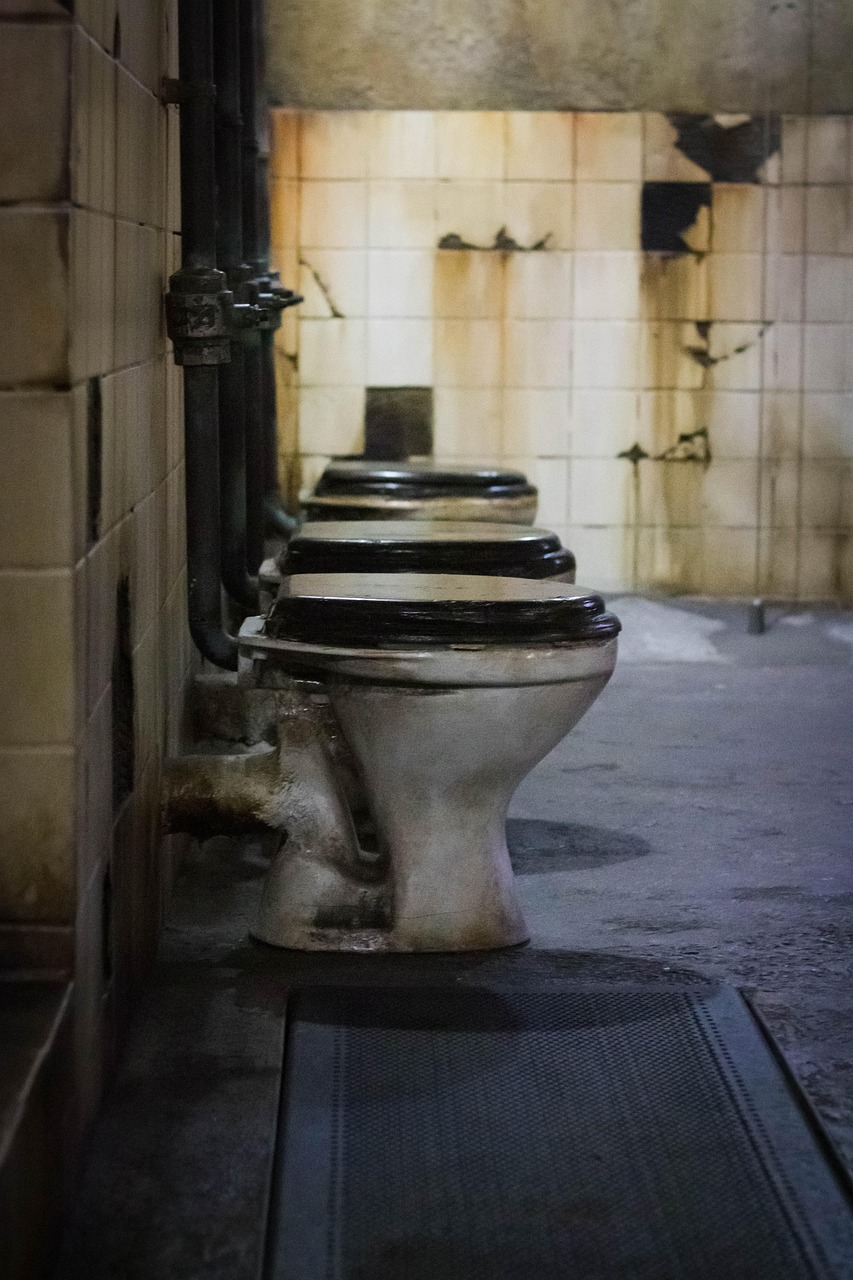
Someone, or more likely a group of fellow male students in a less-than-sober mindset, had found a way to utterly desecrate every single toilet in some way, shape, or form. One had a literal mountain of wet, piss-colored toilet paper spilling out of the toilet, onto the floor, and into the neighboring stall. Another had a massive puddle of liquid shit at the rim of the bowl, eager to flow over at the slightest provocation. And the third had what I can only describe as the coiled anaconda of all shits.

It was so awful I nearly threw up on the spot. Had my stomach not been a firestorm of fermenting sewage, I would’ve run to another bathroom. But I had to go. So, I picked a stall, wading through puddles of piss in the process, and did what I had to do.

Again, I’ll spare everyone the details. But trust me, these are NOT details you want to know. All I’ll say is that, when I was done, I had to take a very long shower in another bathroom. I also washed my hands at least 10 times over the course of that day. The memory of what I had experienced in that bathroom was just too raw.

That memory even lingered after I finished my freshman year and got to live in better dorms later on. In that same time, I didn’t just learn to appreciate the simple comfort of a non-filthy bathroom. I actually went out of my way to clean up after myself and even clean around certain areas if I could. It wasn’t much, but it was better than another shitty ordeal, literally and figuratively.

Even after I finished college and moved out of my parents’ house, I made a big deal about keeping the bathrooms clean. And rest assure, if any toilet ever showed signs of backing up or not working properly, I immediately looked into it. The more proactive you can be with a toilet, the better. You don’t have to be a plumber to know how to keep it working.

Now, I live alone in a place that I own. That means I am fully responsible for how clean and functional my bathroom is. I won’t say it’s always spotless. And I won’t say it’s the cleanest bathroom you’ll ever see. I can only be certain that it will always be pleasant to use and you can be confident that the toilet will work, as needed.

I honestly don’t know how long I’ll live in this crazy world. But I am certain that at some point, I’ll find myself in another situation where I’ll have to badly use a bathroom and I’ll have to go into a public bathroom. I just hope that, whenever or wherever it happens, I never have to use a bathroom like the one I used during my freshman year of college.

Leave a comment

Filed under comedy, Jack Fisher's Insights, rants

Why Time Seems To Go Faster As You Get Older

When I was a kid, the school year always seemed to go on forever. I know it was nine months out of the year and that was a sizable chunk of any given year. But looking back on it, I swear every day felt longer, every week felt like a month, and every month felt like a year. Even as I got older, time seemed to drag and at times, it was agonizing.

These days, the flow of time feels different and not just because of the events of the COVID-19 pandemic. Granted, that did mess up everyone’s sense of time. But even before that, I noticed how the days, months, and years seem to go by differently. And the older I get, the more I feel it. I’m also not the only one.

A lot of friends and relatives I talk to will say the same thing. They swear that 2023 just started a few weeks ago. They remember the ball dropping on New Years Eve. They remember making New Years resolutions, capping off the holidays, and making plans for the new year.

The next thing they know, Halloween is over and the holidays are just around the corner. You start to wonder where the hell the rest of the year went. You wonder why and how it went by so quickly. I’ve certainly wondered that from time to time. But since the end of the pandemic, I feel like my perspectives on how the years go by has struck a unique balance.

And I count that as an accomplishment because for a good chunk of my youth, that balance was lacking and not just because of how much I struggled in high school. College was eventful, but it felt like it ended too quickly for me because I was often anxious about what I would do when I got out. Even when I started working and exploring new creative outlets, I didn’t have much certainty with respect to how I would build a life for myself.

That took a while to figure out. I also made a few mistakes along the way, as most people do when they’re young and uncertain. But once I created a more stable life for myself, finding some decent jobs and moving into my own place, that’s when I really noticed my perceptions of time change.

Unlike being in school, my life was a lot less structured and regimented. There was less obsession over navigating classes, classmates, and assignments and more focus on just getting better at whatever job I happened to have. For someone like me, I tend to thrive more when things are streamlined and I know what I need to do over the course of a given day, week, or month. That allows me to plan accordingly and get things down to a system.

Once I found that, life in general just seemed to run smoother. It also helped that I wasn’t an awkward teenager trying to handle acne, puberty, and poor social skills anymore. Life experience and maturity helped me better navigate my life on a day-to-day basis.

Plus, making my own money, being able to spend it however I wanted, and living on my own schedule was a lot more fulfilling. I was no longer constantly checking the clock, agonizing over when my next assignment or obligation was.

Yes, I had that with my job, but that always felt less stressful than school because it was more limited. There was less emphasis on following strict schedules and getting grades. What mattered more was the end results and once I knew how to do that, there was less stress and anxiety.

Now, it was more a matter of how to enjoy my personal time when I wasn’t working. Having more of that, as well as enough money to make the most of it, really benefited me in terms of mental health. But it also made that time feel more fleeting and precious. When you’re doing your own thing and enjoying it every step of the way, it seems to end sooner. That’s often how I feel every time my trip to New York Comic Con ends.

I suspect that feeling will continue to evolve as I get older. There is some real science behind why time seems to move faster as you get older. Much of it has to do with how getting older makes each experience a smaller and smaller chunk of your lived experience. I think there is some merit to that and my older friends can often attest to it.

But beyond the science, I think this feeling is best summed up by a friend of mine who retired recently. He once told me that “The days are long, but the years feel short.” And I think that holds true, regardless of how old you are.

Every day is going to go by at its own pace, regardless of whether you’re working, going to school, or just enjoying a lazy Saturday afternoon. But as you make it through each day, they add up fast. Eventually, they’ll all feel like a blur as you make it through another year. At times, it feels like those days were wasted. But I would encourage others to avoid that feeling.

Because I believe that no day is truly wasted unless you go out of your way to do so. If you’re just lounging about, but enjoying it every step of the way, then that’s not a wasted day. But if you’re just lounging about and ignoring things you know you have to do, then that is a waste and it will impact the days that follow.

In the end, it’s a balancing act. If you find yourself in a situation that works for you, then it will feel like the years will start to fly by. But that’s not necessarily a bad thing. It means that you’re not in a situation agonizing over what the next day will bring or what you’ll have to do in the weeks to come.

Perception or not, the world will keep spinning and time will keep passing us by. But if you’ve built a good life for yourself and those around you, you’ll find that the days and years were well-spent, regardless of how brief they seemed.

Leave a comment

Filed under Jack Fisher's Insights, psychology, real stories

AI Chatbots May (Thankfully) Render Homework Obsolete

Homework sucks.

Let’s get that out of the way.

I doubt anyone will disagree with that sentiment. No matter who you are or how many years you’ve been out of school, you probably don’t miss doing homework. It’s one of those special shared hatreds reserved only for traffic jams, parking tickets, and slow internet. But unlike those undeniable frustrations, homework isn’t an inescapable force of nature or law. It’s something we, as a society, choose to continue.

I’ve certainly questioned that choice, going back to when I was still in school. Having to do homework was among the many reasons why I was so miserable in school. And even though it was required, I can’t honestly say it ever helped me learn anything. Most teachers and administrators often explained why it was important to ensure we were adequately learning the material. But as I’ve gotten older, I’ve come to realize that, even if that were a valid reason, it still was still ineffective.

Just ask yourself honestly. Did you ever do homework because you were curious and wanted to learn?

Now, I could rant and lament on why homework sucks for days on end. But rather than torture myself to such an extreme, I wanted to highlight something that might offer hope to those who still remember how much homework sucked, as well as those currently in school at this very moment. It has to do with the impact of artificial intelligence and chatbots like ChatGPT.

I know I’ve talked a lot about artificial intelligence in the past. I’ve also highlighted the impact and hype surrounding ChatGPT. It is definitely one of the most intriguing and disruptive technologies to come along in decades. But unlike other discussions about whether artificial intelligence and ChatGPT will lead to the destruction of the human race, this is one issue in which the impact is already happening.

Recently, Vox produced an intriguing video about how ChatGPT has impacted education, especially homework. Even as someone who graduated school years ago, I found the issues and insights of this video remarkable. I encourage everyone to check it out.

The long and short of it is simple. ChatGPT is rendering most homework assignments, be they essays or worksheets, obsolete. Students are using ChatGPT to basically do the bulk of the work for them. The only real effort they need to do is make sure that whatever they produce isn’t obviously the product of a chatbot.

That alone can be difficult. It is well-documented that chatbots like ChatGPT can be inaccurate. But when compared to having to do a long, boring assignment that a student probably isn’t interested in, that kind of challenge seems manageable by comparison.

Also, in the interest of full disclosure, I freely admit that I probably would’ve used ChatGPT when I was in school if I had access to it. I promise it wouldn’t be entirely out of laziness or an unwillingness to learn. I just found most homework assignments to be so dull and pointless that I cared more about just getting them done rather than actually learning anything.

I imagine I’m not the only one who feels this way. I suspect the majority of students simply see homework as a means of ensuring grades rather than actually learning something. And even if that assumption is flawed, it’s still an issue that speaks to major flaws in how we educate ourselves and others.

And until ChatGPT, it was easy to ignore that issue. Schools, teachers, and administrators had no reason to stop giving homework or question whether it was an effective tool. It was just one of those things that our education system had always done. So, why not keep doing it?

Well, now there’s a valid reason. Homework, as we know it, can be easily completed by any student with an internet connection. If there was any learning potential, it’s pretty much lost. As the Vox video stated, it has led schools and educators to consider an entirely new recourse.

The knee-jerk response that I suspect most will adopt is to try and ban or limit the use of chatbots. There are software programs out there that can help detect content that has been generated by a chatbot. However, I liken these programs to using scotch tape to seal the ever-widening cracks of a faulty foundation.

Because, like it or not, these AI chatbots are becoming more advanced. And the tools to keep up with them are always going to lag behind. That is a losing race and one no education system should attempt.

There’s even precedent for surmising why that’s a bad approach. When I was in college, there was a blanket ban on using Wikipedia. But enforcing that ban was a losing battle that caused more problems than it solved. It also created some nasty situations where students were accused of plagiarism when they did nothing of the sort. It took a few high-profile incidents, but most schools eventually came to embrace Wikipedia as a useful tool when approached correctly.

I think the impact of chatbots will have to go through a similar process. But unlike Wikipedia, the application of chatbots is a lot broader. These are tools that can effectively summarize books, write essays, and even write poetry with a few simple prompts. And in the same way young people have become more tech savvy than their parents, I suspect they’ll become more adept than most with respect to navigating chatbots.

That means homework, as we’ve been doing it for the past several decades, will be obsolete. While that’s certainly cause for celebration for many, it’s also an opportunity to take a step back and evaluate the process of education, as a whole.

It’s still very important that we educate young people in a meaningful way.

It’s also important to acknowledge that young people today will have access to resources that others have not.

If homework is no longer useful in that regard, what else could we do? What’s a more effective way to teach kids a concept, even when they’re not that motivated to learn it?

I don’t claim to know the answers. I am not a teacher, but I do remember how miserable I was in school and how little it really taught me. Hopefully, the impact of chatbots like ChatGPT will prompt a more thorough evaluation of how we approach education. Because if we keep clinging to old methods, then nobody will benefit in the long run, especially kids.

1 Comment

Filed under Artificial Intelligence, ChatGPT, technology

Why High School Exams Were Harder Than Most Jobs I’ve Had

As I’m writing this, a great many school-age kids in middle school and high school are anxious for summer to begin. For many school districts in the United State, the end of the school year is in sight. It no longer seems so far away and so out of reach. I imagine many are already counting down the days until that magical moment when the final bell rings and school is out for the summer.

I know that wait can be agonizing, at times.

I have not forgotten the elation I often felt on the last day of school

But before any students get to that wondrous moment, they have one last obstacle to face. It involves the last round of standardized tests and exam. It may vary from district to district, but this is usually the time of year when most students take the SATs, AP and IP exams, or a general final exam for each class. They are often among the most difficult and stressful tests of the entire year. I haven’t forgotten how hard they were, either. And while I’ve already made my opinions on standardized testing clear, I’d like to use this moment to share another insight.

Back in high school, I took a number of AP exams during this time of year. And towards my junior and senior year, I also took final exams that often required much more studying than your standard quiz. I took many similar exams in college, but most of those varied in that they didn’t rely entirely on scantron sheets and multiple-choice tests. To date, it was those major exams towards the end of high school that ended up being the hardest test I ever took.

I vividly remember staying up late at night during the days leading up to the test, often going over page after page of notes that weren’t always well-organized. I also remember reading over textbooks again and again, but still struggling to remember key points. It resulted in many restless nights. On the nights before tests, I often laid awake in my bed, going over notes and concepts that I knew I had to remember for the exam the next day.

It was not healthy. I can’t overstate how stressful this was for me.

Even though I ended up passing and even acing some of these exams, the work I had to put in just didn’t feel worth it. And in the grand scheme of things, I don’t feel like all that studying helped me actually learn the concept. Even if I passed or aced the exam, I genuinely can’t remember any helpful knowledge coming from it.

However, this harrowing experience did have one important impact. But I wouldn’t feel it until I graduated college and started working in the real world.

Looking back on all the jobs I’ve had since college, including the ones I found really terrible, I don’t think I’ve ever been as stressed or as anxious as I was when studying or taking those tests. That’s not to say all the jobs I’ve had were easy, by comparison. They certainly weren’t. I’ve had a number of jobs over the years in which I’ve come home feeling sore, drained, and miserable. But even on my busiest days at those jobs, I still didn’t feel nearly as stressed.

And I think that’s an important perspective to share because I imagine there are a lot of young people right now worrying about what the adult world has in store for them. Their only real experience with hard work and stress comes from school. They’re constantly told by teachers, counselors, and administrators that the work their doing now is critical. And it’s meant to prepare them for the much harder work they’ll face in college or the adult world.

If someone out there has been telling you that, I’ve got an important message for you.

Unless you plan on being a doctor or lawyer or a sweatshop laborer, that’s not accurate. That’s just administrators trying to get you to work harder so that you’ll get better grades, which consequently makes them look better. The truth is never that simplistic. And you often don’t find that out until much later in life and after some significant life experience.

But even if you don’t have that experience, you can still maintain a better perspective than I ever did when I was young. I made the mistake of treating every major exam like a defining moment in my life. I genuinely believed that if I didn’t ace every test, my life would fall apart and I would fail at everything moving forward. I also believed that each passing year would get harder and harder. Eventually, I’d have to spend every waking hour studying or working, never having time to enjoy my life. Again, it was not healthy. I did real harm to my mental health by thinking that.

I eventually had to learn that both college and the adult world don’t have to be this never-ending toil of joyless rigor. Once you have some agency and guidance, you can chart your own path. Yes, you’ll still have to work. And yes, you’ll still have to struggle at times. But it’s not nearly as arduous as these exams and the teachers who give them make them out to be. In time, they will be a small sliver of a much richer life.

To date, I don’t think I’ve ever worked as hard or been as stressed out as I was when taking my high school exams from this time of year. Every job I’ve had came with challenges. But rising to those challenges never felt so tedious and arduous. On top of that, I actually got paid for that effort. That definitely took some of the stress out of it. And even in the worst jobs I’ve had, there was a general structure and logic to it all. I knew what I had to do and why. Whereas with school, it was just a matter of doing what the teachers said and getting the grades they said you needed to get.

Time, life experiences, and the benefit of hindsight has helped me see those exams for what they were. As agonizing as they were, a part of me is grateful that they hardened me to the rigors of hard work and stressful nights. Compared to my last few years of high school, every job I’ve had has been less stressful and more manageable. That helped make navigating the adult world easier in the long run.

Even so, I wouldn’t wish that kind of stress on anyone. And I sincerely hope anyone reading this who’s still in school can gain some insight from what I’ve shared.

I know it’s still so overwhelming, having the end of the school year be so close, yet having to navigate final exams.

I know it seems like your entire life revolves around school and these tests, at the moment.

I only ask that you take a step back and appreciate that these challenges will help make you stronger in the long run. You need not fear what comes next. Because if you can survive high school even slightly better than I did, then I promise you’re already strong enough to build a brighter future for yourself in the years to come.

Leave a comment

Filed under Current Events, Jack Fisher's Insights, philosophy, rants, real stories

Jack’s Graduation Speech: Class Of 2022

The following is a video from my YouTube channel, Jack’s World. This video is my personal message to the Class of 2022. I feel like those graduating high school and college this year have overcome more than most. These past two years have been unprecedent and uncharted in terms of challenges. And for that reason, along with plenty of others, I want to offer them both my encouragement and some meaningful advice that I hope will guide them as they move forward. Enjoy!

Leave a comment

Filed under Current Events, Jack's World, YouTube

An Unholy Way To Handle Claims Of Sexual Assault (According To Liberty University)

Scandal at Liberty University: How a Christian college dismisses students'  reports of sexual assault | Salon.com

Every now and then, we encounter a story in the news that is outright egregious, but not the least bit shocking. There’s no question the details are awful. No matter how cynical or jaded you are, there are real injustices in this world. Innocent people are victimized in horrible crimes. A part of us wants to be outraged, but it’s just too unsurprising to get worked up.

I feel like we’ve had a lot of those stories over the past two years. I get the sense that a lot of people have just become so numb to horrible news.

Even so, we should still take notice when a terrible injustice is exposed, even if it doesn’t surprise us. That means that when another high-profile religious institution is found to be culpable in some egregious misdeeds involving sexual assault, we should still try and take interest.

Now, organized religion and egregious sex crimes aren’t new. They aren’t even that shocking anymore. Even if you consider yourself religious and strongly value your faith, it’s hard to miss the headlines that expose heinous crimes of sexual abuse and efforts to cover them up. It’s become so common and belabored that “South Parkdoes jokes about it.

It’s still serious and egregious. There are still real-life victims who suffer this abuse, but cannot get justice because the abusers hide behind religion and religious institutions. Regardless of your affiliation, I hope that upsets you, even if it doesn’t shock you.

For that reason, I also hope we can all share in the dismay and disgust regarding the recent revelations from Pro Publica about how Liberty University failed victims of sexual assault. If you haven’t read this recent report, I highly recommend doing so, but on an empty stomach. Some of the details are a bit graphic, but they’re still worth reading.

It’s a lengthy report that follows how multiple women who attended Liberty University, one of the most prominent Christian private schools in the United States, were sexually assaulted and the school failed to help them. In some cases, they were punished and shamed for the egregious sin of being victimized. It’s even more egregious than it sounds.

I won’t highlight every detail. Again, I encourage everyone to actually read the report. However, I will cite one excerpt that nicely sums up the environment that Liberty University created for victims of sexual assault.

Ten more former students told me they chose not to report their rapes to campus officials amid fear of being punished. “I knew I would face the blame for putting myself in that situation,” said Chelsea Andrews, a Liberty alum who said she was assaulted by a Liberty graduate student.

I hope it goes without saying that this is abhorrent. I also hope most reasonable people agree that we should be careful, understanding, and diligent when it comes to addressing accusations of sexual assault. I’ve said in the past that this can be tricky because sex crimes are difficult to prove and false accusations do happen, even if they’re rare.

In any case, lives can be ruined. People can be scarred for years because of what happened to them. We should definitely make an effort to improve how we handle these sorts of issues, but we should also actively work to not make things worse.

After reading this report, I won’t hide my underlying sentiment. By nearly every measure, Liberty University offers a case study in how not to handle claims of sexual assault. The fact it’s a religious school that touts conservative Christian values only makes it worse, not to mention hypocritical.

That also makes it unsurprising because, as we’ve seen, hypocrisy from organized religion is not that hard to find. However, this is a bit more personal for me because I actually know people who’ve gone to Liberty University. I’ve visited the area around Lynchburg, Virginia where the campus is based and have spent some extended time there.

That school is a big deal in that region. It’s hard to explain to people who have never traveled to that part of Virginia how big a presence they have. They’re not just another college within a college town. This is a university that is closely aligned with all things conservative and Christian.

It was founded by Jerry Falwell, a man who basically spent his entire adult life advocating for a Christian theocracy in America. That’s not hyperbole. Falwell and many like him actively promoted an ideology that sought to impose their brand of Christianity on every domain of American society.

That, in and of itself, should concern everyone who doesn’t want to live in a world devoid of fun, freedom, and anything remotely sexy. However, I’ve already touched on that thorny issue, so I won’t belabor it.

All you need to know is that Liberty University espouses an ultra-conservative brand of Christianity. That also means they impose strict codes of conduct on their students and faculty. I’m not just talking about rules against drinking, smoking, mini-skirts, and premarital sex. This is a school that forbids cursing, extended hugging, and R-rated movies.

Basically, it’s the antithesis of a party school. People go here to be educated in conservative Christian traditions. That’s why they’ve often been closely aligned with the religious right in America.

Now, that’s not to say everyone who goes to that school is some uptight carbon copy of Kirk Cameron. Some of the people I know went to that school found ways to drink, smoke, and get laid while attending. They just had to be extra careful than usual.

After reading this story, I find myself wondering how many gross misdeeds happened in the shadows that never came to light. That same code of conduct I just mentioned made it next to impossible to responsibly address matters involving sexual assault. You could go so far as to say it demonstrates the worst possible way to handle such issues.

Think of it in terms of both context and theology. Here is this very conservative school that is extremely anti-sex in any way that doesn’t result married people producing more Christians. That means any sex act, be it consensual or forced, is a gross violation of that code of conduct they hold so dear.

Then, imagine being someone who was sexually assaulted. You can try to report it, but in doing so, you just admitted to having sex. Even if it was forced on you, neither the code nor the theology seems to take that into account. They might not be able to prove the accuser assaulted you, but they already can prove that you had sex.

That gives them two options. They have to spend time, money, and resources investigating the incident, not knowing whether they’ll be able to find enough proof to warrant prosecution. The other option is to just focus on the fact that someone admitted to having sex, assume they were somehow responsible, and make whatever excuses are necessary to close the case.

One requires a lot of work and investigation.

One just requires assumptions and reinforcing time-tested traditions about blaming the victim.

That’s why investigations at places like Liberty will often focus on what the victim was wearing, what they were doing at the time, and why they put themselves in that position. It’s cruel on a level that defies description, but for religious schools, there are plenty of unfortunate precedents.

For those working these cases at Liberty, they had every incentive to take the path of least resistance. It’s easy to just shame someone who had sex. It’s a lot harder to actually prosecute a crime. That same process also requires that the institute admit some form of responsibility for not protecting people.

If nothing else, this Pro Publica report only confirms what we’ve seen with plenty of other religious organizations. When it comes down to doing the right thing by the people they’ve failed or protecting their power/influence/tax free status, these institutions will do whatever allows them to keep doing what they’re doing.

It doesn’t matter if their preferred holy book gives strict guidelines on what is right and what is wrong.

It doesn’t even matter if basic human decency is enough to surmise that this way of doing things is a gross disservice to victims.

All that matters is protecting the institution and the power it wields. I definitely felt that when I visited Lynchburg. You could say a lot of things about politics and Christianity, but you could not say certain things about Liberty University. That’s just what happens to an institution that is given that much prestige.

Sadly, I doubt these revelations will change that. Liberty University already dealt with some bad press regarding some acts of sordid adultery and some financial scandals. However, this school will still find a way to keep doing what it’s doing. Not enough people care and the school just has too much influence, both on the region and on the nation.

At the very least, this story is out there and that could help inform anyone who is thinking of sending their children to this school. Even if you’re a devout conservative Christian, I hope the knowledge that this is how they handle matters of sexual assault gives you pause.

Leave a comment

Filed under Current Events, human nature, politics, psychology, religion, sex in society, sexuality

My Old Backpack And Why I Can’t Throw It Away

Tips to Ensure your Backpack Lasts Longer - ICSB 2007

We all have certain possessions that mean something to us. They don’t always have to be family heirlooms or valuable collectables. Sometimes, we grow attached to certain things that don’t have any real value outside their use. If anyone else had the same thing, they probably would throw it away without a second thought.

It’s not a matter of hoarding, which is an objectively unhealthy habit when done in excess. It’s a matter of just attaching sentimental value for something in an unexpected way.

I bring all this up because something strange happened recently. After coming back from my vacation to the beach, I thought it was high time I buy a new backpack. Actually, that’s just me being polite. I was exceedingly overdue to buy a new means of carrying small items to nearby places.

That’s because, for reasons I don’t have a good explanation for, I’ve been using the same backpack since my senior year of high school. I don’t remember the exact day I bought that backpack, but I can safely surmise it’s nearly 20 years old. To get an idea of just how old it is, it still has a special pocket for flip phones.

I know I probably just dated myself there, but I’m trying to illustrate an important point. That backpack has served me well for many years. I used it through my entire college career. I used it through multiple jobs and careers. I used it while moving several times to new places. It has carried comics, laptops, and any number of critically important items over the years.

Basically, if it was something I had to keep close, it went in my backpack and that backpack never left my side for too long. If it sounds like I’m overstating the value of this thing, I apologize. It’s nothing fancy. It’s just a backpack, but it literally helped carry me through my entire adult life.

Along the way, it stayed intact and durable. In terms of mundane the possessions I’ve owned, it held up better than almost anything from that long ago.

None of my clothes have lasted that long.

None of my gadgets have lasted that long.

Hell, this backpack has outlived most dogs.

Even though I ultimately bought a new one, it’s still relatively intact. Granted, some parts of it have seen some wear and tear. There are some areas that are faded. There are also some parts that have become a bit torn. However, all the zippers still work and all the compartments are still usable. If I had to, I could still take it out of my closet and use it.

Perhaps it’s because it held up for so long that I can’t bring myself to throw it away. I had it with me during some major milestones in my life. It kept me organized and equipped for some major challenges and memorable trips. My life may have changed a great deal since I bought it, but it has remained one of the few constants.

I think, for that reason, I’m not sure I’ll ever be able to throw it away anytime soon. I even remember having strange feelings when my new backpack arrived. Once I took it out and cleaned out my old backpack, I found myself just holding it up and looking at it for a good couple of minutes.

It had been a long time since it was completely empty. In holding it like that, I remembered how much I’d used it over the years and how much it helped me in so many ways. For something that wasn’t expensive, flashy, or stylish, it did more than I ever could’ve hoped. How many other possessions can we say that for?

Even though the new backpack I got is considerably better in terms of size, features, and storage, it just doesn’t have the same history as my old backpack. Hopefully, it lasts just as long and carries me through just as many ordeals. Even if it does, I may still have my old backpack lying around somewhere. I may still have it years from now.

If it sounds like I’m making too big a deal about a simple backpack, I apologize. I just wanted to share this strange experience because I think it’s something a lot of people encounter over the course of their lives. They come across some mundane possession and grow attached to it for reasons they don’t understand.

Years later, even after they’ve upgraded to something better, they just can’t bring themselves to throw it away. Maybe it’s a watch, a coffee mug, a footrest, or a blanket. Whatever it is, it means something to us personally. Even if it didn’t cost much when we bought it, it became valuable to us in unexpected ways.

For me, it happened with a simple backpack that I bought during high school. For others, it might have been something else. Having shared my story about my backpack, I welcome anyone with a similar experience to share theirs in the comments. What have you owned that gained unexpected personal value? Whatever it was, I hope it served you as well as my old backpack.

Leave a comment

Filed under Jack Fisher's Insights, real stories

The Supreme Court Rules Against NCAA: An (Overdue) First Step For “Student” Athletes

House members add new elements to NCAA name, image, likneess bill

Certain kinds of progress are so overdue that when it finally happens, even in part, we’re just frustrated that it took so long. That’s certainly how many people felt when it took until 2017 to get a proper “Wonder Woman” movie. Those sentiments aside, we should still celebrate such progress. Overdue or not, it’s still progress.

For the “student” athletes who have been playing under the NCAA for over a century, progress has been harder to come by than most. I put “student” in quotes because in many cases, a “student athlete” is an empty term.

These are not student athletes in the literal sense of the word. These are athletes who go to certain schools to play a sport. They’re just called “students” so they can be compensated with a scholarship rather than actual money. Even if you value higher education, that scholarship rarely translates into a proper study.

See the 2014 UNC scandal that exposed just how little energy is put into the student part of student athlete. Keep in mind, that’s just the scandal that got exposed. There’s a good chance there are far more egregious cases that were better hidden.

I also have some personal experience with student athletes. I went to a college that had a nationally ranked football and basketball program. I met some of these student athletes. I can attest that they were not there for class. They were there to play their sport and that scholarship was the only thing they were getting in return.

I vividly recall classes in which basketball players slept in the back of a lecture hall.

I recall classes that had football players enrolled, but they rarely showed up for any classes.

This is not a fair system. These young athletes are generating millions for the school, but getting little in return beyond their scholarship. On top of that, the value of that scholarship is questionable when you consider some of the classes that athletes take.

That’s why I’m very much in favor of reforming this system, if not completely tossing it aside. It’s basically a quasi-plantation system that’s meant to compensate athletes as little as possible so that their efforts can generate the most amount of money for the schools and the NCAA. There have been past efforts to change this, but they rarely result in anything substantive.

Now, after a long string of legal battles, that might finally change. Recently, the Supreme Court of the United States made a ruling that opens the door for NCAA athletes to seek greater compensation. It’s not a massive overhaul of the system, but it is a very overdue first step.

NPR: The Supreme Court Sides With NCAA Athletes In A Narrow Ruling

Faced with the prospect of reshaping college athletics, the U.S. Supreme Court issued a narrow but potentially transformative ruling Monday in a case that pitted college athletes against the National Collegiate Athletic Association.

At issue in the case were NCAA rules that limit educational benefits for college players as part of their scholarships.

The athletes maintained that the NCAA has, in effect, been operating a system that is a classic restraint of competition — in short, a system that violates the nation’s antitrust laws. The NCAA countered that its rules are largely exempt from antitrust laws because they are aimed at preserving amateurism in college sports and because the rules “widen choices for consumers by distinguishing college sports from professional sports.”

On Monday, however, a unanimous court ruled that the NCAA rules are not reasonably necessary to distinguish between college and professional sports.

Writing for the court, Justice Neil Gorsuch said that the NCAA “seeks immunity from the normal operation of the antitrust laws,” an immunity which Gorsuch said is justified neither by the antitrust law nor the previous opinions of the Supreme Court. Noting that big-time NCAA sports have turned into a multibillion-dollar business, Gorsuch said that a couple of sentences from a 1984 opinion did not declare then or now that there is some sort of immunity based on the concept of amateurism.

Without getting too heavy into the legalistic elements of this case, the court finally told the NCAA that they cannot operate as the sole arbiter of college supports. Doing so puts them at odds with anti-trust laws. Unless they change their practices, those laws will be applied and there’s nothing they can do to avoid them.

Again, it’s frustrating that it took this long for someone to sanction the NCAA in a meaningful way, but it still counts as progress. You don’t have to do much digging to see how the NCAA exploits student athletes. It’s such an open secret that South Park even did a parody of it.

There’s just no getting around it anymore. College sports are making billions off of branding and TV deals every year, but very little of that ever gets to the athletes. They’re the ones putting their bodies on the line to produce the spectacles. They’re more than deserving of fair compensation and a scholarship just isn’t enough.

I don’t claim to know how to structure a better system. Plenty of people far smarter than me have offered some ideas. We won’t know which actually work until we start trying. Until this ruling, the NCAA never had a reason to try. Now, they have to do something.

I sincerely hope that whatever they do benefits these young athletes. Having known more than a few, I can attest that these are wonderful, talented young people. They have a rare gift that allows them to compete at a high level. They should be able to get compensated for that gift in a manner that helps them, as well as their families.

It may take time and any subsequent reforms will also be frustratingly overdue. That still counts as progress and that’s something that college sports desperately needs.

Leave a comment

Filed under Current Events, politics, sports

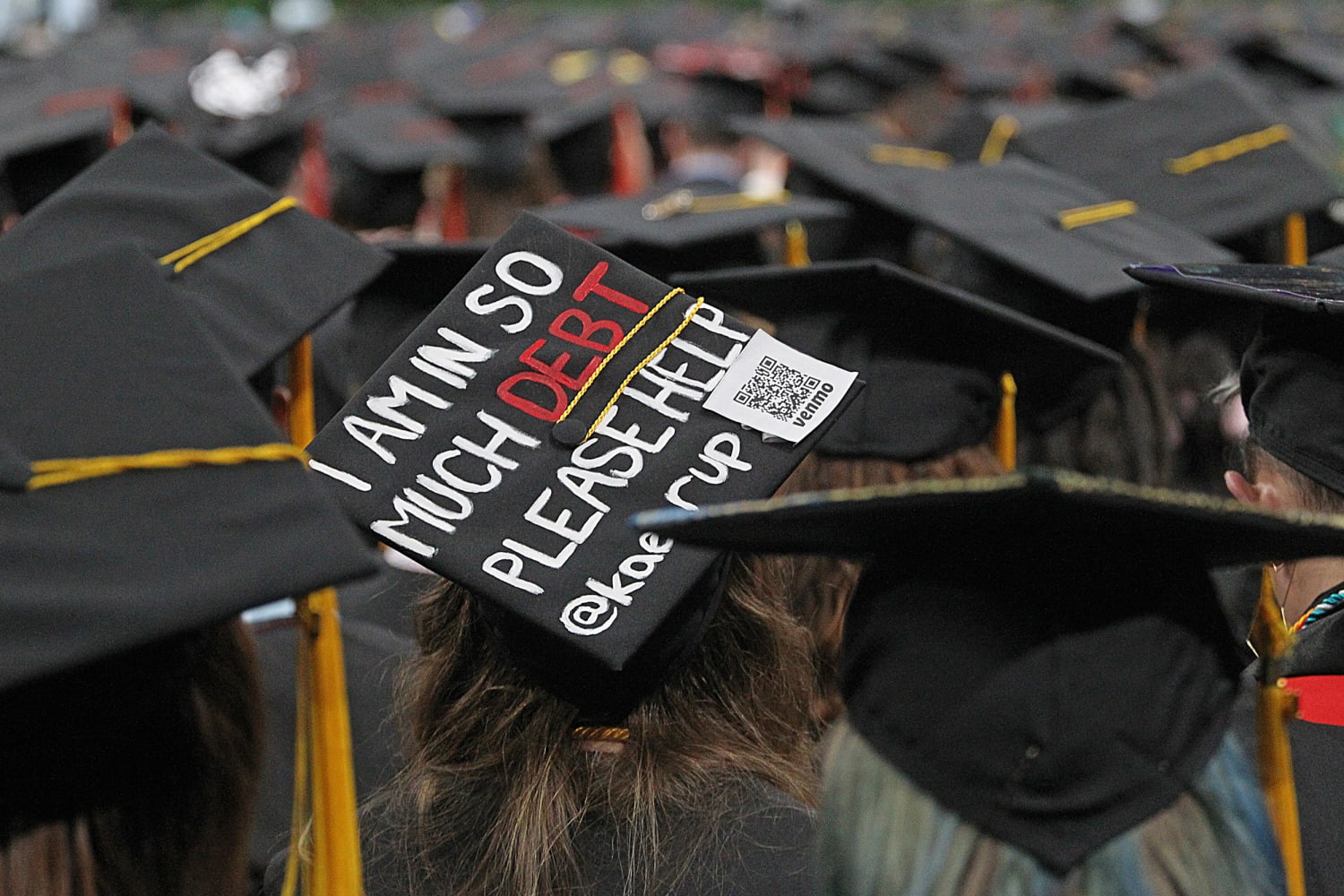
I Paid Off My Student Loans, But I Still Support Student Loan Forgiveness

After I graduated high school, I was a mess. I was not yet equipped to charge into the adult world and start a career. I didn’t even know what the hell I wanted to do with my life. I didn’t know where to begin.

That’s why I went to college. I didn’t go there thinking I would find all the answers, but it felt like the best decision for me at the time. In hindsight, that feeling was spot on. I really blossomed in college. I learned more my first year than I did in my past four years of high school. It’s there where I made new connections, developed my sub-par social skills, and started building my future.

For me, college was incredibly beneficial. At the same time, it was expensive. Even though my parents had saved up some money, I still had to take out loans in order to attend. I also had to work a summer job in order to help pay for it. Even after I graduated, I still had a sizable debt to pay off. I won’t say how large it was. I’ll just say I had to live at home for a while.

Eventually, I worked long enough and hard enough to pay it all off. Around 80 percent of my paycheck went just to paying down that debt. I didn’t have much money for anything else, but I sacrificed and my parents helped me every step of the way. By the time I moved out of my parent’s house, I was completely debt free.

I understand that makes me more than an exception to the ongoing student loan debt crisis. Some might say it makes me a freak, paying off my entire student debt before I was 26. I don’t deny my situation was unique and not everyone could’ve done what I did.

I personally know some people who attended college for the same years as I did, but graduated with way more debt. One girl in particular had over $100,000 in debt by the time she graduated, but it wasn’t because she was irresponsible. Unlike me, she had no major parental support. She was also going to med school, which is very expensive.

That kind of debt isn’t just big. It’s crippling. I can seriously impact your mental well-being. That’s not a trivial amount for college. That’s a goddamn mortgage for some people.

On top of that, we expect these kids to just start their lives and become productive members of society when they graduate? We expect them to do what their parents did, getting married and having kids despite the limitations of this debt and the cost of living going up?

Regardless of your politics or party affiliations, I ask you honestly. Is that reasonable?

I say it isn’t. In lieu of recent economic trends, I’d say it’s downright absurd. If that weren’t bad enough, there are still a bunch of older, less indebted people whining about how young people are too lazy and entitled. That is not a healthy dynamic.

That’s why I am totally in favor of large-scale student debt forgiveness.

I know that’s a politically charged statement these days. The idea of the government just canceling or forgiving a certain amount of student loan debt has become a legitimate political issue in recent years. Chances are, it will get worse.

Even with the recent global pandemic, the debt levels are increasing. As of this writing, the average loan debt per student is $37,500. That’s more than what I had and that’s from someone who had support from his family. I can’t even imagine how much harder it would be for those who come from poverty.

It’s not like canceling the debt would be that difficult. It might even be possible to do so by executive order. With a stroke of a pen, this financial burden could be lifted for millions of students.

Now, some might say that’s not fair to those who worked hard and paid off their debt. To that, I call bullshit. We’re not talking about forgiving the debt incurred from people who bought too many Beanie Babies in the late 90s. We’re talking about an entire generation who is trying to better themselves by going to college and getting an education.

Why not support them?

Why not make it just a little bit easier for them?

Would there still be a cost and consequence to canceling so much debt? Yes, of course it would. There’s always a larger impact to consider. I still believe the benefits outweigh the cost.

If ever there was a time to give a large swath of indebted students relief, it’s this. We’re coming out of the worst pandemic in over a century. We’re dealing with record levels of income inequality and a job market that is becoming increasingly limited. Doing nothing in a situation like this can be just as damaging as doing something wrong. I’m not a student anymore and I have no student loan debt, but I remember how relieved I was the day I paid it off. If we can share that feeling with millions of students in need of help, I say it’s worth doing.

Leave a comment

Filed under Current Events, Jack Fisher's Insights, real stories