Tag Archives: comic books

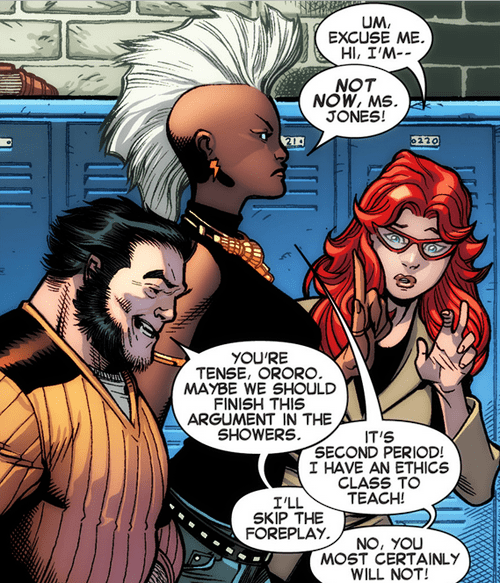
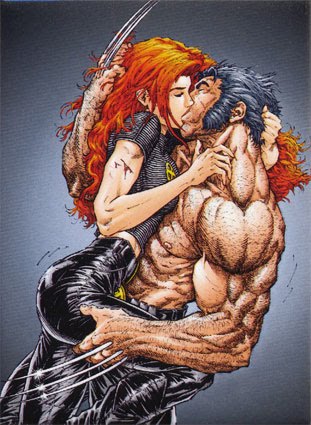
Cyclops, Jean Grey, and Wolverine in the X-men: The Worst Love Triangle of All Time

I’m not a successful writer yet. I’m not certain that I’m an overly skilled writer either. However, as someone who has been writing almost every day since he was 15-years-old, I like to think I know something about this topic. As such, I’m of the opinion that any overly bizarre or frustratingly inane plot can work if written well. With enough skill, a writer can make a story about snake handler hooking up with an alien compelling.

Then, there are certain plots that are so poorly structured, so inherently weak, and so intrinsically flawed that the combined efforts of Shakespeare, Tolken, and Faulkner can’t save it. For me, that plot is that of the love triangle. I even dedicated an entire post about why I think it’s one of the most overused, poorly written plot devices in all of romance.

I avoided getting into specifics in that post because I wanted to focus on the bigger picture as to why love triangles as a concept suck in general. For this post, I’m going to reach deep into the steaming pile of shit that countless stories featuring bad love triangles have excreted over the years and discuss the worst of the worst.

So which love triangle is the worst among the vast mountain of shit that occupies such a prominent position in popular culture? In this case, the worst comes from the world of X-men and involves the characters Cyclops, Jean Grey, and Wolverine.

For the sake of this blog, it’s very convenient that the absolute bottom of the pit that is terrible love triangles takes place in the world of superhero comics. This is, after all, a topic that’s near and dear to my heart. I’ve made my love of superhero comics known on this blog before. I will likely cite superhero comics again in future posts as I discuss similar issues. In this case, however, it really is an issue of pragmatism because I really could not find a worse example of a bad love triangle than this one.

What makes it so mind-numbingly terrible? Well, to answer that, here’s a quick rundown of the structure of this worst-of-the-worst brand of romantic drama. Cyclops and Jean Grey are founding members of the X-men. They were among the original X-men that were first introduced in 1963 by the ultimate creative dynamic duo, Stan Lee and Jack Kirby. They’re also, by far, one of the most iconic couples in the history of X-men, if not all of superhero comics.

Wolverine didn’t enter the picture until later. He doesn’t join the X-men until 1975, which is a while after he makes his first appearance as a supporting character in The Incredible Hulk. As the X-men’s resident bad boy, he’s basically the opposite of Cyclops. He’s brutish, crude, ill-mannered, quick-tempered, and bad-ass to an insane degree. So naturally, he pulls in a lot of ass. There’s actually a chart documenting Wolverine’s many romantic entanglements and it’s even more confusing/impressive than it looks.

So the very idea of Jean Grey falling in love with him while being in love with Cyclops is akin to a man being in love with both a nun and a crack whore. However, that discrepancy alone isn’t what makes this love triangle so horrendously bad. It’s all the circumstances surrounding it that make it the poster child for everything that sucks about love triangles.

First and foremost, the entire reason why Jean Grey developed an attraction to Wolverine in the first place is ridiculously contrived. X-men writer, Chris Claremont (also known as the most prolific X-men writer ever), indicated in numerous interviews that the attraction between them was extremely shallow.

“He sees Jean, Jean sees him, hormones kick in, the rational brain checks into the Happy Hour hotel, and everyone else runs for cover.”

There’s nothing wrong with basic attraction. That’s the sort of thing men feel whenever they see an attractive stripper or the sort of thing women feel when they see Channing Tatum without his shirt on. It’s a good setup for a one night stand. It’s not a good foundation for a meaningful romance, which is the only thing that makes a love triangle functional to some degree.

That never happens in X-men and for a very bad reason. Due to editorial decisions within the X-men comics that are too convoluted for a single blog post, Claremont soured on Cyclops as a character and openly despised his relationship with Jean Grey, despite having done more than any other X-men writer to solidify their status as the premier romance of the X-men. So what does he do? He tries everything he can to break them up and had editors not thwarted him in 1991, he would’ve succeeded.

That’s the entire reason that this love triangle exists. A writer grew to despise a certain character and decided to punish them by making his girlfriend fall for someone who is the exact opposite of him. Think about that long and hard for more than 15 seconds. Seriously, think about it as rationally as any human mind can manage on topics involving fictional characters.

Are you done? Then, I hope you can now see just how flawed that reasoning is. The writer hates one character and uses that as the sole justification for an entirely separate relationship between two characters who have next to nothing in common. That’s akin to loving soccer just because you hate American football. It’s a bad reason to love a sport and a worse reason for a love triangle.

In my post about why love triangles suck, I pointed out that they tend to devalue characters. It turns them into prizes to be won. It tends to override other meaningful traits a character may have. For Wolverine, it turns him from this bad-ass loner into an obsessive, petty asshat. That’s the trait of an insecure teenager, not a bad-ass loner.

The effect is just as bad on Jean Grey, who effectively becomes the ultimate prize of sorts for Cyclops and Wolverine. This is pretty insulting to her character because Jean Grey does so much to set herself apart as a strong female character from an era where the concept hadn’t been refined yet. She is the center of the Dark Phoenix Saga, also known as the greatest X-men story ever written. Reducing her to a prize for two men undermines a character with so much more to offer.

The comics do a terrible job setting up this love triangle, which the writer himself admits was created for petty reasons. However, it’s the way it plays out in the X-men movies that make this love triangle truly the worst of the worst.

How can the movies actually make this worse? Well, somehow they found a way. To this day, I have a hard time believing that the writers at Fox didn’t actively try to make this love triangle worse than it already was. What they came up with still confounds me, both as a writer and an X-men fan.

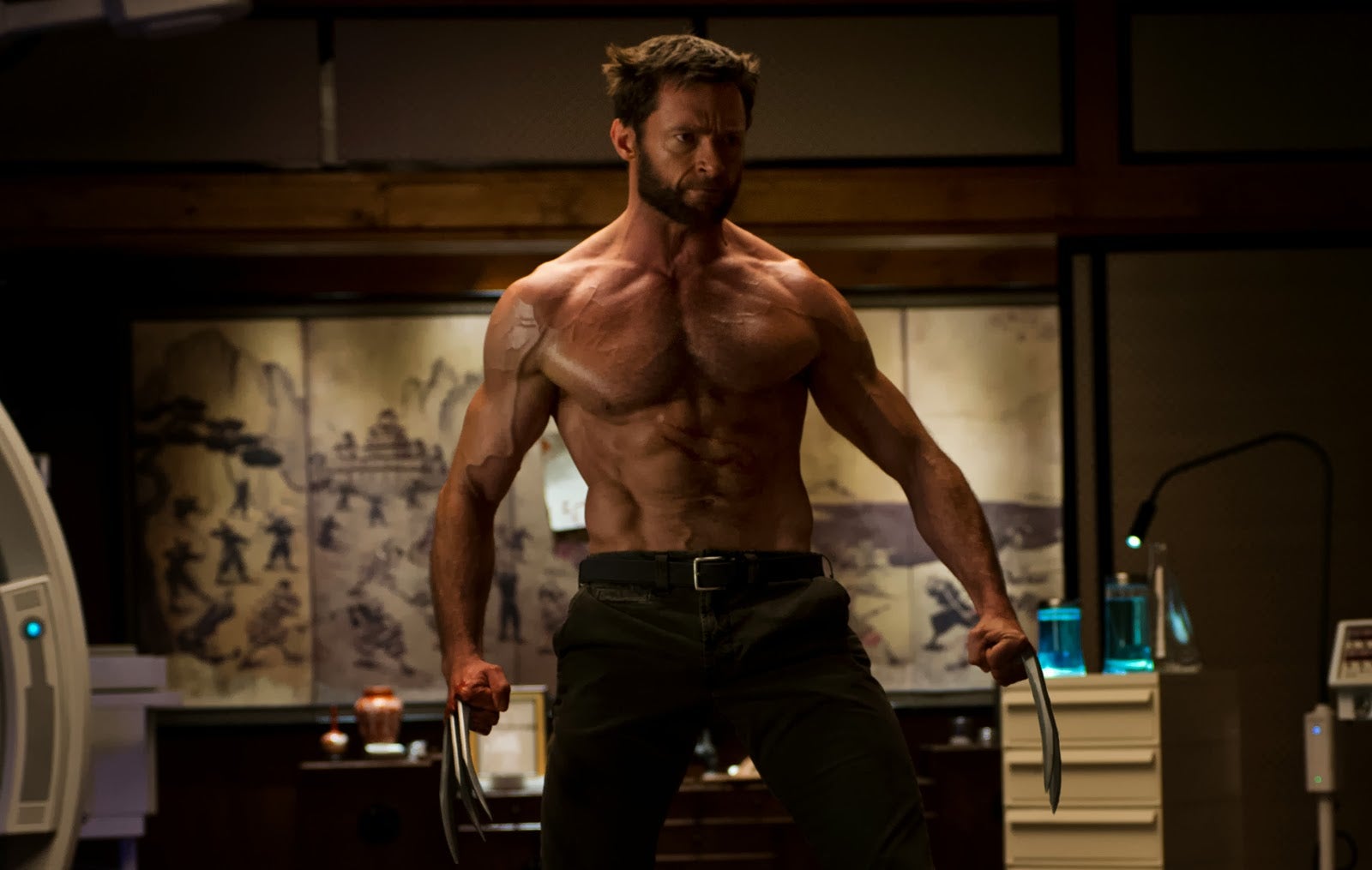
Anyone who has seen any of the X-men movies knows that most of them are structured around Wolverine. That’s entirely fair. He’s the most popular X-men character of all time and he’s played by Hugh Jackman. In case you’ve forgotten, Hugh Jackman looks like this.

I’m not gay, but even I think he’s sexy. Naturally, he’s going to have a love interest. A man this sexy has to have one. The problem is, the writers of this movie don’t realize how terrible the love triangle is with him, Cyclops, and Jean Grey in the comics. That, or they see it and think they have a way to make it worse.

First and foremost, they gave no reason for Jean Grey and Wolverine to be attracted to one another. Hell, he tries to stab her when he first wakes up at the Xavier Institute in the first X-men movie. That alone should ensure her panties stay dry around him for the entire trilogy. Instead, the chemistry between them is outright forced.

It has to be because these two never really have a meaningful conversation. They never really get to know each other. They’re just physically attracted to one another and the only reason they don’t bone is because Jean Grey is engaged to Cyclops. As a result, Cyclops is reduced to the role of being an obstacle to Wolverine. That’s pretty much his only role in the first three X-men movies, being a hindrance to Wolverine getting into Jean Grey’s panties.

There isn’t even an effort to balance things out. Cyclops is portrayed as someone who’s not nearly as badass as Wolverine, but he’s still respectable and likable to an excessive degree. He helps save Wolverine the first time they meet. He offers to shake his hand, which Wolverine flat out refuses. He never gets overly upset with Jean about her being attracted to another man. He’s bland, but likable.

If anything, Wolverine does everything he can to make himself the asshole you don’t want Jean to end up with. He steals Cyclops’ motorcycle. He steals Cyclops’ car. When he dies in the third X-men movie, he doesn’t give a second thought to making out with his girlfriend. He does this after he tells Cyclops earlier that she chose him at the end of the previous movie. He couldn’t come off as more of an asshole without pissing on Cyclops’ grave and stealing Jean Grey’s panties.

As bad as this is, it actually gets worse. At least in the comics, Wolverine actually knows Jean Grey as a person to some extent. He’s worked with her. He’s been on the same team as her. He’s lived under the same roof as her. Chances are he knows how she takes her coffee, what she watches on TV, and what her favorite brand of cereal is. In the movies, he knows none of this.

I’ve seen all these movies and based on the sequence of events and the time that passes between them, it’s clear that Wolverine didn’t know Jean Grey for more than a few days at most. He leaves at the end of the first movie. Jean Grey dies shortly after he returns in the second movie. There’s never any indication that they remained in contact. There’s no hint of tortured love letters, long phone calls, or dick pics being exchanged. They literally have no time to get to know one another.

That’s what makes the events of the third X-men movie all the more infuriating. Towards the end of the movie, Wolverine professes his love for Jean Grey before he kills her, at her request. Never mind the fact that this is the exact opposite of what happens in the comics. He proclaims her to be the love of his life despite the fact he doesn’t even know her. He doesn’t know her hopes, her dreams, or even her middle name. So how are we, the audience, supposed to believe that this love is genuine?

It ruins Jean Grey, as a character. It makes her nothing more than a prop for Wolverine. She’s not just the prize he pursues. She’s the only reason he has any emotional development. The fact that he barely knows her makes his affection for her all the more shallow. On top of that, it reduces Wolverine to this mopey pretty-boy instead of the bad-ass loner he’s supposed to be. He’s supposed to be Wolverine and not this guy.

The combined efforts of the movies and the comics ensure that the Cyclops/Jean Grey/Wolverine love triangle is the alpha and omega of terrible love triangles. It’s a horrendous plot that still plagues the characters to this day.

The biggest tragedy is that the Cyclops/Jean relationship has been shown to function well as a meaningful romance. Just this past month, there was an entire issue dedicated to showing how these two are a romance of equals who can make each other better, just like a good romance is supposed to. Good love stories don’t need a love triangle to develop, grow, and thrive. They just need some actual effort and a basic understanding of what makes a relationship work.

As an aspiring writer who hopes to encourage other aspiring writers, I would only cite the Cyclops/Jean Grey/Wolverine love triangle as a case study in what not to do. There are few ways in which a love triangle can actually work in a romance story. None of those ways are used in this case. In fact, some of those ways are turned upside down, inside out, and gutted.

Quality romance and quality characters, be they superheroes or ordinary people, deserve better. In the same way it’s almost impossible to make a quality meal with bad ingredients, it’s almost impossible to craft a quality love story around a love triangle. The convoluted, misguided clusterfuck that is Cyclops/Jean Grey/Wolverine is just a tragic testament to how bad it can get.


33 Comments

Filed under Jack Fisher's Insights

Starfire: Profile of a Sex-Positive Superhero

I intended to move onto another topic to start this week. I thought I said enough about jealousy and rejection last week, at least for now. Well, I may have been premature and as a man, I do not use that term lightly. Before I get going on another topic, there’s one last item I want to discuss regarding jealousy and rejection. That item involves superheroes.

I know that sounds like a non-sequiter, but hear me out. If you’ve been following this blog, you know that I am a big comic book fan. I tend to refer to comic books and superheroes when discussing issues on this blog, including the sexy kind. I’ve actually referenced the Deadpool movie as an example of progress in our culture’s attitudes towards sex. I promise it’s not as crazy as it sounds. I’ve also highlighted a recent issue of an X-men comic as an example of a balanced modern romance.

It’s not my fault that superheros help make my points so well and this issue is no exception. As I wrote about issues surrounding jealousy, rejection, and our cultural attitudes towards sex, I made some connections to a lesser-known superhero, but one who fits into this discussion in an important way. It’s not Superman. It’s not Batman. It’s not Wonder Woman. It’s not Captain America, Iron Man, or Wolverine. No, I’m talking about Starfire.

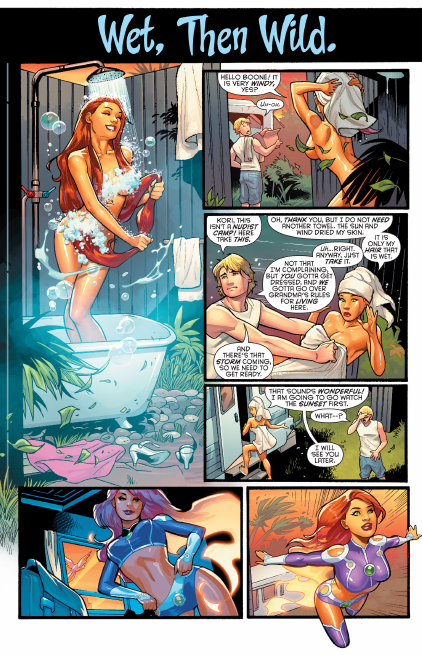
Who is Starfire, you may ask? Well, she’s an alien princess named Koriand’r. She can fly, has super strength, is super durable, and can shoot green energy bolts called starbolts. By all accounts, she’s very similar to Supergirl. She’s not as well-known as some of the other mainstream heroes. She still has quite a history and has done a lot to set herself apart from a crowded superheroes market. Oh, and she looks like this.

I think that tells a good chunk of her story right then and there. However, what makes Starfire special isn’t just her ability to look good in skin-tight outfits. A lot of female superheroes can make that same claim. Looking good in an obscenely revealing and/or extremely impractical costume is par for the course for female heroes and even male heroes to some extent. Anyone who remembers Michelle Pfeiffer’s memorable take on Catwoman in the old Batman movies knows this.

So what sets Starfire apart? Why am I singling her out from the countless other super-powered heroines who wear overly revealing costumes, have an awesome rack, and give pre-teen boys all sorts of strange new feelings? Well, it’s because Starfire embodies a special trait that sets her apart from every other superhero, male or female. She is, by far, the most sex-positive superhero in comics right now.

What do I mean by that? Well, superheroes having sex isn’t new. Superheroes having strange, deviant sex isn’t new either. Starfire exists in a universe where Superman and another female hero named Big Barda made a sex tape. It’s also a universe where Batman and Batgirl have sex on a rooftop. So clearly, comics and comic creators aren’t afraid to get kinky.

What sets Starfire apart is that she isn’t just comfortable with sex. She conveys it in an overtly positive way. She doesn’t treat it as an act of deviance. She doesn’t treat it as something callous or meaningless either. She treats sexuality as part of her overly loving, overly emphatic personality. She always frames it in a good, positive context. In the superhero world, that’s not just rare. That’s an aberration.

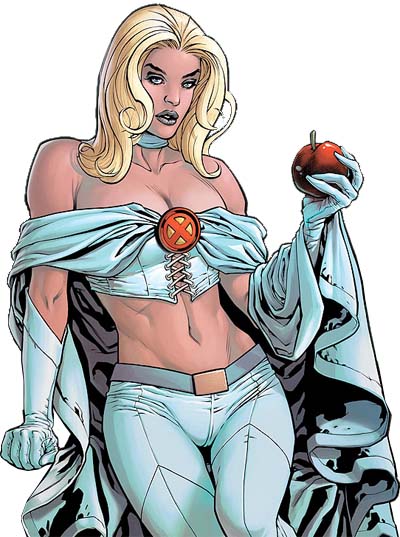
Traditionally, when a female character becomes more sexual, it makes them come off as more deviant. Overly sexual female characters take on a stereotypical vixen, one who flaunts her sexuality and exploits it to the utmost. I already mentioned Catwoman as one example, but Catwoman is a lightweight compared to Emma Frost of the X-men. I won’t get into all the way she’s conveyed her sexuality, but just assume she exploits it in ways even an erotica writer can’t imagine.

It’s an unfortunate theme that has played out in superhero stories in various ways over the years. Like slasher movies and teen movies, it reinforces this puritanical subtext that the more sexual a woman is, the more deviant she is.

Men aren’t immune from this subtext either. While they can get away with having more sex than female superheros, there’s still this unspoken impact attached to it. If a male hero is going to be more sexual, then he’s going to be more of an asshole. Like the jocks in 80s teen movies, they don’t come off as positive or upstanding like Superman or Captain America. The best example of this would be Namor, a character who has actually slept with Emma Frost. This is what he looks like and this is how he usually dresses.

I think that effectively conveys the traditional dynamic of sexual superheroes. It’s also why Starfire is so unique in her persona. She dares to defy this tradition. She dares to be a compassionate, loving hero while being openly sexual. She does not carry herself like some superhero vixen, flaunting and flouting her sexual traits. In fact, flaunting sexuality is downright alien to her.

For Starfire, sexuality is just a simple, natural part of life. It’s just one of the ways she shows love and affection to those around her. She doesn’t do it with an agenda. She doesn’t do it to exploit. She does it for all the right reasons. She’s also very comfortable with her body. It doesn’t just show in her skin-tight superhero outfit either. She’s also very comfortable being naked. Having written extensively about the joys of nudity on this blog, it’s something I can definitely appreciate.

There’s one other trait to Starfire that sets her apart. It has to do with jealousy, the less joyous topic I’ve brought up on this blog. In being so sex-positive, Starfire doesn’t experience jealousy the same way we see in other characters. Throughout the history of superhero comics, there have been all sorts of crazy love triangles and convoluted love stories. Wolverine’s love life alone is a testament to this. With Starfire though, these sorts of convoluted emotional entanglements are a moot point.

The best example of this manifested in a solo series she starred in earlier this year. In that series, she deals with multiple male characters with which she shows a romantic interest. Dick Grayson, the first Robin, is just one of them.

However, it’s her reaction to another relationship with a character named Sol that really sets her apart. While she’s off fighting monsters and exploring subterranean civilizations (it’s a long story, but one that’s totally worth reading), he finds love with a co-worker. What’s Starfire’s reaction to this? Does she get angry, upset, or sad? No. She doesn’t. She’s happy for him.

Does that sound strange? Does it sound downright alien? Well, think about it for a moment. Someone Starfire really cares about finds happiness. Being a loving, empathetic person, she’s happy that he’s happy. Besides, if you love someone and they find a new source of happiness, shouldn’t you be happy as well?

It’s one of those strange thought experiments that makes too much sense for our culture. As I’ve said in other blog posts, our culture does a lot to create unhealthy attitudes towards sex and intimacy. The idea of being happy that a lover finds happiness with someone else feels alien because our culture creates this strange nation that we’re supposed to own the love and happiness of another.

Think about that for a moment. We’re supposed to own the intimate affections of someone else and should be upset when they find it with others. The idea of owning the thoughts and feelings of others doesn’t sit well with me. I imagine it doesn’t sit well with a lot of people on some levels. However, this is what our culture commands us to some extent.

It’s for this reason that Starfire is such a remarkable character. She embodies a different brand of sexuality. She embodies an attitude towards sex that sets her apart. Given that she’s an alien, these attitudes certainly feel alien. However, they’re attitudes that we can and should learn from.

46 Comments

Filed under Uncategorized

A Relationship of Equals: An Unexpected Example From An X-men Comic

375131-_sx1280_ql80_ttd_

This past week, I’ve been writing my thoughts about strong female characters and evolving trends in our concept of romance. I think these are thoughts worth sharing because popular culture is always evolving. Our tastes in stories, characters, and romance changes from person to person, from generation to generation, and from culture to culture. I’ve already seen plenty of changes in my lifetime. I expect to see plenty more, especially as I work on my own love stories.

One of the points I made in my article about doomed romances involves the flaws in dynamics of such romances. When one person, be it male or female, is unequal in terms of sacrifice and input, then that’s typically an obstacle that’s difficult to overcome. When a relationship is between equals, then the romance between them makes both characters stronger. That’s the kind of romance I’m hoping to create with one of my future books. As such, it’s important to take note of promising examples. Low and behold, I found one yesterday.

As I’ve already stated before on this blog, I’m a huge comic book fans. Some of my early exposure to love stories came from famous comic book romances. Among those romances are Cyclops and Jean Grey, two of the most prominent members of the X-men. I always had a soft spot for them. Their love story is among one of the most epic (and convoluted) in the history of comics, stretching all the way back to 1963 and involving multiple deaths along the way (long story).

Like many romances that began in different eras, it didn’t always make both sides equal. However, I would argue that the relationship of Cyclops and Jean Grey was far more equal than those of classic superhero romances like Superman and Lois Lane or Spider-Man and Mary Jane. Unlike those romances, Cyclops and Jean Grey are both superheroes on the same team. They both have superpowers and a superhero identity. On paper, they should be equals. In practice, however, it often led to tiresome tropes. A lot of them centered around Jean Grey fainting and needing to be rescued a lot. Case and point, here’s a clip from the famous X-men animated cartoon in the 90s.

Make no mistake. That happened A LOT. Jean Grey seemed to faint way too often in this cartoon. Things got slightly better for her in the X-men movies, but until her role in this years X-men: Apocalypse, she was largely relegated to being a prize for Cyclops and Wolverine to fight over. It’s a major reason why this romance isn’t quite as celebrated as other major comic book romances and I say it’s a valid reason.

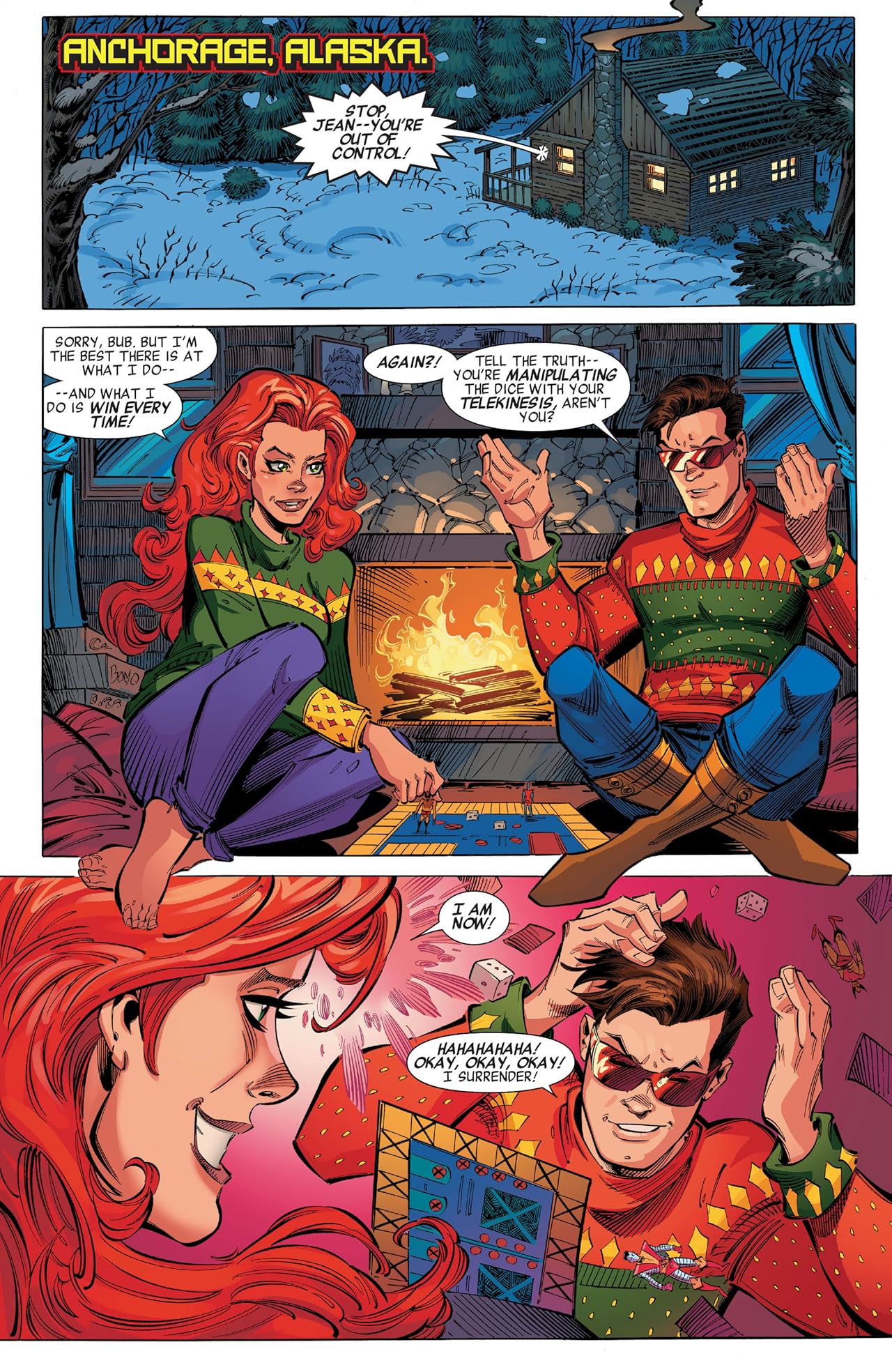
So imagine my surprise when I picked up my comics yesterday and came across X-men 92 #5. In this issue, we catch up with Cyclops and Jean Grey, who are now retired from the X-men and trying to build a life as two normal, healthy lovers. Despite terrible tastes in sweaters, their efforts yield mixed results as superheroes rarely stay retired.

However, it’s not that Cyclops and Jean Grey end up having to don their superhero costumes again that strikes me about this issue. It’s how utterly refined their relationship dynamics are here. Remember that clip I linked to earlier with Jean Grey fainting? That doesn’t happen here. Not once. Anyone who watched all 76 episodes of the X-men cartoon in the 90s can probably appreciate how big a deal that is.

Instead, the comic does something special with these two, something that I actually don’t see very often in comics these days. It shows Cyclops and Jean Grey as two lovers, being superheroes on an equal playing field. At no point do they end up having to save one another. At no point do they undermine or frustrate one another. Every step of the way, they support and complement each other.

That’s not to say there aren’t some disagreements. Cyclops is initially mistrustful of some of the allies they come across, which is perfectly in line with his character, but Jean Grey vouches for them and he trusts in her. He trusts her as anyone should trust their lover and it pays off. He supports her. She supports him. It’s a beautiful thing that shows a relationship actually functioning.

This is something that pop culture overlooks and for good reason. The narrative of how two people fall in love or how two people fall out of love is often more dramatic. However, it’s a story that gets told and retold too often and in too many different forms these days. Rarely do we get a story that shows two lovers actually functioning together on an equal playing field. That’s what makes X-men 92 #5 so astonishing. It uses the romance to complement the story rather than drive it.

This is an important insight and one that I definitely want to take note of for my own work. As I said before, I do have a few projects in mind that rely on relationships between equals. I want to use strong male and female characters who don’t have to rely too much on overplayed tropes because I want my work to stand out. I can’t do that if I tell the same kind of story that people have read a million times before in various forms. So comics like this are vital tools for writers like me.

For others seeking different kinds of love stories, I strongly recommend X-men 92 #5. It offers a different take on an under-appreciated, and often underrated, relationship between two iconic characters. I hope we see more stories like this in comics, as well as movies, books, and TV shows. I think the time is right for this kind of romance to take hold.

49 Comments

Filed under Jack Fisher's Insights, Uncategorized