Tag Archives: money

Wondering If (Not When) I’ll Be Able To Retire

When I was a kid, my parents worked hard. Even at a young age, I could tell. My dad would wake up extra early, often before the sun rose, to prepare for work. My mother would do the same, often leaving just as my school bus arrived. They didn’t always work late, but they worked long enough days that required me to go to daycare or an afterschool program for many years. And even when I was old enough to be home alone after school, I was expected to help out and do a few chores before they got home.

It wasn’t until after high school that I came to appreciate how hard they worked to provide for their family. So, a few years back when they finally got a chance to retire, I gladly celebrated with them. They had more than earned the opportunity to stop working, enjoy their golden years, and dedicate their time to someone other than their employer.

Since then, I can’t deny they’ve made retirement look very enticing. My father, who once woke up at the crack of dawn every morning, now regularly sleeps in past 8:00 a.m. My mother, who spent decades working in an office and navigating rush-hour traffic, now spends her mornings in a bath robe drinking tea and reading the paper.

They don’t worry about what their clients, supervisors, colleagues, or customers will throw at them next.

They don’t worry about driving through rush-hour traffic, agonizing over deadlines, or dreading their next performance review.

Retired life is just life, as they see fit. And I’m glad they have a chance to enjoy it because not everyone gets that chance. And after a spike during the COVID-19 pandemic, fewer people are retiring. Their reasons for doing so vary, but each passing year seems to bring more challenges to retirement. There are even some influential voices who scoff at the very idea of retirement altogether.

In many ways, I consider myself lucky. Unlike many of my peers, I don’t have any student loan debt. I managed to pay that off by living at home during a good chunk of my 20s and basically dedicating over half my paychecks for my first job towards paying it down. That, alone, puts me in a very small percentile of people in my age range.

But even without my student loan debt, I’m not at all certain my current retirement plans will allow me to retire the same way my parents did. And even if I did, I’m not sure how long that plan would last for me when accounting for inflation, economic trends, and the never-ending political battle over social security.

If I were to retire at 67, which is the age in which Americans my age qualify for full social security benefits, I would probably be fine for a few years. The money I’ve saved, the lifestyle I enjoy, and the monthly costs in my general area would be manageable.

However, if there’s a major economic downturn, as there often in any given decade, or a significant bump in inflation, which happens regularly on a global scale, then my current retirement plan would not be sustainable after a number of years. I would either have to get more benefits from the government, spend more of my savings, or find another way to earn money.

None of those options are more than temporary solutions, nor are they as appealing as my parents’ retired life. At the moment, I don’t know and can’t know how viable my retirement plan is in the long run. I also have to assume that I’m not going to strike it rich at any point in the future. Short of winning the lottery, becoming a best-selling author, or seeing my YouTube channel explode in popularity, I just don’t think such wealth is in the cards for me.

I still have many productive years ahead of me. And I don’t doubt for a second the world will be a very different place by the time I’m nearing retirement age. For all I know, artificial intelligence will have completely reshaped the economy in ways I cannot begin to imagine.

Advances in biotechnology might ensure people like me don’t have to worry about the ravages of old age. Something like that is sure to further complicate any plans for retirement. I’m sure there are many wealthy, well-connected people who would love nothing more than to have workforce that stays young, healthy, and able to work for decades if not centuries on end. If that somehow becomes the norm by the time I reach retirement age, then something will have gone horribly wrong with the world and retirement would be the last thing on my mind.

But for now, I’m not going to work under the assumption that advanced AI or biotechnology will create a wholly utopian world where nobody has to work, no matter their age. And even if that technology does exist in some form, I’m not going to assume I’ll be in a position to take advantage of it before the rich and well-connected.

Again, I don’t know what the next 30 years has in store for the world. I don’t even know what things will be like 5 years from now. But I honestly would like to retire at some point. I would like to enjoy my golden years as much as my parents, not having to build a good chunk of my week around work. I’m currently planning and saving as best I can to give me that chance.

Will those plans ultimately pan out as I hope? Only time will tell.

I’m certainly hoping for the best and I’m working just as hard for it. But I’m also bracing for the worst. I just hope it doesn’t take the form of me working until my dying breath.


Leave a comment

Filed under Jack Fisher's Insights, politics

Why AI SHOULD Replace Most CEOs

This is a video from my YouTube channel, Jack’s World.

In this video, I make the case that, of all the jobs artificial intelligence could replace, CEO should be at the top of that list. In recent years, CEOs in general have generated headlines for all the wrong reasons. With the ongoing advancements in AI, this is one job for which we should be actively trying to remove human flaws.

Leave a comment

Filed under Artificial Intelligence, Jack's World, television, YouTube

A Superyacht Caused A Devastating Forest Fire To Further Prove Billionaires Are Assholes

When it comes to being rich, there are only two types.

The first type is more traditional and common, relatively speaking. That type of rich largely covers people who can afford to live in nice houses within nice neighborhoods in well-maintained communities while not drowning in debt, be it from credit cards and student loans. These aren’t the kind of rich people who live in mansions and have butlers. These are just people who have comfortable, affluent lifestyles.

I don’t have a problem with rich people like this. I even know some of them. They’re generally decent people. And while some did inherit part of their wealth, they still had to work to some extent in order to maintain it. If they didn’t, then they wouldn’t remain rich for very long.

Then, there’s the second type of rich people. These people are rich in ways that most of us, including the first type of rich people I just mentioned, cannot begin to fathom. These are people with access to billions of dollars of wealth. I know people love to throw terms like millions and billions around interchangeably, but I don’t think those people realize just how much more a billion is than a million.

To illustrate, consider the following anecdote.

If you made approximately $50,000 a year, it would take you about 18 years in order to make $1 million. That’s a timeframe we can wrap our heads around. Most people work longer than 18 years in their adult lives.

But working at that same rate, it would take over 18,000 years to make $1 billion. That’s nearly three times longer than the history of human civilization. That is not a trivial difference.

And that difference is worth highlighting because only the second type of rich people can afford obscene displays of wealth like yachts. I also think it’s entirely appropriate to label these types of displays as obscene. Because yachts are not just boats.

They might as well be floating private islands that rich people use as extensions of their gawdy lifestyle. It’s not enough they can afford armies of butlers, nurses, nannys, personal chefs, and servants. They have to take that shit with them across the ocean. Just imagine feeling like you need that kind of pampering and luxury to begin with, let alone take it with you on an oversized boat.

It’s just one of the many reasons why I’ve come to believe that there’s no such thing as a “good” billionaire. But if you’re a billionaire who happens to own a yacht, then I’m just going to assume you’re an insufferable asshole until proven otherwise. Thus far, I haven’t been able to find reliable proof in that regard.

But all too often, I come across proof in the opposite direction that further affirms that these types of rich people really are assholes. The latest bit of proof comes courtesy of a misguided fireworks display organized by the crew of a superyacht that had been chartered by a group of rich people who don’t mind dropping $320,000 a week.

What’s the difference between a yacht and a superyacht? I don’t claim to know, but it’s safe to assume you have to be a special kind of greedy, self-centered asshole to think a regular yacht isn’t obscene enough.

But according to the Daily Beast, this particular superyacht tried to do a firework show off the Greek island of Hydra. While it might have looked pretty initially, it didn’t end well because it caused a massive forest fire on the island. Thankfully, no one was hurt in this fire, as far as we know. Even so, this is the kind of display that only the obscenely wealthy can pull off.

It’s not enough for people like this to live on a floating resort where they’re treated like royalty. They need a personal fireworks show to be entertained, even if it puts part of the natural world at risk. Even if you grand them the benefit of the doubt that this was entirely an accident and the people involved feel bad about it, remember this one detail.

These people won’t be the least bit inconvenienced.

It doesn’t matter that the mayor of the island is seeking compensation. Chances are he’ll run into an army overpaid lawyers who will either pay for this incident to go away or just plain intimidate the people on this island into submission. For most of the people paying these lawyers, the most they’ll have to do is make a phone call, sign some papers, and maybe even wire some money.

If anyone else mistakenly caused a forest fire that devastated an entire island, there would be consequences. This wouldn’t be something we could just ignore or bully our way out of. Then again, this isn’t something most of us are in a position to even do. We don’t own or use any yachts, let alone a superyacht.

We don’t know the names of the people who were on this superyacht when the fire erupted. Chances are we’ll never know, thanks to those aforementioned lawyers. But whoever they are, they’re still prime examples of why billionaires in general are assholes.

Leave a comment

Filed under Current Events, human nature, politics, rants, real stories

Why Spider-Man Should NOT Be Broke

This is a video from my YouTube channel, Jack’s World.

This video explores the long-standing, but very much outdated trope of Spider-Man being broke. Like most mainstream superheroes, Spider-Man is subject to a lot of recurring tropes. Most involve his personal life.

However, I don’t think the overplayed plots about him being broke get enough attention. In addition to breaking down why this makes no sense, I also highlight a few other jobs or careers that would easily ensure Spider-Man never has to worry about money. Enjoy!

Leave a comment

Filed under Marvel, Marvel Cinematic Universe, Spider-Man, superhero comics, YouTube

Should Billionaires Even Exist? A Serious Question

In general, I’m in favor of capitalism.

I believe people have the right to work, buy, sell, and do business as they see fit. There certainly need to be rules. No social, economic, or political system can function without rules that are fair and well-enforced. That’s not a political statement. That’s just cold, hard realism.

In that same mold, I am not in favor of unmitigated capitalism in the mold that most libertarians and conservatives envision. I do not believe corporations, businesses, and industries should be given excessive leeway when it comes to dealing with fraud, failure, or environmental destruction. There needs to be some level of regulation to curtail the excesses of the market.

In my youth, I used to be a lot more libertarian in my views on how much or how little capitalism should be regulated. But as I’ve gotten older, I’ve become more aware of just how dangerous unfettered capitalism can be. You need only deal with Comcast’s customer service for any length of time to be convinced of that.

Now, I’m at an age where I feel like I’ve reached a new crossroads with respect to my view of capitalism. I won’t say I’ve completely lost faith in it or the idea. But I’ve seen way too many instances of big corporations doing objectively evil things to not be critical. And when they get in bed with political institutions, that evil only compounds.

Seriously, there are companies and state governments colluding to roll back child labor laws. This is not a joke. These companies want to make children work for them because it’ll result in greater profits.

This brings me to billionaires. They are the most celebrated figures in all of capitalism. They’re regularly ranked and whenever someone else becomes the world’s richest person, it generally makes the news. Like many others, I often celebrated their achievements too. I used to think that making a billion dollars, let alone over $100 billion, took a special kind of drive.

I admit I was wrong about that.

Now, I don’t think that billionaires, as a class, should even exist.

That may sound like a radical position. It’s often a talking point that comes up among those on the extreme left of the political spectrum. And those who espouse anything close to it are often ridiculed as being anti-business, anti-American, or outright communists.

Those criticisms are bullshit, by the way. They’re also just a distraction to avoid the distressing implication about billionaries.

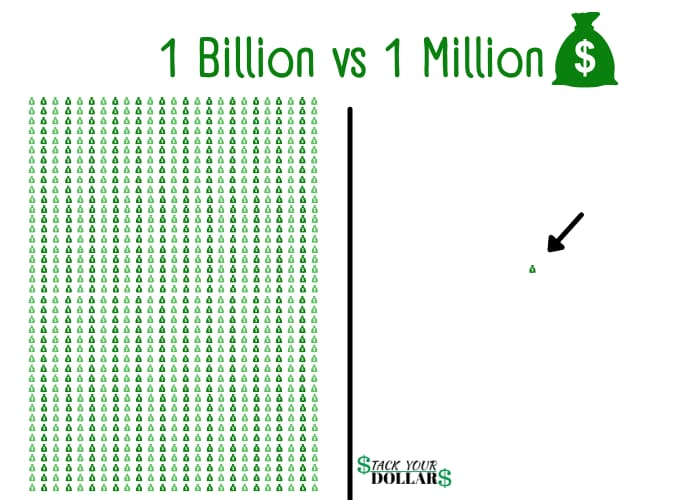
To understand, just take a moment to appreciate how much more a billion dollars is than a million dollars. I know those three extra zeros might not mean much to most people. But in simple mathematical terms, the gap is vast. In case you need something visual, here’s a quick image to help illustrate the concept.

Again, it’s not a trivial difference.

But if you need another way to conceptualize just how big a billion dollars is, consider the following.

One million seconds is about 11 days. Most of us can grasp that length of time.

One billion seconds is 31.5 years. That’s a third of an average person’s lifetime.

I hope that helps belabor the point because with that now in mind, ask yourself one critical question.

Is it humanly possible for anyone to work hard or long enough to justify having a billion dollars?

In the past, I might have considered that a dumb question. But now, I would answer that question with an emphatic no. I don’t care how smart, skilled, capable, or dedicated anyone is. The idea that someone even could work hard enough to earn a billion dollars just doesn’t work.

Again, look at the visuals above. The difference between a million and a billion is extreme.

It also helps to think back to the hardest, most laborious job you ever worked. Whether it was working in fast food, construction, or retail, just think about how hard that job was and how much it paid you. Now, consider how hard your boss worked and how much they got paid. Did the extent of their work actually reflect their salary?

In some cases, it might. But in most, I doubt it. Apply that to how much more billionaires make compared to even senior managers at a company and the disparity becomes even more absurd. If that doesn’t convince you, then maybe this video highlighting a speech by Jesse “The Body” Venture will.

Beyond just the work, take a moment to think about what it would take to spend that kind of money. How many houses could you buy that you could reasonably live in? How many yachts or ships could you buy and actually use in any meaningful extent? How much fancy jewelry could you buy and actually wear?

I’m sure there are those who think they could spend a billion dollars with ease. I doubt those same people truly understand how much more a billion dollars is compared to a million. And even if they could, it would take real, considerable effort to spend that kind of money in a single lifetime.

There’s also the argument that billionaires donate a lot of money to charity and that effort is worth their massive wealth. I used to think there was value in that too. But I’ve also come to see that endeavor as little more than virtue signaling laced with tax avoidance.

And finally, there’s the idea that billionaires are somehow special and they have a unique set of skills that somehow warrants them having that kind of wealth. That’s partially true, but not in a good way. If you just look at how most billionaires made their money, you’d notice that a lot of them either involve inheriting wealth that they didn’t do a damn thing to earn or being exceedingly ruthless in exploiting the labor of others and/or avoiding taxes.

On top of that, those with that level of wealth can literally afford to manipulate the system, legally and illegally, to ensure that their wealth and status is preserved. Whether it’s through tax loopholes or lobbying for laws that benefit them (and only them), billionaires can basically shape the world as they see fit, even if it hurts people, the environment, and everything in between.

Even if you’re in favor of capitalism, it’s hard to deny the corrupting factors that just a few billionaires could have. No system can work when it’s so top-heavy that just three people have more wealth than the bottom half combined. You can still have a functional, vibrant capitalist system that encourages entrepreneurs and wealth creation. You can also have a system that allows for billionaires. But you cannot have both.

As an alternative, I propose this.

Once you make a dollar over $999,999,999, that money gets taxed at 100 percent. And every year, the government sends you a nice trophy that says “Congratulations! You won Capitalism!”

If that much money and the trophy is still not enough for you, then you’re not just greedy. You’re an asshole and you can’t be trusted with millions of dollars, let alone a billion dollars.

Leave a comment

Filed under Current Events, politics

The Only (Free) Self-Help Advice You’ll Ever Need

This is a video from my YouTube channel, Jack’s World.

This video is a simple offer of free self-help advice in a world where every self-professed guru attempts to charge everyone every last penny for what is often common sense. Having seen way too many videos on YouTube professing some sort of magical secret to success, I felt like a video like this was necessary. Enjoy!

Leave a comment

Filed under health, Jack's World, psychology, YouTube

Thought Experiment: Contemplating (Viable) Alternatives To Capitalism

This is another video from my YouTube channel, Jack’s World. This video is a thought experiment about capitalism. Specifically, it challenges us to contemplate alternatives that we could actually implement in the real world. Given the current trends in politics, which either glorify or villainize capitalism, I think this sort of idea is increasingly relevant. And it’s something we should contemplate seriously as technology, society, and the world continues to change. Enjoy!

Leave a comment

Filed under Current Events, human nature, Jack's World, philosophy, politics, Thought Experiment, YouTube

Lasik Eye Surgery: The Best Money I Ever Spent

The following is a video from my YouTube channel, Jack’s World. This video is a recollection and reflection of my Lasik eye surgery, which remains the best thing I ever spent my money on. Enjoy!

Leave a comment

Filed under Jack's World, real stories, YouTube

A Note/Warning To Anyone Investing In Cryptocurrency

A close relative once told me that investing in something you don’t understand is as irrational as hating something you don’t understand. To date, those words still ring true and time has only further vindicated them.

When it comes to a subject like cryptocurrency, which involves both money and mechanisms that are difficult to grasp, even a basic understanding is hard to come by. And when people don’t understand something, they’re inclined to make flawed judgements.

It’s why you have famous investors like Warren Buffet saying Bitcoin is completely worthless or notable publications like Forbes claiming all cryptocurrencies are Ponzi schemes.

This is hyperbole. It’s also a clear indication that these individuals don’t fully understand Bitcoin or what cryptocurrencies are. And getting that information isn’t the same as getting the secret investment strategies of famous investors. It’s an open-source program and you can read the white paper that helps explain it at any time for free, courtesy of this link.

It’s hard to understand because it involves math and encryption, two topics most people don’t know much about. But whether they understand it or not, they still use it. If they use a smartphone, a computer, or anything that connects to the internet, they are utilizing some of the same type of technology that goes into cryptocurrencies.

Now, I say all that because things in the cryptocurrency world have been pretty rocky this year. If you just look at the prices of most major cryptocurrencies, this has been a historically bad year. If you bought any crypto in January, there’s a good chance that investment has lost money by now. I know because I’m one of them.

I’ve noted before that I do own some cryptocurrency. I’ve also talked about it before as both an investment and a useful tool for the internet age. I won’t deny that while my investment in Bitcoin was very small, never exceeding more than a few hundred dollars, the returns this year have not been great. And I would never recommend anyone put all their savings or investments into Bitcoin, or any asset for that matter.

In addition, I would never advise anyone to invest their money in a way that would limit their control of said money. When you put your money in a bank, whether it’s in person or online, you’re trusting a system and the people within it to handle your money. By law and by the fine print of the contracts you sign, you have control over that money and they can’t take that control from you absent some very limited circumstances.

With that in mind, I think there’s an important lesson to learn from the recent collapse of FTX. If you’re at all involved with crypto, chances are you’re aware of this and have felt the impact. I certainly have. It helped make an already terrible year for cryptocurrency that much worse. Last I checked, my Bitcoin value went down a good 20 percent and will likely go lower.

It was a bad turn among many for cryptocurrency and it wasn’t even the first. Before FTX, other famous cryptocurrency exchanges like Mt. Gox also suffered a similar fate. It’s collapse is actually very similar to FTX. The issue was this.

A new institution or organization is set up to buy, sell, and store cryptocurrency.

It becomes successful by making cryptocurrency accessible to more people.

Due to greed and a lack of supervision or understanding of cryptocurrency, the organization begins skimming money while lying about how much actual cryptocurrency it has.

Ultimately, the scheme is either uncovered or it collapses like a Ponzi scheme when too many people try to withdraw their assets.

In both cases, the problem was the same. People were buying cryptocurrency on an exchange and keeping it on that exchange. They weren’t exactly owning any currency. They were essentially paying the exchange to stake a claim on a certain pool of currency that didn’t exist.

In that context, nobody should be that surprised that FTX and Mt. Gox crumbled. I get the appeal of investing in cryptocurrency without having to go through the trouble of storing or securing the coins on your own computers or devices. However, it’s worth remembering that these are not banks. These are not institutions that are subject to the same laws and regulations as banks.

That’s not to say all crypto exchanges are frauds, but fraud is just a lot easier for them than most.

So, if there’s one lesson to take away from FTX and the collapse of any exchange, it’s this. If you’re going to invest in cryptocurrency, make damn sure you actually own or possess the coins in some tangible medium. That’s what I’ve done with all my Bitcoins. I keep them all in a digital wallet that is not at all connected to any exchange. I also keep a backup to ensure that even if I lose one of my devices, I can still access my coins on another.

It’s not that hard to do. In fact, it’s easier now than it was back when Mt. Gox was still active. It’s even become a common refrain from those who still defend the value of cryptocurrency. The mantra is if the Bitcoins aren’t in your own wallet, then they’re not yours.

Exchanges still have their place in the world of cryptocurrencies and probably will for the foreseeable future. I also don’t expect cryptocurrencies to recover from these latest downturns anytime soon. But if you’re going to invest in cryptocurrency in any capacity, there’s a right and wrong way to do it. Even if you don’t understand the math and the science behind cryptocurrency, you’ll do better in the long run if you just do things the right way.

Don’t use exchanges.

Use digital wallets.

Here’s a list of some that I encourage others to look into before buying any crypto.

Leave a comment

Filed under Bitcoin, technology

Bitcoin Price Drop, Buying On The Dip, And How To Do It Responsibly

5 Cryptocurrencies That Ran Circles Around Bitcoin in 2021 | The Motley Fool

I’ve been following Bitcoin for many years now. I’ve seen it rise, fall, crash, rise, surge, crash again, and then rise. To say it’s a volatile product would be like saying Antarctica gets chilly in the winter. It’s volatility is one of its most notable features and it’s also why most consider it a risky investment.

As a result, this is not the kind of investment you treat like your typical blue chip stock. It’s not even the kind of investment you treat as a risky gamble in the mold of r/wallstreetbets. Bitcoin and many cryptocurrencies like it are an emerging technology that not enough people understand. The fact that so many don’t understand it or its utility have led some to call it an outright scam.

I don’t agree with this at all. Unlike actual scams, the math and mechanisms behind Bitcoin are not secret. You can look them up right now. Here’s a link to the original whitepaper made by its mysterious creator, Satoshi Nakamoto. The purpose of Bitcoin is right in the abstract. It’s a tool for sending money directly to people without the need for a financial intermediary.

That’s a technology that has legitimate value. In an increasingly connected world, that’s a value that will likely increase over time. For that reason, I ended up buying some Bitcoin for myself, which I documented on this very site. I plan on buying more down the line, provided I have the extra cash.

I also intend to maintain that plan, even though Bitcoin recently experienced a significant crash in price. Again, it’s a volatile product. It’s value will rise and fall erratically. Since 2010, I’ve seen it crash before. Back in 2013, Bitcoin’s price was around $1,000 and it crashed hard towards the end of the year. At one point, it went all the way down to $200.

At the time, people said that was the end of Bitcoin.

That was the end of cryptocurrencies.

They were wrong. Bitcoin recovered, went up even further, and continued to gain more and more acceptance.

At this point, predicting that Bitcoin will completely collapse any day now is like saying the internet is a passing fad. It’s absurd, short-sighted, and misses the bigger picture. Like it or not, Bitcoin and cryptocurrencies are here to stay. Entire countries like China can try to ban it, but the genie is out of the bottle now. There’s no going back.

On the other end of the spectrum are those who actually celebrate the crash in Bitcoin price, but not because they think it’s going to collapse. Instead, they see it as an opportunity to buy Bitcoin cheap and hold it until the price rises again. It’s not a new idea. That’s something skilled investors have been doing for years with stocks.

It doesn’t always work out. Sometimes, buying the dip means buying stock in a company that’s about to go bankrupt. Just ask anyone who bought stock in Bear Stearns. You can actually lose all your investment by buying the dip in a wrong company. For that reason, you should not see it as a viable trading strategy.

With Bitcoin, investors and speculators like to use Bitcoin’s ability to recover and continue despite many previous collapses as strength whenever they buy the dip. It’s not entirely misguided. Even I’ll wait for the price to dip a little before I buy new Bitcoin.

However, there’s a right way and a wrong way to buy into the dip of any asset. I say that as someone who is not the least bit qualified to give investment advice, but having followed Bitcoin for so long, I’ve seen more than a few people make the same mistakes.

They see the price dip and they either try to sell all their Bitcoins off or they try to buy as much as possible with whatever money they have. Both are byproducts of panic and anxiety. People don’t make wise decisions when they’re in that state of mind, especially when it comes to money. It’s why Warren Buffett is so successful. He stays calm when things are chaotic and doesn’t let knee-jerk reactions drive his decisions.

Even though Buffett himself is not a fan of Bitcoin, his strategy still holds true for Bitcoin. That means when you see the price sink, you shouldn’t panic and sell everything. You also shouldn’t take all your money and throw it into Bitcoin, either. Again, Bitcoin is volatile. You will lose money over time if you’re also volatile.

That’s why, whenever there’s a price drop in Bitcoin like this, I only buy a little extra. It’s not much. I just go to a Bitcoin ATM and buy about $100 to $200, depending on how much extra cash I have on hand. Most importantly, I never buy Bitcoin with money I can’t afford to lose. I only ever use excess cash I have on hand. It’s not something I put in my retirement portfolio.

Maybe that will change one day, but only if Bitcoin and other cryptocurrencies like it become less volatile. Since I don’t see that happening anytime soon, I’m content with just buying on the dip with whatever pocket money I have. Most of my money will still remain safely invested in index funds.

That would be my advice to anyone looking to “buy the dip” with Bitcoin or any investment. Do not put all your eggs in one basket. If you’re going to do it, only use money that you can afford to lose. The rest of your money should be in safe, low-cost index funds. That way, if Bitcoin ever tanks severely, you’re not wiped out.

Conversely, if Bitcoin rockets up in value, then you’ll just have some extra money on the side later on. Regardless of how close you are to retirement, that can only help.

1 Comment

Filed under Bitcoin, technology