Tag Archives: history

A Simple Definition And Criteria For Fascism

A lot of buzzwords and jargon get thrown around the internet these days. Engage in any form of debate or discussion with someone long enough and chances are things will get heated, ugly, and incomprehensible. And if said discussion or debate goes on long enough, then eventually Godwin’s Law will take hold.

Now, I don’t care to recount the futility or frustration that often comes with internet discourse. I’ve already wasted way too many hours debating with idiots, assholes, grifters, creationists, and anti-vaxxers. However, there are certain trends in which substance should take precedent over style. If not, then we’re not even talking about anything. We might as well be yelling obscenities at a rock in a dark basement.

In that spirit, I’d like to remind everyone who sees this post that words do have specific definitions. Concepts do have defined criteria. You can throw them around in any discussion or debate to help your argument. But if you don’t understand what they mean, then you’re not just failing in that effort. You’re actively diluting the very concept of language and contributing to the destruction of society.

I know that may sound hyperbolic, but I have to use that sort of language when it comes to definitions of words like fascism. I know that just by typing that word, I’m raising a lot of red flags and pushing a lot of proverbial buttons. There might be people at this very moment who see that word as a thought-terminating cliche, thereby giving them an excuse to completely ignore or discount anything I say after this sentence.

Please resist that urge. The well-being of the human race needs you to be slightly more self-aware.

Because fascism is a serious topic of discussion. This isn’t some buzzword meant to generate clickbait. Fascism is directly responsible for the deaths and suffering of millions of people. Yet people throw that label around nothing more than a blanket term for “politics/ideology I don’t like.”

Again, please stop doing that. Please resist the urge to do that. You’re spitting on the mass graves of millions of people by doing that.

But given the current political situation in many modern nations, fascism is a growing issue. I’ve even seen it here in my home country, the United States of America. There are people I know who actively support turning our government into a fascist system. They may not call it that, but it fits the criteria. They may not know/care about that criteria, but everyone else should.

Because fascism is a threat to you, your family, and everything you hold dear. You can’t beat it by “owning” fascists in an online debate. You can only beat by actively resisting it. But how do you know if what you’re dealing with is actually fascist and not some generic thought-terminating cliche?

Thankfully, people far smarter than us have actually thought about this and done the necessary work. The following criteria was submitted back in 1995 and to date, it’s one of the most comprehensive lists for defining fascism. There may be others, but this is the most straightforward. What follows is a simple excerpt from Wikipedia:

  1. The cult of tradition“, characterized by cultural syncretism, even at the risk of internal contradiction. When all truth has already been revealed by tradition, no new learning can occur, only further interpretation and refinement.
  2. The rejection of modernism“, which views the rationalistic development of Western culture since the Enlightenment as a descent into depravity. Eco distinguishes this from a rejection of superficial technological advancement, as many fascist regimes cite their industrial potency as proof of the vitality of their system.
  3. The cult of action for action’s sake“, which dictates that action is of value in itself and should be taken without intellectual reflection. This, says Eco, is connected with anti-intellectualism and irrationalism, and often manifests in attacks on modern culture and science.
  4. Disagreement is treason” – fascism devalues intellectual discourse and critical reasoning as barriers to action, as well as out of fear that such analysis will expose the contradictions embodied in a syncretistic faith.
  5. Fear of difference“, which fascism seeks to exploit and exacerbate, often in the form of racism or an appeal against foreigners and immigrants.
  6. Appeal to a frustrated middle class“, fearing economic pressure from the demands and aspirations of lower social groups.
  7. Obsession with a plot” and the hyping-up of an enemy threat. This often combines an appeal to xenophobia with a fear of disloyalty and sabotage from marginalized groups living within the society (such as the German elite’s “fear” of the 1930s Jewish populace’s businesses and well-doings; see also antisemitism). Eco also cites Pat Robertson‘s book The New World Order as a prominent example of a plot obsession.
  8. Fascist societies rhetorically cast their enemies as “at the same time too strong and too weak“. On the one hand, fascists play up the power of certain disfavored elites to encourage in their followers a sense of grievance and humiliation. On the other hand, fascist leaders point to the decadence of those elites as proof of their ultimate feebleness in the face of an overwhelming popular will.
  9. Pacifism is trafficking with the enemy” because “life is permanent warfare” – there must always be an enemy to fight. Both fascist Germany under Hitler and Italy under Mussolini worked first to organize and clean up their respective countries and then build the war machines that they later intended to and did use, despite Germany being under restrictions of the Versailles treaty to not build a military force. This principle leads to a fundamental contradiction within fascism: the incompatibility of ultimate triumph with perpetual war.
  10. Contempt for the weak“, which is uncomfortably married to a chauvinistic popular elitism, in which every member of society is superior to outsiders by virtue of belonging to the in-group. Eco sees in these attitudes the root of a deep tension in the fundamentally hierarchical structure of fascist polities, as they encourage leaders to despise their underlings, up to the ultimate leader, who holds the whole country in contempt for having allowed him to overtake it by force.
  11. Everybody is educated to become a hero“, which leads to the embrace of a cult of death. As Eco observes, “[t]he Ur-Fascist hero is impatient to die. In his impatience, he more frequently sends other people to death.”
  12. Machismo“, which sublimates the difficult work of permanent war and heroism into the sexual sphere. Fascists thus hold “both disdain for women and intolerance and condemnation of nonstandard sexual habits, from chastity to homosexuality”.
  13. Selective populism” – the people, conceived monolithically, have a common will, distinct from and superior to the viewpoint of any individual. As no mass of people can ever be truly unanimous, the leader holds himself out as the interpreter of the popular will (though truly he alone dictates it). Fascists use this concept to delegitimize democratic institutions they accuse of “no longer represent[ing] the voice of the people”.
  14. Newspeak” – fascism employs and promotes an impoverished vocabulary to limit critical reasoning.

Having laid out these points, I urge everyone to take a step back and look at the current political situation in their surrounding area. Take a look at your own politics while you’re at it. Be brutally honest with yourself. Be mindful of what these ideas mean to people who aren’t you and are in a more vulnerable position.

How fascist are your ideals?

How fascist are your politics?

How fascist are your general perspectives on the world?

They may not fit every criterion. They may not even fit half. But how comfortable are you with them fitting more than one? And would you be willing to re-evaluate these principles?

Because one day, you might find yourself in a society where fascism is taking hold. It rarely happens all at once. It also cloaks itself in other labels, be they political slogans or social movements. But try and look beyond the terms. Look instead at the ideas and actions. If it meets a few too many criteria, then you have a choice to make.

If it’s not too late, then you can choose to oppose this distressing trend. Just remember that if you don’t make that choice, then eventually it will be made for you.

Leave a comment

Filed under Current Events, philosophy, politics

When And Why Governments And Societies (Won’t) Change

This is a video from my YouTube channel, Jack’s World.

Change is the only true constant. Many seek it for one reason or another, but there’s always so much resistance to it. Governments and society are very erratic when it comes to change. Why is that?

In this video, I attempt to offer a balanced explanation.

Leave a comment

Filed under Current Events, Jack's World, psychology, YouTube

It’s Election Day America! Go VOTE!

Today is Election Day, America.

I know you’re tired of all the ads.

I know you’re sick of politics on every level.

Now, it’s time to vote. I don’t care how cynical you are. I don’t care how jaded, disillusioned, or alienated you feel. You’re American, damn it! This is what it means to be an American!

You don’t lie down and accept the current state of affairs. You don’t just whine, bitch, and moan about it on social media. You get off your ass, you go to the polls, and you do something. It may not feel like much. Given the many flaws of our voting system, it often doesn’t amount to much. But it’s still worth doing.

It’s not because your vote is the most important vote in the country.

It’s not because this election is the most important election of your life.

Voting is simply the right thing to do in a democracy, full stop. And before any of you smartass libertarians chime in and say America is a republic, not a democracy, let me just say one thing.

First off, fuck you! Fuck you and your never-ending effort to enable the worst reactionaries of every political ideology in the name of your bullshit notion of actual freedom.

Second, America is a democracy. Specifically, it’s a republic with democratic representation. It cannot be a functioning republic without democracy. And it can’t be a democracy without a functioning republic. That functionality only manifests when you actually vote.

It doesn’t have to have a deeper political meaning beyond that. But if that’s still not enough for you, then I’m sorry. You’re a shitty excuse for an American and you might be better off moving to a country that treats voting, laws, and human rights the same way you treat toilet paper.

If it sounds like I’m being more harsh than usual, that’s because I am. I’ll even admit that my faith in American democracy, the state of the world, and the human race as a whole has never been lower. I’m at a point right now where I don’t expect things to get better. I don’t have hope for a better future. I expect things to get worse and I expect entropy to inevitably do its thing to this country I love.

But I’m still going to vote.

I’m still going to do my part for America today.

I don’t need a reason beyond what I’ve just laid out. If you need me to give you more, then that’s your problem.

We’re still Americans. We still love our country. We still value its ideals, no matter what our political leanings might be.

So be a good American and go vote!

Leave a comment

Filed under Current Events, politics, Uncategorized

September 11th Vs. The Oklahoma City Bombing (And Why One Overshadows The Other)

I remember exactly where I was on September 11th, 2001.

I also remember where I was when I first heard about the attacks on the World Trade Center and the Pentagon.

Talk to anyone who was alive on that day and chances are they’ll have a story. They can recount where they were, how they found out, and the plethora of emotions they experienced. There’s no question that this was a historic event that traumatized a generation. Even those born after the events of 9/11 have felt that trauma. And people around my age often agree.

After this day, America was never the same. The world was never the same. Many argue that things have gotten progressively worse since that day. And honestly, I’m inclined to agree.

However, the events of September 11th, 2001, were not America’s first experience with terrorist attacks. There have been others, but none were as destructive or as deadly. That doesn’t negate the tragedy and the loss of human life. But they do tend to get lost in terms of a larger historical context.

But there’s one particular terror attack that has been more overshadowed than most. It was deadly. It was traumatizing. And it scarred countless people for years to come.

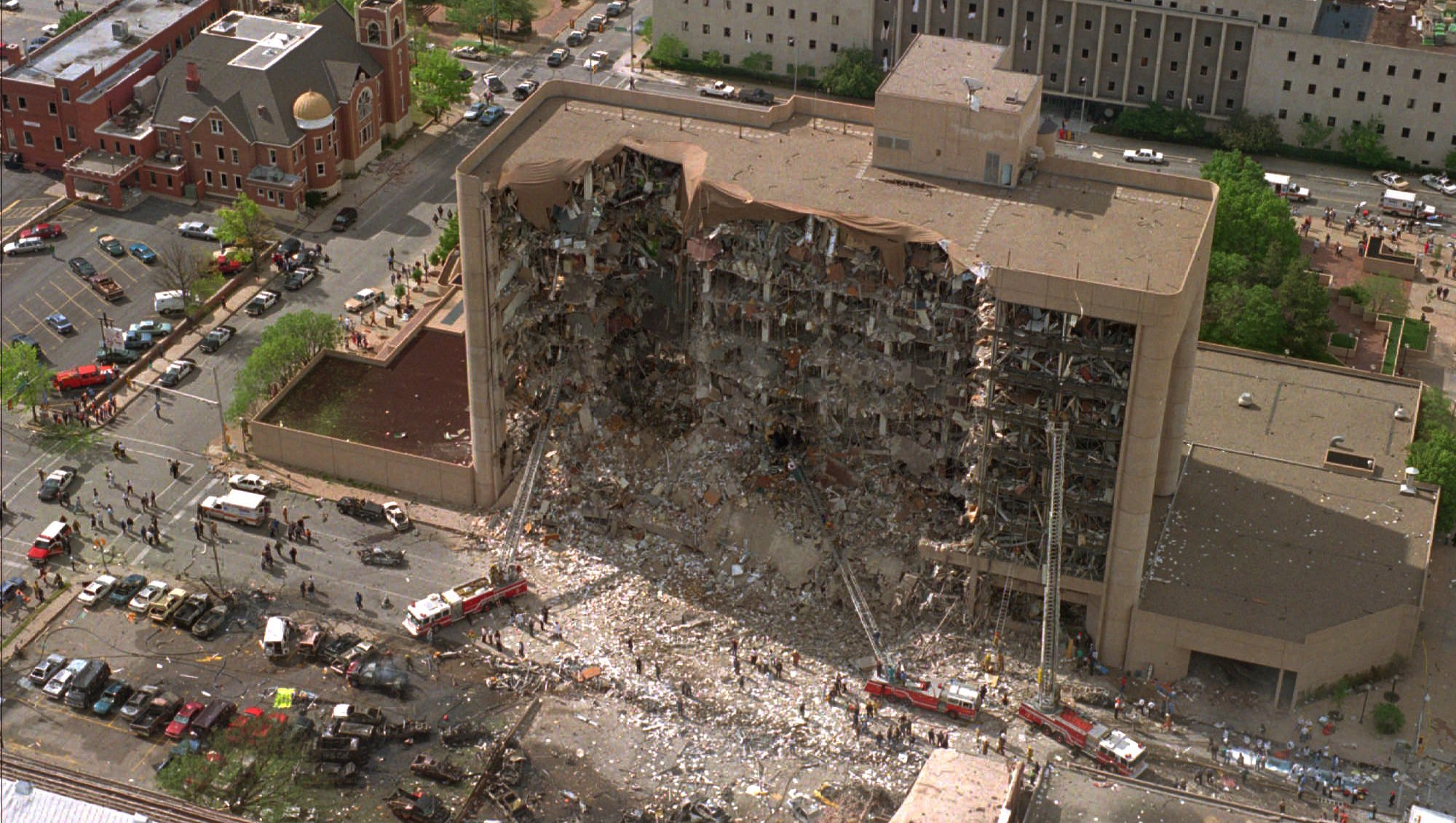
On April 19th, 1995, a truck bomb was detonated in downtown Oklahoma City just outside the Alfred P. Murrah building. It ended up killing 168 people and injured nearly 700 more. And some of those deaths were young children who had been at the daycare center operating within the building.

It was, by every measure, a horrific attack. Before 9/11, it was the deadliest terrorist attack on American soil. While I don’t remember exactly where I was on that day, I still remember it being a big deal. Even though I don’t live anywhere near Oklahoma City, my school and my community held vigils. We even had this elaborate tree on which we placed cards commemorating the victims.

For weeks and months after this event, there was a great deal of fear and panic. If one truck bomb could do this kind of damage, what’s to stop other similar attacks? And if it came from some well-funded terror cell operating internationally, how could we possibly feel safe?

But then, the story surrounding Oklahoma City shifted when federal authorities identified the primary suspect. It was not some terrorist group who had trained overseas. It was not an operation conducted by a rogue nation or some anti-American government. It was perpetrated by a white American man named Timothy McVeigh.

He was not Osama Bin Ladin or Saddam Hussain. He was an all-American man born in upstate New York. He’d also served in the military and fought in the first Gulf War. He did not fit the image of a stone-cold terrorist. He did not match the narrative that most Americans surmised from such a devastating attack. The idea that a white male American veteran would commit a terrorist attack against his own country wasn’t just unthinkable. It made no sense.

Now, McVeigh did have his own twisted reasons for carrying out this attack. He was an extreme reactionary, having fallen in with militant right-wing organizations that had been operating in America for decades. They’re anti-government, anti-liberal, pro-gun, and often racist. I won’t delve too much into the details surrounding McVeigh’s ideology. But it’s disturbing in terms of how mainstream it still is in modern right-wing groups.

And I think it’s because of those parallels that the Oklahoma City bombing got completely overshadowed after 9/11. Because that terror attack, in addition to having a higher death toll, better fit the narrative that most Americans assume. The perpetrators weren’t homegrown. They were all foreign born, having embraced a radical religious ideology that is not at all mainstream in the United States.

It’s much easier to frame terrorists like that in a typical good versus evil dynamic. And it was much easier for the recourse that followed to play out. Unlike Oklahoma City, the 9/11 attacks prompted a quick response against the Taliban, who had harbored Al-Quida. It allowed the news media to play endless stories about America striking back against the evil foreign terrorists who dared to strike our country and kill our citizens.

That certainly made for a better narrative. But a better narrative also left little room for nuance. There’s no question that what happened on 9/11 was an atrocity. And that atrocity warranted a response. But whereas American committed themselves to never forgetting the events of that fateful day, they seem all too willing to forget about the Oklahoma City bombing.

One is simple in that it was an outside force who attacked us.

The other is complicated because it came from a fellow American who’d been radicalized by a dangerous, homegrown ideology.

One requires a forceful response on a foreign land. The other requires introspection and a deeper understanding of what’s happening within certain parts of American culture. Naturally, the recourse that requires less thinking is going to win out. That doesn’t make it right or wrong. But it does obscure our collective perceptions.

I don’t doubt that there’s a real threat posed by Islamic terrorists. Subsequent attacks all over the world after 9/11 have demonstrated that. However, in terms of likelihood and proximity, most Americans are far more likely to be attacked by an extremist in the mold of Timothy McVeigh.

I don’t even need to travel very far to encounter people who share his extremism. If I were to drive about an hour from my house into some of the more rural parts of my region, I’ll come across communities that are deeply conservative and extremely reactionary. Get any one of them talking about the government, gun control, or anyone whose political leanings are slightly to the left of Ronald Ragean, and they’ll seethe with a hatred that is neither rational nor justified.

I’ve had to deal with these people when they are agitated. They are dangerous in their own right. And I’m a lot more wary of them than I am of any foreign-born terror threat. But if I were to articulate this to them or even others who share my leanings, and chances are I’ll get some strange looks. I might even be attacked for thinking my fellow Americans are a greater threat than foreign terrorists.

But I still consider myself a proud American. I want my country to succeed. And I want us to confront any and all threats, be they foreign or domestic. The Oklahoma City bombing on April 19th, 1995, proved that the domestic threat is very real, just as September 11th, 2001, proved that the foreign threat is very real.

Yet we always fear one more than the other. And we’ve committed to never forgetting one while eagerly ignoring the other. But we shouldn’t. If we, as Americans, are to truly become the great country we strive to be, we must remember and learn from both traumatic events, especially if the lessons from one are a lot harder to swallow than others.

Leave a comment

Filed under Current Events, politics

Why Americans Should NEVER Talk To The Police: A (Relevant) Legal Perspective

These are strange, distressing times for America. As an American myself, I’ve never been more concerned or pessimistic about the future of the country I love. There are many reasons for that. But rather than get overly political and go on another rant, I want to offer some important advice to any American who might find this.

Regardless of what you see in the news or in rage-baiting headlines, you still have rights under the Constitution.

The current people in power have shown time and again that they are very willing to undermine those rights. You cannot let them. As an American, it is your responsibility to protect and defend those rights. Believe it or not, you do have the law on your side, even if those enforcing it would have you believe otherwise.

To understand, I’d like to refer to an old YouTube video from 2012 that I often share with people who don’t understand the law, the Constitution, or rights in general. It’s a lecture from a former criminal defense attorney at a law school. He makes the case better than anyone before or since that you, an American citizen, should never under any circumstances talk to the police.

It doesn’t matter if you’re innocent. It doesn’t matter if you’ve never broken a single law in your entire life. Thanks to the Constitution, specifically the 5th Amendment, you have the right to not talk to the police. And you should use it. If you want to know why, just watch this video and share it with everyone you know.

Hopefully, you now understand and will act accordingly, should you ever encounter the police or any law enforcement official. There are plenty of other videos on YouTube that document police encounters. But this one is still the most informative from a purely legal perspective.

Also, I would supplement this video with a few other details that are worth mentioning. If the police ever knock on your door, don’t open it unless you have a screen door separating you and the officers. Unless they have a warrant, they cannot legally enter your home by force.

And if possible, record your encounter and let the officers know that you’re recording. It doesn’t matter if they have body cameras. Make sure you document every detail of the encounter. And make sure the video you’re recording is stored somewhere other than your phone. If you ever have any legal issues, that video will be instrumental.

Lastly, and this is something that I doubt the men in the video could’ve foreseen, but these rights apply to everyone in the United States, regardless of their citizenship status. It doesn’t matter what anyone in the reactionary media say. The language of the 14th amendment is very clear.

All persons born or naturalized in the United States, and subject to the jurisdiction thereof, are citizens of the United States and of the State wherein they reside. No State shall make or enforce any law which shall abridge the privileges or immunities of citizens of the United States; nor shall any State deprive any person of life, liberty, or property, without due process of law; nor deny to any person within its jurisdiction the equal protection of the laws.

Note the bold text. It says person and not citizen. Anyone who claims otherwise is an idiot, a liar, or both.

I really wish I didn’t have to make a post like this for my fellow Americans, as well as those aspiring to be American. But these are the times we currently live in. They suck. They’re probably going to get a hell of a lot worse. But at least for now, the Constitution says you have rights. And now, more than ever, you should cherish and defend them.

Leave a comment

Filed under Current Events, politics

Jack’s CreepyPastas: I Have Demon Vision

This is a video from my YouTube channel, Jack’s World.

This video is a CreepyPasta story inspired by my own experience with poor vision and LASIK eye surgery that I wrote and narrated myself. Enjoy!

Leave a comment

Filed under CreepyPasta, horror, YouTube

Jack’s CreepyPastas: Why Heaven Is Hell

This is a video from my YouTube channel, Jack’s World.

This video is a CreepyPasta story about Heaven and why it is actually Hell. Enjoy!

Leave a comment

Filed under CreepyPasta, horror, YouTube

Jack’s CreepyPastas: I’m A Former Timeline Assassin

This is a video from my YouTube channel, Jack’s World.

This video is a CreepyPasta story inspired by some alternate history stories that I wrote and narrated myself. Enjoy!

Leave a comment

Filed under CreepyPasta, horror, YouTube

Happy Memorial Day 2024

Today is Memorial Day.

For many, it marks the official start of the summer. The pools are open, the beaches are crowded, and flip-flops are the shoes of choice. And that’s all well and good. I love warm weather, sunny beaches, and long days as much as the next American.

But Memorial Day has always had a more serious, and sometimes solemn connotation.

It’s a day in which we take a moment to honor those who have served their country in the armed forces. That is definitely a service worth honoring. America, as a country, would not exist without men and women willing to take up the call. What they do for this nation and what they sacrifice cannot be overstated.

In my own family, I’ve had multiple individuals serve. Going back to my grandfathers who fought in World War II to other close relatives who saw combat in Vietnam, it helps give perspective to what it means to be an American. You can say anything you want about how divided we are politically. You can say even more about the state of our culture, our conflicts, and the many things that make us unique.

There’s a time and a place to have those kinds of debates. But today is not one of them.

Regardless of where you stand on the political spectrum, I urge everyone to use today to take a step back to honor those who sacrifice and serve for the United States of America. If you can, participate in a parade or activity to honor veterans. If you can’t, consider denoting to a veterans charity.

But whatever you do, keep those who have served this country in your heart. They’ve already sacrificed plenty. Today, on Memorial Day, let’s return the favor.

1 Comment

Filed under Current Events

Celebrating Vasili Arkhipov: The Man Who Saved The World (And My Life)

This is a video from my YouTube channel, Jack’s World.

This video celebrates and honors the actions of Vasili Arkhipov, a man who saved the world during the darkest hours of the Cold War. It all unfolded during the Cuban Missile Crisis. The United States and the Soviet Union engaged in a high-stakes showdown over nuclear missiles that had been secretly stationed in Cuba. And at the most intense moment of the conflict, Vasili Arkhipov’s actions ensured the world was spared from nuclear war.

And, as a result, I owe this man my life. And many of those who view it likely owe their existence to him, as well. Enjoy!

Leave a comment

Filed under history, Jack's World, YouTube