Tag Archives: conservative

A Simple Definition And Criteria For Fascism

A lot of buzzwords and jargon get thrown around the internet these days. Engage in any form of debate or discussion with someone long enough and chances are things will get heated, ugly, and incomprehensible. And if said discussion or debate goes on long enough, then eventually Godwin’s Law will take hold.

Now, I don’t care to recount the futility or frustration that often comes with internet discourse. I’ve already wasted way too many hours debating with idiots, assholes, grifters, creationists, and anti-vaxxers. However, there are certain trends in which substance should take precedent over style. If not, then we’re not even talking about anything. We might as well be yelling obscenities at a rock in a dark basement.

In that spirit, I’d like to remind everyone who sees this post that words do have specific definitions. Concepts do have defined criteria. You can throw them around in any discussion or debate to help your argument. But if you don’t understand what they mean, then you’re not just failing in that effort. You’re actively diluting the very concept of language and contributing to the destruction of society.

I know that may sound hyperbolic, but I have to use that sort of language when it comes to definitions of words like fascism. I know that just by typing that word, I’m raising a lot of red flags and pushing a lot of proverbial buttons. There might be people at this very moment who see that word as a thought-terminating cliche, thereby giving them an excuse to completely ignore or discount anything I say after this sentence.

Please resist that urge. The well-being of the human race needs you to be slightly more self-aware.

Because fascism is a serious topic of discussion. This isn’t some buzzword meant to generate clickbait. Fascism is directly responsible for the deaths and suffering of millions of people. Yet people throw that label around nothing more than a blanket term for “politics/ideology I don’t like.”

Again, please stop doing that. Please resist the urge to do that. You’re spitting on the mass graves of millions of people by doing that.

But given the current political situation in many modern nations, fascism is a growing issue. I’ve even seen it here in my home country, the United States of America. There are people I know who actively support turning our government into a fascist system. They may not call it that, but it fits the criteria. They may not know/care about that criteria, but everyone else should.

Because fascism is a threat to you, your family, and everything you hold dear. You can’t beat it by “owning” fascists in an online debate. You can only beat by actively resisting it. But how do you know if what you’re dealing with is actually fascist and not some generic thought-terminating cliche?

Thankfully, people far smarter than us have actually thought about this and done the necessary work. The following criteria was submitted back in 1995 and to date, it’s one of the most comprehensive lists for defining fascism. There may be others, but this is the most straightforward. What follows is a simple excerpt from Wikipedia:

  1. The cult of tradition“, characterized by cultural syncretism, even at the risk of internal contradiction. When all truth has already been revealed by tradition, no new learning can occur, only further interpretation and refinement.
  2. The rejection of modernism“, which views the rationalistic development of Western culture since the Enlightenment as a descent into depravity. Eco distinguishes this from a rejection of superficial technological advancement, as many fascist regimes cite their industrial potency as proof of the vitality of their system.
  3. The cult of action for action’s sake“, which dictates that action is of value in itself and should be taken without intellectual reflection. This, says Eco, is connected with anti-intellectualism and irrationalism, and often manifests in attacks on modern culture and science.
  4. Disagreement is treason” – fascism devalues intellectual discourse and critical reasoning as barriers to action, as well as out of fear that such analysis will expose the contradictions embodied in a syncretistic faith.
  5. Fear of difference“, which fascism seeks to exploit and exacerbate, often in the form of racism or an appeal against foreigners and immigrants.
  6. Appeal to a frustrated middle class“, fearing economic pressure from the demands and aspirations of lower social groups.
  7. Obsession with a plot” and the hyping-up of an enemy threat. This often combines an appeal to xenophobia with a fear of disloyalty and sabotage from marginalized groups living within the society (such as the German elite’s “fear” of the 1930s Jewish populace’s businesses and well-doings; see also antisemitism). Eco also cites Pat Robertson‘s book The New World Order as a prominent example of a plot obsession.
  8. Fascist societies rhetorically cast their enemies as “at the same time too strong and too weak“. On the one hand, fascists play up the power of certain disfavored elites to encourage in their followers a sense of grievance and humiliation. On the other hand, fascist leaders point to the decadence of those elites as proof of their ultimate feebleness in the face of an overwhelming popular will.
  9. Pacifism is trafficking with the enemy” because “life is permanent warfare” – there must always be an enemy to fight. Both fascist Germany under Hitler and Italy under Mussolini worked first to organize and clean up their respective countries and then build the war machines that they later intended to and did use, despite Germany being under restrictions of the Versailles treaty to not build a military force. This principle leads to a fundamental contradiction within fascism: the incompatibility of ultimate triumph with perpetual war.
  10. Contempt for the weak“, which is uncomfortably married to a chauvinistic popular elitism, in which every member of society is superior to outsiders by virtue of belonging to the in-group. Eco sees in these attitudes the root of a deep tension in the fundamentally hierarchical structure of fascist polities, as they encourage leaders to despise their underlings, up to the ultimate leader, who holds the whole country in contempt for having allowed him to overtake it by force.
  11. Everybody is educated to become a hero“, which leads to the embrace of a cult of death. As Eco observes, “[t]he Ur-Fascist hero is impatient to die. In his impatience, he more frequently sends other people to death.”
  12. Machismo“, which sublimates the difficult work of permanent war and heroism into the sexual sphere. Fascists thus hold “both disdain for women and intolerance and condemnation of nonstandard sexual habits, from chastity to homosexuality”.
  13. Selective populism” – the people, conceived monolithically, have a common will, distinct from and superior to the viewpoint of any individual. As no mass of people can ever be truly unanimous, the leader holds himself out as the interpreter of the popular will (though truly he alone dictates it). Fascists use this concept to delegitimize democratic institutions they accuse of “no longer represent[ing] the voice of the people”.
  14. Newspeak” – fascism employs and promotes an impoverished vocabulary to limit critical reasoning.

Having laid out these points, I urge everyone to take a step back and look at the current political situation in their surrounding area. Take a look at your own politics while you’re at it. Be brutally honest with yourself. Be mindful of what these ideas mean to people who aren’t you and are in a more vulnerable position.

How fascist are your ideals?

How fascist are your politics?

How fascist are your general perspectives on the world?

They may not fit every criterion. They may not even fit half. But how comfortable are you with them fitting more than one? And would you be willing to re-evaluate these principles?

Because one day, you might find yourself in a society where fascism is taking hold. It rarely happens all at once. It also cloaks itself in other labels, be they political slogans or social movements. But try and look beyond the terms. Look instead at the ideas and actions. If it meets a few too many criteria, then you have a choice to make.

If it’s not too late, then you can choose to oppose this distressing trend. Just remember that if you don’t make that choice, then eventually it will be made for you.

Leave a comment

Filed under Current Events, philosophy, politics

When And Why Governments And Societies (Won’t) Change

This is a video from my YouTube channel, Jack’s World.

Change is the only true constant. Many seek it for one reason or another, but there’s always so much resistance to it. Governments and society are very erratic when it comes to change. Why is that?

In this video, I attempt to offer a balanced explanation.

Leave a comment

Filed under Current Events, Jack's World, psychology, YouTube

To Those Behind The Jubilee YouTube Channel: Please STOP!

Seriously, for the good of America, the world, and the human species as a whole, just stop what you’re doing.

I hope I don’t need to go into specifics. If you know what I’m talking about, you can probably fill in the blanks based on the first sentence alone. But if you’re blissfully unaware, I’ll only offer the basics.

Jubilee isn’t just the name of a beloved X-Men character. It’s the name of a YouTube channel that specializes in debates/clickbait. They claim they seek to provoke greater discussions and create better connections between those with different points of view.

That’s bullshit.

Everyone working for this channel knows it’s bullshit. If they’re capable of putting their pants without assistance, they have to know.

They’re not in the business of thought-provoking discussions. They’re in the business of clickbait/rage-bait/anything that will get them trending on social media. They invite controversial figures, mostly “influencers” who operate on the extremes of the political spectrum. And they put them in a room surrounded by people who are diametrically opposed to their viewpoints. Then, they engage in timed debates on various controversial issues.

Now, in the pre-internet era, this would’ve been harmless. Even if you put it on TV, it probably wouldn’t have too great an impact. It would just be a temporary spectacle. But this isn’t just a world dominated by the internet. This is a world where extreme voices can make the most noise and gain both attention and power.

That’s not merely an exercise in free speech. That’s enabling assholes by giving them a large platform, a big audience, and an opportunity to completely change/destabilize public discourse on important topics. I liken it to letting random strangers have a say in important medical decisions while your doctor tells you things you don’t like hearing. Yes, people are free to share their opinions on such matters, but listening to those opinions you prefer is going to have serious consequences.

Now, I admit I did watch a number of these Jubilee debates. I’ll even concede that some of them are entertaining and memorable. But at no point do I ever feel like these debates are productive. I guarantee that not one person changed their mind or even reconsidered a position by watching these debates. If anything, all they do is make everyone more extreme and entrenched.

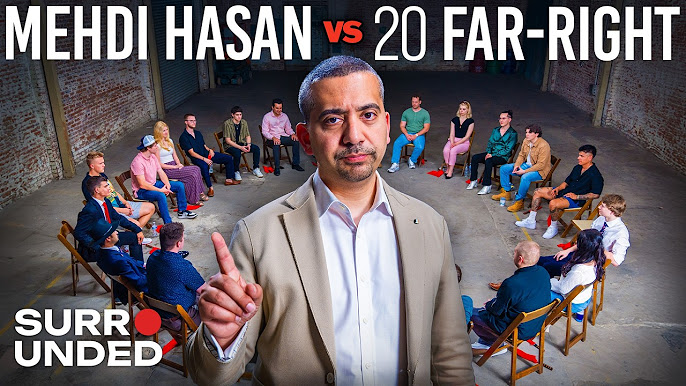
Certain debates have been plenty controversial, given the figures they’ve invited onto this show. But the one that prompted this post involved journalist Mehdi Hasan, who was tasked with debating 20 far-right conservatives.

Now, I don’t want to provide a link to this video. The last thing I want is for this channel to get any extra clicks at my expense. I’ll just say that the label “far-right conservatives” was too generously. Even calling them outright fascists would’ve been too kind. These people who “debated” Mr. Hasan are just assholes in the highest order.

Their politics have nothing to do with policy. They revolve entirely around being a dick to whoever they want, facing no consequences, and getting paid/empowered by their dickish behavior. These aren’t just people who want to live in conservative utopia. They want a world where they’re masters on a planation and everyone else is a slave who does their bidding.

But to write them off or claim they’re not representative of conservative values is missing the point. The fact remains that Jubilee sought them out. Jubilee platformed and emboldened them. Their rhetoric wasn’t just stupid, hateful, and irresponsible. In this current system of clickbait, bots, and algorithms, their assholery will be rewarded.

Sure, one of the participants lost his job for basically espousing Nazi talking points. But then, he used a go-fund-me to raise thousands of dollars to ensure he’ll be rewarded. And any system or society that effectively rewards people who champion Nazi shit is doomed to fail.

Now, as someone who makes YouTube videos who will never have the audience of Jubilee, I understand the desire to get more views, clicks, and subscribers. But at what point is it worth empowering people who champion Nazi shit? No amount of money is worth it. History has shown what happens when assholes like this are emboldened. We cannot let that history repeat itself.

Once again, I call on everyone behind the Jubilee channel to take a step back, think hard about what you’re doing, and realize this shit isn’t just irresponsible. It’s dangerous. If you want to host more debates with Skip Bayless and passionate sports fans, then go for it. That’s far less likely to involve Nazi shit. But what you did with Mehdi Hasan was far beyond any line that should never be crossed.

You have the power to stop.

You have the power to delete the video or at the very least, apologize for it.

Use that power wisely. Because the people who talk Nazi shit sure as hell won’t.

Leave a comment

Filed under politics, rants, YouTube

Why You Should Be Skeptical (And Suspicious) Of Those Who Talk About Falling Birthrates

In general, I try not to discuss politics outside of appropriate spaces. And those spaces are usually small, confined, and located within areas where nobody close enough to punch one another. That’s not just a byproduct of having followed the news too closely for the past 10 years. I’ve just learned over the years that talking politics with random people is a quick way to make enemies, get angry, and generally lose what little faith in humanity you might have had.

There’s a time and a place to have political discussions. That time is almost never and that place is almost nowhere, unless you actively work in institutions that deal in such policies. You just have to be aware that certain discussions about certain issues are bound to get heated. And it’s next to impossible to change anyone’s mind about a particular position through these discussions.

However, in my personal experience, which I understand is limited, I’ve noticed there are a few hot-button topics that often double as red flags for certain people. It’s not that the topics themselves aren’t relevant. They usually are. But when certain people single them out as a major area of concern, it warrants a certain level of caution. Because many of those people may not be arguing in good faith.

There are many issues and topics like that. But one in particular, which has become relevant in multiple countries, has to do with falling birthrates. Now, in terms of the actual numbers, there is cause for concern. If you actually look up population trends in numerous countries, you’ll confirm that this is a global trend. And falling birthrates certainly do incur a host of social, political, and economic problems for any given society.

That being said, there’s a right way to approach this issue, as well a wrong/misguided/deeply disturbing way. The right way is more academic than political. You study the factors surrounding the trend. Analyze which of those factors are influenced by certain policies. Then, you take the appropriate prescriptive measures.

But that’s not the approach certain people make. I don’t want to name names, but most of these people are closely aligned with the conservative, right-wing, or reactionary part of the political spectrum. They also tend to be staunch traditionalists who argue society has deviated too much from the morals, values, and social norms we used to have. And addressing the problem of falling birthrates, along with a host of other problems, requires that society reverse that trend.

Now, the people making these points may very well be sincere. They may genuinely believe that people would be happier and more prosperous if they lived like we did in whatever nostalgic past era they idolize, whenever and wherever it might be.

However, in terms of the actual substance of this argument, it’s total bullshit.

And in terms of larger implications, it might even be a mask for a more nefarious agenda.

To understand why, it’s worth asking two important questions with respect to birthrates and those who obsess over it.

Question #1: Who benefits most directly from increasing birthrates?

Question #2: What other agenda does addressing this issue serve?

In the case of falling birthrates and ways to address it, there are certain policy prescriptions that tend to get emphasized over others. Those who like to frame declining birthrates as a serious issue tend not to talk much about the rising costs of childcare, housing, and food. They also tend not to talk much about the fact that wages, on a global scale, have remained relatively stagnant.

Instead, the reactionary crowd will highlight social issues like LGBTQ rights, declining marriage rates, feminism, and a lack of religious affiliation. Even if they touch on some of the economic issues, they won’t label them as a high priority. They’ll just frame women, teenagers, and sexual minorities as deviants or aberrations who are not contributing to society in a meaningful way.

They may claim they’re just concerned about the future of society. But in general, their concerns can often be boiled down to furthering draconian policies on women, workers, and young people. And the people and organizations who benefit are usually who you might expect.

Rich, well-connected business owners need a growing population to buy their products and/or get locked into their network of services.

Powerful, well-connected political organizations need a growing population to sustain the social and economic status quo that put them into power.

Religious organizations need a steady increase in population to ensure more adherents, which in turn means more influence and tax-free money for them.

The ones who don’t benefit are usually women who can’t access or afford family planning. It also negatively impacts LGBTQ+ communities because they’re denigrated for not contributing to the population/consumer/worker base. It also negatively effects workers who get stuck in cycles of poverty because they have too many kids that they cannot afford.

Again, this is not to say that falling birthrates aren’t an issue. There are certainly steps society can take to address this issue. And those steps will definitely vary from country to country. But for certain people of certain political leanings, it’s a cover for regressive, reactionary policies that benefit nobody except those who are already rich and powerful.

Be aware of that because, in most cases, serving the interests of those at the top of an imperfect system only hinders any efforts to address those imperfections.

Leave a comment

Filed under abortion, political correctness, politics, sex in society

Why Hate And Bigotry Always Win Out (To A Point)

This is a video from my YouTube channel, Jack’s World.

This video is about hatred and bigotry. I’ve witnessed it manifest in many forms over the course of my life. It is a dark, disturbing insight into humanity’s collective psyche. But in that same experience, I came to a number of realizations about hatred and bigotry that I wish to share. Hopefully, it broadens everyone’s perspective on the matter.

Leave a comment

Filed under Current Events, human nature, Jack's World, psychology, rants, YouTube

An Important Hypothetical Question To Consider (Before Any Debate)

I’ve been using the internet for a good chunk of my life. I’m old enough to remember the days of slow dial-up, AOL chatrooms, and messy Geocities websites. And while I don’t miss those days, there are certain elements of my internet experience that have remained fairly constant.

One of them has to do with debates. And if you’ve ever talked politics, comics, anime, or movies with anyone on any medium, you know how heated that can get.

Believe me, I know this as well as anyone. I still haven’t forgotten how heated some debates got on the old comic book message boards I used to frequent. Some want to say social media ruined discourse by making it too easy to engage in such debates. But I respectfully disagree.

This sort of tension between people always existed. Human beings have always had their share of strongly held opinions that they were debate, discuss, and defend far past the point of reason. It doesn’t matter how smart, educated, or well-informed they are. The passion with which they hold their views has always been strong. The internet and social media simply made it more prominent.

I’m bringing this up for two reasons. For one, I see a lot of debates and arguments online, especially in comments sections and on social media. I freely admit that I engage in some of that discourse. It’s rarely productive. And I’ve yet to meet anyone who has been convinced to change their position on something based on a point someone made in a Facebook comment.

Second, I live in the United States of America and this year happens to be an election year. Debates about politics, issues, and policies are bound to get more heated. And that’ll only escalate the closer we get to Election Day on November 5, 2024. I fully expect to see plenty of discourse that will make me lose my faith in democracy, the future, and humanity in general.

For those reasons, and plenty others I don’t care to articulate, I want to present a simple hypothetical to anyone seeking to debate others in any capacity on any issue, be it political or otherwise. It’s not a thought experiment. It’s just a simple perspective that I hope provides greater context into the nature of discourse. It goes like this.

You and one other person are standing in a room. You both hold opposite positions on a particular issue. You spend five minutes making your case to the other person. Then, the other person spends five minutes making theirs. You are not at all swayed by their argument and they are not at all swayed by yours.

But before you start any further discussion, a third person enters the room and pulls out a special phone containing critical, indisputable information about the issue.

In one scenario, the phone contains information that vindicates your position.

In another scenario, the phone contains information that completely disproves your position.

In which scenario do you actively fight for possession of the phone?

What I just described is situation that I hope adds context to the what, why, and how of debating others. Because if you approach this hypothetical in good faith, it puts you in a difficult position. Either you admit you seek vindication and are willing to fight for it or you actively avoid the implication that your position is wrong.

Call it confirmation bias.

Call it cognitive dissonance.

Call it an impossible scenario that will never play out because there are too many issues that cannot be completely verified beyond any and all doubts.

If you’re honest with yourself, you know how you’ll react in that scenario. And if you’re honest about how most people operate in heated discourse, you’ll know how your opponent would react in this scenario.

However you feel about what I just presented, I only ask that you keep it in mind as you engage in further discourse moving forward.

Leave a comment

Filed under philosophy, political correctness, politics, Thought Experiment

A Superyacht Caused A Devastating Forest Fire To Further Prove Billionaires Are Assholes

When it comes to being rich, there are only two types.

The first type is more traditional and common, relatively speaking. That type of rich largely covers people who can afford to live in nice houses within nice neighborhoods in well-maintained communities while not drowning in debt, be it from credit cards and student loans. These aren’t the kind of rich people who live in mansions and have butlers. These are just people who have comfortable, affluent lifestyles.

I don’t have a problem with rich people like this. I even know some of them. They’re generally decent people. And while some did inherit part of their wealth, they still had to work to some extent in order to maintain it. If they didn’t, then they wouldn’t remain rich for very long.

Then, there’s the second type of rich people. These people are rich in ways that most of us, including the first type of rich people I just mentioned, cannot begin to fathom. These are people with access to billions of dollars of wealth. I know people love to throw terms like millions and billions around interchangeably, but I don’t think those people realize just how much more a billion is than a million.

To illustrate, consider the following anecdote.

If you made approximately $50,000 a year, it would take you about 18 years in order to make $1 million. That’s a timeframe we can wrap our heads around. Most people work longer than 18 years in their adult lives.

But working at that same rate, it would take over 18,000 years to make $1 billion. That’s nearly three times longer than the history of human civilization. That is not a trivial difference.

And that difference is worth highlighting because only the second type of rich people can afford obscene displays of wealth like yachts. I also think it’s entirely appropriate to label these types of displays as obscene. Because yachts are not just boats.

They might as well be floating private islands that rich people use as extensions of their gawdy lifestyle. It’s not enough they can afford armies of butlers, nurses, nannys, personal chefs, and servants. They have to take that shit with them across the ocean. Just imagine feeling like you need that kind of pampering and luxury to begin with, let alone take it with you on an oversized boat.

It’s just one of the many reasons why I’ve come to believe that there’s no such thing as a “good” billionaire. But if you’re a billionaire who happens to own a yacht, then I’m just going to assume you’re an insufferable asshole until proven otherwise. Thus far, I haven’t been able to find reliable proof in that regard.

But all too often, I come across proof in the opposite direction that further affirms that these types of rich people really are assholes. The latest bit of proof comes courtesy of a misguided fireworks display organized by the crew of a superyacht that had been chartered by a group of rich people who don’t mind dropping $320,000 a week.

What’s the difference between a yacht and a superyacht? I don’t claim to know, but it’s safe to assume you have to be a special kind of greedy, self-centered asshole to think a regular yacht isn’t obscene enough.

But according to the Daily Beast, this particular superyacht tried to do a firework show off the Greek island of Hydra. While it might have looked pretty initially, it didn’t end well because it caused a massive forest fire on the island. Thankfully, no one was hurt in this fire, as far as we know. Even so, this is the kind of display that only the obscenely wealthy can pull off.

It’s not enough for people like this to live on a floating resort where they’re treated like royalty. They need a personal fireworks show to be entertained, even if it puts part of the natural world at risk. Even if you grand them the benefit of the doubt that this was entirely an accident and the people involved feel bad about it, remember this one detail.

These people won’t be the least bit inconvenienced.

It doesn’t matter that the mayor of the island is seeking compensation. Chances are he’ll run into an army overpaid lawyers who will either pay for this incident to go away or just plain intimidate the people on this island into submission. For most of the people paying these lawyers, the most they’ll have to do is make a phone call, sign some papers, and maybe even wire some money.

If anyone else mistakenly caused a forest fire that devastated an entire island, there would be consequences. This wouldn’t be something we could just ignore or bully our way out of. Then again, this isn’t something most of us are in a position to even do. We don’t own or use any yachts, let alone a superyacht.

We don’t know the names of the people who were on this superyacht when the fire erupted. Chances are we’ll never know, thanks to those aforementioned lawyers. But whoever they are, they’re still prime examples of why billionaires in general are assholes.

Leave a comment

Filed under Current Events, human nature, politics, rants, real stories

Should Billionaires Even Exist? A Serious Question

In general, I’m in favor of capitalism.

I believe people have the right to work, buy, sell, and do business as they see fit. There certainly need to be rules. No social, economic, or political system can function without rules that are fair and well-enforced. That’s not a political statement. That’s just cold, hard realism.

In that same mold, I am not in favor of unmitigated capitalism in the mold that most libertarians and conservatives envision. I do not believe corporations, businesses, and industries should be given excessive leeway when it comes to dealing with fraud, failure, or environmental destruction. There needs to be some level of regulation to curtail the excesses of the market.

In my youth, I used to be a lot more libertarian in my views on how much or how little capitalism should be regulated. But as I’ve gotten older, I’ve become more aware of just how dangerous unfettered capitalism can be. You need only deal with Comcast’s customer service for any length of time to be convinced of that.

Now, I’m at an age where I feel like I’ve reached a new crossroads with respect to my view of capitalism. I won’t say I’ve completely lost faith in it or the idea. But I’ve seen way too many instances of big corporations doing objectively evil things to not be critical. And when they get in bed with political institutions, that evil only compounds.

Seriously, there are companies and state governments colluding to roll back child labor laws. This is not a joke. These companies want to make children work for them because it’ll result in greater profits.

This brings me to billionaires. They are the most celebrated figures in all of capitalism. They’re regularly ranked and whenever someone else becomes the world’s richest person, it generally makes the news. Like many others, I often celebrated their achievements too. I used to think that making a billion dollars, let alone over $100 billion, took a special kind of drive.

I admit I was wrong about that.

Now, I don’t think that billionaires, as a class, should even exist.

That may sound like a radical position. It’s often a talking point that comes up among those on the extreme left of the political spectrum. And those who espouse anything close to it are often ridiculed as being anti-business, anti-American, or outright communists.

Those criticisms are bullshit, by the way. They’re also just a distraction to avoid the distressing implication about billionaries.

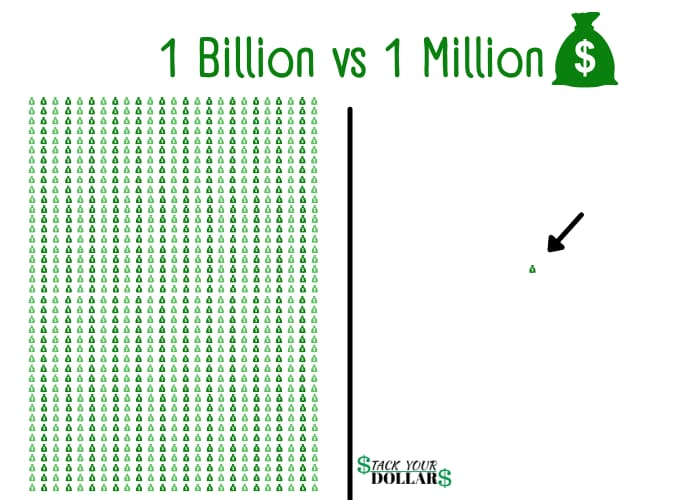
To understand, just take a moment to appreciate how much more a billion dollars is than a million dollars. I know those three extra zeros might not mean much to most people. But in simple mathematical terms, the gap is vast. In case you need something visual, here’s a quick image to help illustrate the concept.

Again, it’s not a trivial difference.

But if you need another way to conceptualize just how big a billion dollars is, consider the following.

One million seconds is about 11 days. Most of us can grasp that length of time.

One billion seconds is 31.5 years. That’s a third of an average person’s lifetime.

I hope that helps belabor the point because with that now in mind, ask yourself one critical question.

Is it humanly possible for anyone to work hard or long enough to justify having a billion dollars?

In the past, I might have considered that a dumb question. But now, I would answer that question with an emphatic no. I don’t care how smart, skilled, capable, or dedicated anyone is. The idea that someone even could work hard enough to earn a billion dollars just doesn’t work.

Again, look at the visuals above. The difference between a million and a billion is extreme.

It also helps to think back to the hardest, most laborious job you ever worked. Whether it was working in fast food, construction, or retail, just think about how hard that job was and how much it paid you. Now, consider how hard your boss worked and how much they got paid. Did the extent of their work actually reflect their salary?

In some cases, it might. But in most, I doubt it. Apply that to how much more billionaires make compared to even senior managers at a company and the disparity becomes even more absurd. If that doesn’t convince you, then maybe this video highlighting a speech by Jesse “The Body” Venture will.

Beyond just the work, take a moment to think about what it would take to spend that kind of money. How many houses could you buy that you could reasonably live in? How many yachts or ships could you buy and actually use in any meaningful extent? How much fancy jewelry could you buy and actually wear?

I’m sure there are those who think they could spend a billion dollars with ease. I doubt those same people truly understand how much more a billion dollars is compared to a million. And even if they could, it would take real, considerable effort to spend that kind of money in a single lifetime.

There’s also the argument that billionaires donate a lot of money to charity and that effort is worth their massive wealth. I used to think there was value in that too. But I’ve also come to see that endeavor as little more than virtue signaling laced with tax avoidance.

And finally, there’s the idea that billionaires are somehow special and they have a unique set of skills that somehow warrants them having that kind of wealth. That’s partially true, but not in a good way. If you just look at how most billionaires made their money, you’d notice that a lot of them either involve inheriting wealth that they didn’t do a damn thing to earn or being exceedingly ruthless in exploiting the labor of others and/or avoiding taxes.

On top of that, those with that level of wealth can literally afford to manipulate the system, legally and illegally, to ensure that their wealth and status is preserved. Whether it’s through tax loopholes or lobbying for laws that benefit them (and only them), billionaires can basically shape the world as they see fit, even if it hurts people, the environment, and everything in between.

Even if you’re in favor of capitalism, it’s hard to deny the corrupting factors that just a few billionaires could have. No system can work when it’s so top-heavy that just three people have more wealth than the bottom half combined. You can still have a functional, vibrant capitalist system that encourages entrepreneurs and wealth creation. You can also have a system that allows for billionaires. But you cannot have both.

As an alternative, I propose this.

Once you make a dollar over $999,999,999, that money gets taxed at 100 percent. And every year, the government sends you a nice trophy that says “Congratulations! You won Capitalism!”

If that much money and the trophy is still not enough for you, then you’re not just greedy. You’re an asshole and you can’t be trusted with millions of dollars, let alone a billion dollars.

Leave a comment

Filed under Current Events, politics

A Brief Note On (The Stupidity Of) Book Bans

We live in strange, tense, and frustrating times. I know you could say that about any point in any era. But it feels like we’ve been saying that a lot late. I know I have. Just look at some of the posts I’ve made on or near Election Day in the United States. But as someone who lives less than two hours from Washington DC, I tend to feel the politics of these times more than most. And I’ve been around long enough to see some strange and troubling trends.

Then, there are certain acts or phenomena that are just plain stupid on a level that defies parody.

I generally try to empathize and understand where other people are coming from, especially if they have a different background or ideology from my own. There are just some instances where that’s not possible. The breadth of the stupidity is just too great.

That’s exactly how I feel about book bans. For reasons that are too fucking idiotic for me to paraphrase, there are real people living in real places in the United States of America who are advocating for book bans. Some are going so far as to burn them.

Again, this is not 1933. This is happening in 2023. That point is worth belaboring.

Now, I don’t want to name names or organizations. But you don’t have to look far to see who are advocating for book bans. You also don’t have to dig too deep to uncover what sort of ideology they ascribe to.

Here’s a hint. It’s the same ideology the requires stormtroopers, secret police, and prison camps.

But all you really need to know is that these efforts are usually the ones the villains in every TV show, book, or movie get behind. They see people reading books with ideas they don’t like. They worry that those same people, which include children and young adults needed for factories and war zones, embracing or identifying with those ideas.

But rather than confront those ideas, the book banning advocates would just prefer that people never know about those ideas in the first place. The evil, sadistic logic is that if people never read about it, then they can never think about it. And if they can never think about it, then they’re easier to control and guide.

That may not be the reason book banning advocates say out loud, but that is the effect. They’ll usually frame it as “protecting children” or “combating obscenity.” But don’t fall for that. At the end of the day, those who seek to ban books just want to eliminate ideas and stories they don’t like from the public consciousness.

That’s not conducive to protecting children and fostering a healthy society.

That’s a tactic for fascists, authoritarians, dictators, and general assholes.

Now, those tactics were certainly damaging in the past. Until very recently, books were the primary source of important information. If people didn’t have access to books, then they didn’t have access to knowledge, stories, and new ideas. Finding or preserving banned books used to take a concerted effort and many brave individuals put their lives at risk to further those efforts.

However, what makes modern book bans especially stupid is the simple fact that the internet exists. Libraries and book stores are no longer the lone repositories of knowledge and stories. Anyone with a smartphone can access more knowledge in five seconds than an entire university of academics could 50 years ago.

At this point, trying to ban books is akin to trying to censor telegrams. All they achieve now is raising the profile of these books they’re trying to ban. Hell, the book banning advocates might as well identify as free advertising because sales of banned books tend to spike whenever they bitch and moan about certain titles.

So, in addition to being a dick move, as well as tactics used primarily by fascists, it’s completely counterproductive. It wastes time, money, energy, and has the opposite effect of what’s intended. With that in mind, I have just one last message to those who still think banning books is a worthwhile endeavor.

Read a fucking book! Preferably a history book!

Leave a comment

Filed under Current Events, politics, technology, Uncategorized

A Brief Message On Voting (And Those Who Try To Restrict It)

When I was a teenager, it was not unusual to see these cheesy, poorly produced ads on TV that emphasized the importance of voting. Some even took it to cartoonish extremes, even for the era. I distinctly remember how sick I got of all those “Vote or Die” campaigns that seemed to air every 15 minuets.

Then, when I reached voting age, I finally got a chance to experience it. And, for the most part, I found it mundane and inconvenient. Just registering was a hassle. It couldn’t be done over the internet at the time. I had to go through my local post office, which was not a very memorable experience. And I had to find my polling place, which happened to be a local elementary school with dirty bathrooms and poor heating.

Even so, I voted because everyone told me it was important. I didn’t appreciate it at the time. And I still didn’t appreciate it, even as I kept voting throughout college. Granted, I did miss voting a few years, mostly because the mail-in ballots I had to use were a pain. And I had a lot of other crap going on both during and after college that kept me occupied.

But once my post-college life stabilized, I made it a point to keep voting in every election, even when it wasn’t for President. I still never put too much thought into it. Following local races can be difficult, especially when every campaign ad can be reduced to cheesy soundbites about how “evil” the opponent is.

All that being said, my perspective on voting has changed a lot in the past few years. It’s not that I’ve become politically awakened or radicalized in any meaningful sense. My politics today aren’t terribly different from what they were 10 years ago. It’s just that, over the past five years, I’ve watched American politics become increasingly ugly.

It used to be that people just disagreed on certain social and regulatory policies. Reasonable people can certainly disagree how much we ought to be taxed, how much we ought to be regulated, and how we allocate public resources. But politics since 2016 is not about reasonable disagreements.

Instead, it’s about opposing, resisting, or outright hurting your political opponents. It’s not that they disagree with you on certain issues anymore. It’s that they’re flat out evil. I have heard real, sober, straight-faced people call others devil-worshipping, baby-eating, child rapists over politics. There’s no discussing anymore. There’s not even an attempt at debate. It’s just yelling and hating against those you don’t agree with.

As a result, voting hasn’t just become more important. It’s also become hazardous. If you don’t believe me, just look up some of the harassment that poll workers have gotten in recent years. Just be warned, some of what they face is not for the faint of heart.

Now, I’m not bringing this up just to go on a political rant. I’m not even going to try and appeal to the humanity, patriotism, and civic responsibility of my fellow Americans. Having dealt with some of these people directly, I know that ship has sailed and sunk to the bottom of the ocean of tribalism.

We’ve officially crossed a line in American politics where voting is no longer a mundane civic duty.

It is one of the few remaining institutions that safeguard the public from demagogues, despots, and plutocrats.

So, with Election Day 2023 coming up soon for much of my fellow Americans, I certainly want to encourage everyone to vote. I also want to encourage everyone to register if they haven’t already. I can attest it’s much easier today than it was when I was a teenager. Just go to a website like Vote.org. No matter which state you live in, it offers all the resources you need to vote in local, state, and federal elections.

Again, it’s Vote.org.

Click the link. Follow the prompts. If you can read this website, you can register to vote.

But there’s one other important perspective I’d like to share on top of encouraging everyone to vote. And it has less to do with voting, itself, and more to do with those working very hard to make it difficult for more people.

Because make no mistake. There are powerful, well-connected individuals who are doing everything they can to make it harder to vote. This is not a conspiracy theory. There’s no effort to hide it, either. These anti-American, anti-freedom, objectively deplorable assholes (and no, I am not being hyperbolic) are outright targeting people they know won’t vote for them to gain, retain, or expand power.

Seriously, fuck these people.

Fuck them, their doners, and everyone on their staff who helps them undermine democracy.

They are an insult to American values. Take it from someone who consumes more superhero media than 85 percent of the population. Those who make concerted efforts to suppress, limit, or undermine peoples’ right to vote are either outright villains or they freely support such villains.

How else would you describe people who got upset when Taylor Swift encouraged her passionate legion of fans to register to vote? She didn’t even tell them to vote for a particular party or candidate. She just told them to register to vote. And still, one particular wing of the American political spectrum whined about it. It’s almost as though they know that if more people vote, they’re likely to lose because they know the general public thinks they’re assholes.

Again, fuck these people with the fury of a billion venomous spiders. I cannot belabor that enough.

We may not have superheroes in this world, but we the people can still oppose these villains. And the best way to do that for now is to vote. We can still disagree on any number of issues. But in general, if the choice is between a candidate or party that protects your right to vote and a candidate or party that would prefer to restrict it, then the choice should be clear.

If it’s not, then I don’t know what else to tell you other than to just make sure you’re registered to vote. Do not take this freedom for granted. Just take a brief look at the history of any country that has failed or declined. Once the people lose their rights, it’s very difficult to get them back.

Leave a comment

Filed under Current Events, politics, rants