Tag Archives: American Football

On Football, CTE, And Its (Not So) Bleak Future

When you love something a lot, you’ll make any excuse possible to keep loving it, no matter how unhealthy it may be. Whether it’s a toxic relationship or skydiving naked over the arctic, our desire to love and preserve such love knows no bounds. It’s a testament to the power of excuses and our capacity for excuse banking.

We’ve all loved something that may or may not be unhealthy, if not downright toxic, at some point in our lives. We may know in the back of our heads that it’s unhealthy. We may even admit it to someone. That still doesn’t stop us from loving it. We’ll still try to find a way to make that love work. Like an alcoholic or a heavy smoker in denial, we don’t want to admit its a problem. In the long run, it often comes back to hurt us.

I say all this because in recent years, there are a growing number of voices calling American football the new tobacco. Apparently, getting hit in the head by a bunch of 200-pound athletes is just as dangerous as inhaling smoke. In the same way smoking contributes to dreaded diseases like lung cancer, football contributes to a new dreaded disease called chronic traumatic encephalopathy, or CTE.

CTE has become the most dreaded three-letter acronym to football players since ACL. It is a new kind of disease, one that ravages the brain of former athletes. It causes all sorts of horrors such as headaches, memory loss, erratic behavior, dementia, tremors, vertigo, and suicidal tendencies. These are symptoms that can’t get more terrifying without involving explosive diarrhea.

It has already rocked the sport, so much so that it inspired a crappy Will Smith movie called “Concussion.” Sure, it tanked, but it helped raise awareness to the issue for fans and players alike. In wake of the deaths of several high-profile football players, including Hall of Famers like Ken Stabler and Junior Seau, it’s taken on a tragic element that cannot be ignored.

Then, just this past week, a study by the Journal of the American Medical Association published a report that probably has everyone at NFL offices banging their heads against the wall, if only to provide a sense of irony. Of the 111 brains of former football players they studied, 110 showed signs of CTE. In terms of sheer math, you literally can’t get a correlation that more precise without being paid for by oil companies.

This has led many to speculate that football’s days are numbered. Never mind the fact that it’s still, by a wide margin, the most popular sport in America. Never mind the fact that it generates billions in revenue and has some of the most passionate fans of any sport. An issue like this is just too damaging. A disease as awful as CTE is bound to drive people away from this sport, right?

Okay, I’m going to stop with the dire doom-saying rhetoric and call a timeout on the whole conversation. I do so while freely admitting, and admitting proudly, that I love NFL football and football in general. It is my favorite sport. I build my entire Sundays around watching NFL games.

I acknowledge that it’s a violent sport, one that leads to major injuries for various players. I make no excuses in my love for that kind of gladiator-style violence. I’m as human as anyone else reading this blog. Violent sports appeal to the primal parts of our brains. Like admitting you love an extra orgasm every now and then, there’s nothing wrong with admitting you love contact sports.

Does that make fans and team owners bad people for promoting a sport that leads to such a terrible health ailment like CTE? The answer is no. It doesn’t, not unless you’re willing to say car companies and car buyers are terrible people for promoting a product that killed over 32,000 people in the United States alone in 2015.

However, football fans and the NFL can take comfort in the knowledge that car companies have already created a model for addressing issues like CTE. There was no getting around it, even during the days of Henry Ford. Cars could be very dangerous to those who drove them and drove them poorly. Early cars were basically steel death traps.

Since killing customers is never a good business practice, car companies invested heavily in new safety features. They developed now-standard features such as air bags, seat-belts, and even on-board computers that stop your car for you. Cars today are safer than they’ve ever been before.

So how does this help football? A car is different from a human brain by orders of magnitude. The sheer complexity of the human brain ensures that a helmet or an airbag just isn’t going to cut it in terms of protection. We barely understand how the damn thing works. How can we hope to protect it?

Well, keep in mind that people once said the same thing about mapping the human genome. The human brain isn’t some magical object that runs on wizard spells and unicorn farts. It’s a hunk of biomatter no bigger than a football, ironically enough. It operates on the basic rules of chemistry and biology. It’s not some rough-cut diamond wherein one single flaw means it can never be fixed.

The brain can and does heal itself. It has to in a chaotic world that most people struggle to process. Sure, the damage endured by football players is greater than most. You can say that about anyone who spends four hours out of the week putting a target on their head and inviting others to hit it. What you can’t say, however, is that the problem of damaged brains in contact sports is insurmountable.

We’re not talking about teaching quantum physics to a hamster, here. We’re talking about a physical problem with the human body. As flawed as the human body may be, it’s also fairly malleable. The brain is no exception.

Back in 2013, a kid in North Carolina had half his brain cut out to alleviate his debilitating seizures. There’s no amount of head trauma any football player could endure that’s akin to having half a brain cut out. However, the kid recovered and his brain was able to effectively rewire itself so he could live a fairly normal life. That’s because of a little thing called neuroplasticity.

That’s just a fancy technical way of saying the brain can rewire and repair itself. Given how humans adapted in an environment full of giant predators and coconuts falling from trees, we kind of need our brains to do that sort of thing. The only issue is we still don’t understand it. However, we do understand the horrific damage done by diseases like CTE.

Therein lies the flaw in debate surrounding the future of football. It deals with something with which we don’t have a clear understanding. Even those who participated in the CTE study clearly admitted that it had its flaws. One of the researchers said:

“Families don’t donate brains of their loved ones unless they’re concerned about the person. So all the players in this study, on some level, were symptomatic. That leaves you with a very skewed population.”

That’s entirely understandable and a common problem within the realm of science. However, that will do little to alleviate the fear and dread among football players and football fans. We’re already seeing some players retire early due to concerns about concussions. Who can blame them, though? It’s a scary thought, the idea that playing a sport you love will destroy your brain.

However, fear often obscures the lens of reality. Add doom-saying, such as those who think a multi-billion dollar industry like the NFL is going to die, and you can expect reality to disappear from the conversation. The truth, in a sense, is not something you’ll find in a Will Smith movie. It also gives football fans and football players reason to hope.

Since the problem of CTE is a physical health problem, then that means there is a medical solution. Sure, there’s a lot we don’t understand about the human brain or healing it, but you could’ve made that same argument back in the 80s when AIDS was first discovered. For a while, that was a true death sentence. Now, we have treatments that make the disease manageable.

Keep in mind, though, that diseases like AIDS didn’t have a multi-billion dollar industry like the NFL with huge incentives to develop such treatments. When there’s a problem to be solved and there’s a multi-billion dollar industry with an incentive to solve it, you can probably assume said industry will invest billions in treating that problem.

That means if you’re a brain researcher and you develop a treatment for concussions, you can expect a lot of money from the NFL and various sports organizations to support you. Hell, Jerry Jones from the Dallas Cowboys will probably fly you to a resort and have the Dallas Cheerleaders give you unlimited massages.

CTE is a major issue, but it’s a solvable issue. On top of preventative measures like better helmets, medical science can help. That same science is what cured Small Pox, Polio, and is on the verge of eliminating many diseases with tools like CRISPR. It’s more than up to the challenge to tackle something like CTE.

Now that awareness of the disease is growing, you can expect the NFL and medical science to start pressuring it. That’s why football is going to be okay. This isn’t like smoking. This isn’t like human sacrifice. This is a problem that can only be solved with better tools. Say what you will about the flaws in humanity. We’re still exceptionally good at certain things and making tools is one of them.

For the players playing now, it’s definitely scary. However, that’s only because there’s still plenty we don’t know. It’s not an insurmountable challenge though. It is possible to defy the odds. If anyone knows that better than most, it’s NFL players. Just ask the 2007 New York Giants.

4 Comments

Filed under Jack Fisher's Insights

Happy Super Bowl Afterglow!

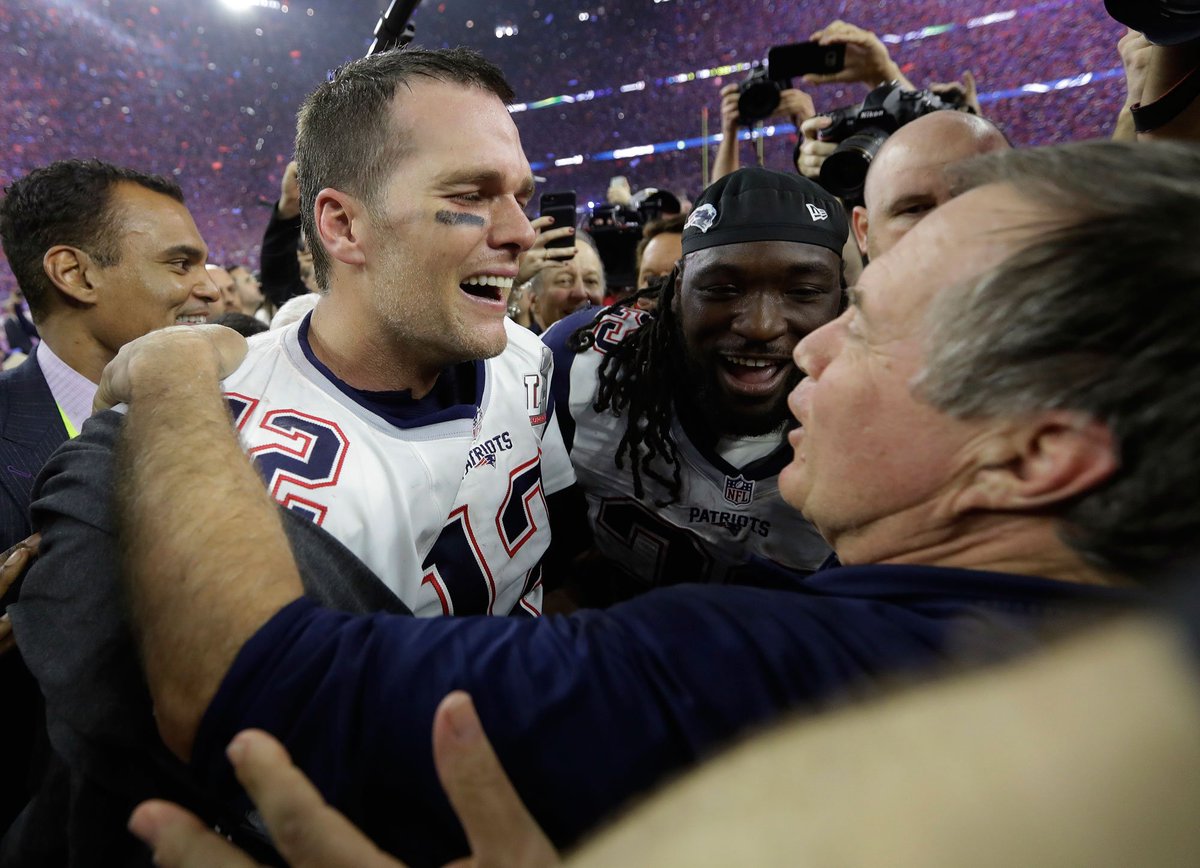
What a game, eh? The Super Bowl is over. Congrats to the New England Patriots and Gisele Bunchen’s husband for winning, crafting the greatest comeback in Super Bowl History. Now, the NFL season is over.

As a lifelong football fan, it’s a momentous, yet bittersweet moment. A champion has been crowned. A season has ended. For NFL fans and football fans in general, it’s the end of a beginning and the beginning of an end.

I hope everyone enjoyed the game. I certainly did. How could I not? Between the snacks, the beer, and the Lady Gaga halftime show, I achieved the true sport nirvana. As a man, it’s an amazing feeling. I won’t say it’s as good as sex. I’ll just say it’s a damn close second.

As such, today is a day of recovery. I am in no condition, physically or mentally, to discuss any overly sexy topics. Hell, even unsexy topics would be pushing it. Right now, I’m just letting my mind and body recover. I encourage everyone to do the same.

Don’t worry. I’ll be back to discussing exceedingly sexy topics soon enough. For now, get some rest, settle in for the off-season, and enjoy the post-Super Bowl afterglow. We’ve earned it.

5 Comments

Filed under Jack Fisher's Insights, Uncategorized

Lessons On Love, Expectations, And Tattoos

czjii_wweaafqzu

Lofty expectations can lead to loftier disappointments. It’s only when expectations turn into assumptions that disappointment becomes stupidity. That’s not some wise musing from some ancient Zen master in 4th century China. That’s just a colorful way of making sense of the world after surviving several decades on this planet as a human.

When it comes to erotica/romance and writing about it in novels, it’s important to set expectations and avoid assumptions. You don’t want someone to expect “Twilight” style romance, only to get “50 Shades of Grey” level kink. That’s just plain deceptive.

It can be a fine line. You don’t want to be too predictable, but you want to get readers excited. When I wrote “Skin Deep” and “The Escort and the Gigolo,” I made it a point to craft a certain level of mystery around the narrative. I didn’t want to tell a story where the outcome would be too obvious. That’s just not very exciting. It’s not very sexy either.

That brings me to the Dallas Cowboys. Bear with me. I promise this isn’t a complete non-sequiter. I promise I’m completely sober and coherent in crafting this post and there is a point to it. I just feel the best way to make this point is cite recent event involving one of America’s most popular franchises and not just because of how they play football.

In case you got lost in a cave or were trapped in a dungeon over the weekend, you probably know by now that the Dallas Cowboys lost their NFC Divisional playoff match against the Green Bay Packers by a score of 34 to 31. It was a damn good game. It might be the best NFL playoff game of the decade. For Cowboys fans, though, it hurt. It hurt like a baseball bat to the spine.

It hurt because the Dallas Cowboys were the number one ranked team in the NFC this year. They had the best record in the league at 13 and 3. They were, by far, one of the most dominant teams of the year. They were heavily favored to make it to the Super Bowl and win it. Losing in the playoffs to a 10 and 6 Packers team that they beat earlier in the season just adds to the sting.

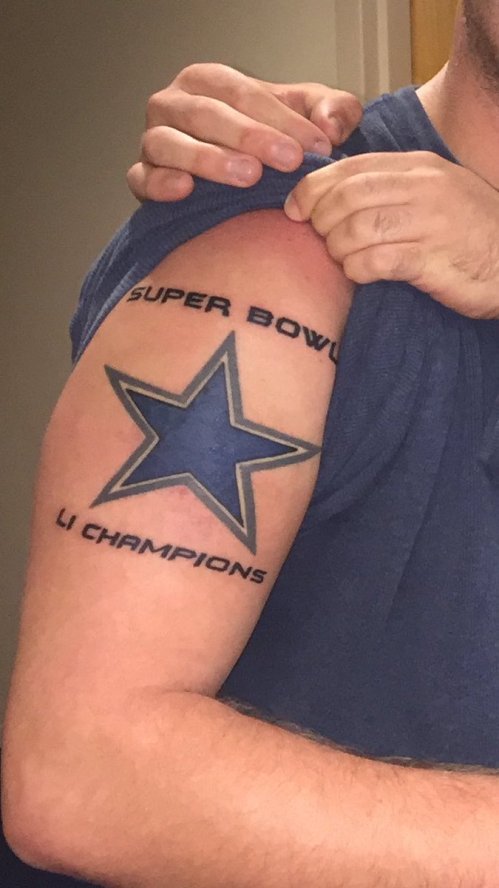
For one fan in particular, though, the sting leaves some permanent scars in a very literal way. Cowboys super-fan Jordan Garnett was so confident that his team would win the Super Bowl that he prematurely got a tattoo on his arm, declaring the Cowboys Super Bowl champions back in early December. As of now, that tattoo is both dead wrong and a harsh reminder of his team’s failure.

So how does this apply to expectations about love, romance, and everything in between? Well, in many respects, it’s a fitting metaphor for arguments I’ve already made on this blog. I’ve talked about how the law and our culture sets us up for disappointment in both our romantic lives and our sex lives. When you think about it, a tattoo is not unlike the complex legal documents we sign when we legally bind ourselves to one another.

That’s not to say that legal proclamations are inherently bad. They exist for a reason and they definitely serve their purpose, even if parts of that purpose are grossly outdated. The problem for some people is the expectations of those who enter them. Sometimes, those expectations are either wholly unrealistic or completely misguided.

This man who boldly got his Cowboys tattoo is akin to someone who decides on a whim to marry a someone they just met at a chapel in Las Vegas. While that can make for an entertaining Ashton Kutcher movie, it can also lead to some heartbreaking disappointment. It may not be on the same level of disappointment that Cowboys fans are feeling right now, but it’s probably close.

When it comes to sex and romance, there are few instances where jumping the gun works out. There are all sorts of dirty jokes to be made from that previous sentence, but I won’t get into them, if only because it may be too personal for certain men. I’ll just add that thinking things through and feeling things through are two different processes. You may be able to get away with skipping one, but not both.

As kids, we’re taught to broaden our expectations. As adults, we’re taught to manage them. We’re pretty good at it most of the time, but when our passions get the better of us, it can make for some awkward moments. For some, it means having a grossly inaccurate tattoo. For others, it means setting themselves up for heartache and ensuring their genitals hate them.

For the lives we live and the romance/erotica novels I write, I think it’s wise to avoid these outcomes. I’m all for being passionate about something, be it a lover or a football team. Just be careful with your expectations. Heartbreak and tattoo removal are both very painful.

Leave a comment

Filed under Jack Fisher's Insights

What The NCAA Says About Our Sexual Attitudes

Is anybody else still buzzing from the College Football Championship game earlier this week? I sure am. I still feel like I just left a rock concert and my ears are still ringing. At least with Monday’s game, I don’t have to worry about permanent hearing damage down the line.

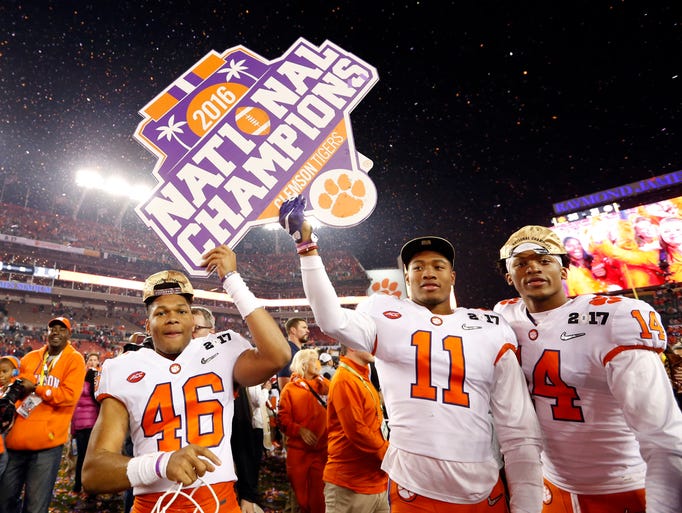
In case you’ve been in a coma for the past several days, Alabama and Clemson played one of the most epic college football games in history. It was a hell of a game from start to finish, full of big plays, big turning points, and players that really rose to the occasion. It highlighted everything I love about football, a sport I’ve loved since I was a kid.

As much as I love football though, there is one component about college football that still bothers me. It’s not necessarily the football part though. That’s the fun part that most sports fans can get behind. It’s the college component.

This doesn’t just apply to football either. I watch other college sports from time-to-time, mainly basketball. When I was in college, I even knew some college athletes. It’s a big part of college life. Between class and keggers, college sports are a big part of the culture. However, as I’ve gotten older, I’ve come to see it in a different context, one that is probably a byproduct of being an erotica/romance writer.

Unlike the professional ranks, college athletes don’t get paid. Sure, they get a scholarship to a school (although it can be revoked and rescinded at any time), but they don’t make any money directly. It doesn’t matter if your Deshaun Watson, the quarterback from Clemson who just became an icon at his school, or some backup point guard on the basketball team. They don’t make a penny directly.

This is kind of odd because the NCAA, the governing body for college sports, made over $1 billion in 2014 alone. They made this money despite not having to pay a dime to the actual people who play these sports that entertain us so much, namely the athletes.

Understandably, there are some folks who have a problem with this. The issue of paying college athletes is a sensitive issue, so much so that South Park dedicated an entire episode to mocking it with crack babies. It’s as entertaining and offensive as it sounds. Since the basic rule of thumb is that if South Park mocks it, then it must be a serious issue, it’s safe to assume there’s some major controversy/injustice going on.

Now I’m not going to dedicate this entire post to arguing for or against paying college athletes. That is a complex issue with more wrinkles than a porn star’s bed sheets. I’m not entirely qualified to discuss the particulars of this issue, but someone like John Oliver is. Last year, he dedicated a show to reviewing this issue and, as he often does, he breaks it down in a pretty astonishing way.

In watching this, it’s hard to feel much sympathy for the NCAA. That would be like feeling sympathy for the New York Yankees for not winning the World Series this past year. It’s an organization full of bureaucrat businessmen whose sole purpose is to make more money for the organization. I don’t mind people making money, but when it involves exploiting people to such a degree, I have a problem.

Then again, there might be other forces at work here beyond the greed of the NCAA and those who share in their profits. It’s a force that John Oliver never touched on and rightly so. It’s one of those forces that’s clearly there, but the implications are hard to see.

Watch that clip again and focus on the parts about the coaches and administrators making all that money from these college athletes. Do you notice something about them? Well, don’t look too hard. It’s fairly bland on the surface. A lot of these people are older individuals. They’re either at middle-age or beyond. They wear suits, they sit at desks, and they have as much sex appeal as a shaved cat.

Why do I bring this up? It’s not just to mock the ages of those involved. That’s just wrong. I mention their ages because it highlights an unspoken facet of our sexual attitudes. Listen to older folk talk about the sexual behaviors of the younger generation for more than five minutes and you’ll probably hear the same story, assuming you have a strong enough stomach.

Most will complain that these kids are out of control. They’re all a big ball of hormones, ticking time bombs that will go off at the sight of anything that looks like a tit. Put them in a room with anything that’s even somewhat alive and they’ll find a way to fuck it. They’re just that horny. They’re just that decadent.

Never mind that this generation, the Millennials, is having less sex than previous generations. This is the perception of the older crowd. It’s a perception that every older crowd seems to have about younger crowds in some form or another. Whether it’s baby boomers, hippies, yuppies, or whatever crazy generations emerged in Ancient Egypt, old people whined about them.

Why do they whine? Why does younger people having sex make them so upset? Well, if you’re older, you’re more likely to have kids. That means you’re also likely to have a daughter. Talk to any proud father about their daughter and chances are, they’ll vomit uncontrollably if they think about their daughter having any kind of sex that doesn’t involve making a grand-baby that will care for them in a nursing home.

It hearkens back to the Bronze Age idea that men must protect their daughter’s virginity, as though it’s some sort of precious commodity that they can later sell for a juicy dowry. Never mind that this isn’t the goddamn Bronze Age and it’s illegal to sell your children. Older men still recoil at the idea of their precious girls being defiled by hormonal men.

So how does this apply to college athletes? Well, anyone who saw the movie Varsity Blues has a vague idea. College athletes are big, strong, handsome, and a good chunk of them are minorities. They don’t just attract women. They can physically overpower them, sometimes in horribly violent ways.

The idea of paying these young men money, which they could then use to more effectively have sex with more women, probably doesn’t sit well with the older men who coach and govern college sports. Some of them may even worry that their own daughters, sisters, girlfriends, or mistresses will fall prey to a handsome, athletic stud’s charms.

It’s fairly undeniable that young athletes are quite horny and quite eager to fuck. The stories that come out of Olympic Village every four years during the Olympics are proof of that. For the NCAA and the old folk who run it, they just can’t stomach the idea of giving these young men too many resources. They’ll just use them to do more humping.

Now this is just the wild interpretation of an erotica/romance writer. I’m not saying that this thought crosses the minds of those in the NCAA when they’re arguing against paying college athletes. However, I do think there’s an unspoken concern that older generations have about the young, one that makes them look for excuses to not give them too many resources.

In some respects, I understand that. I like to think I was fairly mature when I was young, but there’s no way I could’ve made real, adult decisions about the future of my life at 18, which is when most college athletes start their careers. Give me a lot of money and athletic prowess and I might find a way to fuck it up.

Then again, is the problem really that college athletes are too horny and immature? Or is it that we just treat them with the expectation that this is how they’re going to be and they can’t possibly be any different? It’s just something to think about the next time you hear someone make excuses on why we shouldn’t give too much money to young, handsome, athletic men.

4 Comments

Filed under Jack Fisher's Insights