This is a video from my YouTube channel, Jack’s World.
TV dads are known for being stubborn, dense, and foolish. But some do manage to stand out for all the right reasons. They’re still stubborn, but that doesn’t prevent them from having greater depth.
Hank Hill from King of the Hill is a perfect example of this. He is very much defined by how stubborn and uncompromising he is. But he has also been shown to be reasonable. And that helps make him such a better character while also providing for some endearing comedy.
From the outside, it looks like a typical McDonald’s. It has the same aesthetics and architecture that have become so iconic. But inside, there are none of the usual fast-food workers. There are just rows of kiosks and a conveyer belt. Once you place your order, it’s automatically prepared behind the scenes in the kitchen. Then, when it’s ready, it’s bagged and wheeled out to you.
When it’s working optimally, you never have to interact with another human being. Whether you consider that a good or bad thing is entirely up to you, but that’s the ideal. As for how it handles orders that aren’t properly bagged, food that isn’t properly cooked, or drinks that aren’t properly prepared, that’s not yet clear.
This isn’t intended to be the start of a massive effort to automate every McDonald’s restaurant. It’s largely a test to see just how much a standard fast food restaurant can be automated.
As someone who’s first paying job was in fast food, I have some mixed feelings about this.
On one hand, I welcome this kind of automation. I remember what it was like working at these restaurants. The pay was awful. The conditions sucked. And you had to regularly clean up messes that made you want to throw up.
On the other, this is an undeniable sign that automation is accelerating and the low-skilled jobs that many people rely on might become less and less available in the coming years. And for those who really need a job, even if it’s a lousy, low-paying job, that could be seriously detrimental to large swaths of people.
In terms of the bigger picture, I think this is a much larger story than people realize. Automation has been a popular talking point for years now. I’ve certainly touched on it. And I think the recent rise of artificial intelligent programs like ChatGPT have really raised the profile of automation, mostly because it revealed that it’s more than just factory jobs that are vulnerable to it.
It might even be because of ChatGPT that this story about McDonald’s flew under the radar. But I honestly think automation in the fast food and restaurant industry could be more disruptive in the short-term than products like ChatGPT.
In the coming years, we might look back at this automated McDonald’s as the first step towards a new trend in automation. People have talked about automating things like fast food for years. Then, the lingering effects of the COVID-19 pandemic and new trends in labor converged to create new incentives.
This is no longer just an idea that exists on paper or in the imaginations of CEO’s fantasizing about not having to pay minimum-wage workers anymore. This restaurant actually exists. People in the Fort Worth area can visit it right now.
Again, it’s not part of an ongoing effort to automate every McDonald’s. If you go to this restaurant, chances are you’ll deal with a system that’s still being refined. There’s probably still people there behind the scenes, monitoring and fixing whatever bugs emerge in the system. There’s a good chance those people are paid much more than minimum wage. There’s also a good chance that this particular McDonald’s isn’t going to be more profitable than those with human workers.
But those are just logistical issues that can be polished, refined, and streamlined. All it takes is time and experience. It’s not unlike the first assembly line or the first 3D-printer. It’s messy and clunky at first, but it steadily becomes more efficient with time and investment.
Eventually, it’ll get to a point where a functional McDonald’s won’t ever need a staff of low-skilled employees anymore. In principle, it would only need one person to be there to make sure the ingredients are re-stocked and the equipment doesn’t break. The company probably wouldn’t even need to pay the person that much. If they’re qualified to work as an unpaid intern in a standard IT department, they’re probably qualified to manage this system.
And if McDonald’s finds a way to make it work, you can expect the competition to catch up quickly. There would just be too much incentive to remove all the low-skilled wage labor as a means of increasing profits. It won’t happen overnight, but one company only needs to succeed once before others copy it.
Fittingly enough, that’s something McDonald’s did before. Their system of fast food was pioneered in the early 1950s and proved so successful that many other competitive, including Burger King and Taco Bell, embraced it. It’s very likely we’ll see something similar play out with automation.
But what does that mean for low-skilled labor, in general?
That’s a relevant question. There’s no way this kind of automation will stop at fast food restaurants. Add AI tools like ChatGPT into the mix and even mid-skill jobs could be at risk.
I don’t claim to know the answer, but I suspect we’re going to see some major upheavals in how we work in the coming years. That’s going to have consequences, good and bad. And I honestly worry that we’re not prepared for the bad consequences in the slightest.
Whenever I talk about politics, I try my best to be balanced. Even when I talk about hot-button issues like abortion, which I’ve doneon multiple occasions, I make a concerted effort to see the bigger picture.
That said, I don’t think I can make such an effort with the recent events surrounding the blatantly draconian Texas abortion laws. There’s a line between being balanced on an issue and just being cruel, callous, and dense. I get the impression that those supporting this law aren’t even trying to be understanding.
If you care at all about women having any control over their bodies, general women’s health, and the health of children, this law should concern you at the very least. At the very most, it should disgust you. In terms of allowing the state to both micromanage and punish women for what they do with their bodies, this is pretty damn blatant.
Now, there’s a lot I could say about this law and this issue. I think I’ve made my own position quite clear. I generally lean towards pro-choice side of the issue. It’s not that I think abortions are great and should be celebrated. I just find the pro-choice arguments more consistent form a moral, legal, and ethical standpoint.
Since I’m a man and I can’t get pregnant, I know those words can only carry so much weight. I really do try to take the arguments made by the pro-life/anti-abortion side seriously. I even try to empathize with it on some levels. However, I can only do so much. I just can’t get around the fact that the anti-abortion stance cannot be enforced without undermining a woman’s bodily autonomy.
In that sense, I’m very much in favor of bodily autonomy. I wouldn’t want the state to force me to donate my blood or my organs to someone else against my will. That’s a hard moral and ethical line for me.
As bad as this law is, it’s hardly the end of the abortion debate. If anything, it’s likely a catalyst for more legal, political, and social battles. I expect those battles to get ugly. I expect the anger, hate, and vitriol to escalate and it was already bad to begin with. I honestly can’t think of an issue that stirs up this much heated discord and I’ve been to 4chan.
In the near-term, the front line of debate will take place within the courts. There are serious legal consequences for this law, both for the women involved and those who attempt to enforce this it. I think it’s likely that the Supreme Court will eventually hear another case on abortion rights. Depending on the details, it could very well end with a complete overturn of Roe v. Wade.
However, we’re not quite there yet. I know the implications of that have many women and pro-choice advocates feeling anxious right now. I sympathize with that. Unfortunately, there too many women in situations in which they cannot wait for the legal system to sort this out.
Until that time comes, I’d like to offer some basic advice to all those affected by this law and anyone who might know someone who’s effected. At the moment, the simplest thing you can do is donate to organizations actively fighting this law and helping the women in Texas who are affected.
New York Magazine put together a list of 20 organizations who are actively involved. Donating to just one of them won’t fix the issue, but it will help.
Another thing you can do is educate yourself and others on the use of contraception. At the moment, emergency contraception, also known as the morning after pill, is not illegal under this law. However, given how anti-abortion advocates tend to oppose contraception as well, despite the obvious hypocrisy, expect it to be a target by anti-sex, anti-promiscuity advocates.
It’s critical that women affected by this law and others like it understand the morning after pill and how to use it. We also can’t expect the education system to do it. States like Texas already have notoriously sub-par and politically motivated agendas when it comes to sexual education.
In that sense, women in Texas should refrain from seeking information about sex and pregnancy from most public school teachers. They also shouldn’t get it from anyone affiliated with a religious organization or politicians, many of whom don’t seem to understand how women’s bodies work. In general, they should talk to a private doctor or at least one who doesn’t work at a Catholic hospital.
Finally, and most importantly, I would recommend that women in Texas make connections with friends or family who live outside the state. Those connections will be critical, should you ever find yourself in a situation where you need to seek an abortion. Some out-of-state health facilities are already feeling he impact of people taking this recourse.
I know that’s not always possible, especially for those lacking money or connections. That’s why it’s critical to make the effort while you’re not in that situation. Make a plan for yourself. Get other women to help you. I agree it’s not right that you have to make such a plan in the first place, but this is the situation. It sucks, but this is where we are.
The last bit of advice I’d like to give is to simply remember this law whenever you vote in the next election, be it national or local. I know that’s a bit oversimplified. I also know that states like Texas are very conservative and some prefer not voting over voting for a non-republican.
I get it. Our political structures are awful and messy. However, we’re stuck with them for now. The only reason politicians in Texas are passing laws like this is because they think they can get away with it and they’ll get enough votes to stay in office. The only way that changes is if voters prove them wrong.
Most polls state that the majority of people support preserving abortion rights. The best way to ensure the laws reflect that sentiment is to vote as such. I know it’s not an immediate solution, but for an issue this divisive, it’s important to take a long view approach.
I don’t claim to know how the abortion debate will change as a result of this law. I fully expect things to get worse and more heated before they get better. For now, though, this Texas law presents a major challenge. We have to be ready, willing, and able to confront it.
In the meantime, take comfort in the fact that George Carlin still summed this issue up perfectly years ago. Until someone does a better job, I’ll keep referring to this.
The greatness of a TV show is often measured in how endearing the characters are. Whether it has dramatic themes like “Mad Men” and “Breaking Bad” or over-the-top comedy like “It’s Always Sunny In Philadelphia,” TV shows thrive and fail by the strength of their characters.
A show like “King of the Hill” is a good example of this and not just because it has plenty of great characters. The personalities and stories of characters like Hank Hill, Boomhauer, and Luanne are all endearing in their own unique way. I’ve even gone out of my way to praise Hank Hill on multiple occasions for his work ethic and his unique approach to masculinity.
However, “King of the Hill” is unique in the sheer range of characters it offers, with respect to likability. Characters like Bill Dautrieve and Khan Souphanousinphone have definite flaws, but do plenty to warrant respect. Peggy Hill is a textbook narcissist, but still does plenty to balance it out. Dale Gribble is a paranoid idiot, but he’s still a loyal friend and just fun to be around.
There are also a few characters who are just assholes most of the time. While the show goes out of its way to balance everyone to some extent, there’s only so much you can do with characters like Cotton Hill and Buck Strickland. I could say a lot about those two, in terms of how they impact the themes of the show, but I’d like to focus on a character who has confounded me over the years.
Confounded, yet entertained.
Of all the colorful characters that make “King of the Hill” one of my favorite shows of all time, Bobby Hill is the one I’m most conflicted about. I’ve always had mixed feelings about him. I can watch one episode where I have no sympathy for him, but in the very next, he’ll come off as one of the most respectable characters in Arlen.
Some of that might have to do with me, as a viewer. When I started watching this show, I was younger and had a lot more in common with Bobby. We were both overwhelmed by the prospect of growing up. We often felt beleaguered by school, adults, and puberty. I related to him a lot more than I did with the adults in the show.
Then, as I re-watched those same episodes as an adult, I saw Bobby in a different light. I had a hard time sympathizing with his struggles in certain episodes. At times, he came off as some immature kid trying desperately to avoid responsibility and hard work. In one episode, he became a full-fledged panhandler.
At the same time, Bobby had moments where he genuinely shined. While I would argue that the series finale was his finest hour and the culmination of his growth, he also had other moments in which he stepped up to do something awesome. He was, in my opinion, the most confounding characters in the entire show.
Now, after having watched and re-watched every episode of “King of the Hill,” while also having the benefit of my own personal growth, I feel like I can appreciate Bobby’s character in a new way. In terms of the bigger picture, Bobby Hill represents an important theme in the show. Specifically, his story revolves around someone torn between adulthood and childhood.
While “King of the Hill” has many themes, Bobby’s were often tied to his youth and that youth was often the catalyst for his misadventures. When the show begins, he’s 11-year-old. By the time it ends, he’s 13-years-old. These are some formative years in a boy’s life and the show takes full advantage of that.
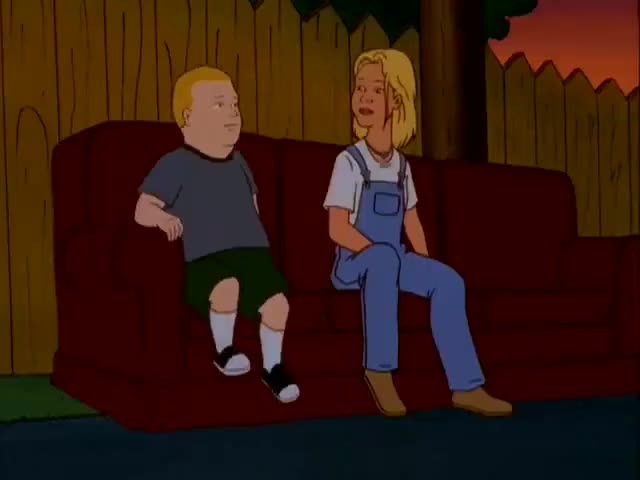
In some cases, he wants to be an adult. He even enjoys the maturity and status that comes with it. In others, he actively avoids it, clinging to his childhood and the carefree innocence that it entails. Granted, there are times when he just wants to be lazy. At one point, he states outright that he prefers taking baths because he doesn’t like standing for so long.
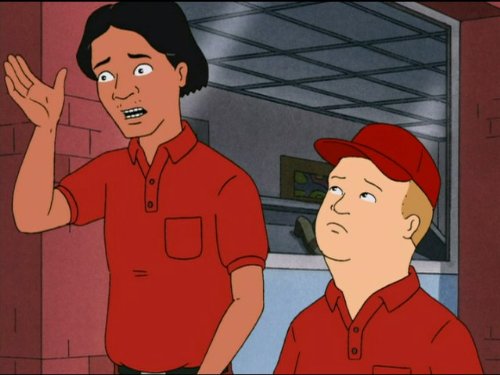
However, there are plenty of other instances in which he sees the rigors of adulthood and doesn’t find it the least bit appealing. It doesn’t help that he’s had some very unpleasant experiences with the adult world, which includes one in which he ran out onto a racetrack because of an asshole boss. After an experience like that, who wouldn’t long for the more sheltered life of childhood?
To some extent, it’s not entirely Bobby’s fault that the adult world is so overwhelming. His laziness doesn’t help, but there are times when Hank’s uptight parenting skills actively contribute to the problem. The only reason he had that aforementioned job at a racetrack was because Hank tried to teach him a lesson about hard work and it taught him the wrong lesson, entirely.
On top of that, Peggy often babies him in ways that reinforce how much easier and carefree it is to be a child. Whether it’s cutting his hair or giving him one of Hank’s old trophies, she often makes childhood feel a lot easier and safer, albeit indirectly. Bobby gets so many mixed messages throughout the show that it’s easy to see why he’s often so conflicted.
Like most themes in “King of the Hill,” the nature of the conflicts fluctuate. There is a sense of progression for certain characters, but there’s also a general consistency over the course of the show. Joseph and Luanne are very different by the final season when compared to the first season, but Bobby’s journey is left somewhat ambiguous.
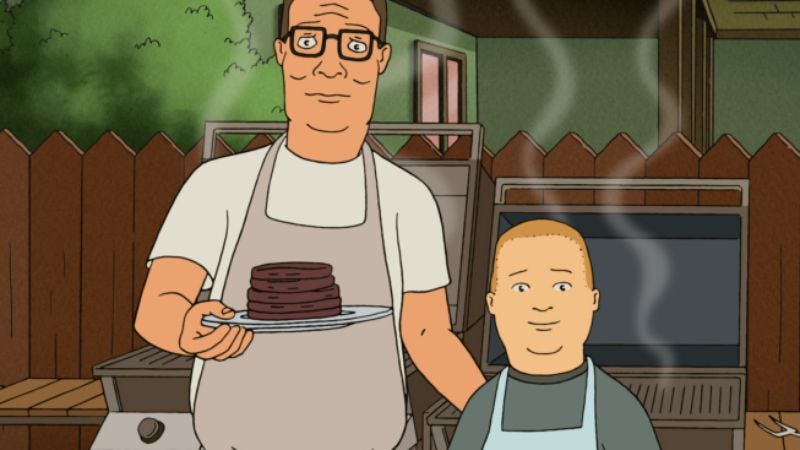
By the end of the show, he finds a skill and a passion that he wants to pursue. In the same way Hank has a passion for propane and propane accessories, Bobby discovers a passion for grading the quality of steaks. It’s a passion that requires both hard work and a level of maturity the likes of which he hasn’t pursued before. It also makes for a powerful moment when he and his dad finally get to share in a mutual interest.
At the same time, he still carries himself like a kid. Even within that final episode, he gets overwhelmed by the pressure placed on him by other adults. While he managed to overcome the pressure, there’s still a sense that he’s not entirely ready for the adult world. At the very least, he’s not quite as reluctant to pursue it.
Bobby Hill’s journey, struggling between childhood and adulthood, is just one among many compelling plots in “King of the Hill.” His journey has many setbacks and absurdities, but it still feels real and relatable. For an animated show that includes eccentric characters in fictitious settings, it’s quite an achievement.
Hank Hill often says his boy ain’t right. On some levels, that might be true. In the grand scheme of things, however, the show demonstrated that Bobby Hill was as right as he needed to be when struggling between childhood and adulthood.








 Jack Fisher's Official Publishing Blog